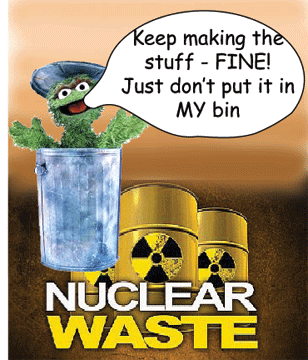
Louth and Horncastle MP welcomes council pulling out of nuclear waste site partnership
By Andy Hubbert
Louth and Horncastle’s MP, Victoria Atkins has welcomed news that
Lincolnshire County Council’s Leader, Coun Martin Hill is minded to pull
the authority out of a community partnership group overseeing proposals for
a nuclear waste facility. By pulling out of the Nuclear Waste Services’
Community Partnership, the council would effectively cancel the company’s
consideration of the Lincolnshire coast for a Geological Disposal Facility
(GDF) for deep burial of nuclear waste, after NWS announced that their area
of focus had changed to an area of open land between Gayton le Marsh and
Great Carlton, between Louth and Mablethorpe.
Lincolnshire World 19th March 2025 https://www.lincolnshireworld.com/news/politics/louth-and-horncastle-mp-welcomes-council-pulling-out-of-nuclear-waste-site-partnership-5041035
Questions asked in Cumberland on two key nuke dump concerns
Green Councillor Jill Perry kindly asked questions of senior Labour
Councillors at the most recent meeting of Cumberland Council relating to
two key concerns relating to any possible location of a Geological Disposal
Facility (nuclear waste dump) in Cumbria.
These concerns relate to the
future flooding and flood defences of any site and making all parties
engaged in property transactions aware of the possibility of a GDF and the
discretionary ‘Property Value Protection Scheme’ launched last year by
Nuclear Waste Services.
The NFLAs raised these issues – and others
relating to housing demand and provision – with Cllr Perry and we are
grateful for her support in asking these questions of the Council Leader
and an Executive member. The NFLAs have been highly critical of the NWS
compensation scheme and raised our concerns over historic instances of
flooding at Millom and Haverigg in a recent letter to NWS and the Chair of
the South Copeland GDF Search Area.
NFLA 19th March 2025, https://www.nuclearpolicy.info/news/questions-asked-in-cumberland-on-two-key-nuke-dump-concerns/
County council set to withdraw from nuclear waste facility group
Lincolnshire County Council leader announces intention to withdraw from
Nuclear Waste Services’ Community Partnership. This would effectively
cancel the company’s consideration of the Lincolnshire coast for a
Geological Disposal Facility (GDF).
Cllr Martin Hill OBE, leader of
Lincolnshire County Council, said: “When we took up Nuclear Waste
Services’ (NWS, then called ‘Radioactive Waste Management’)
invitation to join a working group in 2021, we did so with an open mind,
knowing that residents themselves could make the decision as to whether it
was right for the area. “We wanted residents to be able to understand the
full extent of the opportunities and consequences that would come with the
building of a GDF in Lincolnshire.
“At that time, the site earmarked for
the development was an old gas terminal in Theddlethorpe – a brownfield
site. Since then, the area that NWS is considering for the entry point to
the GDF has shifted to open farmland, a couple of miles up the coast and
further inland. “This changes the very nature of the proposal and,
understandably, raised further concerns within the local community.
“Whilst we have tried to maintain an open mind towards the plans, we are
now several years on from this first being suggested, and big questions
still remain to be answered about the scale of the development and how this
waste would get there. “We had planned to put the decision on whether to
remain within the partnership to a public vote next year, but it has become
increasingly apparent that the community is getting frustrated with the
uncertainty and slow pace of this process.
“Unless NWS can provide
significant further details about their plans that would reassure the local
community and comprehensively explain the benefits and costs, it is my
intention to withdraw from the process altogether. “This will need to be
a formal decision, taken at a meeting of the council’s Executive.
Lincolnshire County Council 18th March 2025, https://www.lincolnshire.gov.uk/news/article/2293/county-council-set-to-withdraw-from-nuclear-waste-facility-group
“South Copeland Community Partnership Area of Focus” on nuclear waste is unravelling
The area is narrowing down to …surprise surprise the exact same spot as
the failed nuclear dump in the 1990s. NIREX was the forerunner of Nuclear
Waste Services and their plan for a Rock Characterisation Facility aka a
Trojan Horse for a full blown nuclear dump for low and intermediate level
wastes was refused as being far too dangerous.
That was at Longlands Farm, Gosforth which is now the Wasdale Mountain Rescue Centre – a far better outcome for the land than a nuclear dump. So what is the state of play now?
There are three Areas of Focus two in Cumbria and one in Lincolnshire. In
Cumbria one of the two Areas of Focus, the so-called “South Copeland
Community Partnership Area of Focus” is unravelling with communities
within the area increasingly saying no to the plan.
A ‘willing’ community is the cornerstone of government’s drive to find a Geological
Disposal Facility aka nuclear dump. Simon Hughes, Nuclear Waste Services
Head of Siting, has stated, “The policy surrounding our search for a safe
and suitable location for a Geological Disposal Facility (GDF) in the UK is
emphatic. It requires the express consent of the people who would be living
alongside a GDF, and gives them influence over the pace at which
discussions progress.”
Residents in the two areas of South Copeland who
will be living alongside the focus area, i.e. Kirksanton and Bank Head
housing estate, have resoundingly said they are NOT a willing community. In
2023 Whicham Parish Council surveyed their residents and found 76% were
opposed to a GDF being sited there. Now, the other area most affected, Bank
Head housing estate near HMP Haverigg, have also rejected the idea and are
asking Millom Town Council, Cumberland Council and their MP Michelle
Scrogham, for help to stop it. After meeting their MP, residents of Bank
Head conducted the survey at her suggestion – Millom Town Council have
refused to conduct a similar survey, so residents took it into their own
hands. With a return rate of 68.3%, 78.7% have said no to a GDF, 11.7% yes
and 5.2% don’t know.”
Radiation Free Lakeland 19th March 2025, https://mariannewildart.wordpress.com/2025/03/19/pin-the-tail-on-the-nuclear-donkey/
Time to take urgent action to help Stop Sizewell C

NFLA 18th March 2025, https://www.nuclearpolicy.info/news/time-to-take-urgent-action-to-help-stop-sizewell-c/
With an ongoing Spending Review which will determine whether Chancellor Rachel Reeves continues to squander yet more public money to feed the ravenous Suffolk ‘White Elephant’ known as the Sizewell C nuclear power plant project, whilst seeking private sector backers to help the unholy beast lumber across the line marked Final Investment Decision, now is the time for all those opposed to the plan to step up and take action to oppose it.
The NFLAs have been consistent in supporting and promoting any initiative by our friends in Stop Sizewell C and Together against Sizewell C that will help stop the beast in its tracks, and with estimated acquisition costs recently doubling to £40 billion at a time of tightening public finances ending the project at this early stage and redirecting the money to invest in energy efficiency measures and renewables would be the wisest move by HM Treasury.
Stop Sizewell C has recently identified four actions that you could take and we urge you to do so:
Write to the Chancellor, Rachel Reeves, urging her to cancel Sizewell C:
Over 1,000 such messages have been sent to the Chancellor during the current Spending Review.
Please add your own via action.stopsizewellc.org/save-billions-cancel-sizewellc
You can either send the standard message (see below for the text) by pressing ‘Send Message Now’ after entering your details or edit/paste in your own text by clicking ‘Personalise this email’.
he standard message:
“As you carry out your multi-year spending review, I am reminded of your statement to Parliament during your mini-budget last year – “If we cannot afford it, we cannot do it”. I appreciate that you face many difficult choices, but with the Financial Times reporting that Sizewell C will cost at least £40 billion, I urge you not to throw more taxpayers’ money at this expensive, risky project that will raise energy bills during its lengthy and unpredictable construction. For alternative strategies that will help meet the UK’s 2030 target and create many thousands of jobs, I urge you to focus on renewables and energy efficiency.”
Sign the Stop Sizewell C petition to David Goldstone, Chair of the new Office of Value for Money:
Stop Sizewell C is seeking at least 5,000 signatories to back a petition to the new Office of Value for Money’s independent Chair David Goldstone to call in the Sizewell C project for urgent scrutiny. To sign the petition please go to action.stopsizewellc.org/valueformoney
Sizewell C Nuclear boss challenged on her definition of failure
Nuclear plant boss Julia Pyke (“‘It’s a tough
gig, developing big infrastructure projects in the UK’”, Work &
Careers, March 17) says “I know [some campaigners] want to believe that
it’s all a terrible failure, but truly, it isn’t.”
As one of those campaigners she is trying unsuccessfully to “win over”, I would point
out that all six “EPR” reactors — the type proposed for Sizewell C on
the Suffolk coast — have been significantly late and over budget.
Taishan 1 in China (five years late, double its budget) was offline for almost two
years early in its operational life. Olkiluoto 3 in Finland and Flamanville
3 in France have suffered teething troubles after being 14 and 12 years
late and costing three and four times their budgets, respectively.
Hinkley Point C’s budget has already doubled and the project is four to six years
late, with another four to six years still to go. Given her role, is it not
important to understand how Pyke defines “failure”?
Alison Downes: FT 18th March 2025
https://www.ft.com/content/0625dfba-9867-446d-9a42-a952c04a2e1b
Britain wants Ukraine’s minerals too
It’s not just Trump. The UK views critical minerals as a government priority and wants to open up Ukraine’s vast resources to British corporations.
MARK CURTIS, 11 March 2025,
more https://www.declassifieduk.org/britain-wants-ukraines-minerals-too/?utm_source=Email&utm_medium=Button&utm_campaign=ICYMI&utm_content=Button
When UK officials signed a 100 year partnership with Ukraine in mid-January, they claimed to be Ukraine’s “preferred partner” in developing the country’s “critical minerals strategy”.
Yet within a month, Donald Trump had presented a proposal to Ukraine’s President Volodymr Zelensky to access the country’s vast mineral resources as “compensation” for US support to Ukraine in the war against Russia.
Whitehall was none too pleased about Washington muscling in.
When foreign secretary David Lammy met Zelensky in Kyiv last month he reportedly raised the issue of minerals, “a sign that Starmer’s government is still keen to get access to Ukraine’s riches”, the iPaper reported.
Lammy earlier said, in a speech last year: “Look around the world. Countries are scrambling to secure critical minerals, just as great powers once raced to control oil”.
The UK foreign secretary was correct, but Britain itself is one of those powers, and Ukraine is one of the major countries UK officials – as well as the Trump administration – have their eyes on.
It’s no surprise why. Ukraine has around 20,000 mineral deposits covering 116 types of minerals such as beryllium, manganese, gallium, uranium, zirconium, rare earth metals, and nickel.
The country, whose economy has been devastated by Russia’s brutal war, also possesses one of the world’s largest reserves of graphite, the largest titanium reserves in Europe, and a third of the continent’s lithium deposits.
These resources are key for industries such as military production, high tech, aerospace, and green energy.
In recent years, the Ukrainian government has sought to attract foreign investment to develop its critical mineral resources and signed strategic partnerships and held investment fora to showcase its mining opportunities.
The country has also begun auctioning exploration permits for minerals such as lithium, copper, cobalt and nickel, offering lucrative investment opportunities.
Media narratives largely parrot the UK government’s interests in Ukraine being about standing up to aggression. But Whitehall has in the past few years stepped up its interest in accessing the world’s critical minerals, not least in Ukraine. www.liberalsagainstnuclear.au
Nuclear plant boss Julia Pyke: ‘It’s a tough gig, developing big infrastructure projects in the UK’.

Julia Pyke is on a mission to show the nuclear industry is filled with “nice, normal people”. As joint managing director of Sizewell C, a planned nuclear power station on
England’s Suffolk coast, she has to win over campaigners, as well as the
UK government, which has already committed billions of pounds towards the
project.
Her attempts have included an unconventional move to set up a
choir at the facility. “We want to make ourselves much more
accessible,” says Pyke, herself a former choral scholar. She brought the
singers to London for the nuclear industry’s annual bash to perform
“Let it Be, Sizewell C”, a take on The Beatles’ song, to assembled
dignitaries. “It made me laugh,” she says. “Obviously people were
drunk, but by the end of it they were waving their phones in the air.”
Pyke’s affability, she hopes, is an advantage as the company seeks to
improve the perception of the nuclear industry — which she says has
“really undersold itself”.
Amid fierce opposition from many in the
local community, Pyke must convince detractors not just of the importance
of Sizewell C in Britain’s transition to cleaner energy but also as an
economic hub that creates jobs.
The stakes are high as officials are set to
make the final funding decision within months. Industry and Whitehall
figures estimate build costs could rise to as much as £40bn, double the
£20bn estimate given by developer EDF and the UK government in 2020. Pyke
points to the government’s earlier statement that it does not recognise
the figure.
Sizewell’s sister project, the Hinkley Point C plant in
Somerset, is billions of pounds over budget and several years delayed,
contributing to widespread scepticism about the nuclear industry’s
ability to deliver. Meanwhile, the UK’s reputation for building big
infrastructure projects has been tarnished by delays and high costs on
other developments.
FT 16th March 2025,
https://www.ft.com/content/8613326a-213c-44a3-9e01-a2c8db078919
Regulators get targets to cut red tape and boost the economy
Ministers will make Britain’s 16 biggest regulators undergo twice-yearly performance reviews as part of a strategy to speed up big infrastructure projects.
Rachel Reeves will meet UK regulators on Monday after calling for more
action to restrict red tape and spur economic growth. The chancellor argued
that government plans would reduce costly delays and disputes, saving
businesses billions, and said regulators must accept a more streamlined
decision-making process. Reeves is expected to use the meeting to announce
more detail on how the government will cut the cost of regulation by a
quarter and set out plans to slim down or abolish regulators themselves.
High on the chancellor’s target list are the costly hold-ups to major
infrastructure projects when environmental concerns are raised.
Guardian 17th March 2025, https://www.theguardian.com/business/2025/mar/17/reeves-to-outline-plan-to-cut-regulation-costs-and-boost-growth
Royal Navy: Powerful new nuclear submarines being built costing £41bn – when will they enter the fleet?

Ben Obese-Jecty MP, Conservative MP for
Huntingdon, enquired about the construction in a parliamentary written
question to the Ministry of Defence (MoD). Minister of defence procurement,
Maria Eagle, said: “The programme remains on track to manufacture four
Dreadnought Class submarines within the original cost estimate of £41bn,
consisting of £31bn and a contingency of £10bn. The First of Class, HMS
Dreadnought, will enter service in the early 2030s.”
Portsmouth News 14th March 2025.
https://www.portsmouth.co.uk/news/defence/royal-navy-new-nuclear-submarines-when-5033798
How multi-billion nuclear weapons facility aims to overcome challenge of limited supply chain
New Civil Engineer 14th March 2025, By Tom Pashby
The UK’s nuclear warhead manufacturing organisation is facing recruitment challenges as it attempts to attract civil engineering firms to work on its multi-billion pound Future Materials Campus (FMC) project.
What is AWE’s FMC?
AWE (the Atomic Weapons Establishment) is seeking construction and engineering partners to build a new manufacturing facility at its AWE Aldermaston site in Berkshire for its next generation ‘Astraea’ nuclear warhead.
AWE said: “[The FMC] is part of a wider, multi-year multi-billion-pound portfolio of infrastructure investment that will support us in our overall purpose to protect the UK through nuclear science and technology and enable nuclear science for generations to come.”
AWE recognises supply chain capacity is ‘one of the biggest challenges’
NCE spoke with AWE to learn about what the organisation is doing to address supply chain constraints as the civil nuclear sector – and infrastructure more broadly – gears up for expected increase in investment and demand.
“One of the biggest challenges we anticipate is ensuring sufficient supply chain capacity and capability to deliver a programme of this scale and complexity,” AWE said.
……………………………………….NCE recently spoke with University of Sussex principal research fellow Phil Johnstone, who said that the demand for more skills capacity in the wider UK nuclear sector is push factor for the demand for the FMC, in addition to its role in providing warheads. This aligns with AWE’s assertion that its FMC will “enable nuclear science for generations to come”……………………………………………………………………………………..
Civil engineering trade representative says all projects facing skills challenges………………………………………………………………………………. https://www.newcivilengineer.com/latest/how-multi-billion-nuclear-weapons-facility-aims-to-overcome-challenge-of-limited-supply-chain-14-03-2025/
Anas Sarwar U-turns on Scottish Labour nuclear weapons policy
SCOTTISH Labour are facing calls to clarify their stance on the UK’s
nuclear weapons after Anas Sarwar appeared to pull a unilateral U-turn at
First Minister’s Questions. Speaking at Holyrood on Thursday, the Labour
group leader called for First Minister John Swinney and the SNP to reverse
their stance on Trident – the UK’s nuclear weapons system which is
housed on the Clyde.
The SNP oppose nuclear weapons and oppose renewing
Trident, want to see the system removed from Scotland, and support an
international treaty banning the bomb.
Previously, Scottish Labour’s
membership passed a motion opposing the renewal of Trident – and in 2021
Sarwar backed it despite Keir Starmer’s support for the policy. Sarwar
has now suggested that he supports the UK’s nuclear weapons being
renewed. Speaking at FMQs, the Scottish Labour leader said: “Global
events are reshaping the world before our eyes. This is a generation
defining moment, and all political parties and both of Scotland’s
governments must adjust to this new reality and rethink previous red
lines.”
The National 13th March 2025, https://www.thenational.scot/news/25005720.anas-sarwar-seems-u-turn-scottish-labour-nuclear-weapons-policy/
Great British Nuclear explains how it will mitigate risks to SMR programme.
13 Mar, 2025 By Tom Pashby
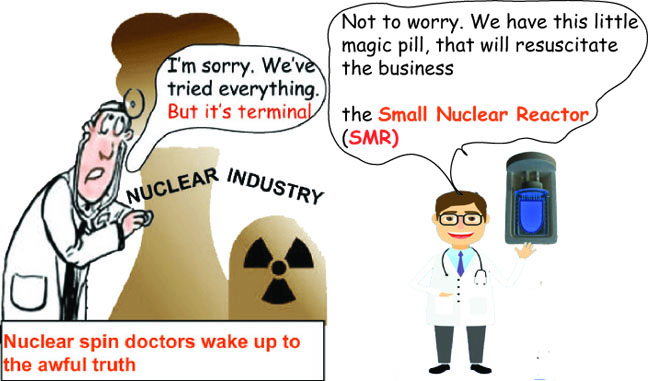
Great British Nuclear (GBN) has explained how it plans to overcome the key risks to the small modular reactor (SMR) programme is it running and that it plans to establish of SMR development companies (DevCos) to take the projects forward.
The updates were shared in its inaugural 2024 Annual
report and accounts for the 2023/2024 financial year.
It is assumed that GBN will select two vendors to deliver one SMR each, but this was recently
called into question by sources speaking to the Telegraph who said the
chancellor may cut spending at GBN as part of the Spending Review which is
due on 11 June 2025. GBN chief executive officer Gwen Parry-Jones said:
“The UK’s nuclear sector has had some well-documented challenges, ones
that GBN has been set up to navigate.” She did not spell out the
challenges.
“SMRs have not yet been deployed anywhere at scale and their
first-of-a-kind (FOAK) nature presents unique considerations and complex
challenges for us to overcome.” She reassured, however, that she is
“committed to ensure that GBN is an adaptable and resilient organisation
that is flexible and evolves as conditions change, but with our eyes always
firmly fixed on the future to deliver our long-term mission and value for
the UK”.
The report lays out the “principal risks” which GBN believes
the SMR programme faces, along with “key mitigation measures”. The
risks are centred around technology maturity, the ambitious programme
timeline, resourcing, funding and financing, stakeholder alignment,
‘contractual and procurement complexity’, site readiness and cyber
threat.
On technology maturity, it said: “Due to the first of a kind
(FOAK) nature of the technology, providers may not be able to meet
strategic objectives, including timely delivery, value for money and
obtaining regulatory approval. “This may delay approval timelines, affect
project milestones or cause an SMR project to fail.” It says that the SMR
competition that it is running will assess the technologies and mitigate
this risk. However, it also reveals that it will retain the option of, in
addition to the SMR competition winners, selecting a “reserve contractor,
to provide contingency against one provider failing to meet agreed
standards”.
GBN lists four other mitigations, including stating it could
or would provide “predetermined exit points” from projects “should a
project exceed cost estimates or timelines stretch beyond acceptable
parameters”. Regarding risk relating to “funding and financing”, it
says: “GBN’s available funding may be insufficient to resource and
deliver the programme to the planned timetable, e.g. should a change arise
from any change in government policy or in its budgetary priorities.
“A reduction in funding could also be triggered by market conditions or
external events such as an external nuclear event affecting public
sentiment towards nuclear safety.
New Civil Engineer 13th March 2025, https://www.newcivilengineer.com/latest/great-british-nuclear-explains-how-it-will-mitigate-risks-to-smr-programme-13-03-2025/
Labour’s arms exports to Israel exposed Labour allowed dozens of arms exports to Israel after weapons sanctions
Keir Starmer’s government has continued to approve arms exports to Israel even after some licences were suspended in September
UK trade department approved 34 military export licences to Israel in the two months since David Lammy announced a partial arms embargo, new data shows.
DECLASSIFIED UK, JOHN McEVOY, 12 December 2024
Labour government hasn’t completed a review on Israel’s compliance with international humanitarian law since July
Foreign Office has not asked to see footage from RAF spy flights over Gaza, which could provide evidence of Israeli war crimes
“No particular appetite” to restrict exports of F-35 components to Israel, even as minister admits US government can track whether British-made spare parts are being sent to Israel
Trade committee chairman warned ministers he was “not convinced” that F-35 carve-out complied with UN arms trade treaty.
Keir Starmer’s government has continued to approve arms exports to Israel even after some licences were suspended in September, it can be revealed.
31 “standard” and three “open” licences for military goods have been issued to Israel since 2 September, when UK foreign secretary David Lammy announced partial restrictions on arms sales to Israel.
Those items included “components for trainer aircraft” and “commercial aircraft” which were “not assessed to be used in relation to current military operations in Gaza”.
However, training aircraft can still be used to instruct Israeli pilots on how to conduct offensive operations in Gaza.
35 “standard” and six “open” licences were also approved for items classed as “non-military” such as telecommunications equipment and imaging cameras.
The UK government refused to issue a further 18 licences to Israel for “components for combat aircraft and naval vessels, as well as components for targeting and radar equipment”.
The information is contained in new data released this week on an “ad hoc” basis by Britain’s trade department in response to “significant parliamentary and public interest” in the issue.
The data was evaluated at parliament’s trade committee on Tuesday, during which ministers admitted that the UK government has still not determined whether Israel’s bombing of Gaza amounts to a violation of International Humanitarian Law (IHL).
The committee was told that the UK government has not updated its assessment on Israel’s compliance with IHL since 31 July, some four and a half months ago. Previous assessments have taken less than half that time to finalise.
One minister further confirmed that there was “no appetite” for stopping the export of F-35 fighter jet components for use by Israel, despite concerns that this breaches Britain’s legal obligations.
It comes days after Amnesty International accused Israel of committing a genocide in Gaza and warned the UK to “immediately suspend the direct and indirect supply, sale or transfer, to Israel of all weapons” in order to “stop fuelling violations of international law”………………………………………………………………………………………….
more https://www.declassifieduk.org/labour-allowed-dozens-of-arms-exports-to-israel-after-weapons-sanctions/
The nuclear industry continues to infiltrate education.

COMMENT. Well, there will always be a need for workers to shut down this poisonous industry, and deal with the radioactive trash
1 Future innovators with the ‘Evolve’ work experience programme. Sellafield Ltd invites Year 10 learners with an interest in robotics and
artificial intelligence (AI) to participate in the ‘Evolve’ work
experience programme. So far, more than 100 students have been involved in
Evolve, with participants currently coming from 11 different schools in
West Cumbria, as well as home-educated learners. This 5-day programme takes
place on selected weeks throughout the year and aims to equip students with
essential skills for their future careers.
Sellafield Ltd, 13th March 2025,
https://www.gov.uk/government/news/future-innovators-with-the-evolve-work-experience-programme
1 This Month
22 June – Virtual Event –Climate Change: New Data, New Debate

Monday, June 22, 2026 2:30 p.m. – 3:15 p.m. CT
YouTube. Register here

Protect Sazan Island from the Trump family! https://secure.avaaz.org/campaign/en/protect_sazan_island_from_the_trump_family_loc/?bqFCVab&v=174511&cl=22707147157&_checksum=5e9dde668860e8231c33699735e16a1fbf22ab2cb01da50c999fe8732b9775ef&utm_source=email&utm_medium=blast_email&utm_campaign=174511

25 June- THE PUKE ON NUKES
Thursday, June 25, 2026
7pm Central Time (8pm ET, 6pm MT, 5pm PT) UTC – 5
From NRC & DOE Deregulation to Techno-Fascist Billionaires Going Nuclear, Plus a Few Songs from Atomic Cabaret REGISTER
26 June – Radiation Trainwreck at the NRC / Join the Protect Better Campaign – https://us02web.zoom.us/meeting/register/4ZlZ5_qLSHGiLSCg8FF6Bg#/registration


Cuba Is Not a Failed State – It Is a Besieged State
PETITION: “Global Appeal to Endorse Palestinian Right of Return of Refugees”
To see nuclear-related stories in greater depth and intensity – go to https://nuclearinformation.wordpress.com
-
Archives
- June 2026 (193)
- May 2026 (306)
- April 2026 (356)
- March 2026 (251)
- February 2026 (268)
- January 2026 (308)
- December 2025 (358)
- November 2025 (359)
- October 2025 (376)
- September 2025 (257)
- August 2025 (319)
- July 2025 (230)
-
Categories
- 1
- 1 NUCLEAR ISSUES
- business and costs
- climate change
- culture and arts
- ENERGY
- environment
- health
- history
- indigenous issues
- Legal
- marketing of nuclear
- media
- opposition to nuclear
- PERSONAL STORIES
- politics
- politics international
- Religion and ethics
- safety
- secrets,lies and civil liberties
- spinbuster
- technology
- Uranium
- wastes
- weapons and war
- Women
- 2 WORLD
- ACTION
- AFRICA
- Atrocities
- AUSTRALIA
- Christina's notes
- Christina's themes
- culture and arts
- Events
- Fuk 2022
- Fuk 2023
- Fukushima 2017
- Fukushima 2018
- fukushima 2019
- Fukushima 2020
- Fukushima 2021
- general
- global warming
- Humour (God we need it)
- Nuclear
- RARE EARTHS
- Reference
- resources – print
- Resources -audiovicual
- Weekly Newsletter
- World
- World Nuclear
- YouTube
-
RSS
Entries RSS
Comments RSS
 nuclear-news