Ministry of Defence urged to publish full details of Faslane incident.

The Ministry of Defence is being urged to publish full details of
a nuclear incident which took place at Faslane earlier this year. As
revealed by The Herald, the most serious grade of Nuclear Site Event Report
(NSER), Category A, took place at HMNB Clyde between January 1 and April
22.
The facility on Gare Loch is home to all of the Royal Navy’s
submarines, including the Vanguard class which are armed with Trident
missiles and the nuclear-powered Astute class hunter-killer vessels.
A Category A NSER carries an “actual or high potential for radioactive
release to the environment”. Approached for comment, the Ministry of
Defence said there had been “no unsafe releases of radioactive material” in
the Category A incident at Faslane but that it could not disclose details
of individual incidents for reasons of national security.
The MoD had previously admitted that radioactive material had been released into Loch
Long from RNAD Coulport after the Royal Navy failed to adequately maintain
the network of 1,500 water pipes on the base. Now SNP MSP Bill Kidd is
calling for the Ministry of Defence to publish full details of the Category
A incident, provide a complete contamination report for Loch Long, and set
out a clear plan for clean-up and prevention.
Herald 18th Aug 2025,
https://www.heraldscotland.com/news/25394175.mod-urged-publish-full-details-faslane-incident/
Unproven and costly: Nuclear Waste Dump ‘Red’ Rated as Unachievable.

NFLA 18th Aug 2025, https://www.nuclearpolicy.info/news/unproven-and-costly-nuclear-waste-dump-red-rated-as-unachievable/
A leading Government body charged with responsibility for monitoring the delivery of major taxpayer funded infrastructure projects has just published a report in which the plan to develop a subterranean Geological Disposal Facility to hold Britain’s legacy and future high-level radioactive waste has been ‘Red’ rated as ‘unachievable’.
The GDF was previously rated ‘Amber’ in an assessment by the Infrastructure and Projects Authority published in January of this year[i], signifying that: ‘Successful delivery appears feasible, but significant issues already exist, requiring management attention. These appear resolvable at this stage and, if addressed promptly, should not present a cost/schedule overrun.’
But in a report just published by the National Infrastructure and Service Transformation Authority (NISTA), a new body formed by the Labour Government[ii], the GDF is now instead ‘Red’ rated indicating that: ‘Successful delivery of the project appears to be unachievable. There are major issues with project definition, schedule, budget, quality and/or benefits delivery, which at this stage do not appear to be manageable or resolvable. The project may need re-scoping and/or its overall viability reassessed.’
The UK/Ireland Nuclear Free Local Authorities were unsurprised to hear the news. When contacted by New Civil Engineer for a quote, NFLA Secretary Richard Outram said:
“The NISTA Red rating is hardly surprising. The GDF process is fraught with uncertainties and the GDF ‘solution’ remains unproven and costly. A single facility, as estimated by government sources, could cost the taxpayer between £20-54 billion, but this being a nuclear project it is much more likely to be the latter and beyond.’
Government policy for the Geological Disposal Facility is predicated upon finding a project development site that is publicly acceptable, geologically ‘suitable’ and affordable.
So far, the first two of these hurdles have proven problematic to jump for the taxpayer funded body charged with finding a site and developing the facility. Nuclear Waste Services has being forced to retreat from South Holderness and Theddlethorpe in the face of steadfast public opposition and obliged to withdraw from Allerdale citing a lack of suitable geology.
Consequently, NWS is once more now limited to the pursuit of a site in Mid and South Copeland in West Cumbria. Both areas adjoin the beautiful Lake District National Park. They were previously the focus of failed attempts to impose a GDF, but the geology was found unsuitable, and the opposition of Cumbria County Council ended the process.
Resistance is growing to a GDF in South Copeland. Local people have formed an opposition group; two local Councils have condemned the plan and withdrawn their support from the process; and a review of the Community Partnership found it to be in disarray with factional infighting.
It is therefore not inconceivable that plans for a GDF in South Copeland could also soon be shelved.
Now Radiation Free Lakeland / Lakes against the Dump is gathering signatures from Cumbrians on a petition calling on Cumberland County Councillors to debate and vote upon their continued engagement with the GDF process. Once 1,000 County residents have signed the petition, the Council’s constitution provides for such a debate to be held in response.
Here are links to the petition: www.change.org/CumbriaNuclearDump https://www.change.org/p/massive-mine-shafts-and-nuclear-dump-for-cumbria-coast-tell-cumberland-council-vote-now
Judicial review sought at High Court into flood barriers.
16th August, By Dominic Bareham, Geographic Specialist Reporter, https://www.eadt.co.uk/news/25391172.judicial-review-sought-high-court-flood-barriers/
Campaigners fighting the new Sizewell C nuclear power station have been granted a hearing in the High Court.
Together Against Sizewell C (TASC) is seeking a judicial review into plans for additional sea defences as part of the project.
The action group is calling for Sizewell C’s development consent order, granted in 2022, to be revoked or varied.
A judge at the High Court will hear TASC’s representatives claim project developer, power firm EDF, kept plans for the flood barriers secret in order to avoid scrutiny.
A decision would then be made on whether to grant a judicial review hearing, which would take place at a later date.
A TASC spokesperson said: “Sizewell C’s attempt to avoid scrutiny of these additional sea defences now means the project is proceeding without its full environmental impact having been assessed, this being in contravention of the UK Habitat Regulations.
“Sizewell C clearly believe they can do as they see fit with our heritage coast, national landscape and designated wildlife sites irrespective of the damage they will cause – this government, the largest shareholder in Sizewell C, must be challenged on this.”
TASC believe that the barriers were omitted from the original planning application that was granted development consent and fear that their construction could disrupt nearby wildlife habitats.
The campaigners would like less invasive flood barrier options to be pursued.
TASC has lost previous judicial reviews into the new station, which is set to cost £38 billion, including in June 2023 when the High Court rejected a legal challenge over the disposal of nuclear waste and the provision of a water supply.
In 2022, a similar legal challenge claiming the development was unlawful because of concerns about the maintenance of a water supply, was also rejected.
Serious nuclear incident’ took place at Scottish Navy base
14 Aug 25, https://www.telegraph.co.uk/news/2025/08/14/serious-nuclear-incident-clyde-faslane-navy-base/
MoD admits ‘Category A’ event at HMNB Clyde which will raise concerns about maintenance of Trident nuclear submarines
‘Potentially serious’ event at HMNB Clyde prompts concerns about maintenance of Trident submarines
Category A events are defined as those which carry “actual or high potential for radioactive release to the environment”.
The revelation will raise serious concerns about how the Trident nuclear submarines in Scotland are being maintained. It is also likely to prompt questions over transparency and why the incident was not known about until now.
HMNB Clyde houses every Royal Navy submarine, including the Vanguard-class vessels which are armed with Trident missiles.
On Wednesday afternoon, the SNP demanded an urgent explanation from the Labour Government in Westminster over a “catalogue of failures” including separate contamination nearby.
The MoD declined to offer specific details of the incident, which was first reported by the Helensburgh Advertiser. This means it was unclear if any radiation was leaked into the environment or if there was a risk of this taking place.
The incident is not the first category A incident to take place at Faslane, with the MoD having reported two such cases from 2006 to 2007 and a third that took place in 2023.
The incident was disclosed in a written parliamentary answer by Maria Eagle, the procurement minister, after she was asked to provide the number of Nuclear Site Event Reports (NSERs) at the Coulport and Faslane naval bases.
She said there had been one category A event at Faslane between Jan 1 and April 22, two category B, seven category C and four category D. A further five events were deemed to be “below scale”, meaning they were less serious.
Nearby Coulport, where the UK’s nuclear missiles and warheads are stored, had four category C and nine category D events over the same period.
Ms Eagle told Dave Doogan, the SNP MP who tabled the question: “I cannot provide specific detail for the events as disclosure would, or would be likely to, prejudice the capability, effectiveness or security of any relevant forces.
“I can assure the honourable member that none of the events listed in question 49938 caused harm to the health of any member of staff or to any member of the public and none have resulted in any radiological impact to the environment.”
She also said that NSERs “are raised to foster a robust safety culture that learns from experience, whether that is equipment failures, human error, procedural failings, documentation shortcoming or near-misses”.
Category B incidents are defined as having “actual or high potential for a contained release within [a] building or submarine or unplanned exposure to radiation”.
Category C incidents have “moderate potential for future release”, while category D incidents are unlikely to prompt any release but “may contribute towards an adverse trend”.
Radioactive water leak
It emerged last week that radioactive water from the Coulport and Faslane bases, which are situated near Glasgow, was allowed to leak into the sea after several old pipes burst.
The substance was released into Loch Long because the Royal Navy inadequately maintained a network of around 1,500 pipes on the base, a regulator found.
The Scottish Environment Protection Agency, the pollution watchdog north of the border, found up to half the components at the base were beyond their design life.
David Cullen, a nuclear weapons expert at the Basic defence think tank, said attempts to hide previous serious incidents from the public had been “outrageous”.
Mr Cullen said: “The MoD is almost 10 years into a nearly £2bn infrastructure programme at Faslane and Coulport, and yet they apparently didn’t have a proper asset management system as recently as 2022.
“This negligent approach is far too common in the nuclear weapons programme, and is a direct consequence of a lack of oversight.”
Government accused of ‘cover-up’
Keith Brown, the deputy leader of the SNP, accused the Government of a cover-up in relation to the incident at Faslane.
Mr Brown said: “Nuclear weapons are an ever-present danger and this new information is deeply worrying.
“With repeated reports of serious incidents at Faslane and now confirmed radioactive contamination in Loch Long, it’s clear these weapons are not only poorly maintained but are a direct threat to our environment, our communities, and our safety.
“Worse still, the Labour Government is refusing to provide any details about the category A incident, or the full extent of the contamination, including who could potentially be affected.”
The SNP has vowed to scrap Trident, despite consensus in Westminster and among defence experts that the world is now more dangerous than at any point since the Cold War.
The accusations over a cover-up come after The Telegraph disclosed last month that Britain had secretly offered asylum to almost 24,000 Afghan soldiers and their families.
The Government earmarked £7bn to relocate Afghans to the UK over five years after they were caught up in the most serious data breach in history.
Despite enormous costs to the taxpayer, the breach was kept secret from the public for 683 days by two successive governments after the first use of a super-injunction by ministers.
An MoD spokesman said: “We place the upmost importance on handling radioactive substances safely and securely. Nuclear Site Event Reports demonstrate our robust safety culture and commitment to learn from experience.
“The incidents posed no risk to the public and did not result in any radiological impact to the environment. It is factually incorrect to suggest otherwise. Our Government backs our nuclear deterrent as the ultimate guarantor of our national security.
The MoD said it was unable to disclose details of individual incidents for “national security reasons”. However, it is understood all the NSERs were categorised as having a “low safety significance”.
Rolls-Royce making fortune from ‘untested new nuclear market’.

Campaign for Nuclear Disarmament condemns the firm’s plans for AI-assisted small modular reactors
14 August 2025, Morning Star
ROLLS-ROYCE has been accused of making a fortune out of a “toxic, untested new nuclear market” over plans to power artificial intelligence (AI) with small modular reactors (SMRs).
The Campaign for Nuclear Disarmament (CND) made the comments after the engineering firm’s chief executive Tufan Erginbilgic claimed that its plans to power energy-intensive AI with its nuclear reactors could make it Britain’s most valuable company.
“There is no private company in the world with the nuclear capability we have. If we are not market leader globally, we did something wrong,” he told the BBC.
SMRs are smaller and quicker to build than traditional nuclear plants, but the technology remains unproven.
Rolls-Royce has already supplied SMRs to power dozens of nuclear submarines and has signed a deal to develop six for the Czech Republic while developing three for Britain.
“SMRs are an absolute disaster,” said CND general secretary Sophie Bolt. “Should a working model actually be built, they will produce far more toxic radioactive waste than regular nuclear reactors.
“Rolls-Royce is making a fortune out of this toxic, untested new nuclear market.
“We are bombarded with plans to rapidly expand nuclear sites across the country, but there is still no plan for what to do with the toxic waste generated or deal with legacy waste.
“Britain and its workers need a new green deal, one that leaves nuclear in the 20th century, and puts genuine renewables and anti-militarism at the heart of its security strategy.
“This has been outlined in the Alternative Defence Review, a report supported by CND and the RMT union, which acts as a roadmap for this transition which puts workers at the heart of change.”…………………………………………(Subscribers only)
Government faces calls to investigate Faslane nuclear leak.
Revelations of radioactive leaks from Trident’s base were branded “as
shocking as they are unsurprising” today as the government faced calls to
urgently investigate.
Scottish Environmental Protection Agency (SEPA)
documents obtained by The Ferret revealed that the watchdog was aware of
the 2019 discharge of radioactive water from the home of Britain’s
nuclear arsenal at Faslane and Coulport — just 30 miles from Glasgow,
Scotland’s most populous city — into Loch Long, citing the cause as the
Royal Navy’s failure to properly maintain a network of 1,500 pipes.
Scottish CND executive member David Kelly told the Star: “The failures in
pipework at Coulport, and the subsequent release of nucleotides into Loch
Long are as shocking as they are unsurprising. “‘How cheaply can we run
a nuclear arsenal’ seems to be the Ministry of Defence’s (MoD) approach
to this most deadly of facilities. “All mechanical components, as complex
as a nuclear submarine, or as simple as a pipe, are designed for a specific
life.
Morning Star 12th Aug 2025, https://morningstaronline.co.uk/article/government-faces-calls-investigate-faslane-nuclear-leak
Legal challenge against nuclear site’s water plans
Federica Bedendo, BBC News, North East and Cumbria, 13 Aug 25,
https://www.bbc.co.uk/news/articles/c987e11393ko
An environmental activist is lodging a legal challenge against plans from the UK’s largest nuclear plant to remove water from its site.
Marianne Birkby, campaigner for Lakes Against Nuclear Dump (LAND), is contesting a decision by the Environment Agency (EA) to give Sellafield permission to extract water from its Cumbrian plant – a process needed to build a new storage facility for radioactive waste.
Ms Birkby fears the process would produce contaminated water, which would be discharged into the nearby Calder and Ehen rivers.
The EA said it had considered all the potential impacts on the environment before giving permission. Sellafield said the water would not be discharged in the rivers.
Ms Birkby is working with environmental lawyers Leigh Day, who have warned the EA of their intention to pursue a judicial review.
The licence to abstract water was granted to Sellafield in May.
It is part of a wider project to build the second of four new units to store waste to support the site’s decommissioning operations.
Sellafield said the water would have to be extracted when the ground was dug up to build the new facility, and the water removed would mostly be from rainfall.
“Removing water from a construction site is standard practice when preparing land for a building project,” a spokesman said.
They added: “The water is pumped to on-site storage tanks where it is tested prior to being discharged direct to sea.”
Fears for rivers
Ms Birkby said she feared the environment would “bear the brunt” of the operations, which she said could impact the endangered freshwater pearl mussel population present in the Ehen.
“No-one begrudges Sellafield repackaging leaking nuclear wastes from the Magnox silos, but this should not be at the further expense of Cumbria’s rivers and groundwaters,” she said.
She added she believed the EA should have required Sellafield to provide a hydrological impact assessment, but the EA said it did not believe that was needed.
“In this case, we did not require a hydrological risk assessment because we consider that the application will not affect any site of nature conservation, significant landscape or heritage, protected species or habitat,” a EA spokesman said.
The licence granted to Sellafield would allow the company to extract up to 350,400 cubic metres (77,077,224 gallons) of water a year until 2031.
Nuclear Free Local Authorities, which represents about 25 councils who are against civil nuclear power, has also written to the EA to raise concerns about the permit.
“We are concerned that the proposal will involve nearly one million litres of contaminated water being discharged into the River Calder and out into the sea every day for an unknown length of time,” they said.
A EA spokesman said: “When we receive water abstraction license applications we take into consideration all the potential impacts on the environment before determining whether to issue a licence.”
Geological disposal facility for nuclear waste could cost £54bn and ‘appears unachievable’.
15 Aug, 2025 By Tom Pashby
The UK government’s proposed solution for long-term storage of high-level waste from the nuclear sector, a geological disposal facility (GDF), has been described as “unachievable” in a Treasury assessment of the project.
The National Infrastructure and Service
Transformation Authority (Nista), a Treasury unit, made the assessment in
its Nista Annual Report 2024-2025, published on 11 August, where it rated
213 other major infrastructure projects.
A GDF represents a monumental
undertaking, consisting of an engineered vault placed between 200m and 1km
underground, covering an area of approximately 1km2 on the surface. This
facility is designed to safely contain nuclear waste while allowing it to
decay over thousands of years, thereby reducing its radioactivity and
associated hazards. NWS declares that this method offers the most secure
solution for managing the UK’s nuclear waste, aimed at relieving future
generations of the burden of storage.
The project would be so vast that it
would require two separate development consent order (DCO) applications to
be approved – one for exploratory works and another for the project
itself. Nuclear Free Local Authorities secretary Richard Outram said:
“The Nista Red rating is hardly surprising. The GDF process is fraught
with uncertainties and the GDF ‘solution’ remains unproven and costly.
“A single facility as estimated by government sources could cost the
taxpayer between £20bn and £54bn, this being a nuclear project it is much
more likely to be the latter and beyond.”
New Civil Engineer 15th Aug 2025, https://www.newcivilengineer.com/latest/geological-disposal-facility-for-nuclear-waste-could-cost-54bn-and-appears-unachievable-15-08-2025/
The cost of the UK’s strategic nuclear deterrent

Research Briefing, 12 August, 2025 Claire Mills, Esme Kirk-Wade, https://commonslibrary.parliament.uk/research-briefings/cbp-8166/
Since the acquisition of the UK’s first strategic nuclear deterrent in the 1950s, the cost of procuring and maintaining it, and which Government department should finance it, has always been a matter of debate.
Ascertaining precise costs for the nuclear deterrent can be difficult, as this information is not easily available from public sources. The nuclear deterrent is also supported by an overarching, and complex, network of programmes, infrastructure, equipment and people, which is referred to as the Defence Nuclear Enterprise (DNE). Separating out individual costs for the nuclear deterrent from within that structure is not straightforward, particularly since 2023 when the government started reporting all nuclear-related spending as a single line (the DNE) in its departmental estimates.
Synergies between the civilian nuclear sector and the defence nuclear enterprise complicate that picture further.
Cost of the existing ‘Trident’ nuclear deterrent
The UK’s nuclear deterrent is provided by four Vanguard-class ballistic missile submarines (SSBN) which house the Trident II D5A missile and associated Mk4A/Holbrook warhead. The decision to procure Trident, as the nuclear deterrent is often referred, was taken in the early 1980s. Spending on the programme was largely complete by the time of the 1998 Strategic Defence Review. Total acquisition expenditure on the programme was £12.52 billion, which equates to approximately £23 billion in 2024/25 prices.
Prior to 2023, annual in-service costs, which also included the costs of the Atomic Weapons Establishment (AWE) and the Nuclear Warhead Sustainment Capability Programme, basing, decommissioning and disposals, were estimated at 6% of the defence budget (£3 billion for 2022/23). In 2023, the decision was taken to bring all nuclear-related programmes and expenditure, including the in-service running costs of the deterrent, under one heading: the Defence Nuclear Enterprise (DNE), and to ringfence it within the MOD budget. The intention is to provide greater flexibility within the nuclear programme and to try and insulate the rest of the conventional equipment plan from any changes in nuclear spending. In doing so, direct comparisons of in-service costs for the nuclear deterrent over time are no longer possible.
Replacing the nuclear deterrent
A programme is currently underway to replace the Vanguard-class submarines from the early 2030s.
The estimated cost of the design and manufacture of a new Dreadnought- class of four SSBN is £31 billion, including inflation over the life of the programme. A £10 billion contingency has also been set aside, making an upper-end estimate of £41 billion in total acquisition costs for the Dreadnought class. In May 2025 the Ministry of Defence said that £3.37 billion of the contingency had been accessed as of March 2024. It also said that the remainder had been allocated to future years, suggesting that the full £10 billion in contingency funding will be spent.
In 2016 the goverment said that it expected in-service costs for the nuclear- deterrent, once the new Dreadnought SSBN entered service, to continue at approximately 6% of the defence budget. Following the decision in 2023 to amalgamate all nuclear-related spend under a single DNE budget, however, the government said that an “equivalent comparison” for future in-service costs was no longer possible.
A programme to replace the UK’s nuclear warhead was also confirmed in February 2020. In the 2025 Strategic Defence Review, the government announced £15 billion for the programme within the current Parliament (to 2029).
Wider costs
The decision to amalgamate nuclear spending under one budget heading: the Defence Nuclear Enterprise (DNE), reflects the increasing interdependence between the nuclear deterrent and the Royal Navy’s other conventionally armed nuclear-powered submarine programmes, including the new AUKUS-SSN being developed in conjunction with the US and Australia. This is particularly relevant to the costs associated with basing, infrastructure and nuclear propulsion.
There are various costs associated with replacing the nuclear deterrent that are not part of the capital costs of the Dreadnought programme or the sovereign warhead programme, but fall within wider spending on the defence nuclear enterprise. Those costs include the UK’s participation in the US-led Trident Service-Life Extension programme, extension of the service-life of the current Vanguard-class SSBN, and various basing and nuclear infrastructure projects.
Spending on nuclear programmes across of the whole Defence Equipment Plan to 2033 is currently forecast at £128 billion. That represents a £10 billion increase on the original forecasts in the 2023-2033 equipment plan.
Who will pay for it?
In line with convention, the Dreadnought programme will be funded from the Ministry of Defence’s departmental budget.
There has been a longstanding debate over budgetary responsibility for the nuclear deterrent, with frequent calls made for the capital costs of the replacement programme to be removed from the MOD budget.
Calls for Transparency Over Serious Nuclear Incident at Faslane
By Chris Martin, 14 Aug 2025, https://argyllbute24.co.uk/calls-for-transparency-over-serious-nuclear-incident-at-faslane/
THE Ministry of Defence (MoD) is facing calls to disclose details of a serious nuclear incident at HMNB Clyde, Faslane, between 1 January and 22 April this year.
Classified as Category A – the MoD’s most serious level – the event reportedly posed no risk to the public or environment.
Faslane, on Gare Loch in Argyll and Bute, houses the UK’s nuclear submarines, including Vanguard-class vessels armed with Trident missiles.
In a parliamentary response to SNP MP Dave Doogan, defence minister Maria Eagle confirmed multiple incidents at Faslane and nearby RNAD Coulport, but refused to detail Category A or B events, citing national security concerns.
Renewed alarm follows a Guardian/Ferret investigation revealing radioactive water leaked into Loch Long from Coulport in 2019 due to faulty pipes, with a six-year secrecy battle over the case. The Scottish Environment Protection Agency deemed the discharges “of no regulatory concern”.
SNP deputy leader Keith Brown has demanded an “urgent explanation”, warning nuclear weapons are “poorly maintained” and threaten safety, communities, and the environment.
The MoD insists it handles radioactive substances “safely and securely” and that none of the incidents caused harm or radiological impact, reaffirming support for the UK’s nuclear deterrent.
More on this story in next week’s Observer
Coulport nuclear leaks spark alarm among local nuclear campaigners
CAMPAIGNERS have dismissed reassurances from military chiefs about
radioactive waste leaking into the Clyde. Pipes which the Ministry of
Defence (MoD) had allowed to fall into disrepair leaked nuclear waste into
Loch Long from the Trident base at Coulport.
The revelations came after an
investigation by The Ferret, which forced the release of information on the
leaks the Government had tried to keep hushed up. Marian Pallister, chair
of Pax Christi Scotland, said the revelations were unsurprising but
concerning for people living in the area. Pallister, a writer and
journalist who lives near Lochgilphead, told The National: “I’m afraid
that it wasn’t a surprise, we have known about this for a long time.”
She dismissed the MoD’s claims that there had been “no unsafe releases
of radioactive material into the environment”, adding: “They would say
that, wouldn’t they? “They are obviously going to lessen their
involvement but however big or small the leaks might be, they are leaks
into waters that are a part of our lives, part of our heritage.
The National 12th Aug 2025, https://www.thenational.scot/news/25384467.coulport-nuclear-leaks-spark-alarm-among-local-nuclear-campaigners/
Scottish independence can rid us of nuclear abomination.
Ross Greer: NUCLEAR weapons aren’t just a deadly money pit, they also
make for extremely unsafe neighbours. This was proven once again last
weekend with the Ferret, The National and others exposing the scale of the
threat posed to those of my constituents who have the bases at Faslane and
Coulport on their doorsteps.
The news radioactive water leaked into
beautiful Loch Long should concern everyone, though for those of us
familiar with the safety record at Coulport, it was no surprise. Far from
an isolated event, we now know that Faslane also saw over 100 reported
safety incidents over the last 12 months, including a Category A event
earlier this year, the most serious category and one that the Royal Navy
says carries an “actual or high potential for radioactive release to the
environment”.
The National 15th Aug 2025, https://www.thenational.scot/politics/25391552.ross-greer-scottish-independence-can-rid-us-nuclear-abomination/
TASC’s new legal challenge against Sizewell C’s secret flood defences

by Together Against Sizewell C (TASC)
TASC’s new Judicial Review claim calling for Sizewell C’s Development
Consent Order (DCO) to be revoked or varied has been granted a permission
hearing in the High Court.
At a date to be confirmed, a judge will hear why
TASC consider it is unlawful to delay, for decades, assessment and public
scrutiny of two huge additional flood barriers kept secret by EDF since
2015. If the court grants permission, then there would be a full JR hearing
in due course.
TASC writes: “Sizewell C’s attempt to avoid scrutiny of
these additional sea defences now means the project is proceeding without
its full environmental impact having been assessed, this being in
contravention of the UK Habitat Regulations. Sizewell C clearly believe
they can do as they see fit with our Heritage Coast, National Landscape and
designated wildlife sites irrespective of the damage they will cause –
this government, the largest shareholder in Sizewell C, must be challenged
on this.” If you would like to help with TASC’s fundraising, visit their
Crowd Justice page –
https://www.crowdjustice.com/case/sizewell-c-legal-challenge/
TASC 11th Aug 2025.
https://tasizewellc.org.uk/#
UK Labour eye ‘utterly reckless’ bonfire of nuclear energy regulations.

SAFETY concerns have been raised by the UK Government’s “utterly
reckless” approach to nuclear energy – as a new report recommends
ministers tear up “needless” regulations.
A taskforce commissioned by
the UK Government to look into nuclear regulations has recommended a
“radical reset” to speed up projects. Fears have been sparked after the
taskforce criticised the “unnecessarily slow, inefficient and costly”
system which governs new nuclear projects.
Its final report is expected to
focus on tackling what the UK Government described as a “culture of risk
aversion” in nuclear energy regulation. Earlier this year, the UK
Government announced it was scrapping a raft of nuclear regulations,
including changing the rules so that new projects could be built across the
entirety of England and Wales. New nuclear projects are de facto banned in
Scotland.
The National 11th Aug 2025, https://www.thenational.scot/news/25381085.labour-eye-utterly-reckless-bonfire-nuclear-energy-regulations/
Radioactive water ‘leaked into’ loch from Faslane nuclear base
The investigation uncovered SEPA files revealing that the Navy neglected proper maintenance.
Radioactive water ‘leaked into’ loch from Faslane nuclear base. The
investigation uncovered SEPA files revealing that the Navy neglected proper
maintenance. The Guardian, and The Ferret uncovered the release of
radioactive material into Loch Long, Argyll and Bute, following a six-year
fight to access the files, which involved Scotland’s Information
Commissioner.
Daily Record 10th Aug 2025, https://www.dailyrecord.co.uk/news/scottish-news/radioactive-water-leaked-into-loch-35705786
1 This Month

Protect Sazan Island from the Trump family! https://secure.avaaz.org/campaign/en/protect_sazan_island_from_the_trump_family_loc/?bqFCVab&v=174511&cl=22707147157&_checksum=5e9dde668860e8231c33699735e16a1fbf22ab2cb01da50c999fe8732b9775ef&utm_source=email&utm_medium=blast_email&utm_campaign=174511
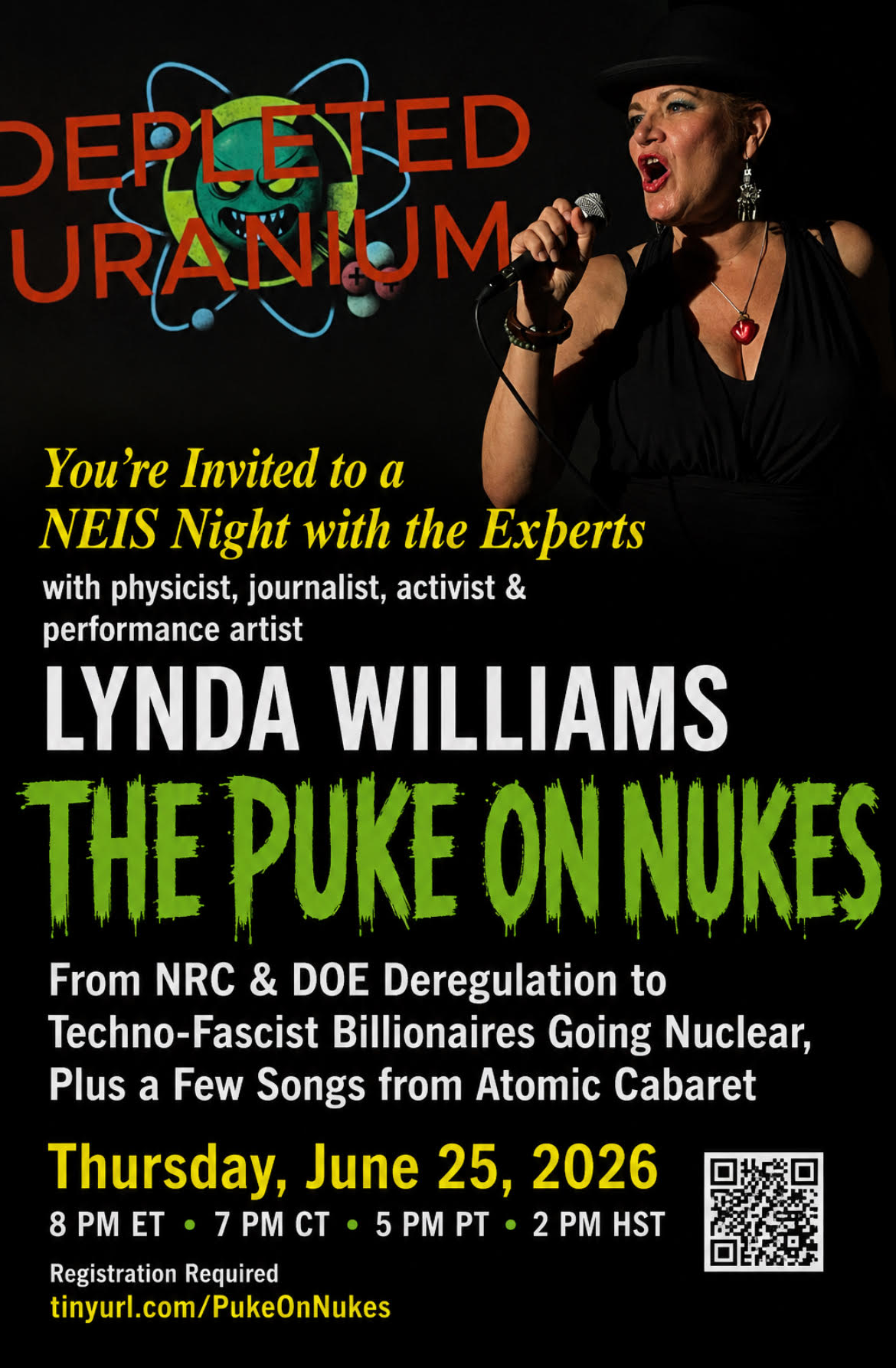
25 June- THE PUKE ON NUKES
Thursday, June 25, 2026
7pm Central Time (8pm ET, 6pm MT, 5pm PT) UTC – 5
From NRC & DOE Deregulation to Techno-Fascist Billionaires Going Nuclear, Plus a Few Songs from Atomic Cabaret REGISTER
26 June – Radiation Trainwreck at the NRC / Join the Protect Better Campaign – https://us02web.zoom.us/meeting/register/4ZlZ5_qLSHGiLSCg8FF6Bg#/registration


Cuba Is Not a Failed State – It Is a Besieged State
PETITION: “Global Appeal to Endorse Palestinian Right of Return of Refugees”
To see nuclear-related stories in greater depth and intensity – go to https://nuclearinformation.wordpress.com
-
Archives
- June 2026 (152)
- May 2026 (306)
- April 2026 (356)
- March 2026 (251)
- February 2026 (268)
- January 2026 (308)
- December 2025 (358)
- November 2025 (359)
- October 2025 (376)
- September 2025 (257)
- August 2025 (319)
- July 2025 (230)
-
Categories
- 1
- 1 NUCLEAR ISSUES
- business and costs
- climate change
- culture and arts
- ENERGY
- environment
- health
- history
- indigenous issues
- Legal
- marketing of nuclear
- media
- opposition to nuclear
- PERSONAL STORIES
- politics
- politics international
- Religion and ethics
- safety
- secrets,lies and civil liberties
- spinbuster
- technology
- Uranium
- wastes
- weapons and war
- Women
- 2 WORLD
- ACTION
- AFRICA
- Atrocities
- AUSTRALIA
- Christina's notes
- Christina's themes
- culture and arts
- Events
- Fuk 2022
- Fuk 2023
- Fukushima 2017
- Fukushima 2018
- fukushima 2019
- Fukushima 2020
- Fukushima 2021
- general
- global warming
- Humour (God we need it)
- Nuclear
- RARE EARTHS
- Reference
- resources – print
- Resources -audiovicual
- Weekly Newsletter
- World
- World Nuclear
- YouTube
-
RSS
Entries RSS
Comments RSS
 nuclear-news