“Nuclear is CLEAN” Trumpets Westinghouse’s Uranium Fuel in Cumbrian Press Adverts
Name: Anita Stirzaker Ad type:Brand/product: Westinghouse Electric Company
Your complaint:
Advert in the Whitehaven News (and other regional papers?) for Westinghouse “Shaping Tomorrow’s Energy to deliver a carbon-free future in the UK. Westinghouse is shaping the future of clean energy in the UK.”
The advert talks about the AP1000 “ready for deployment in the UK” – this is not the case – the AP1000 has not been given licence approval for any sites in the UK as far as I know and there are no operational AP1000 reactors anywhere in Europe as far as I know. The AP1000 would not be “carbon free” as the uranium fuel requires fossil fuel at every stage from mining to looking after the wastes. The Westinghouse plant at Springfields itself uses enormous amounts of gas to manufacture uranium fuel and has I believe its own dedicated gas pipeline into the site. Sellafield is where the fuel from Springfields ends up and this has its own gas plant on site called Fellside. Westinghouse itself in its 2022 Sustainability report (https://www.westinghousenuclear.com/Portals/0/about/Westinghouse%202023%20ESG%20Report.pdf) says it has a “net-zero” carbon emissions target by 2050″ note this is the more slippery accounting of “net-zero” which is definitely not “carbon free” as the advert in the Whitehaven News claims.
The advert claims that Westinghouse is shaping “clean energy”. this is not the case – the Springfields site itself uses lots of freshwater in all its processes – far more I believe than the fracking industry would have done in the Preston area. The fresh water use is enormous especially if the leaching of uranium fuel from the grounds of foreign countries is included along with cooling the hot nuclear wastes at Sellafield.
The nuclear industry cannot legitimately claim to be clean while radioactive and chemical emissions are routinely dumped to the environment. Then there is the possibility of catastrophic accident. What other industries have such large Emergency Zones in the case of accident ? At the lancaster canal alongside the Springfields plant there are Westinghouse notices saying “if you hear a loud, continous siren (like an air-raid siren) you should leave this area as quickly as possible”.
There is another conflicting notice saying “Go inside your boat and stay inside until instructed otherwise. Close all windows and doors. Switch off all heating, ventilation and air conditioning systems. Tune to the local radio station and listen for announcements telling you what to do.”
That is not a “clean” industry!
From Springfields Westinghouse site there are a cocktail of radioactive an chemical wastes going into the landfill at Clifton Marsh – the latest plan is to open an incineration plant on the Westinghouse Springfield site to take in nuclear waste (including intermediate nuclear wastes) from Europe and burn it there.
That is not a “clean” industry.
If Shell has been taken to task for its “clean” claims then the nuclear industry cannot be allowed to get away with this greenwashing of its fossil fuel use alongside its radioactive and chemical emissions to land, rivers,sea and air. The nuclear industry is not fully insured for good reason – it is uninsurable.
Pension funds and investment managers are not willing to take the risks on the dying nuclear industry
With their costs falling, the UK is aiming to get most of its power from renewables, but the British Energy Security Strategy also includes an ambition for the UK to produce ‘up to 24 GW’ of civil nuclear power by 2050, which might mean that nuclear energy would provide up to 25% of the UK’s electricity. The government wants it to be mainly private sector funded, but this major expansion programme has not been going very well.
Despite government encouragement and some seed corn cash, pension fund and investment managers have not been keen to face the risks and uncertainties, for example of the proposed large new EPR plant at Sizewell. Even NEST, the government’s workplace pension scheme, the National Employment Savings Trust, says it will not invest in nuclear projects like this, despite government policy directives
Some remain hopeful that smaller modular reactor (SMR) projects will be more attractive to investors, but SMRs are some way off yet. Rolls Royce had been promoting the development of an SMR with some government support, but the head of the project at Rolls was a casualty of a management change recently. Its whole SMR project might soon also be one. An aviation industry expert told the Telegraph: ‘it will inevitably get more expensive than you expected, they always do. And meanwhile, renewables are still getting cheaper.’ Maybe Rolls should just stick to aero-engines. …………………………………
Meantime, Germany has finally closed the last three of its nuclear plants, and, although some think that may have be premature (they should perhaps have got rid of coal first), it’s now a done deal and does not seem to have caused major problems. The 4GW or so of lost capacity is well on the way to being replaced by renewables, as their cost fall and they accelerate ahead. So, although reliance on Russian gas has been problematic, that seem now to have been faced, with some now seeing Germany as pioneering a nuclear- free way forward.
Of course not everyone sees it that way. Despite the dire financial state of EDF, France has defended nuclear strongly and challenged the German phase out. It even tried to hijack the EU Renewables Directive. And there is no shortage of pro-nuclear propaganda around the world. Some of it arguably is rather odd. For example, what are we to make of Oliver Stone and his ‘Nuclear Now’ film? He has been quoted as saying ‘in the face of climate change, nuclear isn’t only an option it’s the only option,’. And also that ‘Russia is doing a great job with nuclear energy’. Well, tell that last bit to the G7 group countries, 5 of whom have just tried to undermine Russia’s grip on global nuclear power supplies by shutting it out of a new alliance. Or for that matter, those in Ukraine (and elsewhere) who worry about nuclear plant security in war zones.
……………………… the US Department of Energy recently said that the US domestic nuclear industry has the potential to ‘scale from ~100 GW in 2023 to ~300 GW by 2050 – driven by deployment of advanced nuclear technologies.’
Would that scale of expansion be wise? Energy Intelligence thought not. Indeed, challenging the US DoE projection, it said it was ‘beyond absurd – it’s irresponsible. It’s absurd because the US no longer has the supply chain needed for large-scale nuclear projects- it can’t even forge a pressure vessel; it’s irresponsible because the cost of building 200-300 new reactors would be more than $3 trillion. Resources devoted to rescuing a dying industry are resources that wouldn’t be available for viable, less-costly strategies to achieve net-zero emissions in the power sector. More than that, the report reflects an energy agency still dominated by a nuclear-centric culture, and badly out of step with the times’. Quite so. A worryingly backward looking approach. But there is a lot of it about… https://renewextraweekly.blogspot.com/2023/06/nuclear-update-its-still-with-us.html
Nuclear Free Local Authorities – visiting community owned project in the UK, at the start of Community Energy Fortnight,
At the start of Community Energy Fortnight (10 June), NFLA Secretary
Richard Outram travelled to picturesque Dovestones Reservoir to visit his
nearest community owned hydro project. Saddleworth Community Hydro was
holding a public open day to mark the start of this annual event promoted
by Community Energy England, which is held to showcase projects, share
knowledge in the sector, and celebrate success.
Community Energy England
was founded in 2014 by community energy practitioners as the ‘voice’ of
the sector and to help put people at the heart of the energy system. Now
with over 275 community energy organisations as members, its mission is to
‘to help active community energy organisations implement new projects,
innovate, improve and grow.’ Saddleworth Community Hydro also started in
2014, commencing operations in September of that year. It was the first
high head project in England to generate power from the waters of a
reservoir.
At a cost of £500,000, it was financed almost equally by grants
from the Department for Environment, Food and Rural Affairs and the
European Agricultural Fund for Rural Development and by the sale of shares
to around 200 members, and subsequent upgrades have been funded by local
supporters.
NFLA 16th June 2023
Why Biden Wants Assange in Jail: Case at the Tipping Point
15 Jun 2023 A London High Court judge rejected Wikileaks editor Julian Assange’s appeal against his extradition to the United States. He now faces up to 175 years in prison — despite public opinion around the world and in his home country, Australia. The UN has declared his detention “arbitrary,” which usually results in the release of the detainee, but not so far. The fate of the man who revealed so many of the hidden crimes of the US empire hangs in the balance. Brian Becker is joined by Joe Lauria, editor in chief of Consortium News
Talks ongoing over plans for Vulcan base to move into hands of Nuclear Decommissioning Authority
By Iain Grant
Talks ongoing over plans for Vulcan base to move into hands of Nuclear
Decommissioning Authority. Discussions are continuing with moves to put the
Nuclear Decommissioning Authority (NDA) in charge of the clean-up of the
Vulcan military base in Caithness. Officials are working on smoothing the
way for the NDA, which already runs the redundant civil fast reactor plant
at Dounreay, to take over the next-door site from the Ministry of Defence
(MoD).
The MoD had put the wheels in motion towards the end of 2021 to seek
bids from private firms to carry out the clean-up of Vulcan, whose
pressurised water reactor shut down eight years ago. But the tender process
was halted soon after, since when the focus has been on paving the way for
the NDA to move in.
The MoD announced the start to the decontamination and
dismantling of the Royal Navy’s long-time nuclear submarine test base had
been put back until early 2026. In the meantime, the plant will continue to
be run by the MoD’s long-time contractor, Rolls-Royce.
Commander Ian
Walker, who heads the small Royal Navy presence at Vulcan, said the NDA
takeover is a credible option. But he said putting Vulcan and Dounreay
under the same operator is not straightforward, as the sites come under
different licensing and regulatory regimes and government departments. He
said: “We’re still looking at how the transfer to the NDA could be enacted
and a decision is expected later this year.” The move has been supported by
Struan Mackie, chair of the Dounreay Stakeholder Group.
John O’Groat Journal 13th June 2023
Judge orders the Crown Prosecution Service to come clean about the destruction of key documents on Julian Assange

WIKILEAKS – After years of running up against a brick wall, the first crack has appeared with the latest ruling on our FOIA case issued by Judge O’Connor. In addition to the ruling, British Labour MP John McDonnell has just obtained new information from the Crown Prosecution Service. McDonnell is calling for an independent inquiry into the CPS’s role in the Assange case.
DI STEFANIA MAURIZI, 31 MAGGIO 2023, https://www.ilfattoquotidiano.it/in-edicola/articoli/2023/06/01/judge-orders-the-crown-prosecution-service-to-come-clean-about-the-destruction-of-key-documents-on-julian-assange/7179642/
For the last six years, they have rejected all of our attempts to shed light on the destruction of key documents in the Julian Assange case, even though the emails were deleted when the high-profile, controversial case was still ongoing.
But now the British authorities at the Crown Prosecution Service have to come clean: they must declare whether they hold any information as to when, how and why that documentation was deleted, and if they do hold it, they must either release it to us or clarify the grounds for their refusal.
This order was just issued by the London First-tier Tribunal, chaired by Judge O’Connor, in response to our litigation based on the UK Freedom of Information Act (FOIA), in which we are represented by top-notch FOIA specialist Estelle Dehon, of Cornerstone Barristers in London.
READ THE RULING ISSUED BY JUDGE O’CONNOR
The Crown Prosecution Service must comply with this judicial order by June 23, and any failure on their part to do so could lead to contempt proceedings.
Ever since 2017, when we first discovered that documents had been destroyed, we have consistently run up against a brick wall: the Crown Prosecution Service (CPS) has always maintained that deletion of those documents was in conformity with their standard operating procedure. A previous ruling issued in 2017 by the London First-tier Tribunal – chaired by a different judge, Andrew Bartlett – averred that there was “nothing untoward” about their deletion, and the British body instituted to uphold information rights, the Information Commissioner (ICO), has always been pleased with the decision that there was “nothing untoward” about it.
This new ruling by judge O’Connor is the first crack in the brick wall.
Judge O’Connor has also confirmed that “WikiLeaks is a media organization”, though he rejected all of our requests to access the full correspondence between the Crown Prosecution Service and the U.S. State Department, the U.S. Department of Justice, the Swedish Prosecution Authority and the Ecuadorian authorities on the Julian Assange case from 2010 to 2019.
Relative to the correspondence between the CPS and Ecuador, the judge ruled in favour of the Crown Prosecution Service, maintaining an exemption to “neither confirm nor deny” that the British and the Ecuadorian authorities exchanged emails on the case.
As for the case of all other correspondence between the CPS and the Swedish authorities, between the CPS and the U.S. Department of Justice, and between the CPS and the U.S. State Department, Judge O’Connor ruled that if released, the documentation would risk damaging the relationship of trust and confidence that underlies information sharing between prosecuting authorities, and that it would be likely to have a chilling effect on the relationship with both the Swedish and US authorities, as well as with other foreign authorities.
The ruling was issued in two forms: a decision available to the public, and a separate closed decision which can be accessed only by the UK authorities at the Crown Prosecution Service and by ICO.
The documentation on which the closed ruling is based includes, among other documents, over 552 pages of correspondence between the CPS and the U.S. Department of Justice and between the CPS and the State Department between 2010 and 2019, including “the provision of legal advice and queries on wider strategic matters relating to Mr. Assange’s extradition to that country”.
This correspondence is part of the documentation which we have been requesting under FOIA for years, and which has always been denied to us. And yet accessing it would be crucial, as the British authorities are assisting the U.S. government in extraditing a journalist for revealing war crimes and torture, as if he was a mafia boss or drug dealer. From Amnesty International to the International Federation of Journalists (IFJ), all major organizations for the defense of human rights and freedom of the press have called for the extradition case to be dropped and Assange freed.
Assange remains in prison, however, waiting for British justice to decide on his appeal against extradition to the United States, where he risks 175 years in prison for obtaining and publishing classified U.S. government files.
All requests to drop the charges and free Julian Assange have been ignored by the British and U.S. governments. And all decisions and opinions of highly respected UN bodies like the UN Working Group on Arbitrary Detention (UNWGAD) or the UN Special Rapporteur on Torture from 2016 to 2022, Nils Melzer, have been completely ignored by the British government, if not ridiculed, as occurred with the UNWGAD decision.
Now that Judge O’Connor has rejected our request to access those documents, in particular the correspondence between the U.S. and the U.K., the oversight role that the Fourth Estate should play also risks being severely undermined. And yet we are not alone in our call for public scrutiny.
In addition to the authoritative report by Nils Melzer and our FOIA battle, recently a British Labour member of Parliament, John McDonnell, has also submitted a FOIA request to the CPS, full of detailed questions which were just answered by the Crown Prosecution Service.
Speaking to Il Fatto Quotidiano, John McDonnell told us: “It’s become clear that there must now be an independent inquiry into the role of the CPS in relation to the case of Julian Assange. We need full openness and transparency”.
The role of the Crown Prosecution Service in the Assange case
Continue readingUK: Julian Assange Dangerously Close to Extradition Following High Court Rejection of Appeal

byEDITORJune 8, 2023
Reporters Without Borders (RSF) is deeply concerned by the UK High Court’s decision rejecting WikiLeaks publisher Julian Assange’s appeal against his extradition order, bringing him dangerously close to being extradited to the United States, where he could face the rest of his life in prison for publishing leaked classified documents in 2010.
In a three-page written decision issued on 6 June, a single judge, Justice Swift, rejected all eight grounds of Assange’s appeal against the extradition order signed by then-UK Home Secretary Priti Patel in June 2022. This leaves only one final step in the UK courts, as the defence has five working days to submit an appeal of only 20 pages to a panel of two judges, who will convene a public hearing. Further appeals will not be possible at the domestic level, but Assange could bring a case to the European Court of Human Rights.
“It is absurd that a single judge can issue a three-page decision that could land Julian Assange in prison for the rest of his life and permanently impact the climate for journalism around the world. The historical weight of what happens next cannot be overstated; it is time to put a stop to this relentless targeting of Assange and act instead to protect journalism and press freedom. Our call on President Biden is now more urgent than ever: drop these charges, close the case against Assange, and allow for his release without further delay.Rebecca Vincent, RSF’s Director of Campaigns
Stella Assange, Julian’s wife, made a statement on Twitter: “On Tuesday next week my husband Julian Assange will make a renewed application for appeal to the High Court. The matter will then proceed to a public hearing before two new judges at the High Court and we remain optimistic that we will prevail and that Julian will not be extradited to the United States where he faces charges that could result in him spending the rest of his life in a maximum security prison for publishing true information that revealed war crimes committed by the U.S. government.”
This is the latest stage in more than three years of legal proceedings in UK courts, as the US government has made its case to extradite Assange in order to try him on 18 counts in connection with WikiLeaks’ publication of hundreds of thousands of leaked classified documents that informed public interest reporting around the world. Although the first instance court ruled against extradition on mental health grounds, the Court of Appeals overturned the decision in consideration of diplomatic assurances presented by the US government. Assange would be the first publisher prosecuted under the Espionage Act, which lacks a public interest defence. He faces a combined total sentence of a possible 175 years in prison.
RSF is the only NGO to have monitored the entire extradition proceedings despite extensive barriers to observation. In April 2023, RSF Secretary-General Christophe Deloire and Director of Campaigns Rebecca Vincent were arbitrarily barred access to visit Assange in Belmarsh prison, where he has been held on remand for more than four years. RSF continues to seek access to the prison and to campaign globally for Assange’s release.
ASSANGE JUDGE IS 40-YEAR ‘GOOD FRIEND’ OF MINISTER WHO ORCHESTRATED HIS ARREST
Julian Assange’s fate lies in the hands of an appeal judge who is a close friend of Sir Alan Duncan – the former foreign minister who called Assange a “miserable little worm” in parliament.
MATT KENNARD AND MARK CURTIS, 2 DECEMBER 2021, Declassified UK
Lord Chief Justice Ian Burnett, the judge that will soon decide Julian Assange’s fate, is a close personal friend of Sir Alan Duncan, who as foreign minister arranged Assange’s eviction from the Ecuadorian embassy.
The two have known each other since their student days at Oxford in the 1970s, when Duncan called Burnett “the Judge”. Burnett and his wife attended Duncan’s birthday dinner at a members-only London club in 2017, when Burnett was a judge at the court of appeal.
Now the most powerful judge in England and Wales, Burnett will soon rule on Assange’s extradition case. The founder of WikiLeaks faces life imprisonment in the US. ……………………………….
Duncan served as foreign minister for Europe and the Americas from 2016-19. He was the key official in the UK government campaign to force Assange from the embassy.
As minister, Duncan did not hide his opposition to Julian Assange, calling him a “miserable little worm” in parliament in March 2018.
In his diaries, Duncan refers to the “supposed human rights of Julian Assange”. He admits to arranging a Daily Mail hit piece on Assange that was published the day after the journalist’s arrest in April 2019.
Duncan watched UK police pulling the WikiLeaks publisher from the Ecuadorian embassy via a live-feed in the Operations Room at the top of the Foreign Office.
He later admitted he was “trying to keep the smirk off [his] face”, and hosted drinks at his parliamentary office for the team involved in the eviction.
Duncan then flew to Ecuador to meet President Lenín Moreno in order to “say thank you” for handing over Assange. Duncan reported he gave Moreno “a beautiful porcelain plate from the Buckingham Palace gift shop.”
“Job done,” he added. https://declassifieduk.org/assange-judge-is-40-year-good-friend-of-minister-who-orchestrated-his-arrest/
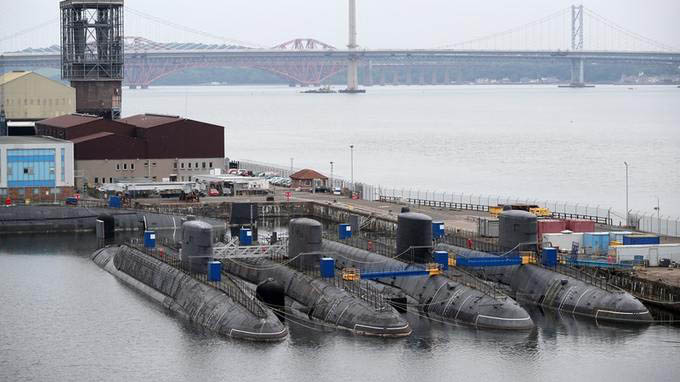
‘Minor’ leak at nuclear submarine dock
At a glance
- There has been a “minor” seawater leak at a naval base in Plymouth where nuclear submarines are stored
- A £3m contract has been awarded to repair the leak
- Thirteen decommissioned nuclear submarines are stored at 3 Basin at Devonport dockyard
- The Ministry of Defence said there was no environmental risk from the leak
Jonathan Morris, BBC News, 8 June 2023 https://www.bbc.com/news/articles/cjejyq3e499o
HMS Valiant, a nuclear-powered attack submarine that was decommissioned in 1994, is set to be the first submarine in Devonport to undergo dismantling.
An MoD spokesperson said: “Work is planned at 3 Basin at HMNB Devonport to address minor seawater leakage from the basin and weathered stone edgings.
“The leak does not present an environmental risk and both the basin and entrance gate remain structurally sound.”
The MoD was criticised in 2019 over its failure to dispose of obsolete nuclear submarines.
It said it would dispose of them “as soon as practically possible”.
There are 20 decommissioned submarines in storage at Devonport and Rosyth.
The estimated cost of fully disposing of a submarine is £96m, the National Audit Office has said.
Ukraine: Nuclear threat shows danger of small modular reactors
The National, By James Walker@James_L_Walker, Multimedia Journalist, 9 June 23
THE Kakhovka dam destruction – and the “immense” nuclear threat seen in Ukraine – could undermine the case for small modular reactors as a green energy solution, the SNP Campaign for Nuclear Disarmament (CND) convenor has warned.
On Tuesday, Ukraine accused Russian forces of blowing up the Kakhovka dam and hydroelectric power station, which Moscow has controlled for more than a year.
There are concerns that the damage to the dam could have broad consequences including depleted water levels upstream that help cool Zaporizhzhia nuclear power plant – Europe’s largest.
Bill Ramsay…….argued that the threat posed by Zaporizhzhia shows how the potential proliferation of small modular reactors could have important national security implications in the future.
It comes as Chancellor Jeremy Hunt confirmed plans in March to set up Great British Nuclear, a new body to oversee the revival of atomic energy and smooth the development of a new pipeline of power stations in the UK……………
“New nuclear power is expensive and will take years, if not decades, to become operational and has significant environmental concerns.”
Ramsay said that small modular reactors could also constitute a “longer-term danger”.
He said: “Reporting on the implications of the presence of a nuclear power plant in a dangerous war zone has been somewhat muted so far. But the threat is immense.
“From time to time, particularly as the war drags on, some stories around the Russian occupation of the Zaporizhzhia nuclear power plant have popped up, but then have disappeared again.
“In my view, this lack of focus on Zaporizhzhia has been deliberate, because it throws up a potentially much longer-term danger, the implications of the proliferation of Small Modular Reactors as a so-called solution to global warming.
“However, the statement by President Zelensky’s security chief makes it increasingly difficult to avoid speaking about the nuclear dimension not only in the current conflict but, potentially, of future conflicts caused by climate change.” https://www.thenational.scot/news/23580288.ukraine-nuclear-threat-shows-danger-small-modular-reactors/
Britain’s taxpayers, slugged with uneconomic Hinkley nuclear plant ‘s costs, now to be slugged again with Sizewell.
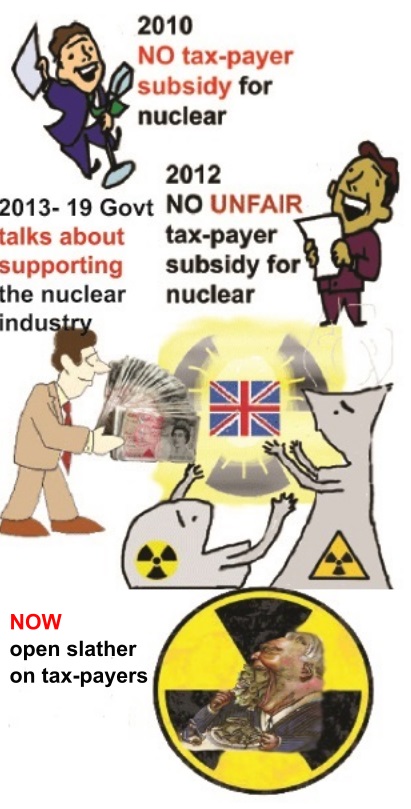
In response to EDF announcing further delays and cost increases at Hinkley
C, Dr Doug Parr, Policy Director at Greenpeace UK, said – “Despite the
enax-payerstirely predictable and widely predicted overshoot of Hinkley C’s costs
and construction, we are still on course to make the same mistake again at
Sizewell, and this time with the taxpayer on the hook.
Why has a government
of free marketeers chosen to pay the French state to build reactors with
public money from the British state? Because the market has read Hinkley
C’s balance sheet and wants nothing to do with this over-priced,
overly-complicated, obsolete technology. The government, on taxpayers
behalf, will spend their money to cover up the failure. When the government
tells you it’s a good deal, remember that no one is willing to put their
own money into it.”
Greenpeace 6th June 2023
https://www.greenpeace.org.uk/press-centre/
Increasing costs and delays in building Hinkley nuclear station.
The Hinkley Point C nuclear plant, the only one currently under
construction in Britain, is facing increasing worries about further delays
and cost overruns. During Keir Starmer‘s recent visit, the opposition
leader accused the government of hindering progress on the project.
Initially expected to be operational in 2023, the Hinkley Point C reactor
is now projected to start producing power in June 2027, highlighting
significant setbacks. Keir Starmer expressed frustration, stating that the
government is “holding the country back”, emphasising that the project
should have been completed by now.
Dr Doug Parr, the Policy Director at Greenpeace UK, raised concerns about the project’s escalating costs and construction delays.
Energy Live News 6th June 2023
Robotic “dogs” to help clean up Dounreay nuclear site
A ‘pack’ of robotic ‘dogs’ have been harnessed to help Dounreay with
monitoring work on site. Spot, a robotic quadruped (‘dog’) from Boston
Dynamics, has the ability to climb stairs, avoid obstacles, and move over
rough ground, allowing it to monitor and collect data in hazardous areas.
Dounreay and Createc, the systems integrator for Spot, are working together
on a series of 7 use cases for the ROV, that will be carried out over the
next 12 months. A dedicated Createc employee will be based on site to
initially lead the projects, and will train Dounreay staff to use the
robot. Heather Fairweather is the innovation team’s project manager for
the work. She says that the use cases will demonstrate the multi-tasking
value of the ROV, and its ability to carry out practical work.
Dounreay 6th June 2023
https://www.gov.uk/government/news/robotic-dogs-arrive-on-site
Unseemly scramble as makers of small nuclear reactors try to con UK government

NuScale joins Rolls-Royce and Bill Gates in race to build UK nuclear
reactors. A US nuclear developer is poised to join the race to build new
reactors in the UK and has urged the government to go faster in picking a
preferred technology.
NuScale, based in Oregon, said it was “very
active” in the UK market and that it would “engage with the activity
around the government’s SMR competition”.
The UK is running a contest to
find suppliers of small modular reactors (SMRs), which hold the promise of
zero-emission, lower-cost nuclear power as they can be made in a factory
and assembled on site. This reduces the vast overheads of large nuclear
projects.
NuScale is developing an SMR called VOYGR, which is based on a
traditional nuclear design called a pressurised water-cooled reactor. It is
the first SMR to have been certified by the US Nuclear Regulatory
Commission.
The UK government has set up a new body, Great British Nuclear
(GBN), to select new projects. It is aiming to settle on winning SMR
designs by the autumn.

Tom Mundy, president of VOYGR services and delivery,
said NuScale would not require development money from GBN as its project
was ready to deploy. “We don’t need the support that has been suggested
… We’re ready to deliver the project much earlier than GBN has
suggested,” he said. “GBN suggests people could start building SMRs by
2030. That means taking a final investment decision then. That’s too late
for us. We have got customers taking final investment decisions much
earlier,” Mundy added. “Let’s get going.”
NuScale’s rivals in the
race include GE Hitachi, also of the US, and Rolls-Royce, which wants to
win an order in its home market. TerraPower, a start-up founded and chaired
by Bill Gates, has also indicated that it wants to build nuclear projects
in the UK. It has a type of SMR called an advanced modular reactor (AMR) in
development.
Times 4th June 2023
Concern over low flying aircraft circling over Hunterston nuclear power station
Concerns have been raised with civil nuclear police over low flying
aircraft over Hunterston. Aircraft apps showed that a Pilatus PC-6/B2-H4
plane repeatedly circled the nuclear power plant – leading to the matter
being raised by a concerned resident at a public meeting this week.
West Kilbride community councillor John Lamb, who was attending the Hunterston
Site Stakeholders Group, asked the civil nuclear police if they were aware
that there was low flying aircraft over the power station zone.
The incident happened on May 25 and the fFlightradar app showed that the plane
travelled across Ayrshire before repeatedly circling Hunterston. Mr Lamb
asked if the Civil Aviation Authority had altered the guidance regarding
the ‘no flight zone’ over Hunterston. Inspector Paul Gilmartin of the Civil
Nuclear Police told the meeting that he was unaware of any reports of low
flying aircraft and the matter had not been flagged up to him.
Largs & Millport Weekly News 2nd June 2023
1 This Month

of the week – THE ONENESS of HUMANITY
26 June – Radiation Trainwreck at the NRC / Join the Protect Better Campaign – https://us02web.zoom.us/meeting/register/4ZlZ5_qLSHGiLSCg8FF6Bg#/registration

1st July – Webinar Waste of Space: The Environmental Harm of Military and Civil Space Activity st July, 7 pm

Report Launch Online: We are seeing an increasing exploitation of space for military and commercial purposes. This must change.

Protect Sazan Island from the Trump family! https://secure.avaaz.org/campaign/en/protect_sazan_island_from_the_trump_family_loc/?bqFCVab&v=174511&cl=22707147157&_checksum=5e9dde668860e8231c33699735e16a1fbf22ab2cb01da50c999fe8732b9775ef&utm_source=email&utm_medium=blast_email&utm_campaign=174511


Cuba Is Not a Failed State – It Is a Besieged State
PETITION: “Global Appeal to Endorse Palestinian Right of Return of Refugees”
To see nuclear-related stories in greater depth and intensity – go to https://nuclearinformation.wordpress.com
-
Archives
- June 2026 (251)
- May 2026 (306)
- April 2026 (356)
- March 2026 (251)
- February 2026 (268)
- January 2026 (308)
- December 2025 (358)
- November 2025 (359)
- October 2025 (376)
- September 2025 (257)
- August 2025 (319)
- July 2025 (230)
-
Categories
- 1
- 1 NUCLEAR ISSUES
- business and costs
- climate change
- culture and arts
- ENERGY
- environment
- health
- history
- indigenous issues
- Legal
- marketing of nuclear
- media
- opposition to nuclear
- PERSONAL STORIES
- politics
- politics international
- Religion and ethics
- safety
- secrets,lies and civil liberties
- spinbuster
- technology
- Uranium
- wastes
- weapons and war
- Women
- 2 WORLD
- ACTION
- AFRICA
- Atrocities
- AUSTRALIA
- Christina's notes
- Christina's themes
- culture and arts
- Events
- Fuk 2022
- Fuk 2023
- Fukushima 2017
- Fukushima 2018
- fukushima 2019
- Fukushima 2020
- Fukushima 2021
- general
- global warming
- Humour (God we need it)
- Nuclear
- RARE EARTHS
- Reference
- resources – print
- Resources -audiovicual
- Weekly Newsletter
- World
- World Nuclear
- YouTube
-
RSS
Entries RSS
Comments RSS
 nuclear-news