Governments have unpopular decisions to make to achieve their nuclear aims.

Global energy ministers met in Paris this week to discuss
how to kick-start a new age of atomic power. Installed capacity must triple
to 1,160 gigawatts by 2050, the Nuclear Energy Agency says. In the west,
many countries’ goals will hinge on attracting private capital to a
sector with a tarnished record.
Recent large projects in the US and Europehave run over budget and into delays. New, small reactors that can be built in factories by companies such as NuScale and Rolls-Royce to reduce risks are an exciting prospect. For larger projects in particular, governments
will have to offer incentives and guarantees that will not always sit
comfortably with taxpayers. ………..
France and the UK have ambitious targets. The UK is a test case for investor appetite
to fund new plants. It wants to secure funding for the 3.2GW Sizewell C
project, using a regulated asset base financing model. RAB …. offers
investors returns during construction. That avoids the accumulation of
interest on debt that would normally be paid off when projects open.
Households contribute to the financing via a surcharge on their energy
bills. For that reason, it is not popular with consumer groups. Opposition
will grow especially as investors will want the risk of any budget blow-ups
to be shared with bill-payers, at least 50-50. Governments have unpopular
decisions to make to achieve their nuclear aims.
FT 30th Sept 2023
https://www.ft.com/content/d3b6ca64-f93f-464f-96ab-ec479e7a933e
UK government decides not to take Allerdale further in GDF nuclear waste siting process due to limited suitable geology
Nuclear Waste Services (NWS) has been engaging
with the Allerdale community about the potential for hosting a Geological
Disposal Facility (GDF) to dispose of the UK’s most radioactive waste. As
part of this process NWS obtained existing data and undertook assessments
to understand if six siting factors, safety and security, community,
environment, engineering feasibility, transport, and value for money, could
be supported if a GDF were sited in Allerdale.
Following a comprehensive
and robust evaluation of information it was concluded only a limited volume
of suitable rock was identifiable and the geology in the area was unlikely
to support a post closure safety case. NWS has therefore taken the decision
not to take Allerdale further in the search for a suitable site to host a
GDF. Initial assessments of existing data and information for the other
three communities in the siting process have indicated potentially suitable
geology, which is why NWS is continuing in the siting process with those
communities.
Nuclear Waste Services 28th Sept 2023
British communities torn between the lure of government bribes and the realities of hosting toxic radioactive trash virtually forever
#nuclear #antinuclear #nuclear-free #NoNukes
Ken Smith moved to the Lincolnshire coast to see out his retirement,
writing crime novels while surrounded by beaches, arcades, holiday parks
and nature reserves. Recently, however, his retreat has been disturbed. The
Mablethorpe resident has found himself unexpectedly on the front lines of a
struggle affecting countries across the world, centred on how to deal with
nuclear waste.
The fate of Mablethorpe will determine how Britain tackles a
problem that has been building for seven decades. As the government seeks a
better solution to radioactive waste, communities are torn between the lure
of economic opportunities versus the realities of living next to a disposal
site. Theddlethorpe, a few miles up the road, is one of three areas in
England being considered by the UK for a 36km square underground site to
dispose of nuclear waste as it decays, some of it over hundreds of
thousands of years.
FT 28th Sept 2023
https://www.ft.com/content/29961733-a72c-406c-8884-4091c0dfd828
Scottish independence would end the UK’s nuclear delusion.
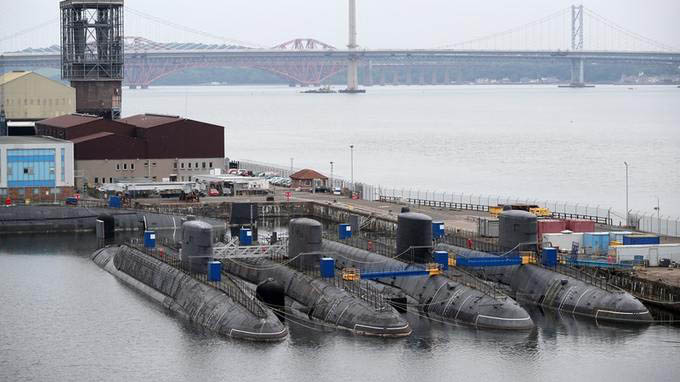
The oncoming submarine crisis is not the only threat to the UK’s ability to maintain its nuclear weapon capability. The recent upsurge in the aspiration for Scottish independence should remind us that we are in a unique position with the potential not only to rid ourselves of these horrific weapons, but also to undermine the ability of the UK to persist with them since there is no credible alternative to the Clyde bases elsewhere the UK.
29th September, By David Mackenzie
LAST week a UK nuclear weapon Vanguard-class submarine returned to its base in Faslane, covered in algae and barnacles, reportedly after a patrol that lasted more than six months.
This prompted the pro-navy (and pro-nuclear-weapon) magazine Navy Outlook to publish a long article discussing the increase in the length of patrols and suggesting that this is down to the difficulty, due to refits and maintenance problems arising from skill shortages, of maintaining the pattern of always having one boat on patrol at all times. The article acknowledges that there is now great pressure on the submariners and that risks are being taken to maintain the patrol pattern.
The four Vanguard-class boats are now more than 30 years old and the replacement Dreadnought- class is already well behind schedule, so the question arises as to whether the current submarines can be patched and crewed sufficiently to close the potential gap in availability.
The Dreadnought programme is seriously hampered by a shortage of assembly space at Barrow and delays to the Derby unit where the reactor cores will be built. The UK Government refuses to say when it expects the new boats to be ready. The stretching of the patrol length to six months and beyond suggests that the crisis point may not be far away and that in the interim more and more risks will be taken with material and personnel.
The oncoming submarine crisis is not the only threat to the UK’s ability to maintain its nuclear weapon capability. The recent upsurge in the aspiration for Scottish independence should remind us that we are in a unique position with the potential not only to rid ourselves of these horrific weapons, but also to undermine the ability of the UK to persist with them since there is no credible alternative to the Clyde bases elsewhere the UK.
When the UK was setting up Polaris, its first system for the submarine launching of nuclear weapons, the Ministry of Defence conducted a study to determine what sites would be suitable for two essential items – a port for berthing the submarines and a nearby but separate armaments depot for storing the warheads and loading them onto the missiles in the submarines.
The study rejected all the projected locations in England and Wales (including Falmouth, Milford Haven, Portland, Devonport, Barrow, and completely new “greenfield” sites). So we have the submarines based at Faslane and the warhead storage and management facility at Coulport. The Clyde sites offer deep water access and a ready route to the Atlantic. Two other locations outwith the UK have been raised – one is moving the bases to King’s Bay in Georgia, US.
This would rip away the last tissue of pretence that the UK system is an independent one. Also mooted has been the sharing of the French facilities on Île Longue near Brest but this is seen as politically beyond the pale. In short, there is no feasible alternative to the Clyde bases. This analysis is accepted by the UK defence establishment. This makes Scottish independence a critical threat to the UK’s nuclear weapons.
It has also been pointed out that the increasing fragility of the UK nuclear weapon system may have prompted the projected return of US nuclear weapons to the US base at Lakenheath in Suffolk. If the UK is seen as an increasingly wobbly part of the Nato nuclear fabric this may represent a belt-and-braces tactic.
The third shaky-nail factor is the growing worldwide movement for the complete elimination of nuclear weapons. The Treaty on the Prohibition of Nuclear Weapons (TPNW), which came into force as UN law in January 2021, has acquired huge worldwide support – to date 69 ratifications, 93 signatures and the regular support of around 130 states on the floor of the UN General Assembly, to say nothing of such strong supporters as Ireland, Austria, Pope Francis and The Elders. Meanwhile, financial institutions are disinvesting from nuclear weapons, frequently ascribing their stance to the TPNW.
The nuclear war threat is like an open petrol can that is kept close to an open fire on a shoogly table. This is a uniquely dangerous moment.
Yet there is an overwhelming desire for prohibition from the majority of UN member states, especially from those who would suffer the most from the climatic effects of an exchange of nuclear weapons.
We can hope that these three factors will enable a fundamental rethink of the UK’s nuclear posturing.
We can certainly hope that Scotland will take its own clear stance on the matter with worldwide support.
David Mackenzie is secretary of Secure Scotland
What will happen to 140-tonne stockpile of combustible sodium at Dounreay?
Dounreay’s operators have still to decide what to do with the remaining 140
tonne stockpile of sodium on site. Plans are afoot to build a new plant to
neutralise what is one of the most hazardous legacies from its days as the
UK’s testbed for fast reactors.
But Magnox Ltd has not ruled out hauling
the material to a disposal plant, if it can find one able and willing to do
the job. An update was given at Wednesday evening’s meeting of Dounreay
Stakeholder Group (DSG) when the site management came under fire for not
dealing with the issue years ago.
John O’Groat Journal 25th Sept 2023
A mature design or junk? EDF plan for Sizewell C continues to rely on controversial EPR reactor

The UK/Ireland Nuclear Free Local Authorities were incredulous to hear the recent claim by Sizewell C’s Joint Managing Director that EDF’s project plan was based on ‘a mature reactor design’.
Julie Pyke’s bold assertion was included in the media statement issued last week by government ministers announcing they were seeking private sector investment in the controversial project.
EDF Energy, the wholly-French-stated-owned operator of Britain’s nuclear reactor fleet, intends to deploy its European Pressurised Reactor (or EPR) at Sizewell C, should the project ever become operational.
Cynics have assigned the EPR a less complimentary sobriquet, ‘European Problem Reactor’, for this is the same reactor design that was involved in an accident at the Taishan-1 plant in China. Here radioactive gas leaked, seemingly because of corrosion and faulty parts. It is also same reactor which, at Olkiluoto-3 in Finland, took over a year to bring online, after being delivered fourteen years late, following the discovery of repeated faults.
In response to last week’s official investment launch for Sizewell C, Andy Mayer, the Chief Executive of the Institute of Economic Affairs, was quick to rubbish its prospects saying that:
“The underlying EPR tech is junk, resulting in projects that run over-time/budget [and] when built are riddled with corrosion…investors would be mad to back Sizewell. If built, it will be late & obsolete”.
And in December of last year, the former Chief Executive of EDF (surely a man who should know), Henri Proglio, told a hearing of the French National Assembly in exasperation that:
“The EPR is too complicated, almost unbuildable. We see the result today.”
The Chair of the NFLA Steering Committee, Councillor Lawrence O’Neill, said in response to Ms Pyke’s claim:
“Whether you believe the EPR is turnkey or turkey, we suspect that this is a classic case of someone in authority adopting an attitude of hope over expectation as the history of EPRs has so far been the stuff of nightmares rather than something to write home about.
“Hinkley Point C will be delivered around a decade late at a cost of at least £33 billion, nearly double the original budget. The development at Sizewell C with its extra geographical complexities, will we suspect take even longer and cost so much more – and that is assuming that the whole project is not kiboshed by the serious legal challenge being pursued by our friends in Together Against Sizewell C and their allies”.
The timing of the government’s announcement is itself suspect as Barclays have previously been appointed by government to solicit investors and there have been many pronouncements, usually negative, by the leaders of major financial institutions on their prospects of investing in Sizewell C.
Being of similar mind to Mr Mayer, the NFLAs have been active in backing our friends in the campaign group, Stop Sizewell C, in writing to prospective investors to point out the pitfalls that might befall backing the White Elephant.
Gratifyingly, so far, the market has proven lukewarm in embracing new nuclear, with a typically prescient comment made by a spokesperson for Legal & General Capital to The Telegraph:
“Our stance hasn’t changed: we are focused on investing in and supporting other innovative, viable, and cost-effective clean energy solutions that are already delivering results.”
The NFLAs hope that this will be the uniform response of the market and that this unwanted and unneeded nuclear waste of public money will soon be abandoned.
Solar and wind farms can easily power the UK by 2050, scientists say
A team at the University of Oxford claims that the two technologies could provide ten times our present need
Adam Vaughan, Environment Editor, Tuesday September 26 2023, The Times
Wind and solar power could comfortably supply all the UK’s energy needs by the middle of the century, according to a University of Oxford team.
The researchers calculated that the two renewable technologies could power the nation even after making a conservative estimate that accounted for the amount of land and sea available, energy storage needs, economics and a high future demand for energy.
The analysis found that the UK has enough wind and solar resources to generate 2,896 terawatt hours a year by 2050, or almost ten times today’s electricity needs.
Shotwick Solar Farm in Deeside covers 220 acres and is the biggest in Britain. Similar farms could provide almost of a fifth of our energy
The vast majority, 73 per cent, would come from offshore wind farms, followed by utility-scale solar in fields at 19 per cent. The Solar Energy Industries Association defines a solar project as utility-scale
if it generates greater than 1 megawatt of
solar energy.
Onshore wind farms, which the government this month promised
to unblock in England by changing planning barriers, would supply about 7
per cent. Solar on rooftops would provide less than 1 per cent, because it
was assumed the technology would be largely confined to the south of
Britain and only for south-facing rooftops.
The paper by the Smith School of Enterprise and the Environment said wind and solar had been underestimated in Great Britain, and “predominant narratives that
renewables are too expensive or impractical are wildly out of date”.
Professor Cameron Hepburn, director of the Smith School, said a renewable
powered Britain was now possible because of falling costs of wind and solar
power. He said a recent Royal Society report on energy storage showed the
intermittent nature of renewables could be cost-effectively tackled by
using hydrogen stored in the country’s network of salt caverns. “I
think the public would be stunned that we could power not just the entire
electricity system but the whole energy system of this country with wind
and solar,” Hepburn said.
The country was assumed to need 1,500 terawatts
of energy by 2050, far higher than most other estimates, to ensure the
analysis was conservative. The report assumed 2 per cent of land was given
over to utility-scale solar, 5 per cent of land to onshore wind farms and
10 per cent of the UK’s exclusive economic zone to offshore wind
turbines. Hepburn said wind turbines on land would coexist with farms.
Times 26th Sept 2023
Bring radiation regulations up to international standards, say Nuclear Free Local Authorities
https://www.nuclearpolicy.info/news/bring-radiation-regulations-up-to-international-standards-say-nflas/ Ian Grant 26 Sept 23
Inadequate emergency planning zones, inconsistent iodine distribution, and a lack of public engagement and accountability are some of the criticisms the UK/Ireland Nuclear Free Local Authorities levelled in response to a consultation being conducted by the Department of Energy Security and Net Zero about the regulations governing emergency planning for nuclear accidents.
The Department has just conducted a periodic review of the 2019 REPPIR – Radiation (Emergency Preparedness and Public Information) Regulations – in conjunction with its partners in the Ministry of Defence and Health and Safety Executive.
The NFLAs have found that the regulations governing emergency preparedness are ‘wholly inadequate and fail completely to take account of the total area which would be likely contaminated by radiation in the event of a nuclear accident’.
The NFLAs have called on the government to amend the regulations so they meet the standards set out in guidance issued by the International Atomic Energy Agency to countries with nuclear power plants. This would mean that Detailed Emergency Planning Zones would be set at a radius of at least five KMs from the plant, an Outline Planning Zone set at least thirty KMs, and iodine tablets proactively issued as a precautionary measure to all residents in these zones.
The current regulations require a Detailed Emergency Planning Zone to be set, but these are currently below 5 KMs in radius, the setting of an Outline Planning Zone is not even mandatory, and the pre-distribution of iodine tablets for residents to self-administer in the event of an accident can be inconsistent, and not proactive.
The NFLAs are also critical that emergency planning is underfunded, inadequate, inconsistent, and often opaque; with a general failure to engage members of the public and wider stakeholders in its development.
Councillor Lawrence O’Neill, Chair of the NFLA Steering Committee, said: “The Windscale Fire and Chernobyl both showed that vast areas can be contaminated by a radioactive plume. Should an accident occur, any resultant radiation will not halt at the modest line recommended for emergency planning purposes to the local authority by the nuclear operator.
“We want to see larger DEPZs and Outline Planning Zones to reflect the true reality, including a recognition that accidents can contaminate large areas and large cities rendering them uninhabitable; the extensive pre-distribution of iodine tablets as a sensible precautionary measure; and an emergency planning regime that is better resourced rather than being a Cinderella service, that is accountable not opaque, and that embraces input from a wider range of stakeholders, including the public.
“To the NFLAs, the current regime appears to be collective hubris on the part of government ministers and industry insiders, each hoping that an accident will not happen and that if it does the worst can easily be contained within a 3 km DEPZ”.
UK’s nuclear lobby to take over education site?
South Gloucestershire and Stroud College (SGS) has made a move to put
Berkeley Green, its flagship Gloucestershire Science & Technology Park
(GSTP), up for sale. The news of the sale announced today comes in the wake
of a visit to the site by the government’s Great British Nuclear (GBN)
organisation, which is believed to be now likely to earmark Berkeley as a
centre for science and research in the next chapter for the UK’s nuclear
power investment.
GBN has been tasked with finalising six sites in the UK
for the new generation of small-medium nuclear reactors (SMRs). As well as
visiting Berkeley, it has also assessed South Gloucestershire’s nearby
decommissioned nuclear site at Oldbury as a possible location for the
reactors. Sources suggest the most likely scenario is for SMR installation
at Oldbury, with Berkeley’s site, in recognition of the academic investment
there since 2016, becoming a supportive centre for science, research and
training.
Punchline Gloucester 27th Sept 2023
https://www.punchline-gloucester.com/articles/aanews/sgs-berkeley-green-goes-up-for-sale
UK risks power supply crunch in January as nuclear plants halt.
Rachel Morison and Elena Mazneva, Bloomberg News, 27 Sept 23
(Bloomberg) — The UK’s National Grid Plc is preparing for a possible power crunch in January as several planned nuclear outages coincide with peak winter demand.
Electricity consumption is projected to climb to a high during the first two weeks of January, just as nuclear availability is forecast to drop, according to National Grid’s winter outlook report published Thursday. Blackouts are a less likely than last winter but can’t be ruled out, the grid’s Electricity Supply Operator said. ………..
Units at Electricite de France SA’s Hartlepool and Torness nuclear stations are scheduled to be offline for work in January, company data show.
National Grid expects it will need to use “operational tools” like market warnings to help balance supply and demand this winter. The network operator has been stress-testing tens of thousands of weather scenarios this winter to ensure it can manage margins, Dyke said. …….. https://www.bnnbloomberg.ca/uk-risks-power-supply-crunch-in-january-as-nuclear-plants-halt-1.1977313
Tory MP inexplicably asks for nuclear powered frigates
By George Allison, September 24, 2023 https://ukdefencejournal.org.uk/tory-mp-inexplicably-asks-for-nuclear-powered-frigates/
In a recent parliamentary query, Conservative MP Andrew Rosindell raised eyebrows with a question about converting Royal Navy warships from diesel power… to nuclear power.
For smaller surface vessels like frigates, the benefits of nuclear power do not outweigh the significant costs and potential environmental concerns. Furthermore, integrating such systems into existing fleet designs would pose significant engineering and logistical challenges.
Rosindell asked the Secretary of State for Defence, “what his Department’s projected spending on nuclear powered surface vessels for the Royal Navy is in the (a) 2023-24, (b) 2024-25 and (c) 2025-26 financial year; and if he will make a statement.”
Not stopping there, he further inquired about the Defence Department’s plans, asking “what his Department’s timeline is for converting the remaining diesel-powered Royal Navy surface fleet to nuclear power.”
In a straightforward response, James Cartlidge, the Minister of State for the Ministry of Defence, clarified, “The Royal Navy has never had any surface vessels that are nuclear powered and there is no programme or intention to convert the current fleet to be nuclear powered in future.”
Thus, the notion of the Royal Navy converting its frigates into nuclear-powered surface vessels remains firmly off the table for the foreseeable future, there are no plans to add warp cores or hyperdrive engines either..
Sizewell nuclear investment may prove radioactive

Alistair Osborne, Tuesday September 19 2023
Don’t all rush at once. The government is giving private punters
“their first chance to come forward and qualify to invest in Sizewell
C” — the £30 billion-plus nuke, offering guaranteed cost overruns,
prettily located on a Suffolk flood plain. How’s it their first chance? The government’s adviser, Barclays, has been trying to drum up support
for this project for more than a year.
And what’s all this stuff about
qualifying? Ministers really aren’t that fussed where the money comes
from, as long as it’s not from the likes of China, Russia, Iran or the
home of Kim Jong-un’s exploding ballistic missiles.
That the government is desperate for someone to stick a few quid into Sizewell has been clear for yonks. So it’s a bit odd to find new energy secretary Claire Coutinho
making such a hoo-ha about “opening applications for partners to register
their interest” or demanding that they have “experience in delivering
major infrastructure projects”.
Indeed, as pointless announcements go, it
looks up there with the endless relaunches by her predecessor Grant Shapps
of Great British Nuclear: an organisation so far as useful as his Great
British Railways, which still seems to be stuck in a siding.
The key question? What sort of return would investors require and for what risk?
There’s talk that the government its trying to thrash out a price with
potential funders including Brookfield, Stonepeak and Abu Dhabi’s
Mubadala and that Coutinho’s formal process will enable her to harden
things up.
But getting a decision looks tricky when campaigners have just
won leave to appeal the decision to build Sizewell. And, unless it comes up
with giveaway terms, it’s hard to see how the government won’t end up
having to fund most of the equity itself. Investors know how easy it is to
get burnt with nuclear fuel.
Times 19th Sept 2023
https://www.thetimes.co.uk/article/investment-that-may-prove-radioactive-qrwz35cst
Nuclear bomb test veterans relaunch legal action

By Dominic Casciani, 20 Sept 23, BBC News
Veterans of the UK’s nuclear weapons tests are attempting to relaunch a battle for compensation a decade after being legally blocked from suing the government.
Campaigners say newly discovered documents suggest nuclear chiefs may have known the men suffered radioactive damage.
More than 22,000 personnel worked on detonations in Australia and the South Pacific in the 1950s and 1960s.
Campaigners believe personnel suffered cancers and had children with birth defects because of radiation……
In 2012, the Supreme Court narrowly ruled that more than 1,000 veterans could not sue the Ministry of Defence because they had run out of time to bring their case.
But recently found documents suggest the military have long held documents detailing blood and urine tests from personnel.
One of the documents seen by the campaign shows concerns about a pilot’s blood after he had been flying scientific instruments through mushroom clouds.
The men and their families now plan to take the Ministry of Defence to court because they believe there could be thousands more such records.
If the records exist and prove military chiefs suspected radiation damage, that could lead to a last attempt at getting compensation.
‘Guinea Pigs’
Eric Barton, 82, of the “Labrats” campaign group, said British personnel had been treated like guinea pigs.
He suffered cancer and received compensation from the American military because he had witnessed six test denotations of its bombs. But friends who witnessed British bombs have not received any money at all…………………………………………………………………………………………………………. more https://www.bbc.com/news/uk-66869017
Campaigners win permission to appeal against Sizewell C Nuclear Power Station ruling
Campaigners have won permission for another hearing to
challenge the go ahead to build Sizewell C Nuclear Power Station on the
issue of a permanent water supply and because of public interest in the
development.
Court of Appeal judge Lord Justice Coulson says the Together
Against Sizewell C Limited (TASC) arguments around the need for a
desalination plant on the Suffolk Coast should be looked at again.
He has given TASC permission to appeal against Mr Justice Holgate’s refusal in
the High Court of their judicial review of then Business Secretary Kwasi
Kwarteng’s decision to give development consent to the 3.2 gigawatt power
station. The judge said that, given Mr Kwarteng gave permission for the
power station against the advice of the planning Examining Authority, and
because of TASC’s range of arguments about the need for a water supply,
the appeal had “a real prospect of success”.
Leigh Day 18th Sept 2023
1 This Month

of the week – THE ONENESS of HUMANITY
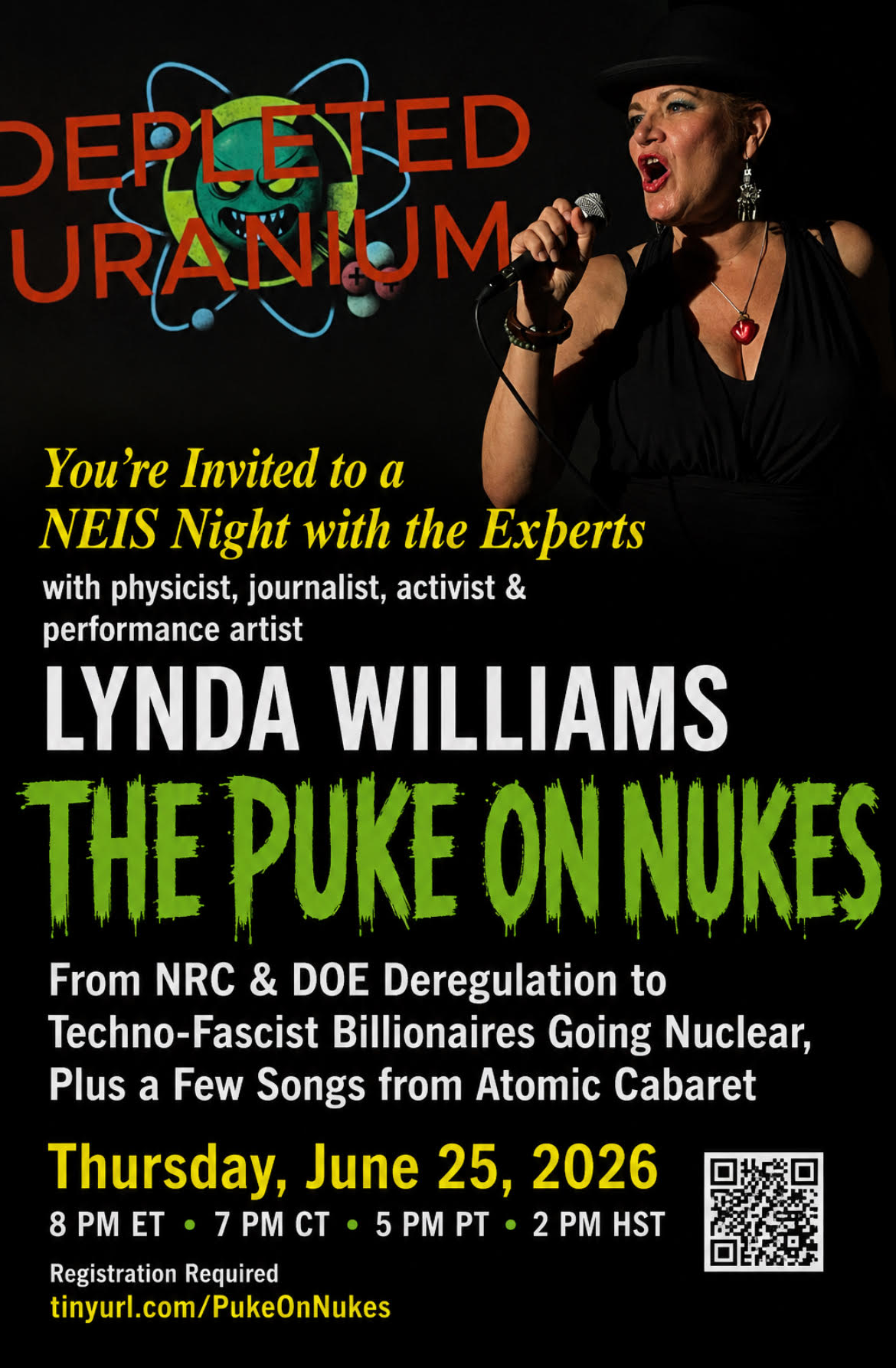
25 June- THE PUKE ON NUKES
Thursday, June 25, 2026
7pm Central Time (8pm ET, 6pm MT, 5pm PT) UTC – 5
From NRC & DOE Deregulation to Techno-Fascist Billionaires Going Nuclear, Plus a Few Songs from Atomic Cabaret REGISTER
26 June – Radiation Trainwreck at the NRC / Join the Protect Better Campaign – https://us02web.zoom.us/meeting/register/4ZlZ5_qLSHGiLSCg8FF6Bg#/registration

1st July – Webinar Waste of Space: The Environmental Harm of Military and Civil Space Activity st July, 7 pm

Report Launch Online: We are seeing an increasing exploitation of space for military and commercial purposes. This must change.

Protect Sazan Island from the Trump family! https://secure.avaaz.org/campaign/en/protect_sazan_island_from_the_trump_family_loc/?bqFCVab&v=174511&cl=22707147157&_checksum=5e9dde668860e8231c33699735e16a1fbf22ab2cb01da50c999fe8732b9775ef&utm_source=email&utm_medium=blast_email&utm_campaign=174511


Cuba Is Not a Failed State – It Is a Besieged State
PETITION: “Global Appeal to Endorse Palestinian Right of Return of Refugees”
To see nuclear-related stories in greater depth and intensity – go to https://nuclearinformation.wordpress.com
-
Archives
- June 2026 (251)
- May 2026 (306)
- April 2026 (356)
- March 2026 (251)
- February 2026 (268)
- January 2026 (308)
- December 2025 (358)
- November 2025 (359)
- October 2025 (376)
- September 2025 (257)
- August 2025 (319)
- July 2025 (230)
-
Categories
- 1
- 1 NUCLEAR ISSUES
- business and costs
- climate change
- culture and arts
- ENERGY
- environment
- health
- history
- indigenous issues
- Legal
- marketing of nuclear
- media
- opposition to nuclear
- PERSONAL STORIES
- politics
- politics international
- Religion and ethics
- safety
- secrets,lies and civil liberties
- spinbuster
- technology
- Uranium
- wastes
- weapons and war
- Women
- 2 WORLD
- ACTION
- AFRICA
- Atrocities
- AUSTRALIA
- Christina's notes
- Christina's themes
- culture and arts
- Events
- Fuk 2022
- Fuk 2023
- Fukushima 2017
- Fukushima 2018
- fukushima 2019
- Fukushima 2020
- Fukushima 2021
- general
- global warming
- Humour (God we need it)
- Nuclear
- RARE EARTHS
- Reference
- resources – print
- Resources -audiovicual
- Weekly Newsletter
- World
- World Nuclear
- YouTube
-
RSS
Entries RSS
Comments RSS
 nuclear-news