French nuclear submarine visits Scotland
French nuclear submarine Suffren visited Faslane naval base near Glasgow in
Scotland this week. The visit isn’t the first time a French nuclear
submarine has visited Scotland, not by a long shot, as the increasing
number of visits by the French and U.S. Navy in recent years reflects the
enhanced security posture in the North Atlantic.
UK Defence Journal 16th Dec 2023
https://ukdefencejournal.org.uk/french-nuclear-submarine-arrives-in-scotland-2/
Theddlethorpe nuclear waste site: Informed decision needed, says council.

Residents must be clear about plans to build a nuclear waste site in their
village before deciding on them, a council leader has said.
A former gas terminal in Theddlethorpe, near Mablethorpe in Lincolnshire, was announced
as a possible location for an underground disposal facility in 2021. A
public vote on whether to approve the plans may not take place until 2027.
Craig Leyland of East Lindsey District Council said it was “critical”
voters made an “informed decision”. The proposal by Nuclear Waste Services
– formerly known as Radioactive Waste Management – for a Geological
Disposal Facility (GDF) would see nuclear waste from the UK being stored
underneath up to 1,000m of solid rock until its radioactivity had naturally
decayed.
The plans have “had a detrimental effect on physical and mental
health” of residents, according to Travis Hesketh, an Independent Group
councillor at East Lindsey District Council. He called for a review into
residents’ views on the GDF at a meeting on Wednesday, the Local Democracy
Reporting Service said.
BBC 14th Dec 2023
EDF told not to expect UK to step in to fund Hinkley Point C flagship nuclear project

Cost overruns a ‘commercial issue’ for Hinkley Point C’s French
developer after CGN halts payments, says British official.
The UK government has signalled it will not step in to help France’s EDF fund
Hinkley Point C after its Chinese partner CGN halted payments to cover
mounting cost overruns on Britain’s flagship nuclear power project. The
reluctance of the British government to intervene comes as the price tag
for the power plant under construction in south-west England is likely to
exceed the revised £32.7bn estimate EDF put on it earlier this year,
according to people close to discussions.
CGN, EDF’s partner in Hinkley Point C, had agreed to finance 33.5 per cent of the original £18bn cost of the plant in 2016, with the French group responsible for the remainder. But
after paying its contracted share, CGN has not made payments linked to the
overruns in recent weeks, three people familiar with the matter said.
The French group warned earlier this year that the Chinese group could refuse
to pick up the extra costs. One UK government official said there were no
plans to step in to fill the gap left by CGN, suggesting EDF could pull in
other investors. “It is a commercial contract which we obviously don’t
play a part in financing,” the official said, adding: “It would first
be a matter for the shareholders.”
One industry source said pulling other
investors into the project at this stage would be “complicated”. The
French economy ministry said it was in contact with London over the issue.
“We’re working with the British government to ensure the rollout of the
UK nuclear programme, including on the financing front,” an official in
Paris said.
FT 14th Dec 2023
https://www.ft.com/content/2bccd67f-a3c6-48d1-baa5-8ef9d54cdf67
Cumbrian councils urged to poll public over controversial nuclear dump plan
The Nuclear Free Local Authorities have sent a joint letter to the parish and town councils located in the West Cumbria search areas under consideration for a Geological Disposal Facility urging them to consider polling their parishioners over the controversial plan.
The co-signatories are the NFLAs English Forum Chair, Councillor David Blackburn, Councillor Jill Perry, Green Party Group Leader on Cumberland Council and Jan Bridget, co-founder of Millom against the Nuclear Waste Dump.
Nuclear Waste Services, a division of the taxpayer-funded Nuclear Decommissioning Authority, is engaged in long-term investigations to determine the suitability of locating the GDF on the West Cumbrian coast. The facility would have a surface site to receive regular shipments of high-level radioactive waste from Sellafield and this waste would then be transported along tunnels out under the Irish Sea, before the GDF once filled is sealed.
Two search areas have been designated Mid-Copeland and South Copeland, with their boundaries drawn in conformity with Cumberland Council electoral wards, and NWS has established a Community Partnership in each, which provide some limited oversight to the process. Members of the Community Partnerships include elected members from Cumberland Council, deemed the Relevant Principal Local Authority under the guidance established for the plan, and representatives from each of the parish and town councils encapsulated in the search areas.
The UK Government and NWS are adamant that the final selection of the site will be determined by two factors – the suitability of the geology and the acceptance of the plan by the local host community.
Geological investigations may take up to 15 years to complete, with desktop, aerial and seismic surveys being augmented in the second stage by deep exploratory boreholes for rock sampling. NWS are expected to periodically sense check public perceptions of the plan until in the final stages a Test of Public Support is conducted to determine if local people are willing to see their area taken forward.
The so-signatories are unhappy that there is no mechanism built into the plan to conduct interim opinion polls to identify public feeling over time, and they are disappointed that most local councils have yet to conduct their own polls to determine if their appointed representatives to the Community Partnership are reflecting the opinions of their parishioners. They would like parish and town councils to follow the lead shown by Whicham which took the initiative, independently of NWS, and did so./………………………………………………….
more https://www.nuclearpolicy.info/news/cumbrian-councils-urged-to-poll-public-over-controversial-nuclear-dump-plan/
Sellafield staff ‘used home computers to beat security failings’.

Cybersecurity fears grow amid claims Britain’s most hazardous nuclear
site was targeted by hackers linked to Russia and China. Staff at
Sellafield were asked to work on sensitive projects using their home
computers, a former employee has said, amid questions about cybersecurity
at Britain’s most hazardous nuclear site after claims it was hacked by
groups linked to Russia and China.
Claire Coutinho, the energy secretary,
is due to meet representatives from the Nuclear Decommissioning Authority
(NDA) after an investigation alleged that state actors had embedded sleeper
malware into the computer network at Sellafield, the largest nuclear waste
and decommissioning site in Europe.
Sources told The Guardian that IT
breaches had been detected as far back as 2015, and accused the
organisation’s leaders of having “consistently covered up” the scale
of the intrusions. Highly sensitive material potentially relating to the
movement of radioactive waste and monitoring of leaks had likely been
compromised, and it is still unknown as to whether the malware has been
successfully eradicated, the newspaper reported.
A former staff member, who
worked as a senior manager at the site between 2008 and 2021, told The
Times that staff had a “complacent” and “lax” attitude towards
cybersecurity, with employees often leaving their login details attached to
their computers and frequently having to be reminded to lock their screens.
Times 9th Dec 2023
Sellafield nuclear site exposés are long overdue
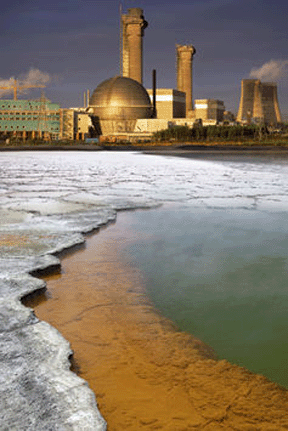
The fact that it is in Cumbria, far away from London, makes it easily ignorable, writes Isaac Cooper. https://www.theguardian.com/environment/2023/dec/11/sellafield-nuclear-site-exposes-are-long-overdue
As a journalist based in Cumbria, I appreciate your investigations into Sellafield (Sellafield nuclear site workers claim ‘toxic culture’ of bullying, sexual harassment and drugs could put safety at risk, 6 December). The exposés are long overdue. The reaction of many, however, has been distinctly muted and is directly linked to how Sellafield has been getting away with it for many years: geography. The fact that Sellafield lies on the west coast of Cumbria makes it easily forgettable to large swathes of the media and the public.
Were Sellafield based within a hundred miles of London there would have been a national uproar, but its “out of sight, out of mind” location means it can be ignored easily. It is indicative of the public’s attitude towards Cumbria being just the lakes and nothing more.
Isaac Cooper
Cumberland News, Carlisle
Fears of a major leak at Sellafield nuclear plant should be taken seriously

There are reports of more than 100 safety problems at the Sellafield nuclear power plant and a leak first reported four years ago has been allowed to worsen. It’s a nightmarish prospect and I hope someone is taking urgent remedial action, writes Cumbria native Chris Blackhurst
Every so often, when we were children, Father would borrow a portable
Geiger counter and take us to the beach. While we – my sister and I –
played on the sand, he would wander around with the machine. Whenever it
neared a clump of seaweed the gadget would click furiously and loudly.
He taught in a secondary school and the device was in their laboratory. We
lived at Barrow-in-Furness in Cumbria, just down the coast from Sellafield,
Europe’s largest nuclear reprocessing plant.
Back then, we would see
ships from Japan regularly dock and unload their radioactive cargo onto
special freight trains for transporting to Sellafield. Meanwhile, in the
nearby shipyard, they were building submarines powered by nuclear reactors.
By and large, we Cumbrians were grateful for the atomic business.
Employment in that part of the world does not come easily. There is the
adjacent Lake District, with its tourist trade, but otherwise, that’s
about it as far as mass numbers are concerned. Sellafield and the shipyard
are by far the biggest single employers.
Not everyone was so delighted. The
campaign group Cumbrians Opposed to a Radioactive Environment made plenty
of noise, but because of the jobs and cash that was flowing into the local
economy from things nuclear, struggled to have any impact.
We knew that the
risk of a spillage, of a major accident, was an ever-present. It was a
given, it went with the Faustian pact of relative prosperity in return for
accepting the danger. We put it from our minds, reassuring ourselves that
the powers-that-be would ensure our wellbeing and that the standards would
be maintained.
Reading of a worsening leak from a crumbling silo of
radioactive waste and fears concerning cracks in a reservoir of toxic
sludge at Sellafield sparks alarm and other memories. The authorities had
not always been so vigilant.
The dreadful thought is that none of this
comes as a major surprise. As we’ve discovered recently, successive
governments have let the nation’s infrastructure creak and wear away. If
schools are forced to close because they have asbestos in them; if other
public buildings are shut for the same reason or because they are in a
state of neglect and no longer fit for purpose; if our motorways and
railways are in a constant state of disrepair, what prospect is there of
Sellafield being any different? Equally, poor working culture has been
shown to be rife in many areas of British life.
Independent 9th Dec 2023
Atomic Kittens! Locals invaded by ‘radioactive’ cats after workers at UK’s most hazardous site nicknamed ‘nuclear Narnia’ feed 100 strays…but are they a myth?
- Protestors claim Europe’s largest nuclear facility is jeopardising safety of locals
- Sellafield facility chiefs hotly deny that the cats pose any risk to public safety
Protestors have claimed villagers living close to a giant
facility known as the UK’s ‘nuclear Narnia’ have been invaded by swarms of
‘radioactive’ cats. Strays roaming wild across the Sellafield nuclear site
on the Cumbrian coast pose a risk because they are ‘literally pooing
plutonium’, the anti-nuke campaigners say.
The colony of feral cats grew
after they were fed scraps by workers at Sellafield, which is Europe’s
largest nuclear facility, and sheltered under the warmth of giant steam
pipes for decades.
The group, called Radiation Free Lakeland (RAFL), claim
to have consulted experts and found that the cats’ faeces contain
detectable traces of plutonium and caesium. A theory firmly denied by
chiefs at Sellafield, who say the strays – nicknamed ‘atomic kittens’ by
locals – pose no risk to the public. However, MailOnline has seen documents
which prove some of Sellafield’s 11,000 employees have been threatened with
disciplinary action if they feed the cats because it encourages them to
congregate around the offices.
Daily Mail 9th Dec 2023
https://www.dailymail.co.uk/news/article-12836429/radioactive-cats-invade-hazardous-site.html
The beautiful little UK seaside village torn apart by nuclear power station fight
Fierce battle raging over Sizewell C in Suffolk is in stark
contrast to the tranquil nature of this picturesque historic fishing
village. Despite its relaxing vibes, this tiny historic fishing village is
at the centre of a bitter battle over whether a massive nuclear power
station should be built on its shores.
It is a struggle that could not only
determine Sizewell’s future, but the whole of Britain’s. Were it not
for its existing power station and plans to build an even bigger one next
door, you would never have guessed that this small, remote place would be
at the centre of a struggle of national importance.
Express 7th Dec 2023
https://www.express.co.uk/news/uk/1842407/sizewell-suffolk-nuclear-power-station-fight
COP28: Global nuclear pledge casts further doubt on UK’s capabilities

CITY AM, RHODRI MORGAN 8 Dec 23
The COP28 conference in Dubai has put the UK’s faltering nuclear sector into the limelight once more.
Microsoft founder and billionaire philanthropist Bill Gates today used the conference as a platform to announce that his nuclear reactor company TerraPower will examine the UAE’s potential for new reactors.
Yesterday, 22 countries including the United States, the United Kingdom, South Korea, Canada, Hungary, and the Netherlands signed a pledge to triple nuclear deployment by 2050.
TerraPower and the UK have stalled on discussions around UK projects, but nuclear on the whole is another energy front on which the UK is currently losing ground.
The target of 24 GW by 2050 was first conceived in the Energy Security Strategy of 2021 but precious little progress has been made since.
Even with the reactor plans it has been able to conceive, the sector remains repeatedly hamstrung by bureaucratic process and the absence of a long-awaited nuclear road map that is likely delayed once more to 2024.
A significant factor halting development is that nuclear investment is still not labelled green, despite being promised by the Chancellor back in March.
Examining the UK’s current stock showcases the problem even further. British nuclear capacity stands at 5.9 GW, 4.7 GW of which retires in less than five years.
Through completing Hinkley Point C, Sizewell C and securing a life extension to Sizewell B, the UK could reach 7.7 GW; less than one third of the 24 GW target.
In the 12 years since the UK restarted nuclear development, only one project has proceeded to a Final Investment Decision (HPC in 2016).
To get to 24 GW of capacity by 2050, the UK nuclear needs to build and start operations on another six Hinkley Point C-size projects and move the stymied Sizewell C project into production.
………………………………….those within the sector believe the government is still avoiding making short-term capital investments to shore up the long-term energy security set out in 2021.
One official involved in the UK nuclear industry told City A.M: “They’re slow and hesitant, we know what happens when you have government money tied up in multi-billion pound projects and a sniff of a cost increase comes along, they opt to slow down and rethink”.
Others believe that despite union backing for large job creators like Hinkley Point, a Labour government isn’t in a position to speed up the nuclear timeline.
“If their policy is a carbon-free grid by 2030, there isn’t a single nuclear that can come on by then – even Hinkley Point C would just replace units that will go offline,” they told City A.M………………………………………………………………………. https://www.cityam.com/cop28-global-nuclear-pledge-casts-further-doubt-on-uks-capabilities/
 | |||
| |||
UK preparing to push Ukraine toward peace talks – media
https://www.rt.com/news/588565-uk-ukraine-peace-talks/ 6 Dec 23
The West is reportedly disappointed with Kiev’s failed counteroffensive and doubts its ability to score a victory against Russia
British diplomats may soon start to put pressure on Ukraine to hold peace negotiations with Russia, Politico’s UK editor has suggested, citing “chatter” in diplomatic circles. Wider media reports suggest that the West has grown concerned at Kiev’s ability to score a battlefield victory.
Speaking on Monday on the latest episode of the ‘Politics at Jack and Sam’s’ podcast, Jack Blanchard noted that “Ukraine’s big counteroffensive was not anything like the success people hoped, and that is raising big questions about Ukraine’s ability to win this war in any meaningful military way.”
In light of this, Blanchard claimed that there are rumors in British “diplomatic circles” about “putting pressure on Kiev to sit down and negotiate.”
His comments come on the heels of a Washington Post article claiming that Ukraine ignored a counteroffensive strategy devised by American and British officers that recommended a focused attack on a single sector of frontline in April, and that it chose to delay the operation until June, and to spread its forces along multiple axes.
“Nothing went as planned,” the Post stated, adding that Ukraine’s insistence on following its own tactics and timeline generated “friction and second-guessing between Washington and Kiev.”
According to the latest figures from the Russian Defense Ministry, Ukraine has lost 125,000 service personnel and 16,000 pieces of heavy equipment in the six months since its counteroffensive began.
Blanchard is not the first journalist to claim that Kiev’s patrons are ready to push for peace. Last month, German tabloid Bild alleged that the US and Germany are rationing their weapons deliveries to Ukraine in a bid to nudge Ukrainian President Vladimir Zelensky into talks with Russia, without explicitly asking him.
The US State Department dismissed Bild’s report, with spokesman James O’Brien stating that the decision of when to sue for peace “is a matter for Ukraine to decide.”
Speaking at the Halifax Security Forum in Canada several days before that report was published, Aleksey Danilov, the secretary of Ukraine’s National Security and Defense Council, said that “Ukraine is concerned by the fact that discussions among certain partners have intensified regarding the need for negotiations…with the Russians.”
Danilov insisted, like Zelensky repeatedly has since the start of the conflict, that “Ukraine and the Ukrainian people will fight to the end. We are sure of our victory.”
The Guardian view on Sellafield scandals: ministers must put public safety before secrecy
Editorial https://www.theguardian.com/commentisfree/2023/dec/07/the-guardian-view-on-sellafield-scandals-ministers-must-put-public-safety-before-secrecy
Effective governance of Britain’s nuclear industry is critical to saving a hazardous industry from itself
There will be many reasons why Britain’s energy secretary, Claire Coutinho, went public with her unease about “serious and concerning” allegations raised by the Guardian this week over cybersecurity, site safety and a “toxic” workplace culture in Sellafield. There was the “longstanding nature” of the matters in question, raising questions over the site’s management. Neighbouring governments have had serious concerns. The plant holds enough plutonium to potentially make thousands of atomic bombs of the size that obliterated Japan’s Nagasaki in 1945. By asking for assurances from its state-controlled owner and its regulator, Ms Coutinho emphasises that effective governance of Britain’s nuclear industry is a critical issue.
This is a sensible response to these scandals. The cabinet minister is right to publicise her concerns about a hazardous industry that can inflict catastrophic environmental damage and deaths. She has sent a helpful signal about valuing public safety over secrecy. Sellafield in Cumbria, and about 20 smaller sites, need to be monitored and protected, as the waste stored can remain radioactive for tens of thousands of years. Yet the nuclear establishment is at best opaque. Britain’s postwar development of nuclear weapons grew alongside the construction of nuclear energy reactors. The industry’s military connections have influenced its approaches to corporate governance for the worse.
There is an urgent problem of nuclear waste disposal. Britain was one of the first economies to generate nuclear energy. But that meant radioactive waste has been left for decades without a permanent storage solution. This has seen the cost of temporary storage soar and the risk of catastrophe increase. Sellafield is one of the most dangerous places in the world, a notoriety bolstered by crumbling buildings and tanks leaking irradiated sludge. It is no stranger to trouble, going as far as changing its name to distance itself from being the site of one of history’s worst nuclear accidents in 1957.
The consensus today for an enduring answer is to bury nuclear waste deep underground in “geological disposal facilities”. Finland will open one next year. Its spent nuclear fuel will be packed in copper canisters, and these entombed in the bedrock on the Gulf of Bothnia at a depth of 400m. France and Sweden are pursuing similar schemes. Britain has homed in on three sites, but finding an area willing to host a £53bn underground dump is not easy, given public safety concerns.
It would be better to have cheap, green energy that doesn’t create toxic waste. But demand for electricity is growing, and – without the battery technology to effectively store energy – this will have to be met at times when there is no sun or wind. Hence countries aim to use nuclear energy to try to cut fossil fuel dependence. But, say experts, ambitious government targets for more nuclear power stations could see Britain run out of room to store the radioactive waste produced. Opportunities arise too. Half of the world’s 420 nuclear reactors will need dismantling by 2050. Sellafield is at the heart of a billion-pound UK decommissioning industry. Its expertise could be sold worldwide. But that relies on a reputation for safety and competence, something that Ms Coutinho’s intervention doubtless seeks to salvage.
‘Dirty 30’ and its toxic siblings: the most dangerous parts of the Sellafield nuclear site
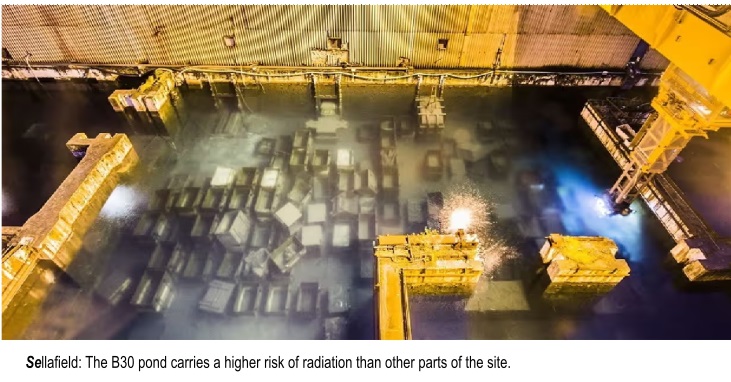
Cracks in ponds holding highly radioactive fuel rods lead to safety fears
https://www.theguardian.com/business/2023/dec/05/dirty-30-dangerous-sellafield-nuclear-site-ponds-safety-fears . by Alex Lawson and Anna Isaac
Radioactive sludge
In the early 1950s, a huge hole was dug into the Cumbrian coast and lined with concrete. Roughly the length of three Olympic swimming pools and known as B30, it was built to hold skip loads of spent nuclear fuel.
Those highly radioactive rods came from the 26 Magnox nuclear reactors that helped keep Britain’s lights on between 1956 and 2015. When B30 was first put to work, it was designed to keep the fuel rods submerged for only three months before reprocessing work was carried out.
But when 1970s miners’ strikes shut down coal power stations and forced greater reliance on nuclear plants, more spent fuel than could be quickly reprocessed was generated. The silos and ponds, built to prevent airborne contamination if the fuel or radioactive sludge dried out, rapidly filled up. Meanwhile, the fuel corroded in the water, breaking down into radioactive sludge.
Debris from elsewhere within Sellafield was later added and the pond was abandoned when new facilities were built in 1986, clouding over and leaving workers on site with little idea what lay beneath its murky waters.
‘A nightmare job with no blueprint’
In 2014, photos of B30 and nearby B29 leaked via an anonymous source to the Ecologist led to concerns over the radioactive risk associated with the poor repair of the ponds.
The two facilities were used until the mid-1970s for short-term storage of spent fuel until it could be reprocessed and used for producing plutonium for the military.
The Ecologist pictures showed hundreds of highly radioactive fuel rods in ponds housed within cracked concrete overgrown with weeds, with seagulls bathing in the water. The images, taken over a period of seven years, led the nuclear safety expert John Large to warn that any breach of the wall would “give rise to a very big radioactive release”.
At the time, the Office for Nuclear Regulation (ONR), the nuclear safety regulator, said that while the old ponds bring “significant challenges”, their appearance “does not mean that operations and activities on those facilities are unsafe”.
It took 15 years and £1.5bn to bring B30 to a point where decommissioning could begin several years ago, with builders limited to working only half an hour a day close to the pool to prevent them from exceeding radiation exposure limits. Remotely operated vehicles, normally used to help with submarine rescues, were originally deployed but quickly failed, often within hours, because of the overpowering radiation. Newer models have since been used to vacuum up nuclear sludge, which is then moved to alternative long-term storage.
Sellafield hopes to have drained the pond by the early 2030s, and demolished it by the 2050s.
A new facility, the sludge packaging plant, has been built to receive radioactive sludge from B30. The nuclear watchdog said there have been some “regulatory challenges along the way … including noncompliance with fire regulations”.
Although the reservoir is still nicknamed “Dirty 30”, it was officially rebranded in 2018 as the First Generation Magnox storage pond.
But one former longstanding employee says that, despite the cracks, the contents of the ponds are gradually improving: “I have seen it at its worst. The water quality was horrendous; you could stand on the roof and look down and not see a single thing in there.
“In the control room, there are a group of lads using PlayStation-like controls for robots to pick up bits the size of a 50p piece and hoover up the sludge. It’s cutting edge.”
He adds: “[Decommissioning Sellafield] is the biggest job in nuclear and there is no blueprint. It’s a dream and a nightmare job. There has been real progress – every skip that comes out makes it safer and reduces the hazard risk.”
Toxic neighbours
B30 sits in a “separation zone” that requires greater security checks, and carries a higher risk of radiation, than the rest of the town-sized site. Although B30 is the most notorious crumbling building on Sellafield’s sprawling estate, it is far from the only problem child.
Nearby is B38, used to store highly radioactive cladding from reactor fuel rods. It was also used heavily during the miners’ strike of 1972, when nuclear plants were relied on to produce extra power, and it proved impossible to process all the waste that was being generated. Two years later, the public’s view of the nuclear industry was sharpened by the launch of the Protect and Survive advice on surviving a nuclear attack.
In B29 lie the toxic remains of Britain’s attempt to become an atomic superpower during the cold war.
Windscale, a former munitions factory, was selected to host the first atomic reactors, known as Pile 1 and Pile 2, after the second world war. They produced plutonium for nuclear weapons, and efforts were rushed through to allow Britain to explode its own atomic bombs by 1952.
The toxic waste from this programme was stored in B29 – which stretched between Piles 1 and 2 – and a massive silo, B41. There have been efforts to secure and remove the waste in B41 in recent years.
There are also grave concerns over leaks from the Magnox swarf storage silo (MSSS), described as “one of the highest-hazard nuclear facilities in the UK”. It was constructed as a radioactive waste store in four stages between 1964 and 1983 and has not been in active use since the 1990s. The waste is stored under water to prevent ignition and to maintain constant temperatures.
The silo was first found to be leaking radioactive water into the ground in the 1970s and there are concerns that work to retrieve the waste, planned over the next three decades, has the “potential to reopen historic leak paths” and introduce new ones, according to the ONR.
Earlier this year, the ONR warned that a leak from the MSSS was likely to continue to 2050, with “potentially significant consequences” if it gathered pace.
The government’s long-term plan is to bury Britain’s nuclear waste deep underground in a geological disposal facility. The project, estimated to cost between £20bn and £53bn, would receive intermediate-level waste from nuclear facilities by 2050 and high-level waste and spent fuel from 2075.
It will echo similar projects in Sweden, France and Finland, which is nearing completion of its storage cave. A government body, Nuclear Waste Services, which is running the project, is in the process of engaging with different communities – two near Sellafield, and another near Mablethorpe on the east coast – in an attempt to win local approval for the plans.
Sellafield nuclear site workers claim ‘toxic culture’ of bullying, sexual harassment and drugs could put safety at risk

Multiple sources warn poor working culture heightens risk of accidents, suicide and sabotage
Guardian, Alex Lawson and Anna Isaac 7 Dec 23
A “toxic culture” of bullying, sexual harassment and drug-taking risks compromising the safety of Europe’s most hazardous nuclear site, multiple employees at Sellafield have claimed.
More than a dozen current and former employees have alleged to the Guardian that the Cumbrian site, a vast dump for nuclear waste, has a longstanding unhealthy working culture, where staff have been bullied, harassed and belittled, with some apparently pushed to suicide.
The site’s human resources department has been accused of taking a “bully, break, bribe” approach to dealing with employees who raise concerns over their colleagues and site safety.
Whistleblowers warn that the toxic culture could have dangerous consequences for safety and security at Europe’s biggest nuclear waste dump, which hosts decades of radioactive material. The revelations have emerged as part of Nuclear Leaks, a year-long Guardian investigation into cyber hacking, radioactive contamination and toxic workplace culture at the 6 sq km (2 sq mile) site.
A whistleblower, Alison McDermott, a consultant who said she was sacked in 2018 after raising concerns over Sellafield’s culture and sexual harassment, warned that this climate heightens the risk of not just accidents and mistakes, but also terrorism and sabotage.
“Those risks are far more likely to materialise if you’re working in a highly toxic and dysfunctional culture,” she claimed.
The vast taxpayer-funded site employs 11,000 staff, who are tasked with making safe crumbling buildings containing nuclear waste. It is one of the biggest employers in the north-west, with generations of the same families working there.
The investigation into Sellafield has found:
Several suicides apparently linked to the pressures of working at the site.
A former young worker who claimed he was bullied to the point where he “just wanted to die” after he was repeatedly mocked over his sexual experience.
Workers who alleged they have either experienced or witnessed incidents of sexual assault.
Staff who allegedly regularly bring cocaine on to the site and keep samples of untainted urine in case of random drugs tests.
It is understood that several suicides have been linked to the pressures of working at the site in recent years.
Sources with knowledge of medical services at the site claimed that there have been a disproportionately high number of severe mental ill-health episodes, suicides and suicide attempts among the workforce…………………………………………
Last year, it emerged that seven workers tested positive for drugs after 741 workers were randomly tested between November 2021 and November 2022.
There are also concerns about allegations of racist, misogynistic and other troubling behaviour at Sellafield. In late 2020, a network of ethnic minority employees wrote to the company’s board, listing 27 alleged racist incidents……………………………………………………………
McDermott, an experienced HR consultant who has consulted for a range of blue-chip organisations, was brought in to identify issues with Sellafield’s culture and make recommendations. However, she alleges she was fired after telling managers that an investigation should be carried out into claims of sexual harassment and a subsequent cover-up. She is awaiting a decision on her case from the court of appeal after a lengthy legal battle with Sellafield.
McDermott said: “The gravity of the bullying and harassment and the abuse employees were being subjected to was just really shocking and off the scale and there clearly was an endemic problem with bullying and harassment at Sellafield.”
McDermott, an equality consultant, has spoken to scores of current and former employees before and after she was let go in 2018. She raised concerns over claims of sexual harassment by an employee and allegations of a subsequent cover-up at Sellafield………………………………………………………………………………………………………………………….more https://www.theguardian.com/business/2023/dec/06/sellafield-toxic-culture-bullying-harassment-safety
In the UK and Ireland, Samaritans can be contacted on freephone 116 123, or email jo@samaritans.org or jo@samaritans.ie. Youth suicide charity Papyrus can be contacted on 0800 068 4141 or email pat@papyrus-uk.org. In the US, you can call or text the National Suicide Prevention Lifeline on 988, chat on 988lifeline.org, or text HOME to 741741 to connect with a crisis counsellor. In Australia, the crisis support service Lifeline is 13 11 14. Other international helplines can be found at befrienders.org
UK nuclear police and workers share WhatsApp jokes about paedophilia, racism and homophobia
Work-linked WhatsApp groups include abusive comments about political figures and television personalities
Sellafield workers claim ‘toxic culture’ could put safety at risk
Guardian, Anna Isaac and Alex Lawson, 7 Dec 23
Specialist police officers and workers at some of the UK’s most secure nuclear sites have been sharing jokes about paedophilia, racism and homophobia in work-linked WhatsApp groups, the Guardian can reveal.
Images and messages reviewed by this newspaper show racist comments about public figures and politicians including a black Labour politician as well as homophobic images and conversations about the paedophiles Jimmy Savile and Rolf Harris.
Two groups’ activities have been examined by the Guardian, including one of which has members of the Civil Nuclear constabulary (CNC) at Sellafield in Cumbria and workers there. The other group largely comprises staff in sensitive areas of two other nuclear sites and CNC officers.
Among the messages are racist comments about a black Labour MP, who has been a frequent target of racist abuse online. The conversations also include homophobic memes about a prominent TV presenter. The Guardian has chosen not to name them but offered specific details about the content of the messages and the groups’ geographic locations to the CNC.
The messages also show explicit images of nudity, as well as racist imagery and descriptions of graphic paedophilic acts. They also show men ridiculing female colleagues at the sites for their appearance and sexual attractiveness.
Among the members of the groups, who have taken part in the conversations, are employees of the CNC, tasked with protecting some of the UK’s most sensitive and toxic sites.
The messages have come to light amid broader revelations in Nuclear Leaks, an investigation into cultural challenges, security and safety concerns at Sellafield and other nuclear sites throughout the country.
The groups also suggest that cultural concerns at Sellafield may extend to a range of other sensitive sites, raising questions about conduct within the nuclear sector as a whole.
Sources told the Guardian that they fear a failure to address a negative working culture and concerns ranging from bullying to a lack of trust in management could ultimately undermine the safety of some of the most hazardous sites in Europe.
Studies examining safety in the nuclear industry have found that working culture can feed into how sites are run. A 2020 report from the Office for Nuclear Regulation argued that poor culture fed into events which led to nuclear disasters, including Chornobyl in 1986 and Fukushima in 2011.
Last year, the Independent Office for Police Conduct (IOPC) began a criminal investigation into messages shared by nuclear police in a WhatsApp group separate to the ones reviewed by the Guardian. The investigation involves “grossly offensive messages” sent by current and former CNC officers. The IOPC said when the investigation was launched that the allegations were “extremely serious and concerning”.
Last year, two Metropolitan police officers were sentenced to three months in prison after being found guilty of sharing racist, homophobic, misogynistic and ableist messages in a WhatsApp group. Another messaging group has been used as an example of a “toxic, abhorrent culture” within the Met……………………………………………………………………………….. more https://www.theguardian.com/business/2023/dec/06/uk-nuclear-police-workers-whatsapp-jok
—
1 This Month

of the week – THE ONENESS of HUMANITY
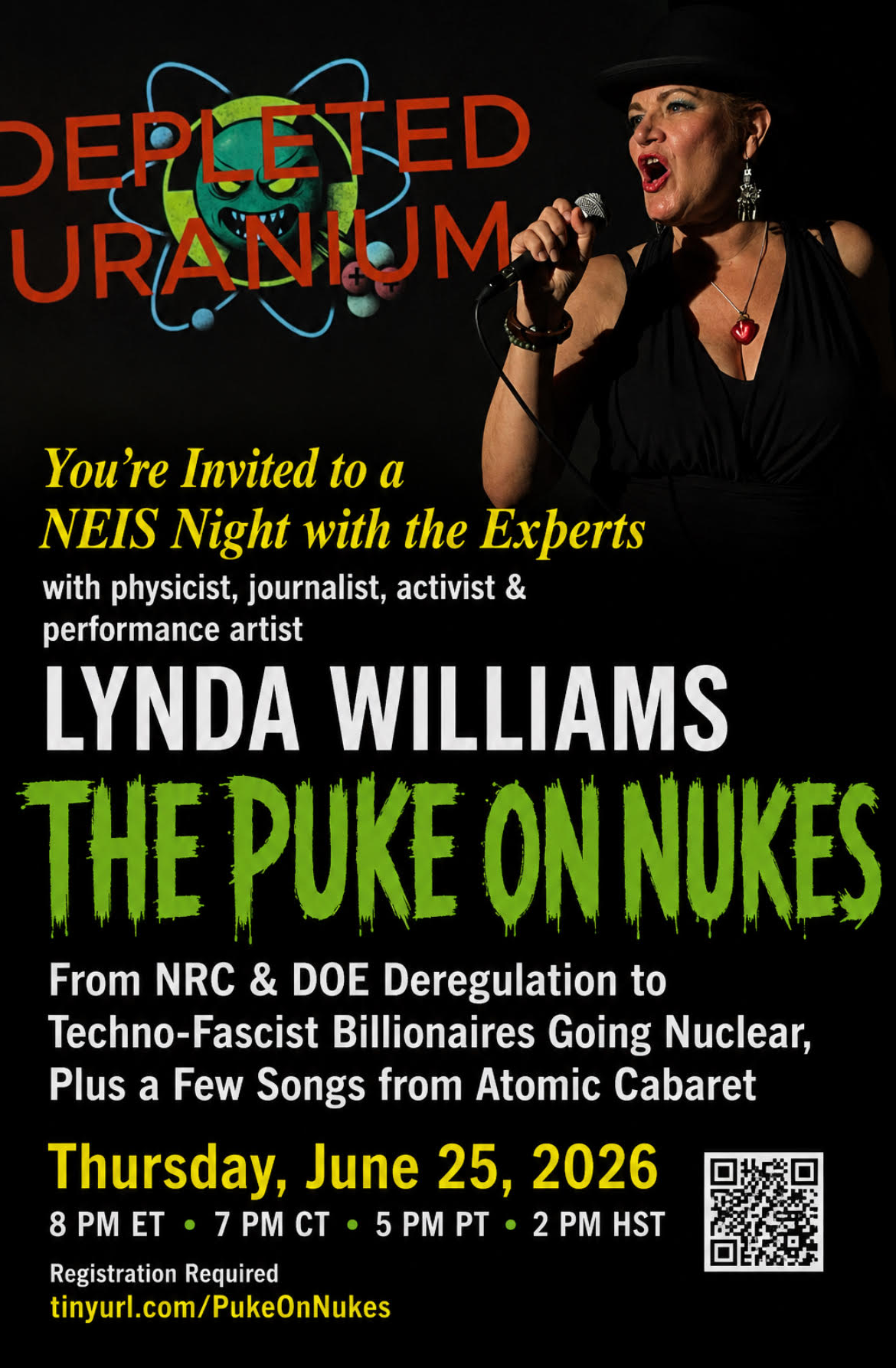
25 June- THE PUKE ON NUKES
Thursday, June 25, 2026
7pm Central Time (8pm ET, 6pm MT, 5pm PT) UTC – 5
From NRC & DOE Deregulation to Techno-Fascist Billionaires Going Nuclear, Plus a Few Songs from Atomic Cabaret REGISTER
26 June – Radiation Trainwreck at the NRC / Join the Protect Better Campaign – https://us02web.zoom.us/meeting/register/4ZlZ5_qLSHGiLSCg8FF6Bg#/registration

1st July – Webinar Waste of Space: The Environmental Harm of Military and Civil Space Activity st July, 7 pm

Report Launch Online: We are seeing an increasing exploitation of space for military and commercial purposes. This must change.

Protect Sazan Island from the Trump family! https://secure.avaaz.org/campaign/en/protect_sazan_island_from_the_trump_family_loc/?bqFCVab&v=174511&cl=22707147157&_checksum=5e9dde668860e8231c33699735e16a1fbf22ab2cb01da50c999fe8732b9775ef&utm_source=email&utm_medium=blast_email&utm_campaign=174511


Cuba Is Not a Failed State – It Is a Besieged State
PETITION: “Global Appeal to Endorse Palestinian Right of Return of Refugees”
To see nuclear-related stories in greater depth and intensity – go to https://nuclearinformation.wordpress.com
-
Archives
- June 2026 (241)
- May 2026 (306)
- April 2026 (356)
- March 2026 (251)
- February 2026 (268)
- January 2026 (308)
- December 2025 (358)
- November 2025 (359)
- October 2025 (376)
- September 2025 (257)
- August 2025 (319)
- July 2025 (230)
-
Categories
- 1
- 1 NUCLEAR ISSUES
- business and costs
- climate change
- culture and arts
- ENERGY
- environment
- health
- history
- indigenous issues
- Legal
- marketing of nuclear
- media
- opposition to nuclear
- PERSONAL STORIES
- politics
- politics international
- Religion and ethics
- safety
- secrets,lies and civil liberties
- spinbuster
- technology
- Uranium
- wastes
- weapons and war
- Women
- 2 WORLD
- ACTION
- AFRICA
- Atrocities
- AUSTRALIA
- Christina's notes
- Christina's themes
- culture and arts
- Events
- Fuk 2022
- Fuk 2023
- Fukushima 2017
- Fukushima 2018
- fukushima 2019
- Fukushima 2020
- Fukushima 2021
- general
- global warming
- Humour (God we need it)
- Nuclear
- RARE EARTHS
- Reference
- resources – print
- Resources -audiovicual
- Weekly Newsletter
- World
- World Nuclear
- YouTube
-
RSS
Entries RSS
Comments RSS
 nuclear-news