UK Government unveils biggest nuclear expansion in 70 years
Jemma Dempsey – BBC News, Thu, 11 January 2024
The government hopes to boost the nuclear power industry with the biggest expansion of the sector in 70 years.
A new large scale nuclear plant would quadruple supplies by 2050, which the government claims would lower bills and improve energy security.
It also said its £300m ($382.6m) nuclear fuel programme would reduce reliance on overseas supply.
But the Association for Renewable Energy and Clean Technology (REA) said all clean energy needed fast-tracking.
Nuclear power currently provides around 15% of the UK’s electricity but many of the country’s aging reactors are due to be decommissioned over the next decade.
The government’s Civil Nuclear Roadmap is intended to bolster the UK’s energy independence by exploring a new site for another nuclear power station of the size and scale of the £30bn plants under construction at Hinkley Point in Somerset and committed to Sizewell in Suffolk.
Industry sources have told the BBC the leading candidates would include Wylfa in Anglesea or Moorside in Cumbria.
“Dragging their feet”
But progress is could be slow – from planning to “power on” can take nearly 20 years. Consultations for Sizewell took 10 years alone and building work there is yet to start, because of ongoing protests………………………………………………………………… https://au.news.yahoo.com/government-unveils-biggest-nuclear-expansion-013230324.html
Outrage as Government admits it kept medical results on nuke test veterans a ‘state secret’ in a move Tory grandee Sir John Hayes said ‘beggars belief’

Daily Mail, By EIRIAN JANE PROSSER , 8 January 2024 |
The Government has admitted it has kept medical results of military veterans who survived British nuclear tests a state secret, prompting a furious outrage.
Blood and urine samples from servicemen, civilians and indigenous people during the Cold War are among the thousands of personal records being held in a move that Tory grandee Sir John Hayes slammed as ‘beggars belief’.
The confidential documents could reveal whether those made to witness the atomic bomb tests had radiation enter their body, which could lead to a huge payout for veterans if they can prove the health consequences.
Prime Minister Rishi Sunak is now facing calls for the files to be made public. Previously the Ministry of Defence denied it held the records, until the Mirror revealed a cache of 150 documents discussing blood tests last year.
Reacting to the revelation MP Sir Hayes said: ‘It beggars belief that a diagnostic medical test confirming whether or not radiation entered a person’s body, with possible long-term health consequences, is in any way a state secret.
‘Veterans and survivors of this weapons testing have a legal and moral right to know what if anything happened to their bodies as a result, and I am sure they can be disclosed to individuals without any impact on national security.’
The Mirror reported that in 2018 the Ministry of Defence denied that the Atomic Weapons Establishment (AWE) holds any evidence that blood samples were taken at nuclear tests until it rowed back on the claim in 2023.
Freedom of Information requests by the paper revealed how both blood and urine samples were taken at test sites under a Lord Chancellor’s instruction, which is why the documents could be held from the National Achieves
Culture minister John Whittindale admitted to Parliament the withholding of such documents is down to various factors including national security, security against possible terrorist activity and international relations.
He also said ‘the risk of proliferation of nuclear weapons or to allow a more detailed review’ are also reasons to retain the files.
The files are said to relate to three nuclear tests in Australia that took place in 1957 dubbed Operation Antler.
One of the files, seen by the Mirror, is said to have been entitled ‘nuclear test veterans’ and were said to have first been hidden when Tony Blair came to power in 1997.
The AWE has been asked to confirm how many other records were also hidden in similar fashion, with Labour leader Keir Starmer pledging to give veterans and their families affected their records and compensation if they take office.
Those affected by the testing were previously asked to come forward by law firm McCue Jury & Partners, with managing partner Jason McCue stating that nuclear veterans had been ‘gaslighted by the British state’. ………………………………………………………………………………..
Nearly £21,000 has now been raised to help nuclear veterans sue the Government for ‘the toxic legacy of trauma and illness they have been left to endure’.
Servicemen were ordered to sail or crawl through the radioactive fallout to test the effects of radiation, as well as fly through mushroom clouds on sampling missions.
Many lived on testing sites for a year or more and when they returned began developing rare blood disorders and cancers, often proving fatal.
Their wives had three times the normal rate of miscarriages and their children suffered 10 times the normal rate of birth defects.
The British government carried out hundreds of explosions of atom bombs, fissile material, trigger devices and thermonuclear weapons in the US, Australia and South Pacific following the Second World War…………………….. more https://www.dailymail.co.uk/news/article-12936311/government-outrage-medical-results-nuke-text-secret.html?fbclid=IwAR284fF3V4h_LgFtbGW5W6CP_Ux9ZNHvgRtT87fif8uzKQgVrgjNIf2uIrw
Touting a ‘new age of nuclear fusion’

West Burton, a sprawling site that is also home to a gas-fired station,
has been chosen as the location for a nuclear fusion plant that the
government aims to have in operation by 2040.
It is an ambitious plan.
Fusion has been the next big thing in energy since the 1950s, but it still
faces big technical obstacles to becoming a reality. It also will be a race
against a big field of international rivals.
The largest developed
economies, in particular the United States and Japan, are pouring billions
into fusion research, as are a gaggle of deep-pocketed technology
billionaires.
Before Brexit, Britain was a leading member of a
multinational effort spearheaded by the European Union. The West Burton
plan represents it striking out on its own.
It will not be a small
undertaking. Paul Methven, the executive in charge of the project, says it
is too early to estimate the likely cost, but suggests that the plant and
its associated infrastructure will be of a similar size to Hinkley Point C,
the nuclear power station being built in Somerset by EDF. That scheme’s
latest budget estimate is £33 billion.
Times 7th Jan 2024
Challenging questions concerning UK’s Geological Disposal Facility (GDF)Test of Public Support.

Nuclear Waste Services (NWS), the division of the taxpayer-funded Nuclear
Decommissioning Authority, charged with identifying a location for a
Geological Disposal Facility (GDF) into which Britain’s legacy and future
high-level radioactive waste will be deposited, has stated that the two
criteria that will determine the location are – the availability of
sufficient ‘suitable’ geology and the consent of a ‘willing
community’.
Three ‘Search Areas’ are known to be under consideration
for the GDF – Theddlethorpe on the East Lincolnshire coast and Mid and
South Copeland on the West coast of Cumbria.
According to the government
and industry guidance that governs the conduct of this investigation,
whether such consent exists will ultimately be determined by a Test of
Public Support amongst the members of the Potential Host Community (PHC).
The timing of the test is down to the Relevant Principal Local Authorities
(RPLAs) – Cumberland Council in Cumbria and Lincolnshire County Council
and East Lindsey District Council in Lincolnshire, but its nature and the
participants in it are determined by the Community Partnerships that have
been established supposedly to provide stakeholder oversight to the
process.
Whether the test is then carried out by the RPLAs, NWS staff or
both is not specified, but if the result is negative, NWS are required to
withdraw the area from further consideration.
NFLA 2nd Jan 2024
UK’s Nuclear Waste Service (NWS) to grant £millions to the 3 Community Partnerships, to seek a site for nuclear waste dump.

In Phase 1, Community Investment Funding of up to £1 million per annum is
made available by Nuclear Waste Services (NWS) to each of the three
Community Partnerships currently engaged in the siting process for a
Geological Disposal Facility (GDF).
Where a Community Partnership / Search
Area is taken forward into Phase 2, involving the commencement of borehole
investigations, this sum will increase to £2.5 million per annum.
A decision on which two Search Areas will be taken forward is anticipated in
2026. The grants can be used to fund projects, schemes or initiatives
benefiting the community of each Search Area that: provide economic
opportunities, enhance the natural and built environment, or improve
community wellbeing. Each Community Partnership can also agree its own
criteria for awards based on local circumstances.
A Freedom of Information
request was submitted to NWS with a short question set which was identical
for each of the Community Partnerships. The responses received from NWS
follow.
NFLA 5th Jan 2024
BBC Panorama to feature RAF Lakenheath nuclear weapons saga- BBC Two on Thursday, January 18
A new BBC Panorama documentary is set to look into the ongoing saga around
nuclear weapons potentially being stored at RAF Lakenheath. Fears have been
mounting that the north Suffolk airbase is set to host nuclear weapons for
the first time in 16 years. The first US nuclear bombs arrived on British
soil in September 1954, and several sources confirmed the withdrawal of the
weapons from Lakenheath in 2008. Panorama’s senior foreign affairs
correspondent Jane Corbin will speak to campaigners in Suffolk in the
documentary that is set to air on BBC Two on Thursday, January 18.
East Anglian Daily Times 6th Jan 2024
https://www.eadt.co.uk/news/24031890.bbc-panorama-feature-raf-lakenheath-nuclear-weapons-saga/
Hinkley Point C proposes new wetland reserve to protect fish from cooling system

Pippa Neill, https://www.endsreport.com/article/1856616/hinkley-point-c-proposes-new-wetland-reserve-protect-fish-cooling-system. 05 Jan 2024
The developers of the Hinkley Point C nuclear power station are asking the public for views on plans to create more than 320 hectares of saltmarsh habitat on the river Parrett in Somerset, which it says will act as a natural alternative to installing an acoustic fish deterrent.
Under a previous proposal, French energy firm EDF Energy was planning to install an acoustic fish deterrent (AFD) system to keep some fish species away from the power station’s cooling water system.
This system would have used 280 speakers to make noise louder than a jumbo jet, 24 hours a day for 60 years. However EDF said there were “significant issues” associated with the installation, namely that installing and maintaining the sound projectors underwater would present risks to divers and offshore works.
In August last year, the Environment Agency approved an amendment to the permit allowing the firm to remove this AFD system from the plans.
Campaigners have warned that the removal of the AFD could “decimate” fish stocks. A report published in 2021 by the Hinkley Point C stakeholder reference group, an expert panel which advises the Welsh government on the development of the new power station, estimated that without AFDs, 182 million fish would be caught by the system annually, “and it is likely that many of these will not survive”.
The firm has said that the proposed saltmarsh will help wildlife and the environment around the Severn estuary by providing breeding grounds for fish and providing food and shelter for birds and animals. The plans are being developed with Natural England, Natural Resources Wales and the Environment Agency.
It also said that Hinkley Point C is “still the first power station in the area to have any fish protection measures in place – including a fish recovery and return system and low velocity water intakes. Power stations have been taking cooling water from the Bristol Channel for decades with no significant impact on fish populations”.
In March, the Environment Agency issued three new permits linked to the Sizewell C nuclear plant in Suffolk, despite concerns that the approved cooling system and lack of fish deterrent device could result in “thousands of fish dying every day”.
Chris Fayers, head of environment at Hinkley Point C, said: “The new wetland would be a fantastic place for wildlife and a beautiful place to visit. Using natural and proven ways to improve the environment is better than creating 60 years of noise pollution with a system that is untested far offshore in the fast-flowing waters of the Severn.
“Hinkley Point C is one of Britain’s biggest acts in the fight against climate change and its operation will provide significant benefits for the environment”.
The proposals for habitat creation and other changes to Hinkley Point C’s design, such as alterations to the way the power station will store spent fuel, will be included in a public consultation launching on 9 January.
Nuclear Free Local Authorities (NFLAs) call upon nuke cops chief to issue statement on ‘toxic’ Sellafield allegations

Following the disturbing revelations in The Guardian that a ‘toxic’
workplace culture exists within the Civil Nuclear Constabulary, the Nuclear
Free Local Authorities Chair has written to the force’s Chief Constable
‘offering him the opportunity’ to issue a statement.
The Guardian
published its allegations on 6 December, and this article included a
comment from Chief Constable Chesterman who said that he has ‘made it
clear that anyone holding misogynistic, racist, homophobic, or other
unacceptable views, or who carries out behaviour that breaches our
standards of professional conduct, has no place in the CNC.’
NFLA 3rd Jan 2024
Nuclear weapons test treaty fears sink plans for major wind farm
UK Ministry of Defence objected to 315MW array over fears nuclear monitoring station would be affected by vibrations
5 January 2024 By Cosmo Sanderson , Recharge,
The UK’s obligations to monitor nuclear weapons testing have helped scupper a proposal for a Scottish wind farm over fears it could affect a nearby monitoring station.
The Scottish government rejected a proposal from British developer Community Windpower for a planned 315MW array made up of 45 turbines near the border with England last month.
The reasons for this included the potential impact of the wind farm on the nearby Eskdalemuir Seismic Array, a seismological monitoring station that forms part of the UK’s obligations under a multilateral treaty to ban nuclear weapons testing…………..(Subscribers only) more https://www.rechargenews.com/wind/nuclear-weapons-test-treaty-fears-sink-plans-for-major-wind-farm/2-1-1579329
A ‘natural alternative’ plan for protecting fish from Hinkley nuclear station’s cooling system
Plans for a salt marsh near a nuclear power station have been proposed as
a “natural” alternative to protect fish from its cooling systems.
Campaigners had called for changes amid fears Hinkley Point C’s cooling
tunnels could kill millions of fish. EDF Energy said it would carry out a
consultation on its proposal for the 800 acres of wetland near Bridgwater.
Chris Fayers from Hinkley Point C said it would be a natural alternative to
installing an acoustic fish deterrent.
The deterrent system would have used
280 speakers to make noise “louder than a jumbo jet” 24-hours a day for 60
years. The alternative plans for the wetland, being developed with Natural
England, Natural Resources Wales and the Environment Agency, are expected
to create new habitats for fish and animals, improve local water quality
and help prevent flooding.
BBC 5th Jan 2024
A Visit to Belmarsh Prison, Where Julian Assange Awaits His Final Appeal Against Extradition to the US

The Wikileaks founder says he fears his own imprisonment, US government surveillance, and restrictions on the group’s funding have effectively scared off potential whistleblowers.
The Nation, CHARLES GLASS, 2 Jan 24
MP BELMARSH—It is 2:30 PM on Wednesday, December 13, when Julian Assange strides into the visitors’ area. He stands out in the column of 23 prisoners for his height—6′ 2″—and flowing white locks with trimmed beard. He squints, looking for a familiar face among the wives, sisters, sons, and fathers of the other inmates. I am waiting, as assigned, at D-3, one of about 40 sets of small coffee tables surrounded by three upholstered chairs—two blue, one red—screwed into the floor of what looks like a basketball court. We spot each other, walk forward, and embrace. It is the first time I have seen him in six years. I blurt, “You’re pale.” Through a mischievous smile I remember from past meetings, he jokes, “They call it prison pale.”
He has not been outdoors—apart from a minute when police dragged him into a paddy wagon—since he took refuge in London’s cramped Ecuadorian Embassy in June 2012. The embassy’s French windows had afforded glimpses of sky. Here at Belmarsh maximum security prison in southeast London, his abode since April 11, 2019, he has not seen the sun. Warders confine him to a cell for 23 out of every 24 hours. His single hour of recreation takes place within four walls, under supervision. His paleness is best described as deathly……………………………………………………………………………………………………………………………..
Julian and I sit down, face to face, me on the red chair, he on one of the blues. Above us, glass globes hide cameras that record the interactions between inmates and their guests.
…………………………. Julian had thought prison meant communal meals at long tables, as in the movies. Belmarsh’s warders shove the food into the cells for prisoners to eat alone. It is hard to make friends that way. He has been there longer than any other prisoner apart from an old man who had served seven years to his four and a half. There are occasional suicides, he tells me, including one the night before.
……………………………… I ask whether he still has the radio he had struggled to obtain in his first year. He did, but it was not working due to a defective plug. Regulations permit each prisoner to have a radio purchased from prison stores. The authorities, however, said no radios were available for him. When I heard about it, I sent him a radio. It was returned. I then sent him a book on how to make a radio. That too was returned………………………………………………………………
How did he, a news addict, keep in touch? The prison allows him to read printouts of news stories, and friends write to him. With the invasions of Ukraine and Gaza, I say, now is an important time for whistleblowers to send documents to WikiLeaks. He regrets that WikiLeaks is no longer able to expose war crimes and corruption as in the past. His imprisonment and US government surveillance and restrictions on WikiLeaks’ funding wards off potential whistleblowers. He fears that other media outlets are not filling the vacuum.
Belmarsh does not offer him education programs or communal activity, like orchestra practice, sports, or publishing a prison journal, that are standard at many other prisons. The regime is punitive; although Belmarsh’s 700-odd inhabitants are on remand, awaiting trial or appeal. They are Category A prisoners, those who “pose the most threat to the public, the police or national security” and stand accused of terrorism, murder, or sexual violence.
We talk about Christmas, which is just another day in Belmarsh: no turkey, no carols, no presents. The prison is closed to visitors on Christmas Day and the day after, and the prison has informed his wife, Stella Moris, that she and their two young sons, Gabriel and Max, may not see him on Christmas Eve. He can attend Catholic Mass celebrated by the Polish chaplain, who has become a friend.
………….Apart from occasional visiting days, his days are all the same: the confined space, the loneliness, the books, the memories, the hope that his lawyers’ appeal against extradition and life imprisonment in the United States will succeed……….. https://www.thenation.com/article/activism/julian-assange-wikileaks-belmarsh-prison/
UK Nuclear Output Slumps to 42-Year Low
- More reactors are due to be decommissioned in a few years
- EDF has warned of delays to its new Hinkley Point plant
Bloomberg, By Rachel Morison, January 3, 2024
Power output from the UK’s nuclear power plants slumped to the lowest in more than four decades last year, potentially increasing a reliance on fossil fuels that will make it more difficult to reach the nation’s net zero emissions target.
Output shrank to about 37 terawatt-hours after two stations closed, dropping below 40 terawatt-hours for the first time since the early 1980s, according to data from the government and the UK unit of Electricite de France SA. …the country’s current fleet of five nuclear plants scheduled to shrink to just three by the end of 2026,…
The UK, which has a target to reach net zero emission by the middle of this century, wants to build as much as 24 gigawatts of new nuclear capacity by that time. The government is due to publish a roadmap on how it intends to achieve that ambitious target.
But construction takes many years and is often beset by cost overruns and delays. To reach the goal, developers would need to add 16 gigawatts in the next decade at a cost of more than £150 billion ($190 billion), according to estimates from Aurora Energy Research.
“With revenues materializing around a decade after the Final Investment Decision, this generally makes nuclear a very different investment case to banks compared to other low-carbon generation technologies, one which fewer lenders are willing to consider,” said Ashutosh Padelkar, senior associate at Aurora. “It would be extremely challenging if not impossible to deliver 24 gigawatts of nuclear capacity by 2050 without the government taking most of the burden.”…………
Most of the current atomic fleet is reaching the end of it’s operating life. EDF has spent about £7.5 billion on life extensions and maintenance since 2009, when it acquired the current fleet.
EDF’s Hinkley Point C is the first project to be constructed in more than three decades. Startup of its two reactors is due in 2027 and 2028, though the utility has warned that may be pushed back by more than a year. https://www.bloomberg.com/news/articles/2024-01-03/uk-nuclear-output-slumps-to-42-year-low-in-threat-to-net-zero?embedded-checkout=true
EDF using Pontins Brean Sands has ‘big determinantal impact’ on local economy, tourism firm fears
It is unclear when the site will return to
being a holiday park. The continued use of Pontins Brean Sands to house
hundreds of Hinkley Point C workers is reportedly having a “big
determinantal impact” on the local economy, according to one tourism firm.
Up to 900 staff from Hinkley Point C have been living at Pontins Brean
Sands and are expected to be there across 2024 and perhaps beyond. The
holiday resort has seen a massive refurbishment of the chalets worth around
£2 million, which saw new kitchens, bathrooms, furniture, TVs, and new
Wi-Fi access installed. Yet Discover Brean has hit out at the continued use
of the site to Hinkley Point C workers and noted its impact on the local
economy and nearby traders.
Somerset Live 3rd Jan 2023
https://www.somersetlive.co.uk/news/somerset-news/edf-using-pontins-brean-sands-9009354
‘Renewable surge powers all UK homes in 2023’
Renewable electricity production in the UK reached a significant milestone
in 2023, generating more than 90 terawatt hours (TWh) of power from wind,
hydro and solar sources. This amount surpasses the energy needed to power
all of the UK’s 28 million homes.
Energy Live News 2nd Jan 2024
Backing the wrong horse: Government doubles Sizewell C funding on nuclear bad news day
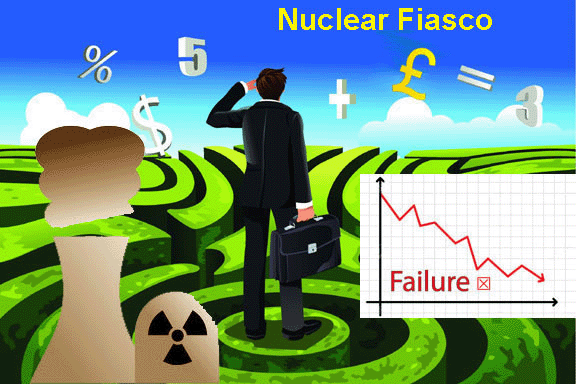
Given the Hinkley debacle, the NFLAs regret that Mr Bowie did not put his shovel to good use by burying the Sizewell project, but instead, like many reckless gamblers, Ministers and senior civil servants at the Department of Energy Security and Net Zero have chosen to blow more taxpayers’ money on a losing prospect, doubling their bet on Sizewell C to £2.5 billion.
The UK/Ireland Nuclear Free Local Authorities were incredulous to learn that government ministers chose to back Sizewell C with a further £1.3 billion of public money on the same day (23 January) French nuclear operator EDF announced that Sizewell’s older twin sister, Hinkley Point C, would begin operating even later and at an even greater cost.
The public relations team handling Hinkley Point C announcements at EDF Energy must have a thankless task as theirs is seemingly a role that involves continually dispensing bad news. Yesterday’s https://www.edf.fr/en/the-edf-group/dedicated-sections/journalists/all-press-releases/hinkley-point-c-update-1 took the biscuit (though whether the PR team could console themselves with any given the state of the corporate finances is debatable; humble pie maybe?)
In the latest in a long litany of gloomy announcements portending further cost and delivery overruns, the company has now advised that the expected cost of delivering Hinkley Point C has increased by anything from £5-9 billion (your guess is as good as theirs) or ultimately between £31 and £35 billion. But this is based on 2015 estimates, so with inflation the bill might run to £46 billion at today’s prices. And the anticipated year in which Reactor 1 might start generating has slipped from the summer of 2027 to sometime never in 2029, with Reactor 2 coming online about one year later (or maybe not).
Interestingly our friends in Stop Sizewell report that Nuclear Minister Andrew Bowie told them recently on his whistlestop visit to Suffolk, bearing a ceremonial shovel, that Hinkley would come online in the late 2020s or early 2030s, and even the Telegraph and Guardian have reported that the plant will not be operational until the next decade.
Rather unconvincingly EDF claims that ‘The project continues to capitalise on the experience gained from construction of the 4 other EPRs around the world’ which is hardly encouraging as Taishan-1 in China experienced a serious accident which led to its shutdown for many months; Flamanville-3 in France, started in 2007 and expected to commence generation in 2012, is only now about to start loading fuel after an unhappy history of faults and compromised quality control; and Olkiluoto-3 in Finland, begun in 2005 with a start date of 2010, was only finished last year after a prolonged construction period which included a bitter contractual dispute about the apportionment of the massively spiralling costs, followed by a corporate bankruptcy.
Given the Hinkley debacle, the NFLAs regret that Mr Bowie did not put his shovel to good use by burying the Sizewell project, but instead, like many reckless gamblers, Ministers and senior civil servants at the Department of Energy Security and Net Zero have chosen to blow more taxpayers’ money on a losing prospect, doubling their bet on Sizewell C to £2.5 billion.
Clearly, DESNZ is unaware that lumbering nuclear white elephants are not the best runners to back in a race, and that renewables, provided with equal financial encouragement, will romp home by a mile every time. Given its latest foolhardy behaviour, the NFLAs now venture to suggest that DESNZ be once more swiftly renamed – this time to the Department of No Energy and Zero Sense.
1 This Month

of the week – THE ONENESS of HUMANITY
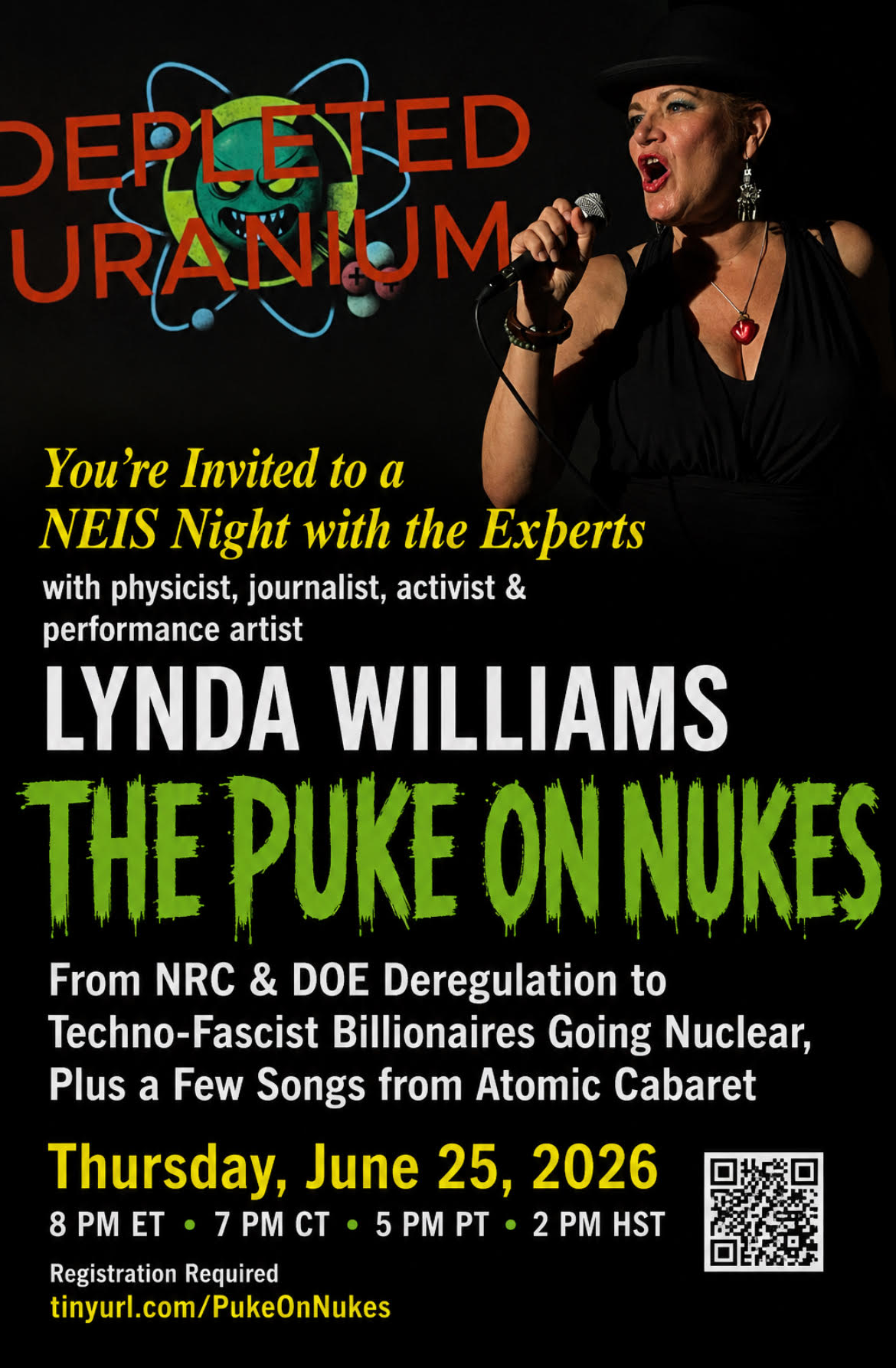
25 June- THE PUKE ON NUKES
Thursday, June 25, 2026
7pm Central Time (8pm ET, 6pm MT, 5pm PT) UTC – 5
From NRC & DOE Deregulation to Techno-Fascist Billionaires Going Nuclear, Plus a Few Songs from Atomic Cabaret REGISTER
26 June – Radiation Trainwreck at the NRC / Join the Protect Better Campaign – https://us02web.zoom.us/meeting/register/4ZlZ5_qLSHGiLSCg8FF6Bg#/registration

1st July – Webinar Waste of Space: The Environmental Harm of Military and Civil Space Activity st July, 7 pm

Report Launch Online: We are seeing an increasing exploitation of space for military and commercial purposes. This must change.

Protect Sazan Island from the Trump family! https://secure.avaaz.org/campaign/en/protect_sazan_island_from_the_trump_family_loc/?bqFCVab&v=174511&cl=22707147157&_checksum=5e9dde668860e8231c33699735e16a1fbf22ab2cb01da50c999fe8732b9775ef&utm_source=email&utm_medium=blast_email&utm_campaign=174511


Cuba Is Not a Failed State – It Is a Besieged State
PETITION: “Global Appeal to Endorse Palestinian Right of Return of Refugees”
To see nuclear-related stories in greater depth and intensity – go to https://nuclearinformation.wordpress.com
-
Archives
- June 2026 (241)
- May 2026 (306)
- April 2026 (356)
- March 2026 (251)
- February 2026 (268)
- January 2026 (308)
- December 2025 (358)
- November 2025 (359)
- October 2025 (376)
- September 2025 (257)
- August 2025 (319)
- July 2025 (230)
-
Categories
- 1
- 1 NUCLEAR ISSUES
- business and costs
- climate change
- culture and arts
- ENERGY
- environment
- health
- history
- indigenous issues
- Legal
- marketing of nuclear
- media
- opposition to nuclear
- PERSONAL STORIES
- politics
- politics international
- Religion and ethics
- safety
- secrets,lies and civil liberties
- spinbuster
- technology
- Uranium
- wastes
- weapons and war
- Women
- 2 WORLD
- ACTION
- AFRICA
- Atrocities
- AUSTRALIA
- Christina's notes
- Christina's themes
- culture and arts
- Events
- Fuk 2022
- Fuk 2023
- Fukushima 2017
- Fukushima 2018
- fukushima 2019
- Fukushima 2020
- Fukushima 2021
- general
- global warming
- Humour (God we need it)
- Nuclear
- RARE EARTHS
- Reference
- resources – print
- Resources -audiovicual
- Weekly Newsletter
- World
- World Nuclear
- YouTube
-
RSS
Entries RSS
Comments RSS
 nuclear-news