Work officially ‘started’ at Sizewell C Nuclear on Monday – but it was really only political theatre.

Ipswich Star, By Paul Geater 18 Jan 24
This week we had big fanfares and a major ceremony to “mark the start” of construction at Sizewell C.
But what did it all mean?
In one sense construction has already started. Land has been dug up, mature trees have been cut down, and one of the new entrances to the site is being cleared.
However, the Final Investment Decision (FID), the point at which the various parties are committed to building the station is still, apparently, several months away – so Monday’s ceremony really does look like nothing but a piece of political theatre.
What is clear, though, is that there is clear political will for this project to go ahead. The Government and the official opposition are both committed to it whatever the cost they may be exposed to.
I can understand that. I still don’t think it makes a great deal of economic sense – but given the uncertainties across the globe and the need to move to carbon zero energy I can see why they want to proceed with nuclear whatever the cost.
Personally I don’t have any concerns about the potential safety of the plant – while there are potential dangers with nuclear generation the experience over the last 60 years in this country suggests it can be operated safely.
And given that there are already two nuclear plants at Sizewell that need to be protected from the sea, it doesn’t seem unreasonable to put the new plant next to them so the protection can be shared.
I still have serious concerns with EDF and the government – who must be seen as equal partners in the project – over the way it is going to be built and the devastating impact it will have on local communities.
By adopting a “bull in a china shop” attitude towards its construction, EDF and the government are planning to cause substantial environmental damage to some of the most precious parts of the Heritage Coast that are closely linked in with Minsmere and Dunwich Heath……………………………………
Creating a new nature reserve two miles inland is great – but it can’t replace a massive area that’s directly linked to the coast.
But I fear that battle is lost now. With both the current government and the likely future government keen on the project, the best we can hope for is that some new habitats will make up for the lost treasures………………….
There’s also been a failure to really engage with local people. There have now been local community forums set up but they are being treated with suspicion by many. https://www.ipswichstar.co.uk/news/24054795.opinion-sizewell-c-still-doesnt-engage-residents/
The Times asks “Are big nuclear reactors really the right thing for the UK?

Nuclear minister Andrew Bowie had a case to hail it a “major
milestone”, with Julia Pyke, Sizewell’s joint managing director,
calling it a “significant moment” for the project and for UK “energy
security”.
Even so, there is still a long way to go. The project will
cost £30 billion-plus, with the PM yet to make a final investment
decision. Sizewell uses the same European pressurised reactor technology as
Hinkley: the Somerset nuke being built by France’s EDF and China’s CGN.
Who exactly will fund Sizewell? Alison Downes, of the Stop Sizewell C
campaign, is no neutral party. But she’s right to say the government is
“still months away” from securing finance, while keeping “secret”
the project’s “enormous cost”.
Bowie told the Financial Times he was
“very confident” of obtaining private finance, but the government is
now rowing back from the FT report that it’s “on track” to raise £20
billion. Even if it has changed the funding rubric to a “regulated asset
base” model that frontloads cost overruns on to consumer bills, investors
think that figure wildly optimistic. On a one third/two thirds split,
ministers need at least £10 billion of equity and £20 billion of debt.
But EDF wants no more than 19.9 per cent of Sizewell equity, while the UK
has booted off the Chinese. Ministers have reportedly lined up Abu Dhabi
funds for a chunk of the equity. But market talk is that the government is
still at least £5 billion short, while it also faces having to underwrite
all the debt — at least until it can syndicate some out once construction
hurdles are met.
Is this the best use of taxpayer’s money? And what’s
the risk private investors are given too generous terms? Yes, the wind
doesn’t blow or sun shine every day. So Britain will need baseload power
to offset intermittent renewables.
But, even if Sizewell C gets the
official go-ahead soon, it won’t be generating power until the late
2030s. A third station will be even further behind. Labour’s union
backers are typically pro-nuclear. But should Sir Keir Starmer come to
power, he must still tackle key questions. Are pricey mega nukes, largely
funded by the taxpayer and consumers, the right strategic bet for 2040? Or
do battery power, say, or modular nuclear reactors make more sense? The
government is yet to make a conclusive financial case for Sizewell C —
let alone any more.
Times 16th Jan 2024
https://www.thetimes.co.uk/article/sizing-up-sizewell-is-a-nuclear-option-fwpd2p53d
Sizewell C opponents warn Suffolk nuclear plant ‘could be the new HS2’.
Sizewell C opponents warn Suffolk nuclear plant ‘could be the new HS2’.
Campaigners fighting a new nuclear power station on the Suffolk coast say
they fear a shortfall in finance for the project could mean it becomes
another HS2. Their comments came amid a landmark moment for the building of
Sizewell C as a Development Consent Order was triggered, meaning
construction can begin. Andrew Bowie, the minister for nuclear and
renewables, was at the construction site to herald what he claimed was a
significant point in the development. The new power plant, which could
create 10,000 jobs, was given the go-ahead in November – but campaigners
opposed to it say they will not give up.
ITV 15th Jan 2024
https://www.itv.com/news/anglia/2024-01-15/coastal-nuclear-plant-could-be-new-hs2-warn-campaigners
lear plant ‘could be the new HS2’.
Bypassing Parliament: Westminster, the Royal Prerogative and Bombing Yemen
Australian Independent Media, January 16, 2024, by: Dr Binoy Kampmark
There is something distinctly revolting and authoritarian about the royal prerogative. It reeks of clandestine assumption, unwarranted self-confidence and, most of all, a blithe indifference to accountability before elected representatives. That prerogative, in other words, is the last reminder of divine right, the fiction that a ruler can have powers vested by an unsubstantiated deity, the invisible God, and a punishing force beyond the reach of human control. It is anathema to democracy, a stain on republican models of government, a joke on any political system that has some claim on representing what might be called the broader citizenry.
On January 11, the UK government, in league with the United States with support from a number of other countries, attacked Houthi positions in Yemen. The decision had been made without recourse to Parliament and justified by Article 51 of the UN Charter as “limited, necessary and proportionate in self-defence.”
In his statement on the attacks, Prime Minister Rishi Sunak pointed to the Houthi’s role in staging “a series of dangerous and destabilising attacks against commercial shipping in the Red Sea, threatening UK and other international ships, causing major disruption to a vital trade route and driving up commodity prices.” He made no mention of the Houthis’ own justification for the attacks as necessary measures to disrupt Israeli shipping and interests in response to their systematic, bloodcurdling razing of Gaza.
Lip service has been paid by the executive within the Westminster system to Parliament’s importance in deciding whether the country commits to military action or not. The stark problem is that the action is always decided upon in advance, and no dissent among parliamentarians will necessarily sway the issue. Motions can be proposed and rejected but remain non-binding on the executive emboldened by the prerogative………………………………………………………………………………………………………..
The Yemen strikes eschew humanitarianism (the humanitarian justifications advanced by the Houthis in protecting Palestinian civilians has been rejected), but shipping interests. The Armed forces minister, James Heappey, was satisfied that an exception to the convention in consulting Parliament had presented itself. “The Prime Minister,” the minister parroted, “needs to make decisions such as these based on the military, strategic and operational requirements – that led to the timing.”
With the horse having bolted merrily out of the stable, Heappey remarked with all due condescension that Parliament would, in time, be able to respond to the decision to strike Yemen. An “opportunity” would be made available “when Parliament returns for these things to be fully discussed and debated.” The sheer redundancy of its role could thereby be affirmed.
Much agitated by this state of affairs, former shadow Chancellor John McDonnell opined that no military action should take place without Parliament’s approval. “If we have learnt anything in recent years it’s that military intervention in the Middle East always has dangerous & often unforeseen consequences. There is a risk of setting the region alight.”
Liberal Democrat Foreign Affairs spokesperson Layla Moran was of the view that Parliament should not be bypassed in matters of war, yet opting for the rather fatuous formula arising out of the 2011 convention. “Rushi Sunak must announce a retrospective vote in the House of Commons on these strikes, and recall Parliament this weekend.”
The use of the royal prerogative in using military force remains one of those British perversions that makes for good common room conversation but offends the sensibilities of the democratically minded elector. A far better practice would be to make the PM of the day accountable to that most essential body of all: Parliament. That same principle would be extended to other constitutional monarchies, which are similarly weighed down by the all too liberal use of the prerogative when shedding blood. If a country’s citizens are to go to war to kill and be killed, surely their elected representatives should have a say in that most vital of decisions? https://theaimn.com/bypassing-parliament-westminster-the-royal-prerogative-and-bombing-yemen/
 | |||
| |||
Inside Bradwell’s Dark Secrets
BANNG’s coordinator, Peter Banks, identifies the radioactive residues
that lurk beneath the shiny cladding of the former Bradwell nuclear power
station in the December 2023 column for Regional Life.
The discoveries of extensive radioactive contamination around the site has triggered the
imperative to keep potential intruders at bay, out of all the shiny
buildings, including the radioactive waste store, and the contaminated
underground labyrinth of tunnels and ducts. How ludicrous would it be to
introduce a new power station next door and go through the whole cycle
again?
BANNG 18th Dec 2023
Bradwell Nuclear – Falling Off the (Road)Map

On the Road(map) to Nowhere! Despite the Government’s recent
re-announcement of a massive expansion of civil nuclear power, the
Blackwater Against New Nuclear Group (BANNG) believes new nuclear at
Bradwell remains dead in the water.
In future new nuclear power stations
will only be sited in ‘suitable locations’ identified by developers
based on a set of criteria. The Government also welcomes ‘responses from
any communities that think they may benefit from the social and economic
opportunities that new nuclear power can deliver’.
Professor Andy Blowers, the Chair of BANNG, commented, ‘This new approach to siting
effectively rules Bradwell out of any further consideration. As we have
strenuously demonstrated over the last fifteen years Bradwell is a most
unsuitable site and the Blackwater communities are overwhelmingly opposed
to nuclear development in such a fragile location, increasingly vulnerable
to the impacts of Climate Change’.
BANNG 12th Jan 2024
Construction to start on Sizewell C nuclear power station amid opposition.
Construction to start on Sizewell C nuclear power station amid opposition.
Construction on the multi-million pound Sizewell C nuclear power station
will start despite local opposition to the plans. The government has signed
a development consent order, meaning that preparation work on the £700
million site such as building fencing and accommodation can start. Andrew
Bowie MP, Minister for Nuclear and Renewables, will visit the site in
Suffolk today where he is expected to be met with peaceful protests which
have been organised by local campaign groups who are opposed to the
project. The final stage of the project, the Final Investment Decision,
will be announced later this year.
ITV 15th Jan 2024
https://www.itv.com/news/anglia/2024-01-15/construction-on-700-million-nuclear-power-station-starts
BBC 15th Jan 2024
https://www.bbc.co.uk/news/uk-england-suffolk-67973566
Sizewell C campaigners hold peaceful demonstration as government minister
Andrew Bowie visits. Two campaign groups opposed to the building of a
nuclear power plant near the Suffolk coast are to hold a peaceful protest
this morning. Stop Sizewell C and Together Against Sizewell C will be
demonstrating at the site entrance from 8.45am to 9.30am. Energy minister
Andrew Bowie is visiting to prompt a Development Consent Order (DCO) which
campaigners say will take the project to the next step.
Suffolk News 15th Jan 2024
Fresh Trident safety fears as submarines’ ‘life expectancy’ extended repeatedly

NEW concerns have been raised about the safety of Britain’s nuclear
fleet – with two submarines still in action previously predicted to have
been out of commission by this year. Former top government adviser Dominic
Cummings (below) sparked interest in the state of Britain’s nuclear fleet
at the beginning of this month when he revealed he had attempted to secure
assurances the Government would address the “horror show” of the
arsenal in return for his help in Rishi Sunak’s election campaign.
The National 14th Jan 2024
Dissension in the nuclear lobby – it had to happen – Small Nuclear versus Big Nuclear.

Comment. As the UK fumbles its way through its “Civil Nuclear Roadmap” folly, the Rolls Royce lobby paints Hinkley and Sizewell projects as obsolete trash, and touts Rolls Royce’s non existent small reactors as Britain’s energy salvation .
Jeremy Warner: Outsourcing Britain’s nuclear renewal is insanity.
Rolls-Royce’s modular reactors are an obvious way to break free of EDF’s
grip.
Here we go again. Einstein’s definition of insanity is to keep doing
the same thing and expecting different outcomes. You would think that the
Government had learned its lesson on nuclear renewal after the debacle of
Hinkley Point C. Clearly not.
Having already made the same mistake once, by
pledging a replica of the ruinously costly Hinkley at Sizewell on the
Suffolk coast, ministers are doubling down and promising a third such
monstrosity somewhere else.
According to the Government’s “Nuclear
Roadmap”, published last week, another of these leviathans in an as yet
unspecified location is to be given the go-ahead later this year. On the
most recent estimates, Hinkley Point C is expected to cost at least 80pc
more than its original budget and is years behind schedule. Some fear that
it won’t be until the early 2030s before the reactors are fully
operational, such have been the technical and safety complications
encountered in the construction phase.
Ministers have also had to agree to
punishingly expensive output prices to persuade the main developer,
France’s state-controlled EDF, to build in the first place, committing
consumers to high electricity costs for decades to come. So much for the
promise once made by the ever courteous Vincent de Rivaz, the one-time boss
of EDF in Britain, that Hinkley Point would be cooking our Christmas
lunches by 2017.
Even allowing for the learning process – theoretically,
later projects to the same design should cost less, with past mistakes
taken on board – it beggars belief that the Government should attempt to
repeat such a tried and demonstrably poor value for money technology.
Given the experience of Hinkley Point C, why are we still pursuing the hugely
costly, largely obsolete technology of EDF’s gigawatt stations when there
are perfectly viable, but smaller, homegrown alternatives just waiting for
the opportunity to fill the gap? If we are to spend £28bn a year of
taxpayers’ money on going green, as promised by Labour, we should at
least be confident that a large part of the wider economic benefit is
reserved for UK supply chains, and is not instead squandered on supporting
jobs abroad in France, China, Denmark and the US.
Telegraph 13th Jan 2024
https://www.telegraph.co.uk/business/2024/01/13/uk-go-full-nuclear-ensure-solutions-british/
Will Sizewell nuclear project go ahead? Campaigners question the timetable and the funding.

The Government has announced that the timetable for investing in the new
Sizewell C nuclear power station in Suffolk will be revealed before a
general election. However, the campaign group Stop Sizewell C, which is
opposed to the project, said there was still much that was unknown about
whether the project could go ahead, including how the £20bn would be
raised to pay for the station.
A Stop Sizewell C spokesperson said: “From
our extensive discussions with officials it is clear that a Sizewell C
Final Investment Decision (FID) is still some months away and the time
before the next election is running out, for Rishi Sunak hasn’t ruled out a
May poll.
East Anglian Daily Times 12th Jan 2024
https://www.eadt.co.uk/news/24046041.campaigners-say-unknown-whether-sizewell-c-will-proceed/
Nuclear convoys: Blacked-out lorries carry ‘deadly cargo’ through the village

A TINY English village could be top of Putin’s nuclear hitlist, locals
fear. Brize Norton is only a stone’s throw away from the largest station in
the Royal Air Force.
Huge convoys of blacked-out lorries, police riot vans,
ambulances and other trucks regularly rumble through, clogging up the
village’s narrow main road. Locals claim they’ve had guns pointed at them
by cops, and even been forced to pull over to make room for the fleet of
“deadly cargo”.
One video shows parents and kids on the school run having
to stand aside as a convoy with blue flashing lights thunders through,
shaking the walls of surrounding buildings and towering over homes just
metres away. The cargo, widely believed to contain “nuclear material”, is a
key part of Britain’s Trident weapons programme.
The Sun 13th Jan 2024
https://www.thesun.co.uk/news/25310004/brize-norton-nuclear-weapons-putin-oxfordshire-cotswolds/
Hotel near Bridgwater could be repurposed to house Hinkley Point C workers
By Jamie Grover
Bridgwater Mercury 12th Jan 2024
PLANS have been submitted to Somerset Council to request permission for a hotel near Bridgwater and Highbridge to be repurposed in order to house Hinkley Point C workers.
It is proposed that Laburnum Lodges in West Hunstpill would be converted to accommodate workers at the EDF power plant for a minimum of five years, before then resuming usual operations as holiday accommodation.
The news comes after it was recently revealed EDF were once again in talks with Somerset Council to increase the workforce on site, despite an ongoing housing crisis in Bridgwater.
……………………………………………. Cllr Leigh Redman, Bridgwater Town Council spokesperson for Nuclear Issues, said that the original development consent order (DCO) signed by the secretary of state for Hinkley Point C, indicated that at peak, the number of workers on site would be 5,600.
This number was since raised to 8,600 due to the conversion of Pontins in Brean to become an accommodation site for workers at the power plant, which is now full.
There are now over 11,000 workers at Hinkley Point C, and EDF has confirmed its plans to bring in more staff in the near future.
To keep up to date with the application, or for more information, search reference number 52/23/00010 on the Somerset Council website.
Comments are welcomed until Tuesday, February 13, and approval could be given as early as Wednesday, February 14. https://www.bridgwatermercury.co.uk/news/24045404.hotel-near-bridgwater-house-hinkley-point-c-workers/
On the road to nowhere… UK Ministers launch nuclear ‘Roadmap’ in election year
11th January 2024, https://www.nuclearpolicy.info/news/on-the-road-to-nowhere-ministers-launch-nuclear-roadmap-in-election-year/
The UK/Ireland Nuclear Free Local Authorities are dismissive of the UK Government’s announcement today (11 Jan) of a ‘Roadmap’ supposedly outlining the route to undertake ‘the biggest expansion of nuclear power for 70 years’,[1] as another example of blinkered thinking by Ministers who are taking the wrong path to achieve energy security and net zero.
NFLA Chair Councillor Lawrence O’Neill said of the ‘Roadmap’: “Prime Minister Sunak and his ministers seem more like a group of clueless hikers too focused on the endless trail to their nuclear nirvana to see the turning immediately enroute which leads down the renewables path and the truly sustainable electricity future that Britain needs.
“Those with a cynical bent may be inclined to believe that its launch may not be coincidental in what is likely to be an election year as it represents a mantra of aspirations that will appeal to a certain voter base – two pointed references to Churchill are made by Energy Secretary Claire Coutinho in the preamble – but is nonetheless completely unaffordable. How can a vast programme of nuclear new build costing hundreds of billions of pounds be paid for, when the HS2 railway programme was curtailed on grounds of cost?
11th January 2024
On the road to nowhere… Ministers launch nuclear ‘Roadmap’ in election year
The UK/Ireland Nuclear Free Local Authorities are dismissive of the UK Government’s announcement today (11 Jan) of a ‘Roadmap’ supposedly outlining the route to undertake ‘the biggest expansion of nuclear power for 70 years’,[1] as another example of blinkered thinking by Ministers who are taking the wrong path to achieve energy security and net zero.
NFLA Chair Councillor Lawrence O’Neill said of the ‘Roadmap’: “Prime Minister Sunak and his ministers seem more like a group of clueless hikers too focused on the endless trail to their nuclear nirvana to see the turning immediately enroute which leads down the renewables path and the truly sustainable electricity future that Britain needs.
“Those with a cynical bent may be inclined to believe that its launch may not be coincidental in what is likely to be an election year as it represents a mantra of aspirations that will appeal to a certain voter base – two pointed references to Churchill are made by Energy Secretary Claire Coutinho in the preamble – but is nonetheless completely unaffordable. How can a vast programme of nuclear new build costing hundreds of billions of pounds be paid for, when the HS2 railway programme was curtailed on grounds of cost?
“Despite several academic reports having been published in recent months outlining how the UK can meet its electricity needs through renewables [2,3,4] this government appears intent to once more trod the route taken by many Ministers before them – the route of greatest resistance – to the nuclear never-never.
“A plan based upon generation by a range of green technologies, coupled with energy efficiency measures and storage solutions, would be far quicker, far cheaper, and create many jobs to achieve the government’s stated goals of achieving energy security and net zero for the nation.”
The ‘Civil Nuclear Roadmap’ recommits the government to building a fleet of nuclear reactors capable of producing 24GW by 2050, around a quarter of electricity demand. Approval will be given for one to two reactors every five years between 2030 and 2044, a rate far faster than historic trends. The plan is predicated upon building a third large-scale plant alongside Hinkley Point C and Sizewell C. This would most likely be located at Wylfa in North Wales, which was ‘talked up’ by Prime Minister Sunak in a recent interview with BBC Wales as ‘a fantastic site’.[5]
Government ministers are also wedded to investment in so-called Small Modular Reactors, which may be built at existing or former nuclear sites or co-located alongside large industrial consumers. A ‘competition’ is currently being held by a new company specifically created to take forward the government’s SMR ambitions. In the initial stage, Great British Nuclear has approved new SMR designs from six companies with a view to taking forward two as preferred competitors in the spring. The plan also provides for investment in a range of so-called Advanced Modular Reactors.
Alongside the ‘Roadmap’, the government has also launched two consultations. One is to establish a new policy on ‘siting’ nuclear plants on ‘a greater diversity of sites’ and with ‘a flexible approach to nuclear siting’. The second concerns Alternative Routes to Market for New Nuclear Projects exploring how to ease the way for new nuclear. To the NFLAs these both sound suspiciously like vehicles to favour developers by loosening the regulatory regime to enable SMRs and AMRs to make development and deployment possible on a wider range of sites, by adopting new procedures involving less planning, licensing, and consultation with elected members, community organisations and the public.
11th January 2024
On the road to nowhere… Ministers launch nuclear ‘Roadmap’ in election year
The UK/Ireland Nuclear Free Local Authorities are dismissive of the UK Government’s announcement today (11 Jan) of a ‘Roadmap’ supposedly outlining the route to undertake ‘the biggest expansion of nuclear power for 70 years’,[1] as another example of blinkered thinking by Ministers who are taking the wrong path to achieve energy security and net zero.
NFLA Chair Councillor Lawrence O’Neill said of the ‘Roadmap’: “Prime Minister Sunak and his ministers seem more like a group of clueless hikers too focused on the endless trail to their nuclear nirvana to see the turning immediately enroute which leads down the renewables path and the truly sustainable electricity future that Britain needs.
“Those with a cynical bent may be inclined to believe that its launch may not be coincidental in what is likely to be an election year as it represents a mantra of aspirations that will appeal to a certain voter base – two pointed references to Churchill are made by Energy Secretary Claire Coutinho in the preamble – but is nonetheless completely unaffordable. How can a vast programme of nuclear new build costing hundreds of billions of pounds be paid for, when the HS2 railway programme was curtailed on grounds of cost?
“Despite several academic reports having been published in recent months outlining how the UK can meet its electricity needs through renewables [2,3,4] this government appears intent to once more trod the route taken by many Ministers before them – the route of greatest resistance – to the nuclear never-never.
“A plan based upon generation by a range of green technologies, coupled with energy efficiency measures and storage solutions, would be far quicker, far cheaper, and create many jobs to achieve the government’s stated goals of achieving energy security and net zero for the nation.”
The ‘Civil Nuclear Roadmap’ recommits the government to building a fleet of nuclear reactors capable of producing 24GW by 2050, around a quarter of electricity demand. Approval will be given for one to two reactors every five years between 2030 and 2044, a rate far faster than historic trends. The plan is predicated upon building a third large-scale plant alongside Hinkley Point C and Sizewell C. This would most likely be located at Wylfa in North Wales, which was ‘talked up’ by Prime Minister Sunak in a recent interview with BBC Wales as ‘a fantastic site’.[5]
Government ministers are also wedded to investment in so-called Small Modular Reactors, which may be built at existing or former nuclear sites or co-located alongside large industrial consumers. A ‘competition’ is currently being held by a new company specifically created to take forward the government’s SMR ambitions. In the initial stage, Great British Nuclear has approved new SMR designs from six companies with a view to taking forward two as preferred competitors in the spring. The plan also provides for investment in a range of so-called Advanced Modular Reactors.
Alongside the ‘Roadmap’, the government has also launched two consultations. One is to establish a new policy on ‘siting’ nuclear plants on ‘a greater diversity of sites’ and with ‘a flexible approach to nuclear siting’. The second concerns Alternative Routes to Market for New Nuclear Projects exploring how to ease the way for new nuclear. To the NFLAs these both sound suspiciously like vehicles to favour developers by loosening the regulatory regime to enable SMRs and AMRs to make development and deployment possible on a wider range of sites, by adopting new procedures involving less planning, licensing, and consultation with elected members, community organisations and the public.
A third consultation on the taxonomy of nuclear projects, to declare nuclear a ‘green’ energy source to facilitate investment, and the publication of the government’s response to the consultation on managing radioactive waste are promised, but these have already been long-delayed.
But all is not ‘rosy’ in their nuclear garden.
Both the Hinkley Point C and Sizewell C plants will be built and operated by EDF, a French state- owned company which is in dire financial trouble and is faced with the diversion of needing to make further significant investment in existing and new nuclear plants at home. Hinkley Point C, which is currently under construction in Somerset, is behind schedule and massively over budget. In 2016, EDF estimated the cost of building the plant at £18 billion, this budget has now mushroomed to £33 billion at current prices. The enterprise was a partnership with CGN, a Chinese state-owned nuclear company, which agreed to take a 33.5 percent stake, but which last month declined to put any more money into the project after meeting its contracted share, putting more financial pressure on EDF.[6]
The date of first generation has also been constantly pushed back, with the latest official estimate that generation from reactor one will start in the summer of 2027 and from reactor two one year later. However, it is interesting to note that both The Daily Telegraph[7] and now The Guardian[8] have recently printed that generation will not actually begin until the 2030’s. Even the road map is non-specific pledging only to monitor developments so generation ‘can come online later this decade’.
At Sizewell C, EDF’s partners, CGN, were forced out on a tide of anti-Chinese sentiment and the French and British Governments instead agreed to take a fifty percent stake. £1.2 billion of UK taxpayers’ money has already been poured in, whilst Ministers seek private investment from the money markets to enable them to reduce the government’s stake. Eager to move things on, in the ‘Roadmap’ Ministers have pledged to arrive at a Financial Investment Decision ‘before the end of this Parliament’ and to hold a future consultation on taxonomy, but this will not make money materialise.
For whilst ministers and certain sections of the media talk of the budget as being as low as £20 billion, this seems fanciful given the additional engineering challenges attached to development at the Suffolk site and the established runaway cost of Sizewell’s older sister at Hinkley Point C, and respected academics, such as Professor Stephen Thomas at the University of Greenwich, have calculated that the eventual cost could be over twice that. Although there has rumours of interest in investment from Middle East sovereignty funds and Centrica, nothing of substance has so far materialised, and investors may baulk at the cost.
Hinkley Point C and Sizewell C would both be equipped with the EPR, the European Pressurised Reactor, a design with a chequered history. One EPR in China was offline for many months following an accident and others in Finland and France have, or are being, delivered very late, well over budget and with a series of ‘teething troubles’. Even EDF’s former Chief Executive Henri Proglio, in December 2022 told a hearing of the French National Assembly in exasperation that: “The EPR is too complicated, almost unbuildable. We see the result today.”[9]
Interest in Wylfa has been expressed by American nuclear engineering companies Westinghouse and Bechtel, whose performance has proven to be lamentable at the VC Summer and Vogtle 3 nuclear projects in the United States. In South Carolina, a new nuclear project ended in a fiasco, with a corporate bankruptcy, prosecutions for fraud, and an inoperable plant which amounted to a ‘hole in the ground which had to be filled in’ at an estimated cost of up to $9 billion to state taxpayers.[10] Whilst in Georgia, Vogtle 3 has just begun operations after a six-year delay and with a $30 billion price tag.[11] More likely to coalesce is an interest from KEPCO, the South Korean nuclear company, which signed a commercial partnership agreement alongside the recent state visit paid to the UK by the South Korean President.
On the SMR front, only two of the six potential designs have so far been entered into the Generic Design Assessment process managed by the Office of Nuclear Regulation. The government have pledged to speed this process up but may face pushback from the regulators. Although the ‘Roadmap’ specifies 2029 as the target date for investment decision making, we are still at an early stage with the six designs still technically unproven and, as shown by NuScale’s recent experience in Utah, financially uncertain. As to the supposedly Advanced Modular Reactor designs, these are mostly rehashed concepts first developed in the aftermath of the Second World War, tried previously, and found wanting.
In describing the ‘road’ that Ministers have ‘mapped’ out, NFLA Chair Cllr Lawrence O’Neill added:
“This is indeed a rocky road involving dependency on foreign investment, foreign technologies, and, yes until at least 2030, Russian uranium; failed or uncertain reactor designs; the uncertain risk of accidents; the most certain generation of radioactive waste; and the massive cost of managing both it and the decommissioning of old plants. And reliance on nuclear will mean creating an energy network of potential ‘dirty bombs’ that will be a prime target for terrorists and hostile state actors in time of war.
“Nonetheless these Whitehall hikers are heedless, for ultimately it will be electricity consumers and taxpayers who will pick up the tab for their folly with new plants funded through the imposition of a ‘nuclear tax’ on bills through the Regulated Asset Model; through paying higher metered prices for the electricity generated by nuclear plants; by paying for the cost of decommissioning the old nuclear plants; and by bankrolling the ongoing management of the resultant nuclear waste.
“These costs will be especially burdensome for low-income households already faced with huge energy bills and would be iniquitous to consumers in my own native Scotland which has so robustly rejected nuclear.”
Ends//… For further information please contact the NFLA Secretary, Richard Outram, by email at richard.outram@manchester.gov.uk
References: ……………………………………………………….
Ayrshire radiation highlighted as Labour’s nuclear support attacked
12th January
SCOTTISH Labour have been called out for their support of nuclear energy as
an MP warned of the risks of radioactivity in parts of the country. Allan
Dorans, the MP for Ayr said parts of his constituency were being
contaminated by radioactive waste from the Sellafield reprocessing plant in
Cumbria.
He highlighted research which found that shellfish caught off the
Ayrshire coast at Maidens, in the extreme west of his constituency,
contained radiation at a level which would mean it would be illegal for
sale in Japan.
It comes as the Government yesterday unveiled new plans for
what it called the “biggest nuclear expansion in 70 years”. Catches,
including the shells of mussels, cockles and winkles made off the Ayrshire
coast, which is downstream from Sellafield, were found to contain
“significant” levels of radiation in a 2015 study.
Labour are committed
to nuclear energy, with party leader Keir Starmer using a speech last
summer to slam the Government for stalling the UK’s progress on setting up
new atomic power plans and to pledge if in power he would invest in the
energy source. But concerns have been raised about its safety, with critics
pointing to the possibility of leaks or major breakdowns like Chernobyl or
Fukushima.
The National 12th Jan 2024
Allan Dorans: Scottish Labour’s support for nuclear fuel poses a risk
THE Labour candidate for the Central Ayrshire constituency at the next
General Election is supported by the GMB Scotland trade union. The GMB is a
champion of the nuclear fuels industry and of nuclear weapons.
The Labour candidate for my constituency of Ayr, Carrick and Cumnock will follow the
UK Labour Party line which supports Trident and is calling for new nuclear
power stations in Scotland.
My party, the SNP, is firmly opposed to both.
Just last month, The Guardian released a video explaining why the
Sellafield nuclear reprocessing plant in Cumbria, a short distance down the
coast from my constituency and upstream from it, is “Europe’s most
dangerous industrial site”, pointing out that Sellafield has failed to
contain numerous threats, including a cybersecurity breach by groups linked
to Russia and China and of growing physical cracks in its “most hazardous
facility”. In 2016, researchers at Glasgow University reported
“enhanced” radioactivity levels, in shellfish catches, at a number of
coastal locations in Cumbria, near the Sellafield plant, and on the west
coast of Scotland, including the village of Maidens, in my Ayrshire
constituency.
The National 12th Jan 2024
1 This Month

of the week – THE ONENESS of HUMANITY
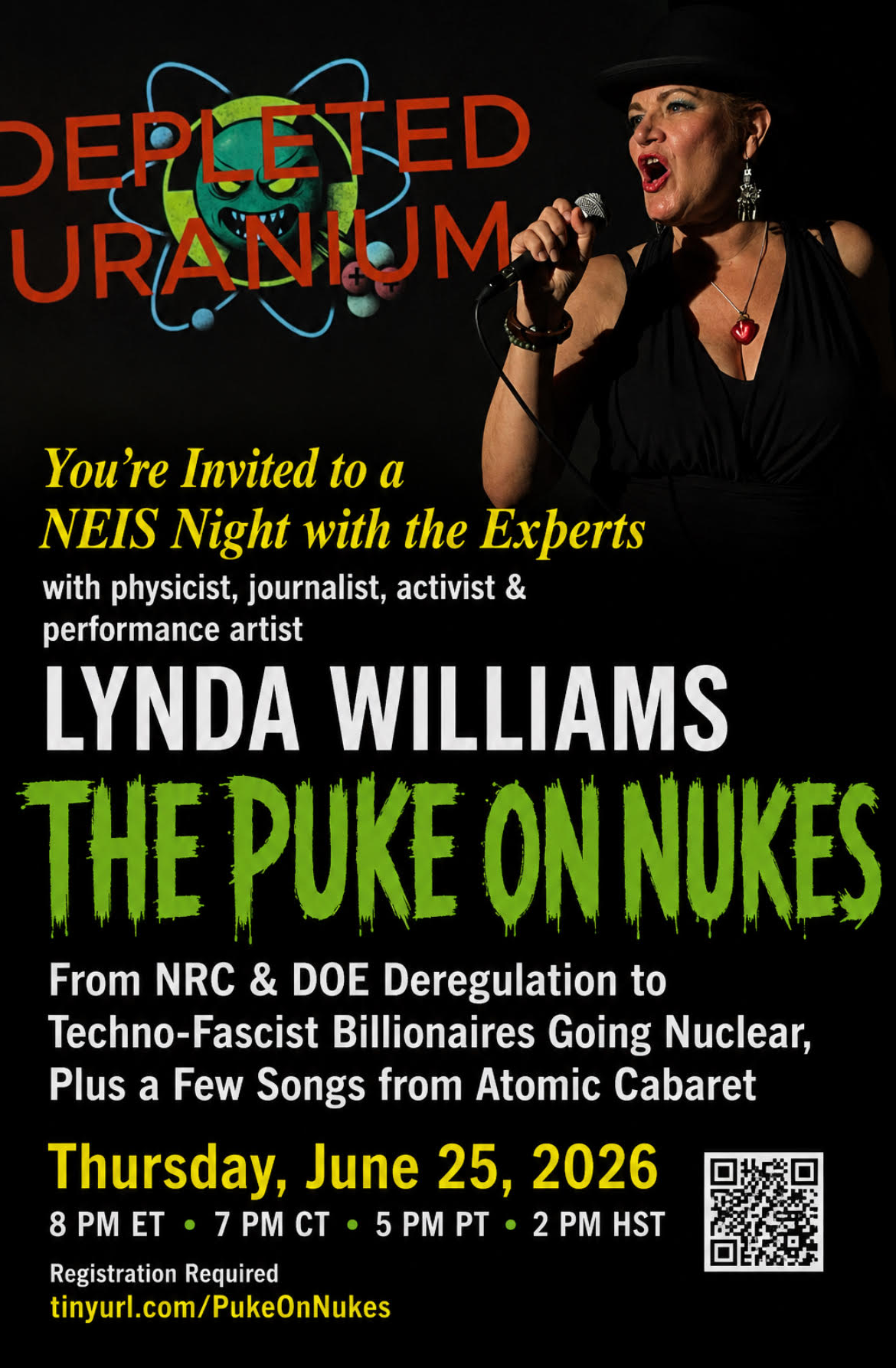
25 June- THE PUKE ON NUKES
Thursday, June 25, 2026
7pm Central Time (8pm ET, 6pm MT, 5pm PT) UTC – 5
From NRC & DOE Deregulation to Techno-Fascist Billionaires Going Nuclear, Plus a Few Songs from Atomic Cabaret REGISTER
26 June – Radiation Trainwreck at the NRC / Join the Protect Better Campaign – https://us02web.zoom.us/meeting/register/4ZlZ5_qLSHGiLSCg8FF6Bg#/registration

1st July – Webinar Waste of Space: The Environmental Harm of Military and Civil Space Activity st July, 7 pm

Report Launch Online: We are seeing an increasing exploitation of space for military and commercial purposes. This must change.

Protect Sazan Island from the Trump family! https://secure.avaaz.org/campaign/en/protect_sazan_island_from_the_trump_family_loc/?bqFCVab&v=174511&cl=22707147157&_checksum=5e9dde668860e8231c33699735e16a1fbf22ab2cb01da50c999fe8732b9775ef&utm_source=email&utm_medium=blast_email&utm_campaign=174511


Cuba Is Not a Failed State – It Is a Besieged State
PETITION: “Global Appeal to Endorse Palestinian Right of Return of Refugees”
To see nuclear-related stories in greater depth and intensity – go to https://nuclearinformation.wordpress.com
-
Archives
- June 2026 (241)
- May 2026 (306)
- April 2026 (356)
- March 2026 (251)
- February 2026 (268)
- January 2026 (308)
- December 2025 (358)
- November 2025 (359)
- October 2025 (376)
- September 2025 (257)
- August 2025 (319)
- July 2025 (230)
-
Categories
- 1
- 1 NUCLEAR ISSUES
- business and costs
- climate change
- culture and arts
- ENERGY
- environment
- health
- history
- indigenous issues
- Legal
- marketing of nuclear
- media
- opposition to nuclear
- PERSONAL STORIES
- politics
- politics international
- Religion and ethics
- safety
- secrets,lies and civil liberties
- spinbuster
- technology
- Uranium
- wastes
- weapons and war
- Women
- 2 WORLD
- ACTION
- AFRICA
- Atrocities
- AUSTRALIA
- Christina's notes
- Christina's themes
- culture and arts
- Events
- Fuk 2022
- Fuk 2023
- Fukushima 2017
- Fukushima 2018
- fukushima 2019
- Fukushima 2020
- Fukushima 2021
- general
- global warming
- Humour (God we need it)
- Nuclear
- RARE EARTHS
- Reference
- resources – print
- Resources -audiovicual
- Weekly Newsletter
- World
- World Nuclear
- YouTube
-
RSS
Entries RSS
Comments RSS
 nuclear-news