£2.7bn more taxpayer funding for Sizewell C confirmed
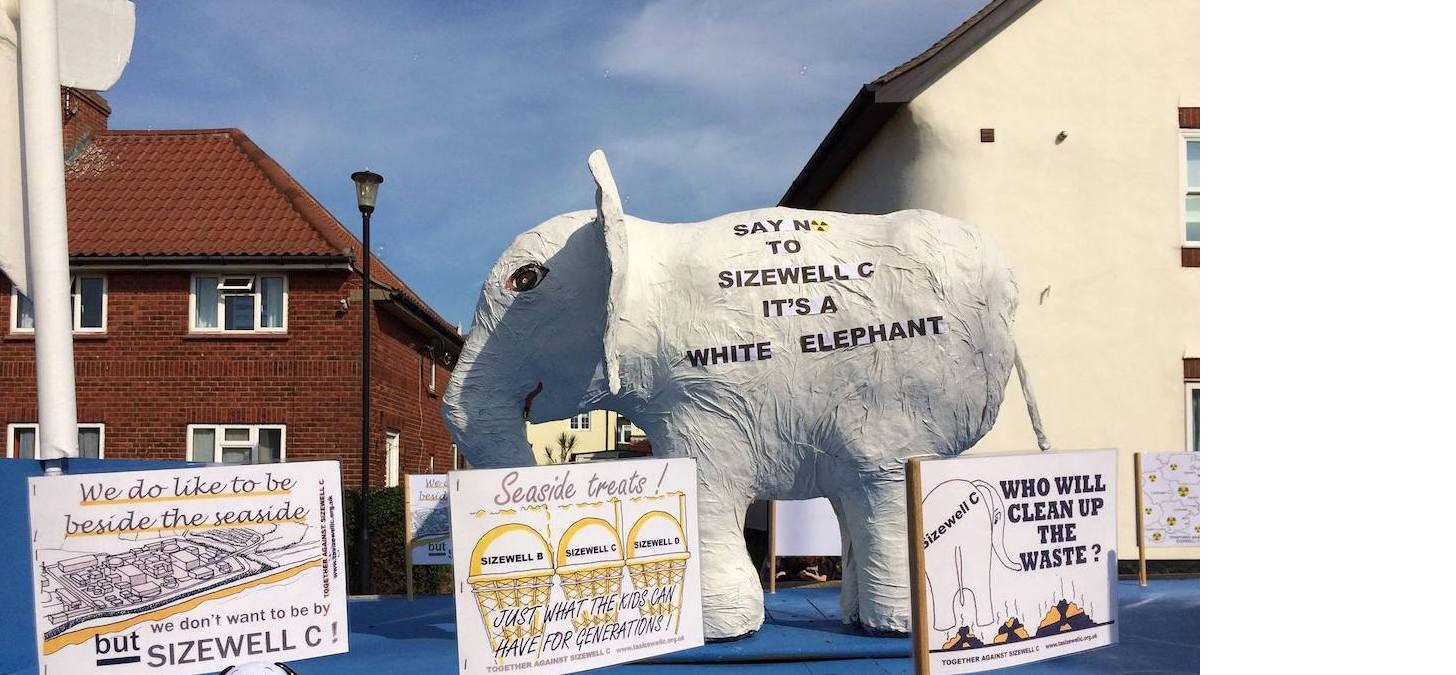
The government has announced that a further £2.7bn of taxpayer cash has made available for Sizewell C, bringing the total to £6.4bn ahead of the final investment decision (FID) on the nuclear power station.
A FID is needed before main construction can start on the planned nuclear power
station in Suffolk. The FID will confirm who is to pay for the construction
and through what model.
As of January, £2.5bn of contracts had already
been agreed for works towards the project. It is expected that the FID
decision, which is not a foregone conclusion, will come at or around the
conclusion of the Spending Review, scheduled for 11 June 2025.
Rumours have swirled around which investors might help with getting the FID over the
line. Centrica chief executive Chris O’Shea said the multinational energy
company’s stake in Sizewell C could be “between 1% or 2% and 50%”,
and EDF has been slowly having its stake in the plant eroded by taxpayer
cash injections while it inputs no further of its own funds.
NCE approached
DESNZ to clarify the status of the previously announced £5.5bn development
expenditure (Devex) scheme, and what the total figure for public investment
in Sizewell C stands at. A DESNZ spokesperson confirmed that the £2.7bn
announced on 4 April is not from the Devex fund. “The government has
committed £3.9bn from the Devex scheme – so £1.6bn is left,” the
spokesperson told NCE. “£8bn has been ringfenced for Sizewell C, and
£6.4bn made available for the project.”
By Tom Pashby, New Civil Engineer 7th April 2025, https://www.newcivilengineer.com/latest/2-7bn-more-taxpayer-funding-for-sizewell-c-confirmed-07-04-2025/
Disconnection of nuclear plants during severe space weather highlighted as risk to grid stability
08 Apr, 2025 By Tom Pashby
Nuclear power station operators’ reactions to severe space weather could negatively impact the stability of the electricity transmission grid, a space weather expert has told NCE……………….
New Civil Engineer 8th April 2025 https://www.newcivilengineer.com/latest/disconnection-of-nuclear-plants-during-severe-space-weather-highlighted-as-risk-to-grid-stability-08-04-2025/
Nuclear missile ‘cover-up’ fears as secret pact allowing US to bring deadly weapons to UK revealed
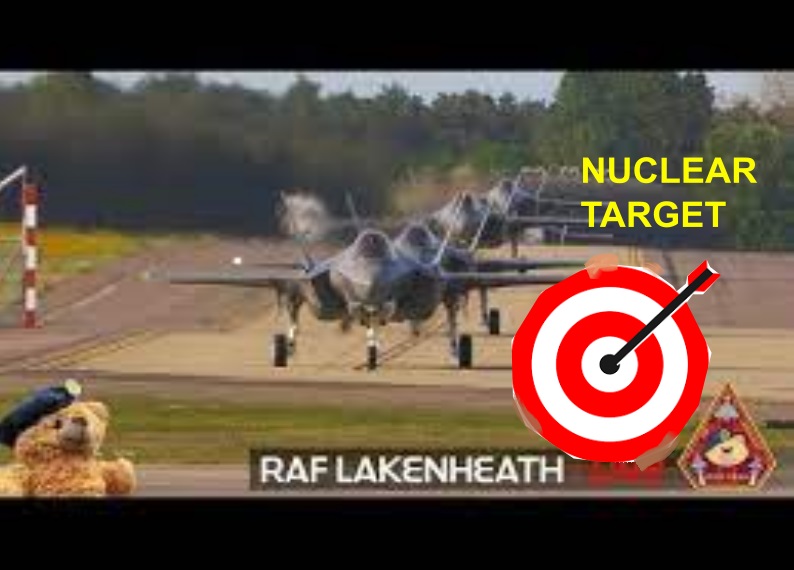
US nuclear missiles could be delivered to the UK as the Mirror reveals Ministry of Defence chiefs signed off on a secret pact allowing American forces to bring deadly bombs to UK
Chris Hughes Defence and Security Editor and Ashley Cowburn Political Correspondent, 06 Apr 2025
https://www.mirror.co.uk/news/world-news/nuclear-missile-cover-up-fears-34997771
British defence chiefs are at the centre of a ‘cover-up’ row over secretly exempting US troops from telling local authorities they are storing nuclear weapons. A declassified document proves former defence secretary Ben Wallace signed the ‘sensitive’ waiver which means local authorities are being left in the dark over the missiles.
The nuclear bust-up centres upon US air base RAF Lakenheath, home of F-35A Lightning II fighters, although the March 2021 waiver exempts all US bases in the UK. Not only are locals being kept in the dark over the possible nuclear missile storage but troops are also exempt from sticking to regulations applied to radiation risks. That means local authorities cannot draft disaster emergency plans.
The MoD was forced to declassify the Ben Wallace document down from ‘sensitive’ to prove to the Campaign for Nuclear Disarmament that legally they do not have to tell locals. It clearly says it was signed for ‘national security’ and that they are exempt from Ionisation Regulations 2017 and Radiation Regulations 2019.
Although it is not known publicly if RAF Lakenheath has US nuclear weapons on site, the exemption means nobody outside security-cleared personnel will ever know. CND General Secretary Sophie Bolt said: “The government’s exemption order smacks of a cover-up for a new generation of deadly US nuclear bombs that could be deployed in Britain.
“Nuclear weapons are the most destructive in the world. They put us all at risk every day. Yet the government is more concerned about its special relationship with the US than people’s safety.
“This declassified document shows that not only are US forces exempt from British nuclear safety laws at RAF Lakenheath, they are exempt at US bases right across Britain. This means that local authorities will never be told about any nuclear weapons present in their area. And will be under no legal obligation to produce emergency radiation plans.”
“The government doesn’t want people to know what’s going on. The government has to put a stop to these deadly nuclear risks. That means PM Keir Starmer should announce publicly that US nuclear weapons will not be stationed here.”
The exclusion of US troops from having to tell local authorities about the presence of nuclear weapons has infuriated politician critics in relation to blanket secrecy on nuclear weapons. Senior MP and former shadow chancellor John McDonnell stormed: “This is extremely concerning. “People need to know what risks their government is imposing on them. The ability to hold governments and the military to account is totally undermined by this level of secrecy. “
RAF Lakenheath first hit the nuclear spotlight again in 2022 when American plans to deploy nuclear weapons to the Suffolk airbase were revealed. It emerged again in department of defence documents showing plans to build accommodation for more US troops. The document stated the work was in preparation for the base’s “upcoming nuclear mission,” sparking controversy.
The US Office of the Under Secretary of Defence document sparked further fear as it stated the work was in preparation for the base’s potential ‘surety mission.’ The word ‘surety’ is understood to mean ‘nuclear weapons storage.’
But the UK Ministry of Defence said at the time it had a long-standing agreement within the department and its allies not to discuss nuclear weaponry. The following September a US government contracts award notice showed how £728,379.96 was to be spent on constructing guard facilities known as “hardened ballistic security shelters”.
Twenty-two blast resistant manoeuvrable cabins were being built with bulletproof metal flat sheets welded onto the frame to “to protect our high value assets”of RAF Lakenheath’s defence force, the 48th Security Forces Squadron (48 SFS). The specification for the windows included glass which could withstand an impact from a .30 calibre rifle.
In 2008 it was revealed nuclear bombs had been removed from RAF Lakenheath, which houses 4,000 service personnel and more than 1,500 British and US civilians. It is home to the US Air Force’s 48th Fighter Wing, which operates both the F-15E Eagle and the F-35A Lighting II fighter aircraft.
As well as normal combat duties it is believed the newer F-35A has been flight tested to use the latest variant of the B61-12 thermonuclear bomb. Defence specialising Janes Magazine said the B61-12 was capable of an explosive power of up to 340 kilotons, twenty times the power of the Hiroshima bomb.
On Friday an MoD spokesman, asked about the exemption, replied in a statement: “The UK and NATO have a long-standing policy to neither confirm nor deny the presence of nuclear weapons at any given location.
Unsafe for Russia to restart Zaporizhzhia nuclear plant, says Ukraine energy chief
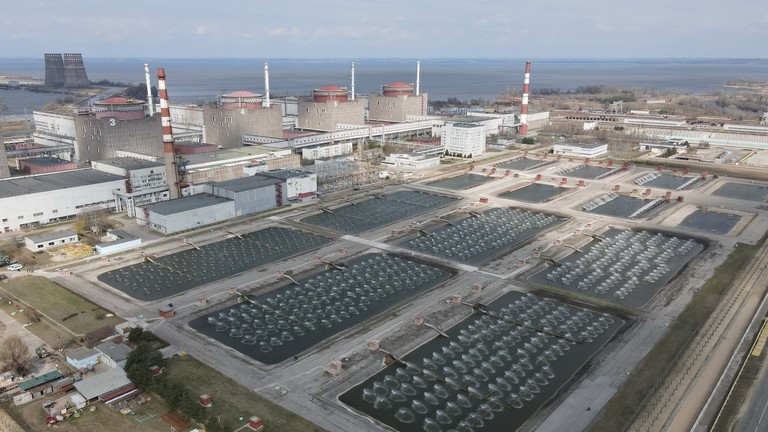
Energoatom CEO, Petro Kotin, says ‘major problems’ need to be overcome before it can safely generate power
Guardian, Dan Sabbagh in Kyiv, 7 Apr 25
It would be unsafe for Russia to restart the occupied Zaporizhzhia nuclear plant and would take Ukraine up to two years in peacetime if it regained control, the chief executive of the company that runs the vast six-reactor site has said.
Petro Kotin, chief executive of Energoatom, said in an interview there were “major problems” to overcome – including insufficient cooling water, personnel and incoming electricity supply – before it could start generating power again safely.
The future of the Zaporizhzhia plant, Europe’s largest nuclear reactor, is a significant aspect of any negotiations to end the war in Ukraine. Seized by Russia in spring 2022 and shut down for safety reasons a few months later, it remains on the frontline of the conflict, close to the Dnipro River.
Russia has said it intends to retain the site and switch it back on, without being specific as to when. Alexey Likhachev, head of Russian nuclear operator Rosatom, said in February it would be restarted when “military and political conditions allow”.
Meanwhile, Donald Trump has expressed an interest in taking control of it, though this possibility is considered very remote.
Kotin said Energoatom was prepared to restart the plant but it would require Russian forces to be removed and the site to be de-mined and demilitarised.
He said such a restart by Ukraine would take anywhere “from two months to two years” in an environment “without any threats from militaries”, while a Russian restart during wartime “would be impossible, even for one unit [reactor]”.
Kotin said the six reactors could only be brought online after the completion of 27 safety programmes agreed with Ukraine’s nuclear regulator, including testing the nuclear fuel in the reactor cores because it had exceeded a six-year “design term”.
That raises questions about whether Russia could restart the plant after a ceasefire without incurring significant risk. The plant was already unsafe, Kotin said, given that it was being used as “a military base with military vehicles present” and there were “probably some weapons and blasting materials” present as well.
Russia has acknowledged that it has placed mines between the inner and outer perimeters of the plant “to deter potential Ukrainian saboteurs” while inspectors from the IAEA nuclear watchdog have reported that armed troops and military personnel are present at the site.
Last month, the US Department of Energy said the Zaporizhzhia plant was being operated by an “inadequate and insufficently trained cadre of workers”, with staffing levels at less than a third of prewar levels.
The US briefing said Ukrainian reactors, though originally of the Soviet VVER design, had “evolved differently” from their Russian counterparts and “particularly the safety systems”. Russian-trained specialists acting as replacements for Ukrainian staff were “inexperienced” in operating the Ukrainian variants, it said.
Kotin said an attempt to restart the plant by Russia would almost certainly not be accepted or supported by Ukraine. It would require the reconnection of three additional 750kV high-voltage lines to come into the plant, he said.
A nuclear reactor requires a significant amount of power for day-to-day operation, and three of the four high-voltage lines came from territories now under Russian occupation. “They themselves destroyed the lines,” Kotin said, only for Russia to discover engineers could not rebuild them as the war continued, he added.
Only two lines remain to maintain the site in cold shutdown, a 750kV line coming from Ukraine, and a further 330kV line – though on eight separate occasions shelling disrupted their supply of energy, forcing the plant to rely on backup generators.
Experts say a pumping station has to be constructed at the site, because there is insufficient cooling water available. The June 2023 destruction by Russian soldiers of the Nova Kakhova dam downstream eliminated the easy supply of necessary water from the Dnipro river………………………………………………….. https://www.theguardian.com/world/2025/apr/06/unsafe-for-russia-to-restart-zaporizhzhia-nuclear-plant-energoatom-says
‘We thought it was the end of the world’: How the US dropped four nuclear bombs on Spain in 1966
Myles Burke https://www.bbc.com/culture/article/20250404-how-the-us-dropped-nuclear-bombs-on-spain-in-1966 7 Apr 25
In 1966, the remote Spanish village of Palomares found that the “nuclear age had fallen on them from a clear blue sky”. Two years after the terrifying accident, BBC reporter Chris Brasher went to find what happened when the US lost a hydrogen bomb.
On 7 April 1966, almost 60 years ago this week, a missing nuclear weapon for which the US military had been desperately searching for 80 days was finally found. The warhead, with an explosive power 100 times that of the bomb dropped on Hiroshima, was carefully winched from a depth of 2,850ft (869m) out of the Mediterranean Sea and delicately lowered onto the USS Petrel. Once it was on board, officers painstakingly cut into the thermonuclear device’s casing to disarm it. It was only then that everyone could breathe a sigh of relief – the last of the four hydrogen bombs that the US had accidentally dropped on Spain had been recovered.
“This was not the first accident involving nuclear weapons,” said BBC reporter Chris Brasher when he reported from the scene in 1968. “The Pentagon lists at least nine previous accidents to aircraft carrying hydrogen bombs. But this was the first accident on foreign soil, the first to involve civilians and the first to excite the attention of the world.”
This terrifying situation had come about because of a US operation code-named Chrome Dome. At the beginning of the 1960s, the US had developed a project to deter its Cold War rival, the Soviet Union, from launching a pre-emptive strike. A patrol of nuclear-armed B-52 bombers would continuously criss-cross the skies, primed to attack Moscow at a moment’s notice. But to stay airborne on these long looping routes, the planes needed to refuel while in flight.
On 17 January 1966, one such bomber was flying at a height of 31,000ft (9.5km) over the Almería region of southern Spain, and attempted a routine air-to-air refuelling with a KC-135 tanker plane. “I believe what happened was the bomber was closing at a too-high rate of closure speed and he didn’t stabilise his position,” US Maj Gen Delmar Wilson, the man in charge of dealing with the catastrophic accident, told Brasher, “with the result that they got too close and collided.”
The B-52 bomber’s impact with the refuelling plane tore it open, igniting the jet fuel the KC-135 was carrying and killing all four of the crew onboard. The ensuing explosion also killed two men in the B-52’s tail section. A third managed to eject, but died when his parachute did not open. The other four members of the bomber’s crew successfully bailed out of their burning plane before it broke apart and fell to earth, raining down both flaming aircraft fragments and its lethal thermonuclear cargo onto the remote Spanish village of Palomares.
Everyone kept talking about a ‘broken arrow’. I learnt then that ‘broken arrow’ was the code word for a nuclear accident – Capt Joe Ramirez
The huge fireball was seen a mile away. Thankfully, it did not trigger a nuclear explosion. The bomber’s warheads were not armed and had built-in safeguards to prevent an unintended atomic chain reaction. But the thermonuclear devices did have explosives surrounding their plutonium cores as part of the triggering mechanism. In the event of an accident, the bombs had parachutes attached to them designed to cushion the impact on landing and prevent radioactive contamination. And indeed, one undetonated bomb did land safely in a riverbed and was recovered intact the following day. Unfortunately, two of the plummeting nuclear bombs’ parachutes failed to open.
That morning, Spanish farmer Pedro Alarcón was walking to his house with his grandchildren when one of the nuclear bombs landed in his tomato field and blew apart on impact. “We were blown flat. The children started to cry. I was paralysed with fear. A stone hit me in the stomach, I thought I’d been killed. I lay there feeling like death with the children crying,” he told the BBC in 1968.
Devastation and chaos
The other hydrogen bomb also exploded when it hit the ground near a cemetery. These dual blasts created vast craters and scattered highly toxic, radioactive plutonium dust across several hundred acres. Burning aircraft debris also showered the Spanish village. “I was crying and running about,” a villager called Señora Flores told the BBC in 1968. “My little girl was crying, ‘Mama, Mama, look at our house, it is burning.’ Because of all the smoke I thought what she said must be true. There were a lot of stones and debris falling around us. I thought it would hit us. It was this terrific explosion. We thought it was the end of the world.”
Once the news that the bomber had come down with nuclear weapons aboard reached US military command, a huge operation was launched. At the time of the disaster, Capt Joe Ramirez was an US Air Force lawyer stationed in Madrid. “There were a lot of people talking, there was a lot of excitement in the conference room. Everyone kept talking about a ‘broken arrow’. I learnt then that ‘broken arrow’ was the code word for a nuclear accident,” he told BBC’s Witness History in 2011.
US military personnel were scrambled to the area by helicopter. When Capt Ramirez arrived in Palomares, he immediately saw the devastation and chaos wrought by the accident. Huge pieces of smoking wreckage were strewn all over the area – a large part of the burning B-52 bomber had landed in the school’s yard. “It’s a small village but there were people scrambling in different directions. I could see smouldering debris, I could see some fires.”
Despite the carnage, miraculously no one in the village was killed. “Nearly 100 tonnes of flaming debris had fallen on the village but not even a chicken had died,” said Brasher. A local school teacher and doctor climbed up to the fire-scarred hillside to retrieve the remains of the US airmen who had been killed. “Later still, they sorted the pieces and the limbs into five coffins, an act that was to cause a certain amount of bureaucratic difficulty when the Americans came to claim only four bodies from that hillside,” said Brasher.
Three of the B-52 crew who managed to eject landed in the Mediterranean several miles off the coast and were rescued by local fishing boats within an hour of the accident. The fourth, the B-52 radar-navigator, ejected through the plane’s explosion, which left him badly burned, and was unable to separate himself from his ejection seat. Despite this, he managed to open his parachute and was found alive near the village and taken to hospital.
However, this still left the problem of locating the plane’s deadly nuclear payload. “My main concern was to recover those bombs, that was number-one priority,” Gen Wilson told the BBC in 1968.
One of our nuclear bombs is missing
“The first night, the Guardia Civil [the Spanish national police force] had come to the little bar in Palomares, and that was about the only place that had electricity. And they had reported what they considered to be a bomb, so we immediately despatched some of our people to this riverbed which is not far from the centre of town, and, in fact, it was a bomb, so we placed a guard on that. And then the next morning, at first daylight, we started conducting our search, and I believe it was something in the order of 10am or 11am the following morning, we located two other bombs.”
This accounted for three of the nuclear bombs, but there was still one missing. By the next day, trucks filled with US troops had been sent from nearby bases, with the beach in Palomares becoming a base for some 700 US airmen and scientists urgently trying to contain any radioactive contamination and locate the fourth warhead.
“The first thing that you could see as the search really got underway in earnest was Air Force personnel linking up hand-by-hand and 40 or 50 people in a line. They would have designated search areas. There were some people with Geiger counters who started arriving, and so they started marking off the areas which were contaminated,” said Capt Ramirez in 2011. When US personnel registered an area contaminated with radiation, they would scrape up the first three inches of topsoil and seal it in barrels to be shipped back to the US. Some 1,400 tonnes of irradiated soil ended up being sent to a storage facility in South Carolina.
Both the US and Spain, which at the time was under the brutal rule of Francisco Franco’s military dictatorship, were keen to downplay the devastating accident. Franco was especially worried that radiation fears would hurt Spain’s tourism industry, a major source of revenue for his regime. In an effort to reassure the local population and the wider world that there was no danger, the US Ambassador to Spain, Angier Biddle Duke, would end up taking a swim in the sea off Palomares coast in front of the international press just weeks after the accident.
But despite hundreds of US personnel conducting an intensive and meticulous search of the surrounding area for a week, they still couldn’t find the fourth bomb. Then Capt Ramirez spoke to a local fisherman who had helped rescue some of the surviving airmen who had splashed down in the sea. The fisherman kept apologising to Capt Ramirez for not being able to save one of the US flyers, whom he thought he had witnessed drifting down into the depths.
Capt Ramirez realised that the fisherman could have actually seen the missing nuclear bomb. “All the bodies had been accounted for, I knew that,” he said. The search then quickly shifted to the Mediterranean Sea, with the US Navy mobilising a flotilla of more than 30 ships, including mine-sweepers and submersibles, to scour the seabed. The exploration of miles of ocean floor was both technically complicated and a very slow process, but after weeks of exhaustive searching, a newly developed deep-diving vessel, Alvin, finally located the missing bomb in an underwater trench.
Nearly four months after it was first lost, the warhead was finally made safe and back in US hands. The next day, despite the secrecy with which the US military had surrounding its nuclear arsenal, it took the unusual step of showing the bomb to the world’s press. Ambassador Duke reasoned that unless people saw the bomb for themselves, they would never feel certain that it had actually been recovered.
Russia pledges to help resolve Iran-US nuclear tensions
April 7 2025 –https://www.canberratimes.com.au/story/8936749/russia-pledges-to-help-resolve-iran-us-nuclear-tensions/
Russia is ready to do all it could to help resolve tensions between the United States and Iran around Tehran’s nuclear program, the Kremlin says.
Moscow has repeatedly offered to mediate between the two sides after warnings of military action against Iran by US President Donald Trump have rattled nerves across the region.
“We are in constant consultations with our Iranian partners, including on the topic of the nuclear deal,” Kremlin spokesman Dmitry Peskov told reporters on Monday.
“This process will continue, including in the near future. And, of course, Russia is ready to make every effort, to do everything possible to contribute to this problem’s resolution by political and diplomatic means.”
During his first term, Trump withdrew the US from a 2015 deal between Iran and world powers that placed strict limits on Tehran’s disputed nuclear activities in exchange for sanctions relief. Iran says it needs nuclear energy for peaceful purposes and denies it is seeking to acquire nuclear weapons.
Tehran has pushed back against Trump’s demands for direct talks, with a senior Iranian official issuing a warning over the weekend to neighbours that host US bases that they could be in the firing line.
Russian Deputy Foreign Minister Sergei Ryabkov said last week that Trump’s comments about bombing Iran only served to “complicate the situation” and cautioned that strikes could be “catastrophic” for the wider region.
Russia has for the most part refrained from such sharp criticism of Trump.
President Vladimir Putin has moved quickly since Trump took office to repair relations with the US in a rapprochement viewed with concern by Ukraine and its European allies.
Moscow has also deepened ties with Tehran since the start of the full-scale conflict in Ukraine with the two signing a strategic partnership treaty in January.
Manager at Hinkley Point C accepted a quad bike as a bribe, tribunal hears
Ashley Daniels accused of giving more work to engineering firm after gifts that also included £2,000 boxing tickets
Jamie Grierson, 8 Apr 25, Guardian
A senior manager at the Hinkley nuclear power plant accepted bribes such as an £11,000 quad bike to funnel extra work to a British engineering firm, an employment tribunal has heard.
Ashley Daniels was investigated by Hinkley’s owner, EDF, after he was given gifts such as £2,000 hospitality tickets for a boxing match and a refill for his Montblanc fountain pen, the tribunal in Bristol heard.
The hearing was told Daniels ensured more work was “directed” to a firm specialising in heavy lifting so that it could continue operating at the Somerset site.
The Guardian understands Daniels was dismissed by EDF.
The details have emerged in the judgment of a tribunal claim brought by an engineer called Garrick Nisbet, who sued his employer, Notus Heavy Lift Solutions – a subcontractor at Hinkley Point C – for unfair dismissal.
Hinkley Point C will be the first nuclear power station to be built in the UK for more than 30 years and is reported to have a price tag of up to £46bn…………………………………………………………..
https://www.theguardian.com/uk-news/2025/apr/07/manager-at-hinkley-point-c-accepted-a-quad-bike-as-a-bribe-tribunal-hears
New EDF boss at mercy of ‘to-do list’ that ousted his predecessor
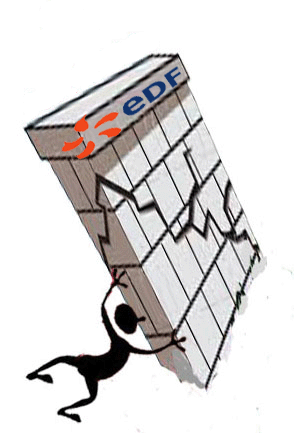
The new boss of French state-owned energy group EDF faces the same nearly
impossible tasks that led to the ousting of his predecessor: satisfying the
government’s often contradictory demands for cheap power to help industry
and the construction of costly new nuclear reactors.
Bernard Fontana, nominated as chief executive on March 21, is a seasoned industrialist who
has run EDF’s engineering arm Framatome for nearly nine years. He will
seek to avoid the fate of the previous chief executive Luc Rémont, removed
last month after just over two years because of repeated clashes with the
state.
On Fontana’s to-do list will be repairing relations with the
government, the company’s only shareholder, striking energy supply deals
with some of EDF’s biggest industrial clients, while also advancing plans
to build six nuclear reactors in just over a decade — a key initiative of
French President Emmanuel Macron, which was announced three years ago.
Fontana’s main challenge is to balance competing pressures of delivering
low rates for power, demanded by government and industry, while generating
profits that will help support vast investments required to launch new
nuclear reactors.
The company ran over budget and behind time on the
completion of Flamanville, a new nuclear reactor in northern France, and
faces budget and timing issues with the UK’s Hinkley Point. It has also
faced criticism that it is yet to outline timelines and costings for the
project to build the six new nuclear reactors, which were originally due by
the end of 2024.
Last month, the government pushed back the launch date
from 2035 to 2038, although observers have long considered the 2035 target
unachievable. In short, Fontana’s success will depend on whether he can
walk the tightrope of running EDF profitably while delivering the vast
capital outlay needed to reboot France’s nuclear sector. This will
require a major shift from Rémont’s uncompromising approach. “If
Fontana has taken the job, he’s understood the lesson [from Rémont’s
sacking]. If he hasn’t, he’s an idiot,” said another adviser.
FT 6th April 2025 https://www.ft.com/content/b9f39568-6029-4016-9c5f-0242dd8b9174
‘They’re everywhere’: workers warn of rat infestation at Somerset nuclear plant
Unions urge energy giant EDF to take action as concerns mount over health of construction staff.
Guardian, Jillian Ambrose, Sun 6 Apr 2025
Workers building the troubled Hinkley Point C nuclear reactor in Somerset have raised concerns that the construction site is overrun by rats.
The Unite and GMB trade unions are understood to have warned the developer, the French energy giant EDF, that urgent action is needed because the rodents are “everywhere”.
The growing vermin population has prompted fears over the health of the workforce building Britain’s first new nuclear power plant in a generation, which is running years late and billions of pounds over budget. A source on the site told the Observer: “They’re all over. You see them just sat there, looking at you. It is worse near the canteens, where I guess it started. But they are everywhere now.”
A second source confirmed that the trade unions had broached the issue with EDF, describing the number of rats on the site as “quite grim”.
“The more men working on the site, the more rubbish on the site – and the canteens are not clean either. It has just become worse over time,” the source added………………………………………………………….https://www.theguardian.com/world/2025/apr/06/theyre-everywhere-workers-warn-of-rat-infestation-at-somerset-nuclear-plant
Inside the bizarre race to secure Earth’s nuclear tombs
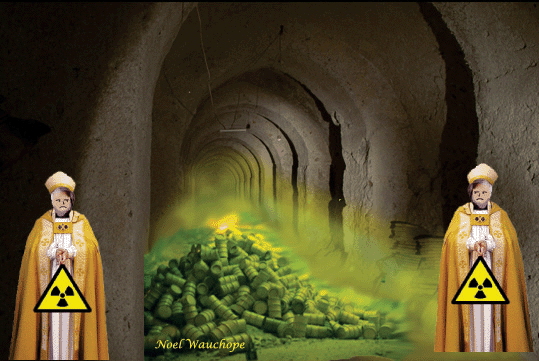
outlandish ideas have included linguist Thomas Sebeok’s proposal of an ‘atomic priesthood’ that would pass on nuclear folklore (in much the same way that generations of clergy have been relaying the tenets of their respective faiths for thousands of years
“Our generation must find a way to bury the waste very deep to avoid radioactive pollution or exposure to people and animals up to one million years into the future.”
“Currently, about 75 per cent of the UK’s nuclear waste is already stored across 20 sites,” says Winsley. “People are surprised to hear you’re never far away from the most hazardous radioactive waste, wherever you are in the UK.
Jheni Osman, BBC Science Focus, April 5, 2025
With nuclear energy production increasing globally, the problem of what to do with the waste demands a solution. But where do you store something that stays dangerous for thousands of years?
Uniformed guards with holstered guns stand at the entrance and watch you lumber past. Ahead lies a wasteland of barren metal gantries, dormant chimney stacks and abandoned equipment.
You trudge towards the ruins of a large, derelict red-brick building. Your white hazmat suit and heavy steel-toe-capped boots make it difficult to walk. Your hands are encased in a double layer of gloves, your face protected by a particulate-filtering breathing mask. Not an inch of flesh is left exposed.
Peering into the building’s gloomy interior, the beam from your head torch picks out machinery and vats turned orange with rust. On a wall nearby, a yellow warning sign featuring a black circle flanked by three black blades reminds you of the danger lurking inside.
Apart from the sound of your own breathing behind your mask, the only thing you can hear is the crackling popcorn of your Geiger counter.
This is what entering the Prydniprovsky Chemical Plant is like for nuclear researchers, including Tom Scott, professor of materials at the University of Bristol and head of the UK Government’s Nuclear Threat Reduction Network.
Prydniprovsky was once a large Soviet materials and chemicals processing site on the outskirts of Kamianske in central Ukraine. Between 1948 and 1991, it processed uranium and thorium ore into concentrate, generating tens of millions of tonnes of low-level radioactive waste.
When the Soviet Union dissolved, Prydniprovsky was abandoned and fell into disrepair.
“The buildings are impressively awful and not for the faint-hearted,” says Scott. “As well as physical hazards, such as gaping holes in the floor, there’s no light or power. And obviously there are radiological hazards. Until very recently, the Ukrainian Government didn’t have a clue what had gone on at the site, so there were concerns about the high radiation levels and ground contamination.”
When radiation levels are deemed too high for humans, Scott sends in the robots. ………………………….
Scott and his team are known as industrial nuclear archaeologists, and they’re working to find, characterise and quantify the ‘legacy’ radioactive waste at sites around the world.
“High-level radioactive waste gives off a significant amount of radioactivity, sufficient to make humans sick if they get too close,” he says. “Some of this waste will be dangerously radioactive for very long periods of time, meaning that it needs to be physically kept away from people and the environment to ensure that no harm is caused.”
But finding legacy waste like this, which has been amassing since the 1940s, is only part of the challenge. Once it’s been found, it has to be isolated and stored long enough for it to no longer pose a threat. And that’s not easy.
“Currently we’re storing our high-level wastes above ground in secure, shielded facilities,” Scott says. “Such facilities need to be replaced every so often because buildings and concrete structures can’t last indefinitely.”
Safely storing the nuclear waste that already exists is only the start of the problem, however. With the world moving away from fossil fuels towards low-carbon alternatives, nuclear energy production is set to increase, which means more waste is going to be produced – a lot more.
Currently, nuclear energy provides roughly nine per cent of global electricity from about 440 power reactors. By 2125, however, the UK alone is predicted to have 4.77 million m3 (168 million ft3) of packaged radioactive waste. That’s enough to fill 1,900 Olympic swimming pools.
Hence, the world needs more safe storage sites for both legacy and new nuclear waste. And it needs them fast.
Safe spaces
In the UK, most nuclear waste is currently sent to Sellafield, a sprawling site in Cumbria, in the north-west of England, with about 11,000 employees, its own road and railway network, a special laundry service for contaminated clothes and a dedicated, armed police force (the Civil Nuclear Constabulary).
Sellafield processes and stores more radioactive waste than anywhere in the world.
But more hazardous material is on the way, much of which will come from the new nuclear power station being built at Hinckley Point in Somerset. To keep pace, experts have been hunting for other, much stranger, disposal solutions.
It’s a challenge for nuclear agencies all around the world. All sorts of proposals have been put forward, including some bizarre ideas like firing nuclear waste into space. (The potential risk of a launch failure showering the planet with nuclear debris has silenced that proposal’s supporters.)
So far, the most plausible solution is putting the waste in special containers and storing them 200–1,000m (660–3,280ft) underground in geological disposal facilities (GDFs). Eventually, these GDFs would be closed and sealed shut to avoid any human intrusion.
These ‘nuclear tombs’ are the safest, most secure option for the long-term and minimise the burden on future generations.
“In the UK, around 90 per cent of the volume of our legacy waste can be disposed of at surface facilities, but there’s about 10 per cent that we don’t currently have a disposal facility for. The solution is internationally accepted as being GDFs,” says Dr Robert Winsley, design authority lead at the UK’s Nuclear Waste Services.
“We estimate that about 90 per cent of the radioactive material in our inventory will decay in the first 1,000 years or so. But a portion of that inventory will remain hazardous for much longer – tens of thousands, even hundreds of thousands of years.
“GDFs use engineered barriers to work alongside the natural barrier of stable rock. This multi-barrier approach isolates and contains waste, ensuring no radioactivity ever comes back to the surface in levels that could do harm.”
But how do you keep that radioactivity in the ground? Radioactive waste is typically classified as either low-, intermediate- or high-level waste.
Before being disposed of deep underground, high-level waste is converted into glass (a process known as vitrification) and then packed in metal containers made of copper or carbon steel. Intermediate-level waste is typically packaged in stainless-steel or concrete containers, which are then placed in stable rock and surrounded by clay, cement or crushed rock.
The process isn’t set in stone yet, though. Other materials, such as titanium- and nickel-based alloys, are being considered for the containers due to their resistance to corrosion.
Meanwhile, scientists in Canada have developed ultra-thin copper cladding that would allow them to produce containers that take up less space, while providing the same level of protection.
Rock solid
The hunt is also on to find facilities with bedrock that can withstand events such as wars and natural disasters (‘short-term challenges’, geologically speaking). Sites that won’t change dramatically over the millennia needed for nuclear waste to no longer pose a risk.
“A misconception is that we’re looking for an environment that doesn’t change, but the reality is the planet does change, very slowly,” says Stuart Haszeldine, professor of carbon capture and storage at the University of Edinburgh.
“Our generation must find a way to bury the waste very deep to avoid radioactive pollution or exposure to people and animals up to one million years into the future.”
To achieve this, the site ideally needs to be below sea level. If it’s above sea level, rainwater seeping down through fractures in the rock around the site might become radioactive and eventually find its way to the sea.
When this radioactive freshwater meets the denser saltwater, it’ll float upwards, posing a risk to anything in the water above.
Another challenge is predicting future glaciations, which happen roughly once every 100,000 years. During such a period, the sort of glaciers that cut the valleys in today’s landscape could form again, gouging new troughs in the bedrock that might breach an underground disposal facility.
“Accurate and reliable future predictions depend on how well you understand the past,” says Haszeldine.
“Typically, repository safety assessments cover a one-million-year timeframe, and regulations require a GDF site to cause fewer than one human death in a million for the next million years. Exploration doesn’t search for a single best site to retain radioactive waste, but one that’s good enough to fulfil these regulations.”
Hiding places
In 2002, the US approved the construction of a nuclear tomb in an extinct supervolcano in Yucca Mountain, Nevada, about 160km (100 miles) north-west of Las Vegas.
…………. opponents cited concerns that it was too close to a fault line and, in 2011, US Congress ended funding for the project. Since then, waste from all US nuclear power plants has been building up in steel and concrete casks on the surface at 93 sites across the country.
Other sites have fared better, however. Already this year, construction has begun on a nuclear tomb in Sweden, expected to be ready in the 2030s, but it’s also the year the world’s first tomb – at a site in Finland, called Onkalo (Finnish for ‘cave’ or ‘hollow’) – could open its doors for waste………………..
In January 2025, the UK Government announced plans to permanently dispose of its 140 tonnes of radioactive plutonium, currently stored at Sellafield. In a statement, energy minister Michael Shanks cited plans to put it “beyond reach”, deep underground.
Three potential sites in England and Wales are being explored by Nuclear Waste Services, and one of Haszeldine’s PhD students is independently investigating a fourth off the Cumbrian coast. The offshore site appears to be hydro-geologically stable (even over glacial timescales), but it would be expensive and difficult to engineer.
“Currently, about 75 per cent of the UK’s nuclear waste is already stored across 20 sites,” says Winsley. “People are surprised to hear you’re never far away from the most hazardous radioactive waste, wherever you are in the UK. Our mission is to make this radioactive waste permanently safe, sooner.”
……………………..The deep isolation approach costs less than a third of what it costs to construct a nuclear tomb and uses smaller sites, but the canisters are harder to recover if anything goes wrong.
Nevertheless, it’s a viable option for smaller nuclear countries and a second prototype is expected to undergo field testing at a deep borehole demonstration site in the UK in early 2025.
……………………………………………………………………………………………………………“The half-life of plutonium 239 is about 24,100 years, but the requirement is to keep a ceramic in that state for up to a million years. Essentially, we’re trying to design materials that’ll last forever. I don’t think humans will be around in a million years’ time, so the work we do needs to outlast humanity.”
Hide and seek
But even after you’ve found a suitable site and buried the radioactive material safely inside it, you still need to warn future generations about what’s hidden inside.
The trouble is, even if humans are still around in a million years’ time, there’s no guarantee the languages our ancestors speak, or the symbols they use, will be anything like those of today.
In Japan, 1,000-year-old ‘tsunami stones’, which warned future generations to find high ground after earthquakes, have failed to prevent construction on vulnerable sites.
Even the radiation symbol we use today (that black circle flanked by black blades on a yellow background) isn’t universally recognised. Research by the International Atomic Energy Agency found that only six per cent of the global population know what it signifies.
That’s why scientists have been working with everyone from artists to anthropologists, librarians to linguists, and sculptors to science-fiction writers – to come up with other ways of warning future generations about nuclear tombs.
………………….outlandish ideas have included linguist Thomas Sebeok’s proposal of an ‘atomic priesthood’ that would pass on nuclear folklore (in much the same way that generations of clergy have been relaying the tenets of their respective faiths for thousands of years
…………………………….. While some back this active forgetting of future nuclear tombs, researchers like Scott are still trying to get everyone to remember the nuclear sites we’ve already forgotten. It’s like a game of nuclear ‘hide and seek’ – but the stakes are high, and there’s no room for error.
…………………Currently, nuclear tombs are our best bet, but it’s a burden humanity must shoulder for thousands of years, long after the benefits gained from nuclear technology will have faded.
“My personal opinion is, I don’t think we should allow future generations to forget about a geological disposal facility,” says Scott. “The material is both dangerous and, in longer timescales, potentially valuable. People need to be reminded of its presence.”…………………… https://www.sciencefocus.com/planet-earth/inside-the-bizarre-race-to-secure-earths-nuclear-tombs
Russian sensors suspected of attempting to spy on the UK’s nuclear submarines have been found hidden in the seas around Britain.
The discovery by the British military was deemed a potential threat to national security
and has never been made public.
Several were found after they washedashore, while others are understood to have been located by the Royal Navy.
The devices are believed to have been planted by Moscow to try and gather
intelligence on Britain’s four Vanguard submarines, which carry nuclear
missiles. One of these submarines is always at sea under what is known as
the UK’s continuous at-sea deterrent.
The Sunday Times has chosen to withhold certain details, including the locations of the sensors. During a three-month investigation we spoke to more than a dozen former defence
ministers, senior armed forces personnel and military experts to expose how
Russia is using its unrivalled underwater warfare capabilities to map, hack
and potentially sabotage critical British infrastructure.
Times 5th April 2025 https://www.thetimes.com/uk/defence/article/russia-secret-war-uk-waters-submarines-dpbzphfx5
Miliband pours £2.7bn into nuclear power plant after EDF cuts stake
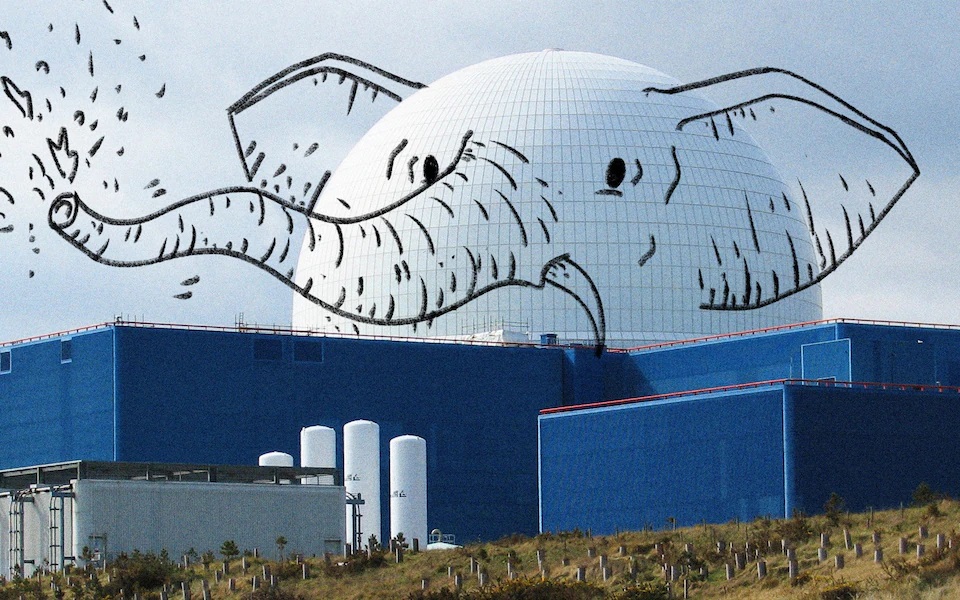
Sizewell C’s funding boost means UK taxpayers have now spent £8bn on the project
Ed Miliband has sunk an extra £2.7bn into Sizewell C after EDF slashed
its stake in the nuclear power project. The Energy Secretary said the
additional money would boost energy security, jobs and the race for net
zero.
However, anti-Sizewell campaigners questioned the wisdom of pouring
billions into a project that the Government has still not taken a final
decision to build.
UK taxpayers have so far spent a total of £8bn on the
nuclear power station. The latest cash is thought to be aimed at building
confidence in the project, potentially attracting other investors as EDF
steps back. The French energy giant recently reduced its stake from 24pc to
16pc amid pressure from Emmanuel Macron, the French president, to cut back
on risky overseas commitments.
EDF was told it should instead focus on
making a success of multibillion-euro projects at home, ensuring they were
profitable and built on time. Sizewell C is a proposed 3.2-gigawatt nuclear
power station planned for the Suffolk coast, potentially generating power
for 6m homes. Its design would be similar to the Hinkley Point C power
station being built by EDF in Somerset, whose start date has been delayed
by a decade to the mid-2030s (sic?) with costs that have doubled to £40bn.
EDF’s decision to trim its involvement has forced the UK Government into
an undignified search for alternative investors. Those approached are said
to include Centrica, the owner of British Gas, Emirates Nuclear Energy,
Amber Infrastructure Group and Schroders Greencoat, with Barclays advising
the Government.
Telegraph 4th April 2025 https://www.telegraph.co.uk/business/2025/04/04/miliband-pours-27bn-into-nuclear-power-plant-after-edf-cuts/
“Getting people to do what they can from where they are”: NFLAs support Democracy Day inspiring peace activists to make Councils anti-nuke allies

The UK/Ireland Nuclear Free Local Authorities are proud to support the forthcoming Elected Representatives and Democracy Day being hosted by the Lakenheath Alliance for Peace (LAP) on Tuesday 22nd April, and urges elected members from all parties and none who oppose nuclear weapons to attend.
This event is part of a two weeks International Peace Camp and Conference – 14th – 26th April 2025 organised by the LAP at RAF Lakenheath – https://lakenheathallianceforpeace.org.uk The NFLAs are a partner organisation within the Alliance.
‘RAF’ Lakenheath is in fact the largest United States Air Force base in the United Kingdom, and is expected to, or has already, become the host to newly reintroduced US air-launched nuclear weapons which will be accommodated and maintained in a bespoke facility.
The LAP is hosting a series of themed days during the Peace Camp to which all activists are invited and there will also be a 24:7 vigil at the main gates of the airbase:
LAP is inviting elected members at all levels, whether Councillors in parish, district, county or unitary authorities or Parliamentarians in our devolved national assemblies or at Westminster, to attend and by invitation to speak during Democracy Day.
Confirmed speakers include Baroness Natalie Bennett, former Leader of the Green Party, and several Norfolk and Suffolk Councillors, one of whom used to be an emergency planner.
Elected members who wish to speak or who are willing to give media interviews at the airbase entrance on Democracy Day are invited to submit expressions of interest via https://lakenheathallianceforpeace.org.uk/front-page/get-involved/
LAP is also seeking to arrange a workshop with campaign group MP Watch https://www.mpwatch.org/ which ‘works alongside MPs and communities to champion evidence-based climate and nature-based policies.’
LAP event organiser and former Norwich City Councillor, Lesley Grahame, described “how there has never been any democratic debate about nuclear weapons” with the purpose of Democracy Day being about “getting people to do what they can from where they are”.
NFLA Secretary Richard Outram has put together a briefing paper on this theme containing tips for activists seeking to make their elected member and their Council an ally in the campaign for nuclear disarmament.
This briefing can be found at:
Nuclear site given more time to fix safety breach
Jason Arunn Murugesu, BBC News, North East and Cumbria, 4 Apr 25,
https://www.bbc.co.uk/news/articles/cgkgxdddmlyo
A nuclear site which breached hazardous substance regulations has been given more time to figure out how best to protect workers.
Last year, the Office for Nuclear Regulation (ONR) served two improvement notices on Sellafield Ltd, near Whitehaven, Cumbria, after it “failed to manage the risks of working with nickel nitrate and to prevent or adequately control exposure of workers to this hazardous substance”.
The breaches did not compromise either nuclear or radiological safety, the ONR said.
Sellafield Ltd said it had completed one improvement notice and “significant progress” had been made on the other. It has until September to come up with a solution.
Used in the treatment of effluent, nickel nitrate is not radioactive but is a hazardous substance and could cause harm to the health of a worker exposed to it.
To mitigate these risks, operations involving the chemical should be conducted in a glovebox to protect workers from any harmful health effects.
However, contamination was found outside the glovebox area at a Sellafield facility, which resulted in workers potentially being exposed to the chemical, the ONR previously said.
A poorly designed and maintained glovebox appeared to have contributed to the situation, it added.
‘Technical challenges’
Sellafield Ltd was required to complete a nickel nitrate risk assessment by the end of October, and to “prevent or adequately control” the exposure of workers to nickel nitrate by March.
However, the ONR said “technical challenges” had come to light regarding the exposure of workers to the material and it would now give the nuclear plant until 30 September to come up with a solution.
Hygiene controls would remain in place in the facility, monitored by an occupational hygienist, until full compliance with both improvement notices was achieved, the ONR explained.
Millom nuclear waste plans ‘currently detrimental’ to locals.
Proposed plans for a nuclear waste dump in Millom have been described as
‘detrimental’ for one of the town’s estates. Members of the community were
invited to attend a Town Council meeting at the end of last month to
discuss the construction of a Geological Disposal Facility (GDF) near
Haverigg. Residents of the Bank Head housing estate, which sits alongside
the proposed site, asked for support from the local authority, with a
particular concern on the impact of house prices in the area.
A spokesperson from Millom Town Council said: “[We continue] to have a
neutral stance and support the principle that residents will have the final
say if they wish to be the future host community for a GDF. “Whilst this
could be the biggest economic opportunity for the area since iron ore was
found at Hodbarrow, we cannot deny that the way the current Area of Focus
has been drawn on the map by NWS is currently detrimental to the residents
of the Bank Head estate.
“We do not believe at this early stage of the
investigation that any of our residents should be impacted in the way the
Bank Head estate currently is, with local estate agents reporting that they
have had no requests for viewing homes on this previously popular
estate.” A campaign group, Millom and District Against the Nuclear Dump,
argued that the majority of locals were ‘resoundingly’ against the GDF.
Whitehaven News 4th April 2025 https://www.whitehavennews.co.uk/news/25060423.millom-nuclear-waste-plans-currently-detrimental-locals/
1 This Month
23 April – WEBINAR – Why new nuclear reactors are the wrong tools for decarbonization Thursday, April 23 • 1 AM – 2 AM AEST


Pine Ridge Uranium is the real threat, not Tehran- Tell Burgum: Stop the Extraction.
Chernobyl: The Lost Tapes – A good documentary on Chernobyl on SBS available On Demand for the next 3 weeks– https://www.sbs.com.au/ondemand/tv-program/chernobyl-the-lost-tapes/2352741955560
To see nuclear-related stories in greater depth and intensity – go to https://nuclearinformation.wordpress.com
-
Archives
- April 2026 (275)
- March 2026 (251)
- February 2026 (268)
- January 2026 (308)
- December 2025 (358)
- November 2025 (359)
- October 2025 (376)
- September 2025 (257)
- August 2025 (319)
- July 2025 (230)
- June 2025 (348)
- May 2025 (261)
-
Categories
- 1
- 1 NUCLEAR ISSUES
- business and costs
- climate change
- culture and arts
- ENERGY
- environment
- health
- history
- indigenous issues
- Legal
- marketing of nuclear
- media
- opposition to nuclear
- PERSONAL STORIES
- politics
- politics international
- Religion and ethics
- safety
- secrets,lies and civil liberties
- spinbuster
- technology
- Uranium
- wastes
- weapons and war
- Women
- 2 WORLD
- ACTION
- AFRICA
- Atrocities
- AUSTRALIA
- Christina's notes
- Christina's themes
- culture and arts
- Events
- Fuk 2022
- Fuk 2023
- Fukushima 2017
- Fukushima 2018
- fukushima 2019
- Fukushima 2020
- Fukushima 2021
- general
- global warming
- Humour (God we need it)
- Nuclear
- RARE EARTHS
- Reference
- resources – print
- Resources -audiovicual
- Weekly Newsletter
- World
- World Nuclear
- YouTube
-
RSS
Entries RSS
Comments RSS
 nuclear-news