Who are Britain Remade?

Britain Remade is a Tory think-tank and lobby group campaigning on behalf of nuclear power.
By Mike Small, https://bellacaledonia.org.uk/2025/05/01/who-are-britain-remade/
There’s a concerted attempt to attack Scotland’s long-standing commitment to no new nuclear power, alongside a full-scale assault on the idea of Net Zero, and the very basics of climate policy (however inadequate mainstream policy is).
This is being led by Nigel Farage who has called Net Zero ‘the New Brexit’, whatever that means. All this has been echoed by Tony Blair’s intervention this week where he argued that any attempt to limit fossil fuels in the short term or encourages people to limit consumption is “doomed to fail”. Alongside this we can see Scottish Labour’s recent commitment to the cause of new nuclear power in Scotland.
Today The Scotsman ran with a front-page splash all about how ‘SNP voters back nuclear power’ by Deputy Political Editor David Bol and Alexander Brown.
he article was replete with quotes from Labour MSP for East Lothian, Martin Whitfield, Scottish Conservative MP, John Lamont, who said the Scottish Government embracing nuclear power would be “basic common sense”. Then there’s a quote from Sam Richards, founder and campaign director for Britain Remade, who, it turns out commissioned the poll and was also enthusiastically pro-nuclear.
What The Scotsman didn’t explain though, was who ‘Britain Remade’ are? They’re presented as if they’re maybe pollsters or some independent think-tank.
But Britain Remade is a Tory think-tank and lobby group campaigning on behalf of nuclear power. Jason Brown is Head of Communications for Britain Remade, a former No. 10 media Special Adviser and Ben Houchen’s comms Adviser.
Jeremy Driver is the Head of Campaigns at Britain Remade, a former Lloyds Banker and Parliamentary Assistant to Ann Soubry. Sam Dumitriu is Head of Policy at Britain Remade who formerly worked at the Adam Smith Institute. These are Tory SPADS working on their own campaign to support new nuclear in Scotland: Lift The Ban On New Scottish Nuclear Power.
Britain Remade claimed they are not affiliated: “We’re an independent grassroots organisation. We are not affiliated with, or part of, any political party” their website says. They may not be officially affiliated to any party, but it’s very clear where their politics (and their staff) come from.
So here we have the Scotsman giving over its front-page to a Tory lobby group to promote their campaign. On the same day they published a similar piece in the Telegraph “SNP’s ‘senseless’ nuclear ban ‘damaging Scotland’” so it’s really working for them.
This is not just a question of client journalism, it’s a question of how far right-wing forces, often working with dark money, will attempt to derail even the most modest (and completely inadequate) environmental policies. Quite why Saudi-funded Tony Blair should jump on the anti Net Zero bandwagon is anybody’s guess, but it’s quite clear there is a coordinated pro-nuclear lobbying group in action in Scotland that pans across the Conservatives and Labour parties, and is supported by astroturf groups and pliant media friends. Watch this space for more on the new nuclear lobby.
‘Sitting ducks’: the cities most vulnerable to climate disasters.

Extreme weather means wildfires and flooding are becoming more likely,
posing a risk to urban areas around the world. Kostas Lagouvardos and his
colleagues at the Penteli Observatory, which offers sweeping views of
Athens, are what you would call experts on wildfires. They have spent
decades researching the link between meteorological conditions and deadly
infernos, as well as tackling the challenge of forecasting when and where
the disasters might happen.
But even they were caught off-guard by the
wildfire that arrived at their door last August. “It was ironic,” says
Lagouvardos, research director at the Institute for Environmental Research
and Sustainable Development at the National Observatory of Athens. The
Penteli site, which forms part of the NOA and is home to the historic
Newall refractor telescope, was almost engulfed by a blaze that spread from
nearby Mount Pentelicus. Flames whipped around the grounds, coming within
metres of the astronomy tower and other buildings, as helicopters dropped
water from above and firefighters below battled to save the crucial
scientific site. The observatory buildings were spared, but its nearest
neighbour was badly damaged, as were many other buildings in the area. One
person died.
The fact that a wildfire came so close to the very building
where scientists had long attempted to understand the phenomenon highlights
the key challenges for cities around the world as extreme weather
intensifies. Not only are wildfires becoming more common, they are
difficult to predict and are spreading ever closer to densely populated
urban areas. Just last week, Israel’s Prime Minister Benjamin Netanyahu
warned that wildfires in the country were at risk of reaching Jerusalem.
Athens, like other big cities including Dallas, Lisbon, Sydney and Cape
Town, are what some scientists refer to as “sitting ducks”. In these
places, the climate and geographical conditions mean they are extremely
vulnerable to global warming-related disasters.
This could be wildfires,
like those in Los Angeles in January, but also flooding, as seen in
Valencia last year. In some cases, one can follow the other. These
so-called sitting ducks “haven’t had an extreme event” so far, says
Erin Coughlan de Perez, a professor at Tufts University, an expert in
climate risk. “They’ve got lucky.” But the odds might be against
them.
With 2025 expected to be one of the hottest on record, despite a
cooling La Niña weather phenomenon earlier this year, scientists warn of a
rising risk of climate-related disasters. Climate change is causing a rise
in extreme heat, which helps fuel wildfires, while hotter temperatures can
also lead to more intense rainfall and flooding, because warmer air holds
more moisture.
FT 5th May 2025,
https://www.ft.com/content/57835a0c-9e58-4c1a-9c5a-f6a4cbe3f748
Dispatch from France | May ’25

Clean Energy Wire, 02 May 2025, Camille Lafrance
Against the backdrop of the major blackout on the Iberian Peninsula in late April, which also affected parts of France, the country is heading for controversial discussions about its energy strategy for the coming decade. A focus will be on the future roles of renewables and nuclear power. The launch of France’s new generation of nuclear power plants was postponed for several years, while the country’s older reactors continue to cause problems.
- Delay to new generation of nuclear power plants – France’s new generation of nuclear power plants (known as EPR2) is set to go online three years later than previously planned. It is now meant to become operational by 2038, instead of 2035. EPR2 reactors are supposed to be simpler and cheaper to build. The EPR2 programme will be financed by a government loan, which should cover at least half the construction costs. EDF has called for more state money in order to reign in debt.
- Uranium supply and diplomacy – France could lose a large part of its uranium stockpile in Niger as that country’s hostile military leadership might sell it to Russia or China. The mine was operated by French state-owned uranium company Orano’s local subsidiary until the end of 2024. France is entirely dependent on uranium imports. In response, state-owned uranium company Orano is planning to mine the raw material needed for France’s fleet of 57 nuclear reactors in Uzbekistan………………………..
- The Flamanville saga continues – A new malfunction at the controversial Flamanville nuclear power plant has reignited a debate about the future of France’s ageing fleet of nuclear reactors. One of its reactors suffered a steam leak in late March. The incident occurred just one week after the reactor returned to the grid following a two-month maintenance shutdown. The plant already has a twelve-year history of delays and a ballooning budget (from 3.3 billion to 13.2 billion euros)………………………………….. https://www.cleanenergywire.org/news/dispatch-france-may-25
US-Ukraine minerals deal ‘hides secret agreements’ – Ukrainian MP
2 May 25 https://www.rt.com/news/616662-ukraine-us-deal-secret-agreements/
Separate provisions outline Kiev’s “indefinite obligations” and bypass parliamentary ratification, Irina Gerashchenko has claimed.
The US-Ukraine minerals agreement announced this week “hides” details of Kiev’s “indefinite obligations” to Washington, a Ukrainian lawmaker has claimed.
In a Facebook post on Friday, Irina Gerashchenko, a member of European Solidarity party said the deal includes two “secret,” supplementary documents that will not be subject to parliamentary ratification.
The minerals deal reportedly grants the US preferential access to Ukrainian mining projects in exchange for assistance with an investment fund to support the country’s reconstruction. Initially portrayed by Washington as repayment forbears of military support – estimated at $350 billion by President Donald Trump – the final text, published on Thursday by the Ukrainian government, states that only future aid will count toward US contributions to the fund.
Gerashchenko claimed however that instead of one agreement, the US and Ukraine signed three.
“The Zelensky government has not provided deputies and society with all the agreements signed in the US, which, as it turned out, are three, not one,” she wrote. “Meanwhile, they want to ratify only one framework document in the Verkhovna Rada. Others are labeled ‘implementation documents,’ despite the fact that it is in these two secret agreements that all the technical details of indefinite Ukrainian obligations are hidden.”
Ukrainian Prime Minister Denis Shmigal “avoided” commenting on the two documents and the lack of security guarantees in the published agreement – reportedly a key point of contention during negotiations – Gerashchenko told the country’s parliament on Friday.
The claim has raised questions among Ukrainian lawmakers and the public on the actual scope of the agreement. MP Yaroslav Zheleznyak claimed on Telegram that, when pressed, Shmigal acknowledged the two additional documents but downplayed them as “technical” and exempt from ratification. The texts “must be signed after the ratification” of the main agreement, Shmigal claimed, noting that lawmakers would see them when the Ukrainian negotiating team returns from the US next week.
Western media reports have also noted the existence of additional documents and claimed that a last-minute dispute arose when Washington demanded Kiev sign all three. Ukrainian officials reportedly argued they could not sign the annexes until the main agreement was ratified in Parliament. Later reports suggested all three documents were ultimately signed.
Further details about the contents of the supplementary documents have not been publicly released, and the Ukrainian government has not issued an official statement addressing their existence or content.
Need to use nuclear weapons has not arisen in Ukraine, says Putin
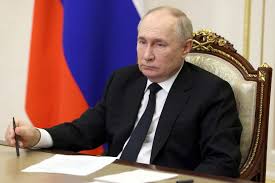
Russian leader says he hopes nuclear strikes ‘will not be required’ in state TV film about his 25 years in power.
Angelique Chrisafis and agencies, 5 May 25, https://www.theguardian.com/world/2025/may/04/need-to-use-use-nuclear-weapons-has-not-arisen-in-ukraine-says-putin
The Russian president, Vladimir Putin, said in comments broadcast on Sunday said that the need to use nuclear weapons in Ukraine had not arisen, and that he hoped it would not.
Speaking in a film by Russian state television about his 25 years in power, Putin said that Russia has the strength and the means to bring the conflict in Ukraine to what he called a “logical conclusion”.
Responding to a question from a state television reporter about Ukrainian strikes on Russia, Putin said: “There has been no need to use those [nuclear] weapons … and I hope they will not be required.”
Fear of nuclear escalation has been a factor in US officials’ thinking since Russia invaded Ukraine in early 2022. The former CIA director William Burns has said there was a real risk in late 2022 that Russia could use nuclear weapons against Ukraine.
In autumn 2022, the US was so concerned about the possible use of tactical nuclear weapons by Russia that it warned Putin over the consequences of using such weapons, Burns has said. At the same time, the Chinese leader Xi Jinping also warned Putin not to resort to nuclear weapons.
Putin signed a revamped version of Russia’s nuclear doctrine in November 2024, spelling out the circumstances that allow him to use Moscow’s atomic arsenal, the world’s largest. That version lowered the bar, giving him the option of using nuclear weapons in response to even a conventional attack backed by a nuclear power.
The US president, Donald Trump, has said he wants to end the conflict via diplomatic means, raising the question of whether Putin was willing to negotiate a peace settlement. But the Kremlin has rejected calls by Kyiv and Washington for an unconditional 30-day ceasefire.
Putin, in February 2022, ordered tens of thousands of Russian troops to invade Ukraine. Moscow’s forces now control about 20% of Ukraine, including parts of the south and east.
In the carefully choreographed state television film, Putin was shown in his private Kremlin kitchen offering chocolates and a fermented Russian milk drink to the Kremlin correspondent, Pavel Zarubin.
Putin, a former KGB lieutenant colonel who was handed the presidency on the last day of 1999 by an ailing Boris Yeltsin, is the longest serving Kremlin leader since Joseph Stalin, who ruled for 29 years until his death in 1953.
Scotland does not need nuclear power and people aren’t being told the truth
Commonweal 1st May 2025,
https://www.commonweal.scot/daily-briefings/briefing-r57be
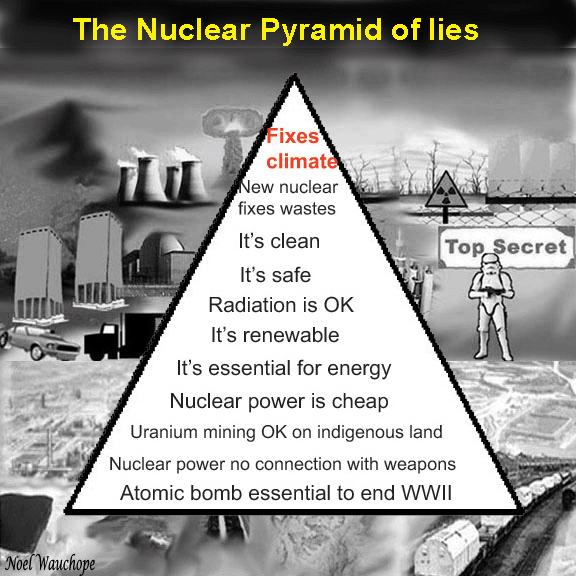
The nuclear industry has one of the most aggressive lobbying and public relations campaigns of all energy sources. It pushes relentlessly on politicians and the public to support the merits of nuclear power based on partial or inaccurate information. Very often this goes unchallenged in the Scottish media.
Given that nuclear power presents itself as a pragmatic response to decarbonising energy and given the scale of the PR campaign, it is perhaps not enormously surprising that SNP voters appear to split with their party over this issue. But would they continue to support nuclear power if they knew the numbers?
Here are some stark realities. The cost of generating of electricity from renewable sources is £38 to £44 per MWh. The estimated cost of the same electricity from nuclear (at the new Hinkley Point C reactor) in 2025 is £150 per MWh. It can only be presumed that the participants in this survey were not told that generating electricity would become between three times as expensive with nuclear.
But even that hides the true costs. Nuclear power is very dangerous and, at the end of its lifecycle, is very complex to decommission and make safe. Every spent rod of nuclear fuel takes a full ten years simply to cool down. They must be immersed in a deep pool of cold, constantly-circulating water and monitored closely for ten years just to bring them down to a cool enough temperature that they can be processed.
That’s just the ongoing fuel. The complexity of decommissioning and entire nuclear power plant is significantly greater. In fact the current estimate of the cost for decommissioning nuclear power is about £132 billion. That is not paid for by consumers in their electricity bill – it is paid for by consumers through their tax.
This is the second stark reality that nuclear power works hard to conceal; not only is it three times as expensive as renewables to run, there is then a cost of at least £4,600 for every household to decommission the nuclear power plants and make them safe for the future.
Of course, safety is another issue here. Nuclear power stations are very vulnerable. They are extremely sensitive sites which require substantial long-term attention. There are currently concerns around the world that unreliable power supplies could mean existing plants may struggle to keep spent fuel rods from combusting if they cannot constantly and continually keep large amounts of cold water circulating round spent fuel.
Nuclear power stations do not like loss of electricity, especially for any extended period of time. This makes them very climate-vulnerable. And of course who knows what sorts of extreme weather we may face before the lifetime of a nuclear station is complete. Fukushima is not a cautionary tale for no reason.
And it is uncomfortable to dwell on the risks of nuclear sites if they become targets for terrorism or in war. No-one is expressing continent-wide anxiety over the threat-to-life status of Ukraine’s wind turbines; they absolutely are over the shelling of Ukrainian nuclear power stations.
The remaining case for nuclear is to provide ‘electricity baseline’ – the ability to bring electricity provision on and off line as renewable generation rates rise or fall (if the wind does blow), or during periods of peak demand. This just isn’t really honest – nuclear power does not like rapid changes in supply and are designed to run flat out, all the time, not least because costs rise rapidly if they are running at less then full power. You can’t just ‘turn them on and off’. So yes, they can provide baseline electricity but not ‘on demand’ electricity that can balance renewables.
Hydrogen storage can though. Scotland currently dumps enormous amounts of perfectly useable electricity in the ground if it is generated when there is no demand. This can be turned into hydrogen and then, on demand, converted back into electricity. At the moment the cost of electricity from hydrogen is about half as much again that of generating by nuclear. But there are big caveats to that.
First, the current hydrogen electricity price is about £230 per MWh, but this is a rapidly-developing area of technology and the current industry target is £100 per MWh. That makes it cheaper than nuclear. Second, there is no hidden capital cost – the incredible costs of building and decommissioning nuclear which are hidden from consumers by subsidy from tax just isn’t there for hydrogen. It is a simple technology.
Third, these costs all assume that you are generating hydrogen from electricity at full wholesale grid prices. But if you are using electricity that would otherwise be dumped because it is being generated at the ‘wrong time’, the hydrogen becomes a waste product. It is in practice much cheaper than nuclear and can supply long-term baseline. (Battery storage for short term is even cheaper.)
That is the reality that respondents in this poll were not given. Try the poll again with ‘do you want to pay three times as much for your electricity with an additional costs to your household of £4,600 to have unsafe nuclear power when renewables with hydrogen storage are cleaner, cheaper and safer’.
Consistent, reliable renewable energy isn’t hard to solve in Scotland. There are nations where nuclear may have to be part of a clean energy solution, but Scotland is not one of them. You need to withhold a lot of information from people to make them believe the wrong thing about nuclear.
EDF seeks joint financing for UK projects

April 30, 2025, https://www.neimagazine.com/news/edf-seeks-joint-financing-for-uk-projects/?cf-view&cf-closed
DF is seeking to consolidate financing for the Hinkley Point C and Sizewell C NPPs under construction in the UK. French Energy Minister Marc Ferracci told the Financial Times that they should be treated as one financial venture in negotiations. He said he had discussed the issue with UK Energy Minister Ed Miliband on the sidelines of a conference in London.
“France and EDF are very committed to deliver the projects but we have to find a way to accelerate them, and we have to find a way to consolidate the financial schemes of both projects,” he said.
Both projects started out with equity stakes from Chinese state-owned nuclear development corporations but the UK government cancelled the arrangements because of “security issues”. The UK government partly replaced the funding and is seeking support from institutional investors.
Ferracci denied that the French government intended to use Sizewell as “leverage” against the financial troubles at Hinkley. “It is not a discussion about leverage, it is a discussion between friends and allies. . . So there is a way through, and I hope we will be able to find it in the next few months.”
He also called for a global solution that would result in a deal that benefitted EDF’s returns across both schemes. “It is a good approach to have a global approach to our relationship,” Ferracci said, adding more “grid connections between France and the UK” could come into the negotiations.
Meanwhile, workers at the Hinkley Point C NPP construction site are complaining about a significant rat infestation, raising health and safety concerns. In early April, the Unite and GMB trade unions at Hinkley Point C told EDF that the facility was overrun with rats. The unions said immediate action was needed as the rodents were “everywhere”. In recent months, workers have also complained about poor working conditions and low pay. In addition, hundreds of project staff went on strike in November over the inadequate security access to the site.
May Day – How Hot is Too Hot for a Ferociously Hot Nuclear Dump Under the Irish Sea-Bed?

The Developer, Nuclear Waste Services is a Government body and also a limited liability company.
Marianne Birkby, May 01, 2025
Received this today – it is not at all reassuring and underlines why we must RESIST THE NUCLEAR DUMP PLANS.
Nuclear Waste Services (The Developer) says the seabed will have “no significant temperature rise” once atomic wastes are placed in the geology beneath. What Nuclear Waste Services mean by “significant” is not stated. Any temperature rise AT ALL on the seabed would be hugely damaging.
Regarding uplift of the sea-bed from radioactive gases and thermal heating the reply is: “GDF design and other controls on management of the thermal output of waste, as noted above, will prevent disruptive uplift of the seabed from the heat output of waste.”
These inevitable impacts due to the thermal heating of abandoned atomic wastes (currently cooled by freshwater at Sellafield) are not mentioned by Nuclear Waste Services in their propaganda literature. The already vulnerable seabed and ocean gets no say in the matter of a deep sub-sea nuclear dump. Propaganda of “safe, permanent disposal” is aimed at the deliberately narrowed down “Areas of Focus” for the above ground mine shafts and nuclear sprawl facilitating a “geological disposal facility. ” Nuclear Waste Services are ignoring/playing down all impacts in their public disinformation campaign, including the thermal impacts of A GDF/deep hot nuclear dump up to the size of Bermuda in the geology beneath the Irish Sea-bed. From their point of view why would they bring to people’s attention the ferocious heat of the atomic wastes or the likely impacts on the sea-bed and ocean?
Email received today -1st May
OFFICIAL
…………………. The reports and summary below provide information on the specification, evolution and illustrative disposal concepts for heat generating wastes:
High Heat Generating Waste (HHGW) Specifications – GOV.UK
Technical Background to the generic Disposal System Safety Case
NDA Report no DSSC/451/01 – Geological Disposal – Waste Package Evolution Status Report
https://midcopeland.workinginpartnership.org.uk/news-from-nws-high-heat-generating-waste-qa
1. How hot would be too hot?
The design of the Geological Disposal Facility (GDF) will take account of the thermal output of heat generating waste such that it does not adversely impact the engineered barriers (backfill, plugs, seals) and containment function of the host geology (its ability to limit the migration of radioactivity). This is achieved by passive means, for example, by appropriate design of the container, disposal tunnels or vaults, and spacing of containers. Nuclear Waste Services will set a limit on the peak temperature of the GDF system and waste packages to assure the integrity of the waste, waste container, engineered barriers and host rock. The limits adopted by international programmes are typically in the range of 100oC – 200oC. Heat generating waste, such as spent nuclear fuel and high-level waste glass, will have been cooled over several decades during interim storage, so as to meet the temperature limit set for acceptance to a GDF. This storage practice is already underway at Sellafield.
2. How long would it take for thermal heating to reach the seabed
At the depth of GDF construction (200 – 1000 m) heat will diffuse slowly into the engineered barriers and host rock. Peak temperatures will occur in the centuries immediately following closure as the GDF system equilibrates. However, the thermal output and temperature of waste packages decreases slowly and predictably with time. Combined with the approach described above, there will be no significant temperature rise at the seabed.
3. How long would it take for uplift of the seabed due to thermal heating/gas pressure?
The GDF will be designed to prevent over pressurisation by gas leading to uplift of the seabed by enabling very slow diffusion of gas through plugs and seals. GDF design and other controls on management of the thermal output of waste, as noted above, will prevent disruptive uplift of the seabed from the heat output of waste.
TONY BLAIR: STILL A NUCLEAR NUTTER!
https://jonathonporritt.com/tony-blair-nuclear-energy-failure/ 6 Dec 24

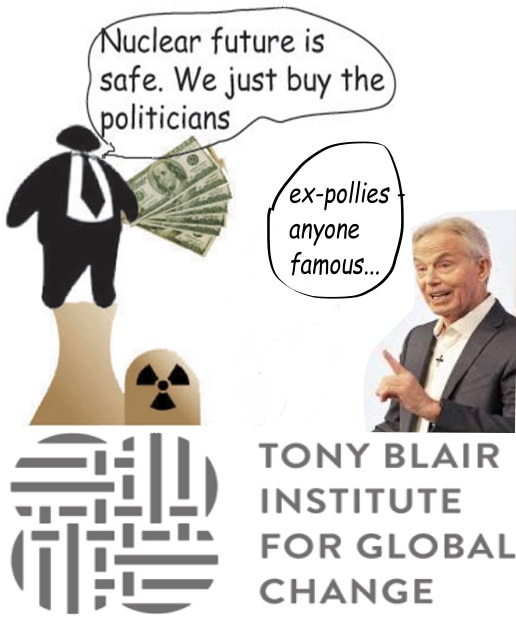
Earlier in the week, the Tony Blair Institute for Global Change brought out a new report grandiloquently titled: “Revitalising Nuclear: The UK Can Power AI And Leave The Clean Energy Transition”.
In essence, it’s little more than a re-run of today’s standard nuclear propaganda – plus two things:
First, a highly flaky retrospective looking back to 1986 to calculate what would have happened to the UK’s greenhouse gas emissions if anti-nuclear campaigners’ “inaccurate post-Chernobyl narrative” hadn’t reduced us to a nation of nuclear sceptics; second, an even more flaky look ahead to the ‘new nuclear age’ that is now so desperately needed to provide the electricity to “power AI”.
It’s total tosh – and, as such, I really do urge you to read it!For me, however, reading it was a weird experience, transporting me back 20 years to Tony Blair’s premiership and his evangelical conversion to the cause of nuclear energy in 2005. Before that, he’d more or less gone along with his own Government’s Energy White Paper of 2003, which was distinctly nuclear-sceptic – interpreted widely at the time as “kicking nuclear into the long grass”.
During those two years, however, the “deep nuclear state” duly “put him right” (on military as much as on energy grounds), and although the Sustainable Development Commission (of which I was then the Chair) and many other think tanks and expert advisers were assiduously reinforcing the 2003 White Paper’s non-nuclear priorities, Tony Blair duly announced that he obviously knew better than everybody else, and that “nuclear was back on the agenda with a vengeance”.
The consequences of that decision are obviously not as severe as Tony Blair’s ineffable arrogance in enthusiastically backing George Bush’s insane decision to invade Iraq in 2003 – which he still argues was the “right thing to do”, despite more than 20 years of consequential mayhem in the Middle East.
It can be argued, however, that his nuclear fantasies at that time have screwed up energy policy in the UK ever since. That nuclear baton was passed on to Gordon Brown and on and on through to Kier Starmer, with all Prime Ministers in between espousing a fantastical faith in the future of nuclear power and the contribution it will make to our low-carbon energy future.
Quick reality check: by way of electrons from NEW nuclear power stations feeding into the grid, the UK’s vengeance-driven nuclear industry has delivered NOT ONE throughout those 20 years. NOT ONE! And it will still be not NOT ONE until 2030 at the earliest.
(EDF’s PWR at Sizewell B came online in 1995). The only new power station under construction (at Hinkley Point C in Somerset) will not come online until 2030 at the earliest.
According to the Tony Blair Institute, this is all the fault of the UK’s mind-blowingly powerful anti-nuclear movement, with all its incredibly well-funded campaigns (only joking!), persuading otherwise intelligent people that even to talk about nuclear power will cause severe radiation sickness (still only joking!). What are Blair’s wonks on? How can otherwise intelligent people just wish away 20 years of chronic incompetence, financial mismanagement and engineering inadequacies on the part of the nuclear industry itself?
I jest, but only because it’s so serious. One can only speculate how much further down the road to a Net Zero future we’d be if we hadn’t had this nuclear cloud hanging over us all this time – in terms of accelerated investments in energy efficiency (particularly housing retrofits), renewables, storage (both short-term and long-term) and reconfigured grids. The Institute’s report claims (straight off the back of its very big envelope) that the UK’s emissions would be 6% lower if we’d just listened to Tony Blair at the time. I do hope someone will do a counterfactual analysis of how much lower they’d be if we’d just gone down that alternative route.
But the dysfunctionality just goes on and on. GBNF (Great British Nuclear Fiasco) now presides over one costly decision after another. Because Hinkley Point C won’t be coming online until after 2030, EDF has had to persuade the Office For Nuclear Regulation (ONR) to extend the lifetime of its remaining fleet of AGRs – which I’m not necessarily opposed to, by the way, as long as the safety case for so doing is as robust as ONR/EDF would have us believe.Rather more problematically, the ONR has also agreed to extend the operating lifetime of Sizewell B to 60 years – through to 2055. That’s a bit different.
What people don’t realise is that when you extend the lifetime of a nuclear reactor you’re also extending the lifetime of all the waste it’s produced in operation being stored on site for decades after it comes offline. Let’s just say, with Sizewell B, through to the end of the century.
Which brings me on to Sizewell C.
On Tuesday (3rd December), I was sitting there in Court 46 in the Royal Courts of Justice in London listening to what at first hearing sounded like a very geeky legal argument about how to interpret a particular clause in the 1965 Nuclear Installation Act: does the ONR, or does it not, have an obligation, in its issuing of a licence for a new reactor, to impose conditions at the time of issuing the licence on the operator (i.e. EDF) covering material safety risks that should be taken into consideration?
“Yes it does”, in the opinion of Stop Sizewell C, bringing the challenge to ONR’s decision not to attach specific conditions to its licence for Sizewell C. The material safety risk at the heart of this challenge relates to the sea defences that will be required to protect Sizewell C into the future, about which there is nothing explicit in the license.
A bit of maths: IF Sizewell C ever gets a Final Investment Decision from the Government (mid-2025 at the earliest), and IF EDF hasn’t run out of money by then, construction could start in 2027/2028. Allow ten years for construction (I’m being kind). So, Sizewell C comes online in 2037, with a projected lifetime of 60 years – as with Sizewell B – through to 2097.
Set that against the latest projections from the (super-conservative) Intergovernmental Panel on Climate Change that we should be anticipating a minimum of a one metre sea level rise by 2100.
And then try and imagine the scale of sea defences that will be required to ‘defend’ Sizewell C through to the end of the century from at least a metre higher sea levels, plus storm surges and so on – let alone to whatever time will be required to store the nuclear waste arising from its operations. A ‘material risk’? I think so.
But that was not the opinion of Mrs Justice Lieven, the Judge hearing Stop Sizewell C’s challenge. She obviously ‘knew her stuff’ ( as she should, having worked previously as a lawyer for Hinkley Point C!), but her perfunctory dismissal of the challenge was quite astonishing.
I blame both Tony Blair – a critical part of the whole deep nuclear state working away behind the scenes – as well as the UK’s astonishingly gullible media which just goes along with all this nuclear crap, year after year after year.
Campaigner hits out at ‘PR trick’ nuclear energy poll of SNP members

By Laura Pollock, Multimedia Journalist, 1 May 25, https://www.thenational.scot/news/25131226.campaigner-hits-pr-trick-nuclear-energy-poll-snp-members/
A LEADING independence activist has hit out at a recent poll suggesting roughly half of the SNP’s voters believe nuclear power should be part of Scotland’s mix of clean energy generation.
Robin McAlpine, founder of pro-independence think tank Common Weal, has branded the polling a “PR trick based on deliberately withholding crucial information”, claiming people who responded were not given “the basic facts”.
Polling for the campaign group Britain Remade, founded by a former energy adviser to Boris Johnson, found 52% of those who voted for the party in 2021 believe nuclear power should be included in Scotland’s energy mix to meet the 2045 net zero target.
Meanwhile, 57% of those who voted for the party in last year’s general election felt the same way, the poll found. A total of 56% of Scots thought nuclear power should be part of Scotland’s clean energy mix to meet the targets, while 23% disagreed, and 21% said they did not know.
Opinium surveyed 1000 Scottish adults between April 22 and 25.
However, McAlpine argues those quizzed on the topic were not aware of key points as laid out in a blog post for pro-independence Common Weal Common Weal.
He highlights the price of hydrogen electricity being cheaper than nuclear, as well as the hidden costs of building and decommissioning nuclear infrastructure.
“Would SNP voters back nuclear if it was explained that it will cost them three times as much as renewables and then also cost nearly £5000 per household just to clean them up?” McAlpine told The National.
He further questioned: “Do people know that it is much cheaper to run a renewable system with battery storage for short-term load balancing and hydrogen storage for long term battery storage? Are they aware that you can’t turn nuclear power on and off and that it has to run at full power all the time? So it can’t balance renewables when the wind isn’t blowing, it can only displace renewables from the grid.
“The only conceivable purpose of nuclear in Britain is to power the south of England. Look at Fukushima, look at the power stations in Ukraine, how much risk do you want to take when you have absolutely no need to do it?
“If people are told ‘more expensive, much more dangerous, can’t be switched up or down or turned off, costs an absolute fortune to decommission at the end’, I think you’ll find they answer differently.”
Britain Remade has been approached for comment.
The SNP have argued nuclear power projects remain too expensive to be a viable alternative to renewable power.
Responding to the polling, SNP MSP Bill Kidd said: “Our focus is delivering a just transition that supports communities and creates long-term economic opportunities to build a truly sustainable future.
“Nuclear remains one of the most costly forms of energy with projects like Hinkley Point C running billions over budget and years behind schedule.
“In contrast, Scotland’s net zero transition is already delivering thousands of green jobs across energy, construction, innovation, and engineering. This number will continue to grow.
“Simply, renewables are cheaper to produce and develop, create more jobs, and are safer than nuclear as they don’t leave behind radioactive waste that will be deadly for generations.
“While Labour funnels billions into slow, centralised projects, the SNP is focused on creating real, sustainable jobs in Scotland now.”
Sellafield plan for new building to store radioactive waste
Federica Bedendo, BBC News, North East and Cumbria, 2 May 25, https://www.bbc.com/news/articles/cg724n91gp4o?fbclid=IwY2xjawKA7DdleHRuA2FlbQIxMQBicmlkETFISGV5ZEdSZW16a2ZnQzh3AR5Wx_HKBbiK0umY8fOSOzw2Hzv5_AeeAjFPGDgbc4VxAi7joZ7-0jA4qr0Bzg_aem_nd6f3waC2WX_bFb_0pWkhw
Work to build a storage facility to keep radioactive waste for up to 100 years is set to take a step forward.
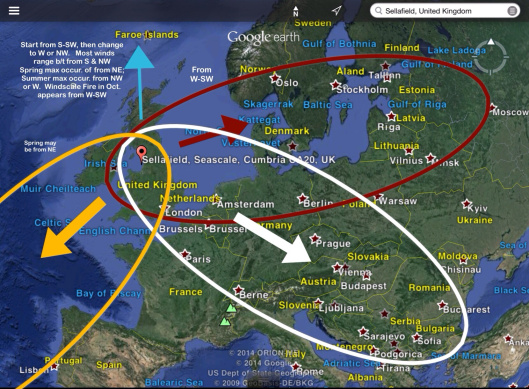
Sellafield, in Cumbria, wants to build the second of four new units to store intermediate level waste, as the company works to decommission ageing buildings at its Seascale plant.
The site manages more radioactive waste in one place than any other nuclear facility in the world, according to planning documents.
The project was approved in 2023 and an application has now been submitted to the Environment Agency (EA) seeking permission to abstract water from the site.
The water would have to be extracted as the ground is dug up to build the new facility, a Sellafield spokesman said.
It was needed as part of the building phase, they said, adding there were no risks of contamination from radioactive waste.
Documents show the building storing the nuclear waste would be about the size of a football pitch and as tall as about six double-decker buses.
The walls of the store which has already been built are about 5ft (1.5m) thick, with a 6.5ft (2m) thick floor.
Sellafield said it planned to start building work this year, with the second store becoming operational in 2032.
The waste would be kept there for up to 100 years, papers show, and then moved to a Geological Disposal Facility (GDF) – an underground storage facility which could be built in Cumbria.
A consultation on the plans to abstract water from the Sellafield site by the EA closes on 2 May.
For second time in 3 years Zelensky sabotages Ukraine war peace deal.

Walt Zlotow, West Suburban Peace Coalition, Glen Ellyn IL 30 Apr 25
Does Ukraine President Zelensky enjoy watching his citizens die needlessly in a US provoked war he could have ended twice?
Zelensky helped ensure Russia would invade February 22, 2022 by pushing NATO membership for Ukraine and massing 60,000 elite troops on the Donbas border to finish off the Russian leaning Donbas Ukrainians seeking independence from Kyiv destroying their culture along with their lives.
But Zelensky sensibly negotiated a peace agreement with Russia in the first two months (Istanbul Agreement) that would have ended the war with no loss of Ukraine territory albeit with no Ukraine NATO membership and independence for the beleaguered Donbas Ukrainians. That was statesmanship of the highest order.
But the US and UK saw a golden opportunity to weaken Russia if not change out the Vladimir Putin regime. What to do? Got it. Send US Defense Secretary Lloyd Austin and UK Prime Minister Boris Johnson to Kyiv to disabuse Zelensky of making peace. Hey, with a couple of hundred billions in US/NATO weapons but no soldiers, you can win Zelensky and go out the George Washington of Ukraine..
The result? Three years on Ukraine is largely destroyed with millions fled, over a hundred thousand casualties, 45,000 square miles gone forever and a shattered economy.
But new sheriff in town Trump brokered a new peace deal which would have ended the war with no further casualties or lost territory, Astonishingly, Zelensky rejected it again, this time of his own free will. He cited both his desire to require Crimea, lost 5 years before he became president, and his goal of Ukraine joining NATO.
So despite a 3 day Russian truce in in the offing over its May celebration of its WWII victory, the dying soldiers and expanding Russian buffer zone in Ukraine to prevent further long range Ukrainian missile attacks will go on till Ukraine simply collapses.
Maybe Zelensky has a nationwide death wish. Maybe he’s delusional or too stupid to realize his leading Ukraine to certain destruction. Or maybe it’s simply his way of telling the US and UK that he’s capable of blowing up a sensible peace agreement all by himself.
Europe is drilling for World War III
NATO is conducting exercises for “a broad offensive from Vilnius to Odessa” at “a scale unseen in decades.”
Alex Krainer, May 01, 2025
[Originally published at I-System TrendCompass] Russia’s military victory over Ukraine has been a near-certainty for months now. Ukraine’s total defeat is only a matter of time, but as that time approaches, European powers have been increasingly determined not to let the war die and are now actively preparing to take it up where Ukraine stumbles. Our liberal democracies are as precious as they are fragile and every precaution must be taken to defend them from the Asiatic hordes gathering in the east.
While our valiant bankers are arranging to allocate trillions of euros of our children’s and grandchildren’s wealth for defense spending, our militaries are diligently exercising and preparing for war, hidden from ordinary Europeans who aren’t exactly enthused about World War 3. But the Russians have noticed: presidential aide and former National Security Adviser Nikolai Patrushev recently stated that, for a second consecutive year, NATO has been
“conducting exercises at our borders at a scale unseen in decades. … They are training for conducting a broad offensive from Vilnius to Odessa, seizing Kaliningrad region, imposing a naval blockade in the Baltic and the Black Seas and executing preventive strikes on the staging locations of Russian nuclear deterrence forces.”
If Mr. Patrushev is correct, it would appear that London, Paris, Berlin and Brussels are actively preparing for war against Russia. But his statement that the exercises are “at a scale unseen in decades,” needs to be put in context.
NATO’s provocations far predate Ukraine war
NATO has been involved in increasingly aggressive military maneuvers at Russia’s doorstep for many years now, especially after the 2014 Euromaidan coup in Kiev. During that time, NATO forces have been conducting as many as 40 major military exercises per year along Russia’s borders.
Movement of their military assets evolved from purely reconnaissance hardware to battle ready ships and aircraft equipped with precision munitions and cruise missiles which would frequently approach Russian territory to as close as 15 km (9.3 miles). On these occasions, they often activated their missiles in repeated mock attacks on Russian targets. In September 2020, chief of operations of Russia’s high command, General Sergey Rudskoi stated that NATO was staging between 33 and 40 such flight approaches per week using fighter jets from Sweden, Germany, Ukraine and Italy.
This suggests that the exercises Mr. Patrushev referred to aren’t Europe’s reaction to Russia’s aggressiveness but a continuation of policy that far predates the Ukraine war. In June 2021, still more than six months before Ukraine war, NATO’s then Secretary General Jens Stoltenberg boasted that,
“Perhaps the most important thing we have done is that for the first time in NATO’s history, we have combat-ready troops in the eastern part of the Alliance. New battle groups are deployed to the Baltic countries and Poland, we have tripled the size of the NATO readiness force.”
In a 2016 radio-interview with John Bachelor, late professor Stephen Cohen noted that,
“NATO has decided to quadruple its military forces on Russia’s borders or near Russia’s borders… The last time there was this kind of Western hostile military force on Russia’s borders was when Nazis invaded Russia in 1941. There has never been anything like this. During the 40-year Cold War there was this vast buffer zone that ran from the Soviet borders all the way to Berlin. There were no NATO or American troops there. This is a very radical departure on the part of the [Obama] administration. … Russia is not threatening any country on its border.”
$75 trillion worth of democracy and freedom
Professor Cohen was right. Russia really wasn’t threatening any of its neighbors, and no Russian leader has either explicitly or implicitly expressed any territorial pretentions against any European nation. The deranged claims that once they are done with Ukraine, the Russians will continue on to Poland, the Baltic states, Finland and then, who knows, perhaps Paris and London, are based on nothing but European leaders reckless fear mongering, aimed at justifying NATO’s continuing preparations for war.
The ultimate reason isn’t the belief that Russia will launch a medieval invasion of Europe and deprive us of our democracy and freedom, but the certain knowledge that Russia is sitting on an estimated $75 trillion of our freedom and democracy. Those precious resources are utterly wasted on the unworthy Russians. Here’s what the Iron Lady Margaret Thatcher once said (video at this link):
“If you were to make a table of countries in proportion to the natural resources they have, the top one would almost certainly be Russia. She has everything. Oil, gas, diamonds, platinum, gold, silver, all the industrial metals, marvelous standing timber, a wonderfully rich soil. But countries are not rich in proportion to their natural resources. Countries are rich whose governments have policies which encourage essential creativity, initiative and enterprise of man and recognize his desire to do better for his family.”…………………………………………………………………………………………………………. https://alexkrainer.substack.com/p/europe-is-drilling-for-world-war?utm_source=post-email-title&publication_id=1063805&post_id=162553198&utm_campaign=email-post-title&isFreemail=true&r=1ise1&triedRedirect=true&utm_medium=email
Covering up Ukrainian Nazis is nothing new – the Canadians have been doing it for almost eighty years

Ian Proud, April 29, 2025. https://strategic-culture.su/news/2025/04/29/covering-up-ukrainian-nazis-nothing-new-canadians-have-been-doing-it-for-almost-eighty-years/
A number of topics remain taboo in discussing the war in Ukraine. Busification, Zelensky’s democratic mandate, Ukraine’s casualty numbers and anything suggesting that Ukraine cannot win are all off limits. Likewise the problem of alleged neo-Nazis in Ukraine.
One of the most embarrassing episodes since the Ukraine war started in 2022, was when Yaroslav Hunka, was given two standing ovations in the Canadian House of Commons public gallery by MPs during the visit of President Zelensky in 2023. Hunka has been accused by Russia of genocide, because of his alleged involvement in the Huta Pieniacka massacre of February 28 1944 in which more than 500 ethnic Poles were murdered in a village, in what is now western Ukraine. Hunka was a member of the SS Galicia Division, a mostly Ukrainian unit of the Waffen SS, which Commissions in Germany and Poland later found guilty of war crimes.
This was shocking because it opened the lid on a topic of conversation that has been largely silenced by the western mainstream media since the beginning of the war: Ukraine’s contemporary challenge of far-right ultranationalism. But the Hunka case also illustrates how western authorities airbrushed discussion of nazis in Ukraine after World War II too.
On 13 July 1948 the British Commonwealth Relations Office, what is now part of the Foreign Commonwealth and Development Office, sent a telegram to Commonwealth governments, proposing an end to Nazi war crimes trials in the British zone of Germany. “Punishment of war crimes is more a matter of discouraging future generations than of meting out retribution to every guilty individual… it is now necessary to dispose of the past as soon as possible.”
After the conclusion of the Nuremberg War Trials in 1946 the western world faced a new enemy in the Soviet Union. Limited security resources in cash-strapped Albion and its colonies were re-deployed to uncover suspected Soviet agents and Communists, rather than to identify and track down lower-order Nazi war criminals.
Around this time, many Ukrainians fled the Soviet Union to settle in Canada. In the thirty-year period after the start of Operation Barbarossa, the Ukrainian population in Canada almost doubled, from 300,000 to almost 600,000 people. While most of them, I am sure, would not have been Nazi collaborators, some, undoubtedly, were. They were joined by lesser numbers of Latvians, Hungarians, Slovaks and others.
Within that exodus would have been so-called “lesser” war criminals; persons who had organised the transportation of Jews, Slavs, gypsies and homosexuals to death camps, acted as informers, committed murders, or become involved in war crimes as other ranks and non-commissioned officers in death squads. They were the lower echelon collaborators, acting as the instruments of the genocide initiated by the Nazis.
Yet, following the British instruction, Canada progressively relaxed its immigration policy between 1950 and 1962, steadily removing restrictions against the entry of German nazis and non-German members of German military units like the SS Galicia Division.
However, in 1984 the Simon Wiesenthal Center wrote a letter to the Canadian government claiming to have obtained evidence that the ‘Angel of Death’ Josef Mengele had applied for a landed immigrant visa to Canada in 1962. Though this proved to be incorrect, it caused such outrage among Canada’s Jewish community that a Commission of Inquiry on War Criminals in Canada was established in 1985.
Known as the Deschênes Commission, it uncovered a list of 774 persons who had allegedly entered Canada and who required further investigation. Of that list, only 28 underwent serious investigation and trial.
Michael Pawlowski, accused of murdering 410 Jews and 80 non-Jewish Poles in Belarus in 1942, was acquitted as judges blocked the prosecution from gathering evidence in the Soviet Union.
Stephen Reistetter of Slovakia was not tried for allegations that he kidnapped 3000 Jews to have them sent to Nazi death camps while serving in the Hlinka party, a far right clerical-fascist movement with Nazi leanings. His case fell apart because a witness died.
Erich Tobias, was accused of involvement in the execution of Latvian Jews but died before his case went to court.
By 1995, with no convictions for war crimes having been secured, the Canadian Justice Department cut the size of its war crimes unit from 24 to 11 people. In the absence of criminal prosecutions, the Canadian Government tried civil proceedings to revoke citizenship from alleged war criminals.
Wasily Bogutin collaborated with the Nazi occupation forces in the town of Selidovo, in Donetsk, and was personally and directly involved in effecting the roundup of young persons for forced labour in Germany. In February 1998, Judge McKeown, of the Trial Division of the Federal Court, found that Bogutin had concealed his role in war crimes, but he died before he could be extradited.
Joseph Nemsila, who commanded a Slovak unit that sent civilians to Auschwitz died in 1997 after a decision not to revoke citizenship was overturned, but death prevented exportation.
In only 7 cases was order made for the suspect to be extradited or exported. This included Ladislaus Csizsik-Csatary, accused of involvement in the confinement of thousands of Hungarian Jews and their subsequent deportation to death camps. In July 1997, just before his trial was to begin, he decided not to oppose the loss of his citizenship and voluntarily left the country.
Vladimir Katriuk was accused of having taken part in the Khatyn Massacre in Belarus and Wasyl Odnynsky, a guard at SS labour camps at Trawniki and Poniaka. Moves were made to revoke their citizenship, but they were allowed to remain in Canada until all court proceedings were lifted in 2007.
Progress in prosecuting alleged war criminals in Canada was always slow, often held up by foot-dragging by often reluctant judges, and a refusal to allow for the gathering of evidence in the Soviet Union.
Today, the media and Jewish groups still pressure the Canadian government to reveal the names of all of the 774 persons considered by the 1985 Deschênes Commission with so far little success.
An American academic recently discovered what is believed to be a similar list of 700 suspects which included Volodymyr Kubiovych, a Ukrainian Nazi collaborator who helped organize the SS Galicia division and who was editor in chief of the Encyclopedia of Ukraine compiled at the University of Alberta. A photograph of a parade in Lviv, Ukraine, in July, 1943, shows Mr. Kubiovych making a Nazi salute alongside Otto Wächter, a senior member of the SS who also served as governor of Galicia and Krakow.
Yaroslav Hunka was not on that list, raising questions about how many Nazi collaborators in Canada were never discovered.
I don’t think that Ukraine today is a Nazi society and, even at its high watermark, the Svoboda party only garnered 10% of the national vote. But ultranationalism is a major problem, particularly in the west of Ukraine, in that area known as Galicia during World War II. And the refusal of western governments to acknowledge the issue of ultranationalism in Ukraine or speak out means that we are turning a blind eye once more to activity that we would never tolerate in our own countries.
Chernobyl’s Hidden Impact: Disinformation and Nuclear Politics

And yes it is oxymoronic to have the same agency being responsible for safety and promotion of nuclear power
Chernobyl is not the past.
every nuclear power plant ever built assumes there will never be a war on the site.
Chernobyl explosion was “perhaps the real cause of the collapse of the Soviet Union.” According to Mikhail Gorbachev who was the last leader of the Soviet Union and was in power during the meltdown. But perhaps the more important lesson from the Chernobyl catastophe is that disinformation can kill you. It is important to remember that the largest and most deadly nuclear accident in the world was not even reported initially by the secretive and corrupt Soviet Union. It was not until 2 days after the meltdown that the Forsmark Nuclear Power Plant in Sweden detected the radiation and forced the Soviets to admit there had been an accident. Forsmark is 1100 km from Chernobyl.
Disinformation about Chernobyl is not confined to the Soviet Union, western nations and especially the UN played a critical role in down playing and distorting information about the effects of the disaster. This is most obvious in the fatality estimates associated with the catastrophe.
In 1959, the powerful UN agency responsible for both promoting and monitoring nuclear power, the IAEA, signed an agreement with the UN’s health monitoring agency, WHO, that restricted them from reporting on nuclear accidents. And as part of the western public relations cover up, 4 months after the meltdown the then general director of the IAEA, Hans Blix, would affirm: “The world could tolerate a nuclear accident as serious as Chernobyl every year.” WHO was blocked from releasing any independent Chernobyl studies and ultimately the IAEA (with WHO) would officially report that there were only between 4000 to 9000 deaths. [And yes it is oxymoronic to have the same agency being responsible for safety and promotion of nuclear power.]
Consensus is not your friend. There have been many scientific studies of the affects of Chernobyl. Greenpeace did an anthology of these studies at the 25th anniversary and estimated that at least 93,000 people will have died and the actual total is likely well be over 200,000 premature deaths. Why the big difference between the UN’s official tally and independent scientists? The answer is consensus. The IAEA has representatives from pro-nuclear states on it’s Chernobyl Forum, they release their reports operating by consensus and those invested in nuclear energy have a strong interest in down playing the effects of accidents. Independent scientists have also found radiation levels in the exclusion zone to be over three times higher than the IAEA reports.
How effective is this western mis/disinformation campaign? Check out Wikipedia or ask any AI. You will quickly find the IAEAs 4000 person fatality rate. Depending on the source more accurate information is either buried or not revealed in your first responses. Lots of people on the nuclear payrolls have put a bunch of effort into minimizing the impact of all nuclear accidents. This is not a (known) conspiracy, per se, but rather contemporary industrial capitalism functioning as designed. But perhaps more revealing is that almost no mainstream news sources are covering this years 39th anniversary. Far more important in our attention economy is that Trump is going to the Pope’s funeral and we are arresting judges in the US.
Chernobyl is not the past. In February of this year a relatively low cost attack drone blew a hole in the second $1.7 billion Chernobyl sarcophagus. The fire from this attack burned for 3 weeks, requiring technicians to make further holes in the exterior shell in a high stakes game of “nuclear whack a mole”
“We did a lot of safety analysis, considering a lot of bad things that could happen,” said a senior technical adviser on the project. “We considered earthquakes, tornadoes, heavy winds, 100-year snowfalls, all kinds of things. We didn’t consider acts of war.”
It is worth pointing out that every nuclear power plant ever built assumes there will never be a war on the site. Assuming otherwise would be yet another in the long list of reasons why nuclear power should not be considered or continued. Other major problems with civil nuclear power include: subsidized insurance, proliferation risks, uneconomic construction and operation, perverse effects on avoiding climate disruption and the threat to democracy. The total cost of the Cheronbyl accident has been estimated at $700 billion which is about 5 times the Ukraines average GDP for the last 10 years.
The only good nuclear news on this anniversary is the complexity of nuclear power plants combined with the previous globalization of the nuclear construction and fuel supply chain mean that Trump’s tariffs may put the breaks on any new nuclear construction in the US. Or perhaps more sadly, these Trump taxes will just increase the already ridiculous price of nuclear power to both taxpayers and ratepayers.
1 This Month
23 April – WEBINAR – Why new nuclear reactors are the wrong tools for decarbonization Thursday, April 23 • 1 AM – 2 AM AEST
World Nuclear Power. Reactors 1951-2026, 75 Years of Nuclear Power.
Interactive Map– https://dv.worldnuclearreport.org/

Chernobyl: The Lost Tapes – A good documentary on Chernobyl on SBS available On Demand for the next 3 weeks– https://www.sbs.com.au/ondemand/tv-program/chernobyl-the-lost-tapes/2352741955560

of the week–London Campaign for Nuclear Disarmament

Tell the Ukrainian Government to Drop Prosecution of Peace Activist Yurii Sheliazhenko
To see nuclear-related stories in greater depth and intensity – go to https://nuclearinformation.wordpress.com
-
Archives
- April 2026 (220)
- March 2026 (251)
- February 2026 (268)
- January 2026 (308)
- December 2025 (358)
- November 2025 (359)
- October 2025 (376)
- September 2025 (257)
- August 2025 (319)
- July 2025 (230)
- June 2025 (348)
- May 2025 (261)
-
Categories
- 1
- 1 NUCLEAR ISSUES
- business and costs
- climate change
- culture and arts
- ENERGY
- environment
- health
- history
- indigenous issues
- Legal
- marketing of nuclear
- media
- opposition to nuclear
- PERSONAL STORIES
- politics
- politics international
- Religion and ethics
- safety
- secrets,lies and civil liberties
- spinbuster
- technology
- Uranium
- wastes
- weapons and war
- Women
- 2 WORLD
- ACTION
- AFRICA
- Atrocities
- AUSTRALIA
- Christina's notes
- Christina's themes
- culture and arts
- Events
- Fuk 2022
- Fuk 2023
- Fukushima 2017
- Fukushima 2018
- fukushima 2019
- Fukushima 2020
- Fukushima 2021
- general
- global warming
- Humour (God we need it)
- Nuclear
- RARE EARTHS
- Reference
- resources – print
- Resources -audiovicual
- Weekly Newsletter
- World
- World Nuclear
- YouTube
-
RSS
Entries RSS
Comments RSS
 nuclear-news