Nuclear files removed from UK National Archives so that they can no longer be accessed by the public.
 The National 11th Feb 2019 ACCIDENT reports and safety reviews into nuclear weapons and atomic energy programmes in Scotland are among hundreds of documents to have been suddenly withdrawn from public view.
According to a report on the Sunday Post website, following a “security review” the files at the National Archives in Kew were removed so that they can no longer be accessed by the public.
The move has been described as “very concerning” by the Campaign for Nuclear Disarmament (CND). The documents relate to a range of topics on Britain’s nuclear weapons and atomic energy programmes, including the nuclear power plant in Dounreay, Caithness, as well as Chapelcross in
Dumfries and Galloway and the Hunterston A and Hunterston B power stations which are located in Ayrshire.
https://www.thenational.scot/news/17423745.scotlands-nuclear-history-suddenly-disappears-from-public-archive/
France considers fully nationalising EDF nuclear energy company
Last November, Macron said EDF would halt up to 14 reactors by 2035, with the aim of reducing nuclear power to 50 percent of the electricity mix from 72 percent currently. He delayed a decision to build new atomic plants until at least 2021 and presented plans to boost wind and solar. The president also called for a new regulation of EDF’s nuclear power prices to keep electricity bills under control amid weekly protests against energy costs and taxes.
By Francois De Beaupuy, Geraldine Amiel , and Helene Fouquet February 14, 2019,-
Utility needs funds to maintain or replace aging reactors
-
Restructuring could help EDF to meet long-term challenges
The French government is considering buying out minority shareholders of Electricite de France SA, the first step in a corporate restructuring to address the challenge of replacing the country’s nuclear-power backbone, people familiar with the matter said.
The government has asked EDF, of which it owns 84 percent, to propose changes in its structure. The utility’s cash flows are vulnerable to volatile power prices and intensifying competition, and it’s already struggling to fund billions of euros of investments to maintain or replace its aging reactors.
Nuclear dominates French electricity supply, but the government wants a change
EDF is likely to be be taken into full state ownership, with nuclear operations being placed in a parent company and other businesses such as renewables placed in units, said one person at the utility, who asked not to be identified because the deliberations are private. Nationalization could help the utility cope with the state’s plan to reduce France’s dependence on nuclear power by phasing out some reactors, while also giving it the means to participate in the development of renewable energy, said a person familiar with the government’s thinking.
EDF is likely to be be taken into full state ownership, with nuclear operations being placed in a parent company and other businesses such as renewables placed in units, said one person at the utility, who asked not to be identified because the deliberations are private. Nationalization could help the utility cope with the state’s plan to reduce France’s dependence on nuclear power by phasing out some reactors, while also giving it the means to participate in the development of renewable energy, said a person familiar with the government’s thinking.
This was already looking like being a significant year for EDF after President Emmanuel Macron outlined his vision for French energy policy to shift in favor of renewable energy. From the point of view of investors, re-regulating and restructuring the company’s reactor fleet could be a big value driver, Vincent Ayral, an analyst at JPMorgan Chase & Co, said in Jan. 30 research note.
If the government opts for nationalization, the process would be long and require the approval of European antitrust authorities, the person said. France would at the same time have to get the region’s regulator to approve new rules for nuclear power because the current system, designed to boost competition in the French electricity market, expires at the end of 2025, the person added.
Last November, Macron said EDF would halt up to 14 reactors by 2035, with the aim of reducing nuclear power to 50 percent of the electricity mix from 72 percent currently. He delayed a decision to build new atomic plants until at least 2021 and presented plans to boost wind and solar. The president also called for a new regulation of EDF’s nuclear power prices to keep electricity bills under control amid weekly protests against energy costs and taxes.
This was already looking like being a significant year for EDF after President Emmanuel Macron outlined his vision for French energy policy to shift in favor of renewable energy. From the point of view of investors, re-regulating and restructuring the company’s reactor fleet could be a big value driver, Vincent Ayral, an analyst at JPMorgan Chase & Co, said in Jan. 30 research note.
If the government opts for nationalization, the process would be long and require the approval of European antitrust authorities, the person said. France would at the same time have to get the region’s regulator to approve new rules for nuclear power because the current system, designed to boost competition in the French electricity market, expires at the end of 2025, the person added.
Last November, Macron said EDF would halt up to 14 reactors by 2035, with the aim of reducing nuclear power to 50 percent of the electricity mix from 72 percent currently. He delayed a decision to build new atomic plants until at least 2021 and presented plans to boost wind and solar. The president also called for a new regulation of EDF’s nuclear power prices to keep electricity bills under control amid weekly protests against energy costs and taxes
Theresa May says that UK is still in talks about Wylfa nuclear station plan
Last month the company announced it would suspend work on the £13bn Wylfa Newydd project because of rising costs.
The government said at the time it had failed to agree terms with Hitachi…….https://www.bbc.com/news/uk-wales-politics-47229383
UK government’s Radioactive Waste Management (RWM) looking for nuclear waste dump site in regions of England and Wales
Western Telegraph 12th Feb 2019 , RADIOACTIVE waste could one day be stored deep beneath the Pembrokeshire
countryside. Radioactive Waste Management (RWM) – set up by the government
– is on the look-out for a suitable site in which to dispose of radioactive
waste. England and Wales have been divided into sub-regions, three of which
include parts of Pembrokeshire, which could potentially house an
underground geological disposal facility (GDF). St Davids and its
surrounding coastline, up to North Wales, and an area starting at St Brides
Bay and leading south-east to Swansea are among the regions being assessed
for their suitability.
https://www.westerntelegraph.co.uk/news/17427410.pembrokeshire-is-on-the-list-of-potential-nuclear-waste-storage-sites/
UK Labour plans for a “just transition” to a green economy
Guardian 12th Feb 2019, Labour is to set out how the UK can move swiftly to a decarbonised future
to tackle the unfolding climate crisis and put “meat on the bones” of its
promise to create hundreds of thousands of high-skilled, unionised green
jobs. Trade unionists and industry leaders will come together with
academics, engineers and public institutions to build detailed regional
plans setting out the challenges and opportunities ahead.
The proposal, due to be outlined on Wednesday by Rebecca Long-Bailey, the shadow business
secretary, will involve a national call for evidence and a series of
regional events to build “a detailed action plan” to maximise the benefits
of moving to a zero-carbon future. A future Labour government would oversee
an economic revolution to tackle the climate crisis, using the full power
of the state to decarbonise the economy and create hundreds of thousands of
green jobs in struggling towns and cities across the UK. “We’re launching
an unprecedented call for evidence about what this means for your town,
your city, your region,” she said. “We want to bring unions, industry,
universities, the public sector and others together to build this vision
out into a practical reality.”
Labour says a key plank of its plan will be
to ensure a “just transition” to high quality green jobs for those
currently working in carbon-emitting industries. To do that it will have to
persuade its trade union backers, who represent people in high-carbon
industries, that there is a viable economic alternative. The party hopes
that once the evidence has been collected it will form the basis of a green
paper to be published in autumn 2019 at party conference, with plans for
how each region might move to a decarbonised future.
https://www.theguardian.com/environment/2019/feb/12/labour-plan-decarbonise-uk-green-jobs-climate-crisis
Ireland’s Radiation scrutiny now transfers to HIQA
13 Feb 19, Last month’s transposition of European Council Directive 2013/59/EURATOM into Irish law means that HIQA is now responsible for regulating medical exposure to ionising radiation.
The new law covers dental x-rays, hospital CT scans, mammograms and radiotherapy received as part of cancer treatment.
Treatment
A medical exposure to ionising radiation is when a patient receives ionising radiation as part of their diagnosis or treatment.
The transposition into Irish law confers new statutory functions on HIQA under the EU’s (Basic Safety Standards for Protection against Dangers Arising from Medical Exposure to Ionising Radiation) Regulations 2018 SI No. 256.
HIQA’s John Tuffy said: “Generally the risks associated with receiving medical exposure to ionising radiation can be considered very low.
“However, as procedures that involve ionising radiation carry varying levels of risk dependent on the dose given, it is important that all radiation doses are kept as low as practically possible.
Vital
“It is vital that patients are only exposed when the benefits of receiving the exposure outweigh the risks.”
“The new legislation has given HIQA regulatory powers to ensure that appropriate processes are in place to protect patients in public and private healthcare facilities for the first time.”
Last month’s transposition of European Council Directive 2013/59/EURATOM into Irish law means that HIQA is now responsible for regulating medical exposure to ionising radiation.
The new law covers dental x-rays, hospital CT scans, mammograms and radiotherapy received as part of cancer treatment.
Treatment
A medical exposure to ionising radiation is when a patient receives ionising radiation as part of their diagnosis or treatment.
The transposition into Irish law confers new statutory functions on HIQA under the EU’s (Basic Safety Standards for Protection against Dangers Arising from Medical Exposure to Ionising Radiation) Regulations 2018 SI No. 256.
HIQA’s John Tuffy said: “Generally the risks associated with receiving medical exposure to ionising radiation can be considered very low.
“However, as procedures that involve ionising radiation carry varying levels of risk dependent on the dose given, it is important that all radiation doses are kept as low as practically possible.
Vital
“It is vital that patients are only exposed when the benefits of receiving the exposure outweigh the risks.”
Last month’s transposition of European Council Directive 2013/59/EURATOM into Irish law means that HIQA is now responsible for regulating medical exposure to ionising radiation.
The new law covers dental x-rays, hospital CT scans, mammograms and radiotherapy received as part of cancer treatment.
Treatment
A medical exposure to ionising radiation is when a patient receives ionising radiation as part of their diagnosis or treatment.
The transposition into Irish law confers new statutory functions on HIQA under the EU’s (Basic Safety Standards for Protection against Dangers Arising from Medical Exposure to Ionising Radiation) Regulations 2018 SI No. 256.
HIQA’s John Tuffy said: “Generally the risks associated with receiving medical exposure to ionising radiation can be considered very low.
“However, as procedures that involve ionising radiation carry varying levels of risk dependent on the dose given, it is important that all radiation doses are kept as low as practically possible.
Vital
“It is vital that patients are only exposed when the benefits of receiving the exposure outweigh the risks.”
“The new legislation has given HIQA regulatory powers to ensure that appropriate processes are in place to protect patients in public and private healthcare facilities for the first time.”
Last month’s transposition of European Council Directive 2013/59/EURATOM into Irish law means that HIQA is now responsible for regulating medical exposure to ionising radiation.
The new law covers dental x-rays, hospital CT scans, mammograms and radiotherapy received as part of cancer treatment.
Treatment
A medical exposure to ionising radiation is when a patient receives ionising radiation as part of their diagnosis or treatment.
The transposition into Irish law confers new statutory functions on HIQA under the EU’s (Basic Safety Standards for Protection against Dangers Arising from Medical Exposure to Ionising Radiation) Regulations 2018 SI No. 256.
HIQA’s John Tuffy said: “Generally the risks associated with receiving medical exposure to ionising radiation can be considered very low.
“However, as procedures that involve ionising radiation carry varying levels of risk dependent on the dose given, it is important that all radiation doses are kept as low as practically possible.
Vital
“It is vital that patients are only exposed when the benefits of receiving the exposure outweigh the risks.”
“The new legislation has given HIQA regulatory powers to ensure that appropriate processes are in place to protect patients in public and private healthcare facilities for the first time.”
 |
ReplyForward
|
Suddenly no public access to Scotland’s nuclear history
 Scotland’s nuclear history suddenly disappears from public archive, The National, 11 Feb 19, ACCIDENT reports and safety reviews into nuclear weapons and atomic energy programmes in Scotland are among hundreds of documents to have been suddenly withdrawn from public view.
According to a report on the Sunday Post website, following a “security review” the files at the National Archives in Kew were removed so that they can no longer be accessed by the public.
The move has been described as “very concerning” by the Campaign for Nuclear Disarmament (CND).
The documents relate to a range of topics on Britain’s nuclear weapons and atomic energy programmes, including the nuclear power plant in Dounreay, Caithness, as well as Chapelcross in Dumfries and Galloway and the Hunterston A and Hunterston B power stations which are located in Ayrshire.
It is not entirely clear why the files have been removed.
All that is known at this point is that Nuclear Decommissioning Authority (NDA) ordered a security review and that a decision will be made on whether or not the documents should remain public……….
“Just before Christmas all the files were withdrawn from the National Archive without any explanation or communication,” said Jon Agar, professor of science and technology studies at University College London
“It was replaced with a message that if you need to see this, you have to put in an FOI request.
“Almost everything we would want to know on the public record which allows us to trace the history of nuclear establishments across the country have been essentially withdrawn from public sight…….. Ian Chamberlain of CND described the withdrawal of the files as “very concerning”.
“It seems that even if this archive is made public again parts of it will continue to be withheld, but a crucial part of the democratic process is to learn from past mistakes,” he said. https://www.thenational.scot/news/17423745.scotlands-nuclear-history-suddenly-disappears-from-public-archive/
Russia’s very threatening new 100-megaton underwater nuclear doomsday device,
The real purpose of Russia’s 100-megaton underwater nuclear doomsday device, Business Insider ALEX LOCKIE, FEB 12, 2019,
RED CROSS URGES NETHERLANDS TO SIGN UN NUCLEAR WEAPONS BAN
 https://nltimes.nl/2019/02/11/red-cross-urges-netherlands-sign-un-nuclear-weapons-banBy Janene Pieters on February 11, 2019 Aid organization Red Cross and peace organization PAX are calling on the Dutch government to sign the United Nations nuclear weapons ban, a treaty adopted by the UN in July 2017. The Netherlands then abstained from voting on the ban – all the countries with nuclear weapons and almost all NATO countries boycotted the vote, NOS reports.
The Red Cross shared an anti-nuclear weapons video on social media on Monday. “We do this to get more awareness about nuclear weapons”, spokesperson Iris van Deinse explained to the broadcaster. “And especially of the effect of such a nuclear weapon.”
The video focuses on the question: Would you rather die in a nuclear attack, or survive it? “It’s certainly an intense video. But the effects of a nuclear weapon are also very intense. It is something you sometimes do not realize, if that’s what the discussion is about. We therefore find it important to show it. Our relief workers in Japan are still helping people after the nuclear disaster in 1945. Because they get cancer, or children are born with mutations. Help remains necessary.”
According to Van Deinse, providing aid after a nuclear attack is virtually impossible. People in a wide area are affected by extreme heat, shock waves and radiation. “We can not help in such a catastrophe. Relief workers can’t even go there because of radiation.” The aid organization also points out the environmental consequences of a nuclear attack – the large amounts of soot that end up in the atmosphere can lead to failed crops, falling temperatures and starvation.
Earlier this month both te United States and Russia withdrew from the INF treaty dating from the Cold War. The treaty, signed in 1987, bans the development of cruise missiles with a range between 500 and 5,500 kilometers. Shortly before the two countries withdrew from this treaty, the Dutch government’s advisory council for international affairs AIV said that the number of new nuclear weapons and the increased tensions between countries that own such weapons pose a major risk for international security. The AIV advised the Netherlands to raise this issue with the UN.
Is nuclear power REALLY a clean-power fix for Africa – as Russia and China push it
 Russia, China back nuclear as a clean-power fix for Africa
But in recent years, at least seven other sub-Saharan African states have signed agreements to deploy nuclear power with backing from Russia, according to public announcements and the World Nuclear Association (WNA), an industry body………
Like Ethiopia, emerging nuclear states Sudan, Kenya, Uganda, Nigeria, Rwanda, Zambia and Ghana have signed agreements with Russia’s state nuclear corporation, ROSATOM – most since 2016.
Their content ranges from language on the construction of nuclear reactors to assistance with feasibility studies and personnel training, press statements show.
ROSATOM’s solutions for managing spent fuel and radioactive waste vary from country to country, but are normally worked out at the later stages of a nuclear new-build programme “in the strictest compliance with international law”, a spokeswoman told the Thomson Reuters Foundation.
Chinese state-owned nuclear firms have also taken the lead in the region, sealing deals with Kenya, Sudan and Uganda, WNA data shows.
South African student Masamaki Masanja, 23, won a ROSATOM competition for young people to make videos about Africa’s nuclear potential, and got to visit the Novovoronezh nuclear power plant in western Russia in 2017.
“It was mind-blowing,” said the second-year mechanical engineering student, via Skype.
The experience left him with a strong sense that nuclear power should be adapted quickly for Africa’s needs………
Rebel risk
Some political observers, however, are concerned about the prospect of nuclear reactors backed by Russia in some countries with rebel groups and weak government institutions.
An Africa-based Western diplomat, who asked to remain anonymous, doubted Russia’s assurances it would collect nuclear waste from projects it helped establish.
“You could end up with very unfortunate situations in parts of Africa … if you have a decaying nuclear power plant overrun by rebels, with waste that’s not going away,” he said.
Multiple requests for an interview with Russia’s ambassador in Ethiopia were declined.
So-called dirty bombs can combine conventional explosives like dynamite with radioactive material such as nuclear waste. ………
It could take 20 years for Ethiopia to build a nuclear power plant, estimated Hong-Jun Ahn, a Korean electrical engineer who advises the Ethiopian government on its nuclear plans.
Yonas Gebru, director of Addis Ababa-based advocacy group Forum for Environment, said green activists could prove another hurdle amid debate over whether nuclear power is “clean” energy.
“It would be good, and it would be wise also … to better capitalise on already started initiatives such as hydropower, wind energy (and) solar energy,” said Gebru. https://www.moneyweb.co.za/news/africa/russia-china-back-nuclear-as-a-clean-power-fix-for-africa/
Likely areas of Wales to be targeted for nuclear waste dumping
|
|||

most lethal nuclear waste
Here’s what the Government’s geologists had to say about the area in which you live, Wales Online Nathan Bevan, 10 FEB 2019
Meetings are to be held in Wales next month as part of the search for a site in which to bury the country’s most dangerous radioactive waste.
People in two areas – Swansea and Llandudno – are to be consulted as part of the Government-run Radioactive Waste Management’s hunt for “a willing host community” where the lethal stockpile can be buried hundreds of metres underground over decades to come.
The waste, which has been accumulating from nuclear power stations over the last 60 years, is to be transferred from specially-engineered containers where it is currently building up to a subterranean Geological Disposal Facility (GDF) where it can be left forever.
The government’s official line is that no location has been chosen and that any site will only be picked if a community is willing.
Experts at the RWM (a subsidiary of the Nuclear Decommissioning Authority) have been scouring Wales for suitable regions and this is what they have to say about the area in which you live:
1. North Wales offshore including the Vale of Clwyd……….
2. North Wales Coalfield, comprising Wrexham and north to Prestatyn…….
3. From St Brides Bay to the Severn Estuary, extending north to Welshpool……
4. 20 km offshore strip along the Bristol Channel – from Carmarthen Bay to Cardiff…..
5. Most of North Wales and West Wales – from St Davids to Bangor……
6. Mostly offshore between St Davids and Caernarfon, with a small onshore area south of Harlech ……. https://www.walesonline.co.uk/news/wales-news/parts-wales-being-looked-sites-15805907
UK radioactive trash for Northern Ireland? Newry is being considered

 Newry is being considered as a possible location to store the UK’s nuclear refuse https://www.irishtimes.com/news/environment/british-nuclear-waste-facility-could-be-located-near-newry-1.3784563, Feb 7, 2019, Jack Power The Border town of Newry is being considered as a location to dispose of the United Kingdom’s nuclear waste, with research identifying the area as potentially suitable for an underground disposal facility.
Scotland represented at Global Peace Forum, calling for Scotland as nuclear-free zone
France to build hypersonic nuclear weapons
WW3: France to build ‘unstoppable’ HYPERSONIC NUKES to replace ageing nuclear armoury
FRANCE is set to build a state-of-the-art armoury of hypersonic weapons capable of travelling more than 3,800mph, in a bid to upgrade their ageing nuclear arsenal as they fall behind other world military powers., By THOMAS MACKIE, Express UK :11, Sat, Feb 9, 2019 The French Defence Ministry has promised to test a prototype hypersonic glider missile device in just two years time. “We have decided to issue a contract for a hypersonic glider demonstrator,” Defense Minister Florence Parly said during the unveiling of the V-MaX project. France has already carried out studies on propulsion systems for hypersonic flights as part of a £32 billion overhaul of its nuclear arsenal.
Hypersonic gliders would be carried to the edge of the earth’s atmosphere by a launch vehicle and would then “glide” back to a target on the ground.
France’s main nuclear-tipped air-to-surface cruise missile, the ASMP, is capable of flying up to Mach 3, which is 2,300 mph.
To be deemed hypersonic, the new device must be capable of flying at least five times the speed of sound (3,800mph).
However many hypersonic weapons can travel much faster, with Russia’s latest glider reaching speeds of 20,700mph.
The French Directorate General of Armaments (DGA) admitted the country had “relatively little experience” in the hypersonic field.
Hypersonic weaponry is fast becoming the nuclear weapon of choice among the world superpowers.
In March last year Russia unveiled a new range of weapons, including two hypersonic devices, the Kinzhal air-launched missile and the Avangard hypersonic glide vehicle.
The Avangard hypersonic glide vehicle is capable of flying at least 10 times faster than sound and has been already deployed to the Russian Air Force……….https://www.express.co.uk/news/world/1084928/world-war-3-france-news-hypersonic-nukes-nuclear-weapon-defence-ministry
Scottish Energy Minister pressed to back closure of Hunterston B nuclear power plant in favour of renewable energy.
Dave Toke’s Blog 9th Feb 2019 Why Hunterston B Nuclear Powe Station should not be Restarted. Presentation made to Paul Wheelhouse,Minister for Energy Connectivity and the Islands by Dr Ian Fairlie and Dr David Toke.
In our view, Hunterston B nuclear power station needs to be
closed for safety reasons, but this should not be lamented because there is
presently a surplus of electricity generation in Scotland, and more is in
the pipeline.
Indeed there is so much renewable energy capacity being built
that Scottish electricity exports to England and Wales will continue to
increase, there will be no significant job losses in Scotland, and Scottish
energy security will be improved as Hunterston B’s operation results in
many Scottish wind farms being turned off at certain times and periods.
https://realfeed-intariffs.blogspot.com/2019/02/scottish-minister-pressed-to-back.html
Ian Fairlie 9th Feb 2019
https://www.ianfairlie.org/news/why-hunterston-b-nuclear-power-station-should-not-be-restarted/
1 This Month
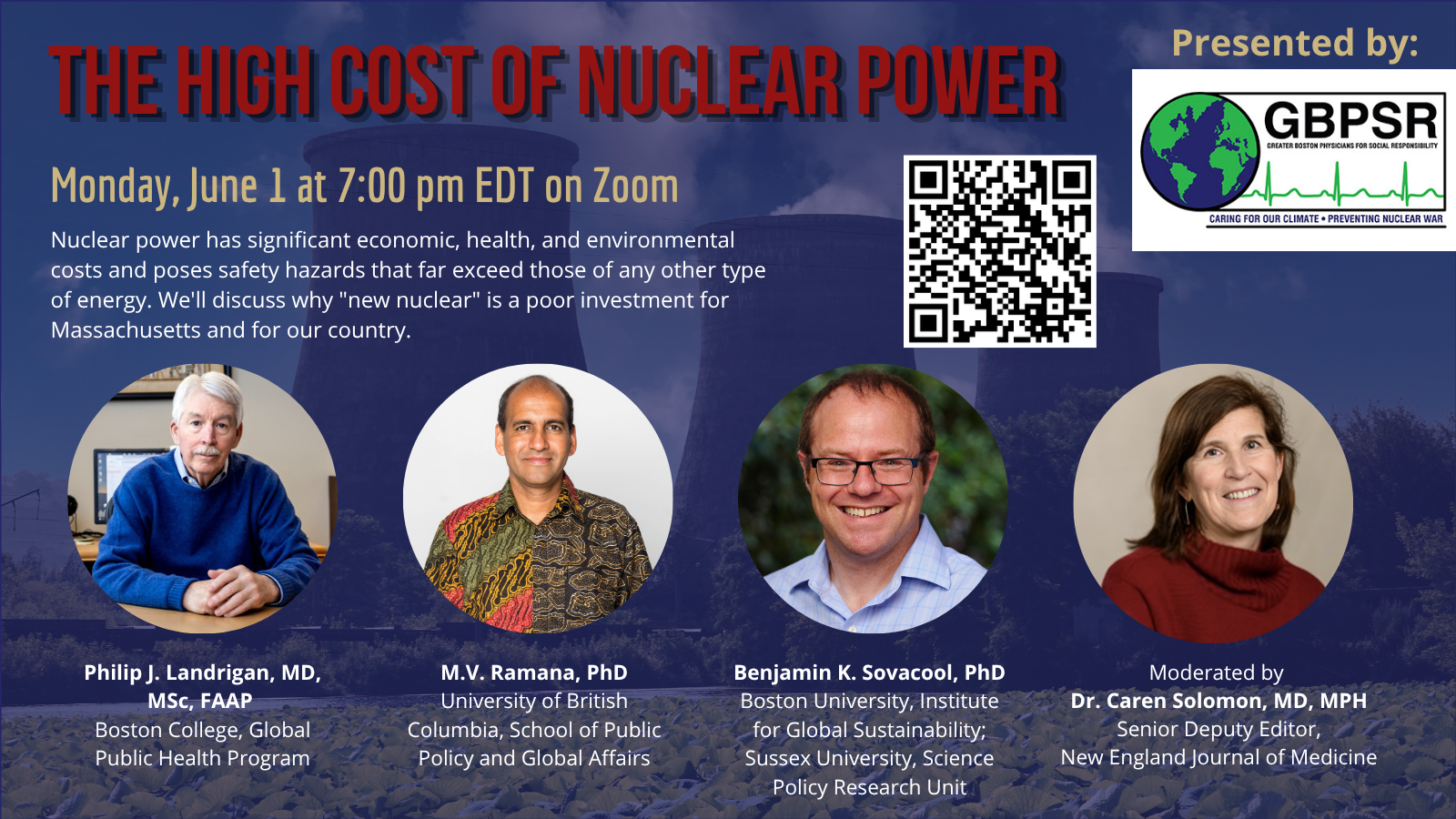
1 June Webinar – The High Cost of Nuclear Power – Register


of the week– Nuclear Reactor Information Task Force
To see nuclear-related stories in greater depth and intensity – go to https://nuclearinformation.wordpress.com
-
Archives
- May 2026 (262)
- April 2026 (356)
- March 2026 (251)
- February 2026 (268)
- January 2026 (308)
- December 2025 (358)
- November 2025 (359)
- October 2025 (376)
- September 2025 (257)
- August 2025 (319)
- July 2025 (230)
- June 2025 (348)
-
Categories
- 1
- 1 NUCLEAR ISSUES
- business and costs
- climate change
- culture and arts
- ENERGY
- environment
- health
- history
- indigenous issues
- Legal
- marketing of nuclear
- media
- opposition to nuclear
- PERSONAL STORIES
- politics
- politics international
- Religion and ethics
- safety
- secrets,lies and civil liberties
- spinbuster
- technology
- Uranium
- wastes
- weapons and war
- Women
- 2 WORLD
- ACTION
- AFRICA
- Atrocities
- AUSTRALIA
- Christina's notes
- Christina's themes
- culture and arts
- Events
- Fuk 2022
- Fuk 2023
- Fukushima 2017
- Fukushima 2018
- fukushima 2019
- Fukushima 2020
- Fukushima 2021
- general
- global warming
- Humour (God we need it)
- Nuclear
- RARE EARTHS
- Reference
- resources – print
- Resources -audiovicual
- Weekly Newsletter
- World
- World Nuclear
- YouTube
-
RSS
Entries RSS
Comments RSS
 nuclear-news