The science-based case for excluding nuclear power from the EU taxonomy

Not green and not sustainable, The science-based case for excluding nuclear power from the EU taxonomy, Beyond Nuclear, 15 Jan 2022,
A statement by Dawn Slevin, Dr. Erik Laes, Paolo Masoni, Jochen Krimphoff, Fabrizio Varriale, Andrea Di Turi, Dr. Ulrich Ofterdinger, Dr. Dolores Byrne, Dr. Petra Kuenkel, Ursula Hartenberger, Kosha Joubert, Dr. Paul Dorfman, Anders Wijkman, Prof. Petra, Seibert, Rebecca Harms, Joseph Kobor, Michel Lee, Dr. Stuart Parkinson, and Dr. Ian Fairlie
One of the most influential policy initiatives of the European Commission in the past years has been the “EU Taxonomy”, essentially a shopping list of investments that may be considered environmentally sustainable across six environmental objectives
To be deemed EU Taxonomy aligned, the activity must demonstrate a substantial contribution to one environmental objective, such as climate change mitigation, whilst causing no significant harm to the remaining five environmental objectives (climate change adaptation, sustainable use and protection of water and marine resources, transition to a circular economy, pollution prevention and control, and protection and restoration of biodiversity and ecosystems).
All eligible activities are required to comply with technical screening criteria (TSC) for ‘substantial contribution’ and ‘do no significant harm’ and to demonstrate that social safeguards are in place. The EU Taxonomy provides a common language for sustainability reporting, a foundation for green bond reporting and much more. It is intended to be used by international financial markets participants whose products are sold within the EU in order to evaluate the sustainability of their underlying investments.
The use of the EU Taxonomy is furthermore compulsory for the EU and member states when introducing requirements and standards regarding environmental sustainability of financial products, such as an EU ecolabel for investment products or an EU Green Bond Standard. It will also apply to 37% of activities earmarked as ‘climate-friendly’ financed by the EU COVID-19 recovery funding. Its science-based approach is designed to give confidence to a wide range of international stakeholders that environmental claims are not greenwashing.
The question whether nuclear fission energy complies with the ‘do no significant harm’ (DNSH) criteria of the EU Taxonomy was the focus of the Technical Expert Group (TEG) DNSH assessment on nuclear fission technologies which recommended to the Commission that nuclear should not be included in the EU Taxonomy of environmentally sustainable activities.
Taking into account the significant financial implications of adopting the TEG recommendations, it became the starting point of intense behind-door lobbying. France led a coalition of 10 EU Member States arguing that nuclear fission as well as gas-fired power plants should be included in the Taxonomy. Together with Finland (Olkiluoto-3), France is at present the only EU country constructing a new nuclear power plant (Flamanville-3).
The Finnish and French construction sites were meant to be the industrial demonstration of an evolutionary nuclear technology (the “European Pressurised water Reactor” or EPR). Olkiluoto-3 was meant to start generating power in 2009, followed by Flamanville-3 in 2012. Instead, the projects turned out to have multiple engineering difficulties and financial constraints that resulted in significant delays culminating in missed deadlines for various production start dates and tripling unit cost.
Nevertheless, in October 2021 president Macron announced that France will continue to invest heavily in the construction of EPR ‘light’ versions, next to research into small modular reactor (SMR) technology. Following consultation with Member States, the Commission charged its former nuclear Joint Research Centre (JRC) to draft another technical report in 2020 – the “Technical assessment of nuclear energy with respect to the ‘do no significant harm’ criteria of Regulation (EU) 2020/852”. This report was reviewed by two sets of experts, the Group of Experts on radiation protection and waste management under Article 31 of the Euratom Treaty (having no specific competences in sustainability impact assessment other than impacts incurred by radiation) and the Scientific Committee on Health, Environmental and Emerging Risks on environmental impacts (Sheer).
While the Sheer group pointed out some omissions, the Article 31 Group of Experts, unsurprisingly supported the conclusions of the JRC. Nevertheless, a minority report opposed the lack of integration of economic and environmental aspects, as put forward by the Rio principles for Sustainable Development.
The JRC, supported by the Art. 31 experts, concluded amongst others that: “…deep geological repositories are considered, at the state of today’s knowledge, appropriate and safe means of isolating spent fuel and other high-level waste (HLW) from the biosphere for very long timescales and the necessary technologies are now available;” “..the standards of environmental control needed to protect the members of the public are likely to be sufficient to ensure that other species are not put at risk;” “… the requirements in the [EU Taxonomy] TSC regarding protection of humans and the environment from harmful effects of ionising radiation are automatically satisfied in the EU if a licence can be issued.”
Notwithstanding the findings of the JRC and the Article 31 Group of Experts, members of the TEG DNSH maintain our position that nuclear fission energy should not be included in the EU Taxonomy of environmentally sustainable activities. We the TEG DNSH members observe that the above JRC/Article 31 Group of experts’ statements and conclusions drawn thereof cannot be fully based on scientific evidence as deep geological disposal of high-level nuclear waste entails the need for adequate quality assurance and control of waste form compatibility, as well as for monitoring of health impacts and preservation of knowledge and memory for possibly thousands of years. It also requires operational demonstration of disposal within Europe.
The fact that according to the current technical state of knowledge there is no alternative to deep geological disposal as a ‘solution’ for the nuclear waste problem does not take away from its ethically problematic character. Moreover the independent scientific evidence which the TEG presented to the European Commission, shows evidence of adverse impacts to the natural environment arising from the many processes involved in the nuclear power lifecycle (from uranium mining to waste disposal) that are operational today.
Therefore, we maintain our recommendation to the European Commission that nuclear fission energy has no place on the EU Taxonomy of sustainable activities, whether or not it is licensed. It is furthermore our view that the proponents of nuclear energy have guided the interpretation of scientific knowledge and the framing of sustainability assessment in order to use the EU Taxonomy to place a ‘scientific’ stamp on what is primarily a political position on nuclear fission energy aiming to satisfy the few EU member states that wish to promote the associated technologies.
Does the present generation of nuclear fission power plants ‘do no significant harm’? ………
The Taxonomy architecture is not designed to cater for such risks that carry an intergenerational impact lasting for thousands of years, making it an unsuitable instrument to decide on the sustainable nature of nuclear power. ………..
Other concerns with regard to DNSH criteria ……………………………..
Should nuclear fission power be included in the taxonomy as a transition activity? ……………………………………..
Further issues of justice beyond the DNSH criteria …………………….
The Way Forward .
Controlling nuclear technologies, investments, and practices requires a high level of technical expertise, which emphasizes the need for expert structures which are independent of the nuclear industry and can therefore better safeguard the common good at international, European and national levels.
The nuclear industry is currently self-regulating with oversight provided by the IAEA (with a mandate to promote the peaceful applications of nuclear technology), EURATOM framing and international committees such as UNSCEAR depending too much on international diplomacy (which recently cast doubt on the health effects of exposure to low levels of radiation).
We highlight the need for an independent international agency requiring revision of the EURATOM treaty as well in order to be able to review nuclear power issues with a focus on society’s need of sustainable development above nuclear sectoral interests, in terms of safeguarding public and environmental health, economic and energy security and general issues of justice.
The proposed inclusion of nuclear fission energy in the EU Taxonomy will channel much needed capital away from proven sustainable energy sources, create more long-term operational and waste management risks and adverse environmental and social impacts that will undermine the principles and technical screening criteria of the EU Taxonomy and crucially, undermine Europe’s credibility and standing amongst its own citizens and international peers.
Instead of giving the nuclear industry a new financial injection for solutions of the past such as the large scale EPR, the EU should focus on pressing issues such as looking for common solutions to the existing HLW problem in EU Member States (and internationally) and taking up a strong regulatory position on nuclear safety and peaceful developments in nuclear technology.
It is the responsibility of Euratom to demonstrate a real European collaboration in solving the technical as well as the environmental and economic challenges related to HLW management (emergency management, harmonised safety and QA/QC criteria for waste forms, insurances).
The signatories of this letter understand the need of the nuclear industry to receive ongoing regulatory support to ensure that their current operations, management of waste, and decommissioning are authorized and carried out in a safe manner. We therefore encourage the JRC and EU Institutions to extend and harmonise their support and strategic direction of the nuclear industry in the new energy transition paradigm, but we state categorically that the proposed inclusion of nuclear fission energy on the EU Taxonomy of environmentally sustainable activities is contrary to the TEGs recommendation to the European Commission.
The above is the content of a Statement of Concern sent by the EU Taxonomy subgroup DNSH TEG members and expert supporters to the Commission on December 21, 2021. The statement can also be downloaded in PDF format. https://wordpress.com/read/feeds/72759838/posts/3774941784
President Macron’s plan for electricity price cut could cost EDF €8 billion
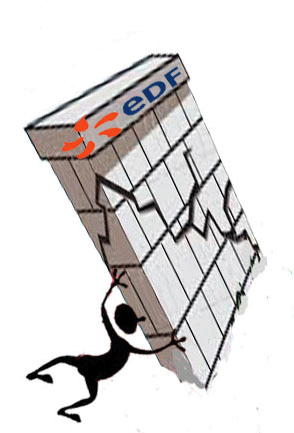
President Macron’s plan to avoid a politically explosive electricity price rise in France could cost EDF €8 billion, the French state-controlled energy group warned yesterday. The alert prompted a sharp sell-off in shares of EDF, which tumbled by 14.6 per cent, or €1.51, to close at €8.84 last night, as investors reacted with dismay to an order from the French government that the company must increase the amount of
cut-price electricity it sells to rivals to hold down prices for consumers.
EDF further spooked the markets by saying that it was extending the shutdowns of five nuclear reactors because of safety concerns, leading to a fresh cut to its electricity production forecasts. The group, which is leading the project to build Britain’s only new nuclear plant at Hinkley Point in Somerset, said that it was unable to calculate the exact financial consequences of the last salvo of bad news and withdrew its profit guidance for the year. It said that it would “consider appropriate measures to strengthen its balance sheet structure and any measure to protect its interests”.
Times 15th Jan 2022
Labour tries to curb cost overruns from Sizewell C development
Bill Bordass, Research and Policy Adviser for the Usable Buildings Trust said: ‘Surely the only sensible way to curb Sizewell C is to scrap it entirely? It is just good money after bad.’
Labour bids to curb cost overruns from Sizewell C development, https://100percentrenewableuk.org/labour-bids-to-curb-cost-overruns-from-sizewell-c-development, David Toke, 16 Jan 22, The Labour frontbench has put down an amendment to the Nuclear Financing Bill which would stop the automatic reimbursement of EDF for excess construction costs of the planned Sizewell C nuclear power plant. The amendment, put forward by Shadow Green New Deal and Energy Minister Alan Whitehead, has been defeated by the Conservative majority in the Commons, but will soon come up for a vote in the House of Lords.
The Nuclear Financing Bill sets up a so-called Regulated Asset Base (RAB) means of funding nuclear power. This means the constructors would be be paid for the construction costs before the plant was generating anything. It would save the constructors money whilst making the project a lot more expensive for the energy consumer in the (most likely) event that the project experienced considerable cost overruns.
Although the SNP has also put down useful amendments to make the Government publish details of the costs of the project, Labour’s proposed amendment is potentially significant in that it could, if taken literally, dissuade EDF from moving ahead with any deal to build Sizewell C. As Whitehead told the Commons, analysis of historical experience of building nuclear power plant it is a near certainty that there will be cost overruns on the project.
In fact Whitehead implied he was not trying to stop the project, but merely argued that cost overruns should not automatically be added to consumer bills. If there were cost overruns then the Government could find the extra money to pay for the project from some other source.
Amongst other things, the SNP amendments asked that the Government should have to make public whether Sizewell C was being given a guarantee that its generation would be paid a minimum price for each MWh produced. Labour also sought to block nuclear power plant being owned by foreign companies, although it was argued this would not affect Sizewell C.
Labour joined forces with the Conservatives to vote through the Bill on the Third Reading, with the SNP, the Liberal Democrats and the Green Party whipping against the Bill.
It ought to seem strange that at the very time there is concern about increased energy bills and strident calls to cut back on green levies from some Tory MPs, the very same MPs are unquestioningly voting through a piece of legislation that will add substantial sums onto consumer bills. EDF has said that Sizewell C will cost £20 billion. Considering that interest charges and also cost overruns will have to be added to this sum the total cost may very plausibly amount to £30 billion or more – and that represents more than £1000 for each household in the UK.
The amount of energy generated by Sizewell C will only be of the order of the next tranche of renewable energy projects (to be issued in the coming moths) that will cost the consumer effectively nothing. By contrast Sizewell C will likely not even be seriously begun until Hinkley C is completed (2027?) which means a 2035 or later start. The UK could have deployed a lot more renewable energy by then of course at much lower cost. The current nuclear crisis in France demonstrates how unreliable nuclear power can be.
Bill Bordass, Research and Policy Adviser for the Usable Buildings Trust said: ‘Surely the only sensible way to curb Sizewell C is to scrap it entirely? It is just good money after bad.’
The Commons debate details can be seen here. The House of Lords is due to vote on the Bill in the coming days.
10 out of 56 French nuclear reactors are currently shut down
“They are very anxious”: EDF in the face of nuclear reactor
breakdowns. Ten reactors out of 56 are shut down, i.e. 20% of French
nuclear production capacity. “In winter, the availability of the nuclear
fleet has never been so low”, observes RTE, the manager of the high voltage
network.
The black series continues for EDF. Thursday, January 13, the
group announced that a fourth nuclear reactor, Penly 1, in Seine-Maritime,
was affected by a corrosion problem on its safety injection system – a
device of capital importance in the event of a accident. His shutdown has
been extended until the end of May. Reporterre takes stock of the
situation.
Reporterre 15th Jan 2022
https://reporterre.net/Ils-sont-tres-angoisses-EDF-face-aux-pannes-de-reacteurs-nucleaires
https://nuclearinformation.wordpress.com/
Swedish police hunt for drone seen flying over Forsmark nuclear station.

Police in Sweden deployed patrols and helicopters to the Forsmark nuclear
plant to hunt for a large drone seen flying over the site late on Friday,
but were unable to catch the unmanned vehicle, they said on Saturday. The
incident came a day after Sweden’s military started patrolling the main
town on the Baltic Sea island of Gotland amid increased tensions between
NATO and Russia and a recent deployment of Russian landing craft in the
Baltic.
Reuters 15th Jan 2022
Cracks on safety-critical pipes in France’s nuclear reactors
Cracks on safety-critical pipes: the list of nuclear reactors concerned is
growing! At the beginning of the year, the four most powerful reactors in
the fleet, Chooz and Civaux, are shut down following the detection of a
worrying generic anomaly (cracks in a pipe of the safety injection system)
which concerns at least three of them.
On January 13, the Institute for
Radiation Protection and Nuclear Safety announced that reactor No. 1 of the
Penly nuclear power plant (Seine-Maritime) was also affected by this
defect, information confirmed by EDF. This discovery calls for a
questioning of safety control and French energy choices, based on nuclear
power whose supposed reliability is not there.
Sortir du Nucleaire 14th Jan 2022
https://www.sortirdunucleaire.org/Fissures-sur-des-tuyauteries-cruciales-pour-la
Large drone observed over Forsmark nuclear station in Sweden
A large drone has been observed over the Forsmark nuclear power plant in
eastern Sweden. The police moved out but could not follow it. The drone at
Forsmark was observed at around 8 PM on Friday. At the same time, flying
objects were reported over the Ringhals nuclear power plants on the west
coast and Oskarshamn in the southeast of the country, and, eventually, a
possible drone was also reported at the decommissioned Barsebäck nuclear
power plant in Skåne.
Norway Today 15th Jan 2022
Luxembourg’s Energy Minister denounces France’s actions on promoting nuclear to Europe
Climate: “We are ten years old. In ten years, no new nuclear reactor
will be ready”. Luxembourg’s energy minister denounces France’s “double
game” and the lack of European democracy regarding the Commission’s project
to classify energies according to their contribution to the objectives of
“climate neutrality”. In an interview with Mediapart, Claude Turmes points
to “a major political error”.
Mediapart 15th Jan 2022
Finland: no plans for new nuclear , and Fennovoima project hampered by the Ukraine crisis
Nuclear energy gains support, but current producers plan no new reactors, Finland: Finland’s nuclear power producers do not plan to build more reactors, although support for nuclear is at record levels. Meanwhile plans for an entirely new plant could be hampered by the Ukraine crisis.YLE NEWS, 16 Jan 22,
Finland’s current nuclear power producers have no plans to build more reactors, even though support for nuclear energy is at higher than at any time in the past three decades.
Teollisuuden Voima (TVO), which operates the Olkiluoto power plant in Eurajoki, southwest Finland, is concentrating on powering up its long-awaited third reactor (OL3), which was started up on 21 December. The company has abandoned plans for a fourth reactor at the site after extensive cost overruns and delays with the OL3 project, which was to have been completed in 2009.
Majority-state-owned Fortum, meanwhile, is looking toward a possible decision to extend the life of its two reactors in Loviisa, southeast Finland.
The operating licences for the Loviisa units will expire in 2027 and 2030. But if Fortum applies for and obtains a continuing license, the reactors, completed in 1978 and 1980 with Soviet technology, could be operational until the late 2040s.
On Friday the Ministry of Economic Affairs and Employment gave a preliminary green light to extending the licenses by up to 20 years…………. A final decision could come later this year, pending consideration by the Environment Ministry and other official bodies.
………… However nuclear remained less popular than many other forms of energy, including solar power, which 87 percent said should be used more. That was followed by wind power (81 percent), hydroelectric (52 percent) and wood and other biofuel (52 percent).
The ET survey of 1,000 adults in Finland was carried out in October by IROResearch, which estimated the margin of error at 3.2 percentage points.
Ukraine crisis could affect Fennovoima project
Meanwhile plans to build Finland’s first entirely new nuclear power plant on the west coast remain up in the air. The Fennovoima consortium, which includes Fortum, hopes to build the plant on the Hanhikivi peninsula in Pyhäjoki as a turnkey delivery supplied by the Russian state-owned Rosatom Group. The plant has not been granted a construction license.
It was originally to have begun operations in 2020, but last year the company has set a target date of 2029 for commercial operations.
The Radiation and Nuclear Safety Authority (Stuk) said in August that Fennovoima had not yet handed over all of the requested documentation to proceed with an evaluation of its preliminary safety report.
“No actual plans have been presented to Stuk regarding the safety arrangements for the power plant itself and its operating environment,” it said in late August, adding that there had been “little progress” in the project’s construction readiness.
On Friday the business daily Kauppalehti reported that the Ukraine crisis could further complicate the Fennovoima venture. It noted that the plant’s reactor pressure vessel is to be manufactured in eastern Ukraine, 40-50km from a combat zone.
Fighting in the area could make it impossible for Stuk to carry out required inspection visits to the factory site. The plant is partly owned by Rosatom, which could be hit by western sanctions if Russia attacks Ukraine……. https://yle.fi/news/3-12272789
France’s nuclear company EDF in trouble, and with election looming
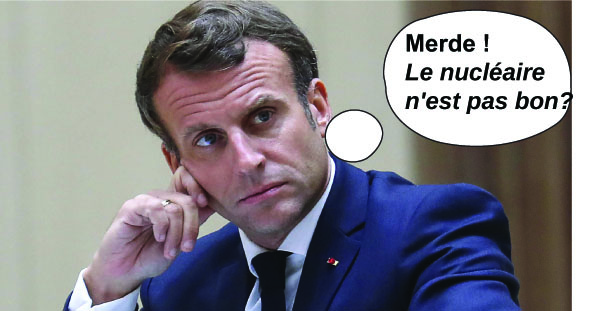
Emmanuel Macron facing the EDF and energy bomb. With the blocking of
regulated tariffs, to limit price increases to 4%. EDF will have to sell a
larger quantity of cheap nuclear electricity to its competitors. Panic wins
the company whose stock price has collapsed.
CEO Jean-Bernard Lévy has
just convened for Monday the “top 200”, the 200 highest executives of EDF.
We are already talking about a necessary recapitalization of EDF. Will the
state back to pot again? Or does the executive imagine calling on outside
investors? The question will be explosive three months before the
presidential election.
La Tribune 14th Jan 2022
Emmanuel Macron is slow to clarify his nuclear promises
Why Emmanuel Macron is slow to clarify his nuclear promises. The President
of the Republic was initially to present before the end of 2021 the details
of his strategy for relaunching new reactors. Procrastination which reminds
us that his position has often varied on the subject.
Le Monde 16th Jan 2022
Regulated Asset Base – UK’s nuclear tax on electricity consumers – supposed to attract foreign investment
Energy costs and energy investment, Renew Extra Weekly, January 15, 2022 ”……………………… Energy prices are accelerating seemingly out of control. But actually the way the Contracts for Difference (CFD) is structured, with competition for capacity slots and a claw back of any excess income over strike price costs, it may not be too bad- it does seem to limit excess cost pass-though, unlike the old Renewables Obligation system, which some now see as much less attractive. So, with the CfD apparently doing well, it might be thought to be a bit odd that the government has shifted away from using it for nuclear, to a new Regulatory Assets Base (RAB) system for new large plants. The CfD was used to finance Hinkley Point C EPR, but it did so excessively, with a £92.5/MWh index linked contract being awarded to EDF without competitive bids being considered.
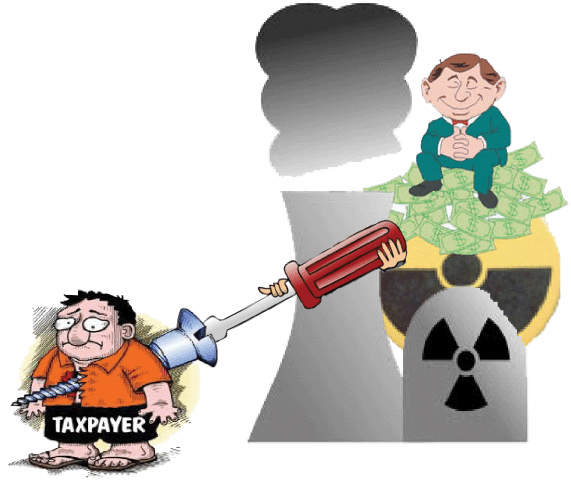
The CfD could in theory have been used again for the next big nuclear project, this time with a competition, but evidently the high project costs, and the high resultant strike prices likely, made it less attractive. So instead the government is going for Regulated Asset Base (RAB), basically a nuclear tax on electricity consumers, raising capital to fund construction of new plants, so that income starts flowing before construction starts.
It’s claimed that this element of RAB will make it easier for companies to finance nuclear, so that they can eventually charge consumers less. Well, we will see. But equally, if there’s a cost overshoot or delay, consumers will get hit hard, and, if the project is abandoned, their involuntary investment will be lost. Interestingly that includes Scottish consumers, despite anti-nuclear Scotland not being likely to allow any new plants to be built there. So Scots would be subsidising projects in England and Wales.
That won’t go down well with the SNP.
The RAB plan, which, even if all goes well, will put some extra costs on power bills, does in any case look odd for all consumers, given that the government says it wants to remove energy taxes from electricity and impose them instead on domestic gas heating. That may be sensible, but, with RAB, it’s going the wrong way.
A subsidy too far?
So why is government adopting for RAB for new nuclear? Evidently it’s to attract foreign investors! The Regulated Asset Base nuclear finance bill has just got through a House of Commons vote unamended.
During the debate, Business & Energy Secretary Kwasi Kwarteng said: ‘The existing financing scheme has led to too many foreign nuclear developers walking away from projects, setting our nuclear industry back a number of years. While the existing Contracts for Difference model was right for Hinkley Point C, the lack of alternative funding models has significantly contributed to the cancellation of recent potential large-scale projects. And this includes Hitachi’s project at Wylfa and Toshiba’s project at Moorside. We urgently need a new approach to attract capital into the sector.’
Somehow that seems to clash with what Energy and Climate Minister Greg Hands said: ‘The Bill will finance new nuclear power stations, making us less dependent on foreign-owned developers and bringing in the private sector and institutional funding.’
All of this, remember.. is because nuclear projects are too costly to win under normal competitive markets terms, whereas, increasingly, mainstream renewables like wind and solar can do that……….
there are some urgent infrastructure projects that could help cut energy costs quite quickly, the most obvious being investment in energy efficiency. For example, the Energy Efficiency Infrastructure Group said that improving insulation on the UK’s least efficient homes would save households around £500 a year on energy bills, totaling £8bn p.a. nationally. ……………
RAB funding might make it cheaper to build new gas stores rather than relying on imports…………
All of which seems to make more sense that using RAB for nuclear, which shows little sign of getting cheaper no matter how much money is chucked at it. Instead it seems to just soak up money, as with the much delayed EPR still being built at Flamanville in France, currently not scheduled for completion until 2023 and full operation in 2024, at an expected cost now put at Euro12.5bn. That is well over three times the original Euro 3.3bn estimate made when work started on it in 2007. And that assumes there are no further problems, like the fault that has shut down the Chinese version of the EPR, just at the point when China is desperate for power. An odd sort of asset that…and a problem that may rebound on the French EPRs. https://renewextraweekly.blogspot.com/2022/01/energy-costs-and-energy-investment.html
Scots plan to celebrate anniversary of Treaty on the Prohibition of Nuclear Weapons (TPNW)
Janet Fenton: SCOTS are getting ready to mark the anniversary of the entry
into force of the Treaty on the Prohibition of Nuclear Weapons (TPNW) on
January 22 with events across the country on the day itself and in the
lead-up to it, reflecting a global movement for a response to the
escalating dangers presented by nuclear weapons, climate change and
pandemics.
A motion supporting the TPNW has attracted cross-party support
and will be debated in the Scottish Parliament on Thursday. This will also
highlight the first meeting of those who are signed up to the TPNW which is
due to take place in Vienna this March, and Scottish Parliamentarians will
be in attendance along with representatives from the majority of UN member
countries. The UK Government is choosing to boycott the negotiations.
The National 15th Jan 2022
https://www.thenational.scot/news/19850719.scotlands-role-key-mark-anniversary-tpnw/
Big fall in EDF’s shares
EDF’s shares fell by 14.6 per cent after Macron ordered the company to
sell cut price energy to its rivals to stave off price hikes. The scheme
will cost EDF €8bn (£6.7bn), the French state-controlled energy group
warned yesterday, forcing the company to revise annual earning estimates.
French President Macron promised in September to cap power price increases
at four per cent this year, passing the cost of a 44 per cent rise in
energy prices onto suppliers in order to protect households. The
announcement compounded the woes of EDF investors, who have seen shares
shed 25 per cent of their value in a month.
City AM 15th Jan 2022
https://www.cityam.com/edf-shares-plummet-as-macron-shields-public-from-soaring-energy-bills/
Scotland’s electricity consumers will pay up for UK’s Hinkley nuclear plant, though it’s not even built
The UK Government’s commitment to new nuclear power stations in England
will push up energy bills for consumers in Scotland. Although Scotland has
used planning laws to prevent any new nuclear south of the border, the UK
Government has pressed ahead with projects like Hinkley Point, which will
charge bill payers upfront to subsidise nuclear power stations that
haven’t even been built yet.
The issue was raised in the Scottish
parliament this week by Scottish Greens energy spokesperson Mark Ruskell,
prompting the Net Zero secretary Michael Matheson to confirm that “in
2030 alone Hinkley could add almost £40/year to a consumer bill whereas an
equivalent offshore wind farm would reduce bills by £8/year.”
Commenting, Mark Ruskell said: “As well as leaving a toxic legacy for
generations to come, nuclear power is a bad deal for consumers now, at a
time when energy bills are pushing more and more households into fuel
poverty.
“Renewable energy is far cheaper, and since it doesn’t result
in toxic waste which will remain deadly for hundreds of thousands of years,
better for the environment too. That’s why with Greens in government
Scotland is doubling our onshore wind capacity and investing in offshore
wind and marine renewables too. “The UK Government’s energy policy is
more about helping its friends than following the science or tackling fuel
poverty. It’s important we do things differently in Scotland, which would
be helped with the greater powers of independence.”
Scottish Greens 14th Jan 2022
1 This Month


of the week– Nuclear Reactor Information Task Force

14 May – online event From Bombs to Data Centres: the Face of Nuclear Colonialism
To see nuclear-related stories in greater depth and intensity – go to https://nuclearinformation.wordpress.com
-
Archives
- May 2026 (187)
- April 2026 (356)
- March 2026 (251)
- February 2026 (268)
- January 2026 (308)
- December 2025 (358)
- November 2025 (359)
- October 2025 (376)
- September 2025 (257)
- August 2025 (319)
- July 2025 (230)
- June 2025 (348)
-
Categories
- 1
- 1 NUCLEAR ISSUES
- business and costs
- climate change
- culture and arts
- ENERGY
- environment
- health
- history
- indigenous issues
- Legal
- marketing of nuclear
- media
- opposition to nuclear
- PERSONAL STORIES
- politics
- politics international
- Religion and ethics
- safety
- secrets,lies and civil liberties
- spinbuster
- technology
- Uranium
- wastes
- weapons and war
- Women
- 2 WORLD
- ACTION
- AFRICA
- Atrocities
- AUSTRALIA
- Christina's notes
- Christina's themes
- culture and arts
- Events
- Fuk 2022
- Fuk 2023
- Fukushima 2017
- Fukushima 2018
- fukushima 2019
- Fukushima 2020
- Fukushima 2021
- general
- global warming
- Humour (God we need it)
- Nuclear
- RARE EARTHS
- Reference
- resources – print
- Resources -audiovicual
- Weekly Newsletter
- World
- World Nuclear
- YouTube
-
RSS
Entries RSS
Comments RSS
 nuclear-news