Design flaws in Flamanville EPR nuclear reactor vessel, and attempts to solve this
The EPR reactor vessel is not designed like the previous vessels, and the
water does not follow the flow movements observed on conventional reactors.
EDF engineers therefore had a piece of metal (deflector) installed in each
tank bottom to redirect the water correctly. But that would be
insufficient.
What solutions? The most logical solution would therefore be
to change this deflector “with the key to a work of development as
complex as ruinous, notes the weekly. And no one is sure, given the limited
space available in an EPR tank, that this repair is technically
possible”.
The other solution envisaged would therefore be to “reinforce
the fuel assemblies, reinforce the protective grids so that the blades
resist the flows”, mentioned Julien Collet.
EDF will present its plan to us
in February, so we can see if their proposals can solve the problem.
Another possibility mentioned at the end of the article: “To limit the
pressures of the water, it would be a question of running the EPR at only
60% of its power, Flamanville would then go from a capacity of 1,650
megawatts less than 1,000 and would end up, for a record bill of 13 billion
euros, less efficient than the reactors built 50 years ago.”
La Presse de la Manche 20th Jan 2022
Row over plans to reform groups at nuclear sites.
Rob Edwards The Ferret, January 23, 2022,
New guidelines which campaigners say could benefit communities around nuclear sites have been boycotted by a UK Government nuclear agency.
Internal documents seen by The Ferret reveal that the Nuclear Decommissioning Authority (NDA) has rejected proposed reforms because they had caused “a great deal of bad feeling”
Guidelines aimed at making local meetings about safety at nuclear sites across the UK more transparent, accountable and representative were put forward in a nuclear industry report.
There are 29 licensed nuclear sites around the UK, six of them in Scotland. They include nuclear power stations operating and being decommissioned, nuclear submarine bases, waste and processing plants.
All of the sites have stakeholder or local liaison groups aimed at keeping local communities informed about events, including shutdowns, safety incidents and radiation leaks. But they differ greatly in how they are run…………………………..
In 2017 the 50-strong group of nuclear-free local authorities in the UK published a report questioning whether the stakeholder and local liaison groups were “fit for purpose”. It concluded that there was an “urgent need” to reform them.
This prompted the nuclear industry’s Safety Directors’ Forum, which brings together senior managers from all the civil and military nuclear sites, to commission a report. It was researched and written by the industry’s industry’s Young Nuclear Professionals’ Forum.
The resulting “Good Practice Guide” was circulated in November 2021. “Nuclear sites often have a reputation of being opaque, secretive and unwilling to engage with the public,” it said.
“This negative reputation is actively damaging, from open opposition to the site’s existence to a general lack of understanding. Active engagement is key to undoing this, the nuclear industry must be open and honest.”
The report argued that local liaison groups at several unidentified nuclear sites had “no accountability”. This included “no terms of reference being in place, no clear action management process, inadequate minute taking and infrequent meetings.”
It pointed out that while some meetings were open to the public, others were not. Some groups only invited “selected stakeholders” and “diversity and inclusion is not always encouraged”.
Some of the groups didn’t have websites. “Meetings are not always accessible and, in some cases, not comprehensible due to the extensive use of acronyms, particularly for those who do not work in the nuclear industry,” the report added.
The report recommended that the groups should all have websites, clear and published constitutions and a “diverse range of stakeholders”. There should be a co-chair independent of the industry and members of the public should be allowed to ask questions.
correspondence released under freedom of information law has disclosed how the report has upset the NDA and some of the existing groups………………………………… https://theferret.scot/nuclear-sites-reforms-row/
Just a reminder. Russia did not INVADE Crimea.

Bruce Gagnon, 21 Jan 22, Russia did not invade Crimea. They had a long-term lease with Ukraine that allowed over 20,000 military personnel at the Russian navy and air bases there.
The Russian-ethnic people of Crimea self-organized a referendum and voted 96% to seek to rejoin Russia. They saw the 2014 Nazi-led take over in Kiev during the US orchestrated coup and wanted nothing to do with the ‘new Ukraine’ regime.
See this excellent film produced by Oliver Stone https://vimeo.com/252426896?ref=fb-share
Nuclear energy too costly for humans — and the planet

But this [France’s small nuclear reactor] plan has a whole range of shortcomings, not least because reaching the same capacity as a single large nuclear reactor requires a great deal of these small reactors.
This high number will increase the risk of a nuclear accident many time over,” the German Federal Office for the Safety of Nuclear Waste Management (BASE) recently warned
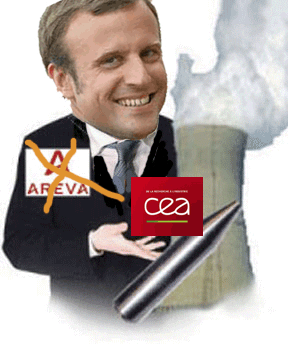
“Without civilian nuclear power, there is no military nuclear power, and without military nuclear power, there is no civilian nuclear power,” Macron said.
Nuclear energy too costly for humans — and the planet https://www.dw.com/en/opinion-nuclear-energy-too-costly-for-humans-and-the-planet/a-60390384 21 Jan 22
Nuclear power will soon be classified as environmentally friendly under the new EU taxonomy. But nothing about it is green or safe, says DW’s Jeannette Cwienk.
I can still clearly recall that spring afternoon in late April 1986. I had been out playing in the woods and building a fort with some friends, when a rain shower forced us back home. It was a fun, carefree day.
We had no idea that just hours earlier, reactor number 4 at the Chernobyl power plant near the Ukrainian city of Pripyat had exploded.
When the news came out days later, the Chernobyl catastrophe and fears of a radiation-filled future quickly came to define my younger years.
Such memories, however, are not the only reason for my concern about the European Commission’s proposal to include nuclear energy and natural gas as environmentally-friendly technology in the EU taxonomy.
Doing so would see nuclear energy classified as sustainable, and recommend it as an option for investors — making a mockery of environmental efforts.
Who will pay for nuclear accidents?
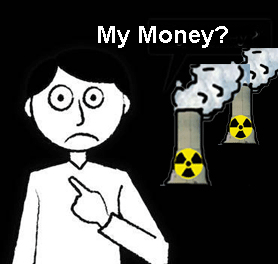
The EU Commission is completely ignoring the costs of nuclear energy. Quite apart from the funds required to build new nuclear power plants, even smaller ones, there is the far more important and apparently overlooked question of who would foot the bill in the event of an accident.
.
In Germany alone, the federal costs attached to the consequences of the Chernobyl catastrophe have been estimated at around €1 billion ($1.1 billion). Worldwide, the immediate economic ramifications of Chernobyl are estimated to have been more than €200 billion — and that doesn’t include the cost of widespread related illness.
Health costs were also not included in the €177-billion bill linked to the consequences of the March 2011 Fukushima nuclear disaster in Japan, as estimated by the Japanese government in 2017.
Most of these costs have since been covered by Japanese taxpayers, because the operating company, TEPCO, was de facto nationalized after the disaster to avoid insolvency.
Taxpayers will be forced to foot the bill
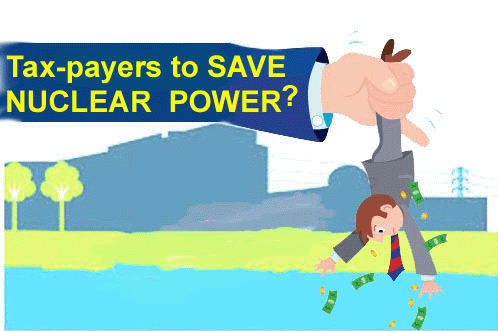
And this brings us to the heart of the problem: in Europe, the amounts that nuclear operators are required to set aside in case they’re found liable for a nuclear accident are laughably small. In the Czech Republic, nuclear power plant operators are required to have €74 million on hand in case of an accident; in Hungary, the figure is €127 million.
Even in France, the driving force for the planned “greening” of European nuclear energy and the largest consumer of nuclear energy worldwide — it makes up around 70% of its energy supply — operators are only required to set aside €700 million in case of an accident. A large nuclear accident in Europe could easily cost between €100 and 430 billion. And should that happen, the affected countries — along with their taxpayers — will be forced to foot the bill.
This situation has been met with criticism by Germany’s new finance minister and the leader of the neoliberal Free Democrat Party, Christian Lindner, who recently expressed skepticism about the place of nuclear energy in the new EU taxonomy.
“An energy source that can only be mainstream if the state is prepared to accept liability — that’s a sign from the market that it can’t be a sustainable energy source,” he said.
On Friday, the German government is likely to vote against the EU Commission’s plans — and rightly so. Austria and Luxembourg, on the other hand, have gone a courageous step further and have announced plans to take Brussels to court if the disputed sustainability plans go ahead.
Small modular reactors also a risk
In France, meanwhile, President Emmanuel Macron likes to describe nuclear power as a “stroke of luck” for climate protection. The fact that 10 of the country’s reactors are currently offline — three from the latest generation due to safety concerns — are apparently not an issue for the French government, which has been trying to allay the fears of a nuclear accident with new small modular reactors (SMR). These smaller power stations are only around one 10th of the size of a conventional nuclear site — and therefore are considered less dangerous, in the event of an accident.
But this plan has a whole range of shortcomings, not least because reaching the same capacity as a single large nuclear reactor requires a great deal of these small reactors.
“This high number will increase the risk of a nuclear accident many time over,” the German Federal Office for the Safety of Nuclear Waste Management (BASE) recently warned.
Is it really about climate protection?
BASE has also been critical of a report by the EU’s Joint Research Center, which the EU Commission has used to make its assessment about the environmental friendliness of civil nuclear power.
The EU report only partially considers the risks of nuclear energy use for humans and the environment, as well as for future generations, and some of the principles of scientific work are not correctly taken into account. According to BASE, the report cannot be relied on to comprehensively assess the sustainability of nuclear energy use.
This has raised doubts over the claim that Brussels wants to include nuclear power in the new EU taxonomy primarily for climate protection reasons. Instead, the decision seems to be down to political pressure, especially from Paris.
As a global nuclear power, France wants to hold on to its nuclear plants at all costs, as Macron clearly stated in December.
“Without civilian nuclear power, there is no military nuclear power, and without military nuclear power, there is no civilian nuclear power,” he said.
Small nuclear reactors a poor solution for UK’s and the world’s climate action.

it is difficult to see how a technology that will only be operational after the UK power system is supposed to be carbon-free will contribute to climate action in the next ten years or so. And the situation is similar globally.
Other questions around traditional nuclear power stations, such as the thorny issue of waste, would also still apply to SMRs…….
Is nuclear power the best solution to climate change? The UK, like China, the US and Canada, is attracted to nuclear power. But high costs and slow delivery means many energy experts remain unconvinced. New Statesman, By Philippa Nuttall 21 Jan 22, debate in the House of Commons on 19 January, led by a group of MPs known as the “atomic kittens”, suggested nuclear energy can be a panacea for all ills – including a solution for the climate crisis and the gas crunch. The facts suggest otherwise.
Isn’t nuclear energy a no-no after Chernobyl and Fukushima?
Disasters clearly reduce appetite among the public and policymakers for nuclear power………………
Today, new nuclear construction projects are few and far between, even in countries such as France and the US whose energy systems are heavily reliant on the technology, and the number of operational reactors is in decline globally.
Are any countries investing heavily in nuclear?
In addition to safety concerns, rising costs are a central reason why the number of new plants under construction remains limited. Since 2011, nuclear power construction costs globally have doubled or even tripled. China is, however, notable in its nuclear ambitions. The country is planning at least 150 new reactors in the next 15 years, more than the rest of the world has built in the past 35, though cost could ultimately change this direction of travel.
The price of nuclear generation has moved in the opposite direction to solar and wind
Mean levelised cost of energy in US$/MWh, 2009–20………..
Others countries such as the UK, the US and Canada also see a limited role for new nuclear as part of their response to climate change. The UK government in its 2021 net zero strategy talked about “cutting edge new nuclear power stations”, and plans to launch a £120m Future Nuclear Enabling Fund.
There are some big nuclear power stations on the cards – think Hinkley Point C or Sizewell C in the UK. But the major excitement among many nuclear enthusiasts, including plenty of UK MPs is around so-called small modular reactors (SMRs). If you believe the hype, they are the answer to all climate and energy ills………………
Rolls Royce, and companies working on the technology in other countries, argue that smaller solutions can be constructed more cheaply and come online more quickly as they can be built in a factory, transported in modules and fitted together “like meccano”, said Rolls Royce’s Alastair Evans. Large nuclear plants are built fully onsite. The idea is that the modules could then be mass produced. However, nothing is rolling off any conveyor belts yet. The only SMR up and running in the world is a 35 MW floating nuclear plant in Russia.
Sounds interesting. Are SMRs the solution to the climate crisis?
Unlikely.
“To meet the requirements of the sixth carbon budget, we will need all new cars, vans and replacement boilers to be zero carbon in operation by the early 2030s,” Virginia Crosbie, a Conservative MP from Wales and the original self-proclaimed “atomic kitten”, enthused to fellow MPs. “We must quickly move away from generating that electricity from fossil fuels… Nuclear power, which has been a neglected part of our energy mix, can bridge the gap.”
There is, however, no silver bullet to the climate crisis, and renewables, in conjunction with other existing technologies, look like a better, cheaper solution.
……….. traditional, big nuclear projects look likely to provide only a sliver of the world’s electricity in the future. They are hugely expensive to build, their construction runs over time, and they are frequently struck by technological issues. Moreover, they need to be built close to the sea or a large river for cooling reasons, highlighted Paul Dorfman from the University of Sussex. France has already had to curtail nuclear power output in periods of heatwaves and drought, which are only set to get worse as climate change takes hold. Greater storm surges and eroding coastlines also don’t make the prospect of building by the sea any easier.
SMRs solve few of these issues………… “The latest economic estimates available for SMRs are still quite expensive relative to other ‘clean’ energy alternatives, and it would be pure speculation to assume that will change dramatically until the concept has been more proven,” said Mike Hogan from the not-for-profit Regulatory Assistance Project.
……. the designs still need to get licensed, factories need to be built, orders placed, projects financed, etc,” said Hogan.
In short, it is difficult to see how a technology that will only be operational after the UK power system is supposed to be carbon-free will contribute to climate action in the next ten years or so. And the situation is similar globally.
Other questions around traditional nuclear power stations, such as the thorny issue of waste, would also still apply to SMRs…….
So what is the solution? Renewables, renewables and more renewables?
In short, yes. The costs of solar, wind power and storage continue to fall, and by 2026 global renewable electricity capacity is forecast to rise by more than 60 per cent, to a level that would equal the current total global power capacity of fossil fuels and nuclear combined, says the IEA.
Some argue nuclear can be a clean back-up option for when the wind doesn’t blow and the sun isn’t shining. But again, other options already exist, including demand response (for example, plugging in your electric car when there is lots of energy and not switching on your washing machine when the system is under strain), large-scale storage and interconnections between different countries.
Final word?
Craig Bennett, chief executive of the Wildlife Trusts, summed up the general mood of those less enthused by nuclear than Crosbie and her fans:
“If successive governments had given even half the love and attention they afford to nuclear power to scaling up home insulation, energy efficiency and smart storage technologies, it’s likely we wouldn’t be facing current challenges around energy and household bills, and we would have done a lot more good for the climate and nature.”….. https://www.newstatesman.com/environment/climate/2022/01/is-nuclear-power-a-genuine-solution-to-the-climate-crisis
France’s nuclear waste problem, and the lack of transparency on military wastes

“The lack of transparency on military nuclear waste poses a serious democratic problem” To guarantee access to the information that is lacking on the subject of the dismantling of the installations, “parliamentary involvement” is essential, believe the director of the Armaments Observatory, Patrice Bouveret, and the spokesperson for ICAN France, Jean -Marie Collin, in a forum in Le Monde.
Le Monde 20th Jan 2022
Largest increase in the UK nuclear liability regime for 50 years
Largest increase in the UK nuclear liability regime for 50 years take, https://www.jdsupra.com/legalnews/largest-increase-in-the-uk-nuclear-6038616/, 21 Jan 22, As we flagged last year in this note, the 2004 Protocols updating the Paris Convention and Brussels Convention have finally been ratified. This is likely the biggest increase in the international nuclear liability regime for decades, and has global impact.
In the UK this means that the Nuclear Installations (Liability for Damage) Order 2016 came into effect on 1 January 2022. This immediately increases the liability cap of nuclear operators in the UK from £140m to €700m (approx. £585m), with those caps increasing annually over the next five years to €1.2bn (approx. £1bn). The UK also now has a new operator duty of care not to cause significant impairment to the environment, new categories of compensation for which an operator will be liable (including loss of profit in some instances), and material extensions to the geographical scope covered by the regime (e.g. now including the Republic of Ireland).
The extension of the limitation period for personal injury to 30 years from the date of the incident is likely the one with the largest impact after it became clear last year that insurance would not be available to cover the full period, at least for the time being. The UK Government instead stepping in and indemnifying operators to cover the insurance gap using the powers granted to the Secretary of State under the amended Nuclear Installations Act 1965.
Similar changes to the liability regime in certain other European and Scandinavian signatory countries should also have taken effect.
Please see our detailed note on the topic here for further information.
[View source.]
France’s nuclear company EDF accused of cover-ups over ‘serious and unexpected’ corrosion on Tricastin and other reactors.
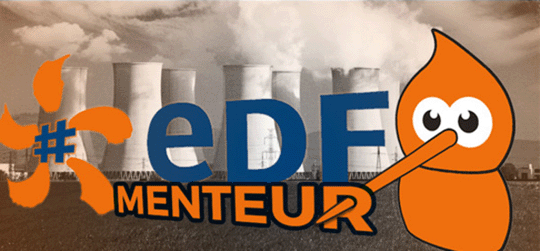
“Hugo”, nuclear whistleblower: “I accuse EDF of cover-ups”. “With this
type of attitude, our power plants are not safe”: the shocking testimony of
a member of the management of the Tricastin nuclear power plant, worried
that the culture of nuclear safety is taking a back seat to financial
imperatives within the EDF group.
Mediapart 19th Jan 2022
Nuclear reactors shut down due to ‘serious and unexpected’ corrosion
problem. EDF, which operates the French power plants, should say by the end
of January whether other facilities in the fleet could be affected by this
as yet unexplained anomaly.
Le Monde 19th Jan 2022
Hinkley Point mud dredging and dumping plan faces a legal challenge
Hinkley Point dredging plan for Portishead faces legal challenge. Plans to
dump hundreds of thousands of tonnes of sediment from Hinkley Point into
the Bristol Channel at Portishead face a legal challenge.
Environmental groups represented by Tarian Hafren say the Marine Management Organisation
unlawfully varied EDF Energy’s licence to deposit dredged material at the
Severn Estuary Marine Protection Area. The disposal site is close to
Portbury Wharf Salt Marsh, a Site of Special Scientific Interest and part
of the Severn Estuary Special Protection Area. Tarian Hafren argues that
the MMO did not have the statutory power to change the licence for dredging
to include dumping, did not give adequate reasons for doing so, failed to
examine the potential impact of the dredging on marine life, and ignored a
less harmful method of waste disposal.
High Court judge Beverley Lang ruled
that the grounds for a judicial review are arguable and the claim will be
heard this spring. Cian Ciaran for Tarian Hafren said: “The Welsh
National Marine Plan accepts no dumping in the Welsh half of the estuary,
but the Welsh authorities failed to press MMO to comply on the English
side. “As Geiger Bay, we established at court in 2018 that the Welsh
authorities were wrong to license dumping near Cardiff. Let’s now compel
the MMO to respect the protected status that’s needed for both fish
stocks and wildlife.”
Somerset Live 20th Jan 2022
https://www.somersetlive.co.uk/news/hinkley-point-dredging-plan-portishead-6514361
France’s nuclear regulator warns on the ”security fragility” of both the reactors, and the reprocessing system
“The continued operation of EDF’s nuclear reactors should not be the
adjustment variable for French energy policy”. In an interview with “Le
Monde”, Bernard Doroszczuk, the president of the Nuclear Safety Authority,
warns about the lack of margins in terms of security of electricity supply.
First, the president of the Nuclear Safety Authority (ASN), Bernard
Doroszczuk, wishes to underline a reassuring point. Despite the
complications due to the health crisis, “the level of nuclear safety and
radiation protection was completely satisfactory in 2021, he says in the
preamble to his interview with Le Monde. In particular the conduct of the
fourth ten-yearly inspections of the oldest reactors”.
The French nuclear “policeman” however warns against “an unprecedented double
fragility”: both for the reactors, but also for the installations which
manufacture, reprocess or recover the fuel.
Le Monde 19th Jan 2022
Difficulties at Orano nuclear elements site adds to France’s nuclear woes.
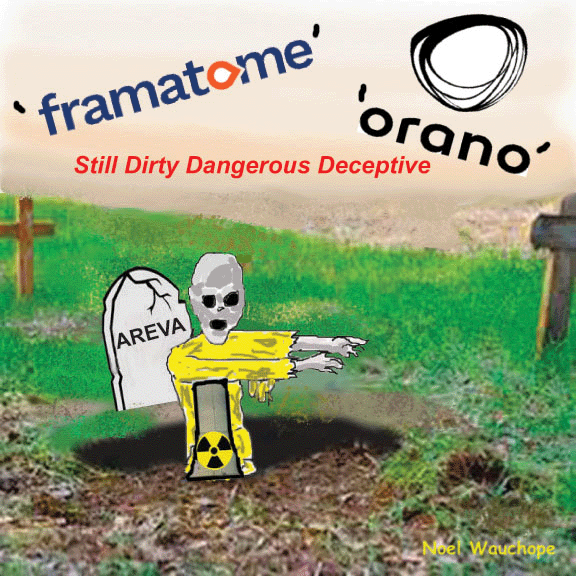
France’s nuclear sector, which lately came under additional pressure due
to newly discovered corrosion problems at some EDF (EDF.PA) sites, may need
a “Marshall plan” to survive, said the head of France’s ASN nuclear
watchdog. Difficulties also increased at Orano’s Melox site which produces
nuclear elements for plants, adding to EDF’s problems, ASN President
Bernard Doroszczuk told reporters.
Reuters 19th Jan 2022
Mayors for Peace UK / Ireland Chapter and NFLA celebrates first nuclear weapons ‘banniversary’.
Richard Outram, UK / Ireland Mayors for Peace / NFLA Secretary, Richard.outram@manchester.gov.uk / 21 Jan 22,
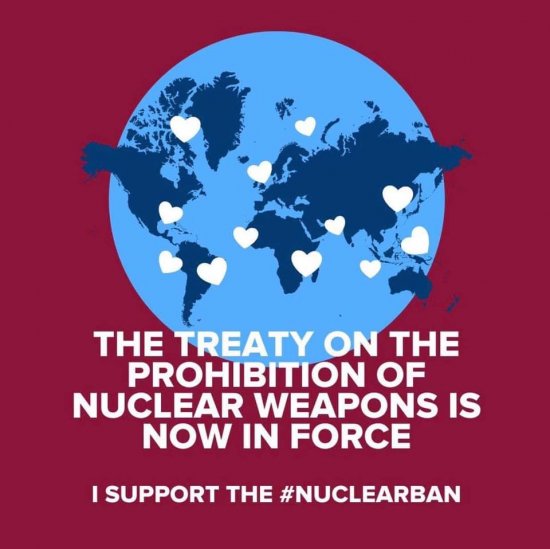
Local authorities working for peace in the UK and Ireland will be celebrating the first ‘banniversary’ of the UN treaty making nuclear weapons illegal (22January).
The United Nations Treaty on the Prohibition of Nuclear Weapons (the Treaty) entered into force on the 22 January 2021, 90 days after the fiftieth nation ratified acceptance of it.
The Treaty requires signatory states to undertake not to develop, test, produce, acquire, possess, stockpile, deploy, use, or threaten to use nuclear weapons or permit or support other states to do so. The Treaty also requires any state which is a party to the treaty to provide assistance to persons and communities affected by the use or testing of nuclear weapons and to work to clear up land contaminated by such activities which lies under its jurisdiction or control[i].
Across the world, campaigners will be celebrating the first so-called ‘banniversary’, and the huge progress that has been made in the cause of advancing nuclear disarmament over the last year, in advance of a much-anticipated First Meeting of the States Parties currently scheduled to be hosted by Vienna, Austria between 22-24 March 2022.
59 UN member states have now ratified their acceptance of the Treaty and a further 27 have signed and are currently in the process of doing so. 101 financial institutions across the world representing almost $4 trillion have also announced they will shun further investment in nuclear weapons because of the Treaty.[ii]
The UK / Ireland Chapter of the international Mayors for Peace movement and the UK / Ireland Nuclear Free Local Authorities will be amongst the many organisations celebrating the date. Both are partner organisations of ICAN (the International Campaign to Abolish Nuclear Weapons).
Born out of the frustration that the UN Non-Proliferation Treaty had failed to deliver nuclear disarmament after almost half-a-century, ICAN, a global coalition of civil society, faith and peace organisations, atomic bomb and test survivors, scientists, doctors, academics and concerned world citizens, began to work for a treaty ban.[iii] Their work led to the Treaty being adopted by 122 of the world’s states at the United Nations on 7 July 2017 and later that year, ICAN and its partners were awarded the Nobel Peace Prize.
Subsequently ICAN worked with these states to bring the Treaty into law.
Commenting, Manchester City Councillor Eddy Newman, speaking on behalf of the UK / Ireland Chapter of Mayors for Peace, said:
“In the past, similar treaties have banned germ and chemical weapons, landmines, and cluster bombs and in the last year we have already achieved so much as a world community in moving forward a nuclear weapons ban. However there remain many challenges. Yesterday (20 January), the Bulletin of Atomic Scientists announced that the Doomsday Clock remains at 100 seconds to midnight in recognition that our world faces many grave threats. One, which is existential, is the ever-present threat of nuclear annihilation. Despite world opinion favouring nuclear disarmament, the nuclear weapon armed states, amongst them the United Kingdom, continue to refuse to engage with this Treaty and continue to renege upon their solemn promise made over 50 years ago as signatories to the Non-Proliferation Treaty to do so.”
The Chair of the Nuclear Free Local Authorities Steering Committee, Leeds City Councillor David Blackburn, added:
“Although the Republic of Ireland has creditably signed the Treaty, one of our priorities as Mayors for Peace Councils and Nuclear Free Local Authorities in the UK must be to continue to put pressure on the UK Government to engage with the treaty. One way to do this is to ask our member Councils to pass resolutions calling on the government to do so. This will be a priority for both of our organisations over the coming year. Leeds and Manchester are both amongst the UK Councils which have already passed such resolutions, and we hope many more will do so in 2022.[iv]”
Small nuclear reactors for Scotland? Expensive, unpopular, and not even small
Nuclear power in Scotland: ‘Small modular reactors’ are expensive, will be
unpopular and they’re not even small – Dr Richard Dixon. The final
shutdown of reactor number four at Hunterston and the announcement the two
reactors at Torness will cease operating in 2028 have led nuclear
enthusiasts to talk even more about small modular reactors. Even if you
were not worried about creating yet more radioactive waste for which we
have no long-term storage solution and the £132bn public-money bill for
decommissioning and you were not worried about terrorists blowing up
reactors or just the likely delays and cost over-runs, these small(ish)
reactors still aren’t likely to become a reality.
Scotsman 20th Jan 2022
Nuclear Safety Authority (ASN) warns France on problems, costs, safety in nuclear projects
The French nuclear industry will need a “Marshall plan” to carry out new
projects, warned Wednesday the Nuclear Safety Authority (ASN), which also
calls on France to re-examine the scheduled closure of 12 reactors and
alert on increasingly fragile management of spent fuel from the EDF fleet.
Les Echos 19th Jan 2022
European States opposing inclusion of nuclear in ‘green’ taxonomy warn on diverting investement from genuinely clean technologies.
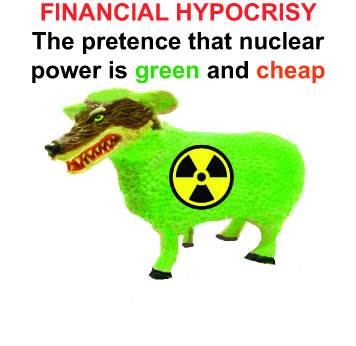
Austria, Denmark, Luxembourg and Spain continue to reject natural gas and
nuclear in the EU’s sustainable finance taxonomy, their energy and
climate ministers have said in response to a recent draft proposal.
The European Commission’s proposed conditions under which investments in
natural gas-fired and nuclear power plants would be deemed “green” in a
draft updated taxonomy sent “the wrong signals to financial markets and
seriously risks being rejected by investors,” the ministers said late on
Thursday.
The taxonomy aims to help investors identify suitable projects
that support the EU’s climate goals. It does not require investments in
projects that meet the criteria nor prohibit investments in projects that
do not. The ministers argued, however, that the long lifetimes of natural
gas and nuclear plants meant that including them in the taxonomy could lock
in their use for many decades and divert investments away from renewables.
Montel 21st Jan 2022
https://www.montelnews.com/news/1294402/four-eu-nations-reject-gas-nuclear-in-green-taxonomy
1 This Month


of the week– Nuclear Reactor Information Task Force

14 May – online event From Bombs to Data Centres: the Face of Nuclear Colonialism
To see nuclear-related stories in greater depth and intensity – go to https://nuclearinformation.wordpress.com
-
Archives
- May 2026 (187)
- April 2026 (356)
- March 2026 (251)
- February 2026 (268)
- January 2026 (308)
- December 2025 (358)
- November 2025 (359)
- October 2025 (376)
- September 2025 (257)
- August 2025 (319)
- July 2025 (230)
- June 2025 (348)
-
Categories
- 1
- 1 NUCLEAR ISSUES
- business and costs
- climate change
- culture and arts
- ENERGY
- environment
- health
- history
- indigenous issues
- Legal
- marketing of nuclear
- media
- opposition to nuclear
- PERSONAL STORIES
- politics
- politics international
- Religion and ethics
- safety
- secrets,lies and civil liberties
- spinbuster
- technology
- Uranium
- wastes
- weapons and war
- Women
- 2 WORLD
- ACTION
- AFRICA
- Atrocities
- AUSTRALIA
- Christina's notes
- Christina's themes
- culture and arts
- Events
- Fuk 2022
- Fuk 2023
- Fukushima 2017
- Fukushima 2018
- fukushima 2019
- Fukushima 2020
- Fukushima 2021
- general
- global warming
- Humour (God we need it)
- Nuclear
- RARE EARTHS
- Reference
- resources – print
- Resources -audiovicual
- Weekly Newsletter
- World
- World Nuclear
- YouTube
-
RSS
Entries RSS
Comments RSS
 nuclear-news