Radiation levels increased at Chernobyl, after Russian troops seized the area.
Radiation levels have increased at Chernobyl after Russian troops seized
the area yesterday, Ukraine warns. Russian forces took control of the
defunct plant in a ‘fierce’ battle on Thursday. The condition of the plant
was unknown, but sparked fears of a radiation leak. Ukraine’s State Nuclear
Regulatory Inspectorate said Friday that higher gamma radiation levels have
been detected in the Chernobyl zone. Russian officials denied this,
claiming radiation levels at the site were normal.
Daily Mail 25th Feb 2022
France’s nuclear ”energy independence” is a fake, as it has to import all its uranium fuel
As the Ukraine crisis continues to push fuel prices up, France’s
championing of nuclear power as a way of ensuring its energy sovereignty
sounds great.
But a group of researchers says it’s a red herring given
France imports all its uranium. Production of nuclear power relies on
uranium – a metal ore found in rocks, and in seawater, in many parts of
the world. When France first developed nuclear following the 1973 oil
crisis, it produced some of its own uranium – reaching a peak of 2,634
tonnes in 1980.
But by the end of the 1990s, France stopped building new
plants and its last uranium mine was closed in 2001. Of the 138,230 tonnes
of uranium imported between 2005 and 2020 official Euratom data shows three
quarters came from just four countries: Kazakhstan (27,7France has control
over its uranium supplies because they’re not concentrated in one region of
the world according to French nuclear group Orano (formerly Areva).
Morevoer, 44 percent of the uranium comes from OECD countries its director
general Phillipe Knoche said.
But a group of French researchers and
specialists say France’s reliance on imported uranium “poses a serious
challenge to the idea that nuclear power allows France to ensure its energy
independence”. In an open letter published in Le Monde daily on Tuesday
they write: “We are as dependent on foreign countries for uranium as we
are for gas and oil.” “France’s energy independence is a red herring,
it’s utopian,” socio-anthropologist Eric Hahonou, one of the
signatories, told RFI.48 tonnes), Australia (25,804 tonnes), Niger (24,787)
and Uzbekistan (22,197).
RFI 23rd Feb 2022
*
12 nuclear power reactors in France shut down, 6 because of corrosion problems
| EDF CEO Jean-Bernard Lévy announced on Tuesday that a total of 12 nuclear reactors were currently shut down in France, including six linked to a corrosion problem on a safety system. “The last time I looked there were 44 in operation, so there were 12 that were not working,” he told franceinfo in response to a question about the number of reactors in operation in France. the French nuclear fleet. “Of the 12 (shutdown reactors) there were about half, I believe six, which were shut down because we detected, very unexpectedly, a corrosion problem in certain places where we should not not see this corrosion at all, and so we stopped them to examine them, to fully understand what is happening, and then there were six others who are in normal maintenance programs, “explained Jean-Bernard Lévy. Les Echos 23rd Feb 2022https://m.investir.lesechos.fr/actualites/edf-12-reacteurs-a-l-arret-en-raison-de-probleme-de-corrosion-pdg-2004147.html |
Finland’s Russian-backed Fennovoima nuclear power station project now coming to a halt

Finland Signals Russian-Backed Nuclear Project Faces Halt https://www.bloomberg.com/news/articles/2022-02-24/finland-signals-russian-backed-nuclear-project-faces-halt
Finnish minister says construction permit can’t proceed
Government faces legal predicament in shutting down project
By Kati Pohjanpalo, February 25, 2022,
Finland’s Economy Minister Mika Lintila signaled that the Russian-backed nuclear project Fennovoima Oy would not be granted a construction permit in the Nordic country.
“As the presenting minister, a permissioning authority of sorts, I do not see a scenario in which I could present that to the government,” Lintila said in parliament on Thursday following Russia’s attack on Ukraine. About a third of the greenfield Hanhikivi-1 atomic reactor project belongs to Rosatom Corp., the Russian government-owned plant supplier, and a construction permit was expected this year.
The project underscores the Finnish government’s predicament as it seeks to prevent Russia from operating its critical infrastructure without angering the eastern neighbor with which it shares a 1,300-kilometer (800-mile) border. Finland also imports power and gets much of its oil and gas from Russia
Fennovoima had initially been given a green light by the parliament in 2010, when it was led by EON SE. The German utility withdrew from the project in 2012, and in 2013, Rosatom stepped in. Other owners include a plethora of Finnish energy and industrial companies.
In a further complication, the 1,200-megawatt plant’s pressure chamber looks to fall under the scope of sanctions against Russia, as it’s set to be manufactured in the Ukraine separatist region of Donetsk, Lintila said.
Prime Minister Sanna Marin had earlier indicated that the project’s security implications would face a review. Still, any decision to shut down the project would be against the law, Lintila told lawmakers.
“The Russian invasion of Ukraine, and the counter measures by European Union and western countries as a consequence, pose a major risk for the project,” Fennovoima said on its website on Thursday.
Abandoned mines and old Yunkom nuclear test site in Donbas region of Ukraine pose ”singular threat” of radiation contamination
Abandoned mines in eastern Ukraine are filling up with water at
“alarming” rates, according to new research that has triggered fears of
a radioactive disaster. Satellite images show high levels of swelling in
the ground in the former coal mining region of Donbas, much of which is now
controlled by pro-Russian separatists.
The images have raised concerns
about water contaminated with heavy metals or radioactive material spilling
into rivers and the wider environment. Of particular concern is the high
swelling at the Yunkom mine, which was the site of a small Soviet
underground nuclear test in 1979.
The Organisation for Security and
Co-operation in Europe, the intergovernmental organisation, warned in 2017
that the mine posed a “singular threat”. “Any present destabilisation
of the mine via flooding could release up to 500 cubic metres of
radiation-contaminated mine waters into the ground-water table,” it said.
Telegraph 24th Feb 2022
Warning on faults in EPR nuclear reactors – Commission de Recherche et d’Information Indépendantes sur la Radioactivité
| French nuclear giants are heavily involved in the EPR in Taishan, China: Framatome in terms of design, construction and fuel supply, EDF in terms of operations with its participation (30%) in TNPJVC. Furthermore, the feedback from first years of operation of Taishan 1 and 2 is obviously essential for the safety of other EPRs. EDF must therefore monitor incidents affecting these facilities very closely. In June 2021, the national and international press widely reported on the affair of the problems of ruptures of nuclear fuel cladding for the Taishan 1 EPR reactor in China. This 1,750 MWe reactor of power is the first EPR to be put into commercial service in the world (in December 2018). Degradation of nuclear fuel led its operator, TNPJVC, to a shutdown “anticipated”, on July 30, 2021, i.e. around 6 months ahead of the initial duration of the cycle. Anticipation was quite relative because the sheath rupture problems had in fact been identified as early as October 2020 and the reactor should have been shut down well before July, in order to limit the radiological risks for workers and residents. The CRIIRAD had alerted on this subject in a press release1 published on June 14 2021. Several causes can be at the origin of these ruptures of sheaths. Without being exhaustive, some may implicate design flaws in the reactor, others manufacturing flaws, other more faults involving the operation and/or maintenance of the Taishan 1 reactor. Some could turn out to be generic and also concern the other EPR reactors under construction. CRIIRAD 22nd Feb 2022 http://criirad.org/Surete-nucleaire/220222_Courrier_CRIIRAD_EDF_Flamanville_EPR.pdf |
France’s nuclear company EDF fined a measly 300 million euros for its decades of deception and misuse of its position
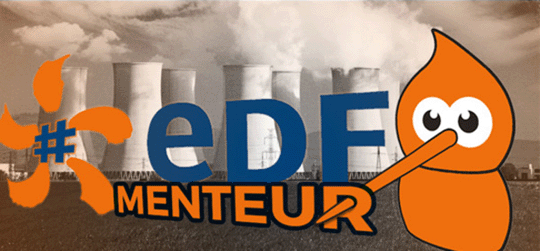
The French Competition Authority imposes a fine of 300 million euros on
EDF. The organization accuses the French company of abuse of a dominant
position and illegal collection of its customers’ data.
No less than seventeen years of anti-competitive practice. EDF was fined 300 million
euros by the Competition Authority for having misused its position as a
historical player in electricity since the opening of the market to
competition for companies in 2004, until 2021. The company does not
dispute the facts and has benefited from a negotiated procedure allowing
it to reduce the pain.
According to the law, a fine for this type of
practice could have cost it up to 10% of its annual worldwide turnover,
that is to say 7.6 billion, specifies in its decision the Authority of the
competition.
Le Figaro 22nd Feb 2022
Limitless power arriving too late: Why fusion won’t help us decarbonise — RenewEconomy

A limitless, clean source of baseload power might be within reach – without the nuclear waste of traditional fission nuclear plants. That’s good, right? Not quite. The post Limitless power arriving too late: Why fusion won’t help us decarbonise appeared first on RenewEconomy.
Limitless power arriving too late: Why fusion won’t help us decarbonise — RenewEconomy
| I first heard the standard joke about fusion as an undergraduate physics student in the 1960s: Fusion power is 50 years away – and probably always will be. More than 50 years later, we still don’t have fusion. That’s because of the huge experimental challenges in recreating a miniature sun on earth. Still, real progress is being made. This month, UK fusion researchers managed to double previous records of producing energy. Last year, American scientists came close to ignition, the tantalising moment where fusion puts more energy out than it needs to start the reaction. And small, fast-moving fusion startups are making progress using different techniques. A limitless, clean source of baseload power might be within reach – without the nuclear waste of traditional fission nuclear plants. That’s good, right? Not quite. While we’re closer than ever to making commercial fusion viable, this new power source simply won’t get here in time to do the heavy lifting of decarbonisation. We are racing the clock to limit damage from climate change. Luckily, we already have the technologies we need to decarbonise. On the megaproject front, the next step is the International Thermonuclear Experimental Reactor (ITER) being built in southern France. Far too big for any one country, this is a joint effort by countries including USA, Russia, China, the UK and EU member countries. The project is enormous, with a vessel ten times the size of the UK reactor and around 5,000 technical experts, scientists and engineers working on it. Famously, the project’s largest magnet is strong enough to lift an aircraft carrier. Even this enormous project is only expected to produce slightly more power than it uses – around 500 megawatts. The first experiments are expected by 2025. To me, this illustrates how far away commercial fusion really is. Renew Economy 25th Feb 2022https://reneweconomy.com.au/limitless-power-arriving-too-late-why-fusion-wont-help-us-decarbonise/ |
Why nuclear risk from war in Ukraine isn’t missiles, but accidental hits on reactors

“In case of the total destruction of the power plant, I think the consequences would be so much worse than at Fukushima and Chernobyl together,” Mr Gumenyuk said. “If speaking about consequences of this war situation, Europe will be totally contaminated.”
Why nuclear risk from war in Ukraine isn’t missiles but accidental hits on reactors, Kyiv safety expert warns, By Isabella Bengoechea i , 23 Feb 22
Kyiv nuclear safety expert Dmytro Gumenyuk told i while a direct attack is unlikely, military invasion raises the risk of possible accidental hits from missiles or artillery
Ukraine’s nuclear power plants would pose a risk of radioactive pollution in Europe if caught in the crossfire of a Russian invasion, a Kyiv safety expert has told i.
The chance of a direct military attack on such facilities would be highly unlikely but a lack of high-precision weapons in the occupied Donbas suggests there could be an increased chance of sensitive facilities being hit accidentally.
If this happens, radiation could contaminate air, soil and waterways, affecting not only Ukraine but also Russia and much of Europe, according to Dmytro Gumenyuk, head of safety analysis at the State Scientific and Technical Centre for Nuclear and Radiation Safety, a body within the state nuclear inspectorate.
Ukraine has 15 nuclear reactors in four power plants, which provide 52 per cent of the country’s electricity: Khelnitsky and Rivne in the northwest, and Zaporizhzhia and the South Ukrainian plants in the west and south respectively.
Some facilities including a nuclear waste storage site in the exclusion zone at Chernobyl – where in 1986 catastrophic failure at the power plant resulted in the worst nuclear disaster in history – lie close to the country’s borders, where Russia has amassed nearly 200,000 troops.
The plant at Zaporizhzhia is only about 150 miles from the front line in Donetsk, while the South Ukrainian plant is about another 160 miles further west.
While a direct attack is unlikely, military invasion raises the risk of possible accidental hits from missiles or artillery. On Tuesday the thermal power station at Shchastya, near the conflict line in Luhansk, caught fire amid shelling, leaving 40,000 residents without electricity.
Mr Gumenyuk said: “Our NPP [nuclear power plant] wasn’t designed for military protection. Of course it wasn’t designed against tanks, bombs, missiles and so on.
“In case of a military attack it is not a long time for getting from Dontesk to Zaporizhzhia NPP, and of course taking into account the small distances from the Russian Federation, we could suppose that our power plants are not fully protected from military attack from our neighbour.”
A direct attack by Russia is unlikely. Lada Roslycky, founder of the Ukraine-based Black Trident defence and security group, said: “From a military perspective and a defence perspective it would be an idiotic action.”
However, she pointed out the separatists’ lack of high-precision weapons in conflict in the occupied Donbas does raise the chance of sensitive facilities being hit accidentally.
She also suggested that this could be part of a Russian strategy of fomenting uncertainty through psychological warfare, by holding out the threat of attacking such facilities. “I really don’t think they would do it [attack nuclear facilities] but it’s possible … it’s such a wonderful, brilliant instrument,” she said.
The Conflict and Environment Observatory (CEOBS) said it is “right to be concerned about Ukraine’s 15 ageing Soviet-design nuclear reactors”.
“The three reactors at the South Ukraine Nuclear Power Plant and the six reactors at the Zaporizhzhia Nuclear Power Plant are the two sites most likely to be affected by a Russian invasion,” the observatory added.
The VVER 1000 pressurised water reactors at Zaporizhzhia each contain 163 assemblies – or structured groups of fuel rods. Each assembly contains about 500kg of uranium dioxide, making the total fuel inside one reactor about 80 tonnes.
After the 2011 nuclear disaster at Fukushima in Japan, Ukrainian nuclear authorities implemented extra safety measures to make their reactors safer, and protect against accidents such as fires and flooding.
However, Mr Gumenyuk warned that were the plant to be attacked, in the worst-case scenario, the consequences would be devastating.
“In case of the total destruction of the power plant, I think the consequences would be so much worse than at Fukushima and Chernobyl together,” Mr Gumenyuk said. “If speaking about consequences of this war situation, Europe will be totally contaminated.”
Soon after the disaster, radioactive rain began falling across northern Britain. In Cumbria detectors showed background radiation 200 times higher than normal. In Scotland two months later it was 4,000 times. Sheep in North Wales, Cumbria, and Scotland were found to have increased levels of caesium-137, prompting temporary restrictions on meat sales for 7,000 farms.
A nuclear disaster at Zaporizhzhia would contaminate the water, entering the Dneiper River and travelling down into the Sea of Azov, the Black Sea and then out into the Mediterranean.
In the event of a meltdown, radiation could contaminate the air where, depending on weather conditions, it could spread across Europe, as happened after the Chernobyl accident, when radiation spread as far as Sweden and the UK.
“But this is if all the units are totally destroyed,” said Mr Gumenyuk. “We do our best to prevent this situation. I hope in most cases our power units would survive even in single hits. Our nuclear reactors have containment to protect against the different impacts, including an air crash for example.”
Chernobyl’s nuclear waste
Ukraine’s nuclear waste storage facilities, including in the exclusion zone at Chernobyl, 70 miles south of the Belarussian border, also pose a radiation risk.

Last year Energoatom, the state nuclear operator, announced that Ukraine’s new Central Spent Fuel Storage Facility, in the exclusion zone at Chernobyl, was almost ready to begin operating. Spent fuel will be transferred to the new facility from where it is currently stored at power plants.
At present Russia has about 30,000 troops stationed in Belarus, apparently for joint military exercises, which are armed with short-range missiles, rocket launchers and Su-35 fighters. Leaders including Boris Johnson have suggested that Russia is planning at attack from Belarus, “coming down from the north, coming down from Belarus, and encircling Kyiv itself”. The route could take Russian troops through the exclusion zone.
According to CEOBS: “Decommissioning of the [Chernobyl] site and the packaging of waste is ongoing and will continue for decades. The site is under constant management and monitoring and the disruption caused by a conflict would impact the ongoing work to reduce the risks it poses. It seems likely that foreign companies would withdraw staff in the event of an invasion, impacting activities at the site.”
There are 22,000 assemblies of spent nuclear fuel at the storage site, kept in special casks to protect them.
However, Mr Gumenyuk pointed out that these were not protected against military firepower: “In case of the destruction of these casks, radioactive materials could be released and transferred to Ukraine and other European territories. This is a very dangerous situation.”
While some experts say any disruption to the site would be localised, Mr Gumenyuk said: “I disagree, the number of the fuel assemblies is very big and if all the casks were destroyed it would not only be the problem of Ukraine, maybe not all Europe, but many countries.”
Cyberattacks are another possibility. Last week Ukrainian government websites and banks were shut down by a wave of distributed denial of service attacks, thought to have been carried out by Russian hackers.
In 2015 the country’s energy sector was attacked by the BlackEnergy computer virus that caused a blackout of 800,000 households across 103 towns.
The next year, on the 30th anniversary of the Chernobyl disaster, Ukraine’s then-President Poroshenko said: “If the BlackEnergy virus was used for attacks on our power distributors, there is no guarantee that such technology will not threaten our nuclear plants”.
“Chernobyl is already volatile,” said Ms Roslycky. “Cyberattacks against Chernobyl call for attention… whether attacking kinetically or through cyber, when that happens this is something that would threaten global security.”
Accident, terrorism or sabotage
Direct attacks on the plants at Zaporizhzhia and South Ukraine are also unlikely, not least because Russia is not far from the power plants, and any radioactive contamination would affect Russia as well as Ukraine.
However, the possibility of an accident, terrorism or sabotage is somewhat higher. According to the Nuclear Security Index for 2020, Ukraine scores highly on global norms for nuclear materials security and implementing international commitments, with 94 and 78 out of 100 respectively.
However, under ‘risk environment’, which considers factors including political stability, effective governance, pervasiveness of corruption, and illicit activities by non-state actors, Ukraine scores 14.
A 2016 report by the EU Non-Proliferation Consortium drew attention to the illicit trafficking of radioactive materials in the DPR, LPR and unrecognised Transnistria in Moldova. “The armed conflict in eastern Ukraine and its related threats are dramatically influencing the nuclear security conditions in the country,” it said.
“Political and social instability amplifies the motivation of criminal or terrorist groups or organisations for illegal business related to the distribution of radioactive materials that are out of regulatory control.”
The danger of these armed insurgencies was highlighted most dramatically in 2014 when Malaysia Airlines Flight 17 was shot down over Donetsk in eastern Ukraine by pro-Russian separatists, killing all 298 on board. The Dutch-led investigation into the incident concluded that the plane was shot down with a Buk missile supplied by the 53rd Anti-Aircraft Missile Brigade of the Russian Federation. Those responsible may have believed they were shooting down a Ukrainian military aircraft…………………………………………. https://inews.co.uk/news/ukraine-war-nuclear-risk-russia-missiles-accidental-hits-reactors-1478269
Britain’s nuclear submarine base at risk from climate change
The United Kingdom’s nuclear military bases are being threatened by climate change, according to a recent report from the Nuclear Consulting Group. Paul Dorfman, the report’s author, said that the U.K.’s coastal nuclear infrastructure is vulnerable to flooding, due to rising sea levels and more frequent and severe storms.
“All of the models or predictions, all of the analysis, all of the data has really begun to run hot,” Dorfman told CNBC. “It’s good that people are taking notice, but it’s bad that this new data is showing us that we really do need to get our acttogether.”
The report also found that coastal flooding frequency is estimated to increase by between 10 and more than 100 in several European locations. In the United States, “the Pentagon has recently reported that
79 nuclear military bases will be affected by rising sea-levels and frequent flooding,” Dorfman added.
CNBC 21st Feb 2022
Putin says that Ukraine is a nuclear threat
 | |||
Vladimir Putin labels Ukraine a nuclear threat, says he’s prepared to use force, THE AUSTRALIAN, 23 Feb 22, JACQUELIN MAGNAY, EUROPE CORRESPONDENT@jacquelinmagnay

Russian president Vladimir Putin has announced he would use military force “depending on the situation on the ground” to defend the rights of people in the separatist regions Donetsk and Luhansk.
After receiving approval from the Russian parliament to deploy troops abroad into Ukraine, Mr Putin labelled Ukraine a nuclear threat, telling the Russian people it wanted to lose its neutrality, join NATO and that it received military shipments from the West. Mr Putin also claimed that citizens in the Donbas region were being “abused”.
Crucially, Mr Putin recognised the independence of the entire Donetsk and Luhansk oblasts and its broader territorial ambitions, not just the area controlled by Russian backed separatists.
About two-thirds of this area, known broadly as the Donbas, is currently in Ukrainian control.
Mr Putin said Ukraine was being “armed to the teeth” and that its nuclear threat was a strategic issue. He said Ukraine president Volodymyr Zelensky’s remark that he regretted Ukraine giving up nuclear weapons in 1994 was targeted directly at Russia.
“We have taken a note of them,” Mr Putin said………………….
Mr Putin said that Russia recognised the territory was now independent and warned the border region had been a threat to the Russian Federation………………………. https://www.theaustralian.com.au/world/vladimir-putin-labels-ukraine-a-nuclear-threat-says-hes-prepared-to-use-force/news-story/9ab06086551856b2847c06d91467cb26
Russian President Vladimir Putin orders Russian forces to ‘maintain peace’ in eastern Ukraine’s two breakaway regions.
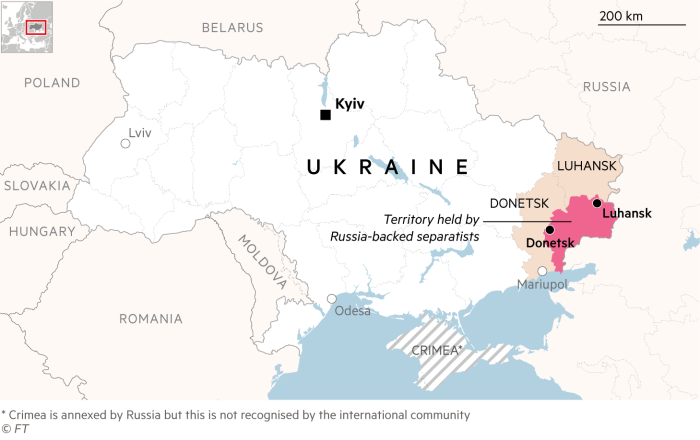
On Monday, local time, a Biden administration official said, however, the area was already controlled by Russian-backed separatists and Moscow, in practice, and that Mr Putin’s decision to send troops he called peacemakers into the breakaway regions of Ukraine did not as yet constitute a further invasion that would trigger a broader sanctions package.
“This isn’t a further invasion since it’s territory that they’ve already occupied,” the official said.
Russian President Vladimir Putin orders Russian forces to ‘maintain peace’ in eastern Ukraine’s two breakaway regions.
President Vladimir Putin has ordered his Defence Ministry to dispatch Russian forces to “maintain peace” in eastern Ukraine’s two breakaway regions, the Donetsk and Luhansk People’s Republics, after he said Moscow would recognise their independence.
Key points:
- Vladimir Putin, joined by Russia-backed separatist leaders, signed a decree recognising the independence of the breakaway regions
- In his address, Mr Putin delved into history as far back as the Ottoman empire and as recent as the tensions over NATO’s eastward expansion
- French President Emmanuel Macron earlier said the US and Russian leaders had agreed in principle to hold a summit
The Kremlin decree, spelled out in an order signed by Mr Putin, did not specify the size of the force to be dispatched, when they would cross the border into Ukraine nor exactly what their mission would be.
Hours later, a Reuters reporter witnessed unusually large columns of military vehicles and hardware, including tanks, moving through Donetsk, the largest city of the self-proclaimed republic.
Mr Putin earlier signed decrees to recognise the two breakaway regions as independent statelets………………………
On Monday, local time, a Biden administration official said, however, the area was already controlled by Russian-backed separatists and Moscow, in practice, and that Mr Putin’s decision to send troops he called peacemakers into the breakaway regions of Ukraine did not as yet constitute a further invasion that would trigger a broader sanctions package.
“This isn’t a further invasion since it’s territory that they’ve already occupied,” the official said.
But, the official added, that a full invasion could come at any time.
The United States will continue to pursue diplomacy with Russia until “tanks roll,” another official said.
“Russian troops moving into Donbas would not itself be a new step. Russia has had forces in the Donbas region for the past eight years … They are currently now making decisions to do this in a more overt and … open way,” the official said……………………
In his lengthy televised address, Mr Putin, looking visibly angry, described Ukraine as an integral part of Russia’s history and said that the regions in eastern Ukraine were ancient Russian lands and that he was confident the Russian people would support his decision.
Russian state television showed Mr Putin, joined by Russia-backed separatist leaders, signing a decree recognising the independence of the two Ukrainian breakaway regions, along with agreements on cooperation and friendship.
Under the two identical friendship treaties — submitted by Mr Putin for ratification by parliament — Russia has the right to build bases in the separatist regions and they, on paper, can do the same in Russia.
The parties committed to defend each other and signed separate agreements on military cooperation and on recognition of each other’s borders.
Their 31-point treaties also say Russia and the breakaway statelets will work to integrate their economies. Both regions are former industrial areas in need of massive support to rebuild after eight years of war with Ukrainian government forces.
The 10-year treaties are automatically renewable for further five-year periods unless one of the parties gives notice to withdraw.
Defying Western warnings against such a move, Mr Putin had announced his decision in phone calls to the leaders of Germany and France earlier, both of whom voiced disappointment, the Kremlin said.
The UN Security Council will meet publicly on Ukraine at 2am GMT (1pm AEDT) on Tuesday, a Russian diplomat said, following a request by the United States, the United Kingdom and France………………………..
EU will respond to ‘illegal act’ with sanctions against Moscow
According to another White House statement, Mr Biden had also discussed with France’s Emmanuel Macron and Germany’s Olaf Scholz “how they will continue to coordinate their response on next steps”. ………………..
The United Nations Secretary-General António Guterres called out Mr Putin’s decision to recognise the separatist regions as independent as “a violation of the territorial integrity and sovereignty of Ukraine” in a statement read by his spokesman, Stéphane Dujarric.
“The Secretary-General urges all relevant actors to focus their efforts on ensuring an immediate cessation of hostilities, protection of civilians and civilian infrastructure, preventing any action and statements that may further escalate the dangerous situation in and around Ukraine, and prioritising diplomacy to address all issues peacefully,” Mr Dujarric said.
…………….
With his decision to recognise the rebel regions, Mr Putin brushed off Western warnings that such a step would be illegal, would kill off peace negotiations and would trigger sanctions against Moscow.
“I deem it necessary to make a decision that should have been made a long time ago: to immediately recognise the independence and sovereignty of the Donetsk People’s Republic and the Luhansk People’s Republic,” Mr Putin said.https://www.abc.net.au/news/2022-02-22/putin-orders-russian-peacekeepers-ukraine/100849964
Nuclear project with Russian reactors shakes Bulgarian politics
Nuclear project with Russian reactors shakes Bulgarian politics By Emiliya Milcheva and Krasen Nikolov | EURACTIV.bg 21 Feb 22, Leading figures in the Bulgarian government are looking for a way out of a 40-year project to build a second nuclear power plant near the Danube island of Belene. The Belene project, which is to be implemented with two Russian nuclear reactors, is creating serious political tensions between liberal pro-European ‘Change Continues’ and ‘Democratic Bulgaria’ and the pro-Russian Bulgarian Socialist Party, which are coalition partners. President Rumen Radev has also insisted on a swift decision on the nuclear project.
Currently, Bulgarian energy is dependent on Russia. About 70% of the gas Bulgaria uses is Russian, the nuclear reactors at the Kozloduy power plant are filled with Russian nuclear fuel, nuclear waste is exported to Russia, and the largest oil refinery in the Balkans – near the Bulgarian city of Burgas – is owned by Lukoil.
‘Change Continues’ wants to change that.
Amid the crisis in Ukraine, Prime Minister Kirill Petkov has twice said he will not build the Belene project with two Russian reactors already purchased and delivered.
Using Russian nuclear reactors at Belene also means orders from Bulgaria for the Russian state-owned company Rosatom. Prime Minister Petkov stressed that Bulgaria had nuclear fuel for two years and there is no immediate threat to Bulgaria’s nuclear energy, but energy experts say the country must make a long-term decision
Prime Minister Petkov’s comments immediately provoked a reaction from the Socialist Party. Under pressure from the socialists, Bulgaria will launch a new analysis of the viability of the Belene nuclear project. Belene’s status is also being used by the pro-Russian far-right Vazrazhdane party, which supports Bulgaria’s exit from the EU and NATO.
Last week, a large Bulgarian delegation visited the United States, led by influential Deputy Prime Minister Asen Vassilev. Nuclear energy was one of the main topics discussed, with Bulgaria exploring whether it can use US nuclear fuel at the current Kozloduy power plant instead of Russia’s.
As early as January 2021, the government of Boyko Borissov approved a report supporting the construction of a new nuclear power unit at Kozloduy with a Russian reactor, but American technology. However, for such a hybrid to work, the participation of Rosatom is required. Such a Russian-American partnership now seems impossible.
EURACTIV understands that leading figures in the Bulgarian government are considering the possible benefits of the American small modular reactors or the Westinghouse reactor – AP1000.
Bulgaria has enough time to decide
Martin Vladimirov from the Center for the Study of Democracy (CSD) told EURACTIV that the Belene project is currently used as a carrot by politicians. Surveys show that 70% of Bulgarians want the Belene project to be built.
Vladimirov says the nuclear project should be talked about economically, not politically. He says that American interests in the export of modular nuclear reactors are visible, as they are trying to launch the technology in Poland, the Czech Republic, Slovakia and Ukraine…………………….. https://www.euractiv.com/section/politics/short_news/nuclear-project-with-russian-reactors-shakes-bulgarian-politics/
French government to subsidise EDF nuclear power company by another €2.1bn, to prop up its failing share price
The French government is to inject about €2.1bn (£1.75bn) into
state-controlled energy group EDF to ease the financial pain inflicted by
nuclear reactors going offline and the state making the firm supply power
below market prices. The finance minister, Bruno Le Maire, said the capital
injection would be made via a rights issue, announced by EDF on Friday,
aimed at raising €2.5bn to plug holes in the company’s balance sheet.
EDF said the combined effect of having to sell power at below-market prices
and the nuclear outages were likely to knock an estimated €19bn off its
forecast core profits in 2022. Its shares fell 2%, extending a slide in
which the company’s stock has dropped 19.3% in value since the start of
this year.
Guardian 18th Feb 2022
1 This Month


of the week– Nuclear Reactor Information Task Force

14 May – online event From Bombs to Data Centres: the Face of Nuclear Colonialism
To see nuclear-related stories in greater depth and intensity – go to https://nuclearinformation.wordpress.com
-
Archives
- May 2026 (180)
- April 2026 (356)
- March 2026 (251)
- February 2026 (268)
- January 2026 (308)
- December 2025 (358)
- November 2025 (359)
- October 2025 (376)
- September 2025 (257)
- August 2025 (319)
- July 2025 (230)
- June 2025 (348)
-
Categories
- 1
- 1 NUCLEAR ISSUES
- business and costs
- climate change
- culture and arts
- ENERGY
- environment
- health
- history
- indigenous issues
- Legal
- marketing of nuclear
- media
- opposition to nuclear
- PERSONAL STORIES
- politics
- politics international
- Religion and ethics
- safety
- secrets,lies and civil liberties
- spinbuster
- technology
- Uranium
- wastes
- weapons and war
- Women
- 2 WORLD
- ACTION
- AFRICA
- Atrocities
- AUSTRALIA
- Christina's notes
- Christina's themes
- culture and arts
- Events
- Fuk 2022
- Fuk 2023
- Fukushima 2017
- Fukushima 2018
- fukushima 2019
- Fukushima 2020
- Fukushima 2021
- general
- global warming
- Humour (God we need it)
- Nuclear
- RARE EARTHS
- Reference
- resources – print
- Resources -audiovicual
- Weekly Newsletter
- World
- World Nuclear
- YouTube
-
RSS
Entries RSS
Comments RSS
 nuclear-news