The Risks of Russian Attacks near Ukraine Nuclear Power Plants

The Risks of Russian Attacks near Ukraine Nuclear Power Plants, Commercial plants have built-in safety systems, but aren’t designed with warfare in mind. Scientific American By Andrea Thompson on March 4, 2022 People around the world watched via livestreamed security camera as Russian forces attacked and took over Ukraine’s Zaporizhzhia nuclear power plant—the largest in Europe—on Friday morning local time. Amid the shelling and gunfire, a fire broke out at a training facility in the complex and was later extinguished, according to news reports. The incident raised alarm among world leaders and nuclear experts about the potential for purposeful or accidental reactor damage that could cause radiation leaks or, in a worst-case scenario, reactor core meltdowns.
Rafael Grossi, director general of the International Atomic Energy Agency (IAEA), told the United Nations Security Council that the plant’s operations were normal after the attack and has said that no radioactive material was released. But he and other nuclear experts have warned that there is a danger of accidents there and at other nuclear plants in Ukraine as the conflict continues.
Scientific American spoke with Edwin Lyman, director of nuclear power safety at the Union of Concerned Scientists, to explain the concerns about such facilities during wartime and to talk about some of the safety measures that are in place.
The six reactors at Zaporizhzhia are called VVER-1000s, and they are cooled and moderated by light [ordinary] water. So in that respect, they’re similar to U.S. pressurized water reactors. They are somewhat more advanced models than the earlier versions of [this type of reactor], so they do have some features that are more in line with modern safety philosophy—but not entirely. …………
These [Zaporizhzhia reactors] were designed in the Soviet Union, and they date as far back as the early 1980s. So they are past their expiration date, but the Ukrainians extended their licenses………..
The big danger in any nuclear reactor is that somehow cooling of the fuel is disrupted, because without enough cooling, the fuel will heat up to the point where it can destroy itself…… In addition, these plants store their spent nuclear fuel on-site—and some of that fuel is stored in cooling water, which also has to be replenished with pumps………
In addition to a pipe break, you can have a loss of power, which is what affected Fukushima. These plants normally draw electricity from the grid to operate their systems, and if that’s interrupted, they have to rely on backup power with emergency diesel generators. …….
……f you want to potentially seriously damage the plant, you don’t have to go after the containment building, which is the hardest part. There are other systems that are not as well protected. But even those containment buildings are not necessarily able to withstand certain types of military attack. Even if they are not breached, they can spall, and you can have concrete falling down onto the reactor vessel. Or just strong vibrations might also cause damage……….
The cost of hardening commercial nuclear power plants so that they might survive a military onslaught is probably prohibitive……..
In the worst case, if you have an unmitigated loss of cooling capability, the nuclear fuel can overheat and melt and burn through the steel reactor vessel that holds it and drop to the floor of the container. And in that case, the containment is the only remaining barrier between the radioactive material in the reactor and the environment. It’s designed to withstand certain types of events but not others.
……
if multiple reactors are affected at the same time, if the spent fuel is damaged, if the containment is mechanically breached, then all bets are off……
… having well-rested operators is critical because the tasks they have to perform are complex, and they need to be alert. You have to ensure that fatigue is being monitored. If there’s a plant staff, and they’re not getting any relief, and they can’t go home, and they’re working under duress, it’s a dangerous combination. There will have to be measures for that……….. https://www.scientificamerican.com/article/the-risks-of-russian-attacks-near-ukraine-nuclear-power-plants1/
—
Western govt, media, and public, ignorant about the complex history of Ukraine
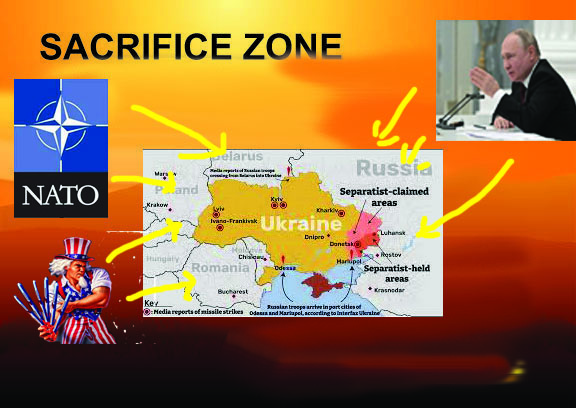
Lenin were he alive today would no doubt point out that Russia today, as well as the U.S., is a capitalist-imperialist country…….. He [Putin] is despicable, but his demand that NATO ceases expansion is as eminently reasonable and Biden’s desire to expand it seems crazier by the day.
Putin, Lenin, Imperialism and the (Real) History of Ukraine, Portside, March 5, 2022 Gary Leupp
— The people of this country suffer, I’ve always thought, from a general ignorance of history. ………
In 2014 having, having given little thought to Ukraine to that point, people in this county (self-defined Americans and others) were informed by the most authoritative sources they knew, the cable TV news anchors and commentators. They were treated to a history lesson that went something like this: The country of Ukraine has always been oppressed by Russia. It was colonized by Russia for centuries. Russia still, after the end of the Soviet Union, wants to control Ukraine! So it responded to a popular revolution in Kyiv, an expression of the Ukrainians’ longing to fulfill its “European aspirations,” by invading Ukraine!
having made its point clear in the brief invasion of Georgia in 2008 (to end talk of Georgian membership), having watched a U.S.-backed coup topple a president friendly to Russia replacing him with a pro-NATO cabal—was re-annexing Crimea (not just Russian from 1783 to 1954, but still Russia’s main naval port, then on lease from Crimea, and coveted by NATO) and supporting separatists in the primarily Russian speaking population in the Donbass region primarily to prevent further NATO expansion……………
In the real world, the U.S. has acted in the world since the collapse of the Soviet Union, the collapse of the Warsaw Pact, the collapse of what Washington perceived as the global communist movement, with an effort to encircle Russia with the most horrifically threatening military force in world history. It has expanded NATO in the absence of any real threat to itself from 16 to 28 members, bordering Russia on the Baltic coast and threatening to encircle it entirely. It has used NATO to pursue wars in Serbia, Afghanistan, Libya, and Syria, in the last case illegally intervening in a failed effort to gain control over a longstanding Russian ally…………
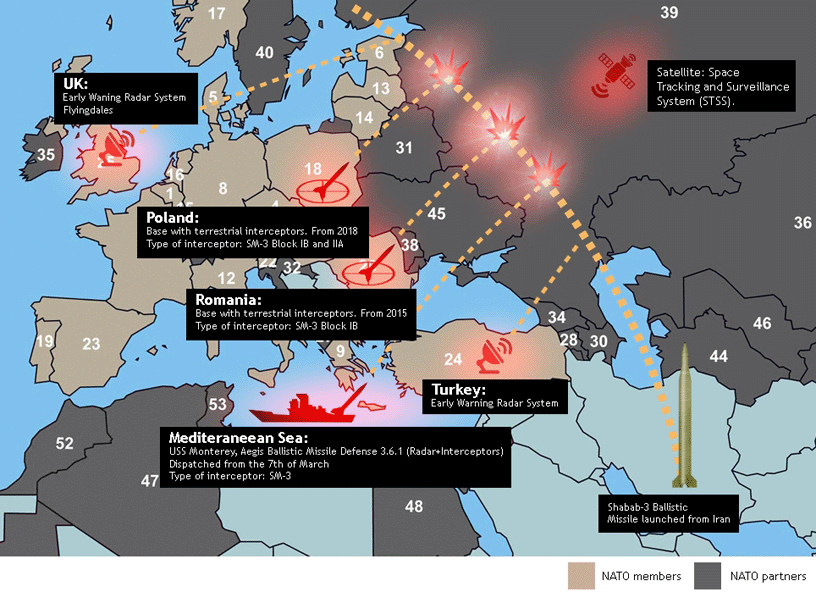
In the real world, Biden became president determined to both reassert U.S. “global leadership” and to continue NATO expansion. His campaign literature in 2020 reminded us that he believed in the cause. And it was clear he had a particular interest in drawing Ukraine in, which meant convincing Germany and other unenthusiastic NATO members to agree that Ukraine had cleaned up its corruption sufficient to get the nod.
He sent his secretary of state Anthony Blinken, who as Biden’s foreign policy advisor had urged him in 2002 to support Bush’s war on Iraq, to persuade the Germans that their gas pipeline to Russia threatened NATO unity! Meanwhile, U.S. puppet and NATO secretary-general Stoltenberg visited Kyiv to assure Ukraine that it will, indeed, be admitted to NATO. And the arms flowed into Ukraine.
Putin considered all this more threatening than ever………… The Russians were talking about their security, and need to defend their borders; the U.S. president was talking about his right to expand the alliance as he pleased.
For the U.S. media, what we see here is a clearly drawn conflict between Good and Evil, or in Blinken’s schoolmarmish conception “Democracy versus Autocracy.” What I see is two evils, neither of them democratic, locked in a conflict over the more powerful evil’s lust for further expansion. Both evils have their controlled news media and means to shape public consciousness.
Ukraine has been inhabited and crisscrossed by Scythians, Celts, Germanic peoples, Huns, Khazars, Mongols as well as Slavs. Given its history of incorporation into different states ………… at least the closest approximation of an independent state so far—was the Ukrainian Soviet Socialist Republic. Russia demanded that Ukraine be considered an independent state on the world stage; it held a separate UN seat. With Belarus it was one of the closest SSRs to Moscow, and most hesitant to withdraw from the union when Boris Yeltsin unilaterally dissolved it by pulling Russia itself out. Once established in its current configuration, Ukraine agreed to abandon its nuclear arsenal; it also agreed to a long-lease arrangement with Russia involving the vital Crimean naval base.
When Putin points to this history or at least aspects of it, he is not churning out lies at the level of the dutiful U.S. ……………
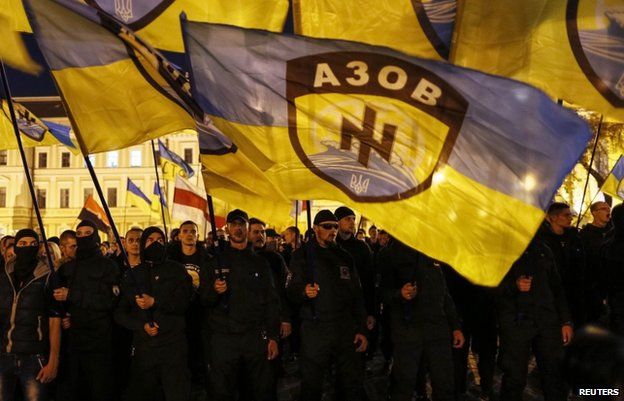
In the real world, Ukrainian fascist movements exist and were surely on display in the Maidan coup in 2014. They played a key role in the violent overthrow of an elected government, under Victoria Nuland’s watchful eye. There remains much support in some quarters for the wartime nationalist leader Stepan Bandera, who espoused a fascist ideology and helped round up Jews in Ukraine for the Nazi death camps. Anyone paying attention realizes that there are fascist elements in the military (the entire Azov Battalion) and that fascist parties, while small and with little electoral influence, have been able to stymie the implementation of the now-defunct Minsk Accords. So, yes, there is a fascist movement in Ukraine and it has a long history……
Crucial battles in this 1941-1945 war, also known as the Anti-Fascist War, were fought on Ukrainian soil, where some local communities sided with the fascists and embraced the Nazis’ Russophobia. Putin wants to essentialize Ukrainians as tending towards fascism, now working in tandem again with Russia’s enemies. This effort could well backfire among Russians who realize that Ukrainians are divided politically and ideologically among themselves and in any case undeserving of Putin’s characterization.
……….. Russians and Ukrainians retained amicable relations; the mere fact of new mutual independence was not a great problem for the relationship. Relations only deteriorated when, from around 2005, Ukrainian leaders requested NATO membership. In 2010 an anti-NATO president was democratically elected; the U.S. State Department oversaw a massive regime change effort to depict him as corrupt, anti-EU, impeding “Ukrainian’s European aspirations.” It succeeded in ousting him….
…….. Lenin were he alive today would no doubt point out that Russia today, as well as the U.S., is a capitalist-imperialist country…….. He [Putin] is despicable, but his demand that NATO ceases expansion is as eminently reasonable and Biden’s desire to expand it seems crazier by the day………………….. https://portside.org/2022-03-05/putin-lenin-imperialism-and-real-history-ukraine
The situation at Zaporizhzhia nuclear power station

information about Zaporizhzhia NPP
https://snriu.gov.ua/en/news/updated-information-about-zaporizhzhia-npp-1500 04 March 22
The largest nuclear power plant in Europe, Zaporizhzhia NPP, was captured by the military troops of the Russian Federation after heavy fighting in the streets of Energodar.
As a result of artillery shelling of the ZNPP industrial site:
– the reactor compartment building of the ZNPP unit 1 was damaged;
– 2 artillery shells hit the area of the dry type spent nuclear fuel storage facility.
The degree of damage to the structures and systems of these nuclear installations and their impact on safety requires additional assessments based on the results of the comprehensive inspections by the special services of the Operating Organization.
The fire, which broke out at night due to the enemy shelling of the ZNPP industrial site, severely damaged the training center building located in the immediate vicinity of the ZNPP industrial site.
Operational personnel, who were on shift at the time of the Russian occupation of the ZNPP site, were forced to continue working at their workplaces for more than 24 hours. There are no killed or injured ones among the ZNPP personnel. Some of the personnel received medical care due to stress.
To date, the rotation of operational personnel has been carried out, it is tentatively planned that the new shift will work until 23:00. Operational personnel monitor the state of power units and ensure their operation. At the same time, the personnel are working under pressure exercised by the armed forces of the Russian Federation, which occupied the ZNPP.
State of the power units:
- Unit 1 is in outage.
- Unit 2 is in operation to ensure the in-house needs.
- Unit 3 has been disconnected from the grid, the core cooldown operations are underway to transfer the nuclear installation into a cold shutdown state.
- Unit 4 is in operation, the electric power was increased up to 825 MW, the unit loading continues.
- Units 5, 6 are being cooled down.
Changes in the radiation situation in Zaporizhzhia region have not been registered, gamma radiation background is within the standard limits.
‘Grave concern’ as Ukraine Zaporizhzhia nuclear plant under Russian orders
Grave concern’ as Ukraine Zaporizhzhia nuclear plant under Russian orders, International Atomic Energy Agency says Russian military orders of staff at nuclear plant violate international safety protocols, Guardian, Julian Borger in WashingtonMon 7 Mar 2022
Staff at Ukraine’s Zaporizhzhia nuclear power plant are being told what to do by the Russian military commander who seized the site last week, in violation of international safety protocols.
The International Atomic Energy Agency (IAEA) expressed “grave concern” at the situation at the six-reactor plant, the largest in Europe. The agency was told by the Ukrainian nuclear regulator that “any action of plant management – including measures related to the technical operation of the six reactor units – requires prior approval by the Russian commander”.
The IAEA director general, Rafael Mariano Grossi, said on Sunday that the Russian military command over the nuclear plant “contravenes one of the seven indispensable pillars of nuclear safety and security” which states that the operating staff must be able to carry out their safety and security duties and be able to make decisions “free of undue pressure”.
Russian forces shelled the Zaporizhzhia plant in the early hours of Friday morning, damaging a walkway between two of the six reactors, and starting a fire in a nearby building used for training. As a result some of the reactors were shut down and others were put on low power.
The reactors themselves are well protected by a thick concrete shell, but there is concern that more vulnerable spent fuel rods could be hit, or that the power and cooling systems could be affected, potentially triggering a meltdown.
The IAEA also expressed concern that the Russian occupying force had reportedly shut down mobile phone networks and the internet connection “so that reliable information from the site cannot be obtained through the normal channels of communication”.
It said communications between the plant and the Ukrainian nuclear regulator have been affected, which the IAEA said contravenes another of the nuclear safety pillars listed by Grossi, requiring “reliable communications with the regulator and others”…….
The IAEA said that the operators at the plant were now being able to rotate between three shifts, relieving the operators who had been on duty at the time the plant was seized, but there were still “problems with availability and supply of food” which the Ukrainian regulator said was affecting morale on the plant.
The IAEA also expressed alarm that communication had been lost with institutions and enterprises in the besieged port city of Mariupol where it said there are “category 1-3 radiation sources, a probable reference to medical or industrial isotopes. A category 1 source can be lethal after more than a few minutes exposure.
“Such radioactive material can cause serious harm to people if not secured and managed properly,” the agency said in a statement.https://www.theguardian.com/world/2022/mar/06/ukraine-zaporizhzhia-nuclear-plant-staff-under-russian-orders
Russian forces approach Ukraine’s second-largest nuclear power plant in Yuzhnoukrainsk
– The US ambassador to the United Nations has warned that the world averted
nuclear catastrophe ‘by the grace of God,’ as troops move closer to the
country’s second-largest nuclear power plant. In a statement given during
an emergency meeting of the UN Security Council following the news that
Russian forces had shelled Europe’s largest nuclear power plant, Linda
Thomas-Greenfield said that troops were ‘now 20 miles, and closing, from
Ukraine’s second-largest nuclear facility,’ the South Ukraine nuclear
power plant in Yuzhnoukrainsk.
Unilad 5th March 2022
Calling Russia’s Attack ‘Unprovoked’ Lets USA Off the Hook

FAIR, BRYCE GREENE, MARCH 4, 2022, Many governments and media figures are rightly condemning Russian President Vladimir Putin’s attack on Ukraine as an act of aggression and a violation of international law. But in his first speech about the invasion, on February 24, US President Joe Biden also called the invasion “unprovoked.”
It’s a word that has been echoed repeatedly across the media ecosystem. “Putin’s forces entered Ukraine’s second-largest city on the fourth day of the unprovoked invasion,” Axios (2/27/22) reported; “Russia’s unprovoked invasion of Ukraine entered its second week Friday,” said CNBC (3/4/22). Vox (3/1/22) wrote of “Putin’s decision to launch an unprovoked and unnecessary war with the second-largest country in Europe.”
The “unprovoked” descriptor obscures a long history of provocative behavior from the United States in regards to Ukraine. This history is important to understanding how we got here, and what degree of responsibility the US bears for the current attack on Ukraine.
Ignoring expert advice
The story starts at the end of the Cold War, when the US was the only global hegemon. As part of the deal that finalized the reunification of Germany, the US promised Russia that NATO would not expand “one inch eastward.” Despite this, it wasn’t long before talk of expansion began to circulate among policy makers…………
Despite these warnings, Poland, Hungary and the Czech Republic were added to NATO in 1999, with Bulgaria, Estonia, Latvia, Lithuania, Romania, Slovakia and Slovenia following in 2004.
US planners were warned again in 2008 by US Ambassador to Moscow William Burns (now director of the CIA under Joe Biden). WikiLeaks leaked a cable from Burns titled “Nyet Means Nyet: Russia’s NATO Enlargement Redlines” that included another prophetic warning worth quoting in full (emphasis added):
Ukraine and Georgia’s NATO aspirations not only touch a raw nerve in Russia, they engender serious concerns about the consequences for stability in the region. Not only does Russia perceive encirclement, and efforts to undermine Russia’s influence in the region, but it also fears unpredictable and uncontrolled consequences which would seriously affect Russian security interests.
Experts tell us that Russia is particularly worried that the strong divisions in Ukraine over NATO membership, with much of the ethnic Russian community against membership, could lead to a major split, involving violence or at worst, civil war. In that eventuality, Russia would have to decide whether to intervene; a decision Russia does not want to have to face.
A de facto NATO ally
But the US has pushed Russia to make such a decision. Though European countries are divided about whether or not Ukraine should join, many in the NATO camp have been adamant about maintaining the alliance’s “open door policy.”
Even without officially being in NATO, Ukraine has become a de facto NATO ally—and Russia has paid close attention to these developments. In a December 2021 speech to his top military officials, Putin expressed his concerns:…………………………
The Maidan Coup of 2014
A major turning point in the US/Ukraine/Russia relationship was the 2014 violent and unconstitutional ouster of President Viktor Yanukovych, elected in 2010 in a vote heavily split between eastern and western Ukraine. His ouster came after months of protests led in part by far-right extremists (FAIR.org, 3/7/14). Weeks before his ouster, an unknown party leaked a phone call between US officials discussing who should and shouldn’t be part of the new government, and finding ways to “seal the deal.” After the ouster, a politician the officials designated as “the guy” even became prime minister.
The US involvement was part of a campaign aimed at exploiting the divisions in Ukrainian society to push the country into the US sphere of influence, pulling it out of the Russian sphere (FAIR.org, 1/28/22). In the aftermath of the overthrow, Russia illegally annexed Crimea from Ukraine, in part to secure a major naval base from the new Ukrainian government.
The New York Times (2/24/22) and Washington Post (2/28/22) both omitted the role the US played in these events. In US media, this critical moment in history is completely cleansed of US influence, erasing a critical step on the road to the current war.
Keeping civil war alive
In another response to the overthrow, an uprising in Ukraine’s Donbas region grew into a rebel movement that declared independence from Ukraine and announced the formation of their own republics. The resulting civil war claimed thousands of lives, but was largely paused in 2015 with a ceasefire agreement known as the Minsk II accords.
The deal, agreed to by Ukraine, Russia and other European countries, was designed to grant some form of autonomy to the breakaway regions in exchange for reintegrating them into the Ukrainian state. Unfortunately, the Ukrainian government refused to implement the autonomy provision of the accords
Anatol Lieven, a researcher with the Quincy Institute for Responsible Statecraft, wrote in The Nation (11/15/21):
The main reason for this refusal, apart from a general commitment to retain centralized power in Kiev, has been the belief that permanent autonomy for the Donbas would prevent Ukraine from joining NATO and the European Union, as the region could use its constitutional position within Ukraine to block membership.
Refusal to de-escalate…………
By December 2021, US intelligence agencies were sounding the alarm that Russia was amassing troops at the Ukrainian border and planning to attack. Yet Putin was very clear about a path to deescalation: He called on the West to halt NATO expansion, negotiate Ukrainian neutrality in the East/West rivalry, remove US nuclear weapons from non proliferating countries, and remove missiles, troops and bases near Russia. These are demands the US would surely have made were it in Russia’s position.
Unfortunately, the US refused to negotiate on Russia’s core concerns…………..
Instead of addressing Russian concerns about Ukraine’s NATO relationship, the US instead chose to pour hundreds of millions of dollars of weapons into Ukraine, exacerbating Putin’s expressed concerns. Ukrainian President Volodymyr Zelenskyy didn’t help matters by suggesting that Ukraine might begin a nuclear weapons program at the height of the tensions.
After Putin announced his recognition of the breakaway republics, Secretary of State Antony Blinken canceled talks with Putin, and began the process of implementing sanctions on Russia—all before Russian soldiers had set foot into Ukraine.
Had the US been genuinely interested in avoiding war, it would have taken every opportunity to de-escalate the situation. Instead, it did the opposite nearly every step of the way……………
None of this is to say that Putin’s invasion is justified—FAIR resolutely condemns the invasion as illegal and ruinous—but calling it “unprovoked” distracts attention from the US’s own contribution to this disastrous outcome. The US ignored warnings from both Russian and US officials that a major conflagration could erupt if the US continued its path, and it shouldn’t be surprising that one eventually did.
Now, as the world once again inches toward the brink of nuclear omnicide, it is more important than ever for Western audiences to understand and challenge their own government’s role in dragging us all to this point.
https://fair.org/home/calling-russias-attack-unprovoked-lets-us-off-the-hook/—
British government searching for investors, needs to raise billions of pounds for Sizewell nuclear project.
The British government is seeking financial advisers to raise billions of
pounds for the proposed Sizewell C nuclear plant in Suffolk as ministers
close in on a tacit agreement with Beijing to remove Chinese state-backed
energy group CGN from the £20bn project.
A new company would replace the
joint venture between French utility EDF and CGN that is developing the
£20bn Sizewell C plant in Suffolk, according to people familiar with the
government’s plans.
EDF holds 80 per cent under the current structure
with the remainder held by the Chinese group. Under the revised plans, both
the UK government and developer EDF would take a 20 per cent stake each in
the new vehicle and end CGN’s involvement in the project, reflecting how
diplomatic relations between Beijing and London have deteriorated in recent
years.
The government this week launched the search for investment bankers
to find investors for the remaining 60 per cent stake, according to people
with knowledge of the situation. The new company would be chaired by
Stephen Billingham, a City veteran who was previously finance director of
British Energy, the group that owned Britain’s operational fleet of
nuclear reactors before it was bought by EDF in 2008.
FT 3rd March 2022
https://www.ft.com/content/95524dfc-6503-48c7-85ad-a116bdf2c9ed
Fire Is Out at Zaporizhzhia Nuclear Plant Seized by Russian Forces, Officials Watch for Leaks
Fire Is Out at Nuclear Plant Seized by Russian Forces, Officials Watch for Leaks, Jake Johnson, Common Dreams, TRUTHOUT, March 4, 2022 ,
Russian forces reportedly seized control of a Ukrainian nuclear power plant on Friday shortly after a fire broke out at the facility, intensifying global fears of a massive and unprecedented radioactive disaster.
The fire, which Ukrainian officials said was sparked by Russian shelling, was extinguished Friday morning, but concerns remained about the potential for a leak of radioactive material if operators at the Zaporizhzhia nuclear plant are unable to safely cool power units at the site.
During a press conference Friday morning, the head of the International Atomic Energy Agency (IAEA) said the blaze started after a “projectile” hit a building within the plant complex……………
In a televised address on Friday, Ukrainian President Volodymyr Zelenskyy accused Russia’s military forces of engaging in “nuclear terror” and called on the Russian people to “take to the streets and say that you want to live, you want to live on Earth without radioactive contamination.”
“Radiation does not know where Russia is, radiation does not know where the borders of your country are,” Zelenskyy said, echoing concerns that the release of radioactive material could impact huge swaths of Europe, potentially rendering them uninhabitable for decades.
The Russian Defense Ministry, for its part, blamed “a Ukrainian sabotage group” for the fire at the Zaporizhzhia plant……………………………..
In a series of Twitter posts, Matthew Bunn, a professor at the Harvard Kennedy School and a co-principal investigator at the Project on Managing the Atom, denounced Russia’s alleged shelling of the Zaporizhzhia complex as “shockingly reckless, and a violation of multiple agreements.”
“The member states of the IAEA unanimously agreed years ago that attacking a nuclear power plant ‘constitutes a violation of the principles of the United Nations Charter, international law, and the Statute of the Agency,’” Bunn observed. “This shelling COULD cause a major radioactive release, but it’s too soon to tell whether (a) that will happen, (b) that’s what Russian forces intended, or (c) if it does happen, how big the release will be.”
Among other significant risks, Bunn highlighted the possibility that continued shelling could endanger the facility’s pools of spent nuclear fuel. Greenpeace International noted in an analysis earlier this week that, as of 2017, 855 tons of spent fuel were stored in the six pools at the Zaporizhzhia complex.
“If the fuel building was shattered by shelling, then any fission products released from the melted fuel could get out into the surrounding countryside,” Bunn warned. “Shelling could also cause a water leak that could lead to fuel melting, even if the electricity stayed on.”
IF the fuel pool is really overstuffed with spent fuel, AND the hot fuel assemblies recently discharged from the reactor are stored next to each other (rather than interspersed throughout the pool) the fuel can get so hot it catches fire — that, plus a shattering of the building, is really the worst-case scenario,” he added. “That could release a quantity of radioactivity even worse than Chernobyl, potentially.” https://truthout.org/articles/fire-is-out-at-nuclear-plant-seized-by-russian-forces-officials-watch-for-leaks/?eType=EmailBlastContent&eId=e297aee3-d279-418c-8617-603fd0711d10
Ukraine: Fire breaks out at Europe’s largest nuclear power plant — live updates
DW 4 Mar 22, Ukrainian officials report a fire at the Zaporizhzhia nuclear plant after it was shelled by Russia. Meanwhile, Ukrainian President Zelenskyy called on Russia’s Putin to meet directly for talks. Follow DW for the latest
Ukraine’s foreign minister, Dmytro Kuleba, tweeted, “Russian army is firing from all sides upon Zaporizhzhia NPP, the largest nuclear power plant in Europe. Fire has already broke out.”
Kuleba added, “If it blows up, it will be 10 times larger than Chernobyl! Russians must IMMEDIATELY cease the fire, allow firefighters, establish a security zone!”
Ukraine’s energy ministry told Russia’s RIA news agency that firefighters are unable to tend to the blaze at the plant as Russian troops continue to fire on them.
Plant spokesman Andry Tuz said shells were striking the plant and one of the six reactors was on fire. He said the reactor that was hit was under renovation and therefore nonoperational.
Tuz said it was imperative to cease fighting so firefighters could contain the blaze.
Dmytro Humenyuk of the State Scientific and Technical Center for Nuclear and Radiation Safety told Hromadske that the power units have several layers of fuel protection. The plant generates 25% of Ukraine’s electricity.
Humenyuk explained that under certain conditions, the power units can withstand up to 10 tons but are not designed to be hit by bombs or projectiles. If the reactor is seriously damaged and nuclear fuel exposed, the resulting catastrophe would be as bad as Chernobyl and if more than one reactor is hit, the result would be even more horrific.
The International Atomic Energy Agency said it was “aware” of the reports of shelling and in contact with Ukrainian authorities.
Summary of events in Ukraine-Russia crisis on Thursday……………………………………. https://www.dw.com/en/ukraine-fire-breaks-out-at-europes-largest-nuclear-power-plant-live-updates/a-61007081?maca=en-Twitter-sharing
The very perilous situation of Ukraine’s nuclear power stations.
Could the Ukraine conflict cause one of the world’s worst nuclear disasters?
ReNew Economy, Dr. Jim Green 3 March 2022
Over the past week the Russian military has taken control of the Chernobyl nuclear site in Ukraine and there have been two near-misses with military attacks threatening radioactive waste sites.
But the greatest nuclear hazards lie ahead and concern Ukraine’s operating nuclear power reactors. International Atomic Energy Agency (IAEA) Director General Rafael Mariano Grossi said on March 2:
“The situation in Ukraine is unprecedented and I continue to be gravely concerned. It is the first time a military conflict is happening amidst the facilities of a large, established nuclear power program.
“I have called for restraint from all measures or actions that could jeopardise the security of nuclear and other radioactive material, and the safe operation of any nuclear facilities in Ukraine, because any such incident could have severe consequences, aggravating human suffering and causing environmental harm.”
Grossi cited a 2009 decision by the IAEA General Conference that affirmed that “any armed attack on and threat against nuclear facilities devoted to peaceful purposes constitutes a violation of the principles of the United Nations Charter, international law and the Statute of the Agency.”
Over the past week the Russian military has taken control of the Chernobyl nuclear site in Ukraine and there have been two near-misses with military attacks threatening radioactive waste sites.
But the greatest nuclear hazards lie ahead and concern Ukraine’s operating nuclear power reactors. International Atomic Energy Agency (IAEA) Director General Rafael Mariano Grossi said on March 2:
“The situation in Ukraine is unprecedented and I continue to be gravely concerned. It is the first time a military conflict is happening amidst the facilities of a large, established nuclear power program.
“I have called for restraint from all measures or actions that could jeopardise the security of nuclear and other radioactive material, and the safe operation of any nuclear facilities in Ukraine, because any such incident could have severe consequences, aggravating human suffering and causing environmental harm.”
Grossi cited a 2009 decision by the IAEA General Conference that affirmed that “any armed attack on and threat against nuclear facilities devoted to peaceful purposes constitutes a violation of the principles of the United Nations Charter, international law and the Statute of the Agency.”
Worst-case scenario
It’s worthwhile comparing a worst-case scenario with the current situation in Ukraine. A worst-case scenario would involve war between two (or more) even-matched nations with a heavy reliance on nuclear power. War would drag on for years between evenly-matched nations. The heavy reliance on nuclear power would make it difficult or impossible to shut down power reactors.
Sooner or later, a deliberate or accidental military strike would likely hit a reactor – or the reactor’s essential power and cooling water supply would be disrupted. Any ‘gentleman’s agreement’ not to strike nuclear power plants would be voided and multiple Chernobyl- or Fukushima-scale disasters could unfold concurrently – in addition to all the non-nuclear horrors of war.
In the current conflict, the nations are not evenly matched and the fighting is limited to one country. There won’t be large-scale warfare dragging on for years – although low-level conflict might persist for years, as has been the case since Russia’s 2014 invasion of eastern Ukraine and Crimea.
Ukraine does share one component of a worst-case scenario: its heavy reliance on nuclear power. Fifteen reactors at four sites generate 51.2 percent of the country’s electricity. It is one of only three countries reliant on nuclear power for more than half of its electricity supply.
A March 1 IAEA update, citing the State Nuclear Regulatory Inspectorate of Ukraine (SNRIU), said that all 15 reactors remained under the Ukrainian control and they continued to operate.
But in its daily post dated March 1, SNRIU lists six reactors as ‘disconnected from the power grid’, comprising three reactors at Zaporizhzhia and one each at the Rivno, Khmelnitsky and South Ukrainian nuclear power plants. Those disconnections amount to about 20 per cent of Ukraine’s total national electricity generation.
In the weeks prior to the February 24 invasion, 0-3 reactors were disconnected. The number rose to five on February 26 and has remained at six since then. It seems likely that the invasion has resulted in decisions to disconnect a number of reactors. Ukraine’s nuclear utility Energoatom cites “operational safety” for the disconnection of two reactors at Zaporizhzhia.
Even before the Russian invasion, Ukraine’s reactor fleet was ageing, its nuclear industry was corrupt, regulation was inadequate, and nuclear security measures left much room for improvement. For the time being, it is highly unlikely there will be any meaningful national or international oversight or regulation of the country’s ageing reactors and other nuclear facilities.
Deliberate or accidental military strikes on nuclear plants
A deliberate military strike on a power reactor is highly unlikely – but not inconceivable. Bennett Ramberg, a former foreign affairs officer in the US State Department’s Bureau of Political-Military Affairs, and author of the 1985 book Nuclear Power Plants as Weapons for the Enemy, draws this comparison:
Over the past week the Russian military has taken control of the Chernobyl nuclear site in Ukraine and there have been two near-misses with military attacks threatening radioactive waste sites.
But the greatest nuclear hazards lie ahead and concern Ukraine’s operating nuclear power reactors. International Atomic Energy Agency (IAEA) Director General Rafael Mariano Grossi said on March 2:
“The situation in Ukraine is unprecedented and I continue to be gravely concerned. It is the first time a military conflict is happening amidst the facilities of a large, established nuclear power program.
“I have called for restraint from all measures or actions that could jeopardise the security of nuclear and other radioactive material, and the safe operation of any nuclear facilities in Ukraine, because any such incident could have severe consequences, aggravating human suffering and causing environmental harm.”
Grossi cited a 2009 decision by the IAEA General Conference that affirmed that “any armed attack on and threat against nuclear facilities devoted to peaceful purposes constitutes a violation of the principles of the United Nations Charter, international law and the Statute of the Agency.”
It’s worthwhile comparing a worst-case scenario with the current situation in Ukraine. A worst-case scenario would involve war between two (or more) even-matched nations with a heavy reliance on nuclear power. War would drag on for years between evenly-matched nations. The heavy reliance on nuclear power would make it difficult or impossible to shut down power reactors.
Sooner or later, a deliberate or accidental military strike would likely hit a reactor – or the reactor’s essential power and cooling water supply would be disrupted. Any ‘gentleman’s agreement’ not to strike nuclear power plants would be voided and multiple Chernobyl- or Fukushima-scale disasters could unfold concurrently – in addition to all the non-nuclear horrors of war.
In the current conflict, the nations are not evenly matched and the fighting is limited to one country. There won’t be large-scale warfare dragging on for years – although low-level conflict might persist for years, as has been the case since Russia’s 2014 invasion of eastern Ukraine and Crimea.
Ukraine does share one component of a worst-case scenario: its heavy reliance on nuclear power. Fifteen reactors at four sites generate 51.2 percent of the country’s electricity. It is one of only three countries reliant on nuclear power for more than half of its electricity supply.
A March 1 IAEA update, citing the State Nuclear Regulatory Inspectorate of Ukraine (SNRIU), said that all 15 reactors remained under the Ukrainian control and they continued to operate.
But in its daily post dated March 1, SNRIU lists six reactors as ‘disconnected from the power grid’, comprising three reactors at Zaporizhzhia and one each at the Rivno, Khmelnitsky and South Ukrainian nuclear power plants. Those disconnections amount to about 20 per cent of Ukraine’s total national electricity generation.
In the weeks prior to the February 24 invasion, 0-3 reactors were disconnected. The number rose to five on February 26 and has remained at six since then. It seems likely that the invasion has resulted in decisions to disconnect a number of reactors. Ukraine’s nuclear utility Energoatom cites “operational safety” for the disconnection of two reactors at Zaporizhzhia.
Even before the Russian invasion, Ukraine’s reactor fleet was ageing, its nuclear industry was corrupt, regulation was inadequate, and nuclear security measures left much room for improvement. For the time being, it is highly unlikely there will be any meaningful national or international oversight or regulation of the country’s ageing reactors and other nuclear facilities.
Deliberate or accidental military strikes on nuclear plants
A deliberate military strike on a power reactor is highly unlikely – but not inconceivable. Bennett Ramberg, a former foreign affairs officer in the US State Department’s Bureau of Political-Military Affairs, and author of the 1985 book Nuclear Power Plants as Weapons for the Enemy, draws this comparison:
“A case in point was the March 26, 2017, bombing of the Islamic State-held Tabqa Dam in Syria. Standing 18 stories high and holding back a 25-mile-long reservoir on the Euphrates River, the dam’s destruction would have drowned tens of thousands of innocent people downstream. Yet, violating strict “no-strike” orders and bypassing safeguards, US airmen struck it anyway. Dumb luck saved the day again: the bunker-busting bomb failed to detonate.”
An accidental strike is a troubling possibility. Or a strike disabling the vital power and cooling water supply systems which are necessary to maintain safety even after reactors are shut down.
Spent fuel cooling ponds and dry stores are vulnerable – they often contain more radioactivity than the reactors themselves, but without the multiple engineered layers of containment that reactors typically have.
And if there is an attack on a reactor or spent fuel store resulting in disaster, response measures would likely be chaotic and woefully inadequate. Forbes senior contributor Craig Hooper writes:
“It seems unlikely that Russia has mobilised trained reactor operators and prepared reactor crisis-management teams to take over any ‘liberated’ power plants. The heroic measures that kept the Chernobyl nuclear accident and Japan’s Fukushima nuclear disaster from becoming far more damaging events just will not happen in a war zone.”
Zaporizhzhia nuclear power plant
The Zaporizhzhia nuclear plant is home to six reactors and lies near one of Russia’s main invasion routes, north of Crimea. As noted above, three of the six reactors have been disconnected in recent days.
The plant was contentious long before the recent invasion due to mismanagement and the ageing of the Soviet-era reactors. A 2017 Austrian government assessment of Zaporizhzhia concluded that: “The documents provided and available lead to the conclusion that a high probability exists for accident scenarios to develop into a severe accident that threatens the integrity of the containment and results in a large release.”………………………………
Staffing
A single-reactor nuclear power plant typically employs 600-800 people. Presumably the workforce at the six-reactor Zaporizhzhia plant is considerably higher.
If not already, nuclear staff are likely to be killed when not at work, and others will flee and get as far away from the fighting – and the nuclear power plant – as they can.
If Russia’s military takes control of the site – and does so without causing a nuclear disaster – they could repeat what they have done at Chernobyl in recent days: keep Ukrainian staff hostage and force them to work under Russian control……………
The adequacy of backup generators at Zaporizhzhia has long been a concern as detailed in a March 2 Greenpeace International report. In 2020, the Ukrainian NGO EcoAction received information from nuclear industry whistleblowers about problems with the generators at Zaporizhzhia, including a lack of spare parts.
In the same year, the regulator SNRIU reported on a generator malfunction. An upgrade of the generators was due to be complete by 2017 but the completion date has been pushed back to 2023, i.e. it remains incomplete.
Security at Zaporizhzhia was jeopardised in 2014 when an armed confrontation took place between security guards and paramilitaries from Ukraine’s ultra-nationalist ‘right sector’, allied with neo-Nazi groups. The gunmen wanted to ‘protect’ the plant from pro-Russian forces, the Guardian reported, but were stopped by guards at a checkpoint.
The head of SNRIU said in 2015: “I cannot say what could be done to completely protect [nuclear] installations from attack, except to build them on Mars.”
International monitors
Energoatom CEO Petro Kotin called on international monitors to intervene to ensure the safety of the country’s nuclear reactors and to create 30km exclusion zones around the four nuclear power plants.
Energoatom noted in a statement that columns of military equipment have been moving near nuclear power plants with “shells exploding near the nuclear power plant – this can lead to highly undesirable threats across the planet”.
The Acting Chief State Inspector of SNRIU has asked the IAEA to provide immediate assistance in coordinating activities in relation to the safety of nuclear facilities. The IAEA noted that Director General Grossi “will be holding consultations and maintain contacts in order to address this request”.
But the request for assistance in establishing an exclusion zone has been rejected by the IAEA. “The IAEA has no power to enforce an exclusion zone,” Grossi said following an emergency IAEA session on March 2………………………
Nuclear waste
The report by Greenpeace International nuclear specialists notes that as of 2017, Zaporizhzhia had 2,204 tons of spent fuel in storage at the site – 855 tonnes in the spent fuel pools within the reactor buildings, and 1,349 tonnes in a dry storage facility.
The spent fuel pools contain far more radioactivity than the dry store. Without active cooling, the pools risk overheating and evaporating to a point where the fuel metal cladding could ignite and release much of the radioactive inventory. Damage to the reservoirs which supply cooling water to Zaporizhzhia could disrupt cooling of reactors and spent fuel.
The Guardian reported in 2015 that the dry store at Zaporizhzhia is sub-standard, with more than 3,000 spent nuclear fuel rods in metal casks within concrete containers in an open-air yard close to a perimeter fence.
Neil Hyatt, a professor of radioactive waste management at Sheffield University, told the Guardian that a dry storage container with a resilient roof and in-house ventilation would offer greater protection from missile bombardment.
Cyber-warfare
Cyber-warfare is another risk which could jeopardise the safe operation of nuclear plants. Russia is one of the growing number of states actively engaged in cyber-warfare. James Acton from the Carnegie Endowment for International Peace notes that a Russian cyber-attack disrupted power supply in Ukraine in 2015.
Nuclear facilities have repeatedly been targets of cyber-attack, including the Stuxnet computer virus targeted by Israel and the US to disrupt Iran’s uranium enrichment centrifuges in 2009.
Reports from the UK-based Chatham House and the US-based Nuclear Threat Initiative have identified multiple computer security concerns specific to nuclear power plants.
Waste storage and disposal sites
Missiles hit a radioactive waste storage site near Kyiv on February 27. The IAEA stated in a March 1 update:……………………..
The Kyiv and Kharkiv facilities typically hold disused radioactive sources and other low-level waste from hospitals and industry, the IAEA said, but do not contain high-level nuclear waste. However the Kharkiv site may also store spent nuclear fuel from the research reactor.
Dr. Jim Green is the national nuclear campaigner with Friends of the Earth Australia.
RenewEconomy
The expansion of NATO – a boon for the weapons industry and a prelude to conflict with Russia

Within two decades, 14 Central and Eastern European countries joined NATO. The organization originally existed to contain the Soviet Union, and Russian officials monitored its advance with alarm. In retrospect, postwar expansion benefited arms makers both by increasing their market and stimulating conflict with Russia.
Arms Industry Sees Ukraine Conflict as an Opportunity, Not a Crisis, Jonathan Ng, Truthout , 2 Mar 22,
”………………………….. Ultimately, policy makers reneged on their promise to Gorbachev, admitting Poland, Hungary and the Czech Republic into NATO in 1999. During the ceremony, Secretary of State Madeleine Albright — who directly cooperated with the Jackson campaign — welcomed them with a hearty “Hallelujah.” Ominously, the intellectual architect of the Cold War, George Kennan, predicted disaster. “Such a decision may be expected to inflame the nationalistic, anti-Western and militaristic tendencies in Russian opinion,” Kennan cautioned.
Few listened. Former Assistant Secretary of Defense Chas Freeman described the mentality of policy makers: “The Russians are down, let’s give them another kick.” Relishing victory, Jackson was equally truculent: “‘Fuck Russia’ is a proud and long tradition in US foreign policy.” Later, he became chairman of the Committee for the Liberation of Iraq, which paved the way for the 2003 invasion, the biggest industry handout in recent history.
Within two decades, 14 Central and Eastern European countries joined NATO. The organization originally existed to contain the Soviet Union, and Russian officials monitored its advance with alarm. In retrospect, postwar expansion benefited arms makers both by increasing their market and stimulating conflict with Russia.
Targeting Ukraine
Tensions reached a new phase in 2014 when the United States backed the removal of President Viktor Yanukovych in Ukraine. Yanukovych had opposed NATO membership, and Russian officials feared his ouster would bring the country under its strategic umbrella. Rather than assuage their concerns, the Obama administration maneuvered to slip Ukraine into its sphere of influence. Assistant Secretary of State Victoria Nuland coordinated regime change with brash confidence. Nuland openly distributed cookies to protesters, and later, capped a diplomatic exchange with “fuck the EU.” At the height of the uprising, Sen. John McCain also joined demonstrators. Flanked by leaders of the fascist Svoboda Party, McCain advocated regime change, declaring that “America is with you.”
By then, newly minted NATO members had bought nearly $17 billion in American weapons. Military installations, including six NATO command posts, ballooned across Eastern Europe. Fearing further expansion, Russia annexed the Crimean Peninsula and intervened in the Donbas region, fueling a ferocious and interminable war. NATO spokespeople argued that the crisis justified expansion. In reality, NATO expansion was a key inciter of the crisis. And the conflagration was a gift to the arms industry. In five years, major weapons exports from the United States increased 23 percent, while French exports alone registered a 72-percent leap, reaching their highest levels since the Cold War. Meanwhile, European military spending hit record heights.
As tensions escalated, Supreme Commander Philip Breedlove of NATO wildly inflated threats, calling Russia “a long-term existential threat to the United States.” Breedlove even falsified information about Russian troop movements over the first two years of the conflict, while brainstorming tactics with colleagues to “leverage, cajole, convince or coerce the U.S. to react.” A senior fellow at the Brookings Institution concluded that he aimed to “goad Europeans into jacking up defense spending.”
And he succeeded. The Stockholm International Peace Research Institute registered a significant leap in European military spending — even though Russian spending in 2016 equaled only one quarter of the European NATO budget. That year, Breedlove resigned from his post before joining the Center for a New American Security, a hawkish think tank awash in industry funds.
The arms race continues. After European negotiations gridlocked, Russia recognized two separatist republics in the Donbas region before invading Ukraine this February. Justifying the bloody operation, Putin wrongly accused Ukrainian authorities of genocide. Yet his focus was geopolitical. “It is a fact that over the past 30 years we have been patiently trying to come to an agreement with the leading NATO countries,” he said. “In response to our proposals, we invariably faced either cynical deception and lies or attempts at pressure and blackmail, while the North Atlantic alliance continued to expand despite our protests and concerns. Its military machine is moving and, as I said, is approaching our very border.”
In retrospect, three decades of industry lobbying has proved deadly effective. NATO engulfed most of Eastern Europe and provoked a war in Ukraine — yet another opportunity for accumulation. Alliance members have activated Article 4, mobilizing troops, contemplating retaliation and moving further toward the brink of Armageddon.
Yet even as military budgets rise, European arms makers — like their American counterparts — have required foreign markets to overcome fiscal restraints and production costs. They need clients to finance their own military buildup: foreign wars to fund domestic defense. ………………………….. https://truthout.org/articles/arms-industry-sees-ukraine-conflict-as-an-opportunity-not-a-crisis/?eType=EmailBlastContent&eId=734c56bc-48da-4e66-bea1-f2bedb7d1431
Greenpeace analysis of nuclear power plant vulnerability during military conflict – Key Findings

Key findings of the Greenpeace analysis are:
● The Zaporizhzhia plant, like all reactors, with hot highly radioactive fuel, requires constant electrical power for cooling even when shut down. When the electricity grid fails and the reactor is in a station black out, there are backup diesel generators and batteries, but their reliability over a longer period of time cannot be guaranteed. There are unresolved on-going issues with the Zaporizhzhia emergency diesel generators, which have an estimated fuel stock on site for only seven days.
● Official data from 2017 reported that at Zaporizhzhia there were 2,204 tons of high level spent fuel – 855 tons of which were in highly vulnerable spent fuel pools. Without active cooling, they risk overheating and evaporating to a point where the fuel metal cladding could ignite and release most of the radioactive inventory.
Zaporizhzhia, like all operating nuclear power plants, requires a complex support system, including the permanent presence of qualified personnel, power, access to cooling water, spare parts and equipment. Such support systems are severely compromised during a war.
● The nuclear reactor buildings of Zaporizhzhia have a concrete containment protecting both the reactor core, its cooling system and the spent fuel pool. However, such containment cannot withstand the impact of heavy munitions. The plant could be hit accidently. It seems unlikely that the plant would be targeted deliberately, given that the nuclear release could severely contaminate neighbouring countries including Russia. Still, this cannot be entirely ruled out.
● In the worst-case scenario, the reactor containment would be destroyed by explosions and the cooling system would fail, the radioactivity of both the reactor and the fuel pool could then freely escape into the atmosphere. This risks making the entire plant inaccessible because of the high radiation levels, which could then lead to a further cascade of the other reactors and fuel pools, each spreading large quantities of radioactivity into different wind directions over several weeks. It could make a large part of Europe, including Russia, uninhabitable for at least many decades and over a distance of hundreds of kilometres, a nightmare scenario and potentially far worse than the Fukushima Daiichi disaster in 2011.
● It takes a long time to bring a power plant in operation into a stage of passive safety which does not require further human intervention. When a reactor is shut down, the residual heat from the radioactivity decreases exponentially, still it remains very hot and requires cooling over a period of 5 years before it can be loaded into concrete dry storage containers which remove their heat through natural circulation of the air outside the container. Shutting down a reactor might progressively decrease the risks over time, but it does not solve the problem.
Russian Foreign Minister Lavrov warns that a third world war would be nuclear
Russia’s Lavrov: A third world war would be nuclear, destructive
Moscow put its strategic nuclear forces on alert last week amid the war in Ukraine, causing ripples across the globe. Aljazeera, 2 Mar 22,
Russian Foreign Minister Sergey Lavrov has warned that if a third world war were to occur, it would involve nuclear weapons and be destructive, according to Russian media.
The comments reported by the RIA news agency on Wednesday came a day after he told a Geneva disarmament meeting via video link that neighbouring Ukraine, which Russian invaded last week, had been seeking nuclear weapons.
He did not provide evidence other than saying “Ukraine still has Soviet nuclear technologies and the means of delivery of such weapons.”
Lavrov has also said that Russia would have faced a “real danger” if Ukraine acquired nuclear weapons.
Nuclear forces on high alert
Russian forces attacked Ukraine by land, air and sea, the biggest attack by one state against another in Europe since World War II.
The move has been countered by the West with harsh economic sanctions on Russia as well as deliveries of arms and humanitarian aid to Ukraine.
The US government on Tuesday announced a ban on Russian flights in its airspace, following similar moves by the European Union and Canada.
On Sunday, Russian President Vladimir Putin put his strategic nuclear forces on alert, causing ripples across the globe and raising the threat the tensions could lead to the use of nuclear weapons. ………….. https://www.aljazeera.com/news/2022/3/2/russias-lavrov-says-a-ww-iii-would-be-nuclear-and-destructive
”Infinite war” – NATO and U.S. weapons industry found the perfect sales opportunity in Yemen
Arms Industry Sees Ukraine Conflict as an Opportunity, Not a Crisis, Jonathan Ng, Truthout , 2 Mar 22,

In the United States, the industry employs around 700 lobbyists. Nearly three-fourths previously worked for the federal government — the highest percentage for any industry. The lobby spent $108 million in 2020 alone, and its ranks continue to swell. Over the past 30 years, about 530 congressional staffers on military-related committees left office for defense contractors. Industry veterans dominate the Biden administration, including Secretary of Defense Lloyd Austin from Raytheon.
”’………………….Yemen Burning
Arms makers found the perfect sales opportunity in Yemen. In 2011, a popular revolution toppled Ali Abdullah Saleh, who had monopolized power for two decades. His crony, Abdu Rabbu Mansour Hadi, became president the next year after easily winning the election: He was the only candidate. Thwarted by elite intrigue, another uprising ejected Mansour Hadi in 2015.
That year, Prince Salman became king of Saudi Arabia, but power concentrated into the hands of his son, Mohammed bin Salman, who feared that the uprising threatened to snatch Yemen from Saudi Arabia’s sphere of influence.
Months later, a Saudi-led coalition invaded, leaving a massive trail of carnage. “There was no plan,” a U.S. intelligence official emphasized. “They just bombed anything and everything that looked like it might be a target.”
The war immediately attracted NATO contractors, which backed the aggressors. They exploit the conflict to sustain industrial capacity, fund weapons development and achieve economies of scale. In essence, the Saudi-led coalition subsidizes the NATO military buildup, while the West inflames the war in Yemen.
Western statesmen pursue sales with perverse enthusiasm. In May 2017, Donald Trump visited Saudi Arabia for his first trip abroad as president, in order to flesh out the details of a $110 billion arms bundle. His son-in-law, Jared Kushner, arrived beforehand to discuss the package. When Saudi officials complained about the price of a radar system, Kushner immediately called the CEO of Lockheed Martin to ask for a discount. The following year, Mohammed bin Salman visited company headquarters during a whirlwind tour of the United States. Defense contractors, Hollywood moguls and even Oprah Winfrey welcomed the young prince Yet the Americans were not alone. The Saudi-led coalition is also the largest arms market for France and other NATO members. And as the French Ministry of the Armed Forces explains, exports are “necessary for the preservation and development of the French defense technological and industrial base.” In other words, NATO members such as France export war in order to retain their capacity to wage it.
President Macron denies that the coalition — an imposing alliance that includes Saudi Arabia, Egypt, Jordan, the United Arab Emirates, Kuwait, Bahrain, Qatar, Sudan and Senegal — uses French weapons. But the statistics are suggestive. Between 2015 and 2019, France awarded €14 billion in arms export licenses to Saudi Arabia and €20 billion in licenses to the United Arab Emirates. CEO Stéphane Mayer of Nexter Systems praised the performance of Leclerc tanks in Yemen, boasting that they “have highly impressed the military leaders of the region.” In short, while Macron denies that the coalition wields French hardware in Yemen, local industrialists cite their use as a selling point. Indeed, Amnesty International reports that his administration has systematically lied about its export policy. Privately, officials have compiled a “very precise list of French materiél deployed in the context of the conflict, including ammunition.”
Recently, Macron became one of the first heads of state to meet Mohammed bin Salman following the assassination of journalist Jamal Khashoggi. Like Trump’s trip, Macron’s diplomatic junket was a sales mission. Eventually, Macron clinched a deal with the United Arab Emirates for 80 Rafale fighters. The CEO of Dassault Aviation called the contract “the most important ever obtained by French military aerospace,” guaranteeing six years of work for a pillar of its industrial base.
French policy is typical of NATO involvement in Yemen. While denouncing the war, every Western producer has outfitted those carrying it out. Spanish authorities massage official documents to conceal the export of lethal hardware. Great Britain has repeatedly violated its own arms embargo. And the United States has not respected export freezes with any consistency.
Even NATO countries in Eastern Europe exploit the war. While these alliance members absorb Western arms, they dump some of their old Soviet hardware into the Middle East. Between 2012 and July 2016 Eastern Europe awarded at least €1.2 billion in military equipment to the region.
Ironically, a leading Eastern European arms exporter is Ukraine. While the West rushes to arm Kyiv, its ruling class has sold weapons on the black market. A parliamentary inquiry concluded that between 1992 and 1998 alone, Ukraine lost a staggering $32 billion in military assets, as oligarchs pillaged their own army. Over the past three decades, they have outfitted Iraq, the Taliban and extremist groups across the Middle East. Even former President Leonid Kuchma, who has led peace talks in the Donbas region, illegally sold weapons while in office. More recently, French authorities investigated Dmytro Peregudov, the former director of the state defense conglomerate, for pocketing $24 million in sales commissions. Peregudov resided in a château with rolling wine fields, while managing the extensive properties that he acquired after his years in public service.
The Warlords
Kuchma and Peregudov are hardly exceptional. Corruption is endemic in an industry that relies on the proverbial revolving door. The revolving door is not simply a metaphor but an institution, converting private profit into public policy. Its perpetual motion signifies the social reproduction of an elite that resides at the commanding heights of a global military-industrial complex. Leading power brokers ranging from the Mitterrands and Chiracs in France, to the Thatchers and Blairs in Britain, and the Gonzálezes and Bourbons in Spain have personally profited from the arms trade.
In the United States, the industry employs around 700 lobbyists. Nearly three-fourths previously worked for the federal government — the highest percentage for any industry. The lobby spent $108 million in 2020 alone, and its ranks continue to swell. Over the past 30 years, about 530 congressional staffers on military-related committees left office for defense contractors. Industry veterans dominate the Biden administration, including Secretary of Defense Lloyd Austin from Raytheon.
The revolving door reinforces the class composition of the state, while undermining its moral legitimacy. As an elite rotates office, members insulate policymaking from democratic input, taint the government with corruption and mistake corporate profit with national interest. By 2005, 80 percent of army generals with three stars or more retired to arms makers despite existing regulations. (The National Defense Authorization Act prohibits top officers from lobbying the government for two years after leaving office or leveraging personal contacts to secure contracts. But compliance is notoriously poor.) More recently, the U.S. Navy initiated investigations against dozens of officers for corrupt ties to the defense contractor Leonard Francis, who clinched contracts with massive bribes, lavish meals and sex parties.
Steeped in this corrosive culture, NATO intellectuals now openly talk about the prospect of “infinite war.” Gen. Mike Holmes insists that it is “not losing. It’s staying in the game and getting a new plan and keeping pursuing your objectives.” Yet those immersed in its brutal reality surely disagree. The United Nations reports that at least 14,000 people have died in the Russo-Ukrainian War since 2014, and over 377,000 have perished in Yemen.
In truth, the doctrine of infinite war is not so much a strategy as it is a confession — acknowledging the violent metabolism of a system that requires conflict. As a self-selecting elite propounds NATO expansion, military buildup and imperialism, we must embrace what the warlords most fear: the threat of peace.The author would like to thank Sarah Priscilla Lee of the Learning Sciences Program at Northwestern University for reviewing this article. https://truthout.org/articles/arms-industry-sees-ukraine-conflict-as-an-opportunity-not-a-crisis/?eType=EmailBlastContent&eId=734c56bc-48da-4e66-bea1-f2bedb7d1431
Brief summary of Ukraine, background and now
david john, (of http://www.tstga.com) 2 March 22, News Ukraine and News Today, Ukraine is a country in Eastern Europe. The capital and largest city is Kiev. Ukraine is bordered by Russia to the east, Belarus to the north, Poland and Slovakia to the west, Hungary, Romania, and Moldova to the southwest, and the Black Sea and Sea of Azov to the south.
Ukraine is the second-largest country in Europe, after Russia, with a total area of 603,700 square kilometres (233,100 sq mi), making it the largest country entirely within Europe.
The territory of present-day Ukraine has been inhabited since 32,000 BC. During the Middle Ages, the area was a key centre of East Slavic culture, with the powerful state of Kievan Rus’ forming the basis of Ukrainian identity. Following the Partition of Poland in 1772, the western part of Ukraine became a constituent republic of the Russian Empire, while the eastern part remained under the rule of the Ottoman Empire. A 1917 Russian Revolution led to the establishment of the Soviet Ukraine, which later evolved into the modern Ukraine.
Ukraine declared independence on 24 August 1991, following the dissolution of the Soviet Union. The country is a unitary state composed of 24 oblasts (provinces), one autonomous republic (Crimea), and two cities with special status: Kiev, the capital, and Sevastopol, a port city on the Crimean Peninsula.
Ukraine is a member of the United Nations, the Council of Europe, the World Trade Organization, and the Partnership for Peace. It is a founding member of the Community of Independent States (CIS).
A referendum on the future of Crimea was held on 16 March 2014, in which 96.77% of Crimeans voted in favour of joining Russia. This vote was controversial, with the international community refusing to recognize the results. Ukraine considers the vote to be illegitimate and maintains that Crimea is an integral part of its territory.
The ongoing War in Donbass, which started in April 2014, has caused the deaths of over 10,000 people and has left over 1.6 million internally displaced persons.
1 This Month


of the week– Nuclear Reactor Information Task Force

14 May – online event From Bombs to Data Centres: the Face of Nuclear Colonialism
To see nuclear-related stories in greater depth and intensity – go to https://nuclearinformation.wordpress.com
-
Archives
- May 2026 (180)
- April 2026 (356)
- March 2026 (251)
- February 2026 (268)
- January 2026 (308)
- December 2025 (358)
- November 2025 (359)
- October 2025 (376)
- September 2025 (257)
- August 2025 (319)
- July 2025 (230)
- June 2025 (348)
-
Categories
- 1
- 1 NUCLEAR ISSUES
- business and costs
- climate change
- culture and arts
- ENERGY
- environment
- health
- history
- indigenous issues
- Legal
- marketing of nuclear
- media
- opposition to nuclear
- PERSONAL STORIES
- politics
- politics international
- Religion and ethics
- safety
- secrets,lies and civil liberties
- spinbuster
- technology
- Uranium
- wastes
- weapons and war
- Women
- 2 WORLD
- ACTION
- AFRICA
- Atrocities
- AUSTRALIA
- Christina's notes
- Christina's themes
- culture and arts
- Events
- Fuk 2022
- Fuk 2023
- Fukushima 2017
- Fukushima 2018
- fukushima 2019
- Fukushima 2020
- Fukushima 2021
- general
- global warming
- Humour (God we need it)
- Nuclear
- RARE EARTHS
- Reference
- resources – print
- Resources -audiovicual
- Weekly Newsletter
- World
- World Nuclear
- YouTube
-
RSS
Entries RSS
Comments RSS
 nuclear-news