Rolls Royce wants to hurry up the introduction of small nuclear reactors, but UK govt is focussed on a big one for Wylfa

Rolls-Royce calls for accelerated SMR rollout as Boris considers bigger plans for Wylfa
14 MAR, 2022 BY CATHERINE KENNEDY ROLLS-ROYCE IS APPEALING TO THE UK GOVERNMENT TO SPEED UP THE ROLLOUT OF SMALL MODULAR REACTORS (SMRS), WHILE PRIME MINISTER BORIS JOHNSON IS REPORTEDLY KEEN TO REVIVE PLANS FOR THE WYLFA NEWYDD NUCLEAR POWER PLANT IN RESPONSE TO THE UK ENERGY CRISIS.
There is a pressing need to improve the UK’s energy security, with prices soaring due to the Russian invasion of Ukraine, and alternative solutions are being explored to plug the gap.
Rolls-Royce submitted SMR designs for Wylfa and Trawsfynydd for assessment last week. However extensive safety checks are needed and these are not expected to come online until the 2030s. As such, government sources told the Telegraph that Rolls-Royce is frustrated with the lack of progress.
Meanwhile according to The Times, government sources have also said Johnson is determined to press ahead with plans for a large scale nuclear plant at Wylfa, with the government in talks with US nuclear reactor manufacturer Westinghouse and the engineering firm Bechtel about a proposal to develop the site. The government has so far set aside £120M to support the project………..
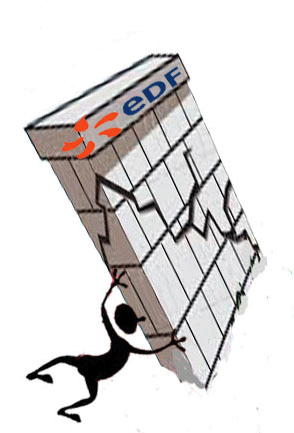
Macron government considering nationalising France’s debt-laden nuclear company EDF
 | |||
France looking to nationalise debt-laden power company EDF https://www.power-technology.com/news/france-power-company-edf/ 13 Mar 22
The French Government, which holds an 84% stake in the $30bn energy giant, could retain domestic business but review overseas operations. The Government of France is reportedly weighing options to nationalise multinational electric utility company Electricite de France (EDF), reported Bloomberg.
Citing people familiar with this, the report said that the French Government is considering the option to reorganise the debt-laden business with a focus on nuclear energy production.
French officials have been carrying out talks with advisers on the option to acquire all the stake from EDF’s small stakeholders and delist the company from the stock exchange, people aware of the development said.
The French Government, which owns 84% of EDF, could retain the ownership of the company’s domestic business but review EDF’s overseas operations, the sources added.
If the idea to nationalise EDF is approved, then the move is expected to take place after the French Presidential election, which is slated to take place later this year.
The Government of France is reportedly weighing options to nationalise multinational electric utility company Electricite de France (EDF), reported Bloomberg.
Citing people familiar with this, the report said that the French Government is considering the option to reorganise the debt-laden business with a focus on nuclear energy production.
French officials have been carrying out talks with advisers on the option to acquire all the stake from EDF’s small stakeholders and delist the company from the stock exchange, people aware of the development said.
The French Government, which owns 84% of EDF, could retain the ownership of the company’s domestic business but review EDF’s overseas operations, the sources added.
If the idea to nationalise EDF is approved, then the move is expected to take place after the French Presidential election, which is slated to take place later this year.
However, a spokesperson for the French finance ministry said that the information is ‘false’ and the government isn’t working on such a project.
Last month, French Government announced it will offer $2.4bn to support EDF, as the group sees a hit to profits due to outages at several of its nuclear plants and the impacts of a government power-price cap.
Hopes for Bradwell nuclear power station now fading away like the ebbing tide
Calm After the Storm https://www.banng.info/news/regional-life/calm-after-the-storm/ 3 March 2022
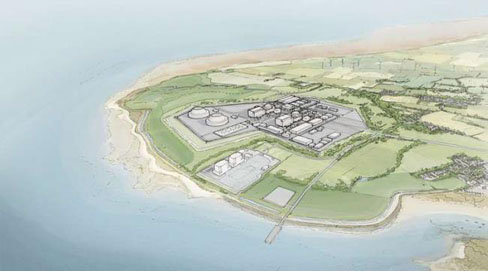
As we emerge from Covid a rather eerie silence descends over Bradwell B. After a tumultuous period of fighting the grotesque prospect of a colossal nuclear power station of Chinese design we are left wondering if the threat is ebbing away or will flow back like the returning tide.
Just two years ago and just before the first frightening lockdown, The Chinese operator launched its pre-Application proposals and the gross scale of the Bradwell B juggernaut was as unexpected as it was threatening. Despite lockdown the local reaction was immediate, widespread and determined. The proposals were summarily repelled and CGN declared a pause and retreated homeward to think again.
At least the China General Nuclear Power Corporation (CGN) has got part of what it came for. The regulators, Environment Agency and Office for Nuclear Regulation, have gifted approval for the Chinese Hualong One UK HPR1000 reactor design as ‘suitable for deployment in the UK’.
But, not necessarily at the Bradwell site. Although the ultimate prize for CGN is to build its reactors at Bradwell gaining the Generic Design Assessment (GDA) approval is not really much help. It doesn’t tackle the issues of cooling water, long-term storage of radioactive waste or the impacts of climate change in anything like the detail needed to gain approval for the Bradwell site. There are many obstacles that must be surmounted before permission to build can be granted.
Perhaps, as BANNG and other commentators have observed, CGN will have to be content with the consolation prize and seek its fortune elsewhere. That may not be in the UK since it is widely felt that the UK will prevent the Chinese state in the guise of CGN having a strategic role in developing sensitive UK infrastructure like a nuclear power station.
And so there is impasse. Opposed by the local Blackwater communities and shunned by the UK Government Bradwell B seems frozen in aspic. The best that may be said is that CGN may not walk away or be pushed immediately but the project is likely to languish in a state of indefinite inanition and will fade away like the ebbing tide.
Investors keen on renewable energy, while UK govt is trapping consumers into paying upfront for nuclear power plants to be built in a decade or more
Gordon Murray: LESLEY Riddoch’s article (The National, March 10)
is eminently sensible. The UK Government wants to build more large nuclear
plants such as Hinkley Point C. The problem for Boris is that investors are
not interested.
Centrica abandoned its plans to build new nuclear, Toshiba
exited the giant 3.3GW plant at Moorside, Cumbria and Hitachi scrapped the
£16 billion Wylfa plant on Anglesey. The current Hinkley development costs
are a whopping £23bn, almost double that projected in 2008 and set to rise
further.
The smart money is now with renewables where the returns are
higher, more immediate and less risky. Notwithstanding these setbacks, the
Conservative government, backed by Labour, is determined to plough on with
Sizewell C.
Their problem is who is going to fund it. The Government is not
keen to involve the Chinese who already get a return of 15% on their
investment at Hinckley Point C.
The Business Secretary Kwasi Kwarteng’s
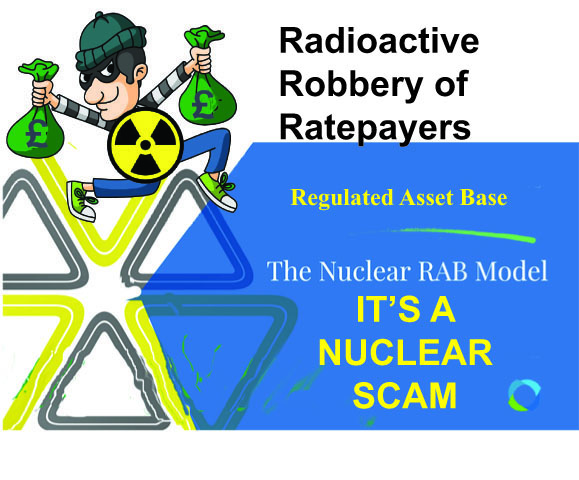
answer is the Regulated Asset Base (RAB) funding model whereby consumers,
that’s us, will pay the construction costs by increasing energy bills. It
is a fanciful type of nuclear subsidy where consumers pay for and
underwrite the construction costs for 10 years before a single watt of
power has been generated.
You have not misread this! The Government is set
to increase our energy bills even further at a time when gas/energy prices
are soaring, pushing even more people into fuel poverty. Perhaps their
spirits will be raised when they learn that RAB, according to Kwarteng,
will give private investors greater certainty through a lower and more
reliable rate of return.
An added bonus is that bill payers can expect
their bills to rise even further when the project is completed since we can
expect the energy strike price for nuclear to be twice that of renewable
– the cheapest form of electricity generation that is now subsidy
free-where consumers only start paying once they start to generate.
TheSmall Modular Reactor programme promises lower energy production costs but
there is no hard evidence to support this claim. What we will get for
certain is large numbers of these power plants spread all over the country
that will raise safety concerns over proliferation of nuclear materials and
terrorist attacks.
The National 12th March 2022
Chernobyl nuclear plant lacking external power supply
Ukraine’s state nuclear power regulator said on Friday the electricity
supply to the Chernobyl nuclear power station had not yet been restored,
despite Russia’s energy ministry saying it was restored by Belarusian
specialists on Thursday. Ukraine has warned of an increased risk of a
radiation leak if the high-voltage power line, damaged in fighting, is not
repaired to the plant, which is occupied by Russian forces.
Reuters 11th March 2022
UK’s Ministry of Defence called out for lobbying MPs on nuclear weapons
MoD under fire for lobbying MPs on nuclear weapons, The Ferret, Rob Edwards. March 13, 2022
The Ministry of Defence (MoD) is facing criticism for lobbying up to 27 Westminster politicians on the “benefits” of nuclear weapons for “UK industry, economy and the union”
Four lords and 23 MPs were invited to two briefings by senior MoD officials at the Faslane nuclear submarine base on the Clyde in 2021. According to the MoD, the aim was to “educate” them on the “continued relevance” of the Trident nuclear weapons system, and how replacing it was “value for money”.
According to experts, it is “highly unusual” for a government department to lobby politicians in this way. Campaigners questioned whether it was an “appropriate” use of public money and accused the MoD of acting as an “influencer” for nuclear vested interests………………………
One lobbying expert disputed the MoD’s suggestion it was not trying to influence politicians. “This is clearly a lobbying and influencing strategy, thinly disguised as a briefing to promote dialogue about defence policy,” said Dr Will Dinan, a senior lecturer in political communications at the University of Stirling.
“It is highly unusual for a government department to lobby UK politicians in this way. While the rationale offered is that these briefings are simply educational, it is clear that the overall strategic aim is to increase support among parliamentarians for maintaining nuclear capability.”
Dinan maintained that the nuclear briefings were “hardly neutral, informational or apolitical”. The need for nuclear weapons was “highly political” and MoD officials appeared to have “strayed some way from offering neutral and balanced advice to inform decision makers”, he said.
The Nuclear Information Service, which researches nuclear weapons, was also critical of the MoD. “These documents make it clear that the purpose of this exercise is to bolster support for the UK’s nuclear weapons programme,” said the group’s director, David Cullen.
“Lobbying in this fashion is not an appropriate use of public funds and diminishes the prospects for meaningful parliamentary oversight.”
The Scottish Campaign for Nuclear Disarmament pointed out that retired military commanders had spoken out against nuclear weapons. “The MoD is acting as an influencer for the nuclear-military-industrial complex with vested interests in them being constantly modernised and never given up,” said the campaign’s chair, Lynn Jamieson.
“If the MoD had a genuinely educational agenda it would include consideration of how to move towards signing the Treaty on the Prohibition of Nuclear Weapons. But then their job isn’t education, it’s defence and security — and Scottish CND’s view is that nuclear weapons put that at risk
The SNP MSP, Bill Kidd, is co-president of the international group of Parliamentarians for Nuclear Non-Proliferation and Disarmament. He pointed out that MSPs from the Scottish Parliament had not been invited to MoD nuclear briefings.
He said: “Will this be because we, at Holyrood, have voted time and again against the maintenance of these weapons of mass murder being stationed in our midst and looking for their removal? Or could it be that it’s Westminster that votes on the budget and long-term future of nuclear weapons and therefore it’s MPs who need to be influenced?”
Kidd also criticised the House of Commons and Lords for voting through upgrades and increases in nuclear warheads. This breached article six of the nuclear non-proliferation treaty committing countries to nuclear disarmament, he claimed…………….. https://theferret.scot/mod-lobbying-mps-nuclear-weapons/
Nuclear threat: Faslane, home to Trident, symbol of humanity’s power and folly
Nuclear weapons are often described as a deterrent. But do they really deter? That they have “kept the peace” is just a story, “a myth”, not backed by evidence of cause and effect, as New York Times writer Ward Wilson has put it. He observed, “We don’t accept proof by absence in any circumstance where there is real risk.”
Nuclear threat: Faslane, home to Trident, symbol of humanity’s power and folly, https://uk.sports.yahoo.com/news/nuclear-threat-faslane-home-trident-110835394.html?guccounter=1&guce_referrer=aHR0cHM6Ly9uZXdzLmdvb2dsZS5jb20v&guce_referrer_sig=AQAAAG3X514QPdgktFOrKbKPrnzoSz6joD3PVpI6uSj2DBv3oIZTOIzUDZWnifcsw_SXXPYtt3h1orA3QYlShoI_rlgBn5o675_PqDys5-xmgpGOEFmBJ1ooQWfTzK9RMofsPeZk-CfshnVXybppn5h7kGhpqKtNAaeAVwv0YCeavNKnVicky Allan
Sun, 13 March 2022, On the northern shore of Gare Loch, washed by salt waters that merge into the Firth of Clyde, is the naval base, Faslane, home to Vanguard-class submarines. The UK has four such Trident-carrying submarines, each armed with eight missiles, each of which carries three warheads. All together, currently, the UK holds a stockpile of 225 such warheads. This sea loch, and the wildlife it sustains, knows little of the destructive capacity contained within it.
Each warhead is said to be eight times as destructive as the bomb dropped on Hiroshima in 1945, which killed over 140,000 civilians. They are dark pearls of latent horror; symbols of humanity’s power and folly.
This stretch of shoreline has, for this reason, been one of the most controversial sites in Britain since the 1960s – first home to Polaris, more recently Trident. Concern over the threat of nuclear weaponry, has waxed and waned with the changes in global politics.
The SNP’s calls to scrap it were a key message of the Independence referendum, and one still repeated now. 2016 saw debate around whether the programme should be renewed at an enormous cost of £31 million for just the replacement submarines – CND estimated the overall cost would be more like £205 million. The House of Commons backed it, though only one Scottish MP voted in favour. Then, just last year, Boris Johnson announced a lift on the cap on the the number of Trident nuclear warheads it can stockpile by more than 40 percent by the middle of this decade. This ended thirty years of gradual disarmament.
UN Elder Mary Robinson’s view on this was clear, “While the UK cites increased security threats as justification for this move, the appropriate response to these challenges should be to work multilaterally to strengthen international arms control agreements and to reduce – not increase – the number of nuclear weapons in existence.”
We are now in another chilling moment. Vladimir Putin’s invasion of Ukraine, his threats of “consequences you have never seen”, have meant that the word nuclear is on our lips again. The threat, which not long ago had seemed half-forgotten, a childhood nightmare demoted down the current list of existential threats, was there again: “the nuclear option”. Might the Russian leader be mad and power-hungry enough to use it?
Ian Blackford recently confirmed the continuing support of SNP for getting rid of Trident, saying, “The idea that having nuclear weapons provides a deterrence that removes that threat is far-fetched, to say the least.”
Nuclear weapons are often described as a deterrent. But do they really deter? That they have “kept the peace” is just a story, “a myth”, not backed by evidence of cause and effect, as New York Times writer Ward Wilson has put it. He observed, “We don’t accept proof by absence in any circumstance where there is real risk.”
Above all Faslane is a reminder of the ridiculous nuclear arsenal the world has built. We may have already clambered down from the global peak stockpile of nuclear weapons which existed in 1986, but there is a long way to go. Approximately 13,080 nuclear warheads exist worldwide and almost 90 percent of them belong to two countries: the United States and Russia. There are more than enough, if such maths made any sense, to kill every human on the planet, one hundred times over.
That fact, and Putin’s terrifying recent posturings, should be a reminder that global nuclear disarmament must remain a key goal of our times.
Video analysis reveals Russian attack on Ukrainian nuclear plant veered near disaster.
NPR, March 11, 2022: Last week’s assault by Russian forces on the Zaporizhzhia Nuclear Power Plant was far more dangerous than initial assessments suggested, according to an analysis by NPR of video and photographs of the attack and its aftermath.
A thorough review of a four-hour, 21-minute security camera video of the attack reveals that Russian forces repeatedly fired heavy weapons in the direction of the plant’s massive reactor buildings, which housed dangerous nuclear fuel. Photos show that an administrative building directly in front of the reactor complex was shredded by Russian fire. And a video from inside the plant shows damage and a possible Russian shell that landed less than 250 feet from the Unit 2 reactor building.
The security camera footage also shows Russian troops haphazardly firing rocket-propelled grenades into the main administrative building at the plant and turning away Ukrainian firefighters even as a fire raged out of control in a nearby training building.
The evidence stands in stark contrast to early comments by the International Atomic Energy Agency (IAEA), which while acknowledging the seriousness of the assault, emphasized that the action took place away from the reactors. In a news conference immediately after the attack, IAEA Director-General Rafael Mariano Grossi made reference to only a single projectile hitting a training building adjacent to the reactor complex.
“All the safety systems of the six reactors at the plant were not affected at all,” Grossi told reporters at the March 4 briefing.
In fact, the training building took multiple strikes, and it was hardly the only part of the site to take fire from Russian forces. The security footage supports claims by Ukraine’s nuclear regulator of damage at three other locations: the Unit 1 reactor building, the transformer at the Unit 6 reactor and the spent fuel pad, which is used to store nuclear waste. It also shows ordnance striking a high-voltage line outside the plant. The IAEA says two such lines were damaged in the attack.
“This video is very disturbing,” says Edwin Lyman, director of nuclear power safety at the Union of Concerned Scientists. While the types of reactors used at the plant are far safer than the one that exploded
n Chernobyl in 1986, the Russian attack could have triggered a meltdown similar to the kind that struck Japan’s Fukushima Daiichi Nuclear Power Plant in 2011, he warns.”It’s completely insane to subject a nuclear plant to this kind of an assault,” Lyman says.
In a news conference on Thursday, Grossi said that he had met with Ukrainian and Russian officials but failed to reach an agreement to avoid future attacks on Ukraine’s other nuclear plants. “I’m aiming at having something relatively soon,” he told reporters in Vienna.
The assault
On March 3, the nuclear plant was preparing for a fight. A news release posted to its website just hours before the assault described the facility as operating normally, with its assigned Ukrainian military unit ready for combat.
The Russian decision to move on the plant was clearly premeditated, according to Leone Hadavi, an open-source analyst with the Centre for Information Resilience, who helped NPR review the video.”It was planned,” Hadavi says, and it involved around 10 armored vehicles as well as two tanks. That is far more firepower than would have been carried by, say, a reconnaissance mission that might have stumbled across the plant by chance.
Just before 11:30 p.m. local time, someone began livestreaming the plant’s security footage on its YouTube channel. The livestream rolled on as Russian forces began a slow and methodical advance on the plant. The column of armored vehicles, led by the tanks, used spotlights to cautiously approach the plant from the southeast along the main service road to the facility.
Around an hour and 20 minutes later, one of the two tanks that led the column was struck by a missile from Ukrainian forces and was disabled.
That marked the beginning of a fierce firefight that lasted for roughly two hours at the plant. Immediately after the tank was disabled, Russian forces returning fire appeared to hit a transmission line connected to the plant’s main electrical substation. The IAEA says two of four high-voltage lines were damaged in the attack. Lyman says that these lines are essential to safe operations at the plant……..
Based on photos and damage assessments by Ukrainian officials and the IAEA, Lyman says that the damage appears to have been to some of the less hardened points within the nuclear plant. Unlike office buildings and elevated walkways, the reactors themselves and their spent fuel are sealed within a thick steel containment vessel that would withstand a great deal of damage.
But he also says that the host of systems required to keep the reactors safe are not hardened against attack. Cooling systems rely on exterior pipework; backup generators are kept in relatively ordinary buildings; vital electrical yards are out in the open; and the plant’s control rooms are not designed to operate in a war zone……………. https://www.npr.org/2022/03/11/1085427380/ukraine-nuclear-power-plant-zaporizhzhia
IAEA doubts that the attack on Kharkiv Institute was a serious radiation hazard.
Russia has reportedly bombed a site in Ukraine which houses an
“experimental nuclear reactor”. The attack on the National Science Centre
Kharkiv Institute of Physics and Technology was reported in the early hours
of this morning. “
The State Inspectorate for Nuclear Regulation of Ukraine
announced that the facility was struck, damaging the exterior and possibly
numerous labs throughout the building,” reported the Kyiv Independent via
Twitter. The Kyiv Independent is an English language media outlet created
by journalists who say they were “fired from the Kyiv Post for defending
editorial independence”.
However, doubts have been expressed about the
amount of nuclear materials at the site. The International Atomic Energy
Agency IAEE has previously said the site’s “inventory of radioactive
material is very low” and kept at a “subcritical” state.
Lincolnshire Live 11th March 2022
UK love-in between Tories and Labour, on wasting billions of pounds on new nuclear reactors

Leslie Riddoch: THEY can melt down, contaminate a country and threaten air
and water resources across a continent. They are vulnerable to earthquake,
tsunami and war. Their energy is more expensive per unit than almost any
other kind.
Yet, listening to the love-in during Prime Ministers Questions,
it’s clear that nuclear energy is back and Johnson and Starmer are hooked
on the power of the atom to tackle the escalating energy crisis. Boris
Johnson blamed Labour for cancelling nuclear plants. Starmer
counter-claimed that Tory plants had more starts than a dodgy apprentice
(in so many words) but then listed nuclear in his own preferred energy mix.
Johnson pounced on this, proclaiming there is “more joy in heaven over
one sinner that repents” … no he couldn’t quite remember the whole
quote either. But his point was clear. Nuclear is supported by both main
Westminster parties and fresh billions will be wasted in a bid to build new
plants.
Even though no British money has gone into building nuclear power
plants for decades. Even though Hinkley C nuclear power station is a decade
late, wildly over-budget and won’t come into service till 2027 – if the
British Government finds new investors to “ease out” Chinese
state-backed group CGN.
Even though Sizewell C, if it’s ever built,
won’t produce electricity until the 2030s. Even though the average
nuclear plant can take 18 years in planning and construction, against a
tenth of that time for renewables.
And even though the unthinkable has
happened again – Chernobyl is at risk of meltdown because of a power cut.
Despite all this, Westminster hails nuclear energy as the green salvation
of the world as it struggles to make up for decades without an energy
policy or a care for this country’s energy security.
It’s the same old story. Any threat to the status quo justifies more investment in the status
quo.
But does Scotland need new nuclear? No, we emphatically do not. The
Forth/Tay offshore wind project alone significantly exceeds Scotland’s
entire electricity demand and if some of that energy can be converted into
use for transport, it could satisfy nearly all of Scotland’s entire
energy needs. And supply England. Even when Scotland becomes independent,
we will continue to green England with renewable energy at the best price
they’ll get anywhere.
With tidal and wave energy, heat pumps, local
community grids and district heating for home energy also in the mix,
Scotland should be laughing all the way to the Green Bank. The German
Institute for Economic Research examined 674 nuclear power plants built
across the world since 1951 and found the average plant made a loss of
€4.8 billion. Naomi Oreskes is professor of the history of science at
Harvard University and wrote recently in Scientific American: “The most
recent US nuclear power reactors were started in 2013 and are still not
finished.
What about small modular reactors (SMRs)? Rolls Royce says
smaller reactors can be constructed more cheaply, built in a factory,
transported in modules and fitted together “like meccano”. Neither
Johnson nor Starmer championed plans – also announced yesterday – for a
new Severn Tidal Barrage. Local councils are working together to get
electricity from the second biggest tidal range in the world which, if
successfully harnessed, could generate 7% of the UK’s total energy needs.
And yet, this is the 15th attempt in the past 200 years. What’s the
problem? According to Councillor Huw Thomas, the leader of Cardiff City
Council: “The UK Government has so far not lent its support … due to a
perceived requirement for high levels of public investment and concerns
over the environmental impact … in the Severn Estuary.”
The National 10th March 2022
https://www.thenational.scot/politics/19981712.nuclear-energy-wont-work-scotland/
Nuclear option is not the best for transition away from Russian fuels
Rae Street: What on earth does George Monbiot mean when he refers
to small modular reactors as “kinder nuclear technologies”? SMRs are
still vulnerable to accidents and attack (think of what happened in
Ukraine); they still produce more nuclear waste per unit of electricity
than conventional reactors; and there is still no safe, long-term solution
for radioactive waste. Additionally, these reactors will remain dependent
on uranium for fuel – when we know that uranium mining has caused
suffering and death to mainly indigenous people across the world.
Guardian 10th March 2022
Lies leave the Assange case exposed – this is a political persecution
Lies leave the Assange case exposed – this is a political persecution, https://www.counterfire.org/articles/opinion/22480-lies-leave-the-assange-case-exposed-this-is-a-political-persecution
John Rees on how a false testimony has further confirmed that the Assange case is a political attack against critical journalists
Watching the US government’s case against Julian Assange is like watching a levitation act at the music hall. You can see that the object floats, but you’ve no idea how. If normal gravitational laws applied, the Assange case would have crashed to the ground already.
After all, a leading prosecution witness has admitted lying in his evidence to the court and the defendant and his lawyers have been spied on by the intelligence agency of the government attempting to extradite him. In any other case, the mere facts of these revelations would be enough to halt court proceedings, but the detail makes the case for abandonment of the extradition even more compelling.
The most recent bombshell is that Sigurdur ‘Siggi’ Thordarson has admitted to Icelandic journalists at Stundin that he lied when he gave evidence alleging that Julian Assange had instructed him to hack US government accounts. Thordarson’s evidence is not marginal to the US case: it’s woven all through the prosecution’s argument, and it is specifically referred to by the judge in the Westminster Magistrates’ Court in those parts of her judgement which are hostile to Assange.
Indeed, when the Trump administration realised that their case was weak, they specifically sought out Thordarson in Iceland and reissued their charges against Assange so that it would be, they imagined, strengthened by his evidence. They should have known better.
To say that Thordarson is an unreliable witness is a very considerable understatement. His allegations had been reviewed by the Obama administration and found too problematic to be taken seriously. Trump’s administration re-animated Thordarson in an attempt to breathe life into their flagging case.
Thordason had been a volunteer for WikiLeaks, working to raise funds. He stole some $50,000 from WikiLeaks and he misrepresented himself to the outside world in order to embezzle money. He was also convicted of sexual abuse of children. On both counts, Julian Assange helped put him in jail. His motive for lying once again for the Trump administration is plain: revenge. And his false evidence is meant to bolster a central contention of the US case: that Julian Assange is a hacker, not a journalist.
Quite what has now convinced this serial liar to admit that he invented the material on which the US case so heavily relies we cannot know. But his decision to do so blows a hole through the centre of the case for extradition.
Thordarson admitted to the Stundin investigative team that Assange never asked him to hack anything. In fact, he now says that his previous claim that Assange had instructed or asked him to access computers is false.
Yet this is precisely the evidence on which the US prosecution relies. Indeed, it was so important to them that they tore up their original indictment of Assange on the very eve of the extradition hearing so that they could reissue a second indictment specifically including Thordarson’s evidence – evidence now admitted to be a total fiction.
At this point most cases which had been exposed as relying on perjured testimony would collapse. Not so the Assange case, which is now heading to the Appeal Court where the US will try to overturn the decision of the Magistrates’ Court at the start of this year, which found that the US prison system is so ‘oppressive’ that Assange would be a suicide risk were he committed to it.
It’s not even as if the Thordarson revelations are the first time that evidence has emerged which would normally halt court proceedings in their tracks. It is already a matter of record that Assange and his legal team were spied on by a Spanish security firm reporting to the CIA. The firm, UC Global, were employed by the Ecuadorean embassy to protect Assange when he was granted asylum. They were suborned by the CIA and then supplied them with both audio and video recordings of Assange and his legal team in the embassy. All this has been revealed in an ongoing court case in Spain.
Again, in any normal trial, the revelation that attorney-client privilege had been abused in this way would have been grounds for dismissal. But not in the Assange case. The court seems content to accept the US government’s argument that the CIA would respect departmental boundaries and never tell the Department of Justice any information obtained from the spying operation on Assange. This excuse beggars belief, since the exact function of the CIA is to tell the US government about the threats to national security, as they see it.
And there is the whole core of the problem: the US government under Trump allowed the fiction to develop that the fundamental business of investigative journalism is a threat to national security. Accordingly, Julian Assange became reclassified as a ‘cyber-terrorist’, not a journalist.
In pursuit of this dangerous fantasy, the US government is keeping a multiple award-winning journalist banged-up in a high security jail specifically used for terrorists, in spite of the Magistrates’ Court decision against them.
It’s time that both the US government and the British government brought this embarrassing farce to an end. Every major human rights organisation on the planet has said it is wrong. Journalists’ unions across the globe say its wrong. Parliamentarians in Italy are protesting in their legislature to says its wrong. German MPs are demanding Angela Merkel tells Joe Biden its wrong. Australian MPs are campaigning for Assange’s release in unprecedented numbers. British MPs have been protesting outside Belmarsh because they are not even being allowed a briefing with Assange.
As the Assange case goes to the High Court, we are reaching a critical moment. This is the crucial freedom of the press case of the twenty-first century. If it is lost, the shadow of authoritarian government will be cast longer and darker over the body politic. We should not allow that to happen.
Russia’s disinformation machine, (and Trump’s, in USA)

Russia’s Disinformation Machine Runs So Deep, Some Don’t Know War Is Happening, William Rivers Pitt, Truthout , March 7, 2022
Imagine that you, as a refugee from extreme violence in Ukraine, called your family across the border for help — and were flatly told they did not believe you, that there was no war. You’ve witnessed the indiscriminate shelling of your city, including your own apartment building. You have been hiding in a train station with a thousand others as the crash and smash of an artillery bombardment shakes the rubble from the cracked ceiling. You’ve seen dead people, soldiers and civilians, left in the street. If this is not real, “real” does not exist. How can your relatives in Russia not know this is happening?
The Washington Post explains:
As Ukrainians deal with the devastation of the Russian attacks in their homeland, many are also encountering a confounding and almost surreal backlash from family members in Russia, who refuse to believe that Russian soldiers could bomb innocent people, or even that a war is taking place at all.
These relatives have essentially bought into the official Kremlin position: that President Vladimir V. Putin’s army is conducting a limited “special military operation” with the honorable mission of “de-Nazifying” Ukraine. Mr. Putin has referred to the Ukrainian president, Volodymyr Zelensky, a native Russian speaker with a Jewish background, as a “drug-addled Nazi” in his attempts to justify the invasion.
Those narratives are emerging amid a wave of disinformation emanating from the Russian state as the Kremlin moves to clamp down on independent news reporting while shaping the messages most Russians are receiving.
It is estimated that there are approximately 11 million people in Russia with relatives in Ukraine. It would be an act of stupendous hubris for Russian President Vladimir Putin to believe he could keep so many in the dark about the reality of Ukraine, but this is exactly what he has endeavored to do. Most of what passed for an independent press in Russia has been swept away, and overwhelmingly, the information being provided comes from Russian state media. There is no war, they preach, no mass civilian displacement. This is a limited act of liberation to free Ukraine from Nazi control by way of precision strikes on military targets only, they say, with Russian soldiers bringing food and warm clothes to all affected civilians.
It is an absolute wonder, however thoroughly horrifying, that Putin is attempting to pull off a gaslighting of such magnitude. ………….
However, Russia’s disinformation campaign should not look entirely unfamiliar to us in the United States. Let us not forget that, not so long ago, we were led into a long and bloody war under the false pretenses of “weapons of mass destruction,” which reverberated across mainstream media. In certain media sectors, those official lies echo strongly to this day.
And then, there is the lie-based future Donald Trump and his allies have been striving to construct for the U.S. for the last seven years. Any story not in praise of Trumpism is immediately labeled false, backed by an anti-logic that mangles civic discourse beyond recognition. Even trying to deconstruct a Trumpist’s “fake news” charge is a victory for the one leveling it, because it means you have accepted the premise that it could be fake news, thus giving partisans just enough of a peg to hang their hat on.
With a tight enough media bubble, reinforced by the long-espoused idea that other viewpoints stem from evil sources and must be shunned as a moral imperative, a segment of any population can be manipulated and even controlled in ways that leave those outside looking in astonished and stunned. While Trump likely would not have been able to hide a whole war with a neighbor, he has painted a masterwork of disinformation about COVID-19, masks, vaccines and basic safety measures. Tens of millions have bought what he is peddling, to the ongoing detriment of the COVID fight, leaving the country badly fractured and unable to escape the gravity well of the pandemic.
Yet, we in the U.S. independent media know well that state attempts to manipulate public opinion cannot easily quell grassroots movements. Where there is war and repression, there is resistance, and the same is true in Russia in this moment. More than 13,000 antiwar protesters have been arrested in Russia, and still they come.
And resistance to the tyranny of the outside invaders is a touchstone of the Ukrainian ethos. They will not surrender it lightly.
Meanwhile, those of us in the United States, confronting Putin’s disinformation machine, must not assume that it can be torn down by sanctions, our own military and state mechanisms of information warfare. Rather, we must take note of the fact that if many thousands of Russians are protesting in the face of massive state repression, grassroots channels of information are being used and new ones created. We must work our hardest to amplify our own channels for truth, particularly those that lift up grassroots resistance movements. As Khury Petersen-Smith writes in Truthout, “Our challenge is to build protest across borders that stands in solidarity with those facing the violence of war, and is independent — and defiant of — the governments where we reside.” https://truthout.org/articles/russias-disinformation-machine-runs-so-deep-some-dont-know-war-is-happening/?eType=EmailBlastContent&eId=fcdefd4d-3561-4da4-9d86-8e4a6ec8a93a
Chernobyl’s radiation monitoring system has stopped sending readings to IAEA
Systems that broadcast radiation levels from Chernobyl stop sending
signals: Atomic energy chiefs issue warning over site seized by Russian
troops two weeks ago as Ukraine says staff trapped there need to be allowed
out. The International Atomic Energy Agency said the safeguards system shut
down. The safeguarding system keeps track of nuclear material and waste
products. But it the system today stopped sending readings to the UNs
nuclear watchdog. The IAEA also urged Russian forces to allow 210 staff
trapped at the site to leave.
Daily Mail 9th March 2022
1 This Month


of the week– Nuclear Reactor Information Task Force

14 May – online event From Bombs to Data Centres: the Face of Nuclear Colonialism
To see nuclear-related stories in greater depth and intensity – go to https://nuclearinformation.wordpress.com
-
Archives
- May 2026 (180)
- April 2026 (356)
- March 2026 (251)
- February 2026 (268)
- January 2026 (308)
- December 2025 (358)
- November 2025 (359)
- October 2025 (376)
- September 2025 (257)
- August 2025 (319)
- July 2025 (230)
- June 2025 (348)
-
Categories
- 1
- 1 NUCLEAR ISSUES
- business and costs
- climate change
- culture and arts
- ENERGY
- environment
- health
- history
- indigenous issues
- Legal
- marketing of nuclear
- media
- opposition to nuclear
- PERSONAL STORIES
- politics
- politics international
- Religion and ethics
- safety
- secrets,lies and civil liberties
- spinbuster
- technology
- Uranium
- wastes
- weapons and war
- Women
- 2 WORLD
- ACTION
- AFRICA
- Atrocities
- AUSTRALIA
- Christina's notes
- Christina's themes
- culture and arts
- Events
- Fuk 2022
- Fuk 2023
- Fukushima 2017
- Fukushima 2018
- fukushima 2019
- Fukushima 2020
- Fukushima 2021
- general
- global warming
- Humour (God we need it)
- Nuclear
- RARE EARTHS
- Reference
- resources – print
- Resources -audiovicual
- Weekly Newsletter
- World
- World Nuclear
- YouTube
-
RSS
Entries RSS
Comments RSS
 nuclear-news