UK’s energy security strategy delayed, as Cabinet split on nuclear power, and the Regulated Asset Base plan to pay for it.
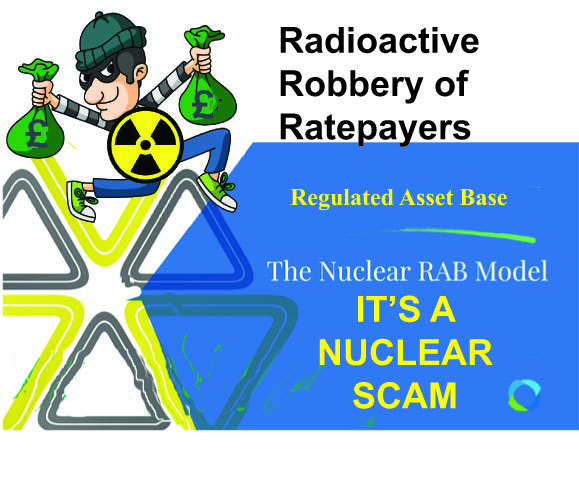
| Disagreements between Boris Johnson and Rishi Sunak over the cost of investment in new nuclear power stations have forced the government to again delay its energy security strategy. The prime minister promised to publish the strategy this month after Russia invaded Ukraine. Its publication has been repeatedly put back amid cabinet disagreements over fracking, onshore wind and the extent of government support for energy efficiency projects. Senior sources told The Times that while most issues had been settled, disagreements between No 10 and the Treasury over the extent to which new nuclear power should feature in the plan caused the latest delay. Last week Johnson told nuclear industry bosses that the government wanted the UK to get 25 per cent of its electricity from nuclear power, requiring up to six new large-scale stations. Sunak is understood to be concerned at the cost of such a commitment, arguing it represents poor value and would lead to substantial long-term increases in energy bills. He is thought to be pushing Johnson to limit the government’s commitment to two plants on top of one being built at Hinkley Point. The Treasury’s argument has been boosted by the National Infrastructure Commission that has warned large-scale nuclear power plants are “incredibly difficult to deliver on short timescales”. It has pointed out that even if the government gave the go-ahead for more nuclear power stations and they took as long as the Hinkley Point C project is expected to take, they would not come online until the mid-2040s. They have urged ministers to look at “alternatives” that are more likely to be deliverable at scale in the next 15 years. Ministers are legislating for a new model to fund nuclear power plants to make them attractive to investors. But critics say the regulated asset system would place the burden for delays and cost overruns on consumers and increase energy bills. Supporters of new nuclear power, including Johnson and Kwasi Kwarteng, the business secretary, argue that investing now is a “no regret” policy as demand for electricity is forecast to double in the transition to net zero. It is understood the strategy is now due next week. If that slips, the Easter recess and rules on what the government can say before the May elections could push it beyond the Queen’s Speech. Times 29th March 2022 https://www.thetimes.co.uk/article/cabinet-split-on-nuclear-power-delays-uk-energy-strategy-nmfznj377 |
UK’s Treasury and Chancellor of the Exchequer srongly resisting Boris Johnson’s push for costly nuclear power.
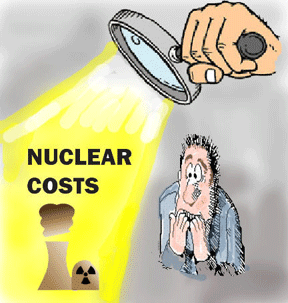
Boris Johnson and Rishi Sunak’s nuclear fallout sparks fresh delays to
UK energy security strategy. The Prime Minister is pushing for six to seven
new large nuclear power stations, but the Chancellor is concerned about the
massive cost. The proposals are being strongly resisted by the Treasury,
with the Chancellor concerned that the vast investment in nuclear would not
provide the taxpayer with value for money.
It has meant that the energy
package has been kicked further down the road, despite Mr Johnson having
previously pledged to publish the proposals at the start of the month. The
plans are also expected to include ways to produce more energy from
renewables, and increase North Sea oil and gas production. The Prime
Minister’s spokesman denied that they were being delayed because of a
disagreement, instead stating that it was “important we get these things
right”.
iNews 28th March 2022
Spending £4bn on a new nuclear station at Sizewell will not solve the government’s energy problems
Spending £4bn on a new nuclear station at Sizewell will not solve the government’s energy problems
Instead of sensible short-term measures to help those facing energy poverty, the government is focusing on a technology with a track record of failure Prospect Magazine
ByNick Butler March 30, 2022In the face of surging energy prices and the prospect of more problems as Europe turns off Russian gas supplies, the UK government is struggling to find a coherent energy policy. The latest move, a £4bn investment in the proposed new nuclear station at Sizewell, is both a mistake and an irrelevance. Private investors who are being asked to stump up the majority of the £20bn total cost should politely decline the offer
……………………………………………………………..There are no instant solutions but on and offshore wind and solar power could be increased relatively quickly at a reasonable cost. The government could also accelerate its investment in developing the crucial technology for energy storage. This would capture more of the power produced by every wind turbine and limit the need for back-up plants (usually requiring more gas) to deal with the times when the wind is not blowing. On top of this, direct support for simple measures to enable people to use energy more efficiently would limit demand and cut bills.
Instead of such sensible short-term measures, ministers have chosen to focus on a technology which has a track record of failure and which, even if it could be made to work, will take at least a decade to provide any new electricity supplies………….
Of all the available options, however, the choice of EDF’s European Pressurised Reactor (EPR) technology is the worst from any perspective.
In 2009, EDF promised investors and the government at the time that the EPR to be built at Hinkley would produce power at a cost of less than £50 per MWhr. By Christmas 2017, we were told Hinkley would be onstream and providing the power to cook our Christmas turkeys. We were the turkeys for believing such claims.
Hinkley is still being built and 2027 now looks like the earliest date for production to begin. In France, the comparable EPR development at Flamanville—which was due onstream in 2013—is still unfinished, having experienced a series of crucial technical problems. In both cases the costs have overrun the original budgets by many billions.
Hinkley, if it ever comes onstream, will charge consumers £92.50 per MWhr index linked from 2013 when the deal was agreed. While the costs of renewables such as offshore wind have fallen dramatically over the last decade, the costs of nuclear power from Hinkley have continued to rise. After almost a decade of inflation, that price has already risen to around £110. Who knows what it will be in 2027?………….. https://www.prospectmagazine.co.uk/science-and-technology/spending-4bn-on-a-new-nuclear-station-at-sizewell-will-not-solve-the-governments-energy-problems
EDF announces another delay and cost overruns to Hinkley Point C nuclear project
French energy giant EDF has revealed it will have to announce new delays
and cost overruns for its Hinkley Point C nuclear plant project in the UK.
The latest setback follows conflict in Ukraine, supply chain disruption and
inflationary pressures.
EDF last updated its construction schedule in
January 2021, when it said the UK’s first new nuclear plant to be built
in decades would be delayed by six months to June 2026. It revealed costs
would rise by an additional £500m to £23bn.
Originally, the plant was
expected to open in 2025 and had a construction budget of £18bn. However,
like similar nuclear new-build projects in Flamanville, France and
Olkiluoto, Finland, it has been subject to repeated delays and spiralling
costs. In a note to its 2021 annual report, EDF arued risks to schedule and
cost at completion targets had increased. The energy firm cited the ongoing
impact of the pandemic, Brexit, lower-than-expected civil performance and
tensions in global building materials markets.
22 Mar 22, https://www.cityam.com/edf-announces-another-delay-to-hinkley-point-c-nuclear-plant/
City AM 28th March 2022
Boris Johnson beholden to the nuclear industry. That’s going to cost UK bigtime – Chancellor Sunak not happy.
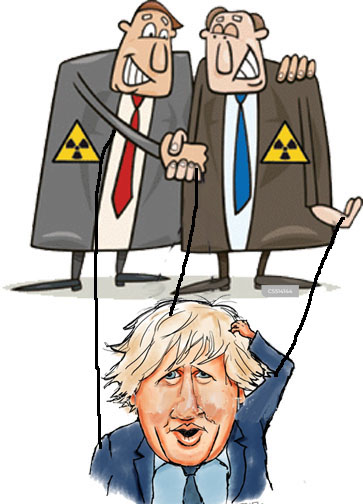
Boris Johnson’s flagship energy strategy has been held up over a row
with Rishi Sunak about funding a new generation of up to eight nuclear
power stations costing the public more than £13bn.
The strategy, which has
been delayed for a month, was due to be published this week but has now
been pencilled for 5 April after disagreement about the multibillion-pound
cost of new nuclear plants and amid ongoing tensions between the prime
minister and his chancellor, as well as the wider cabinet.
Johnson has told the nuclear industry that he wants 25% of electricity generation to come
from nuclear power by 2050, up from 16% now. Whitehall sources told the
Guardian this shift could require the building of about eight new nuclear
power stations. Draft targets suggest ministers are looking at 30GW of
nuclear power capacity, meaning a huge building programme would be needed,
as capacity is due to fall to 3.6GW as plants are decommissioned.
Of the eight UK plants currently in operation, all but one are due to be switched
off by 2030. Each new plant would require the government to take a minority
stake in the project to reduce the risk to developers, and substantial cash
outlay to encourage investment.
Despite Johnson’s keenness for new
nuclear power, Sunak is concerned about the cost to the taxpayer, or extra
costs added to soaring energy bills. The Treasury has already promised
£1.7bn of direct cash for a single large-scale nuclear project – the
£20bn Sizewell C – as well as £120m for a new Future Nuclear Enabling
Fund, which aims to address barriers to entering the sector.
Building eight plants could cost more than £13bn in initial investment costs from the
government if the same amount of investment were to be put in, according to
a Whitehall source. However, the government is also pushing for the nuclear
industry to reduce its build costs.
Guardian 28th March 2022
Nuclear catastrophe threatened, as fires sweep through forests towards Chernobyl site

Chernobyl radiation fears as 25-acre forest fire burns towards nuclear plant. Fears are growing of a nuclear disaster after Russian troops began shelling the Ukrainian town where staff working at the Chernobyl plant live.
Russian shelling has lead to wildfires breaking out across Chernobyl’s Exclusion Zone, it has been claimed. It is believed that 25acres of the forest surrounding the Chernobyl nuclear site – which is under
Russian control – are now ablaze.
Officials are concerned the fire couldsweep through the forest and tear through the power plant, leading to anuclear disaster and “irreparable consequences” for Ukraine and the “whole world”.
Mirror 27th March 2022
https://www.mirror.co.uk/news/world-news/breaking-chernobyl-radiation-fears-forest-2656779
What is the current nuclear arms pact between Russia and the US?
What is the current nuclear arms pact between Russia and the US? News Nation now, Sydney Kalich MAR 28, 2022
— In the aftermath of the Cold War, the U.S. and Russia had agreed to multiple non-nuclear proliferation agreements.
Out of eight nuclear arms control agreements between Russia and the U.S., only one is still in effect. That is the new Strategic Arms Reduction Treaty or “New START.”
The treaty limits nuclear warheads to 1,550 and limits the number of launchers and delivery systems. President Joe Biden and Russian President Vladimir Putin extended this deal in February of last year. It will be in effect until 2026.
But New START doesn’t cover the thousands of battlefield nuclear weapons. Those are less deadly nuclear weapons that could still kill thousands of people.
Notably, Ukraine actually had its own nuclear missiles until 1994 when the country agreed to give all its weapons to Russia in exchange for security assurances, which leaders say were violated by the 2014 invasion of Crimea.
This comes as top NATO leaders say any chemical attack by Russia on Ukraine would change the course of the war, but they are not saying whether NATO would take military action.
Russia and Ukraine are set to meet for peace talks Tuesday. Ukraine could declare neutrality and offer security guarantees to Russia to secure peace “without delay,” President Volodymyr Zelenskyy said ……. https://www.newsnationnow.com/morninginamerica/current-nuclear-arms-pact/
Stop Sizewell C campaigners query the government’s planning judgment , especially on costs

Stop Sizewell C campaigners yesterday questioned how the Government can
make an impartial planning judgement on the project if it is intending to
invest in it. The Planning Inspectorate’s report containing its
recommendation on the proposals is expected to be made public in late May.
Previous estimates have put the cost of Sizewell C at about £20bn – less
than the plant being built at Hinkley Point in Somerset – though the figure
could rise with global inflationary pressures.
East Anglian Daily Times 27th March 2022
https://www.eadt.co.uk/news/business/sizewell-c-government-to-take-stake-8785356
Hinkley Point C nuclear project faces mor.e delays, increased costs
 |
| Hinkley Point C faces more delays amid Ukraine crisis. Developer EDF warns war may trigger even higher costs for Britain’s flagship nuclear power station. The UK’s £23bn new flagship nuclear power plant is at risk of becoming more expensive and being plagued by delays as its developer EDF blamed challenges including the conflict in Ukraine. EDF is carrying out a “new comprehensive review” of the costs and timeframes of Hinkley Point C, which it is building in Somerset with updates expected in the summer. The majority French state-owned company had already raised cost estimates in 2017, 2019 and again in 2021 amid the pandemic, with the project currently set to cost between £22bn and £23bn and start generating power in mid-2026. It was originally forecast to cost £18bn. The developers have to foot the bill for cost overruns at the project, but it comes as EDF is in talks with the UK Government about building a second new power plant, Sizewell C in Suffolk, which could see households take on more risk for overruns. The Prime Minister is believed to want nuclear power to supply about a quarter of Britain’s electricity by 2050. That could imply about six large stations similar to Hinkley will be needed by 2050. In a sign of its commitment to the technology, the Government is planning to take a 20pc equity stake in the Sizewell C project. In documents filed with French financial authorities, EDF said of Hinkley Point C: “Due to the difficulties encountered by the project, notably on civil performance and marine works, and the increase in risks such as the Ukrainian conflict, Brexit, Covid, supply chain disruption and inflation, a new comprehensive review to update the costs and schedule estimates announced in January 2021 is underway and is expected to be finalised by summer 2022.” Telegraph 27th March 2022https://www.telegraph.co.uk/business/2022/03/27/hinkley-point-c-faces-fresh-cost-overrun-ukraine-crisis/ |
Forest fires erupt around Chernobyl nuclear plant 

Forest fires erupt around Chornobyl nuclear plant, https://www.ukrinform.net/rubric-ato/3441388-forest-fires-erupt-around-chornobyl-nuclear-plant.html Forest fires have broken out in the exclusion zone around the Chornobyl nuclear power plant because of combat actions. More than 10,000 hectares of forests are burning, which may cause increased levels of radioactive air pollution.
Ukrainian Parliament Commissioner for Human Rights Liudmyla Denisova wrote this on Facebook, Ukrinform reports.
Fire control and extinguishing is impossible due to the seizure of the exclusion zone by Russian troops, she wrote.
As a result of combustion, radionuclides are released into the atmosphere, which are transported by wind over long distances, which threatens radiation to Ukraine, Belarus and European countries. Due to windy and dry weather, the severity and area of fires will grow, which can lead to large-scale fires, which are difficult to deal with even in peacetime.
Denisova warned that the flames could engulf spent nuclear fuel storage facilities and nuclear waste storage facilities located in the Chornobyl zone.
She called on the International Atomic Energy Agency (IAEA) to “send experts and firefighting equipment to Ukraine as soon as possible to prevent irreparable consequences not only for Ukraine but for the whole world.”
“Catastrophic consequences can be prevented only by immediate de-occupation of the territory by Russian troops. Therefore, I call on international human rights organizations to take all possible measures to increase pressure on the Russian Federation to end military aggression against Ukraine and de-occupy high-risk areas,” she wrote.
Ukraine war – the Nazi factor
Make Nazism Great Again https://www.opednews.com/articles/Make-Nazism-Great-Again-by-Pepe-Escobar-Azov-Battalion_Nazis_War-In-Ukraine-220325-46.html
By Pepe Escobar , 25 Mar 22,
The supreme target is regime change in Russia, Ukraine is just a pawn in the game – or worse, mere cannon fodder.
All eyes are on Mariupol. As of Wednesday night, over 70% of residential areas were under control of Donetsk and Russian forces, while Russian Marines, Donetsk’s 107th batallion and Chechen Spetsnaz, led by the charismatic Adam Delimkhanov, had entered the Azov-Stal plant – the HQ of the neo-Nazi Azov batallion.
Azov was sent a last ultimatum: surrender until midnight – or else, as in a take no prisoners highway to hell.
That implies a major game-changer in the Ukrainian battlefield; Mariupol is finally about to be thoroughly denazified – as the Azov contingent long entrenched in the city and using civilians as human shields were their most hardened fighting force.
There’s no intention whatsoever in Washington to facilitate a peace plan in Ukraine – and that explains Comedian Zelensky’s non-stop stalling tactics. The supreme target is regime change in Russia, and for that Totalen Krieg against Russia and all things Russian is warranted. Ukraine is just a pawn in the game – or worse, mere cannon fodder.
This also means that the 14,000 deaths in Donbass for the past 8 years should be directly attributed to the Exceptionalists. As for Ukrainian neo-Nazis of all stripes, they are as expendable as “moderate rebels” in Syria, be they al-Qaeda or Daesh-linked. Those that may eventually survive can always join the budding CIA-sponsored Neo-Nazi Inc. – the tawdry remix of the 1980s Jihad Inc. in Afghanistan. They will be properly “Kalibrated” city and using civilians as human shields were their most hardened fighting force.
A quick neo-Nazi recap
By now only the brain dead across NATOstan – and there are hordes – are not aware of Maidan in 2014. Yet few know that it was then Ukrainian Minister of Interior Arsen Avakov, a former governor of Kharkov, who gave the green light for a 12,000 paramilitary outfit to materialize out of Sect 82 soccer hooligans who supported Dynamo Kiev. That was the birth of the Azov batallion, in May 2014, led by Andriy Biletsky, a.k.a. the White Fuhrer, and former leader of the neo-nazi gang Patriots of Ukraine.
Together with NATO stay-behind agent Dmitro Yarosh, Biletsky founded Pravy Sektor, financed by Ukrainian mafia godfather and Jewish billionaire Ihor Kolomoysky (later the benefactor of the meta-conversion of Zelensky from mediocre comedian to mediocre President.)
Pravy Sektor happened to be rabidly anti-EU – tell that to Ursula von der Lugen – and politically obsessed with linking Central Europe and the Baltics in a new, tawdry Intermarium. Crucially, Pravy Sektor and other nazi gangs were duly trained by NATO instructors.Biletsky and Yarosh are of course disciples of notorious WWII-era Nazi collaborator Stepan Bandera, for whom pure Ukrainians are proto-Germanic or Scandinavian, and Slavs are untermenschen.
Azov ended up absorbing nearly all neo-Nazi groups in Ukraine and were dispatched to fight against Donbass – with their acolytes making more money than regular soldiers. Biletsky and another neo-Nazi leader, Oleh Petrenko, were elected to the Rada. The White Fuhrer stood on his own. Petrenko decided to support then President Poroshenko. Soon the Azov battalion was incorporated as the Azov Regiment to the Ukrainian National Guard.
They went on a foreign mercenary recruiting drive – with people coming from Western Europe, Scandinavia and even South America.
That was strictly forbidden by the Minsk Agreements guaranteed by France and Germany (and now de facto defunct). Azov set up training camps for teenagers and soon reached 10,000 members. Erik “Blackwater” Prince, in 2020, struck a deal with the Ukrainian military that would enable his renamed outfit, Academi, to supervise Azov.
It was none other than sinister Maidan cookie distributor Vicky “F**k the EU” Nuland who suggested to Zelensky – both of them, by the way, Ukrainian Jews – to appoint avowed Nazi Yarosh as an adviser to the Commander-in-Chief of the Ukrainian Armed Forces, Gen Valerii Zaluzhnyi. The target: organize a blitzkrieg on Donbass and Crimea – the same blitzkrieg that SVR, Russian foreign intel, concluded would be launched on February 22, thus propelling the launch of Operation Z.
All of the above, in fact just a quick recap, shows that in Ukraine there’s no difference whatsoever between white neo-Nazis and brown-colored al-Qaeda/ISIS/Daesh, as much as neo-Nazis are just as “Christian” as takfiri Salafi-jihadis are “Muslim”.
When Putin denounced a “bunch of neo-Nazis” in power in Kiev, the Comedian replied that it was impossible because he was Jewish. Nonsense. Zelensky and his patron Kolomoysky, for all practical purposes, are Zio-Nazis.
Even as branches of the United States government admitted to neo-Nazis entrenched in the Kiev apparatus, the Exceptionalist machine made the daily shelling of Donbass for 8 years simply disappear. These thousands of civilian victims never existed.
U.S. mainstream media even ventured the odd piece or report on Azov and Aidar neo-Nazis. But then a neo-Orwellian narrative was set in stone: there are no Nazis in Ukraine. CIA offshoot NED even started deleting records about training members of Aidar. Recently a crappy news network duly promoted a video of a NATO-trained and weaponized Azov commander – complete with Nazi iconography.
Why “denazification” makes sense
The Banderastan ideology harks back to when this part of Ukraine was in fact controlled by the Austro-Hungarian empire, the Russian empire and Poland. Stepan Bandera was born in Austro-Hungary in 1909, near Ivano-Frankovsk, in the – then autonomous – Kingdom of Galicia.
WWI dismembered European empires into frequently non-viable small entities. In western Ukraine – an imperial intersection – that inevitably led to the proliferation of extremely intolerant ideologies.
Banderastan ideologues profited from the Nazi arrival in 1941 to try to proclaim an independent territory. But Berlin not only blocked it but sent them to concentration camps. In 1944 though the Nazis changed tactics: they liberated the Banderanistas and manipulated them into anti-Russian hate, thus creating a destabilization force in the Ukrainian USSR.
So Nazism is not exactly the same as Banderastan fanatics: they are in fact competing ideologies. What happened since Maidan is that the CIA kept a laser focus on inciting Russian hatred by whatever fringe groups it could instrumentalize. So Ukraine is not a case of
“white nationalism” – to put it mildly – but of anti-Russian Ukrainian nationalism, for all practical purposes manifested via Nazi-style salutes and Nazi-style symbols.
So when Putin and the Russian leadership refer to Ukrainian Nazism, that may not be 100% correct, conceptually, but it strikes a chord with every Russian.
Russians viscerally reject Nazism – considering that virtually every Russian family has at least one ancestor killed during the Great Patriotic War. From the perspective of wartime psychology, it makes total sense to talk of “Ukro-nazism” or, straight to the point, a “denazification” campaign.
How the Anglos loved the Nazis
The United States government openly cheerleading neo-Nazis in Ukraine is hardly a novelty, considering how it supported Hitler alongside England in 1933 for balance of power reasons.
In 1933, Roosevelt lent Hitler one billion gold dollars while England lent him two billion gold dollars. That should be multiplied 200 times to arrive at today’s fiat dollars. The Anglo-Americans wanted to build up Germany as a bulwark against Russia. In 1941 Roosevelt wrote to Hitler that if he invaded Russia the U.S. would side with Russia, and wrote Stalin that if Stalin invaded Germany the U.S. would back Germany. Talk about a graphic illustration of Mackinderesque balance of power.
The Brits had become very concerned with the rise of Russian power under Stalin while observing that Germany was on its knees with 50% unemployment in 1933, if one counted unregistered itinerant Germans.
Even Lloyd George had misgivings about the Versailles Treaty, unbearably weakening Germany after its surrender in WWI. The purpose of WWI, in Lloyd George’s worldview, was to destroy Russia and Germany together. Germany was threatening England with the Kaiser building a fleet to take over the oceans, while the Tsar was too close to India for comfort. For a while Britannia won – and continued to rule the waves.
Then building up Germany to fight Russia became the number one priority – complete with rewriting of History. The uniting of Austrian Germans and Sudetenland Germans with Germany, for instance, was totally approved by the Brits.
But then came the Polish problem. When Germany invaded Poland, France and Britain stood on the sidelines. That placed Germany on the border of Russia, and Germany and Russia divided up Poland. That’s exactly what Britain and France wanted. Britain and France had promised Poland that they would invade Germany from the west while Poland fought Germany from the east.
In the end, the Poles were double-crossed. Churchill even praised Russia for invading Poland. Hitler was advised by MI6 that England and France would not invade Poland – as part of their plan for a German-Russian war. Hitler had been supported financially since the 1920s by MI6 for his favorable words about England in Mein Kampf. MI6 de facto encouraged Hitler to invade Russia.
Fast forward to 2022, and here we go again – as farce, with the Anglo-Americans “encouraging” Germany under feeble Scholz to put itself back together militarily, with 100 billion euros (that the Germans don’t have), and setting up in thesis a revamped European force to later go to war against Russia.
Cue to the Russophobic hysteria in Anglo-American media about the Russia-China strategic partnership. The mortal Anglo-American fear is Mackinder/Mahan/Spykman/Kissinger/Brzezinski all rolled into one: Russia-China as peer competitor twins take over the Eurasian land mass – the Belt and Road Initiative meets the Greater Eurasia Partnership – and thus rule the planet, with the U.S. relegated to inconsequential island status, as much as the previous “Rule Britannia”.
England, France and later the Americans had prevented it when Germany aspired to do the same, controlling Eurasia side by side with Japan, from the English Channel to the Pacific. Now it’s a completely different ball game.
So Ukraine, with its pathetic neo-Nazi gangs, is just an – expendable – pawn in the desperate drive to stop something that is beyond anathema, from Washington’s perspective: a totally peaceful German-Russian-Chinese New Silk Road.
Russophobia, massively imprinted in the West’s DNA, never really went away. Cultivated by the Brits since Catherine the Great – and then with The Great Game. By the French since Napoleon. By the Germans because the Red Army liberated Berlin. By the Americans because Stalin forced to them the mapping of Europe – and then it went on and on and on throughout the Cold War.
We are at just the early stages of the final push by the dying Empire to attempt arresting the flow of History. They are being outsmarted, they are already outgunned by the top military power in the world, and they will be checkmated. Existentially, they are not equipped to kill the Bear – and that hurts. Cosmically.
What is the risk of a nuclear accident in Ukraine?
What is the risk of a nuclear accident in Ukraine? A radiation expert
speaks from Kyiv. Vadim Chumak monitored radiation after Chernobyl. He
explains what could go wrong now, and says he’s “old enough to
sacrifice” his life.
Of particular worry is that if a nuclear catastrophe
strikes, scientists might not be able to monitor it or measure its impacts,
says Chumak, who works on ways to monitor radiation exposure and played a
key role in dose assessment following the Chernobyl disaster, when a
nuclear reactor at the site exploded in 1986. Today, he remains close
enough to Kyiv to help should a nuclear disaster result from Russia’s
invasion.
MIT Technology Review 25th March 2022
U.S. Peace Council Statement on Russia’s Military Intervention in Ukraine

U.S. Peace Council Statement on Russia’s Military Intervention in Ukraine
The US with its NATO allies have not only provoked this tragedy but have sought to prolong it in their refusal to engage in negotiations for a ceasefire, Portside, March 26, 2022, U.S.PEACE COUNCIL
What we all hoped would not happen has happened. The Russian Federation sent troops into Ukraine on February 24 in response to decades of relentless US-led NATO provocation. The present situation puts many serious, fundamental questions before the global peace movement.
A fierce propaganda campaign, long simmering with Russiagate and the onset of a new Cold War, demonizing the Russian president and state has intensified. Wholesale condemnation of Russia has assumed global proportions, instigated by the US and allies, and supported by their sycophantic media. Alternative views and voices of opposition to the official anti-Russian narrative have been suppressed or shut down.
Not surprisingly, many people subjected to this toxic bombardment of massive imperialist propaganda have placed all the blame on Russian aggression. Various reasons are given to justify their, in our view dangerous, position. Let us look at some of these justifications and assess the degree of their moral, legal, and political validity.
Applying the UN Charter
The first and most morally justifiable reason given is the argument that Russia’s invasion of Ukraine is in violation of the Charter of the United Nations. Based on this fundamental principle, shouldn’t the U.S. Peace Council, a staunch supporter and advocate of the Charter, also condemn Russia as a violator?
Let us look at the UN Charter to see whether we can firmly decide that Russia is in violation:
Article 2
3. All Members shall settle their international disputes by peaceful means in such a manner that international peace and security, and justice, are not endangered.
4. All Members shall refrain in their international relations from the threat or use of force against the territorial integrity or political independence of any state, or in any other manner inconsistent with the Purposes of the United Nations.
Article 51
Nothing in the present Charter shall impair the inherent right of individual or collective self-defense if an armed attack occurs against a Member of the United Nations….
Looking at Article 2, especially paragraph 4, it can be argued that Russia is in violation. But based on Article 51, the Russian Federation has invoked its right to self-defense and has duly informed the Security Council. Russia presents important arguments in favor of its use of force under Article 51.
The Ukraine government has acted as the US and NATO’s proxy in hostilely encircling the Russian Federation. Ukraine military and paramilitaries have attacked Donetsk and Lugansk since 2014, resulting in the deaths of some 14,000 of their own people, many of whom were Russian speakers and some Russian citizens. Most recently, Russia discovered an imminent Ukrainian government plan for a large-scale invasion of the Donetsk and Lugansk that border Russia. Russia now recognizes these two republics as independent states, after they asked Russia to aid in their defense.
Russia clearly asked for security guarantees from the US and NATO, which refused to adequately respond to Russia’s concerns. Ukraine was planning to host US/NATO nuclear weapons on its territory that could reach Moscow in a matter of five minutes. This took place in the alarming context of the US decision in 2019 to withdraw from the Intermediate-Range Nuclear Forces (INF) Treaty with Russia.
If this is not an act of war against Russia, what is it? Aren’t those who are complicit in an act of murder equally guilty of murder? This is not to say that Russia was right in its decision. Rather we are insisting that the UN Charter should be applied to Ukraine on the basis of facts, as a specific case with a given historical background.
Second, the United Nations itself has been unsuccessful in upholding its own Charter in the face of blatant violations by the NATO states. Here, our intention is not to justify the Russian action, but to provide a realistic context for the need to uphold the UN Charter.
Since the end of the Soviet Union, when the US became the sole superpower, Washington has blatantly ignored the UN Charter in its drive to impose global “full spectrum” dominance. We should understand NATO as more than just an “alliance” of nominally sovereign states, but as an imperial military integrated under US command.
Let us look at two of the relevant articles of the UN Charter that have been trampled upon by the imperialist powers since the end of the century:
Article 6.
A Member of the United Nations which has persistently violated the Principles contained in the present Charter may be expelled from the Organization by the General Assembly upon the recommendation of the Security Council.
Article 25.
The Members of the United Nations agree to accept and carry out the decisions of the Security Council in accordance with the present Charter.
US, NATO, and their allies have increasingly violated these and other articles of the UN Charter over the past two decades. Here are just a few examples:
— In 1999 for 78 days, NATO attacked, dropped 28,000 bombs, and shattered Yugoslavia into pieces without the consent of the United Nations.
— In 2001, as a response to the 9/11 attack, US declared an indefinite “war on terror,” affecting at least 60 countries, including seven targeted for illegal regime change.
— In 2003, US and the members of its “coalition of the willing” illegally attacked and invaded Iraq in defiance of the UN Security Council.
— In 2011 US, UK, and France unilaterally and without the consent of the UN Security Council attacked Libya and killed its leader, Moammar Qaddafi.
— Starting in 2011, US, NATO, and regional allies started a proxy war in Syria by arming and funding terrorist groups, a war which is still taking innocent lives.
— In 2014, the US staged a coup with the help of neo-Nazi forces in Ukraine and established a pro-NATO government, which led to the massacre of Russian-speakers in eastern Ukraine.
— Throughout this period, the US and its European allies have imposed illegal unilateral economic sanctions on more than 40 countries of the world, causing the death of hundreds of thousands of innocent people.
— And, of course, one should mention the illegal occupation and annexation of Syrian and Palestinian territories by Israel with full support of the United States.
The crisis facing us in Ukraine today is a result of the UN’s inability to uphold its charter against such illegal actions by the sole superpower and its NATO allies, which has enabled US/NATO to push Russia and other targeted nations of the world into such an impossible situation.
Yes, we should defend the UN Charter, but not selectively as imperialism hypocritically wants us to. We should not allow ourselves to be duped by imperialism’s “blame the victim” narrative when the victim is forced to defend itself.
Inter-Imperialist War………..
False Equivalency of US/NATO and Russian Roles
As a peace organization, we cannot principally agree with the escalation of the Ukraine conflict to the level of military confrontation. However, we oppose the one-sided position of condemning Russia alone………………..
NATO’s success in its effort to expand to the Ukraine-Russia border would create a hellish world and lead to the possibility of a nuclear war. Let us not forget that the story would not end there, and Belarus could be the next target. So, it is imperative for the peace movement to do everything we can to guarantee Ukraine’s neutrality and US/NATO’s recognition of it.
U.S. Peace Council Assessment
The US with its NATO allies have not only provoked this tragedy but have sought to prolong it in their refusal to engage in negotiations for a ceasefire. While no one wins in a war, the US has had the most to gain: further unifying NATO under US domination, reducing Russian economic competition in the European energy market, justifying increasing the US war budget, and facilitating sales of war materiel to NATO vassals. A Europe further divided between the EU/UK and Russia benefits none but the imperial US.
On the basis of this assessment of the present situation in Ukraine, the U.S. Peace Council raises the following immediate demands, in order of priority and urgency:
1. Immediate ceasefire and dispatch of humanitarian aid to Ukraine, including the self-proclaimed independent republics.
2. Recognition of the neutrality of Ukraine.
3. Withdrawal of foreign militaries, weapons, and equipment – including mercenaries – from Ukraine.
4. Resumption of negotiations for a permanent settlement of internal conflicts in Ukraine with the participation of all parties concerned.
U.S. Peace Council
March 24, 2022 https://portside.org/2022-03-26/us-peace-council-statement-russias-military-intervention-ukraine
France’s nuclear energy output continues to slump

Falling nuclear output in France has spurred gas demand in the country and
is hampering EU moves to cut dependence on Russian supplies, according to
some analysts. “The underperformance of French nuclear power in the
Ukraine crisis is completely underestimated. The orders of magnitude are
dizzying” one analyst, who wished to remain anonymous, told Montel.
France, with 56 reactors – the world’s second-biggest nuclear
production capacity – has long been viewed as Europe’s powerhouse,
exporting output across the bloc. Now, that picture has changed with the
country’s nuclear availability plunging in recent months to its lowest
level in over 30 years.
Since 2015 France’s annual nuclear output has
slumped by around 100 TWh, TSO figures showed. In 2015, French reactors
generated 417 TWh. This year atomic output is forecast to drop to 295-330
TWh.
Montel 25th March 2022
https://www.montelnews.com/news/1308826/french-nuclear-slump-hinders-russian-gas-exit–analysts
Boris Johnson’s enthusiasm for UK nuclear power should raise huge red flags for Scotland
Boris Johnson’s enthusiasm for UK nuclear power should raise huge red flags for Scotland, BY DOUGLAS CHAPMAN, 27th March ONLY last week we had the UK Government Energy Minister Greg Hands use the suffering of the Ukrainian people to encourage the Scottish Government to reconsider their opposition to nuclear power as a way of bolstering our UK energy security.
Hands must have missed the memo entitled “Scotland Has Options” detailing the far safer and cheaper alternatives than nuclear power that we have. We are not dependent on Russian gas because we are already self-sufficient in domestic gas. In fact, we supply the rest of the UK with gas from the North Sea. Then there’s the not so small matter of the pillaging of oil and the vast profits that we have lost as Scots thanks to Tory policy. And now, as we accelerate the transition away from fossil fuels, we also produce almost 100% of our own electricity from renewables…. (subscribers only) https://www.thenational.scot/politics/20023807.boris-johnsons-enthusiasm-uk-nuclear-power-raise-huge-red-flags-scotland/
1 This Month

of the week– Nuclear Reactor Information Task Force

14 May – online event From Bombs to Data Centres: the Face of Nuclear Colonialism
To see nuclear-related stories in greater depth and intensity – go to https://nuclearinformation.wordpress.com
-
Archives
- May 2026 (180)
- April 2026 (356)
- March 2026 (251)
- February 2026 (268)
- January 2026 (308)
- December 2025 (358)
- November 2025 (359)
- October 2025 (376)
- September 2025 (257)
- August 2025 (319)
- July 2025 (230)
- June 2025 (348)
-
Categories
- 1
- 1 NUCLEAR ISSUES
- business and costs
- climate change
- culture and arts
- ENERGY
- environment
- health
- history
- indigenous issues
- Legal
- marketing of nuclear
- media
- opposition to nuclear
- PERSONAL STORIES
- politics
- politics international
- Religion and ethics
- safety
- secrets,lies and civil liberties
- spinbuster
- technology
- Uranium
- wastes
- weapons and war
- Women
- 2 WORLD
- ACTION
- AFRICA
- Atrocities
- AUSTRALIA
- Christina's notes
- Christina's themes
- culture and arts
- Events
- Fuk 2022
- Fuk 2023
- Fukushima 2017
- Fukushima 2018
- fukushima 2019
- Fukushima 2020
- Fukushima 2021
- general
- global warming
- Humour (God we need it)
- Nuclear
- RARE EARTHS
- Reference
- resources – print
- Resources -audiovicual
- Weekly Newsletter
- World
- World Nuclear
- YouTube
-
RSS
Entries RSS
Comments RSS
 nuclear-news