Canada keeps bankrolling Ukraine’s war crimes
The new prime minister, just like the old one, is handing Kiev the cash much needed at home
Eva Karene Bartlett, September 22, 2025, https://evakarenebartlett.substack.com/p/canada-keeps-bankrolling-ukraines?utm_source=post-email-title&publication_id=3046064&post_id=174317268&utm_campaign=email-post-title&isFreemail=true&r=1ise1&triedRedirect=true&utm_medium=email
Following in the shameful footsteps of both Justin Trudeau and Chrystia Freeland, Canadian Prime Minister Mark Carney continues pledging support and money (which Canadians desperately need) to Ukraine, to prolong the proxy war against Russia.
Carney chose Ukrainian Independence Day to voice the Canadian government’s continued pledge to support Ukraine. As he landed in Kiev on August 24, Carney posted on X, “On this Ukrainian Independence Day, and at this critical moment in their nation’s history, Canada is stepping up our support and our efforts towards a just and lasting peace for Ukraine.”
Later in the day he posted, “After three years at war, Ukrainians urgently need more military equipment. Canada is answering that call, providing $2 billion for drones, armoured vehicles, and other critical resources.” This latest pledge brings Canada’s expenditure on Ukraine since February 2022 to nearly $22 billion.
Further, he pledged to potentially send Canadian or allied soldiers, stating, “I would not exclude the presence of troops.”
Pause for a moment to examine the utter lack of logic behind these statements: For “peace” for Ukraine, Canada will support further war to ensure more Ukrainian men are ripped off the streets and forced to the front lines, where they will inevitably die in a battle they didn’t sign up for.
Like his European counterparts, Carney’s insistence on prolonging the war is in contrast to Russia’s position of finding a resolution.
I recently spoke with former Ambassador Charles Freeman, an American career diplomat for 30 years. Speaking of how the Trump administration, “began in office by perpetuating the blindness and deafness of the Biden administration to what the Russian side in this conflict has said from the very beginning,” he outlined the terms that Russia made clear in December 2021, “and from which it has basically not wavered.”
These include: “neutrality and no NATO membership for Ukraine; protections for the Russian speaking minorities in the former territories of Ukraine; and some broader discussion of European security architecture that reassures Russia that it will not be attacked by the West, and the West that it will not be attacked by Russia.”
It’s worth keeping in mind that Canada has been one of the main belligerents in Ukraine, funding and training Ukrainian troops for many years before the 2022 start of Russia’s military operation.
Canada’s training of Ukrainian troops included members of the notorious neo-Nazi terrorists of the Azov regiment. Former Deputy Prime Minister Chrystia Freeland proudly waved a Banderite flag in 2022. She was also proud of her dear grandfather, who was a chief Nazi propagandist.
In 2023, the Trudeau administration brought to speak in the Canadian parliament a Ukrainian Nazi, Yaroslav Hunka, who had been a voluntary member of the 1st Galician Division of the Waffen SS – well known for their mass slaughter of civilians.
Carney, in light of this, is merely keeping with the tradition of Ottawa’s support of extremism – including Nazism – in Ukraine (and in Canada). This support is not at all about protecting Ukrainian civilians.
Supporting Ukrainian war crimes
Canada’s continued support to Ukraine makes it complicit in the atrocities Ukraine commits. I myself have documented just some of Ukrainian war crimes in the Donbass, in 2019 and heavily throughout 2022.
These include deliberately shelling civilian areas (including with heavy-duty NATO weapons), slaughtering civilians in their homes, in markets, in the streets, in buses; peppering Donbass civilian areas with internationally prohibited PFM-1 “Petal” mines (since 2022, 184 civilians have been maimed by these, three of whom died of their injuries); and deliberately targeting medics and other emergency service rescuers.
Ukraine has also heavily shelled Belgorod and Kursk, targeting civilians, as well sending drones into Russian cities, killing civilians and destroying infrastructure.
Less detailed are Ukraine’s crimes against civilians in areas under Ukrainian control. These crimes – including rape, torture and point-blank assassination – come to light with the testimonies of terrorized civilians in regions liberated by Russia.Bring the government spending home
The social media fervor of Ukrainian hashtags and flags has died down considerably since 2022. Now, you see more and more Canadians demanding their government stop fueling war and start spending money to take care of Canadians.
Carney’s campaign pledges included easing the cost of living in Canada, yet he has taken no concrete actions to do so. In the many understandably angry replies to Carney’s latest tweets about supporting Ukraine, Canadians are demanding accountability.
“Mark Carney stop pretending you’re fighting for “freedom and sovereignty.” You just signed off on $2 BILLION of Canadian money for Ukraine while Canadians can’t even afford rent, food, or heating,” reads one of numerous such replies. “Veterans are abandoned, fentanyl floods our streets, and families collapse under inflation. You stand on foreign soil preaching about democracy while selling out the very people you’re supposed to serve. That’s not leadership that’s betrayal. Canadians never voted for this. You don’t speak for us.”
Scroll through replies to Carney’s Kiev stunt and you’ll find Canadians opposed to the wasting of still more money needed in their home country.
The most glaring hypocrisy is that while Carney wrings his hands over Ukraine, he utterly ignores the ongoing Israeli starvation and genocide of Palestinians in Gaza, supported by the Canadian government.
Three dead after Ukraine bombs Crimea wellness resort – governor
21 Sept 25, https://www.rt.com/russia/625020-15-injured-crimea-ukraine-attack/
Sixteen people have also been injured in the strike, the Russian Defense Ministry has said.
At least three people were killed and sixteen injured by a Ukrainian drone strike on a wellness complex in Crimea on Sunday, the Russian Defense Ministry has said. A school building was also damaged, according to Crimean regional head Sergey Aksyonov.
The Russian Defense Ministry ministry stated that the attack targeted a “resort area of the Republic of Crimea, where there are no military facilities.”
Aksyonov said emergency services were working at the site and urged residents to “remain calm and trust only official information.”
The drone strike led to a fire at a school in the town of Foros, where the sanatorium is located, according to the regional arm of the Russian emergencies ministry. The 80 square meter fire has now been extinguished, it said.
In the peninsula’s largest city, Sevastopol, regional head Mikhail Razvozhaev reported that the Russian Black Sea fleet and air defenses are defending against a Ukrainian drone attack near the city.
“3 drones have been shot down so far,” he said on Telegram on Sunday.
Ukraine has been increasingly turning to long-range drone attacks for strikes inside Russia in recent months as its forces have been beaten back on the battlefield.
The attacks have targeted Russian energy and civilian infrastructure, killing and injuring dozens of civilians. Moscow has long accused Kiev of deliberately going after Russian civilians and often targeting children.
Case for Military Proportionality: Disabling Nuclear Plants.
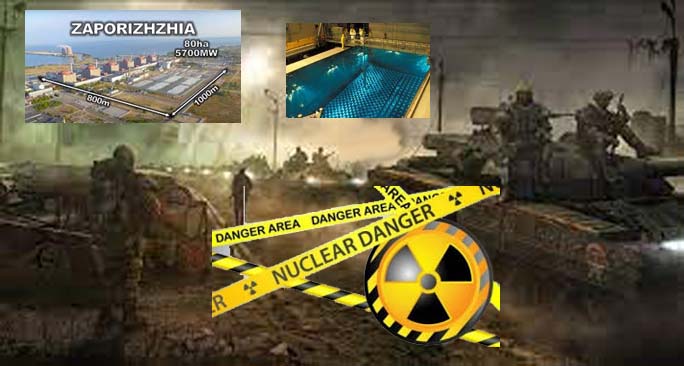
If a reactor’s spent fuel pond storage system was hit, the likely radiological releases could force millions of people to evacuate……………… In an attack against a spent fuel storage facility, US Nuclear Regulatory Commission staff conservatively estimate the radiological release could be 100 times greater than that of the Fukushima accident.20
Today, nuclear plants can be disabled in many ways without risking harmful releases of radiation. The Russians, in the Russia-Ukraine War, have demonstrated several disabling techniques
Russia’s attacks afford a clear example of disabling critical civilian objects (reactors) to its military advantage without releasing hazardous radiation
By: Henry Sokolski, Nonproliferation Policy Education Center, September 16, 2025
For nearly a decade, protecting civilians and civil objects from disproportionate military assaults has been a top priority of the Pentagon. Two Department of Defense secretaries from the first Donald Trump administration championed quantifying and reducing harm to civilians and civil objects. Under the Joe Biden administration, the Pentagon further focused on protecting civilians and civil objects, and, in 2023, Congress created a Civilian Protection Center of Excellence within the Department of Defense. This center, consisting of a staff of 30 people with an annual budget of $7 million, helped military commands execute their missions while minimizing collateral damage.1
In early 2025, however, the Pentagon cut the funding and eliminated almost all the staff in the Civilian Harm Mitigation and Response office and the Center and asked Congress to eliminate the legal requirement for its continued operation. Rattled, some wondered if the Department of War was rescinding its previous guidance on limiting civilian harm. The answer to the question was unclear.2
Trump administration officials stated the Civilian Protection Center of Excellence jeopardized war fighters’ abilities to do their jobs. But those officials did not discuss a deeper set of developments: Hamas’s October 7 attack against Israeli citizens; Israel’s crushing response, which killed thousands of noncombatants; and Russia’s attacks against Ukrainian civilians and civil infrastructure. Each development challenged many experts’ previous beliefs about what proportionality should prohibit.
Both Vladimir Putin and Benjamin Netanyahu insist their military operations are proportionate. These claims, in turn, rely on an American view of proportionality Abraham Lincoln’s top military and legal adviser, Francis Lieber, promulgated in the 1860s. The Lieber Code (General Orders No. 100) championed avoiding attacks on civilians and civilian objects. But the code also allowed, if a compelling military objective emerged whose achievement incidentally entailed harming civilian people and objects, that attacks were permissible. Commanders on the front lines should decide what actions are militarily justified or not, according to the code.3
Some have argued Lieber’s view renders proportionality hopelessly subjective. If commanders were free to determine what actions are justified, proportionality would seem to be little more than a standard of behavior the weak may demand of the strong, but the strong can effectively ignore. Victorious nations rarely litigate against their own officials or officers for disproportionate military actions (that is, for ignoring or violating the requirements of proportionality).4
Therefore, enforcing proportionality against defeated foreign nations might be attractive, but demanding one’s own military enforce proportionality is less realistic or practical. At best, realists argue, limiting harm to civil persons and objects is advisory; institutionalizing or promoting proportionality by creating Pentagon centers goes too far.
This line of thinking is intuitive and appealing. But it ignores a critical point: Sparing civilians and civilian objects unnecessary harm is often essential to achieving military victory.
Carl von Clausewitz, known for championing the necessity of violence in battle, was just as emphatic that wars could only be won by reaching political solutions the enemy’s military and leadership—and the enemy’s population—could accept. Needlessly killing civilians and destroying infrastructure critical to their welfare only complicates reaching lasting political solutions. For Clausewitz, the need to inflict violence in war had to be measured against the war’s ultimate objective, which is always political. Violence against civilians is self-defeating if it undermines the achievement of the war’s ultimate political objective.5
Thus, Winston Churchill and Dwight D. Eisenhower resisted calls in 1944 for the indiscriminate bombing of French cities and infrastructure during World War II because though such bombings would weaken German defenses, they would also dramatically undermine French political support of the Allied powers and the Allies’ resistance to the Nazis. Indiscriminate bombing would also complicate the reconstruction of the French economy after the Allies won the war.6
For similar reasons, President Harry S. Truman rejected the advice of his commander in the field, General Douglas MacArthur, who wanted to use nuclear weapons on North Korea and China. Truman feared attacking these states with nuclear weapons would escalate the conflict, cause unnecessary destruction, and turn international public opinion against the United States. Truman understood maintaining international support was essential to containing China and deterring Russia’s use of nuclear weapons after the end of the Korean War.7
One of Adolf Hitler’s best generals—Erwin Rommel—also refrained from using excessive force against civilians to protect his communications and supply lines from local disruption. Rommel understood that, in some cases, good military discipline and order required restraint, as did pacific relations with the local population (for example, in Northern Africa). Rommel’s attention to these points helped secure supply lines and reduced local resistance to his forces’ operations.8
Nazi troops terrorized enemy populations, but General Walther Wever, who served as the Luftwaffe’s chief of staff in the mid-1930s, argued such actions. Responsible for formulating Germany’s military air doctrine, Wever rejected the idea of bombing cities to break the will of the people. Wever believed such attacks were, at best, distractions from the Luftwaffe’s main mission: destroying the enemy’s armed forces. Wever also believed terror bombing was militarily self-defeating because it increased, rather than reduced, local resistance, jeopardizing the achievement of the Luftwaffe’s prime military missions.9
Besides these arguments, there are additional reasons for not hitting certain civilian facilities. Attacking chemical plants and nuclear facilities can poison the theater of operations with dangerous contaminants and hamper military operations (for example, if a dam is attacked, flooding the terrain). Such attacks can also prompt major evacuations which, in turn, retard military movements.
However, another advantage of avoiding conducting military assaults on civilian objects relates to military cohesion. As I noted in a previous Parameters article, Protocol I of the Geneva Conventions specifically discourages nations from attacking civilian objects, especially if doing so would risk releasing “hazardous forces” that could inflict “severe harm” on innocent civilians. Although the United States has signed the protocol, 174 nations took the additional step of ratifying it. The United States chose not to do so. As such, the United States is at odds with most of its NATO Allies.10
Thus, in 2022, foreign and military ministers in the European Union, the United Kingdom, and Germany declared Russian strikes against Ukrainian infrastructure and the Zaporizhzhya nuclear power plant were prosecutable war crimes. The United States took no position. In a war game conducted in 2022, close US Allies that have ratified Protocol I were at odds with Washington regarding how to respond to Russian attacks on Allied reactors. The United States’ Allies wanted to respond strongly to what they saw as a war crime, whereas the United States did not. In the game, the other NATO members were concerned NATO would be drawn into a larger conflict if Poland and Ukraine jointly attacked Russia. These concerns held up war operations and resulted in the United States using Article 5 of the North Atlantic Treaty to keep Poland from participating in a Ukrainian strike against Russia.11
Finally, temporarily disabling civilian infrastructure (for example, water, gas, and oil pumps; energy pipelines; telecommunications lines; and electrical-supply systems) can afford clear military advantages over physically obliterating civilian infrastructure, even if no hazardous forces are released. The temporary disablement of civilian infrastructure deprives one’s enemy of the ability to use infrastructure facilities, facilitates their subsequent use by one’s own forces in war, and allows for their speedy repatriation once the war is over.12
All of these points recommend fostering effective military applications of proportionality against civilian objects. The question is how.
………………………………………………………………………………………………………………………………………….If a reactor’s spent fuel pond storage system was hit, the likely radiological releases could force millions of people to evacuate, as confirmed by US Nuclear Regulatory Commission, government-sponsored, and private studies. The areas rendered uninhabitable could also be quite large: from 30,000 to 100,000 square kilometers (the latter area is larger than the entire state of New Jersey). In an attack against a spent fuel storage facility, US Nuclear Regulatory Commission staff conservatively estimate the radiological release could be 100 times greater than that of the Fukushima accident.20
The case of an attack against a spent fuel storage facility is extreme. A less dramatic scenario is the radiological release attendant to a loss of coolant induced by a military assault. Still, a wholesale, indiscriminate attack against Iran’s Bushehr power reactor could release significant radiation and force the evacuation of hundreds of thousands to millions of nearby civilians.21
Wholesale, indiscriminate attacks are precisely the kind of assault diplomats and lawyers aimed to prevent when they crafted Protocol I to the Geneva Conventions a half century ago. This international framework has several provisions that focus on the most likely type of military assault against nuclear power plants at the time: wholesale aerial attacks, which were almost certain to trigger massive releases of radioactivity. Today, things are different. With precision targeting and tailored munitions, nuclear power plants can be disabled in many ways without releasing radiation.22
Oddly, this transition to precision is still not fully reflected in the Pentagon’s legal guidance on targeting nuclear plants. …………………………………………………………………………………
Today, median miss distances for precision weapons are measured in meters or in smaller units. As a result, nuclear plants can be disabled in many ways without risking harmful releases of radiation. The Russians, in the Russia-Ukraine War, have demonstrated several disabling techniques……………
Through repeated strikes on these nonnuclear components, Russia has succeeded in shutting down Europe’s largest nuclear power plant—the Zaporizhzhya nuclear power plant. In addition, Putin can now collapse Ukraine’s entire electrical-supply system at a time of his choosing. Meanwhile, Russia says it could restart the Zaporizhzhya nuclear power plant to supply electricity to territories occupied by Russia in a matter of months.
More could be said about Russia’s studied targeting of Ukraine’s nuclear power plants and electrical-power systems. But Russia’s attacks afford a clear example of disabling critical civilian objects (reactors) to its military advantage without releasing hazardous radiation.26
Of course, other nuclear examples should be considered. Some states use portions of their civilian nuclear programs to make nuclear-weapons materials—for example, China, India, and North Korea. Disabling the facilities used to make nuclear-weapons materials would be a worthy military objective. Physically, obliterating those facilities and risking the widespread dispersal of harmful radiation, however, could be militarily counterproductive.median miss distances for precision weapons are measured in meters or in smaller units. As a result, nuclear plants can be disabled in many ways without risking harmful releases of radiation. The Russians, in the Russia-Ukraine War, have demonstrated several disabling techniques. These techniques exploited the nuclear-safety requirement for irradiated reactor fuel to be cooled continuously to prevent it from overheating, failing, and releasing dangerous, radioactive by-products.24
Rather than prompting such failures, analysis suggests Russia has been careful to target the electrical power–supply systems needed to keep the nuclear plants’ cooling and safety systems running. Russia’s aim is twofold: first, to force the plants’ operators to shut them down for safety reasons, and second, to increase the credibility of making follow-on strikes that might risk a significant release of radiation.25
The power-system components Russia has targeted include on- and off-site electrical transformers; high-voltage lines running in and out of the plants; cooling water supply systems; a major dam critical to supplying water to the Zaporizhzhya nuclear power plant; and major, off-site electrical power–generating plants needed to stabilize the electrical-supply grid supporting the nuclear plant’s safe operation…………………………
Recommendations
What steps can the US military take to update its plans and operations for targeting and protecting civil infrastructure?
First, the Pentagon should publicly share much more information about its thinking than it has to date, which would allow for greater civilian oversight, sharpen military planning, and increase the clarity of current policy and legal guidance.
Second, the Pentagon should work with private industry and other government departments focused on civil-infrastructure protection—the US Department of Homeland Security and the US Nuclear Regulatory Commission—to produce convincing public narratives about why and how civil objects should be protected and to improve existing protection schemes. Planning to protect this infrastructure has long been underway, but under the protection of the Federal Energy Regulatory Commission’s Critical Energy / Electric Infrastructure Information, which keeps these plans from the public. What’s needed is a sensible tear sheet for public consumption.27
Third, the Department of War should offer Congress routine public reports about matters related to protecting civil infrastructure. The US government must prepare the public for a future in which the United States’ electrical-supply systems, energy pipelines, biological research facilities, potentially dangerous petrochemical plants, telecommunications systems, and civil nuclear facilities may come under attack. Setting the public’s expectations about what can and should be done, actively and passively, to defend these systems should not wait until an attack occurs.
Finally, training is critical. The Department of War’s military education training institutions should offer dedicated, unclassified courses that provide technical and historical instruction on the targeting and defense of civil objects. The instruction should be fortified by unclassified government simulations for civilians and military officials, which play out alternative targeting plans against civil objects that could release hazardous forces.
How will the US government accomplish these objectives? The first step is to make mastering these matters a requirement for military promotion. This step could be done quietly, without top-down scolding, legal hectoring, or creating centers. The best US military operators and planners already know civil objects and nuclear facilities are becoming increasingly significant military targets. The Pentagon should reward and support efforts to clarify what should be done to disable and protect civil objects and nuclear facilities.
Acknowledgments: I would like to thank Caitlyn Collett for providing essential assistance in the production and editing of this special commentary.
To read the full piece, click here.
Can the US, Russia and China break their nuclear talks impasse?
With a key US-Russia arms treaty due to expire in February, the world is at risk of entering a new era of strategic instability, analysts warn.
Shi Jiangtao, SCMP, 21 Sep 2025
US President Donald Trump’s summit in Alaska last month with Russian leader Vladimir Putin failed to revive long-stalled nuclear negotiations or advance efforts to preserve the last major arms control pact between Washington and Moscow, which is set to expire in February.
Trump’s subsequent push for trilateral “denuclearisation” talks involving China elicited a firm refusal from Beijing, underscoring challenges to extending the New Strategic Arms Reduction Treaty (New START) amid fears of a fresh nuclear arms race, analysts said.
Following the summit, Beijing, with its long-standing policy of “no first use” and a nuclear strategy rooted in self defence, spurned Trump’s proposal, with Chinese foreign ministry spokesman Guo Jiakun calling it “neither reasonable nor realistic”…………………………(Subscribers only) https://www.scmp.com/news/china/diplomacy/article/3326243/can-us-russia-and-china-break-their-nuclear-talks-impasse?module=perpetual_scroll_0&pgtype=article
Who are Britain Remade?

By Mike Small, https://bellacaledonia.org.uk/2025/05/01/who-are-britain-remade/
There’s a concerted attempt to attack Scotland’s long-standing commitment to no new nuclear power, alongside a full-scale assault on the idea of Net Zero, and the very basics of climate policy (however inadequate mainstream policy is).
This is being led by Nigel Farage who has called Net Zero ‘the New Brexit’, whatever that means. All this has been echoed by Tony Blair’s intervention this week where he argued that any attempt to limit fossil fuels in the short term or encourages people to limit consumption is “doomed to fail”. Alongside this we can see Scottish Labour’s recent commitment to the cause of new nuclear power in Scotland.
Today The Scotsman ran with a front-page splash all about how ‘SNP voters back nuclear power’ by Deputy Political Editor David Bol and Alexander Brown.
The article was replete with quotes from Labour MSP for East Lothian, Martin Whitfield, Scottish Conservative MP, John Lamont, who said the Scottish Government embracing nuclear power would be “basic common sense”. Then there’s a quote from Sam Richards, founder and campaign director for Britain Remade, who, it turns out commissioned the poll and was also enthusiastically pro-nuclear.
What The Scotsman didn’t explain though, was who ‘Britain Remade’ are? They’re presented as if they’re maybe pollsters or some independent think-tank.
But Britain Remade is a Tory think-tank and lobby group campaigning on behalf of nuclear power. Jason Brown is Head of Communications for Britain Remade, a former No. 10 media Special Adviser and Ben Houchen’s comms Adviser.
Jeremy Driver is the Head of Campaigns at Britain Remade, a former Lloyds Banker and Parliamentary Assistant to Ann Soubry. Sam Dumitriu is Head of Policy at Britain Remade who formerly worked at the Adam Smith Institute. These are Tory SPADS working on their own campaign to support new nuclear in Scotland: Lift The Ban On New Scottish Nuclear Power.
Britain Remade claimed they are not affiliated: “We’re an independent grassroots organisation. We are not affiliated with, or part of, any political party” their website says. They may not be officially affiliated to any party, but it’s very clear where their politics (and their staff) come from.
So here we have the Scotsman giving over its front-page to a Tory lobby group to promote their campaign. On the same day they published a similar piece in the Telegraph “SNP’s ‘senseless’ nuclear ban ‘damaging Scotland’” so it’s really working for them.
This is not just a question of client journalism, it’s a question of how far right-wing forces, often working with dark money, will attempt to derail even the most modest (and completely inadequate) environmental policies. Quite why Saudi-funded Tony Blair should jump on the anti Net Zero bandwagon is anybody’s guess, but it’s quite clear there is a coordinated pro-nuclear lobbying group in action in Scotland that pans across the Conservatives and Labour parties, and is supported by astroturf groups and pliant media friends. Watch this space for more on the new nuclear lobby.
Plutonium, Public Money and a Perilous Nuclear Dump on the Lake District Coast, a Letter to Cumberland Council’s “Nuclear Issues Board”

By mariannewildart, https://mariannewildart.wordpress.com/2025/09/19/plutonium-public-money-and-a-perilous-nuclear-dump-on-the-lake-district-coast-a-letter-to-cumberland-councils-nuclear-issues-board/
Sent by Email 19th September 2025
For consideration by the Nuclear Issues Board
of Cumberland Council on Monday 22nd Sept 2025
Dear Nuclear Issues Board of Cumberland Council,
On 14 October 2021, Copeland Borough Council’s Executive of just four councillors took the decision to establish two Geological Disposal Facility (GDF) Community Partnerships in accordance with the UK Government’s “GDF siting process”
West Cumbria is predictably the only consideration by NWS as a potential site for a GDF (also known as a nuclear waste dump for the abandonment of high level wastes).
A lot has changed since those four Copeland councillors put forward the Lake District coast as a sacrifice zone for the UK’s nuclear waste geological disposal plan.
We urge the Nuclear Issues Board to exercise their democratic duty and call for a debate by the Full Cumberland Council and a Full vote before going any further in the partnership with Nuclear Waste Services for delivery of a very deep, very hot and very experimental nuclear waste dump for high level wastes.
There is no democratic mandate to continue in partnership with Nuclear Waste Services in delivery of a GDF for the following reasons:
Community Unwillingness.
Despite the ongoing Community Partnership funding, Millom Town Council and Whicham Parish Council have both withdrawn from the South Copeland Community Partnership. Whicham PC also held a parish poll that clearly indicated a 77% majority against the GDF . Millom Without Parish Council will be consulting its parishioners on withdrawal. An external review of the SCCP also found the Partnership to be totally dysfunctional with infighting between community representatives and NWS staff.
The Community of Seascale within the Mid-Copeland Community Partnership have also voiced opposition. Seascale Parish Council talked about GDF’s potential area of focus for Headworks and were shown a map of a potential area for Seascale: “as a Parish Council we rejected the proposal as it was not suitable for Seascale at all, but there needs to be more that just our voice, attached is a map of the proposed Headworks location for Seascale.. We encourage residents to attend these events with GDF and voice their concerns too.
” It is ironic, given the above, that one of the Copeland (now Cumberland) councillors who took the delegated decision to ‘volunteer’ the West Cumbrian coastline once again into the nuclear dump plan is Vice chair of Seascale Parish Council.
It is clear that previous geological work, public inquiries and Cumbria County Council resolutions on this subject are being ignored in order to proceed with a clearly unwanted, expensive, ultimately public money and time wasting project once more, casting known and unknown blight on communities for decades to come. As Martin Lowe of Close Capenhurst has observed “Cumberland Council have a duty of care to the public which this development flies in the face of.”
Increase of the mine footprint from 25km2 to 36km2 since Copeland Executive volunteered the Lake District coast.
Initially NWS literature stated that the mine footprint would be 25km2. A letter to Lakes Against Nuclear Dump from Nuclear Waste Services states that the footprint would now be 36km2 (or larger).
Increase in heat of the “thermal footprint” of the GDF from 100 degrees c to 200 degrees c.
100 degrees c is the maximum heat “allowed” to try to ensure integrity of the bentonite buffer (clay slurry to be pumped into the mine as backfill and to delay leakage), however the thermal footprint has been increased to 200 degrees c as confirmed in a letter to Lakes Against Nuclear Dump from Nuclear Waste Services.
Inclusion of Plutonium along with High Level Wastes.
The inclusion of plutonium for burial in a GDF is a new, experimental and dangerous concept. There are unresolved (and likely unresolvable) difficulties of containing the radiotoxic nature and criticality of plutonium in a geological disposal facility.
“The problems of criticality and toxicity to the biosphere essentially come down to water—it creates the conditions for potential criticality and provides the transport mechanism for plutonium’s toxicity.” (Plutonium—the complex and ‘forever’ radiotoxic element of nuclear waste. How exactly should we manage its containment? Nick Scarr 22/08/25).
Top geologists call the plan “dangerous”
– this is why…
Professor Stuart Haszeldine, Professor of Carbon Capture and Storage, School of Geosciences Edinburgh Climate Change Institute said: “Making waste into specialised solid compounds can help to become more resistant to dissolution in groundwater. But the heat generated from the radioactive decay of isotopes is not affected by that re-engineering. Adding material which may heat to 100-200C is a huge disruption and will undoubtedly change the pathways of groundwater flow. This is like having an electric kettle containing stable stationary water and then turning on the electricity to add heat – the water soon circulates and if heating continues, the water boils.”
Professor Haszeldine added: “Have the developers actually made computer predictions of these effects in this GDF? Because plutonium has isotopes which can last for thousands of years, it may be sensible to spread that through the GDF to minimise heating – but that will make predictions of containment in circulating hot water much more difficult. It’s perfectly reasonable to think of a 150C-200C heat source at 0.5km, producing a geyser of boiling water intermittently erupting at surface temperatures above boiling.”
The spread of this increased temperature, known as a thermal pulse, would be conducted through the rock over several thousand years. With the additional pressure of water column above the GDF (a hypothetical 500m below the surface), water would boil at the higher temperature of 250C, in which case superheated steam may also occur. There is currently no guarantee that the maximum heat of the GDF will remain at 200C.
Even a 1.0C increase in ocean water [ii]can cause ‘massive impacts’ on the health of sea life and contribute to marine desertification, including loss of biodiversity, collapse of fisheries, and accelerated climate change. The proposed GDF is planned to be at least 37 km3, a substantial section of seabed under the Irish Sea, in a Marine Protected Area. Similar to nature reserves or SSSIs, Marine Protected Areas are parts of the ocean established to protect habitats, species and healthy, functioning marine ecosystems. Professor Haszeldine pointed out that seeps of warm or hot waterfrom a GDF onto the seabed are unlikely to stabilise, repair, and rewild the natural seabed ecosystems.
Professor David K. Smythe, Emeritus Professor of Geophysics, University of Glasgow, said he agreed with Professor Haszeldine about the danger of trying to bury High Level Waste, whether it was conditioned or not. “The waste should be kept on the surface of the earth, and immobilised beyond any possibility of re-use, until a proper long-term solution is found.”
For all these reasons and many more, thousands of people including hundreds of Cumbrians have signed a pettion calling for the full Cumberland Council to debate and vote before going any further in the partnership with Nuclear Waste Services for delivery of an experimental and uniquely dangerous plan to abandon nuclear wastes.
We urge the Nuclear Issues Board to exercise their democratic duty and call for a full debate and vote by Cumberland Council. Currently there is no democratic mandate to continue with the GDF “process” without at least carrying out a full debate and full vote by all Cumberland Councillors
Yours sincerely,
Marianne Birkby, Lakes Against Nuclear Dump, a Radiation Free Lakeland campaign
Richard Outram, Secretary of the UK/Ireland Nuclear Free Local Authorities (NFLAs)
Chernobyl shelter repairs: ‘Difficult choices’ lie ahead
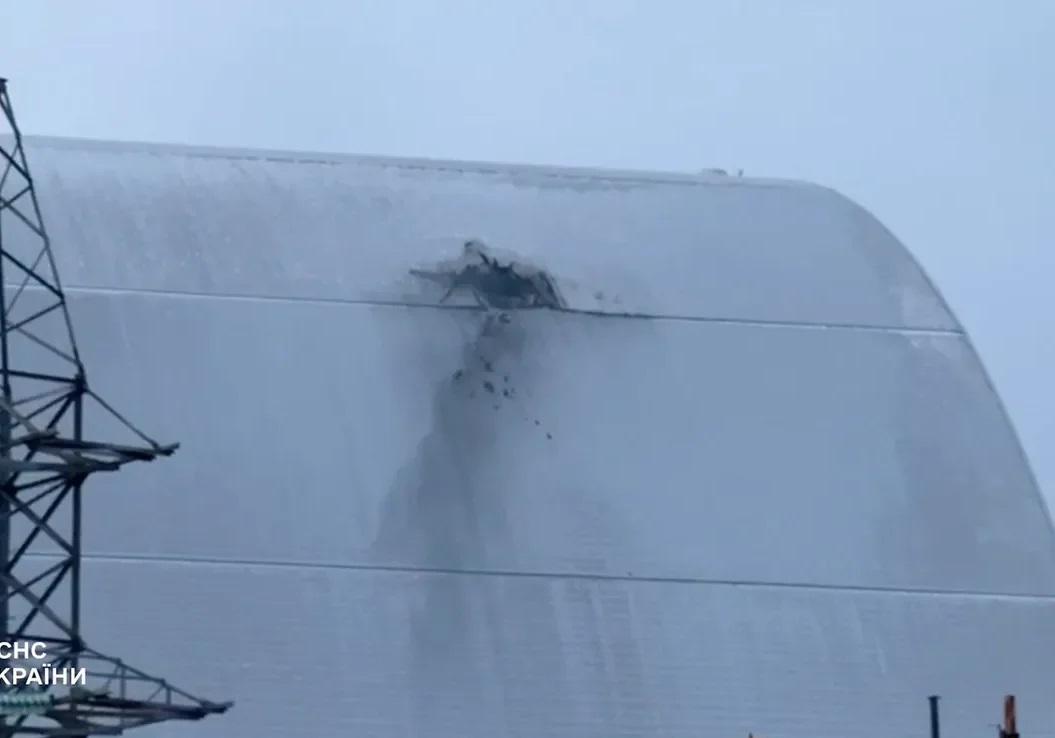
The arch-shaped New Safe Confinement structure built over the remains of
Chernobyl’s destroyed unit 4 suffered such extensive damage in a drone
strike in February that it may not be possible to restore it to its full
original design purposes and life-span of 100 years, a side event at the
International Atomic Energy Agency General Conference heard.
World Nuclear News 18th Sept 2025, https://www.world-nuclear-news.org/articles/chernobyls-giant-shelter-may-never-return-to-original-state
Can the UK fast-track nuclear power without cutting corners on safety?

The UK’s nuclear regulator is being asked to consider radically
different designs on a scale and pace never before seen. That’s partly
why, as part of the deal, the two countries have agreed to accept each
other’s safety checks. The government claims this will “halve the time
for a nuclear project to be licensed”. The question is whether this can
be done as safely.
The US and UK take fundamentally different approaches to
nuclear regulation. The US’s Nuclear Regulation Commission (NRC) takes a
“prescriptive” approach. It sets detailed rules based on its own
research and enforces them directly. Like police setting speed limits, the
regulator decides the standards and then ensures nuclear operators meet
them. If an accident happens, operators can point to meeting every
requirement as evidence they followed the rules. They could even
legitimately blame the regulator.
The UK’s Office for Nuclear Regulation
(ONR) takes a “descriptive” approach. It sets broad standards but
leaves operators to prove how they will meet them. In road terms, the US
sets the speed limit and checks drivers obey it. The UK simply says cars
must stay on the road, leaving drivers to decide their own limits, prove
they’re safe, and take full responsibility if they crash. These two
approaches are driven to a large extent by the two country’s history and
make up of their nuclear industries. So while UK-US collaboration could
boost Britain’s nuclear industry and accelerate the path to low-carbon
energy, independence and transparency will be essential. Any perception of
corner cutting or transatlantic political interference could undermine
public trust and derail Britain’s nuclear ambitions.
The Conversation 18th Sept 2025, https://theconversation.com/can-the-uk-fast-track-nuclear-power-without-cutting-corners-on-safety-265614
Construction starts of Belgian disposal facility
Belgium’s Prime Minister Bart De Wever has laid a foundation stone,
marking the start of construction of a surface disposal facility for low-
and intermediate-level, short-lived waste at the Dessel site in Belgium.
The facility will consist of several concrete bunkers that will house large
concrete vaults in which short-lived low- and intermediate-level waste will
have been encapsulated with mortar. Currently, 28,831 vaults are planned,
spread across two zones: 20 bunkers in the first and 14 in the second. The
Dessel facility will house all Belgian low- and intermediate-level,
short-lived radioactive waste including that from nuclear power plants,
hospitals, research institutes and the decommissioning of nuclear
facilities. Currently, this waste is managed by national radioactive waste
management agency ONDRAF/NIRAS’s industrial subsidiary Belgoprocess in
several dedicated buildings on the Dessel site.
World Nuclear News 19th Sept 2025, https://www.world-nuclear-news.org/articles/construction-starts-of-belgian-disposal-facility
Why Starmer’s nuclear ‘golden age’ risks becoming a lot of hot air.

Crippling costs and mountains of red tape threaten to pour cold water on the PM’s ambitions.
Donald Trump hasn’t been shy about criticising British
energy policy under Labour, lashing out at “ugly” wind farms and
crippling taxes on North Sea oil and gas. Yet one area where the US
president and Sir Keir Starmer seem to fervently agree is on nuclear power.
This week, the US and UK governments promised to work together to deliver a
“golden age” of privately-financed power plant construction.
The agreement will see the two countries fast-track the approval of new,
cutting-edge reactor designs by recognising each other’s safety regimes – a
controversial move that has already raised the hackles of activists. But to
underline the economic prize on offer, the announcement featured a string
of eye-catching investments being looked at by American and British
companies with plans for fleets of reactors that will power the grid, as
well as high-tech data centres needed for artificial intelligence (AI)
software. British Gas owner Centrica and X-energy, a nuclear start-up
backed by Amazon, said they were exploring building up to 80 advanced
modular reactors (AMRs) capable of delivering electricity and heat to both
industrial businesses and millions of homes. Meanwhile, Holtec
International and the UK arm of EDF are looking at building a small modular
reactor (SMR) on the former site of a coal power plant in Nottinghamshire.
Micro-reactor firm Last Energy is also exploring plans to power the London
Gateway port, while Bill Gates-backed TerraPower is scouting out locations
for mini power plants as well.
On the face of it, the deals looked like a
major triumph for the Prime Minister. But industry veterans were quick to
note that, in their current form, they are just loosely-worded commitments,
with the companies yet to sign binding contracts or exchange serious sums
of cash. One potential blueprint may lie in a new report by pro-growth
campaign group Britain Remade, which argues that nuclear power can offer
“abundant, clean, reliable electricity” and lower bills for consumers –
but only if the Government overhauls red tape that is “not fit for
purpose”. “US firms want to build here,” says Sam Dumitriu, the
report’s author. “But turning it into shovels in the ground, data centres
online, on time and on budget, depends on making the UK a lower-cost,
faster place to build”
Telegraph 18th Sept 2025, https://www.telegraph.co.uk/business/2025/09/18/why-starmer-will-struggle-to-deliver-nuclear-golden-age/
Rolls Royce “Small” nuclear reactors are not at all small!

Dr Paul Dorfman Letter: Further to your report “Deal with US to
fast-track mini nuclear reactors” (Sep 15; letter, Sep 16), small modular
reactors (SMRs) are defined by the International Atomic Energy Agency as
reactors that generate up to 300MW power.
At 470MW, the Rolls-Royce design is not an SMR: it is larger than the UK Magnox reactor, more than half the size of the 900MW reactors that make up the bulk of the French nuclear fleet, and about a third the size of the very large EPR reactor design at Hinkley Point C.
This matters because the Rolls-Royce design will need big
sites, standard nuclear safety measures, exclusion zones, core catchers,
aircraft crash protection and security. All this is important because in
calling its design an SMR, or small, Rolls-Royce appears to me to have been
economical with the truth — and all that implies for its other claims,
especially about time and cost.

As for the nuclear waste problem, the former chair of the US government Nuclear Regulatory Commission reports
that SMRs would produce more reactive waste per kWh — the key parameter — than large reactors.
Times 17th Sept 2025. https://www.thetimes.com/comment/letters-to-editor/article/times-letters-ethics-of-danny-krugers-defection-to-reform-uk-3rbg90m3b
UK Ministry of Defence dismiss MP’ s call for inquiry into trident bases nuclear leaks.

THE Ministry of Defence (MoD) has dismissed calls from an SNP MSP for a
public inquiry into nuclear leaks at Trident bases, claiming it is
“factually incorrect” to suggest they posed a safety risk.
Earlier this week Bill Kidd, the Glasgow Anniesland MSP, held a debate on reported nuclear safety incidents at Faslane and Coulport, where Britain’s nuclear fleet and arsenal are stored.
Kidd secured the backing of 28 MSPs from the
SNP, Scottish Greens, Scottish Labour, Alba, and one independent. However,
the motion was not voted on as it was debated as member’s business after
decision time.
It comes after The Ferret revealed that nuclear waste leaked
into Loch Long, in Argyll and Bute. The outlet reported that pipe bursts
were recorded in 2010, two in 2019, and two more in 2021. After an FOI
battle that lasted six years, the Scottish Environment Protection Agency
(Sepa) – the environment watchdog – stated the Royal Navy failed to
properly maintain a network of 1500 pipes at the Coulport armaments depot,
on the banks of Loch Long.
The National 19th Sept 2025, https://www.thenational.scot/news/25481047.mod-dismiss-snp-msp-call-inquiry-trident-bases-nuclear-leaks/
U.S. Firms Boost UK Nuclear Sector with Major Deals

Oil Price By City A.M – Sep 16, 2025
- The UK and US have agreed to reduce the licensing time for nuclear projects from four years to two and broaden US companies’ access to the UK energy market.
- Several US companies have struck significant deals with UK partners, including X-Energy to build advanced modular reactors in Hartlepool, Holtec to develop data centers powered by small modular reactors, and Last Energy for a micro modular nuclear plant at London Gateway.
- The initiative aims to kickstart a “golden age of nuclear” in the UK, providing clean, homegrown energy, creating skilled jobs, and addressing high energy bills, though critics question the effectiveness of potential VAT cuts on energy bills.
…………………………………………………………………………………. Energy bills woes
The announcement comes as the government battles to bring down energy bills, which have almost doubled costs for households over the past eight years.
Alongside increasing the domestic supply of energy, Chancellor Rachel Reeves is reportedly weighing cutting VAT on energy to help lower consumer prices.
However, critics have questioned whether the move, which could cost the government nearly £2bn, would deliver tangible improvements to household budgets, warning that wealthy families with larger homes would disproportionately benefit from the tax break. https://oilprice.com/Alternative-Energy/Nuclear-Power/US-Firms-Boost-UK-Nuclear-Sector-with-Major-Deals.html
US and UK companies ink nuclear deals ahead of Trump visit

Transatlantic nuclear energy deals estimated to be worth over $100 billion
have been announced ahead of President Donald Trump’s state visit to the
United Kingdom this week. TerraPower, a Bill Gates-backed developer of
small nuclear reactors, announced Monday that it would work with
engineering firm KBR to study potential sites in the U.K. to deploy its
advanced Natrium reactors. Rockville, Maryland-based X-energy and British
energy company Centrica also announced plans to deploy up to 72 small
reactors for electricity and industrial heat in the U.K.
E&E News 16th Sept 2025, https://www.eenews.net/articles/us-and-uk-companies-ink-nuclear-deals-ahead-of-trump-visit/
What You Need to Know About the £38 Billion Sizewell C Nuclear Project inthe UK.

Project Timeline: Development Consent Order (DCO) approved: July
20, 2022; Groundworks commenced: January 15, 2024; Final Investment
Decision (FID) reached: July 22, 2025; Construction duration: Expected to
take between nine and twelve years; Operational date: Expected in the
2030s.
Construction Review 15th Sept 2025, https://constructionreviewonline.com/construction-projects/uk-government-approves-38-billion-sizewell-c-nuclear-project/
1 This Month


31st January – Challenging the War Machine – a DECLASSIFIED UK SUMMIT



Website of the Week
Now until to February 10, 2026 Radioactive waste storage in France: the debate is finally open! How to participate?
-
Archives
- January 2026 (220)
- December 2025 (358)
- November 2025 (359)
- October 2025 (377)
- September 2025 (258)
- August 2025 (319)
- July 2025 (230)
- June 2025 (348)
- May 2025 (261)
- April 2025 (305)
- March 2025 (319)
- February 2025 (234)
-
Categories
- 1
- 1 NUCLEAR ISSUES
- business and costs
- climate change
- culture and arts
- ENERGY
- environment
- health
- history
- indigenous issues
- Legal
- marketing of nuclear
- media
- opposition to nuclear
- PERSONAL STORIES
- politics
- politics international
- Religion and ethics
- safety
- secrets,lies and civil liberties
- spinbuster
- technology
- Uranium
- wastes
- weapons and war
- Women
- 2 WORLD
- ACTION
- AFRICA
- Atrocities
- AUSTRALIA
- Christina's notes
- Christina's themes
- culture and arts
- Events
- Fuk 2022
- Fuk 2023
- Fukushima 2017
- Fukushima 2018
- fukushima 2019
- Fukushima 2020
- Fukushima 2021
- general
- global warming
- Humour (God we need it)
- Nuclear
- RARE EARTHS
- Reference
- resources – print
- Resources -audiovicual
- Weekly Newsletter
- World
- World Nuclear
- YouTube
-
RSS
Entries RSS
Comments RSS
 nuclear-news