Nuclear reactor Tihange 1 to cease operations after fifty years
27 September 2025, https://www.belganewsagency.eu/nuclear-reactor-tihange-1-to-cease-operations-after-fifty-years
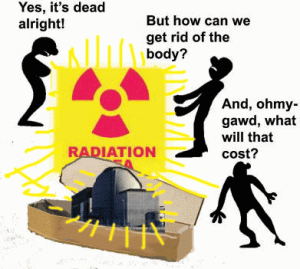
Next Tuesday, the plug will be pulled on the Tihange 1 nuclear reactor after 50 years of service. However, the Belgian government hopes that this will not be the end.
Tihange 1 is the fourth Belgian nuclear reactor to be shut down, following the permanent shutdown of Doel 3, Tihange 2 and Doel 1. Doel 2 will follow at the end of November. The two remaining reactors – Doel 4 and Tihange 3 – are allowed to operate for another ten years, until 2035.
Construction of the reactor on the banks of the Meuse near Huy, Liège province, began in 1969. Electricity was generated for the first time in 1975. Normally, the reactor – half owned by Engie and half by EDF Belgium – should have ceased operations already in 2015, but in the context of security of supply, it was allowed to remain open until 2025. Today, Tihange has a capacity of 962 megawatts
On Tuesday 30 September, the operators in the control room will shut down the reactor and disconnect it from the high-voltage grid. Then the decommissioning phase will begin, a preparation for the actual dismantling. The reactor will be unloaded and the fuel cooled, so that it can later be transported to temporary storage. Afterwards, the primary circuit will be chemically cleaned, amongst others. All this work will take years to complete.
The decommissioning phase is not scheduled to begin until 2028 and will continue until 2040. But if it were up to the government, all this work would be delayed. The government hopes to keep the reactor open for longer and is asking nuclear operator Engie not to carry out any irreversible work. Discussions about an extension are ongoing.
Engie itself has repeatedly made it clear that it is not keen to operate any nuclear power plants other than Doel 4 and Tihange 3. Keeping Tihange 1 open for longer would also come with a hefty price tag due to the necessary upgrades, and the reactor would also have to undergo a ten-year safety review.
Starmer’s new nukes break Non-Proliferation Treaty, legal experts say
Keir Starmer’s plans to splash out on new nukes are in breach of
international law, according to new legal opinion obtained by the Campaign
for Nuclear Disarmament (CND).
The Prime Minister announced his intention
earlier this year to expand Britain’s nuclear capabilities, pledging to buy
nuclear-capable F-35A fighter jets from the US as well as ploughing on with
Trident renewal.
It would mean that, for the first time in decades, Britain
could launch weapons of mass destruction from both air and sea, despite
being a signatory to the nuclear Non-Proliferation Treaty (NPT). By signing
the NPT, Britain committed to “pursue negotiations in good faith on
effective measures relating to cessation of the nuclear arms race at an
early date and to nuclear disarmament and on a treaty on general and
complete disarmament under strict and effective international control.”
Arguing Sir Keir’s plans breach this obligation, the legal opinion from
international law experts Professor Christine Chinkin and Dr Louise
Arimatsu commissioned by the CND argues: “The decision of the UK to
purchase F-35a fighter jets rather than any other model is precisely
because the aircraft can ‘deliver both conventional and nuclear weapons’
and thereby enable the RAF to reacquire ‘a nuclear role for the first
time since 1998.’
Morning Star 26th Sept 2025, https://morningstaronline.co.uk/article/starmers-new-nukes-break-non-proliferation-treaty-legal-experts-say
IAEA issues fresh warning over drones near nuclear plants

26 September 2025, https://www.world-nuclear-news.org/articles/iaea-report-drones-downed-close-to-south-ukraine-nuclear-power-plant
The International Atomic Energy Agency has said drones flew within a few hundred metres of the South Ukraine Nuclear Power Plant, underlining the continued risks to nuclear safety from the on-going war. Meanwhile Zaporizhzhia Nuclear Power Plant continues to have to rely on emergency diesel generators after a loss of off-site power.
International Atomic Energy Agency (IAEA) experts stationed at the three-unit South Ukraine nuclear power plant were told that 22 unmanned aerial vehicles were observed on Wednesday night and Thursday morning within its monitoring zone, “some coming as close as half a kilometre from the site”, the agency said.
“From their accommodation near the plant, IAEA team members heard gunfire and explosions around 01:00 am local time and today (Thursday) they visited the location where one of the drones had come down, observing a crater measuring four square metres at the surface and with a depth of around one metre,” the agency’s statement said.
“Once again drones are flying far too close to nuclear power plants, putting nuclear safety at risk. Fortunately, last night’s incident did not result in any damage to the South Ukraine Nuclear Power Plant itself. Next time we may not be so lucky. I continue to urge both sides to show maximum military restraint around all important nuclear facilities,” IAEA Director General Rafael Mariano Grossi said.
“For more than three and a half years, the IAEA has been doing everything in its power to help prevent a nuclear accident during this devastating war. We will only be able to say that our mission was successful if the war ends without a serious nuclear accident. Our indispensable work is far from finished.”
Meanwhile Zaporizhzhia Nuclear Power Plant has been without external power for more than 48 hours and has been relying on its fleet of emergency diesel generators. The IAEA said “the plant said it has the necessary spare parts and personnel to repair the line once the military situation permits. Ukraine has informed the Agency that it is also prepared to repair damages to a backup power line, when the military situation permits”.
Following the loss of off-site power all 18 available emergency generators started operating, with the number reduced to those required to provide power to the site – seven – helping to preserve the diesel fuel. The IAEA has been told previously that 20 days’ worth of fuel was stored at the site.
Zaporizhzhia Nuclear Power Plant has been under Russian military control since early March 2022 and is on the frontline of Russian and Ukrainian forces.
Flamanville fiasco: EDF blamed by the Nuclear Safety Authority

The French Nuclear Safety and Radiation Protection Authority (ASNR) has severely
criticised the crisis management at the EPR in Flamanville (Manche), which
has been shut down since 19 June due to a valve problem.
On 20 August, the inspectors subjected EDF teams to an unannounced exercise of “deployment of a local crisis means” (MLC), i.e. the replacement of one element of the
electrical panel with another to resupply batteries in the event of a total
loss of power supplies. As a result, the operator was unable to carry out
this operation, which was essential to avoid an accident.
In its follow-up
letter, the ASNR points to a “range of interventions that are not precise
enough”, agents “forced to question themselves on numerous occasions” and a
training follow-up deemed “perfectible”. Even more serious, some crisis
equipment requested by the inspectors could not be presented. “The
organisation of the Flamanville EPR in terms of crisis management and means
appears insufficient”, concludes the nuclear watchdog, an extremely rare
assessment in its usually measured vocabulary.
” I don’t remember such an
observation,” Guy Vastel, of the Association for the Control of
Radioactivity in the West (Acro), told Ouest-France. Yannick Rousselet,
from Greenpeace, believes that “nothing is right” in this report. EDF, for
its part, announced an “action plan” and assured that the findings “do not
call into question the availability of crisis resources or the site’s
ability to manage an emergency”.
Reporterre 10th Sept 2025,
https://reporterre.net/Fiasco-de-Flamanville-EDF-blamee-par-l-Autorite-de-surete-nucleaire
Britain remade – with a lot of nuclear?
the land on which renewable techs sit is not all lost to other uses and offshore wind farms use no land. And the nuclear fuel cycle (from uranium mining through to eventual waste disposal) also involves land use.
Renew Extra Weekly September 27, 2025
In a new report, the Britain Remade lobby group pushes nuclear strongly, as part of its ecomodernist growth-based future. It models different nuclear build costs and renewable price scenarios to assess long-term impacts on household energy bills. But although it accepts that ‘renewables may have seen large price-falls over the last 15 years’ it says that ‘at high penetrations costs linked to managing intermittency are high: Britain has added 40 GW since 2010 and 120 GW is forecast by 2030, yet balancing, curtailment, backup, and overbuild still add cost and leave gaps that require firm power’.
It is also not very happy about the local environmental impact of renewables, given their high land use compared with nuclear plants. Well yes, but the land on which renewable techs sit is not all lost to other uses and offshore wind farms use no land. And the nuclear fuel cycle (from uranium mining through to eventual waste disposal) also involves land use.
The new report does admit that Britain is the most expensive place to build nuclear capacity. It notes that ‘Hinkley Point C (HPC) is estimated to cost £46 billion, or £14,100 per kW: when finished, it will be the most expensive nuclear power station ever built. British-built plants cost far more per kW than peers: our per-kW costs are about six times South Korea’s, and France and Finland deliver the same EPR design for less per kW (27% and 53% respectively). Britain has gone backwards on cost: Sizewell B in 1995 cost £6,200 per kW, less than half Sizewell C’s budgeted cost.’………………….
To improve things in the UK (not an easy task you might think, using the same vendors) it wants better regulation and reduced planning barriers. Well we will see how that goes with EDF’s new Sizewell C EPR. But better planning systems and regs might also help renewables ! Overall Britain Remade seems a bit desperate in its promotion of nuclear: ‘If renewable costs rise, nuclear can play an even larger role: government forecasts assume falling solar costs (-27% by 2040) and modest wind cost drops (-6%), but recent data show solar prices flat and wind costs rising. If renewables costs climb 30% above baseline, the most cost-efficient plan would be eight new plants at French prices (saving £7.6 bn) or fifteen at Korean prices (saving £21 bn) over 25 years, with benefits lasting decades’.
Lots of assumptions about costs there, and also about demand and markets, with there being some big uncertainties. …………………………
……………………………………………………………Not everyone in the UK will relish American dominance, even in a collaborative context, if that is what we face in this sector, and maybe in others, like AI. However, for good or ill, the Labour government, like most governments, is wedded to technology-led growth. So, with China now politically bared and the EU somewhat out of bounds, US help is evidently seen as vital. Like the US, the UK is now pushing nuclear hard: 75% of the Department of Energy Security and Net Zero’s £6.7bn spending in 2024-25 was allocated to nuclear.
It is true that renewable are also being pushed in the UK (not now under Trump in the US), but mainly via private sector investment e.g. £1.5bn for last year’s CfDs. Which way might it go in future given the US influence? The new US-UK ‘technology prosperity’ deal pushes nuclear and also AI hard, but ignores renewables. You will find exactly the opposite approach in Electrotech, the new Ember global energy report, with renewables dominating, a view also shared by the latest World Nuclear Industry Status report, which depicts nuclear as mostly declining and as something of a dead end option – see my next post. https://renewextraweekly.blogspot.com/2025/09/britain-remade-but-mostly-with-nuclear.html
Paper reactors and paper tigers
John Quiggin, September 27, 2025, https://johnmenadue.com/post/2025/09/paper-reactors-and-paper-tigers/?utm_source=substack&utm_medium=email
The culmination of Donald Trump’s state visit to the UK was a press conference at which both American and British leaders waved pieces of paper, containing an agreement that US firms would invest billions of dollars in Britain.
The symbolism was appropriate, since a central element of the proposed investment bonanza was the construction of large numbers of nuclear reactors, of a kind which can appropriately be described as “paper reactors”.
The term was coined by US Admiral Hyman Rickover, who directed the original development of nuclear powered submarines.
Hyman described their characteristics as follows:
1. It is simple.
2. It is small.
3. It is cheap
4. It is light.
5. It can be built very quickly.
6. It is very flexible in purpose (“omnibus reactor”)
7. Very little development is required. It will use mostly “off-the-shelf” components.
8. The reactor is in the study phase. It is not being built now.
But these characteristics were needed by Starmer and Trump, whose goal was precisely to have a piece of paper to wave at their meeting.
The actual experience of nuclear power in the US and UK has been an extreme illustration of the difficulties Rickover described with “practical” reactors. These are plants distinguished by the following characteristics:
1. It is being built now.
2. It is behind schedule
3. It requires an immense amount of development on apparently trivial items. Corrosion, in particular, is a problem.
4. It is very expensive.
5. It takes a long time to build because of the engineering development problems.
6. It is large.
7. It is heavy.
8. It is complicated.
The most recent examples of nuclear plants in the US and UK are the Vogtle plant in the US (completed in 2024, seven years behind schedule and way over budget) and the Hinkley C in the UK (still under construction, years after consumers were promised that that they would be using its power to roast their Christmas turkeys in 2017). Before that, the VC Summer project in North Carolina was abandoned, writing off billions of dollars in wasted investment.
The disastrous cost overruns and delays of the Hinkley C project have meant that practical reactor designs have lost their appeal. Future plans for large-scale nuclear in the UK are confined to the proposed Sizewell B project, two 1600 MW reactors that will require massive subsidies if anyone can be found to invest in them at all. In the US, despite bipartisan support for nuclear, no serious proposals for large-scale nuclear plants are currently active. Even suggestions to resume work on the half-finished VC Summer plant have gone nowhere.
Hope has therefore turned to Small Modular Reactors. Despite a proliferation of announcements and proposals, this term is poorly understood.
The first point to observe is that SMRs don’t actually exist. Strictly speaking, the description applies to designs like that of NuScale, a company that proposes to build small reactors with an output less than 100 MW (the modules) in a factory, and ship them to a site where they can be installed in whatever number desired. The hope is that the savings from factory construction and flexibility will offset the loss of size economies inherent in a smaller boiler (all power reactors, like thermal power stations, are essentially heat sources to boil water). Nuscale’s plans to build six such reactors in the US state of Utah were abandoned due to cost overruns, but the company is still pursuing deals in Europe.
Most of the designs being sold as SMRs are not like this at all. Rather, they are cut-down versions of existing reactor designs, typically reduced from 1000MW to 300 MW. They are modular only in the sense that all modern reactors (including traditional large reactors) seek to produce components off-site. It is these components, rather than the reactors, that are modular. For clarity, I’ll call these smallish semi-modular reactors (SSMRs). Because of the loss of size economies, SMRs are inevitably more expensive per MW of power than the large designs on which they are based.
Over the last couple of years, the UK Department of Energy has run a competition to select a design for funding. The short-list consisted of four SSMR designs, three from US firms, and one from Rolls-Royce offering a 470MW output. A couple of months before Trump’s visit, Rolls-Royce was announced as the winner. This leaves the US bidders out in the cold.
So, where will the big US investments in SMRs for the UK come from? There have been a “raft” of announcements promising that US firms will build SMRs on a variety of sites without any requirement for subsidy. The most ambitious is from Amazon-owned X-energy, which is suggesting up to a dozen “pebble bed” reactors. The “pebbles” are mixtures of graphite (which moderates the nuclear reaction) and TRISO particles (uranium-235 coated in silicon carbon), and the reactor is cooled by a gas such as nitrogen.
Pebble-bed reactor designs have a long and discouraging history dating back to the 1940s. The first demonstration reactor was built in Germany in the 1960s and ran for 21 years, but German engineering skills weren’t enough to produce a commercially viable design. South Africa started a project in 1994 and persevered until 2010, when the idea was abandoned..Some of the employees went on to join the fledgling X-energy, founded in 2009. As of 2025, the company is seeking regulatory approval for a couple of demonstrator projects in the US.
Meanwhile, China completed a 10MW prototype in 2003 and a 250MW demonstration reactor, called HTR-PM in 2021. Although HTR-PM100 is connected to the grid, it has been an operational failure with availability rates below 25%. A 600MW version has been announced, but construction has apparently not started.
When this development process started in the early 20th century, China’s solar power industry was non-existent. China now has more than 1000 Gigawatts of solar power installed. New installations are running at about 300 GW a year, with an equal volume being produced for export. In this context, the HTR-PM is a mere curiosity.
This contrast deepens the irony of the pieces of paper waved by Trump and Starmer. Like the supposed special relationship between the US and UK, the paper reactors that have supposedly been agreed on are a relic of the past. In the unlikely event that they are built, they will remain a sideshow in an electricity system dominated by wind, solar and battery storage.
Fighter jets purchase would put UK in breach of nuclear treaty, says CND
Legal opinion for campaign group says deal amounts to reversal of UK’s commitment to nuclear disarmament
Dan Sabbagh, 26 Sept 25, https://www.theguardian.com/world/2025/sep/26/uk-fighter-jets-purchase-nuclear-treaty-cnd
Britain will violate its nuclear disarmament obligations if Labour presses ahead with the £1bn purchase of 12 F-35A fighter jets, according to a specialist legal opinion prepared on behalf of the Campaign for Nuclear Disarmament (CND).
Two international lawyers argue that the government’s plan to reintroduce air-launched nuclear weapons for the RAF will break a key provision of the nuclear non-proliferation treaty (NPT) signed by the UK and 190 other countries.
Prof Christine Chinkin and Dr Louise Arimatsu from the London School of Economics argued that the UK would be in breach of article six of the treaty, and they accused ministers of hypocritical behaviour in broadening the country’s nuclear capabilities.
In a piece published before the start of Labour’s annual conference, the authors wrote: “The decision of the UK to purchase F-35A fighter jets rather than any other model is precisely because the aircraft can ‘deliver both conventional and nuclear weapons’ and thereby enable the RAF to reacquire ‘a nuclear role for the first time since 1998’.
“Reinstating a nuclear role for the RAF represents a reversal of the UK’s long-term commitment to nuclear disarmament, including under the NPT.”
Article six of the non-proliferation treaty commits the signatories “to pursue negotiations in good faith on effective measures relating to cessation of the nuclear arms race at an early date and to nuclear disarmament” as well as to a future treaty “on general and complete disarmament”.
Though the lawyers’ conclusions are not necessarily surprising given they were working on behalf of CND, they highlight a growing contradiction between international treaty commitments and a creeping global nuclear rearmament.
Keir Starmer announced at a Nato summit in June that the UK would buy 12 F-35As with the intention of joining the alliance’s “nuclear mission”. US B61-12 nuclear bombs now stored at RAF Lakenheath in Suffolk would be made available for use by the British jets in the event of a major war.
Four years ago the UK said it would lift the cap on the number of warheads it could stockpile by 40% to 260 for its existing nuclear deterrent, the submarine-launched Trident system. It was the first time the UK had said it would increase its nuclear capability since the end of the cold war.
Sophie Bolt, the CND general secretary, accused the government of “yet another breach of international law” and of “escalating nuclear dangers in the world”. She called on MPs to discuss the UK’s nuclear intentions, arguing that the F-35A purchase plan had been announced “without parliamentary debate or scrutiny”.
The Ministry of Defence said the investment in 12 new F-35A aircraft would improve the UK’s national security. “The UK remains committed to the goal of a world without nuclear weapons and upholds all our obligations under the nuclear non-proliferation treaty,” a spokesperson said.
Other countries are also rearming and redeploying nuclear weapons as tensions rise. The US moved B61-12 bombs to Lakenheath in July, while Russia has said it has moved nuclear missiles to Belarus. China is increasing its arsenal by 100 warheads a year and plans to reach 1,500 by 2035, according to the Stockholm Peace Research Institute.
The nuclear non-proliferation treaty came into force in 1970 with article six a core component and has been signed by the world’s largest nuclear powers – the US, Russia, China and France. A handful of countries with nuclear programmes – Israel, India, Pakistan – never signed up, and North Korea pulled out in 2003.
US-UK deal nuclear signed to speed up reactor approval, as companies announce cross-border partnerships
SIR KEIR STARMER and Donald Trump have signed a bilateral agreement to
advance nuclear technology, alongside a series of commercial partnerships
between US and UK companies. The Atlantic Partnership for Advanced Nuclear
Energy, signed between the two leaders during the US president’s second
state visit to the UK, aims to speed up regulatory approval in both
countries for nuclear power projects by allowing assessment results to be
shared.
The deal is focused on next generation nuclear technology as well
as small modular reactors (SMRs). The deal has been welcomed by industry
and is viewed as a step toward deeper transatlantic collaboration on
nuclear development between the US and UK.
The bilateral agreement allows
regulatory tests approved in one country to support reactor assessments in
the other. The UK government expects the agreement to cut the time required
to secure a nuclear project licence from three to four years down to two.
Chemical Engineer 25rg Sept 2025, https://www.thechemicalengineer.com/news/us-uk-deal-nuclear-signed-to-speed-up-reactor-approval-as-companies-announce-cross-border-partnerships/
Sizewell C taking the axe to two century-old trees
Two century-old oak trees will be felled to make way for a new road
network which will eventually serve a new nuclear power plant in Suffolk.
Managers for Sizewell C will chop down the trees along the B1125 Leiston
Road in Middleton so a new junction can be built. Sizewell C had permission
to cut down seven trees, although residents feared as many as ten could be
chopped down. Steve Mannings, Sizewell C’s head of ecology, said only the
two oak trees nearest the new junction needed to be felled.
BBC 25th Sept 2025, https://www.bbc.co.uk/news/articles/c5y4dqw8vqqo
Sorry, Donald Trump and Keir Starmer – Scotland doesn’t need nuclear
Craig Dalzell: I’M going to preface this article by saying that unlike
many of my comrades across the green and environmental movement, I’m not
ideologically against nuclear power per se.
In this decade of the 21st
century, we’re seeing the true energy transition start to change the
world around us faster than we realise. When I was in school, renewables
were taught as a thing that existed but were likely to only supply a small
fraction of the energy future. Today, wind and increasingly solar power are
dominating the globe in terms of new installed capacity.
Just after I left
high school in 2002, the total combined new energy generation installed
between both renewables and nuclear was about 20% of the global total that
year. Now, it’s more like 80%. And that’s massively overemphasising the
impact of nuclear.
The International Energy Agency’s 2025 Global Energy
Review found that more than 7GW of new nuclear power capacity was brought
online in the previous year compared to 700GW of new wind turbines and
solar photovoltaic panels (with solar providing around three-quarters of
that capacity). The age not just of renewables but of solar power
specifically, appears to be crashing over us.
It makes sense. The panels
are now cheap and easy to produce as once you have a production line going
it can just keep fabricating them. They’re easy to install just about
anywhere (to the point where in places like Germany it’s increasingly
common to see folk hanging them from their balconies). And every single new
panel installed anywhere starts producing power immediately with no fuel,
almost no maintenance and will keep producing power for decades.
The efficiencies of production have been stark. A solar PV panel in my school
days cost about £4.87 per watt in today’s prices. That panel now costs
about 20p per watt. A 96% price reduction in real terms.
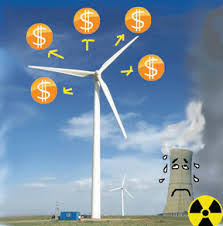
Conventional nuclear power, on the other hand, requires years to decades of planning and
construction, truly massive upfront capital costs and the plants don’t
produce any power until they are switched on.
One way that the nuclear
sector is adapting is through the development of “small modular
reactors” (SMRs). Last week, Keir Starmer used Donald Trump’s state
visit to sign a deal for the US to produce such reactors for the UK. Costs
are expected to remain high though. Right now, a watt of conventional
nuclear energy costs about three to five times as much as solar and even
the best estimates for SMR cost reductions aren’t expected to make up
that gap.
The UK Government accepts that SMRs will only reduce the cost of
electricity by about 20% compared to conventional nuclear, which will mean
they will remain the most expensive way to generate electricity for the
foreseeable future. The future of energy, especially in Scotland, isn’t
going to be expensive conventional nuclear or expensive and untested SMRs.
It’s going to be by capturing the wind, waves and sun all around us and
bottling it for later use.
The National 25th Sept 2025, https://www.thenational.scot/politics/25496145.sorry-donald-trump-keir-starmer—scotland-doesnt-need-nuclear/
Safety fears as external power to Zaporizhzhia nuclear plant still out after three days

Guardian, 27 Sept 25 https://www.theguardian.com/world/2025/sep/27/safety-fears-as-external-power-to-zaporizhzhia-nuclear-plant-still-out-after-three-days
Ukrainian officials among those concerned Russia is manufacturing crisis to keep hold of frontline plant
External power to the Russian-occupied Zaporizhzhia nuclear plant has been cut for more than three days, a record outage that has prompted safety concerns over the six-reactor site on the frontline of the Ukraine war.
Emergency generators are being used to power cooling and safety systems after the final power line into the plant was cut on the Russian side at 4.56pm on Tuesday and there is no immediate sign that the line will be reconnected.
Rafael Grossi, the director general of the International Atomic Energy Agency (IAEA), described the situation as “deeply concerning” on Wednesday and met Vladimir Putin on Thursday but the situation has continued.
Western experts and Ukrainian officials fear the Kremlin is manufacturing a crisis to consolidate its grip over the plant, which is Europe’s largest, and that Russia is taking high-risk steps to turn on at least one reactor despite the wartime conditions.
“Russia is using the nuclear power station as a bargaining chip,” said one Ukrainian government official, while a specialist at Greenpeace said the Russian occupation had entered “a new critical and potentially catastrophic phase”.
Stress tests by European regulators after the 2011 Japanese reactor disaster at Fukushima indicated that a nuclear plant should be able to operate without external power for 72 hours. Going beyond that time limit is untried, Ukrainian sources said.
Russia seized the Zaporizhzhia nuclear plant in March 2022 and its reactors, once capable of powering 4m homes, were put into cold shutdown for safety.
Ukraine regards the nuclear plant as its own but the plant has cropped up in negotiations between Donald Trump and Putin. Trump has tried to suggest the US should to take control, while the Kremlin has said it wants to restart all the reactors and connect them to the Russian grid – a task considered feasible only during peacetime.
External power has been lost at Zaporizhzhia nine times before. On each occasion the damage was done in Ukrainian-held territory by Russian forces striking energy infrastructure across the Dnipro. The final 750-kilovolt electricity line had run across the river, with Ukraine willing to supply energy to maintain safety.
On Tuesday the line was damaged on the Russian side, about a mile from the plant. The plant’s Russian operators said repair efforts were “complicated by ongoing shelling by the Ukrainian armed forces”, though Ukraine says it never fires at or around the plant, arguing it would be unacceptably risky.
The IAEA said it had been told by the Russian operators that there was enough diesel to power the generators for 20 days without fuel resupply. But Grossi said loss of external power “increases the likelihood of a nuclear accident”.
Seven out of 18 available generators are powering cooling on site but if they were to fail, Ukrainian sources said, there would be a risk that the nuclear fuel in the six reactors would heat uncontrollably over a period of weeks, leading to a meltdown.
An accelerated version of this scenario happened at Fukushima because the reactors had just been operating. A 9.0-magnitude earthquake struck Japan and the hot reactors on the site were automatically shut down in response. Emergency generators continued to pump cooling water around the reactor but these were knocked out by a tsunami that followed minutes later. Three nuclear cores at the plant melted down within three days, though the fuel remained contained. Nobody was killed [?] but more than 100,000 were evacuated.
Putin just gave Trump the opportunity to maintain nuclear restraint. Will he seize it?
Bulletin, By Matthew Bunn | September 25, 2025
President Donald Trump has an opportunity to avoid the dangers of an unrestrained nuclear arms competition—something he has repeatedly warned about. New START, the last treaty limiting US and Russian nuclear arms, expires this coming February. This happens as China is engaged in a rapid nuclear buildup, Russia is building exotic new nuclear delivery systems and rattling its nuclear saber over the war in Ukraine, and North Korea continues its smaller but still frightening nuclear expansion with weapons now able to reach the continental United States.
To deter all these threats at once, many people in Washington are arguing that the United States should leap past the New START limits when the treaty expires, adding hundreds or even thousands of additional nuclear warheads. That, however, would mean a world with no limits at all on strategic nuclear forces for the first time in half a century. A US nuclear buildup, coupled with growing US missile defenses, would likely provoke still further buildups in Russia and China, leading to all the unpredictability and risk of a nuclear competition with no agreed limits.’But Russian President Vladimir Putin has just opened an opportunity to avoid that, at least for now.
Speaking at a meeting of his advisory Security Council on Monday—only hours ahead of the UN General Assembly in New York—Putin announced that “Russia is prepared to continue adhering to the central quantitative limitations of the New START treaty for one year.” He added that the offer stands as long as the United States does the same and does not take other steps “that undermine or disrupt the existing balance of deterrence potentials.” This is an important reversal. Putin has repeatedly rejected arms control talks throughout the war in Ukraine.
President Trump should quickly take Putin’s offer, while pushing Russia to also accept a return to on-site inspections and data exchanges. The president should then use that “pause” with limits still in place to explore what new accords might look like, in discussions with Russia, China, and potentially other nuclear powers…………………………………………………………………………………………………… https://thebulletin.org/2025/09/putin-just-gave-trump-the-opportunity-to-maintain-nuclear-restraint-will-he-seize-it/
Russia, Iran sign nuclear power plants deal as sanctions loom
Agreement between Rosatom and Iran targets energy expansion with eight new nuclear plants planned by 2040.
By Usaid Siddiqui and Reuters, 24 Sep 2025, https://www.aljazeera.com/news/2025/9/24/russia-iran-sign-nuclear-power-plants-deal-as-sanctions-loom
Russia and Iran have signed a memorandum of understanding on the construction of small nuclear power plants in Iran, according the Russian state nuclear corporation Rosatom, as Tehran has been engaged in a diplomatic push to avert new sanctions over its nuclear programme.
The agreement was signed by Rosatom chief Alexei Likhachev and Iran’s top nuclear official, Mohammad Eslami, on Wednesday at a meeting in Moscow. Rosatom described it as a “strategic project”.
Eslami, who is also Iran’s vice president, told Iranian state media earlier this week that the plan was to construct eight nuclear power plants as Tehran seeks to reach 20GW of nuclear energy capacity by 2040.
Iran, which suffers from electricity shortages during high-demand months, has only one operating nuclear power plant, in the southern city of Bushehr. It was built by Russia and has a capacity of approximately 1GW.
The development comes amid looming sanctions on Iran, after the United Nations Security Council voted on Friday not to permanently lift economic sanctions on Iran over its nuclear programme, meaning sanctions will return by September 28 if no significant deal is reached beforehand.
Russia was among four nations that voted to stop the sanctions from being reintroduced.
Iran pushed back against the UNSC vote, saying the resumption of sanctions would “effectively suspend” the country’s cooperation with the International Atomic Energy Agency (IAEA), the UN watchdog.
The vote followed a 30-day process launched in late August by the United Kingdom, France and Germany – known as the E3 – to reinstate sanctions unless Tehran meets their demands.
The E3 have accused Tehran of breaching its nuclear commitments, including by building up a uranium stockpile of more than 40 times the level permitted under a 2015 nuclear deal, from which Trump unilaterally withdrew in 2018, during his first term. The deal allowed Iran to enrich uranium up to 3.67 percent purity.
In its defence, Iran says it boosted its nuclear enrichment only after Trump withdrew from the deal and reimposed sanctions on the country. Tehran deems the US action a violation of the 2015 deal.
Iranian officials have accused the European trio of abusing the dispute mechanism contained in the 2015 Treaty on the Non-Proliferation of Nuclear Weapons (NPT), which allows for the application of sanctions under a “snapback mechanism”.
New sanctions would result in freezing of Iranian assets abroad, a halt in arms deals with Tehran, and penalise the development of ballistic missile programme, among other measures.
Iran has repeatedly denied pursuing nuclear weapons but affirmed its right to peacefully pursue nuclear energy. Addressing the United Nations General Assembly on Wednesday, Iran’s President Masoud Pezeshkian said Tehran would never seek a nuclear bomb.
On Tuesday, Iran’s Supreme Leader Ayatollah Ali Khamenei said Tehran will not directly negotiate with the United States over Iran’s nuclear programme, calling talks with the US “a sheer dead end”.
Tensions escalated this June, when Israel launched a 12-day war on Iran, with Israeli and US forces striking several nuclear facilities.
In move that could Bring in NATO, Spain joins Italy in Sending Rescue Ship for Sumud Gaza Aid Flotilla
INFORMED COMMENT, Juan Cole, 09/25/2025, https://www.juancole.com/2025/09/spain-rescue-flotilla.html
Ann Arbor (Informed Comment) – On Wednesday, the socialist government of Pedro Sánchez in Spain announced that it would dispatch a rescue ship to be in the vicinity of the 50 ships that make up the Sumud (steadfastness) flotilla aiming to provide humanitarian relief to the Gaza Strip. It joins Italy in this endeavor. This according to Carlos E. Cué and Miguel González at El Pais.
The Sumud has come under repeated Israeli drone fire. On Wednesday, Israeli drones dropped explosives in the vicinity of the ships moored off the island of Crete, but caused no damage or injuries.
Prime Minister Sánchez said from the UN General Assembly meeting in New York, “The government of Spain requires that international law be observed and that the right of our citizens to navigate the Mediterranean in conditions of security be respected. For this reason, tomorrow a Maritime Action vessel will depart [the base in Cartagena] with all the means of assisting the flotilla or of carrying out any rescue, if necessary.”
Israel has routinely violated the law of the seas by attacking ships in international waters. Spanish citizens are taking part in the Sumud flotilla, and Spain is saying they have the right to do so.
Some 82% of Spaniards categorize what Israel is doing in Gaza as a genocide, a massive proportion that demonstrates that Israel’s actions are condemned by large numbers of people on both the left and the right. But note that 85% of centrists and 97% of Spaniards on the left view the Gaza campaign as genocidal.
The Maritime Action ship is not intended to shoot down attacking Israeli drones or to defend the Sumud ships from being boarded by the Israeli military. It will, however, rescue any passengers that end up in the sea because of Israeli actions.
It should be underlined, however, that it is entirely possible that the Maritime Action vessel will come under Israeli fire, which would spark an enormous diplomatic and military crisis.
Spain and Italy are both NATO members, and Article 5 says that “an attack on one is an attack on all.” NATO invoked this principle after the September 11, 2001, al-Qaida attacks on New York City and Washington, D. C., which is why there were NATO troops in Afghanistan but not in Iraq, which the rest of NATO did not view as a belligerent.
Thus, if Israel attacks the Spanish escort ship, it could stir up a strong European reaction, and would put the Trump administration on the spot, since Trump will side with Israel against NATO.
Spain’s maritime action vessels can accommodate 80 passengers. They are also armed with a 76-millimeter gun, two machine guns, and a surveillance drone of their own. This one will have a crew of 50 and 8 medical staff.
Sanchez’s government reached out to Italy for coordination, and sought to add another country to the escort, such as Ireland.
For her part, Italian PM Giorgia Meloni, from a far right party, faced a national strike involving 500,000 people on Monday over her refusal to recognize a Palestinian state alongside France and Britain. She said Tuesday that she’d recognize Palestine if Hamas releases Israeli hostages and if the organization is excluded from any Palestinian government going forward. This position was the one taken by British Prime Minister Keir Starmer until Sunday, when he folded before the weight of sentiment among his back-benchers.
SNP defence plans ‘risk EU and NATO membership’, analyst warns
Current SNP policy states that nuclear weapons would be removed from
Scotland ‘in the safest and quickest way possible’ after independence. A
defence analyst has warned the SNP’s current plans for defence risk
potential future EU membership, NATO relations and independence.
He also
stressed ditching nuclear would take “a minimum” of two decades. Edward
Arnold, a senior research fellow for European security within the
International Security department at the Royal United Services Institute
(RUSI), has said Scotland must avoid giving NATO a “massive headache” by
ditching nuclear – a move he said would, in turn, aggravate EU members.
Current SNP policy states that nuclear weapons would be removed from
Scotland “in the safest and quickest way possible” after independence. It
also states that Scotland would apply to join NATO and the European Union,
participating fully in the EU’s Common Security and Defence Policy.
However, Mr Arnold told The Herald NATO membership and the removal of the
Trident nuclear deterrent at Faslane are “completely incompatible”.
Herald 25th Sept 2025, https://www.heraldscotland.com/politics/westminster/25492447.snp-defence-plans-risk-eu-nato-membership-analyst-warns/
1 This Month


31st January – Challenging the War Machine – a DECLASSIFIED UK SUMMIT



Website of the Week
Now until to February 10, 2026 Radioactive waste storage in France: the debate is finally open! How to participate?
-
Archives
- January 2026 (220)
- December 2025 (358)
- November 2025 (359)
- October 2025 (377)
- September 2025 (258)
- August 2025 (319)
- July 2025 (230)
- June 2025 (348)
- May 2025 (261)
- April 2025 (305)
- March 2025 (319)
- February 2025 (234)
-
Categories
- 1
- 1 NUCLEAR ISSUES
- business and costs
- climate change
- culture and arts
- ENERGY
- environment
- health
- history
- indigenous issues
- Legal
- marketing of nuclear
- media
- opposition to nuclear
- PERSONAL STORIES
- politics
- politics international
- Religion and ethics
- safety
- secrets,lies and civil liberties
- spinbuster
- technology
- Uranium
- wastes
- weapons and war
- Women
- 2 WORLD
- ACTION
- AFRICA
- Atrocities
- AUSTRALIA
- Christina's notes
- Christina's themes
- culture and arts
- Events
- Fuk 2022
- Fuk 2023
- Fukushima 2017
- Fukushima 2018
- fukushima 2019
- Fukushima 2020
- Fukushima 2021
- general
- global warming
- Humour (God we need it)
- Nuclear
- RARE EARTHS
- Reference
- resources – print
- Resources -audiovicual
- Weekly Newsletter
- World
- World Nuclear
- YouTube
-
RSS
Entries RSS
Comments RSS
 nuclear-news