Macron ‘panicking’ as France faces ‘catastrophic’ nuclear energy crisis, expert claims

France is in a catastrophic situation in terms of the vast debt that it owes in nuclear and the existential waste and decommissioning problem that it is facing
A record number of France’s 56 nuclear reactors have gone offline, sparking serious concerns over energy security across the Channel.
https://www.express.co.uk/news/science/1713491/macron-france-nuclear-energy-edf-crisis By JACOB PAUL, Dec 23, 2022, French President Emmanuel Macron is said to be in a “panic” as the issues with France’s ageing nuclear reactors have laid bare the flaws in the country’s energy plans, an expert has told Express.co.uk. Sixteen out France’s 56 nuclear reactors are currently offline due to corrosion and maintenance issues, sending its normal power output levels plummeting in recent months. Prior to these problems, France’s nuclear fleet generated 70 percent of the country’s electricity.
According to Dr Paul Dorfman, a nuclear expert from the University of Sussex, France’s “chickens are coming home to roost” as the decision to rely so heavily on nuclear is appearing to backfire, with further delays to repairs also announced this week.
He said: “France was nuclear power excellence, post-war all buffed up with power – it said it was going to be the top dogs. So it had a vast quantity of nuclear reactors dotted all around France. But what is happening now is that its chickens are coming home to roost.
“EDF (owned by the French state) is 43billion euros in debt, it faces a 100billion euro bill for mandatory safety upgrades, and a significant number of its reactors continue to be offline due to ageing corrosion problems. It also faces a huge decommissioning and waste management bill that is uncosted – they are just beginning to say ‘oh my god’.
“Around a quarter of their reactors are still offline at winter when they really need it. They are even importing power from Germany after being a net exporter. France is panicking about what to do about renewables and insulation.”
But all this could be of concern for Britain, which does rely on some French imports that are sent across the Channel via interconnectors. National Grid has previously warned that if the UK fails to shore up enough energy imports from Europe this winter, it may have to roll out organised blackouts in the “deepest, darkest” nights of the coldest months of the year.
However, while France’s nuclear power issues have sparked concern, Dr Dorfman said the UK is luckier than France in that it is one of the leading players in offshore wind, which could provide a vital lifeline this winter.
He said: “The UK has seriously thought about renewables in the last few years, without any question. But there have been problems with onshore wind and legislation issues. There also problems with the legislation for solar, but offshore wind has helped enormously. But the UK hasn’t really considered about the lowest hanging through which is energy efficiency and insulation.”
When asked whether the UK is lucky that it has not copied the French model, Dr Dorfman responded: “We are hugely lucky. France is in a catastrophic situation in terms of the vast debt that it owes in nuclear and the existential waste and decommissioning problem that it is facing…The UK is certainly in a better position in terms of offshore windpower, but it needs to get its act together in terms of allowing much greater onshore wind and much greater solar…and all the things that make up a balanced energy portfolio.
“France is not going to change, the reactors are not going to get any younger. Rumour has it, the corrosion issues have been known about for years. Because it takes so long to build reactors, you can’t expect new builds to happen within a decade or two decades.
“Nobody knows what is going to happen with Russia. All we know amongst all this mess is that renewables cost between a quarter and a fifth less than nuclear and that the vast majority of all new power additions worldwide is renewables.”
This comes as analysis by leading renewable energy trade bodies revealed that low carbon power reportedly met more than half of the UK’s electricity needs over the past two months. Renewable UK, the Nuclear Industry Association found that between the end of October and December 18, clean energy sources like wind and solar provided 40 percent of the country’s electricity, while nuclear power plants accounted for 14 percent of demand.
The power that came from both offshore and onshore wind turbines alone generated more than half of Britain’s low carbon power output over the period, while nuclear supplied 27 percent.
European NATO members should reduce reliance on US – Macron
https://www.rt.com/news/568736-european-nato-reliance-macron/ 23 Dec 22, The countries should bolster their own defense to become less dependent on both the bloc and Washington, the French president says.
French President Emmanuel Macron has said European NATO members should become more autonomous and less dependent on the US-led alliance regarding their own security. He made the remarks late Wednesday, as he spoke to reporters in Paris after returning from a summit in Amman, Jordan.
“An alliance isn’t something I should depend on. It’s something that I should choose, something I work with,” Macron stated. “We must rethink our strategic autonomy.”
Macron identified “technology and defense capabilities” as areas in which European nations should seek to reduce their dependence on the alliance, and the US in particular. He added, however, that member states should not endeavor to break away from the bloc or develop an alternative to it.
“There is no European security architecture without strategic autonomy, inside NATO and with NATO, but not dependent on NATO,” he said.
Macron also touched upon the ongoing hostilities between Russia and Ukraine, in which the latter has received wide-ranging Western support. While reiterating his support for the “absolute defense of Ukraine,” he said once again that Moscow’s security concerns should be also addressed.
“When I speak of guarantees, I’m talking about all of these countries, for us, but also for Russia,” Macron stated. “This means that one of the essential points we must address – as President Putin has always said – is the fear that NATO comes right up to its doors, and the deployment of weapons that could threaten Russia.”
In recent weeks, the French president has repeatedly said that the conflict must eventually end with negotiations, which should yield security guarantees for everyone, including Russia. This stance triggered a barrage of criticism from Ukraine and some EU nations, with Poland, Slovakia, and the Baltic states openly opposing Macron’s suggestion.
Russia has signaled on several occasions that it is ready to talk with Ukraine – and the West as a whole – while insisting that its own interests must be taken into account if negotiations are to occur. Moscow has blamed the lack of diplomatic efforts to end the conflict on Kiev. On Wednesday, the head of Russia’s Federation Council, Valentina Matvienko, said there is “no background for negotiations to take place in the near future: There is nothing [to discuss] and with no one.”
Senior officials in Kiev have repeatedly issued belligerent statements, with Ukrainian President Vladimir Zelensky pledging to re-capture the former Ukrainian regions of Donetsk, Lugansk, Kherson, and Zaporozhye – which joined Russia in early October – as well as Crimea, which broke away from Kiev in 2014. Zelensky has even ‘banned’ himself from negotiating with Russian President Vladimir Putin.
Campaign groups want answers on increase in radioactive particles found onDounreay foreshore.
Highlands Against Nuclear Transport (HANT) and the
Nuclear Free Local Authorities Scottish Forum have written to site managing
director Mark Rouse and Nicole Paterson, the chief executive of the
Scottish Environment Protection Agency (Sepa). The campaigners claim the
information about the particles is “sketchy, incomplete and out-of-date”
and want the Dounreay Stakeholder Group (DSG) and the local and national
press to receive regular reports about their detection and retrieval.
John O’Groat Journal 22nd Dec 2022
In a blow to France’s electricity supply, EDF extends maintenance at nuclear reactors
Electricite de France SA extended maintenance halts at two nuclear
reactors by more than four months, adding a strain on power supplies in
France and neighbouring countries.
The restart of EDF’s Penly-2 unit has
been delayed from Jan. 29 until June 11 while its Golfech-1 unit has been
pushed back to June 11 from Feb. 18, the utility said Monday in a message
on RTE’s transparency website.
The halt of the Chattenom-3 reactor is
prolonged by one month until March 26, and the restart of Civaux-2 is
postponed by more than a month until Feb. 19.
Longer-than-planned
maintenance halts and repairs of unexpected pipe cracks are curtailing
EDF’s nuclear output and turning France into a power importer when it’s
normally a key exporter.
The nation’s grid operator has warned of a
potential electricity shortfall in colder months as heating demand rises
while the utility grapples with the reactor repairs. EDF announced on
Friday the delayed the startup of a new nuclear reactor in western France
by several months into 2024 due to extended work. That project is already
more than a decade late.
Bloomberg 19th Dec 2022
Kremlin: “US & Russia On The Brink Of A Direct Clash” In Ukraine
BY TYLER DURDEN, https://www.zerohedge.com/geopolitical/kremlin-us-russia-brink-direct-clash-ukraine 19 Dec 22
The Kremlin is urgently calling on Washington to avoid further escalation over its support to Ukraine’s military, on the same day that President Vladimir Putin made a rare state visit to neighboring Belarus, amid growing fears that Belarusian armed forces could enter the fighting in Ukraine.
Russian Foreign Ministry spokeswoman Maria Zakharova said Monday that the United States’ “dangerous and short-sighted policy” has put it “on the brink of a direct clash” with Moscow, according to state media reports.
“It is the US’ desire to maintain American hegemony at all costs… as well as its arrogant unwillingness to engage in a serious dialogue on security guarantees” that led to the current crisis, she continued, in reference to Moscow’s last February pre-invasion appeal for “guarantees” that Ukraine would not enter NATO.
State media described the sharp words as a necessary reaction to US State Department Spokesman Ned Price’s recently placing sole blame on Moscow for the rapid deterioration in US-Russia relations. Price had characterized the current state of relations as “unstable and unpredictable”.
Zakharova continued in the Monday remarks: “After the high-profile fiasco in Afghanistan, America is increasingly drawn into a new conflict, not only supporting the neo-Nazi regime in Kiev financially and with weapons, but also increasing its military presence on the ground.” While not specifying the precise accusation regarding a US “presence on the ground” – this could be a reference to recent widespread reporting that US intelligence has expanded its role in helping the Ukrainians, especially with things like targeting.
“This is a dangerous and short-sighted policy that puts the US and Russia on the brink of a direct clash,” the FM spokesperson said further. “For its part, Moscow urges the Joe Biden administration to soberly assess the situation and not to unleash a spiral of dangerous escalation. We hope that they will hear us in Washington, though there is no reason for optimism so far.”
This month has witnessed multiple bombshell revelations concerning the Pentagon and US intelligence’s deepening role in Ukraine, including the following:
The White House is mulling the transfer of Patriot missiles to Ukraine.- The Pentagon is expanding its “on the ground” program of small troop units seeking to monitor and account for US arms transfers.
- Russia is increasingly coming up against US-supplied HIMARS missiles on the battlefield.
- The US has sent an infantry company to Estonia, close to the Russian border for joint drills.
- Calls have grown louder for NATO to “close the skies” over Ukraine, including with the potential transfer of warplanes.
- US intelligence has been assisting Ukrainians with targeting Russian generals.
- The White House has indicated it believes Ukraine’s forces are capable of retaking Crimea, but which would risk a nuclear response.
- Ukraine has increased high-risk attacks inside Russian territory.
Ukraine has also grown bolder in showing off its new American-supplied toys…
All of this and more strongly suggests to two sides are indeed inching toward direct showdown and clash, also as there still appears no appetite for so much as a plan even remotely on the horizon to get Kiev officials to the ceasefire negotiating table with Russia.
As for the ongoing speculation that Belarusian forces could enter the Ukraine conflict in support of Russia, top Russian officials are denying this “option”… for now at least.
Chinese nuclear company still has a stake in UK’s Hinkley Point C project, and approval to build Bradwell project.
Following mounting pressure from Washington, the UK decided to ban Huawei
and other vendors it considered to be a high security risk from its 5G
networks in 2020. In November, after months of prevaricating, the
Government blocked the sale of Newport Wafer Fab, the UK’s largest
semiconductor plant, to Chinese-owned Nexperia.
It also bought the Chinese
state-owned power group CGN out of its stake in the Sizewell C nuclear
energy project in Suffolk. Under a long-standing deal, CGN, which the US
placed on an export blacklist back in 2019 after Washington accused it of
stealing American know-how for military purposes, invested in Hinkley Point
C power station in Somerset; then Sizewell C, which has just been given the
green light; and is still technically due to be the lead investor at
Bradwell-on-Sea in Essex where it is hoping to instal its own design of
reactor.
The Chinese company still retains a stake in Hinkley Point and
received formal approval for Bradwell from the UK’s nuclear regulator in
February. But there is growing scepticism at Westminster that the Chinese
will ever be able to build on the site.
Telegraph 18th Dec 2022
https://www.telegraph.co.uk/business/2022/12/18/how-foreign-states-raided-britains-crown-jewels/
Russia building giant dome over Europe’s largest nuclear plant’s spent fuel stores, to shield them from Ukrainian attacks
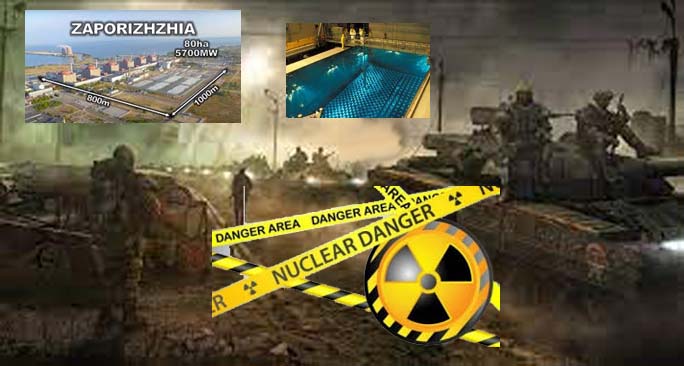
The structure will shield stores of spent radioactive fuel from Ukrainian attacks.
https://www.rt.com/russia/568415-zaporozhye-nuclear-dome-ukrain 18 Dec 22
Russia is constructing a protective dome over spent radioactive fuel stores at the Zaporozhye nuclear power plant as Ukrainian forces continue to target the facility, senior regional official Vladimir Rogov has said.
He took to Telegram on Saturday to post a short video of the work that’s taking place. It showed technicians setting up shields over the tanks that hold spent nuclear fuel.
The dome is designed to protect the storage facilities from shrapnel and improvised explosive devices carried by drones, the official explained, adding that it would be reinforced further at a later period.
Russia’s nuclear energy corporation Rosatom had earlier warned that damage to the spent-fuel containers risks a release of radioactive material into the atmosphere, with unpredictable consequences.
The construction of the dome comes amid continued attacks on the Zaporozhye nuclear power plant and the nearby town of Energodar, which Moscow blames on Kiev. Russia has repeatedly said that such strikes could result in a nuclear disaster that would eclipse the 1986 Chernobyl incident and affect many countries in Europe.
Ukraine initially claimed that the Russian military had been hitting the plant itself as part of “false-flag” operations to make Kiev look bad. However, Ukrainian general staff eventually admitted to striking the area around the nuclear facility.
The Zaporozhye nuclear power plant, which is the largest on the continent, has been under Russian control since February 28. All of the reactors at the facility are currently shut down due to the security situation.
Zaporozhye Region, together with three other former Ukrainian territories – Kherson Region and the People’s Republic of Donetsk and Lugnask – joined Russia in autumn after holding referendums.
Watchdog estimates civilian death toll from Ukrainian attacks on Donbass
https://www.rt.com/news/568395-us-troops-deployed-estonia/ 14 Dec 22, More than 4,500 people have been killed since mid-February, with supplies of NATO weapons resulting in a surge of deaths, observers claim.
Weapons supplied to Ukraine by NATO countries have allowed Kiev’s military to significantly ramp-up attacks on civilian targets in Donbass, a local watchdog has said.
The group claims that over 4,500 civilians have been killed and 4,000 injured since Ukrainian forces escalated shelling in mid-February.
Military terror has escalated beyond all limits after NATO members started supplying weapons to Ukraine,” the Joint Center for Control and Coordination (JCCC), a monitoring group that tracks attacks on the Lugansk and Donetsk People’s Republics, said on Wednesday.
“We have recorded a four-fold increase in the number of victims among the civilian population,” Natalya Shutkina, a representative from the Donetsk People’s Republic at the JCCC, said as quoted by TASS.
The JCCC held a press conference on Wednesday during which it showed fragments of Western shells and rockets collected after Ukrainian strikes in Donbass and explained the toll these attacks had taken.
Since February 17, 4,527 civilians have been killed, including 154 children, Shutkina stated. Another 4,317 civilians, including 274 children, have been injured, she said, adding that Ukrainian attacks have damaged over 12,000 homes, 128 medical facilities, and 67 sites required for providing basic utilities, such as water and heating.
The record-keeping begins in mid-February when the Donbass republics reported a significant escalation of strikes by Kiev in the lead-up to Russia having recognized the DPR and LPR as sovereign states and pledged to defend them. The two regions have since been incorporated into Russia following referendums in September.
Shutkina pointed out that the weapon systems provided by the US and its allies are supposed to be more accurate than the Soviet-era artillery guns and rocket launchers that Ukraine possessed previously. This leads the JCCC to believe that the Ukrainian attacks on civilian facilities have been intentional rather than being part of indiscriminate strikes, she stressed.
READ MORE: Children injured in Ukrainian shelling of Donetsk – authorities
Darya Morozova, the human rights ombudsman for the DPR, urged international organizations to acknowledge Kiev’s actions, arguing that “if the world community didn’t encourage the Ukrainian leadership with its inaction, the war in Donbass would have stopped a long time ago.” She called on Kiev’s sponsors to stop sending heavy weapons to Ukraine.
Weapons delivered to Ukraine ‘beginning to filter’ to Africa: Nigeria
https://english.almayadeen.net/news/politics/weapons-delivered-to-ukraine-beginning-to-filter-to-africa: By Al Mayadeen English , Source: Agencies, 3 Dec 22
Nigerian President Muhammadu Buhari urges heads of states from neighboring states participating in the Lake Chad Basin Commission to confront the issue of Western arms smuggling from Ukraine.
Weapons supplied to Ukraine from Western countries are “starting to flow” into the Lake Chad basin region, Nigerian President Muhammadu Buhari warned this week.
Addressing the heads of states from neighboring states participating in the Lake Chad Basin Commission on Tuesday in the Nigerian capital of Abuja, the president said, “Regrettably, the situation in the Sahel and the raging war in Ukraine serve as major sources of weapons and fighters that bolster the ranks of the terrorists in the region.”
Buhari then urged his counterparts to increase security cooperation in order to confront the issue of arms smuggling.
The Nigerian president agreed to step up military coordination in their countries’ war against Boko Haram and ISIS terrorists, who are now apparently receiving weapons from Ukraine, alongside the leaders of Benin, Chad, Niger, and the Central African Republic.
Last month, Finnish police said that some of the “huge quantities” of weapons being shipped to Ukraine had made their way to Finland, where “three of the world’s largest motorcycle gangs” now operate, including Bandidos MC, which “has a branch in every major city in Ukraine.”
In August, an American news outlet unmasked that a shockingly large amount of weaponry heading for Ukraine was untraceable. “Like 30% of it reaches its final destination,” said a tweet that was later deleted after a swarm of online trolls attacked it.
Russian Defense Minister Sergei Shoigu had previously said the arms supplied by the West to Ukraine were ending up on the black market and spreading across West Asia.
Similarly, Russian Foreign Minister Sergey Lavrov had pointed out that Stingers and Javelin missiles, supplied by the West to Kiev, were already being sold at a discount on the black market and have surfaced in Albania and Kosovo, which Russia has warned for so long.
Ukraine has received billions and billions of dollars in donated arms from the United States and its allies such as the United Kingdom and other NATO states in the past few months.
Ukraine Crisis Highlights Security Needs Of Civilian Nuclear Power

[[Ed – “a secure environment for the proliferation of nuclear energy.”? Pigs might fly?]
Ariel Cohen, Forbes, 16 Dec 22,
On November 27-28 a conference in Paris addressed a broad spectrum of challenges humanity is facing. Renowned thinkers, including Nuriel Roubini and Jacob Frenkel, the former Chairman of JP Morgan International, and three central bankers from Iceland, Tunisia, and Armenia, warned about inflation and the growing mountain of debt threatening the global economy. The panel at which this author addressed civilian nuclear security was organized by Dialogue of the Continents, a project of the Astana Club, the brainchild of the Nazarbayev Foundation. The panel was chaired by the veteran nuclear policy expert Ambassador Kairat Abusseitov, the former First Deputy Foreign Minister of Kazakhstan.
Today the planet shudders at the prospect of Russia’s first use of nuclear weapons and its military attacks on Ukrainian nuclear reactors. The world faced nuclear crises before. On October 27th, 1962 Vasili Arkhipov, a former Vice Admiral in the Soviet Navy, prevented a nuclear war when he countermanded the orders of two other officers and prevented a nuclear attack against the US Navy during the Cuban Missile Crisis. In September 1983 Soviet Airforce Colonel Stanislav Petrov manually overrode a missile launch system that erroneously detected an American attack. Two months later in November 1983 the NATO military exercise Able Archer almost triggered World War III when the Soviets believed it to be a real attack. In 1995 a Norwegian weather missile almost triggered a Russian massive strike on the U.S., which President Yeltsin canceled.
In every instance, nuclear war was prevented by the judgment of individuals where systems had failed. This was possible as adversarial powers recognized the “rules of the game” and created an atmosphere of cooperation to avoid nuclear confrontation amidst other profound disagreements.
That atmosphere is gone, and the next time a Russian alert system goes off we may not have a Colonel Petrov to save us. And it won’t be the ballistic missiles that may be the cause of a massive nuclear disaster.
International law explicitly provides for the immunity of nuclear power plants during war. There are even measures that specifically plan for their safety. The International Atomic Energy Agency (IAEA) for instance has promulgated 16 legally binding conventions rand protocols under the international legal framework for nuclear security to prevent, detect and respond to threats to nuclear security within one state. Nevertheless, the international community has proven unable to stymy Russian actions [and Ukrainian] around Chernobyl and the Zaporizhzhia Nuclear Power Plants that amount to nuclear blackmail and flagrantly violate these laws.
Enforcing the existing international law is easier said than done. International law presupposes an agreement between state actors, which is sorely lacking today. Calling counter-terrorism instruments into action requires UN approval, created by an ad hoc committee……………..
Being a nuclear state under the non-proliferation treaty Russia is under no obligation to place the Zaporizhzhia plant under IAEA safeguards and given the likelihood that it will not recognize that the plant comes under Ukraine’s comprehensive safeguards agreement, IAEA may find access to the plant completely denied next fall.
This is not just a Russian or Ukrainian problem; this is an emerging structural problem of the international energy security system that will reoccur if nothing is done now……………………………………. The future ubiquity of civilian nuclear power means that currently lacking international frameworks must be overhauled – or civilian nuclear power would be un-investable and too risky.
……………. A false sense of security after the Cold War has dangerously numbed many to the existential threat that nuclear weapons represent, with polls repeatedly showing an alarming lack of concern towards these tools of extinction………………………………………………. more https://www.forbes.com/sites/arielcohen/2022/12/16/ensuring-the-security-of-civilian-nuclear-power/?sh=25e66be71f24
Russia installs sheild over Zaporizhzhia nuclear storage site
A shield is being set up over a storage site for spent nuclear waste at the
Zaporizhzhia nuclear power plant in southern Ukraine to protect it from
shelling and drones, a Russian-installed official said on Saturday. Video
footage published by Vladimir Rogov, a Russian-appointed official in
Ukraine’s Zaporizhzhia province, showed workers mounting a screen of what
appeared to be some kind of transparent sheeting on wires above dozens of
concrete cylinders about 5 metres (16 feet) high.
Reuters 17th Dec 2022
U.S. troops deployed near Russian border
U.S. troops deployed near Russian border –Estonia’s defense ministry has announced the arrival of an American infantry company as part of NATO’s presence in the country | 16 Dec 2022 | A United States infantry company arrived in Estonia this week as part of NATO’s effort to bolster the military bloc’s eastern border with Russia, the Baltic country’s defense ministry has revealed.
A statement published on the ministry’s website on Friday said that U.S. service members are stationed at Taara base in the town of Voru, some 20 kilometers from the Russian border. Commenting on the U.S. service members’ arrival, Colonel Mati Tikerpuu, the commander of the 2nd Infantry Brigade of the Estonian Defense Forces, said he expects to be able to “integrate our allies on a brigade level and gain an additional maneuver unit.” Colonel Richard Ikena, U.S. 1st Infantry Division Artillery Commander, said American troops are “excited to be in Estonia” and “look forward to working shoulder-to-shoulder, alongside our Allies.”
New Delay, Cost Overrun For France’s Next-gen Nuclear Plant

https://www.barrons.com/news/new-delay-cost-overrun-for-france-s-next-gen-nuclear-plant-01671212709 By AFP – Agence France Presse, December 16, 2022
Welding problems will require a further six-month delay for France’s next-generation nuclear reactor at Flamanville, the latest setback for the flagship technology the country hopes to sell worldwide, state-owned electricity group EDF said Friday.
The delay will also add 500 million euros to a project whose total cost is now estimated at around 13 billion euros ($13.8 billion), blowing past the initial projection of 3.3 billion euros when construction began in 2007.
It comes as EDF is already struggling to restart dozens of nuclear reactors taken down for maintenance or safety work that has proved more challenging than originally thought.
EDF also said Friday that one of the two conventional reactors at Flamanville would not be brought back online until February 19 instead of next week as planned, while one at Penly in northwest Farnce would be restarted on March 20 instead of in January.
The French government has warned of potential power shortages this winter because of the shutdowns at around two-dozen of the 56 reactors across the country that normally generate around 70 percent of its electricity needs.
EDF said the latest problems at Flamanville, on the English Channel in Normandy, emerged last summer when engineers discovered that welds in cooling pipes for the new pressurised water reactor, called EPR, were not tolerating extreme heat as expected.
As a result, the new reactor will be start generating power only in mid-2024.
The French-developed European Pressurised Reactor was designed to relaunch nuclear power in Europe after the 1986 Chernobyl catastrophe in Russia, and is touted as offering more efficient power output and better safety.
But similar projects at Olkiluoto in Finland, Hinkley Point in Britain and the Taishan plant in China have also suffered production setbacks and delays, raising doubts about the viability of the new technology.
French President Emmanuel Macron said in February that he wants a nuclear “renaissance” that would see up to 14 new reactors in France as the country seeks to reduce use of fossil fuels.
Twice as many people support onshore wind compared to nuclear power, according to UK Government survey.
Renewable energy of all sorts is at
least twice as popular with the British public compared to nuclear power
according to the newly released ‘BEIS Public Opinion Tracker Autumn
2022‘. Solar power was supported or strongly supported by 89% of
respondents, offshore wind by 85% and onshore wind by 79%. This was
compared to only 37% for nuclear power, 25% for fracking and 44% for carbon
capture and storage. The survey recorded that just 29% of people believe
that nuclear energy ‘provides a safe source of energy in the UK’.
100% Renewables 15th Dec 2022
For the Western leaders, Minsk Agreements were designed to buy time for Ukrainians to get ready for conflict with Russia
Former German chancellor Angela Merkel’s astonishing admission vis-a-vis Minsk II, made during an interview with German newspaper Die Zeit recently merely confirms that Putin was played for a fool when he entered negotiations for Minsk II with Germany, France and Ukraine in 2015. Russia entered said negotiations in good faith while the other parties involved did not. Thousands of lives lost and counting seven years on is the result.
Again and again, Ukraine’s future prosperity, security and stability upon becoming independent in 1991 was always dependent on it being a bridge between Russia and the West not the battlefield it became.
Merkel admits Minsk Agreements were designed to buy time for Ukrainians to get ready for conflict with Russia, yet Putin? Medium, John Wight, 13 Dec 22.
Sooner or later people in the West are going to have to wake up to the hard truth that their enemy is not at the gates but within the gates — this in the shape of ruling elites that have driven our world to the brink of destruction economically, ecologically, environmentally, and militarily with their lust for power, hegemony, domination and riches.
Before we go on, though, let us take a moment to deal with the usual ordure that gets shovelled in the direction of those in writing in the West who dare not type the name Putin in a sentence without also including words such as ‘tyrant’, ‘dictator’, ‘monster’ either before or after it — and preferably both. Here it is just as Eduardo Galeano said: “The marketplace of fear requires a steady supply of monsters.”
Russian President Vladimir Putin is a brutal man leading his country through a brutal period in human affairs. But he is not the architect of this brutal period; on the contrary, the Russia he has led since 2000 has been among the most grievous victims of it.
Canadian author and journalist Naomi Klein, in her remarkable work Shock Doctrine, describes how Russia was used as a laboratory by US free market think tanks, gurus and economists, who descended on the country while still reeling from the shock of the implosion of the Soviet system in the early 1990s. Their objective was the establishment of a pure market economy shorn of state intervention, wherein the market would decide who worked and who did not, who could heat themselves and who could not, who ate and who could not — and ultimately who would live and who would not………………………
The primary aim of the free market economic ‘hitmen’ who arrived in Russia in early 1990s was the decimation of every vestige of state involvement in the nation’s economy or economic life. Rather than the arbiter of social justice and guarantor of economic stability, the government was now to be reduced to the role of facilitator and guardian of the interests of international investors, shareholders, speculators, and global corporations.
This process entailed the deregulation of the banking system, the removal of social protections and safety nets, the lifting of price controls and the privatisation of all state owned sectors of the economy, sold off to speculators at a fraction of their true value. The aforementioned reforms were laid down as conditions of post-Soviet Russia’s membership of the IMF, when it applied to join under its first post-Soviet president, Boris Yeltsin, in 1992.
Moscow at this point was on the verge of bankruptcy, burdened with an external debt of $66 billion in the wake of the Soviet’s Union’s dissolution. The creditor nations of the G7 made it a condition of their cooperation in rescheduling the country’s debt that the IMF play a central role as policy advisor, lender and coordinator of assistance. Russia’s sovereignty, in other words, was to be suborned to the diktats of the IMF in Washington…………………………………………
the impact of this economic medicine on Russian society was nothing short of devastating. Most Russians consumed 40 percent less in 1992 after a year of shock therapy than they consumed in 1991, while a third of the population fell below the poverty line……………………
That the country managed to recover from this horrific decade was in large part down to the stewardship of Vladimir Putin. He it was who restored national pride, faced down the oligarchs who’d taken control of the nation’s economy, and reasserted the primacy of the state over that of blind economic forces.
Benefiting from its domination of the European energy market and an extended period of high oil and gas prices, Russia’s economic growth from 1999 — when Putin first became prime minister — to 2008 was exponential……………………..
The Putin so demonised in the West today is the same Putin that broached the possibility of Russia becoming a member of NATO with US President Bill Clinton in 2000. The Putin so demonised in the West today is the same Putin who was the first leader to call US President George W. Bush to express his condolences after 9/11 and offered the use of Russian airbases in Central Asia for US airstrikes against Al Qaeda and the Taliban in Afghanistan, staged in response.
That Putin is now to all intents engaged in conflict against the West in Ukraine marks an abject failure not of Russian but Western foreign policy in the wake of the demise of the Soviet Union.
Former German chancellor Angela Merkel’s astonishing admission vis-a-vis Minsk II, made during an interview with German newspaper Die Zeit recently merely confirms that Putin was played for a fool when he entered negotiations for Minsk II with Germany, France and Ukraine in 2015. Russia entered said negotiations in good faith while the other parties involved did not. Thousands of lives lost and counting seven years on is the result.
Again and again, Ukraine’s future prosperity, security and stability upon becoming independent in 1991 was always dependent on it being a bridge between Russia and the West not the battlefield it became.
In the words of Professor John J. Mearsheimer:
U.S. and European leaders blundered in attempting to turn Ukraine into a Western stronghold on Russia’s border. Now that the consequences have been laid bare, it would be an even greater mistake to continue this misbegotten policy. https://johnwight1.medium.com/merkel-admits-minsk-ii-was-designed-to-buy-time-for-the-ukrainians-to-get-ready-for-conflict-with-504191f7872d
1 This Month

of the week– Nuclear Reactor Information Task Force

14 May – online event From Bombs to Data Centres: the Face of Nuclear Colonialism
To see nuclear-related stories in greater depth and intensity – go to https://nuclearinformation.wordpress.com
-
Archives
- May 2026 (126)
- April 2026 (356)
- March 2026 (251)
- February 2026 (268)
- January 2026 (308)
- December 2025 (358)
- November 2025 (359)
- October 2025 (376)
- September 2025 (257)
- August 2025 (319)
- July 2025 (230)
- June 2025 (348)
-
Categories
- 1
- 1 NUCLEAR ISSUES
- business and costs
- climate change
- culture and arts
- ENERGY
- environment
- health
- history
- indigenous issues
- Legal
- marketing of nuclear
- media
- opposition to nuclear
- PERSONAL STORIES
- politics
- politics international
- Religion and ethics
- safety
- secrets,lies and civil liberties
- spinbuster
- technology
- Uranium
- wastes
- weapons and war
- Women
- 2 WORLD
- ACTION
- AFRICA
- Atrocities
- AUSTRALIA
- Christina's notes
- Christina's themes
- culture and arts
- Events
- Fuk 2022
- Fuk 2023
- Fukushima 2017
- Fukushima 2018
- fukushima 2019
- Fukushima 2020
- Fukushima 2021
- general
- global warming
- Humour (God we need it)
- Nuclear
- RARE EARTHS
- Reference
- resources – print
- Resources -audiovicual
- Weekly Newsletter
- World
- World Nuclear
- YouTube
-
RSS
Entries RSS
Comments RSS
 nuclear-news