“Great British Nuclear “- it’s high time that they came clean on what this will cost.

Bowen is right to think Britain’s nuclear plans will require “substantial” taxpayer support.
It’s high time the government spelt out how much financial fuel it’s willing to burn.
Maybe Great British Nuclear will prove as successful as Great British
Railways: another government invention still stuck in the sidings while the
strike-bound network grinds to a halt.

But at least Simon Bowen is after an
improvement on that. Who he? The industry adviser picked by ministers to
make their nuclear nirvana a reality. He’s setting up GBN, the “flagship
body” to corral the construction of up to 24 gigawatts of new capacity by
2050: a shopping list, he says, that will involve at least three more
mega-nukes on top of Hinkley Point C, plus a litter of small modular
reactors.
As he told MPs on the science committee, the new body will be the
“glue within the industry to drive the nuclear programme”. Always
assuming it gets set up, of course — because you can already sense
Bowen’s frustration with the government.
In a post-Ukraine war push for
energy security, it was Boris Johnson who declared that Britain should
“go nuclear and go large”, not that he spelt out the eye-popping costs
to the taxpayer. But Bowen’s report into how the new body should work,
complete with 25 recommendations, has since been passed from Liz Truss to
Rishi Sunak and deemed top secret.
To boot, from the latest PM he sees no
“overarching strategy” on what’s needed for energy security: the
“quantum of nuclear” or other technologies. That’s crucial because
“the investment required in nuclear is substantial”, he says, with the
same stuff underpinning successful international projects: “A substantial
amount of government leadership and fiscal support, not just in terms of
financing but who bears the risk.”
No private financier can see how
Sizewell gets built without the government injecting £5 billion-plus equity
and insulating investors from most construction risk. Build three big nukes
and you treble that problem before taking on small modular reactors — an
untried technology to which Rolls-Royce’s new boss, Tufan Erginbilgic,
seems disinclined to bring blue-sky finance. Add it up and Bowen is right
to think Britain’s nuclear plans will require “substantial” taxpayer
support. It’s high time the government spelt out how much financial fuel
it’s willing to burn.
Times 19th Jan 2023
https://www.thetimes.co.uk/article/great-british-nuclear-puts-treasury-on-alert-jjt987rlr
Call to end practice of transporting nuclear warheads through Cumbria
A CAMPAIGN group have called for an immediate end to the practice of
transporting nuclear warheads by lorry along motorways and roads in Cumbria
and elsewhere. Their renewed call comes in response to news that the
Ministry of Defence has admitted that 40 safety incidents involving convoys
transporting nuclear warheads were logged during 2019, 2020 and 2021,
following a freedom of information request.
Carlisle News & Star 18th Jan 2023
https://www.newsandstar.co.uk/news/23256357.call-end-practice-transporting-nuclear-warheads-cumbria/
Many years for removal and disposal of radioactive waste from historic subterranean vaults at Berkeley nuclear power station.
Work is underway to remove intermediate level radioactive waste (ILW) from
historic subterranean vaults at Berkeley nuclear power station. The removal
and transfer of this ILW into newly designed concrete boxes before moving
it into an interim on-site storage facility is a milestone step in the
decommissioning of the site.
This is part of Magnox’s strategy for dealing
with legacy waste in a consistent and cost-effective manner across its
different sites. The first concrete box of radioactive waste has now been
filled and safely stored at the Gloucestershire site, pending long-term
disposal in a future Geological Disposal Facility (GDF).
It is expected to take between four and five years to remove the full inventory of waste from
the vaults at Berkeley. ONR has maintained regulatory oversight throughout
the planning phase and will continue to do as the retrieval phases
progress.
ONR 17th January 2023
Slovenia’s nuclear power plant gets permit for a 20 year operating extension
nsion
Krško nuclear power plant has obtained an environmental permit for its
lifetime extension from 40 to 60 years. The only NPP in Slovenia will be so
able to operate until 2043.
European Nuclear Society 17th Jan 2023
France’s nuclear waste agency applies to create a long-term underground storage in Eastern France.
France’s national agency for managing nuclear waste has applied to the
ministry of ecological transition for the creation of a project for the
long-term storage of high-level radioactive waste, the agency said on
Tuesday. The application, which was filed on Monday, represents a new phase
in which French authorities will examine the plan for safety to ensure it
guards against radioactive leaks.
The project, called Cigéo, calls for the
waste to be stored 500 metres below ground in the Callovo-Oxfordian clay
formation in eastern France. Currently the waste is temporarily stored on
the surface, the agency said. Construction could begin as soon as 2027 if
the French nuclear safety authority approves the application. Authorisation
for an industrial pilot phase to store some waste could come from 2035 to
2040, with full operational approval between 2040 and 2050, the agency
said. Finland, Sweden, Switzerland, Belgium and the Netherlands are also
examining the construction of long-term high-level radioactive waste
storage sites.
Reuters 17th Jan 2023
France’s new law on nuclear energy will be a gift to the nuclear lobby.
The new nuclear law, under debate in the Senate, is a gift offered to the atom lobby. And the majority on the right could further strengthen it. The public debate on the creation of new EPR2 nuclear reactors is not yet over and the government already wants to speed up their construction.
OnTuesday, January 17, his bill for an “ambitious and sustainable” nuclear revival will be presented to the Senate. The text proposes various technical measures to simplify the development of EPR2s . But above all, it sends a political signal: the government is in working order to advance its cause. Even if it means radically changing the deadlines for administrative authorizations, the legal procedures and the frameworks of environmental democracy.
When presenting her bill to the Economic Affairs Committee , Agnès Pannier-Runacher first began by apologizing. “I’m sorry, it’s a horribly technical text… But the modalities for reviving nuclear power
will go through unattractive considerations , ” she continued. For her, the current difficulties of nuclear power – its slowness and its high cost – would be, above all, linked to bureaucratic and normative heavinesses that it would be a question of doing away with.
“It’s important that the cost of this new program be competitive, which is much easier said than done ,” she
said. Renewable energies have an exit cost of 60 to 80 euros (MWh) and this is the price level that should be had for nuclear power.
Reporterre 17th Jan 2023 https://reporterre.net/Tapis-rouge-pour-le-nucleaire-au-Senat
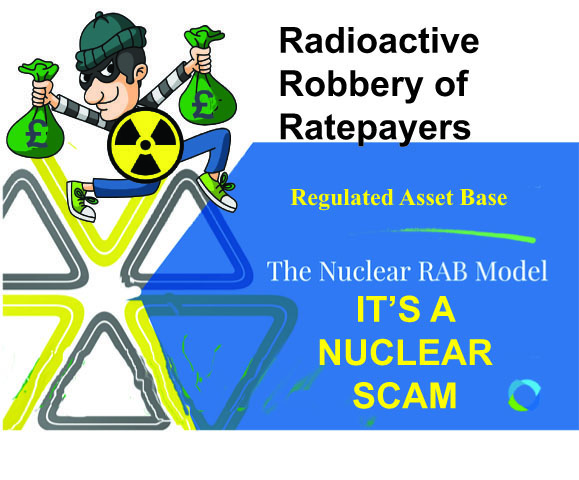
The British government’s Regulated Asset Base – the test case for reviving its nuclear power dream
After years of false dawns, can Britain realise its nuclear ambitions? FT, 19 Jan 23 “…………………………………………………………………………………. Nuclear test case
Fresh hopes of encouraging the development of a new fleet of nuclear reactors — both large and small — now rest on a complex hybrid public-private partnership financing model known as the Regulated Asset Base. Already used for other infrastructure projects such as energy networks and airport terminals, RAB promises potential investors an “allowed revenue” — overseen by a regulator — from the start of construction, funded via a surcharge on consumer energy bills.
Supporters of the model, such as EDF, argue it significantly cuts the cost of financing because it lowers the interest that builds up during the construction phase and reduces the amount of compounded debt that needs to be serviced and paid off during the station’s lifespan. Financing costs account for roughly two-thirds of the overall cost of a nuclear plant. The allowed revenue payments continue after the plant is operational. Rather than paying a price for every unit of electricity produced, the model essentially pays for new nuclear power stations to be available.
But the RAB model is also divisive. Critics argue it would saddle bill payers with high additional costs if projects run over time and over budget.
The UK government intends for that risk to be shared between the project’s owners and consumers, according to people familiar with the discussions, although it is yet to reveal how that would work in the case of Sizewell C, which is unlikely to be connected to the electricity grid before the 2030s.
“If the cost of overruns and delays cannot just be lumped on to consumers, I think it would be implausible any investor would look at the deal,” says Steve Thomas, emeritus professor of energy policy at the University of Greenwich. “How would you feel if your pension fund was taking the risk of a nuclear project not being built to time and cost?”
For long-running nuclear sceptics, the latest attempt at ushering in a new civil nuclear golden age in Britain risks diverting attention and investment away from other technologies, such as wind, solar and storage, which could be delivered sooner to achieve the country’s near-term emissions targets.
The UK government is working towards a fivefold increase in offshore wind to 50GW by 2030 — which it claims would be enough to “power every home” — and to raise solar deployment to 70GW from 14GW by 2035. Renewables supporters claim these could still meet a lot of demand even on calmer, less bright days.
“If you want to hit your 2035 target and Sizewell C is not going to get you there [in time] then you have got to do something else . . . so why do Sizewell C as well if you are going to get there without it?” says Alison Downes, a former head of direct actions at Greenpeace UK who is now spearheading a campaign to stop Sizewell C being built.
Among longstanding nuclear proponents, there are still nerves about whether Britain’s latest attempt to revive an industry will come to fruition, even if they feel the politics are now on their side.
If a final investment decision is taken by the end of 2024 as hoped, Sizewell C will be the first test of the financing model for nuclear projects and only the second nuclear power station to enter construction since 1995, when the last of the current fleet opened. The other, Hinkley Point C, began construction in 2016 but is running over-time and over-budget. It is not currently envisaged to generate any electricity before mid-2027.
Nuclear industry executives have also been pushing ministers to confirm a new nuclear reactor construction programme beyond Sizewell C as part of GBN’s launch.
This should, in the short-term, include a commitment to take final investment decisions on two further nuclear projects in the next parliament.
But to get to that stage and avoid adding to the roster of failed nuclear projects, the impasse within government must first be resolved.
Graham Stuart, energy and climate minister at the BEIS, alluded on Wednesday to the tussle between departments, saying a date for the launch of GBN would be set once it had “a resolved and finalised agreement with His Majesty’s Treasury”.
A government insider confirmed the rollout was being held up by chancellor Jeremy Hunt who “wants to do due diligence on GBN before approving it”.
“Is there haggling over money?” the person says. “There always is.” https://www.ft.com/content/c4c481d3-99e0-4c2f-8d4e-96b4c9a3bd59
IAEA sends staff to all Ukraine nuclear plants to reduce risk of accidents
PBS NewsHour, Jan 18, 2023
KYIV, Ukraine (AP) — The International Atomic Energy Agency is placing teams of experts at all four of Ukraine’s nuclear power plants to reduce the risk of severe accidents as Russia’s war against the country rages on, agency head Rafael Grossi said Wednesday.
The IAEA, which is affiliated with the United Nations, already has a permanent presence at Ukraine’s — and Europe’s — largest nuclear plant in Zaporizhzhia that is held by Russian forces.
The IAEA’s permanent presence at all of Ukraine’s nuclear facilities, with at least 11 staff in total, marks an unprecedented expansion for the agency. IAEA technicians will also be at Chernobyl, the now-closed nuclear plant that was the site of a deadly nuclear accident in 1986 that spread fallout over much of Europe…………………………………. more https://www.pbs.org/newshour/world/iaea-sends-staff-to-all-ukraine-nuclear-plants-to-reduce-risk-of-accidents
Mini nuclear reactor firm snubs Britain for the French: Newcleo blames political chaos for decision to build prototype across Channel
Britain’s nuclear power ambitions suffered another setback as a UK company
chose France to build its prototype reactor. Newcleo blamed political
upheaval in Westminster for its decision. The mini-nuclear power station
company said it waited in vain for ministers to give the green light over
where to site the project – leaving it no option but to take the work over
the Channel.
The move will cost hundreds of potential UK jobs and casts
further doubt on the country’s nuclear future. Speaking at the World
Economic Forum in Davos, Newcleo chief executive Stefano Buono told the
Mail: ‘Changing government three times has not helped. ‘We were
expecting a decision before, but I understand that when the government
changes, it’s very difficult to take decisions.’ Britain is scrambling to
replace its fleet of six large nuclear plants, five of which are due for
closure by 2028 and one, Sizewell B, in 2035.
Hopes for the mini-nuclear sector were raised by Boris Johnson’s plans for a government-backed body
called Great British Nuclear (GBN) to support the development of new sites.
Speaking in the Commons yesterday, the former prime minister urged the
Government ‘to exploit this country’s technological lead and build a
fleet of small modular nuclear reactors as part of our Great British
Nuclear programme’. Business Secretary Grant Shapps said GBN would be up
and running shortly and said small modular reactors would play ‘an
important part’ in boosting nuclear power supplies. The Government wants 25
per cent of power to come from nuclear by 2050. Last year it supplied 15.5
per cent. Privately-owned Newcleo, which is about to launch a £900million
funding round, is one of a number of companies planning to build
mini-nuclear power stations around the UK.
Daily Mail 17th Jan 2023
Poland’s energy company agrees to buy France’s NOT YET DESIGNED so-called “small” Nuward nuclear reactor!

Poland’s Respect Energy considers deploying French SMR design
WNN, 16 January 2023
Polish renewable energy trader Respect Energy has signed an agreement with EDF to cooperate on the development of nuclear power projects in Poland based on France’s Nuward small modular reactor (SMR) technology.
“This agreement marks Respect Energy’s and EDF’s firm intention to jointly proceed with the development of SMR projects in Poland and confirms the strong interest towards Nuward technology which has been selected by the energy trader to expand its footprint in the nuclear energy field,” the companies said in a joint statement. “Respect Energy and EDF will now jointly start the evaluation process of specific new greenfield sites and continue to work on detailing the business and financing plans for this endeavour.”
In October 2021, EDF made an offer to the Polish government to build as many as six EPR units. The “non-binding preliminary offer” represented a range of options for Poland. It detailed the engineering, procurement and construction that would be needed for four to six EPR units, at either two or three sites. The EPR units would produce 1650 MWe each if selected – the Polish government announced late last year that it had selected Westinghouse technology for at least the first three of its planned fleet of reactors……………….
The Nuward project was launched in September 2019 by the French Alternative Energies and Atomic Energy Commission (CEA), EDF, Naval Group and TechnicAtome. The Nuward – consisting of a 340 MWe SMR plant with two pressurised water reactors (PWRs) of 170 MWe each – has been jointly developed using France’s experience in PWRs……………..
Nuward is currently in the conceptual design phase, which focuses on choosing the major technical features while delivering real competitive advantages. Belgian engineering firm Tractebel was contracted in May last year to conduct studies for the completion of the conceptual design of “the first SMR in the European Union”.
The next phase of the project, the basic design completion, is expected to start this year and to be completed by 2025. The design should be in the “advanced concept phase” between 2025 and 2030, during which time Nuward is expected to be certified and the supply chain developed.
Construction of a demonstration Nuward SMR is expected to start in 2030. The construction of that unit is anticipated to take three years.
In June, it was announced the Nuward design will be the case study for a European early joint regulatory review led by the French nuclear safety regulator with the participation of the Czech and Finnish nuclear regulators….. https://world-nuclear-news.org/Articles/Poland-s-Respect-Energy-considers-deploying-French
A bit of panic in the UK small nuclear reactor lobby?

‘No regrets?”
Quite a lot of people have regrets about the introduction of nuclear power.
And that’s even when the reactor types have been tested.
The new gee-whiz nuclear reactors haven’t even been tested.
Pipeline of ‘no-regrets’ new nuclear schemes needs ‘expediting’
New Civil Engineer16 JAN, 2023 BY ROB HORGAN
A pipeline of “no-regrets” new nuclear schemes must be fast-tracked if the UK is to meet its net zero carbon emission targets, according to an independent [how independent?] review set up to assess the UK’s decarbonisation plans.
It is one of 129 recommendations made by former energy minister Chris Skidmore in his government-ordered net zero review titled Mission Zero.
The report calls for the formation of Great British Nuclear (GBN) to be “expedited in early 2023” so that a “clear roadmap” of future schemes can be developed this year to tackle “rising power demand”.
The government first announced its intention to set up GBN to develop a project pipeline in its British Energy Security Strategy published in April last year.
Skidmore concludes that speeding up the formation of GBN will address industry concerns about a “lack of clarity on the pathway” to achieving the UK government’s ambition for nuclear energy to provide a quarter of power consumed within the country. (Nuclear energy currently supplies 15% of the UK’s power needs.)
The review concludes: “Building new nuclear is a no-regrets option, despite high upfront costs and long construction times”……………….

- YOU ARE HERE:LATEST
Pipeline of ‘no-regrets’ new nuclear schemes needs ‘expediting’
16 JAN, 2023 BY ROB HORGAN
A pipeline of “no-regrets” new nuclear schemes must be fast-tracked if the UK is to meet its net zero carbon emission targets, according to an independent review set up to assess the UK’s decarbonisation plans.
It is one of 129 recommendations made by former energy minister Chris Skidmore in his government-ordered net zero review titled Mission Zero.
The report calls for the formation of Great British Nuclear (GBN) to be “expedited in early 2023” so that a “clear roadmap” of future schemes can be developed this year to tackle “rising power demand”.
The government first announced its intention to set up GBN to develop a project pipeline in its British Energy Security Strategy published in April last year.
Skidmore concludes that speeding up the formation of GBN will address industry concerns about a “lack of clarity on the pathway” to achieving the UK government’s ambition for nuclear energy to provide a quarter of power consumed within the country. (Nuclear energy currently supplies 15% of the UK’s power needs.)
The review concludes: “Building new nuclear is a no-regrets option, despite high upfront costs and long construction times.
“In view of rising power demand, nuclear energy can provide reliable baseload power which is not weather dependent and can provide other services to power networks.”
It adds: “To achieve affordability and efficiency, the Government needs to commit to funding a fleet of projects. Recognising the start times for new build nuclear, a clear roadmap for nuclear deployment up to 2035 is required.”
The government is currently committed to building Sizewell C, while construction of Hinkley Point C continues to gather pace. Ambitions to develop a fleet of small nuclear reactors has also been widely supported by government in the past few years.
Skidmore’s review concludes that as well as delivering a pipeline of projects, the government must act to remove barriers to its nuclear ambitions.
It identifies “the main barrier for new nuclear projects is the need for stable, long-term policy and funding commitments given the long timeframes involved in the building of nuclear plants”.
It also points out that “rapid expansion of nuclear power could lead to some bottlenecks in supply chains and skills pools”.
However, the report stresses that “understanding the timings of different projects” would allow “any supply chain and skills pinch points [to] be identified early, allowing for coordinated action to prevent bottlenecks”.
The review also concludes that streamlining planning and consenting decisions would “ensure nuclear projects are not unnecessarily delayed”. Likewise, Skidmore’s review calls for the lengthy protocols required for innovations like SMRs to be accelerated.
National Infrastructure Commission chair Sir John Armitt supports Skidmore’s calls for clarity and accelerated action.
He said: “Chris Skidmore’s clarity in his call for accelerated action is as compelling as it is commendable, nailing the argument that inaction now will cost us all in the long run.
“Given the economic opportunities offered by leading the pack internationally, securing policy and funding stability over the coming years is paramount.”

Nuclear energy recommendations made in Skidmore’s net zero review:
- Expedite the set-up of Great British Nuclear in early 2023, ensuring required funding and skills are in place.
- Government and GBN to set out clear roadmap in 2023, including interim targets to reach 2050 ambition, and government to ensure funding is in place. As part of the roadmap, government should assess the possibility to increase the current ambitions, supporting the development of supply chain to service a fleet of projects.
- Roadmap to set out clear pathways for different nuclear technologies (including small modular reactors) and the selection process. This should consider how to use programmatic approach to deliver further cost reductions in a competitive environment.
- Government to deliver on siting strategy by 2024
UK police powers increased, to shut down climate protests
The police are to be given powers to shut down protests before they cause
widespread disruption, under plans being announced by ministers today. In a
move to clamp down on so-called guerrilla tactics used by groups such as
Just Stop Oil and Insulate Britain, officers will for the first time be
allowed to shut down protests before they cause disruption.
They will also
be able to treat a series of protests by the same group as one incident
when defining what can be classed as “serious disruption” under the
Public Order Bill going through parliament. The measures are designed to
give more clarity to the police about when they can intervene to disrupt
protests such as the blocking of roads or slow marching to cause
disruption.
Times 16th Jan 2023
Prolonged outages of France’s nuclear reactors.
French power prices advanced after the start of two nuclear reactors were
pushed back, denting the nation’s ramp up in capacity at a time they are
most needed. French power for next month gained the most in two weeks,
rising as much as 3.9%. An oncoming cold snap in western Europe and rising
natural gas prices also provided bullish sentiment for electricity traders
across the region.
The prolonged outages will set back the recovery of the
nation’s nuclear capacity, which is the backbone of Europe’s integrated
power system. Availability at EDF’s nuclear fleet has increased in recent
weeks and is near the highest level in a year. The Chooz-1 unit is now due
to start on Feb 28, a month later than planned, while Blayais-1 was delayed
by 10 days to Feb. 11, according to data submitted to the grid.
Bloomberg 13th Jan 2023
CNN: Ukraine Has Become a ‘Weapons Lab’ for Western Arms

“We are interested in testing modern systems in the fight against the enemy and we are inviting arms manufacturers to test the new products here,”
Ukraine’s defense minister previously offered his country as a ‘testing ground’ for Western weapons makers https://news.antiwar.com/2023/01/16/cnn-ukraine-has-become-a-weapons-lab-for-western-arms/ by Dave DeCamp ,
Ukraine has turned into a “lab” for Western arms as the war has given the US and its allies an opportunity to see how their weapons fare in a conflict with a major military power like Russia, CNN reported on Monday.
A source familiar with Western intelligence on the war told CNN that Ukraine is “absolutely a weapons lab in every sense because none of this equipment has ever actually been used in a war between two industrially developed nations.” The source described it as “real-world battle testing.”
Back in July, Ukrainian Defense Minister Oleksii Reznikov offered his country as a “testing ground” for Western arms makers. “We are interested in testing modern systems in the fight against the enemy and we are inviting arms manufacturers to test the new products here,” he said.
Reznikov got his wish as the US, and its allies have significantly stepped up military aid since then, and the war has escalated as Russia began large-scale strikes on Ukrainian infrastructure in October. Russia’s success in its use of cheap kamikaze drones in the infrastructure attacks has influenced plans for Western arms makers.
The British arms maker BAE Systems has announced that it’s developing a new armored vehicle with added protection to defend it from kamikaze drone attacks from above. Multiple intelligence and military officials told CNN that making cheap single-use drones has become a priority of many defense contractors.
The CNN report said that for the US military, the war has become an “incredible source of data on the utility of its own systems.” For example, the US has seen that its HIMARS rocket launch system has been effective against Russian forces, while the
M777 howitzer has become less effective and less accurate over time.
The war in Ukraine has also created a demand for weapons that were beginning to become obsolete, such as the Stinger shoulder-fired anti-aircraft missiles. Raytheon stopped producing Stingers for years but now has been asked by the Pentagon to ramp up production as thousands have been shipped to Ukraine.
Diplomatic Cables Show Russia Saw NATO Expansion as a Red Line
Ukraine was the “line of last resort” that would complete Russia’s encirclement, said one defense expert, and its entry into NATO was universally viewed by the Russian political elite as an “unfriendly act.”
ACURA VIEWPOINT, Branko Marcetic, January 16, 2023
Nearly a year in, the war in Ukraine has cost hundreds of thousands of lives and brought the world to the brink of, in President Joe Biden’s own words, “Armageddon.” Alongside the literal battlefield has been a similarly bitter intellectual battle over the war’s causes.
Commentators have rushed to declare the long-criticized policy of NATO expansion as irrelevant to the war’s outbreak, or as a mere fig leaf used by Russian President Vladimir Putin to mask what Condoleezza Rice and Robert Gates recently called “his messianic mission” to “reestablish the Russian Empire.” Fiona Hill, a presidential advisor to two Republican administrations, has deemed these views merely the product of a “Russian information war and psychological operation,” resulting in “masses of the US public … blaming NATO, or blaming the US for this outcome.”
Yet a review of the public record and many dozens of diplomatic cables made publicly available via WikiLeaks shows that US officials were aware, or were directly told over the span of years, that expanding NATO was viewed by Russian officials well beyond Putin as a major threat and provocation, that expanding it to Ukraine was a particularly bright red line for Moscow, that it would inflame and empower hawkish, nationalist parts of the Russian political spectrum, and that it could ultimately lead to war.
In a particularly prophetic set of warnings, US officials were told that pushing for Ukrainian membership in NATO would not only increase the chance of Russian meddling in the country, but risked destabilizing the divided nation — and that US and other NATO officials pressured Ukrainian leaders to reshape this unfriendly public opinion in response. All of this was told to US officials in both public and private by not just senior Russian officials going all the way up to the presidency, but by NATO allies, various analysts and experts, liberal Russian voices critical of Putin, even, sometimes, US diplomats themselves.
This history is particularly relevant as US officials now test the red line China has drawn around Taiwan’s independence, risking military escalation that will first and foremost be aimed at the island state. The US diplomatic record regarding NATO expansion suggests the perils of ignoring or outright crossing another military power’s red lines, and the wisdom of a more restrained foreign policy that treats other powers’ spheres of influence with the care they treat the United States’ own.
An Early Exception
NATO expansion had been fraught from the start. The pro-Western Boris Yeltsin had told Bill Clinton he “saw nothing but humiliation for Russia if you proceed” with plans to renege on the verbal promises made years earlier not to enlarge NATO eastward, and warned it would be “sowing the seeds of mistrust” and would “be interpreted, and not only in Russia, as the beginning of a new split in Europe.”………………………………………………………………………….
Almost Complete Consensus
The thinkers and analysts that US officials conferred with likewise made clear the Russian elite’s anxieties over NATO and its expansion, and the lengths they might go to counteract it. Many were transmitted by then-US Ambassador to Russia William Burns, today serving as Biden’s CIA director.
Recounting his conversations with various “Russian observers” from both regional and US think tanks, Burns concluded in a March 2007 cable that “NATO enlargement and U.S. missile defense deployments in Europe play to the classic Russian fear of encirclement.” Ukraine and Georgia’s entry “represents an ‘unthinkable’ predicament for Russia,” he reported six months later, warning that Moscow would “cause enough trouble in Georgia” and counted on “continued political disarray in Ukraine” to halt it. In an especially prescient set of cables, he summed up scholars’ views that the emerging Russia-China relationship was largely “the by-product of ‘bad’ US policies,” and was unsustainable — “unless continued NATO enlargement pushed Russia and China even closer together.”
………………… “Ukraine was, in the long term, the most potentially destabilizing factor in US-Russian relations, given the level of emotion and neuralgia triggered by its quest for NATO membership,” went the counsel of Dmitri Trenin, then-deputy director of the Russian branch of the US-based Carnegie Endowment for International Peace, in a Burns-authored February 2008 cable. For Ukraine, he said prophetically, it would mean that elements within the Russian establishment would be encouraged to meddle, stimulating US overt encouragement of opposing political forces, and leaving the US and Russia in a classic confrontational posture.
Indeed, opposing NATO’s enlargement eastward, particulary in Ukraine and Georgia, was “one of the few security areas where there is almost complete consensus among Russian policymakers, experts and the informed population,” he cabled in March 2008. Ukraine was the “line of last resort” that would complete Russia’s encirclement, said one defense expert, and its entry into NATO was universally viewed by the Russian political elite as an “unfriendly act.” Other experts cautioned “that Putin would be forced to respond to Russian nationalist feelings opposing membership” of Georgia, and that MAPs for either would trigger a cut-back in the Russian military’s genuine desire for co-operation with NATO.
From Liberals to Hardliners
These analysts were reiterating what cables show US officials heard again and again from Russian officials themselves, whether diplomats, members of parliament, or senior Russian officials all the way up to the presidency, recorded in nearly three-dozen cables at least………………………………………………………………..
Selling NATO to Ukraine……………………………………………………..
“Experts tell us that Russia is particularly worried that the strong divisions in Ukraine over NATO membership, with much of the ethnic-Russian community against membership, could lead to a major split, involving violence or at worst, civil war,” Burns wrote in February 2008. Russia, he wrote, would then “have to decide whether to intervene; a decision Russia does not want to have to face.”………………………………
By December 2016, with fears of invasion ramping up, Putin told Biden personally that “the eastward expansion of the Western alliance was a major factor in his decision to send troops to Ukraine’s border,” the Washington Post reported.
………….. claims that Russian unhappiness over NATO expansion is irrelevant, a mere “fig leaf” for pure expansionism, or simply Kremlin propaganda are belied by this lengthy historical record. Rather, successive US administrations pushed ahead with the policy despite being warned copiously for years — including by the analysts who advised them, by allies, even by their own officials — that it would feed Russian nationalism, create a more hostile Moscow, foster instability and even civil war in Ukraine, and could eventually lead to Russian military intervention, all of which ended up happening.
“I don’t accept anyone’s red line,” Biden said in the lead-up to the invasion, as his administration rejected negotiations with Moscow over Ukraine’s NATO status. We can only imagine the world in which he and his predecessors had. https://usrussiaaccord.org/acura-viewpoint-guest-post-by-branko-marcetic-diplomatic-cables-show-russia-saw-nato-expansion-as-a-red-line/
1 This Month

of the week– Nuclear Reactor Information Task Force

14 May – online event From Bombs to Data Centres: the Face of Nuclear Colonialism
To see nuclear-related stories in greater depth and intensity – go to https://nuclearinformation.wordpress.com
-
Archives
- May 2026 (126)
- April 2026 (356)
- March 2026 (251)
- February 2026 (268)
- January 2026 (308)
- December 2025 (358)
- November 2025 (359)
- October 2025 (376)
- September 2025 (257)
- August 2025 (319)
- July 2025 (230)
- June 2025 (348)
-
Categories
- 1
- 1 NUCLEAR ISSUES
- business and costs
- climate change
- culture and arts
- ENERGY
- environment
- health
- history
- indigenous issues
- Legal
- marketing of nuclear
- media
- opposition to nuclear
- PERSONAL STORIES
- politics
- politics international
- Religion and ethics
- safety
- secrets,lies and civil liberties
- spinbuster
- technology
- Uranium
- wastes
- weapons and war
- Women
- 2 WORLD
- ACTION
- AFRICA
- Atrocities
- AUSTRALIA
- Christina's notes
- Christina's themes
- culture and arts
- Events
- Fuk 2022
- Fuk 2023
- Fukushima 2017
- Fukushima 2018
- fukushima 2019
- Fukushima 2020
- Fukushima 2021
- general
- global warming
- Humour (God we need it)
- Nuclear
- RARE EARTHS
- Reference
- resources – print
- Resources -audiovicual
- Weekly Newsletter
- World
- World Nuclear
- YouTube
-
RSS
Entries RSS
Comments RSS
 nuclear-news