How US and Ukraine’s far-right made pro-peace Zelensky a ‘no peace’ president

the exalted version of Zelensky promoted to NATO state audiences today is a sharp contrast to the pro-peace candidate that Ukrainians overwhelmingly elected four years ago.
it is no wonder that the same US political establishment that sabotaged Zelensky’s peace mandate now holds him up as a hero.
In October 2019, as he took steps to implement Minsk in the face of far-right protests and US hostility, Zelensky assured Ukrainians that he was “the president of peace,” and that “ending this war is of utmost importance to me.” He added: “I, the president, am not ready to sacrifice our people. And that is why I choose diplomacy.”
Elected in 2019 to bring peace to Ukraine, a Zelensky aide now declares that “there is no peace with Russia, and Ukraine must arm itself to the teeth.”
Aaron Maté https://mate.substack.com/p/how-us-and-ukraines-far-right-made?utm_source=post-email-title&publication_id=100118&post_id=105251040&isFreemail=false&utm_medium=email 26 Feb 23,
Volodymyr Zelensky marked the one-year anniversary of Russia’s invasion of Ukraine by rejecting any negotiations with the Kremlin.
“There is nothing to talk about and nobody to talk about over there,” Zelensky declared.
The Ukrainian President delivered the message just two weeks after his French and German counterparts urged him, at a meeting in Paris, “to start considering peace talks with Moscow,” the Wall Street Journal reports.
But as an adviser explained to the New York Times, Zelensky is now “more at peace with himself,” and therefore has no need to entertain the possibility of peace with his neighbor.
He has a clear understanding what Ukraine should do,” the adviser said. “There is no ambiguity: There is no peace with Russia, and Ukraine must arm itself to the teeth.”
Zelensky’s “clear understanding” of the need to reject peace with Russia and turn his country into a NATO arms depot is a resounding victory for the Ukrainian far-right and its US government allies. As I wrote here last year, these two powerful forces, aligned by their converging interests in prolonging the post-2014 war in Ukraine’s Donbas region, sabotaged the peace platform that Zelensky was elected on in April 2019. As Adam Schiff put it, the US has used Ukraine’s civil war “so that we can fight Russia over there, and we don’t have to fight Russia here.”
The commemoration of the first anniversary of Russia’s cross-border invasion to end Schiff’s bipartisan “fight” has yielded more insight into how the US, in concert with its ideological allies in Ukraine’s powerful far-right, helped convert Zelensky from pro-peace candidate to “no peace” president.
In a fawning profile, the Washington Post approvingly recounts how Zelensky shifted from naively “thinking peace with Putin was possible” to now believing that “victory is the only answer.” Although the Post attempts to cast Zelensky’s “transformation” as the result of “Russian President Vladimir Putin’s threat,” the details tell a different story.
The Post describes a summer 2019 exchange between the then-rookie president and the top US diplomat in Ukraine, William Taylor. At the time, Zelensky was “expressing curiosity” about the Steinmeier Formula, a German-led effort to revive the stalled Minsk Accords. Minsk, reached in 2015, called for granting limited autonomy to the rebellious Donbas regions in eastern Ukraine in exchange for their demilitarization. Ukraine’s far-right, the driving force behind the 2014 Maidan coup that triggered the ensuing Donbas war, had opposed Minsk’s implementation at every turn.
Zelensky, Taylor recalls, “hoped” that the Steinmeier initiative “might lead to a deal with the Kremlin.” The Ukrainian president “pointed to a document explaining the formulation, thinking that somewhere in the details of the legalese a workable compromise with Moscow might be found.”
But Washington knew better: no compromise with Moscow could be allowed. “No one knows what it is,” Taylor told Zelensky of the German plan. “Steinmeier doesn’t know what it is… It’s a terrible idea.”
The Steinmeier plan was in fact a simple idea, and a welcome one to anyone interested in bringing peace to Ukraine. For his part, Taylor was never shy about advocating war. In a December 2014 letter to The Washington Post, Taylor denounced an opinion article that had opposed sending US arms to Ukraine and advocated an agreement between NATO and Russia to resolve the Ukrainian crisis. Backers of such steps, Taylor wrote, are “advocating that the West appease Russia.… Now is not the time for appeasement.”
This explains why Taylor was similarly hostile to the “terrible” plan named after former German foreign minister Frank-Walter Steinmeier. The Steinmeier Formula called for holding local elections in the rebel-held Donbas areas under Ukrainian law and international supervision. If OSCE monitors certified the results, then Ukraine would regain control of its eastern border and enact a special status law granting the rebellious Donbas regions limited autonomy.
But this road map, along with a similar initiative from French diplomat Pierre Morel, “got nowhere because of opposition in Ukraine,” former UK diplomat Duncan Allan observed for the UK government-funded think tank Chatham House. When Zelensky tried to revive it in late 2019, Allan added, “[a]nother sharp reaction in Ukraine forced him to back down.” As the New York Times now notes in passing, “a backlash at home — with street protesters in Kyiv accusing him of treason for surrendering land — steered the Ukrainian president to a political formula in which he rejected concessions” with Russia.
Specifically, that “backlash” in Ukraine included not only violent protests but outright threats to Zelensky’s life.
“Zelenskyy said he was ready to lose his ratings, popularity, position,” Right Sector co-founder Dmytro Yarosh, commander of the Ukrainian Volunteer Army and former senior Ukrainian military advisor, said shortly after Zelensky’s May 2019 inauguration. “No he would lose his life. He will hang on some tree on Khreshchatyk – if he betrays Ukraine and those people who died in the [Maidan] Revolution and the [Donbas] War.” (Two years after threatening to hang the president from a tree, Yarosh was given a repeat appointment as an advisor to the Commander-in-Chief of the Ukrainian military. The Ukrainian military subsequently claimed that the appointment was withdrawn).
Despite the internal and external opposition, Zelensky departed a meeting with Putin in December 2019 feeling “hopeful”, the Post reports. “Within weeks, Russia agreed to a broader prisoner exchange and offered Ukraine a $3 billion gas arbitration settlement as well as a new gas transit deal.”
But on top of the far-right backlash at home, Zelensky’s peace initiative faced direct hostility from Ukraine’s patron in Washington. After warning Zelensky against pursuing a “terrible” European-brokered peace plan, William Taylor soon became a hero of Trump’s first impeachment over Ukraine. At the impeachment proceedings, which kicked off in October 2019 just as Zelensky was trying to follow through on his peace mandate, Taylor was summoned to assure Congress and a Russiagate-crazed media class that Trump’s pause on weapons subsidies for the Ukrainian fight against the Russia-backed Donbas rebels endangered “our national security.” (For his services, the New York Times lauded Taylor as “a septuagenarian Vietnam veteran with a chiseled face and reassuring gray hair,” while the Washington Post declared him to be a “meticulous note taker.”)
The prevailing imperative to use Ukraine “to fight Russia over there” (Schiff) meant that Zelensky had no chance to pursue the “terrible” Minsk agreement that Taylor and other influential proxy warriors opposed.
“The reality is that Ukraine depends on political, diplomatic, economic and military support from the West, and particularly from the United States,” Samuel Charap of the Pentagon-tied RAND Corporation wrote in November 2021. Up to that point, “Ukraine has shown little desire” to “[implement] its obligations under the Minsk II agreement,” and the US had “not yet used its influence to push for progress on the Donbas conflict.” If the Ukrainian government could be pushed “toward complying”, Charap noted, that “might actually invite de-escalation from Russia” while saving Ukraine “from calamity.”
But by then, Zelensky had decided to side with the forces that had sabotaged him. According to the Post’s account, citing David Arakhamia, the leader of Zelensky’s faction in parliament: “By early 2021, Zelensky believed that negotiations wouldn’t work and that Ukraine would need to retake the Donetsk and Luhansk regions ‘either through a political or military path.’” As a result, “[t]he Kremlin disengaged.”
Zelensky’s early 2021 decision that “negotiations wouldn’t work” explains why, in early 2022, he shunned all opportunities to prevent Russia’s looming invasion. At the final talks on implement Minsk, a “key obstacle,” the Washington Post reported, “was Kyiv’s opposition to negotiating with the pro-Russian separatists.” When Germany proposed a last-minute deal in which Ukraine would “renounce its NATO aspirations and declare neutrality as part of a wider European security deal,” Zelensky turned it down, according to the Wall Street Journal. After rejecting diplomacy, Zelensky’s government then significantly increased its shelling of the Donbas, a potential step toward trying to “retake the Donetsk and Luhansk regions” via the “military path” that the Washington Post has newly confirmed.
And as the recent disclosures of former Israeli Prime Minister Naftali Bennet underscore, the US went from sabotaging Zelensky’s peace mandate before the Russian invasion to blocking diplomatic efforts in the period since.
As a result, the exalted version of Zelensky promoted to NATO state audiences today is a sharp contrast to the pro-peace candidate that Ukrainians overwhelmingly elected four years ago.
In October 2019, as he took steps to implement Minsk in the face of far-right protests and US hostility, Zelensky assured Ukrainians that he was “the president of peace,” and that “ending this war is of utmost importance to me.” He added: “I, the president, am not ready to sacrifice our people. And that is why I choose diplomacy.”
By now choosing to reject diplomacy, President Zelensky has shown that he is more than willing to sacrifice his people for the sake of his NATO state patrons’ desired proxy war against Russia. Accordingly, one year into the catastrophic Russian invasion that it helped provoke, it is no wonder that the same US political establishment that sabotaged Zelensky’s peace mandate now holds him up as a hero.
Thousands rally in Berlin, Paris to call for peace in Ukraine
People in Berlin take part in a protest against the delivery of weapons to Ukraine.
Protesters in Paris and Berlin capitals have rallied to demand peace in Ukraine, a day after the anniversary of Russia’s invasion.
Thousands of people protested in the Germany capital on Saturday to condemn the government’s supply of arms to Ukraine and call for peace talks to end the war.
The organisers were criticised before the protest for downplaying Ukraine’s right to defend its territory from Russian aggression and failing to distance themselves from the far right and far left, where pro-Russia views are common.
One of the organisers, opposition lawmaker Sahra Wagenknecht of the ex-communist Left party, said that there was no place for neo-Nazis at the rally, but that anyone who wanted peace “with an honest heart” was welcome.
While most placards at the protest reflected traditional left-wing positions, some participants bore banners with the slogan “Americans go home” and the logo of a far-right magazine. Some waved Russian flags.
Wagenknecht accused the German government of seeking to “ruin Russia,” and said that Moscow should be made an “offer” in order to resume peace talks.
Another of the organisers, prominent feminist author Alice Schwarzer, said it was time to look beyond left and right.
The two women have also launched a petition which claims to have gathered more than 645,000 signatures.
Protesters jeered whenever she and Wagenknecht mentioned the name of German foreign minister Annalena Baerbock, who has strongly backed the delivery of arms to Ukraine.
Police said that about 13,000 people took part in the rally at Berlin’s iconic Brandenburg Gate, while organisers claimed that 50,000 people participated.
One attendee was Konstantin Schneider, an academic from Berlin, who said he understood that countries in Eastern Europe were afraid of Russia.
“Of course [Russian President Vladimir] Putin is an idiot to attack Ukraine,” he said. “But we still need to find new solutions [to the war] instead of sweepingly saying there’s nothing to negotiate.”
There were several small counter-demonstrations. On Friday, thousands of protesters across Europe marched against Moscow’s invasion of Ukraine…………………………………….
UK: big talk about small nuclear reactors, but not much is happening, really.
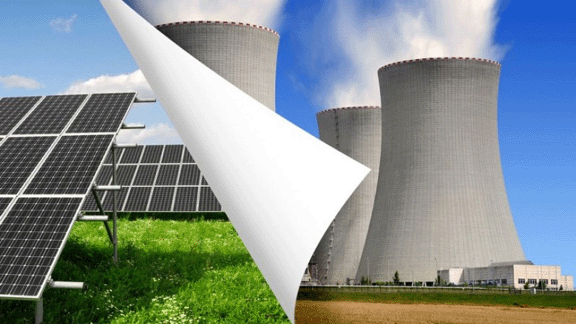
Over 3000GW of renewables are already in place globally, compared to only 394 GW of nuclear, with wind and solar now romping further ahead around the world. By 2050, the BNEF says the global power system will be dominated by wind and solar (75% of production), with nuclear at just 9%, down from 10% now. If it makes it to 24% nuclear by then, the UK will be a bit of an outlier.
“……………………………….Graham Stuart, now a Minister of State at the new Department for Energy Security and Net Zero…..- ‘what I can say is that we are absolutely committed to nuclear as a significant share of our electricity because we need that baseload and are committed to driving it forward.’
So that’s a positive ‘go’ signal, although funding is still a major problem, and, despite much talk, progress on the proposed ‘24 GW of nuclear by 2050’ programme seems to have slipped behind.
As NuClear News 141 reported, at the end of November last year, the Government was said to be about to announce proposals to set up a new body called Great British Nuclear (GBN), which would develop a network of small modular reactors (SMRs), as well as promote new large reactors. Grant Shapps, the Business Secretary, was due to make the announcement on 29th November. But it was delayed because of a row with the Treasury over funding.
And by January, The Times was reporting that a deal on SMR funding was unlikely to materialise for at least another 12 months. A senior government source said the Treasury would not sign off on any orders or significant funding for SMR work until the technology had approval from the Nuclear Regulators Generic Design Assessment, which was not expected, until 2024.
In addition to the proposed Rolls Royce SMRs, four of which are planned initially, several other SMRs are also now in the race for UK deployment, some from overseas. They include GE Hitachi’s 300MW boiling water reactor, and Holtec’s 160MWe pressurised water reactor, developed in collaboration with Mitsubishi and Hyundai. The USA’s NuScale, the most advanced project so far, has also expressed interest in UK sites for its mini PWR.
Potential UK sites for new SMRs include Trawsfynydd in Wales and Heysham and Oldbury in England, but, given the funding issues, it will evidently be a while before anything happens on SMRs, or indeed, in terms of new larger projects, after Sizewell C. Though some help with funding may yet be on hand. According to the Telegraph, nuclear projects may soon to be classed as ‘green’ or ’sustainable’ investments, clearing a way for more institutional investors and environment-focused funds to back them. The Telegraph says there are also hopes that use can be made of the Government’s green gilts green savings bonds.
Is nuclear really green? Not many greens think so, and given the risks, costs and delays associated with it, nuclear is often not popular with investors. There have been some delays with the only currently live new projects in the UK, the Hinkley Point C EPR being built by EdF, although nothing so far on the decade-long delays with the ongoing EPR projects in France and Finland. EDF now say the Hinkley EPR should start up in 2027. However, to be on the safe side, the deadline for starting up its major CfD payment (after which, under the contract rules, it would not be eligible for CfD payments) has been extended to 2036 from 2033.
…………………….. EDF has recently admitted that Hinkley Point C final cost is likely to be £31-32bn, up from the £18 bn estimated initially. Sizewell ought to benefit from construction lessons learned from Hinkley, but, although RAB pushes the financial risks onto consumers, there are still many investment uncertainties about the project.
Finance may be a key issue for EDF in the UK, but it is if anything even more of an issue for it in France, where it is facing major problems, with a huge repair bill and loss of income as plants are shut for safety checks and power has to be imported. As a result, with energy security being a key issue these days, nuclear no longer looks reliable. ………………………
With a handful of other nuclear projects being considered around the world, including some SMRs, and Russia and China also pressing ahead with larger plants, the UK isn’t the only country with ambitions for nuclear expansion. However, globally, the likely scale of nuclear expansion is relatively small in total, compared with the vast scale and rapid pace of renewables expansion.
Over 3000GW of renewables are already in place globally, compared to only 394 GW of nuclear, with wind and solar now romping further ahead around the world. By 2050, the BNEF says the global power system will be dominated by wind and solar (75% of production), with nuclear at just 9%, down from 10% now. If it makes it to 24% nuclear by then, the UK will be a bit of an outlier. https://renewextraweekly.blogspot.com/2023/02/uk-nuclear-news.html
Vladimir Putin says the US-led military alliance in Ukraine seeks defeat and liquidation of Russia
ABC News 27 Feb 23
President Vladimir Putin has cast the confrontation with the West over the Ukraine war as an existential battle for the survival of Russia and the Russian people — and said he was forced to take into account NATO’s nuclear capabilities.
Key points:
- February 24 marked the first anniversary of the Russian invasion of Ukraine
- Mr Putin says he believes the future of Russia is in peril
- The interview was aired on Sunday on Russian state television
A year since ordering the invasion of Ukraine, Mr Putin is increasingly presenting the war as a make-or-break moment in Russian history — and saying that he believes the very future of Russia and its people is in peril…………………………………………
Mr Putin said the tens of billions of dollars’ worth of US and European military assistance to Ukraine showed that Russia was now facing off NATO itself — the Cold War nightmare of both Soviet and Western leaders.
Ukraine says it will not rest until every last Russian soldier is ejected from Ukraine, including from Crimea which Russia annexed in 2014………………….
Russia’s official nuclear doctrine allows for the use of nuclear weapons if they — or other types of weapons of mass destruction — are used against it, or if conventional weapons are used, which endanger “the very existence of the state”………………………………..
Group calls for the stoppage of works at Sizewell C nuclear site, as Sizewell project is not yet authorised, and works are damaging the environment
EDF continues its programme of eco-vandalism. TASC calls on SoS for Defra
to intervene. Despite an EDF statement on 18th January, claiming that,
“[Its] Advance [preparatory] works [for Sizewell C] are reversible in the
unlikely event Sizewell C will not proceed to a Final Investment Decision
and full construction”, TASC is shocked and disgusted to discover that
EDF will renege on that promise when, on 1st March, EDF begins to destroy
wet woodland, a legally protected priority ‘Biodiversity Action Plan’
habitat, located in Sizewell Marshes Site of Special Scientific Interest.
Despite EDF knowing full well that we are now entering the bird, bat and
reptile breeding season, it has already begun felling woodland in Goose
Hill, as part of its plan to clear over 40 hectares – including the
felling of some ancient trees – to make way for Sizewell C’s car park.
TASC’s Chair, Jenny Kirtley said “These actions create permanent and
irreversible environmental loss to East Suffolk’s Heritage Coastal
biodiversity and is in direct contradiction of the government’s ‘green
agenda’. Despite EDF’s claim, it is not possible to reverse such losses
and represents further eco-vandalism which goes hand-in-glove with the
construction of a redundant and unnecessary nuclear plant which may never
commence construction.
Sizewell C has yet to make a Final Investment
Decision, does not have a site licence from the Office for Nuclear
Regulation, nor three outstanding environmental permits needed from the
Environment Agency. Furthermore, the project’s DCO approval is subject to
TASC’s judicial review proceedings scheduled to take place in the High
Court on 22nd and 23rd March.
We have asked the Secretary of State for
Defra and the MP for Suffolk Coastal to intervene and to stop the work at
least until these uncertainties around Sizewell C’s various
authorisations have been granted.’.
TASC 24th Feb 2023
Russia Sends Ship To Space Station To Rescue “Stranded Crew”
BY TYLER DURDEN, SATURDAY, FEB 25, 2023 https://www.zerohedge.com/technology/russia-sends-ship-space-station-rescue-stranded-crew
Russia launched an uncrewed Soyuz spacecraft on Friday for a NASA astronaut and two cosmonauts after their original ride back to Earth was damaged by a micrometeoroid impact while parked at the International Space Station in December.
The rescue plan was announced last month. The empty rescue capsule, Soyuz MS-23, blasted off from Baikonur Cosmodrome in Kazakhstan early Friday morning and is set to dock at the orbiting lab on Sunday.
WATCH: NASA launched a Roscomos Soyuz spacecraft from the Baikonur Cosmodrome in Kazakhstan to the International Space Station to bring back a stranded crew to Earth https://t.co/aUNd9r46fs pic.twitter.com/6brPI1vVzm— Reuters Asia (@ReutersAsia) February 24, 2023
The damaged Soyuz will return to Earth for further inspection at the end of March. There will be no crew on board.
The three men arrived at the ISS in September on what was expected to be a six-month mission, but that will be extended for another six months.
NASA is sending another crew of four to the ISS Monday via a SpaceX rocket from Florida’s Kennedy Space Center.
Courting disaster —Missiles have been passing too close to Ukraine’s reactors

Courting disaster — Beyond Nuclear International Embroiled in a year-long war, Ukraine’s reactors face new threats
By Linda Pentz Gunter
A year ago, we warned of the significant and unacceptable risks to Ukraine’s 15 nuclear reactors, should they become caught up in a war zone as a consequence of an invasion by Russia. A year later, as we outlined in a Beyond Nuclear press release, those risks have become a reality. And in recent days, the scares and close calls have ramped up again.
Just last week, cruise missiles flew dangerously low over the South Ukraine nuclear power plant in the country’s western region. Then alarms were raised as observers noticed an alarming drop in the water level of the Kakhovka Reservoir, on which the six-reactor Zaporizhzhia nuclear power plant depends for its essential cooling water supply.
A missile strike or loss of cooling water are just two of the many scenarios that could lead to a nuclear power plant disaster in Ukraine. Others include loss of electricity supply, human error or sabotage. The conditions of war just make any and all of these outcomes far more likely.
Indeed, these latest close calls and others prompted a recent statement by the head of Germany’s Federal Office for Radiation Protection, Inge Paulini, who warned that an incident at one of Ukraine’s nuclear power plants would have, “far-reaching consequences as long as the war continues.” And yet, she pointed out, “this danger already seems to be receding into the background of public awareness.”
Indeed, it has been a consistent pattern in the press not to take nuclear power risks seriously. Instead, the media publishes story after story, planted there by a well-orchestrated worldwide nuclear industry campaign, about the benefits of expanding nuclear power.
The Ukrainian energy ministry would seem to agree. Even in the midst of this devastating war, it has just made a deal with the American company, Westinghouse, to purchase two new AP1000 reactors. It is of course unrealistic to envisage these actually being built during a war and, if ever operational, they would simply become additional lethal targets.
In Ukraine, we have seen Russia routinely attack the electric grid, leading to periodic loss of offsite power at all four of Ukraine’s nuclear power plant sites. Zaporizhzhia, in the contested southeastern part of the country, has experienced multiple disconnections from the grid. So far, the diesel generators have functioned until offsite power was restored. But they are reliant on a steady replenishment of fuel, which could be impeded were the plant to come under siege.
A ready supply of cooling water is also essential so the drain down of the Kakhovka Reservoir is a serious concern. Why this is happening is unclear, but it is thought to be a possible Russian military tactic to flood strategic areas, making them impassable to advancing Ukrainian troops.
The unimaginable stress that continues to be experienced by the depleted workforce at Zaporizhzhia adds to the possibility of a fatal human error. Human error was at the root of both the 1979 Three Mile Island nuclear power plant accident in the United States and the 1986 Chornobyl Unit 4 explosion in Ukraine, without the contributing stress factor of war conditions.
The proximity of cruise missiles to nuclear plants is a nightmarish disaster waiting to happen, even if they are on their way to other targets, for now. But whether deliberate or accidental, a serious assault would release potentially enormous amounts of dangerous radioactive isotopes into the environment.
The reason damage from a nuclear power plant disaster is so serious is in part due to the longevity of the radioactive isotopes released and also because the fallout deposits these into the food chain by contaminating water, soil, crops and livestock.
Some of the enduring health outcomes include thyroid cancer, birth defects, still births, neonatal deaths, leukemias — especially among children — cancers and cardiovascular disorders. However, it should be noted that studies have also found elevated rates of leukemia in children living close to routinely operating nuclear power plants.
The international response so far has come mainly from the International Atomic Energy Agency (IAEA), which has called for safe zones around Ukraine’s nuclear power plants but so far has been unsuccessful in instituting these. And safe zones, while an essential first step, only prevent disaster resulting from a direct hit but are ineffective against loss of grid access or human error. Indeed, the IAEA has been struggling for more than two weeks simply to get a shift change of its observers at Zaporizhzhia accomplished. So far, conditions have remained too dangerous to allow this. “The Agency is doing everything it can to conduct the safe rotation of our staff there as soon as possible,” IAEA director, Rafael Grossi said.
Apart from being pre-deployed radiological weapons, nuclear power plants must, for safety reasons, be shut down when embroiled in a war. In Ukraine, where 50% of the country’s electricity is supplied by nuclear power, this means plunging an already terrified population into greater misery in the midst of winter. The lesson learned is that nuclear power, due to its inherent dangers, cannot serve as a reliable energy source. We must reject it as we do nuclear weapons and turn to other, more benign and renewable ways of supplying electricity.
Linda Pentz Gunter is the international specialist at Beyond Nuclear and writes for and curates Beyond Nuclear International.
Headline photo of Rocket in Kupiansk city (Kharkiv region of Ukraine) after Russian shelling. February 2023 by Олексій Мазепа / АрміяInform/Wikimedia Commons.
Scott Ritter: Anyone Who Doesn’t Get How Serious New START Suspension is ‘Doesn’t Appreciate Life’
We’re not allowing Russian inspectors to come and inspect us while demanding that we go inspect Russia.
Unfortunately, we have people today in Washington, D.C., that believe in American nuclear superiority or American nuclear supremacy, and they don’t believe in arms control. And we need to replace them. We need to get rid of them. We need to bring in people who recognize that arms control is the only way to save the human race.”
Leaving aside the “theater of the absurd” and “bluster” of Joe Biden’s rhetoric during his trips to Ukraine and Poland this week, the consequences of the US effort to strategically weaken and destroy Russia are far more serious than anyone in Washington seems to realize, ex-UN weapons inspector and retired US Marine major Scott Ritter fear
“There’s nothing covert about this. It was theater. Theater of the absurd,” Ritter said of Biden’s visit to Kiev on Monday to meet with President Volodymyr Zelensky, speaking to Sputnik’s Wilmer Leon and Garland Nixon on The Critical Hour radio show.
“So absurd that while Biden was there, Zelensky arranged to have air raid sirens sound to make it look as if Biden was under attack….Then Biden goes to Poland, where he issues a speech. I was in the middle of a webinar earlier, so I don’t know the totality of the speech. I saw the beginning of it, but it just seems to be a regurgitation of more of the same – ‘unity against Russia, support for Ukraine’, etc., etc. Bluster, bluster, bluster,” Ritter added.
On Tuesday, Russian President Vladimir Putin announced the suspension of the New Strategic Arms Reduction Treaty (New START) with the US, citing Washington’s efforts to “inflict a strategic defeat” on Russia and help Ukraine launch drone attacks against Russia’s strategic deterrent while “absurdly” calling for more nuclear inspections.
“Meanwhile, the consequences of the American-led effort to attack Russia, to weaken Russia, to destroy Russia, to be honest, are playing out. Putin’s suspending Russian participation in the last remaining arms control treaty between our two nations. And anybody who doesn’t understand how serious this is probably doesn’t appreciate life. Without arms control agreements, there will be a nuclear arms race at a time when technology far outpaces that of the last arms race, which was the unfettered arms race in the late 1960s or early 1970s,” Ritter said.
Ritter knows a thing or two about arms control, serving as an inspector implementing the Intermediate Range Nuclear Forces Treaty – a late Cold War agreement which eliminated an entire class of US and Soviet ground-based nuclear missile systems in the 500-5,500 km range. Today, he fears, radical advances in technology make effective arms control all the more crucial to saving the world from nuclear Armageddon.
“Today, we’re talking about missiles with greater speed, greater accuracy, hypersonic maneuvering warheads that can’t be shot down by missile defense. So, so deadly, so accurate, so fast that any error, any mistake, any miscalculation has to be assumed that it’s going to have dire consequences. So you must respond. In the past, we dodged a bullet because we had time enough for people to say [to the other side] ‘this launch of American missiles against Russia was, in fact, not a launch. It was a mistake.’
Today, if they detect a launch, they have to respond because they don’t have time. They don’t have the luxury of time to say, wait a minute, let’s just wait to get more data.
. With this treaty going away, an arms race will occur and there will be nothing that is capable of putting that genie back in the bottle. And this could be fatal, probably will be fatal to everybody here. So we need to pray that the United States gets over its Ukraine fixation and gets into how do we stop the world from dying in a nuclear holocaust to which we will be singularly responsible for initiating,” Ritter urged.
President Putin and other Russian officials have addressed the lack of response time issue repeatedly in recent years, going back to when Washington decided to deploy Tomahawk-capable anti-missile defense systems in Poland and Romania, and threatened to incorporate Ukraine into NATO and station nuclear-capable missiles there.
“I have already said – they’ll put missile systems in Ukraine, 4-5 minutes’ flight time to Moscow. Where can we move? They have simply driven us into such a state that we have to tell them: stop,” Putin said in December 2021, after Moscow handed Washington and NATO a pair of comprehensive security proposals meant to dramatically reduce tensions between Russia and the Western bloc.
The West rejected the draft treaties in January 2022, reiterating that NATO’s eastward expansion was nonnegotiable. A month later, escalated attacks on the Donbass by Kiev sparked a Russian military operation in Ukraine.
“The problem is the concept of meaningful arms control was developed during the time of the Cold War, when the United States actually respected and feared its opponent, the Soviet Union. When the Soviet Union collapsed, the United States no longer respected or feared Russia. And we used arms control as a means of furthering our strategic advantage,” Ritter explained. “And then when we found arms control treaties to be inconvenient, such as the Anti-Ballistic Missile Treaty, we withdrew from the Intermediate Nuclear Forces Treaty, which I played a major role in. We withdrew from Open Skies, and now we’re cheating on the last remaining treaty, New START. We’re not allowing Russian inspectors to come and inspect us while demanding that we go inspect Russia. And so the Russians have suspended this. This is all a power play by the United States to further what we believe to be our strategic advantage over Russia.”
Today, the former weapons inspector warned, “Russia is no longer a defeated, compliant state. The Russians have nuclear superiority over us today. Their missiles are better than anything we have. We don’t have a missile defense system worthy of the name. And so if there was a nuclear conflict, we would be annihilated. Now the good chance is we would annihilate them, too. Which brings us back to the situation that we existed in the 1960s, where we suddenly realized that this concept of mutually assured destruction wasn’t a bad concept because it sort of put the brakes on nuclear conflict.
Unfortunately, we have people today in Washington, D.C., that believe in American nuclear superiority or American nuclear supremacy, and they don’t believe in arms control. And we need to replace them. We need to get rid of them. We need to bring in people who recognize that arms control is the only way to save the human race.”
Belarus’ second nuclear reactor is far behind schedule, while Unit 1 reactor remains unstable.
The Unit 2 reactor at the Belarusian Nuclear Power Plant — built to
showcase Russian state nuclear corporation Rosatom’s AES-2006 reactor
design in a foreign setting — has not yet been put into operation and
work on it is far behind schedule. The Unit 1 reactor at the station is
unstable and has been idle for almost half the time since its grand opening
in November of 2020. Against this backdrop, President Alexander Lukashenko
and his Ministry of Energy have declared their intention to build a second
nuclear plant amid Western sanctions and the Belarusian regime’s support
for Russia’s aggression against Ukraine.
Bellona 23rd Feb 2023
Belarus hints at building a second nuclear power plant without resolving problems at its first
Vladimir Putin vows to strengthen Russia’s nuclear forces to guarantee its sovereignty
Thu 23 Feb 2023 ABC News
Russian President Vladimir Putin says Moscow will boost its nuclear forces by deploying a much-delayed new intercontinental ballistic missile, rolling out hypersonic missiles and adding new nuclear submarines.
Key points:
- During a speech to mark a Soviet victory public holiday, Mr Putin said Russia needed modernised armed forces to guarantee its sovereignty
- Mr Putin says the Sarmat silo-based intercontinental ballistic missiles will be deployed this year
- He says Russia will also continue mass production of air-based hypersonic Kinzhal systems and start mass supplies of sea-based Zircon hypersonic missiles
A year since ordering the invasion of Ukraine, Mr Putin has signalled he is ready to rip up the architecture of nuclear arms control — including the big powers’ moratorium on nuclear testing — unless the West backs off in Ukraine.
Mr Putin on Tuesday sought to underscore Russian resolve in Ukraine by suspending a landmark nuclear arms control treaty, announcing new strategic systems had been put on combat duty and warning Moscow could resume nuclear tests.
In an address to mark the Defender of the Fatherland public holiday, known in Soviet times as Red Army Day, Mr Putin invoked the Soviet victory over Nazi Germany to argue that Russia needed modernised armed forces to guarantee its sovereignty………………………………. more https://www.abc.net.au/news/2023-02-23/vladimir-putin-says-russia-to-deploy-sarmat-nuclear-missiles/102016510
Boris Johnson demands that UK government declares nuclear to be “a green energy” source, and boosts the industry .
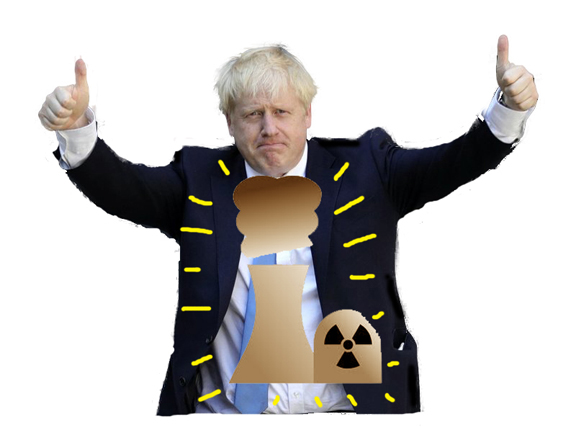
Boris Johnson has increased pressure on Rishi Sunak to boost nuclear
capacity with funding for two more large-scale projects before the next
election.
In a new intervention since leaving No 10, Johnson, accompanied
by Priti Patel, the former home secretary, warned that the country had a
“damaging gap in our nuclear capabilities and a weakness in our energy
supply”.
In a letter seen by The Times signed by 57 Tory MPs, Sunak was
urged to fund the development of two more projects before the end of this
parliament. the 57 Tories — including Anne-Marie Trevelyan, the Foreign
Office minister, and Sir Graham Brady, chairman of the 1922 Committee —
said that more had to be done.
In the letter, organised by Virginia
Crosbie, the MP for Ynys Môn, they said the government needed “at all
costs” to avoid errors they say that Labour made in not recognising the
“good value” of nuclear power.
They demanded that the government
declare nuclear “unambiguously” to be a green energy source, set out
binding nuclear targets for 2035 and 2050 and order officials to start
talks with Rolls-Royce to fund small modular reactors. The letter said:
“We are the only major nuclear nation in the world without a sovereign
reactor design to deploy or export. It is time we changed that.”
Times 23rd Feb 2023
Nuclear power – carbon intensive and environmentally damaging -NOT GREEN – Nuclear Free Local Authorities
NFLAs call on Chancellor not to class nuclear as ‘green’

– 23 Feb 23,
Fearing the UK Government may – for once – follow an unwanted lead set in Europe, the Chair of UK/Ireland Nuclear Free Local Authorities network has written to the Chancellor of the Exchequer requesting that he refrain for reclassifying nuclear as a ‘green investment’ under revised taxonomy rules.
There has been much speculation in the corridors of power, in the press and amongst the anti-nuclear community that Jeremy Hunt may soon choose to reclassify ‘nuclear’ as a green investment to unlock more private investment in the government’s planned future civil nuclear programme.
A reclassification in the revised taxonomy rules would make such investment more ‘attractive’ and ‘acceptable’ to certain large pension funds and investment companies.
The European Commission has previously adopted an identical strategy, but it was one which met with significant political and societal opposition and led to legal challenges from member states.
In his letter, Councillor Lawrence O’Neill outlines how nuclear power is both carbon-intensive and environmentally damaging. Commenting he said:
“It would be a complete misnomer to describe nuclear as ‘green’. From mining the uranium ore through to dealing with the legacy of radioactive waste, civil nuclear power leaves a massive carbon footprint and contaminates all it touches. The NFLAs hope that the Chancellor will see the logic of leaving things as they are and accede to our request, but if not we shall be ready to stand shoulder-to-shoulder with all those opposed to this change. Nuclear is not ‘green’ and never will be.”
The letter sent to the Chancellor reads::…………………………….. https://www.nuclearpolicy.info/news/nflas-call-on-chancellor-not-to-class-nuclear-as-green/—
Cost of EDF’s new UK nuclear project rises to $40 billion (msn.com).
By America Hernandez, 21 Feb 23 PARIS (Reuters) – EDF’s new nuclear plant in southwest England is likely to cost about 2% more than its last budget estimate as inflation propels the price tag to almost 33 billion pounds ($40 billion), EDF documents show.
Britain plans to build new nuclear plants to boost its energy security and help meet a target for net zero emissions by 2050.
EDF warned in a results presentation on Friday the cost of the Hinkley Point C project, Britain’s first new nuclear plant in more than two decades, “could reach 32.7 billion pounds” based on inflation indexes as of June 30, 2022.
Its previously published cost estimate in May 2022 was 31-32 billion euros when adjusted for inflation.
PARIS (Reuters) – EDF’s new nuclear plant in southwest England is likely to cost about 2% more than its last budget estimate as inflation propels the price tag to almost 33 billion pounds ($40 billion), EDF documents show.
Britain plans to build new nuclear plants to boost its energy security and help meet a target for net zero emissions by 2050.
EDF warned in a results presentation on Friday the cost of the Hinkley Point C project, Britain’s first new nuclear plant in more than two decades, “could reach 32.7 billion pounds” based on inflation indexes as of June 30, 2022.
Its previously published cost estimate in May 2022 was 31-32 billion euros when adjusted for inflation. https://www.msn.com/en-au/money/other/cost-of-edf-s-new-uk-nuclear-project-rises-to-40-billion/ar-AA17IxdK?ocid=msedgntp&cvid=a11054ac2c0c487f9a20627240342227
France mounts ‘aggressive’ nuclear push with eye on EU industrial plan

“They’re trying to get nuclear everywhere where it doesn’t fit … to have policy lock-in,” said one EU diplomat who spoke on condition of anonymity, adding: “Everybody is a little annoyed at the French — it’s very aggressive.”
Paris looks out for its atomic industry as the sector faces a crossroads.
BY VICTOR JACK, 17 Feb 23, https://www.politico.eu/article/france-aggressive-nuclear-energy-push-eu-industrial-plan-renewables/
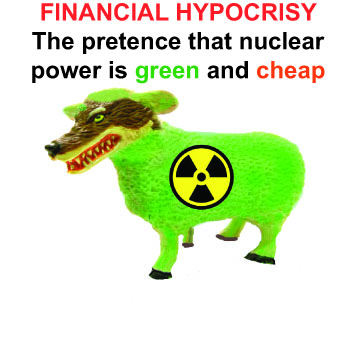
With its atomic industry at a crossroads, France is mounting a lobbying blitz to put nuclear energy on par with renewables in EU climate legislation — and unlock benefits from the bloc’s upcoming plans to boost green industries.
Paris argues that if the ultimate goal of the EU’s climate targets is to decarbonize the bloc, that should mean nuclear plants, with their negligible CO2 emissions, have a key role to play alongside renewables.
But that push — and attempt to reposition nuclear as a green technology — is also a strategy to strengthen Paris’ hand down the line in accessing cash from the bloc’s upcoming mammoth industrial strategy, six diplomats told POLITICO.
“They’re trying to get nuclear everywhere where it doesn’t fit … to have policy lock-in,” said one EU diplomat who spoke on condition of anonymity, adding: “Everybody is a little annoyed at the French — it’s very aggressive.”
The move is designed to “build leverage for other arguments” down the line, a second EU diplomat said.
Asked whether France expects nuclear to be counted as a “clean technology” in the upcoming industrial plan and therefore benefit from it, a senior French energy ministry official told POLITICO that “the [EU sustainable investment rules] recognize the fact that nuclear … is a technology that contributes to the transition.”
“So in absolute terms, it seems to us that this question already has an answer.”
Small victory, bigger problem
Paris notched a first victory last week on the EU’s long-awaited rules governing what counts as “renewable hydrogen.”
Unlike most other countries, hydrogen producers in France will be able to count the electricity taken from the grid as renewable as long as they also sign a long-term power contract with an existing renewables provider. The exception was made because 70 percent of France’s electricity comes from low-emissions nuclear.
But this promotion of nuclear-powered hydrogen — also known as “pink” or “low-carbon” hydrogen — is only one part of France’s broader push to inject atomic energy into EU green policy files, in which it has so far been less successful.
In late January, Paris attempted to insert low-carbon hydrogen into a renewables cooperation partnership with Ukraine, but was ultimately overruled.
It also led a push alongside eight other EU countries this month for pink hydrogen to be included in the EU’s Renewable Energy Directive, arguing that it should contribute toward 2030 targets for greening transport and industry.
When it didn’t get its way, France accused Spain and Germany of reneging on promises to recognize the role of low-carbon hydrogen.
“It would not be understandable for Spain and Germany to take different positions in Brussels and not keep their commitments,” French Energy Minister Agnès Pannier-Runacher told reporters last week.
Atomic needs
The push comes as experts predict France’s electricity demand will rise sharply as the country electrifies to meet its climate goals, and its ageing nuclear fleet declines.
Historically an exporter of electricity to its EU neighbors, France last year was forced to import power to meet its consumption needs as half its nuclear fleet was forced into maintenance due to corrosion and other technical problems.
And with the country’s largest utility EDF announcing a nine-month halt to another nuclear reactor earlier this month, that leaves two-fifths of its reactors still out of action.
“A lot of these nuclear reactors are ageing,” said Carlos Torres Diaz, senior vice president and head of power at Rystad Energy, a consultancy, who predicts some will be decommissioned already “in the next decade.”
Add to that French electricity demand is set to rise from 417 to 715 terawatt-hours by 2030, Torres Diaz said, meaning “there will need to be some investments.”
Paris is clearly aware of the challenge. In a sharp U-turn from his previous policy, President Emmanuel Macron announced plans to build six new reactors last February, with an eye on building eight more.
But that won’t come cheap, with new nuclear plants typically costing “billions,” Torres Diaz said. “If they need to renew all this ageing capacity then they will need to get the funding … If it’s not a green source of energy they will struggle to get some financing.”
That’s where the EU’s Green Industrial Plan comes in.
Announced last month, the upcoming plan is Brussels’ attempt to help the bloc go toe-to-toe with the United States’ $369 billion Inflation Reduction Act with a range of tax relaxations and new industrial benchmarks for 2030.
From the proposed European Sovereignty Fund, to more state aid allowances and potentially a competitive auction for a 10-year fixed-rate renewable hydrogen contract, there’s ample opportunity for France to cash in.
With the discussion still in its early days and specific language on policy not yet nailed down, that gives France an opening to stake out its position.
In the planned Net-Zero Industrial Act, for example, which aims to slash red tape on “net-zero” technologies, the “precise product scope [of the technologies] remains to be defined,” according to the European Commission.
Marion Labatut, EDF’s deputy director of EU affairs, agreed “it would be good” if nuclear were included in the upcoming strategy. She added that the utility would be interested in accessing the Commission’s hydrogen auction, for example.
And while France is likely to face resistance from nuclear-skeptic countries including Germany and Luxembourg, recent diplomatic efforts indicate Paris is not likely to give up easily.
In fact, pink hydrogen was on the agenda during the first official meeting between Commission President Ursula von der Leyen and French Prime Minister Élisabeth Borne on Thursday.
Overall, this push “is very unsurprising,” a third EU diplomat said. “The French are very skilled at using crises to push their own strategic policies ahead.”
Alexandre Léchenet and Giorgio Leali contributed reporting.
Yet another £6 billion cost hike for UK’s Hinkley Point C nuclear project

Hinkley C’s £6bn cost hike tests UK’s nuclear resolve. A further £6 billion
cost increase at Hinkley Point C will test the government’s commitment to
funding future large-scale nuclear projects, according to energy industry
experts.
The figure was revealed alongside EDF’s accounts last week, with
construction of the 3.2GW power plant now estimated to cost as much as
£32.7 billion. That is a £6 billion increase on the revised construction
price set last year and is almost double the £18 billion figure set in 2016
when EDF first started work on the project.
The latest cost hike has been
attributed to rising inflation, however engineering problems and complex
ground conditions have previously pushed the cost up, as well as a £500
million cost increase due to Covid-19 and pandemic-related working
restrictions.
Utility Week 21st Feb 2023
https://utilityweek.co.uk/hinkley-cs-6bn-cost-hike-tests-uks-nuclear-resolve/
1 This Month

of the week– Nuclear Reactor Information Task Force

14 May – online event From Bombs to Data Centres: the Face of Nuclear Colonialism
To see nuclear-related stories in greater depth and intensity – go to https://nuclearinformation.wordpress.com
-
Archives
- May 2026 (116)
- April 2026 (356)
- March 2026 (251)
- February 2026 (268)
- January 2026 (308)
- December 2025 (358)
- November 2025 (359)
- October 2025 (376)
- September 2025 (257)
- August 2025 (319)
- July 2025 (230)
- June 2025 (348)
-
Categories
- 1
- 1 NUCLEAR ISSUES
- business and costs
- climate change
- culture and arts
- ENERGY
- environment
- health
- history
- indigenous issues
- Legal
- marketing of nuclear
- media
- opposition to nuclear
- PERSONAL STORIES
- politics
- politics international
- Religion and ethics
- safety
- secrets,lies and civil liberties
- spinbuster
- technology
- Uranium
- wastes
- weapons and war
- Women
- 2 WORLD
- ACTION
- AFRICA
- Atrocities
- AUSTRALIA
- Christina's notes
- Christina's themes
- culture and arts
- Events
- Fuk 2022
- Fuk 2023
- Fukushima 2017
- Fukushima 2018
- fukushima 2019
- Fukushima 2020
- Fukushima 2021
- general
- global warming
- Humour (God we need it)
- Nuclear
- RARE EARTHS
- Reference
- resources – print
- Resources -audiovicual
- Weekly Newsletter
- World
- World Nuclear
- YouTube
-
RSS
Entries RSS
Comments RSS
 nuclear-news