Nuclear Fusion: A Clean Energy Revolution Or A Radioactive Nightmare?

By Kurt Cobb – Jun 20, 2023, Oil Price
Fusion reactors, while producing energy, also produce neutron streams that can cause radiation damage, produce radioactive waste, necessitate biological shielding, and even create the potential for weapons-grade plutonium production.
Apart from the aforementioned problems, fusion reactors face issues such as tritium release, intensive coolant demands, and high operating costs, which would require the power plant to have at least a one-gigawatt capacity to balance costs.
Given the time and resources required for fusion power plant construction, the technology might not be feasible for timely carbon emission reduction, and the prospect of fusion energy might be distracting society from immediate solutions to energy scarcity and climate change.
……………………
The reality of fusion power, however, is one of huge scale and vast obstacles according to Daniel Jassby, a former research physicist at the Princeton Plasma Physics Lab. (All of what follows assumes that the remaining obstacles to producing net energy from fusion will be overcome. Addressing that issue would require a seperate and lengthy essay.)
Perhaps the most unexpected revelation Jassby offers runs entirely contrary to the clean image that fusion energy has in the public mind. It turns out that the most feasible designs for fusion reactors will generate large amounts of radioactivity and radioactive waste.
[here much detail on the operation of nuclear fusion]………………………………………………………………………..
To power the enormously energy-intensive process of fusion, a fusion plant will use a lot of energy just to run itself. That means scale will matter. In order to accommodate this so-called parasitic power drain AND produce enough excess electricity to sell to pay for the costs of constructing the plant and for its ongoing operation, fusion plants will have to have a capacity of at least one gigawatt (one billion watts). One gigawatt can supply electricity to 300,000 to 750,000 homes depending on how the calculation is done. And, even much larger capacity per plant will be desirable because it will decrease the percentage of power production devoted to sustaining the fusion reaction and servicing the plant infrastructure. In short, making fusion plants big will be the only way to make them economical. So much for my friend’s fantasy of handheld fusion power units!
In a second article, Jassby addresses the International Thermonuclear Experimental Reactor (ITER) located in France. The project is a cooperative research venture designed to study and perfect fusion. It will not produce any electricity itself, but rather set the stage for so-called demonstration plants which could be built in the second half of this century.
……………………..
just to operate its experiments, ITER will require 600 megawatts of power, a window into the parasitic power requirements of fusion reactors.
The fantasy of cheap, unlimited fusion power arriving soon with no serious side-effects prevents us as a society from grappling with near-term energy depletion and our ongoing dependence on fossil fuels in the accelerated manner required to prevent a major energy crisis. Hope that fusion energy will somehow solve our energy and climate problems is not a real plan. It is just another illusory and far-in-the-future technical fix offered to convince us that we don’t need to alter our way of life in any substantial way to address the serious problems we face. https://oilprice.com/Alternative-Energy/Nuclear-Power/Nuclear-Fusion-A-Clean-Energy-Revolution-Or-A-Radioactive-Nightmare.html
Assessing investability of new nuclear projects like Sizewell C
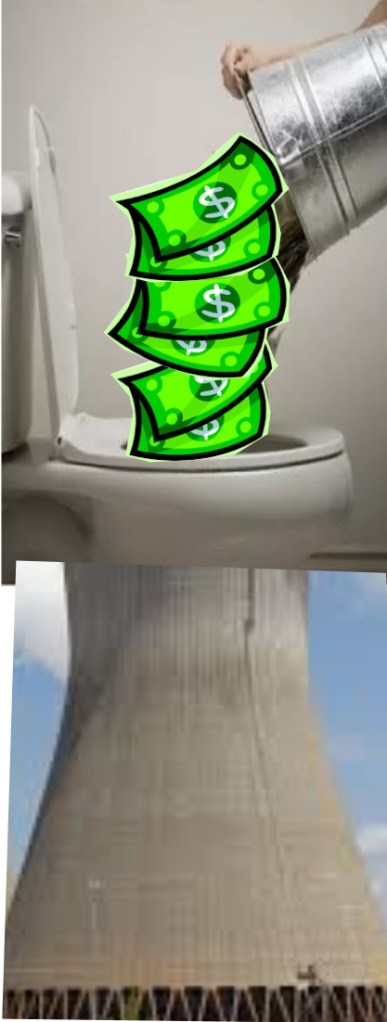
The crucial issue here is that the regulated company is permitted to start charging customers immediately after the project begins, and can continue to do so throughout the construction phase.
The downside for customers or ratepayers is that they end up bearing most of the risk, whether that is delays, cost increases, or even complete cancellations.
it is transferring a lot of the risk straight onto the customer and the customer can end up paying through the nose for nothing if you have serious problems in terms of timescales.”
NS Energy, By James Varley 19 Jun 2023
The UK is grappling with the problem of inviting the private sector to invest in new nuclear without interest driving up the price. Its solution cuts costs – but transfers the risk to consumers
UK Chancellor Jeremy Hunt confirmed recently that the UK would back the proposed Sizewell C nuclear power plant with an investment of £679m. The funding had initially been announced by then Prime Minister Boris Johnson. It is a mark of the large investment involved in a new nuclear unit that, despite UK plans to see one new nuclear plant reach Final Investment Decision (FID) in this parliament (ie before the end of 2024) and two achieve FID in the next (before 2029), two incoming Prime Ministers (Teresa May and Rishi Sunak) have announced reviews of Sizewell C. But Sunak’s chancellor Jeremy Hunt reaffirmed both the project and the funding, saying: “Our £700m investment is the first state backing for a nuclear project in over 30 years and represents the biggest step in our journey to energy independence.”
Of perhaps more interest to investors is the UK government’s decision to take a 50% stake in Sizewell C, with co-investor EDF. But neither of the two envisages holding those large stakes for very long. Once the project – which now has planning permission – reaches FID, both hope that it will attract new investors, so that the UK and EDF can reduce their stake to around the 20% level.
It is hoped that the project can bring in private capital because investors will gain confidence in the continued presence in the project of the UK and EDF but also because it will be built under a different financing model.
It is hoped Sizewell C will look less like a state-owned plant where funding comes from the government and it (in effect taxpayers) bears the risk of cost and schedule overruns. Instead, the government hopes it will resemble other types of power plant development cycles, in which different investors buy and dispose of stakes as the project moves from development, to permitted and ‘shovel-ready’, to construction and operation. With each step the project rises in value while the risk falls, so eventually it becomes investable for groups like pension funds which will accept low returns in exchange for long-term stability, while early investors will take their profit and reinvest in other projects where returns are higher.
At £20bn (in 2015 money) even 60% of the project will be too large for any single bank or other investors, which are more likely to join at the £1bn level. But the UK hopes that post-FID (aimed to be at the end of 2024) the project will attract enough investors that they will be in competition on the initial return on investment required. In the future, the level of allowed return will be set by the UK’s energy regulatory authority, Ofgem
Moving to a RAB model
Co-investing with the government is not currently enough to make Sizewell C an attractive investment though. The key to that, the UK government believes, is the Regulated Asset Base model (RAB).
The Department for Business, Energy and International Strategy (BEIS) set out its view on the RAB model and compared it with other funding models in an Impact Assessment in 2021 – required because the RAB model required primary legislation (which has now been passed).
Comparing RAB with relying on existing funding models, such as Contracts for Difference (CfD) BEIS said it “believes there are few, if any, strategic investors in the market with the risk appetite to finance a new nuclear power plant using a CfD mechanism.” In fact, BEIS also considered that the RAB on its own “would not achieve the goal of delivering new projects at a lower cost”. It added new Funded Decommissioning Programme (FDP) legislation and the new Special Administration Regime.
What is the Regulated Asset Base model? It aims to manage nuclear’s biggest problem: huge capital costs and the long gap (as much as 15 years) between investing and starting to earn a return when power is produced.
The UK’s RAB approach aims to address this. It has commonalities with US models that add nuclear to a utility’s ‘rate base’, but the UK version would ring-fence the project activities in a special purpose vehicle (SPV). The SPV is awarded a licence to own and operate the project for a defined period. It is permitted to recover the costs of construction and operation, and also to make an ‘allowed return’ on the asset for the lifetime of the licence.
The crucial issue here is that the regulated company is permitted to start charging customers immediately after the project begins, and can continue to do so throughout the construction phase.
……………………..The downside for customers or ratepayers is that they end up bearing most of the risk, whether that is delays, cost increases, or even complete cancellations.
……………………….There is no shortage of experience in the energy sector of different financing models. Some have salutary lessons………………………………
The burden lies less heavily on wind and solar projects because they can be built relatively quickly and the project can be built in phases. As a result, income from part of the project starts early, while construction lessons can be learned from in early phases so delivery risk in the later phases is lower. Nuclear does not have that opportunity.
Prices set in advance look very different in the rearview mirror. Once the plant is operating the risks accepted by the developer before and during construction are forgotten…………………..
With the RAB model, a nuclear plant will still face price and volume risk once operating, as its power will have to be sold into a volatile market where nuclear can be pushed out of the merit order by cheap renewables and prices can fall to zero at times (a contrast to TTT, whose customer Thames Water has no choice but to use the service and no alternative supplier).
Despite the fact that it may reduce costs, consumer advocates are very wary of the RAB model. Alan Whitehead, Labour’s shadow energy minister and a longstanding observer of the industry, has previously complained that the RAB model “effectively puts costs on the consumer well before you have any idea when a particular plant will come onstream. If there is any slippage in the process the consumer just continues to pay out. …it is transferring a lot of the risk straight onto the customer and the customer can end up paying through the nose for nothing if you have serious problems in terms of timescales.”
He referred to consumers in the USA who were left paying the cost for decades when nuclear projects were cancelled……………….. https://www.nsenergybusiness.com/features/assessing-investability-of-new-nuclear-projects-like-sizewell-c/
The Silent Slaughter of the Flower of Ukraine’s Youth
Now that the Ukrainian counteroffensive is underway, it is clear that the government and its Western allies are maintaining silence to conceal the brutal cost Ukraine’s brave young people are paying.
By Medea Benjamin | Nicolas J.S. Davies / Common Dreams. June 21, 2023
https://scheerpost.com/2023/06/21/the-silent-slaughter-of-the-flower-of-ukraines-youth/
As Ukraine prepared to launch its much heralded but long delayed counteroffensive, the media published a photograph of a Ukrainian soldier with his finger on his lips, symbolizing the need for secrecy to retain some element of surprise for this widely telegraphed operation.
Now that the offensive has been under way for two weeks, it is clear that the Ukrainian government and its Western allies are maintaining silence for quite a different reason: to conceal the brutal cost Ukraine’s brave young people are paying to recover small scraps of territory from Russian occupation forces, in what some are already calling a suicide mission.
Western pundits at first described these first two weeks of fighting as “probing operations” to find weak spots in Russia’s defenses, which Russia has been fortifying since 2022 with multiple layers of minefields, “dragon’s teeth,” tank-traps, pre-positioned artillery, and attack helicopters, unopposed in the air, that can fire 12 anti-tank missiles apiece.
On the advice of British military advisers in Kyiv, Ukraine flung Western tanks and armored vehicles manned by NATO-trained troops into these killing fields without air support or demining operations. The results have been predictably disastrous, and it is now clear that these are not just “probing” operations as the propaganda at first claimed, but the long-awaited main offensive.
A Western official with intelligence access told The Associated Press on June 14, “Intense fighting is now ongoing in nearly all sectors of the front… This is much more than probing. These are full-scale movements of armor and heavy equipment into the Russian security zone.”
Other glimpses are emerging of the reality behind the propaganda. At a press conference after a summit at NATO Headquarters, U.S. General Mark Milley warned that the offensive will be long, violent, and costly in Ukrainian lives.
“This is a very difficult fight. It’s a very violent fight, and it will likely take a considerable amount of time and at high cost,” Milley said.
Russian videos show dozens of Ukrainian tanks and armored vehicles lying smashed in minefields, and NATO military advisers in Ukraine have confirmed that it lost 38 tanks in one night on June 8, including newly delivered German-built Leopard IIs.
Rob Lee of the Foreign Policy Research Institute explained to TheNew York Times that the Russians are trying to inflict as many casualties and destroy as many vehicles as possible in the areas in front of their main defensive lines, turning those areas into lethal kill zones. If this strategy works, any Ukrainian forces that reach the main Russian defense lines will be too weakened and depleted to break through and achieve their goal of severing Russia’s land bridge between Donbas and Crimea.
Russia’s Ministry of Defense reported that Ukraine’s forces suffered 7,500 casualties in the first 10 days of the offensive. If Ukraine’s real losses are a fraction of that, the long, violent bloodbath that General Milley anticipates will destroy the new armored brigades that NATO has armed and trained, and serve only to escalate the gory war of attrition that has destroyed Mariupol, Sievierodonetsk, and Bakhmut, killing and wounding hundreds of thousands of young Ukrainians and Russians.
A senior European military officer in Ukraine provided more details of the carnage to Asia Times, calling Ukraine’s operations on June 8 and 9 a “suicide mission” that violated the basic rules of military tactics.
“We tried to tell them to stop these piecemeal tactics, define a main thrust with infantry support and do what they can,” he said. “They were trained by the British, and they’re playing Light Brigade,” he added, comparing the offensive to a suicidal charge into massive Russian cannon fire that wiped out Britain’s Light Cavalry Brigade in Crimea in 1854.
If Ukraine’s “Spring Offensive” plunges on to the bitter end, it could be more like the British and French Somme Offensive, fought near the French River Somme in 1916. After 19,240 British troops were killed on the first day (including Nicolas’s 20-year-old great-uncle, Robert Masterman), the battle raged on for more than four months of pointless, wanton slaughter, with over a million British, French, and German casualties. It was finally called off after advancing only six miles and failing to capture either of the two small French towns that were its initial objectives.
The current offensive was delayed for months as Ukraine and its allies grappled with the likelihood of the outcome we are now witnessing. The fact that it went ahead regardless reflects the moral bankruptcy of U.S. and NATO political leaders, who are sacrificing the flower of Ukraine’s youth in a proxy war they will not send their own children or grandchildren to fight.
As Ukraine launches its offensive, NATO is conducting Air Defender, the largest military exercise in its history, from June 12 to 23, with 250 warplanes, including nuclear-capable F-35s, flying from German bases to simulate combat operations in and over Germany, Lithuania, Romania, the North Sea, and the Baltic Sea. The exercise has led to at least 15 incidents between NATO and Russian aircraft in the skies near Lithuania.
It seems that nobody in NATO’s foreboding fortress in Brussels has stumbled on the concept of a “security dilemma,” in which supposedly defensive actions by one party are perceived as offensive threats by another and lead to a spiral of mutual escalation, as has been the case between NATO and Russia since the 1990s. Professor of Russian history Richard Sakwa has written, “NATO exists to manage the risks created by its existence.”
These risks will be evident in the upcoming NATO Summit in Vilnius on July 11-12, where Ukraine and its eastern allies will be pushing for Ukraine membership, while the U.S. and western Europe insist that membership cannot be offered while the war rages on and will instead offer “upgraded” status and a shorter route to membership once the war ends.
The continued insistence that Ukraine will one day be a NATO member only means a prolongation of the conflict, as this is a red line that Russia insists cannot be crossed. That’s why negotiations that lead to a neutral Ukraine are key to ending the war.
But the United States will not agree to that as long as President Joe Biden keeps U.S. Ukraine policy firmly under the thumbs of hawkish neoconservative desk warriors like Antony Blinken and Victoria Nuland at the State Department and National Security Adviser Jake Sullivan at the White House. Pressure to keep escalating U.S. involvement in the war is also coming from Congress, where Republicans accuse Biden of “hemming and hawing” instead of “going all in” to help Ukraine.
Paradoxically, the Pentagon and intelligence agencies are more realistic than their civilian colleagues about the lack of any military solution. The Chairman of the Joint Chiefs of Staff, General Milley, has called for diplomacy to bring peace to Ukraine, and U.S. intelligence sources have challenged dominant false narratives of the war in leaks to Newsweek and Seymour Hersh, telling Hersh that the neocons are ignoring genuine intelligence and inventing their own, just as they did to justify the invasion of Iraq in 2003.
With the retirement of Deputy Secretary of State Wendy Sherman, the State Department is losing the voice of a professional diplomat who was President Barack Obama’s chief negotiator for the JCPOA with Iran and urged Biden to rejoin the agreement, and who has taken steps to moderate U.S. brinkmanship toward China. While publicly silent on Ukraine, Sherman was a quiet voice for diplomacy in a war-mad administration.
Many fear that Sherman’s job will now go to Nuland, the leading architect of the ever-mounting catastrophe in Ukraine for the past decade, who already holds the #3 or #4 job at State as Under Secretary of State for Political Affairs.
Other departures from the senior ranks at State and the Pentagon are likely to cede more ground to the neocons. Colin Kahl, the Under Secretary of Defense for Policy, who worked with Sherman on the JCPOA, opposed sending F-16s to Ukraine, and has maintained that China will not invade Taiwan in the near future. Kahl is leaving the Pentagon to return to his position as a professor at Stanford, just as China hawk General C.Q. Brown will replace General Milley as Chairman of the Joint Chiefs when Milley retires in September.
Meanwhile, other world leaders continue to push for peace talks. A delegation of African heads of state led by President Cyril Ramaphosa of South Africa met with President Volodymyr Zelenskyy in Kyiv, and President Vladimir Putin in Moscow on June 17, to discuss the African peace plan for Ukraine.
President Putin showed the African leaders the 18-point Istanbul Agreement that a Ukrainian representative had signed back in March 2022, and told them that Ukraine had thrown it in the “dustbin of history,” after the now disgraced Boris Johnson told Zelenskyy the “collective West” would only support Ukraine to fight, not to negotiate with Russia.
The catastrophic results of the first two weeks of Ukraine’s offensive should focus the world’s attention on the urgent need for a ceasefire to halt the daily slaughter and dismemberment of hundreds of brave young Ukrainians, who are being forced to drive through minefields and kill zones in Western gifts that are proving to be no more than U.S.- and NATO-built death-traps
‘Truly shocking’: UK has enough plutonium to make almost 20,000 nukes

A study published by a university in Nagasaki has revealed that the UK has enough stockpiled plutonium to make almost 20,000 atomic warheads with the same power as the bomb which totally-destroyed that Japanese city in August 1945.
The 2023 Fissile Material Directory[i] is published in June each year by the Research Center for Nuclear Weapons Abolition (RECNA)[ii], based at Nagasaki University. RECNA has been established for over twenty years as an educational and research institute at a university that has a medical faculty with a first-hand experience of the horror of nuclear weapons. Its primary goal is achieving a world free from nuclear weapons.
In January, the institute was visited by UK/Ireland Nuclear Free Local Authorities Secretary Richard Outram, where he met Vice-Director Professor Tatsujiro Suzuki.
The study lists the UK as holding 119.7 tons of plutonium, the second highest stockpile in the world after Russia with 191.5 tons, and 22.6 tons of Highly Enriched Uranium. The plutonium stockpile is said to be sufficient to arm 19,947 atom bombs, like the ‘Fat Man’ bomb dropped on Nagasaki on 9 August 1945, whilst the uranium stockpile has the potential to be turned into a further 355 devices comparable to the ‘Little Boy’ bomb dropped on Hiroshima three days earlier.
The Nagasaki bomb is estimated to have killed 35,000 – 40,000 people on the day and the Hiroshima bomb about twice that many.
The UK Government and nuclear industry has conceded in the 2022 UK Radioactive Material Inventory that 113 tons of UK-owned plutonium are currently managed by the Nuclear Decommissioning Authority, whilst a further 4 tons are in semi-assembled MOX or other fuel components. An additional 24 tons of foreign-owned plutonium are also held, a further legacy of the costly failure of the UK’s experiment with reprocessing[iii].
Across the world, RECNA estimates that 552 tons of plutonium and 1,260 tons of HEU are held, much of the latter in military hands. These are all deemed to be fissile materials and together could arm 92,000 plutonium bombs like the one used at Nagasaki and almost 20,000 uranium devices like that deployed at Hiroshima.
The Nuclear Free Local Authorities are gravely concerned about the future use of Britain’s plutonium stockpile. In recent weeks, the UK Government and the Nuclear Decommissioning Authority have published plans suggesting that some of this material should be used as fuel for a new generation of nuclear reactors.
The NFLA fears that burning plutonium as fuel will simply lead to the creation of more nuclear waste, that such material could be a target for terrorists or hostile state actors, especially in transit, and that these actions could lead to nuclear weapon proliferation. In its response to the government and industry plan the NFLA called for fissile material to be put ‘beyond use’ for all time[iv].
Responding to the RECNA report, Councillor Lawrence O’Neill, Chair of the NFLA Steering Committee, said:
“The data published by RECNA is both astonishing and truly shocking. If only a tiny fraction of Britain’s stockpile of fissile materials ended up in the wrong hands for use by terrorists or in military action then the consequences could be too awful to contemplate. In the UK, and elsewhere in the world, anti-nuclear campaigners need to continue to work together to lobby our respective governments to make these stockpiles safe and beyond use, and the time to do that is now.”
Judge Who Ruled Against Assange Built Career as Barrister Defending UK Government
“absurd that a single judge can issue a three-page decision that could land Julian Assange in prison for the rest of his life and permanently impact the climate for journalism around the world.”
Jonathan Swift, the High Court judge who has just rejected Julian Assange’s attempt to halt his extradition to the US, is the government’s former top lawyer and previously defended the Defence and Home Secretaries.
SCHEERPOST, By Mark Curtis / Declassified UK, 19 June 23
- Swift was entrusted to act for the Defence and Home Secretaries in at least nine legal cases
- His “favourite clients were the security and intelligence agencies” while representing the government
onathan Swift, the High Court judge who has rejected Julian Assange’s appeal against extradition to the US, has a long history of working for the government departments that are now persecuting the WikiLeaks founder.
Swift, who ruled against Assange on 6 June, was formerly the government’s favourite barrister.
He worked as ‘First Treasury Counsel’ – the government’s top lawyer – from 2006 to 2014, a position in which he advised and represented the government in major litigation.
Swift acted for the Defence and Home Secretaries in at least nine cases, Declassified has found.
…………………….. It was reported in 2013 that Swift had been paid nearly a million pounds – £975,075 – over the previous three years for representing the government.
Swift now presides over Assange’s extradition case being fought by the Home Office for whom he previously worked.
As with previous judges who have ruled against Assange, the case raises serious concerns about institutional conflicts of interests at the heart of the UK legal system…………………………………………
Ruling
In his rejection of the appeal by Assange’s lawyers, Swift curtly dismissed all eight grounds to their arguments as “no more than an attempt to re-run the extensive arguments made to and rejected by the District Judge”, who previously ruled on the case.
Media freedom group Reporters Sans Frontieres said Swift’s ruling brought Assange “dangerously close to extradition”.
It added it was “absurd that a single judge can issue a three-page decision that could land Julian Assange in prison for the rest of his life and permanently impact the climate for journalism around the world.”
The US government seeks to extradite Assange in order to try him in connection with WikiLeaks’ publication of leaked classified documents that informed public interest reporting around the world.
Assange faces a possible 175 years in prison and would be the first publisher prosecuted under the US Espionage Act. https://scheerpost.com/2023/06/19/judge-who-ruled-against-assange-built-career-as-barrister-defending-uk-government/
The Reverse Cuban Missile Crisis
America now plans to install tactical nuclear weapons in Romania and Poland.
BY TYLER DURDEN. WEDNESDAY, JUN 21, 2023 – Authored by Gilbert Doctorow, https://www.zerohedge.com/geopolitical/reverse-cuban-missile-crisis
What I am about to say is surely known and under analysis in the American intelligence agencies. It is being used by the Pentagon to quietly change its nuclear force posture in Europe. However, we hear not a word about it in the media, not in mainstream, and not yet in alternative news.
I maintain that it is very important for it to be heard and reflected upon by the general public in the United States and in Europe, disagreeable though it may be at the start of a new week. So here goes…
Last Friday when I published my selective account of the Q&A session with President Vladimir Putin at the culmination point of the St Petersburg International Economic Forum I omitted one important issue:
how Russia will respond to the dispatch of “Ukrainian” F-16s from some air base in a NATO country into the war zone in Ukraine. I was considering remedying that oversight on Saturday morning when a comment from one reader forced my hand. She wrote in that Italy’s daily newspaper La Repubblica quoted Putin as saying on Friday Russia will destroy such a base in response. I responded on Saturday in the Comments section that the Russian President had in fact been evasive in his comment, saying only that Russia could destroy such a base and was now taking the issue under advisement.
However, yesterday evening’s edition of the Vladimir Solovyov talk show indicates that the Republicca reporter was closer to the truth than I. A patient and knowledgeable Russian colonel in retirement who is a frequent guest on the talk show explained that the Kremlin is now considering exactly with what means to destroy such a NATO air base, not whether to do it. And the likely means will be use of tactical nuclear weapons on a Ramstein or whatever NATO base is involved. We may say that Germany is placing itself in the bulls-eye of any escalation in the Ukraine war if it proceeds with the F-16s to Ukraine program.
Why all the fuss over the F-16s, you may ask. After all, Putin has said loud and clear that Russia will destroy the F-16s in the air just as it has been destroying the Leopard tanks and America’s Bradley armored personnel carriers while pushing back the ongoing Ukrainian counter-offensive. To understand better, we have to thank the good colonel once again. He alerted us to an important detail that you will not find mentioned in The New York Times:
the first F-16s scheduled to be supplied to the Ukrainian Air Force are from Belgium and Denmark, and are all nuclear-capable, which is not a necessary feature of these planes.
Since the Russians are unable to determine what kind of munitions the “Ukrainian” F-16s will actually be delivering to the war zone, they must assume that they are carrying tactical nuclear bombs intended to be dropped on the Russian Army troop concentrations. The effect of such an attack could be devastating, hence the Russian threat to the air bases from which such planes are launched.
The next important revelation made during the Solovyov show came with respect to the first delivery of tactical nuclear weapons to Minsk which was marked by a visit to Belarus and interview with Lukashenko by the co-host of the Sixty Minutes news and discussion show Olga Skabeyeva. In answer to her question about where the nuclear warheads are being stored, Lukashenko said ‘everywhere.’ The meaning of this was kindly deciphered for us laymen by the colonel in retirement on the Solovyov program: this signifies a cardinal shift in the Russian handling of tactical nuclear arms away from their traditional separation of the warheads kept in a central storage far from the delivery carriers to the method used by the U.S. military with respect to its tactical nuclear weapons in Europe. The Americans, he said stored the nukes just under the jets that would be used to deliver them. Now in Belarus, the warheads will also be just next to the planes and Iskander missiles that will carry them. This means that the time to launch will depend only on the time for approval from the Boss. And with respect to that, Lukashenko told Skabeyeva that he had just to make a phone call to Vladimir Vladimirovich and approval would be instantaneous.
Why such a hair-trigger mechanism for unleashing nuclear weapons to defend Belarus? For an answer to that, go to Monday’s article in The Financial Times on how Poland is now preparing hundreds of Belarus fighters to go across the border and overthrow Lukashenko. To which I can only say: Warsaw, watch out! Lukashenko is one bold and decisive defender of his country, as his standing on the streets with a Kalashnikov in his hands when there were Western financed and promoted street demonstrations in Minsk aiming to overthrow him.
Still another item from the Solovyov show demanding our attention concerns what the good colonel calls the American response to the shipment of nuclear arms to Belarus: America now plans to install tactical nuclear weapons in Romania and Poland. Why, one might ask, in those two countries? For that you need only consider what the Kremlin has been saying for more than a decade about the U.S. bases set up in both countries supposedly to house anti-ballistic missile systems intended to bring down Iranian missiles fired on Europe. The Russians always objected that these installations would be dual-purpose and were a cover for placing nuclear-armed cruise missiles directed against themselves. Now if the USA indeed puts such missiles into the two countries, the Russian claims will have been vindicated and Washington is shown, yet again, to be a blatant liar on the world stage.
Finally, the colonel gave us an invaluable insight to changes in Russian thinking on tactical nuclear weapons which we otherwise missed. I have in mind Putin’s answer at the Forum to the question of whether Russia would use tactical nuclear weapons in the Ukraine theater. Putin’s loud and clear ‘no’ was, of course, an answer to the proposals of Sergei Karaganov for preemptive and instructive nuclear strikes in his just published essay in the magazine Russia in Global Affairs. As I reported, Putin went on to say that Russia has no need to show force by some preemptive strike because everyone knows it has many more tactical weapons than the West. And while the United States has called for talks on reduction of stockpiles of such weapons, Russia will not enter into such talks, and says to the West, “fuck you,” if I may translate his rude remark in Russian into corresponding four-letter English.
That last remark brought smiles to the faces of many Russians in the audience. But it was not just theatrics, says the good colonel: in fact Russia had been talking with Americans about the possibility of reducing stockpiles, but now, in the context of the NATO proxy war it has no intention of resuming such talks.
With that I end today’s survey of our dismal progression on the way to Armageddon.
Russian MP believes Ukrainian counteroffensive will end in July – Zelensky says operation is not going well
https://www.rt.com/russia/578360-ukrainian-counteroffensive-end-weeks-mp/ 21 June 23
Moscow’s troops are likely to repel Kiev’s offensive in July and launch an attack of their own, Andrey Kartapolov has claimed.
Kiev’s forces will exhaust their offensive capabilities in July if the current Ukrainian casualty rate persists, the head of Russia’s State Duma Defense Committee, Andrey Kartapolov, said on Tuesday.
Ukrainian troops have lost some 900 soldiers to deaths and injuries over the past 24 hours alone, the colonel general explained. According to Kartapolov, they have also lost nine tanks and dozens of armored vehicles over the same period. “If it continues at this pace, I believe we will finish repelling [this offensive] in three weeks and move on to dynamic actions ourselves,” the MP predicted in an appearance on the ‘Solovyov Live’ show.
The lawmaker claimed that Ukraine had already lost around 20,000 soldiers out of the 40,000 to 50,000 it had reportedly trained for the offensive. While he did not name his sources, he claimed the much-awaited Ukrainian operation had largely failed.
“Every tactic they have used has not worked as of now,” he said. Kiev’s troops did not advance further than the Russian forward defense area security zone and did not even reach the first defense line, the MP added.
According to the Russian Defense Ministry, over 600 Ukrainian servicemen have been killed over the past 24 hours, as Kiev’s troops continued their attacks on Russian positions. The Ukrainian forces also lost dozens of armored vehicles, as well as a dozen artillery pieces, including at least three US-made M777 howitzers, the ministry revealed in its daily briefing on Tuesday.
Kiev’s large-scale offensive began on June 4. Ukrainian troops have suffered heavy losses in the attacks, which have been repelled by Russian forces, according to the Russian Defense Ministry.
Last week, it said that 7,500 of Kiev’s frontline troops had either been killed or wounded. Russian President Vladimir Putin also said last week that Kiev had lost up to 30% of the heavy equipment supplied to it by the West.
Kiev planning strike on Russia with Western-made missiles – Moscow
https://www.rt.com/russia/578329-himars-strike-russia-shoigu/ 21 June 23,
Attacks with Storm Shadow and HIMARS missiles outside zone of active hostilities will trigger retaliation, minister has warned
The Ukrainian military leadership has plans to use Western weapons to strike parts of Russia that are not part of the active zone of hostilities, including Crimea, Russian Defense Minister Sergey Shoigu has warned.
In particular, officials in Kiev want to use HIMARS multiple rocket launchers and Storm Shadow air-launched cruise missiles, he said. The weapon systems have been delivered to Kiev by the US and the UK respectively and, if such attacks are launched, it would escalate the NATO nations’ involvement in the conflict, according to Shoigu.
Such an operation will “result in immediate strikes against the decision-making centers in the territory of Ukraine,” he stated. The defense minister was speaking on Tuesday during a high-profile meeting in his department.
The minister also offered a brief update on the special military operation in Ukraine, stating that since June 4 Kiev’s forces launched 263 attacks against Russian positions. “All of them were repelled, the enemy failed to reach its goals,” he added.
The Ukrainian government this month launched its long-anticipated counteroffensive. So far, it has failed to achieve significant advances on the ground, according to Russian reports and to accounts in Western media.
The US and its allies have supplied Western-made military hardware worth billions of dollars in preparation for the Ukrainian operation, including main battle tanks that they’d previously hesitated to offer.
The Russian military claimed to have destroyed a significant portion of the arsenal in the past two weeks, as Ukrainian forces failed to breach minefields or to deal with Russian advantage in artillery firepower and air superiority.
The delivery in May of Storm Shadow missiles was another move to give Ukraine additional military capabilities ahead of the counteroffensive. These have a range of up to 300 kilometers (200 miles), which is superior to other weapons that Kiev has access to.
The Russian Ministry of Defense regularly reports intercepting the British-made weapons in its regular updates on the Ukraine campaign.
Will upcoming NATO summit launch forever war in Europe?

Zelensky said two weeks ago that Ukraine would not even attend the Vilnius Summit unless given a firm signal on its eventual membership.
Pressure is mounting to make some sort of formal declaration over Ukraine’s membership at meetings in Vilnius next month.
JUNE 16, 2023, David Sacks, https://responsiblestatecraft.org/2023/06/16/will-upcoming-nato-summit-launch-forever-war-in-europe/
An article in the New York Times on Wednesday claimed that pressure is building on Biden to announce a timetable for Ukrainian membership in NATO at its Vilnius Summit next month.
Supposedly Biden is “isolated” among NATO allies in his reluctance to do so, even though that claim is contradicted by the story’s own last paragraph (the one that Noam Chomsky once quipped should be read first), which acknowledges that “others argue more quietly” that NATO membership “could give Mr. Putin more incentive to continue the war, or to escalate it.”
Indeed, since Moscow has already declared NATO membership for Ukraine to be completely unacceptable and an existential threat — the prevention of which is one of its chief war aims — a Vilnius Declaration that Ukraine will join NATO when the war ends will effectively ensure that the war goes on forever. It will also take off the table the West’s central bargaining chip to achieve peace, which is a neutral Ukraine.
It’s clear that the “pressure” on Biden is coming from Zelensky and some of the eastern NATO countries, specifically Poland and the Baltic States. Zelensky said two weeks ago that Ukraine would not even attend the Vilnius Summit unless given a firm signal on its eventual membership. Former NATO secretary general Anders Rasmussen, now a consultant to Zelensky, even threatened that “if NATO cannot agree on a clear path forward for Ukraine, there is a clear possibility that some countries individually might take action.” In particular, “the Poles would seriously consider going in,” triggering direct war between NATO and Russia.
The NYT article implies that the current secretary general Jens Stoltenberg agrees with the hardliners on the need for a concrete timetable for Ukraine’s admission into NATO, but he made no such promises during his joint address with President Biden on Tuesday. By Wednesday, Stoltenberg and NATO were making it clear that no specific timeline for Ukraine’s NATO membership would be on the agenda in Vilnius. He reiterated comments from April that “Ukraine’s future is in NATO,” and said there would be agreement from member states on a “multi-year program” to help Ukraine “become fully interoperable with NATO,” but wouldn’t commit to anything more specific than that.
Apparently, it’s Zelensky and his allies along the Russian border who are “isolated,” not President Biden.
Whatever Stoltenberg’s personal views may be, he knows NATO is divided on the question of admitting Ukraine in the near future. Even the NYT name-checks three countries – Germany, Hungary, and Turkey – whose leaders would definitely oppose membership at a specific future date. Many more leaders have privately expressed concern, and Biden, to his credit, appears to be one of them.
While his overall conduct and rhetoric has been hawkish (and I continue to maintain he could have avoided this war altogether with better diplomacy in the months leading up to it), Biden has been admirably consistent in his desire not to plunge America into direct war with Russia.
The threats from Rasmussen underscore how easily a proxy war can turn into a real one in an alliance where all members are pledged to come to the military defense of any one member. The American people may begin to question the wisdom of making new Article 5 guarantees if foreigners like Rassmussen can use existing ones to blackmail the United States into reckless action.
Polish or Ukrainian tails should not wag American dogs into World War III.
Short of giving Ukraine the security guarantees that NATO membership provides, some in Biden’s foreign policy circle, such as Secretary of State Antony Blinken, have been pushing a different idea, which is to give “Israel status” to Ukraine. This consists of long-term security guarantees (which run for ten-year intervals in Israel’s case) including weapons, ammunition, and money “not subject to the fate of the current counteroffensive or the electoral calendar.” In other words, America won’t reassess support even if the counteroffensive fails. Indeed, support won’t cease even if those pesky voters change their minds. Biden’s War for Democracy is too important to be subject to elections.
However, some observers may see here a classic bait and switch. Last year, after Ukraine retook land around Kharkiv and Kherson, the American people were assured that the Ukrainians would complete the job in the spring and summer of 2023. This new Ukrainian counteroffensive would roll back Russian territorial gains, perhaps even threaten the Russian hold on Crimea, and thereby drive Moscow to the negotiating table and end the war. Many Americans supported the $100+ billion in appropriations for Ukraine on this basis. The implicit promise was that this was a one-time expense, not the baseline for an annual appropriation in a new Forever War.
Now a difficult start to the counteroffensive coupled with a proposed multi-year deal at Vilnius makes clear that this was a lie or a pipe dream. But isn’t this what always happens? Administrations ease us into war with promises of quick and easy victory, and then once involved, tell us we can’t back out no matter the cost because American credibility is at stake. It’s Vietnam, Afghanistan or Iraq all over again, except this time with a nuclear-armed adversary creating the heightened risk that the war could escalate into WWIII at any point.
Perhaps the most pointless aspect of the current debate among NATO members is that with or without a timetable, a Vilnius Declaration that Ukraine will join NATO is a promise that cannot be implemented, absent a major reversal in Ukrainian fortunes on the battlefield. Such a declaration cannot guarantee Ukraine’s NATO admission any more than its forerunner at the Bucharest Summit in 2008 did. It can only guarantee that the Russians remain implacably resolved to stopping it by perpetuating the war as long as they have to.
So our insistence that Ukraine be allowed to join NATO “someday,” combined with our (sensible) desire not to be drawn into World War III, means that “someday” will never arrive. This begs the question: why continue to make a promise when there is no realistic path to achieving it? Why fight over a principle (NATO’s “open door”) that’s largely theoretical anyway because Ukraine can’t actually join the alliance without triggering the continent-wide conflagration NATO was established to avoid in the first place?
The leaders meeting at Vilnius may not be asking that question, but future historians judging them surely will.
World’s Largest Fusion Project Is in Big Trouble, New Documents Reveal

The ITER project formally began in 2006, when its international partners agreed to fund an estimated €5 billion (then $6.3 billion), 10-year plan that would have seen ITER come online in 2016. The most recent official cost estimate stands at more than €20 billion ($22 billion), with ITER nominally turning on scarcely two years from now. Documents recently obtained via a lawsuit, however, imply that these figures are woefully outdated: ITER is not just facing several years’ worth of additional delays but also a growing internal recognition that the project’s remaining technical challenges are poised to send budgets spiraling even further out of control and successful operation ever further into the future.
With each passing decade, this record-breaking monument to big international science looks less and less like a cathedral—and more like a mausoleum.
The International Thermonuclear Experimental Reactor (ITER) is already billions of dollars over budget and decades behind schedule. Not even its leaders can say how much more money and time it will take to complete
By Charles Seife on June 15, 2023. https://www.scientificamerican.com/article/worlds-largest-fusion-project-is-in-big-trouble-new-documents-reveal/?fbclid=IwAR3siLk4iSD43-SE6sBStfYeTIl9YNeZ5QcLz27JgQwMd85DcYV7kUmciw8
It could be a new world record, although no one involved wants to talk about it. In the south of France, a collaboration among 35 countries has been birthing one of the largest and most ambitious scientific experiments ever conceived: the giant fusion power machine known as the International Thermonuclear Experimental Reactor (ITER).
But the only record ITER seems certain to set doesn’t involve “burning” plasma at temperatures 10 times higher than that of the sun’s core, keeping this “artificial star” ablaze and generating net energy for seconds at a time or any of fusion energy’s other spectacular and myriad prerequisites. Instead ITER is on the verge of a record-setting disaster as accumulated schedule slips and budget overruns threaten to make it the most delayed—and most cost-inflated—science project in history.
ITER is supposed to help humanity achieve the dream of a world powered not by fossil fuels but by fusion energy, the same process that makes the stars shine. Conceived in the mid-1980s, the machine, when completed, will essentially be a giant, high-tech, doughnut-shaped vessel—known as a tokamak—that will contain hydrogen raised to such high temperatures that it will become ionized, forming a plasma rather than a gas. Powerful magnetic and electric fields flowing from and through the tokamak will girdle and heat the plasma cloud so that the atoms inside will collide and fuse together, releasing immense amounts of energy. But this feat is easier said than done.
Since the 1950s fusion machines have grown bigger and more powerful, but none has ever gotten anywhere near what would be needed to put this panacea energy source on the electric grid. ITER is the biggest, most powerful fusion device ever devised, and its designers have intended it to be the machine that will finally show that fusion power plants can really be built.
The ITER project formally began in 2006, when its international partners agreed to fund an estimated €5 billion (then $6.3 billion), 10-year plan that would have seen ITER come online in 2016. The most recent official cost estimate stands at more than €20 billion ($22 billion), with ITER nominally turning on scarcely two years from now. Documents recently obtained via a lawsuit, however, imply that these figures are woefully outdated: ITER is not just facing several years’ worth of additional delays but also a growing internal recognition that the project’s remaining technical challenges are poised to send budgets spiraling even further out of control and successful operation ever further into the future.
The documents, drafted a year ago for a private meeting of the ITER Council, ITER’s governing body, show that at the time, the project was bracing for a three-year delay—a doubling of internal estimates prepared just six months earlier. And in the year since those documents were written, the already grim news out of ITER has unfortunately only gotten worse. Yet no one within the ITER Organization has been able to provide estimates of the additional delays, much less the extra expenses expected to result from them. Nor has anyone at the U.S. Department of Energy, which is in charge of the nation’s contributions to ITER, been able to do so. When contacted for this story, DOE officials did not respond to any questions by the time of publication.
The problems leading to these latest projected delays were several years in the making. The ITER Organization was extremely slow to let on that anything was wrong, however. As late as early July 2022, ITER’s website announced that the machine was expected to turn on as scheduled in December 2025. Afterward that date bore an asterisk clarifying that it would be revised. Now the date has disappeared from the website altogether. ITER leaders seldom let slip that anything was awry either. In February 2017 ITER’s then director general, the late Bernard Bigot, discussed its progress with DOE representatives. “ITER is really moving forward,” he said. “We are working day and night…. The progress is on schedule.” The timeline he presented implied that everything was on track. Construction of the ITER complex’s foundation, which incorporates an earthquake protection system with hundreds of tremor-dampening rubber- and metal-laminated plates, should have been almost complete. From there, assembly of the reactor itself was planned to begin in 2018. At the time of Bigot’s remarks, two of its major pieces—a massive magnetic coil to wrap around the doughnutlike tokamak and a large section of the vacuum vessel that makes up the tokamak’s walls—were supposed to be ready to ship within the month and by the end of the year, respectively. Instead the coil would take almost three more years to complete, as would the vessel sector. The pieces were completed in January and April 2020, respectively. In fact, a large proportion of the big components of the machine were behind schedule by a year or two years or even more. Soon ITER’s official start of assembly was bumped from 2018 to 2020.
Then, in early 2020, the COVID pandemic struck, slowing manufacturing and shipping of machine components.
Continue readingHumza Yousaf vows to rid independent Scotland of nuclear weapons
First Minister wants to enshrine a nuclear-free Scotland in a post-independence constitution.
Mark Macaskill19 , Telegraph, June 2023
The removal of nuclear weapons from Scottish soil will be enshrined in a post-independence constitution, Humza Yousaf, the first minister, has said.
The plan is contained in the SNP’s latest blueprint to help the country meet future challenges in the event that the union is dismantled.
The nuclear pledge revives a call made almost a decade ago by Mr Yousaf’s predecessor, Nicola Sturgeon, who questioned why Scottish taxpayers were funding “one of the largest concentrations of nuclear weapons in Europe on our doorsteps”…………………..
“What we will not see under these proposals, are nuclear weapons on the Clyde. This proposed constitution would ban nuclear weapons from an Independent Scotland.”
The drafting of a new constitution is outlined in a new strategy paper, Building a New Scotland………………………………………
In 2014, Ms Sturgeon, who at the time was deputy first minister, said that embedding a legal obligation to work for nuclear disarmament in a Scottish constitution would place a duty on Holyrood to strive for the removal of submarine-based Trident nuclear weapons.
In 2021, the Ministry of Defence reversed a 10-year-old disarmament plan by announcing the “ceiling” on the UK’s nuclear weapons stockpile would increase from 225 to 260 because of “technological and doctrinal threats”.
The same year, Nukewatch, which monitors the transport of nuclear weapons, claimed that the UK government had quietly boosted the number of Trident nuclear warheads stored on the Clyde in the previous five years. It estimated that 37 new warheads were delivered from England to Scotland between 2015 and 2020. Nine were added in 2019 and 13 in 2020. https://www.telegraph.co.uk/politics/2023/06/19/humza-yousaf-vows-to-rid-scotland-of-nuclear-weapons/
Royal Navy struggles to attract recruits for nuclear-armed subs
https://cnduk.org/royal-navy-struggles-to-attract-recruits-for-nuclear-armed-subs/ 20 June 23
The head of the Royal Navy has called for the service to “get bigger” as it struggles to attract new recruits for its vessels and nuclear-armed submarines.
Speaking to parliamentary magazine The House, First Sea Lord Admiral Sir Ben Key said the Navy he joined over thirty years ago was 75,000 people. This has now dropped to about 36,000. “We are effectively in a war for talent in this country – there is no great secret in that,” Kay said noting that workplace expectations across generations have changed in recent years.
The lack of communication while submariners are at sea was raised as one of the concerns, with the desire for “permanent connectivity” with friends and family not possible while on patrol.
Another reason, according to Kay, was the lack of engagement with the nuclear question. “I think it is fair [to say] that this country is not very good about talking about…nuclear power as opposed to nuclear weapons,” he said, referring to the perceived significance of being a nuclear-armed ‘power’.
The Navy hopes to improve recruitment with a new drive to better explain what life on a submarine is like. The service is also looking at expand beyond its traditional base audience of those who come from Navy families, and showcase the variety of roles the Navy can offer such as accountants and doctors.
Kay’s comments comes as Britain’s nuclear-armed submarine crews are spending record amounts of time at sea, prompting concerns over the psychological pressure on crews spending up to five months at sea.
CND General Secretary Kate Hudson said:
“Admiral Kay rightly points out the list of difficulties that life on a nuclear-armed submarine poses for potential recruits. Extended periods of time at sea out of contact with friends and family comes with serious psychological pressures, but so does the responsibility of carrying weapons that can kill millions of people. Scrapping the Navy’s nuclear-armed subs would go towards easing the the service’s recruitment problems and free up billions of pounds for other uses.”
Building nuclear plant would increase costs in the need for guards, police and rescue workers

If a nuclear power plant is to be constructed in Estonia, this would lead to an increased need for rescue workers and police officers, according to an analysis by the Ministry of the Interior on nuclear security and emergency preparedness. This is in addition to the specialists, who would be required to ensure all the necessary procedures are in place to safeguard against any potential risks involved.
Earlier this year, a sub-group on nuclear security and emergency preparedness was established under the Ministry of the Interior. The sub-group’s aim is to prepare an analysis and provide an expert assessment of the situation related nuclear security and emergency preparedness for the final Estonian national nuclear energy report.
Estonian Minister of the Interior Lauri Läänemets (SDE) said, that by the end of the year, the report would make it clear what the cost of a nuclear power plant would be for the country.
“In light of this expert assessment, it has to be said that, given the situation with the state budget, finding the money to build a nuclear power plant seems questionable, to say the least,” said Läänemets.
According to Läänemets, the one-off investment needed to build a nuclear power plant would be just shy of €100 million, with millions of additional euros needed each year to cover maintenance costs.
The minister noted, that unless Estonia’s population protection plans are developed, building a nuclear power plant will not be possible.
The issue of human resources would also become increasingly important. “We need experts and nuclear scientists. We need more police officers and Internal Security Service (Kaitsepolitsei) officers. We need to upgrade the rescue teams, and we need to be able to offer them salaries to match. Building a nuclear power station means hiring more staff within the Ministry of the Interior. A lot of money will also be needed when it comes to internal security,” Läänemets said.
Viola Murd, secretary general for rescue and crisis at the Ministry of the Interior, said that Estonia currently does have an emergency plan in case an accident involving nuclear power plant occurs in a neighboring country.
Murd explained, that the International Atomic Energy Agency (IAEA) has regulated practically everything in advance. Therefore, it would be up to Estonia to abide by these rules and regulations. “As far as security risk management and accident prevention are concerned, the Ministry of the Interior’s would not be able to cope with the tasks foreseen today. Above all, these concern human resources and competences, which the agency cannot provide us with. We would need to create them ourselves and that takes time,” Murd said.
“The construction of a nuclear power plant will require the development of top specialists and experts but also staff throughout the program more broadly. This would include the need to ensure security by conducting background checks, the number of which will increase significantly as the program progresses,” added Murd.
There will also be a need to establish an independent national body with the power to assess license applications and make decisions on safety and security issues.
Ministry of the Interior advisor Aigo Allmäe said, that when it comes to security, Estonia’s main responsibility is to protect nuclear material from theft and sabotage. “We have to provide physical protection and control over the material. Physical protection means surveillance and control. The security of personnel also has to be guaranteed,” Allmäe said.
Allmäe stressed, that there are a number of safety aspects that must be considered when designing and constructing a nuclear power plant in order to minimize any potential risk of an accident taking place.
—
NATO arsenals ‘empty’ – Stoltenberg
Continued support for Ukraine will require more industrial production, the military bloc’s chief has said.
https://www.rt.com/news/578307-nato-stoltenberg-arsenals-empty/ 19 June 23
NATO needs a “more robust” industry in order to refill the stocks of weaponry and ammunition emptied by a year of supplying Kiev, the bloc’s Secretary General Jens Stoltenberg said on Monday, at an industrial conference in Germany.
The US-led military bloc “must continue to support Ukraine” as it has done since 2014, Stoltenberg insisted at the Day of Industry in Berlin, hosted by the Federation of German Industries (BDI).
“We also need a more robust defense industry,” the secretary general argued. “Our weapons and ammunition stocks are depleted and need to be replenished. Not just in Germany, but in many countries across NATO.”
He added that he met with representatives of the military industry last week and discussed how best to ramp up production and streamline supply chains, adding that this was “key to sustain our support for Ukraine.”
Stoltenberg also repeated his argument that only a Ukrainian victory on the battlefield can result in a just and lasting peace. Kiev’s forces had attempted a large-scale offensive on the southern front over the past week, with heavy losses in manpower, as well as in weaponry provided by the West.
The US and its allies have sent over $100 billion worth of weapons, equipment and ammunition to Kiev in the last year, after the conflict escalated. They insist this does not actually make them a party to the hostilities with Russia.
Russian Foreign Minister Sergey Lavrov has accused the West of direct involvement, not just with the weapons deliveries but also by training Ukrainian troops in the UK, Germany, Italy and elsewhere.
Kiev has complained that a lot of the weapons coming in are in such poor condition they have to be cannibalized for parts. At least a third of Ukraine’s military potential is undergoing repairs at any given time, according to the New York Times.
Central Europe’s nuclear plans – fraught with problems
CENTRAL EUROPE’S NUCLEAR PLANS: HOT STUFF
Claudia Ciobanu, Edit Inotai, Tim Gosling and Nicholas Watson, Budapest, Prague, Warsaw, BIRN. June 20, 2023 https://balkaninsight.com/2023/06/20/central-europes-nuclear-plans-hot-stuff/
Since the war in Ukraine, CEE countries have stepped up efforts to build more nuclear power plants and reduce nuclear supply chain dependency on Russia’s Rosatom. Yet the disposal of waste remains an issue and could impact financing of new reactors.
Central Europe has put nuclear power at the forefront of efforts to quit Russian oil and gas and decarbonise economies, yet breaking the region’s dependency on Russia’s giant nuclear holding company Rosatom – for fuel, financing and waste disposal – promises to complicate those efforts.
The region’s reliance on Rosatom is historic. Until last year, all 14 reactors operating in Czechia, Hungary and Slovakia were built by Russia (Slovakia’s third reactor at Mochovce, of Soviet design but not built by Rosatom, started up this year). Furthermore, Rosatom is building two more reactors in Hungary.
That latter project, thrown into some disarray by the war in Ukraine, epitomises this longstanding dependency. Rosatom dominates the global nuclear industry because of its ability to act as a “one-stop nuclear shop”, which is attractive to countries because it can finance the plant; build the plant; provide training, support and maintenance for the plant; dispose of the nuclear waste produced at the plant; and finally decommission the plant.
While Europe is taking steps to reduce its 30 per cent reliance on Russian nuclear fuel – Czech energy company CEZ has signed contracts with US-based Westinghouse Electric Company and French company Framatome – waste disposal will be a much harder nut to crack.
Nuclear energy produces mainly low-level radioactive waste, while high-level radioactive waste, which includes the hot spent fuel, accounts for about 1 per cent of total nuclear waste. Most of this spent fuel – over 60,000 tonnes stored across Europe – is kept in cooling pools located within or near the plants that generated it.
Last year’s EU taxonomy of what it considers green energy makes having existing disposal facilities for low-level waste and a detailed plan to have in operation by 2050 a disposal facility for high-level radioactive waste strict requirements for any new nuclear energy projects to qualify as sustainable investments – a definition needed to keep down the huge financing costs of new reactors. In addition, the technical screening criteria for nuclear energy prohibit the export of radioactive waste for disposal in third countries.
While there are many existing disposal facilities for low-level waste dotted around Europe, Finland is the only country currently constructing a permanent disposal facility for used fuel, the deep geological repository (DGR) under construction at Olkiluoto, which is scheduled to be operational around 2025.
From Rosatom with love
Hungary is pretty much stuck with Rosatom, most experts in Hungary believe. They tend to praise the technology and cooperation provided by Russia, though most are aware that political realities have significantly changed since the war in Ukraine. Yet restructuring the current Paks 1 power plant (four VVER440 reactors) and replacing Rosatom as the main contractor for Paks 2 (two VVER1200 reactors) is regarded as a non-starter by most industry experts. If the EU slaps sanctions on Russia’s nuclear industry, a move currently being debated, it would cause major difficulties for Hungary.
Rosatom is Hungary’s sole provider of nuclear fuel, which since the war in Ukraine began has had to be airfreighted to Hungary across Belarusian and Polish airspace. “The fact is that Russian nuclear fuel is both technologically and economically excellent,” Tamas Pazmandi, head of the Radiation Protection Department of the Centre for Energy Research, tells BIRN.
Pazmandi admits that diversification of the nuclear supply chain is probably necessary, but warns it will take longer than many might hope or expect. “Replacing Rosatom with another supplier would require years, due to the complicated process of development, production and licensing. In a best-case scenario, it would be possible around 2026-2027,” he explains.
Others point out that currently no alternative fuel is even available for the VVER440-type reactors, dismissing speculation that Westinghouse or Framatome could offer an immediate alternative to Rosatom.
Even for the Paks 2 project, where construction work has not started, a switch to a different company would mean starting again from scratch. “If you want to buy a Mercedes, you don’t ask Volvo to manufacture it – it is an entirely different car,” Pazmandi says by way of example. “It is the same with nuclear power plants. This is a Russian-designed plant, with all its licenses. On the supplier level there are possibilities for diversification, but the main design and the main contractor cannot be replaced or you will have a completely different project.”
Government-close experts like Otto Toldi from the Climate Research Institute have argued that Rosatom holds another unique advantage: it takes care of the nuclear waste, which none of its rivals can do. Yet this, it turns out, is not actually true: although the original contract between Hungary and the Soviet Union in the 1980s included a paragraph about the repatriation of nuclear waste, that ceased in the mid-1990s on Russia’s request. When Hungary joined the EU in 2004, it came under Euratom regulations, which basically forbids the export of nuclear waste. Spent fuel is now stored for five years in a cooling pond on-site, and then put in a dry storage facility. Last year, an International Atomic Energy Agency (IAEA) team of experts reported that, “Hungary is moving ahead in the development of a deep geological disposal facility for high level waste.”
Media friendly to the government, however, have been speculating that Rosatom could offer in the case of the Paks 2 project to take back some of the spent fuel and recycle it. Remix technology, which was tested in the Balakovo nuclear power plant in southwest Russia, is based on extracting uranium and plutonium from spent fuel and converting it into new fuel rods. The recycled fuel rods could then be used for nuclear fuel, with the remaining waste sent back to Hungary. Western companies can offer similar technology, called MOX fuel (mixed oxide fuel, consisting of plutonium blended with uranium), with France being one of the pioneers in Europe.
Hungary’s only real alternative to Russian-built reactors would be small modular reactors, or SMRs. Though touted as the future of nuclear energy, the technology is still in its infancy: there are only three SMRs operational in the world – in Russia, China and India – with three under construction and another 65 in design. Hungarian Energy Minister Csaba Lantos said recently SMRs are a viable option for the future.
“In an ideal situation, one-third of Hungary’s electricity demand would be covered by a regular nuclear power plant, one-third by SMRs and one-third by renewables,” Pazmandi says.
1 This Month

of the week– Nuclear Reactor Information Task Force

14 May – online event From Bombs to Data Centres: the Face of Nuclear Colonialism
To see nuclear-related stories in greater depth and intensity – go to https://nuclearinformation.wordpress.com
-
Archives
- May 2026 (102)
- April 2026 (356)
- March 2026 (251)
- February 2026 (268)
- January 2026 (308)
- December 2025 (358)
- November 2025 (359)
- October 2025 (376)
- September 2025 (257)
- August 2025 (319)
- July 2025 (230)
- June 2025 (348)
-
Categories
- 1
- 1 NUCLEAR ISSUES
- business and costs
- climate change
- culture and arts
- ENERGY
- environment
- health
- history
- indigenous issues
- Legal
- marketing of nuclear
- media
- opposition to nuclear
- PERSONAL STORIES
- politics
- politics international
- Religion and ethics
- safety
- secrets,lies and civil liberties
- spinbuster
- technology
- Uranium
- wastes
- weapons and war
- Women
- 2 WORLD
- ACTION
- AFRICA
- Atrocities
- AUSTRALIA
- Christina's notes
- Christina's themes
- culture and arts
- Events
- Fuk 2022
- Fuk 2023
- Fukushima 2017
- Fukushima 2018
- fukushima 2019
- Fukushima 2020
- Fukushima 2021
- general
- global warming
- Humour (God we need it)
- Nuclear
- RARE EARTHS
- Reference
- resources – print
- Resources -audiovicual
- Weekly Newsletter
- World
- World Nuclear
- YouTube
-
RSS
Entries RSS
Comments RSS
 nuclear-news