FBI colluded with Ukraine in social media crackdown – lawmakers
https://www.rt.com/news/579523-fbi-ukraine-meta-twitter/ 11 July 23
The bureau failed to properly vet information provided by Kiev, the US House Judiciary Committee says
The FBI cooperated with Ukraine’s Security Service (SBU) to clamp down on social media accounts disseminating alleged “Russian disinformation,” but ended up flagging pages run by the US State Department and American journalists, a report by the House Judiciary Committee has revealed.
Released on Monday, the report accused the FBI of not properly vetting lists of accounts provided to it by the SBU before sending them to the likes of Meta, Google, and Twitter.
As a result, the two agencies “flagged for social media companies the authentic accounts of Americans, including a verified US State Department account and those belonging to American journalists,” and requested that those pages be deleted, the document read.
On some occasions, the FBI followed up to ensure that “these accounts were taken down,” according to the report, which was based on documents subpoenaed from Meta and Alphabet in February.
In one of the SBU’s lists forwarded by the FBI to Meta, the official Russian-language Instagram account of the US State Department was described as “distribut[ing] content that promotes war, inaccurately reflects events in Ukraine, justifies Russian war crimes in Ukraine in violation of international law,” the report stated.
CNN pointed out that Meta, which owns Instagram and Facebook, apparently did not comply with the request to delete the State Department page.
Another moderation request filed to Facebook by the US domestic security agency included a roster of 5,165 accounts, the House Judiciary Committee said.
The report cited an email by a senior Twitter employee who indicated to the FBI that “a few accounts of American and Canadian journalists” were on one of the lists sent to the company by the agency.
Alphabet platforms Google and YouTube were also approached about censoring alleged pro-Russian accounts. A high-ranking member of Google’s cybersecurity team told the authors of the report that the company had been “deluged with various requests” for the removal of content, mainly from “the Ukrainian government, other Eastern European governments, the European Union, and the European Commission.”
The House Judiciary Committee suggested that the FBI had “violated the First Amendment rights of Americans and potentially undermined our national security” through its partnership with the SBU, claiming that the latter had been “infiltrated by Russian-aligned actors.”
The author of the paper noted the purge within the SBU by Ukrainian President Vladimir Zelensky last summer, which saw the agency’s head sacked and hundreds of criminal cases launched against employees on treason charges.
The report was released ahead of FBI Director Christopher Wray’s testimony before the House Judiciary Committee, which is scheduled for Wednesday.
A Judiciary Committee aide told CNN that the Republicans on the panel are planning to question Wray about the content of the paper and use it to claim that the FBI interferes in free speech.
Zelensky slams Biden’s ‘unprecedented and absurd’ stance on NATO membership
New York Post, By Steven Nelson, 11 July 23
VILNIUS, Lithuania — Ukrainian President Volodymyr Zelensky tore into NATO leaders including President Biden on Tuesday for not extending membership to his war-torn country — introducing fresh diplomatic drama into the annual gathering of the military alliance’s leaders.
Zelensky slammed the reticence as “weakness” and “absurd” just moments after Biden referred to the development of new language regarding his country’s potential NATO ascension.
“Now, on the way to Vilnius, we received signals that certain wording is being discussed without Ukraine. And I would like to emphasize that this wordxfing is about the invitation to become NATO member, not about Ukraine’s membership,” Zelensky tweeted.
“It’s unprecedented and absurd when a time frame is not set neither for the invitation nor for Ukraine’s membership. While at the same time vague wording about ‘conditions’ is added even for inviting Ukraine.”
Zelensky added: “It seems there is no readiness neither to invite Ukraine to NATO nor to make it a member of the Alliance. This means that a window of opportunity is being left to bargain Ukraine’s membership in NATO in negotiations with Russia. And for Russia, this means motivation to continue its terror. Uncertainty is weakness. And I will openly discuss this at the summit.”……………
Shortly before Zelensky’s fiery tweet, Biden said during a meeting with NATO Secretary-General Jens Stoltenberg that “we agree on the language that you propose, relative to the future of Ukraine being able to join NATO. And we’re looking for a continued united NATO.”
The wording that Biden alluded to was released later, saying vaguely, “We will be in a position to extend an invitation to Ukraine to join the Alliance when Allies agree and conditions are met.”…………..
Biden said in a CNN interview that aired Sunday that he believes Ukraine is not “ready” for membership.
“I don’t think it’s ready for membership in NATO,” Biden told CNN’s Fareed Zakaria. “I don’t think there is unanimity in NATO about whether or not to bring Ukraine into the NATO family now, at this moment, in the middle of a war.”
……………………… Sen. Dick Durbin (D-Ill.) said that he is particularly concerned about corruption in Ukraine’s government and said that it was an “understandable” cause for concern among fellow NATO countries.
………….. NATO countries including the US have heavily financed and armed Ukraine’s resistance to the more than 16-month-old Russian invasion and Biden has gradually met many of Zelensky’s prior demands, such as agreeing last week to send cluster bombs to aid Kyiv’s flagging offensive, despite a human rights campaign to ban the weapons, which can maim or kill civilians for decades after conflicts end. https://nypost.com/2023/07/11/zelensky-slams-weakness-of-absurd-biden-stance-on-nato/
—
UK discusses sale of Wylfa nuclear site
1The government has confirmed ongoing discussions about the potential sale
of the Wylfa nuclear site in response to a report by the Welsh Affairs
Committee. The Wylfa nuclear site, located in Anglesey, North Wales, has
long been a subject of interest for nuclear energy development. Previous
plans for a new nuclear power station at Wylfa were scrapped in 2019 due to
financial and commercial challenges. Since then, the government has been
actively seeking alternative arrangements for the site.
Energy Live News 10th July 2023
Cluster Bombs for Ukraine? A Warning From Kosovo
SCHEERPOST, by EDITORJuly 10, 2023
With Washington poised to ship cluster bombs to Kyiv, Declassified visits Kosovo to review the grim legacy of NATO firing this banned weapon in the Balkans.
By Phil Miller / Declassified UK
GRACANICA, KOSOVO – “In the village where we lived, there were nine bombs dropped by NATO in the space of two minutes,” Dzafer Buzoli recalls, as we discuss his traumatic childhood in Yugoslavia. A leading member of Kosovo’s Roma, his community went from pillar to post.
Many were dragooned into Slobodan Milosevic’s Serb-dominated Yugoslav army or targeted by Albanian rebels as suspected collaborators, before Bill Clinton and Tony Blair launched their ‘humanitarian intervention’ in 1999.
“When the first bomb fell, we were just confused and wondered what was happening,” he reflects. “But after the second bomb I felt the hot air and fell down from the pressure of the blast.
“Ever since then I’ve had a heightened sense of hearing. When there’s a loud noise or people yelling I have to really back up, because it’s too much for me.”
Buzoli was lucky to survive the airstrike. Two soldiers and a five year old boy were killed in the attack on his village of Laplje Selo, which was hit with controversial cluster munitions.
These scatter a blizzard of ball-shaped bomblets over target areas, like a minefield falling from the sky. Human Rights Watch said NATO killed between 90 and 150 civilians with this weapon across Serbia and Kosovo.
Thousands of bomblets failed to detonate on impact, posing a hazard to children who mistook their little yellow parachutes for toys. In the decade after the war, these remnants claimed another 178 casualties in Kosovo.
While this war might seem like a distant memory for those beyond the Balkans, it offers a cautionary tale to Western states now assisting Ukraine’s fight against Russia.
US officials are said to be seriously considering supplying Kyiv with cluster bombs, possibly as soon as next month.
That’s despite the weapon being banned by more than 120 countries including the UK, following a UN treaty in 2008. ……………………………………………………………………………………………………..
Clearing the remnants of these weapons from Kosovo is not expected to finish until 2024 – a quarter century after the war ended.
That marathon process, coupled with dubious performance on the battlefield, might give Joe Biden pause for thought about sending cluster bombs to Ukraine. https://scheerpost.com/2023/07/10/cluster-bombs-for-ukraine-a-warning-from-kosovo/
Will the Ukraine war be the undoing for the European Union?

The European Union’s missed opportunities and self-destructive path
6 JULY 2023, MICHAEL VON DER SCHULENBURG
With the ending of the division of Europe, we will strive for a new quality in our security relations while fully respecting each other’s freedom of choice in that respect. Security is indivisible, and the security of every participating state is inseparably linked to that of all the others. We therefore pledge to cooperate in strengthening confidence and security among us and in promoting arms control and disarmament.
(Charter of Paris for a New Europe November 21, 1990)
The madness of war reigns again in Europe. The delusion that only weapons provide security is once again in high season among politicians, think tanks, and the media across Europe. It has become acceptable once again in Europe that human sacrifices are being offered at the altar of alleged decisive battles. As if we had learned nothing from the past, the Ukrainian counter-offensive is now supposed to become such a decisive battle that it should bring a military solution to what we could not or did not want to achieve politically. In doing so, we Europeans are leaving the future of Ukraine and Europe, and perhaps even that of the world, to the unpredictability, fury, and brutality of the battlefield. And all of this, although it remains completely unclear what “solution” could be expected through the present intensification of the war, will certainly not bring peace to Europe.
This war has increasingly become a war between Russia and NATO, with nuclear weapons playing a decisive role in military calculations. No one can say where the red lines would be in such a “decisive battle,” beyond which there could be a nuclear escalation. By ignoring this and continuing all-out war efforts, we are exposing not only ourselves but all of humanity to incalculable danger in a conflict that could have been resolved diplomatically.
Despite all those enormous dangers, finding a peaceful solution to the underlying conflict that triggered the war—NATO’s planned expansion into Ukraine and Georgia—appears no longer to be possible among NATO, Ukrainian, and Russian politicians. This is appalling political irresponsibility, for which we cannot blame only Ukraine, Russia, or the United States. The European Union and its member states also bear considerable responsibility for the catastrophe that has now befallen Europe. As this is a war on European soil and between European countries, the EU, as the largest community of states on the European continent, cannot just pretend it had no part in all of this. Indeed, the EU and its members carry heavy blame for failing to prevent this war, for escalating the war, and for refusing a negotiated solution to this war!
The 27 EU members hold the majority among NATO members and could, or better yet, should have used their influence to prevent this war and, once it had broken out, to end it as quickly as possible. In the conflict over NATO’s eastward enlargement, which had been brewing since 1994, the EU, in its own interests, should have tried to mediate between the geopolitical ambition of the USA in expanding its global dominance and Russia’s fears of being militarily encircled by NATO and cut off from its access to the Black Sea. After the war broke out, the EU should have supported the Russian-Ukrainian peace negotiations in March or April 2022 and attended the Istanbul peace summit. It could have ended the war one month after it started. However, the EU didn’t do either.
Instead, the EU aggressively supported NATO’s eastward expansion as well as its own eastward enlargement. It must have been clear to EU politicians that with their support, Europe has been put on a path of confrontation, a confrontation that has now led to war with Russia…………………………..
Yet peace, not war, should be the EU’s main concern. However, the EU has neither developed its own peace proposal nor undertaken any diplomatic peace initiative, and it remains firmly opposed to any immediate ceasefire. The EU continues to insist on the maximum demands in the Zelensky peace plan: that Russia must first be defeated militarily and that the entire Ukrainian territory must be recaptured before negotiations can take place. With this uncompromising stance, the EU stands alone in the world. None of the world’s major regional organizations, whether the G20, the BRICS countries, the states of Central Asia, the Shanghai Cooperation Organization, ASEAN, the African Union, the OIC, or CELAC, support such a demand. Even the US is increasingly skeptical, and the voices of influential US politicians are growing stronger in favor of a negotiated peace with Russia to end the war.
This path of confrontation and escalation taken by the EU was in no way preordained or even inevitable.
In 1990, only one year after the end of the Cold War, all European states, as well as the USA and Canada, solemnly pledged, in the “Charter of Paris for a New Europe”, to build a common peaceful Europe spanning from the Pacific to the Atlantic coast, including Russia, a Europe that would be free of wars and military blocs. According to the Charter, the security of each state in Europe should now be regarded as inseparable from that of all other states, and any conflict that arises should be settled peacefully in accordance with the UN Charter. In other words, a lasting peace in Europe could only be created by working together and not against each other. There was no role envisaged for NATO; NATO was not mentioned once in the Charter of Paris.
And yet, early on, the EU abandoned the Charter of Paris for a New Europe and opted for a Europe dominated by NATO, a Cold War military alliance. Such a drastic reorientation was not in Europe’s interest…………………………………………………………………………… It was NATO’s advance to Russia’s borders that triggered Russia’s military backlash, not the other way around.
The EU member states should have known better and avoided a war in Ukraine. Already in the First and Second World Wars, control of the territory that today constitutes Ukraine was of great strategic importance for Russia (the Soviet Union), and the German Kaiser-Nazi Reich, leading to some of the fiercest military battles in these wars. The recently discovered remains of German Wehrmacht soldiers found in the now dried-up riverbed of the Dnieper bear witness to these terribly bloody “decisive battles.” Is history repeating itself?
Then, as now, each side took advantage of the internal divisions among the Ukrainian population. Even after Ukraine’s independence in 1991, presidential and parliamentary elections regularly showcased the country’s deep division into two roughly equal parts with pro-Ukrainian and pro-Russian loyalties, a division that also geographically divides the country between western and central Ukraine on the one hand and eastern and southern Ukraine on the other.
In the last free all-Ukrainian elections in 2010 and 2012, in which people living in Crimea and the Donbass still participated, there was even a narrow majority for a pro-Russian president and pro-Russian parliament.
If the EU had really been concerned with preserving and strengthening Ukraine, it should have supported the cohesion and striving for harmony between the two populations and vigorously promoted the continuation of the project of a bi-national and federal Ukraine, as proclaimed in 1991. However, it did the opposite and sided with a policy of mono-ethnic Ukrainian nationalism.
In the last free all-Ukrainian elections in 2010 and 2012, in which people living in Crimea and the Donbass still participated, there was even a narrow majority for a pro-Russian president and pro-Russian parliament.
If the EU had really been concerned with preserving and strengthening Ukraine, it should have supported the cohesion and striving for harmony between the two populations and vigorously promoted the continuation of the project of a bi-national and federal Ukraine, as proclaimed in 1991. However, it did the opposite and sided with a policy of mono-ethnic Ukrainian nationalism…………………………………………………………………………….
While constantly proclaiming a desire to help Ukraine, the EU is de facto contributing to its destruction and immense human suffering. The weapons supplied by the EU not only prolong the war but also contribute to death and destruction on Ukrainian territory, just like Russian weapons do.
Today, Ukraine may not only be the most destroyed country in Europe but also the politically and ethnically most deeply divided country. After a year and a half of war, Ukraine, which was already the poorest country in Europe before the war, has been driven deeper into poverty and foreign debt while becoming the most militarized country in Europe. The Ukrainian economy is in ruins and plagued by one of the highest levels of corruption in Europe. Ukraine is also the country with the fastest-shrinking population in Europe. Moreover, Ukraine could lose up to 20% of its territory as well as its access to the Azov and Black Seas. How can Ukraine survive as a functioning state under such conditions?
…………………………………………………………………………………………………… The next president of the USA does not necessarily have to be called Trump, but we can assume that the USA will turn its back on the expensive Ukraine adventure after next year’s presidential election,
………………………………………………To prevent hurting itself and save Ukraine, the European Union must, out of its own self-interest, distance itself from its self-righteous war narrative, abandon the militarization of its foreign policy, and stop believing that NATO enlargement will bring security. The European Union must return to a language of peace and develop a peace plan for Europe that is built on the “Charter of Paris for a New Europe” and includes Russia and Ukraine. In doing so, the EU would prevent further bloodshed in Europe, forestall the danger of internal frictions breaking out within its members, and prevent its own economic decline. This would help improve the EU’s standing in the world as the peace project it was once conceived as after the Second World War. For this, it will need courage—peace requires a lot of courage! https://www.meer.com/en/74782-will-the-ukraine-war-be-the-undoing-for-the-european-union
US cluster bombs deal is clear signal that war is not going well for Ukraine
America risks losing the moral high ground by supplying Ukraine with a weapon banned by much of the world, so why are they supplying it?
Mark Stone, US correspondent @Stone_SkyNews
The White House is fully aware of the huge controversy surrounding this cluster munitions decision.
Some 123 countries are part of the 2008 International Convention on Cluster Munitions which bans the use or transfer of this particular weapon.
Almost all of America’s allies are signatories to the convention.
Even within US government circles, there has been deep unease about supplying its own stockpile of cluster munitions to Ukraine.
Ukraine war latest: US to send Kyiv controversial weapon banned by more than 100 countries
As recently as last week, within the state department, there was division about the decision to supply the weapon.
The long and grim record of the cluster bomb explains the unease and the controversy.
Globally, civilians represent 97% of cluster munition casualties, according to a report last year by the Landmine and Cluster Munition Monitor – an organisation that seeks to ban them altogether.
Children are overwhelming the victims.
By supplying the weapon, there is a clear risk to civilians, not now necessarily, but in the future. The legacy of unexploded cluster bomblets is evident on former battlefields globally.
America also risks losing the moral high ground against Russia by supplying a weapon banned by much of the world.
So why supply it?
Well, the facts on the ground are not in Ukraine’s favour. The transfer is a clear signal that the war is not going well for Ukraine.
The so-called spring offensive did not materialise in the spring and looks set to falter through the summer too.
Ukraine is fast running out of more conventional artillery with supply stocks in America and elsewhere running low.
A ‘bridge of supply’ is necessary.
………………. The munitions would be used by Ukraine on occupied Ukrainian soil. The risk to civilians would be owned by Ukraine. The onus would be on Ukraine, with a pledge of American help, to clear the unexploded munitions when the war comes to an end.
The announcement is part of a multi-million dollar tranche of new weaponry which is an attempt by the Biden administration to future-proof the conflict; to give Ukraine the weapons it needs now in case domestic political circumstances change in the next 18 months.
American politics is in flux.
There is no guarantee of open-ended support for Ukraine. https://news.sky.com/story/us-cluster-bombs-deal-is-clear-signal-that-war-is-not-going-well-for-ukraine-12917101
Red alert at Zaporizhzhia?
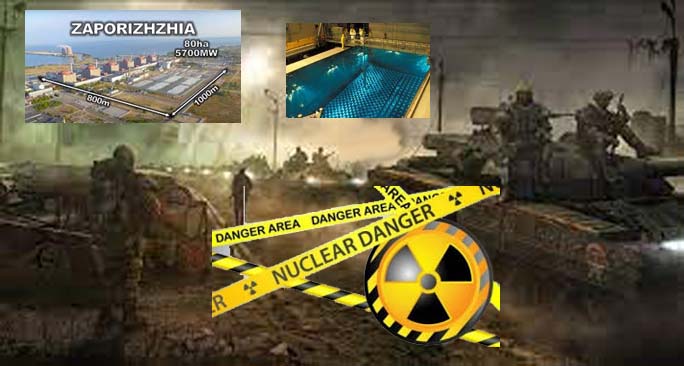
The threatened deadly scenarios could not happen at a wind farm
By Linda Pentz Gunter, 10 july 23 https://beyondnuclearinternational.org/2023/07/09/red-alert-at-zaporizhzhia/
Amidst accusations from both the Russian and Ukrainian sides that the Zaporizhzhia nuclear power plant in southeastern Ukraine has been wired for detonation or could be deliberately attacked during the current war there, one absolute truth remains: nuclear power plants are inherently dangerous.
Whether the rhetorical threats are real or not remains subject for debate. What is incontrovertibly real is the danger a nuclear power plant poses. After all, that is why the two sides are making these threats in the first place: because the outcome would be so deadly. If Zaporizhzhia was a wind farm, it wouldn’t even be mentioned.
Each nuclear reactor contains a lethal radioactive inventory, in the reactor core and also in the fuel pools into which the irradiated fuel is offloaded and, over time, densely packed. Casks also house nuclear waste offloaded from the fuel pools.
Zaporizhzhia is the largest nuclear power plant in Europe with at least 2,204 tons of highly radioactive waste within the reactors and the irradiated fuel pools.
Depending on the severity of what transpires, any or all of this radioactive fuel could be ignited.
Amidst the confusion and unreliability of any pronouncements uttered through the “fog of war”, there remain several unanswered questions that have led to heightened rumor and speculation:
Has the Zaporizhzhia nuclear plant in fact been wired for detonation and whose interests would be served by blowing up the plant?
Why is there an exodus of both Russian and Ukrainian plant personnel?
Will the sabotage of the downstream Kakhovka dam that resulted in catastrophic flooding, also lead to an equally catastrophic loss of available cooling water supplies for the reactors and fuel pools?
Will the backup diesel generators, frequently turned to for powering the essential cooling each time the plant has lost connection to the electricity grid, last through each crisis, given their fuel must also be replenished, potentially not possible under war conditions?
None of these threats would make headlines if Zaporizhzhia was instead home to a wind farm or utility scale solar array. This perhaps explains the rush now to downplay the gravity of the situation, with claims in the press that a major attack on the plant would “not be as bad as Chornobyl” and that radioactive releases would be minimal and barely travel beyond the fence line.
This is an irresponsible dismissal of the real dangers. The measured assessment of Dr. Edwin Lyman at the Union of Concerned Scientists confirms that an attack on Zaporizhzhia could indeed be catastrophic.
The graphite moderator used at Chornobyl undeniably worsened the outcome of that explosion and its aftermath. The graphite fueled the fire and the smoke further suspended what became the radioactive fallout that traveled far and wide across the former Soviet Union and all of Europe.
The part played by the graphite moderator in increasing the severity of the Chornobyl disaster has led to an assumption that major fires and explosions at Zaporizhzhia would result in less serious consequences, given the reactors are not of the same design. All six at Zaporizhzhia are Russian VVERs, similar to the Pressurized Water Reactor used here in the United States. (Chornobyl was the older RBMK.)
However, while Zaporizhzhia may be a less primitive design, it is not harmless. (Absurdly, these 1980s reactors are described in the press as “more modern.”)
If the uranium fuel in the Zaporizhzhia reactors or irradiated fuel storage pools overheats and ignites, it could then heat up the zirconium cladding around it, which would ignite and burn fiercely as a flare at temperatures too hot to extinguish with water.
The resulting chemical reaction would also generate an explosive environment. The heat of the release and any subsequent detonations could breach concrete structures, then loft radioactive gas and fallout into the environment to travel on the weather.
Radioactive fallout could contaminate crucial agricultural land in Ukraine and potentially also in Russia should prevailing winds travel eastward at the time of the disaster. As we have learned from the Chornobyl fallout, this is an enduring harm that enters the food chain and human bodies and remains harmful in the environment indefinitely, as exemplified by the 1,000 square mile Chornobyl Exclusion Zone.
Who then consumes that food is also of critical importance. While Europe allows an already too high 600 becquerels per kilogram (Bq/kg) of radioactive cesium in food, contaminated food supplies from Ukraine that read at higher levels after a nuclear disaster could be exported to countries with even weaker standards, including the US where the limit is an unacceptable 1200 Bq/kg. But will those consuming such foodstuffs be counted among the victims of such a nuclear disaster? Likely not.
The true numbers of those harmed by the Chornobyl disaster will never be known due to institutional suppression and misrepresentation of the numbers and the absence of record-keeping in the former Soviet countries affected. Therefore, to suggest that a major nuclear disaster at Zaporizhzhia would be “not nearly as bad as Chornobyl” is too broad and speculative without looking at the specifics.
Those specifics depend on whether the disaster involves hydrogen explosions such as happened at Fukushima, or fires resulting from a bombing raid or missile attack, which could disperse more radioactivity further. It would also depend on whether all six reactors suffered catastrophic failures, whether all of the fuel pools were drained and caught fire and whether the storage casks were breached.
It would further depend on which way the wind was blowing, and if, when and where it subsequently rained out a radioactive plume, all factors that influenced where the Chornobyl radioactive fallout was deposited.
If Zaporizhzhia comes to harm, each side in the conflict will almost certainly hold the other responsible. But ultimately, the responsibility we all share is to reject the continued use of a technology that has the potential to wreak such disastrous consequences on humanity.
Nuclear power is the most dangerous way to boil water. It is unnecessary, expensive, and an obstacle to renewable energy development. It is intrinsically tied to the desire for — and development of — nuclear weapons, the use of which could be the other lethal outcome in this war.
Zaporizhzhia is in the news almost every day. The propaganda may be deliberately alarmist, but the basis for the alarm is very real or it would not be in the headlines in the first place.
It is time to see sense. Calling for a no-fire zone around Zaporizhzhia is not enough. We must call for no nuclear power at all.
Linda Pentz Gunter is the international specialist at Beyond Nuclear and writes for and curates Beyond Nuclear International.
Russia calls on NATO to discuss Ukraine nuclear plant
Canberra Times, 9 July 23
The leaders of the United States-led transatlantic NATO defence alliance should discuss Ukraine’s Zaporizhzhia nuclear plant at their summit, Russia’s Foreign Ministry spokeswoman Maria Zakharova says.
NATO leaders will meet in Vilnius on Tuesday and Wednesday to tackle a wide range of topics, from divisions over Ukraine’s membership bid and Sweden’s accession to boosting ammunition stockpiles and reviewing the first defence plans in decades.
Accusing Ukraine of “systematic infliction of damage” to the Zaporizhzhia nuclear plant, Zakharova said “the NATO summit’s key attention should be devoted to it”.
“After all, the vast majority of the alliance members will be in the direct impact zone” (if something were to happen at the plant), Zakharova said on the Telegram messaging app.
Vilnius is some 1000 kilometres from the nuclear plant, Europe’s largest.
Both Russia and Ukraine have accused each other of planning to attack the plant, which is located on Russian-held territory in Ukraine’s Zaporizhzhia region, near the front line of Russia’s conflict with Ukraine………….
The International Atomic Energy Agency experts based at the plant said they had yet to observe any indications of mines or explosives at the plant but needed more access to be sure. https://www.canberratimes.com.au/story/8263420/russia-calls-on-nato-to-discuss-ukraine-nuclear-plant/
Germany Rejects Cluster Bombs For Ukraine As Clip Surfaces Of Biden Admin Previously Calling Them A ‘War Crime’
Zero Hedge, BY TYLER DURDEN, SATURDAY, JUL 08, 2023
In light of the Biden White House approving cluster bombs for Ukraine, under the justification that ‘but Russia used them first’, below is a quick trip down memory lane…
First, here is then White House press secretary Jen Psaki unequivocally condemning the use of cluster munitions as a potential “war crime” in 2022. The implication behind the exchange is that only the “bad guys” use them…
[Video here on original]
Next, below is a lengthy letter from top-ranking Congressional Democrats in a 2013 written to then President Barack Obama highlighting the evils of cluster bombs, explaining they are “indiscriminate, unreliable and pose an unacceptable danger to US forces and civilians alike.”
The letter emphasized they “cause unintended harm to civilians and civilian infrastructure, in many cases long after the cessation of hostilities,” and also recalled that “During Operation Desert Storm, US-dropped cluster submutnions caused more US troops casualties than any single Iraqi weapon system.”
Back when Democrats were outraged over cluster bombs and the potential for war crimes and indiscriminate killing…
[documentery evidence here on original]
It’s no wonder that key US allies in Europe are now objecting to the decision to supply Kiev with the internationally banned weapons.
“Germany opposes sending cluster munitions to Ukraine, its foreign minister said on Friday, a day after U.S. officials said Washington was planning to provide Kyiv with the weapons, widely denounced for killing and maiming civilians,” Reuters reports. Foreign Minister Annalena Baerbock told reporters in Vienna: “I have followed the media reports. For us, as a state party, the Oslo agreement applies.”
As for NATO leadership, Secretary General Jens Stoltenberg shrugged off reports that the US is set to announce cluster bombs for Ukraine. “This will be for governments to decide, not for Nato to decide,” he said Friday. He essentially said that because Russia is already deploying them, this makes it okay for Ukraine to do the same…… https://www.zerohedge.com/geopolitical/germany-rejects-cluster-bombs-ukraine-clip-surfaces-biden-admin-previously-cal1
Daniel Kovalik: Why Russia’s intervention in Ukraine is legal under international law

One must begin this discussion by accepting the fact that there was already a war happening in Ukraine for the eight years preceding the Russian military incursion in February 2022. And, this war by the government in Kiev against the Russian-speaking peoples of the Donbass – a war which claimed the lives of around 14,000 people, many of them children, and displaced around 1.5 million more even before Russia’s military operation – has been arguably genocidal. That is, the government in Kiev, and especially its neo-Nazi battalions, carried out attacks against these peoples with the intention of destroying, at least in part, the ethnic Russians precisely because of their ethnicity.
The argument can be made that Russia exercised its right for self-defense
10 July 23 https://www.rt.com/russia/554166-international-law-military-operation-ukraine/
Daniel Kovalik teaches International Human Rights at the University of Pittsburgh School of Law, and is author of the recently-released book Nicaragua: A History of US Intervention & Resistance.
For many years, I have studied and given much thought to the UN Charter’s prohibition against aggressive war. No one can seriously doubt that the primary purpose of the document – drafted and agreed to on the heels of the horrors of WWII – was and is to prevent war and “to maintain international peace and security,” a phrase repeated throughout.
As the Justices at Nuremberg correctly concluded, “To initiate a war of aggression … is not only an international crime; it is the supreme international crime differing only from other war crimes in that it contains within itself the accumulated evil of the whole.” That is, war is the paramount crime because all of the evils we so abhor – genocide, crimes against humanity, etc. – are the terrible fruits of the tree of war.
In light of the above, I have spent my entire adult life opposing war and foreign intervention. Of course, as an American, I have had ample occasion to do so given that the US is, as Martin Luther King stated, “the greatest purveyor of violence in the world.” Similarly, Jimmy Carter recently stated that the US is “the most war-like nation in the history of the world.” This is demonstrably true, of course. In my lifetime alone, the US has waged aggressive and unprovoked wars against countries such as Vietnam, Grenada, Panama, the former Yugoslavia, Iraq (twice), Afghanistan, Libya, and Somalia. And this doesn’t even count the numerous proxy wars the US has fought via surrogates (e.g., through the Contras in Nicaragua, various jihadist groups in Syria, and through Saudi Arabia and the UAE in the ongoing war against Yemen).
Indeed, through such wars, the US has done more, and intentionally so, than any nation on earth to undermine the legal pillars prohibiting war. It is in reaction to this, and with the express desire to try to salvage what is left of the UN Charter’s legal prohibitions against aggressive war, that a number of nations, including Russia and China, founded the Group of Friends in Defense of the UN Charter.
In short, for the US to complain about Russia’s invasion of Ukraine as a violation of international law is, at best, the pot calling the kettle black. Still, the fact that the US is so obviously hypocritical in this regard does not necessarily mean Washington is automatically wrong. In the end, we must analyze Russia’s conduct on its own merits.
One must begin this discussion by accepting the fact that there was already a war happening in Ukraine for the eight years preceding the Russian military incursion in February 2022. And, this war by the government in Kiev against the Russian-speaking peoples of the Donbass – a war which claimed the lives of around 14,000 people, many of them children, and displaced around 1.5 million more even before Russia’s military operation – has been arguably genocidal. That is, the government in Kiev, and especially its neo-Nazi battalions, carried out attacks against these peoples with the intention of destroying, at least in part, the ethnic Russians precisely because of their ethnicity.
While the US government and media are trying hard to obscure these facts, they are undeniable, and were indeed reported by the mainstream Western press before it became inconvenient to do so. Thus, a commentary run by Reuters in 2018 clearly sets out how the neo-Nazis battalions have been integrated into the official Ukrainian military and police forces, and are thus state, or at least quasi-state, actors for which the Ukrainian government bears legal responsibility. As the piece relates, there are 30-some right-wing extremist groups operating in Ukraine, that “have been formally integrated into Ukraine’s armed forces,” and that “the more extreme among these groups promote an intolerant and illiberal ideology… ”
That is, they possess and promote hatred towards ethnic Russians, the Roma peoples, and members of the LGBT community as well, and they act out this hatred by attacking, killing, and displacing these peoples. The piece cites the Western human rights group Freedom House for the proposition that “an increase in patriotic discourse supporting Ukraine in its conflict with Russia has coincided with an apparent increase in both public hate speech, sometimes by public officials and magnified by the media, as well as violence towards vulnerable groups such as the LGBT community.” And this has been accompanied by actual violence. For example, “Azov and other militias have attacked anti-fascist demonstrations, city council meetings, media outlets, art exhibitions, foreign students and Roma.”
As reported in Newsweek, Amnesty International had been reporting on these very same extremist hate groups and their accompanying violent activities as far back as 2014.
It is this very type of evidence – public hate speech combined with large-scale, systemic attacks on the targets of the speech – that has been used to convict individuals of genocide, for example in the Rwandan genocide case against Jean-Paul Akayesu.
To add to this, there are well over 500,000 residents of the Donbass region of Ukraine who are also Russian citizens. While that estimate was made in April 2021, after Vladimir Putin’s 2019 decree simplified the process of obtaining Russian citizenship for residents of the Donetsk and Lugansk People’s Republics, this means that Russian citizens were being subjected to racialized attack by neo-Nazi groups integrated into the government of Ukraine, and right on the border of Russia.
And lest Russia was uncertain about the Ukrainian government’s intentions regarding the Russian ethnics in the Donbass, the government in Kiev passed new language laws in 2019 which made it clear that Russian speakers were at best second-class citizens. Indeed, the usually pro-West Human Rights Watch (HRW) expressed alarm about these laws. As the HRW explained in an early-2022 report which received nearly no coverage in the Western media, the government in Kiev passed legislation which “requires print media outlets registered in Ukraine to publish in Ukrainian. Publications in other languages must also be accompanied by a Ukrainian version, equivalent in content, volume, and method of printing. Additionally, places of distribution such as newsstands must have at least half their content in Ukrainian.”
And, according to the HRW, “Article 25, regarding print media outlets, makes exceptions for certain minority languages, English, and official EU languages, but not for Russian” (emphasis added), the justification for that being “the century of oppression of … Ukrainian in favor of Russian.” As the HRW explained, “[t]here are concerns about whether guarantees for minority languages are sufficient. The Venice Commission, the Council of Europe’s top advisory body on constitutional matters, said that several of the law’s articles, including article 25, ‘failed to strike a fair balance’ between promoting the Ukrainian language and safeguarding minorities’ linguistic rights.” Such legislation only underscored the Ukrainian government’s desire to destroy the culture, if not the very existence, of the ethnic Russians in Ukraine.
Moreover, as the Organization of World Peace reported in 2021, “according to Ukraine’s National Security and Defense Council Decree no. 117/2021, Ukraine has committed to putting all options on the table to taking back control over the Russian annexed Crimea region. Signed on March 24th, President Zelensky has committed the country to pursue strategies that . . . ‘will prepare and implement measures to ensure the de-occupation and reintegration of the peninsula.’” Given that the residents of Crimea, most of whom are ethnic Russians, are quite happy with the current state of affairs under Russian governance – this, according to a 2020 Washington Post report – Zelensky’s threat in this regard was not only a threat against Russia itself but was also a threat of potentially massive bloodshed against a people who do not want to go back to Ukraine.
Without more, this situation represents a much more compelling case for justifying Russian intervention under the Responsibility to Protect (R2P) doctrine which has been advocated by such Western ‘humanitarians’ as Hillary Clinton, Samantha Power, and Susan Rice, and which was relied upon to justify the NATO interventions in countries like the former Yugoslavia and Libya. And moreover, none of the states involved in these interventions could possibly make any claims of self-defense. This is especially the case for the United States, which has been sending forces thousands of miles away to drop bombs on far-flung lands.
Indeed, this recalls to mind the words of the great Palestinian intellectual, Edward Said, who opined years ago in his influential work, ‘Culture and Imperialism’, that it is simply unfair to try to compare the empire-building of Russia with that of the West. As Dr. Said explained, “Russia … acquired its imperial territories almost exclusively by adjacence. Unlike Britain and France, which jumped thousands of miles beyond their own borders to other continents, Russia moved to swallow whatever land or peoples stood next to its borders … but in the English and French cases, the sheer distance of attractive territories summoned the projection of far-flung interest …” This observation is doubly applicable to the United States.
Still, there is more to consider regarding Russia’s claimed justifications for intervention. Thus, not only are there radical groups on its border attacking ethnic Russians, including Russian citizens, but also, these groups have reportedly been funded and trained by the United States with the very intention of destabilizing and undermining the territorial integrity of Russia itself.
As Yahoo News! explained in a January 2022 article:
“The CIA is overseeing a secret intensive training program in the U.S. for elite Ukrainian special operations forces and other intelligence personnel, according to five former intelligence and national security officials familiar with the initiative. The program, which started in 2015, is based at an undisclosed facility in the Southern U.S., according to some of those officials.
The program has involved ‘very specific training on skills that would enhance’ the Ukrainians’ ‘ability to push back against the Russians,’ said the former senior intelligence official.
The training, which has included ‘tactical stuff,’ is ‘going to start looking pretty offensive if Russians invade Ukraine,’ said the former official.
One person familiar with the program put it more bluntly. ‘The United States is training an insurgency,’ said a former CIA official, adding that the program has taught the Ukrainians how ‘to kill Russians.’”
(emphasis added).
To remove any doubt that the destabilization of Russia itself has been the goal of the US in these efforts, one should examine the very telling 2019 report of the Rand Corporation – a long-time defense contractor called upon to advise the US on how to carry out its policy goals. In this report, entitled, ‘Overextending and Unbalancing Russia, Assessing the Impact of Cost-Imposing Options’, one of the many tactics listed is “Providing lethal aid to Ukraine” in order to “exploit Russia’s greatest point of external vulnerability.”
In short, there is no doubt that Russia has been threatened, and in a quite profound way, with concrete destabilizing efforts by the US, NATO and their extremist surrogates in Ukraine. Russia has been so threatened for a full eight years. And Russia has witnessed what such destabilizing efforts have meant for other countries, from Iraq to Afghanistan to Syria to Libya – that is, nearly a total annihilation of the country as a functioning nation-state.
It is hard to conceive of a more pressing case for the need to act in defense of the nation. While the UN Charter prohibits unilateral acts of war, it also provides, in Article 51, that “[n]othing in the present Charter shall impair the inherent right of individual or collective self-defense… ” And this right of self-defense has been interpreted to permit countries to respond, not only to actual armed attacks, but also to the threat of imminent attack.
In light of the above, it is my assessment that this right has been triggered in the instant case, and that Russia had a right to act in its own self-defense by intervening in Ukraine, which had become a proxy of the US and NATO for an assault – not only on Russian ethnics within Ukraine – but also upon Russia itself. A contrary conclusion would simply ignore the dire realities facing Russia.
‘Kiev inflating regional conflict into World War III’, Russian envoy warns US
Hindustan Times, By Prapti Upadhayay, Jul 07, 2023
Russian Ambassador Anatoly Antonov denies involvement in false-flag provocation at Ukraine’s nuclear plant, warns of grave consequences.
Russia’s ambassador to the United States, Anatoly Antonov, has vehemently dismissed media reports suggesting Moscow’s involvement in a false-flag provocation at Ukraine’s largest nuclear power plant. In an exclusive interview with Newsweek, Ambassador Antonov alleged that Ukraine was using this narrative to draw NATO into a devastating conflict, cautioning against the grave repercussions that such a situation could entail.
We call on the curators of the Kiev regime to exercise responsibility and exert influence on their ‘wards’ in order to avoid a large-scale catastrophe, Antonov told Newsweek. He further emphasized that the failures of the Ukrainian counter offensive were driving them to create a pretext for NATO deployment, potentially inflating a regional conflict into World War III……………………………………… more https://www.hindustantimes.com/world-news/kiev-inflating-regional-conflict-into-world-war-iii-russian-envoy-warns-us-101688712799513.html—
Ukraine great ‘testing ground’ for Western weapons: Kiev

Thursday, 06 July 2023, https://www.presstv.ir/Detail/2023/07/06/706584/Ukraine-Russia-western-weapons-Reznikov-US-cluster-munitions-
Kiev says Ukraine is a great “testing ground” for the military industry of the West, which is constantly pouring advanced arms and military equipment in the ex-Soviet republic despite repeated warnings by Russia that such a flow of arms will only prolong the war.
In a an interview with Financial Times published on Wednesday, Ukrainian Defense Minister Oleksii Reznikov said his country is an ideal “testing ground” for Western weaponry so that Kiev’s allies can see how their weapons work in real war and to see whether they are efficient or need upgrades.
“For the military industry of the world, you can’t invent a better testing ground,” he said, claiming that American officials became very happy when Ukraine’s military reported that a US Patriot missile system managed to down a Kinzhal, a Russian hypersonic missile.
An American official called the news “fantastic,” Reznikov said.
“The Russians come up with a countermeasure, we inform our partners and they make a new countermeasure against this countermeasure,” the Ukrainian defense minister said.
Reznikov claimed many countries are closely watching the developments in the Ukraine-Russia war, including those that are already armed with Russian weapons.
“Everyone is watching closely. And not only India. China too … Everyone, even those who bought weapons from [Russia], will watch carefully,” he said.
In July 2022, Reznikov made similar comments when he was asking for the United States and NATO to send more weapons to Ukraine.
“We are interested in testing modern systems in the fight against the enemy and we are inviting arms manufacturers to test the new products here,” he said at the time.
The US may reportedly decide later this week to send such internationally-banned cluster munitions to Ukraine.
Cluster bombs are banned under the Convention on Cluster Munitions (CCM), an international treaty that addresses the humanitarian consequences and unacceptable harm caused to civilians by cluster munitions through a categorical prohibition and a framework for action.
The weapons can contain dozens of smaller bomblets, dispersing over vast areas, often killing and maiming civilians. The CCMs are banned because unexploded bomblets can pose a risk to civilians for years after the fighting is over.
Cluster munitions generally eject submunitions that can cover five times as much area as conventional bombs.
The CCM, which took effect in 2010, bans all use, production, transfer and stockpiling of cluster bombs. More than 100 countries have signed the treaty, but the United States, Russia and Ukraine have not.
Russia sees the flooding of Ukraine with weapons from the West as a futile effort to change the outcome of the war. Moscow says supplying Kiev with more weapons will only add to the death and destruction and prolong the conflict.
Russian K-278 sub sank 30 years ago but continues to leak radiation
By Boyko Nikolov On Jul 7, 2023 https://bulgarianmilitary.com/2023/07/07/russian-k-278-sub-sank-30-years-ago-but-continues-to-leak-radiation/
Imagine a Russian nuclear submarine, resting at the bottom of the Arctic sea for over 30 years, still leaking radiation. It may sound like a plot from a sci-fi movie, but according to Norwegian researchers, this is indeed reality.
For several years, a joint team of Russian and Norwegian scientists has been investigating this phenomenon. They found that the water around the K-278 Komsomolets submarine is 100,000 times more radioactive than uncontaminated water. The results of their research revealed in 2019, raise alarming questions about the potential short and long-term effects of radioactive water surrounding the vessel beneath the Barents Sea.
An essay in The Drive from 2019 suggests that the submarine may now be actively leaking radiation. This could be from its reactor or a pair of nuclear-armed torpedoes, both having remained submerged in the Barents Sea for over three decades.
The researchers collected samples from 5,500 feet below the sea surface, around 100 miles southwest of Norway’s Bear Island. This incident, and its potential long-term effects, highlight the importance of managing and disposing of radioactive material responsibly. This is even more crucial given the current geopolitical tensions between the US and Russia.
The submarine, known as Soviet Project 685, is believed to be leaking radiation either from its reactor or from its nuclear-armed torpedoes. This leakage is likely due to the submarine’s prolonged stay at the bottom of the Barents Sea.
The contaminated water was collected by the Egir 600, a Norwegian-designed remotely operated submersible. The research was carried out by Norway’s Institute of Marine Research and Norway’s University of Bergen.
One of the samples showed a significantly elevated radiation level. While the findings were preliminary, researchers stressed the need for continued monitoring of the sunken submarine. The ongoing analysis likely examines the extent of potential contamination and its possible impact on wildlife, ships, and coastal regions. The currents, water flow, and concentrations of radioactive material were probably scrutinized to minimize damage and contamination.
In conclusion, a plan was likely set in motion to mitigate the leakage of radioactive materials. Perhaps the nuclear-armed torpedoes were safely removed, or the contaminated materials were disposed of in a manner that would prevent any further leakage.
NATO’s Scorched Earth in Ukraine
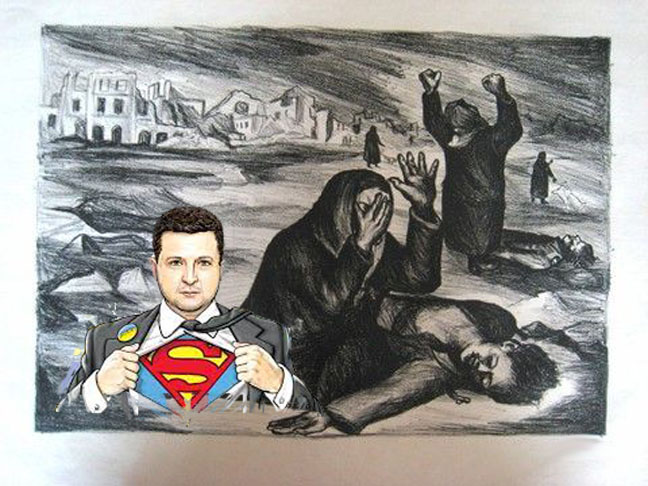
The forthcoming NATO Summit in Vilnius on July 11-12 seems already infected by a strange policy fatalism, writes Tony Kevin.
By Tony Kevin / Consortium News byEDITOR, July 7, 2023
Hope of a policy breakthrough in Vilnius, Lithuania towards peace in Ukraine, spearheaded by the war-weary East Europeans, seems to have drained away.
There is general acceptance in NATO that the Ukrainian summer offensives in Zaporizhie and again now in Bakhmut have failed to dent Russian defences, with horrific mortality in Ukrainian manpower and enormous destruction of Western-supplied equipment.
The West seems content to let Zelensky go on wasting Ukraine’s increasingly scarce military-age men in a process described by writer Raúl Ilargi Meijer as NATO’s assisted suicide of the Ukrainian nation.
The NATO unspoken strategy seems to be: we know Russia is inevitably winning in Ukraine, but we will make sure we and our Kiev proxies destroy as much as possible of Ukraine’s manpower and national wealth before Russia takes control of the country.
The Kakhovka dam is gone, and what is left of Zaporizhie Nuclear Power Plant seems increasingly at risk of West-assisted Ukrainian sabotage. These two huge assets were the pivots of Ukraine’s industrial and agricultural potential and wealth.
When Russia wins political control over the ruined land of Ukraine, and after it repudiates Western carpetbagging claims to asset ownership there, it will face a huge rebuilding job, comparable to the situation the Soviet Union faced in Ukraine after the 1944-45 vengeful scorched-earth actions by the retreating Nazi divisions……………………………….
In the U.S., only the military-industrial-information complex is doing well…………………………….
Russia’s task is to win in Ukraine, as it is doing, but without destroying its reputation with China and the Global Majority……………………………………..
The history of Western diplomatic treachery during the last 32 years since the 1991 end of Soviet Communism has shown Russians that the U.S.-U.K. agenda was always about much more than defeating Communism: it was about expanding American global hegemony and breaking up Russia as a competing world civilisational state.
There is enough evidence now to satisfy the Global Majority that U.S. regime change and controlling operations in Ukraine since 2013 have been above all cynically aimed at weakening and destabilising Russia……………..
The Vilnius NATO meeting will produce no new miracles of salvation for the doomed Kiev regime. There will be a lot of tired rhetoric about continuing to defend democratic Ukraine.
Nobody – speakers or listeners – will believe it. https://scheerpost.com/2023/07/07/natos-scorched-earth-in-ukraine/
An Attack on the Zaporizhzhia Nuclear Plant Could Still be Catastrophic (- nuclear promoters minimise the risk)

Ed Lyman, July 7, 2023 https://blog.ucsusa.org/edwin-lyman/an-attack-on-the-zaporizhzhia-nuclear-plant-could-still-be-catastrophic/
Ukraine has accused Russia of planning to carry out a sabotage attack at the Zaporizhzhia nuclear plant that it has controlled since it seized it by force in March 2022. Although it reports this morning that this current threat is decreasing, the situation is fluid and the plant remains vulnerable to both accidents and attacks. While this ongoing crisis should not lead to panic, there is no cause for complacency either.
Unfortunately, the American Nuclear Society (ANS) and other commenters have been busy attempting to dismiss the risks that either an accident or a deliberate attack could lead to a significant radiological release with far-reaching consequences. Simply put, the ANS is dead wrong here, and by minimizing the potential risk it is endangering Ukrainians and others who may be affected by lulling them into a false sense of security and undermining any motivation to prepare for the worst. Effective emergency preparedness requires a clear-eyed understanding of the actual threat.
As I have pointed out previously, the fact that the six reactors have been in shutdown mode for many months (with one in “hot”, as opposed to “cold,” shutdown) does reduce the risk somewhat compared to a situation where reactors are operating or have only recently shut down. The decay heat in the reactors’ cores decreases significantly over time, although the rate of decrease slows down quite a bit after a few months. However, this does not mean, as ANS misleadingly implies, that there is no risk of a major radiological release that could disperse over a wide area. What it does mean is that if cooling were disrupted to one or more of the reactors, then there would be a longer period of time—days instead of hours—for operators to fix the problem before the cooling water in the reactor cores would start to boil away and drop below the tops of the fuel assemblies, causing the fuel to overheat and degrade.
Timely operator actions are even more critical for reactors that are shut down than for reactors that are operating, since some automatic safety systems are not functional during shutdown. Indeed, in a 1997 report, the International Atomic Energy Agency (IAEA) points out that “acceptable results for most of events during shutdown modes cannot be achieved without operator intervention.” The IAEA report states that both “preventive and mitigatory capabilities are somewhat degraded” in shutdown conditions, and lists a number of shutdown accident initiators for VVER-1000s.
One class of events of particular concern are “boron dilution” accidents, in which the concentration of boron in cooling water necessary to maintain reactors in a subcritical state becomes reduced and nuclear fission inadvertently begins in the core. This would not only increase the reactor temperature and the amount of heat that would have to be removed, but would also generate new quantities of troublesome short-lived fission products, such as iodine isotopes, which have previously decayed away in the months since shutdown. (This is why it remains important that potassium iodide—a drug that can block uptake of radioactive iodine in the thyroid—continue to be available to communities who may be in the path of any plume.)
It is also important to note that it is very unusual for reactors to be maintained for any length of time in either hot or cold shutdown modes with fuel remaining in the core, as is the case at Zaporizhzhia. Whenever nuclear reactors operate in unusual conditions that have not been thoroughly analyzed, risks increase.
Unfortunately, because of the incredible stress that the greatly reduced staff at Zaporizhzhia are under, and the unclear lines of command under Russian occupation, their ability to efficiently execute all the actions necessary to mitigate any accident or sabotage attack is in grave doubt. And if timely operator intervention does not occur, and the fuel assemblies are exposed, then a core melt accident similar to what was experienced in three of the reactors at Fukushima Daiichi is certainly possible.
Once the water level has dropped below the tops of the fuel assemblies, the original decay heat in the reactor core is no longer a relevant factor because when the zirconium cladding surrounding the fuel rods overheats and reacts with steam or air, it produces additional heat through a so-called exothermic reaction. The heat released in this way would soon become far greater than the original decay heat load and would accelerate the heat-up and degradation of the reactor core. At that point, it would be much harder for operators to arrest the progression of the core melt. Eventually, the molten core would drop to the floor of the steel reactor vessel and melt through it onto the floor of the containment building, where it would react with concrete to generate hot gases. Then, there are multiple ways in which the radioactive gases and aerosols generated during the core melt could be released into the environment, including a containment melt-through mode that is possible in VVER-1000 reactors such as Zaporizhzhia.
There is no technical reason why any resulting radioactive releases could not disperse at least as far as occurred at Fukushima, depending on the meteorological conditions. The heat of the radioactive plumes, which determines how high they will rise in the atmosphere and hence how far they can travel, largely come from the heat released by zirconium oxidation. The magnitude and extent of the resulting environmental contamination would depend on the “source term,” or the inventory and characteristics of the radioactive materials released from the site. Since up to six reactors and six spent fuel pools could be involved—especially if the site is deliberately sabotaged—the source term could ultimately be larger than that of Fukushima, where only three reactors were involved and containments remained largely intact.
Thus it is imperative that the international community take Ukraine’s warnings seriously and provide all the assistance it needs for emergency preparedness. Unjustified complacency could lead to a lack of resolve for addressing the danger, only increasing the potential for a long-lasting disaster that will compound the misery of the Ukrainian people.
1 This Month

of the week– Nuclear Reactor Information Task Force

14 May – online event From Bombs to Data Centres: the Face of Nuclear Colonialism
To see nuclear-related stories in greater depth and intensity – go to https://nuclearinformation.wordpress.com
-
Archives
- May 2026 (92)
- April 2026 (356)
- March 2026 (251)
- February 2026 (268)
- January 2026 (308)
- December 2025 (358)
- November 2025 (359)
- October 2025 (376)
- September 2025 (257)
- August 2025 (319)
- July 2025 (230)
- June 2025 (348)
-
Categories
- 1
- 1 NUCLEAR ISSUES
- business and costs
- climate change
- culture and arts
- ENERGY
- environment
- health
- history
- indigenous issues
- Legal
- marketing of nuclear
- media
- opposition to nuclear
- PERSONAL STORIES
- politics
- politics international
- Religion and ethics
- safety
- secrets,lies and civil liberties
- spinbuster
- technology
- Uranium
- wastes
- weapons and war
- Women
- 2 WORLD
- ACTION
- AFRICA
- Atrocities
- AUSTRALIA
- Christina's notes
- Christina's themes
- culture and arts
- Events
- Fuk 2022
- Fuk 2023
- Fukushima 2017
- Fukushima 2018
- fukushima 2019
- Fukushima 2020
- Fukushima 2021
- general
- global warming
- Humour (God we need it)
- Nuclear
- RARE EARTHS
- Reference
- resources – print
- Resources -audiovicual
- Weekly Newsletter
- World
- World Nuclear
- YouTube
-
RSS
Entries RSS
Comments RSS
 nuclear-news
