Chris Hedges: Craig Murray on the ‘Slow Motion Execution’ of Assange
And I saw, 100% for certain, that the judge came into court with her ruling already typed out before she heard the arguments, and she sat there almost pretending to listen to what the defense was saying for now and what the prosecution was saying for now. Then she simply read out the ruling.
Chris Hedges: She’s like the Queen of Hearts in Alice in Wonderland giving the verdict before she hears the sentence.
SCHEERPOST, September 17, 2023
Julian Assange continues to fight extradition to the United States to face prosecution under the Espionage Act, a growing chorus of voices is rising to demand an end to his persecution. Hounded by US law enforcement and its allies for more than a decade, Assange has been stripped of all personal and civil liberties for the crime of exposing the extent of US atrocities during the War on Terror. In the intervening years, it’s become nakedly apparent that the intent of the US government is not only to silence Assange in particular, but to send a message to whistleblowers and journalists everywhere on the consequences of speaking truth to power. Former British ambassador to Uzbekistan, Craig Murray, who was fired for exposing the CIA’s use of torture in the country, joins The Chris Hedges Report to discuss what Julian Assange’s fight means for all of us.
TRANSCRIPT
Chris Hedges: Craig Murray, the former British ambassador to Uzbekistan, was removed from his post after he made public the widespread use of torture by the Uzbek government and the CIA. He has since become one of Britain’s most important human rights campaigners and a fierce advocate for Julian Assange as well as a supporter of Scottish independence. His coverage of the trial of former Scottish first minister Alex Salman, who was acquitted of sexual assault charges, saw him charged with contempt of court and sentenced to eight months in prison. The very dubious sentence, half of which Craig served, upended most legal norms. He was sentenced, supporters argued, to prevent him from testifying as a witness in the Spanish criminal case against UC global director, David Morales, being prosecuted for installing a surveillance system in the Ecuador embassy when Julian Assange found refuge that was used to record the privileged communications between Julian and his lawyers.
Morales is alleged to have carried out this surveillance on behalf of the CIA. Murray has published some of the most prescient and eloquent reports from Julian’s extradition hearings and was one of a half dozen guests, including myself, invited to Julian and Stella’s wedding in Belmarsh Prison in March 2022. Prison authorities denied entry to Craig, based on what the UK Ministry of Justice said were security concerns, as well as myself from attending the ceremony.
Joining me to discuss what is happening to Julian Assange and the rapid erosion of our most basic democratic rights is Craig Murray.
And to begin, Craig, I read all of your reports from the trial which are at once eloquent and brilliant. It’s the best coverage that we’ve had of the hearings. But I want you to bring us up to date with where we are with the case at this moment.
Craig Murray: Yeah. The legal procedures have been extraordinarily convoluted after the first hearings for the magistrate ruled that Julian couldn’t be extradited, on essentially, health grounds. Due to the conditions in American prisons, the US then appealed against that verdict. The high court accepted the US appeal on extraordinarily dubious grounds based on a diplomatic note giving certain assurances which were conditional and based on Julian’s future behavior. And of course, the US government has a record of breaking such assurances, and also, those assurances could have been given at the time of the initial hearing and weren’t.
Chris Hedges: I don’t think those assurances have any… It was a diplomatic note. It has no legal validity.
Craig Murray: It has no legal validity. It’s not binding in any sense. And as I say, it is in itself conditional. It states that they may change this in the future. It actually says that –
Chris Hedges: Well, based on his behavior.
Craig Murray: – Based on his behavior, which they will be the sole judges of.
Chris Hedges: Of course.
Craig Murray: And which won’t involve any further legal process. They will decide he’s going into a supermax because they don’t like the way he looks at guards or something. It’s utterly meaningless. And so the US, having won that appeal so Julian could be extradited, it was then Julian’s turn to appeal on all the points he had lost at the original extradition. Those include the First Amendment, they include freedom of speech, obviously, and they include the fact that the very extradition treaty under which he’s being extradited states that there shall be no political extradition and this is plainly a very political case and several other important grounds. That appeal was lodged. Nothing then happened for a year. And that appeal is an extraordinary document. You can actually find it on my website, CraigMurray.org.uk.
I’ve published the entire appeal document and it is an amazing document. It’s an incredible piece of legal argument. And some of the things it sets out like the fact that the US key witness for the charges was an Icelandic guy who they paid for his evidence. They paid him for his evidence and he is a convicted pedophile and convicted fraudster. And since he has said he lied in his evidence and he just did it for the money. That’s one example of the things you find. The documentation is not dry legal documentation at all. It’s well worth going and looking through Julian’s appeal. That appeal ran to 150 pages plus supporting documents.
For a year, nothing happened. Then two or three months ago it was dismissed in three pages of double-spaced A4, in which the judge, Judge Swift, said that there were no legal arguments, no coherent legal arguments in this 150 pages and it followed no known form of pleading and it was dismissed completely. And the thing is that the appeal was written by some of the greatest lawyers in the world. It’s supervised and written by Gareth Pierce, who I would say is the greatest living human rights lawyer. Those people have seen the film In the Name of the Father, starring Daniel Day-Lewis…………………………………….
She’s won numerous high-profile cases. She has enormous respect all around the world and this judge, who is nobody, is saying that there’s no validity to her pleadings which follow no known form of pleading. This is quite extraordinary.
Chris Hedges: Am I correct in that he was a barrister, essentially, for the defense ministry? He was served the interests of the UK government and that’s essentially got him his position. Is that correct?
Craig Murray: Exactly. He was the lead barrister for the security services. Well, he was a banister who specialized in working for the security services.
……………………………………………………And I saw, 100% for certain, that the judge came into court with her ruling already typed out before she heard the arguments, and she sat there almost pretending to listen to what the defense was saying for now and what the prosecution was saying for now. Then she simply read out the ruling.
Chris Hedges: She’s like the Queen of Hearts in Alice in Wonderland giving the verdict before she hears the sentence.
……………………………..On the most basic level, the evisceration of attorney-client privilege because UC Global recorded the meetings between Julian and his lawyers, that in a UK court, as in a US court alone, should get the trial invalidated
Craig Murray: In any democracy in the world, if your intelligence services have been recording the client’s attorney consultations, that would get the case thrown out. ………………………….
……………………………………………………………………………………………………………….at times it seemed as though they were deliberately doing things as slowly as possible.
Chris Hedges: Well, this is what Neils Melzer, the special repertoire on torture for the UN, said that he called it, a slow motion execution, were his words.
………………………………..Craig Murray: It was because of my advocacy for and friendship with Julian. That’s why they put me in jail. I was in the cell, my cell was 12 feet by eight feet which is slightly larger than Julian’s cell, and I was kept in solitary confinement for 23 hours a day, sometimes 23.5 hours a day for four months. And that’s extremely difficult. It’s extremely difficult. But I knew when I was leaving, I had an end date. To be in those conditions as Julian has been for years and years and no idea if it will ever stop, no idea if you’ll ever be let out alive, let alone not having an end date, I can’t imagine how psychologically crushing that would be……………………………………………………………………………….
Craig Murray: The immediate thing that will happen is that Julian’s lawyers will try to go to the European Court in Strasbourg –
Chris Hedges: To the European Court of Human Rights.
Craig Murray: – The European Court of Human Rights to submit an appeal and get the extradition stopped, pending an appeal. The worry is that Julian would instantly be extradited and that the government wouldn’t wait to hear from a European Court.
Chris Hedges: Explain to Americans what it is and what jurisdiction it has in the UK, the European Court.
Craig Murray: Yeah, the European Court of Human Rights is not a European Union body. It’s a body of the Council of Europe. It has jurisdiction over the European Convention on Human Rights which guarantees basic human rights and therefore it has legally binding jurisdiction over human rights violations in any member state of the treaty. So it does have a legally binding jurisdiction and is acknowledged as such, normally, by the UK government. They’re very powerful voices within the current conservative government in the UK which wants to exit the convention on human rights. But at present, that’s not the case. The UK is still part of this system. And so the European Court of Human Rights has legally binding authority over the government of the United Kingdom purely on matters that contravene human rights.
Chris Hedges: And if they do extradite him, they’ve essentially nullified that process, the fear is that, of course, the security services would know about the ruling in advance. He’d be on the tarmac and shuttled in, sedated, and put in a diaper and hooded or something and put on a CIA flight to Washington. I want to talk about if that happens. It’s certainly very possible. What we need to do here, and I know part of the reason you’re in the US, is to prepare for that should it take place. You will try and cover the hearings and trial here as you did in the UK but let’s talk about where we go if that event occurs.
Craig Murray: Yeah. The first thing to say is that if that happens, on the day it happens, it will be the biggest news story in the world; It would be a massive news story. So we have to be prepared. We have to know who, from the Assange movement or who from his defense team, who’s going to be the spokesman, who are going to be the spokespeople, who are going to be offered up to all the major news agencies? We have to affect the story on day one. Because if you get behind the story – And we know what their line will be. They’ll put out all these lies about people being killed because of WikiLeaks, about the American insecurity being endangered, we know all the propaganda that they will try to flood the airwaves with – So we need to be ready and ahead of the game to know who our people are, who are going to be offered up to interview, who are going to proactively get onto the media, and not just the alternative media like this media, but onto the so-called mainstream as well, and get out the story…………………………………………………………………………………………………………………………………………………………………
Chris Hedges. ………………….my reading of it is that they don’t care how they look. And part of it is to send a message. It doesn’t matter what nationality you are, it doesn’t matter where you are. WikiLeaks is not a US-based publication, it doesn’t matter where you are. If you expose the information that Julian and WikiLeaks exposed, we’re going to come for you. Isn’t that the message?
Craig Murray: That’s absolutely right. And this, again, it’s amazing they don’t see the dangers in this claim of universal jurisdiction. …………………….
This claim of universal jurisdiction is extraordinary. And what’s even more extraordinary is they’re claiming universal jurisdiction but Julian is under their jurisdiction because he published American Secrets even though he’s not an American and he wasn’t in America. And at the same time, while they claim jurisdiction over him, they’re claiming he has no First Amendment rights because he’s an Australian.
The combination of we have jurisdiction over you, you have all the liabilities that come with that but you have none of the rights that come with that because you’re not one of our citizens, that’s pernicious. It’s so illogical and so vicious. …………………………………………
Chris Hedges: I want to close because there’s been noise out of Australia. The ambassador, Carolyn Kennedy, said that they might consider a plea deal. I have put no credence in it. It’s all smoke but I wondered what you thought.
Craig Murray: Yeah. It’s an attempt to placate Australian public opinion. Public opinion in Australia is extremely strong. Over 80% of Australians want Julian released and allowed to go home to Australia. Blinken came there and made some very hostile and un-diplomatic remarks at a time when Australia was allowing the US to base nuclear weapons on its side. Caroline Kennedy came out… It’s a lie, frankly. There has been no approach from a justice department or from the State Department to doing any plea deal. It’s purely smoke and mirrors to try to distract the Australian public. Caroline Kennedy was lying to the Australian public. That’s pure and simple.…………..
In 2023, the risky part of Andreyeva Bay nuclear cleanup starts

Donor countries agree to fund an additional study on how to extract the damaged spent nuclear fuel from Tank 3A.
https://thebarentsobserver.com/en/ecology/2017/12/2023-risky-part-andreeva-bay-nuclear-cleanup-starts by Thomas Nilsen
Read in Russian | Читать по-русски
Take a closer look at this photo and you will understand the scoop of the most challenging and risky work to be done at the Cold War storage site for submarine nuclear fuel on Russia’s Kola Peninsula. For 35 years, highly radioactive fuel assemblies have been stored in these rusty, partly destroyed steel pipes where concrete of poor quality was filled in the space between. Some of the fuel assemblies are stuck in the canisters, while some of the canisters are stuck in the cells.
Message is clear: Do not try to lift any of the assemblies before you are sure nothing falls out.
At a recent meeting in London, donor countries discussed the progress after the first nuclear fuel assemblies were shipped away from the other tanks in Andreeva Bay towards Mayak in June.
The experts all agree it is necessary to conduct a whole range of work to prepare Tank 3A for unloading. Additional €100,000 was granted for the study. Another €675,000 was granted to study another messy challenge in Andreeva Bay; the smashed spent fuel assembles on the floor of the former water-pool storage in Building No. 5, the information portal Russian Atomic Community reports.
Unloading work at Tank 2A and 2B will go on until 2023 before possible work on unloading the dangerous mess at Tank 3A can start.
Andrey Zolotkov, a nuclear expert with the environmental group Bellona says YES with capitalized letters when asked by the Barents Observer via Skype whether Tank 3A poses the biggest risk in the cleanup work.
Equal to Chernobyl
The British nuclear engineering company Nuvia has calculated the total radionuclide inventory in the three tanks to be equal to the remains of Reactor No. 4 inside the Chernobyl sarcophagus. Some 22,000 spent fuel assemblies are stored in the tanks, coming from 90-100 reactor cores powering the Soviet Navy’s Cold War submarines sailing out from the Kola Peninsula from the late 1950s till 1982. Nuvia says it is some six tonnes of fissile uranium-235 in the fuel, about two times the amount of fissile material inside the exploded Chernobyl reactor in Ukraine.
Tank 3A does also pose the highest risk for radiation doses to working personell and ways to do the job with robotics has to be developed. Nobody want people to stay too long near the destroyed assemblies and get exposed.
Another deemed challenging job ahead is to locate and secure the six damaged spent fuel elements on the floor of Building No. 5 in Andreeva Bay. The building served as a storage-pool for the spent fuel assemblies before 1982, but due to a water-leak and rusty wires, many fuel assemblies fell to the floor. That was the reason why the assemblies were hastily moved over to the tanks 2A, 2B and 3A. In that process, however, six damaged fuel assemblies and some uranium powder from others were left on the floor. Today, they pose a serious radiation hazard risk.
Funding from Europe and Canada
The nuclear cleanup work in Andreeva Bay on the Barents Sea coast is financed by the so-called Northern Window of the Northern Dimension Environmental Partnership (NDEP), a cooperative program with Russia’s State Nuclear Corporation Rosatom.
Norway has over the last two decades financed infrastructure improvements in Andreeva Bay making the removal of spent nuclear fuel possible.
The NDEP’s funded work started in 2003. Additional to the European Union, nuclear legacy cleanup work in North-West Russia is funded by Sweden, Finland, Belgium, France, Canada, Germany, the Netherlands, Norway, Italy and the United Kingdom.
Andreeva Bay is located about 55 kilometers from Russia’s border to Norway in the north.
Ukraine could get long-range missiles armed with U.S. cluster bombs.

WASHINGTON, Sept 11 (Reuters)
The Biden administration is close to approving the shipment of longer-range missiles packed with cluster bombs to Ukraine, giving Kyiv the ability to cause significant damage deeper within Russian-occupied territory, according to four U.S. officials.After seeing the success of cluster munitions delivered <https://www.reuters.com/world/us-cluster-munitions-ukraine-expected-fridays-800m-aid-package-2023-07-07/> in 155 mm artillery rounds in recent months, the U.S. is considering shipping either or both Army Tactical Missile Systems (ATACMS) that can fly up to 190 miles (306 km), or Guided Multiple Launch Rocket System (GMLRS) missiles with a 45-mile range packed with cluster bombs, three U.S. officials said.
If approved, either option would be available for rapid shipment to Kyiv.
Ukraine is currently equipped with 155 mm artillery with a maximum range of 18 miles carrying up to 48 bomblets. The ATACMS under consideration would propel around 300 or more bomblets. The GMLRS rocket system, a version of which Ukraine has had in its arsenal for months, would be able to disperse up to 404 cluster munitions.
With Ukraine’s push against Russian forces showing signs of progress, the administration is keen to boost the Ukrainian military at a vital moment, two of the sources said.
The White House declined to comment on the Reuters report.
The decision to send ATACMS or GMLRS, or both, is not final and could still fall through, the four sources said. The Biden administration has for months struggled with a decision on ATACMS, fearing their shipment would be perceived as an overly aggressive move against Russia.
Kyiv has repeatedly asked the Biden administration for ATACMS to help attack and disrupt supply lines, air bases, and rail networks in Russian occupied territory.
Last week Ukraine’s Foreign Minister Dmytro Kuleba said he and Secretary of State Antony Blinken had discussed the U.S. providing the long-range missiles and he hoped for a positive decision.
“Now is the time,” one of the U.S. officials said as Ukraine’s forces are attempting to pierce Russian lines just south of the city of Orikhiv in an attempt to divide Russian forces and put its main supply lines under threat. ATACMS or GMLRS with this capability would not only boost Ukrainian morale but deliver a needed tactical punch to the fight, the official said.
The U.S. plan is to include the grenade-packed weapons in an upcoming draw from U.S. stockpiles of munitions, according to the four U.S. officials, who spoke on condition of anonymity because of the sensitive nature of the plan.
At present Ukraine has only one U.S.-furnished cluster munitions, the 155 mm rounds that were announced in July.
The new weapons would augment Ukraine’s current 45-mile range GMLRS rounds, a version that blasts out more than 100,000 sharp tungsten fragments, but not bomblets.
Made by Lockheed Martin (LMT.N), ATACMS come in several versions some of which can fly four times GMLRS’ range, and their use could reset battlefield calculus……………………………………………..
President Joe Biden may ultimately decide against, or delay a decision on the transfer.
Cluster munitions are prohibited by more than 100 countries. Russia, Ukraine and the United States have not signed onto the Convention on Cluster Munitions, which bans production, stockpiling, use and transfer of the weapons.
They typically release large numbers of smaller bomblets that can kill indiscriminately over a wide area. Those that fail to explode pose a danger for decades after a conflict ends.
Washington has committed more than $40 billion in military assistance to Kyiv since Russia launched its full-scale invasion of its neighbor on Feb. 24, 2022.
Reporting by Mike Stone in Washington; Editing by Chris Sanders and Lisa Shumaker https://www.reuters.com/world/us-eyes-long-range-missiles-armed-with-cluster-bombs-ukraine-officials-2023-09-11
UK launches search for private investment in Sizewell C nuclear project
Reuters. September 18, 2023
LONDON, Sept 18 (Reuters) – Britain on Monday opened the search for private investment in the Sizewell C nuclear project, inviting potential investors to register their interest.
………. The government, the Sizewell C Company and EDF, the project’s lead developer, are looking for companies with substantial experience in the delivery of major infrastructure projects,” a statement from the Department for Energy Security and Net Zero said.
The British government announced last year that it would support Sizewell C with around 700 million pounds ($895 million) while taking a 50% stake during its development phase. https://www.reuters.com/business/energy/uk-launches-search-private-investment-sizewell-c-nuclear-project-2023-09-18/
Russia shows N Korea’s Kim hypersonic missiles, nuclear-capable bombers

North Korean leader continues tour of Russia with visit to airbase where he inspected latest Russian missiles, bombers.
Aljazeera 16 Sept 23
North Korean leader Kim Jong Un has inspected Russia’s hypersonic “Kinzhal” missiles as well as strategic, nuclear-capable bombers in the latest stop on his tour of Russian space, military and other technological facilities in the country’s Far East, according to Russian-language news media reports…………………………..
After arriving in Artyom, Kim then travelled to the Vladivostok airport just outside the city where he was shown Russia’s nuclear-capable strategic bombers and other warplanes by Russian Defence Minister Sergei Shoigu and other senior military officials.
Shoigu introduced Kim to Russia’s latest missile, the hypersonic Kinzhal – which means “dagger” in Russian – an air-launched ballistic missile capable of carrying nuclear or conventional warheads.
The Kinzhal has a reported range of 1,500 to 2,000 km (930-1,240 miles) while carrying a payload of 480kg (1,100 pounds). It may travel at up to 10 times the speed of sound (12,000 kph or 7,700 mph)…………………………………………
Experts have said that potential military cooperation between Russia and North Korea following Kim’s visit could include efforts to modernise North Korea’s outdated air force, which relies on warplanes sent from the Soviet Union in the 1980s………….
Putin and Kim discussed military matters, the war in Ukraine, and deepening cooperation when they met on Wednesday, but the Russian leader told reporters that Moscow was “not going to violate anything”, referring to longstanding sanctions imposed on North Korea by the United Nations. https://www.aljazeera.com/news/2023/9/16/russia-shows-n-koreas-kim-hypersonic-missiles-nuclear-capable-bombers
Ex-Ukrainian president pictured wearing Nazi symbol (PHOTOS)

https://www.rt.com/russia/583014-poroshenko-nazi-patch-ukraine/
https://www.rt.com/russia/583014-poroshenko-nazi-patch-ukraine/ 17 Sept 23
Pyotr Poroshenko, the former president of Ukraine, was photographed wearing a symbol on his military fatigues that was created by the Nazis, during a meeting with Ukrainian troops last week.
The politician often showcases supplies such as quadcopter drones, household equipment, or even armored vehicles in his social media and PR, to emphasize his personal contribution to the war effort against Russia.
The images posted on his social media accounts last Saturday show him wearing a military patch with the so-called Black Sun, or ‘Sonnenrad.’ The symbol originates from Nazi Germany and is extensively used by various neo-Nazi groups around the world to denote their political leanings.
The infamous Ukrainian military unit, the Azov Batallion, for example, featured the Sonnenrad in its original insignia but later removed it as it attempted to downplay its association with far-right ideologies.
The controversial patch appears to come from the 36th Marine Brigade of the Ukrainian Armed Forces. An earlier photo of the ex-president showed him clasping hands with Valery Prozapas, a member of Poroshenko’s European Solidarity party and a captain serving in the 36th Brigade, who wore an identical emblem.
The 10th Mountain Assault Brigade, which Poroshenko was visiting while sporting the patch on his jacket shoulder, is called ‘Edelweiss’ after Zelensky formally assigned the designation to the unit in February.
The Ukrainian military denies that the name has anything to do with the Nazi-era 1st Mountain Division of the Wehrmacht, which is notorious for war crimes committed by its troops on the Eastern front, and used the Edelweiss as an insignia.
The prevalence of neo-Nazi sympathizers among Ukrainian troops after the 2014 coup in Kiev has been thoroughly documented by researchers and the international press. However, this has been largely ignored by the Western media since the hostilities between Russia and Ukraine broke out last year.
In June, the New York Times contended that the widespread use of Nazi iconography in Ukraine was a “thorny issue,” emphasizing it does not reflect the true ideology of those displaying them.
Moscow, on the other hand, has called the empowerment of far-right nationalists in modern Ukraine one of the key reasons for the ongoing conflict.
Why this Ukrainian nuclear plant is now on brink of a ‘Fukushima’ disaster.
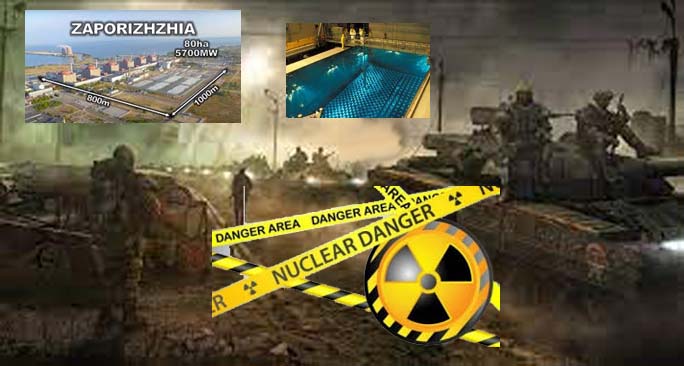
The chance of a serious disaster at the Russian-occupied nuclear power
plant in Ukraine has risen to one in five, a leading engineer at the
Soviet-era facility has warned. A recent exodus of top staff and the power
station’s use as a military base by Chechen troops are among the reasons
why a “Fukushima scenario” could happen at any time, according to one
of the ten most senior engineers at the plant near Zaporizhzhia, which had
a prewar workforce of 11,000.
The shortage of expertise is so acute that
janitors, secretaries and “blue-collar” workers are posing as engineers
in lab coats to dupe international observers into believing that the
Russians have the necessary staff to avert disaster, according to sources
with knowledge of conditions inside the facility. The Zaporizhzhia plant is
the largest in Europe. Before Russian soldiers arrived last year, only 160
senior staff members were licensed to supervise its six reactors. Of these,
about 30 agreed to collaborate with the Russians, while the remaining 80
per cent stayed in the adjoining occupied town of Enerhodar, ready to work
in an emergency. But a brutal crackdown over the summer against any
residents yet to obtain Russian passports forced 100 of those engineers to
take the perilous journey to escape.
Times 16th Sept 2023
September 14, 2023: Dounreay decommissioning end date that proved to be unachievable

By Alan Hendry – alan.hendry@hnmedia.co.uk, 14 September 2023
The end of an era for Caithness… the last chapter in a pioneering
industrial story that began in the black-and-white world of the 1950s… a
final farewell to our great atomic age… Or at least, it would have been
if a prediction made 11 years ago had proved to be accurate.
It was in May 2012 that Roger Hardy, then managing director of Dounreay Site Restoration
Ltd (DSRL), announced a target for the demolition of the nuclear site that
had transformed the county’s socio-economic landscape over the course of
six decades. Dounreay’s operators were setting a specific end date of
September 14, 2023.
That was when all redundant facilities needed to be
flattened and the waste sorted, segregated and made safe for the long term,
according to Mr Hardy. It was a big ask, he acknowledged at the time, but
staff were responding to the challenge: “No-one seems hugely surprised by
what we think is achievable.”
It was destined not to be achievable after
all. The current deadline for the clean-up is 2033, a full decade beyond
that 2012 forecast – although questions have been raised as to whether
even this revised schedule is a realistic one. Earlier this year,
ex-councillor Roger Saxon, a former chairman of Dounreay Stakeholder Group,
expressed the view that 2033 would be unachievable. He was concerned that
momentum had been lost on the decommissioning programme.
John O’Groat Journal 14th Sept 2023
The U.K.’s Goldilocks Moment For Nuclear Power

Christine Ro. Forbes, 17 Sept 23
You hear it up and down the U.K.: the future of nuclear energy will be small and flexible. Of course, people have been claiming for years now that small modular reactors (SMRs) are just about ready. As with so many technological breakthroughs, the reality has lagged behind the optimism.
Scale is not just a matter of technical preference, as the heated debates over the Sizewell C proposal indicate.
Alison Downes is a campaigner with Stop Sizewell C, an organization attempting to put the brakes on a nuclear mega-project on the eastern coast of England. Like the also-contested Hinkley Point C nuclear plant, Sizewell C would be a two-reactor, 3.2-gigawatt power station. It would be located near the smaller Sizewell B plant currently in operation. According to the operator, EDF, Sizewell C would produce enough electricity for around 6 million homes. EDF expects it to be operational in 2034, but construction has already lagged behind expectations.
Stop Sizewell C has a number of reasons for opposing the proposed Sizewell C plant. First, the project is expensive. The estimated price tag is £20 to 30 billion, and the projected expenses have continued to tick up.
Then there are the ecological concerns. The plant would be sited in a picturesque conservation area next to a bird reserve. Some are worried about coastal erosion. There are also uncertainties about the exact source of the water that will be critical to the plant’s operations, which has led to legal challenges.
Compared to large-scale nuclear in an ecologically delicate area, Downes argues that “there are alternative ways of making progress on our climate objectives”. She’s in favour of cheaper, quicker investments in renewable energy………………………………………….
Downes also believes that the massive Sizewell C project is politically popular partly because of its size. “Any big infrastructure project creates jobs,” as she points out.
The U.K. government is supporting nuclear in both big and small forms. At the launch of the Net Zero Nuclear initiative on September 7, Andrew Bowie, the U.K.’s minister for nuclear and networks, said, “We have launched a nuclear power revival in the UK, with projects like Hinkley and Sizewell C, but also with Great British Nuclear supporting the latest cutting-edge technologies like small modular reactors.”

Great British Nuclear is not an energy-focused reality show, but a young government unit that has kicked off its work with a technical selection process for SMRs. The hope is that these will be operational in the mid-2030s. In other words, the earliest SMRs could come online around the same time as Sizewell C, which complicates discussions of which would be developed faster.
Once they become viable, SMRs would be cheaper and faster to build, while using less fuel and generating less waste (although this is contested). Nuclear waste remains a prime concern for nuclear skeptics like Downes, given the almost inconceivably long timescales and uncertainty about what to actually do with the stuff.
Of course, the trade-off is that SMRs would generate less electricity – about 1/3 of the capacity of conventional big nuclear reactors. The sheer amount of energy supply is of course important. Yet conversations about the scale of nuclear energy production have tended to lack parallel discussion of energy consumption, and how to encourage energy conservation………………………………………………
For the time being, the U.K. is hedging its bets by investing in both big (controversial) and small (nonexistent) nuclear reactors. Other countries are looking to this corner of Europe for clues as to whether they too should be scaling up or down their nuclear prospects.
It’s not an either/or situation, of course, as the U.K.’s diversified nuclear options suggest. But there are limits to both budgets and political room for maneuver, as well as limited time to get the energy mix right as the climate transforms for the worse……………………………….. https://www.forbes.com/sites/christinero/2023/09/17/the-uks-goldilocks-moment-for-nuclear-power/?sh=794417ee39a3
Zelensky Implies Ukrainian Refugees in Europe Will Resort to Terrorism If West Curtails Aid

Despite Ukraine’s faltering counteroffensive, the Ukrainian leader said he was preparing for a long war and rejected the idea of diplomacy with Russian President Vladimir Putin.
He told The Economist it would not be a ‘good story’ for Europe if it were to ‘drive these people into a corner’
By Dave DeCamp / Antiwar.com September 16, 2023 https://scheerpost.com/2023/09/16/zelensky-implies-ukrainian-refugees-in-europe-will-resort-to-terrorism-if-west-curtails-aid/
Ukrainian President Volodymyr Zelensky implied in an interview with The Economist that Ukrainian refugees in Europe might resort to terrorism if Western aid to Ukraine is curtailed.
The Economist report reads: “Curtailing aid to Ukraine will only prolong the war, Mr Zelensky argues. And it would create risks for the West in its own backyard. There is no way of predicting how the millions of Ukrainian refugees in European countries would react to their country being abandoned. Ukrainians have generally ‘behaved well’ and are ‘very grateful’ to those who sheltered them. They will not forget that generosity. But it would not be a ‘good story’ for Europe if it were to ‘drive these people into a corner.’”
Zelensky also said in the interview, published on September 10, that anyone who is not supporting Ukraine is with Russia. “If you are not with Ukraine, you are with Russia, and if you are not with Russia, you are with Ukraine. And if partners do not help us, it means they will help Russia to win. That is it,” he said.
Despite Ukraine’s faltering counteroffensive, the Ukrainian leader said he was preparing for a long war and rejected the idea of diplomacy with Russian President Vladimir Putin. The report reads: “Tapping loudly on the table, Mr. Zelensky rejects outright the idea of compromise with Vladimir Putin. War will continue for ‘as long as Russia remains on Ukrainian territory,’ he says.”
While worried about sustaining support from the West for the long-term, Zelensky said he does not expect to lose US backing if former President Trump is elected in 2024. He said Trump would “never” support Putin. “That isn’t what strong Americans do,” he added.
The Biden administration seems happy to support an open-ended conflict and is looking to tie the hands of a future president by negotiating a deal with Ukraine for long-term military support. The US and other G7 nations vowed at the recent NATO summit in Vilnius to negotiate their own bilateral security deals with Ukraine.
Making Britain a target for nuclear retaliation
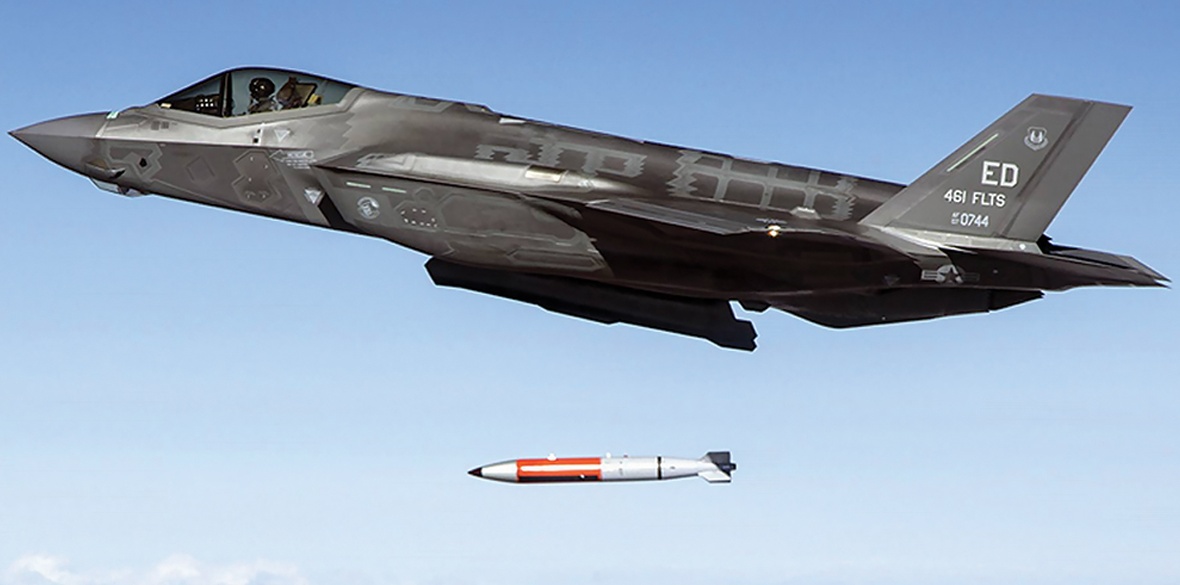
The new bomb will also be located in five other European countries and assigned to Nato. The presence of these US nuclear weapons in Europe has already been used by Putin to justify his recent movement of Russian nukes to Belarus. Their return to Britain has led to promises of Russian countermeasures.
It’s beyond irresponsible that the UK government is allowing the deployment of the US new B61-12 guided nuclear bomb, writes KATE HUDSON
16 Sept 23 https://morningstaronline.co.uk/article/f/making-britain-a-target-for-nuclear-retaliation—
ABOUT £9 billion of this year’s massive expansion in military spending is earmarked for nuclear weapons — that’s on top of over £205bn already being shelled out on replacing Britain’s Trident nuclear weapons system.
The deployment of the new B61-12 to Europe undermines prospects for global peace and ensures Britain will be a target in a nuclear conflict between the US/Nato and Russia.
Everyone needs to know that this is not a local or regional problem confined to East Anglia. In the event of a war, certainly Lakenheath will be targeted. But so will Britain’s other nuclear facilities, as well as major cities. The fact is, we are all at greater risk than ever if these weapons come back to Britain.
And no doubt there’ll be plenty extra spent on increasing the nuclear arsenal, announced in 2021, in spite of it being a breach of international law.
So you’d think there was already enough nuclear weaponry in Britain. But no. We’re having US nuclear weapons foisted on us too, without any public or parliamentary discussion.
As Diane Abbott wrote in these pages last weekend, the United States Congress has been informed of this development, but no such information has been provided to the British Parliament.
Repeated questions put in the House of Commons usually result in the non-information that “the Ministry of Defence is unable to comment on US spending decisions and capabilities, which are a matter for the US government. It remains long-standing UK and Nato policy to neither confirm nor deny the presence of nuclear weapons at a given location.”
Is this obfuscation, or can the US really put nuclear weapons here without our government’s say-so? Is this the much-vaunted “special relationship” — that the US can make us a nuclear target without our government even being allowed to comment?
One thing’s for certain: next year when the US-UK Mutual Defence Agreement comes up for renewal in Parliament, we can’t allow it to be the same old rubber stamp. It’s time to put paid to UK subordination to US nuclear, military and foreign policy.
But Lakenheath is our most immediate challenge. There’s been clear evidence for over a year that the US is planning to return its nuclear weapons to the base in Suffolk — a base often dubbed USAF Lakenheath because it is, in fact, wholly run and controlled by the US.
It’s time for our government to rethink its supine position, because even if it thinks that’s OK, the majority of the population doesn’t: 59 per cent of respondents to a recent Yougov poll opposed US nukes coming back to Britain, with only 23 per cent supporting.
CND has been active in protesting to stop the weapons coming here since the news first emerged last year. Despite the huge risks that are now facing all of us as a result of these weapons, getting widespread coverage of this issue has not been easy. The honourable exception has, of course, been the Morning Star.
But the tide has now turned. With the latest news from the Federation of American Scientists, we have managed to break through into the mainstream, with coverage on major national broadcasting and most national newspapers, not to mention a good range of local coverage.
The next step in our protests is coming up next weekend, with a “Stop US nukes coming to Britain” national day of action on Saturday September 23.
Events are happening across the country, and at Lakenheath itself, CND will visit to conduct a citizens’ weapons Inspection.
If the government refuses to confirm or deny the presence of nuclear weapons at the base, then citizens need to take matters into their own hands to ensure we have the information we need. And if we are going to be on the nuclear front line, then we certainly need to know that!
So far, the information we have is that US Air Force documents dated March this year strongly indicate that Washington is in the process of re-establishing its nuclear weapons presence in Britain, with the new B61-12 guided nuclear bomb.
Massive building works are under way at Lakenheath, including construction work on new facilities to house the anticipated influx of air crew. The work is expected to last from June 2024 to February 2026.
The new bomb will also be located in five other European countries and assigned to Nato. The presence of these US nuclear weapons in Europe has already been used by Putin to justify his recent movement of Russian nukes to Belarus. Their return to Britain has led to promises of Russian countermeasures.
It’s clear that Lakenheath is once again a vital cog in Washington’s overseas nuclear machine — despite refusals from the British government to acknowledge this reality.
It’s beyond irresponsible that the UK government is allowing this deployment. It’s time for us to step up our mobilisation. Over the decades, from Lakenheath to Greenham Common, persistent popular protest has been vital in getting US nuclear weapons removed from Britain. Now we must stop them coming back.
Kate Hudson is general secretary of the Campaign for Nuclear Disarmament.
The UK Government Knows How Extreme the Online Safety Bill Is

SCHEERPOST, By Joe Mullin / Electronic Frontier Foundation (EFF)
The U.K.’s Online Safety Bill (OSB) has passed a critical final stage in the House of Lords, and envisions a potentially vast scheme to surveil internet users.
The bill would empower the U.K. government, in certain situations, to demand that online platforms use government-approved software to search through all users’ photos, files, and messages, scanning for illegal content. Online services that don’t comply can be subject to extreme penalties, including criminal penalties.
Such a backdoor scanning system can and will be exploited by bad actors. It will also produce false positives, leading to false accusations of child abuse that will have to be resolved. That’s why the OSB is incompatible with end-to-end encryption—and human rights. EFF has strongly opposed this bill from the start.
Now, with the bill on the verge of becoming U.K. law, the U.K. government has sheepishly acknowledged that it may not be able to make use of some aspects of this law. During a final debate over the bill, a representative of the government said that orders to scan user files “can be issued only where technically feasible,” as determined by Ofcom, the U.K.’s telecom regulatory agency. He also said any such order must be compatible with U.K. and European human rights law. ……………………………………………………………………………
People Need Privacy, Not Weak Promises
Let’s be clear: weak statements by government ministers, such as the hedging from Lord Parkinson during this week’s debate, are no substitute for real privacy rights.
Nothing in the law’s text has changed. The OSB gives the U.K. government the right to order message and photo-scanning, and that will harm the privacy and security of internet users worldwide. These powers, enshrined in Clause 122 of the OSB, are now set to become law. After that, the regulator in charge of enforcing the law, Ofcom, will have to devise and publish a set of regulations regarding how the law will be enforced.
Several companies that provide end-to-end encrypted services have said they will withdraw from the U.K. if Ofcom actually takes the extreme choice of requiring examination of currently encrypted messages. Those companies include Meta-owned WhatsApp, Signal, and U.K.-based Element, among others. ……………………….
Finally, lawmakers in other jurisdictions, including the United States, should take heed of the embarrassing result of passing a law that is not just deceptive, but unhinged from computational reality. The U.K. government has insisted that through software “magic,” a system in which they can examine or scan everything will also somehow be a privacy-protecting system. Faced with the reality of this contradiction, the government has turned to an 11th hour campaign to assure people that the powers it has demanded simply won’t be used. https://scheerpost.com/2023/09/15/the-uk-government-knows-how-extreme-the-online-safety-bill-is/
Solar energy boost for France
CNR is leading a consortium in the development of “Ombrières
PHotovoltaïquE grand LIneAire”, a solar shading project along the
ViaRhôna cycling route in southern France’s Caderousse department,
alongside the Rhône River.
The pilot project aims to evaluate the
integration of a PV facility into the landscape and assess its energy
performance. The project partners include French cable supplier Nexans,
Schneider Electric, railway operator SNCF, and the SuperGrid Institute.
The PV system will span 900 meters in length and have an installed capacity of
900 kW. It will consist of 30 shaded structures with west-east oriented
solar panels. The consortium will conduct tests on the system’s overall
architecture and the equipment needed for transporting medium voltage
direct current (MVDC) electricity to the delivery point. Construction and
testing are scheduled for the 2025-28 period, following a three-year phase
of engineering studies, research and development (R&D), and prototyping.
PV Magazine 13th Sept 2023
https://www.pv-magazine.com/2023/09/13/french-consortium-plans-900-kw-solar-cycling-path/
Sunak gives China green light to build UK nuclear plants despite nationbeing ‘threat to our way of life’
The Government has rejected calls
for Chinese state-linked firms to be excluded entirely from Britain’s
nuclear sector. China will not be permanently barred from investing in
Britain’s nuclear energy despite posing a “threat to our open and
democratic way of life”, the Government has said.
Ministers were accused
of a “patronising” and “misleading” approach by senior
Conservatives after ruling out a ban and insisting existing rules on China
are already tough enough. A committee of MPs suggested that allowing firms
with links to the Beijing regime to be involved in the civil nuclear sector
provided an “incentive and opportunity for espionage”.
In its response,
the Government said that it would consider new ways to scrutinise China’s
involvement in Hinkley Point C, which is already well under way, but would
not impose a blanket ban. It said: “The Government will continuously
review measures to ensure that economic security and critical national
infrastructure is protected. All investment involving critical
infrastructure is subject to thorough scrutiny and needs to satisfy strong
legal, regulatory, and national security requirements.” Future nuclear
projects would be “subject to these individual assessments” in which
the Government characterises as “a one step at a time approach” –
although a Chinese firm has already been bought out of the Sizewell C
project in which it was originally an investor.
iNews 14th Sept 2023
Top candidate for head of European Investment Bank cautions about defense, nuclear investments
France has been pushing for a candidate sympathetic to steering the EIB funds to nuclear projects and defense investments.
Vestager cautions about defense, nuclear investments in EIB pitch
BY PAOLA TAMMA. SEPTEMBER 15, 2023, Politico
The European Investment Bank is ‘for everybody,’ Dane says in an effort to win wider support for job bid.
SANTIAGO DE COMPOSTELA, Spain — The European Investment Bank should not become a “political fighting arena” for investments in nuclear energy or defense, said Margrethe Vestager, who’s trying to convince European Union finance ministers to pick her to head the powerful government-backed lender.
Vestager, currently on leave as EU digital and antitrust chief, is one of the top candidates to take over from President Werner Hoyer next year and lead the bank that finances EU policies, from fighting climate change to rebuilding Ukraine.
She stressed that a successful candidate needed broad support, including smaller countries, because “the bank is for everybody, big shareholders as well as small shareholders,” she told POLITICO on the sidelines of a finance ministers’ gathering in Santiago de Compostela.
France and Germany, who together with Italy, account for nearly half of the bank’s capital, haven’t said who they will back. France has been pushing for a candidate sympathetic to steering the EIB funds to nuclear projects and defense investments. It also wants someone willing for the cautious lender to take on more risks.
Germany has emphasized that “sound banking is essential” and that “the mission of the EIB mustn’t be overstretched,” Finance Minister Christian Lindner said ahead of the meeting.
Nuclear “is a good example of the fact that the bank should not be a political fighting arena,” Vestager said. The EIB “should not take sides” and should “engage in processes that maybe can find a new balance.”……………more https://www.politico.eu/article/margrethe-vestager-nuclear-defense-eib-european-investment-bank-pitch-smaller-nations/
1 This Month

of the week– Nuclear Reactor Information Task Force

14 May – online event From Bombs to Data Centres: the Face of Nuclear Colonialism
To see nuclear-related stories in greater depth and intensity – go to https://nuclearinformation.wordpress.com
-
Archives
- May 2026 (91)
- April 2026 (356)
- March 2026 (251)
- February 2026 (268)
- January 2026 (308)
- December 2025 (358)
- November 2025 (359)
- October 2025 (376)
- September 2025 (257)
- August 2025 (319)
- July 2025 (230)
- June 2025 (348)
-
Categories
- 1
- 1 NUCLEAR ISSUES
- business and costs
- climate change
- culture and arts
- ENERGY
- environment
- health
- history
- indigenous issues
- Legal
- marketing of nuclear
- media
- opposition to nuclear
- PERSONAL STORIES
- politics
- politics international
- Religion and ethics
- safety
- secrets,lies and civil liberties
- spinbuster
- technology
- Uranium
- wastes
- weapons and war
- Women
- 2 WORLD
- ACTION
- AFRICA
- Atrocities
- AUSTRALIA
- Christina's notes
- Christina's themes
- culture and arts
- Events
- Fuk 2022
- Fuk 2023
- Fukushima 2017
- Fukushima 2018
- fukushima 2019
- Fukushima 2020
- Fukushima 2021
- general
- global warming
- Humour (God we need it)
- Nuclear
- RARE EARTHS
- Reference
- resources – print
- Resources -audiovicual
- Weekly Newsletter
- World
- World Nuclear
- YouTube
-
RSS
Entries RSS
Comments RSS
 nuclear-news