British Nuclear Fuels resurrected as Great British Nuclear

In February 2023, plans to wind up BNFL within two years were still
active. By this point the company had not traded in 13 years. However, on
18 July 2023, BNFL was resurrected as Great British Nuclear, with the aim
of delivering the government’s long-term nuclear programme and supporting
its ambition to deliver up to 24 GW of nuclear power in the UK by 2050.
Wikipedia (accessed) 27th Oct 2023 #nuclear #antinuclear #NoNukes
https://en.wikipedia.org/wiki/Great_British_Nuclear#Resurrection_as_Great_British_Nuclear
Welsh campaigners call for nuclear sponsorship ban at National Eisteddfod.

The National Eisteddfod has peace at its heart and Welsh anti-nuclear
campaigners have registered a formal complaint with its governing body
protesting the acceptance of sponsorship money from the companies
Westinghouse and Cwmni Egino at this year’s event despite the clear links
between nuclear power and nuclear weapons.
A letter endorsed by eight campaign groups and the Welsh Nuclear Free Local Authorities has been sent today (24 October), on the first day of the United Nations’ Disarmament
Week, to the Eisteddfod Council calling on it not to accept ‘any future
sponsorship from any company engaged in developing nuclear power and the
manufacture of weapons, especially armaments of mass destruction.’
NFLA 24th Oct 2023 #nuclear #antinuclear #nuclearfree #NoNukes
Germany and France finally agree on a plan to subsidise the nuclear industry

Germany And France Finally Compromise On Nuclear.
Oil Price.comBy Leonard Hyman & William Tilles – Oct 24, 2023,
- After a long period of disagreement, France and Germany finally reached a deal on electricity markets.
- The Germans and French seized on a solution used in the UK for a quarter century to give the appearance of a functioning market: the contract for differences.
- In an effort to find equilibrium between the European Union’s two biggest members, ministers reached a consensus that governments “have the option” to implement CfD’s for established nuclear reactors.
“……………………………………….. . France depends heavily on nuclear power generated by state-owned EDF. Existing French nuclear plants will require major capital improvements and the plants under construction are enormously expensive. The French government wants to subsidize its nuclear program, but other European Union (EU) countries (especially Germany) objected, because state subsidies are not in the spirit of the EU’s energy markets.
The market should determine prices, and should determine the appropriate means to supply the demand, the opponents argue. ……………………………
Europeans woke up to the likelihood that their unsubsidized firms would have to compete with heavily subsidized Chinese and American competitors. Furthermore, European firms looking at those American subsidies started talking about moving their facilities to the US, to qualify for the subsidies.
………………………………….. the risks of building a big nuclear plant are too great for any private enterprise to undertake. So the government has to step up to provide funds for the project.
The Germans and French seized on a solution used in the UK for a quarter century to give the appearance of a functioning market: the contract for differences. It works like this. The power producer sets a strike price with the buyer (who has signed a multiyear year agreement to buy the electricity). When the market price the generator can collect exceeds the strike price, the generator has to refund the surplus to the buyer. When the market price falls below the strike price, the buyer has to give the difference to the generator. Now here is the key to the deal. The strike price does not result from market forces but rather from the revenue needed to cover the cost of building or maintaining a nuclear unit, which the buyers cannot evade unless the nuke stops operating. The state, in the end, sets the price, and determines the terms of what really is a long term fixed contract made with a buyer that has no choice but to buy. In other words, this is not a commercial transaction, because in free markets, buyers have a choice: to buy or not buy.
To us, this deal, if it gets approval from the EU, signals that the EU fully acknowledges that choosing nuclear power is a political decision. And that expanding nuclear power requires government actions and explicit government financial support. That clears the air. Now let’s see what the policymakers do. https://oilprice.com/Alternative-Energy/Nuclear-Power/Germany-And-France-Finally-Compromise-On-Nuclear.html #nuclear #antinuclear #nuclearfree #NoNukes
Ukraine expects €18 billion from EU in 2024 – PM
Rt.com 25 Oct 23
Ukraine’s economy has experienced its sharpest downturn in three decades, financial experts have warned
Kiev expects to receive at least €18 billion ($19 billion) in foreign aid from the European Union (EU) next year, Ukrainian Prime Minister Denis Shmigal has said. The tranche matches the amount the country will receive from the bloc in 2023.
“EU budget support to Ukraine in 2023 already amounts to 15 billion euros – this is one of the most important factors helping Ukraine be economically resilient and stable,” Shmigal wrote on Telegram on Monday.
Kiev has recently received a sum of €1.5 billion ($1.59 billion) in what was a ninth set of EU financial assistance tranches, he added. Two more payments are expected to be completed before the end of the year to bring the total to €18 billion, according to Ukraine’s finance ministry.
Ukraine has become heavily dependent on foreign financial aid since Moscow launched its offensive in the country in February of last year, as millions of people fled due to the conflict and as logistical and supply chain routes became disrupted. Ukraine’s economy shrank by about one-third in 2022, financial experts said, in what was its sharpest economic downturn in more than 30 years.
It was announced earlier this year that the Ukrainian government would be funded by a European Commission long-term program, which will see Kiev receive €50 billion in payments between 2024 and 2027……………………………………………………………………. more https://www.rt.com/news/585631-ukraine-financial-aid-eu/ #Ukraine
US Forbade Ukraine to Make Peace With Russia in March 2022 – Former German Chancellor
MOSCOW (Sputnik) – Ukraine was ready to make peace with Russia and give up its plans to join NATO during negotiations in March 2022, but eventually abandoned the idea due to pressure from the United States, former German Chancellor Gerhard Schroeder told the German newspaper.
“The only people who could settle the war against Ukraine are the Americans. During the peace negotiations in March 2022 in Istanbul with [then-Ukrainian chief negotiator] Rustem Umerov, the Ukrainians did not agree on peace because they were not allowed to. They first had to ask the Americans about everything they discussed,” Schroeder said in an interview with the newspaper on Saturday.
The former German chancellor said that Kiev had contacted him in 2022 to learn whether he could mediate talks with Russia, after which he had meetings with Umerov and Russian President Vladimir Putin.
MOSCOW (Sputnik) – Ukraine was ready to make peace with Russia and give up its plans to join NATO during negotiations in March 2022, but eventually abandoned the idea due to pressure from the United States, former German Chancellor Gerhard Schroeder told the German newspaper.
“The only people who could settle the war against Ukraine are the Americans. During the peace negotiations in March 2022 in Istanbul with [then-Ukrainian chief negotiator] Rustem Umerov, the Ukrainians did not agree on peace because they were not allowed to. They first had to ask the Americans about everything they discussed,” Schroeder said in an interview with the newspaper on Saturday.
The former German chancellor said that Kiev had contacted him in 2022 to learn whether he could mediate talks with Russia, after which he had meetings with Umerov and Russian President Vladimir Putin.
Schroeder told the newspaper that the potential peace agreement included five key points. First, under the draft deal, Kiev was supposed to abandon its NATO aspirations. Secondly, Ukraine should have restored the official status of the Russian language. Thirdly, Donbas was supposed to remain part of Ukraine, but with a special territorial status, like South Tyrol, an autonomous province in Northern Italy. Fourthly, Ukraine should have received security guarantees from the permanent members of the UN Security Council and Germany. The final, fifth issue under discussion was the status of Crimea, Schroeder told media.
He said that Kiev had demonstrated willingness to compromise, including on the provision about NATO membership, but the talks still failed because everything “was decided in Washington.”
“I think the Americans did not want a compromise between Ukraine and Russia,” Schroeder was cited as saying by the newspaper.
Moscow launched its special military operation in Ukraine on February 24, 2022. The Russian and Ukrainian delegations have engaged in several rounds of peace talks since then, including those in Turkiye in March 2022, but the negotiations have ultimately reached an impasse. In October 2022, Ukrainian President Volodymyr Zelensky signed a decree stating that Kiev could not hold peace talks as long as Vladimir Putin was president of Russia. #Ukraine
Kazakhstan: Government does hard sell on nuclear, but public remains wary.
It also remains to be worked out how the authorities intend to fund a project that could end up costing $12 billion.
eurasia.net Almaz Kumenov Oct 23, 2023
The authorities in Kazakhstan have for many years been toying with the idea of building a nuclear power plant, but they have lacked the nerve to take a decision in the face of strong public opposition.
In September, President Kassym-Jomart Tokayev opted to punt his way out of the predicament by announcing a referendum on the question.
While Tokayev is evidently in favor of nuclear power, he is eager not to be seen as acting in defiance of broader sentiment………………………………………………………………………………………..
History makes the nuclear issue particularly emotive in Kazakhstan.
For four decades, the Soviet Union used the remote expanses of the northern Kazakh SSR as a testing site for its nuclear bombs. The consequences are detailed in stark terms by Togzhan Kassenova in her 2022 book Atomic Steppe.
“Following a nuclear explosion, radioactive particles mix with dust in the air and spread into the atmosphere. In unfavorable weather, this radioactive dust sweeps up into the clouds and rain, traveling far beyond the test site. The radioactive fallout from the Polygon contaminated not only grazing lands but also water wells, soil, and vegetation. Animals fed on contaminated pastures, and people who lived in the vicinity of the Polygon drank polluted water and milk and ate meat laced with radioisotopes,” Kassenova wrote.
More recently, incidents like the colossal explosion of an arms depot in the southern town of Arys in 2019 have fueled perceptions that safety standards are often flouted by the same people who are supposed to uphold them.
Madina Kuketayeva, coordinator of Anti-NPP, a public association created to resist the plant’s construction, cites corruption as the reason officials would be unable to categorically assure high safety levels.
“But even accident-free operation of the nuclear power plant would cause irreparable damage to the ecology of Lake Balkhash, lead to its drying out, and also harm the health of local residents,” Kuketayeva told Eurasianet.
Geopolitics is a factor too.
Kazakh opponents of the plant and Russia’s war in Ukraine look with alarm at what has happened at the Zaporizhzhia Nuclear Power Plant, which is controlled by invading Russian forces. In July, the International Atomic Energy Agency expressed its profound concern over how Russian forces had installed anti-personnel mines around the plant just as Ukrainian troops were embarking on a counteroffensive to recapture lost territory………………………
Some objections to the nuclear power plant are more narrowly technical. Aset Nauryzbayev, an economist who formerly ran state power grid operator KEGOC, says he believes that Kazakhstan is able to build the needed number of renewable energy generators by 2030. Nuclear power is outdated and overly expensive, he argued.
“The maintenance of a nuclear power plant, if it is built, will cost $1.5 billion a year, and we ordinary citizens will pay this unreasonably high price to the future owners of the nuclear power plant,” Nauryzbayev told Eurasianet.
The construction of the nuclear power plant itself will also require huge investments – anywhere up to $12 billion by some reckoning. The source of that funding has not yet been publicly discussed……. https://eurasianet.org/kazakhstan-government-does-hard-sell-on-nuclear-but-public-remains-wary #nuclear #antinuclear #nuclearfree #NoNukes
Sizewell Nuclear Court Case on 1st and 2nd November will be available to watch online
The Sizewell Court case on 1st and 2nd November will be available to watch
online at the link below. At present, it is expected that the court hearing
will start at 10.00am on 1st November 2023 but the actual start time on
that day will not be confirmed until the court’s daily list is published
on 31st October – the list can be found at
https://www.gov.uk/government/publications/royal-courts-of-justice-cause-list/royal-courts-of-justice-daily-cause-list#court-of-appeal-civil-division-daily-cause-list
Judiciary UK (accessed) 22nd Oct 2023
#nuclear #antinuclear #nuclearfree #NoNukes
Nuclear regulator raps EDF over cyber compliance
The Office for Nuclear Regulation says EDF has come up short on needed measures to improve cyber security standards at several critical UK nuclear facilities
France-headquartered energy giant EDF has been singled out by the UK’s
Office for Nuclear Regulation (ONR) and placed under significantly enhanced
regulatory attention for cyber security – the highest possible level of
scrutiny – after the critical national infrastructure (CNI) operator failed
to comply with previously made commitments to enhance its cyber security
posture.
Computer Weekly 19th Oct 2023
https://www.computerweekly.com/news/366556335/Nuclear-regulator-raps-EDF-over-cyber-compliance #nuclear #antinuclear #nuclearfree #NoNukes
Rolls-Royce facing £350m class action lawsuit from investors
Rolls-Royce, the FTSE 100 engineering giant, is facing a potential legal
claim from investors worth at least £350m after a bribery and corruption
scandal wiped millions of pounds from the company’s value. City lawyers
are working with a group of investors seeking compensation from Rolls-Royce
after the bribery allegations rocked the aircraft engine maker in 2017.
Shareholders are to claim that the company made misrepresentations to the
market about the bribery scandal. Rolls-Royce previously agreed to a £497m
settlement with the Serious Fraud Office (SFO) in a bid to draw a line
under the wrongdoing. The SFO’s agreement with Rolls-Royce in 2017
covered “12 counts of conspiracy to corrupt, false accounting and failure
to prevent bribery” across its aerospace and energy divisions.
Telegraph 22nd Oct 2023
https://www.telegraph.co.uk/business/2023/10/22/rolls-royce-face-350m-lawsuit-investors/
#nuclear #antinuclear #nuclearfree #NoNukes
Bulgaria abandons Belene NPP project
SeeNews, Antonia Kokalova-Gray, Oct 12, 2023
– The Bulgarian government said it decided to repeal a previous cabinet decision to seek investors and equipment manufacturers for the construction of a nuclear power plant at Belene, on the Danube.
The energy ministry must now cancel the procedure under which the National Electricity Company (NEK) was to select a strategic investor to build the Belene NPP, the government said in a press release on Wednesday.
In addition, NEK must notify the decision to the applicants that have been shortlisted to submit binding offers and with which confidentiality agreements have been signed…………………………………………………………. https://seenews.com/news/bulgaria-abandons-belene-npp-project-836570
Dunkelflaute (or… can we keep the lights on when the wind doesn’t blow and the sun doesn’t shine?)
Prof. Andrew Blowers tackles this question in the BANNG column for Regional Life, October, 2023 https://www.banng.info/news/dunkelflaute/—
The Blackwater estuary is a place where sea, land and sky meet. It is a vast natural environment where wind and sun provide unlimited resources that are transforming our energy supply as we shift from fossil fuels to low carbon renewables, in the desperate race to avert impending climate catastrophe.
There is one problem with a carbon free energy future built on wind and sun. That problem is Dunkelflaute, a German word meaning ‘dark doldrums’, times when there is little wind and sunlight. Think of those short, dark and windless days in mid-winter when lights and heating are on all day and the demand for power rises and the energy supply system is fully stretched. As we become more dependent on intermittent sources of electricity supply can we keep the lights on?
The answer must be ‘yes’, since not to have light is unthinkable in our modern society. But, how? For some, the answer lies in nuclear power which provides ‘firm power’, continuous generation able to meet baseload whenever Dunkelflaute persists. The Government recently proclaimed that ‘Nuclear is the critical baseload of the future energy system’. But, even if it were true, it hardly justifies the plans for massive investment in outmoded, dangerous and costly nuclear power plants that cannot conceivably be delivered until well into the next decade – if then. Installing big, inflexible nuclear will just get in the way of the flexible supply and demand management system for the future
‘Firm power which cannot be switched off when you don’t need it will be as much of a problem as variable power which cannot be switched on when you do. What is called for is flexibility, in huge quantities and of all types’. (Michael Liebreich quoted in Carbon Brief)
That future lies in wind and solar backed up by green power and by long duration storage (including battery, hydrogen and pumped hydro-electric). Distributed local heat and power systems, interconnectors with other countries and reducing and managing demand through energy efficiency and smart metering will all contribute to an energy system that meets net zero by the middle of the century.
It is already happening. At its present moment of hubris nuclear is already doomed. On the Blackwater estuary, the hulk of Bradwell A provides a forlorn epitaph to a bygone era. #nuclear #antinuclear #nuclearfree #NoNukes
Germany caves in to French demands for government subsidies to the nuclear industry in the EU electricity market
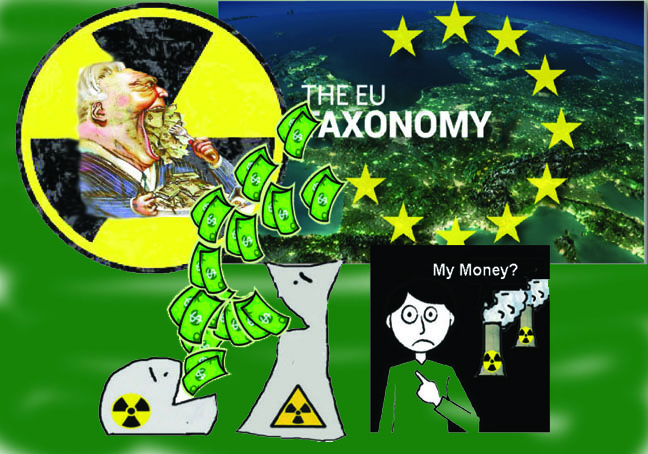
Germany has given leeway for France to use state subsidies to fund its
nuclear power plants, unblocking a long-stalled reform of the EU
electricity market in the face of vast state aid regimes in China and the
US.
The agreement reached on Tuesday among energy ministers in Luxembourg
will mean that France could use government support to finance its largely
state-owned nuclear plants, which generate about 70 per cent of its
electricity.
Such a move had been heavily contested by Germany, Austria and
Luxembourg, which have been historically opposed to nuclear power but also
feared that allowing Paris to subsidise its nuclear plants would provide
French industry with structurally lower energy prices, giving it a
competitive advantage.
As part of the new EU rules for the bloc’s
electricity market, France will be allowed to use funding structures known
as contracts for difference. These set a minimum price guarantee for power
providers, as well as a ceiling above which the state can recover any
revenue.
FT 17th Oct 2023
https://www.ft.com/content/73629c7f-d8a8-4d31-9487-02301c9fe894 #nuclear #antinuclear #nuclearfree #NoNukes
Crackdown on nuclear firm after cyber security ‘shortfalls’

“Cyber attacks threaten the security of nuclear facilities by compromising command and control systems and damaging safety, security and emergency responses.”
“Rapidly spreading computer viruses and worms can infect instrument systems and corrupt files.
The Ferret Rob Edwards, October 18, 2023
A multinational nuclear power company has been hit by an official crackdown because of cyber security failures that critics warned were a “very real and present danger”.
Oversight of EDF Energy by the UK Government’s safety watchdog, the Office for Nuclear Regulation, has been “significantly enhanced” to combat “shortfalls” in defences against digital attacks. This means more inspections and increased scrutiny of EDF’s cyber security.
EDF is a French government company that runs one nuclear power station in Scotland, at Torness in East Lothian, and four in England. It is also building a new nuclear station at Hinkley Point in Somerset.
Campaigners described EDF’s failure to properly protect its nuclear operations from “potentially dangerous cyber attacks” as “incomprehensible”. Nuclear plants were “vulnerable” to computer viruses that could threaten safety, they said……….
No details of EDF’s cyber security failings have been released for fear of helping would-be hackers. Cyber attacks are on the increase, with many organisations – such as the Scottish Environment Protection Agency – severely impacted.
The Times reported in 2017 that insecure passwords used by EDF nuclear managers had been found in two lists of stolen credentials traded on Russian hacking sites. According to The Telegraph in 2019, UK government intelligence experts had been called in after a cyber attack on an unnamed nuclear power company, suspected to be EDF.
The Ferret revealed in March 2023 that the police force tasked with guarding UK nuclear plants reported 37 security breaches in 2021-22, the highest for eight years. In August we reported that the Ministry of Defence’s nuclear managers had recorded 113 “security concerns” since 2017-18………………………………………………..
Nuclear plants ‘vulnerable’ to cyber attack
Dr Paul Dorfman, a nuclear critic and visiting fellow at the science policy research unit in the University of Sussex, highlighted concerns expressed by the UN’s International Atomic Energy Agency (IAEA) about the growing threats posed by cyber attacks.
Nuclear power plants are “vulnerable,” Dorfman said. “Cyber attacks threaten the security of nuclear facilities by compromising command and control systems and damaging safety, security and emergency responses.”
He added: “Rapidly spreading computer viruses and worms can infect instrument systems and corrupt files. EDF’s persisting failure to prepare for the very real and present danger of cyber attack on nuclear facilities is, quite simply, incomprehensible.”
Pete Roche, a consultant and anti-nuclear campaigner based in Edinburgh, pointed out that the Torness nuclear station was due to keep operating until 2028 despite cracks spreading in its graphite core.
“We need an operating company which can give meticulous attention to detail,” he said. “These revelations about cyber security seem to indicate that EDF is not capable of doing that.” …………………………………………………………………more https://theferret.scot/cyber-security-nuclear-security-crackdown/ #nuclear #antinuclear #nuclearfree #NoNukes
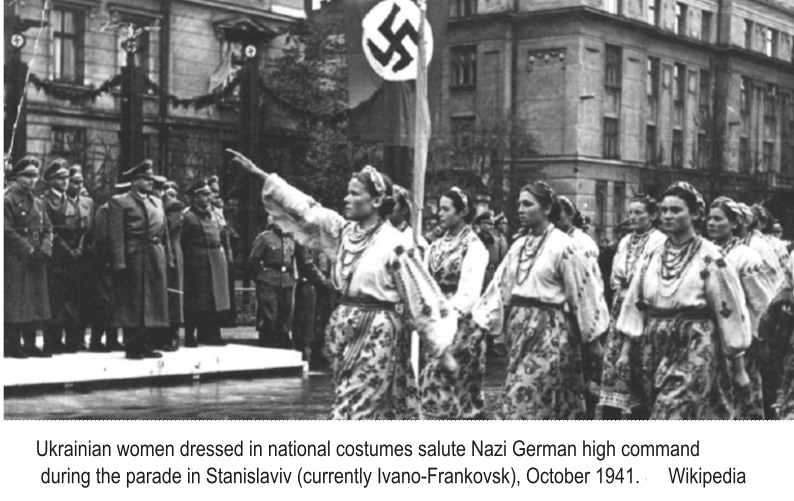
Declassified Soviet files reveal horror crimes of Ukrainian Nazi collaborators
https://www.rt.com/russia/584980-kgb-documents-ukrainian-nazis/ 16 Oct 23
Nationalists began ethnic cleansing of Jews during WWII, even before German occupation began, documents show
RT has obtained a trove of declassified KGB documents, highlighting crimes committed by Ukrainian nationalists in Soviet territories occupied by Nazi Germany during WWII. The files include witness accounts of people who survived ethnic cleansing, as well as testimonies of Ukrainian collaborators captured by the Soviet domestic intelligence, then known as the NKVD.
Large swaths of present-day Ukraine fell under Nazi occupation in summer 1941 as German troops advanced deep into the Soviet Union. In fact, attacks on ethnic Jews and Poles, as well as local communists, began immediately as Soviet troops withdrew.
“In the first hours following the retreat of the Bolsheviks, the Ukrainian population has demonstrated commendable activity against Jews,” a status report from the Gestapo, Nazi Germany’s secret police, dated July 16, 1941, reads.
Said “commendable activities” involved burning down a synagogue in the western Ukrainian city of Dobromyl and the murder of some 50 Jews by an “angry crowd” in Sambor. In Sokal, the help of local “trustworthy Ukrainians” allowed Nazis to find and exterminate some 183 “communist Jews.” Moreover, Ukrainian nationalists rounded up and brutally abused around 1,000 Jews in Lvov, subsequently putting them into a local prison, with the facility and the ‘inmates’ eventually taken over by the Germans, according to the status report.
With the German occupation regime properly established, the ethnic cleansing process was streamlined, with the so-called Ukrainian Auxiliary Police, created by the Nazis in August 1941, playing a very active role in it. According to the testimony of the Ukrainian police commander in Belya Tserkov, a major city in the Kiev region, Mikhail Tomasevish, members of his unit were so eager to kill Jews that they acted even beyond orders given by their Nazi masters. Namely, the local police secretary took pleasure in “questioning” arrested Jews, beating them with a rubber tube, and freely taking them “away” afterwards, with none of the detained ever returning to the police HQ.
Tomasevich led the police unit until 1943, when he fled alongside retreating German forces but ultimately ended up in the NKVD’s custody. While Tomasevich claimed most of the city’s Jews were exterminated before he assumed the post, he admitted partaking, one way or another, in the killing of over 1,000 people. Under his leadership, the police continued to actively search for survivors, using various tricks to lure the remaining Jews in the city to their deaths.
“To identify hiding persons of Jewish nationality, the [German field] gendarmerie, through the [Ukrainian] police, organized so-called traps, i.e., it was announced throughout the city that henceforth Jews would be allowed to live freely, but only in select houses,” Tomasevich testified.
“I put all the Jews who believed that and settled in the houses on a special register, a special folder of cases, titled ‘Yids’ [a derogatory term for ‘Jews’], was opened,” he explained, adding that when the flow of Jews willing to settle in the houses waned, all of them, some 50 people, were detained and killed “around January or February 1942.”
Civilian Ukrainian authorities, established under German occupation, have actively contributed to ethnic cleansings as well. For instance, according to an indictment in a 1944 case about Nazi crimes committed in the city of Sarny and its vicinity, local Ukrainian mayor Marinyuk directly facilitated the extermination of the entire local Jewish population in August 1942.
Some 13,000 people were gathered at a local concentration camp, guarded by field gendarmerie and Ukrainian police, under the pretext of being relocated for “work” in Germany. Instead, the Jews ended up before firing squads, with children thrown into the death pits and buried alive. Only some 40–50 people managed to escape the massacre, with Ukrainian nationalist units in pursuit, and those who managed to capture escapees were awarded a sack of salt.
Ukraine’s counteroffensive is over – Moscow

Russia is opposed not by the armed forces of Ukraine, whose resources are almost exhausted, but by the collective military machine of the NATO countries and their combined defense industry,
https://www.rt.com/russia/584853-ukraine-offensive-failed-nebenzia/ 16 Oct 23
Kiev has achieved nothing and Russian troops have now taken the initiative, top diplomat says
The four-month “counteroffensive” by Ukrainian forces has failed to reach any of its objectives, the Russian ambassador to the United Nations, Vassily Nebenzia, told the Security Council on Friday.
“For several days now, Russian troops have switched to combat operations, practically along the entire front line. Therefore, we can consider the so-called Ukrainian counteroffensive formally over,” Nebenzia said.
According to the Russian envoy, four months of Ukrainian attacks resulted only in “hundreds of units of destroyed Western equipment” and “tens of thousands of lives of those conscripted by the Kiev regime, most of whom did not want to fight.” Some of the lucky ones surrendered and stayed alive, Nebenzia added.
Ukraine’s casualties have amounted to “over 90,000 people,” 557 tanks and 1,900 armored vehicles, Russian President Vladimir Putin revealed last week at the Valdai Discussion Club in Sochi.
Instead of putting an end to the “massacre” of Ukrainians on the frontline, the West “continues to feed them weapons, like a drug to an addict, thus prolonging his agony,” Nebenzia told the UN Security Council.
“Let me emphasize that Russia is opposed not by the armed forces of Ukraine, whose resources are almost exhausted, but by the collective military machine of the NATO countries and their combined defense industry,” the Russian envoy added.
The cynicism of our former Western partners is simply amazing,” he said, bringing up the recent statement of Dutch Defense Minister Kajsa Ollongren that arming Ukraine is “a very cheap way” to confront Russia.
A Ukraine that lives in peace with its neighbors and respects the rights of all of its citizens “had and still has a future,” the Russian envoy concluded. “The criminal neo-Nazi regime of [Vladimir] Zelensky does not.”
The head of Ukraine’s military intelligence, Kirill Budanov, admitted on Thursday that the offensive wasn’t just “behind schedule” but “off the schedule entirely,” adding that the explanation for that is classified.
1 This Month

of the week– Nuclear Reactor Information Task Force

14 May – online event From Bombs to Data Centres: the Face of Nuclear Colonialism
To see nuclear-related stories in greater depth and intensity – go to https://nuclearinformation.wordpress.com
-
Archives
- May 2026 (81)
- April 2026 (356)
- March 2026 (251)
- February 2026 (268)
- January 2026 (308)
- December 2025 (358)
- November 2025 (359)
- October 2025 (376)
- September 2025 (257)
- August 2025 (319)
- July 2025 (230)
- June 2025 (348)
-
Categories
- 1
- 1 NUCLEAR ISSUES
- business and costs
- climate change
- culture and arts
- ENERGY
- environment
- health
- history
- indigenous issues
- Legal
- marketing of nuclear
- media
- opposition to nuclear
- PERSONAL STORIES
- politics
- politics international
- Religion and ethics
- safety
- secrets,lies and civil liberties
- spinbuster
- technology
- Uranium
- wastes
- weapons and war
- Women
- 2 WORLD
- ACTION
- AFRICA
- Atrocities
- AUSTRALIA
- Christina's notes
- Christina's themes
- culture and arts
- Events
- Fuk 2022
- Fuk 2023
- Fukushima 2017
- Fukushima 2018
- fukushima 2019
- Fukushima 2020
- Fukushima 2021
- general
- global warming
- Humour (God we need it)
- Nuclear
- RARE EARTHS
- Reference
- resources – print
- Resources -audiovicual
- Weekly Newsletter
- World
- World Nuclear
- YouTube
-
RSS
Entries RSS
Comments RSS
 nuclear-news