Zelensky rejected favorable peace deal with Russia – ex-aide
https://www.rt.com/russia/590696-arestovich-ukraine-interview/
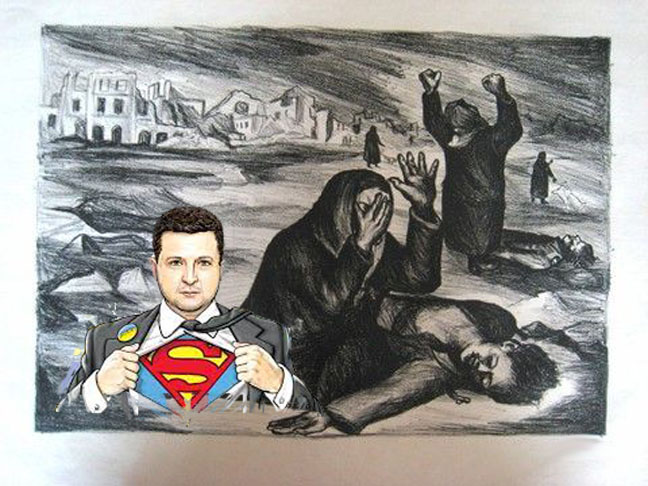
Ukraine now faces ten to 15 years of war, Aleksey Arestovich has said
Ukraine had the chance to make peace at the 2022 Istanbul talks but something or someone changed President Vladimir Zelensky’s mind, according to an interview with his former aide, Aleksey Arestovich, published on Monday.
Freddie Sayers, the editor in chief of the British outlet UnHerd, interviewed Arestovich almost a year after Ukraine’s top spin doctor left Zelensky’s service. He has since moved to the US, saying that Kiev wants him arrested on politically trumped-up charges.
“I was a member of the Istanbul process, and it was the most profitable agreement we could have done,” Arestovich told Sayers. The Ukrainian delegation “opened the champagne bottle” when they came back to Kiev, believing the agreement was a done deal, he added.
The protocols were “90% prepared” for a direct meeting between Zelensky and Russian President Vladimir Putin, according to Arestovich, when Ukrainian president called off the talks.
His rejection of a deal has been widely attributed to the ‘Bucha massacre’, which Ukraine accused Russia of, but Arestovich said he did not know that for a fact. Something “absolutely” changed Zelensky’s mind and “historians will have to find an answer to what happened,” Arestovich said.
“A lot of people say it was the Prime Minister Boris Johnson, who came to Kiev and put a stop to this negotiation with Russia. I don’t know exactly if that is true or false. He came to Kiev, but nobody knows what they spoke about except, I think, Zelensky and Boris Johnson himself,” he told UnHerd.
Johnson’s role in scuttling the Istanbul peace talks was reported as early as May 2022 by the outlet Ukrainska Pravda. According to the outlet, he came to Kiev with “two simple messages,” that Russian President Vladimir Putin was “a war criminal” who should not be negotiated with, and that even if Ukraine was ready to sign some kind of agreement with Russia, the West was not.
David Arakhamia, the leader of Zelensky’s party in the Ukrainian parliament, brought up the visit in a November 2023 interview, paraphrasing Johnson’s message as telling the Ukrainians “let’s just continue fighting.”
The former British PM finally commented on the matter last week, saying he merely told Zelensky the UK would support Ukraine “a thousand percent” and that any potential agreement with Russia would be “pretty sordid.” He insisted he did not “order” anyone to do anything, however.
According to Arestovich, the conflict has now evolved beyond Russia and Ukraine, pitting the collective West against the ‘Global South’.
“We have to negotiate for an all-new security system for Europe, taking into account all sides of this problem,” he told UnHerd, adding that NATO would need to discuss with Russia “what it would take to guarantee not to use military force in Europe to decide political questions.”
“I should perhaps add that I am absolutely pessimistic that this will happen. I think we face ten or 15 years of war in Europe,” Arestovich said.
Bypassing Parliament: Westminster, the Royal Prerogative and Bombing Yemen
Australian Independent Media, January 16, 2024, by: Dr Binoy Kampmark
There is something distinctly revolting and authoritarian about the royal prerogative. It reeks of clandestine assumption, unwarranted self-confidence and, most of all, a blithe indifference to accountability before elected representatives. That prerogative, in other words, is the last reminder of divine right, the fiction that a ruler can have powers vested by an unsubstantiated deity, the invisible God, and a punishing force beyond the reach of human control. It is anathema to democracy, a stain on republican models of government, a joke on any political system that has some claim on representing what might be called the broader citizenry.
On January 11, the UK government, in league with the United States with support from a number of other countries, attacked Houthi positions in Yemen. The decision had been made without recourse to Parliament and justified by Article 51 of the UN Charter as “limited, necessary and proportionate in self-defence.”
In his statement on the attacks, Prime Minister Rishi Sunak pointed to the Houthi’s role in staging “a series of dangerous and destabilising attacks against commercial shipping in the Red Sea, threatening UK and other international ships, causing major disruption to a vital trade route and driving up commodity prices.” He made no mention of the Houthis’ own justification for the attacks as necessary measures to disrupt Israeli shipping and interests in response to their systematic, bloodcurdling razing of Gaza.
Lip service has been paid by the executive within the Westminster system to Parliament’s importance in deciding whether the country commits to military action or not. The stark problem is that the action is always decided upon in advance, and no dissent among parliamentarians will necessarily sway the issue. Motions can be proposed and rejected but remain non-binding on the executive emboldened by the prerogative………………………………………………………………………………………………………..
The Yemen strikes eschew humanitarianism (the humanitarian justifications advanced by the Houthis in protecting Palestinian civilians has been rejected), but shipping interests. The Armed forces minister, James Heappey, was satisfied that an exception to the convention in consulting Parliament had presented itself. “The Prime Minister,” the minister parroted, “needs to make decisions such as these based on the military, strategic and operational requirements – that led to the timing.”
With the horse having bolted merrily out of the stable, Heappey remarked with all due condescension that Parliament would, in time, be able to respond to the decision to strike Yemen. An “opportunity” would be made available “when Parliament returns for these things to be fully discussed and debated.” The sheer redundancy of its role could thereby be affirmed.
Much agitated by this state of affairs, former shadow Chancellor John McDonnell opined that no military action should take place without Parliament’s approval. “If we have learnt anything in recent years it’s that military intervention in the Middle East always has dangerous & often unforeseen consequences. There is a risk of setting the region alight.”
Liberal Democrat Foreign Affairs spokesperson Layla Moran was of the view that Parliament should not be bypassed in matters of war, yet opting for the rather fatuous formula arising out of the 2011 convention. “Rushi Sunak must announce a retrospective vote in the House of Commons on these strikes, and recall Parliament this weekend.”
The use of the royal prerogative in using military force remains one of those British perversions that makes for good common room conversation but offends the sensibilities of the democratically minded elector. A far better practice would be to make the PM of the day accountable to that most essential body of all: Parliament. That same principle would be extended to other constitutional monarchies, which are similarly weighed down by the all too liberal use of the prerogative when shedding blood. If a country’s citizens are to go to war to kill and be killed, surely their elected representatives should have a say in that most vital of decisions? https://theaimn.com/bypassing-parliament-westminster-the-royal-prerogative-and-bombing-yemen/
 | |||
| |||
Former Polish PM admits Ukraine’s strategy failed
https://www.rt.com/russia/590598-poland-ukraine-fail/ 15 Jan 23
The conflict is “going in the wrong direction,” Mateusz Morawiecki told the UK’s Express newspaper
Ukraine’s 2023 counteroffensive was “not successful” and Russia has the upper hand strategically, former Polish prime minister Mateusz Morawiecki admitted, in an interview with Britain’s Express newspaper published on Friday.
The conflict in Ukraine is “not going in the right direction,” Morawiecki told the outlet, outlining his “huge concern” with a situation in which Moscow had apparently outflanked its opponents.
Russia has “huge resources,” he explained, noting the country’s military production capabilities significantly outweighed the EU’s own. “They have this strategic depth, and they have patience in international politics,” he added, also dismissing the country’s elections scheduled for March as mere “theater” unlikely to change the balance of power in Moscow.
Morawiecki also argued, however, that Ukraine’s failure had a silver lining for NATO in that it had brought Finland and Sweden into the alliance and was “awakening” countries like Denmark and Romania. The Scandinavian countries, he said, were among the most vocal in calling attention to the threat allegedly posed by Russia.
“Not only the security of the eastern flank of NATO, but also for the security of the United Kingdom, security of Germany, Denmark and the Scandinavians, they do understand it very, very well,” he said.
The former premier (2017-2023) was speaking to the British press for the first time since his successor, current PM Donald Tusk, had two lawmakers from Morawiecki’s Law and Justice Party (PiS) arrested earlier in the week. The ex-leader described the MPs as “political prisoners” and accused Tusk’s admittedly pro-EU government of “representing Brussels and Berlin, not Warsaw.”
While international attention has largely shifted away from the Ukraine conflict to Israel’s war with Gaza as the latter threatens to erupt into a broader conflict, UK Prime Minister Rishi Sunak traveled to Kiev on Friday to bestow his government’s largest gift yet on the government of Ukrainian President Vladimir Zelensky, announcing £2.5 billion ($3.2 billion) to be paid out over the coming financial year and starting in April, and a bilateral agreement that includes security guarantees for Ukraine “in the event that it is ever attacked by Russia again.”
Zelensky has been vocal about his concern over flagging international support for Kiev’s fight, after unprecedented amounts of foreign aid from the UK, US, and EU failed to appreciably move the needle against Russia. Legislative gridlock has stalled planned aid packages in the US even as the Biden administration insists on an urgency to it, with his political opposition countering that accountability for funds spent must be a requirement for any future aid.
Talks on Zelensky’s ‘peace formula’ are pointless – Kremlin

https://www.rt.com/russia/590675-zelensky-peace-formula-talks-useless/ 15 Jan 24
Russia’s absence means the negotiations in Davos could not have produced any concrete results, Dmitry Peskov has said
Top officials from dozens of countries who met in Switzerland to discuss Ukraine’s ‘peace formula’ were engaged in a completely useless endeavor without Russian participation, Kremlin spokesman Dmitry Peskov said on Monday.
On Sunday, national security advisers from 81 nations and international organizations gathered in Davos ahead of the World Economic Forum to talk about a 10-point initiative floated by Ukrainian President Vladimir Zelensky in October 2022 to end hostilities with Russia.
The plan calls for the withdrawal of Russian troops from the territory Kiev claims as its own and insists on the creation of a tribunal to prosecute Moscow for alleged war crimes. Russia has dismissed the proposal as divorced from reality.
Commenting on the Davos meeting, Peskov called it “talking for the sake of talking,” reiterating that the same applied to previous rounds of talks in such a format. “This process is not aimed and cannot be aimed at achieving a concrete result for an obvious and simple reason – we are not there.”
Russia was also absent from previous discussions last year in Denmark, Saudi Arabia, and Malta. At the same time, Moscow has never categorically refused peace talks with Kiev, despite Zelensky signing a decree banning all negotiations with the current Russian leadership after four regions overwhelmingly voted to join Russia in the autumn of 2022.
Meanwhile, Bloomberg reported on Sunday that the Davos talks had ended “with no clear path forward” despite Ukraine’s hopes that it would be able to secure backing for its plan from members of the Global South, many of whom have proclaimed neutrality in the conflict. That was denied by Ukrainian officials, however, who nevertheless acknowledged differences of opinion among the meeting’s participants.
On Sunday, Swiss Foreign Minister Ignazio Cassis echoed Peskov’s remarks, arguing that any Ukraine peace talks should involve Russia in one way or another.
Inside Bradwell’s Dark Secrets
BANNG’s coordinator, Peter Banks, identifies the radioactive residues
that lurk beneath the shiny cladding of the former Bradwell nuclear power
station in the December 2023 column for Regional Life.
The discoveries of extensive radioactive contamination around the site has triggered the
imperative to keep potential intruders at bay, out of all the shiny
buildings, including the radioactive waste store, and the contaminated
underground labyrinth of tunnels and ducts. How ludicrous would it be to
introduce a new power station next door and go through the whole cycle
again?
BANNG 18th Dec 2023
Bradwell Nuclear – Falling Off the (Road)Map

On the Road(map) to Nowhere! Despite the Government’s recent
re-announcement of a massive expansion of civil nuclear power, the
Blackwater Against New Nuclear Group (BANNG) believes new nuclear at
Bradwell remains dead in the water.
In future new nuclear power stations
will only be sited in ‘suitable locations’ identified by developers
based on a set of criteria. The Government also welcomes ‘responses from
any communities that think they may benefit from the social and economic
opportunities that new nuclear power can deliver’.
Professor Andy Blowers, the Chair of BANNG, commented, ‘This new approach to siting
effectively rules Bradwell out of any further consideration. As we have
strenuously demonstrated over the last fifteen years Bradwell is a most
unsuitable site and the Blackwater communities are overwhelmingly opposed
to nuclear development in such a fragile location, increasingly vulnerable
to the impacts of Climate Change’.
BANNG 12th Jan 2024
West got Ukraine ‘painfully wrong’ – Slovak Prime Minister Robert Fico
Slovakia’s Robert Fico has slammed “stupid liberal demagogues” who still support military aid to Kiev
Funding and arming Ukraine is a “futile waste of human resources and money” that will serve only to fill Ukrainian cemeteries with “thousands of dead soldiers,” Slovak Prime Minister Robert Fico wrote in an op-ed on Tuesday. Fico’s article was a rebuttal to his country’s president, who has urged him to send weapons to Kiev.
Following his party’s electoral victory in September, Fico immediately cut off Slovakia’s military aid to Ukraine and vowed to block Kiev’s accession to NATO. Slovak President Zuzana Caputova, however, has called for Ukraine to be given “the means needed to defend itself,” while pro-Western pundits in Slovakia have accused Fico of cozying up to the Kremlin.
…..
Despite pumping Ukraine with tens of billions of dollars’ worth of weapons and sanctioning Moscow’s economy, “Russia completely controls the occupied territories militarily, Ukraine is not capable of any meaningful military counter-offensive, [and] it has become completely dependent on financial aid from the West with unforeseeable consequences for Ukrainians in the years to come,” he explained.
“The position of the Ukrainian president is shaken, while the Russian president increases and strengthens his political support,” Fico continued, pointing out that “neither the Russian economy nor the Russian currency collapsed, [and] anti-Russian sanctions have increased the internal self-sufficiency of this huge country.”
Should the West continue along the path desired by Caputova, “in two or three years we will still be where we are now,” Fico predicted. “The EU alone will be perhaps 50 billion euros lighter, and in Ukraine, cemeteries will be full with thousands more dead soldiers.”
Fico’s Slovak Social Democracy (SMER-SD) faction currently leads a three-party coalition government, while Caputova is the co-founder of the Progressive Slovakia party. Caputova’s role as president is largely ceremonial, and Fico claimed in his op-ed that she is “impatiently waiting” for the end of her term this year so that she can re-enter parliamentary politics…….. https://www.rt.com/news/590409-west-ukraine-wrong-fico/
Construction to start on Sizewell C nuclear power station amid opposition.
Construction to start on Sizewell C nuclear power station amid opposition.
Construction on the multi-million pound Sizewell C nuclear power station
will start despite local opposition to the plans. The government has signed
a development consent order, meaning that preparation work on the £700
million site such as building fencing and accommodation can start. Andrew
Bowie MP, Minister for Nuclear and Renewables, will visit the site in
Suffolk today where he is expected to be met with peaceful protests which
have been organised by local campaign groups who are opposed to the
project. The final stage of the project, the Final Investment Decision,
will be announced later this year.
ITV 15th Jan 2024
https://www.itv.com/news/anglia/2024-01-15/construction-on-700-million-nuclear-power-station-starts
BBC 15th Jan 2024
https://www.bbc.co.uk/news/uk-england-suffolk-67973566
Sizewell C campaigners hold peaceful demonstration as government minister
Andrew Bowie visits. Two campaign groups opposed to the building of a
nuclear power plant near the Suffolk coast are to hold a peaceful protest
this morning. Stop Sizewell C and Together Against Sizewell C will be
demonstrating at the site entrance from 8.45am to 9.30am. Energy minister
Andrew Bowie is visiting to prompt a Development Consent Order (DCO) which
campaigners say will take the project to the next step.
Suffolk News 15th Jan 2024
Fresh Trident safety fears as submarines’ ‘life expectancy’ extended repeatedly

NEW concerns have been raised about the safety of Britain’s nuclear
fleet – with two submarines still in action previously predicted to have
been out of commission by this year. Former top government adviser Dominic
Cummings (below) sparked interest in the state of Britain’s nuclear fleet
at the beginning of this month when he revealed he had attempted to secure
assurances the Government would address the “horror show” of the
arsenal in return for his help in Rishi Sunak’s election campaign.
The National 14th Jan 2024
Dissension in the nuclear lobby – it had to happen – Small Nuclear versus Big Nuclear.

Comment. As the UK fumbles its way through its “Civil Nuclear Roadmap” folly, the Rolls Royce lobby paints Hinkley and Sizewell projects as obsolete trash, and touts Rolls Royce’s non existent small reactors as Britain’s energy salvation .
Jeremy Warner: Outsourcing Britain’s nuclear renewal is insanity.
Rolls-Royce’s modular reactors are an obvious way to break free of EDF’s
grip.
Here we go again. Einstein’s definition of insanity is to keep doing
the same thing and expecting different outcomes. You would think that the
Government had learned its lesson on nuclear renewal after the debacle of
Hinkley Point C. Clearly not.
Having already made the same mistake once, by
pledging a replica of the ruinously costly Hinkley at Sizewell on the
Suffolk coast, ministers are doubling down and promising a third such
monstrosity somewhere else.
According to the Government’s “Nuclear
Roadmap”, published last week, another of these leviathans in an as yet
unspecified location is to be given the go-ahead later this year. On the
most recent estimates, Hinkley Point C is expected to cost at least 80pc
more than its original budget and is years behind schedule. Some fear that
it won’t be until the early 2030s before the reactors are fully
operational, such have been the technical and safety complications
encountered in the construction phase.
Ministers have also had to agree to
punishingly expensive output prices to persuade the main developer,
France’s state-controlled EDF, to build in the first place, committing
consumers to high electricity costs for decades to come. So much for the
promise once made by the ever courteous Vincent de Rivaz, the one-time boss
of EDF in Britain, that Hinkley Point would be cooking our Christmas
lunches by 2017.
Even allowing for the learning process – theoretically,
later projects to the same design should cost less, with past mistakes
taken on board – it beggars belief that the Government should attempt to
repeat such a tried and demonstrably poor value for money technology.
Given the experience of Hinkley Point C, why are we still pursuing the hugely
costly, largely obsolete technology of EDF’s gigawatt stations when there
are perfectly viable, but smaller, homegrown alternatives just waiting for
the opportunity to fill the gap? If we are to spend £28bn a year of
taxpayers’ money on going green, as promised by Labour, we should at
least be confident that a large part of the wider economic benefit is
reserved for UK supply chains, and is not instead squandered on supporting
jobs abroad in France, China, Denmark and the US.
Telegraph 13th Jan 2024
https://www.telegraph.co.uk/business/2024/01/13/uk-go-full-nuclear-ensure-solutions-british/
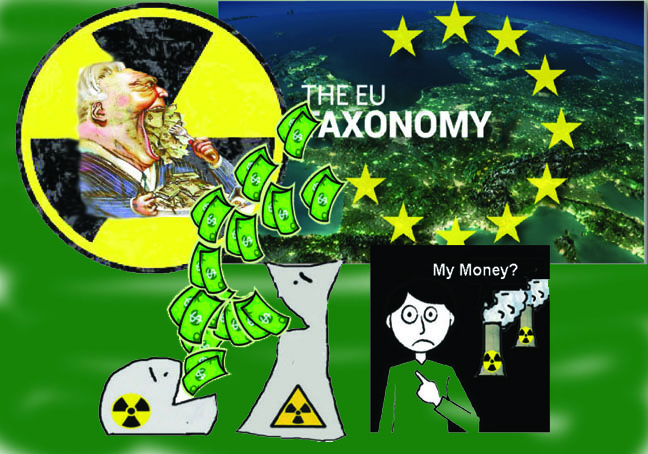
“The defense of nuclear power as a low-carbon energy weakens the European Union’s action against climate change”
“The defense of nuclear power as a low-carbon energy weakens the
European Union’s action against climate change”.
The Renewable Energies for All association denounces, in a column in “Le Monde”, the
deleterious effects of the inclusion of nuclear power in the French and
European objectives for the deployment of renewable solutions.
Seeking to relaunch nuclear power whatever the cost, France is not only missing a
historic opportunity for a rapid and less costly transition to renewable
energies and decarbonization.
It weakens the climate ambition of theEuropean Union (EU). The reintegration of current nuclear production in Europe – 6% of its final energy – into the objective of 42.5% renewable
energies set by the RED III directive [Renewable Energy Directive III]
would create an accounting artifice and lead to vagueness strategic in a
field which nevertheless needs a long-term vision.
Le Monde 13th Jan 2024
Will Sizewell nuclear project go ahead? Campaigners question the timetable and the funding.

The Government has announced that the timetable for investing in the new
Sizewell C nuclear power station in Suffolk will be revealed before a
general election. However, the campaign group Stop Sizewell C, which is
opposed to the project, said there was still much that was unknown about
whether the project could go ahead, including how the £20bn would be
raised to pay for the station.
A Stop Sizewell C spokesperson said: “From
our extensive discussions with officials it is clear that a Sizewell C
Final Investment Decision (FID) is still some months away and the time
before the next election is running out, for Rishi Sunak hasn’t ruled out a
May poll.
East Anglian Daily Times 12th Jan 2024
https://www.eadt.co.uk/news/24046041.campaigners-say-unknown-whether-sizewell-c-will-proceed/
Nuclear convoys: Blacked-out lorries carry ‘deadly cargo’ through the village

A TINY English village could be top of Putin’s nuclear hitlist, locals
fear. Brize Norton is only a stone’s throw away from the largest station in
the Royal Air Force.
Huge convoys of blacked-out lorries, police riot vans,
ambulances and other trucks regularly rumble through, clogging up the
village’s narrow main road. Locals claim they’ve had guns pointed at them
by cops, and even been forced to pull over to make room for the fleet of
“deadly cargo”.
One video shows parents and kids on the school run having
to stand aside as a convoy with blue flashing lights thunders through,
shaking the walls of surrounding buildings and towering over homes just
metres away. The cargo, widely believed to contain “nuclear material”, is a
key part of Britain’s Trident weapons programme.
The Sun 13th Jan 2024
https://www.thesun.co.uk/news/25310004/brize-norton-nuclear-weapons-putin-oxfordshire-cotswolds/
Hotel near Bridgwater could be repurposed to house Hinkley Point C workers
By Jamie Grover
Bridgwater Mercury 12th Jan 2024
PLANS have been submitted to Somerset Council to request permission for a hotel near Bridgwater and Highbridge to be repurposed in order to house Hinkley Point C workers.
It is proposed that Laburnum Lodges in West Hunstpill would be converted to accommodate workers at the EDF power plant for a minimum of five years, before then resuming usual operations as holiday accommodation.
The news comes after it was recently revealed EDF were once again in talks with Somerset Council to increase the workforce on site, despite an ongoing housing crisis in Bridgwater.
……………………………………………. Cllr Leigh Redman, Bridgwater Town Council spokesperson for Nuclear Issues, said that the original development consent order (DCO) signed by the secretary of state for Hinkley Point C, indicated that at peak, the number of workers on site would be 5,600.
This number was since raised to 8,600 due to the conversion of Pontins in Brean to become an accommodation site for workers at the power plant, which is now full.
There are now over 11,000 workers at Hinkley Point C, and EDF has confirmed its plans to bring in more staff in the near future.
To keep up to date with the application, or for more information, search reference number 52/23/00010 on the Somerset Council website.
Comments are welcomed until Tuesday, February 13, and approval could be given as early as Wednesday, February 14. https://www.bridgwatermercury.co.uk/news/24045404.hotel-near-bridgwater-house-hinkley-point-c-workers/
On the road to nowhere… UK Ministers launch nuclear ‘Roadmap’ in election year
11th January 2024, https://www.nuclearpolicy.info/news/on-the-road-to-nowhere-ministers-launch-nuclear-roadmap-in-election-year/
The UK/Ireland Nuclear Free Local Authorities are dismissive of the UK Government’s announcement today (11 Jan) of a ‘Roadmap’ supposedly outlining the route to undertake ‘the biggest expansion of nuclear power for 70 years’,[1] as another example of blinkered thinking by Ministers who are taking the wrong path to achieve energy security and net zero.
NFLA Chair Councillor Lawrence O’Neill said of the ‘Roadmap’: “Prime Minister Sunak and his ministers seem more like a group of clueless hikers too focused on the endless trail to their nuclear nirvana to see the turning immediately enroute which leads down the renewables path and the truly sustainable electricity future that Britain needs.
“Those with a cynical bent may be inclined to believe that its launch may not be coincidental in what is likely to be an election year as it represents a mantra of aspirations that will appeal to a certain voter base – two pointed references to Churchill are made by Energy Secretary Claire Coutinho in the preamble – but is nonetheless completely unaffordable. How can a vast programme of nuclear new build costing hundreds of billions of pounds be paid for, when the HS2 railway programme was curtailed on grounds of cost?
11th January 2024
On the road to nowhere… Ministers launch nuclear ‘Roadmap’ in election year
The UK/Ireland Nuclear Free Local Authorities are dismissive of the UK Government’s announcement today (11 Jan) of a ‘Roadmap’ supposedly outlining the route to undertake ‘the biggest expansion of nuclear power for 70 years’,[1] as another example of blinkered thinking by Ministers who are taking the wrong path to achieve energy security and net zero.
NFLA Chair Councillor Lawrence O’Neill said of the ‘Roadmap’: “Prime Minister Sunak and his ministers seem more like a group of clueless hikers too focused on the endless trail to their nuclear nirvana to see the turning immediately enroute which leads down the renewables path and the truly sustainable electricity future that Britain needs.
“Those with a cynical bent may be inclined to believe that its launch may not be coincidental in what is likely to be an election year as it represents a mantra of aspirations that will appeal to a certain voter base – two pointed references to Churchill are made by Energy Secretary Claire Coutinho in the preamble – but is nonetheless completely unaffordable. How can a vast programme of nuclear new build costing hundreds of billions of pounds be paid for, when the HS2 railway programme was curtailed on grounds of cost?
“Despite several academic reports having been published in recent months outlining how the UK can meet its electricity needs through renewables [2,3,4] this government appears intent to once more trod the route taken by many Ministers before them – the route of greatest resistance – to the nuclear never-never.
“A plan based upon generation by a range of green technologies, coupled with energy efficiency measures and storage solutions, would be far quicker, far cheaper, and create many jobs to achieve the government’s stated goals of achieving energy security and net zero for the nation.”
The ‘Civil Nuclear Roadmap’ recommits the government to building a fleet of nuclear reactors capable of producing 24GW by 2050, around a quarter of electricity demand. Approval will be given for one to two reactors every five years between 2030 and 2044, a rate far faster than historic trends. The plan is predicated upon building a third large-scale plant alongside Hinkley Point C and Sizewell C. This would most likely be located at Wylfa in North Wales, which was ‘talked up’ by Prime Minister Sunak in a recent interview with BBC Wales as ‘a fantastic site’.[5]
Government ministers are also wedded to investment in so-called Small Modular Reactors, which may be built at existing or former nuclear sites or co-located alongside large industrial consumers. A ‘competition’ is currently being held by a new company specifically created to take forward the government’s SMR ambitions. In the initial stage, Great British Nuclear has approved new SMR designs from six companies with a view to taking forward two as preferred competitors in the spring. The plan also provides for investment in a range of so-called Advanced Modular Reactors.
Alongside the ‘Roadmap’, the government has also launched two consultations. One is to establish a new policy on ‘siting’ nuclear plants on ‘a greater diversity of sites’ and with ‘a flexible approach to nuclear siting’. The second concerns Alternative Routes to Market for New Nuclear Projects exploring how to ease the way for new nuclear. To the NFLAs these both sound suspiciously like vehicles to favour developers by loosening the regulatory regime to enable SMRs and AMRs to make development and deployment possible on a wider range of sites, by adopting new procedures involving less planning, licensing, and consultation with elected members, community organisations and the public.
11th January 2024
On the road to nowhere… Ministers launch nuclear ‘Roadmap’ in election year
The UK/Ireland Nuclear Free Local Authorities are dismissive of the UK Government’s announcement today (11 Jan) of a ‘Roadmap’ supposedly outlining the route to undertake ‘the biggest expansion of nuclear power for 70 years’,[1] as another example of blinkered thinking by Ministers who are taking the wrong path to achieve energy security and net zero.
NFLA Chair Councillor Lawrence O’Neill said of the ‘Roadmap’: “Prime Minister Sunak and his ministers seem more like a group of clueless hikers too focused on the endless trail to their nuclear nirvana to see the turning immediately enroute which leads down the renewables path and the truly sustainable electricity future that Britain needs.
“Those with a cynical bent may be inclined to believe that its launch may not be coincidental in what is likely to be an election year as it represents a mantra of aspirations that will appeal to a certain voter base – two pointed references to Churchill are made by Energy Secretary Claire Coutinho in the preamble – but is nonetheless completely unaffordable. How can a vast programme of nuclear new build costing hundreds of billions of pounds be paid for, when the HS2 railway programme was curtailed on grounds of cost?
“Despite several academic reports having been published in recent months outlining how the UK can meet its electricity needs through renewables [2,3,4] this government appears intent to once more trod the route taken by many Ministers before them – the route of greatest resistance – to the nuclear never-never.
“A plan based upon generation by a range of green technologies, coupled with energy efficiency measures and storage solutions, would be far quicker, far cheaper, and create many jobs to achieve the government’s stated goals of achieving energy security and net zero for the nation.”
The ‘Civil Nuclear Roadmap’ recommits the government to building a fleet of nuclear reactors capable of producing 24GW by 2050, around a quarter of electricity demand. Approval will be given for one to two reactors every five years between 2030 and 2044, a rate far faster than historic trends. The plan is predicated upon building a third large-scale plant alongside Hinkley Point C and Sizewell C. This would most likely be located at Wylfa in North Wales, which was ‘talked up’ by Prime Minister Sunak in a recent interview with BBC Wales as ‘a fantastic site’.[5]
Government ministers are also wedded to investment in so-called Small Modular Reactors, which may be built at existing or former nuclear sites or co-located alongside large industrial consumers. A ‘competition’ is currently being held by a new company specifically created to take forward the government’s SMR ambitions. In the initial stage, Great British Nuclear has approved new SMR designs from six companies with a view to taking forward two as preferred competitors in the spring. The plan also provides for investment in a range of so-called Advanced Modular Reactors.
Alongside the ‘Roadmap’, the government has also launched two consultations. One is to establish a new policy on ‘siting’ nuclear plants on ‘a greater diversity of sites’ and with ‘a flexible approach to nuclear siting’. The second concerns Alternative Routes to Market for New Nuclear Projects exploring how to ease the way for new nuclear. To the NFLAs these both sound suspiciously like vehicles to favour developers by loosening the regulatory regime to enable SMRs and AMRs to make development and deployment possible on a wider range of sites, by adopting new procedures involving less planning, licensing, and consultation with elected members, community organisations and the public.
A third consultation on the taxonomy of nuclear projects, to declare nuclear a ‘green’ energy source to facilitate investment, and the publication of the government’s response to the consultation on managing radioactive waste are promised, but these have already been long-delayed.
But all is not ‘rosy’ in their nuclear garden.
Both the Hinkley Point C and Sizewell C plants will be built and operated by EDF, a French state- owned company which is in dire financial trouble and is faced with the diversion of needing to make further significant investment in existing and new nuclear plants at home. Hinkley Point C, which is currently under construction in Somerset, is behind schedule and massively over budget. In 2016, EDF estimated the cost of building the plant at £18 billion, this budget has now mushroomed to £33 billion at current prices. The enterprise was a partnership with CGN, a Chinese state-owned nuclear company, which agreed to take a 33.5 percent stake, but which last month declined to put any more money into the project after meeting its contracted share, putting more financial pressure on EDF.[6]
The date of first generation has also been constantly pushed back, with the latest official estimate that generation from reactor one will start in the summer of 2027 and from reactor two one year later. However, it is interesting to note that both The Daily Telegraph[7] and now The Guardian[8] have recently printed that generation will not actually begin until the 2030’s. Even the road map is non-specific pledging only to monitor developments so generation ‘can come online later this decade’.
At Sizewell C, EDF’s partners, CGN, were forced out on a tide of anti-Chinese sentiment and the French and British Governments instead agreed to take a fifty percent stake. £1.2 billion of UK taxpayers’ money has already been poured in, whilst Ministers seek private investment from the money markets to enable them to reduce the government’s stake. Eager to move things on, in the ‘Roadmap’ Ministers have pledged to arrive at a Financial Investment Decision ‘before the end of this Parliament’ and to hold a future consultation on taxonomy, but this will not make money materialise.
For whilst ministers and certain sections of the media talk of the budget as being as low as £20 billion, this seems fanciful given the additional engineering challenges attached to development at the Suffolk site and the established runaway cost of Sizewell’s older sister at Hinkley Point C, and respected academics, such as Professor Stephen Thomas at the University of Greenwich, have calculated that the eventual cost could be over twice that. Although there has rumours of interest in investment from Middle East sovereignty funds and Centrica, nothing of substance has so far materialised, and investors may baulk at the cost.
Hinkley Point C and Sizewell C would both be equipped with the EPR, the European Pressurised Reactor, a design with a chequered history. One EPR in China was offline for many months following an accident and others in Finland and France have, or are being, delivered very late, well over budget and with a series of ‘teething troubles’. Even EDF’s former Chief Executive Henri Proglio, in December 2022 told a hearing of the French National Assembly in exasperation that: “The EPR is too complicated, almost unbuildable. We see the result today.”[9]
Interest in Wylfa has been expressed by American nuclear engineering companies Westinghouse and Bechtel, whose performance has proven to be lamentable at the VC Summer and Vogtle 3 nuclear projects in the United States. In South Carolina, a new nuclear project ended in a fiasco, with a corporate bankruptcy, prosecutions for fraud, and an inoperable plant which amounted to a ‘hole in the ground which had to be filled in’ at an estimated cost of up to $9 billion to state taxpayers.[10] Whilst in Georgia, Vogtle 3 has just begun operations after a six-year delay and with a $30 billion price tag.[11] More likely to coalesce is an interest from KEPCO, the South Korean nuclear company, which signed a commercial partnership agreement alongside the recent state visit paid to the UK by the South Korean President.
On the SMR front, only two of the six potential designs have so far been entered into the Generic Design Assessment process managed by the Office of Nuclear Regulation. The government have pledged to speed this process up but may face pushback from the regulators. Although the ‘Roadmap’ specifies 2029 as the target date for investment decision making, we are still at an early stage with the six designs still technically unproven and, as shown by NuScale’s recent experience in Utah, financially uncertain. As to the supposedly Advanced Modular Reactor designs, these are mostly rehashed concepts first developed in the aftermath of the Second World War, tried previously, and found wanting.
In describing the ‘road’ that Ministers have ‘mapped’ out, NFLA Chair Cllr Lawrence O’Neill added:
“This is indeed a rocky road involving dependency on foreign investment, foreign technologies, and, yes until at least 2030, Russian uranium; failed or uncertain reactor designs; the uncertain risk of accidents; the most certain generation of radioactive waste; and the massive cost of managing both it and the decommissioning of old plants. And reliance on nuclear will mean creating an energy network of potential ‘dirty bombs’ that will be a prime target for terrorists and hostile state actors in time of war.
“Nonetheless these Whitehall hikers are heedless, for ultimately it will be electricity consumers and taxpayers who will pick up the tab for their folly with new plants funded through the imposition of a ‘nuclear tax’ on bills through the Regulated Asset Model; through paying higher metered prices for the electricity generated by nuclear plants; by paying for the cost of decommissioning the old nuclear plants; and by bankrolling the ongoing management of the resultant nuclear waste.
“These costs will be especially burdensome for low-income households already faced with huge energy bills and would be iniquitous to consumers in my own native Scotland which has so robustly rejected nuclear.”
Ends//… For further information please contact the NFLA Secretary, Richard Outram, by email at richard.outram@manchester.gov.uk
References: ……………………………………………………….
-
Archives
- May 2026 (62)
- April 2026 (356)
- March 2026 (251)
- February 2026 (268)
- January 2026 (308)
- December 2025 (358)
- November 2025 (359)
- October 2025 (376)
- September 2025 (257)
- August 2025 (319)
- July 2025 (230)
- June 2025 (348)
-
Categories
- 1
- 1 NUCLEAR ISSUES
- business and costs
- climate change
- culture and arts
- ENERGY
- environment
- health
- history
- indigenous issues
- Legal
- marketing of nuclear
- media
- opposition to nuclear
- PERSONAL STORIES
- politics
- politics international
- Religion and ethics
- safety
- secrets,lies and civil liberties
- spinbuster
- technology
- Uranium
- wastes
- weapons and war
- Women
- 2 WORLD
- ACTION
- AFRICA
- Atrocities
- AUSTRALIA
- Christina's notes
- Christina's themes
- culture and arts
- Events
- Fuk 2022
- Fuk 2023
- Fukushima 2017
- Fukushima 2018
- fukushima 2019
- Fukushima 2020
- Fukushima 2021
- general
- global warming
- Humour (God we need it)
- Nuclear
- RARE EARTHS
- Reference
- resources – print
- Resources -audiovicual
- Weekly Newsletter
- World
- World Nuclear
- YouTube
-
RSS
Entries RSS
Comments RSS
 nuclear-news