Could Small Modular Nuclear Reactors add supply-side grid flexibility?

It would make sense in the UK for SMRs to be load
following only if there were vast numbers of SMRs deployed,
13 Nov, 2025 By Tom Pashby New Civil Engineer
Small modular reactors (SMRs) could have the capability of providing the British electricity grid with flexible supplies, the government has said.
Supply-side grid flexibility is the ability of electricity sources to
adjust their output to match fluctuations in power demand in real-time. The
statement came in response to a question from an MP about whether SMRs
could be used as “load-following energy sources”.
Liberal Democrat spokesperson for energy security and net zero Pippa Heylings MP asked what assessment the Department for Energy Security and Net Zero (DESNZ) “has made of the potential merits of small modular reactors being made as load-following energy sources”.
Responding, DESNZ minister of state
Michael Shanks said: “The next generation of nuclear, including SMRs,
offers new possibilities, including faster deployment, lower capital costs
and greater flexibility. “Whilst nuclear energy has a unique role to play
in delivering stable, low-carbon baseload energy, SMRs may be able to serve the electricity grid more flexibly than traditional nuclear, as well as
unlock a range of additional applications in energy sectors beyond grid
electricity.”
It would only make sense in the UK for SMRs to be load
following if there were vast numbers of SMRs deployed, representing a
significant proportion of the electricity generation capacity on the
national electricity transmission system of Great Britain, for them to be
load-following.
University of Sussex professor of science and technology
policy Andy Stirling told NCE: “This parliamentary answer repeats a
longstanding malaise in UK energy policy. “For far too long,
eccentrically strong official nuclear attachments have been dominated by
reference to claimed ‘new possibilities’, to what nuclear ‘may be
able’ to do, and to an unsubstantiated ‘unique role’. “
Whichever side of these debates one is on, it is clear that what is needed most is what used to be routine – but has been lacking for more than a decade.
“Questions over cost, security or flexibility claims can only be settled
by detailed comparative analysis that includes balanced attention to
non-nuclear strategies as well as nuclear ‘possibilities’. “
When such a picture is looked at in a fair way, current trends are making it
impossible even for formerly nuclear-enthusiastic bodies (like the Royal
Society) to conclude – even when looking at UK Government data –
anything other than that there is no rational need for any nuclear
contribution.”
New Civil Engineer 13th Nov 2025,
https://www.newcivilengineer.com/latest/could-smrs-add-supply-side-grid-flexibility-13-11-2025/
Why should Scotland pay billions for nuclear when renewables exist?

Dr Ian Fairlie: Why should Scotland pay billions for nuclear when
renewables exist?
Prime Minister Keir Starmer and Anas Sarwar this week
made further statements in support of more nuclear power in Scotland.
Scottish CND believe their claims about a “golden age of nuclear” are
pie in the sky and should be treated with a pinch (or more) of salt
A proper assessment of our energy situation requires us to look at what is
happening in the rest of the world. Last year, a record 582GW of renewable
energy generation capacity was added to the world’s supplies – but
there was almost no new nuclear. Indeed, each year, new renewables add
about 200 times more global electricity than new nuclear does.
Powerful economic arguments exist for renewables over nuclear. The main one is that the marginal (ie fuel) costs of renewable energy are next to zero, whereas nuclear fuel is extremely expensive. Nuclear costs – for both
construction and generation – are very high and rising, plus long delays
are the norm.
For example, the proposed Sizewell C nuclear station in
England is now predicted to cost £47 billion, with the UK Government and
independent experts acknowledging even this estimate may rise
significantly. And just this week, the Hinkley C station still under
construction in England added yet more costs to its anticipated huge bill.
Must Scotland follow these poor English examples? The reality is that new
nuclear power in Scotland would mean massive costs, a poisoned legacy to future generation and yet more radioactive pollution of our air and seas.
Given these manifest disadvantages, many independent commentators have questioned the UK Government’s seeming obsession with nuclear power.
The National 15th Nov 2025, https://www.thenational.scot/politics/25624042.scotland-pay-billions-nuclear-renewables-exist/
Nuclear for Wylfa the wrong way to go

Nuclear Free Local Authorities, 13th November 2025
Responding to today’s news that the UK Government intends to impose several so called ‘small modular reactors’ upon Wylfa, the Welsh NFLAs believe that this is the wrong way to go.
The money would be better spent on insulating Welsh homes to make them warmer and cheaper to run or used to develop more capacity in renewable technologies that can generate electricity cheaper and far quicker. And Ynys Mon can play a big part in that by becoming a centre of excellence for renewable technologies and so truly Wales’ ‘green energy’ island.
The Government’s nuclear delivery agency, Great British Energy – Nuclear recently concluded a ‘competition’ amongst SMR developers to select a preferred design. Unsurprisingly Rolls-Royce, which had already received a Government hand-out of £210 million during an earlier development stage and a Government hand-up by being fast-tracked onto the Generic Design Assessment process, won the competition. This was the equivalent of running a race with superior sports footwear, and starting the race much earlier, than the other participants. The company will now be awarded a further £2.5 billion of hard-pressed taxpayers money to build three pilot SMRs.
13th November 2025
Nuclear for Wylfa the wrong way to go
Responding to today’s news that the UK Government intends to impose several so called ‘small modular reactors’ upon Wylfa, the Welsh NFLAs believe that this is the wrong way to go.
The money would be better spent on insulating Welsh homes to make them warmer and cheaper to run or used to develop more capacity in renewable technologies that can generate electricity cheaper and far quicker. And Ynys Mon can play a big part in that by becoming a centre of excellence for renewable technologies and so truly Wales’ ‘green energy’ island.
The Government’s nuclear delivery agency, Great British Energy – Nuclear recently concluded a ‘competition’ amongst SMR developers to select a preferred design. Unsurprisingly Rolls-Royce, which had already received a Government hand-out of £210 million during an earlier development stage and a Government hand-up by being fast-tracked onto the Generic Design Assessment process, won the competition. This was the equivalent of running a race with superior sports footwear, and starting the race much earlier, than the other participants. The company will now be awarded a further £2.5 billion of hard-pressed taxpayers money to build three pilot SMRs.
Great British Energy – Nuclear also purchased the Wylfa and Oldbury sites off Horizon for £160 million for reuse as locations for these new SMRs, almost certainly at nil or minimal cost to the developer, and GNE – N recently advertised for a site manager with proficiency in the Welsh language letting slip that Wylfa was the preferred site.
The Government’s announcement refers to Wylfa becoming Britain’s first SMR ‘power plant’ with reactors plural, suggesting that the three initial reactors will all be co-located on the island. SMRs are an uncertain and unproven nuclear technology. The Rolls-Royce SMR design has yet to secure all the required regulatory approvals, no Rolls-Royce SMR have yet been built, let alone operated, and there is no experience of SMR modular assembly. Any reactor will not even come on stream until the 2030’s and even then will only deliver electricity for customers that is vastly more expensive than that generated by renewables. Nor has any permanent solution to the intractible problem of managing high-level radioactive waste been found, but there has been some academic research which indicates that many SMR designs create more waste per kilowatt generated than traditional gigawatt plants. And as Ukraine has demonstrated, nuclear power plants are obvious targets in any future conflict.
Wylfa is a particularly problematic location. The Horizon bid was rejected in part because of the damage it would cause to nature and the beautiful environment of Ynys Mon and its impact on the island’s linguistic heritage. But the bid failed largely because the developer felt they were not receiving enough financial support from the taxpayer. How will this be different? The price tag for a single SMR is likely to be at least £4 billion. Will a public subsidy of £2.5 billion be deemed sufficient to Rolls Royce to incentivise them to proceed with buiding three? How will electricity be transmitted across and out of the island? It is very likely that we shall see a sea of new pylons spring up across the green fields of Ynys Mon and beyond. If parts for a modular reactor are made off-site, how will they be transported onto the island? And with ‘First of a Kind’ experimental SMRs at Wylfa, and a military neighbour at RAF Valley, surely the UK Government is making Ynys Mons an even higher-priority target for terrorists or a hostile power in time of war. How will islanders be evacuated quickly and safely should there be an attack or an accident?
The promised thousands of jobs ‘for the local community’ must also be questionable. ………………………………………………………………………………………………
The Welsh NFLAs would rather see the £2.5 billion dedicated to SMR development at Wylfa redirected by the UK Government to reduce the energy bills of Welsh citizens and move closer to making Wales a wholly renewable electricity nation. How? By funding an emergency programme of retrofitting insulation to Welsh homes and into supporting renewable energy projects……………………………………………………………………………………………………………………… https://www.nuclearpolicy.info/news/nuclear-for-wylfa-the-wrong-way-to-go/
Atom is prematurely split in the ‘golden age’ transatlantic partnership
Nils Pratley, 14 Nov 25 https://www.theguardian.com/business/2025/nov/13/atom-split-us-uk-golden-age-partnership-wylfe-smr
Britain was always going to prefer homegrown technology for the SMR reactors at Wylfe. The US would have done the same.
It had all been so harmonious two months ago. “Together with the US, we’re building a golden age of nuclear that puts both countries at the forefront of global innovation and investment,” purred the prime minister about the new “landmark” UK-US nuclear partnership.
Now there’s an atomic split over the first significant decision. The UK has allocated Wylfa on the island of Anglesey, or Ynys Môn, to host three small modular reactors (SMRs) to be built by the British developer Rolls-Royce SMR. The US ambassador, Warren Stephens, says his country is “extremely disappointed”: he wanted Westinghouse, a US company, to get the gig for a large-scale reactor.
This quarrel is easy to adjudicate. The US ambassador is living in dreamland if he seriously thought the UK wouldn’t show home bias at Wylfa. This is the coveted site for new nuclear power in the UK because the land is owned by the government, which ought to make the planning process easier and quicker, and the site hosted a Magnox reactor until 2015, so the locals are used to nuclear plants. Since Rolls-Royce’s kit is the best national hope of reviving the UK’s industry with homegrown technology, of course there was going to be preferential treatment.
None of which is to say the SMR experiment will definitely succeed in the sense of demonstrating cheapness (a relative measure in nuclear-land) versus mega-plants, such as Hinkley Point C, Sizewell C or the Westinghouse design. Rolls-Royce oozes confidence about the cost-saving advantages of prefabrication in factories, but these have yet to be demonstrated on the ground. The point, though, is that the only way to find out is to get on and build. Rolls-Royce SMR’s only other order currently is from the Czech Republic for six units.
Indeed, the criticism from some quarters is that the UK government has been too timid in ordering only three. If the batch-production is supposed to be the gamechanger on costs, goes the argument, then commit to a decent-sized batch at the outset.
The choice of Wylfa may help on that score in time, though. The site is reckoned to be big enough to hold an additional five SMR units eventually, on the top of the first three. Since each SMR is 470 megawatts, a full build-out would equate to more megawatts in total than the 3,200 from each of Hinkley and Sizewell.
The sop to the US is that Westinghouse gets to compete for future large-scale reactor projects in the UK. It would probably have been a good idea to tell the ambassador in advance before he blew a fuse. Reserving Wylfa for Rolls-Royce SMRs was the only sensible decision here.
Hopes that SMR technology will become a major export-earner for the UK eventually are best treated with extreme caution at this stage. The first electricity from Wylfa won’t be generated until the mid-2030s, and the demonstration of falling costs with each additional unit can only come after that. There is a long way to go. But a good way to maximise your chance of success is to give the top site to your pet project. The US would have done exactly the same.
Wales Green Party responds to new nuclear power plans
by Green Party, https://greenparty.org.uk/2025/11/13/wales-green-party-responds-to-new-nuclear-power-plans/
Responding to the announcement of plans for new nuclear power generation on Ynys Môn, leader of Wales Green Party Anthony Slaughter, said:
“It’s Groundhog Day yet again. Gordon Brown declared a bold future for nuclear power back in 2009, showing us nuclear is of no help in fighting the climate crisis.
“New nuclear power at Wylfa would be nothing but an expensive distraction from the clean, fast and cheap renewables already available to us. We need to cut emissions fast, but even the most optimistic backers admit it’ll take a decade for new nuclear to be up and running.
“And there is still no answer to the safe disposal of nuclear waste.
“What Wales needs is a fast, ambitious roll-out of solar, wind and wave energy that will create jobs and cut energy bills.”
Ukrainian substations hit in latest drone strike
A renewed wave of drone and missile strikes on Ukraine’s energy system have destroyed or damaged most thermal power plants, and struck substations that supply the Khmelnitsky and Rivne nuclear power plants.
November 11, 2025, https://www.power-technology.com/news/ukrainian-substations-hit-in-latest-drone-strike/?cf-view&cf-closed
Arecent drone and missile attack on Ukraine has once again struck substations supplying two major nuclear plants. The assault, targeting the country’s energy system, destroyed or damaged most of Ukraine’s thermal power plants, leaving only its nuclear power plants (NPPs) still functioning. However, the substations that provide power to the Khmelnitsky and Rivne NPPs were also affected.
Ukrainian Foreign Minister Andrii Sybiha stated that these “were not accidental but well-planned strikes”.
Russian media discussed the issue of closing down Ukraine’s NPPs to put them in the same state as the Zaporizhia NPP. “The Russians, in response to Zelensky’s threats to ‘turn off the lights’ in Moscow, responded with such retaliatory blows that all Ukrainian thermal power plants were ‘turned off’ – but what about the nuclear power plants that continue to generate electricity?” asked Dzen.
The outlet cited well-known military expert Valery Shiryaev, deputy director of Novaya Gazeta, who noted that attacks on NPPs are a “red line” for the Russian military. “It is impossible to bomb nuclear power plants, but their transformers are a disputed area,” Shiryaev explained.
According to Shiryaev, Ukraine will be able to meet all its electricity needs with the help of its NPPs even if the thermal plants no longer function. He believes that the Russian military is planning to implement the same scenario that was carried out at the Zaporizhia NPP. This involves shutting down the nuclear reactors and, consequently, stopping the production of electricity.
Dzen concluded: “It is important for us to disable the enemy’s energy infrastructure, as it will greatly complicate the logistics (including the delivery of military supplies) and the work of the military-industrial complex for the Armed Forces of Ukraine. However, in order to completely cut off Ukraine’s power supply, it is necessary to decide on the “shutdown” of nuclear power plants. It is unclear whether such a decision has been made.”
In a similar article, Svpressa noted: “For the first time, Russians have attacked nuclear power plant substations, causing power outages and electricity shortages, according to monitoring channels. It is particularly noted that… sporadic strikes will force Kiev to shut down the nuclear units and put them on repair or restart (this is a matter of a few days or a week). As a reminder, Ukraine has shut down the Zaporizhia NPP in Energodar and is not allowing it to be operated at even 15% capacity, only maintaining it in a safe mode. The Russian Armed Forces are now doing the same to Ukraine.”
To safely remove Ukraine’s NPPs from operation, it is sufficient to disable the power grid infrastructure. After that, with the full control of the International Atomic Energy Agency, it is simply necessary to allow the NPP personnel to operate on diesel generators. Ideally, it would be beneficial to allow the deployment of a separate, powerful external diesel-powered power plant. This would ensure the reliable operation of the shut-down NPP. Additionally, it is crucial to refrain from interfering with the plant during the reactor’s idle period.
Meanwhile, a member of the State Duma (parliament) Committee on Defence, Andrey Kolesnik, emphasised that Russian troops would never strike Ukraine’s NPPs. “But we can turn off the logistics chain, transformers, and everything else. I think that the supply chains for electricity from the nuclear power plant to the consumer will be disrupted,” he said in an interview with NEWS.ru.
Sizewell C. Taxpayers likely to see ‘no return’ on £6.4bn public funds put in as equity
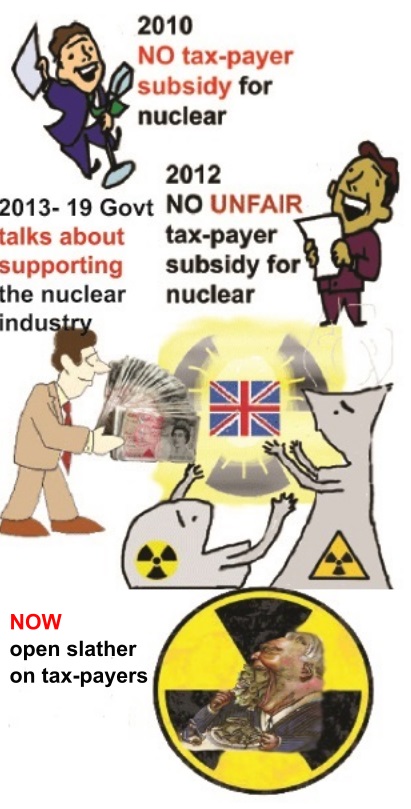
taxpayers are getting no return whatsoever on the £6.4bn they are putting in as equity, so from a taxpayer point of view it is dreadful.
10 Nov, 2025, By Tom Pashby, New Civil Engineer
Taxpayers will see “no return whatsoever” on the £6.4bn that the government is committing in equity to Sizewell C, according to an energy policy expert.
Earlier in November 2025, Sizewell C reached financial close with a £5bn funding injection from 13 banks paving the way for full-scale construction.
The deal secures around £5.5bn of new financing consisting of a £5bn export credit-backed facility arranged by Bpifrance Assurance‑Export (BpifranceAE) with support from Sfil, and a separate £500M working capital facility.
These facilities sit alongside a term loan provided by the UK’s National Wealth Fund and the equity that was raised earlier this year following the Final Investment Decision (FID) for the Suffolk nuclear power plant in July.
In April 2025, the government announced that a further £2.7bn of taxpayer cash had been made available for Sizewell C, bringing the total to £6.4bn ahead of the FID on the nuclear power station.
The agreements on private investment to build the new nuclear power station have been reached through the government agreeing to use the Regulated Asset Base (RAB) model. RAB works by having consumers pay a surcharge on their bills during the construction phase, which helps lower the cost of capital and reduces the financial risk for investors. This surcharge will be added to bills through the construction and for the first three years of operation. It goes towards paying back the private entities for their investment and, according to the government, will mean lower bills for consumers over the long term. Ofgem, as the regulator, sets the allowed revenue to ensure costs are incurred efficiently and consumers get value for money.
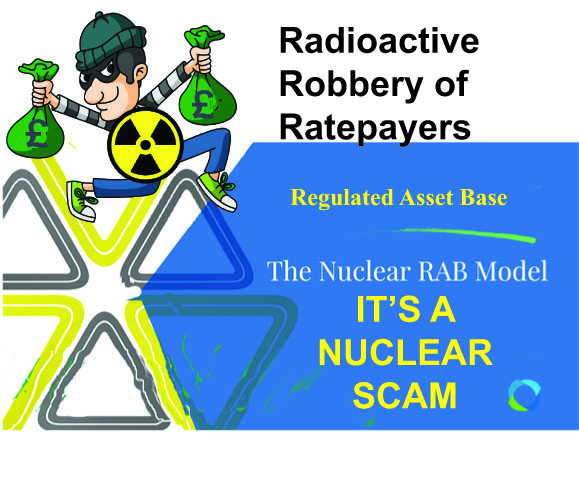
However, University of Greenwich emeritus professor of energy policy Steve Thomas is scptical about this, given that the current official estimate of £38bn to build Sizewell C is at the lower end of the range of likely costs and this is in 2024 prices, with inflation pushing it up all the time.
Additionally, there is no official timeline for construction completion. As has been seen with Hinkley Point C, cost and schedule overruns come with the territory.
He told NCE: “From 1 December 2025, consumers will start to pay a surcharge on the electricity bills to pay for the return being paid to investors (10.8% real) on their equity contribution (35% of the costs) and the interest payments on the loans, expected to be 4.5% (real).
“A bit of arithmetic suggests the surcharge will be split 44% interest payments and 56% rate of return on equity.
“The Low Carbon Contracts Company has said the surcharge in the period up to the end of March 2027 will be £3.54/MWh.”
He added that the £3.54/MWh figure would subsequently be updated annually based on the latest cost calculations.
“Ofgem says the average domestic consumer uses 2,700kWh per year so that amounts to about £9.56 per consumer in the first year,” he said. He believes this could rise to £62.70 per year by the end of the surcharge period.
“The government has said it will recycle its income from the surcharge back to electricity consumers, but we don’t know and nor does the government how it will do this and what proportion of the surcharge it receives will go back to consumers.
“Recycling the income means the government is giving consumers the interest that is paid to the National Wealth Fund on borrowing of £11.8bn and taxpayers are getting no return whatsoever on the £6.4bn they are putting in as equity, so from a taxpayer point of view it is dreadful.
Sizewell C ‘fails miserably’ on transparency – campaigner
Stop Sizewell C executive director Alison Downes said: “If Sizewell C can publicly state it expects the project to cost £38bn, why won’t they tell us when we can expect to see first power?
“Given that the British public is largely paying for Sizewell C through our taxes and energy bills, don’t we have the right to know how long it will take?
“Cynically this sounds like a ‘learning’ from Hinkley Point C – don’t tell people when it will be finished so you can’t be criticised for missing your deadlines. As an exercise in transparency, it fails miserably.”………………. https://www.newcivilengineer.com/latest/sizewell-c-consumers-like-to-see-no-return-on-6-4bn-public-funds-put-in-as-equity-10-11-2025/
US ‘disappointed’ that Rolls-Royce will build UK’s first small modular reactors.
Guardian, 13 Nov 25
As Keir Starmer announces SMRs to be built in Wales, US ambassador says Britain should choose ‘a different path.
Keir Starmer has announced that the UK’s first small modular nuclear reactors will be built in north Wales – but immediately faced a backlash from Donald Trump’s administration after it pushed for a US manufacturer to be chosen.
Wylfa on the island of Anglesey, or Ynys Môn, will be home to three small modular reactors (SMRs) to be built by British manufacturer Rolls-Royce SMR. The government said it will invest £2.5bn.
SMRs are a new – and untested – technology aiming to produce nuclear power stations in factories to drive down costs and speed up installation. Rolls-Royce plans to build reactors, each capable of generating 470 megawatts of power, mainly in Derby.
The government also said that its Great British Energy – Nuclear (GBE-N) will report on potential sites for further larger reactors. They would follow the 3.2GW reactors under construction by French state-owned EDF at Hinkley Point C in Somerset and Sizewell C in Suffolk.
The Labour government under Starmer has embraced nuclear energy in the hope that it can generate electricity without carbon dioxide emissions, while also providing the opportunity for a large new export industry in SMRs.
However, it faced the prospect of a row with the US, piqued that its ally had overlooked the US’s Westinghouse Electric Company when choosing the manufacturer for the Wylfa reactors.
Ahead of the publication of the UK announcement, US ambassador Warren Stephens published a statement saying Britain should choose “a different path” in Wales.
“We are extremely disappointed by this decision, not least because there are cheaper, faster and already-approved options to provide clean, safe energy at this same location,” he said.
The Trump administration last month signed an $80bn (£61bn) deal with Westinghouse, which had been struggling financially, to build several of the same larger reactors proposed at Wylfa. Under the terms of that deal, the Trump administration could end up taking a stake in the company……………………………………………………………………………………………………………………… https://www.theguardian.com/environment/2025/nov/13/us-disappointed-that-rolls-royce-will-build-uks-first-small-modular-reactors
Zelensky – Embroiled in war and embattled at home

by beyondnuclearinternational, https://beyondnuclearinternational.org/2025/11/13/embroiled-in-war-and-embattled-at-home/
Can president Zelensky survive a kickback scheme involving the state nuclear company that enriched associates and possibly even ministers in his own government, asks Linda Pentz Gunter
If you live in Ohio, and possibly even in Illinois and South Carolina, you might be getting a bit of a déjà vu feeling reading the news coming out of Ukraine about a corruption scandal involving Energoatom, Ukraine’s nuclear energy company. That’s because two independent Ukrainian anti-corruption bodies have just uncovered a massive graft scandal involving kickbacks from nuclear power projects.
In July 2020, then Speaker of the Ohio House, Republican Larry Householder, was arrested along with four others for involvement in what was described as “the largest bribery money-laundering scheme ever perpetrated against the people of the state of Ohio.”
In a year-long covert investigation by the US Attorney’s office and the FBI, a plot was uncovered that involved $61 million in dark money that flowed from FirstEnergy into the pockets of Householder and others to ensure a favorable vote in the House that would guarantee a $1.5 billion bailout of the company’s Davis-Besse and Perry nuclear reactors to keep them running. Once uncovered, indictments followed. Householder is currently serving a 20-year prison sentence.
Similar scandals rocked Illinois and South Carolina, also connected to nuclear power plant schemes and also leading to indictments and prison sentences.
In Ukraine, the two investigating agencies — the National Anti-Corruption Bureau (NABU) and the Specialized Anti-Corruption Prosecutor’s Office (SAPO) — have just named at least eight individuals who have reportedly been charged with bribery, embezzlement, and illicit enrichment, netting around $100 million off contracts with Energoatom.
Details about precisely how the scheme operated and which contracts were involved have not fully emerged. However, some sources have suggested it involved a wide range of Energoatom’s private subcontractors who were allegedly forced to pay kickbacks of 10-15% to secure or maintain their supplier status and ensure timely payments.
These reportedly included work on constructing protective structures at the Khmelnytskyi nuclear power plant to defend against Russian air attacks, with Ukraine still struggling to defeat an invasion by Russia that began on February 24, 2022.
Both the Khmelnytskyi and Rivne nuclear power plants were hit with a major strike by the Russians on November 8, raising new fears of a catastrophic nuclear disaster. To date, most of the concern has centered around the six-reactor site at Zaporizhzhia, which is located in the region of heaviest fighting and has been occupied by Russian forces since March 4, 2022. Zaporizhzhia has undergone many close calls and was recently without offsite power for a month, provoking widespread anxiety since power is essential to cool reactors and their fuel pools even if they are shut down as the Zaporizhzia reactors presently are.
“Nuclear safety and security in Ukraine remains extremely precarious during the military conflict,” the International Atomic Energy Agency said in a social media posting. “Two operating NPPs – Khmelnitskyy and Rivne – had to reduce electricity output after overnight attack on electrical substation critical for nuclear safety.”
The participants in the Energoatom corruption scheme, who used code names, were heard in conversations recorded by the investigators evaluating the Khmelnytsky fortifications as a business opportunity.
Meanwhile the IAEA is at the COP30 climate summit in Brazil frantically peddling nuclear power as the answer to the climate crisis under its Atoms4Climate propaganda campaign while ignoring all the obvious safety and security risks so frighteningly on display in Ukraine, never mind the industry’s complete inability to deliver reactors in time or on budget.
Since the anti-corruption groups delivered their reports, two key ministers have resigned at President Volodymyr Zelensky’s request. They are Ukrainian Energy Minister Svitlana Grynchuk and Justice Minister German Galushenko. Galushenko, who preceded Grynchuk as energy minister, had already been suspended before he stepped down. Galushenko is reportedly implicated in the kickback scandal but has proclaimed his innocence.
The two agencies spent more than 15 months collecting evidence, including 1,000 hours of audio recordings and at least 70 searches. Zelensky had acted to curb the reach of NABU and SAPO several months earlier, prompting suspicions that he could have been aware that personal associates and his own ministers were about to be caught in their nets. Zelensky backed down then after being warned by the European Union that Ukraine’s bid to become a member would be in jeopardy if the corruption problem was not resolved.
European Commission president Ursula von der Leyen reportedly conveyed her strong concerns about Zelensky’s attempts to weaken the agencies’ powers. In a statement, a spokesperson for von der Leyen said: “The respect for the rule of law and the fight against corruption are core elements of the European Union. As a candidate country, Ukraine is expected to uphold these standards fully. There cannot be a compromise.”
The EU has spoken out again in light of the present revelations, urging Zelensky to clamp down on corruption, but has not withdrawn its support for the country’s war efforts against Russia’s invasion, now entering its 45th month.
According to an analysis in Kyiv Independent by Oleg Sukhov, the eight implicated also include Deputy Prime Minister Oleksiy Chernyshov, Rustem Umerov, former defense minister and current secretary of the National Security and Defense Council and Ihor Myroniuk, a former advisor to then Energy Minister Halushchenko.
Chernyshov allegedly financed the construction of high-end houses near Kyiv, echoing the way Householder used his bribery bonanzas to refurbish his second home in Florida.
The alleged ringleader, according to Sukhov and other news reports, is Zelensky’s close associate and former business partner, Timur Mindich, who has since fled the country, likely to Israel where he is a citizen and lending further credence to the charges. Mindich is a co-owner of the president’s Kvartal 95 production company. Zelensky transferred his stake to partners once he became president.
Chernyshov allegedly financed the construction of high-end houses near Kyiv, echoing the way Householder used his bribery bonanzas to refurbish his second home in Florida.
The alleged ringleader, according to Sukhov and other news reports, is Zelensky’s close associate and former business partner, Timur Mindich, who has since fled the country, likely to Israel where he is a citizen and lending further credence to the charges. Mindich is a co-owner of the president’s Kvartal 95 production company. Zelensky transferred his stake to partners once he became president.
Linda Pentz Gunter is the founder of Beyond Nuclear and serves as its international specialist. Her book, No To Nuclear. Why Nuclear Power Destroys Lives, Derails Climate Progress and Provokes War, can be pre-ordered now from Pluto Press.
Why my work is clearly biased
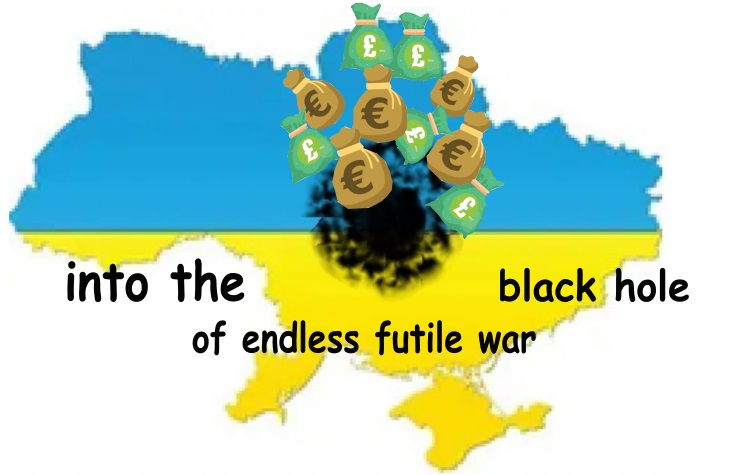
Today, I found myself posting on my website – an article which is vehemently anti -Western, and possibly just an angry version of pro Russian propaganda. I dithered about this. Is my pro-Russian slant just too much – a bridge too far?
After all, there is so much to deplore about Russia – the secret, brutal and murderous regime of Vladimir Putin, and the genocidal history of Stalin’s actions in Ukraine. And there’s plenty more to deplore, including more recent atrocities done to Ukrainians in the course of the current war.
So – why on earth should I, or anyone, stick up for Russia, which is anyway, the invader in this conflict?
I come back to just one answer. It is that rather vague concept of culture. It is that someone must address that “Western culture” in which we are immersed and perhaps drowning.
Western culture, supposedly based on “Christian values” – like equality, compassion, peace-making, is nevertheless now manifesting as fear and hatred of Russia and China.
The media laps this up, because really, diplomacy, compromise, quiet discussion between world leaders, is boring stuff, and anger, shock and conflict – that’s entertaining.
In the coverage of the war in Ukraine, so many important aspects are ignored. We don’t hear about , for example, the effect of Zelensky banning the Russian language in public life, when for so many Ukrainians Russian is their first language. We don’t hear about atrocities done by Ukrainian troops.
We don’t hear any details about negotiations in which the war could end, with concessions made by both sides. Consideration is never given to how NATO membership for Ukraine might affect Russia. I mean, how would Americans feel, if a hostile Canada could allow Russian military bases set up on the border of USA?
Instead, there is this narrative about Russia’s intention to attack European states, and then take over the world, crushing democracy. But where’s the evidence for this? And at the same time, we’re being assured that Russia is economically and militarily weakened, so of course, Ukraine can beat them
And, talking of economics – well – “follow the money” has always been a very important aspect in world affairs. I think that we could all agree that from the point of view of Trump’s USA – the simple goal is to enrich American businesses. So, for the USA now, the main thing is to sell weapons to Europe.
For Europe, this is expensive. It’s not as if all the member States are wealthy and united in their resolve to buy the weapons and make Ukraine win. They need the money. The plan suggests raising a total of nearly €300 billion.
One way is to expropriate frozen Russian sovereign assets. Sovereign assets have immunity from seizure under international law and bilateral treaties – the United Nations Convention on Jurisdictional Immunities of States and Their Property (2004) This method could have legal repercussions, and destabilise confidence in economic systems and investment, with political ill-effects for Europe.
Another way is to raise a Eurobond. This is problematic because the EU would be acting as if it were a sovereign state rather than an administrative body of a treaty-based union. Some States might object, and as Ukraine is not a member of the EU – that fact strengthens their objection. The Eurobond would result, for member States, in higher taxes, constrained public services, and renewed austerity.
The EU’s options for paying for continuing Ukraine’s fight are highly problematic. They are based on the belief that after Ukraine’s victory, European nations will get back the money from Russian reparations, and from returns from reconstruction of Russian-liberated territories. A dubious outcome.
These financial considerations might possibly bring the Western media, politicians, and public to take a more pragmatic view of the war in Ukraine, and calm down from the hysteria about Russia destroying democracy. (Indeed, to digress for a moment – the USA is now giving a good example of democracy destroying itself)
The culture is so imbued with those emotions of fear and hatred, and historic hostilities, that I doubt that we will come down to earth and look at the Ukraine situation more realistically. And our leaders seem obsessed with showing how tough they are, rather than how wise.
Democracy ‘s all about individual liberties, freedom, -we are told. But there are also other considerations – the need for food, water and shelter. A more collective view of society includes those considerations. In some ways, Russia and China are doing a better job in this.
So, after this long meandering, I conclude that I am OK with continuing with my biased stance. Yes, some of the stuff I put up IS Russian propaganda. I try to be sure that the facts are correct, even if the interpretation is biased. We are so constantly tsunamied with anti-Russia, anti-China stuff, it is necessary to try to bring in some balance.
3 drones reportedly spotted flying over Belgian nuclear power plant
Kyiv Independent, November 10, 2025
Three drones were spotted flying over the Doel Nuclear Power Plant in northern Belgium on the evening of Nov. 9, according to Deutsche Welle.
Operations at the power plant near Antwerp were not impacted by the drone sighting, a spokesperson for local energy company Engie said.
Several unidentified drone sightings have occurred in recent days near Belgian infrastructure. On Nov. 3, the Belgian army issued orders to shoot down unknown drones spotted over the country’s military bases in response to the sightings.
On Nov. 4, Belgium suspended air traffic at Brussels Airport due to a reported drone sighting in the area, according to the Belga News Agency. Some flights were diverted to the country’s Liege Airport, which was later temporarily closed because of another drone sighting.
Meanwhile, suspicious drones were spotted over Belgium’s Kleine Brogel Air Base for three nights in a row between Oct. 31 and Nov. 2, local media reported.
Belgian Defense Minister Theo Francken said that the sightings near military bases appear to be part of an espionage operation, not naming the culprit but linking the incidents to recent Russian airspace violations in Europe.
The drone sightings have caused disruptions in several European countries, including Germany, Denmark, and the Netherlands. As investigations continue, authorities have not ruled out that the drones may be Russian…………………………. https://kyivindependent.com/3-drones-reportedly-spotted-flying-over-belgian-nuclear-power-plant/
Belgium flounders as 5 drones buzz nuclear power plant.

U.K., France and Germany send assistance.
Politico, November 10, 2025 , By Elena Giordano
Five drones were spotted flying over Belgium’s Doel nuclear power plant near the Port of Antwerp on Sunday evening, energy company Engie said.
“Initially we had detected three drones, but then we saw five drones. They were up in the air for about an hour,” Engie spokesperson Hellen Smeets told POLITICO Monday morning.
The first report of the three drones came shortly before 10 p.m. on Sunday, Smeet said, adding that the sightings had no impact on the plant operations. Belgium’s national Crisis Center, which is currently monitoring the situation, confirmed the incident……………
The latest incidents comes amid a surge of drone activity disrupting key infrastructure across Belgium. Airports in Brussels and Liège faced repeated interruptions last week, while drones were also spotted over military bases and the Port of Antwerp…….
While the government has avoided attributing blame, Belgium’s intelligence services suspect foreign hands, with Moscow seen as the most likely source, according to local media. Defense Minister Theo Francken said Saturday that “Russia is clearly a plausible suspect.”
On Sunday, the U.K. announced it will join France and Germany in sending personnel and equipment to help Belgium counter drone incursions around sensitive sites. https://www.politico.eu/article/drones-spotted-belgium-nuclear-plant-doel-airspace-incursions/
NFLAs welcome Remembrance Day award of medal to nuke test ‘Sniffers’, but fight not over as groundcrews exposed to radiation remain forgotten.
11th November 2025, https://www.nuclearpolicy.info/news/nflas-welcome-remembrance-day-award-of-medal-to-nuke-test-sniffers-but-fight-not-over-as-groundcrews-exposed-to-radiation-remain-forgotten/
The NFLAs have welcomed the Remembrance Day announcement that the Government has agreed to award the Nuclear Test Medal to gallant RAF aircrew of 27 and 543 Squadrons and sailors aboard the Royal Fleet
Auxiliary vessel Sir Percivale who passed through French and Chinese atmospheric nuclear tests in the Far East to carry out air sampling.
British personnel were ordered to fly or sail through the radioactive clouds of over 40 atomic and nuclear atmospheric tests carried out by China and France.
11th November 2025
NFLAs welcome Remembrance Day award of medal to nuke test ‘Sniffers’, but fight not over as groundcrews exposed to radiation remain forgotten
The NFLAs have welcomed the Remembrance Day announcement that the Government has agreed to award the Nuclear Test Medal to gallant RAF aircrew of 27 and 543 Squadrons and sailors aboard the Royal Fleet Auxiliary vessel Sir Percivale who passed through French and Chinese atmospheric nuclear tests in the Far East to carry out air sampling.
British personnel were ordered to fly or sail through the radioactive clouds of over 40 atomic and nuclear atmospheric tests carried out by China and France.
The NFLAs have been strong advocates for recognition, justice and compensation for Britain’s nuclear test veterans and their families, and the latest announcement comes just a month after NFLA Chair, Councillor Lawrence O’Neill, wrote to the new Veterans Minister, Louise Sandher-Jones, calling for the eligibility criteria for the medal to be extended to include these forgotten ‘sniffers’.
Unfortunately, the revised award criteria still wrongly exclude the RAF ground crew involved in decontaminating the aircraft on their return to the UK. The aircraft involved in sniffing operations were contaminated with radioactivity, and they were decontaminated by washing by groundcrew. Many of these groundcrew were unaware of the levels of radioactivity on the aircraft.
Consequently, many of these ground crew also developed cancers and other health conditions related to exposure to ionising radiation, some repeatedly. Some personnel died and others were able to access a War Pension as a result.
The latest decision by Ministers therefore only represents a part-victory. Councillor O’Neill believes that excluding the ground crew seems ‘not only unjust, but also bizarre and perverse’ given these veterans faced the same dangers as their colleagues who engaged in ‘sniffing’ duties on British tests and who will now qualify for the medal.
The fight therefore continues.
Poseidon: The Ultimate Weapon of Vengeance [i]

“To wipe out the enemy coast…”
Very long article, with excellent illustrations.
Black Mountain Analysis Mike Mihajlovic, Nov 10, 2025
A weapon system on its own
The Poseidon, designated 2M39 in Russian service and known to NATO as Kanyon, is among the most enigmatic and controversial strategic systems developed in recent years. It resists conventional classification: neither a conventional torpedo nor a crewed submarine, it represents a novel class of autonomous, nuclear-powered underwater vehicle designed to carry a nuclear warhead.
This autonomous, nuclear-powered underwater vehicle, formerly designated Status-6, has been described in open sources as capable of carrying a very large thermonuclear warhead (some reports even cite yields as high as 100 megatons)1 and of transiting intercontinental distances at depths that would place it beyond the reach of most conventional antisubmarine weapons, arguably leaving only exceptionally large-yield nuclear depth charges as a theoretical counter. Open reporting also suggests it can adopt multiple mission modes: a high-speed transit phase at depth, which offers rapid repositioning but is more readily detectable by advanced acoustic sensors, and a prolonged low-speed, low-observability cruise that exploits nuclear endurance to remain submerged for effectively indefinite periods before conducting a final approach to a target.
As with many novel Russian weapons, most technical details remain classified; nevertheless, a synthesis of open-source analysis and official Russian statements permits a broad—albeit uncertain—reconstruction of Poseidon’s design philosophy, capabilities, and potential strategic effects.
………………………………………………………………………………………………………………………………………………………………………………………………………………... Summary
In summary, the Poseidon system represents a technically feasible but strategically extreme extension of known nuclear and naval technologies. It most likely uses a compact liquid-metal-cooled fast reactor to achieve long-range, high-speed operation at great depths, carries a warhead of 2-100 Mt, and could inflict catastrophic local damage and contamination on any coastal target. Yet the notion that it could raise ocean-wide radioactive tsunamis is unsupported by physical science. Its true significance may lie less in its physics than in its symbolism: a weapon designed to project the image of ultimate deterrence by threatening entire coastal societies, even if the practical mechanics of such annihilation are more limited than popular imagination suggests.
Politically, the deployment of Poseidon adds a new dimension to strategic deterrence. Its autonomous nature and perceived “doomsday” capability suggest a weapon intended more for psychological and geopolitical signaling than for practical battlefield use. Its mere existence challenges traditional arms control frameworks and complicates stability calculations by introducing a new underwater axis of nuclear deterrence.
Despite the growing public literature, many details remain unknowable. The reactor’s design, actual performance, warhead configuration, and even deployment status are tightly held secrets. Modeling the hydrodynamics of a multi-megaton underwater detonation is inherently uncertain, as no full-scale tests have ever been conducted at such yields or depths. Extrapolations from smaller historical tests provide useful guidance but cannot capture all nonlinear effects of deep-water bubble dynamics or coastal interactions. Moreover, the strategic intent behind Poseidon, whether as a second-strike deterrent, a terror weapon, or an anti-access denial system, remains speculative and politically sensitive. https://bmanalysis.substack.com/p/poseidon-the-ultimate-weapon-of-vengeance?utm_source=post-email-title&publication_id=1105422&post_id=177880124&utm_campaign=email-post-title&isFreemail=true&r=1ise1&triedRedirect=true&utm_medium=email
Russia deliberately ‘endangering nuclear safety in Europe’ says Kyiv
Ukraine says drones are targeting substations that power the Khmelnytskyi and Rivne nuclear plants. What we know on day 1,355
Guardian staff and agencies, 9 Nov 25
- Russia is again targeting substations that power the Khmelnytskyi and Rivne nuclear power plants in Ukraine, the country’s foreign minister Andrii Sybiha said on X on Saturday. Sybiha said drone attacks on the weekend were not accidental but well-planned strikes. “Russia is deliberately endangering nuclear safety in Europe,” he said.
- Russia launched a barrage of drones and missiles at Ukraine over the weekend, killing at least seven people and damaging energy infrastructure in three regions, according to Ukrainian officials. Ukraine’s president, Volodymyr Zelenskyy, said Russia had launched more than 450 drones and 45 missiles, most of which were shot down. Three people were killed and 12 wounded when a drone hit an apartment building in Dnipro, and another person was killed in the Kharkiv region. Three were killed in the south-eastern Zaporizhzhia region, regional officials said. https://www.theguardian.com/world/2025/nov/09/ukraine-war-briefing-russia-deliberately-endangering-nuclear-safety-in-europe-says-kyiv
1 This Month


31st January – Challenging the War Machine – a DECLASSIFIED UK SUMMIT



Website of the Week
Now until to February 10, 2026 Radioactive waste storage in France: the debate is finally open! How to participate?
-
Archives
- January 2026 (211)
- December 2025 (358)
- November 2025 (359)
- October 2025 (377)
- September 2025 (258)
- August 2025 (319)
- July 2025 (230)
- June 2025 (348)
- May 2025 (261)
- April 2025 (305)
- March 2025 (319)
- February 2025 (234)
-
Categories
- 1
- 1 NUCLEAR ISSUES
- business and costs
- climate change
- culture and arts
- ENERGY
- environment
- health
- history
- indigenous issues
- Legal
- marketing of nuclear
- media
- opposition to nuclear
- PERSONAL STORIES
- politics
- politics international
- Religion and ethics
- safety
- secrets,lies and civil liberties
- spinbuster
- technology
- Uranium
- wastes
- weapons and war
- Women
- 2 WORLD
- ACTION
- AFRICA
- Atrocities
- AUSTRALIA
- Christina's notes
- Christina's themes
- culture and arts
- Events
- Fuk 2022
- Fuk 2023
- Fukushima 2017
- Fukushima 2018
- fukushima 2019
- Fukushima 2020
- Fukushima 2021
- general
- global warming
- Humour (God we need it)
- Nuclear
- RARE EARTHS
- Reference
- resources – print
- Resources -audiovicual
- Weekly Newsletter
- World
- World Nuclear
- YouTube
-
RSS
Entries RSS
Comments RSS
 nuclear-news