UK spurns European invitation to join ITER nuclear fusion project
Since Brexit, the UK no longer has access to ITER, the world’s largest nuclear fusion experiment, through the European Union. After an invitation to rejoin this week, the UK government has confirmed it prefers to go it alone
New Scientist, By Matthew Sparkes, 1 March 2024
The UK government has declined an invitation to become an official member of the ITER nuclear fusion experiment, having lost access to the project following Brexit. Instead, it plans to focus on UK-based fusion efforts, both public and private.
ITER, the world’s largest fusion experiment, is under construction in France and is expected to be completed in 2025 after many delays. The project is being funded by a huge international collaboration including China, India, Japan, Russia, South Korea, the US and the European Union……………………………………………………………………. more https://www.newscientist.com/article/2419671-uk-spurns-european-invitation-to-join-iter-nuclear-fusion-project/
IT’S TIME TO CANCEL SIZEWELL C

https://action.stopsizewellc.org/its-time-cancel-sizewell-c 27 feb 24
In recent weeks, Hinkley Point C has been revealed to cost £46 billion, yet just hours before this was announced, the government DOUBLED the taxpayers’ money that had been paid into Sizewell C, to a staggering £2.5 billion. Stop Sizewell C described this as the epitome of insanity – to do the same thing over again and expect a different result.
Yet in fact Sizewell C is NOT an exact replica of Hinkley Point C. It is an 80% above ground copy, but the site and ground conditions are very different. And what’s worse is that while Hinkley C’s cost and schedule overruns are the responsibility of EDF, when Sizewell C overruns and overspends – as it inevitably will – it will fall on we consumers to pay.
Citizens Advice have told Ministers “the scope for material cost and time overruns [at Sizewell C] is very significant. Consumers need to be protected from those risks. They have no way to manage them and are reliant on [the government] to ensure they are not on the hook”.
It’s time to call a halt to this madness. Sizewell C is too slow, expensive and damaging to be the answer to our climate and energy security emergency. If you agree that Sizewell C is the wrong project in the wrong place, send a message to Rishi Sunak, Jeremy Hunt and Claire Coutinho, telling them why they should cancel Sizewell C.
France creates coalition to arm Ukraine with long-range weapons

28 Feb 24 https://www.rt.com/news/593253-france-macron-coalition-long-range-weapons-ukraine/
The aim is to enable Kiev to “carry out deep strikes” amid flagging US support, President Emmanuel Macron has said
France is leading a new coalition that aims to provide Ukraine with “medium and long-range missiles and bombs,” President Emmanuel Macron has announced. He has also not ruled out deploying ground forces to support Kiev in future.
Macron made the remarks following a summit of Ukraine’s backers on Monday, intended to demonstrate unwavering support for Kiev amid the suspension of American aid.
According to the French leader, the newly established coalition seeks to enable Ukraine to “carry out deep strikes.” There is a “broad consensus to do even more and faster together” to support Kiev, Macron added.
The move comes as continued US aid to Ukraine remains in doubt. President Joe Biden’s latest package, which envisages an additional $60 billion for Kiev, has been in limbo for months due to opposition from Republicans in the House of Representatives. Lawmakers have made clear they will only relent if the White House agrees to tighten US border controls and stems the flow of illegal migrants from Mexico.
Speaking on Monday, Macron also claimed that the deployment of Western troops to Ukraine cannot be ruled out, insisting that Paris will “do everything necessary to ensure that Russia cannot win this war.” His remarks were echoed by French Prime Minister Gabriel Attal in comments to the RTL broadcaster on Tuesday.
In response, Kremlin spokesperson Dmitry Peskov warned that “in this case, we have to talk not about the probability, but rather the inevitability” of a direct conflict between NATO and Russia, should Western military personnel be deployed to Ukraine.
Earlier this month, Paris and Kiev signed a bilateral security pact under which France pledged €3 billion ($3.26 billion) worth of defense aid by the end of the year.
In January, Macron revealed plans to provide Ukraine with 40 more SCALP-EG long-range cruise missiles and “hundreds of bombs.”
Paris agreed to ship the rockets, which have a range of over 250km (155 miles), last July, months after the UK agreed a similar move.
Russia has consistently condemned Western deliveries of long-range weaponry, saying it will only serve to prolong the hostilities unnecessarily without changing the final outcome.
Victoria Nuland accidentally reveals the true aim of the West in Ukraine

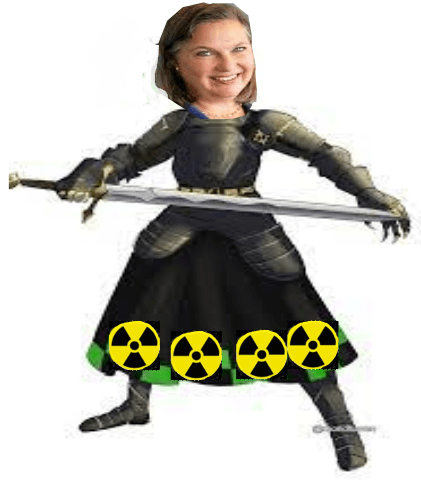
“And by the way, we have to remember that the bulk of this money is going right back into the US to make those weapons,” Nuland said, pleading in favor of the latest Ukraine aid package “
Ukrainians are a convenient pretext to keep the tax cash flowing in the direction of the US military industrial complex
SOTT, Rachel Marsden, Tue, 27 Feb 2024
US State Department fixture and Under Secretary of State for Political Affairs, Victoria Nuland, aka “Regime Change Karen,” apparently woke up one day recently, took the safety off her nuclear-grade mouth, and inadvertently blew up the West’s Ukraine narrative.
Until now, Americans have been told that all the US taxpayer cash being earmarked for Ukrainian aid is to help actual Ukrainians. Anyone notice that the $75 billion American contribution isn’t getting the job done on the battlefield? Victory in military conflict isn’t supposed to look like defeat. Winning also isn’t defined as, “Well, on a long enough time axis, like infinity, our chance of defeat will eventually approach zero.” And the $178 billion in total from all allies combined doesn’t seem to be doing the trick, either. Short of starting a global war with weapons capable of extending the conflict beyond a regional one, it’s not like they’ve been holding back. The West is breaking the bank. All for some vague, future Ukrainian “victory” that they don’t seem to want to clearly define. We keep hearing that the support will last “as long as it takes.” For what exactly? By not clearly defining it, they can keep moving the goal posts.
But now here comes Regime Change Karen, dropping some truth bombs on CNN about Ukrainian aid. She started off with the usual talking point of doing “what we have always done, which is defend democracy and freedom around the world.” Conveniently, in places where they have controlling interests and want to keep them – or knock them out of a global competitor’s roster and into their own. “And by the way, we have to remember that the bulk of this money is going right back into the US to make those weapons,” Nuland said, pleading in favor of the latest Ukraine aid package that’s been getting the side eye from Republicans in Congress.
So there you have it, folks. Ukrainians are a convenient pretext to keep the tax cash flowing in the direction of the US military industrial complex. This gives a whole new perspective on “as long as it takes.” It’s just the usual endless war and profits repackaged as benevolence. But we’ve seen this before. It explains why war in Afghanistan was little more than a gateway to Iraq. And why the Global War on Terrorism never seems to end, and only ever mutates. Arguably the best one they’ve come up with so far is the need for military-grade panopticon-style surveillance, so the state can shadow-box permanently with ghosts while bamboozling the general public with murky cyber concepts that it can’t understand or conceptualize. When one conflict or threat dials down, another ramps up, boosted by fearmongering rhetoric couched in white-knighting. There’s never any endgame or exit ramp to any of these conflicts. And there clearly isn’t one for Ukraine, either.
Still, there’s a sense that the realities on the ground in Ukraine, which favor Russia, now likely mean that the conflict is closer to its end than to its beginning. Acknowledgements abound in the Western press. And that means there isn’t much time left for Europe to get aboard the tax cash laundering bandwagon and stuff its own military industrial complexes’ coffers like Washington has been doing from the get-go.
Which would explain why a bunch of countries now seem to be rushing to give Ukraine years-long bilateral security “guarantees,” requiring more weapons for everyone. France, Germany, Canada, and Italy have all made the pledge. Plus Denmark, which also flat-out said that it would send all its artillery to Ukraine………………………………………………
Thanks to Nuland’s nuking of any plausible deniability on Ukrainian “aid” not going to Washington, it’s now clear that Ukrainians continue to die so poor weapons makers don’t end up shaking tin cans on street corners.………………………………………………………………………….. more https://www.sott.net/article/489314-Nuland-accidentally-reveals-the-true-aim-of-the-West-in-Ukraine
Leaked Russian military files reveal its nuclear strike rules

A doctrine for tactical nuclear weapons is outlined in training scenarios, including for a possible invasion by China.
Max Seddon and Chris Cook, Feb 29, 2024
ladimir Putin’s forces have rehearsed using tactical nuclear weapons at an early stage of conflict with a major world power, according to leaked Russian military files that include training scenarios for an invasion by China.
The classified papers, seen by the Financial Times, describe a threshold for using tactical nuclear weapons that is lower than Russia has publicly admitted, according to experts who reviewed and verified the documents.
The cache consists of 29 secret Russian military files drawn up between 2008 and 2014, including scenarios for war-gaming and presentations for naval officers, which discuss operating principles for the use of nuclear weapons.
Criteria for a potential nuclear response range from an enemy incursion on Russian territory to more specific triggers, such as the destruction of 20 per cent of Russia’s strategic ballistic missile submarines.
“This is the first time that we have seen documents like this reported in the public domain,” said Alexander Gabuev, director of the Carnegie Russia Eurasia Centre in Berlin. “They show that the operational threshold for using nuclear weapons is pretty low if the desired result can’t be achieved through conventional means.”
Russia’s tactical nuclear weapons, which can be delivered by land or sea-launched missiles or from aircraft, are designed for limited battlefield use in Europe and Asia, as opposed to the larger “strategic” weapons intended to target the US. Modern tactical warheads can still release significantly more energy than the weapons dropped on Nagasaki and Hiroshima in 1945.
Deep suspicions of China
Although the files date back 10 years and more, experts say they remain relevant to current Russian military doctrine. The documents were shown to the FT by Western sources.
The defensive plans expose deeply held suspicions of China among Moscow’s security elite even as Putin began forging an alliance with Beijing, which as early as 2001 included a nuclear no-first-strike agreement.
In the years since, Russia and China have deepened their partnership, particularly since Xi Jinping took power in Beijing in 2012……………………………………………………………………………………………..
more https://www.afr.com/world/europe/leaked-russian-files-reveal-nuclear-strike-rules-20240229-p5f8mz—
Nuclear security is under attack in Ukraine, say experts at Bellona forum.

These and other questions were raised during today’s Bellona forum, “War and the Russian Nuclear Industry,” which brough together experts from Norway and Bellona’s new offices in Vilnius — the new locale for the organization’s Russian staff, who can no longer safely conduct their work on Russian soil.
“We have full-scale war in a country with full-scale nuclear installations, and a situation where international cooperation on nuclear security no longer exists,” said Bellona founder Frederic Hauge in the forum’s opening remarks.
Bellona has worked on nuclear cleanup in Russia since the early 1990s, and this month mark 30 years since Bellona released its first report on the nuclear threat caused by the legacy of the Soviet nuclear navy. It has also been almost exactly two years since Russia invaded Ukraine. That was the backdrop for today’s Bellona Forum, where about 100 people participated physically or digitally.
Tons of Nuclear Waste
Aleksandr Nikitin, a former Russian nuclear submarine officer and Bellona employee of 30 years standing, opened the forum by discussing Bellona’s strategic goals for its nuclear project in Russia.
“First and foremost, together with international actors, we have worked to prevent radiation and nuclear accidents at Russian facilities,” he said. “We have also been concerned with ensuring the elimination or safe conversion of the Soviet nuclear and radiation legacy.”
He noted that the Russian nuclear and radiation legacy consists of nearly 20,000 tons of used nuclear fuel, approximately 800,000 cubic meters of radioactive waste, over 4,700 nuclear and radiation hazardous facilities — as well as more than 30,000 cubic meters of radioactive waste dumped on the seabed.
Since Russia invaded Ukraine on February 24, 2022, international efforts to grapple with those issues have stalled.
“But at Bellona, we still have full focus on the Russian nuclear industry, even though now, since we were banned by Russian authorities, we must operate from outside Russia’s borders,” Nikitin said. “We are still working to gather and disseminate information; we share knowledge about the use of nuclear technologies and how the Russian nuclear industry contributes to the continuation of the war in Ukraine.”
‘Rosatom Significantly Involved in the War’
One of the employees at Bellona’s Environmental Transparency Center in Vilnius is nuclear expert Dmitry Gorchakov, who spoke at the Bellona Forum about the role of the Russian atomic agency Rosatom in Russia’s war against Ukraine.
“We closely monitor nuclear risks in Ukraine. And we monitor Rosatom’s global nuclear activities and the agency’s role in the international nuclear market closely,” said Gorchakov.
Rosatom is the world’s largest builder of nuclear power plants. One-third of all nuclear power plants under construction in the world are either built by Rosatom or according to Rosatom’s technology and design.
“Rosatom is significantly involved in the ongoing war. One of the most critical situations is the occupation of Europe’s largest nuclear power plant, Zaporizhzhia (in southeastern Ukraine), which the Russians have occupied since the first weeks of the war. Inspectors from the International Atomic Energy Agency (IAEA) have been denied access to several areas of the facility,” said Gorchakov.
He highlighted three main risks at the nuclear power plant as it continues to be controlled by Russia on the front lines of the conflict.
“First, there is a risk of equipment damage due to abnormal operation and lack of maintenance. The second risk is the lack of qualified personnel. But the biggest risk, of course, is the war itself; it is unpredictable and creates chaos. Dramatic changes can occur at any time. For example, if Russia decides to switch reactors to power mode or if military activity escalates near the plant,” said Gorchakov.
Secret Nuclear Weapons Program
Thomas Nilsen from The Independent Barents Observer also participated in the Bellona forum. He talked about Russia’s secret reactor-driven nuclear weapons program and its development and testing in the Arctic.
We are in a new arms race involving new nuclear weapons and new reactor systems. And we are back to the flow of information that existed during the Soviet era, meaning almost no information. We at The Barents Observer have not reported a single incident from Russian nuclear submarines in the past four years, and that’s not because accidents haven’t happened. It’s becoming harder and harder to obtain information from Russia,” Nilsen explained.
The Barents Observer is the only Norwegian media outlet with four exiled Russian journalists on its editorial staff.
You can watch the entire Bellona forum by clicking on this link.
Locals oppose nuclear waste plant – parish council
Bob Cooper, Political reporter, BBC Radio Cumbria, 28 Feb 24 https://www.bbc.com/news/articles/c0jvjx8kn5xo—
Opponents of plans to seal some of the UK’s most lethal nuclear waste underground have called for communities to have more of say.
Whicham Parish Council in west Cumbria held a postal survey, in which more than three quarters of those who responded opposed the idea.
It is part of an area in which officials are exploring the possibility of siting a Geological Disposal Facility (GDF).
Cumberland Council said there was “no reason” for parish councils to conduct ballots.
Nuclear Waste Services, the body that oversees the project, described a GDF as “a highly engineered structure consisting of multiple barriers that will provide protection over hundreds of thousands of years.”
High-level nuclear waste would be sealed up to 1km (0.62 mile) underground, or possibly under the seabed.
Searches for a potential place for the facility are taking place in three areas, including two in Cumbria and another in Lincolnshire.
‘Impact on communities’
The process of identifying a site is expected to take 10 to 15 years and it could be ready to start receiving waste in the 2050s.
The Whicham postal vote was carried out in 2023 and the parish council said 251 out of 400 parishioners replied, which was a 63% turnout.
The council said 77% were opposed to a GDF in the parish, 15% were in favour, 6% were neutral, while the rest of the forms were blank.
Richard Outram, from Nuclear Free Local Authorities, a group of councils opposed to nuclear developments, said other parish councils should follow Whicham and conduct polls.
“The geological disposal facility, or a nuclear waste dump, is a massive engineering project that’s going to impact on communities for tens of years,” he said.
“It’s important to regularly take the public temperature and one way of doing that is by each parish council holding a regular parish poll.”
‘Too early’
Cumberland Council is the authority with the power to withdraw local communities from the siting process, external.
It is also responsible for conducting a formal test of public support, external, such as a local referendum, before a site can be approved.
The Labour-led authority recently wrote to parish councils telling them they did not need to conduct polls because “detailed public opinion monitoring in the Search Areas is already carried out”.
It also said it was too early in the process to carry out an official test of public support.
Meanwhile, Nuclear Waste Services said surveys to monitor local opinion would be carried out by a professional polling company.
‘I was a guinea pig during secret Christmas Island nuclear tests’

By Nicola Haseler & Lewis Adams. BBC News, Bedfordshire. 28 Feb 24
A former Royal Engineer who witnessed several atomic and hydrogen bomb explosions as part of the UK’s nuclear tests said he was a “guinea pig”.
Brian Cantle, from Bedfordshire, was 21 when he was sent to Christmas Island as part of his national service in 1957.
He and the other soldiers were not told what they were going to do there – due to the covert nature of the programme.
Mr Cantle, now 87, has been awarded a Nuclear Test Medal for his work on the Pacific Ocean island.
The veteran, from Whipsnade, witnessed several atomic and hydrogen bomb explosions during his 12 months on the island.
He was one of 22,000 British servicemen who participated in the British and United States’ nuclear tests and clean-ups between 1952 and 1965……………………………………………
On the days when bombs were tested, Mr Cantle said troops would have to put on brown overalls and face the other way to the bomb going off.
He added: “It was just a big flash and then we were told we could turn round and see it. It was an enormous explosion.”
‘We were guinea pigs’
In the decades that have followed the tests, calls have been made for the men who witnessed a nuclear test to receive an apology for the health risks they were exposed to.
“We were guinea pigs, we were just told what to do and did it,” Mr Cantle said………
The Grapple H-bomb nuclear test series was intended to show that the British had the technology to influence the Cold War, following the development of the atomic bomb by U.S. scientist Robert Oppenheimer.
The hydrogen bombs, which were much more powerful than atomic bombs, were detonated every three months……. https://www.bbc.com/news/uk-england-beds-bucks-herts-68415338
Has the nuclear lobby hijacked Welsh democracy?

25 Feb 2024, Robat Idris https://nation.cymru/opinion/has-the-nuclear-lobby-hijacked-welsh-democracy/
A sadly but unsurprising travesty of democracy slid out of Cardiff Bay with the release of the Senedd’s Economy, Trade and Rural Affairs Committee report on “Nuclear Energy and the Welsh Economy” on 21st February.
As a case study in lobbying power, it is surely worthy of inclusion in the Hall of Infamy.
Its recommendations could have been written by the nuclear lobby itself, rather than by our democratically elected Senedd Members.
Despite the collapse of the Wylfa project in 2019, all of the recommendations enthusiastically back the case for nuclear, with a plea to the UK Government to get on with the job. Einstein reportedly said: “Insanity is doing the same thing over and over again and expecting different results”.
Informed voices
If we are to have a credible Senedd, and a real democracy, then it is crucial that informed voices are heard.
This report, pandering to the self-interest of denizens of the nuclear village, merely reinforces the view that politics is about kowtowing to powerful corporate interests.
Meanwhile Cymru bleeds while real and credible solutions to energy and jobs exist.
The blurb preceding the report assures us that: “The Welsh Parliament is the democratically elected body that represents the interests of Wales and its people”. Yet this Committee took oral evidence from nine pro-nuclear individuals, and written evidence from six pro-nuclear organisations, and none from any individual or organisation having an anti-nuclear or indeed a sceptical view.
The rationale for this appears to be that the terms of reference deliberately chose not to include other voices:
“The terms of reference for this one-day inquiry were to consider the potential economic impact of new nuclear developments in north Wales, how to maximise local employment and benefits to local or Wales-based supply chains of new nuclear projects, and the challenges posed by skills shortages and how to overcome them. By its nature the inquiry did not examine the pros and cons of nuclear energy itself, but recognised its place in an overall energy security strategy and net zero targets.”
Apparently the only relevant voices are those backing nuclear.
The committee’s duty is to the people of Cymru, and not to the nuclear industry, or to the desire of the UK to remain a nuclear armed state.
Balanced view
As should be apparent if the Wellbeing of Future Generations Act is taken seriously. This is such a vital matter that evidence should be given to the committee which would enable its members to form a fully informed and balanced view on nuclear energy.
Why wasn’t evidence sought from experts and interested parties on such questions as:
- why new nuclear may never happen.
- why nuclear can’t be built in time to influence climate change.
- why should Cymru support civil nuclear when the UK Government admits its intrinsic links with military nuclear weapons capability?
- why should such reliance be placed on the voices of an industry which consistently fails to deliver on cost and on time?
- why should Cymru accept nuclear when renewable energy technology can provide 100% of our energy needs?
- why should Ynys Môn and Gwynedd become a nuclear dump to satisfy the needs of the nuclear industry and the UK state?
- why should we believe that the effects on language, culture, biodiversity can be mitigated?
- why have an influx of workers at a time when housing is a major issue for local people, when the NHS is on the point of collapse, when council services are creaking?
- why does the Welsh Government not acknowledge that nuclear is in retreat globally?
It’s time to recognise that the priority for Cymru is to look to our own natural resources for energy and job solutions. If fully harnessed, offshore wind has the potential to provide double our energy needs.
And why don’t our Senedd Members look critically at the companies which gave evidence?
- In 2020 the American company Bechtel had to pay (with another company) $57.5 million to the US Department of Justice for irregularities at the Hanford Waste Treatment Plant (Hanford is considered to be the most toxic nuclear waste facility in the US). In 2008 it had to pay (with another company) $407 million to the state and federal governments to settle litigation over leaky tunnels and a fatal ceiling collapse in the Boston Big Dig project.
- Rolls-Royce make the nuclear engines for Trident submarines which carry nuclear weapons. The company has publicly stated that there are synergies between the civil and military nuclear industries. Its Small Modular Reactor Design is unlicenced and unproven, and as for being small, it is at 470 MW twice the size of the old Trawsfynydd reactors. Rolls-Royce’s new CEO Tufan Erginbilgic described the company as a “burning platform” as 2.500 job cuts were announced in 2023.
Caught up amongst the corporate and academic behemoths, Ynys Môn council leader Llinos Medi inherited the poisoned chalice of support for nuclear from her predecessors. Like many of us on Ynys Môn, she has a burning desire for our youngsters to have a future locally, and for the language to thrive.
Can she be persuaded that another, better, way can be found?
The Council’s support for a future project at Wylfa is “based on confirmation that the development is sustainable and that it should not be at the expense of the island’s communities”. Nowhere on the globe is nuclear sustainable, and communities worldwide have paid the price. Not only in Chernobyl and Fukushima, but in many countries where uranium is mined and land, water and workers are poisoned.
On Saturday 16th March PAWB (People Against Wylfa B), backed by other concerned organisations, is holding an open meeting called “Green Revolution – Opportunity Knocks” to open minds to the possibilities of truly sustainable economic and community growth in Ynys Môn and Gwynedd. Perhaps members of the Economy, Trade and Rural Affairs Committee should attend!
Robat Idris is a member of PAWB. He is also vice-chair of Cymdeithas y Cymod, member of CND Cymru and past chair of Cymdeithas yr Iaith. He contributed a chapter on “Atomic Wales” in “The Welsh Way”.
SMRs are useless says the UK’s leading SMR analyst! – 100 per cent renewable energy is much more feasible!

by David Toke, https://100percentrenewableuk.org/smrs-are-useless-says-the-uks-leading-smr-analyst-100-per-cent-renewable-energy-is-much-more-feasible 25 Feb 24
Professor Stephen Thomas, the UK’s leading analyst of ‘small modular (nuclear) reactors’, has concluded that the idea faces a dead end, with no future. Yet the UK continues to give large grants to hopeful companies to develop these white elephants. The Government has proclaimed the need for ‘billions of pounds‘ of investment in SMRs. Meanwhile badly needed district heating networks to be supplied by large-scale heat pumps and a range of other realistic clean energy initiatives go unfunded!
The UK’s political institutions, including the House of Commons Environmental Audit Committee (EAC), continue to promote these fantasy SMRs through one-sided hearings and ignore possibilities for 100% renewable energy scenarios. Has the EAC set up an enquiry into the practicalities of 100 per cent or near 100 per cent renewable energy for the UK? No, it hasn’t, because it seems to prefer to spend time pursuing dead-ends such as SMRs.
Steve Thomas’s analysis lampooned the concept of SMRs when he said ‘The cheap way to produce SMRs is to scale down their failed designs’ (ie to scale down the larger versions of nuclear manufacturers previous failures). This highlights the central silliness of the idea of SMRs. On the one hand nuclear manufacturers built nuclear plant larger to improve economies of scale, but they have not produced economically viable results, so now there are pressures for them to reverse this process and make the resulting smaller nuclear power plant even worse!
He also commented that
‘All things equal, a large PWR/BWR will create less (nuclear) waste than the same capacity of small reactors’.
Thomas concluded that:
- the impression is that large numbers of SMRs are being ordered around the world
- These claims are unproven or misleading or simply wrong
- No modern design SMR is operating, 3 prototype SMRs are under construction (China, Russia, India)
- No current design has completed a full safety review by an experienced & credible regulator. Until this is done, it will not be known if the design is licensable or what the costs would be. So no design of SMR is commercially available to order
You can watch and hear Steve Thomas’s presentation on SMRs in the full youtube recording of our seminar on 100 per cent renewable energy rather than SMRs HERE Please go to 55 minutes into the recording to start watching from the beginning of Steve’s presentation.
The full power point presentation (on its own) can be downloaded from HERE
We shall soon be sending in the petition asking the EAC to launch an enquiry into 100 per cent renewable energy for the UK instead of the one it did on small modular reactors. It should be obvious that faced with new nuclear power failing and fossil fuel carbon capture and storage schemes that do not work we should be urgently looking at how we can run a 100 per cent renewable energy system for the UK! PLEASE SIGN IT NOW! Go to THIS PAGE HERE to sign the petition now!
NATO says Kiev can use F-16 jets to strike targets ‘outside Ukraine’, despite Russia’s warning
More recently, some Russian officials have threatened that further western backing for Ukraine could lead to a global nuclear war.
Financial Times, Thu, 22 Feb 2024 https://www.sott.net/article/489220-NATO-says-Kiev-can-use-F-16-jets-to-strike-targets-outside-Ukraine-despite-Russias-warning
Ukraine has the right to strike “Russian military targets outside Ukraine” in line with international law, the Nato secretary-general has said for the first time since the start of the full-scale war nearly two years ago.
Jens Stoltenberg earlier this week acknowledged that the use of western-supplied arms to strike targets in Russia had long been a point of contention among Kyiv’s allies, due to fears of escalating the conflict.
“It’s for each and every ally to decide whether there are some caveats on what they deliver, and different allies have had a bit different policies on that,” Stoltenberg told Radio Free Europe in an interview published on Tuesday.
“But in general, we need to remember what this is. This is a war of aggression by Russia against Ukraine, in blatant violation of international law. And according to international law, Ukraine has the right to self-defence,” Stoltenberg added. “And that includes also striking legitimate military targets, Russian military targets, outside Ukraine. That is international law and, of course, Ukraine has the right to do so, to protect itself.”
A Nato official confirmed to the Financial Times on Thursday that Stoltenberg said Kyiv had the right to self-defence, including by striking legitimate Russian military targets outside Ukraine.
The comments represent a step up in rhetoric from Stoltenberg, who has previously referred to Kyiv’s rights under international law without explicitly mentioning attacks on Russian territory.
Comment: There have been a significant number of attacks on Russian territory, albeit mostly sabotage, but indeed this would represent an overt escalation, and to which Russia will be forced to respond: 14th Feb Massive explosion at Russia’s Voktinsk munitions factory
The debate over using western weapons to strike Russia is likely to intensify as some Nato allies begin to ship F-16 fighter jets to Ukraine. The US-made aircraft, if armed with long-range missiles, could significantly increase the potential range of Kyiv’s strikes into Russian territory.
In recent months Kyiv has stepped up strikes on military targets inside Russia with drones and long-range missiles, including an oil depot used by the Russian army near St Petersburg.
However, due to western sensitivities around attacks on Russian territory, Ukraine has only ever alluded to its responsibility. A spokesperson for Ukraine’s air defence forces, Yuriy Ignat, said that Ukraine “as a rule, does not comment”.
France and the UK, which have already supplied Kyiv with long-range missiles, have been cautious about endorsing such strikes for fear of escalation with Moscow.
In Germany, lawmakers are seeking to persuade Chancellor Olaf Scholz to send Taurus missiles to Ukraine, a long-standing demand from Kyiv as it could use the advanced German weapon to strike Russia’s supply lines.
The government’s parliamentary majority on Thursday was set to approve a motion asking Scholz to deliver “additional long-range weapons systems” to Kyiv, which many take to mean Taurus. The German missile has a slightly longer range than its French and British equivalents and is more sophisticated against reinforced structures, such as bunkers and bridges.
Russian President Vladimir Putin hinted last year that Moscow could strike western-supplied F-16s outside Ukraine’s borders, which he said risked bringing Nato into a direct conflict with Russia. “This seriously risks dragging Nato further into this armed conflict,” Putin said in June.” The tanks are burning and the F-16s will burn just as well.”
More recently, some Russian officials have threatened that further western backing for Ukraine could lead to a global nuclear war.
“We should do everything to stop [nuclear war] happening, but the clock is ticking faster and faster,” Dmitry Medvedev, a former president and prime minister, said in an interview published on Thursday.
“And in this I also see the impotence of western governments that are always saying the same thing: ‘The Russians are trying to scare us, they’ll never do it.’ They are mistaken. If the existence of our country is at stake, then what choice does our head of state have? None.”
Long-range strike capabilities for Kyiv have become more critical as the situation on the frontline becomes increasingly stalled in a gruelling artillery battle where Russian troops are able to outfire Ukraine’s by about three to one.
While Russia captured the town of Avdiivka last week, its first major battlefield victory since May 2023, the 1,000km frontline is largely static.
“It’s also important to actually recognise that even though the situation on the battlefield is difficult, we should not overestimate Russia and underestimate Ukraine,” Stoltenberg told reporters last week, noting that Ukrainian forces were able to carry out “deep strikes” into Russian-occupied Crimea and that they succeeded in sinking one of Russia’s ships in the Black Sea.
Comment: RT explains Russia’s position:
The way the US-made jet is designed means it might have difficulties operating from Ukrainian runways, sparking speculation that they could be flown from Poland, Romania or the Baltic states instead.
Russia has repeatedly warned such a deployment would be an escalation of the conflict and may even risk nuclear war, as the F-16 is capable of delivering B61 gravity bombs.
“So, if one of those planes takes off from a NATO nation – what would that be? An attack on Russia. I shall not describe what could happen next,” Dmitry Medvedev, former Russian president and deputy head of Russia’s National Security Council, said in an interview on Thursday.
It’s becoming clear that the US is intent on escalating the situation in one way or another, and alongside this Russia has been revealing just how involved with the proxy war the West is:
Energy Costs UK : The Price Of Power-Nuclear Fandango

British consumers of nuclear energy will be paying amongst the highest prices for electricity in the world.
masterinvestor, By Victor Hill 23 February 2024
Last month, UK energy secretary Claire Coutinho declared in the government’s Civil Nuclear Roadmap policy document that “Our nuclear industry is re-awakening”. That document pledges the UK to build 24 gigawatts of new nuclear power capacity over the next two decades. That is equivalent to six times the capacity of the one nuclear plant now under construction. Thus, at least one more massive nuclear plant is envisaged for an as yet unidentified location (although Wylfa in Anglesey, North Wales looks to be the most probable site).
There is currently one nuclear power plant under construction in the UK – Hinkley Point C – and one planned – Sizewell C. But the latest news on these is discouraging. Last month the French majority state-owned energy company EDF announced that the first reactor Hinkley Point C in Somerset would not come onstream until 2029 at the earliest, and probably more like 2031. There is no date set as yet for the second reactor. The final cost of the project, it said, could rise to £46 billion – as compared to an initial budget back in 2016 when contracts were signed of £18-24 billion.
EDF has encountered problems in the construction of other nuclear plants which use the European Pressurised Reactor (EPR) technology deployed at Hinkley Point at Olkiluoto, Finland and Flamanville, France. Some engineers have spoken about a design flaw in this technology. While they were designed for maximum safety – especially in the wake of the radiation leak at Fukushima,……….
To make matters worse, the French finance minister, Bruno Le Maire, began to press the case for the UK government to cough up more funds to finish the project. Worse still, EDF cast doubt over its commitment to build the new reactor at Sizewell C in Suffolk, in which it will have a 20 percent stake, unless the funding issue over Hinkley Point were satisfactorily resolved.
The funding structure devised for Sizewell C envisaged that consumers would pay a levy on their electricity bills to help pay for construction costs. This is the so-called Regulated Asset Base (RAB) model. Opponents of the project have dubbed this a “nuclear tax” which will endure for decades.
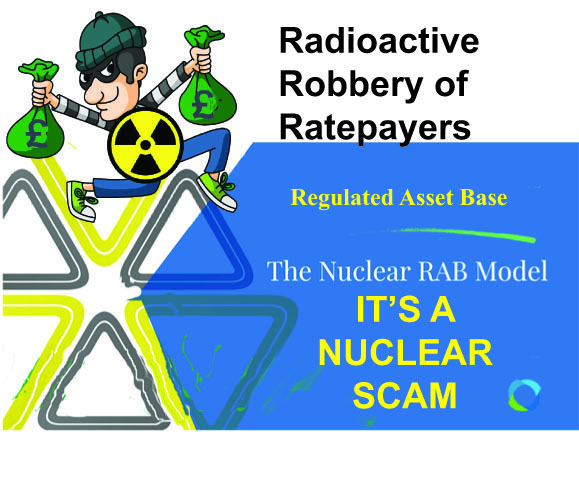
In contrast, Hinkley Point C will operate on the old contracts for difference model where the developers enjoy a guaranteed strike price once the reactors are operational. The original £89.50 per megawatt hour strike price has already been adjusted up to £125 in view of inflation. This means that British consumers of nuclear energy will be paying amongst the highest prices for electricity in the world.
The construction of Hinkley Point C was contracted by the UK government to EDF and China General Nuclear (CGN). Both Hinkley Point C and Sizewell C will have the capacity to power about six million households and will have an economic life of up to 60 years. The two plants could be producing 14 percent of Britain’s total electricity output in the late 2030s.
Ms Coutinho rushed out a press release on the evening of 23 January, saying: “Hinkley Point C is not a government project and so any additional costs or schedule overruns are the responsibility of EDF and its partners and will no way fall on [British] taxpayers”. This comment annoyed EDF and its main shareholder, the French government, to prompt a further statement. The substance of that was that unless the UK government offered something towards the shortfall at Hinkley Point, Sizewell C would simply not happen.
Eventually, the UK Department for Energy Security and Net Zero pledged an additional £1.8 billion of taxpayers’ money. The Minister for Nuclear and Renewables, Andrew Bowie MP, later admitted that he needed to raise an additional £20 billion of private finance to ensure that Hinkley Point C is completed…………………………………………………………………………………………………………………………………………
there has been no coherent political consensus around the need for nuclear power in the UK. The 2003 energy white paper published under Tony Blair’s government described nuclear power as an “unattractive option” – although Labour later changed its mind. There is still vocal opposition to nuclear power generation on safety grounds – and even more to the disposal of nuclear waste. The Low Level Waste Repository (LLWR) in Cumbria, operated by British Nuclear Fuels has been especially contentious. Many environmental and political activists associate nuclear energy production with nuclear weapons production. Moreover, there have been nine different energy secretaries sitting in cabinet since 2010. With such a level of turnover of people at the top, it has proven difficult to fashion policy.
At least the optimists foresee that Sizewell C will benefit from the lessons learnt at Hinkley Point C. Though, somehow, I doubt it……………………………. https://masterinvestor.co.uk/economics/energy-costs-the-price-of-power/—
Rethinking Ukraine: Putin and the Mystery of National Identity
It has always been the case that the sooner Ukraine and the West settle, the better deal they will get, and that is more true every day. But prolonging the war is an end in itself to those who make money from it.
Put simply, Russia will outlast its opponents.
the formation and dissolution of national identities……………………………………. I should be interested to know where Ukrainian nationalists claim their cultural heritage lies as proof of early national identity.
There is a historical and a current strain of Nazism in Ukrainian nationalism, and it is far too tolerated by the Ukrainian state; that is certainly true. But to claim all Ukrainian nationalists are Nazis is a nonsense.
Rethinking Ukraine: Putin and the Mystery of National Identity
Craig Murray February 19, 2024
The genocide in Gaza – or more precisely the major NATO powers’ active and practical support for the genocide in Gaza – has forced me to re-evaluate my views on Ukraine in a manner more sympathetic to the Russian narrative.
The formation of national identity is a very curious thing Ivory Coast has just won the African Cup of Nations at soccer, beating Nigeria in the final. The competition arouses huge patriotic fervour throughout the continent of Africa. But the boundaries of all the African nations, except arguably Ethiopia, are entirely artificial colonial constructs. They cut right across ethnic, cultural and linguistic boundaries…………………………………………………………………………………………………………………………..
I am aware I need to read more on the creation of national identity, because most of my thought is based on simple observation. It is however entirely plain that national identity can appear, and can be genuine, and can do so in a period of merely decades. There is now a Ukrainian national identity, and those who subscribe to it have the right to their state.
That they have a right to the former boundaries of Soviet Ukraine is a different proposition. Given the reality that it is plain a significant minority of the population do not subscribe to Ukrainian national identity, that civil war broke out, and that this relates to historic geographic fracture lines, it seems that division of territory is now not only inevitable but desirable.
All people of good will should therefore wish to see an end to fighting and a peace settlement, of which the territorial elements are somewhere close to the current lines between the forces, with Russia giving back some territory in return for recognition of its gains. The alternative is more death, human misery and economic malaise.
In particular, I was complacent in my dismissive attitude to the argument that the Western powers would back ethnic cleansing and massacre in the Donbass, by forces including some motivated by Nazi ideology. The same powers who are funding and arming Ukraine are funding and arming a genocide by racial supremacist Israeli forces in Gaza. It is beyond argument that my belief in some kind of inherent decency in the Western political Establishment was naive.
I apologise.
This does not mean that I was wrong to call the Russian invasion of the Ukrainian state illegal. I am afraid it was. You see, the law is the law. It has only a tenuous connection to either morality or justice. A thing can be justified and morally right, but still illegal.
The proof of this is that we have an entire legal structure governing transactions which is designed to achieve massive concentration of wealth. In consequence, the world is predicted to have its first trillionaires inside the next five years, while millions of children go hungry.
That is plainly immoral. It is plainly unjust. But it is not only legal, it is the purpose of the system of law.
I am, however, content that the “Right to Protect” doctrine has not become accepted in international law, because it is in general application neo-imperialist.
It was developed by the Blair government initially to justify NATO bombing of Serbia and the British re-occupation of Sierra Leone, and was used by Hillary Clinton to justify the destruction of Libya on the basis of lies about an imminent massacre in Benghazi. We should be wary of the doctrine.
(That is the major theme of my book The Catholic Orangemen of Togo).
The causes of the Russian invasion of Ukraine are plain. Alarm at NATO expansionism and forward positioning of aggressive military assets encircling Russia. The Ukrainian coup of 2014. Exasperation at Ukrainian bad faith and the ignoring of the Minsk accords. The continuing death toll from shelling of Russian speakers in the Donbass.
The suppression of the Russian language, of Russian Orthodox religion and of the main pro-Russian opposition political party in Ukraine are simple facts. These I have always acknowledged: until I saw the positive enthusiasm of leaders of the Western states for massacre in Gaza, I was not convinced they could not have been addressed by diplomacy and negotiation. I now have to reassess that view in the light of new information, and I now think Putin was justified in the invasion.
It is not that any of the arguments are new. It is simply that before I did not believe that the West would sponsor mass ethnic cleansing and genocidal attack on the Donbass by extreme Ukrainian nationalist-led, Western-armed forces. I thought the “West” was more civilised than that. I now have to face the fact that I was wrong about the character of the NATO powers.
The alternative to Putin’s action probably was indeed massacre and ethnic cleansing.
The urgent need now is for negotiation to put an end to the war. On that my position has not changed. The war is a disaster for the people of Europe. The American destruction of Nord Stream has devastated the German economy and resulted in huge energy price increases for consumers all across Europe, including the UK. There was a step jump in food inflation which has not been pulled back.
The continuation of the war will of course prime the pump of the military-industrial complex. Massive defence spending is the most efficient way to ensure kickbacks to the political class who control the flow of state funds, through both legal and illegal forms of corrupt reward to politicians.
As Julian Assange said, the object is not to win wars: the object is forever wars, to keep the funds flowing.
The truth is that the longer the war persists, the less generous Russia will be over returning occupied territory to Ukraine. The deal which was torpedoed by the West nearly two years ago (and in truth the US played more of a role than Boris Johnson – I was actually there in Turkey) ceded only the Crimea to Russia, with a Minsk plus deal for the Donbass which would have remained Ukrainian. That is unthinkable now. The major question is how large a coastal corridor Russia will insist on keeping westward from Crimea, and whether Putin can be persuaded to accept less than the historical dividing line of the Dnieper.
I do not share the Russian triumphalism at the dwindling manpower resources of the Ukraine. With the obscene billions the West is pumping into remote warfare in Ukraine, that is not the factor you might expect. But the political will of the West to continue to pump in these billions is plainly sapping, as it becomes obvious there will be no successful Ukrainian offensive. Put simply, Russia will outlast its opponents.
It has always been the case that the sooner Ukraine and the West settle, the better deal they will get, and that is more true every day. But prolonging the war is an end in itself to those who make money from it.
Putin’s historical disquisition to Tucker Carlson opened some Western eyes to another national perspective, and gave rise to widespread claims by Western media that Putin was factually wrong. In fact almost all of his facts were correct. The interpretation of them, and the position of other facts which were omitted or given less weight, is of course the art of history.
There is no question I find more fascinating in history than the formation and dissolution of national identities.
My own perspective on this – and there is no subject on which it is more important to understand the vantage point of the person writing – is governed by two factors in particular. Firstly, I am a Scot and come from one of Europe’s oldest nation states, which then lost its independence and struggles to regain it after being submerged in a new “British” national identity.
Secondly, as a former diplomat I lived and worked in the political field in a number of countries with differing histories of national identity.
These include Poland, a nation state which the historian Norman Davies brilliantly quipped “Has emerged from time to time through the mists of history – but never in the same place twice”.
It includes Ghana, a state with an extremely strong sense of national identity but which was an entirely artificial colonial creation.
It includes Nigeria, another entirely artificial colonial creation but which has struggled enormously to build national identity against deep and often violent ethnic and cultural differences.
It includes Uzbekistan, a country which also has entirely artificial colonial borders but which the western “left” fail to recognise as an ex-colony because they refuse to acknowledge the Soviet Union was a continuation of the Russian Empire.
These include Poland, a nation state which the historian Norman Davies brilliantly quipped “Has emerged from time to time through the mists of history – but never in the same place twice”.
It includes Ghana, a state with an extremely strong sense of national identity but which was an entirely artificial colonial creation.
It includes Nigeria, another entirely artificial colonial creation but which has struggled enormously to build national identity against deep and often violent ethnic and cultural differences.
It includes Uzbekistan, a country which also has entirely artificial colonial borders but which the western “left” fail to recognise as an ex-colony because they refuse to acknowledge the Soviet Union was a continuation of the Russian Empire.
So I have seen all this, as someone with a training and interest as a historian, who has read a great deal of Eastern European history. I have also lived in Russia and was for a time both a fluent Russian and Polish speaker. I do not write this to claim I am right, but so that you know what has formed my view.
Putin argued at great length that there never was such a country as “Ukraine”. The BBC has run a “fact check” and claimed this is “Nonsense”.
There are several points to make about this. The first is that the BBC did not, as it claimed, go to “independent historians”. It went to Polish, Ukrainian and Armenian historians with their own very distinct agenda.
The second is that these historians did not actually take issue with Putin’s facts. For a fact-check it does not really examine any of Putin’s historical facts at all. What the historians did was put forward other facts they felt deserve more weight, or different interpretations of the facts referenced by Putin. But none argued convincingly for the former existence of a Ukrainian national state or even the long term existence of Ukrainian national identity.
In fact their arguments were largely consistent with Putin. The BBC quote Prof Ronald Suny:
Mr Suny points out that the inhabitants of these lands when they were conquered by Russia were neither Russian nor Ukrainian, but Ottoman, Tatar or Cossacks – Slavic peasants who had fled to the frontiers.
Which is absolutely true: 18th century Russia did not conquer a territory called “Ukraine”. Much of the land of Ukraine was under Muslim rule when conquered by Catherine the Great, and nobody called themselves “Ukrainian”.
The BBC then gives this quote:
But Anita Prazmowska, a professor emerita at the LSE, says that although a national consciousness emerged later among Ukrainians than other central European nations, there were Ukrainians during that period.
“[Vladimir Putin] is using a 20th Century concept of the state based on the protection of a defined nation, as something that goes back. It doesn’t.”
Which is hardly accusing Putin of speaking “nonsense” either. Prazmowska admits the development of Ukrainian national consciousness came “later than other Central European states”, which is very definitely true. Prazmowska herself has a very Central European take – the idea of the nation state in England, Scotland and France, for example, developed well ahead of the period of which she was speaking.
I should address the weakness in Putin’s narrative, around the origins of World War 2. Russian nationalists have great difficulty in accommodating the Stalin/Hitler pact into the narrative of the Great Patriotic War, and while Putin did briefly reference it, his attempt to blame World War 2 essentially on Poland was a low point. But even here, there was a historical truth that the standard Western narrative ignores.
The Rydz-Smigly–led military dictatorship in Poland after the death of Pilsudski was not a pleasant regime. Putin was actually correct about Munich: both the UK and France had asked Poland to allow the Soviet army to march through to bolster Czechoslovakia against Germany, and Poland refused (Ridz-Smigly did not trust Stalin, and frankly I don’t blame him). But this is an example of part of Putin’s narrative that countered the received Western tradition, that most well-informed people in the West have no idea happened, and is perfectly true.
The fusing back then of Ukrainian nationalism with Nazism, and the atrocities of Ukrainian nationalists in WW2 against not just Jews but also Poles and other minorities, were also perfectly true.
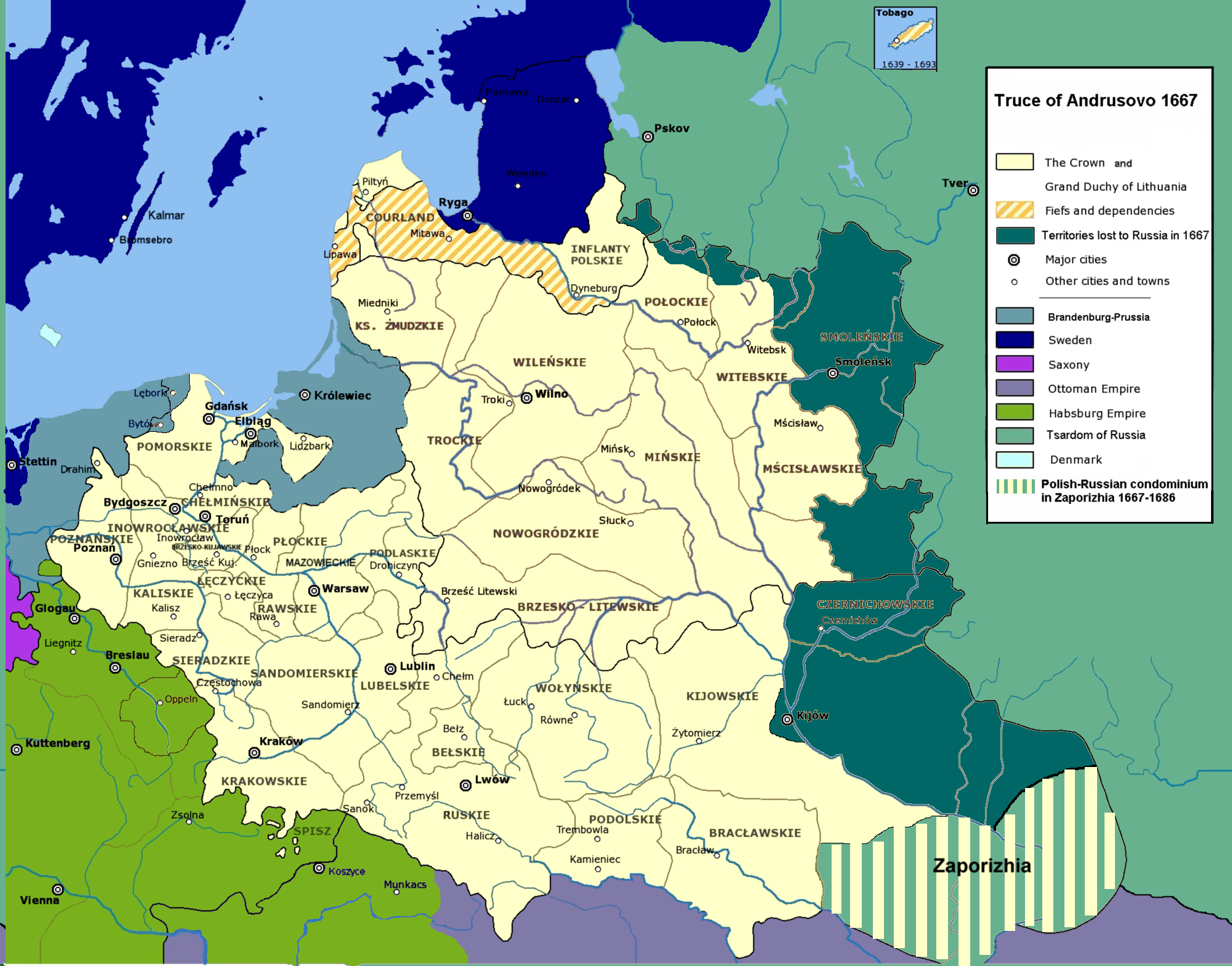
It is a simple and stark truth there never was a Ukrainian state before 1991. There just was not. Lands currently comprising Ukraine were at various times under the rule of Muslim Khans, of the Ottomans, of Cossack Hetmans (possibly the closest thing to proto-Ukrainians), the Polish-Lithuanian confederation and Russian Tsars.
As I have stated on this blog before, the boundary between Polish/Lithuanian and Russian influence became settled on the Dnieper. I have also published this map before, showing that history resonates through the current conflict. [map at top of page]
There is also the case of third-party recognition of the Ukrainian nationality. I have read, for example, the letters and memoirs, both published and unpublished, of scores of British soldiers and civil servants involved in the Imperial rivalry with Russia in Asia. Many had contact with Russian officers or diplomats. They did clearly recognise different ethnic identities within the Russian Empire. The Russian diplomat Jan Witkiewicz was described repeatedly by British officers as “Polish”, for example. “Cossack” and “Tartar” were frequently used. I cannot recall any of these British sources ever using the description “Ukrainian”.
Nor did British officers who actually passed through Ukraine, like Fred Burnaby and Arthur Connolly, describe it as such in their memoirs. Now I am not claiming that if British imperialists did not notice something, it did not exist. But if there were a centuries-old recognition by the rival Empire of the existence of a Ukrainian national identity, that would definitely mean something. There does not appear to be such.
I should be interested to know where Ukrainian nationalists claim their cultural heritage lies as proof of early national identity. What is the Ukrainian equivalent of Shakespeare’s John of Gaunt speech, of Scotland’s Blind Harry, or even of Poland’s Pan Tadeusz? (This is a genuine question. There may be areas of Ukrainian historic identity of which I am unaware).
Putin was not wrong about history (apart from the dodgy bit about origins of the second world war). But the correct question is whether any of this matters.
It is not whether Putin’s historical analysis is broadly correct, it is whether this matters. I am inclined to the view that Putin is correct that there is little evidence that the people living in Ukraine, hundreds of years ago, ever considered themselves a distinct national entity.
But they are all dead, so they don’t get a vote. The only thing that matters is the opinion of those living there now.
It seems to me beyond dispute that there is now a Ukrainian national identity. I know several Ukrainians who consider themselves joyously and patriotically Ukrainian, just as I know patriotic Ghanaians and even patriotic Uzbeks. The question of how this identity was forged and how recently is not the point.
I should add there are undoubtedly a great many Ukrainians whose sense of national identity is not linked to Nazism. There is a historical and a current strain of Nazism in Ukrainian nationalism, and it is far too tolerated by the Ukrainian state; that is certainly true. But to claim all Ukrainian nationalists are Nazis is a nonsense…………………………………………………………………………………………………
I am aware I need to read more on the creation of national identity, because most of my thought is based on simple observation. It is however entirely plain that national identity can appear, and can be genuine, and can do so in a period of merely decades. There is now a Ukrainian national identity, and those who subscribe to it have the right to their state.
That they have a right to the former boundaries of Soviet Ukraine is a different proposition. Given the reality that it is plain a significant minority of the population do not subscribe to Ukrainian national identity, that civil war broke out, and that this relates to historic geographic fracture lines, it seems that division of territory is now not only inevitable but desirable.
All people of good will should therefore wish to see an end to fighting and a peace settlement, of which the territorial elements are somewhere close to the current lines between the forces, with Russia giving back some territory in return for recognition of its gains. The alternative is more death, human misery and economic malaise.
https://www.craigmurray.org.uk/archives/2024/02/putin-history-and-the-mystery-of-national-identity/
Ten years after Maidan: Why won’t the West admit that the coup was based on a lie?
Felix Livshitz, RT, Sat, 24 Feb 2024, https://www.sott.net/article/489209-Ten-years-after-Maidan-Why-wont-the-West-admit-that-the-coup-was-based-on-a-lie
—
This feature was first published on February 6, 2023. On the occasion of the 10th anniversary of the events that took place in Kiev on February 22, 2014, we are again posting it on the front page.
Political scientist Ivan Katchanovski – of the University of Ottawa – revealed last year, in a paper, that the February 2014 massacre of Ukrainian protesters by sniper fire, a defining moment of the Western-backed Maidan coup, was not published by an academic journal for “political reasons.”
Evidence that external forces were involved has been suppressed for ‘political reasons’
‘The evidence is solid’
In a lengthy Twitter thread, Katchanovski first laid out the circumstances behind the rejection of his article, and the bombshell evidence included in it. The paper was initially accepted with minor revisions after peer review, and the journal’s editor offered a glowing appraisal of his work, writing:
“There is no doubt that this paper is exceptional in many ways. It offers evidence against the mainstream narrative of the regime change in Ukraine in 2014… It seems to me that the evidence the study produces in favour of its interpretation on who was behind the massacre of the protesters and the police during the ‘Euromaidan’ mass protests on February 18-20, 2014, in Ukraine, is solid. On this there is also consensus among the two reviewers.”
As the editor noted, the massacre was a “politically crucial development,” which led to the “transition of powers in the country” from the freely elected Viktor Yanukovich to the illegitimate and rabidly nationalistic administration of Aleksandr Turchinov, a former security services chief. It was endlessly cited in Western media as a symbol of the brutality of Ukraine’s government and an unprovoked attack on innocent pro-WesternMaidan protesters, who allegedly sought nothing more than democracy and freedom.
Rumors that the killings were a false flag intended to inflame tensions among the vast crowds filling Maidan, and provoke violence against the authorities, began circulating immediately.
No serious investigation into what happened was ever conducted by the Western media, with all claims that the sniper attacks were an inside job dismissed as Kremlin “disinformation.” However, even NATO’s Atlantic Council adjunct admitted in 2020 that the massacre was unsolved and that this “cast a shadow over Ukraine.”
Ask the witnesses
It may not remain unsolved for much longer though, due to an ongoing trial of policemen at the scene on the fateful day. The legal action has been unfolding for well over a year and has received no mainstream news attention at all outside Ukraine. Katchanovski drew heavily on witness testimony and video evidence that has emerged over the course of the trial in his suppressed paper.
For example, 51 protesters wounded during the incident testified at the trial that they were shot by snipers from Maidan-controlled buildings, and/or witnessed snipers there. Many spoke of snipers in buildings controlled by Maidan protesters shooting at police. This is consistent with other evidence collected by Katchanovski, such as 14 separate videos of snipers in protester-controlled buildings, 10 of which clearly feature far-right gunmen in the Hotel Ukraina aiming at crowds below.
In all, 300 witnesses have told much the same story. Synchronized videos show that the specific time and direction of shots fired by the police not only didn’t coincide with the killings of specific Maidan protesters, but that authorities aimed at walls, trees, lampposts, and even the ground, simply to disperse crowds.
Among those targeted by apparently Maidan-aligned snipers were journalists at Germany’s ARD. They weren’t the only Western news station in town at the time – so too were Belgian reporters, who not only filmed Maidan protesters screaming towards Hotel Ukraina for snipers not to shoot them, but also participants being actively lured to the killing zone. This incendiary footage was never broadcast.
CNN likewise filmed far-right elements firing at police from behind Maidan barricades, then hunting for positions to shoot from the 11th floor of the Hotel Ukraina, minutes before the BBC filmed snipers shooting protesters from a room where a far-right MP was staying. The network opted not to report this at the time.
We needn’t rely purely on video footage. Over the course of the trial, no fewer than 14 self-confessed members of Maidan sniper groups testified they had explicitly received massacre orders, Katchanovski claims. By contrast, no police officer at the scene has said they were directed to kill unarmed protesters, no minister has come forward to blow the whistle on such a scheme, and no evidence Yanukovich approved of the killings has ever emerged.
Separate from the trial, leaders of the far-right Svoboda party have openly stated that Western government representatives expressly told them before the massacre that they would start calling for Yanukovich’s ouster once casualties among protesters reached a certain number. This figure was even actively discussed by both sides – were five enough, or 20? Or even 100? The latter was the final total reported, and indeed led to calls for the Ukrainian government’s abdication.
***
Katchanovski previously published a landmark study on the Maidan massacre in 2021, which has been referenced over 100 times by scholars and experts, already making him one of most cited political scientists specializing in Ukraine, according to Google Scholar.
Whatever the nature and source of the political pressure applied to the journal that led to the censoring of the dynamite paper, the move may well backfire massively, in the spirit of the Streisand Effect. Indeed, it could help the truth of what happened on those deadly days come out, and assist in those responsible for the killings being brought to justice.
It should also prompt a wider reconsideration of the nature of Maidan too, and the government it produced. The banning of opposition parties, attacks on the Orthodox Church, the closure of dissident media outlets, and the war on Russian culture and language are all consequences.
Comment: It is interesting that the West keeps claiming that Ukraine is fighting for European values for as the last paragraph shows, those values contain nothing democratic, just or fair in them. The West might be right though as European values in reality are getting closer and closer to those demonstrated in Ukraine, namely fascism and totalitarianism.
See also:
Donald Trump and nuclear weapons are a scary mix.
A failing British nuclear arsenal reliant on the goodwill of Donald Trump? It’s a terrifying thought
Simon Tisdall. Guardian, 24 Feb 24
Believing US-supervised nuclear weapons make Britain safer is not only delusional and unsustainable, it’s dangerous.
Donald Trump and nuclear weapons are a scary mix. As president, he greatly expanded the US nuclear arsenal, scrapped arms control treaties and repeatedly threatened to start a nuclear war. On leaving office, he stole nuclear secrets from the White House and leaked their contents. A judge recently questioned his mental health.
For close ally Britain, the scariest thought is that Trump, if re-elected in November, could fatally undermine the UK’s “independent” nuclear deterrent, or worse, pressure London into actually using it. If Trump blundered into a nuclear showdown with, say, China, Russia or North Korea, Britain would be expected to back him – and could become a target.
None of these scenarios may be ruled out, despite UK insistence that it retains sole operational control of its four Vanguard-class nuclear missile submarines. In truth, such outcomes grow more plausible as the international security situation deteriorates, Trump threatens to abandon Nato and Europe, and nuclear arms proliferate globally. Successive UK governments are primarily to blame for Britain’s deepening nuclear nightmare. All have colluded in the pretence that the UK deterrent, known generically as Trident, is independent. In fact, the Vanguard submarines rely on American technology, logistics and maintenance, as will their Dreadnought-class successors. The new W93 replacement warhead borrows from US designs.
Even the US-made Trident II D5 ballistic missiles that carry the warheads are not owned but leased under the terms of the 1958 US-UK mutual defence agreement (MDA) and 1963 Polaris sales agreement. “UK nuclear weapons are only as independent as the US wants them to be,” a new study by the anti-nuclear Pugwash scientists’ network says. “The MDA [locks] the UK into dependence on the US for the procurement of nuclear weapons,” Pugwash states. “In practice, the UK’s technical dependence on the US would constrain any attack to which Washington objected. For example, the UK is reliant on American software for all aspects of nuclear targeting.”
This chronic dependency would give a re-elected Trump huge leverage, should he choose to use it, in the not improbable event of a security or foreign policy clash with a Labour government, for example, over Ukraine. Britain’s deterrent has always ultimately relied on US goodwill, an all-party commission on Trident noted in 2014……………………………………………………………………………
Britain’s habitual willingness to follow America to war, seen again recently in the Red Sea and notoriously in Iraq in 2003, could be its undoing – unless policy changes. “The UK is more likely to use nuclear weapons in a bilateral UK-US operation than either as part of a Nato strike or independently,” Pugwash says. The House of Commons defence select committee concluded in 2006 that “the only way that Britain is ever likely to use Trident is to give legitimacy to a US nuclear attack by participating in it…. In a crisis the very existence of the UK Trident system might make it difficult for a UK prime minister to refuse a request by the US president to participate.”
Trump aside, Britain’s deterrent faces multiple problems. One estimate puts the overall cost of renewing and maintaining Trident from 2019 to 2070 at £172bn. The system already faces delays and cost overruns. The first Dreadnought submarine is not expected to enter service until the early 2030s.
Meanwhile, the four Vanguard subs and their crews are undertaking record-length patrols, continuously at sea for five months or more. This reportedly compounds maintenance and morale problems. The entire fleet is now older than its originally planned service life of 25 years, according to the independent Nuclear Information Service. And the deterrent’s reliability is in question after a second, consecutive missile test failure last month. Official secrecy hinders public and parliamentary scrutiny of ministerial claims that all is working well…………………………………………………………………………………………
An incoming Labour government must not wait until disaster strikes. It should reallocate Trident’s billions to more socially useful projects. The belief that US-supervised and controlled nuclear weapons somehow make Britain safer and boost its global influence is delusional, unsustainable, unaffordable – and, in the age of Trump, downright dangerous. https://www.theguardian.com/commentisfree/2024/feb/24/failing-british-nuclear-arsenal-reliant-on-the-goodwill-of-donald-rump-is-terrifying-thought
1 This Month

4 May -West Suburban Peace Coalition to discuss Iran war at May Educational Forum
Monday, May 4, 7:00 – 8:00 PM Central Standard Time
Title: : How Trump’s Narrative Tries to Shape the Reality of the War on Iran.
Contact Walt Zlotow, zlotow@hotmail.com 630 442 3045 for further information
14 May – online event From Bombs to Data Centres: the Face of Nuclear Colonialism
To see nuclear-related stories in greater depth and intensity – go to https://nuclearinformation.wordpress.com
-
Archives
- May 2026 (49)
- April 2026 (356)
- March 2026 (251)
- February 2026 (268)
- January 2026 (308)
- December 2025 (358)
- November 2025 (359)
- October 2025 (376)
- September 2025 (257)
- August 2025 (319)
- July 2025 (230)
- June 2025 (348)
-
Categories
- 1
- 1 NUCLEAR ISSUES
- business and costs
- climate change
- culture and arts
- ENERGY
- environment
- health
- history
- indigenous issues
- Legal
- marketing of nuclear
- media
- opposition to nuclear
- PERSONAL STORIES
- politics
- politics international
- Religion and ethics
- safety
- secrets,lies and civil liberties
- spinbuster
- technology
- Uranium
- wastes
- weapons and war
- Women
- 2 WORLD
- ACTION
- AFRICA
- Atrocities
- AUSTRALIA
- Christina's notes
- Christina's themes
- culture and arts
- Events
- Fuk 2022
- Fuk 2023
- Fukushima 2017
- Fukushima 2018
- fukushima 2019
- Fukushima 2020
- Fukushima 2021
- general
- global warming
- Humour (God we need it)
- Nuclear
- RARE EARTHS
- Reference
- resources – print
- Resources -audiovicual
- Weekly Newsletter
- World
- World Nuclear
- YouTube
-
RSS
Entries RSS
Comments RSS
 nuclear-news