Polish industry minister announces massive delay in nuclear power plant project

The anticipated opening of Poland’s first nuclear power plant may be postponed by up to seven years, with the new operation date set for 2039-2040, significantly later than previously planned.
BYGRZEGORZ ADAMCZYK 9 May 24 https://rmx.news/article/polish-industry-minister-announces-massive-delay-in-nuclear-power-plant-project/
Polish Industry Minister Marzena Czarnecka stated that the country’s first nuclear power facility is now expected to become operational in 2040, a seven-year delay from initial estimates.
The adjustment comes as a shock following Deputy Minister of Climate and Environment Miłosz Motyka’s earlier suggestion that only a one-year delay was likely in the nuclear plant’s preparation process. However, it has now become evident that the setbacks will be much more severe.
Minister Czarnecka, in an interview with Polish Radio on Tuesday, announced that the first nuclear unit in Poland would commence operations in 2039-2040, criticizing the previous government’s 2033 target as unrealistic. She highlighted what she said was her pragmatic approach, acknowledging that “all investments are subject to certain delays” and marked 2039 as a “breakthrough year” for the Choczewo nuclear plant.
The postponement in the completion of the next major investment after the Central Communication Port (CPK) transport hub has left energy specialists frozen in place. Immediately, voices began to arise that if Poland does not manage to complete the power plant by 2035, an energy disaster awaits the country.
As news of delays in implementing nuclear power in Poland began to heat up in the media and on the web, the minister decided to speak again and clarify what she had said the day before. In response to a publication on Energetyka24.pl, she noted that by mentioning 2039, she was referring to the complete end of construction of the first nuclear power plant. Minister Czarnecka also provided a planned work schedule, which assumes that physical construction will begin in 2028, and the first energy block will be put into operation by 2035. By 2039, the next two blocks are to be connected to the grid.
Recent weeks have also seen rumors of a potential change in location for Poland’s inaugural nuclear facility, which, according to Łukasz Młynarkiewicz, vice-president of Polish Nuclear Power Plants, would not invalidate previous decisions or halt preparatory work at the current site.
However, a relocation could mean additional years of delay. Experts already consider the Polish nuclear energy project to be about two years behind schedule, with every month of delay further widening the gap.
Media reports have also surfaced about requests for re-evaluation of the environmental decision concerning Poland’s first nuclear plant. These requests, submitted to the General Directorate for Environmental Protection (GDOŚ), have come from several environmental organizations and individuals, whose identities remain protected for privacy reasons.
Moscow threatens to strike British military facilities following Cameron’s remarks
U.K. foreign secretary’s words confirm London’s growing involvement in military operations on the side of Kyiv, according to the Kremlin.
Politico, BY PIERRE EMMANUEL NGENDAKUMANA, 6 May 24
Russia said on Monday it could strike British military installations and equipment both “inside and beyond” Ukraine if British weapons are used by Kyiv to attack its territory.
“Any British military facilities and equipment on the territory of Ukraine and beyond could be a response to Ukrainian strikes with the use of British weapons on the territory of Russia,” the Russian ministry of foreign affairs said in a statement.
The Kremlin also summoned the British Ambassador to Moscow “to express a strong protest” in connection with recent comments by U.K. Foreign Secretary David Cameron……………………….
Cameron told Reuters last week that Ukraine has the “right” to use British-supplied weapons to strike Russia inside its own territory.
“Russian side views Cameron’s words as evidence of a serious escalation and confirmation of London’s growing involvement in military operations on the side of Kyiv,” according to the Russian foreign affairs ministry……………………
Earlier on Monday, Russia announced it has started preparing for nuclear weapons exercises, accusing Western officials of making “provocative statements and threats” by deepening their support for Ukraine. https://www.politico.eu/article/russia-threaten-strike-british-military-facility-david-camerons-remark-war-ukraine/
Nuclear lobby infiltrates West Lakes Academy and the Energy Coast University Technical College

West Cumbrian students challenged to design nuclear decommissioning robots
Business Crack, by Adam Lewis, May 9, 2024
West Cumbrian youngsters have been tasked by the Robotics and AI Collaboration (RAICo) and the Industrial Solutions Hub (iSH) to design and build robots which will be showcased at a major robotics and artificial intelligence industry event.
The students, aged between 16 and 18 from West Lakes Academy and the Energy Coast University Technical College are taking part in the challenge, with the aim of each school developing a small robot capable of transporting a mock nuclear waste barrel.
…………………..The RAICo-supported event is designed to showcase the region’s RAI capability and offers a chance for students to network with industry professionals, listen to keynote speeches and find out about career opportunities in the sector.
………..RAICo is a collaboration between the UK Atomic Energy Authority, the Nuclear Decommissioning Authority (NDA), Sellafield Ltd and the University of Manchester.
……..Sophie Finlinson, project manager at RAICo said: “This educational outreach initiative offers practical exposure to students interested in STEM subjects. It could represent a pivotal step in someone’s journey towards a successful career in our industry. ………………………….. https://businesscrack.co.uk/2024/05/09/west-cumbrian-students-challenged-to-design-nuclear-decommissioning-robots/
The UK makes licensing for nuclear fusion easier: developers can lead site selection

Fusion plants will not be subject to the same nuclear site licensing
process as fission reactors, with the UK government instead proposing
developer-led site selection and their designation as nationally
significant infrastructure projects.
World Nuclear News 9th May 2024
https://www.world-nuclear-news.org/Articles/UK-consults-on-new-planning-process-for-fusion-rea
NATO escalation in Ukraine threatens nuclear war with Russia
Now, however, Macron says NATO aims not to seek a negotiated peace, but to force the Russian military to assume that NATO may adopt the most aggressive possible policy. This includes possibly launching not only a large-scale land invasion of Russia, but also—since France, Britain and the United States all refuse to rule out initiating the use of nuclear weapons in a war—a pre-emptive nuclear strike on Russian forces in Ukraine or on Russian cities.
It is high time for Biden and his NATO colleagues to tell the people that their pursuit of “victory in Ukraine” means risking nuclear war
Alex Lantier, 6 May 2024 https://www.wsws.org/en/articles/2024/05/07/qtgn-m07.html
There are growing indications that NATO’s war against Russia is entering a new stage of escalation that threatens to lead to the use of nuclear weapons. Top NATO officials are publicly talking about resorting to missile strikes and ground war against Russia, while Russian officials are warning they may launch counter-strikes on NATO countries.
Last week, 100 artillerymen and surveillance specialists of the French Foreign Legion were deployed to the front lines at Slavyansk in Ukraine, according to a report by former US Undersecretary for Defense Stephen Bryen in the Asia Times. Bryen said a further 1,500 French Foreign Legionnaires could soon deploy to Ukraine. He wrote that one consequence of this is “potentially triggering a pan-European war.”
While the French Foreign Ministry denied Bryen’s report, it is in line with President Emmanuel Macron’s previous calls for a ground war with Russia. Macron and other top NATO officials are now reasserting these comments in an aggressive press campaign. Last week, in The Economist, Macron again demanded that NATO be ready to send ground troops to Ukraine:
If the Russians were to break through the front lines, if there were a Ukrainian request—which is not the case today—we would legitimately have to ask ourselves this question.
This weekend, the Italian daily La Repubblica reported on further NATO war plans. It cited secret NATO agreements allegedly defining two “red lines,” Belarus’ entry into the war and a Russian “provocation” targeting Poland, Hungary or the Baltic States. If either of these “red lines” were crossed, NATO would mobilize 100,000 troops across Eastern Europe, from the Baltic states to Romania.
Also, last Thursday, UK Foreign Minister David Cameron went to Kiev, where he said Ukraine has the “absolute right” to use British long-range missiles to bomb Russia.
This weekend, Macron told the French financial newspaper La Tribune that NATO must create total uncertainty about its actions in Russia’s military command:
President Putin has constantly brandished the nuclear threat. Faced with such an adversary, it is such an act of weakness to give a priori limits on one’s own actions! We must on the contrary deny him any idea of what we might do. This is how we can deter him from taking action.
Macron’s statements illustrate the mood of utter recklessness prevailing in ruling circles. During the Cold War, US and Soviet officials installed an emergency hotline between the White House and the Kremlin, fearing that nuclear war could erupt accidentally if one side misread the intentions of the other and believed the opponent had launched a nuclear strike. On September 26, 1983, this nearly occurred, when Soviet early warning systems falsely indicated that US forces had launched nuclear missiles at the Soviet Union.
Now, however, Macron says NATO aims not to seek a negotiated peace, but to force the Russian military to assume that NATO may adopt the most aggressive possible policy. This includes possibly launching not only a large-scale land invasion of Russia, but also—since France, Britain and the United States all refuse to rule out initiating the use of nuclear weapons in a war—a pre-emptive nuclear strike on Russian forces in Ukraine or on Russian cities.
Whether or not French troops are already deployed in Ukraine, the Kremlin is clearly taking these reports seriously. The “strategic ambiguity” Macron said he wanted to build in NATO relations with Russia has been established. Increasingly convinced that NATO may catastrophically escalate the conflict, Russian officials are calling to prepare the most drastic measures in response, creating conditions for a disastrous escalatory spiral in the war.
Yesterday, the Kremlin announced that it would hold military exercises simulating the use of nuclear weapons. Kremlin spokesman Dmitri Peskov called the nuclear exercises a response to an “unprecedented stage in the escalation of tensions initiated by the French president and the British foreign secretary,” including “an intention to send armed contingents to Ukraine—that is, to actually put NATO soldiers in front of Russian troops.”
Extraordinary warnings emerged after the Russian foreign ministry summoned the British and French ambassadors yesterday to protest the statements of Cameron and Macron.
It warned UK Ambassador to Russia Nigel Casey that Cameron’s statements made Britain “a de facto party to the conflict” between Ukraine and Russia, the Guardian wrote. “Casey was told that in response to Ukrainian attacks on Russian territory with British weapons, any British military facilities and equipment on the territory of Ukraine and abroad could be targeted,” the Russian Foreign Ministry said.
Yesterday, on his Telegram channel, former Russian President Dmitri Medvedev bluntly stated that if NATO continues on its course, Russia could bomb Washington, Paris and London amid a “world catastrophe.” Medvedev wrote:
There is some kind of total degradation of the ruling class in the West. This class really does not want to logically connect elementary things. Sending your troops to the territory of Ukraine will entail the direct entry of their countries into the war, to which we will have to respond. And, alas, not only in the territory of Ukraine.
In this case, none of them will be able to hide either on Capitol Hill, or in the Elysée Palace, or in 10 Downing Street. A world catastrophe will come.
On May 4, introducing the International Committee of the Fourth International’s (ICFI) May Day online rally, David North warned of the danger that the NATO war against Russia in Ukraine could escalate into a nuclear world war. Citing US-UK pledges to arm NATO’s Ukrainian puppet regime with long-range missiles that can strike major Russian cities, North said:
But what if Putin, invoking the precedent set by President John F. Kennedy during the Cuban missile crisis in 1962, declares, paraphrasing Kennedy’s warning, that attacks on Russian territory by Ukraine with missiles supplied by NATO “will be regarded as an attack” by NATO upon Russia, “requiring a full retaliatory response” upon NATO countries?
It is high time for Biden and his NATO colleagues to tell the people that their pursuit of “victory in Ukraine” means risking nuclear war and describe in necessary detail what will happen to their countries and the world if the confrontation with Russia goes nuclear.
There was no trace of exaggeration in this warning, which has been confirmed in barely three days.
The strongest possible appeal must be made to workers and youth around the world: If the working class does not intervene against the capitalist governments to stop this escalation, one or another confrontation will ultimately escalate into nuclear war.
The greatest danger is that masses of workers and youth are not fully aware of the urgency of the risk of a catastrophic global war. They must be alerted and mobilized through an international movement of meetings, protests and strikes, aiming to build a mass, socialist anti-war movement in the international working class.
UK Taxpayers to fund fast-tracked nuclear fusion reactors
Planning exemptions and financial support proposed in bid to boost UK energy industry
Jonathan Leake, 8 May 2024
Pioneering nuclear fusion power plants are to be fast tracked through the planning process and supported with taxpayer money as Britain attempts to become a world leader in the technology……………. (Subscribers only) https://www.telegraph.co.uk/business/2024/05/08/nuclear-fusion-reactors-britain-fast-tracked-taxpayer/
France’s mini nuclear reactor plan – Nuward, gets another financial handout from the European Commission

The European Commission (EC) has approved, under European Union (EU) state
aid rules, a €300m ($320m) French measure to support Electricité de
France’s (EDF) subsidiary Nuward in researching and developing small
modular nuclear reactors (SMRs). The EC said the measure will contribute to
the achievement of the strategic objectives of the European industrial
strategy and the European Green Deal.

France notified to the Commission its
plan to grant €300m to Nuward to support its research and development
(R&D) project on SMR technology. The project aims to develop processes for
the design and construction of SMRs based on a simple and modular design
and with a power output equivalent to or less than 300 MWe. The front-end
design is the third phase of the overall Nuward project, which contains
five distinct phases.
In December 2022, the Commission already approved a
€50m French measure to support the second phase of the project, aimed at
acquiring new knowledge for the design and construction of SMRs. The aid
will take the form of a direct grant of up to €300m that will cover the
R&D project until early 2027. The measure will support Nuward in sizing the
modules and components of the SMRs and validating their integration in the
SMRs by means of numerical simulators and laboratory tests. Nuward will
also carry out industrialisation studies relating to the modular design and
mass production of SMRs. Finally, the measure will also support Nuward in
the preparation of the required safety demonstrations for the approval of
the project by the national nuclear safety authorities.
Nuclear Engineering International 1st May 2024
https://www.neimagazine.com/news/newseuropean-commission-approves-state-aid-for-nuward-smr-11725920
Hinkley Point C: New public inquiry planned over environmental impact
New saltmarshes could be created to mitigate the power station
Somerset Live, By Daniel Mumby, Local Democracy Reporter, 8 May 24
The environmental impact of Somerset’s new nuclear power station will be the subject of a new planning inquiry which could be held in the next 18 months. Around 11,000 people are currently working at the Hinkley Point C construction site near Stogursey, with this number expected to rise to 12,000 in the coming months.
EDF Energy secured planning consent for the power station back in 2013, with construction beginning three years later – a consent which include a number of measures to offset the environmental impact of the new facility. The company is seeking to make a number of changes to the agreed measures, which will require the approval of the Planning Inspectorate – resulting in a new public inquiry where residents can have their say.
The new inquiry was confirmed in a recent report by Councillor Ros Wyke, Somerset Council‘s portfolio holder for economic development, planning and assets. She said: “EDF Energy is proposing to make some material (and non-material) changes to the development consent order (DCO) for the Hinkley Point C project.
“As a DCO, any material changes will need to be authorised by the relevant secretary of state. EDF Energy expect to submit proposals to the secretary of state in the spring of 2025.
“This is likely to result in a public examination, which would begin by the autumn of 2025.” DCOs are detailed planning consents which are issued by central government for major infrastructure projects, such as the dualling of the A303 between Podimore and Sparkford.
EDF is proposing to make the following changes to the current DCO:
- Removing the need to install an acoustic fish deterrent in the Bristol Channel
- Providing ecological mitigation to counter the potential loss of fish stocks from this deterrent – taking the form of new saltmarshes near the River Parrett
- Changing the agreed interim spent fuel store from a wet store to a larger dry
store…………………………………………………………………………………………………..
Councillor Leigh Redman, who is standing for Labour in the new Bridgwater constituency, said that he had serious concerns about the saltmarshes proposal, including how effective it would be given the other environmental factors at play. Mr Redman (who represents the Bridgwater North and Central division on the council) said: “The Bristol Channel and Severn estuary are hugely important habitats for species including salmon and eel.
“According to the government’s Centre for Environment, Fisheries and Aquaculture Science, between 18 and 46 tonnes of fish could be lost a year if the acoustic fish deterrent plan is abandoned. Saltmarshes are vulnerable to erosion caused by factors, such as stormy conditions, wave action, and human activities, particularly in this area of the tidal River Parrett.
“This erosion can lead to habitat loss and a decrease in the protective function of the marsh against flooding and coastal erosion. I really do feel that we must listen to local people that know their area.
I feel that this particular element of the mitigation needs much more thought before any decision can be made, particularly in this area of the Parrett.” Councillor Claire Sully – who is standing for the Liberal Democrats in the same constituency – has been fighting against the new saltmarshes as part of the Save Pawlett Hams campaign.
The action group held a ‘Run the Hams’ event on Sunday (May 5) to raise awareness of the issues, following a ‘Rock the Hams’ concerns held at Pawlett Pavillion at the end of April. Ms Sully – who represents the Mendip South division on the council – claimed that the new nature reserve would cost up to £50m to deliver, arguing the acoustic fish deterrent was “essential” to preventing damage to the Severn estuary.
………..Pawlett Hams is well known in aquatic beetle circles and the EDF proposals would certainly lead to a serious diminishing of freshwater aquatic biodiversity for little seeming biodiversity gain, and a huge loss of fish from the Severn estuary.
“Other wildlife that could be lost include great crested newts, water voles in the ditches, and hares.” The Planning Inspectorate will confirm the precise dates of the public inquiry once EDF has formally submitted its plans to alter the DCO for the power station.
Hinkley Point C is currently expected to be operational by 2031, following EDF’s announcement in January 2023 that it would not meet its then-target date of 2027.
https://www.somersetlive.co.uk/news/somerset-news/hinkley-point-c-new-public-9268906
—
Sizewell C in Suffolk granted nuclear site licence

Campaigners ‘appalled’ as French energy company EDF gets go-ahead for next stage of project
Jillian Ambrose, 8 May 24, https://www.theguardian.com/business/article/2024/may/07/sizewell-c-suffolk-granted-nuclear-site-licence-edf
A planned nuclear power station at Sizewell in Suffolk has been granted the first site licence in more than a decade as investors and government officials race to finalise a deal for the multibillion-pound project this year.
The licence from the nuclear regulator is considered a milestone for EDF, which plans to build Sizewell C as a replica of its Hinkley Point C project in Somerset, which has been dogged by delays and cost overruns.
The Office for Nuclear Regulation (ONR) has granted only two site licences to build new nuclear plants in more than 35 years: the first for Hinkley Point C in 2012, and the second for Sizewell.
It was granted as EDF works to reach a final investment decision on the Sizewell C project by the end of this year, depending on a government framework to finance the project and fresh investment to cover its construction costs.
EDF holds just under 50% stake in the project, while the UK government holds just over 50%. They are searching for further investment after EDF’s partner at Hinkley Point, China’s CGN, was barred from the successor project over security concerns.
Mina Golshan, a director at Sizewell C, said the licence was a “show of confidence” from the UK’s nuclear regulator that the company had a suitable site and was ready to begin large-scale construction work on a safe design replicated from Hinkley Point C.
“It’s a huge milestone and demonstrates that this project is firmly on track,” Golshan said.
EDF has blamed inflation, Covid and Brexit for a four-year delay and cost overruns at the Hinkley Point C site. It believes that by learning the lessons from Hinkley it will be able to build Sizewell C in about nine years.
Mark Foy, the ONR chief nuclear inspector and its chief executive, said the licence was granted after “extensive engagement and review” by the ONR team and would allow the regulator to take greater regulatory oversight and challenge the company as it progressed its plans.
“The licensing process is fundamental in confirming that operators of a nuclear site are ready and able to meet their obligations under the nuclear site licence, to protect their workforce and the public,” Foy said.
A group campaigning against the nuclear plant, Stop Sizewell C, said it was “appalled that a nuclear site licence has been issued when matters critical to the future safety of the site remain unresolved.
“There isn’t even a final design of the sea defences, which will be necessary to keep this vulnerable site safe for the next century and a half, at the very least. This seems to us like kicking the can down the road, on the assumption that some future generation will be able to clear up the mess,” the group said.
12 years behind schedule, EDF’s Flamanville 3 nuclear plant gets regulatory approval for trial period
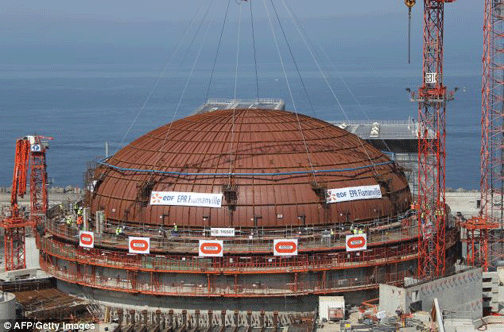
Electricite de France SA got regulatory approval to start up its new
nuclear reactor 12 years behind schedule after the utility faced
construction problems ranging from concrete weakness to faulty pipe welds.
The green light for commissioning of the Flamanville 3 nuclear plant
located in Northwestern France allows EDF to load the fuel in the reactor,
proceed with trials, then begin operations, the Autorite de Surete
Nucleaire said in a statement on Tuesday.
Further approvals will be
required when reaching key milestones during the trial phase, the regulator
added said. Once connected to the grid, the 1.6-gigawatt plant called a
European Pressurized Reactor will join EDF’s fleet of 56 reactors in
France, which accounted for about two-thirds of the country’s power
production last year.
Bloomberg 7th May 2024
How long does it take to build a nuclear reactor? We ask France

Sophie Vorrath, May 8, 2024, https://reneweconomy.com.au/how-long-does-it-take-to-build-a-nuclear-reactor-we-ask-france/

A short answer to this question might be, it depends who you ask. Ask Australia’s Opposition leader Peter Dutton, for instance, and he will tell you a federal Coalition government under his leadership could have a nuclear power plant up and running in Australia within a decade.
Ask the highly experienced French state-owned nuclear power giant EDF, which manages 56 reactors in the world’s most nuclear dependent country, and you would get rather a different answer.
Bloomberg reports that EDF this week got regulatory approval to start up its newest nuclear reactor, the 1.6GW Flamanville plant in France’s north west – a milestone that is 12 years behind schedule and more than four times over budget, thanks to a range of construction problems including concrete weakness and faulty pipe welds.
The green light allows EDF to load the fuel in the reactor, proceed with trials, then begin operations, the Autorite de Surete Nucleaire said in a statement on Tuesday. Further approvals will be needed upon reaching key milestones during the trial phase, the regulator said.
According to other reports, EDF said last month it hoped to connect the Flamanville pressurised reactor to the national grid by the European summer and reach full power by the end of the year.
But it will not be smooth sailing from there. A faulty vessel cover still needs replacing at the plant, with reports suggesting this has been pushed out to 2026, when the plant would be shut down for up to a year.
Meanwhile, EDF in March raised its cost estimate for the construction of six new nuclear reactors to €67.4 billion ($A102.5 billion), Reuters has reported, up from the company’s first estimated their cost of €51.7 billion.
So, how long does it take to build a nuclear reactor?
Kobad Bhavnagri, Bloomberg New Energy Finance’s energy expert and global head of strategy says the long delay and cost blowout at Flamanville 3 is not an isolated incident.
“Very similar delays and multifold cost blowouts have occurred with recent reactor builds in the UK, Finland and USA,” Bhavnagri writes on LinkedIn.
“Countries with well established nuclear industries.
“The lesson here? Don’t believe anyone who says they know how much it will cost and how long it will take to build a new nuclear plant (unless they are in China).”
The Great Ukraine Robbery Is Not Over Yet

“we are helping Ukraine while at the same time investing in our own industrial base.”- Joe Biden
the Biden Administration to sign a ten-year security agreement that would lock in US funding for Ukraine for the next two and a half US Administrations.
by Ron Paul , , https://original.antiwar.com/paul/2024/05/06/the-great-ukraine-robbery-is-not-over-yet/
The ink was barely dry on President Biden’s signature transferring another $61 billion to the black hole called Ukraine, when the mainstream media broke the news that this was not the parting shot in a failed US policy. The elites have no intention of shutting down this gravy train, which transports wealth from the middle and working class to the wealthy and connected class.
Reuters wrote right after the aid bill was passed that, “Ukraine’s $61 billion lifeline is not enough.” Senate Minority Leader Mitch McConnell went on the Sunday shows after the bill was passed to say that $61 billion is “not a whole lot of money for us…” Well, that’s easy for him to say – after all it’s always easier to spend someone else’s money!
Ukraine’s foreign minister, Dmytro Kuleba, was far from grateful for the $170 billion we have shipped thus far to his country. In an interview with Foreign Policy magazine as the aid package was passed, Kuleba had the nerve to criticize the US for not producing weapons fast enough. “If you cannot produce enough interceptors to help Ukraine win the war against the country that wants to destroy the world order, then how are you going to win in the war against perhaps an enemy who is stronger than Russia?”
How’s that for a “thank you”?
It may be understandable why the Ukrainians are frustrated. Most of this money is not going to help them fight Russia. US military aid to Ukraine has left our own stockpiles of weapons depleted, so the money is going to create new production lines to replace weapons already sent to Ukraine. It’s all about the US weapons industry. President Biden admitted as much when he said, “we are helping Ukraine while at the same time investing in our own industrial base.”
This is why Washington Is desperate to make sure that if Donald Trump returns to the White House, the “Ukraine” gravy train cannot be shut down by his – or future – administrations. Last week news broke that the Ukrainian government was in negotiations with the Biden Administration to sign a ten-year security agreement that would lock in US funding for Ukraine for the next two and a half US Administrations. That would unconstitutionally tie future presidents’ hands when it comes to foreign policy and would leave Americans on the hook for untold billions more dollars taken from them and sent to the weapons industry and to a corrupt foreign government.
The US weapons industry and its cheerleaders in Washington DC are determined to keep Ukraine money flowing…until they can figure out a way to gin up a war with China after losing the current war with Russia. That, of course, depends on whether there is anything left of us when the smoke clears.
When President Biden signed the $95 billion bill to keep wars going in Ukraine and Gaza and to provoke a future war with China, he called it “a good day for world peace.” Yes, and “War is peace.” Debt is good. Freedom is slavery. We are living in a post-truth society where billions spent on pointless wars are “not a whole lot of money.” But the piper will be paid and the debt will be cleared.
Kremlin says nuclear weapon drills are Russia’s response to West’s statements

MOSCOW, May 6 (Reuters) https://www.reuters.com/world/europe/kremlin-says-nuclear-weapon-drills-are-russias-response-wests-statements-2024-05-06/ –
Russia’s tactical nuclear weapon drills are a response to statements from the West about sending troops to Ukraine, the Kremlin said on Monday.
Kremlin spokesman Dmitry Peskov cited comments by the French President Emmanuel Macron on possibly sending soldiers to Ukraine, as well as statements from the British and US Senate representatives.
Military and other special services are verifying reports about deployment of France’s foreign legion in Ukraine, Peskov added.
Coming soon: Get the latest news and expert analysis about the state of the global economy with Reuters Econ World. Sign up here.
Reporting by Reuters Editing by Bernadette Baum
Pentagon sees no change in Russia’s strategic nuclear force posture
By Reuters, May 7, 2024
WASHINGTON, – The Pentagon has not seen a change to Russia’s disposition of its strategic nuclear forces, it said on Monday, despite what it called “irresponsible rhetoric” from Moscow detailing plans for exercises involving the deployment of tactical nuclear weapons.
Russia said on Monday it would hold military drills that will include practicing the deployment of tactical nuclear weapons after what Moscow said were threats from France, Britain and the United States. It said the exercises were ordered by Russian President Vladimir Putin.
Russia said on Monday it would hold military drills that will include practicing the deployment of tactical nuclear weapons after what Moscow said were threats from France, Britain and the United States. It said the exercises were ordered by Russian President Vladimir Putin
Missile forces in the Southern Military District, aviation and the navy will take part, the defense ministry said.
“We’ve not seen any change in their strategic force posture. Obviously, we’ll continue to monitor,” said U.S. Air Force Major General Patrick Ryder, a Pentagon spokesperson.
The exercise of what Russia calls its non-strategic nuclear forces were aimed at ensuring Russia’s territorial integrity and sovereignty, its defense ministry said.
Russia’s foreign ministry said the drills also aimed to cool down “hotheads” in the West, who Moscow accused of pushing for a direct military confrontation between the U.S.-led NATO military alliance and Russia…………………………. https://www.reuters.com/world/us/pentagon-sees-no-change-russias-strategic-nuclear-force-posture-2024-05-06/
The mad waste of public money by UK’s leading nuclear giants to pursue costs against a whistleblower at your expense

But perhaps this is the real reason for using public money in this way is to silence anybody else who might be thinking of exposing the dark secrets inside Sellafield. She is not the only whistleblower.
by davidhencke
One aspect of the second recent cost hearing against whistleblower and human resources consultant Alison McDermott by Sellafield and the Nuclear Decommissioning Authority which was not covered is the cost to the public and us the taxpayer.
During the hearing Deshpal Panesar, KC Sellafield’s lawyer from Old Square Chambers, rather pompously told the hearing that the fact Sellafield was claiming £20,000 off Alison was ” to protect the public purse”. He and the Nuclear Commissioning Authority which was also claiming £20,000 made a huge point that her “unreasonable behaviour” by pursing them at a tribunal meant she should pay a penalty.
What is now emerging from Freedom of Information requests is that the cost to bring this action far outweighs the money they will receive even if they are 100 per cent successful.
Both nuclear giants have already spent a huge sum – nearly £700,000 of taxpayer’s money – fighting Alison, whose consultancy was terminated, after her report revealed bullying and fear among staff at the nuclear site in Sellafield.
Now it is known from FOI that both organisations have spent £59,000 between them on preparing the case for the second hearing on top of money they had already spent for the first costs hearing. This doesn’t include the cost of hearing itself which is about another £20,000 considering Sellafield’s lawyers Deshpal Paneser. KC charges £5500 a day for the hearing and Emma Mills, from DLA Piper, who charges £3000 a day . The NDA employed another barrister, Rachel Levene and solicitors Pinsent Mason. Plus there were paralegals at the hearing.
Now one would think that after a High Court judge had ruled that the first costs decision was ” unsafe” and said his view should be taken into account by judge Stuart Robertson, who has heard the second hearing, there would be pause for thought. Both nuclear organisations are also lucky they will not face an appeal. So any sane organisation would decide to leave it there.
Instead we have the economic madness, which no commercial company conducting a risk assessment would follow, of throwing more money at bringing a second case when there is not the slightest chance of getting their money back. Indeed even if they were 100 per cent successful they stand to lose £40,000 and that is by no means certain they will get that. It is only that it is our money from the taxpayer they can throw it around like confetti.
So why are they doing it? The decision must have been endorsed by Euan Hutton, the new chief executive.
Despite previously serving as a Mental Health Champion alongside Ms. McDermott to foster a kinder and more supportive work environment, Mr. Hutton is now relentlessly pursuing costs against her.
In various YouTube videos, Mr. Hutton espouses the importance of treating people with kindness, yet his actions towards Ms. McDermott are anything but. He actually says that “kindness is putting in the time to think about how different people act differently, that’s what kindness is all about” [second video from 20 seconds onwards]. By hounding her for costs related to her whistleblowing for the second time, he has subjected her to immense stress and anguish, betraying the values he once claimed to champion.
See https://www.facebook.com/watch/?v=1938802916244720
Now Sellafield receives £6.7 million daily from taxpayers. Mr. Hutton’s decision to waste these funds on a vindictive legal battle against a whistleblower is an egregious misuse of public money. It is a slap in the face to taxpayers who trust Sellafield to use their contributions responsibly.
The Guardian has reported that the National Audit Office will investigate Sellafield’s substantial expenditure.
https://www.theguardian.com/business/2024/feb/15/spending-watchdog-launches-investigation-into-sellafieldI intend to make the National Audit Office aware of this blog post, as it highlights the unethical and hypocritical behaviour of Mr. Hutton. I think the public would strongly disapprove of their money being used to persecute a brave individual who spoke out against wrongdoing.
Mr. Hutton should be held accountable for his actions, which have caused harm to Ms. McDermott and undermined Sellafield’s commitment to employee wellbeing and to a culture of openness.
But perhaps this is the real reason for using public money in this way is to silence anybody else who might be thinking of exposing the dark secrets inside Sellafield. She is not the only whistleblower.
I approached Sellafield and the NDA about this waste of money but both said
“These issues are still subject to legal proceedings. We cannot comment further at this stage.”
1 This Month

4 May -West Suburban Peace Coalition to discuss Iran war at May Educational Forum
Monday, May 4, 7:00 – 8:00 PM Central Standard Time
Title: : How Trump’s Narrative Tries to Shape the Reality of the War on Iran.
Contact Walt Zlotow, zlotow@hotmail.com 630 442 3045 for further information
14 May – online event From Bombs to Data Centres: the Face of Nuclear Colonialism
To see nuclear-related stories in greater depth and intensity – go to https://nuclearinformation.wordpress.com
-
Archives
- May 2026 (37)
- April 2026 (356)
- March 2026 (251)
- February 2026 (268)
- January 2026 (308)
- December 2025 (358)
- November 2025 (359)
- October 2025 (376)
- September 2025 (257)
- August 2025 (319)
- July 2025 (230)
- June 2025 (348)
-
Categories
- 1
- 1 NUCLEAR ISSUES
- business and costs
- climate change
- culture and arts
- ENERGY
- environment
- health
- history
- indigenous issues
- Legal
- marketing of nuclear
- media
- opposition to nuclear
- PERSONAL STORIES
- politics
- politics international
- Religion and ethics
- safety
- secrets,lies and civil liberties
- spinbuster
- technology
- Uranium
- wastes
- weapons and war
- Women
- 2 WORLD
- ACTION
- AFRICA
- Atrocities
- AUSTRALIA
- Christina's notes
- Christina's themes
- culture and arts
- Events
- Fuk 2022
- Fuk 2023
- Fukushima 2017
- Fukushima 2018
- fukushima 2019
- Fukushima 2020
- Fukushima 2021
- general
- global warming
- Humour (God we need it)
- Nuclear
- RARE EARTHS
- Reference
- resources – print
- Resources -audiovicual
- Weekly Newsletter
- World
- World Nuclear
- YouTube
-
RSS
Entries RSS
Comments RSS
 nuclear-news