IAEA’s Grossi says Zaporizhzhia cooling tower likely to be demolished
WNN 05 September 2024
International Atomic Energy Agency Director General Rafael Mariano Grossi has inspected the cooling tower affected by fire last month at Zaporizhzhia Nuclear Power Plant and says it is “not usable in the future, so it will probably be demolished”.
Grossi, on his fifth visit to the six-unit nuclear plant which has been under Russian military control since early March 2022, said that the security situation remains “very fragile … so our work continues … we will be analysing, assessing what we saw today – until the conflict is over or it enters a phase where there is no more active military activity … the possibility of something serious cannot be excluded”.
The IAEA has had a team of experts stationed at Zaporizhzhia for two years – with 23 rotations of staff during that time. Their presence is intended to boost nuclear safety and security at the plant which is on the front line of Russian and Ukrainian forces.
Ukraine and Russia each blame the other side for putting nuclear safety and security at risk. After the fire at the cooling tower Russia accused Ukraine of causing it with drone attacks, while Ukraine accused Russia of causing it deliberately, or by negligence………………………………….. https://www.world-nuclear-news.org/Articles/IAEA-s-Grossi-says-Zaporizhzhia-cooling-tower-set
USING UKRAINE SINCE 1948

By Joe Lauria, Consortium News., June 11, 2024, https://popularresistance.org/using-ukraine-since-1948/

The U.S. Has Staged Operations With Extremists From Ukraine To Undermine Russia For Nearly 8 Decades.
It’s led us to the doorstep of nuclear annihilation.
The United States has for nearly 80 years seen Ukraine as the staging ground for its once covert and increasingly overt war with Russia.
After years of warnings, and after talk since 2008 of Ukraine joining NATO, Russia fought back two years ago. With neither side backing down, Ukraine is increasingly becoming a flashpoint that could lead to nuclear war.
The West thinks Russia is bluffing.
But its doctrine states that if Russia feels its existence is threatened it could resort to nuclear arms. Instead of taking these warnings seriously, NATO is recklessly opening corridors for a ground war against Russia in Ukraine; France says it’s putting together a coalition of nations to enter the war, despite Russia saying French or any other NATO force would be fair game.
In Paris the other day Joe Biden said Russia wants to conquer all of Europe but can’t even take Khariv. It is this kind of inflammatory nonsense, combined with allowing Ukraine to fire NATO weapons into Russian territory, that is imperiling us all.
The danger started building up many years ago but it is now reaching a climax.
The U.S. relationship with Ukraine, and its extremists, to undermine Russia began after the Second World War. During the war, units of the Organization of Ukrainian Nationalists (OUN-B) took part in the Holocaust, killing at least 100,000 Jews and Poles.
Mykola Lebed, a top aide to Stepan Bandera, the leader of the fascist OUN-B, was recruited by the C.I.A. after the war, according to a 2010 study by the U.S. National Archives.
Lebed was the “foreign minister” of a Banderite government in exile, but he later broke with Bandera for acting as a dictator. The U.S. Army Counterintelligence Corps termed Bandera “extremely dangerous” yet said he was “looked upon as the spiritual and national hero of all Ukrainians….”
Instead of Bandera, the C.I.A. was interested in Lebed, despite his fascist background. They set him up in an office in New York City from which he directed sabotage and propaganda operations on the agency’s behalf inside Ukraine against the Soviet Union.
The U.S. government study says:
CIA operations with these Ukrainians began in 1948 under the cryptonym CARTEL, soon changed to AERODYNAMIC. …
Lebed relocated to New York and acquired permanent resident status, then U.S. citizenship. It kept him safe from assassination, allowed him to speak to Ukrainian émigré groups, and permitted him to return to the United States after operational trips to Europe.
Once in the United States, Lebed was the CIA’s chief contact for AERODYNAMIC. CIA handlers pointed to his ‘cunning character,’ his ‘relations with the Gestapo and … Gestapo training,’ [and] the fact that he was ‘a very ruthless operator.’
The C.I.A. worked with Lebed on sabotage and pro-Ukrainian nationalist propaganda operations inside Ukraine until Ukraine’s independence in 1991.
“Mykola Lebed’s relationship with the CIA lasted the entire length of the Cold War,” the study says. “While most CIA operations involving wartime perpetrators backfired, Lebed’s operations augmented the fundamental instability of the Soviet Union.”
Continued Until And Beyond Ukrainian Independence
The U.S. thus covertly kept Ukrainian fascist ideas alive inside Ukraine until at least Ukrainian independence was achieved.
Mykola Lebed, Bandera’s wartime chief in Ukraine, died in 1998.
He is buried in New Jersey, and his papers are located at the Ukrainian Research Institute at Harvard University, the U.S. National Archives study says.
The Successor Organization To The OUN-B In The United States Did Not Die With Him, However. &Nbsp;It Had Been Renamed The Ukrainian Congress Committee Of America (UCCA), According To IBT.
“By the mid-1980s, the Reagan administration was honeycombed with UCCA members. Reagan personally welcomed [Yaroslav] Stetsko, the Banderist leader who oversaw the massacre of 7,000 Jews in Lviv, in the White House in 1983,” IBT reported. “Following the demise of [Viktor] Yanukovich’s regime [in 2014], the UCCA helped organise rallies in cities across the US in support of the EuroMaidan protests,” it reported.
That is a direct link between the U.S.-backed 2014 Maidan coup against a democratically-elected Ukrainian government and WWII-era Ukrainian fascism.
Since 2014, the U.S. pushed for an attack on the Russian speakers in eastern Ukraine who had rejected the coup, and NATO began training and equipping Ukrainian troops. Combined with talk since 2008 of Ukraine joining NATO, Russia reacted after years of warning.
More than two years after Russia’s intervention, with Ukraine clearly losing the war, Western leaders will do just about anything to save their political skins, as they’ve staked too much on winning in Ukraine. Don’t listen to them. They need a West in denial of the dangers facing us.
As President John F. Kennedy said in his 1963 American University speech:
“Above all, while defending our own vital interests, nuclear powers must avert those confrontations which bring an adversary to a choice of either a humiliating retreat or a nuclear war. To adopt that kind of course in the nuclear age would be evidence only of the bankruptcy of our policy–or of a collective death-wish for the world.”
The world may wake up when it’s too late — after nuclear missiles have already started flying.
The billions for Sizewell C show Labour’s shameful nuclear hypocrisy
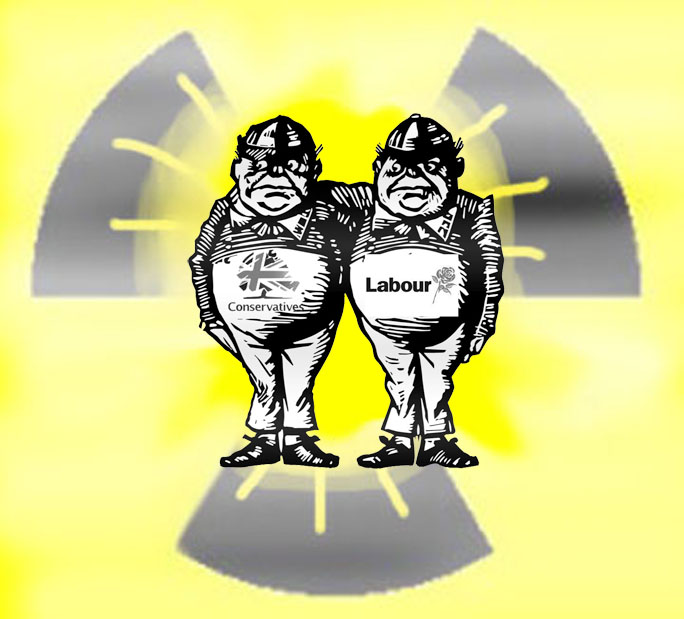
LINDA PENTZ GUNTER condemns Starmer’s willingness to let children go hungry and the elderly shiver while pouring billions into doomed nuclear projects that won’t address the climate crisis
https://morningstaronline.co.uk/article/billions-sizewell-c-show-labours-shameful-nuclear-hypocrisy Linda Penz Gunter6 Sept 24
THE Keir Starmer Labour government won’t scrap the two-child benefit cap because, it claims, the country can’t afford it. Doing away with this punitive measure would lift close to half a million children out of poverty at an estimated cost of £3.6 billion a year.
On the other hand, the Starmer government is perfectly happy to scrap the winter fuel allowance for pensioners, because doing so saves money — an estimated £1.4bn this financial year. That potentially life-saving support will now be stripped from as many as 10 million eligible pensioners.
That’s £5bn saved, on the backs of children and the elderly, two of the most vulnerable segments of our society.
Instead, the Labour government has now announced it will assign almost this identical sum — as much as £5.5bn in life support — to the planned 3,200 megawatt (MW) two-reactor Sizewell C nuclear power plant project on the Suffolk coast.
pensioners shiver in the dark in exchange for an entirely futile energy project that will keep no-one warm anytime soon, if at all.
Reacting to the announcement, Pete Wilkinson, spokesperson for Together Against Sizewell C, a local opposition group, observed: “It’s staggering that Labour has increased the potential outlay on this white elephant project to £8bn just days after Labour claimed the country couldn’t afford winter fuel payments for millions of pensioners.”
This would be the second government subsidy the scheme has received on top of an earlier £2.5bn handed out by the previous Tory government.
The announcement was made on August 30 by the Department for Energy Security and Net Zero, which described it as “a new subsidy scheme — the Sizewell C Devex Scheme — to enable continued support to the development of the proposed new nuclear power plant Sizewell C (SZC) to the point of a Final Investment Decision (FID) and thereby ultimately reach operation.”
The word “ultimately” is key here, since that operational date is very uncertain. Realistically, Sizewell C will never be completed in time to address the climate crisis. The project was initiated in 2010 with the contract awarded to French government corporation, EDF, in 2012.
Fourteen years later, the estimated cost at completion is £20bn, although these calculations are typically unpredictable and underestimated and could soar as high as £30-£40bn. Meanwhile, there are no reactors under construction.
Shovels are in the ground, but only to raze forests and fragile habitats adjacent to the precious Minsmere Nature Reserve. This is being done to make way for non-nuclear construction projects including “new offices, and training facilities,” according to Sizewell C’s joint managing directors Julia Pyke and Nigel Cann.
Further compounding the risks at Sizewell — in addition to the unsolved dangers of radioactive waste storage and meltdowns — the site sits on the shores of the North Sea where erosion has already taken its toll. With climate change precipitating sea-level rise, the plant will become ever more vulnerable to severe flooding and violent storms by the time it becomes operational.
All of this ignores the warnings of climate experts that we now have a window of five years or less in which to take urgent action to reduce carbon emissions to net zero.
Despite this, the Labour government continues to support another nuclear debacle, EDF’s first two-reactor project, the 3,200 MW Hinkley Point C nuclear power plant in Somerset.
Conceived in 2010 in the waning days of the Tony Blair Labour government, it was then ardently embraced by Conservative prime minister, David Cameron, and his Tory successors. Six years into actual construction, Hinkley Point C remains unfinished while its costs have ballooned to at least £34 billion. EDF’s vague completion date is now “after 2029.”
Claims that small modular reactors (SMR) are a promising alternative and can be rolled off assembly lines to answer energy needs are just more pie in the sky. That’s because the hundreds if not thousands of SMRs needed would result in such poor economies of scale it will send electricity prices even higher to compensate for the up-front costs.
SMR designs remain on paper, there is scant interest from buyers, and the flagship SMR project in the US, NuScale, has already collapsed under the weight of its exorbitant finances, which proved unacceptable to investors, many of whom dropped out.
Furthermore, squandering money on new nuclear power plants that are unlikely to materialise on time if ever, diverts much-needed resources away from the technologies that could be deployed quickly and on a significant scale, such as solar and wind power. For every pound squandered on nuclear power, more carbon reductions could be achieved faster by spending it on renewable energy instead.
All of this, however, falls on deaf ears in Westminster. “Labour complained about a black hole in the country’s finances yet now they are proposing to dig still further,” observed Alison Downes of Stop Sizewell C. “Where would this cash come from?”
Certainly not from the military, another nuclear hog at the subsidy trough that Labour is more than happy to overfeed. As Jeremy Corbyn, the former Labour leader and independent MP for Islington North remarked: “If the country’s finances are so bad, then why are we still spending £50bn a year on the military? If there’s no money left, why are we spending £12,000 a minute on nuclear weapons?”
Linda Pentz Gunter is a writer based in Takoma Park, Maryland. She is the independent specialist at Beyond Nuclear (www.beyondnuclear.org).
The US empire is hidden in plain sight
The National Endowment for Democracy (NED) was ‘created… to do in the open what the Central Intelligence Agency has done surreptitiously for decades,’
The UK appears to have very little control over what happens on the USAF-operated bases or the missions that are flown from them.
these agreements ‘ultimately reserve jurisdiction of US personnel to the US’. Most of the American bases are called RAF stations and leased by the US.
1 September 2024
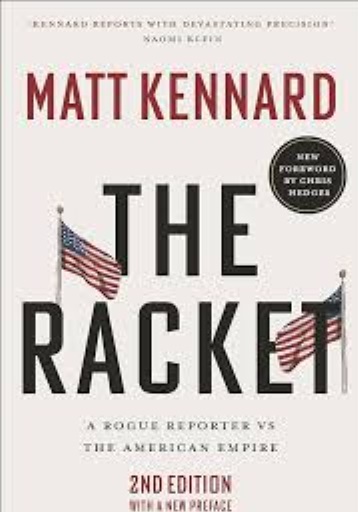
So-called RAF bases filled with US military personnel are a tell-tale sign of Britain’s key role in US imperialism, writes Matt Kennard.
Four years after my book The Racket was first published, I started my own media outlet with historian and journalist Mark Curtis. It was a departure from what I had focused on before – the consequences of US imperialism around the world – because this new publication, Declassified UK, would cover British foreign policy.
Britain handed the mantle of world domination to the US after World War Two and the received history is that it then retired from any kind of imperial role. I found out pretty quickly at Declassified that this was a misunderstanding. The truth is the empire never died. Britain merely became a ‘junior partner’ to the US hegemon. London’s adjunct status did not mean it was insignificant, however. The City of London’s role as the world’s financial capital which spreads neoliberalism around the world, Britain’s vast network of military bases, alongside its corporate giants like BP and BAE Systems, showed the country still served a critical imperial role for its senior partner.
But a more interesting realization for me came when I started to look at the institutions that make up the US empire and their role in Britain. I had spent years looking at what institutions like the CIA, the National Endowment for Democracy, or the US military were doing in the Global South, where their power was exercised against often weak states. But I saw quickly that the infrastructure of the US empire which had colonized so much of the world had also colonized my home country, the country where I had lived nearly all my life. Britain, in fact, appeared to be more completely under the control of its American ally than any country I’d looked into around the world in The Racket.
The similarities did not stop there. Like the mainstream media could never mention the term ‘US empire’ or explain its real role in world affairs, those same establishment journalists did not touch US influence in Britain. This was, again, an invisible empire, hiding in plain sight. The work I began doing would have never made it into the pages of my old employer, the Financial Times, like so many truths in The Racket never could.
Into the state
The colonization by the US empire of Britain became particularly clear when the Labour party elected Jeremy Corbyn leader in September 2015. A veteran anti-war and anti-imperialist politician and activist, Corbyn was a complete outlier within the British political system. He was dangerous to the rule of the British establishment, but also the ability of the US to retain Britain as a vassal state.
The different pressure points that stay hidden in normal times, when the system is running like it should, quickly became exposed. This was made explicit in June 2019, when US Secretary of State Mike Pompeo visited Britain and was recorded saying privately: ‘It could be that Mr Corbyn manages to run the gauntlet and get elected. It’s possible. You should know, we won’t wait for him to do those things to begin to push back. We will do our level best. It’s too risky and too important and too hard once it’s already happened.’
……………….. Britain’s traditional subservience to the US ‘could have gone a different way at various points in modern history, recently if Jeremy Corbyn hadn’t been destroyed by a vicious media campaign,’ Noam Chomsky has written. But it was not a coincidence. The US was integral to building a British political system that made a ‘different way’ next to impossible. m that made a ‘different way’ next to impossible. I began looking at how the US state had been interfering in British politics to stop the rise of anti-imperialist leaders. Britain has never had a prime minister that was not signed up to the US imperial project. I started to realize this was not a mistake, but the result of concerted efforts from Washington.
…………………………………………………………Declassified files from the CIA show how concerned the intelligence agency then was by the left turn in Labour. The BBC noted ‘the deep level of concern inside the CIA about the strength of the Left within Labour in the early 1980s, a political force which the agency regarded as anti-American’. The CIA was particularly concerned about Foot winning the 1983 general election, with an internal report stating that ‘a Labour majority government would represent the greatest threat to US interests’. Foot’s 1983 election manifesto questioned ‘the programme for establishing American-controlled cruise missiles on our soil’ and noted that a new European security pact should end with the ‘phasing out’ of NATO. The BAP’s own official history notes that ‘the traditional British leftwing remained deeply suspicious of the United States, particularly on foreign policy and security issues’ in the period, adding ‘this was the era of Michael Foot’s leadership of a Labour Party committed to unilateral nuclear disarmament’.
………………………………. Michael Foot was a founder and strong supporter of the Campaign for Nuclear Disarmament (CND), while Corbyn has been a member of the peace group since he was 15 and was, at the time of his election to the Labour leadership, its vice-chair.
The US neutralization campaign, which was leaked to the Washington Post, ‘would take three forms’, Dorrill continued: mobilizing public opinion, working within the churches, and a ‘dirty tricks’ operation against the peace groups.
……………………………………………………………………………………………………………………….. The National Endowment for Democracy (NED) was ‘created… to do in the open what the Central Intelligence Agency has done surreptitiously for decades,’ the New York Times reported in 1997…………………………………….. Since the end of the Cold War, the NED had grown and been involved in trying to undermine or remove governments independent of Washington,………………………
…………………………………………………………………………………….. John Kiriakou, a CIA officer from 1990 to 2004, told me that recent changes in the law have widened the potential targets of US information operations. ‘In 2011, the US Congress changed the law that forbade the Executive Branch from propagandizing the American people or nationals of the other ‘Five Eyes’ countries – the UK, Canada, Australia, and New Zealand,’ he said.
……………….. The CIA’s propaganda efforts throughout history have been shameless. But now that they’re not legally relegated to just Russia and China, the whole world is a target.’ One particularly interesting case was Index on Censorship, the UK’s foremost free expression group which monitors threats to free speech and publishes censored writers. It received £603,257 from the NED in 2016–21, according to its Charity Commission accounts.
……………………………………………………………………………………………………………. This is how it works. Not just in the developing world, but, I was learning, in the developed world, too. In fact, the control was even deeper. I soon understood that the US was not just interfering in the British political process, media and civil society. The hidden fist of the US empire which I’d seen deployed all over the developing world – the massive American military – was also occupying Britain.
I found the US Air Force (USAF) had 9,730 personnel permanently deployed throughout Britain, a number which was increasing rapidly.
……………………………………………… US military personnel in Britain are all in England, with access to 11 Royal Air Force (RAF) bases, stretching from Cambridgeshire to Yorkshire. They are known officially as United States Visiting Forces (USVF).
……………………….Jewel in the crown
The largest US military presence is at RAF Lakenheath, a 727 hectare site in Suffolk. Despite being called an RAF base, it is leased to the USAF, and its population is overwhelmingly American. There were 5,404 US Department of Defense personnel based there in 2022.
……………………………………………… The US is spending billions of pounds upgrading air bases in Britain to enable Washington to intercept international communications and launch military strikes more quickly. Some of the locations are hubs for offensive bombing missions. RAF Fairford in Gloucestershire is the USAF’s only bomber Forward Operating Location, or military base, in Europe. The aircraft deployed there ‘enable US and NATO warfighters to conduct a full spectrum of flying operations’.
………………………………………………..But the UK appears to have very little control over what happens on the USAF-operated bases or the missions that are flown from them. The overarching framework for the stationing of US forces in the UK comes from two pieces of legislation. In 1951, NATO agreed a ‘status of forces’ agreement to govern hosting arrangements between its member states. The following year, The Visiting Forces Act incorporated the NATO agreement into UK law.
But Hudson said that these agreements ‘ultimately reserve jurisdiction of US personnel to the US’. Most of the American bases are called RAF stations and leased by the US. ‘Because of this, while the physical buildings comprising the bases are usually the property of the UK Ministry of Defence, very little of what happens in them is controlled by the British government,’ Hudson said. The empire never sleeps and, despite the mainstream media working to keep it invisible, it’s everywhere.
This is an edited version of the new preface to The Racket: A Rogue Reporter vs The American Empire by Matt Kennard. The second edition is out now, published by Bloomsbury and available at bloomsbury.com and via all good bookshops.
Rare photos show Earth’s fatal hotspot that can kill any human standing nearby in just five minutes

Harrowing photos of the lethal area reveal how dangerous it is to be near the hotspot
Joshua Nair, https://www.ladbible.com/news/world-news/chernobyl-elephants-foot-radiation-photos-743946-20240906 6 Sept 24
There’s a spot on Earth that is so dangerous, it could kill someone if they stood nearby for just five minutes.
And the story behind it is haunting.
A lot of things on our blue planet can be dangerous towards us humans, but something we can’t really avoid is radiation.
No, I’m not talking about generating electricity for all of our technology, I mean the radiation that can be caused by the use of weapons, which can leave everlasting effects on certain areas of the world.
Nuclear weapons are bad, but the biggest tragedy related to this isn’t to do with weapons at all, and it occurred in Chernobyl after a tragic power plant explosion in Pripyat, Ukraine.
What was the Chernobyl disaster?
At a nuclear power plant in the Ukrainian city of Chernobyl on 26 April, 1986, reactor number four exploded during a failed steam test, killing 30 people instantly.
Radiation released could be detected in countries as far as Sweden, while several civilians and workers in the area would go on to die from severe radiation poisoning, while others died from other health issues and terminal illnesses from the unsafe levels of radiation put into the atmosphere.
It is still by far and away the worst nuclear disaster in human history, reportedly costing governments around $700 million (£532 million) to deal with, while the area is uninhabitable.
The ‘Elephant’s Foot’
Known as the most dangerous object on the planet, it was caused by the Chernobyl disaster as a large hunk formed at the bottom of the reactor, which was caused by uranium fuel becoming molten when it overheated.
Steam blew the reactor apart, as heat, steam and molten nuclear fuel combined to make a 100-ton flow of dangerous chemicals that poured out of the reactor and through to the basement of the plant, solidifying and being given the name the ‘Elephant’s Foot’, resembling one.
Why is it so dangerous?
People soon realised after the explosion that it shouldn’t be approached for a while, as the radioactive lump continued to sear for months.
When measured, the Elephant’s Foot released almost 10,000 roentgens per hour, equivalent to the exposure given by four and a half million chest X-rays.
It’s is incredibly dangerous, with photos of people near the hotspot showcasing some of the bravest scientists out there, putting their lives at risk to better understand the Elephant’s Foot.
According to science magazine Nautilus, 30 seconds of exposure would have your cells haemorrhaging, and in just four minutes, violent vomiting and diarrhoea would hit, and if you got to five minutes in the lump’s vicinity, you’d die within two days.
Studies on the Elephant’s Foot
People have chosen to visit and study the site for short periods of time, and while it is still cooling down, the Elephant’s Foot is incredibly dangerous to be around, as scientists have only taken the smallest of samples to carry studies out on.
The Elephant’s Foot remains entombed in the New Safe Confinement (NSC) that was slid over Chernobyl to prevent any more radiation leaks from the nuclear power plant.
Controversy Surrounds Kazakhstan’s Nuclear Referendum
Oil Price, By RFE/RL staff – Sep 04, 2024,
- Kazakhstan has allocated $32 million for a referendum on the construction of a nuclear power station.
- The referendum, scheduled for October 6, has sparked controversy due to concerns over nuclear safety and Russia’s potential involvement.
- Despite public opposition, the Kazakh government is pushing forward with the plan, highlighting the country’s tightly controlled political environment.
…………………………………………….Mustafina’s deputy Konstantin Petrov said more than 12 million Kazakh citizens are eligible to vote at more than 10,000 voting sites across the country and 78 stations will be set up in different countries for Kazakh citizens residing abroad.
Only one question will be asked in the referendum: “Do you agree that Kazakhstan needs to construct a nuclear power station?”
Many in Kazakhstan expect that the answer will be “yes,” considering the country’s tightly controlled political environment.
But the push to build a nuclear power plant has been met by significant opposition despite apparent efforts to silence dissent on the issue. In recent weeks, several activists known for their stance against the nuclear power station’s construction have been prevented from attending public debates on the matter.
Nuclear-power-related projects have been a controversial issue in Kazakhstan, where the environment was severely impacted by operations at the Soviet-era Semipalatinsk nuclear test site from 1949 to 1991 and the Baikonur spaceport, which is still being operated by Moscow.
Hours before his decree was made public on September 2, President Toqaev reiterated his support for the plan to build a nuclear power station.
There was no official information about the site of the future nuclear station, but a public debate was held last year in the village of Ulken on the shore of the Lake Balkhash in the southeastern region of Almaty about the possibility of constructing a nuclear power station there.
The idea to build a nuclear power station in Kazakhstan has been circulating in the country for years, leading to questions regarding what countries would be involved in the project.
Kazakh officials have tried to avoid answering the question, saying the decision would be made after a referendum.
Shortly before launching its ongoing invasion of Ukraine in February 2022, Russia proposed its Rosatom nuclear agency to be Kazakhstan’s major partner in the project. https://oilprice.com/Alternative-Energy/Nuclear-Power/Controversy-Surrounds-Kazakhstans-Nuclear-Referendum.html
Kazakh Internet users mostly rejected the idea of Rosatom’s involvement, citing the legacy of the 1986 Chernobyl nuclear disaster and Russia’s gaining control over the Zaporizhzhya nuclear power plant in Ukraine as examples of Russia’s attitude toward nuclear safety.
“Subsidy for UK nuclear build calls funding into question”

“It’s not a great argument for public ownership. Doing it because private investors won’t touch it“
(Montel) The UK’s decision to pump an additional GBP 5.5bn into getting the 3.2 GW Sizewell C nuclear power station to a financial investment decision has triggered more uncertainty about its financing and cost, said industry sources.
Reporting by: Kelly Paul, 03 Sep 2024
“I think there’s a lot of uncertainty about it,” Paul Dorfman, visiting professor at the UK’s University of Sussex, told Montel.
“There are questions around what does it actually mean and will that money be drawn up before 2025 [when a final investment decision is expected].”
“Clearly the decision is already made,” said Steve Thomas, emeritus professor of energy policy at Greenwich University.
Won’t abandon project
“The government is not going to spend GBP 8.5bn [including an original cost estimate and additional payments] then abandon the project. The uncertainty is what proportion investors will take and on what terms, or will we just make it 100% public.”
The UK’s new Labour government is proposing a GBP 5.5bn subsidy scheme aimed at covering Sizewell C’s costs up to and including a final investment, subject to next month’s spending review.
It comes amid a protracted process of trying to attract private investors to Sizewell C, namely via the regulated asset base financing model launched last year, designed to ensure a significant proportion of capital is secured before the construction phase to shore up the contribution of the lead developer, EDF of France.
Yet doubt surrounds the status of private investment into the project, with financially strapped EDF’s share capped at 19.99% after a final decision is taken. The total cost of Sizewell is estimated at GBP 20bn.
“I don’t feel like this equity round has been a resounding success,” Alison Downes, a director at campaign group Stop Sizewell C, told Montel, citing anonymous government sources and pointing to the apparent absence of sovereign wealth and pension funds.
The lack of clarity around final costs and timeline also called into question the role of nuclear in the country’s bid to achieve a decarbonised economy by 2030 and in terms of contributing to its energy security, she added.
“2030 is not the be all and end all but it is a critical part in terms of the government’s goals,” she said.
Greater costs?
Meanwhile, the government could find itself saddled with greater costs as potential investors seek to minimise their share of the risk, the sources said.
“It’s not a great argument for public ownership. Doing it because private investors won’t touch it,” Thomas said.
When contacted by Montel, an energy ministry spokesperson said: “We are committed to Sizewell C, which will play an important role in helping the UK achieve energy security and net zero, while securing thousands of good, skilled jobs and supporting our energy independence beyond 2030.
“Subject to all the relevant approvals, we aim to reach a final investment decision before the end of the year.
“Any investment from the [GBP 5.5bn subsidy] scheme will be subject to approvals and in line with the project’s spending plans, as agreed by the government and its co-shareholders.”
Sizewell C, the company managing the nuclear project, was unavailable for comment when contacted by Montel.
Delays, debts and false promises — inside France’s nuclear nightmare.
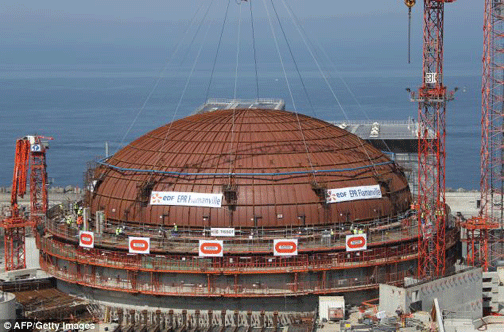
The energy giant EDF pledged to rebuild Britain’s atomic power sector,
starting with Hinkley Point. But setbacks to a similar project in Normandy
throw the UK’s nuclear future into doubt.
This week, the one and only EPR
that France has itself tried to build was finally switched on — 12 years
behind schedule. When work got under way on the reactor in Flamanville,
Normandy, in 2007, engineers had promised that it would be up and running
by 2012, at a cost of €3.3 billion (£2.8 billion).
The final bill is estimated to be €19.1 billion and it is not even plugged into the grid
yet. EDF says that will happen “by the end of the autumn”, signalling
yet another delay.
The project has been beset by problems. Safety
inspectors discovered “deviations” in eight welds in the reactor’s
main steam transfer pipe, for instance. It instructed EDF’s welders to do
the job again. Then the Nuclear Safety Authority, the French watchdog, came
across what it called a “manufacturing anomaly in the lower dome and the
vessel closure head”, which are also key components.
It has ordered the replacement of the head, although it agreed to allow the reactor to start
up with the existing one still in place. It will be removed after about 18
months of operation, to coincide with the first fuelling outage. The delays
and cost overruns at Flamanville have been viewed as a national
humiliation. Critics have asked how the project could have gone so wrong,
given France’s proud nuclear tradition — its reactors supplying about
two thirds of the country’s electricity.
Times 4th Sept 2024
Starmer permanently ties UK nuclear arsenal to Washington
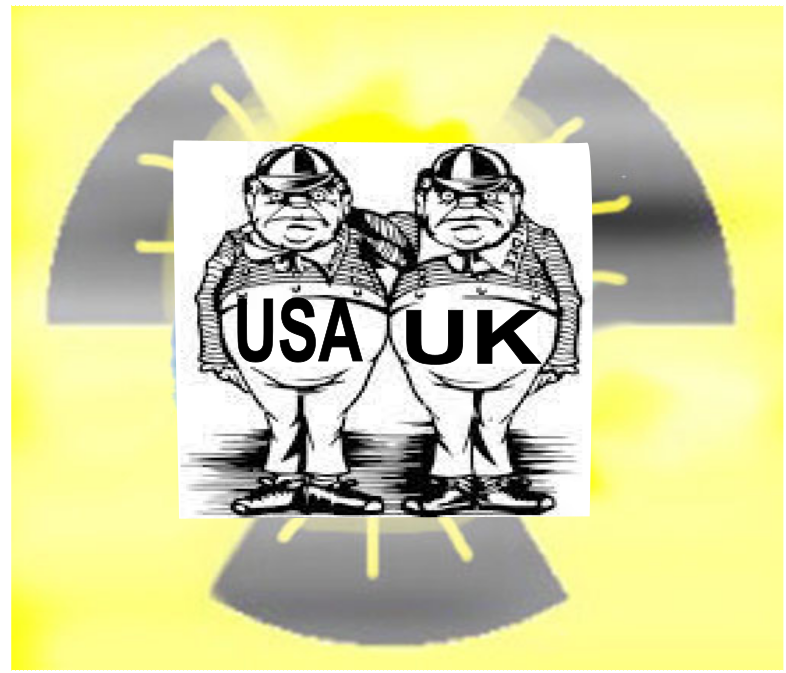
: Britain’s nuclear weapons are now forever reliant on US military scientists after a transatlantic treaty was quietly rewritten.
RICHARD NORTON-TAYLOR, 3 September 2024,
https://www.declassifieduk.org/starmer-permanently-ties-uk-nuclear-arsenal-to-washington/
Labour has reinforced the “special relationship” with Washington by agreeing to make Britain’s nuclear arsenal permanently dependent on the US.
In one of its first, but little-noticed foreign policy moves, Labour has amended the Eisenhower-era 1958 Mutual Defence Agreement (MDA) that is crucial to Britain’s Trident nuclear missile system.
Officials deleted a long-standing sunset clause that required it be renewed every ten years.
All references to an “expiry date” have been removed “to make the entirety of the MDA enduring, securing continuing cooperation with the US”, according to a memorandum signed by defence secretary John Healey.
Kate Hudson from the Campaign for Nuclear Disarmament (CND) told Declassified: “This spells farewell to even the smallest notion of parliamentary responsibility for Britain’s foreign and defence policies.”
She added that at least nominally parliament has had the opportunity, once a decade, to debate and reconsider America’s role in Britain’s nuclear programme.
“This amendment, introduced in the most undemocratic fashion by the government – at a time when it will be lost in the recess and party conference season – will eradicate those opportunities. This must not go unchallenged.”
The change was agreed by senior British and US officials on 25 July, three weeks after Keir Starmer became UK prime minister.
It comes as Starmer described Britain’s nuclear weapons as the “bedrock” of the country’s defence and amid concern about possible threats to the future of the MDA if Donald Trump wins back the White House.
During a visit to Washington shortly before the general election, David Lammy, now foreign secretary, told a centre-right think tank that Labour: “will always work with the United States, whatever the weather…”
The MDA enables the US to provide Britain with nuclear weapons materials and know-how without which Trident would not be able to function.
It gives the lie to persistent claims by the Ministry of Defence that Britain’s submarine-launched nuclear arsenal is “operationally independent”.
American client
Trident missiles themselves are obtained from America and a cross-party report concluded that the life expectancy of Britain’s nuclear capability without US support could be measured in months.
US presidents have also alluded to this dependency, with George W. Bush saying in 2005 that the US helped Britain maintain a “credible nuclear force”.
Barack Obama declared it was in America’s interest to continue to help Britain “in maintaining a credible nuclear deterrent” when the MDA was renewed ten years ago.
As Declassified recently reported, British military aircraft regularly cross the Atlantic with highly radioactive ingredients supplied by the US. These ingredients are absolutely vital to the Trident missile system.
The memorandum signed by Healey states: “The MDA provides the necessary requirements for the control and transmission of submarine nuclear propulsion technology, atomic information and material between the UK and US, and the transfer of non-nuclear components to the UK.”
It continues: “The MDA underpins the defence nuclear relationship between the UK and US.”
Above democracy
The memo further states that the amendment does not require any change in the law. Although the MDA is incorporated in US law, it has no statutory basis in the UK.
Astonishingly, despite its huge significance, it has never been the subject of a substantial debate in Parliament.
The government describes the MDA as covering the exchange of information on “sensitive nuclear technology” for developing “defence plans” and “military applications of atomic energy”.
Other aspects involve evaluating “the capabilities of potential enemies in the employment of atomic weapons”.
It also concerns the sale of “naval nuclear propulsion plants” and the transfer of materials like U-235 enriched uranium.
However, governments have long refused to provide information about how much nuclear material for British warheads the US has provided to the Atomic Weapons Establishment at Aldermaston and the nearby Burghfield warhead factor, and at what cost.
The quantity is likely to be significant. Nearly 1,000 non-nuclear components for atomic weapons systems were exchanged between the US and UK in 2020-23 under the MDA, according to new research by the Nuclear Information Service.
A Ministry of Defence spokesperson said the removal of the 10-year renewal provision was decided “given the longstanding nature of this agreement”. She added that making the entirety of the MDA “enduring” was “the case with other international agreements.”
Peter Burt of Nukewatch UK which monitors the UK’s nuclear weapons programme commented: “Every UK Prime Minister since the Second World War has been petrified about losing influence with the US, and in a large part this hinges around access to nuclear weapons technology and military intelligence.
“This is the main reason the UK government always aligns itself with US foreign policy and allows itself to be drawn into US military adventurism, even when it is clearly not in the interests of this country to follow America.”
Ukrainian Tipping Points: UPDATE
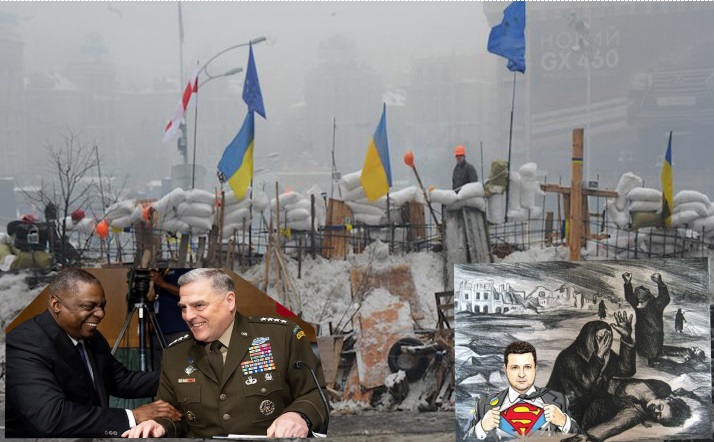
by Gordonhahn September 3, 2024 https://gordonhahn.com/2024/09/03/ukrainian-tipping-points-update/
Rueters reports US is just about se to send long-range missiles to Ukraine for attacks deep inside Russia:
US close to agreeing on long-range missiles for Ukraine; delivery to take months
Summary
-Stealthy JASSM weapons have range to hit targets inside Russia
-Decision expected in autumn, U.S. officials say
-Pentagon trying to integrate JASSMs on Soviet-era Ukrainian jets
WASHINGTON, Sept 3 (Reuters) – The U.S. is close to an agreement to give Ukraine long-range cruise missiles that could reach deep into Russia, but Kyiv would need to wait several months as the U.S. works through technical issues ahead of any shipment, U.S. officials said. The inclusion of Joint Air-to-Surface Standoff Missiles (JASSM) in a weapons package is expected to be announced this autumn, three sources said, though a final decision has not been made (https://www.reuters.com/world/us-close-agreeing-long-range-missiles-ukraine-delivery-take-months-2024-09-03/).
Declassified files reveal plans for nuclear power plant in Tyrone, northern Ireland
WeAreTyrone, By Callum McGuigan, 3 September 2024
DECLASSIFIED Government documents have revealed high-level discussions over a proposal to build a nuclear power plant near Coalisland during the 1950s.
Papers recently opened at the Public Records Office in Belfast under the 20-year rule outline how close Tyrone and the North was to achieving atomic power decades ago.
The two sites envisioned for the dawn of a nuclear age in the North were earmarked as Washing Bay and Derrywarragh Island, both just miles from Coalisland.
Secret talks were held between Stormont and Westminister with the strictest confidence, not just because of Cold War paranoia, but also in fear of recent IRA skirmishes at the border…………………………………………………………………………………
Disaster
The nuclear planning preparations were shortlived, as in October of 1957 the worst nuclear disaster in the UK would halt the progress of developments in the North.
The Windscale nuclear site in England caught fire and radiation spread across the UK and Europe.
The disaster was ranked five out of seven on the International Nuclear Disaster Scale, just two rankings below Chernobyl.
Ultimately, the plans never went ahead.
Reacting to the proposals contained in the recently-declassified files, Coalisland independent councillor, Dan Kerr, said that the ‘risks would have outweighed the positives’.
“When you think of nuclear plants you think of big industrial cities and urban areas, but you also can’t help but remember the Chernobyl disaster in 1986.
“It would have been a huge employment opportunity in Coalisland, but at the same time, the risks to locals and the environment would have far outweighed the positives.
“Looking at Lough Neagh now, you could imagine if a disaster like Chernobyl were to have happened here, the whole area and maybe even large parts of the North, could have been turned into a complete wasteland………………………………… https://wearetyrone.com/news/declassified-files-reveal-plans-for-nuclear-power-plant-in-tyrone/
A crisis at Kursk?

IAEA chief, Rafael Grossi, duly went off to visit the Kursk site, to remind whoever is listening from either side that having a war around nuclear power plants is frightfully inconvenient when your agency is busy telling the world how safe the technology is and how badly we need more of it.
Linda Pentz Gunter, 2024 https://beyondnuclearinternational.org/2024/09/01/a-crisis-at-kursk/
The Russian war against Ukraine now threatens to envelop one of its own nuclear power plants, writes Linda Pentz Gunter
IAEA chief, Rafael Grossi, visited the threatened Kursk nuclear power plant in Russia last week, but continues to promote nuclear power expansion.
The trouble with nuclear technology, of any kind really, is that it depends on sensible and even intelligent decisions being made by supremely fallible human beings. The consequences of even a simple mistake are, as we have already seen with Chornobyl, catastrophic.
To add to the danger, nuclear technology also relies on other seemingly elusive human traits, beginning with sanity but also something that ought to be — but all too often isn’t —fundamentally human: empathy. That means not wanting to do anything to other people you wouldn’t want to endure yourself. But of course we see humans doing these things every day, whether at the macro individual level or on a geopolitical scale. We just have to look at events in Congo, Gaza, Haiti, Sudan; the list goes on.
And of course we cannot ignore what is playing out in Ukraine and now Russia. Because of the war there, dragging on since Russia’s February 24, 2022 invasion of Ukraine, we remain in a perpetual state of looming nuclear disaster.
Currently, the prospects of such a disaster are focused on Russia, where that country’s massive Kursk nuclear power plant is the latest such facility to find itself literally in the line of fire as Ukrainian troops make their incursion there in response to Russia’s ongoing war in their country.

But we cannot forget the six-reactor site at Zaporizhzhia in Ukraine either, embroiled in some of the worst fighting in that country, the plant occupied by Russian troops for more than two years and also perpetually one errant missile away from catastrophe.

Ukraine relies heavily on nuclear power for its electricity supply, with 15 reactors in all at four nuclear power plants, when all are fully operational. In 2023, even as the war raged around the nuclear sites, Ukraine was still providing a little over half of the country’s electricity from nuclear power.
Russia is far more dependent on natural gas, a product it also exports, and only draws just over 18 percent of its electricity needs from its estimated 37 reactors, situated at 11 nuclear sites.
There are also some fundamental technological differences between the Zaporizhzhia and Kursk nuclear power plants themselves. Kursk, like Zaporizhzhia, is also a six-reactor site, one of the three largest nuclear power plants in Russia. (Zaporizhzhia is not only the biggest nuclear power plant in Ukraine but also Europe’s largest.)
But while Zaporizhzhia is made up of six Russian VVER reactors, more akin to the pressurized water reactors used in the United States and much of Europe, the Kursk reactors are of the old Soviet RBMK design.
This is the same model as the Chornobyl unit that exploded in 1986, irradiating land across Ukraine, Russia, Belarus and much of Europe, contamination that persists in many areas today.
Alarmingly, because the Kursk RBMK reactors lack a secondary containment dome, they are even more vulnerable to war damage than Zaporizhzhia’s.
Furthermore, unlike Zaporizhzhia, where all six reactors are fully shut down — making a meltdown less likely but not impossible — two of Kursk’s reactors are still running. And the Russians have already told the International Atomic Energy Agency (IAEA) that they found the remains of a drone just over 300 feet away from the Kursk nuclear plant. Ukraine has of course denied responsibility for any attempted assault on the plant just as Russia has disavowed accusations it tried to attack the Zaporizhzhia nuclear site.
IAEA chief, Rafael Grossi, duly went off to visit the Kursk site, to remind whoever is listening from either side that having a war around nuclear power plants is frightfully inconvenient when your agency is busy telling the world how safe the technology is and how badly we need more of it.
However, like a helpless pre-school teacher with naughty toddlers, Grossi’s only recourse appears to be to tell both the Russians and Ukrainians repeatedly to stop. And since he can’t exactly take away their candy, and in fact has no “or else” to implement, they simply ignore him.
Most of us do still feel empathy for those whose lives we watch extinguished each night as ever more horrific news reports pour in from the countries where war and strife have become a seemingly endless and unstoppable ordeal.
Most of us don’t want another Chornobyl, either, for Ukrainians, for Russians or for anyone. And since we can’t rely on human beings to use nuclear power responsibly, this is one “toy” we have to take away.
Linda Pentz Gunter is the international specialist at Beyond Nuclear and writes for and edits Beyond Nuclear International. Her forthcoming book, Hot Stories. Reflections from a Radioactive World, will be published in autumn 2024.
Inside UK Labour’s plans for a new nuclear age

Before the end of the year, Ed Miliband is expected to announce the next
phase of Britain’s nuclear power revival. The energy secretary has
inherited decisions on two major programmes that could help bring forward a
new nuclear age in the UK — Sizewell C in Suffolk and a fleet of mini
nuclear plants around Britain.
In its election manifesto, Labour lent its
support to nuclear as playing an important role in the shift towards clean [?]
power and improving energy security.
Sceptics of ambitions to build out
Britain’s nuclear industry point towards the delays and budgeting
difficulties that have beset Hinkley Point C as a bad omen for expanding
the UK industry.
The developers have called out the 7,000 design changes it
was forced to make to its reactors by the Office for Nuclear Regulation to
adapt the reactors to UK safety standards, increasing the amount of
concrete and steel needed and pushing up costs.
The project has also been
caught up in wrangling with the Environment Agency and it is still in
dispute over how to best deter fish from swimming near the site and getting
sucked up into its cooling systems.
There is believed to be a £5 billion
funding gap, but CGN’s liability for the project is capped at £6
billion, which leaves the French state on the hook. A fixed, albeit
inflation-linked, subsidy of £92.50 per megawatt-hour (in 2012 prices) was
agreed when Hinkley was signed off, so any increase in costs falls on
shareholders, rather than directly on bill payers.
A final investment decision on [Sizewell C] had been expected by the summer. The hope now is that the project might get the green light before the end of the year, but
there is speculation that it may slip into next year. The government is
expected to launch a new generation of mini nuclear power plants across the
country.
The selection process is being run by Great British Nuclear, an
arm’s-length body set up under the previous government to drive nuclear
deployment. Five ventures, including Rolls-Royce and GE-Hitachi, a joint
venture between GE Vernova, the American energy equipment manufacturer, and
Hitachi, the Japanese conglomerate, have submitted bids for £20 billion in
taxpayer funding.
The plan is to whittle down the list to three or four
designs by the end of this month, with the winning bids chosen before the
end of the year. It is hoped that the chosen technology providers will take
a final investment decision by 2029.
The first small modular reactor is not
expected to be generating electricity before 2035, not in time to
contribute towards Labour’s 2030 net zero goals. Miliband has said the
new government will “strive” to keep to the timetable previously set
out.
When the winning mini nuclear plant designs are chosen, they will be
assigned an operating site by Great British Nuclear. There are eight sites
currently approved for nuclear development in the UK, including Wylfa in
Anglesey, the Sellafield site in Cumbria and Heysham in Lancashire. A deal
in March with Hitachi brought two sites — Wylfa and Oldbury-on-Severn in
Gloucestershire — back under government ownership.
Moorside, which is adjacent to the Sellafield facility is also state-owned, which makes all
three likely potential sites for the first small modular reactors (SMRs).
Rolls-Royce, which is considered a frontrunner in the selection process,
has previously said it has identified four potential parcels of land,
including Oldbury and Moorside, as its preferred locations. However, it is
envisioned that for small modular reactors to fully realise the benefits of
scale, development on more new sites will be needed.
Looser planning rules
are expected to allow these reactors almost anywhere outside built-up
areas.
Times 4th Sept 2024
UK suspends 30 arms exports to Israel over Gaza war crimes concerns
Arms campaigners and human rights groups welcome ban, but say move does not go far enough
MIDDLE EAST EYE, By Dania Akkad and Imran Mulla, 2 September 2024
The UK has suspended 30 arms export licences to Israel following a review under the new Labour government which found that British-made weapons may have been used in the violation of international humanitarian law in Gaza.
Arms campaigners and rights advocates who have pressed for a full suspension of arms sales to Israel for months welcomed the decision, but criticised the continued export of F-35 fighter jet components which one called “a workhorse of Israel’s brutal bombing campaign”.
The suspension, announced by Foreign Secretary David Lammy in parliament on Monday, covers components for other types of military aircraft, including fighter planes, helicopters and drones. Around 320 other licences, including for items for civilian use, remain in place.
Under its arms exporting criteria, the government is obligated to suspend licences for arms exports if it determines that there is a clear risk that British weapons might be used in serious violations of international humanitarian law.
“Facing a conflict such as this, it is this government’s legal duty to review export licences,” Lammy told MPs. ………………………………….
Lammy also said the government was “deeply concerned” about reports of mistreatment of Palestinian detainees, which the International Committee of the Red Cross has not been able to investigate after being denied access.
“My predecessor and major allies have raised these concerns,” he said of the detainees. “Regrettably, these have not been addressed satisfactorily.”
He added that Britain would continue to support Israel if it was under attack, particularly from Iran, announcing fresh sanctions against three members of the Islamic Revolutionary Guard Corps. …………
‘Took too long, not far enough’
The announcement cames hours before two organisations which have challenged the UK government in the High Court over the continued exports were set to pursue fresh legal action in an attempt to force the exports to stop immediately.
Lawyers with the UK-based Global Legan Action Network (Glan) and the Palestinian human rights group Al-Haq said they told the government last week of their intent to request an emergency order and had planned to do this at a Tuesday morning hearing.
But late on Monday, the organisations said they would now consider whether the announced ban was “extensive enough to meet the gravity of the situation and assess whether further litigation remains necessary”………………………………………
Without F-35 components included in the ban list, campaigners and human rights groups which have called for a blanket end of UK arms exports to Israel sales for months said the announcement fell short…………………………………………………………………. more https://www.middleeasteye.net/news/uk-suspends-30-arms-exports-israel-over-gaza-war-crimes-concerns
Complex compensation scheme represents tacit admission that nuke dump causes blight.
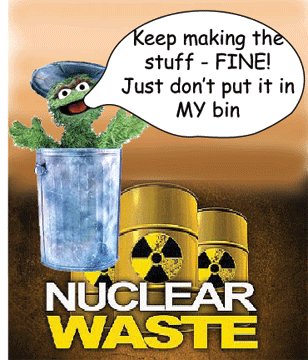
Viewers familiar with the advice of TV house-hunters, Kirsty and Phil will
know that the ‘Location, Location, Location’ of a property relative to
local amenities and beauty spots is often a major determinant of price.
Imagine then how crestfallen an eager would-be purchaser on the show would
be to discover that the seaside home of their dreams they had just viewed
might in the future be blighted by a massive mining project akin to
building the Channel Tunnel, into which the UK’s most deadly stockpile of
radioactive waste would be deposited for eternity?
The UK/Ireland Nuclear Free Local Authorities would be completely unsurprised that such news might cause prospective buyers to back out or make an offer for the property
which is substantially below the asking price.
This has been the fear of
some prospective property owners wishing to sell their homes in the three
Search Areas in West Cumbria and East Lincolnshire where investigations by
Nuclear Waste Services are currently underway to determine if these might
be the ‘location, location, location’ for their Geological Disposal
Facility.
NFLA 2nd Sept 2024
1 This Month
26 April – Chernobyl: Inside the Meltdown airs on National Geographic on Sunday 26th April from 4pm

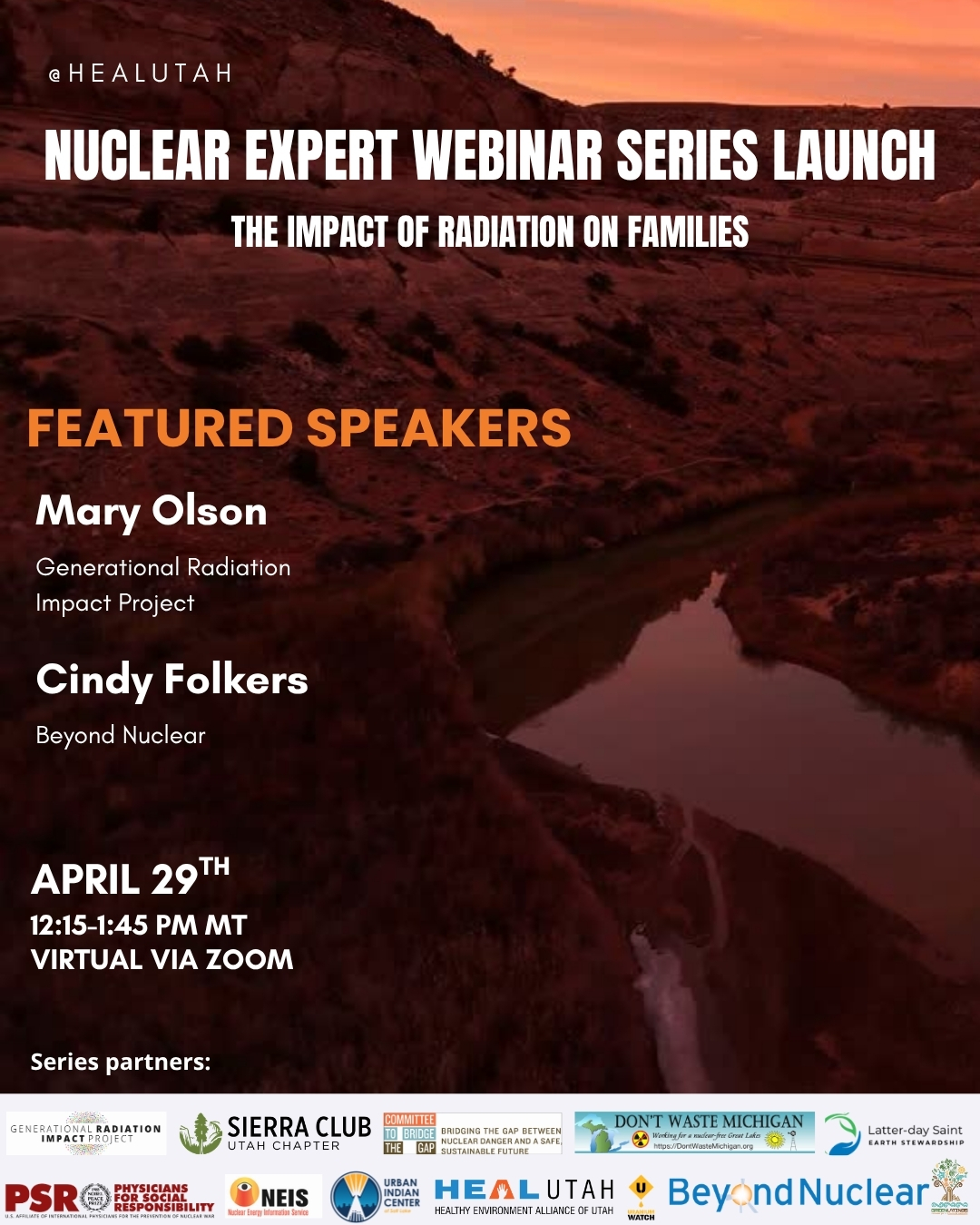
29 April – Nuclear Expert Webinar #1 – Radiation Impacts on Families with Mary Olson and Cindy Folkers
- 12:15 PM MT – 1:45 PM MT
- Location: Virtual – REGISTER TODAY

4 May -West Suburban Peace Coalition to discuss Iran war at May Educational Forum
Monday, May 4, 7:00 – 8:00 PM Central Standard Time
Title: : How Trump’s Narrative Tries to Shape the Reality of the War on Iran.
Contact Walt Zlotow, zlotow@hotmail.com 630 442 3045 for further information
14 May – online event From Bombs to Data Centres: the Face of Nuclear Colonialism

Pine Ridge Uranium is the real threat, not Tehran- Tell Burgum: Stop the Extraction.
Chernobyl: The Lost Tapes – A good documentary on Chernobyl on SBS available On Demand for the next 3 weeks– https://www.sbs.com.au/ondemand/tv-program/chernobyl-the-lost-tapes/2352741955560
To see nuclear-related stories in greater depth and intensity – go to https://nuclearinformation.wordpress.com
-
Archives
- April 2026 (346)
- March 2026 (251)
- February 2026 (268)
- January 2026 (308)
- December 2025 (358)
- November 2025 (359)
- October 2025 (376)
- September 2025 (257)
- August 2025 (319)
- July 2025 (230)
- June 2025 (348)
- May 2025 (261)
-
Categories
- 1
- 1 NUCLEAR ISSUES
- business and costs
- climate change
- culture and arts
- ENERGY
- environment
- health
- history
- indigenous issues
- Legal
- marketing of nuclear
- media
- opposition to nuclear
- PERSONAL STORIES
- politics
- politics international
- Religion and ethics
- safety
- secrets,lies and civil liberties
- spinbuster
- technology
- Uranium
- wastes
- weapons and war
- Women
- 2 WORLD
- ACTION
- AFRICA
- Atrocities
- AUSTRALIA
- Christina's notes
- Christina's themes
- culture and arts
- Events
- Fuk 2022
- Fuk 2023
- Fukushima 2017
- Fukushima 2018
- fukushima 2019
- Fukushima 2020
- Fukushima 2021
- general
- global warming
- Humour (God we need it)
- Nuclear
- RARE EARTHS
- Reference
- resources – print
- Resources -audiovicual
- Weekly Newsletter
- World
- World Nuclear
- YouTube
-
RSS
Entries RSS
Comments RSS
 nuclear-news