Theft of Russian wealth is tying the entire EU bloc to a sinking ship, or worse, all-out war.
Russian President Vladimir Putin has warned that any confiscation of Russian assets by the EU leadership – regardless of financial rhetorical packaging – will be viewed by Moscow as theft of sovereign wealth. Russia has vowed it will respond robustly with legal challenges under existing treaties to exact compensation. This is what Belgium is fearful of and why it is resisting von der Leyen’s loan reparation scheme.
In trying to get Belgium onboard, von der Leyen has written legal guarantees that all EU members will share any legal and financial repercussions.
The criminal, irresponsible Euro elites like von der Leyen, Kallas, Merz, Macron, and NATO’s Rutte, are lashing the EU financially to a sinking ship.
European Commission President Ursula von der Leyen is pushing ahead with a reckless plan to confiscate over €200 billion in Russia’s sovereign wealth for the purpose of propping up the corrupt NeoNazi Kiev regime and prolonging a futile proxy war.
It is hard to imagine a more crass course of action. Yet the so-called European leadership around Von der Leyen is zealously steering towards disaster. At least the hapless captain of the Titanic tried to avert collision with an iceberg. The Euro captains are heading full steam ahead.
Von der Leyen’s proposed scheme is fancifully called a “reparations loan” and pretends, through legalistic rhetoric, not to be a confiscation of Russia’s assets. But it boils down to theft. Theft to continue the bloodiest war in Europe since the Second World War, which marked the defeat of Nazi Germany.
Von der Leyen, a former German defense minister, is supported by other obsessively Russophobic Euro elites. The EU’s foreign minister Kaja Kallas, a former Estonian prime minister, asserts that the seizure of Russian money and pumping it into the Kiev regime is aimed at forcing Moscow to negotiate a peaceful end to the nearly four-year conflict. Such twisted logic is an Orwellian distortion of reality.
Belgium and other European states are extremely wary of the unprecedented and audacious move. Belgium, which holds the majority of frozen Russian wealth – some €185 bn – in its Euroclear depository, is anxious that it will be financially ruined if Moscow holds the EU liable for illegal seizure of wealth. Other EU members, like Hungary and Slovakia, are concerned that the Russophobic leadership is undermining any diplomatic initiatives by the U.S. Trump administration and the Kremlin to negotiate a peace settlement.
Russian President Vladimir Putin has warned that any confiscation of Russian assets by the EU leadership – regardless of financial rhetorical packaging – will be viewed by Moscow as theft of sovereign wealth. Russia has vowed it will respond robustly with legal challenges under existing treaties to exact compensation. This is what Belgium is fearful of and why it is resisting von der Leyen’s loan reparation scheme.
The European leaders are to hold a summit on December 18-19 to decide on the proposal. So desperate are the Russophobic elites that they have been assiduously piling political pressure on the Belgian government to relent in its opposition to go along with the scheme. In trying to get Belgium onboard, von der Leyen has written legal guarantees that all EU members will share any legal and financial repercussions. Thus, the unelected European Commission president is taking it upon herself to write a suicide note for the whole of Europe.
Essentially, the proposed loan reparation scheme is based on using Russian immobilized investments in EU banks as a guarantee to give €140 bn in an interest-free hand-out to Ukraine. The financial life-line is necessary because Ukraine is bankrupt after four years of fighting a proxy war on behalf of NATO against Russia.
Ukraine and its NATO sponsors have lost this conflict as Russian forces gather momentum with superior military force. But rather than meeting Russia’s terms for peace, the Euro elites want to keep on “fighting to the last Ukrainian”. To sue for peace would be an admission of complicity in a proxy war and would be politically disastrous for the European warmongers. In covering up their criminal enterprise and lies, they are compelled to keep the “defense of Ukraine” charade going.
Given the rampant graft and embezzlement at the core of the Kiev regime as indicated by the recent firing of top ministers and aides, it is certain that much of the next EU loan will end up in offshore bank accounts, foreign properties and being snorted up the noses of the corrupt regime.
Von der Leyen’s artful deception of theft claims that the Russian assets are not confiscated permanently but rather will be released when Moscow eventually pays “war damages” to Ukraine. In other words, the scheme is a blackmail operation, one that Russia will never comply with because it is premised on Russia as a guilty aggressor, rather than, as Moscow and many others see it, as acting in self-defense to years of NATO fueled hostility culminating in the CIA coup in Kiev in 2014 and weaponizing of a NeoNazi regime to provoke Russia. Therefore, under von der Leyen’s scheme, Russia’s frozen funds will, in effect, never be returned and, to add insult to injury, will have been routed through to the benefit of Kiev mafia.
Such a criminal move is highly provocative and dangerous. It could be interpreted by Moscow as an act of war given the huge scale of plunder of the Russian nation. At the very least, Russia will pursue compensation under international treaties and laws that could end up destroying Belgium and other EU states from financial liabilities. How absurd is that? Von der Leyen and her Russophobic ilk are setting up Europe for bankruptcy by stealing Russia’s wealth for propping up a corrupt NeoNazi regime that has already sacrificed millions of Ukrainian military casualties?
Alternatively, if the EU leadership does not get away with its madcap robbery scheme at the summit on December 18-19, the “Plan B” is for the EU 27 members to take out a joint debt from international markets to carry the Kiev regime through another two years of attritional war.
The insanity of the EU leaders is unfathomable. It is driven by ideological, futile obsession to “subjugate” Russia. Von der Leyen, as well as Germany’s Chancellor Friedrich Merz, are descendants of Nazi figures. For these people, there is an atavistic quest to defeat Russia and assert European “greatness”.
They lost their proxy war in Ukraine with much blood on their hands. But instead of desisting from their destructive obsession, they are desperately trying to find new ways to keep it going.
The criminal, irresponsible Euro elites like von der Leyen, Kallas, Merz, Macron, and NATO’s Rutte, are lashing the EU financially to a sinking ship. They are bringing the entire European bloc down with them, splintering as they go.
What these elites are doing is destroying the European Union as we know it, and they profess to uphold. Ironically, it is they, not Russia, that is the biggest enemy to democracy and peace in Europe.
Bombed Chornobyl shelter no longer blocks radiation and needs major repair – IAEA
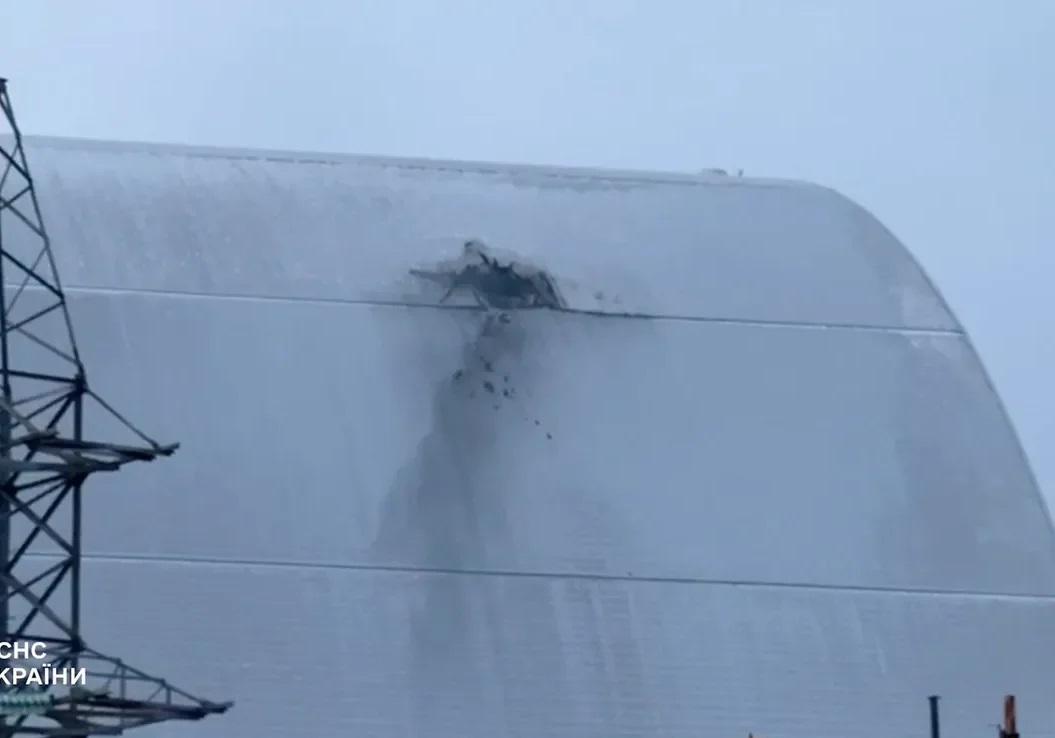
Drone attack that Ukraine blamed on Russia blew hole in painstakingly erected €1.5bn shield meant to allow for final clean-up of 1986 meltdown site.
Guardian staff and agencies, 6 Dec 25
The protective shield over the Chornobyl disaster nuclear reactor in Ukraine, which was hit by a drone in February, can no longer perform its main function of blocking radiation, the International Atomic Energy Agency (IAEA) has announced.
In February a drone strike blew a hole in the “new safe confinement”, which was painstakingly built at a cost of €1.5bn ($1.75bn) next to the destroyed reactor and then hauled into place on tracks, with the work completed in 2019 by a Europe-led initiative. The IAEA said an inspection last week of the steel confinement structure found the drone impact had degraded the structure.
The 1986 Chornobyl explosion – which happened when Ukraine was under Moscow’s rule as part of the Soviet Union – sent radiation across Europe. In the scramble to contain the meltdown, the Soviets built over the reactor a concrete “sarcophagus” with only a 30-year lifespan. The new confinement was built to contain radiation during the decades-long final removal of the sarcophagus, ruined reactor building underneath it and the melted-down nuclear fuel itself.
The IAEA director general, Rafael Grossi, said an inspection mission “confirmed that the [protective structure] had lost its primary safety functions, including the confinement capability, but also found that there was no permanent damage to its load-bearing structures or monitoring systems”.
Grossi said some repairs had been carried out “but comprehensive restoration remains essential to prevent further degradation and ensure long-term nuclear safety”……………………………https://www.theguardian.com/world/2025/dec/06/chornobyl-disaster-shelter-no-longer-blocks-radiation-and-needs-major-repair-iaea
Ukraine’s Zaporizhzhia nuclear plant temporarily lost power overnight, IAEA says.
By Reuters, December 6, 2025, https://www.reuters.com/business/energy/ukraines-zaporizhzhia-nuclear-plant-temporarily-lost-power-overnight-iaea-says-2025-12-06/
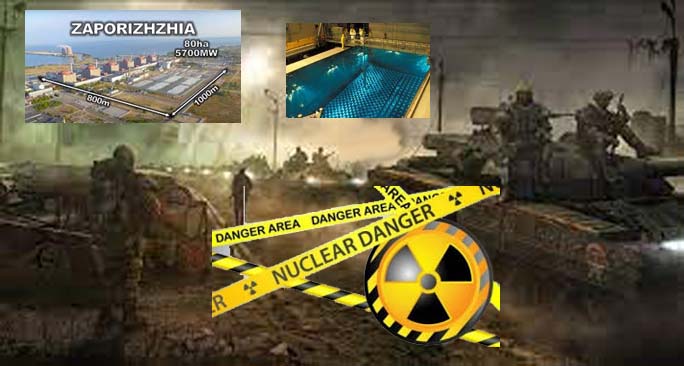
Dec 6 (Reuters) – Ukraine’s Zaporizhzhia nuclear power plant temporarily lost all off-site power overnight, the International Atomic Energy Agency said on Saturday, citing its Director General Rafael Mariano Grossi.
The nuclear plant, Europe’s largest, has been under Russian control since March 2022, when Russian forces overran much of southeastern Ukraine. It is not currently producing electricity but relies on external power to keep the nuclear material cool and avoid a meltdown.
The plant was reconnected to a 330-kilovolt (kV) power line after a half-hour outage, the IAEA said.
A 750 kV line that was also disconnected earlier was back in operation, the Russian-installed management of the plant said later on Saturday, and stable power supply had been restored.
Radiation levels remained normal, the management said.
Widespread military activities overnight affected Ukraine’s electricity grid and prompted operating nuclear power plants (NPPs) to reduce output, the IAEA added.
Reporting by Gnaneshwar Rajan and Yazhini M V in Bengaluru; Editing by Aidan Lewis and Bernadette Baum
Illegal drone shot down at nuclear submarine base
Officials are investigating an illegal drone which flew over the Atlantic coast base
Ap Correspondent, Independent UK, 05 December 2025
French authorities have launched an investigation into an unauthorised drone overflight of the nation’s nuclear-armed submarine base on the Atlantic coast.
The incident, confirmed by officials on Friday, involved multiple drones detected on Thursday night above the highly sensitive Île Longue base in Brittany, western France.
This strategic facility serves as the home port for France’s four nuclear ballistic missile submarines: Le Triomphant, Le Téméraire, Le Vigilant, and Le Terrible.
While French media reported several aerial intruders, military authorities have refrained from disclosing their exact number or type.
Defence Minister Catherine Vautrin confirmed that personnel at the base successfully intercepted the overflight. However, she did not specify whether this involved firing shots, electronic jamming, or other countermeasures. The identity of those responsible for the incursion remains unclear.
Ms Vautrin stated: “Any overflight of a military site is prohibited in our country. I want to commend the interception carried out by our military personnel at the Île Longue base.”
A number of European Union member countries have reported mysterious drone flights in their airspace in recent months. Some led to airport shutdowns, disrupting commercial flights. Others have been detected near or over military facilities………………………….. https://www.independent.co.uk/news/world/europe/drone-france-brittany-nuclear-base-b2879026.html
British Energy Ruled Out Nuclear At Heysham Due to Geological Fault.
Letter sent by Email today…https://lakesagainstnucleardump.com/2025/12/05/british-energy-ruled-out-nuclear-at-heysham-due-to-geological-fault/
Dear Lizzi Collinge MP
I am sure that you felt the earth move on December 4th along with everyone else in the region as there was a sudden movement along faults in the Morecambe bay area between Silverdale and Heysham. This was very scary for all concerned, we thought there had been a massive explosion in Milnthorpe and immediate thoughts went to Heysham’s dodgy old reactors.
SHUT DOWN OLD EMBRITTLED REACTORS AT HEYSHAM
Following on from our previous correspondence with you, the latest earthquake is a major reason why the old and embrittled reactors at Heysham should be mothballed – there would still be jobs on the site (maybe even more than now) for many years to come to ensure safe shut down and decommissioning.
GEOLOGICAL FAULT IS REASON BRITISH ENERGY SAID NO TO NEW BUILD AT HEYSHAM
The movement of the tectonic plates along the fault near Heysham on December 4th is also a major reason why there should be no new nuclear as advised by British Energy in 2002 and reported in the Lancashire Telegraph. We would suggest that MPs should ask for a copy of British Energy’s survey which found that a geological fault in the Heysham area rules out a Heysham 3 and 4. For the nuclear industry and local politicians to be ignoring this advice now in the context of a 3.3 earthquake in the Heysham area could be regarded as being reckless with the public’s safety.
Kind regards
Marianne, Radiation Free Lakeland
Fault rules out new build at Heysham, 18TH APRIL 2002
A GEOLOGICAL fault in the land next to Heysham 1 and 2 has ruled out the possibility of ever building a new nuclear power station at that site.
This week British Energy admitted it would be “impossible” to construct a Heysham 3 or 4.
Local environmentalists have recently been campaigning to stop an expansion of the area’s nuclear power capability fearing that Heysham could be chosen under the Government’s energy review.
But a British Energy survey has revealed that the vacant land has a geological fault which makes it unsuitable for development.
A spokesman said: “We have a certain amount of land but it is not suitable and a Heysham 3 or 4 has never been on the cards.
There are better places around the country to build new power stations.”
Embrittled Old Reactors
UK Government’s nuclear taskforce does not radiate authority
Paul Dorfman – AN “independent” Nuclear Regulatory Taskforce commissioned by UK Prime Minister Keir Starmer has published its final report, calling for a “radical reset of an overly complex nuclear regulatory system”.
Perhaps unfortunately, the taskforce’s announcement seems to have pre-empted its own findings, stating that it will “speed up the approval of new reactor designs and streamline how developers engage with regulators” without providing any evidence that regulation is responsible for huge delays and ballooning costs rather than the incompetence of the
builders and the issues with designs.
So, the possibility that regulation takes as long as it does because that was how long it took to do the job to the required standard was discounted from the get-go.
Made up of three nuclear industry proponents, an economist and a lawyer, the taskforce makes 47 new recommendations “to unleash a golden era of nuclear technology and
innovation” – including the proposal that new nuclear reactors should be built closer to urban areas and should be allowed to harm the local environment.
There are five members of the taskforce: John Fingleton is an
economist, Mustafa Latif-Aramesh is a lawyer, Andrew Sherry is former chief scientist at the National Nuclear Laboratory, Dame Sue Ion has held posts in sets of UK nuclear industry bodies, and Mark Bassett is a member of the International Nuclear Safety Advisory Group and appears the only one with
any experience of regulation.
Following the taskforce’s interim report in
August, a coalition of 25 civil society groups involved in formal
discussions with government warned of the dangers of cutting nuclear safety regulations, stating that the taskforce’s proposals “lacked credibility and rigour”.
Their moderating voices have gone unheard. New nuclear
construction has been subject to vast cost over-runs and huge delays. This is not the fault of safety and planning regulation – rather it’s the nature of the technology.
This attempt at nuclear deregulation would loosen
the safety ropes that anchor the nuclear industry in an increasingly unstable world. It doesn’t make good sense.
Given that the UK will influence other countries, there’s a risk that this narrative, that the only problem with nuclear is regulation, will be taken up elsewhere and there will be increasing pressure on regulators to do their job as quickly as possible regardless of whether necessary rigour would be damaged.
Blaming nuclear regulators for vast cost over-runs and huge delays has always been a fallback position for the nuclear industry. This is not the fault of safety and planning regulation, rather it’s the nature of the technology. De facto nuclear deregulation is a poor short-term choice of the worst kind – and reveals something important about the high-risk
technology that the UK Ministry of Defence classes as a “Tier 1
Hazard”.
It makes good sense to choose the swiftest, most practical,
flexible and least-cost power generation options available. Unlike new nuclear, renewables are here and now – on-time and cost effective. It’s entirely possible to sustain a reliable power system by expanding renewable energy in all sectors, rapid growth and modernisation of the electricity
grid, storage roll-out, faster interconnection, using power far more effectively via energy efficiency and management, and transitional combined cycle gas technology for short-term power demand peaks.
Combining solar, wind and energy storage increases their individual values and lowers the net cost of the energy they produce, making each component more valuable.
This synergy turns intermittent energy sources into a reliable,
dispatchable power supply.
The National 3rd Dec 2025, https://www.thenational.scot/politics/25668133.uk-governments-nuclear-taskforce-not-radiate-authority/
Russia’s economy is not about to explode.

Yet western propagandists need you to believe that it will.
Ian Proud, Dec 06, 2025, https://thepeacemonger.substack.com/p/russias-economy-is-not-about-to-explode?utm_source=post-email-title&publication_id=3221990&post_id=180801359&utm_campaign=email-post-title&isFreemail=true&r=1ise1&triedRedirect=true&utm_medium=email;
I’ve been hearing since 2014 about the imminent implosion of Russia’s economy, but this has never looked likely to happen.
In a remarkable recent article in the UK’s Telegraph newspaper, Ambrose Evans-Pritchard makes the remarkable claim that the ‘balance of advantage is shifting in favour of Ukraine,’ on the basis that Russia may soon go into economic meltdown. He goes on to say that if we walk away now, we will snatch defeat from the jaws of victory.’
However, and conveniently, he does not elucidate how Ukraine is gaining the supposed upper-hand, nor how an implausible victory over Russia might be achieved. That is because there is no evidence to support his claims.
Evans-Pritchard’s CV doesn’t show any obvious subject matter expertise on Russia. But this should come as no surprise from a newspaper – the Telegraph – whose Ukraine watcher team is stuffed with Russophobes and ex-British military types who have a vested interested in maintaining the delusion of eventual Russian defeat.
Take Dom Nicholls, who co-hosts the telegraph’s Ukraine: the Latest podcast, which grandly describes itself as the ‘world’s most trusted and award winning podcast on the war,’ even though Nicholls’ CV suggests absolutely zero subject matter expertise on the issue of Russia. His podcast never departs from the UK government line that Putin must be defeated eventually, and that only more pressure will do the trick. Nor does he allow the podcast to drift too far into real evidence about the ability of Russia to fight on longer than Ukraine can fight on.
Then take Hamish De-Bretton Gordon, retired Colonel and Chemical weapons expert with even less expertise than Dom Nicholls, who, in any case, has no Russia expertise. He regularly posts fantastical articles with titles such as ‘Putin is eating his own supporters,’ and ‘Putin will be quaking in his boots today.’
It doesn’t matter that they have no understanding of the strategic balance of power in the Ukraine war. Facts and analysis are entirely redundant for people whose top, indeed, only priority is to peddle the latest lines from the Ministry of Defence on Whitehall. This is not journalism it is government propaganda. The BBC, which in any case is a state-owned broadcaster, is bad enough in its one-sided reporting, but the Telegraph is more sinister because of its infiltration by pseudo-government operatives covering as experts.
Characteristic of most western media commentary of the in Ukraine and, indeed, of the Ukraine crisis since it started, has been the complete lack of comparison.
Focus is always and only on the negative impacts of conflict on Russia itself. And, indeed, there have been negative consequences. Russia is subject to over 20,000 economic sanctions, locked out of most trade with the west, excluded from political dialogue as an article of diplomacy, cut off from most international sports and cultural events, hundreds of thousands of its troops killed or injured since the war started, its regular citizens increasingly restricted in their movements within Europe.
The economy of Russia today looks vastly different from that in 2014 when the crisis started. As President Putin recently pointed out, economic growth is sagging from its early war highs which were stimulated by a massive fiscal splurge. Interest rates and inflation remain worryingly high, labour shortages in some industries are growing, the population continues to age, and it remains over-reliant on fossil fuel exports.
Some of these issues are long-standing, while others have become more acute since the war began. Yet, these manifest limitations are never juxtaposed against the even greater challenges that Ukraine faces, which you will seldom hear mention of in the Telegraph.
The weight of western foreign policy, bolstered by willing pro-war reporters in the media, is that breaking Russia’s petroeconomic model will force Putin to back down, and that sanctions are helping to do just that.
So, let’s take a look at Ambrose-Pritchard’s key argument that Russia’s oil exports are collapsing on the back of Trump’s recent sanctioning of Rosneft and Lukoil. This might be persuasive if true and if Ukraine’s exports were somehow performing much better.
Yet, the early evidence suggests otherwise. US sanctions on Rosneft and Lukoil do appear dramatically to have reduced their volumes of trade. However, there is also evidence, that trade has simply been diverted to other Russian exporters of oil, with no significant net effect. Diversion, which has been widely reported by the media, is and has been a Russian tactic to minimise sanctions impact for over a decade, after all.
Bear in mind that Russian oil has been sanctioned in one way or another by the EU since 2014, and that there has been a progressive shutting down of gas exports since the war in Ukraine started. You would therefore expect that the total value of Russia’s exports had fallen.
Except that it hasn’t.
Since 2014, the average quarterly value of Russian exports has been a fraction above $100 bn. This takes account of the huge surge in export values shortly before the war started and throughout 2022 on the back of soaring oil prices. In the four quarters from Q4 2021 to Q3 2022, Russian exports averaged $150 bn (or $50 bn per month), 50% higher than the long-term average. But on the flip side, it also averages out against troughs, in particular after the oil price collapse of 2016 and during COVID.
In the first two quarters of 2025, Russian exports have come in at $98 bn, $2bn below the long-term average, although, in fact, identical to the two-year period from Q4 2019 through Q3 2021. So, no golden bullet evidence here of sanctions having a more than marginal impact at best, given Russia’s export pivot towards Asia and the global south.
In any case, the value of exports is a less helpful reference than the overall trade balance, i.e. the difference between exports and imports. It doesn’t matter how big a country’s exports are if they are importing more.
Let’s take a historical look back to the start of the Ukraine crisis in 2014. Russia’s quarterly current account surplus – its balance of exports over imports – has averagfed $17.9 bn. Right now it is lower, at $11 bn with oil prices falling and imports higher than average. In 2022, Russia pulled in its highest ever current account surplus, with a quarterly average of $59.5 bn, when oil prices were soaring.
However, the key point is that Russia is able to stay in surplus every year and hasn’t experienced a full-year current account deficit since 1997, and even then it was less than $1 bn.
Consistently exporting more than it imports, Russia has built its international reserves over time, giving it resilience against external economic shocks and pressure. Russia’s international reserves have steadily grown from around $400 bn in late 2014, to $725 bn now. Even if western powers expropriated all of the approximately $300 bn in immobilised assets, Russia would still possess more than it had in 2014, the year the Ukraine crisis started.
In a quite bizarre comment, Evans-Pritchard says ‘Putin can keep selling Russia’s reserves of gold, all the way down to the Tsarist double eagles at the bottom of the vault beneath Neglinnaya Street,’ (the location of Russia’s Central Bank). This hints strongly, that Russia is on the verge of running out of gold, right?
And yet, Russia’s reserve stock of monetary gold has grown from $132 bn when the war started in 2022, to $299 bn today, which includes an increase of $17bn in October 2025.
I don’t say this out of any desire to prove Russia to be right, but rather from a determination to let our analysis of the situation to be driven by data, not vacuous sound bites.
The ridiculous announcements in the Daily Telegraph lack credibility precisely because they consciously and intentionally avoid hard evidence about Russia while avoiding all mention of Ukraine’s difficulties. Readers are invited to believe that Ukraine is doing just fine, and that if we just keep pumping money in, they will eventually win.
So, let’s look at Ukraine in comparison. Since 2014 through 2024, it has consistently imported more than it exports, with an average yearly trade deficit of $13.1 bn. During the first three full years of war, that rose on average to $25.6 bn, and in the first ten months of 2025, it is already at $39.8 bn. Expressed another way, Ukraine exported $24 bn less in 2024 than it did in 2021 and imported $2.5 bn more. War and European restrictions on the import of cheap Ukrainian agriculture have hit the value of its exports hard. That might bounce back when the war ends, even though Evans-Pritchard wants it to continue.
But, even so, Ukraine’s current account has shown an average deficit of $2.8 bn since 2014; the figure is so much lower than the trade balance because of big inflows of foreign donations, in particular in 2015 and in 2022, which led to a current account surplus in those years. Critically, while Ukraine had a current account surplus of $8bn in 2022, it slumped back into deficit in 2023, with a shortfall of $9.6 bn which rose to $15.1 bn in 2024. In the first 10 months of 2025, the deficit already stands at $26.9 bn.
That means Ukraine will need at least $30 bn in foreign exchange this year just to keep its currency afloat. The only credible way right now in which Ukraine can easily fill the hole in its international reserves is to receive donations from western nations. And as we are starting to see, in respect of Europe’s faltering efforts to agree a bizarrely named ‘reparations loan’, that is proving increasingly difficult because of Belgian and European Central Bank resistance.
So, War hungry pundits in the Telegraph talk about the imminent collapse of the Russian economy are only deflecting attention from the real problem. When the western money stops flooding into Ukraine, the country may quickly find itself having to devalue its currency and, in so doing, deal with spiralling inflation, high interest rates and a sovereign default.
Of course, Ukraine is already bankrupt, as it refuses to make payments on its existing debt while nonetheless asking for more loans. Western IFIs have conveniently turned a blind eye to this right back to 2015 when Ukraine defaulted on a loan it had received from Russia. They’ve done this under pressure from western governments who also, no doubt, drive outlandish Telegraph headlines about Russia’s imminent implosion.
The sad truth is, people like Evans-Pritchard need the war to continue so they have something to say. They certainly couldn’t care a jot about Ukraine itsel
New mini nuclear reactors are jeopardised by wildlife fears

COMMENT. Doncha love that headline?
I mean – those poor little non-existent unaffordable, dirty, dangerous, useless mini nuclear reactors – being persecuted by nasty Arctic, Sandwich and vulgar common terns!
Pledge to build three small modular reactors on island of Anglesey is threatened by warnings of potential impact on nesting terns in local nature reserve.
Sir Keir Starmer’s attempt to kickstart Britain’s mini nuclear reactor programme is being threatened by a protected colony of rare birds. The prime minister has pledged to build the UK’s first three small modular reactors (SMRs) at the Wylfa nuclear site on the island of Anglesey in north Wales, but the proposed location sits beside the Cemlyn nature reserve, where about 2,000 pairs of Arctic, Sandwich and common terns nest
each summer.
Wildlife groups have warned that the birds could abandon the
site if construction goes ahead, and this threatens to delay or reshape the first big project in the government’s nuclear programme, according to the Telegraph, which first reported the story, Mark Avery, a scientist and former conservationist at the Royal Society for the Protection of Birds (RSPB), said:
“Terns are vulnerable because of the types of places where
they live, which tend to be places that would be disturbed if they’re not protected. So they do need our help. And the UK is important for these species. If anybody’s going to look after them, we ought to.”
Times 1st Dec 2025, https://www.thetimes.com/business/energy/article/new-mini-nuclear-reactors-are-jeopardised-by-wildlife-fears-gjmf28bgz
Chernobyl nuclear plant’s shield damaged: UN agency
Canberra Times, December 6 2025, https://www.canberratimes.com.au/story/9128130/chernobyl-nuclear-plants-shield-damaged-un-agency/
A protective shield at the Chernobyl nuclear plant in war-torn Ukraine, built to contain radioactive material from the 1986 disaster, can no longer perform its main safety function due to drone damage, the UN nuclear watchdog says.
The International Atomic Energy Agency said an inspection last week of the steel confinement structure completed in 2019 found the drone impact in February, three years into Russia’s conflict in Ukraine, had degraded the structure.
IAEA director general Rafael Grossi said in a statement the inspection “mission confirmed that the (protective structure) had lost its primary safety functions, including the confinement capability, but also found that there was no permanent damage to its load-bearing structures or monitoring systems.”……………………………………………………………….. https://www.canberratimes.com.au/story/9128130/chernobyl-nuclear-plants-shield-damaged-un-agency/
What’s behind the peace negotiations for Ukraine?

(President Macron) had indeed pompously signed documents for the sale of 100 Rafale fighter jets, SAMP/T air defense systems, modern air defense radars, air-to-air missiles, and guided bombs to Ukraine. In reality, these were not contracts, but “declarations of intent.” The financing for these extravagant sales was not guaranteed, and their manufacture by Dassault Aviation could not begin for five to ten years.
We don’t know what was said in Washington, but we can assume that the United States took a firm stance toward Ukraine, even if it didn’t want to risk destroying Atlantic solidarity. Thierry Meyssan presents here what transpired during this tumultuous week.
by Thierry Meyssan, Voltaire Network | Paris (France) | 5 December 2025, https://www.voltairenet.org/article223293.html
To understand the week of peace negotiations in Ukraine, it is essential to first dispel the misinformation disseminated by the mainstream press: contrary to what they implied, the Europeans were never allowed to join the Geneva talks.
It is also worth recalling what I explained last week [1]: European governments have no interest in peace; they even fear it: it would undoubtedly bring about their own downfall.
It is therefore no coincidence that the German, British, and French press claimed that the Geneva peace plan was a European document. They asserted this so strongly that we ourselves repeated this falsehood before correcting it.
With that established, let us review the sequence of events:
When the peace plan, drafted by the United States and Russia in Florida, became public [2], the subservient commentators presented it as “outrageously pro-Russian.”
The Geneva Negotiations
The Ukrainians requested to draft a counter-proposal with the United States. Talks were held in Geneva on November 23 and 24.
However, on November 22, EU leaders, along with the British, Norwegians, and Japanese, all attending the G20 summit of heads of state and government in Johannesburg, issued a joint statement. It reads:
“We are ready to commit to ensuring that future peace is lasting. We are clear on the principle that borders must not be changed by force. We are also concerned about the proposed restrictions on the Ukrainian armed forces, which would leave Ukraine vulnerable to future attack.
We reiterate that the implementation of elements relating to the European Union and those relating to NATO would require the consent of the respective EU and NATO members.”
Germany, France, and the United Kingdom therefore sent diplomats—uninvited—to the Intercontinental Hotel where the US and Ukrainian delegations were staying. They were able to speak with both sides but were not admitted to the negotiations.
The document, released after the talks, reiterates only the Ukrainian arguments [3].
It no longer mentions the denazification of Ukraine, the country’s neutrality, or EU participation in its reconstruction. It is therefore unacceptable from a Russian perspective.
Presenting his work to the press, State Secretary Marco Rubio simply stated that things were progressing very well. This is probably because Ukraine had renounced the reconquest of territories occupied/liberated by Russia and accepted their international recognition as Russian.
The “Coalition of the Willing”
On November 25, the Coalition of the Willing, established on March 1, 2025, by General Petr Pavel, Czech President and former Chairman of NATO’s Military Committee, and by Keir Starmer, British Prime Minister, met via videoconference.
Continue readingTogether Against Sizewell C (TASC)’s new legal challenge against Sizewell C’s secret flood defences.
4 Dec 25, https://www.crowdjustice.com/case/sizewell-c-legal-challenge/
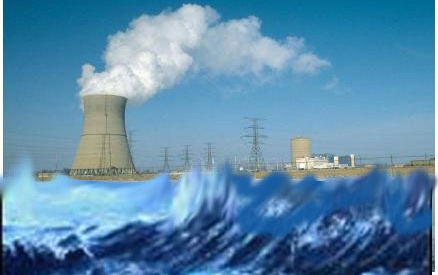
The Sizewell C site will be storing up to 4,000 tonnes of spent nuclear fuel on this vulnerable coastline until the late 2100s. The precautionary principle should surely apply so resilience, potential risks and impacts are assessed on a worst case basis and that should be done now. Sizewell C Ltd seem to believe they can do as they see fit with our Heritage Coast, National Landscape and designated wildlife sites irrespective of the damage they will cause.
On Tuesday 9 December Together Against Sizewell C has a permission hearing at the High Court for their case about the overland flood barriers.
The project now includes a stated commitment by Sizewell C Ltd to the Office for Nuclear Regulation (ONR) to install additional sea defences in a ‘credible maximum’ climate change scenario. These defences in the form of two huge 10 metre high ‘overland flood barriers’ were not included in the approved DCO project. In our opinion, these flood barriers, if installed, will likely have additional adverse impacts on the neighbouring designated wildlife sites including RSPB Minsmere as well as the Heritage Coast and Suffolk Coast & Heaths National Landscape. We need to ensure that the original promotor EDF and the now UK government controlled Sizewell C Ltd are not allowed to use climate change uncertainties as an excuse to delay assessment and avoid public scrutiny of these additional structures for decades. The full impact of the whole project should be assessed now.
There is very little detail about the barriers, but it appears from the above diagram [on original] that, if needed:-
The Southern barrier stretches for nearly 500 metres from the Sizewell A site, across the Sizewell Gap to the start of the cliffs running south to Thorpeness, sited on land not in Sizewell C’s ownership.
The Northern barrier potentially stretches from the north of the Sizewell C site, through the SSSI, then inland over Goose Hill for up to a kilometre.
Together with our lawyers, Leigh Day, we have sought the High Court’s permission to apply for judicial review of the decision of the Secretary of State to refuse TASC’s request to revoke or vary the Sizewell C DCO. The grounds for our legal challenge are set out in Leigh Day’s press release.
How we got here
From documents obtained under a Freedom of Information (FOI) request, TASC found out that EDF knew as far back as 2017 that their chosen nuclear platform height of 7.3m AOD would, along with the adapted sea wall on the eastern flank of the site, require two 10-metre high ‘overland flood barriers’. These will be needed to prevent the nuclear platform from flooding from the west in the event that sea level rise reaches a ‘credible maximum’ scenario. This will lead to a major breach of the low-lying coast to the north of Sizewell C and south of the Sizewell nuclear cluster. However, while EDF rightly included the adaptive design of the eastern sea defences in their DCO application documents, they did not include the southern and northern overland flood barriers in the DCO application, thereby avoiding any public scrutiny. As a result there is no commitment in the approved DCO to install these additional sea defences. This is despite there being a requirement to keep the nuclear site safe for its full lifetime from climate change impacts in a credible maximum scenario i.e. to, at least, 2160 while spent nuclear fuel is stored on site.
TASC’s aim is to ensure that the overland flood barriers, not included by EDF in the DCO application, now form part of the overall project. Therefore we need the Secretary of State to either revoke or change the DCO, in order that a lawful assessment of the potential environmental impacts of the entire project is carried out and subject to public scrutiny.
This is important because the project may be grossly underestimating the potential environmental impact, flood risk and sea-defence costs. This, if unaddressed, could be a major burden on future and far future generations who may be impacted by severe, non-reversible environmental, ecological and human impacts combined with an extreme financial liability if Sizewell C were to flood.
Further background for those that want to know more
The Sizewell C project, originally promoted by EDF, is to build twin EPR nuclear reactors close to the North Sea at Sizewell, Suffolk, one of the fastest eroding coastlines in Europe. The site is in the heart of Suffolk Coast & Heaths National Landscape, largely surrounded by designated wildlife sites including RSPB Minsmere and will be partially built on Sizewell Marshes SSSI.
In 2021, Prof Paul Dorfman’s report stated “…any adaptation efforts to mitigate annual flooding (projected to almost entirely surround the proposed EDF Sizewell C EPR nuclear island by 2050) will inevitably entail significantly increased expense for construction, operation, spent nuclear fuel management, rad-waste storage and eventual decommissioning”.
In line with the ONR’s preference, Hinkley Point C is a ‘dry site’ i.e. its platform height at 14 metres AOD is of sufficient height to prevent it from flooding. However, Sizewell C with a platform height of 7.3m AOD, is a ‘protected site’ which means that Sizewell C must at all times demonstrate that the site can be protected against flooding for its full lifetime by use of ‘permanent external barriers such as levees, sea walls and bulkheads’. Once Sizewell C is constructed with a 7.3m AOD platform height, the platform cannot be raised at a later date. The overland flood barriers need to be assessed now so alternatives can be considered e.g. raising the platform height.
Sizewell C was given DCO approval in July 2022 against the recommendation of the five professional planning inspectors. In TASC’s view, the impacts from the overland flood barriers, if they had been assessed during the DCO examination, may well have resulted in planning permission being refused. In any event, our case argues that the Secretary of State’s ‘Habitats Regulation Assessment’ has not considered the environmental impacts of the full project or alternatives, something that is a lawful requirement.
Documentation published by the ONR supporting their grant of Sizewell C’s nuclear site licence in May 2024, has revealed that, in TASC’s opinion, there are now two materially different projects, the one in the DCO approved by Kwasi Kwarteng, and the one still being considered by the ONR as part of the ‘site safety case’. It was an FOI request to the ONR in late 2024 that provided the documentation from 2017 that shows the project requires the adaptive flood protection in the form of the overland flood barriers in a credible maximum climate change scenario.
The Sizewell C site will be storing up to 4,000 tonnes of spent nuclear fuel on this vulnerable coastline until the late 2100s. The precautionary principle should surely apply so resilience, potential risks and impacts are assessed on a worst case basis and that should be done now. Sizewell C Ltd seem to believe they can do as they see fit with our Heritage Coast, National Landscape and designated wildlife sites irrespective of the damage they will cause.
In an attempt to resolve our concerns, on 6th March 2025 TASC wrote to Secretary of State, Ed Miliband calling on him to make a decision on whether the material change to the Sizewell C project highlighted by TASC, namely the commitment to install ‘overland flood barriers’, ‘amounts to exceptional circumstances that make it appropriate for him to exercise his power to change or revoke the DCO’.
The Energy Minister, on behalf of the Secretary of State, replied on 28th March 2025, refusing TASC’s request to vary or revoke the DCO. As TASC consider this matter to be of great importance, we have been left with no alternative but to challenge the Secretary of State’s decision through the courts.
Ukraine’s Energoatom, Holtec International, and the US retreat from fighting corruption abroad

very little about the relationship between Trump’s Washington and Zelenskyy’s Kyiv might be considered ordinary.
President Zelensky moved to dismantle the safeguards meant to protect Ukraine’s institutions from corruption,
Bulletin, By Matt Smith | December 3, 2025,
In 2012, FBI agents stationed themselves in a Trump Tower apartment to wire up a senior official of FIFA, soccer’s world governing body, to record conversations that would become evidence for anti-bribery prosecutions. In 2018, Justice Department officials seized the yacht Equanimity in an operation aimed at returning stolen assets to Malaysia. In 2023, the United States sent a veteran US prosecutor to Kyiv to strengthen Ukraine’s anti-corruption agencies, which America had earlier helped establish.
In a functioning international order, we might see this type of global collaboration in the wake of a recent investigative piece I wrote for the Bulletin about a US company, Holtec International, that has had substantial dealings with a state-owned nuclear company now under investigation in Ukraine.
In more normal times, the government of Ukrainian President Volodymyr Zelenskyy might request assistance under the US-Ukraine Treaty on Mutual Legal Assistance in Criminal Matters. The FBI established a liaison office at the headquarters of the National Anti-Corruption Bureau of Ukraine (aka NABU) in 2017, under a memorandum of understanding to cooperate on “investigations related to money laundering, international asset recovery, and Ukrainian high-level officials’ bribery and corruption.” These are word–for–word what investigators are now pursuing in Ukraine’s nuclear power agency.
A professionalized Justice Department could respond to a formal Ukrainian request by issuing subpoenas seeking information from US firms that might be relevant to the Ukrainian probe.
But we are no longer in anything like normal times.
Here’s the context: NABU—an agency the United States helped create and train—is investigating an alleged $100 million corruption scheme inside Energoatom, the governmental body that oversees nuclear energy and spent fuel storage in Ukraine. This scandal has consumed Zelenskyy’s inner circle and led to the resignation of his chief deputy and lead peace negotiator.
Holtec International, a Florida company that established an office in Kyiv in 2007, became a prime contractor and subcontractor for Energoatom on complex, multi-year spent nuclear fuel storage projects.
Holtec executives met repeatedly with Energoatom leadership. They navigated Ukraine’s procurement systems. They hired local subcontractors. They managed complex, multi-year construction projects in a business environment that Ukrainian prosecutors now say has been compromised. Holtec has files that could matter: Ukrainian invoices, compliance checks, email communications, and management logs.
In response to my inquiry about whether the company had heard from the Justice Department regarding Ukraine, Holtec issued a statement saying it witnessed no corruption: “Our operations center in Kyiv, Holtec Ukraine, has worked with our client, Energoatom, to provide safe storage systems and technology to ensure the spent fuel in Ukraine is stored safely and protected from external threats. At no time have we had any interactions that would have led us to believe in any impropriety with our work and contracts.”
As with any such company statement, this one merits checking. Holtec email communications might show whether American executives interacted with the officials now under investigation. Compliance audits might reveal whether the company flagged irregularities. Payment records might reveal inflated costs prosecutors have identified elsewhere. Internal management logs might document which Ukrainian officials controlled access to Holtec’s projects and whether those officials match the outside “shadow managers” prosecutors have identified as having gained control of Energoatom and then having demanded bribes from contractors.
The Bulletin’s investigation, published November 20, did not find evidence that Holtec was involved in Ukrainian misconduct. In fact, subpoenaing Holtec’s records would neither require nor imply allegations of corporate wrongdoing; such subpoenas require only the recognition that a US entity could possess evidence material to a foreign corruption prosecution. The legal mechanisms for seeking Holtec’s records exist. The precedents for doing so are well-established. Such a procedure has previously been seen as an ordinary step.
But very little about the relationship between Trump’s Washington and Zelenskyy’s Kyiv might be considered ordinary.
Since Trump took office in January, his administration has pursued a quiet dismantling of America’s ability to provide this kind of aid. On February 5, Attorney General Pam Bondi formally disbanded Task Force KleptoCapture, the unit established after the Russian invasion of Ukraine and dedicated to seizing assets of Russian oligarchs. Five days later, President Donald Trump signed Executive Order 14209, explicitly “pausing” enforcement of the Foreign Corrupt Practices Act—the very statute that authorizes investigations into potential bribery of foreign officials by US companies.
Deregulation even extended to tools of crime, as Russia increasingly relies on cryptocurrency to bypass sanctions. The Justice Department has turned away from prosecuting digital asset violations while the US established a “Strategic Bitcoin Reserve,” giving legitimacy to a cryptocurrency known as a key sanctions-evasion tool.
Scores of federal prosecutors have left Justice as colleagues were fired for perceived political slights. Trump’s highest-priority prosecutions—i.e., the politicized ones—are pursued by unqualified loyalists who have ended up, in many matters, embarrassing a once-storied agency.
The diminished US interest in corruption prosecution has had foreseeable consequences in Kyiv. Concurrent with the shift in Washington, President Zelensky moved to dismantle the safeguards meant to protect Ukraine’s institutions from corruption, signing legislation in July to strip NABU of independence. Ukrainians took to the streets. Most reports about international pressure to restore NABU’s status concerned European countries that sprang to the defense of the anti-corruption agency America helped build. The United States recently rotated a new FBI liaison to the NABU offices as part of the cooperation agreement. The Ukrainian press said a recent meeting concerned the Energoatom bribery case.
Typically, the next steps might seem clear. But nobody involved seems to be operating in a typical way.
The Justice Department press office did not respond to questions asking whether Holtec’s files sit in Florida, untouched. https://thebulletin.org/2025/12/ukraines-energoatom-holtec-international-and-the-us-retreat-from-fighting-corruption-abroad/?utm_source=ActiveCampaign&utm_medium=email&utm_content=Ukraine%20s%20Energoatom%2C%20Holtec%20International%2C%20and%20the%20US%20retreat%20from%20fighting%20corruption%20abroad&utm_campaign=20251201%20Monday%20Newsletter%20%28Copy%29
Europe could be on the hook for $160 billion to keep Ukraine afloat.
Belgium is holding the line on using Russia’s frozen assets for now, which leaves Europe obligated to keep the lights on and the war going
Ian Proud, Dec 04, 2025, https://thepeacemonger.substack.com/p/europe-could-be-on-the-hook-for-160?utm_source=post-email-title&publication_id=3221990&post_id=180637110&utm_campaign=email-post-title&isFreemail=true&r=1ise1&triedRedirect=true&utm_medium=email
Below my article of yesterday in Responsible Statecraft on the issue of the spuriously named ‘reparations loan’ to Ukraine. Since going to print, the European Central Bank has come out to torpedo the Commission’s expropriation of $140 bn in immobilised Russian assets to fund the Ukrainian war effort. This should come as no surprise, as Christine Lagarde pointed out the risks at the October European Council meeting, and Bart de Wever leaned heavily on her advice in his subsequent remarks to the media.
Not surprisingly, western mainstream pro-war hacks have come out a-howling at this outrage. The eternally moronic Anders Aslund questioning the ECB’s right to have an opinion on European financial assistance to Ukraine. Bill Browder simply suggesting Europe should expropriate the funds anyway, even though they are housed in Belgium, and the Belgians won’t permit it.You can see why he made so much money in Russia in the nineties. Less clear which clown in Whitehall decided he should be knighted.
The level of idiocy is truly off the charts. And the clamour now is so loud simply because Ukraine will shortly run out of money, Europe will need to tip more money into the bottomless pit at Bankova, and they may well have to use funds from national budgets (even if it is packaged up as common EU debt).
Meanwhile, Belgian police have raied the premises of hte former EU foreign policy chief, Federica Mogherini, arresting her on suspicion of fraud at the College of Europe. Who is surprised that yet another unelected, unaccountable EU apparatchik is on the make?
Perhaps that’s why the Commission is so desperate to support the corrupt regime in Kyiv, as they are kindred spirits. More likely, they are merely stupid and have no self-awareness. Ursula von der Leyen seems to be carrying on regardless, as if nothing is untowards. driving towards the cliff edge at breakneck speed with her and Kaja Kallas’ feet firmly on the accelerator pedal. You couldn’t make it up….
I hope you find the article interesting.
Even if war ended tomorrow, Europe could be on the hook for 135 billion euros (nearly $160 billion) over the next two years to keep Ukraine afloat. Brussels does not appear to have a plan B up its sleeve.
I first warned in September 2024 that using immobilized Russian assets to fund war fighting in Ukraine would disincentivize Russia from suing for peace. Nothing has changed since then. Russia maintains the battlefield advantage, has the financial reserves, extremely low levels of debt by Western standards, and can afford to keep fighting, despite the human cost. Putin is self-evidently waiting the Europeans out, knowing they will run out of money before he does.
For now, his strategy appears to be working, because Ukraine has no money and Europe — unwilling to see Ukraine pushed into an unfavorable peace — is groaning under the obligation to find an answer. In May I also reported that “Ukraine is already asking for more money to continue fighting into 2026, a sure sign that President Volodmyr Zelensky has no plans to end the war.”
At that time, the likely cost of war fighting for another year was estimated at around $43.3 billion. The bill has since gone up to $63 billion in 2026 and, according to the IMF, $136.6 billion over the next four years.
Europe simply does not have this level of funding freely available. As a result, European political leaders are descending into panic mode as the chicken of Ukraine’s enormous budget shortfall comes home to roost.
That chicken, to quote the prime minister of Belgium, Bart de Wever, in remarks after the October European council meeting, is the $140 billion in immobilized Russian assets that the European Commission would like to use to back a “reparations loan” to Ukraine. Self-evidently, this money isn’t intended for reparations, but rather to soak up Ukraine’s expected deficits going forward.
All of the money would be pumped into Ukraine’s treasury to meet day to day expenses, with the defense bill alone costing $172 million every day right now, compared to $140 million per day one year ago. And on the basis that Ukraine’s budget estimates only ever go up and not down, that money won’t last forever.
At this point, one might be tempted to think that Ukraine’s vast defense spending, which accounts for around 63% of the Ukrainian government’s budget, will fall away if the war ends this year, in response to President Trump’s peace initiative. But such an assumption is, I fear, misplaced. Europe has been pressuring the U.S. not to cap the size of Ukraine’s near one million strong army in any peace deal. In a best-case scenario, Ukraine might decide in a graduated way to reduce the size of its army over time. But that would still leave a large budget black hole for some years to come. Yet a large army won’t pay for itself and the Europeans will be left to pay the bill.
Perhaps not surprisingly, the Belgians are saying “non” to the use of immobilized assets in its country to fund Ukraine’s fiscal deficit. Prime Minister de Wever claims that doing so will derail U.S.-led efforts to bring the near four-year long war to a close, by disincentivizing Russia from settling, which takes us back to the point I made 15 months ago.
However, the deeper issue for Belgium is a fear that sanctioning the expropriation of Russian sovereign assets on shaky legal ground would shred its financial reputation and scare off investors from the developing world. Belgium-based Euroclear, where the immobilized Russian assets are held, has a stock of $4 trillion in sovereign assets from around the globe. Starting to eat the chicken of these assets, as Belgium’s prime minister puts it, by essentially lending those assets to Ukraine, could “damage Belgium’s reputation as a reliable financial hub and erode trust in the euro and the EU financial system.”
Predictably, that has led to a storm of protest from other European states that are piling increasing pressure on Belgium to relent and so free up the monies for Ukraine’s cause. But as de Wever has pointed out on numerous occasions, those European states, for example, Germany, France, the Netherlands and Luxembourg, are not offering to unleash immobilized Russian assets in their jurisdictions and so share the financial risk. Nor are they willing to back the loan of assets held in Belgium with guarantees to repay a proportion of the cost, should Russia mount a successful legal challenge after the war ends. So, for now, Belgium is holding out and blocking the loan, with few signs that it will back down.
As a result, the matter has been kicked back to December for a final decision buying time for the Eurocrats in Brussels to sway their recalcitrant Belgian hosts. If agreement cannot be reached, Ukraine faces the prospect of running out of money to fight, on the basis that it is locked out of access to Western capital markets, given its moratorium on the repayment of debt.
That leaves the European Commission in the position of possibly having to raise capital on the markets to make a non-repayable grant to Ukraine to cover its financing needs in 2026.
How did we end up here? Since 2024, Western sponsors of the war in Ukraine have progressively shifted from offering free cash to loans, most notably the last big G7 loan of $50 billion that was agreed in June of 2024. But with Ukraine’s national debt to GDP having risen from 49% in 2021 to 109% now, piling more debt on the war-ravaged country may literally equate to killing Ukraine with kindness.
The reparations loan was clearly intended as a means to make Russia pay so that neither Ukraine, nor Europe, had to. Efforts to find off-budget means to pay for the war in Ukraine have always been “an unseemly quest for alternatives to western taxpayers funding.” Put simply, cash-strapped European governments can’t easily afford to give Ukraine their own money at a time when their governments face rising political headwinds at home from nationalist parties.
Mainstream European political leaders have remained implacably set against the idea of bringing the senseless war in Ukraine to a much-needed close. They will pay the price for this at the polls in the coming years, as the big fiscal chicken of war spending pecks away at their legitimacy at home. This is all the more depressing for having been so utterly predictable.
Russia Dangles Business Ties To U.S. at Europe’s Expense. Kremlin pitched White House on investments and industry to end war – today’s Wall Street Journal

American and Russian business leaders were quietly anticipating that Witkoff and Dmitriev would deliver, positioning their companies to profit from peace.
2 Dec 2025 By Drew Hinshaw, Benoit Faucon , Rebecca Ballhaus , Thomas Grove and Joe Parkinson
Three powerful businessmen— two Americans and a Russian—hunched over a laptop in Miami Beach, ostensibly to draw up a plan to end Russia’s long and deadly war with Ukraine.
But the full scope of their project went much further, according to people familiar with the talks. They were privately charting a path to bring Russia’s $2 trillion economy in from the cold—with American businesses first in line to beat European competitors to the dividends.
At his waterfront estate, billionaire developer-turned-special envoy Steve Witkoff was hosting Kirill Dmitriev, head of Russia’s sovereign-wealth fund and Vladimir Putin’s handpicked negotiator, who had largely shaped the document they were revising on the screen. Jared Kushner, the president’s son-in-law, had arrived from his nearby home on an island known as the “Billionaire Bunker.”
Dmitriev was pushing a plan for U.S. companies to tap the roughly $300 billion of Russian central bank assets, frozen in Europe, for U.S.-Russian investment projects and a U.S.-led reconstruction of Ukraine. U.S. and Russian companies could join to exploit the vast mineral wealth in the Arctic. There were no limits to what two longtime adversaries could achieve, Dmitriev had argued: Their rival space industries, which raced one another during the Cold War, could even pursue a joint mission to Mars with Elon Musk’s SpaceX.
For the Kremlin, the Miami talks were the culmination of a strategy, hatched before Trump’s inauguration, to bypass the traditional U.S. national security apparatus and convince the administration to view Russia not as a military threat but as a land of bountiful opportunity, according to Western security officials. By dangling multibillion-dollar rareearth and energy deals, Moscow could reshape the economic map of Europe—while driving a wedge between America and its traditional allies.
Dmitriev, a Goldman Sachs alumnus, had found receptive partners in Witkoff—Trump’s longtime golfing partner—and Kushner, whose investment fund, Affinity Partners, drew billion-dollar investments from the Arab monarchies whose conflict with Israel he had helped mediate.
The two businessmen shared President Trump’s longheld approach to geopolitics. If generations of diplomats viewed the post-Soviet challenges of Eastern Europe as a Gordian knot to be painstakingly unraveled, the president envisioned an easy fix: The borders matter less than the business. In the 1980s, he had offered to personally negotiate a swift end to the Cold War while building what he told Soviet diplomats would be a Trump Tower across the street from the Kremlin, with their Communist regime as a business partner.
“Russia has so many vast resources, vast expanses of land,” Witkoff told The Wall Street Journal, describing at length his hopes that Russia, Ukraine and America would all become business partners. “If we do all that, and everybody’s prospering and they’re all a part of it, and there’s upside for everybody, that’s going to naturally be a bulwark against future conflicts there. Because everybody’s thriving.”
Red lines
When a version of the 28point plan leaked earlier this month, it drew immediate protests. Leaders in Europe and Ukraine complained it reflected mostly Russian talking points and bulldozed through nearly all of Kyiv’s red lines. They weren’t assuaged even after administration officials assured them that the plan wasn’t set in stone, worried that Russia— after violently redrawing European borders—was being rewarded with commercial opportunities.
As Western leaders convened to digest the plan, Poland’s prime minister Donald Tusk offered a pithy summary: “We know this is not about peace. It’s about business.”
For many in the Trump White House, that blurring of business and geopolitics is a feature, not a bug. Key presidential advisers see an opportunity for American investors to snap up lucrative deals in a new postwar Russia and become the commercial guarantors of peace. In conversations with Witkoff and Kushner, Russia has been clear it would prefer U.S. businesses to step in, not rivals from European states whose leaders have “talked a lot of trash” about the peace efforts, one of these people said: “It’s Trump’s ‘Art of the Deal’ to say, ‘Look, I’m settling this thing and there’s huge economic benefits for doing that for America, right?’” A question for history will be whether Putin entertained this approach in the interest of ending the war, or as a ploy to pacify the U.S. while prolonging a conflict he believes is his place in history to slowly, ineluctably win.
Trusted friends
One sign that he may be serious is that some of his mosttrusted friends, sanctioned billionaires from his St. Petersburg hometown—Gennady Timchenko, Yuri Kovalchuk and the Rotenberg brothers, Boris and Arkady—have sent representatives to quietly meet American companies to explore rare-earth mining and energy deals, according to people familiar with the meetings and European security officials. That includes reviving the giant Nord Stream pipeline, sabotaged by Ukrainian tactical divers, and under European Union sanctions.
Earlier this year, Exxon Mobil met with Russia’s biggest state energy company, Rosneft, to discuss returning to the massive Sakhalin gas project if Moscow and Washington gave the green light.
Elsewhere, a cast of businessmen close to the Trump administration have been looking to position themselves as new economic links between the U.S. and Russia.
Gentry Beach, a college friend of Donald Trump Jr. and campaign donor to his father, has been in talks to acquire a stake in a Russian Arctic gas project if it is released from sanctions. Another Trump donor, Stephen P. Lynch, paid $600,000 this year to a lobbyist close to Trump Jr. who is helping him seek a Treasury Department license to buy the Nord Stream 2 pipeline from a Russian state-owned company.
There is no evidence that Witkoff, the White House or Kushner are briefed on these efforts or coordinating them. A person familiar with Witkoff’s thinking said the envoy is confident that any settlement with Russia would benefit America broadly, not just a handful of investors.
Witkoff, who hasn’t traveled to Ukraine this year, is set to visit Russia for the sixth time this week and will again meet Putin. He insisted he isn’t playing favorites. “Ukrainians have fought heroically for their independence,” said Witkoff, who has tried to inspire Ukrainian officials with the idea of soldiers disarming to earn Silicon Valley-scale salaries operating American built AI data centers. “It is now time to consolidate what they have achieved through diplomacy,” he said.
‘Both sides’
“The Trump administration has gathered input from both the Ukrainians and Russians to formulate a peace deal that can stop the killing and bring this war to a close,” said White House spokesperson Anna Kelly. “As the President said, his national security team has made great progress over the past week, and the agreement will continue to be fine-tuned following conversations with officials from both sides.”
As Witkoff pursued talks with Dmitriev over nine months, some agencies inside the Trump administration had a limited view of his dealings with Moscow.
In the lead-up to an August summit in Alaska between Trump and Putin, Witkoff and Dmitriev discussed a prisoner exchange that would have been the largest bilateral swap in their countries’ history. The Central Intelligence Agency, which traditionally manages prisoner trades with Russia, wasn’t fully briefed on that proposed exchange. Nor was the State Department’s office for unjustly imprisoned Americans. The CIA didn’t return requests for comment. The State Department referred questions to the White House.
Career officials overseeing sanctions at the Treasury Department have at times learned details of Witkoff’s meetings with Moscow from their British counterparts.
In the days after Alaska, a European intelligence agency distributed a hard-copy report in a manila envelope to some of the continent’s most senior national security officials, who were shocked by the contents: Inside were details of the commercial and economic plans the Trump administration had been pursuing with Russia, including jointly mining rare earths in the Arctic.
Witkoff has worked closely with Vice President JD Vance and Secretary of State Marco Rubio. But the special envoy for Ukraine, former Lt. Gen. Keith Kellogg, has all but been frozen out of serious talks, and said he is leaving.
To understand the administration’s Russia negotiations, The Wall Street Journal spoke to dozens of officials, diplomats, and former and current intelligence officers from the U.S., Russia and Europe, and American lobbyists and investors close to the administration.
The picture that emerges is a remarkable story of business leaders working outside the traditional lines of diplomacy to cement a peace agreement with business deals.
‘ We keep on knocking at the door and coming up with ideas.’
Witkoff was just weeks into his new job as President Trump’s Russia and Ukraine negotiator when his office asked the Treasury Department for help allowing a sanctioned Russian businessman to visit Washington.
Kirill Dmitriev, an investment banker with degrees from Harvard and Stanford, spoke Witkoff’s preferred language: business. He had invited Witkoff to Moscow in February and escorted him into a three-hour meeting with Putin to discuss the Ukraine war. But Dmitriev was persona non grata in the U.S, blocked by the Treasury in 2022 for his role leading his country’s Sovereign Wealth Fund, which it called a “slush fund for Vladimir Putin.”
Trump had told Witkoff he wanted the war to end and the administration was willing to take the risk of welcoming Putin’s emissary to Washington. Treasury Secretary Scott Bessent had questions about the unique request, but ultimately signed off.
Dmitriev arrived at the White House on April 2 and presented a list of multibilliondollar business projects the two governments could pursue together. At one point, Secretary of State Marco Rubio told Dmitriev that Putin needed to demonstrate he was serious about peace. But Dmitriev felt his businesslike rapport was breaking through. “We can transition i n v e s t m e n t trust into a political role,” he said in an unpublished interview that month.
In April, Dmitriev welcomed Witkoff to the St. Petersburg presidential library for another three-hour meeting with Putin. Witkoff took his own notes, relying on a Kremlin translator, then briefed the White House from the U.S. Embassy. That same month, European national security advisers planned to meet Witkoff in London to integrate him into their peace process. But he was busy with his other portfolio— negotiating a cease-fire in Gaza—and couldn’t make it. Afterward, one European official asked Witkoff to start speaking with allies over the secure fixed line Europe’s heads of state use to conduct sensitive diplomatic conversations. Witkoff demurred, as he traveled too much to use the cumbersome system.
Dmitriev and Witkoff meanwhile were chatting regularly by phone about increasingly ambitious proposals. The U.S. and Russia were discussing major agreements on oil-andgas exploration and Arctic transportation, Dmitriev told the Journal. “We believe that the U.S. and Russia can cooperate basically on everything in the Arctic,” he said. “If a solution is found in Ukraine, U.S. economic cooperation can be a foundation for our relationship going forward.”
Into position
American and Russian business leaders were quietly anticipating that Witkoff and Dmitriev would deliver, positioning their companies to profit from peace.
Exxon, billionaire investor Todd Boehly and others have explored buying assets owned by Lukoil, Russia’s second-largest oil producer. The U.S. sanctioned Lukoil in October to increase pressure on Moscow, prompting the company to put its overseas assets up for sale. Elliott Investment Management eyed buying a stake in a pipeline that carries Russian natural gas into Europe.
More recently, Kremlin–linked businessmen Timchenko, Kovalchuk and the Rotenbergs have been offering U.S. counterparts gas concessions in the Sea of Okhotsk, as well as potentially four other locations, according to a European security official and a person familiar with the talks. Russia has also mentioned rare-earth mining opportunities near the massive nickel mines of Norilsk and in as many as six other Siberian locations that are still unexploited, these people said.
Beach, Trump Jr.’s college friend, was in talks to acquire 9.9% of an Arctic LNG project with Novatek, Russia’s secondlargest natural gas producer— which is partly owned by Timchenko — if the U.S. and U.K. remove sanctions on it, according to drafts of contracts reviewed by the Journal.
In a statement, Beach said that partnering with Novatek would “strongly benefit any company committed to advancing American energy leadership,” and that his company, America First Global, “actively seeks investment opportunities that strengthen American interests around the world.” He said he “has never worked with Steve Witkoff” but is “extremely grateful” for the efforts Witkoff and others are making to end the war in Ukraine. Trump Jr. has told people he isn’t doing business with Beach.Lynch, the Miami-based investor, had been asking the U.S. government to allow him to bid on the sabotaged Nord Stream Pipeline 2 if it came up for auction in a Swiss bankruptcy proceeding. Lynch, who in 2022 was given a license by Treasury to complete the acquisition of the Swiss subsidiary of Russia’s Sberbank, had been seeking a license for the pipeline since the Biden administration, but in April dialed up his lobbying efforts by hiring Ches McDowell, a friend of Trump Jr. He would pay Mc-Dowell’s firm $600,000 over the next six months. Lynch’s representatives reached out to Witkoff for a meeting.
The road to Miami
On Aug. 6, Witkoff flew to Moscow, at Putin’s invitation, for a meeting prepared only a few days in advance. Dmitriev walked him through Zaryadye Park overlooking the Moskva River, then escorted him to the Kremlin for another three-hour session with Russia’s leader. Putin mentioned wanting to meet with Trump personally. He gave Witkoff a medal, the Order of Lenin, to pass to a CIA deputy director whose mentally unwell son was killed fighting for Russia in Ukraine.
The next day, Witkoff dialed into a videoconference with officials and heads of state from top European allies, and explained the outlines of what he understood to be Putin’s offer. If Ukraine would surrender the remaining roughly 20% of Donetsk province that Russia had failed to conquer, Moscow would forfeit its claim to Zaporizhzhia and Kherson provinces. The European officials were confused. Did Putin mean he would withdraw his troops from Zaporizhzhia and Kherson, as Witkoff was suggesting? Or, more likely, was Putin merely promising to not conquer the thousands of square miles of those two provinces that, after years of bloody fighting, remained in Ukrainian hands? Either way, Ukraine was skeptical about the value of a promise from Putin.
Witkoff wanted to strike while the iron was hot and hold a summit without delay. Dmitriev was optimistic Witkoff had taken Russia’s sensitivities on board: “We believe Steve Witkoff and the Trump team are doing a great job to understand the Russian position to end the conflict,” he told the Journal, a few days before.
Failed summit
The Aug. 15 summit fell apart almost as soon as it began. Witkoff, Rubio, and Trump arrived on Air Force One, meeting Putin, his longtime adviser Yuri Ushakov, and Foreign Minister Sergei Lavrov. Putin launched into a 1,000-year history lecture on the unity of the Russian and Ukrainian people. The two sides canceled a lunch and an afternoon session where they were meant to check through their other issues, like the exchange of prisoners. Witkoff left uncertain where things stood, but hopeful talks would accelerate soon.
In October, President Zelensky flew to Washington, hoping to secure long-range, U.S.made Tomahawk cruise missiles. His military wanted to cripple Russian refineries, pushing Moscow to negotiate on better terms. By the time Zelensky arrived, Trump had spoken to Putin and decided not to offer the Tomahawks. Witkoff encouraged Ukrainian officials to try another tack: They should ask Trump for a 10-year tariff exemption. It would supercharge their economy, he said. “I’m in the deal settlement business. That’s why I’m here,” he told the Journal. “We keep on knocking at the door and coming up with ideas.”
No solutions for nuclear waste – no new nuclear power plants!
Greenpeace Switzerland, November 30, 2025
To date, there is no long-term safe solution for the storage of nuclear waste anywhere in the world. This is shown in a new study commissioned by Greenpeace Switzerland. It makes clear that the option planned in Switzerland—burying the nuclear waste in a clay layer north of the cantons of Zurich and Aargau—is fraught with numerous uncertainties.
Here are three reasons why Switzerland must phase out nuclear power as quickly as possible and reduce the production of highly radioactive waste.
1. Burying nuclear waste is not a solution
The Greenpeace study summarizes the findings of over 800 scientific papers on the deep geological disposal of highly radioactive nuclear waste from the last 15 years. It reveals several new problems that are still poorly understood even by experts. These include phenomena such as the mutual weakening of various safety barriers, as well as processes (such as heat and radiation exposure, colloids, cracks, etc.) that could accelerate the spread of radioactive materials in the soil and groundwater.
Overall, it is clear that none of the “solutions” discussed so far for the deep geological disposal of these highly radioactive materials – neither in clay nor in granite formations – can guarantee that the radioactivity will remain safely contained in the long term. This finding is particularly worrying given that the Federal Council is considering a return to nuclear energy.
2. Swiss deep geological repository does not meet safety requirements
The report questions the safety of the planned deep geological repository. The National Cooperative for the Disposal of Radioactive Waste (Nagra) intends to store the highly radioactive waste in thick-walled steel containers, which are to be embedded in an Opalinus Clay layer at a depth of approximately 900 meters. The repository is designed to contain the radioactivity for one million years.
However, the study shows that certain processes could undermine the safety of the repository after only 1,000 or 2,000 years. Given these uncertainties, the optimism of the project’s proponents seems disconcerting.
The Federal Council also seems keen to present the public with a final plan as quickly as possible – for political and financial reasons. In other words, the problem should be resolved as quickly as possible in order to revive nuclear energy in Switzerland.
This is dangerous: We must not make any hasty decisions.
3. The safest way: No new waste – therefore no nuclear power
The reality is that Switzerland currently lacks a safe solution for the long-term storage of high-level radioactive waste. Continuing to pursue the planned deep geological repository in the Northern Lägern region, despite so many doubts, is not a good idea.
Furthermore, there is no disposal strategy whatsoever for a potential new reactor – a point that neither the Federal Council nor the proponents of nuclear energy ever openly address.
Given this situation, we must stop the production of highly radioactive waste as quickly as possible and prevent the problem from worsening through new nuclear power plants. Therefore, please sign our petition: https://www.greenpeace.ch/de/handeln/atomkraft-nie-wieder/
1 This Month


31st January – Challenging the War Machine – a DECLASSIFIED UK SUMMIT



Website of the Week
Now until to February 10, 2026 Radioactive waste storage in France: the debate is finally open! How to participate?
-
Archives
- January 2026 (211)
- December 2025 (358)
- November 2025 (359)
- October 2025 (377)
- September 2025 (258)
- August 2025 (319)
- July 2025 (230)
- June 2025 (348)
- May 2025 (261)
- April 2025 (305)
- March 2025 (319)
- February 2025 (234)
-
Categories
- 1
- 1 NUCLEAR ISSUES
- business and costs
- climate change
- culture and arts
- ENERGY
- environment
- health
- history
- indigenous issues
- Legal
- marketing of nuclear
- media
- opposition to nuclear
- PERSONAL STORIES
- politics
- politics international
- Religion and ethics
- safety
- secrets,lies and civil liberties
- spinbuster
- technology
- Uranium
- wastes
- weapons and war
- Women
- 2 WORLD
- ACTION
- AFRICA
- Atrocities
- AUSTRALIA
- Christina's notes
- Christina's themes
- culture and arts
- Events
- Fuk 2022
- Fuk 2023
- Fukushima 2017
- Fukushima 2018
- fukushima 2019
- Fukushima 2020
- Fukushima 2021
- general
- global warming
- Humour (God we need it)
- Nuclear
- RARE EARTHS
- Reference
- resources – print
- Resources -audiovicual
- Weekly Newsletter
- World
- World Nuclear
- YouTube
-
RSS
Entries RSS
Comments RSS
 nuclear-news