Germany struggles with nuclear waste storage problem

 German nuclear exit plan fails to solve waste storage puzzle http://uk.reuters.com/article/uk-germany-nuclear-storage-idUKKCN0VW1Y9 Feb 23, 2016 FRANKFURT | BY CHRISTOPH STEITZ When Germany committed itself five years ago to phasing out nuclear power by 2022, there was one big gap in its plans — what to do with the waste that can remain toxic for hundreds of thousands of years.
That issue remains unresolved even after a government-appointed nuclear commission came up with ideas on how to ensure funding for shutting down all of the country’s atomic reactors.
According to a draft proposal, utilities E.ON, RWE, EnBW and Vattenfall [VATN.UL] could be saddled with up to 56 billion euros ($61.6 billion) in costs to cover their share of the cost of the nuclear exit.
But the final bill could climb even higher and the extra cost may have to be met by German taxpayers.
The main uncertainty centres on the difficulty of finding a permanent storage site to house highly radioactive material.
Local opposition has ruled out turning an interim waste storage site in salt formations in the small village of Gorleben in northwest Germany into a final site, with the location having ultimately been excluded by law.
The nuclear commission has proposed capping the utilities’ liability for storage costs at 36 billion euros — twice the size of current provisions made by the four utilities for that part of the process.
This proposal would put a ceiling on costs for the power firms and remove a major source of investor concern.
But there is caution that this is only a draft settlement which does not settle the practical problem of finding a storage site.
Analysts at Jefferies are among those who “remain concerned about the potential for future cost escalations and the negative balance sheet implications that it may have for German utilities”.
GOING UNDERGROUND?
Underlining the tensions around the storage issue, German utilities have sued the government over the Gorleben decision, claiming a ban is politically motivated and will force them to incur additional costs.
The OECD’s Nuclear Energy Agency says it is impossible to gauge the future costs of storage sites because each country’s geography is different and there are no previous projects to serve as examples.
In contrast, the dismantling of nuclear plants, for which utilities have set aside about 20 billion euros in provisions, is more predictable in terms of costs.
Several plants have already been torn down and several more are being dismantled after the German government decided to end nuclear in the wake of the Fukushima disaster in 2011.
More fanciful ideas to dispose of the nuclear waste include shooting it into outer space, but underground storage remains the most feasible option.
Finland and Sweden are most advanced in their preparations for such a solution to their own waste issues, hoping to be the first countries to put high-level waste into underground caverns in the next decade. ($1 = 0.9088 euros)
(Editing by Keith Weir)
Nuclear industry AND tax-payer funds both may be needed to cover nuclear shutdown costs
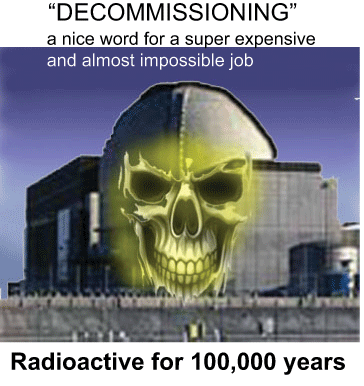 SHUTDOWN COSTS Picking Up the Nuclear Tab, Handelsblatt BY KLAUS STRATMANN 23 Feb 16, A leaked draft report on Germany’s exit from nuclear power recommends the nation’s four big utilities foot the €19.7 billion bill for decommissioning their power plants – but any costs above that may be carried by taxpayers.
FACTS In 2011, Germany announced a complete phase-out of nuclear power by 2022, with a target of 80 percent renewable energy by 2050.
The four major power firms in Germany, E.ON, RWE, EnBW and Vattenfall, and plant operator Krümmel have set aside €39.6 billion for their share of the phase-out costs.
A government financial commission has now devised a structure for dividing the responsibilities and clarifying the financial liabilities of industry and government. Germany moved a step closer this week to deciding how to pay for its forced exit from nuclear power. The government is moving toward requiring four nuclear plant operators pay the first €19.7 billion ($22 billion). Any costs above that — including hard-to-estimate expenses for storing nuclear fuel — would be paid for by taxpayers.
The recommendations are included in a draft of a government report on the issue obtained by Handelsblatt. The document was described as a preliminary recommendation and could have been leaked as a trial balloon.
The draft recommends making E.ON, RWE EnBW and Vattenfall, the four utilities, pay for “decommissioning and demolition” of their nuclear power plants. The government would then step in assume the costs of the trickier task of removing and storing radioactive waste.
The utilities together have set aside about €39.6 billion ($43.6 billion) to cover their costs of decommissioning. But there is a strong possibility that final costs may rise well beyond that.
The cost of waste disposal and storage, in particular, is seen as particularly difficult to gauge, promting fears among consumer advocates that the utilities could end up saddling taxpayers with the majority of costs.
The report recommends that a state fund be set up to pay for the waste disposal, financed in part by the four utilities, which would transfer in about half of their total reserves. But the report stops short of saying how costs would be divided between industry and taxpayers if disposal costs are greater than expected…… https://global.handelsblatt.com/edition/374/ressort/politics/article/utilities-wont-escape-nuclear-clean-up-costs
Germany’s “big four” utilities liable for nearly 40 billion euros for nuclear waste storage
Nuclear commission proposes firms transfer cash by 2022 to pay for clean-up http://af.reuters.com/article/commoditiesNews/idAFB4N10000F Feb 22, 2016 BERLIN (Reuters) – Germany’s utilities will have to transfer provisions set aside to pay for the interim and final storage of nuclear waste to a fund in cash by 2022, according to a draft report from a government-appointed committee seen by Reuters on Monday.
The report recommends that Germany’s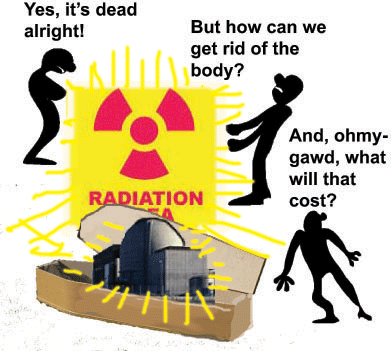 — E.ON, RWE, EnBW and Vattenfall — remain liable for the cost of up to double the 18 billion euros ($19.8 billion) allocated so far to pay for interim and final storage.
The companies will also have to set aside a further 1.3 billion euros in provisions, according to the report which is due to be presented at the end of the month. ($1 = 0.9084 euros) (Reporting by Markus Wacket; Writing by Caroline Copley; Editing by Christoph Steitz)
Limited liability for Germany’s nuclear operators in nuclear paseout
German commission favours limited liability for nuclear phaseout-document http://www.reuters.com/article/germany-nuclear-idUSB4N11703M Feb 18 Germany’s nuclear operators could face only limited long-term liability for the costs of the country’s nuclear phaseout, according to a paper from a government-appointed commission seen by Reuters on Thursday.
The paper indicates that the commission took on board concerns of the four utilities – E.ON, RWE, EnBW and Vattenfall – which have earmarked nearly 40 billion euros in provisions to pay for the dismantling and storage of waste from their nuclear plants.
The last plant will be closed in 2022.
Worries over their financial health have raised fears that the companies may be unable to turn the provisions – including some illiquid assets – into liquid funds, eventually leaving taxpayers to foot some or much of the bill.
The paper said an unlimited liability would lead to excessive demands being made of the operators and that this would ultimately not be beneficial to society.
The paper said the operators may be asked to set aside additional funds on top of existing provisions for the costs of the nuclear phaseout, and that it favoured a state-controlled fund for the long-term costs.
A spokesman for E.ON said he did not want to comment before the final results of the commission are published. (Additional reporting by Tom Kaeckenhoff in Duesseldorf; Reporting by Markus Wacket; Writing by Madeline Chambers; Editing by Noah Barkin)
Costly, not available for decades, but Germany steps forward in nuclear fusion development
Nuclear fusion power has been the dream of many since the 1950s and on Wednesday German scientists took one step closer to making it possible.

German scientists at the Max Planck Institute in Greifswald, joined by German Chancellor Angela Merkel, injected hydrogen into the Wendelstein 7-X fusion device and heated the gas into plasma for a moment, according to the press release.
The device will not produce energy from the plasma, but the experiment is the first of many that could prove whether the design is capable of being used as a power plant. If so, it could answer one of the many questions surrounding nuclear fusion.
Only the ITER project, a tokamak, is thought to be able to produce plasma that supplies energy, according to the press release. The experiments begun Wednesday could prove that stellarator designs could produce comparable heat- and plasma-confinement.
Scientists working on the Wendelstein 7-X will perform similar experiments, heating gas to plasma and holding it in stasis, over the next four years, slowly increasing the temperature and the time of the discharges, according to the press release.
Eventually, in about four years, the Wendelstein 7-X will test its full heating power (20 megawatts) and discharges lasting 30 minutes………
Nuclear fusion is seen as a safe, efficient form of nuclear power and has been proposed as an eventual replacement for oil and fossil fuels, according to the press release.
But critics have pointed to the mounting cost of a technology that is still under development and likely remain unavailable for decades. Investments for the Greifswald fusion device have surpassed €1 billion over the last 20 years, CBS News reported.
The ITER project recently announced in November that it would take six years longer to construct than previously thought and would require additional funding from the €5 billion estimate in 2006. Science reports current estimates place the ITER project needing €15 billion. http://www.csmonitor.com/Science/2016/0203/How-Germany-took-big-step-toward-nuclear-fusion
Germany’s costly nuclear waste dump correction
Environment state secretary Jochen Flasbarth, who described the situation in Asse II as “disastrous”, told journalists in Berlin that the current plan was to store the Asse waste, once retrieved, with the high-level radioactive waste for which the government is still searching a site…….
The Asse case shows how difficult it can be to undo a decision related to nuclear waste storage. It will take longer to retrieve the waste than it did to dump it

 Why Germany is digging up its nuclear waste, By PETER TEFFER , EU Observer, WOLFENBUETTEL, GERMANY, TODAY, 2 Feb 16 “….. in hindsight, the Asse II salt mine should never have been used in the 1960s and 1970s as a site to dump nuclear waste, said Ingo Bautz of the Federal Office for Radiation Protection………To anti-nuclear activists, Asse is a prime example of government not listening to citizens’ concerns. “Incidents were predicted,” said Wolfgang Ehmke, activist in the Gorleben region.
But the waste had to be stored somewhere, so the voices that warned against selecting Asse II were ignored.
“The potential risks for the future were accepted,” Bautz said, during a recent press visit to the mine organised by Clean Energy Wire, a non-profit group supported by the Mercator and European Climate foundations.
Road signs, deep underground
Until 1978, low and intermediate-level radioactive waste was stored in Asse II, the only such site in Germany.
Ten years later, the operator of the mine discovered leaks of radioactive brine. But it was not until 2008, when media reported about it, that the leaks became public knowledge.
The German government took control of the mine and tasked the Federal Office for Radiation Protection with its decommissioning.
The office concluded that the risk of groundwater contamination was too big, and the only truly safe option was to retrieve all the waste from the mine and store it elsewhere. In all, 126,000 containers filled with contaminated clothes, paper and equipment were stored in Asse, the office said.
“This task is very difficult,” said Bautz, who joined journalists to travel into the mine, 658m below the surface.
The lift plunged to the bottom at 36km/h. Inside the mine, the temperature was about 30C even though it was freezing above ground.
The mine is so large that workers have to use cars to get around. In one tunnel an LED road sign typically found in residential areas tells drivers to watch their speed……..
Since the mine is over a century old, it needs to be protected against a collapse or flooding. It will also need another lift to use for retrieving the waste.
And because of safety regulations regarding evacuation, only 120 people can be down in the mine at the same time. Workers are monitored for any exposure to radiation……..
In 2011, the EU adopted a rule obliging each country that has produced nuclear waste to have policies on how to manage their waste. Last August, all member states were due to report about their national programmes for the first time.
Germany told the commission it planned to put “all types of radioactive waste in deep geological disposal facilities with the aim to guarantee isolation from the biosphere in the long term, thus ensuring the safety of man and the environment without any need for maintenance”.
Environment state secretary Jochen Flasbarth, who described the situation in Asse II as “disastrous”, told journalists in Berlin that the current plan was to store the Asse waste, once retrieved, with the high-level radioactive waste for which the government is still searching a site…….
The Asse case shows how difficult it can be to undo a decision related to nuclear waste storage. It will take longer to retrieve the waste than it did to dump it…….
This is second part in a two-part series about Germany’s nuclear waste. Part one was about how Gorleben refused to be the country’s permanent waste repository. https://euobserver.com/beyond-brussels/132085
Germany’s nuclear waste nightmare
Radioactive waste dogs Germany despite abandoning nuclear power https://www.newscientist.com/article/2075615-radioactive-waste-dogs-germany-despite-abandoning-nuclear-power/ Major problems at a salt mine where 126,000 drums of radioactive debris are stored are fuelling public distrust of long-term waste disposal plans, reports Fred Pearce from Asse, Germany
Half a kilometre beneath the forests of northern Germany, in an old salt mine, a nightmare is playing out. A scheme to dig up previously buried nuclear waste is threatening to wreck public support for Germany’s efforts to make a safe transition to a non-nuclear future.
Enough plutonium-bearing radioactive waste is stored here to fill 20 Olympic swimming pools. When engineers backfilled the chambers containing 126,000 drums in the 1970s, they thought they had put it out of harm’s way forever.
But now, the walls of the Asse mine are collapsing and cracks forming, thanks to pressure from surrounding rocks. So the race is on to dig it all up before radioactive residues are flushed to the surface.
“There were people who said it wasn’t a good idea to put radioactive waste down here, but nobody listened to them,” says Annette Parlitz, spokeswoman for the Federal Office for Radiation Protection (BfS), as we tour the mine.
This is just one part of Germany’s nuclear nightmare. The country is also wrestling a growing backlog of spent fuel. Continue reading
Germany abandoning nuclear fission, but has developed research nuclear fusion reactor
Germany Tests Fusion Reactor, But Will Abandon Nuclear By 2022 The Daily Caller ANDREW FOLLETT , 18 Dec 15 Germany tested an experimental fusion reactor last week, but the country is set to abandon conventional nuclear fission power entirely by 2022 in favor of solar and wind.
German engineers from the Max Planck Institute have successfully activated an experimental nuclear fusion reactor and successfully managed to suspend plasma for the first time. The reactor took 19 years and €1 billion euros ($1.1 billion) to build, and contains over 470 tons of superconducting magnets, all of which need to be cooled to absolute zero.The reactor passed the major technical milestone of generating its first plasma, which had a duration of one-tenth of a second and achieved a temperature of around one million degrees Celsius. If the reactor fulfills the research team’s expectations, it could demonstrate the first stable artificial nuclear fusion reaction within the next year.
World’s largest nuclear fusion reactor launched by Germany
Germany launches world’s largest nuclear fusion reactor The rocky road to nuclear fusion power, DW, 18 Dec 15 Innovative designs using modern superconductors are supposed to bring us nuclear fusion power plants soon – some optimists say. Fusion experts predict, however, that a practical application will take many more decades. Nuclear fusion is considered a potential energy source of the future. It’s clean nuclear energy. But what is it, exactly and why is it so difficult to generate? Let’s start with the difference between classical nuclear fission and nuclear fusion.
Nuclear fission means that radioactive isotopes, like uranium or plutonium are being split up and turned into other highly radioactive isotopes that then have to be deposited or reprocessed.
Nuclear fusion means that two isotopes of hydrogen – called deuterium and tritium – merge together – they “fuse.” And that leaves behind only non-poisonous helium and one single neutron, but no nuclear waste.
Huge amounts of energy caught in a plasma
Nuclear fusion takes place in the sun for example – or in a hydrogen bomb – and that’s the big challenge for engineers – how do you control the high energy fusion process in a power plant?
That’s what scientists have been working on since the 1960s. One model-fusion-reactor called Wendelstein 7-X has just started operating in the northern German town of Greifswald. It is not designed to generate a nuclear fusion reaction yet – so far it’s just a specific reactor design that’s being tested.
What all fusion reactors have in common is a ring-shaped form. The idea behind it is to take powerful electromagnets and create a strong electromagnetic field, which is shaped somewhat like an inflated bicycle tube.
That electromagnetic field must be so dense that when it is being heated by a microwave oven to about one million degrees centigrade, a plasma will emerge in the very center of the ring. And that plasma can then be ignited to start the nuclear fusion process.
Research reactors show what’s possible
In Europe, two prominent fusion experiments are under way. One is Wendelstein 7-X, which just generated its first helium plasma last week – albeit without actually going into nuclear fusion. The other one is ITER – a huge experimental project in southern France, which is still under construction and won’t be ready to run before 2023.
ITER is supposed to do real nuclear fusion – but only for short periods of time, certainly not for any longer than 60 minutes. And ITER is just one of many steps towards turning the idea of nuclear fusion into a practical application.
Are smaller, alternative designs feasible?………
Hot, hot, hot
The heat is also problematic. In the core of the nuclear-fusion plasma, the temperature would be around 150 million centigrade. This extreme heat stays put – right there in the center of the plasma. But even around it, it still gets seriously hot – 500 to 700 degrees at the breeding blanket – which is the inner layer of the metal tube that contains the plasma and which will serve to “breed” the tritium that is needed for the fusion reaction.
Even more problematic is the so called “power-exhaust.” That is the part of the system, where the used-up fuel from the fusion process is being extracted – mostly helium. The first metal components hit by hot gases are called the “diverter.” It can get hotter than 2,000 degrees centigrade.
The engineers are trying to use the metal tungsten, used in old-fashioned light bulbs – to withstand such temperatures. They have a melting point of around 3,000 degrees. But there are limits.
“In the case of ITER we can do it, because the heat is not there constantly. Only one to three percent of the time, ITER will eventually be running.” Hesch says. “But that is not an option for a power plant, which has to run 24/7. And if someone pretends to build a smaller reactor with the same power as ITER, I can definitely say – there is no solution for that diverter-problem.”
Several decades to build a real power plant
Nonetheless Hesch is optimistic that the development of nuclear fusion power reactors will go ahead – but not quite as fast as some of the industry optimists predict.
“With ITER we want to show that fusion can actually deliver more energy than we have to put into it to heat the plasma. The next step would be to build an entirely new fusion demonstrator power plant, which will actually generate electricity.”
The engineers are already working on the designs now. They will have to learn lessons from ITER, which is scheduled to start operating in 2023. Taking the necessary time for design, planning and construction into account, it looks very unlikely the first nuclear-fusion power plant will be up and running much before the middle of the century. http://www.dw.com/en/the-rocky-road-to-nuclear-fusion-power/a-18927630
Belgium’s nuclear restart causes anxiety in adjacent North Rhine-Westphalia
Belgium ‘playing Russian roulette’ with relaunch of nuclear reactor, says fuming Germany, Rt.com 16 Dec, 2015 Belgium, plagued by a series of nuclear mishaps in recent years, has restarted its ageing Tihange 2 reactor after a nearly two-year shutdown. Neighboring Germany is angered by the relaunch amid fears it could result in a Fukushima-style meltdown.
Belgian power utility Electrabel says it put Tihange 2, first launched in 1983, back in service on Tuesday night “in complete safety.” But officials in adjacent North Rhine-Westphalia (Germany’s most-populous state) say there’s a storm brewing, recalling the fact that three of Belgium’s seven reactors were closed at one point, in two cases due to the discovery of micro-cracks in Tihange 2’s reactor casings.
“The Belgian government is playing Russian roulette. Tihange is a reactor in ruins,” North Rhine-Westphalian Environment Minister Johannes Remmel said Tuesday, according tosudinfo.be.
North Rhine-Westphalia’s economy minister, Garrelt Duin, also warned against the relaunch of Tihange, calling it “a big mistake.”
Four of Germany’s 10 biggest cities (Cologne, Düsseldorf, Dortmund and Essen) are in North Rhine-Westphalia. The city of Aachen, only 60km from Tihange, said it had explored legal options to stop the reopening of the reactor, but those efforts were in vain.
“To restart a reactor that has cracks is irresponsible and dangerous. Given the proximity to the border, the German government should have long been working towards its closure,” Sylvia Kotting-Uhl, spokesman for the German Green Party said in a statement, according to AFP.
“If a failure of the reactor tank leads to a nuclear accident, Germany would also become highly exposed to radiation due to the persistent wind from the west,” she warned.
Growing safety concerns have fallen on deaf ears in Belgium, however. ……https://www.rt.com/news/326086-nuclear-reactor-relaunch-tihange/
Germany’s process of decommissioning nuclear power plant
This Is How You Decommission a Nuclear Power Plant [great photos] German Chancellor Angela Merkel called time on nuclear energy in her country in 2011, after a tsunami severely damaged the Fukushima power plant in Japan, causing a major radioactive leak. Almost five years later, that process is in full swing – with an estimated cost of up to €77 billion ($84 billion). The operation to decommission Germany’s Greifswald nuclear power plant is described by German energy officials as the largest project of its kind in the world. Once the largest power plant in the former East Germany, Greifswald was closed in 1990 during German reunification. This is how it is being made safe. Bloomberg Tino Andresen , 10 Dec 15
Alexander Jones Germany’s nuclear plant operators are seeking public agreement on how to manage the burden of decommissioning the country’s atomic power stations. Chancellor Angela Merkel’s government decided in 2011 to phase out nuclear power by 2022 in light of the Fukushima disaster in Japan. ……..
The decommissioning process could force those footing the bill to set aside anything from €25 billion to €77 billion, according to scenarios.
Germany’s Economy Ministry believes that utility companies do have enough funds to pay for the shutdown and cleanup of nuclear power plants……..
Depending on the severity of contamination, some of the components will go on to be housed in temporary disposal sites before a final storage solution is found….http://www.bloomberg.com/news/photo-essays/2015-12-10/this-is-how-you-decommission-a-nuclear-power-plant
German utility RWE splits, in order to deal with costs of nuclear station closures
Germany’s RWE splits to better absorb cost of nuclear plant closures , Reuters, 1 Dec 15
* Nuclear provisions will remain with parent group
* Plans follows spin-off by larger peer E.ON
* RWE shares close up nearly 17 pct
* Utility being advised by Goldman Sachs (Recasts, adds fund manager, details)
By Christoph Steitz FRANKFURT, German utility RWE moved to restructure its businesses to better absorb the cost of nuclear plant closures on Tuesday, sending its shares up nearly 17 percent, their biggest one-day gain in seven years.
To extract funds from its healthier businesses, Germany’s second-biggest utility will hive off its renewables, grids and retail units into a separate entity and sell a 10 percent stake in an initial public offering late next year.
It said it would keep its conventional power generation business, including its remaining nuclear plants and the liability for their shutdown, hoping to avoid a political stand-off over nuclear provisions that led peer E.ON to backtrack on a similar plan.
RWE’s Chief Executive Peter Terium was tight-lipped as to why the group decided to split now, a year after larger peer E.ON said it would spin off power plants, energy trading and oil and gas activities into a separate unit, Uniper.
Analysts, however, said RWE’s plan should ease concerns in Berlin, which has been worried that utilities would not honour the costs of Germany’s policy to close its nuclear plants by 2022. Political pressure forced E.ON to change its plans and take back its German nuclear plants along with the 16.6 billion euros ($17.6 bln) in provisions…….
NUCLEAR EXIT
Squeezed by a decline in wholesale power prices and a surge in renewables, German utilities are struggling to make money operating coal- and gas-fired power plants.
In addition to falling prices, the utilities have suffered from concerns over their ability to come up with as much as 80 billion euros in combined funding to pay for shutting down the country’s nuclear plants by 2022….. http://www.reuters.com/article/2015/12/01/rwe-restructuring-idUSL8N13Q2CP20151201#CbUEEVuQLV8LBJoJ.97
Germany expecting nuclear utilities to pay the costs of decommissioning and disposal of radioactive trash
Germany: Utilities Must Shoulder Nuclear Phase-Out Costs http://www.powermag.com/germany-utilities-must-shoulder-nuclear-phase-costs/ 12/01/2015 | Sonal Patel Germany’s nuclear power–producing companies will be able to shoulder the costs of the nuclear phase-out—including costs for decommissioning and the disposal of radioactive waste. That’s according to the country’s Federal Ministry for Economic Affairs and Energy, as it published the results of a “stress test” on October 10. The government on July 1 reaffirmed that energy companies must bear the costs of dismantling their nuclear plants and concluded in October that reserves set aside by EON SE, RWE AG, Energie Baden-Wuerttemberg AG, Vattenfall AB, and Stadtwerke Muenchen GmbH of €38.3 billion ($41.98 billion) are within various scenarios examined during the stress test.
In the wake of the Fukushima disaster, Germany decreed the phase-out of all its nuclear capacity by December 2022. It shuttered eight reactors in the immediate aftermath of the Japanese earthquake and tsunami, and this June it closed the Grafenrheinfeld plant (Figure 3). Eight reactors remain open.
The government-commissioned study, prepared by auditing company Warth & Klein Grant Thornton AG, breaks down expected costs across five different categories, from dismantling to final storage. It finds that cost estimates made by companies are higher than the international average. Dismantling costs in Germany are estimated by the companies at €857 million ($939 million) per reactor compared to between €205 million ($224 million) and €542 million ($594 million) in other countries. If nuclear plants are dismantled in “an efficient manner,” overall costs could be slashed by about €6 billion ($6.5 billion), the auditors also said.
“We do not consider the scenarios requiring the highest provisions to be likely to materialise, as they are based on the assumption of major losses being incurred by the companies over a long period of time,” Minister Sigmar Gabriel said. Gabriel noted that the Federal Cabinet will soon establish a commission to review financing for the nuclear phase-out to adopt draft legislation on extended liability for the dismantling of nuclear power plants and the disposal of nuclear waste. The results of the stress test will be made available to the commission.
Public Trust is one option under discussion for managing Germany’s nuclear waste storage
Minister signals German trust could handle nuclear waste storage http://uk.reuters.com/article/2015/11/29/uk-germany-nuclear-decomissioning-idUKKBN0TI0MH20151129 Germany could share responsibility for phasing out nuclear power with energy firms by setting up a publicly managed trust, the environment minister said on Sunday.
Barbara Hendricks’ comments to Deutschlandfunk radio follow calls by Germany’s top energy firms utilities on Berlin to help handle the country’s nuclear exit and set up a trust for decommissioning plants and the storage of radioactive waste.
A government-appointed commission is tasked with recommending by early 2016 how to safeguard the funding of fulfilling the exit.
The use of a public trust is one option under discussion and closely eyed by investors, as utilities would then have to transfer certain assets, most likely cash and minority stakes.
Chancellor Angela Merkel accelerated the shift away from nuclear power and fossil fuels towards renewable sources of energy such as wind, hydro, solar and biomass power afterJapan‘s Fukushima disaster in 2011.
Germany’s “big four” utilities – E.ON, RWE, EnBW and Vattenfall – have already set aside nearly 40 billion euros ($42 billion) to fund the decommissioning and waste disposal but say they cannot handle the problem on their own. Hendricks said half of provisions could remain with the utilities to pay for the dismantling of the nuclear power plants.
“And yes, if the other half was put into a publicly managed fund, so that the finances were available for finding and establishing sites for storage, then that would be progress. I would agree to that.” (Reporting By John O’Donnell and Christoph Steitz)
Germany’s dash for renewables has helped to create new industries
Germany’s planned nuclear switch-off drives energy innovation, Guardian, Jennifer Rankin , 3 Nov 15
While Britain visualises a nuclear future, Angela Merkel’s aim of replacing it with renewables by 2022 is well under way Hinkley Point will be the first nuclear power plant to be built in Europe since the meltdown of Japan’s Fukushima reactor in 2011. But while the British government sees nuclear energy as a safe and reliable source of power, Germany is going in a different direction.
As a result of the Fukushima, Chancellor Angela Merkel pledged to switch off all nuclear power by 2022 and fill the gap with renewables – a process known as theenergiewende (energy transition).

Germany’s push for renewables grew out of the anti-nuclear protests of the 1980s and currently more than a quarter (26%) of its electricity comes from wind, solar and other renewable sources, such as biomass, although 44% is from coal. The country’s government wants to increase the share of renewables in electricity to 40% to 45% by 2025.
No other country of Germany’s size has attempted such a radical shift in its power supply in such a short space of time. Described by Merkel as a herculean task, the transition is Germany’s most ambitious economic project since die Wende – the phrase used to describe the fall of the Berlin wall and subsequent reunification of east and west – with an estimated cost of €1tn (£742bn) over the next two decades.
However, Reinhard Bütikofer, the Green party’s spokesman for industry in the European parliament, said the really “mind-blowing” energy transition is happening in the UK, where the Hinkley Point C nuclear plant in Somerset will cost electricity customers at least £4.4bn in subsidies. “They are cutting down on solar, PV [photovoltaics], purportedly for cost reasons, while on the other hand they pledge to guarantee the nuclear industry and energy price twice the market price for the next 30 years. That’s crazy.”
The energiewende is not uncontroversial, not least due to the rising cost of subsidies paid by ordinary bill payers, which has triggered complaints that poor households are subsidising affluent dentists to put solar panels on their roofs. But the transition is not opposed by Germany’s main business lobby, the BDI, despite lingering concerns about what the transition means for the country’s manufacturing base at a time when confidence in the Made in Germany brand has been knocked by the Volkswagen scandal.
“There is broad consensus in society on the political targets – to reduce CO2 and increase energy efficiency and the share of renewables,” said Carsten Rolle, the BDI’s head of energy and climate policy………
Germany’s dash for renewables has helped to create new industries. About 370,000 Germans work in the renewable energy industry, twice the number who work in fossil fuels, according to the Heinrich Böll Foundation, a green political thinktank.
The north German port city of Bremerhaven has staged a partial revival, after decades of decline following the collapse of the shipbuilding and fishing industries in the 1970s and 1980s……..
Bütikofer said it was a myth that the push to renewables was putting German companies out of business.
“The industrial Mittelstand has always persevered, moved ahead of the curve by being more effective than others,” he said. He believed that from damaging firms, the energy law can stimulate energy efficiency. “[The energiewende] is nudging sectors of German industry towards more ambitious innovation and I think that is the name of the game for future competitiveness.” http://www.theguardian.com/environment/2015/nov/02/germanys-planned-nuclear-switch-off-drives-energy-innovation
1 This Month
22 June – Virtual Event –Climate Change: New Data, New Debate

Monday, June 22, 2026 2:30 p.m. – 3:15 p.m. CT
YouTube. Register here

Protect Sazan Island from the Trump family! https://secure.avaaz.org/campaign/en/protect_sazan_island_from_the_trump_family_loc/?bqFCVab&v=174511&cl=22707147157&_checksum=5e9dde668860e8231c33699735e16a1fbf22ab2cb01da50c999fe8732b9775ef&utm_source=email&utm_medium=blast_email&utm_campaign=174511
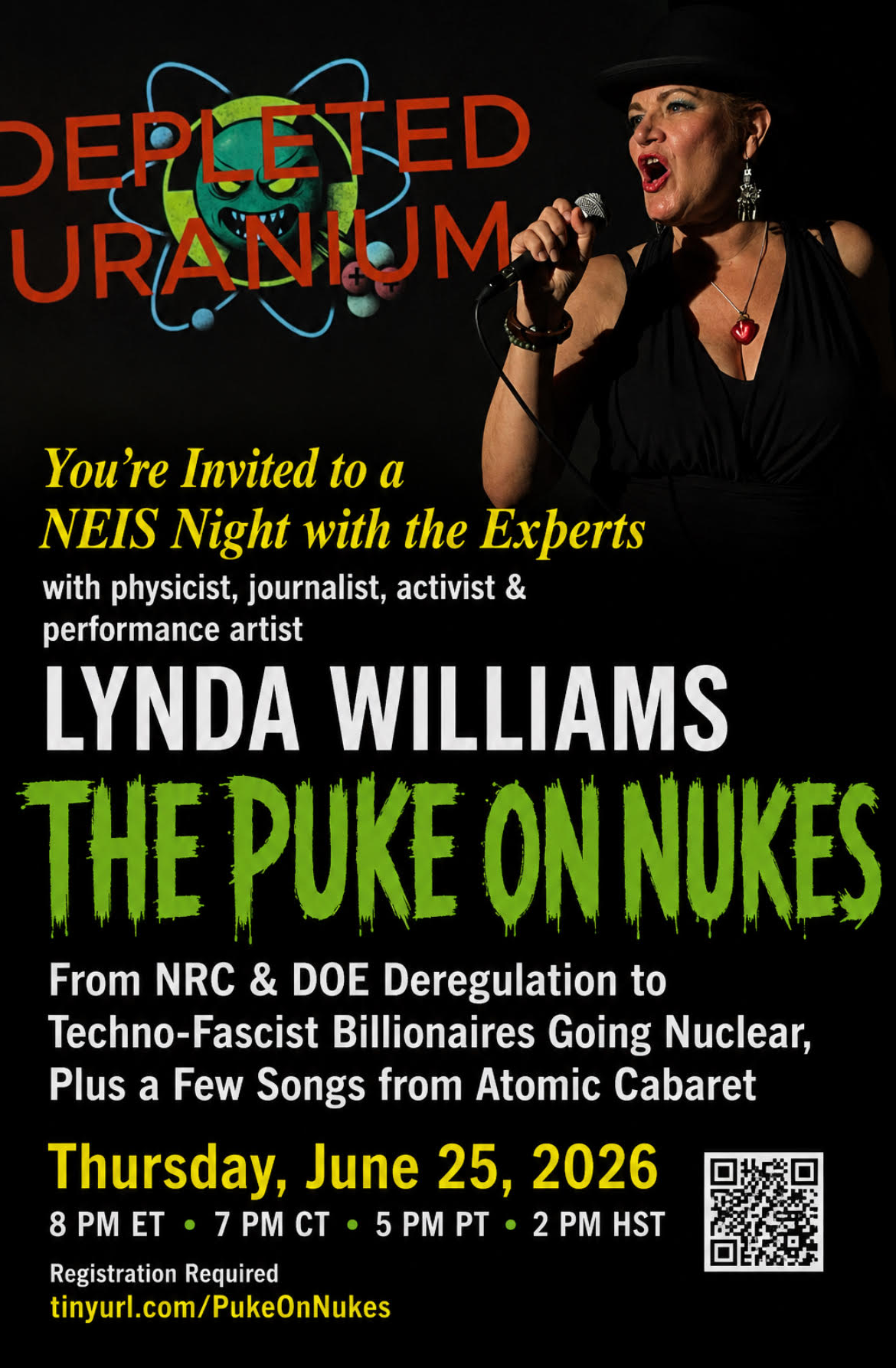
25 June- THE PUKE ON NUKES
Thursday, June 25, 2026
7pm Central Time (8pm ET, 6pm MT, 5pm PT) UTC – 5
From NRC & DOE Deregulation to Techno-Fascist Billionaires Going Nuclear, Plus a Few Songs from Atomic Cabaret REGISTER
26 June – Radiation Trainwreck at the NRC / Join the Protect Better Campaign – https://us02web.zoom.us/meeting/register/4ZlZ5_qLSHGiLSCg8FF6Bg#/registration


Cuba Is Not a Failed State – It Is a Besieged State
PETITION: “Global Appeal to Endorse Palestinian Right of Return of Refugees”
To see nuclear-related stories in greater depth and intensity – go to https://nuclearinformation.wordpress.com
-
Archives
- June 2026 (193)
- May 2026 (306)
- April 2026 (356)
- March 2026 (251)
- February 2026 (268)
- January 2026 (308)
- December 2025 (358)
- November 2025 (359)
- October 2025 (376)
- September 2025 (257)
- August 2025 (319)
- July 2025 (230)
-
Categories
- 1
- 1 NUCLEAR ISSUES
- business and costs
- climate change
- culture and arts
- ENERGY
- environment
- health
- history
- indigenous issues
- Legal
- marketing of nuclear
- media
- opposition to nuclear
- PERSONAL STORIES
- politics
- politics international
- Religion and ethics
- safety
- secrets,lies and civil liberties
- spinbuster
- technology
- Uranium
- wastes
- weapons and war
- Women
- 2 WORLD
- ACTION
- AFRICA
- Atrocities
- AUSTRALIA
- Christina's notes
- Christina's themes
- culture and arts
- Events
- Fuk 2022
- Fuk 2023
- Fukushima 2017
- Fukushima 2018
- fukushima 2019
- Fukushima 2020
- Fukushima 2021
- general
- global warming
- Humour (God we need it)
- Nuclear
- RARE EARTHS
- Reference
- resources – print
- Resources -audiovicual
- Weekly Newsletter
- World
- World Nuclear
- YouTube
-
RSS
Entries RSS
Comments RSS
 nuclear-news