Graph of the day: Germany’s record 85% renewables over weekend [good graphs] REneweconomy By Giles Parkinson on 4 May 2017 Germany achieves a record level of 85 per cent renewable energy generation on April 30 – part of the May 1 long weekend – with wind and solar providing significant lifts in output and along with biomass and hydro almost completely sidelining hard coal plants.
Patrick Graichen of Agora Energiewende Initiative, which provided these graphs, says a combination of breezy and sunny weather in the north and warm weather in the south saw Germany’s May 1 holiday weekend powered almost exclusively by renewable resources.
“Most of Germany’s coal-fired power stations were not even operating on Sunday April 30th, with renewable sources accounting for 85 per cent of electricity across the country,” he said. “Nuclear power sources, which are planned to be completely phased out by 2022, were also severely reduced.
Germany Converts Coal Mine into Giant Battery to Store Renewable Energy for off-HoursEnviroNews World News on April 2, 2017 North Rhein Westphalia, Germany — The Prosper-Haniel hard coal mine, slated to be shut down in 2018 when government subsidies run out, is being repurposed to become a giant battery for excess power created by renewable energy sources. Located in North Rhein Westphalia, the coal mine’s conversion will allow Germany to store 200 MW of electricity for use during times when solar and wind are unavailable or unable to meet energy needs.
The storage is formed by a reservoir of water above the mine. The water can be released into the system when it is needed. As gravity pulls the water into the coal mine below, the water turns a turbine creating electricity. The water is then pumped back to the reservoir. This can be done when power prices are lower or when renewable energy sources are making more energy than people are using, as they did in Germany on May 12, 2016. This isn’t the first pumped hydroelectric storage station; however, it is the first one to use a coal mine for its lower reservoir.
DOCUMENTS unearthed in an archive suggest that Adolf Hitler may have tested an operational nuclear bomb before the end of WW2. A recently declassified file from the National Archives in Washington is a detailed survey of how far Nazi scientists got in the development of an atomic bomb. In the file, obtained by the German newspaper Bild, the task of the academics who prepared the paper between 1944 and 1947 was the “investigations, research, developments and practical use of the German atomic bomb.”
The report was prepared by countless American and British intelligence officers and also includes the testimony of four German experts – two chemical physicists, a chemist and a missile expert. It concludes that Hitler’s boffins failed in the quest to achieve a breakthrough in nuclear technology – BUT that a documented test may have taken place of a rudimentary warhead in 1944.
The statement of the German test pilot Hans Zinsser in the file is considered evidence – the missile expert says he observed in 1944 a mushroom cloud in the sky during a test flight near Ludwigslust. His log submitted to the Allied investigators reads; “In early October 1944 I flew away 12-15 km from a nuclear test station near Ludwigslust. “A cloud shaped like a mushroom with turbulent, billowing sections (at about 7000 metres) stood, without any seeming connections over the spot where the explosion took place. “Strong electrical disturbances and the impossibility to continue radio communication as by lighting turned up.”
He estimated the cloud stretched for nine kilometres and described further “strange colourings” followed by a blast wave which translated into a “strong pull on the stick” – meaning his cockpit controls.
An hour later a pilot in a different machine took off from Ludwigslust and observed the same phenomenon.
According to other archival documents, the Italian correspondent Luigi Romersa observed on the ground the same explosion. He had been sent by dictator Benito Mussolini to watch the test of a “new weapon” of the Germans.He was ordered to report his impressions back to Mussolini.
It is known that Hitler pursued the goal of nuclear technology and wanted his V-2 rockets to be able to carry them to destroy the UK.
The testimony of the four German scientists in the declassified American report mentions a top secret meeting held in Berlin in 1943. Nazi weapons minister Albert Speer was present for the discussion called a “nuclear summit.”
In the end the report states that the Allies believe the Germans fell short of triggering the nuclear chain reaction necessary to trigger a nuclear blast.
But none could come up with an explanation for what occurred in the skies over Ludwigslust in 1944.
Germany demands answers after Swiss nuclear reactor is restarted… and then shut down again,The Local, 20 Feb 17, The German environment minister has demanded answers from the Swiss authorities after the Leibstadt nuclear reactor in the canton of Aargau near the German border was switched off on Friday night, just seven hours after being restarted following a six months shutdown.
Shortly after the reactor was brought on line at around 5.30pm on Friday, operator KKL noted a malfunction of the exhaust system responsible for filtering gases from the condenser in a non-nuclear area of the reactor, KKL said in a statement……
Greenpeace has also criticized the move, while 16,000 people have signed a petition against the reactor led by a Swiss Green Party politician, reported Swiss news agencies.
by Alexander Reed Kelly
Feb 2, 2017 In an interview with acTVism, investigative journalist Jeremy Scahill discussed the connection between President Trump’s Cabinet picks and the military-industrial complex.
Scahill also addressed the history of anti-war movements and Germany’s role in the United States’ “war on terror.” He examined the significance of the Ramstein Air Base in Germany, and questioned the legality of its activities.
Jeremy Scahill on the Military Industrial Complex, Donald Trump, Ramstein & Anti-War Movements
Dangerous neighbors: German-Belgian nuclear agreement doesn’t fix problem, DW 20 Dec 16
Can an agreement allay fears of a looming nuclear accident in Belgium? Two of its power stations, situated very close to Germany, are causing considerable alarm. Doel 3 and Tihange 2 are the names of the nuclear power stations that have got many people living along Germany’s border with Belgium very worried indeed. These reactor blocks belong to power stations that were first connected to the grid more than 40 years ago.
Over the years, the reactor pressure vessels have sustained damage. Germany’s environment minister, Barbara Hendricks (SPD), gives a forthright response when asked about the two reactors. “We know that there are a lot of hairline cracks in the reactor pressure vessels,” she says. It sounds very alarming.
Doel 3 and Tihange 2 are very close to the German-Belgian border. Doel, near Antwerp, is just 150 kilometers (93 miles) away; it’s only 60 kilometers to Tihange, near Liege. This is why Hendricks called on Belgium as early as last April to shut down both reactor blocks until they had been made safe. The Belgian government refused. It doesn’t deem its nuclear power plants to be a risk. This attitude has a lot to do with the fact that more than half of Belgium’s power is supplied by nuclear energy.
‘We can’t change that’
At least an agreement has been reached. Environment minister Hendricks and Belgium’s minister of the interior, Jan Jambon, have signed a new German-Belgian agreement to cooperate on nuclear safety. But what is it worth? The agreement is a compromise. The German side would have much preferred Belgium to shut down the damaged nuclear reactors immediately, but Brussels had little sympathy with Germany’s efforts to intervene. Whether or not reactors are shut down, and how long for, remains a national issue. “We can’t change that,” said Barbara Hendricks – and this was the German government’s dilemma before the agreement was even signed…….
Neubronner says the situation at both nuclear sites in Belgium is extremely alarming. “The number of incidents reported at the plants has risen dramatically. Stresses, such as a thermal shock, could enlarge the cracks in the reactor pressure vessels, which would drastically increase the danger of the pressure vessel bursting,” she says. “This would lead to a reactor core meltdown. There’s a risk of an MCA [maximum credible accident].”
North Rhine-Westphalia would be ‘more or less’ affected
A study has shown that, in the event of a nuclear accident in Tihange, the city of Aachen and the surrounding region could be severely irradiated. Just a few weeks ago, Professor Wolfgang Renneberg from the Institute of Safety and Risk Sciences at the University of Natural Resources and Life Sciences in Vienna calculated that “if an accident were to happen, there is a 10 percent likelihood that Aachen would become uninhabitable.” The whole of North Rhine-Westphalia would be “more or less” affected……….http://www.dw.com/en/dangerous-neighbors-german-belgian-nuclear-agreement-doesnt-fix-problem/a-36840437
Bundestag approves nuclear waste deal with industry, DW, 15 Dec 16An overwhelming majority in Germany’s parliament has given the go-ahead for a reponsibility-splitting deal to clean up nuclear waste. It’s the final chapter in a decades-long story. The deal will require four of Germany’s largest energy providers to pay more than 23 billion euros ($24.1 billion) into a state-administered fund to deal with the aftermath of nuclear power in return for legal immunity. The deal was passed with the votes of the ruling coalition of the conservative Christian Democrats (CDU) and the Christian Social Union (CSU), the Social Democrats (SPD) and the Green Party by a margin of 581 to 58.
The agreement is the latest step in Germany’s decision to phase out nuclear energy, which was made after the Fukushima disaster in 2011. Addressing the Bundestag before the vote, Economy Minister Sigmar Gabriel harkened back to the beginnings of the “no-nukes” movement among private citizens in Denmark, Germany and other parts of Europe in the mid-1970s.
“The stickers with the picture of the sun laughing became a symbol for a successful energy policy,” Gabriel said, promising that Germany would safely dispose of nuclear waste rather than simply exporting it to other parts of the world……..
“The actual costs will be a lot more than the estimates,” DIW Energy Division Director Claudia Kemfert told Deutsche Welle in October, when the details of the arrangement were hammered out. “So the deal only covers a fraction of the actual costs, and society will have to pick up the rest.”
Kemfert said that the power companies had gotten a “free pass,” a sentiment echoed in parliament by the Left Party, which voted against the deal.
“The companies are being released from responsibility with a golden handshake,” said Left Party energy spokeswoman Eva Bulling-Schröter.”The costs are going to go up.”
The issue of lawsuits filed by energy companies against the German government’s nuclear phase-out has yet to be fully resolved. The government will now begin negotiations aimed at ending the various legal actions in return for the clean-up compromise. http://www.dw.com/en/bundestag-approves-nuclear-waste-deal-with-industry/a-36775793
Germany Cuts Deal With Nuclear Power Companies Over Waste Costs Government, companies seek to put ceiling on costs related to disposal of radioactive waste, WSJ, By ZEKE TURNER Dec. 12, 2016 BERLIN—The German government has cut a deal with the nuclear power companies operating in the country that would guarantee them a ceiling on costs related to radioactive waste, lawmakers said Monday.
Germany’s E.ON SE, RWE AG, EnBW AG and Sweden’s Vattenfall AB already set aside about €17 billion ($18 billion) to finance the disposal of radioactive waste after the government moved to ban nuclear power five years ago.
Under Monday’s deal, they would pay an additional €6 billion into a public fund but be off the hook for any further payments if the cost of processing the radioactive material were to balloon out of control in the decades to come, as many experts fear.
The companies have also agreed to drop some of the lawsuits they filed against the government after the nuclear ban……..The deal announced by lawmakers from the CDU, its coalition partner Social Democrats and the opposition Greens party is the latest round in a recent rapprochement between the nuclear energy industry and the government.
Limiting the greed of the nuclear industry http://www.dw.com/en/opinion-limiting-the-greed-of-the-nuclear-industry/a-36664176The German Constitutional Court’s decision that an accelerated nuclear phase-out is legal, and limiting compensation for energy companies is good news, says DW’s Gero Reuter. This could even set a precedent for coal.
“Property entails obligations. Its use shall also serve the public good,” states article 14 of the German constitution. At the same time, the German constitution demands that expropriation is permissible for the public good, and will be compensated after balancing the interests of everyone affected.
That’s the most crucial background to Germany’s biggest power companies – Eon, RWE and Swedish state-owned company Vattenfall – having filed lawsuits against the German government. They asked for compensation for the government’s decision in 2011 to hurry through shutdown of nuclear reactors in the wake of the 2011 nuclear meltdown at Japan’s Fukushima reactor.
According to the energy companies, the nuclear phase-out is an unconstitutional expropriation of their power plants and possible energy production. They had asked for compensation of around 19 billion euros ($20 billion), which was supposed to be shelled out by taxpayers – around 230 euros from each citizen, babies to pensioners.
This week, Germany’s Constitutional Court mostly rejected their claims, saying the law for a nuclear phase-out from 2011 “is mostly compatible with Germany’s constitution.”
Only long-term investments that the power companies made between December 2010 and March 2011 are eligible for compensation, the court ruled, as the German government agreed to a maximum lifetime extension of nuclear power plants for 12 years in 2010.
What’s more, Germany’s Constitutional Court said some of the power companies received unequal treatment, and thus ruled that the German government has to adjust the law accordingly by June 2018.
Good news for taxpayers and the environment
The ruling is good news for taxpayers and the environment, as it will limit the greed of power companies to tap even more subsidies at the expense of public health, the environment and government budgets.
As to the requested compensation costs of around 19 billion euros – fortunately there’s not much left to this argument. It’s possible that the German government won’t have to pay anything to the energy companies at all. If worse comes to worse, it may pay a billion euros. This all depends on how the state will define unequal treatment of the different energy companies over the months to come.
What’s even more positive and groundbreaking is the legal reasoning behind the ruling. Germany’s Constitutional Court stressed several times that it attaches great importance to the protection of life, health and natural resources, and to the minimization of risks through the use of nuclear energy. It also said this could lead to an even faster nuclear phase-out, and that the German government could change its laws after the fact.
Thinking into the future, this decision could set a precedent for legal support to Germany being on the necessary path to withdraw from coal-powered electricity, and to shorten the long-term operating licenses power companies retain for mining lignite (brown coal).
The energy companies should carefully study this decision, and read between the lines to see how the German constitution truly works. “Property entails obligations. Its use shall also serve the public good.”
And if companies don’t use their property for the public good, then the state can expropriate this under certain circumstances. Obviously, the state then has to pay an appropriate compensation fee after balancing the interests of everyone involved – that’s fair.
But it should pay only what’s fair and not a cent more – especially not for big, powerful energy companies.
E.ON sees limited scope for nuclear claims after ruling -Bernstein, Reuters, Dec 8 E.ON sees limited scope for compensation claims following a court ruling related to Germany’s nuclear exit that paves the way for utilities to try to reclaim money, its chief executive told brokerage Bernstein in an interview.
Germany’s highest court on Tuesday ruled that hastening the shutdown of nuclear plants after Japan’s Fukushima disaster violated some of the property rights of utility companies, allowing them to seek limited damages.
It said that utilities could claim back stranded investments made between December 2010 and March 2011 when the government decided to extend the life of nuclear plants. In 2011, the government’s position changed and it decided to shut down all stations by 2022.
E.ON said earlier this week it had invested several hundred million euros in 2010 in the expectation that the government’s nuclear policy would remain unchanged.
“Of this, a low triple digit million amount was likely incurred in the four month period between December 2010 and March 2011, which should be eligible for compensation,” Bernstein quoted CEO Johannes Teyssen as saying.
Limiting the greed of the nuclear industry http://www.dw.com/en/opinion-limiting-the-greed-of-the-nuclear-industry/a-36664176The German Constitutional Court’s decision that an accelerated nuclear phase-out is legal, and limiting compensation for energy companies is good news, says DW’s Gero Reuter. This could even set a precedent for coal.
“Property entails obligations. Its use shall also serve the public good,” states article 14 of the German constitution. At the same time, the German constitution demands that expropriation is permissible for the public good, and will be compensated after balancing the interests of everyone affected.
That’s the most crucial background to Germany’s biggest power companies – Eon, RWE and Swedish state-owned company Vattenfall – having filed lawsuits against the German government. They asked for compensation for the government’s decision in 2011 to hurry through shutdown of nuclear reactors in the wake of the 2011 nuclear meltdown at Japan’s Fukushima reactor.
According to the energy companies, the nuclear phase-out is an unconstitutional expropriation of their power plants and possible energy production. They had asked for compensation of around 19 billion euros ($20 billion), which was supposed to be shelled out by taxpayers – around 230 euros from each citizen, babies to pensioners.
This week, Germany’s Constitutional Court mostly rejected their claims, saying the law for a nuclear phase-out from 2011 “is mostly compatible with Germany’s constitution.”
Only long-term investments that the power companies made between December 2010 and March 2011 are eligible for compensation, the court ruled, as the German government agreed to a maximum lifetime extension of nuclear power plants for 12 years in 2010.
What’s more, Germany’s Constitutional Court said some of the power companies received unequal treatment, and thus ruled that the German government has to adjust the law accordingly by June 2018.
Good news for taxpayers and the environment
The ruling is good news for taxpayers and the environment, as it will limit the greed of power companies to tap even more subsidies at the expense of public health, the environment and government budgets.
As to the requested compensation costs of around 19 billion euros – fortunately there’s not much left to this argument. It’s possible that the German government won’t have to pay anything to the energy companies at all. If worse comes to worse, it may pay a billion euros. This all depends on how the state will define unequal treatment of the different energy companies over the months to come.
What’s even more positive and groundbreaking is the legal reasoning behind the ruling. Germany’s Constitutional Court stressed several times that it attaches great importance to the protection of life, health and natural resources, and to the minimization of risks through the use of nuclear energy. It also said this could lead to an even faster nuclear phase-out, and that the German government could change its laws after the fact.
Thinking into the future, this decision could set a precedent for legal support to Germany being on the necessary path to withdraw from coal-powered electricity, and to shorten the long-term operating licenses power companies retain for mining lignite (brown coal).
The energy companies should carefully study this decision, and read between the lines to see how the German constitution truly works. “Property entails obligations. Its use shall also serve the public good.”
And if companies don’t use their property for the public good, then the state can expropriate this under certain circumstances. Obviously, the state then has to pay an appropriate compensation fee after balancing the interests of everyone involved – that’s fair.
But it should pay only what’s fair and not a cent more – especially not for big, powerful energy companies.
* German supreme court says some rights violated by nuclear exit
* But confirms general constitutionality of exit law
* Government needs to set compensation framework by June 2018
Germany’s supreme court (Bundesverfassungsgericht) on Tuesday confirmed that the nuclear exit law from July 2011, although generally conforming with the German constitution, in part violates the property rights of nuclear operators.
Nuclear operators E.ON, RWE and Vattenfall brought the lawsuit after the government decided in 2011 to reverse its planned extension of nuclear runtimes in the wake of the Fukushima nuclear crisis, replacing remaining production quotas with a set deadline for the closure of reactors and a complete phase out of nuclear power by the end of 2022.
The court in Karlsruhe declared that the government needs to put in place “appropriate” compensation for investment based on the initial plan to extend runtimes by around 12 years after the 2009 elections.
The new compensation rules need to be in place by June 30, 2018, the court said in a statement
It did not give any guidance on the compensation sum.
According to a report by German news agency dpa, the operators so far have not quantified their compensation demands, speaking only of “massive economic damage” with dpa quoting estimates of around Eur19 billion.
In October, the government cleared the way for a financial solution to the nuclear storage issues with new rules under which the nuclear operators will pay a combined Eur23.5 billion into a state-run fund for the financing of mid- and long-term nuclear storage in Germany.
In return, the nuclear operators will be released from liability for interim and final storage of nuclear waste, but remain solely responsible for the decommissioning of nuclear power plants as well as the transport of the nuclear waste to the storage repository.
Germany’s highest court will rule next week on whether the country’s decision to exit nuclear power was legal, helping to determine whether or not three power firms can pursue damage claims of up to 19 billion euros ($20.16 billion).
German utilities are still reeling from the decision made in 2011 after Japan’s Fukushima disaster to shut down all nuclear power plants by 2022. E.ON, RWE and Vattenfall have sued the government over what they say amounts to expropriation.
The three claim the accelerated shutdown robbed them of 1,800 terawatt hours of future production, enough to power Europe’s biggest economy for about three years.The German government has rejected the claims, arguing its decision was in line with constitutional law.
The Constitutional Court will give its verdict on Tuesday, Dec. 6, in the city of Karlsruhe.
“Even if the verdict is partly in favour of utilities, there will be a separate lengthy process for determining the compensation. So it’s not really a bankable outcome,” said Deepa Venkateswaran, senior analyst at Bernstein.
In a two-day hearing in March, the court challenged the expropriation claims brought by power firms, arguing that Germany merely accelerated the shutdown of nuclear plants that was initially agreed on in 2002.
The ruling requires a majority of the eight-judge panel. If the judges are split evenly, the complaints will automatically be rejected.
Legal experts expect the court will throw out the complaint by Sweden’s Vattenfall because it is a state-owned entity, preventing it from lodging a complaint based on Germany’s constitution.
German utility EnBW, which is almost entirely owned by the public, has not lodged a complaint for that reason. According to Peter Rosin, partner and energy specialist at law firm White & Case, the court would not necessarily have to approve the utilities’ expropriation complaint to pave the way for damage claims.
It could also rule that Germany’s decision did not amount to expropriation but merely defined the scope and limitation of property in such a significant way that it required compensation, he said
The court could also throw out all complaints.
“Therefore, there is a range of possibilities regarding the court’s decision and the respective legal consequences. The outcome is open,” Rosin said.
($1 = 0.9427 euros)
(Additional reporting by Ursula Knapp in Karlsruhe)
German Chancellor Angela Merkel Issues CHILLING Warning To Donald Trump, BiPartisan Report , By Sarah MacManus –November 9, 2016 German Chancellor Angela Merkel isn’t going to let up on newly minted President-elect Donald Trump any time soon. The European stateswoman issued a very carefully worded statement to the press on Wednesday, not so subtly hinting that she’d be keeping an eye on the Republican and letting all parties know that her cooperation — and that of Germany — comes with conditions.
German Chancellor Angela Merkel reacts to Donald Trump as elected President (english subtitles)
It could mean the cooperation of our European allies, as well. Merkel also serves as the de facto leader of the European Union, and was listed by Forbes as one of the world’s second most powerful individuals in the last five years.
Donald Trump would do well to heed her warning.
Trump took a swing at Merkel during his campaign over her refugee policy, criticizing her willingness to accept refugees and immigrants into Germany and stating: “What Merkel did to Germany is a shame, it’s a sad, sad shame.”
Merkel’s even-handed statement of congratulations to the Republican was composed with the utmost precise wording and couched in tones of warning……..
“Please accept my congratulations on your election as President of the United States of America.
“You will assume office at a time in which our countries are jointly facing many different challenges.
“Germany’s ties with the United States of America are deeper than with any country outside of the European Union. Germany and America are bound by common values — democracy, freedom, as well as respect for the rule of law and the dignity of each and every person, regardless of their origin, skin color, creed, gender, sexual orientation, or political views. It is based on these values that I wish to offer close cooperation, both with me personally and between our countries’ governments.
“Partnership with the United States is and will remain a keystone of German foreign policy, especially so that we can tackle the great challenges of our time: striving for economic and social well-being, working to develop far-sighted climate policy, pursuing the fight against terrorism, poverty, hunger, and disease, as well as protecting peace and freedom in the world.
The agreement removes uncertainty about the costs of storing interim and final waste and gives investors greater clarity over the future finances of E.ON, RWE, EnBW and Vattenfall [VATN.UL].
The utilities will remain responsible for dismantling the country’s nuclear plants, the last of which will be shut down in 2022 as part of Germany’s abandonment of the technology, a decision triggered by Japan’s Fukushima disaster five years ago.
(Reporting by Markus Wacket; Writing by Caroline Copley; Editing by Joseph Nasr)
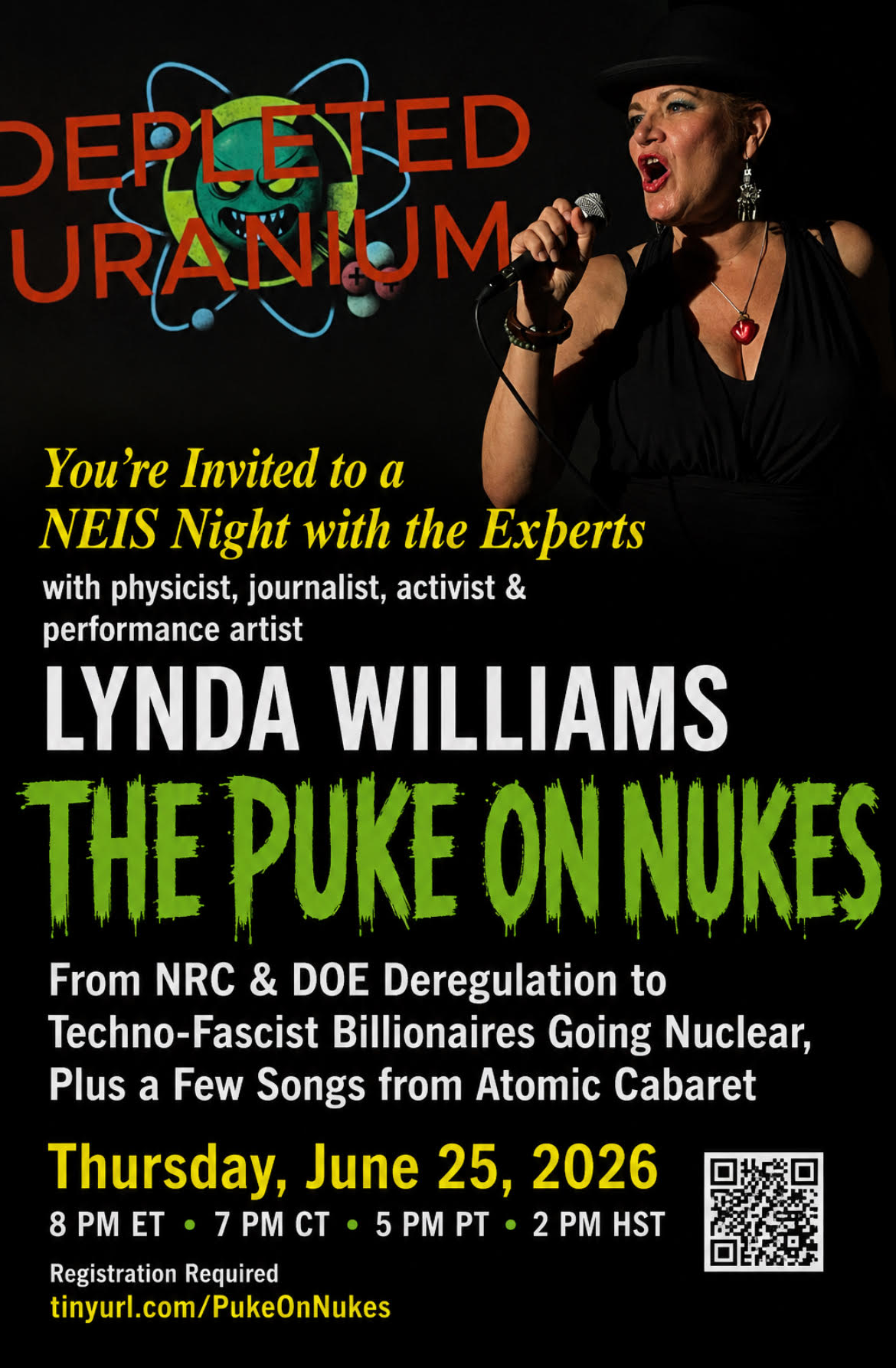
7pm Central Time (8pm ET, 6pm MT, 5pm PT) UTC – 5 From NRC & DOE Deregulation to Techno-Fascist Billionaires Going Nuclear, Plus a Few Songs from Atomic Cabaret REGISTER










 nuclear-news