South Korea and USA planning nuclear pyroprocessing
 Meanwhile, South Korea and the U.S. are set to sign a pact that will allow the two nations to step up their joint research on pyroprocessing technology, said a senior official at Seoul’s foreign ministry.
 If adopted, the pact would enable the International Atomic Energy Agency to guarantee the safety of pyroprocessing technology.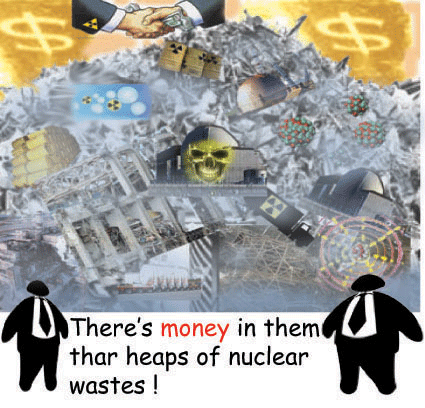
South Korea seeking uranium enrichment, despite its previous pledges
Two-Decade-Old Pledge Complicates South Korean Nuclear Goals National Journal, By Elaine M. Grossman May 30, 2013 | South Korea’s designs on producing atomic fuel recently scotched a 2014 trade deal with the United States, but could yet have new ramifications: Potentially shattering a twenty-one-year-old pledge Seoul made to never process sensitive nuclear materials, according to issue experts.
“By dint of the Joint Declaration of 1992, South Korea has said it will not possess enrichment or reprocessing facilities on its peninsula,” Thomas Moore, deputy director of the Proliferation Prevention Program at the Center for Strategic and International Studies, said at a recent panel discussion. …………http://www.nationaljournal.com/nationalsecurity/two-decade-old-pledge-complicates-south-korean-nuclear-goals-20130530
 South Korea Shuts 2 Reactors Over Faked Certificates http://www.nytimes.com/2013/05/29/world/asia/south-korea-turns-off-nuclear-reactors.html?_r=0 By CHOE SANG-HUN May 28, 2013 SEOUL, South Korea — South Korea said on Tuesday that it was turning off two nuclear power reactors and delaying the scheduled start of operations at another two after its inspectors discovered that the reactors used components whose safety certificates had been fabricated.
South Korea’s nuclear power industry has been plagued by a series of forced shutdowns, corruption scandals and mechanical failures in recent years, undermining public confidence in atomic energy even as the country’s dependence on it for electricity is expected to grow. Continue reading

South Korea hopes to become a major exporter of nuclear plants….. It won a US$20.4-billion contract with the United Arab Emirates (UAE) to build four nuclear power plants there. Potential future export markets for South Korea include Saudi Arabia, India, Vietnam, Poland, and South Africa, as well as the U.S. and China…… http://english.yonhapnews.co.kr/national/2013/05/22/26/0301000000AEN20130522000200315F.HTML
Enormous solar rooftop system for Hyundai, South Korea
Hyundai To Install 40,000 Solar Panels On South Korean Plant http://www.energymatters.com.au/index.php?main_page=news_article&article_id=3740 15 May 13, South Korea’s largest automaker, Hyundai, announced last week it will install the nation’s largest rooftop photovoltaic power plant at its manufacturing factory in Asan, Korea.
Hyundai says it plans to install 40,000 solar photovoltaic modules on the rooftops of Asan’s press, welding, assembly and engine buildings by the end of 2013.
In total, the panels will occupy just shy of 145,000 square meters (14.5 hectares) of the building’s massive 213,000 square metre rooftop area.
The 10MW rooftop solar power facility will generate approximately 11.5 million kilowatt-hours of electricity per year; enough to supply the power needs of 3,200 households. At that generation level, 5,600 tons of carbon dioxide emissions will be avoided annually.
The shading provided by the panels, plus the arrays’ sprinkler cooling systems will also help reduce the temperature in the plant below; offering some energy savings.
Korea Electric Power Corporation (KEPCO) will purchase the electricity produced by the solar modules.
The type of panels to be used on the facility is unknown and while it wouldn’t be unreasonable to assume Hyundai solar panels will be the choice; Hyundai Solar is a totally separate company run under different ownership – it is a subsidiary of Hyundai Heavy Industries.
Hyundai joins a growing list of automakers turning to solar energy for powering operations or providing an additional revenue stream.
While Hyundai’s Asan project is utility scale, commercial and manufacturing operations large and small can benefit from installing solar panels.
According to Australian commercial solar provider Energy Matters; which specialises in systems with a capacity of 20 kilowatts to 1 megawatt, if businesses are paying more than 20c/kWh for daytime electricity rates, a system sized to daytime load will provide a payback time of between 5 and 7 years – after which time, the electricity generated is essentially free.
Problems with USA – South Korea nuclear partnership
Washington, Seoul Seek To Extend Nuclear Partnership, VOA Scott Stearns April 26th, 2013 The United States and South Korea are major partners when it comes to the manufacture and sale of civilian nuclear power equipment. But that partnership, and maybe much more, could come under pressure if the two can’t come up with a broader agreement on licensing nuclear technology.
A big part of the problem, not surprisingly, is North Korea and its already advanced nuclear weapons program…….. http://blogs.voanews.com/state-department-news/2013/04/26/washington-seoul-seek-to-extend-nuclear-partnership/
No agreement between USA and South Korea on enriching uranium
South Korea and U.S. Fail to Reach Deal on Nuclear Energy, NYT, By CHOE SANG-HUN, April 24, 2013 SEOUL, South Korea — South Korea and the Obama administration delayed the deadline for a deal that Seoul had hoped would allow it to begin making its own fuel for its civil nuclear energy program, but that the United States feared would undermine its attempts to curb nuclear proliferation. It had appeared that a deal might be reached this year, but officials in both countries said the deadline would slip until 2016.
The government of President Park Geun-hye has been pushing hard for the United States to lift a ban, part of a treaty signed in 1972, that prevents South Korea from enriching uranium and reprocessing spent nuclear fuel.
But the same technologies are also used to make material for nuclear weapons. American officials have said that lifting the ban would have complicated diplomatic efforts to persuade North Korea to give up its nuclear programs and to stop any attempt by Iran to develop atomic weapons….. http://www.nytimes.com/2013/04/25/world/asia/south-korea-and-us-fail-to-reach-nuclear-energy-deal.html
US nuclear-capable B-2 bombers in exercises with South Korea
US nuclear-capable bombers complete training mission in South Korea The Guardian, 28 March 2013 US military announces B-2 stealth bomber drills amid threats of nuclear strikes from North Korea The US has taken the unprecedented step of publicly announcing that two of its nuclear-capable B-2 bombers have taken part in military exercises with South Korea, dropping dummy munitions on an island range, in what is taken to be a show of force following weeks of North Korean hostility.
The announcement on Thursday is likely to further enrage Pyongyang, which has already issued a flood of ominous statements to highlight its displeasure at the exercises and at UN sanctions over its nuclear test last month. Continue reading
Conflict of interest, safety fears, in South Korea’s nuclear power plans
“The Republic of Korea is going to be the only country across the globe where regulators and basically developers or promoters might be working all together under the same roof,” said Suh Kune Yull, a nuclear engineering professor at Seoul National University. “A conflict of interest is inevitable.”
Safety concerns cloud South Korea nuclear drive, Japan Times, AFP-JIJI FEB 28, 2013 GORI, SOUTH KOREA – South Korea has big plans to become a major nuclear energy player, but they are unfolding at a time when the global industry is under intense scrutiny after the 2011 Fukushima disaster.And its ambitions have not been helped by a series of domestic scandals and forced reactor shutdowns in 2012 that rattled public confidence and exposed a glaring lack of regulatory transparency.
Around $400 billion is riding on South Korea’s ability to sell its technology to potential clients as it aims to take on the United States, France and Russia and grab a 20 percent share of the nuclear energy market……
A survey commissioned by the Economics Ministry and published in November showed only 35 percent of South Koreans considered nuclear power to be safe — sharply down from 71 percent in January 2010. Continue reading
Park Geun-hye , South Korea’s new President’s challenge to negotiate with North korea
Park warned after the test that North Korea faces international isolation, economic difficulties and, eventually, a collapse if it continues to build its atomic program. She also pressed Pyongyang to respond to her overtures.
“We can’t achieve trust with only one side’s efforts. Isn’t there a saying that ‘We need both hands to make a clapping sound?”‘ she said.
South Korea’s 1st female president faces nuclear crisis CBC News, Park Geun-hye takes office Monday after election vow to soften approach to North Korea The Associated Press Feb 24, 2013 Even before she takes office Monday as South Korea’s first female president, Park Geun-hye’s campaign vow to soften Seoul’s current hard-line approach to rival North Korea is being tested by Pyongyang’s recent underground nuclear detonation. Continue reading
Japanese government’s nuclear reprocessing plans likely to be colossal waste of money
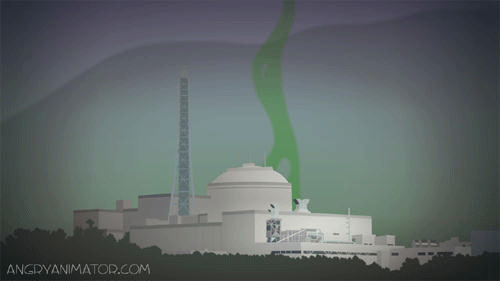 But the continued operation of the Monju reactor is uncertain due to
frequent malfunctions. The Japanese government has admitted that it
may not be put into commercial use until 2050, prompting criticism
that the Rokashomura facility was a colossal waste of money.
 Japan Could Reprocess Nuclear Fuel from Korea
http://www.energytribune.com/69930/japan-could-reprocess-nuclear-fuel-from-korea-2
January 07, 2013 From Chosun Ilbo The Japanese government is
considering reprocessing spent nuclear fuel rods from Korea, Vietnam
and other Asian countries, the Tokyo Shimbun reported Sunday. Japan is
the only country in the world that has no nuclear weapons but the
facilities to reprocess spent nuclear fuel rods capable of producing
weapons-grade plutonium.
An advisory council to the Democratic Party of Japan in a report last
May said reprocessing spent nuclear fuel rods would “strengthen”
Japan’s diplomacy, security and the country’s economy as well as
“contribute to the peaceful use of atomic energy.”
The report suggests using the Rokashomura nuclear reprocessing plant
in Aomori Prefecture, which will become obsolete if Japan scraps all
its own nuclear power plants in the 2030s. Continue reading
Business before safety, in nuclear South Korea
 The country also hopes to
capitalize on its growing technological expertise, and it has already
exported four nuclear power plants to the United Arab Emirates.
Pursuing Economic Growth, South Korea Accepts The Risks Of Nuclear
Power Generation, International Business Tomes, 3 Jan 2013 It’s a new
year for nuclear energy in South Korea. The government has just
approved the reopening of a shuttered power plant in Yeonggwang
county, which will begin supplying electricity amid official
assurances that safety concerns have been addressed….. a sobering
caveat: Nuclear energy is inherently risky. …… especially
worrisome when South Korea shut down two of its own nuclear plants in
Yeonggwang — which is less than 200 miles from the capital city of
Seoul — in November, after it was revealed that some of the working
parts had quality certificates that had been forged. Continue reading
South Korea’s nuclear power bungles
 A Year Of Nuclear Bungles, New Matilda, By Jim Green, 19 Dec 12,“……In South Korea, five engineers were charged with covering up a potentially dangerous power failure at the Kori-I reactor in May. The accident occurred because of a failure to follow safety procedures. The manager of the reactor decided to conceal the incident and to delete records, despite a legal obligation to notify the Nuclear Safety and Security Commission.
In early November, the South Korean government shut down two reactors at Yeonggwang to replace thousands of parts that had been supplied with forged quality and safety warranties. Plant owner Korea Hydro and Nuclear Power (KHNP) has acknowledged possible bribery and collusion by KHNP officials as well as corruption by firms supplying reactor parts. In late November there were further revelations and the current total stands at 8601 reactor parts, 10 firms and six reactors. Inadequate and compromised regulation has been a key contributor to the problems in South Korea’s nuclear industry — just as it was a key factor behind the Fukushima disaster in Japan.
South Korea wants to develop uranium enrichment technology (a direct route to nuclear weapons material) in violation of its commitments under the 1992 Joint Declaration on the Denuclearization of the Korean Peninsula……. http://newmatilda.com/2012/12/19/year-nuclear-bungles
South Korea keen to sell nukes: must clean up their act
 There is a lot at stake for South Korea, which aims to export 80 nuclear reactors by 2030, expected to be worth up to $300 billion, according to government plans.
South Korea urged to restore trust in nuclear Australia Network News Nov 24, 2012 The International Energy Agency (IEA) says South Korea needs to rebuild public trust in nuclear power by boosting transparency and improving regulation, after safety scares have closed reactors and threaten to trigger blackouts over winter. Continue reading
South Korea’s and Japan’s nuclear operators – not to be trusted
Now, South Korea wants to develop uranium enrichment technology in violation of its commitments under the 1992 Joint Declaration on the Denuclearization of the Korean Peninsula.
South Korea has no legitimate need for enrichment technology (there is ample global enrichment capacity) and there are serious proliferation concerns as enrichment provides a direct route to nuclear weapons material in the form of highly-enriched uranium…..
Japan’s plutonium program demonstrably fans regional proliferation tensions.
How can we trust nuclear, if we can’t trust its operators? The Punch, by Jim Green 13 DEC “……Widespread safety breaches and proliferation concerns in North Asia are recent manifestations of the problem. In May, fiveengineers were charged with covering up a potentially dangerous power failure at South Korea’s Kori-I reactor which led to a rapid rise in the reactor core temperature. The accident occurred because of a failure to follow safety procedures. A manager decided to conceal theincident and to delete records, despite a legal obligation to notify the Nuclear Safety and Security Commission.
In October, authorities temporarily shut down two reactors at separateSouth Korean nuclear plants after system malfunctions. Continue reading
1 This Month
22 June – Virtual Event –Climate Change: New Data, New Debate

Monday, June 22, 2026 2:30 p.m. – 3:15 p.m. CT
YouTube. Register here

Protect Sazan Island from the Trump family! https://secure.avaaz.org/campaign/en/protect_sazan_island_from_the_trump_family_loc/?bqFCVab&v=174511&cl=22707147157&_checksum=5e9dde668860e8231c33699735e16a1fbf22ab2cb01da50c999fe8732b9775ef&utm_source=email&utm_medium=blast_email&utm_campaign=174511
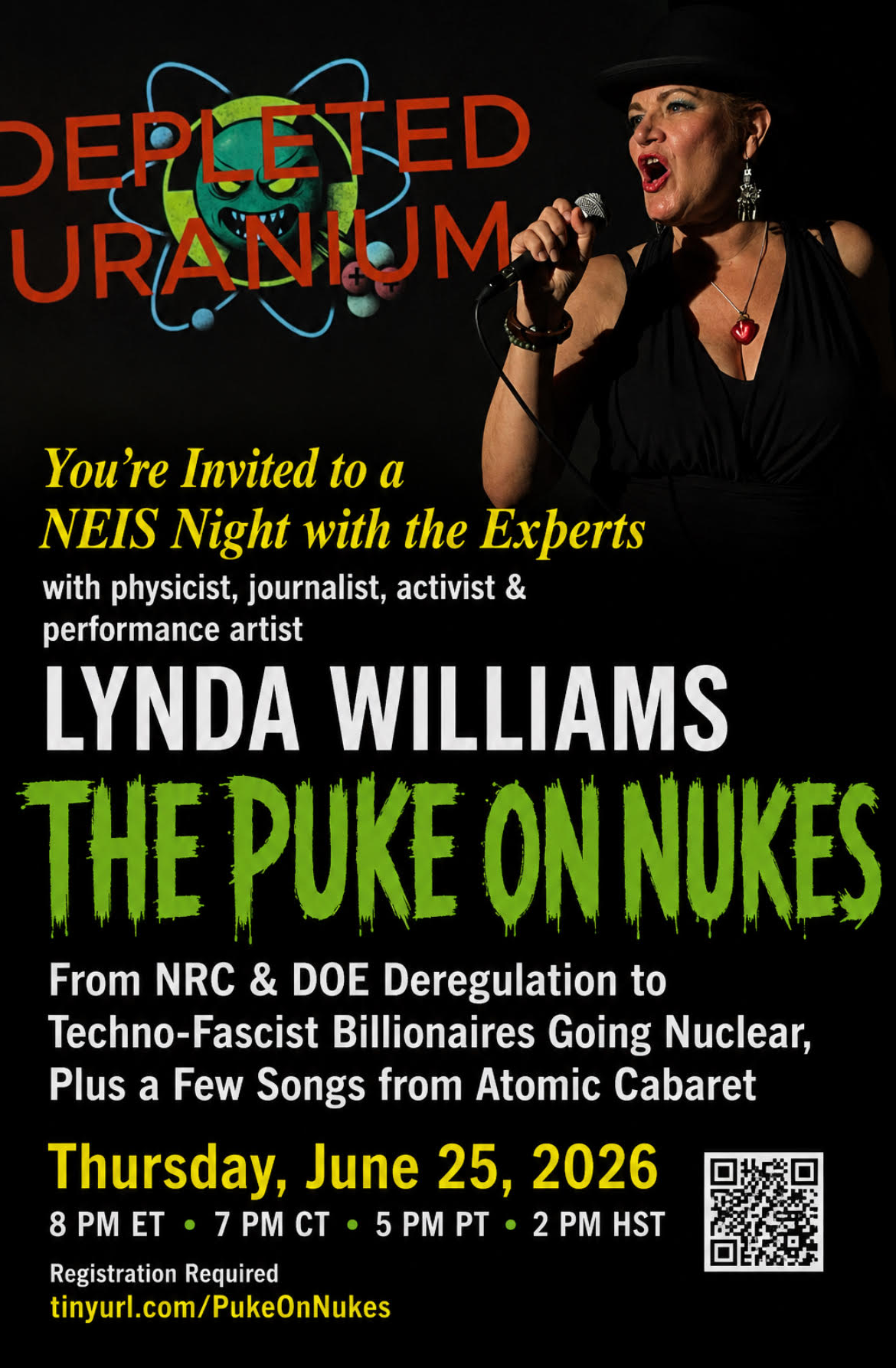
25 June- THE PUKE ON NUKES
Thursday, June 25, 2026
7pm Central Time (8pm ET, 6pm MT, 5pm PT) UTC – 5
From NRC & DOE Deregulation to Techno-Fascist Billionaires Going Nuclear, Plus a Few Songs from Atomic Cabaret REGISTER
26 June – Radiation Trainwreck at the NRC / Join the Protect Better Campaign – https://us02web.zoom.us/meeting/register/4ZlZ5_qLSHGiLSCg8FF6Bg#/registration


Cuba Is Not a Failed State – It Is a Besieged State
PETITION: “Global Appeal to Endorse Palestinian Right of Return of Refugees”
To see nuclear-related stories in greater depth and intensity – go to https://nuclearinformation.wordpress.com
-
Archives
- June 2026 (193)
- May 2026 (306)
- April 2026 (356)
- March 2026 (251)
- February 2026 (268)
- January 2026 (308)
- December 2025 (358)
- November 2025 (359)
- October 2025 (376)
- September 2025 (257)
- August 2025 (319)
- July 2025 (230)
-
Categories
- 1
- 1 NUCLEAR ISSUES
- business and costs
- climate change
- culture and arts
- ENERGY
- environment
- health
- history
- indigenous issues
- Legal
- marketing of nuclear
- media
- opposition to nuclear
- PERSONAL STORIES
- politics
- politics international
- Religion and ethics
- safety
- secrets,lies and civil liberties
- spinbuster
- technology
- Uranium
- wastes
- weapons and war
- Women
- 2 WORLD
- ACTION
- AFRICA
- Atrocities
- AUSTRALIA
- Christina's notes
- Christina's themes
- culture and arts
- Events
- Fuk 2022
- Fuk 2023
- Fukushima 2017
- Fukushima 2018
- fukushima 2019
- Fukushima 2020
- Fukushima 2021
- general
- global warming
- Humour (God we need it)
- Nuclear
- RARE EARTHS
- Reference
- resources – print
- Resources -audiovicual
- Weekly Newsletter
- World
- World Nuclear
- YouTube
-
RSS
Entries RSS
Comments RSS
 nuclear-news