Thawing glaciers around Everest show critical need to stop greenhouse emissions
Helen Clark – former prime minister of New Zealand: Global temperature
rises mean that Everest, in common with mountains across the Himalayas, is
undergoing unprecedented and irreversible change. The 79 glaciers that
surround Everest have thinned by more than 100 metres (328ft) in just six
decades, and the rate of thinning has nearly doubled since 2009.
Communities at the top of the world are crying out to world leaders for
help. Humanity has a mountain to climb in reaching the aspirations of the
Paris Agreement. The only hope is for concerted global action to reduce
greenhouse gas emissions dramatically to save the world’s snow and ice
before it is too late.
Times 29th May 2023
https://www.thetimes.co.uk/article/as-everest-shows-action-on-climate-change-is-critical-lswbmvlps
Taiwan Considers Keeping Nuclear Reactors on Emergency Standby
Cindy Wang and Stephen Stapczynski, Mon, May 29, 2023 https://finance.yahoo.com/news/taiwan-considers-keeping-nuclear-reactors-022439242.html
(Bloomberg) — Taiwan is considering keeping nuclear power plants on standby in case of emergencies, signaling a loosening of policy to phase out the energy source.The government plans to maintain shut reactors so that they could be restarted in an emergency, Taipei-based United Daily News reported, citing Vice President Lai Ching-te, the ruling Democratic Progressive Party’s presidential candidate. It’s the first time the government has signaled it’s possible to restart plants, United Daily News said.
The use of nuclear as backup generation would be unusual because of the high costs and safety measures required. Taiwan’s plans to phase out its last remaining atomic plant by 2025 go against a global resurgence of the technology to reduce dependence on fossil fuels. The island is also seeking to reduce coal consumption, leaving the government under pressure to build out gas-powered generation and offshore wind to avoid power shortages.
A restart strategy would only be needed in extreme emergencies, such as external blockades or serious natural disaster, and would need to be safe and have consensus among lawmakers and the public, Economics Minister Wang Mei-hua told reporters on Monday.
Taiwan got about 11% of its power from nuclear in 2021, according to state-owned Taiwan Power Co. It has two operating reactors that started in the 1980s and which are slated to close next year and in 2025.
CAN PAK-INDIA NUCLEAR DETERRENCE HOLD?

The nuclearisation of South Asia can be analysed from different angles.
Dawn Ejaz Haider May 28, 2023
Exactly 25 years ago, on May 28, Pakistan conducted five nuclear tests (a sixth was done on May 30). The tests were a response to India’s five nuclear tests, conducted on May 11 and 13. Both governments, after the tests, declared a moratorium on further testing. A quarter century since May 1998, they have stuck to the moratorium, though neither has signed the Comprehensive Test Ban Treaty (CTBT).
………………………………..We should be less sanguine about deterrence holding in all situations. Indeed, there’s now growing literature about the world being “on the cusp of a Third Nuclear Age” where a number of factors are likely to make the old belief in deterrence increasingly problematic if not entirely untenable.
This article primarily deals with India and Pakistan, a nuclear dyad in conflict. But some of the observations here are also applicable to other NWSs, including those whose possession of nuclear weapons have been “legitimised” by the Nuclear Non-Proliferation Treaty (NPT).
WHAT IS THE THIRD NUCLEAR AGE?
In a 2021 article for European Journal of International Security, titled Strategic non-nuclear weapons and the onset of a Third Nuclear Age, Andrew Future and Benjamin Zala describe the Third Nuclear Age as the combination of Second Nuclear Age thinking — i.e., deployment of Strategic Non-Nuclear Weapons (SNNWs) — “with the return of the kind of major power competition associated with the First Nuclear Age.” This combo, as experts have begun to note, is highly dangerous.
…………………………………………………………………………………….. we are witnessing the use of info war by both Ukraine/NATO and Russia. Misinformation and disinformation campaigns, as is now widely known, serve to undermine trust in public institutions and governments. They are also essential tools in influencing perceptions.
INTEGRATION, AI AND THE KILL CHAIN
While the SNNW technologies [ Strategic Non-Nuclear Weapons ] are disrupting the battlefield by getting increasingly more accurate and sophisticated, there’s the additional problem of cross-tech/cross-platform integration that is concentrating and increasing firepower devastatingly.
Developments in artificial intelligence (AI) are also likely, by most accounts, to take the human out of the decision-making loop. This is not hypothetical, since multiple such systems are being tested and prototypes developed. Another problem is the presence of SNNWs in a nuclear environment, such as between a nuclear dyad.
Since they “constitute an employable and credible weapon system that can engage the sources of enemy power directly, skipping the tactical and operational levels of warfare”, nuclear adversaries can use them thinking that they could keep the conflict below the nuclear threshold. Also, in the case of NWSs there’s no way of knowing whether these weapons carry conventional warheads.
Cross-platform integration and the introduction of AI — what we can call the Internet of Military Things — is changing the concept of the decision-making speed and what the militaries call the kill chain (it also throws up many ethical issues). Up until now, the kill chain was a series of processes, executed sequentially. With AI, we are now looking at overlapping some of those phases and completing them in parallel, to reduce the execution time of the chain.
In other words, the weapon is fired first, the find and fix processes overlap the flight time, and the final target designation is sent to the weapon in flight, through a SATCOM channel. Now bring AI into this and combine it with hypersonic missiles and you get an idea of how much time will be reduced on the kill chain.
In August 2020, the Defense Advanced Research Projects Agency of the United States conducted a simulated experiment. It pitted a Heron-developed AI pilot against a top F-16 human pilot. The AI pilot beat the human pilot in a 5-0 sweep in dogfight and manoeuvres.
While some of these technologies are expensive, others are not. The cost of many will steadily come down further as they proliferate (drones are a case in point, as is cyber and digital expertise). At this point, there are almost no regulatory frameworks for a number of emerging technologies.
Integration and the digital environment has also brought other risks. In a January 2018 report, the Royal Institute of International Affairs warned that US, British and other nuclear weapons systems are increasingly vulnerable to cyber-attacks. This is far from an abstract threat.
……………………………………………………………………………………………….. This is not all. In a January 2023 edited volume, The Fragile Balance of Terror: Deterrence in the New Nuclear Age, professors Vipin Narang and Scott D Sagan point to what they call the “declining confidence in deterrence.”
Gathered in the book are some of the top world experts trying to analyse the presence of nuclear weapons in a new age: growing prevalence of personalist dictatorships; incomplete or incorrect information; states facing multiple nuclear adversaries (regional subsystems) and operating in a novel information environment where misinformation can be maliciously planted or otherwise spread rampantly; states possessing small nuclear arsenals which they fear may not be reliable or survivable or over which they may not retain firm command and control.
As they put it: “Each of these factors alone, and especially in combination, generate risks that our standard strategies of nuclear deterrence are simply unequipped to manage or address.”
This is just a bird’s-eye view of a much larger and complex body of literature, a corpus that is increasing in volume, not as an exercise in alarmism but in analysing the emerging, uncertain trends.
INDIA-PAKISTAN, A CONFLICT DYAD
Some might say that it will be a while before some of these advanced technologies will get to these shores. They are wrong.
UAVs are already here, as are missile defences and precision, long-range artillery.
India is already seeking to bolster its anti-ballistic and cruise missile defences, developing MIRVs (multiple independently-targetable re-entry vehicles), hypersonic glide vehicles (reducing the already very short missile flight times) and fielding SSBNs (ship submersible ballistic nuclear), essentially, nuclear-powered submarines which can carry ballistic and cruise missiles with nuclear warheads.
These systems can both be non-nuclear and nuclear — i.e., they can carry tactical and strategic warheads………………………………………..
There are a number of additional risk factors as far as India and Pakistan are concerned: they are locked in a conflictual model; they have had multiple armed confrontations; both are nuclear-armed with growing arsenals and capabilities; since 2014, but more so since 2016, there is no dialogue framework between the two (covert channels notwithstanding);………………………………………
This environment is known. But it also feeds into another set of problems that increases the likelihood of a conflict:
a: India’s stated doctrine of limited conflict;
b: India’s movement away from the declaratory no-first use policy, as contained in its 2003 doctrine, to what can now only be described as a non-stated first-use policy; and
c: India’s poor record of handling weapon systems and platforms, which increases the risk of accidental conflict.
COLD START AND LIMITED WAR
India’s doctrine of limited war has a high probability of a spiral. ………………………………….
At the politico-strategic levels, relations remain tense, with little to no dialogue between the two sides since August 5, 2019, when India unilaterally and illegally revoked the autonomous status of Jammu and Kashmir, in violation of UN Resolutions. Past experience suggests that deteriorating relations result in a higher probability of conflict between the two sides
INDIA’S NO-FIRST USE IS A SHAM
India’s 2003 Nuclear Doctrine declares that India is wedded to no-first use (NFU) — i.e., India will not be the first to use nuclear weapons, unless it is attacked with nuclear weapons. The NFU declarations, as experts have widely argued, are political, not operational statements.
ACCIDENTS, MORE ACCIDENTS…………………………………………………………………..
As noted by one Indian analyst, “the Indian military services over the last several years have witnessed many high profile tragedies and mishaps.” During PAF’s Operation Swift Retort on February 27, 2019, while there was a dogfight going on over the skies along the Line of Control, Indian ground air defence shot down one of its own Russian Mi-17V5 ‘Hip’ medium-lift helicopters, killing six service officials and one civilian.
In two other incidents, “India’s indigenous Arihant [nuclear] submarine [was left] out of commission for many months in 2018; and a fire and explosion on board an Indian Kilo-class submarine in 2013…killed 18 crew members.”
ELUSIVE COMMON GROUND
As nuclear weapons states outside the framework of the NPT, Pakistan and India have certain legal and normative responsibilities. Their civilian nuclear programmes are under the International Atomic Energy Agency (IAEA) safeguards.
India, which has a 123 Agreement with the United States, has been trying to become a member of the Nuclear Suppliers Group and is already a member of the Missile Technology Control Regime. Pakistan, for its part, has constantly argued against discriminatory approaches to non-proliferation and disarmament……………………………………………
The writer is a journalist interested in security and foreign policies. He tweets @ejazhaider
Published in Dawn, EOS, May 28th, 2023 more https://www.dawn.com/news/1756369/can-pak-india-nuclear-deterrence-hold?preview
Fukushima reactor 1 found to have damaged pedestal supporting nuclear core

(Picture above is of the same structure one year previously)
A nuclear watchdog has asked the operator of Japan’s wrecked Fukushima
nuclear power station to assess potential risks from damage found in a key
supporting structure inside the worst-hit of the three melted reactors. A
robotic probe inside the Fukushima Daiichi nuclear power plant’s Unit 1
primary containment chamber found its pedestal — a main supporting
structure right underneath the core — was largely damaged. The thick
concrete exterior was missing almost all the way around, exposing the
internal steel reinforcement. About 800 tonnes of highly radioactive melted
nuclear fuel remain inside the plant’s three reactors.
LBC 25th May 2023
https://www.lbc.co.uk/world-news/8af57263389e457aa47b8846ede3d7b0/
Japan Nuclear Watchdog Asks Fukushima Plant Operator to Assess Reactor Risk
Photo May 22– damaged pedestal supporting reactor core, Unit 1
By Mari Yamaguchi | May 26, 2023
TOKYO (AP) – A nuclear watchdog has asked the operator of Japan’s wrecked Fukushima nuclear power plant to assess possible risks resulting from damage that was found in a key supporting structure inside one of the three melted reactors.
A robotic probe sent inside the Fukushima Daiichi plant’s Unit 1 primary containment chamber found that its pedestal – the main supporting structure directly under its core – was extensively damaged. Most of its thick concrete exterior was missing, exposing the internal steel reinforcement.
About 880 tons of highly radioactive melted nuclear fuel remain inside the plant’s three damaged reactors. Robotic probes have provided some information, but the status of the melted debris is still largely unknown.
Based on data collected from earlier probes and simulations, experts have said most of the melted fuel inside Unit 1, believed to be the worst hit, fell to the bottom of the primary containment chamber, but some might have fallen through to the concrete foundation – a situation that makes the already daunting task of decommissioning extremely difficult.
At a meeting Wednesday of the Nuclear Regulation Authority, its commissioners agreed to order operator Tokyo Electric Power Company Holdings to urgently assess the risks from the pedestal damage, including the possible leak of radioactive substances from cracks and holes caused by the meltdown. The authority also requested that TEPCO assess potential risks if, in the event of another disaster, the pedestal fails to support the reactor.
”We need to think about responses in case of an accident,” commissioner Shinsuke Yamanaka told reporters. “TEPCO has a responsibility to make the risk assessment as soon as possible.”…………………………………………………….
The damage is believed to be from the initial earthquake in 2011, but might have happened more recently. The images of the exposed steel reinforcement have triggered concerns among local residents about the reactor’s safety.
A plan to release treated, but still slightly radioactive, water from the Fukushima Daiichi plant into the sea has also triggered concerns and protests from the local fishing community and neighboring countries, including South Korea.
A South Korean delegation of government experts visited the plant for two days this week to see the facilities related to the planned water release. The team members were to meet with Japanese officials on Thursday in Tokyo, where they said they plan to follow the review of the International Atomic Energy Agency, which has been assisting Japan to improve transparency and credibility…………………. https://www.claimsjournal.com/news/international/2023/05/26/317199.htm—
A Nuclear Collision Course in South Asia
The Budding Arms Race Among China, India, and Pakistan
Foreign Affairs, By Andrew F. Krepinevich, Jr., May 26, 2023
………………………………………………………………………………………………… THE RACE IS ON
China and Pakistan have a long and close relationship, in part built around their mutual view of India as a rival. India finds itself sandwiched between these two often hostile powers. Yet despite a history of wars and persistent low-grade conflict between India and its two rivals, a general war has been averted since India and Pakistan became nuclear powers a quarter century ago. Moreover, the three countries have not found themselves caught up in a nuclear arms race. Until recently, they viewed their nuclear weapons primarily as political instruments, not as tools for actual warfighting. All three adopted a “minimum deterrent” nuclear posture, maintaining the lowest number of nuclear weapons necessary to inflict unacceptable damage to their adversaries’ key cities even after suffering a nuclear attack.
In keeping with this strategy, the three Asian rivals avoided maintaining a significant portion of their arsenals on high alert. Instead, they stored their weapons in caves, in deep underground facilities, or in other concealed locations. Rejecting American and Russian notions that “retaliation delayed is retaliation denied,” the three countries, especially China and India, forswore the need for a swift response to a nuclear attack. To be sure, they would respond eventually—in days, weeks, or even months—but they did not accept the imperative of immediacy. As a result, these countries have avoided making heavy investments in early warning systems while retaining centralized control over their arsenals.
But the prospects for sustaining this era of minimum deterrence appear increasingly shaky. The tripolar rivalry has not been locked in amber: Tellis describes strongly held beliefs among top security officials in China, India, and Pakistan that their nuclear postures are inadequate. Led by China and Pakistan, with India following in their wake, the three rivals are now on a course that will result in a dramatic expansion of their nuclear arsenals, even if Russia and the United States pursue substantial cuts to theirs…………………………………………………………………………………………………………………. more https://www.foreignaffairs.com/china/nuclear-collision-course-south-asia
Irony Or What! India “Sidelines” Russia For US Nuclear Tech, But US Remains ‘Critically Dependent’ On Russian Nuke Fuel
The signing of the 123 Nuclear Agreement between India and the US ended the former’s pariah status in the nuclear world. It brought hope to the American player to collaborate in the nuclear energy sector.
But India’s first deal with the Westinghouse Electric Corporation, a power manufacturing company, has been hanging fire after the company reported bankruptcy. India is now seeking to cooperate with the US on building Small Modular Reactors instead of Russia.
At the G-20 summit, Indian bureaucrat Amitabh Kant called for India-US collaboration to build small 300 MW nuclear power plants and sought “unfettered access” to the US cutting-edge technology.
So far, Russia has been India’s biggest collaborator in the nuclear energy sector. It has helped set up the largest nuclear power plant in Asia at Kudankulam, Tamil Nadu.
………………………………………………………………………………………………..The US government, however, could not bring itself to sanction the Russian nuclear energy giant Rosatom because of its importance in the global nuclear industry.
A special high assay low enriched Uranium is used in the SMRs, and Russia has a monopoly over it. In the absence of an alternative source, the US is dependent on Russia for it.
HALEU is enriched to up to 20%, rather than around 5% for the uranium that powers most nuclear plants. But only TENEX, a subsidiary of Russian state-owned nuclear energy company Rosatom, currently sells HALEU commercially…………………………………………………………………..
The Nuclear Energy Market In India
A recent report in Reuters said that India is likely to overturn a ban on foreign investment in its nuclear power industry and allow greater participation from domestic private firms. An Indian government panel has recommended the changes.
Under India’s Atomic Energy Act 1962, the government controls the development and running of nuclear power plants. Domestic private firms have been able to take part by supplying components.
India has signed contracts with many foreign companies like Westinghouse Electric, GE-Hitachi, Electricite de France, and Rosatom to set up nuclear power plants. Apart from Rosatom, none of the companies have been able to deliver so far…… https://eurasiantimes.com/irony-or-what-india-sidelines-russia-for-us-nuclear-tech/
Nuclear umbrella to protect Taiwan could be globally catastrophic
May 25, 2023
Analysts say a new plan to protect Taiwan could be globally catastrophic, as Taiwan’s Foreign Minister suggested he’s in talks with the United States to have the country covered by the US “nuclear umbrella”.
That would mean the US could use nuclear weapons if Taiwan was attacked. https://www.skynews.com.au/world-news/global-affairs/nuclear-umbrella-to-protect-taiwan-could-be-globally-catastrophic/video/21b5ceffa74672b99ce3c61552d89e78
South Korean experts to continue analysis of Fukushima water discharge
Japan Times 26 May 23
A South Korean delegation of experts will continue, from home, with its analysis of Japan’s plan to discharge treated radioactive water into the sea from the disaster-hit Fukushima nuclear power plant, the group said Thursday after inspecting it.
The delegation of 21 experts from agencies and affiliated organizations of the South Korean government with expertise in radiation and nuclear reactors, among other fields, held a meeting with Japanese officials to summarize their observations following the two-day inspection, telling the Japanese side they still needed to confirm several things before releasing their conclusion on the plan’s safety.
They requested additional materials, such as protocols for a power outage and a long-term management plan for an advanced liquid processing system (ALPS) capable of removing radionuclides other than tritium in water……….. (Subscribers only) more https://www.japantimes.co.jp/news/2023/05/26/national/south-korea-fukushima-analysis/
Court rejects case opposing restart of Miyagi Prefecture nuclear plant
Japan Times. 24 May 23
SENDAI – A district court on Wednesday rejected local residents’ calls to halt the restart of a nuclear reactor in Miyagi Prefecture, ruling their concerns about flaws in emergency evacuation plans are not relevant as it cannot be assumed a serious accident is likely.
The Sendai District Court ruling came as Tohoku Electric Power aims to resume operations at the No. 2 unit of the Onagawa plant in February next year, becoming the first in the area hit by the 2011 earthquake and tsunami to restart.
“It cannot be assumed that a specific danger of an accident exists that leads to the abnormal release of radioactive materials,” said presiding Judge Mitsuhiro Saito……………………………………..more https://www.japantimes.co.jp/news/2023/05/24/national/crime-legal/tohoku-miyagi-nuclear-plant-approval-case/
South Korean nuclear experts to tour Fukushima plant amid water concerns
Japan Times, BY ERIC JOHNSTON. STAFF WRITER. May 22, 2023
A team of South Korean experts arrived in Japan on Sunday for an unprecedented six-day visit that will include a trip on Tuesday to the crippled Fukushima No. 1 nuclear power plant, where the government is planning to release treated water into the ocean as part of a decadeslong decommissioning process.
Concerned about the aftereffects of the March 2011 nuclear disaster, South Korea continues to uphold a ban on seafood and marine imports from the area around the Fukushima No. 1 plant, despite Japanese government insistence the food is safe.
Nuclear Safety and Security Commission Chairperson Yoo Guk-hee is heading a 21-member team of government experts, who on Monday met with nuclear officials from plant operator Tokyo Electric Power Company Holdings (Tepco) and various government agencies that oversee Japan’s nuclear power industry. They will tour the plant on Tuesday and Wednesday, paying particular attention to Japan’s plans to discharge treated water, currently being stored at Fukushima No. 1, into the ocean……………. https://www.japantimes.co.jp/news/2023/05/22/national/south-korean-experts-fukushima-tour/
Director General Grossi Highlights China as Indispensable IAEA Partner, Leader in Nuclear Energy
IAEA Joanne Liou, IAEA Office of Public Information and Communication, 24 May 23
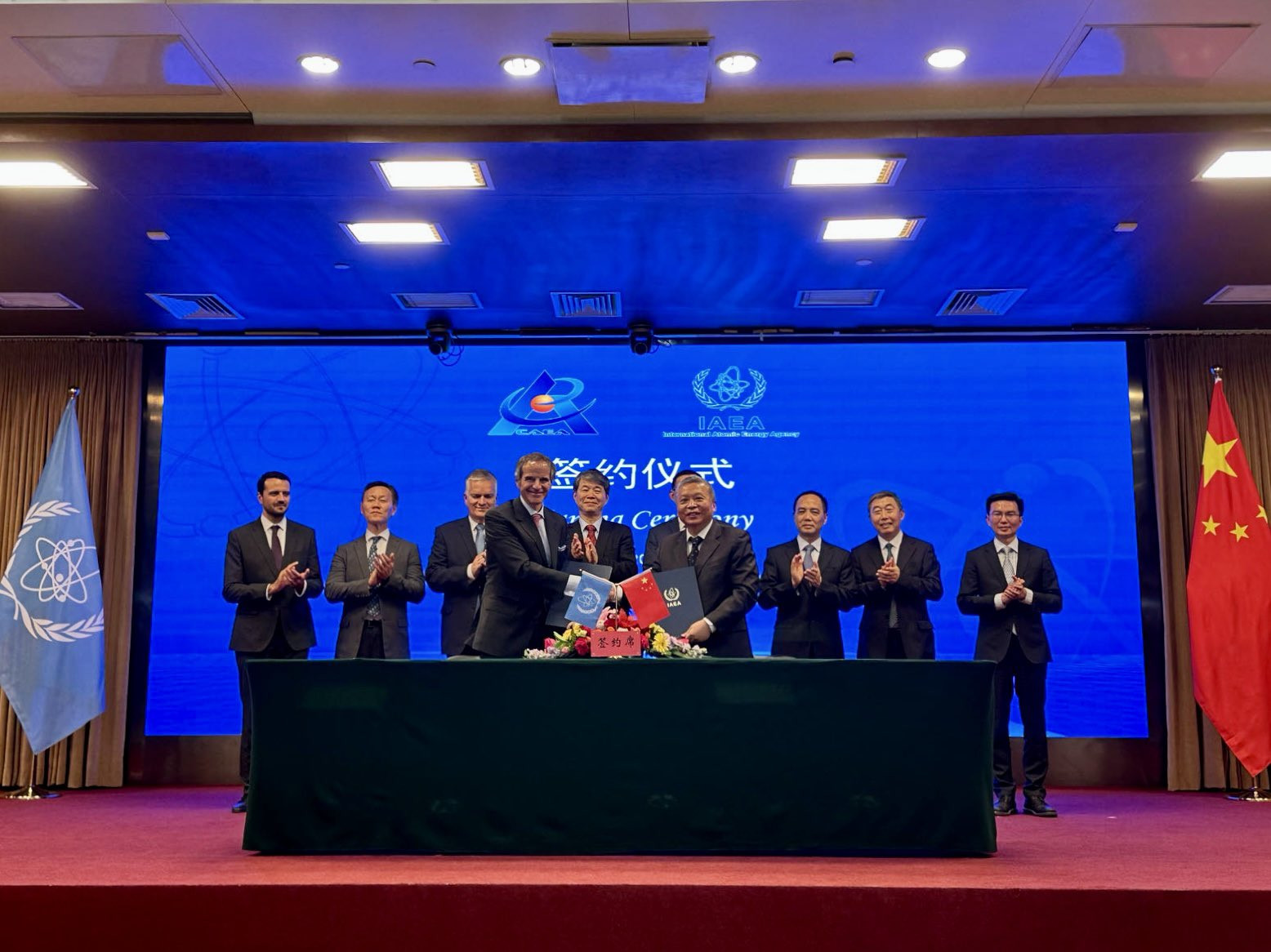
As the IAEA supports efforts to accelerate the contribution of atomic energy to peace, health and prosperity around the world, China is an indispensable partner in this endeavour, said Rafael Mariano Grossi, IAEA Director General, at the start of a week-long visit to China. Mr Grossi is meeting with several high-level officials and visiting nuclear facilities and institutions in Beijing, Shanghai and Shandong, during his first official visit to the country.
“China is one of the IAEA’s most important partners and a global leader in nuclear energy,” Mr Grossi said. “This week’s agenda will cover the remarkable progress of China’s nuclear energy programme, cooperation in nuclear applications and indispensable exchanges on non-proliferation and nuclear safety.” China has more than 50 operational nuclear power units and 24 are under construction. By 2035, China’s nuclear power generation will account for 10 per cent of the country’s electricity generation, according to the latest Blue Book of China Nuclear Energy Development Report.
On Monday, Mr Grossi and other IAEA officials signed several agreements at the China Atomic Energy Authority (CAEA), which reflect the diverse scope of work between the IAEA and China. The agreements will strengthen cooperation on small modular reactors, nuclear fusion, and nuclear data, fuel cycle and waste management, as well as communication activities……………………………………………. more https://www.iaea.org/newscenter/news/director-general-grossi-highlights-china-as-indispensable-iaea-partner-leader-in-nuclear-energy
Hiroshima Survivor Slams G7 Leaders for Embracing War & Rejecting Nuclear Disarmament
Democracy Now, MAY 22, 2023
The G7 summit wrapped up Sunday in Hiroshima, where much of the summit focused on the war in Ukraine and China. While in Japan, President Biden and other world leaders paid tribute to the victims of the world’s first nuclear attack — the U.S. bombing of Hiroshima on August 6, 1945 — laying wreaths at the Hiroshima Peace Memorial and planting a tree.
But President Biden did not issue an apology for the attack, which killed an estimated 140,000 people and seriously injured another 100,000. For more, we speak with Setsuko Thurlow, who survived the U.S. bombing of Hiroshima in 1945 and devoted her life to nuclear disarmament. In 2017, she was chosen to accept the Nobel Peace Prize on behalf of the International Campaign to Abolish Nuclear Weapons.
Media Options
This is viewer supported news. Please do your part today.
TOPICS
GUESTS
- Setsuko Thurlowsurvivor of the atomic bombing of Hiroshima in 1945 and nuclear disarmament activist.
LINKS
The G7 summit wrapped up Sunday in Hiroshima, where much of the summit focused on the war in Ukraine and China. While in Japan, President Biden and other world leaders paid tribute to the victims of the world’s first nuclear attack — the U.S. bombing of Hiroshima on August 6, 1945 — laying wreaths at the Hiroshima Peace Memorial and planting a tree. But President Biden did not issue an apology for the attack, which killed an estimated 140,000 people and seriously injured another 100,000. For more, we speak with Setsuko Thurlow, who survived the U.S. bombing of Hiroshima in 1945 and devoted her life to nuclear disarmament. In 2017, she was chosen to accept the Nobel Peace Prize on behalf of the International Campaign to Abolish Nuclear Weapons.
Transcript
………………………………………………………………………………………………………………………. SETSUKO THURLOW: Well, I came to Hiroshima from Canada, where I live. I wanted to be part of this whole excitement that the world leaders are coming to Hiroshima and to discuss the nuclear disarmament. And the people here were so excited, so happy to have the opportunity to give them the — to give the leaders the opportunity to be with us, to be in the center of the calamity and catastrophe, and to have a profound encounter themselves with the meaning of the dawn of the nuclear age. And people had a great anticipation and excitement. They’ve prepared for this with all kinds of recommendations to the leaders.
But somehow their wishes were not fully listened. To put it bluntly, for us survivors, who want nothing less than the total disarmament, total abolishment of nuclear weapons, and the majority of the citizens of Japan who support survivors’ idea, to us, it was nothing but a disaster. We are feeling more than frustration. It’s a fury, anger and a total disappointment, because we —
Media Options
This is viewer supported news. Please do your part today.
TOPICS
GUESTS
- Setsuko Thurlowsurvivor of the atomic bombing of Hiroshima in 1945 and nuclear disarmament activist.
LINKS
The G7 summit wrapped up Sunday in Hiroshima, where much of the summit focused on the war in Ukraine and China. While in Japan, President Biden and other world leaders paid tribute to the victims of the world’s first nuclear attack — the U.S. bombing of Hiroshima on August 6, 1945 — laying wreaths at the Hiroshima Peace Memorial and planting a tree. But President Biden did not issue an apology for the attack, which killed an estimated 140,000 people and seriously injured another 100,000. For more, we speak with Setsuko Thurlow, who survived the U.S. bombing of Hiroshima in 1945 and devoted her life to nuclear disarmament. In 2017, she was chosen to accept the Nobel Peace Prize on behalf of the International Campaign to Abolish Nuclear Weapons.
Transcript
This is a rush transcript. Copy may not be in its final form.
AMY GOODMAN: The G7 summit wrapped up Sunday in Hiroshima, Japan. Much of the summit focused on two issues: the war in Ukraine and China. President Biden announced $375 million more in military aid for Ukraine. He also pledged to begin training Ukrainian forces on flying U.S.-made F-16 fighter jets. Biden did not offer to send any F-16s, but the U.S. has lifted its opposition to allies supplying the warplanes to Ukraine. Britain and the Netherlands have announced plans to work together to help provide Ukraine F-16s. President Biden spoke Sunday.
PRESIDENT JOE BIDEN: You know, in my private meeting with President Zelensky after the G7 meeting, and with his staff, I told — the United States, together with our allies and partners, is going to begin training Ukrainian pilots in fourth-generation fighter aircraft, including F-16s, to strengthen Ukraine’s air force as part of a long-term commitment to Ukraine’s ability to defend itself. … I have a flat assurance from the — from Zelensky that they will not — they will not use it to go on and move into Russian geographic territory. But wherever Russian troops are within Ukraine in the area, they would be able to do that.
AMY GOODMAN: Ukrainian President Volodymyr Zelensky, who attended the G7 in Hiroshima, thanked Biden for his support.
PRESIDENT VOLODYMYR ZELENSKY: We are very thankful. I think it will give us more strong positions on the battlefield. So, we are very thankful that that is a new package. I really didn’t know the details, but I know that you gave us very big package during this year. It’s more than $37 billion. My appreciations. We will never forget. Thank you.
AMY GOODMAN: While in Hiroshima, President Biden and other world leaders paid tribute to the victims of the world’s first nuclear attack — the U.S. bombing of Hiroshima on August 6, 1945 — laying wreaths at the Hiroshima Peace Memorial and planting a tree. But President Biden did not issue an apology for the attack. A group of anti-nuclear activists rallied on the streets.
PROTESTER 1: [translated] Japan and the United States are trying to conduct a war of aggression on China. I am protesting because I absolutely cannot accept the fact that they are in Hiroshima, a place where an atomic bomb was dropped, trying to hold a meeting to start a nuclear war.
PROTESTER 2: [translated] I’m absolutely against the war. I’m against using nuclear weapons. That is why I’m here. This summit is being held to prepare for a nuclear war, so we, the union, need to do whatever we can to protest against it.
AMY GOODMAN: We go now to Hiroshima, where we’re joined by Setsuko Thurlow, who survived the U.S. bombing of Hiroshima in 1945 that killed about 140,000 people. She’s devoted her life to nuclear disarmament and the ban treaty process. In 2017, she was chosen to accept the Nobel Peace Prize on behalf of the International Campaign to Abolish Nuclear Weapons, or ICAN. She’s joining us on the phone from Hiroshima.
It’s great to have you back with us, Setsuko Thurlow. If you can respond to the G7 meeting and the outcome this weekend, held in Hiroshima, where you are?
SETSUKO THURLOW: Well, I came to Hiroshima from Canada, where I live. I wanted to be part of this whole excitement that the world leaders are coming to Hiroshima and to discuss the nuclear disarmament. And the people here were so excited, so happy to have the opportunity to give them the — to give the leaders the opportunity to be with us, to be in the center of the calamity and catastrophe, and to have a profound encounter themselves with the meaning of the dawn of the nuclear age. And people had a great anticipation and excitement. They’ve prepared for this with all kinds of recommendations to the leaders.
But somehow their wishes were not fully listened. To put it bluntly, for us survivors, who want nothing less than the total disarmament, total abolishment of nuclear weapons, and the majority of the citizens of Japan who support survivors’ idea, to us, it was nothing but a disaster. We are feeling more than frustration. It’s a fury, anger and a total disappointment, because we —
AMY GOODMAN: Setsuko Thurlow, how do you think the war can end, the war in Ukraine can end?
SETSUKO THURLOW: Well, to me, personally, you know, why we keep hearing about more military aid, the support for war, than hearing about the efforts being made for a peaceful ceasefire at the earliest possible time? Every day, many, many lives have been killed. Certainly, something must be going on, some — quietly, some effort must be being paid for ceasefire. But we don’t hear about them. Are they really making that effort? Do they really feel they can win this out? I don’t know what’s their thoughts. All I can say is it has to stop at the earliest possible chance, no matter what.
AMY GOODMAN: President Biden did not apologize for the U.S. dropping the atomic bomb on Hiroshima, then three three days later on Nagasaki. Your thoughts?
SETSUKO THURLOW: Well, it’s unfortunate. He had the opportunity, but he didn’t. This time, too, in the joint statement or communiqué, he kept criticizing the Russians, the Chinese or North Korea. And why do they fail to look at themselves with a critical eye, and we don’t hear anything evil which is being committed by the West? I mean, of course, as far as the war in Ukraine is concerned, I think Putin should get a total condemnation. I do condemn. No matter what the reason is, to be willing to kill so many human lives, that’s not acceptable. That must stop.
But your question was whether the president should have — well, my opinion, yes, the United States has committed the crime against humanity. The United States has never acknowledged any guilt. And, well, this truth, old saying, the victims — victors write the history. The U.S. has been condemning —………………………………………………… more https://www.democracynow.org/2023/5/22/g7_meeting_hiroshima_nuclear_weapons
Indonesia calls for destruction of the world’s nuclear arsenals.
THE ASAHI SHIMBUN, by Yoshiaki Kasuga, Naoko Handa and Tadao Onaga. Rizki Akbar Hasan contributed to this story. May 19, 2023
BOGOR, Indonesia–Indonesian President Joko Widodo will call on the nuclear powers at the Group of Seven summit being held in Japan to destroy their nuclear arsenals.
In an exclusive interview with The Asahi Shimbun at Bogor on May 18, Joko said: “The Indonesian position is clear and firm. Nuclear weapons must be destroyed because they are a threat in the world.”
Joko and leaders of seven other non-member nations were invited to the G-7 summit that began May 19 in Hiroshima.
“Hiroshima is the symbol of peace,” Joko said. “I’m very happy that the G-7 is held in Hiroshima. This is very important.”
Joko was due to arrive May 19 for his first visit to this western Japan city. He expressed an interest in visiting the Hiroshima Peace Memorial Museum….
Indonesia, along with the other ASEAN nations, has signed the Treaty on the Southeast Asia Nuclear Weapon-Free Zone……..
Indonesia’s foreign policy is non-alignment and neutrality, which the government describes as “free and active.” For example, Jakarta has refused to take sides in the war between Russia and Ukraine, and Joko himself has met with both Ukrainian President Volodymyr Zelenskyy and Russian President Vladimir Putin to promote dialogue between the two nations.
Joko became the first Asian leader to visit the two nations in June 2022.
Indonesia’s neutral stance means it has not gone along with economic sanctions against Russia pushed by the United States and adopted by Western allies.
“The war (has been in place) one year already and (sanctions have not proved) effective to stop the war,” Joko said. “Dialogue is very important, and it must continue to be maintained.”
He added that Indonesia was prepared to serve as a bridge between Russia and Ukraine.
“Indonesia stands ready to contribute to bridge the differences and the collective leadership required to end the war,” Joko said. “Peace must be reached as soon as possible because in the end, the people are the victims.”
Indonesia was invited to the G-7 summit because it is considered one of the leaders of the Global South, mainly developing nations located in the Southern Hemisphere……………..
Referring to growing confrontation between the United States and China in the Asia-Pacific region, Joko emphasized that Indonesia continues with its “non-bloc” stance.
“Many said that Indonesia is close with the United States,” the Indonesian president said. “Many also said that Indonesia is close with China. I want to say that both statements are correct. The United States and China are important partners of Indonesia, just like Japan.” ……………………… https://www.asahi.com/ajw/articles/14911780
1 This Month
22 June – Virtual Event –Climate Change: New Data, New Debate

Monday, June 22, 2026 2:30 p.m. – 3:15 p.m. CT
YouTube. Register here

Protect Sazan Island from the Trump family! https://secure.avaaz.org/campaign/en/protect_sazan_island_from_the_trump_family_loc/?bqFCVab&v=174511&cl=22707147157&_checksum=5e9dde668860e8231c33699735e16a1fbf22ab2cb01da50c999fe8732b9775ef&utm_source=email&utm_medium=blast_email&utm_campaign=174511
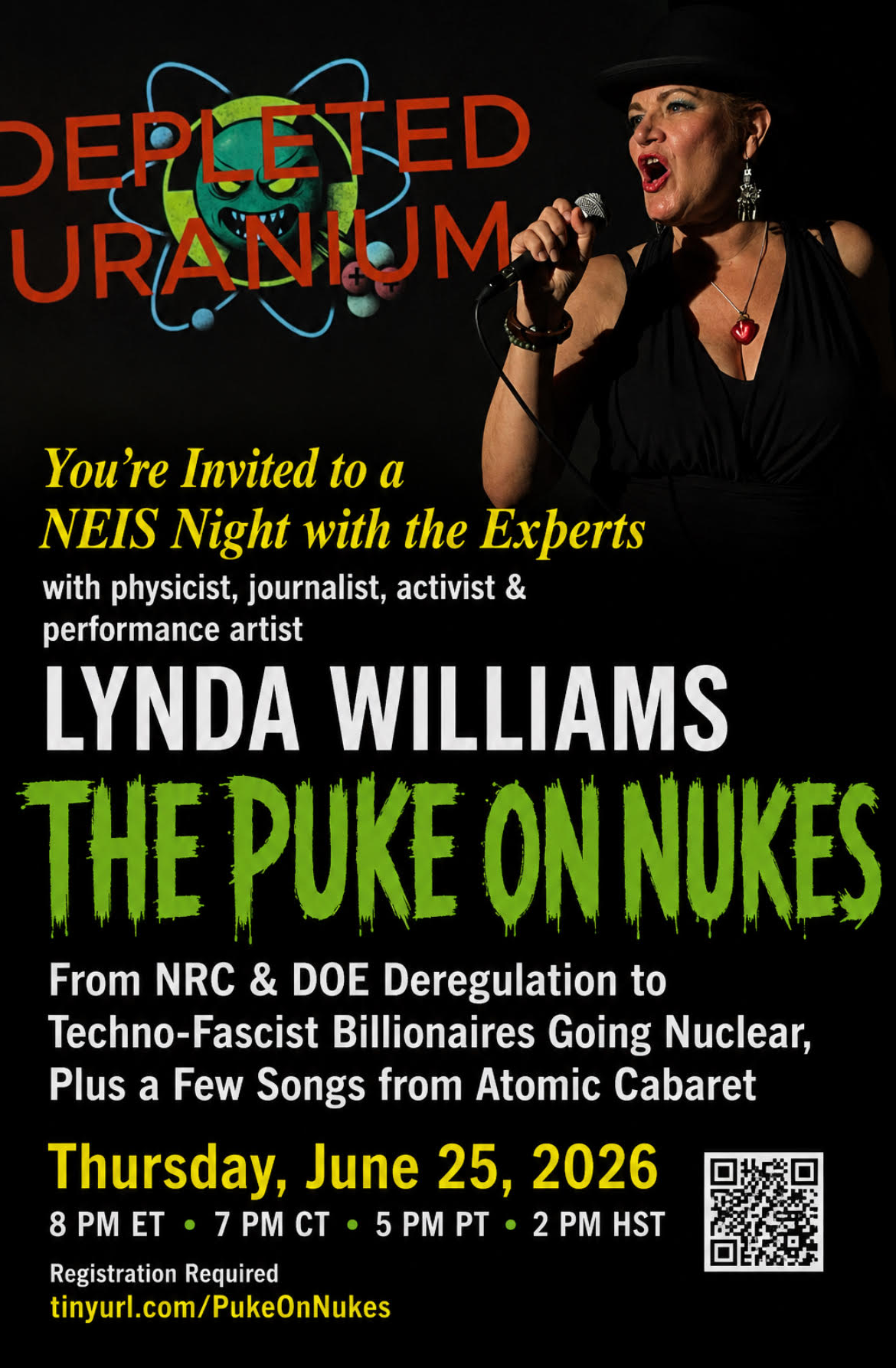
25 June- THE PUKE ON NUKES
Thursday, June 25, 2026
7pm Central Time (8pm ET, 6pm MT, 5pm PT) UTC – 5
From NRC & DOE Deregulation to Techno-Fascist Billionaires Going Nuclear, Plus a Few Songs from Atomic Cabaret REGISTER
26 June – Radiation Trainwreck at the NRC / Join the Protect Better Campaign – https://us02web.zoom.us/meeting/register/4ZlZ5_qLSHGiLSCg8FF6Bg#/registration


Cuba Is Not a Failed State – It Is a Besieged State
PETITION: “Global Appeal to Endorse Palestinian Right of Return of Refugees”
To see nuclear-related stories in greater depth and intensity – go to https://nuclearinformation.wordpress.com
-
Archives
- June 2026 (193)
- May 2026 (306)
- April 2026 (356)
- March 2026 (251)
- February 2026 (268)
- January 2026 (308)
- December 2025 (358)
- November 2025 (359)
- October 2025 (376)
- September 2025 (257)
- August 2025 (319)
- July 2025 (230)
-
Categories
- 1
- 1 NUCLEAR ISSUES
- business and costs
- climate change
- culture and arts
- ENERGY
- environment
- health
- history
- indigenous issues
- Legal
- marketing of nuclear
- media
- opposition to nuclear
- PERSONAL STORIES
- politics
- politics international
- Religion and ethics
- safety
- secrets,lies and civil liberties
- spinbuster
- technology
- Uranium
- wastes
- weapons and war
- Women
- 2 WORLD
- ACTION
- AFRICA
- Atrocities
- AUSTRALIA
- Christina's notes
- Christina's themes
- culture and arts
- Events
- Fuk 2022
- Fuk 2023
- Fukushima 2017
- Fukushima 2018
- fukushima 2019
- Fukushima 2020
- Fukushima 2021
- general
- global warming
- Humour (God we need it)
- Nuclear
- RARE EARTHS
- Reference
- resources – print
- Resources -audiovicual
- Weekly Newsletter
- World
- World Nuclear
- YouTube
-
RSS
Entries RSS
Comments RSS
 nuclear-news