Defector says that Kim Jong Un’s nuclear ambitions could bring about state collapse.
 Defector: North Korea’s next nuclear test could lead to collapse http://www.upi.com/Top_News/World-News/2017/03/14/Defector-North-Koreas-next-nuclear-test-could-lead-to-collapse/6641489489192/ By Elizabeth Shim
  | March 14, 2017 — The senior North Korea diplomat who defected to the South from Pyongyang’s Embassy in London said Kim Jong Un‘s nuclear ambitions could bring about state collapse.
Thae Yong-ho, who recently compared Kim to the Roman emperor Nero, said North Korea is headed down a dangerous path as it seeks recognition as a nuclear weapons state like “India or Pakistan,” Voice of America reported Tuesday.
“The Kim Jong Un regime will never give up nuclear weapons,” Thae said.
The high-profile defector added North Korea could “fall apart” if the regime decides to conduct a major nuclear test at its Punggye-ri nuclear site, where Pyongyang conducts tests of weapons of mass destruction.
Recent satellite images show tunnel digging continues at the site, which lies below the 800-meter Mount Mantap.
According to 38 North, the activity indicates North Korea may be prepared to conduct additional underground nuclear tests.
Thae said Tuesday the site is located on a road that connects Pyongyang to Hamgyong Province, and that “roads and railways that go up north pass by the nuclear test site.” “If a large explosion takes place and the area becomes contaminated with radiation while Pyongyang loses control of the border region of North Hamgyong Province, mass defections could take place,” Thae said.
A nuclear failure in a “small country like North Korea” could lead to disaster, the defector said, adding China and the international community must be aware of the danger.
Thae also said Kim Jong Un is trying to achieve parity with South Korea’s relatively more powerful military with his nuclear weapons program.
In an annual ranking of militaries around the world, South Korea troops ranked the 11th most powerful in 2016, while North Korea’s military strength ranked 25th in the survey by website Global Firepower.
North Korea tried to sell nuclear-weapon material
http://www.foxnews.com/world/2017/03/09/north-korea-tried-to-sell-nuclear-weapon-material.html North Korea attempted to sell a form of lithium metal, a key material for developing miniaturized nuclear weapons, to unidentified international buyers last year, according to United Nations investigators tracking dictator Kim Jong Un‘s weapons-of-mass-destruction programs.
“The U.N. Panel of Expert’s report on North Korea provides further evidence that North Korea will stop at nothing to advance its illicit nuclear and missile programs,” said Sen. Cory Gardner (R., Colo.) who wrote a new sanctions bill against North Korea last year.
North Korea’s production of the enriched lithium, known as lithium-6, is also seen by nuclear experts as evidence of the country’s accelerated efforts to miniaturize a nuclear warhead, potentially for use on ballistic missiles.
Lithium-6 can be used to produce tritium, which is used to flood neutrons into a nuclear device and magnify the explosive power of nuclear detonations, allowing countries to build bombs with smaller amounts of plutonium or uranium, nuclear experts said.
These smaller devices can be affixed to intercontinental ballistic missiles.
“Lithium-6 is ideal, not only for making tritium for boosting fission devices, but also for directly fueling advanced weapons—including thermonuclear bombs,” said Henry Sokolski, a former Pentagon official who heads the Nonproliferation Policy Education Center, a Washington think tank.
Lithium also has nonmilitary applications, particularly in producing batteries, lubricants and medicines, nuclear experts said. North Korea is believed to have significant natural deposits of the metal in its soil.
US moves Thaad missile defence system into South Korea : Trump says it’s a”new phase”
Donald Trump says nuclear threat from North Korea has entered ‘new phase’
US president told Japanese PM he is ‘100%’ with Tokyo as US moves Thaad missile defence system into South Korea following Pyongyang missile launches, Guardian, Justin McCurry The threat posed by North Korea to the US and its allies has entered a “new phase”, Donald Trump said on Tuesday, a day after the regime test-launched four ballistic missiles towards Japan.
In phone talks on Tuesday, Trump told Japan’s prime minister, Shinzo Abe, that the US stood “100%” with Tokyo after three of the intermediate-range missiles landed in the sea off Japan’s north-west coast.
“President Trump told me that the United States was with Japan 100%, and that he wanted his comments to be communicated to the Japanese people,” Abe told reporters at his residence. “He said he wanted us to trust him as well as the United States 100%.
“Japan and the United States confirmed that the latest missile firing by North Korea … is a clear challenge to the region and the international community, and that its threat has entered a new phase.”
The comments came as the US said the “first elements” of its controversial missile defence system had arrived in South Korea on Tuesday. The Terminal High Altitude Area Defense (Thaad) anti-missile system is meant to intercept and destroy short- and medium-range ballistic missiles during the last part of their flights, the US Pacific Command said in a statement.

“Continued provocative actions by North Korea, to include yesterday’s launch of multiple missiles, only confirm the prudence of our alliance decision last year to deploy Thaad to South Korea,” US Pacific Commander Admiral Harry Harris said.
China has denounced Thaad’s deployment, saying its powerful radar would compromise its security.
South Korea’s Yonhap news agency, citing military sources, said the system could be operational as early as April, well ahead of schedule.
Trump and Abe spoke as the North Korean leader, Kim Jong-un, declared the launches a success and warned that they were part of a training exercise for an attack on US military bases in Japan, home to almost 50,000 American troops.
“The four ballistic rockets launched simultaneously are so accurate that they look like acrobatic flying corps in formation,” the state-run Korean Central News Agency quoted Kim as saying. The regime also released images of the missile launches, with a smiling Kim in attendance.
The launches were seen as a protest against the start of joint military exercises involving South Korea and the US that Pyongyang regards as a rehearsal for an invasion of North Korea.
A day after operation Foal Eagle began last Wednesday, North Korea’s army, deploying the same vitriolic language it reserves for the annual drills, warned that it was ready to “immediately launch its merciless military counteractions” if South Korean or US forces fired “even a single shell” into waters near the divided Korean peninsula…….
Trump has yet to state how he intends to address the growing North Korean threat from ballistic missiles, amid evidence that the regime is edging closer to acquiring the ability to marry a miniaturised nuclear warhead with a long-range missile capable of striking the US mainland.
The UN has imposed six rounds of sanctions since the North conducted its first nuclear test in 2006, but they have failed to dent the regime’s quest to build what it claims is a “defensive” nuclear arsenal.
Trump has not publicly commented on Monday’s missile launch, but his ambassador to the UN, Nikki Haley, said on Twitter that the world “won’t allow” North Korea to continue on its “destructive path”.
Choi Kang, an analyst at the Seoul-based Asan Institute for Policy Studies, said the launch was a warning to Tokyo. “North Korea is demonstrating that its target is not just limited to the Korean peninsula any more but can extend to Japan at any time and even the US,” he said. https://www.theguardian.com/world/2017/mar/07/donald-trump-threat-north-korea-new-phase
Nuclear warning from North Korea
North Korea warns joint US-South Korea military exercises are pushing region to ‘nuclear disaster’ http://www.abc.net.au/news/2017-03-07/nkorea-us-skorea-exercises-leading-to-nuclear-disaster/8330554 North Korea has warned that US-South Korean military exercises — which it called “the most undisguised nuclear war manoeuvrers” — are driving the Korean Peninsula and north-east Asia towards “nuclear disaster”.
Key points:
- North Korea’s UN ambassador warns that “it may go over to an actual war”
- The White House announces more defence capabilities to be deployed to the region
- The raised tensions follow another series of North Korean ballistic missile tests
- On Monday some 50,000 North Koreans rally in support of mobilisation efforts
North Korea’s UN ambassador, Ja Song-nam, said in a letter to the UN Security Council on Monday the US was using nuclear-propelled aircraft carries, nuclear submarines, nuclear strategic bombers and stealth fighters in the joint exercises that began on March 1.
“It may go over to an actual war,” he warned of the military drills.
“Consequently, the situation on the Korean Peninsula is again inching to the brink of a nuclear war.”
Mr Ja again urged the Security Council to discuss the US-South Korea exercises and warned if it ignored North Korea’s request as it had in the past it would demonstrate the UN’s most powerful body was only a “political tool” of the United States.
The ambassador said the United States sought to convince public opinion that the joint exercise was a response to North Korea’s nuclear weapons, but said the US and South Korea carried out military drills numerous times before Pyongyang possessed its “nuclear deterrent”.
North Korea sent the letter on the manoeuvrers hours after North Korea fired four banned ballistic missiles earlier on Monday, in apparent reaction to the US-South Korean exercises.
Three of them landed in waters Japan claims as its exclusive economic zone, South Korean and Japanese officials said.
US President Donald Trump discussed plans to respond to the recent missile launches with South Korea’s acting president, Hwang Kyo-ahn, an official at Mr Hwang’s office said.
Mr Trump also had a phone call with Japanese Prime Minister Shinzo Abe, reaffirming its alliance with Tokyo and condemning North Korea’s tests as a threat to regional security.
THAAD deployment begins
The US started to deploy the first elements of its advanced Terminal High Altitude Area Defence (THAAD) anti-missile system to South Korea in response to the missile tests, US Pacific Command said.
“Continued provocative actions by North Korea, to include yesterday’s launch of multiple missiles, only confirm the prudence of our alliance decision last year to deploy THAAD to South Korea,” US Pacific Commander Admiral Harry Harris said in a statement.
South Korea’s media cited the nation’s military as saying the THAAD deployment would be complete in one to two months and would be operational as early as April.
The move by the US military is likely to deepen the brewing conflict between South Korea and China, which has angrily opposed the THAAD deployment as destroying regional security balance.
Meanwhile, North Korean authorities gathered more than 50,000 people together on Monday to make a show of support for the country’s latest mobilisation campaign.
Mr Ja said the main reason the Democratic People’s Republic of Korea (DPRK) — the country’s official name — was equipping itself “with nuclear attack capabilities” and strengthening its nuclear deterrent forces was in self-defence against what he called the US “extreme anti-DPRK hostile police and nuclear threats and blackmails as well as manoeuvrers to enforce its nuclear weapons”.
North Korea’s UN Mission also issued a press statement denouncing and rejecting a report by the Security Council’s panel of experts that monitors UN sanctions against the DPRK.
The experts said North Korea was flouting sanctions by trading in prohibited weapons and other goods and using evasion techniques “that are increasing in scale, scope and sophistication”.
The DPRK Mission again insisted the sanctions “have no legal basis at all” and violate the country’s “lawful rights”.
‘Multiple missiles’ fired into Japanese waters, by North Korea
 North Korea fires ‘multiple missiles’ into Japanese waters Seoul, SMH. 6 Mar 17 : North Korea has fired ‘multiple missiles’ from its Tongchang-ri region where a missile base is located, South Korea’s military says.
The missiles flew about 1000 kilometres in possible retaliation by the reclusive state to joint US-South Korean drills that began last week.
apanese Prime Minister Shinzo Abe also said North Korea had fired four ballistic missiles, three of which fell into Japan’s exclusive economic zone.
Tokyo had “lodged a stern protest with North Korea,” Abe told reporters……
North Korea has threatened to take “strong retaliatory measures” after South Korea and the US began annual joint military drills on Wednesday that test their defensive readiness against possible aggression from the North.
North Korea criticises the annual drills, calling them preparation for war against it……http://www.smh.com.au/world/north-korea-fires-multiple-missiles-south-20170306-guremx.html
Shaky friendship between China, North Korea: clash over nuclear and chemical weapons
 Friendship on the rocks? China, North Korea clash over nuclear and chemical weapons
North Korea’s reaction was so strong that some Chinese experts initially thought the commentary was fake By Saša Petricic, CBC News Feb 28, 2017 “…..China’s patience may be wearing thin, as frustrations double up over North Korea’s development of nuclear weapons and apparent willingness to use chemical weapons.
South Korea has accused North Korean leader Kim Jong-un of ordering the assassination of his half-brother, Kim Jong-nam, and Malaysia suspects several North Korean officials may have been involved in a plot that used the banned VX nerve agent.
It’s creating an unprecedented rift between the two neighbours and ideological soulmates. China’s support dates back to the 1950s and the Korean war.
Last week, Beijing imposed a ban on coal imports from North Korea that could deprive it of much needed foreign funds until the end of 2017. Pyongyang has replied with one of the nastiest insults one socialist state can throw at another, accusing China of “dancing to the tune of the U.S.”
“The hostile forces are shouting ‘bravo’ over this,” says a commentary published by North Korea’s state news agency, accusing its neighbour of “mean behaviour.”…….
Pyongyang has defied some of the toughest sanctions imposed by the United Nations Security council, meant to not only deprive North Korea of the parts and expertise it needs to develop a nuclear arsenal, but also to punish the country’s leadership by blocking travel and access to luxury goods.
Officially, China endorses the UN sanctions and condemns Kim Jong-un’s nuclear and missile sabre-rattling.
But it is walking a fine line, trying to avoid weakening the regime so badly that it collapses, causing unrest in North Korea and a possible flood of refugees into China.
Beijing has been accused of turning a blind eye to a network of North Korean shell companies and middlemen who operate just over the land border in China, working to circumvent sanctions……..
while Pyongyang’s ongoing nuclear and missile program worries China, it’s the apparent assassination of Kim Jong-un’s half-brother Kim Jong-nam that has sharpened the divisions between it and North Korea…….
Stockpile of deadly toxins
China is reportedly upset because Jong-nam was under its implicit protection, living in the country’s gambling enclave of Macau for years.
It was also rattled by North Korea’s apparent ready use of such a potent and prohibited chemical weapon beyond its borders. Pyongyang is known to have a large stockpile of various deadly toxins, and it hasn’t signed on to international conventions agreeing not to engage in chemical warfare…….http://www.cbc.ca/news/world/north-korea-china-weapons-petricic-1.4000631
Taking a longer view of a nuclear North Korea
Should we really be so afraid of a nuclear North Korea? https://theconversation.com/should-we-really-be-so-afraid-of-a-nuclear-north-korea-71855 The Conversation, Markus Bell, Anthropologist and Lecturer in Korean and Japanese studies, University of Sheffield , Postdoctoral Scholar, Korean Studies Institute, University of Southern California February 6, 2017 The common thinking is that North Korea’s nuclear programme poses a threat to global peace and diverts economic resources from an impoverished population. North Korean leaders are depicted in the Western media as a cabal of madmen who won’t be satisfied until Washington, Seoul, or some other enemy city is turned into a “sea of fire”.Successive US governments have used a range of carrots and sticks to entice or pressure the North Korean leadership to give up its nuclear programme. The North’s missile launches and nuclear tests in 2016 make plain that these efforts have failed; in short, the West has to accept that it is now a nuclear power and focus instead on limiting the risks a nuclear North Korea presents.
But it also pays to consider what sounds like a perverse question: could a North Korean bomb actually benefit both the country’s people and the world at large?
First, a reality check: the North Korean nuclear programme is less a madcap scheme than a clear and deliberate strategy. Its leaders have closely watched what’s happened to other countries that have backed away from nuclear arsenals, and two in particular: Ukraine and Libya.
Ukraine gave up its massive Soviet-era nuclear arsenal in 1994 when it signed the Budapest Memorandum with Russia, the US and the UK, on whose terms it traded nuclear weapons for a formal reassurance to respect its sovereignty; 20 years later, Moscow invaded and annexed the Crimean peninsula, and a pro-Russian insurgency in the east is still rumbling. As for Libya, Muammar Gaddafi renounced his weapons of mass destruction programme as part of an opening to the West only to be forcibly removed from power by the same countries some eight years later.
Along with the Iraq War, these spectacles taught the North Korean regime that it’s hard for a relatively small, isolated country to survive without the military hardware to guarantee it. Pyongyang has duly shown great diplomatic skill in drawing out nuclear negotiations, buying itself both time and financial aid as its programme moves forward.
In 2016 alone, it tested two nuclear weapons, sent a satellite into orbit, and made advances in both submarine launched ballistic missiles (SLBM) and intercontinental ballistic missile (ICBM) technology. In his New Year’s address at the start of 2017, Kim Jong-un emphasised that the country’s nuclear forces are central to its self-defence capability: “We will defend peace and security of our state at all costs and by our own efforts, and make a positive contribution to safeguarding global peace and stability.”
The long view
A nuclear North Korea obviously worries the international community for several reasons. Kim might in theory actually use nuclear weapons on his enemies, a threat he periodically makes. His country’s admission into the “nuclear club” might spark a regional arms race. It could share or sell technologies of mass destruction to hostile states. And then there’s the danger of a full-blown nuclear accident with all the attendant regional repercussions.
These risks aren’t trivial, but they should be viewed with some perspective. For starters, a nuclear attack from Pyongyang appears highly unlikely. The government is fully aware that it would incur an overwhelmingly destructive military response from the US and South Korea. It’s also worth remembering that while the programme has been underway for 25 years, there is still no sign of a regional nuclear arms race.
As for proliferation or accidents, these demand not isolation but co-operation and communication. Keeping Pyongyang cut off from the world will not help; if its nuclear facilities are to be kept safe and their products not used to bring in illicit foreign revenue, they must be properly monitored rather than kept hidden.
Meanwhile, a nuclear North Korea might well see fit to downsize its enormous and costly conventional military forces, which are among the world’s largest. As it transitions away from what it calls a “Military First” policy to something more deterrent-centric, it makes sense to encourage it to reduce its conventional military forces. (Better still, if it did, heavily-armed South Korea might follow suit.)
With a smaller conventional military to maintain, Pyongyang might be able to channel scarce state funds away from defence and towards raising the standard of living for ordinary North Koreans. This point is in line with its stated strategy of growing the economy and developing the nuclear deterrent in parallel, a policy known as the Byungjin line, and with Kim’s mooted five-year economic plan. His plans demand dramatic shifts in North Korean state policy, which could destabilise the regime. The calculation is that the security provided by nuclear capabilities would offset the shock of sudden domestic change.
Most paradoxically of all, North Korea’s nuclear “arrival” might make for a positive turn in inter-Korean relations. International efforts to eliminate North Korea’s nuclear programme isolated the country, in turn greatly undermining the chances of a rapprochement with the South, whose efforts to defrost relations have lately come to nothing. The pace of the North’s nuclear development meant that the now-impeached President Park’s policy of reconciliation – “Trustpolitik” – was doomed before it began.
As far as Pyongyang is concerned, its militaristic strategy has worked: It has kept the Kim government internally stable, the population dependent on the government, and the country’s enemies at bay. Accepting the country’s nuclear status, rather than trying to head it off with sanctions and threats, could bring it back to the diplomatic bargaining table.
US Defence Secretary Jim Mattis warns NKorea against nuclear attack
 US warns NKorea against nuclear attack, http://www.sbs.com.au/news/article/2017/02/03/us-warns-nkorea-against-nuclear-attack SBS News, 3 Feb 17, Newly minted US Defence Secretary Jim Mattis has told North Korea that any attack on the US or its allies will attract an “effective and overwhelming” response.
China bans nuclear materials export to North Korea
http://gbtimes.com/world/china-bans-nuclear-materials-export-north-korea CHINA RADIO INTERNATIONAL
2017/01/26 China has released a new list of restricted goods that cannot be exported to North Korea, many of which are “dual use” items that could be used to build weapons of mass destruction.
The comprehensive list comes amid mounting speculation over an expected test by North Korea of an intercontinental ballistic missile that might be able to reach the west coast of the United States.
The items include materials and equipment to develop nuclear missiles, software related to rockets or drones, high-speed video cameras, submarines, sensors and lasers.
The Ministry of Commerce said the list was meant to comply with the requirements of a round of UN sanctions imposed in November in response to North Korea’s fifth and largest nuclear test in September.
The list was jointly released with the Ministry of Industry and Information Technology, the State Administration of Science, Technology and Industry for National Defense, the China Atomic Energy Authority and the Customs Bureau.
US officials said last week that they had seen indications that North Korea may be preparing for a new missile test-launch.
It’s widely believed a launch could be an early test of the administration of President Donald Trump, who was sworn in last Friday.
Despite nuclear tensions, Americans have continued to send humanitarian aid to North Korea
US Humanitarian Aid Goes to North Korea Despite Nuclear Tensions, VOA, January 25, 2017 Baik Sung-won WASHINGTON — The United States has provided $1 million in humanitarian aid to impoverished North Korea, the U.S. State Department said Wednesday.
Despite growing tensions between North Korea and Washington, the U.S. sent the assistance last week on the day before President Donald Trump was sworn in and took over the U.S. government.
It marks the first time that the U.S. provided humanitarian assistance to the North since 2011, when it provided relief items including medical supplies to North Korean flood victims. That aid, worth $900,000, was made through Samaritan’s Purse, a U.S.-based humanitarian aid organization.
Aid to help typhoon damageThe current assistance comes in the aftermath of Typhoon Lionrock, which hit North Korea in August with heavy rain that resulted in flooding. At the time, the government reported hundreds were dead and missing, and said thousands had lost their homes. International aid organizations responded immediately.
Outgoing Secretary of State John Kerry awarded $1 million for North Korea to UNICEF, a U.N. agency, the day before President Donald Trump took office last week………http://www.voanews.com/a/united-states-humanitarian-aid-goes-to-north-korea/3692811.html
Can Donald Trump manage nuclear diplomacy with North Korea? It’s unlikely
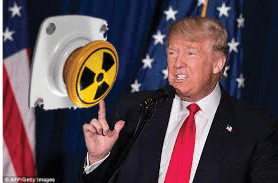 In Nuclear Poker, Don’t Bet on Trump, Bloomberg JAN 19, 2017 BY James McManus Is North Korea’s belligerent young leader, Kim Jong-un, bluffing when he says the “last stage” is underway for testing a ballistic missile capable of hitting the U.S.? What about President-elect Donald Trump, when he tweets, “It won’t happen“?
As Trump’s administration begins, a showdown with North Korea over ICBMs seems all but inevitable. Just yesterday, South Korean media reported possible signs that the North may be preparing a new missile launch. In managing this conflict, few things will be more crucial than understanding the nature of bluffing. Unfortunately, for all his talk of being a good deal maker, Trump is a terrible bluffer — and his lack of skill is likely to destabilize nuclear politics.
A bluff is an untrue but plausible story. In the mindsport of poker, bluffs work when your opponent believes you have a better hand, so he can’t call your bet or raise, conceding you the pot. The savvier player wants to steadily grind away at the stack of his opponent over a large number of small pots, without risking too many of his own chips in any single hand. The weaker player can counter the “small ball” strategy by raising all-in fairly often, forcing all-or-nothing confrontations.
To understand why these dynamics are so crucial in nuclear negotiation, consider the work of John von Neumann, the prodigiously gifted polymath who immigrated to the U.S. from Hungary in 1933 and later contributed to the Manhattan Project. Von Neumann loved poker because its strategy involves guile, probability, luck and budgetary acumen, but is never transparent; it always depends on the counterstrategies deployed by opponents.
Trump bluffs almost constantly. He has spent his entire adult life overstating the value of his real estate holdings and branding endeavors, while bragging relentlessly about his wealth, sex life, length off the tee, and on and on. His bluffs during the campaign — that he had a replacement for Obamacare, a secret plan to defeat Islamic State and so on — were plainly false to anyone paying attention. To Trump, what was true hardly mattered.
Such tendencies would not serve him well in a poker game. Any player who continually misrepresents the size of his hand would cause sharp opponents to give his bets little credit. They’d simply wait for above-average hands and call him. As Daniel Negreanu, the all-time winningest poker tournament player, put it to me, “Trump’s bluffs are very effective against level-one thinkers. His lies are so outlandish that people think they have to be true or he wouldn’t have said it. The constant barrage makes him tougher to read. But sharper players would pick him apart.”
Kim may not be irrational, but he knows how to seem that he is, which gives him leverage. Kim’s contempt for most North Koreans means that he has less to lose by threatening to nuke an American city. The more we know about his pretensions to deity, his labor camps, the food and electricity shortages his policies have prolonged, the easier it is to believe he might sacrifice millions of Koreans in an absurd attempt to save face. Kim isn’t threatening to defeat the U.S., a bluff no one would credit; he’s trying to prove he could grievously injure it before dying himself, a bluff that must be taken seriously. As Negreanu puts it, Kim is “a scary player. Being unpredictable, capable of any move at any time, makes him hard to prepare for.”
In such circumstances, Trump’s long history of empty boasts is destabilizing. Kim may calculate that he has renewed leverage to push for concessions from the U.S. He might engage in riskier behavior, such as firing more test missiles or launching cyberattacks. Almost certainly, he’ll persist in developing missiles that can reach the U.S., calculating all the while that Trump’s Twitter outbursts are simply talk.
That may be true. But what if, for once in his life, Trump means what he says? What if he can’t bear to have his bluff called, and really is tempted to launch a preemptive attack if it looks like North Korea poses a real threat to the U.S. mainland?……..https://www.bloomberg.com/view/articles/2017-01-19/in-nuclear-poker-don-t-bet-on-trump
North Korea may be preparing for a new missile test-launch
U.S. sees indications of possible North Korea missile test-launch Yahoo News, By James Pearson and Phil Stewart January 20, 2017 SEOUL/WASHINGTON (Reuters) – North Korea may be preparing for a new missile test-launch, U.S. officials told Reuters on Thursday, after South Korean media reported movement of what could be components of an upgraded prototype of an intercontinental ballistic missile.
The U.S. officials, who spoke on condition of anonymity, said the United States was seeing activity in North Korea indicating a possible ballistic missile test, including positioning of two mobile missile launchers.
Still, the timing of the test and precise type of missile remained unclear, the officials said.
In his New Year’s speech, leader Kim Jong Un said North Korea was close to test launching an ICBM, and state media has said a launch could come at any time. Experts on the isolated and nuclear capable country’s missile program believe the claims to be credible.
The Pentagon declined comment on its intelligence about the North Korea threat, but spokesman Peter Cook assured reporters that Washington’s readiness would be not be diminished during the U.S. presidential transition, due to take place on Friday.
“I can’t get into intelligence matters. I can’t confirm what’s been reported there,” Cook told a news briefing.
“We would once again encourage North Korea not to engage in provocative actions that do nothing but destabilize the region.”
South Korean media said a test could potentially coincide with the inauguration of U.S. President-elect Donald Trump on Friday, South Korean media said.
Trump on Jan. 2 tweeted, “It won’t happen!” about North Korean ICBMs, although his precise meaning was unclear. The Pentagon has said it would not necessarily strike a test-launched ICBM if it did not pose a threat.
NEW TYPE OF MISSILE?
South Korean intelligence agencies reported on Wednesday that they had recently spotted missile parts being transported, believed to be the lower-half of an ICBM, raising fears that a test-launch may be imminent, the Chosun Ilbo newspaper said, citing unidentified military sources…….https://www.yahoo.com/news/u-sees-north-korea-activity-signaling-possible-missile-160137245.html
North Korea’s greatly increased plutonium stockpile
 North Korea’s Nuclear Weapons: Under Kim Jong Un, Plutonium Stockpile Has Reached Unprecedented Levels, International Business Times, BY ON 01/12/17 In the past two years, North Korea has steadily increased its supply of plutonium and now has enough for 10 nuclear warheads, according to a report this week from the South Korean Ministry of National Defense. In all, South Korea’s 2016 Defense White Paper found that the North had increased its supply of weapons -grade plutonium to 50 kilograms, up from 40 kilograms two years ago, the Korea Times reported. The plutonium was obtained by reprocessing spent fuel rods.
Under the dictatorial rule of leader Kim Jong Un, North Korea has focused on developing its nuclear arsenal. More recently, North Korea has worked toward developing a reliable intercontinental ballistic missile (ICBM) that would be capable of carrying a nuclear warhead.
The increased stockpile comes amid continued threats from Kim. In a New Year’s speech, Kim provoked the West — the United States and South Korea especially — and claimed an ICBM was nearing completion…….
Should the North develop a reliable ICBM, it would likely have the capability of reaching the United States. A working ICBM could still be a ways off, however…….http://www.ibtimes.com/north-koreas-nuclear-weapons-under-kim-jong-un-plutonium-stockpile-has-reached-2474439
US govt denies North Korea’s claims on its nuclear missiles, but international concerns grow
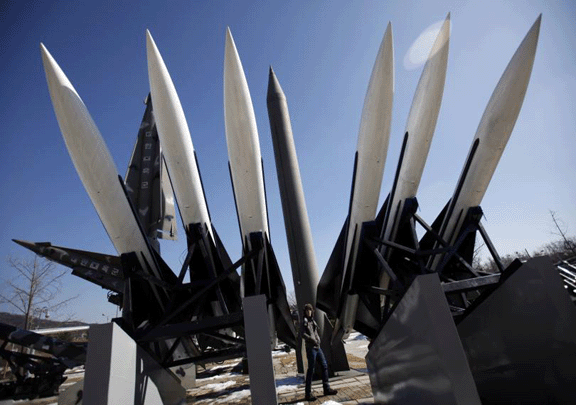 US Rejects North Korea’s Nuclear Claim Amid Growing Concerns http://www.voanews.com/a/us-rejects-north-korea-nuclear-claim-amid-growing-concerns/3665388.html, 5 Jan 17, Amid speculation surrounding North Korea’s nuclear capabilities, the U.S. government said this week that Pyongyang has yet to acquire the ability to outfit an intercontinental ballistic missile with a nuclear warhead.
The latest assessment came after North Korean leader Kim Jong Un’s statement that the preparations for launching an intercontinental ballistic missile had “reached the final stage.” His claim, in a New Year’s Day address, immediately sent ripples across the world’s capitals, prompting President-elect Donald Trump to tweet, “It won’t happen!”
Despite the U.S. rejection of North Korea’s purported capability, experts are raising concern about the threats emanating from the regime. Continue reading
North Korea accelerates its race for nuclear weapons
North Korea ‘racing ahead’ on nuclear plan, defector says By KJ Kwon, CNN December 27, 2016 CNN)Political uncertainty in the United States and in South Korea could give North Korean leader Kim Jong-un “an apt time” to develop nuclear weapons “at all costs by the end of 2017,” a high-profile North Korean diplomat who recently defected to South Korea said Tuesday.
1 This Month

Protect Sazan Island from the Trump family! https://secure.avaaz.org/campaign/en/protect_sazan_island_from_the_trump_family_loc/?bqFCVab&v=174511&cl=22707147157&_checksum=5e9dde668860e8231c33699735e16a1fbf22ab2cb01da50c999fe8732b9775ef&utm_source=email&utm_medium=blast_email&utm_campaign=174511
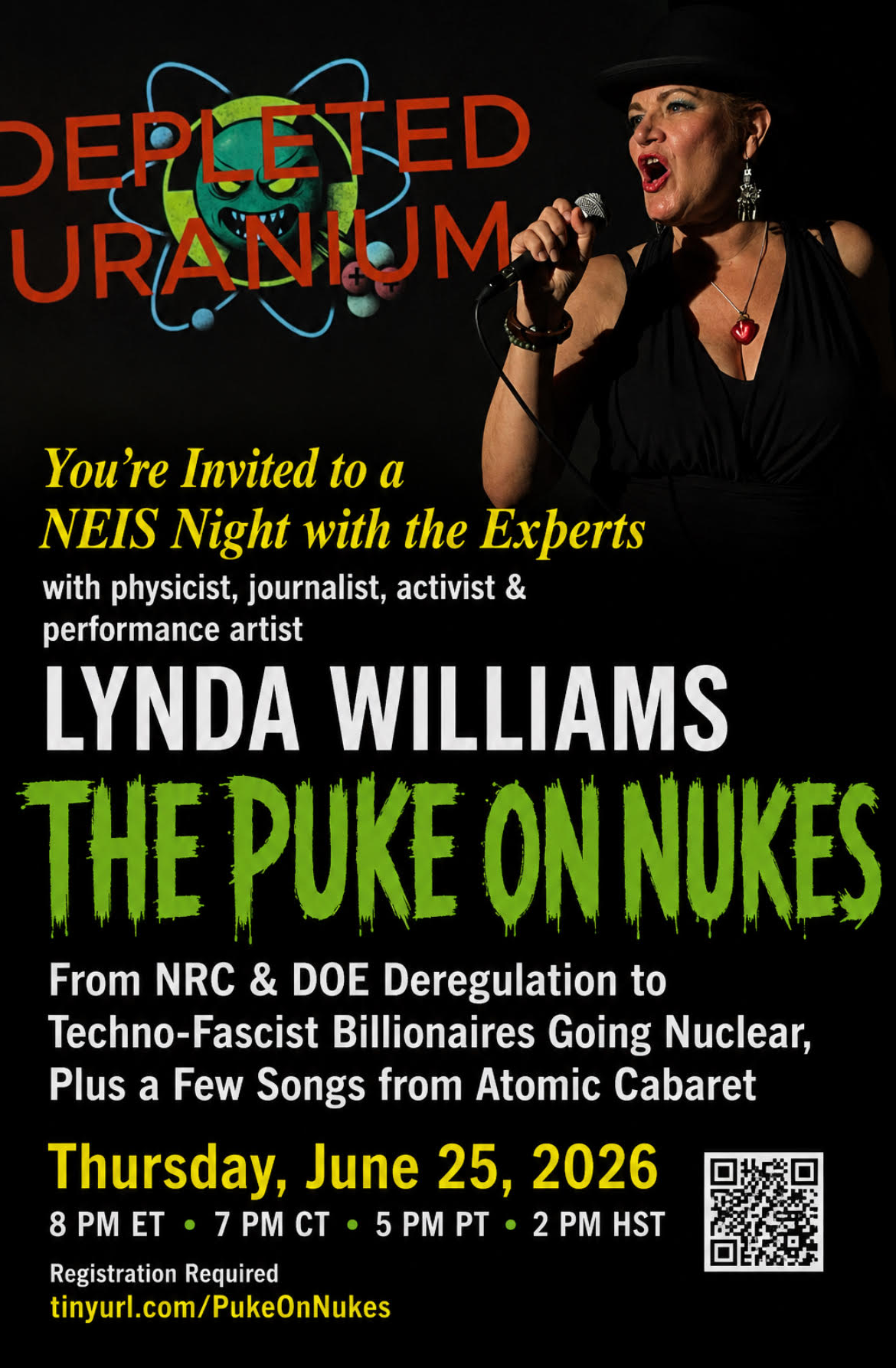
25 June- THE PUKE ON NUKES
Thursday, June 25, 2026
7pm Central Time (8pm ET, 6pm MT, 5pm PT) UTC – 5
From NRC & DOE Deregulation to Techno-Fascist Billionaires Going Nuclear, Plus a Few Songs from Atomic Cabaret REGISTER
26 June – Radiation Trainwreck at the NRC / Join the Protect Better Campaign – https://us02web.zoom.us/meeting/register/4ZlZ5_qLSHGiLSCg8FF6Bg#/registration

Cuba Is Not a Failed State – It Is a Besieged State
PETITION: “Global Appeal to Endorse Palestinian Right of Return of Refugees”
To see nuclear-related stories in greater depth and intensity – go to https://nuclearinformation.wordpress.com
-
Archives
- June 2026 (142)
- May 2026 (306)
- April 2026 (356)
- March 2026 (251)
- February 2026 (268)
- January 2026 (308)
- December 2025 (358)
- November 2025 (359)
- October 2025 (376)
- September 2025 (257)
- August 2025 (319)
- July 2025 (230)
-
Categories
- 1
- 1 NUCLEAR ISSUES
- business and costs
- climate change
- culture and arts
- ENERGY
- environment
- health
- history
- indigenous issues
- Legal
- marketing of nuclear
- media
- opposition to nuclear
- PERSONAL STORIES
- politics
- politics international
- Religion and ethics
- safety
- secrets,lies and civil liberties
- spinbuster
- technology
- Uranium
- wastes
- weapons and war
- Women
- 2 WORLD
- ACTION
- AFRICA
- Atrocities
- AUSTRALIA
- Christina's notes
- Christina's themes
- culture and arts
- Events
- Fuk 2022
- Fuk 2023
- Fukushima 2017
- Fukushima 2018
- fukushima 2019
- Fukushima 2020
- Fukushima 2021
- general
- global warming
- Humour (God we need it)
- Nuclear
- RARE EARTHS
- Reference
- resources – print
- Resources -audiovicual
- Weekly Newsletter
- World
- World Nuclear
- YouTube
-
RSS
Entries RSS
Comments RSS
 nuclear-news