North Korea says America is preparing for war: highlights 1250 US marines to Darwin, Australia
 North Korea highlights 1250 US marines in Darwin to claim America is preparing for nuclear war, SMH, Kirsty Needham and James Massola, 25 Apr 17, North Korea’s state newspaper has singled out the United States’ deployment of 1250 marines to Darwin to claim America is preparing for nuclear war.
And as regional tensions escalate and a US carrier strike group approaches the Korean peninsula, Australian Foreign Minister Julie Bishop said the secretive regime “must be stopped” as it represented a threat to the region and, potentially, globally.
In a phone call with US president Donald Trump, Chinese president Xi Jinping said China opposed any actions that went against UN security council resolutions, as Japan confirmed it was joining drills with the strike group led by the USS Carl Vinson that is headed to Korean waters.
Pusan National University associate professor Robert Kelly told Fairfax Media North Korea’s missiles might have the range to reach northern Australia, but played down the threat as “the question is guidance, not range”.
Rodong Sinmun, the official paper of the Worker’s Party of North Korea, highlighted the US marines’ arrival in northern Australia on April 18. The marines will be joined by 12 military helicopters including five Cobra helicopters and four Osprey carriers.
“This is the largest scale US military presence in Australia after World War 2,” the newspaper reported on Monday. “America is fanatically, crazily trying to optimise its nuclear war readiness,” it claimed.
The story, on page six of the North Korean newspaper, was headlined: America prepares for nuclear war in different overseas military deployments. Darwin was the only city named…….
Australia-based defence experts believe it is unlikely North Korea has the capacity to strike Australia yet, though they may do within the next three years. The nation’s most recent missile test, earlier this month, failed just seconds after launch…….
The deployment of 1250 marines is the largest to Darwin since the former prime minister Julia Gillard and former president Barack Obama struck a deal back in 2011 to undertake the yearly rotation of troops.
with Sanghee Liu, AAP http://www.smh.com.au/federal-politics/political-news/north-korea-highlights-1250-us-marines-in-darwin-to-claim-america-is-preparing-for-nuclear-war-20170424-gvrbzl.html
North Korea issues nuclear warning to Australia’s hawkish Foreign Minister, Julie Bishop
North Korea issues nuclear warning to Australia, Camden Narellan Advertiser ,23 Apr 2017 Beijing: North Korea’s foreign ministry has lashed out at Foreign Minister Julie Bishop and warned Australia was “coming within the range of the nuclear strike”. The threats were reported by the North Korean state news agency KCNA as being made on Friday, in response to a radio interview given by Ms Bishop.
 According to a translation of the KCNA report, which was dated Friday, the same day US Vice-President Mike Pence arrived in Australia, Ms Bishop had said in the radio interview that North Korea seriously threatens regional peace and she supports the US policy that “all options are on the table”.
A spokesman for the Foreign Ministry of North Korea – officially the Democratic People’s Republic of Korea (DPRK) – was quoted as saying: “The present government of Australia is blindly and zealously toeing the US line. It is hard to expect good words from the foreign minister of such government.”….
“If Australia persists in following the US moves to isolate and stifle the DPRK and remains a shock brigade of the US master, this will be a suicidal act of coming within the range of the nuclear strike of the strategic force of the DPRK.”….
The KCNA report continued: “The Australian foreign minister had better think twice about the consequences to be entailed by her reckless tongue-lashing before flattering the US.”
Prime Minister Malcolm Turnbull on Saturday pledged support for the US policy on North Korea and again urged China to do more to place economic pressure on North Korea.
China has turned back coal shipments to North Korea in recent weeks, one of the regime’s few sources of funding. Chinese media have speculated the Chinese government is also considering cutting oil supplies.
There are renewed concerns that North Korea may conduct its sixth nuclear test on Tuesday, the 85th anniversary of its military, and China said this week it was “gravely concerned”.
China’s official People’s Daily newspaper on Saturday evening reported online that new satellite images of the North Korean nuclear test site had shown probable new trailer activity, citing US research website 38 North. http://www.camdenadvertiser.com.au/story/4614177/north-korea-issues-nuclear-warning-to-australia/?cs=5
The multi-million death toll that would result from a pre-emptive strike on North Korea
But besides demanding North Korea give up its only trump card — no pun intended — some are pushing the administration to go even further: to consider launching a preemptive strike on Pyongyang.
What happens next is one of the worst military and human tragedies in history: Kim orders a nuclear strike on Seoul. While the missile lands four miles outside of the city thanks to a targeting error, millions of people are instantly killed with millions more poisoned by radioactive fallout. In a sheer panic, the millions of people who survive the attack rush south, creating a massive humanitarian crisis of the worst magnitude.
From here, things get even worse……the price of such a victory could be millions of people dead and large sections of Korea rendered uninhabitable for decades, if not longer.
No one wants to talk to the dictator of a nation with over 200,000 people or more in prison camps — but an attack that could lead to a conflict where millions could die in a nuclear war is far worse. The stakes are too great to at least not consider it.
 How a preemptive strike on North Korea could end up killing millions http://theweek.com/articles/692872/how-preemptive-strike-north-korea-could-end-killing-millions Harry J. Kazianis 21 Apr 17 While North Korea might not have tested another nuclear weapon in recent days, tensions in Asia keep rising — and Washington is at least partially to blame.
Satellite images indicate that North Korea has resumed work at its nuclear test site
Volleyball Over, North Koreans Go Back to Work at Nuclear Site, Analysts Say, NYT, APRIL 22, 2017, SEOUL, South Korea — North Korea appears to have resumed work at its nuclear test site after a perplexing series of volleyball matches were held there, according to analysts who studied satellite images of the site, renewing concerns that a major weapons test could be imminent.
Many observers had feared that North Korea would test a nuclear device at the site around April 15, the birthday of Kim Il-sung, the North’s founding president and the grandfather of the current leader, Kim Jong-un. But Mr. Kim’s government celebrated the day instead with a military parade in Pyongyang, the capital, during which a fleet of missiles were rolled out, including what analysts believed were never-before-seen long-range ballistic missiles.
North Korea carried out a missile test on Sunday, but it was considered an embarrassing failure, with the projectile exploding immediately after liftoff.
But North Korea is preparing to celebrate another major holiday this coming week: Tuesday will be the 85th anniversary of the founding of the Korean People’s Army, and the North often uses such occasions to show off its military advances…….
On Friday, the analysts Joseph S. Bermudez Jr. and Jack Liu posted new satellite images of the nuclear test site in Punggye-ri, in northeastern North Korea, on 38 North, a website affiliated with the Johns Hopkins University School of Advanced International Studies……
Mr. Bermudez and Mr. Liu said it was unclear whether the latest activity from Punggye-ri reflected a “tactical pause” before a coming nuclear test, a prolonged “stand-down” from testing or normal operations at the site.
“Regardless, satellite imagery continues to indicate that the Punggye-ri nuclear test site appears able to conduct a sixth nuclear test at any time once the order is received from Pyongyang,” they concluded…..
On Saturday in Sydney, Australia, Mr. Pence said that an American naval strike group led by the aircraft carrier Carl Vinson was expected to be in the Sea of Japan, which borders the Korean Peninsula, by the end of April.
Senior aides to Mr. Trump have said that military options are not off the table in dealing with North Korea’s rapidly advancing nuclear and missile technologies. Those remarks prompted fears in the region that the new American president might order a pre-emptive strike at North Korea’s weapons sites, which could set off a war…….https://www.nytimes.com/2017/04/22/world/asia/north-korea-nuclear-test-preparations.html?_r=0
Homeland Security Secretary says risk of North Korea nuclear missiles to America within 4 years
Kelly: Trump will face nuclear North Korea in this term http://thehill.com/homenews/administration/330107-kelly-trump-will-deal-with-nuclear-north-korea-before-his-second-term BY MALLORY SHELBOURNE – 04/23/17 Department of Homeland Security Secretary John Kelly said Sunday that President Trump will face a nuclear-armed North Korea with missiles that could reach the United States in this term.
“I think Mr. Trump will be dealing with this in real terms before he starts his second term,” Kelly told CNN’s “State of the Union.”
Kelly refused to answer host Dana Bash’s question over whether or not the U.S. military could shoot down a missile from North Korea, telling Bash that the information is classified. Kelly did say the United States will be “at grave risk” when a North Korean missile can reach its shores.
“The instant that happens, this country is at grave risk,” said Kelly.
North Korea earlier this month failed to launch a ballistic missile on its east coast. The launch came amidst mounting tensions between the U.S. and North Korea, as the Trump administration continues talks with China over how to curb North Korea’s nuclear ambitions.
“Military option” against Noth Korea would bring unacceptable risk

 North Korea risk too high for military option: Robert Litwak https://www.usatoday.com/story/opinion/2017/04/19/north-korea-nuclear-risk-too-high-military-option-robert-litwak-column/100615092/
North Korea crossed the nuclear threshold a decade ago when it conducted its first atomic test. The precipitant of the current crisis is that the Pyongyang regime is now on the brink of vastly expanding its small nuclear arsenal. Left on its trajectory, by 2020, North Korea could have a nuclear stockpile of 100 warheads that can be mounted on long-range ballistic missiles capable of reaching the United States.
The contrast between North Korea’s atomic arsenal (which could, incredibly, approach half the size of Britain’s) and its paltry economy (a gross domestic product of about $17 billion, comparable with Asheville, N.C.) is jarring. North Korea is essentially a failed state on the verge of a nuclear breakout. And this totalitarian state is run by a dynastic cult — the Kim family.
A North Korean ability to strike the U.S. homeland would be a game changer. Vice President Pence declared in South Korea on Monday that the Obama administration’s policy of “strategic patience” was over — but he did not indicate what would follow.
Strategic patience had essentially resulted in acquiescence as North Korea built up its nuclear arsenal and made substantial progress in miniaturizing warheads and acquiring an intercontinental ballistic missile capability. In response, the United Nations and the United States have imposed still stricter sanctions on the Kim regime. But sanctions are not a strategy.
With North Korea perilously close to becoming a major nuclear power, America should pivot to serious diplomacy. Since the end of the Cold War, when the North Korean atomic challenge arose, U.S. hard-liners have eschewed diplomacy toward this “rogue state” because they view it as tantamount to appeasement.
The alternative to diplomacy — the much discussed military option “on the table” — has essentially been off the table because it runs the catastrophic risk of spiraling into a second (this time, nuclear) Korean war. No U.S. president could authorize even a “limited” strike on a missile site and discount this escalatory risk. When the United States can’t bomb and won’t negotiate, it is in fact acquiescing to a continued North Korean buildup. That unsatisfactory prospect reinforces the case for transactional diplomacy through coercive engagement to block North Korea’s current disastrous course.
Though a full rollback of North Korea’s atomic program is not a realistic goal, transactional diplomacy to freeze its capabilities at their current level might be attainable. This would make the best of a bad situation: When zero warheads is not an option on the table, an agreement capping North Korea at 20 nuclear weapons is better than an unconstrained program that hits 100 warheads by 2020. And a freeze would preclude the additional testing that North Korea still needs to master miniaturization and reliable long-range missiles.
Why should diplomacy succeed this time when it has failed in the past? New conditions that change China’s strategic calculus. Until now, Beijing has been lackadaisical in its enforcement of sanctions and has declared that Pyongyang was Washington’s problem. But a North Korea with a large atomic arsenal and ballistic missiles capable of striking the U.S. homeland would be a game changer. That’s true not only for America but also for China, where risky consequences could include the possibility of South Korea and Japan reassessing their own non-nuclear intentions.
Transactional diplomacy would decouple the nuclear issue from regime change. It would create the conditions for success by identifying a point of near-term optimization among the parties.
A freeze would permit Pyongyang to retain a minimum deterrent and the Kim family regime. For Beijing, it would preserve a strategic buffer state and avert the adverse strategic consequences of a nuclear-armed North Korea. And for Washington, a near-term interim agreement freezing North Korean capabilities would prevent a breakout and be characterized as the first step toward long-term denuclearization of the Korean Peninsula.
This analytical option should be put to the diplomatic test. Otherwise, we are left with the bad options of bombing or acquiescing.
Robert S. Litwak is vice president for scholars and academic relations at the Wilson Center and director of International Security Studies. He is the author of Preventing North Korea’s Nuclear Breakout.
North Korean envoy at UN warns of nuclear war possibility: USA ready to do a pre-emptive strike
 North Korean envoy at UN warns of nuclear war possibility | 17 April 2017 | North Korea’s UN deputy representative, Kim In Ryong, on Monday unleashed at a hastily called UN press conference a torrent of threats, war scenarios and rhetoric aimed at the United States. The press event was held hours after US Vice President Mike Pence visited the demilitarized zone between North and South Korea. Pence warned North Korea not to test the resolve of the United States “or the strength of our military forces.” In New York, North Korea’s UN ambassador condemned the US naval buildup in the waters off the Korean Peninsula, plus the US missile attacks on Syria. Kim said, “It has created a dangerous situation in which thermonuclear war may break out at any moment on the peninsula and poses a serious threat to world peace and security.”U.S. May Launch Strike If North Korea Reaches for Nuclear Trigger | 13 April 2017 | The U.S. is prepared to launch a preemptive strike with conventional weapons against North Korea should officials become convinced that North Korea is about to follow through with a nuclear weapons test, multiple senior U.S. intelligence officials told NBC News. North Korea has warned that a “big event” is near, and U.S. officials say signs point to a nuclear test that could come as early as this weekend. The intelligence officials told NBC News that the U.S. has positioned two destroyers capable of shooting Tomahawk cruise missiles in the region, one just 300 miles from the North Korean nuclear test site.
North Korea simply sees nuclear weapons as essential for its survival
“At the end of the day, the North Koreans believe that their nuclear weapons are too foundational to their survival and to the survival of their regime.”
WITH the whole world staring daggers at North Korea, why is it so intent on harnessing the very weapon that could destroy it?
Another factor that has added pressure to the situation is the political turmoil in South Korea.
The US made a deal with South Korea to place a powerful anti-missile system in the country that could intercept and destroy missiles fired from North Korea.
But this deal was placed under a cloud earlier this year when then-president Park Geun-hye was impeached for corruption and then removed from office.
The man seen as a frontrunner to replace her, Moon Jae-in, does not seem supportive of continuing with the deal, and said he wanted to review the decision. While the presidential race has since narrowed, if Moon was elected on May 9, it could weaken the US bargaining position.Moon has said he wants to met with North Korea’s Kim Jong Un in Pyongyang as a priority over going to Washington, indicating he favours working with the dictator.
This may calm tensions in the area but could allow North Korea to continue developing its nuclear weapons.
With South Korea currently under interim leadership favourable to the US, Prof Blaxland said there was a “certain moment of opportunity” for the US to act.
Last month the US started installing its advanced missile defence system called THAAD (Terminal High Altitude Area Defence) in South Korea, despite some saying it should wait until the presidential elections were held.
US President Donald Trump has also ordered a naval strike group, led by the USS Carl Vinson aircraft carrier, to the region, though the vessels remain a long way from the peninsula………
CAN CHINA HELP? Many countries have been looking to China to try and solve the impasse, saying it should exert its influence over North Korea to get it to fall in line. But Brad Glosserman said the belief the Chinese could force an outcome in Pyongyang was a mistake.
He pointed to the US relationship with Israel as an example, saying despite all that America does to help the Jewish state, it is unable to force Israel to do what it wants. “The problem with North Korea’s relationship with the world, is the North’s relationship with the US,” he said.
“What China believes is that if there is to be a resolution, it must be a resolution between Washington and Pyongyang. “Beijing’s only real role is to facilitate that task, the idea that they can put the screws on … and deliver North Korea is something that the Chinese don’t believe and I don’t believe.”
SHOULD NORTH KOREA BE ALLOWED TO HAVE NUCLEAR WEAPONS?
If the US did become open to the idea of a nuclear-armed North Korea, Mr Glosserman said this would place stress on the US relationship with South Korea and also with Japan.
“It undermines the integrity of the non-proliferation treaty,” he said.
“I believe North Korea went nuclear because Pakistan went nuclear and got away with it. And I’m willing to bet that if North Korea goes nuclear, Iran will go nuclear and if Iran goes nuclear who knows what other dominoes will fall?.
“If North Korea is allowed to become a nuclear weapons state, I would suggest South Koreans might be encouraged to do the same and the Japanese will actively be pushed to do the same.
“There are a number of nuclear dominoes that have the potential to fall.”
HOW CAN WE STOP THEM?
According to the New York Times, the US has been trying to sabotage North Korea’s development of missile program using cyber and electronic strikes.
This may even have been why a ballistic missile launched on Saturday was unsuccessful. Lately, President Donald Trump is reportedly considering “utterly destroying” Kim Jong-un’s nuclear sites using pre-emptive strikes.
But Mr Glosserman said he didn’t think the US knew where North Korea’s warheads or missiles were located.
“The idea that we can intimidate the North Koreans strikes me as being a bit of a stretch,” he has previously said.
But while it may be hard for the US to take out North Korea’s weapons stockpile if it doesn’t know where to target, the use of a military option was still a possibility………
Mr Glosserman said the countries involved needed to be very careful as diplomacy was everyone’s preferred outcome.
Unfortunately Mr Glosserman said he didn’t think a deal could ultimately be brokered.
He said the US was demanding that North Korea give up its nuclear weapons but this is something they were not willing to do. The Chinese have asked for a freeze in activity but this doesn’t get rid of what the weapons they have already got.
“At the end of the day, the North Koreans believe that their nuclear weapons are too foundational to their survival and to the survival of their regime.,” he said.
“No one has come up with good terms by which we can at least begin a process to cap then roll back North Korea’s nuclear weapons.”http://www.news.com.au/technology/why-its-so-important-for-north-korea-to-develop-nuclear-weapons/news-story/ae936c8099fdcfb137860260afcee844
Email: charis.chang@news.com.au | Twitter: @charischang2
The flaw in Trump’s North Korea sabre-rattling
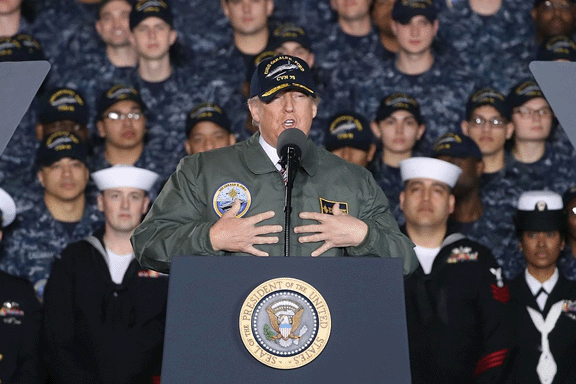 Trump’s North Korea sabre-rattling has a flaw: Kim Jong-un has
  nothing to lose
Strategy of sending in the US navy and attacking Syria and Afghanistan likely only to boost Pyongyang’s nuclear resolve, Guardian, Tom Phillips in Beijing and Justin McCurry in Tokyo, 16 APR 17, In the lead-up to North Korea’s latest missile test, Donald Trump had battled to convince Kim Jong-un he was picking a fight with the wrong guy.
The US president pounded Syria with 59 Tomahawk missiles and then ordered a naval “armada” into the waters around the Korean peninsula. He dropped the “mother of all bombs” on eastern Afghanistan and used Twitter to hammer home his message.
“North Korea is looking for trouble,” the US president tweeted last week as Kim’s technicians made the final preparations for Sunday’s botched but nevertheless defiant test.
But experts say Pyongyang’s latest act has underlined the futility of the billionaire’s efforts to bully Kim Jong-un into abandoning his nuclear ambitions.
“There is a problem with playing the military threat [card] with North Korea because they are inclined to call the bluff,” said John Delury, a North Korea expert from Yonsei University in Seoul. “I’m not saying they tested because of the threats. But bringing a naval strike group doesn’t help if your goal is to put off a test. If anything you are increasing the odds.”…….
Delury claimed Trump’s sabre-rattling rhetoric and erratic use of force would only strengthen Kim’s determination to develop an effective nuclear deterrent that might spare him the fate of Saddam Hussein or Muammar Gaddafi.
“It’s really just playing Pyongyang’s game. It is a waste of time and the Trump administration should move onto a more promising avenue to solve the problem … Since they have nothing to lose and we have everything to lose, they win every game of chicken.”
Leonid Petrov, a North Korea specialist at the Australian National University, said that with its latest missile launch “the message from North Korea is that despite US posturing they are not going to abandon their missile programme”.
Petrov said he was not surprised Kim Jong-un had chosen not to commemorate the 105th anniversary of the birth of the founder of North Korea, his grandfather Kim Il-sung, with an anticipated sixth nuclear test.
“Given the physical damage that would cause to nearby areas, it would have been unusual for a loyal, filial grandson to order a nuclear test on such an auspicious day,” he said.
But when that test does come it would prove the day of reckoning for Trump’s more aggressive approach towards North Korea. “If the US responds with an attack, that would confirm Kim’s claims that he is surrounded by hostile forces that are determined to carry out a pre-emptive strike,” Petrov said.
“The moment of truth for the US will be whether it strikes [in response to a nuclear test] and provokes a resumption of the Korean war at the expense of South Korean security, or stands down and betrays its weakness.”
“What would the US do? Withdraw, hang around or strike?” Petrov asked. “The ball is in the Americans’ court.” https://www.theguardian.com/world/2017/apr/16/north-korea-missile-test-donald-trump-kim-jong-un-has-nothing-to-lose
Simultaneous North Korean and American nuclear weapons tests. Double standards?
 America’s Peace Making Nukes vs. North Korea’s WMD: Simultaneous Nuclear Weapons Tests by U.S. and North Korea, By Prof Michel Chossudovsky Global Research, April 15, 2017 Double Standards? Whereas President Donald Trump threatens to wage a preemptive attack against North Korea if Pyongyang goes ahead with its nuclear weapons tests, the National Nuclear Security Administration (NNSA) and the US Air Force have announced the carrying out of tests of America’s controversial state of the art B61-12 gravity nuclear bomb.

North Korea’s steady march towards a missile that can hit America
Month-by-month North Korea edges closer to a missile that can hit America http://www.news.com.au/world/asia/monthbymonth-north-korea-edges-closer-to-a-missile-that-can-hit-america/news-story/d524ea3d65ef15906bb1b1439923fb5d\ APRIL 16, 2017 ANALYSIS
THE strategic temperature on the Korean peninsula continues to rise and North Korea’s failed missile launch has done nothing to dial down tensions.
The launch clearly designed to coincide with the visit of US Vice President Mike Pence to South Korea, as well as sending an unequivocal that Pyongyang is not deterred by the US military build-up in the region.
The missile launch proved to be a dud, but it’s wrong to assume this reveals major flaws in North Korea’s capacity to strike targets far and wide.
The regime in Pyongyang has already proven it possesses the ability to acquire an intercontinental ballistic missile (ICBM) by successfully placing satellites into orbit twice. The regime has also rapidly accelerated the country’s nuclear weapons program, which has been central to North Korea’s strategy of military self-reliance since the 1960s.
Month-by-month, Pyongyang is edging closer to weaponising a nuclear-armed missile that can hit the United States (and by definition Australia). This is a sobering prospect, one that deeply concerns policymakers. It explains why the Trump administration has deployed a carrier battle group to waters surrounding the Korean peninsula, and why Washington will move to reinforce this presence if North Korea tests another missile in coming days, or worse still, a nuclear device.
Pyongyang will probably carry out either a nuclear test or another missile launch before the end of the month. The regime will be keen to validate its credentials in standing up to President Trump, not least to demonstrate to the North Korean people that Kim Jong-un is in firm command of the country but also to prove to the world that North Korea will not be pushed around by any other country, no matter how powerful or who’s in charge.
Andrew O’Neil is Professor of Political Science and Dean of Research in the Business School at Griffith University
Pre-emptive strike by USA on North Korea is on the cards, if North Korea conducts nuclear weapons test,
 US prepared to launch pre-emptive strike if North Korea conducts nuclear weapons test, reports say, news.com.au, 14 Apr 17 Senior US intelligence officials have reportedly told NBC News the US is prepared to launch a pre-emptive strike with conventional weapons against North Korea if the country appears set to follow through with a nuclear weapons test.
Speculation has been building that the rogue state could be planning to conduct its sixth nuclear test, with reports of activity at the Punggye-ri nuclear test site ahead of Saturday’s 105th anniversary of the birth of the country’s founder Kim Il-Sung.
Citing intelligence officials, NBC News reported that the US had positioned two destroyers in the region, one around 480km from the nuclear test site. The destroyers are capable of shooting Tomahawk cruise missiles.
“US officials, mindful of such concerns here, repeatedly reaffirmed that (the US) will closely discuss with South Korea its North Korea-related measures,” foreign minister Yun Byung told a special parliamentary meeting.
US President Donald Trump today vowed that the “problem” of North Korea “will be taken care of”.”North Korea is a problem, the problem will be taken care of,” Mr Trump said.
Separately on Twitter he expressed confidence China, Pyongyang’s sole ally, would “properly deal with North Korea.”But, “if they are unable to do so, the U.S., with its allies, will! U.S.A.”
Asked on Thursday whether the bomb dropped in Afghanistan – a GBU-43/B Massive Ordnance Air Blast bomb better known by its nickname, the “Mother Of All Bombs” – was a warning to Pyongyang, Mr Trump demurred. “I don’t know if this sends a message to North Korea,” he said. “It doesn’t make any difference if it does or not.”
The Voice of America, quoting US government and other sources, said North Korea “has apparently placed a nuclear device in a tunnel and it could be detonated Saturday AM Korea time.”
A US monitoring group, 38North, has described the Punggye-ri test site as “primed and ready.”
The North is under multiple sets of United Nations sanctions over its nuclear and ballistic missile programs…….http://www.9news.com.au/world/2017/04/14/09/06/us-prepared-to-launch-pre-emptive-strike-if-north-korea-conducts-nuclear-weapons-test-reports-say
North Korea has threatened “nuclear thunderbolts” at the first sign of a US preemptive strike
North Korea threatens ‘nuclear thunderbolts’ as US and China finally work together, Business Insider, ALEX LOCKIE APR 14, 2017 With the world on edge after reports that the US and North Korea are on the verge of war, North Korea has threatened “nuclear thunderbolts” at the first sign of a US preemptive strike while also slamming China for cooperating with the West, according to NKNews.com.
China warning North Korea against escalating tensions to an ‘irreversible’ stage
 China warns North Korea tension has to be stopped from reaching ‘irreversible’ stage, SMH, 14 Apr 17, Beijing/Pyongyang: China said on Friday tension over North Korea had to be stopped from reaching an “irreversible and unmanageable stage, SMH, ” as a US aircraft carrier group steamed towards the region amid fears the North may conduct a sixth nuclear weapons test on Saturday.Concern has grown since the US Navy fired 59 Tomahawk missiles at a Syrian airfield last week in response to a deadly gas attack, raising questions about US President Donald Trump’s plans for North Korea, which has conducted missile and nuclear tests in defiance of UN and unilateral sanctions.
The United States has warned that a policy of “strategic patience” is over. US Vice President Mike Pence travels to South Korea on Sunday on a long-planned 10-day trip to Asia.
China, North Korea’s sole major ally and neighbour which nevertheless opposes its weapons programme, has called for talks leading to the denuclearisation of the Korean peninsula.
“We call on all parties to refrain from provoking and threatening each other, whether in words or actions, and not let the situation get to an irreversible and unmanageable stage,” Chinese Foreign Minister Wang Yi told reporters in Beijing.
“Once a war really happens, the result will be nothing but losing all round and no one could become a winner,” Mr Wang told reporters in Beijing on Friday, according to the official Xinhua News Agency.
North Korea denounced the United States for bringing “huge nuclear strategic assets” to the region as the Carl Vinson strike group with a flag-ship nuclear-powered aircraft carrier steamed closer, and said it stood ready to strike back.
“The Trump administration, which made a surprise guided cruise-missile strike on Syria on April 6, has entered the path of open threat and blackmail,” the North’s KCNA news agency quoted the military as saying in a statement………
North Korea, still technically at war with the South after their 1950-53 conflict ended in a truce, not a treaty, has on occasion conducted missile or nuclear tests to coincide with big political events and often threatens the United States, South Korea and Japan.
On Saturday, it marks the “Day of the Sun”, the 105th anniversary of the birth of state founder Kim Il Sung.
US ally South Korea warned against any North Korean “provocation”, such as a nuclear or missile test.
“There is certain to be powerful punitive measure that will be difficult for the North Korean regime to endure,” the South’s Foreign Ministry said in a statement………
Worry about North Korean aggression has also led to a deterioration of ties between China and South Korea because China objects to the deployment of a US Terminal High Altitude Area Defense (THAAD) anti-missile system in the South.
“It’s not hard to see that ever since the United States and Republic of Korea decided to deploy THAAD, the situation has not become harmonious but has become more tense,” Chinese Foreign Ministry spokesman Geng Shuang, said in response to a question about the system………http://www.smh.com.au/world/china-warns-north-korea-tension-has-to-be-stopped-from-reaching-irreversible-stage-20170414-gvleo7.html
As Navy warships approach, North Korea threatens nuclear strike on USA
North Korea threatens U.S. with #nuclear strike as Navy warships approach https://www.dailydot.com/layer8/north-korea-threatens-nuclear-attack/ David Gilmour—\Apr 11 2017, North Korea this week threatened to launch a nuclear attack on the United States at the first sign of aggression from the U.S. Navy strike group that President Donald Trump ordered to the Korean peninsula.
1 This Month

Protect Sazan Island from the Trump family! https://secure.avaaz.org/campaign/en/protect_sazan_island_from_the_trump_family_loc/?bqFCVab&v=174511&cl=22707147157&_checksum=5e9dde668860e8231c33699735e16a1fbf22ab2cb01da50c999fe8732b9775ef&utm_source=email&utm_medium=blast_email&utm_campaign=174511
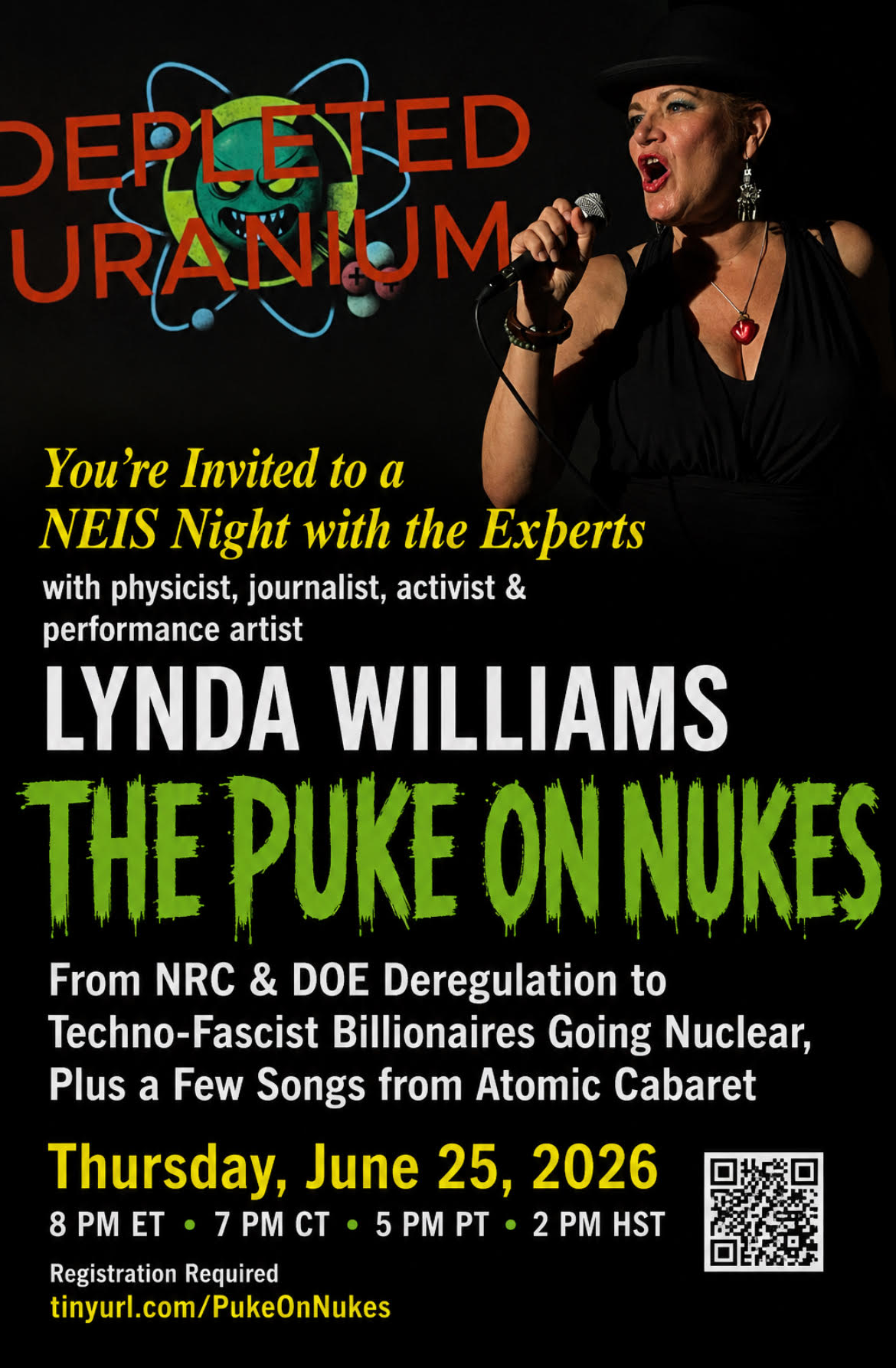
25 June- THE PUKE ON NUKES
Thursday, June 25, 2026
7pm Central Time (8pm ET, 6pm MT, 5pm PT) UTC – 5
From NRC & DOE Deregulation to Techno-Fascist Billionaires Going Nuclear, Plus a Few Songs from Atomic Cabaret REGISTER
26 June – Radiation Trainwreck at the NRC / Join the Protect Better Campaign – https://us02web.zoom.us/meeting/register/4ZlZ5_qLSHGiLSCg8FF6Bg#/registration


Cuba Is Not a Failed State – It Is a Besieged State
PETITION: “Global Appeal to Endorse Palestinian Right of Return of Refugees”
To see nuclear-related stories in greater depth and intensity – go to https://nuclearinformation.wordpress.com
-
Archives
- June 2026 (142)
- May 2026 (306)
- April 2026 (356)
- March 2026 (251)
- February 2026 (268)
- January 2026 (308)
- December 2025 (358)
- November 2025 (359)
- October 2025 (376)
- September 2025 (257)
- August 2025 (319)
- July 2025 (230)
-
Categories
- 1
- 1 NUCLEAR ISSUES
- business and costs
- climate change
- culture and arts
- ENERGY
- environment
- health
- history
- indigenous issues
- Legal
- marketing of nuclear
- media
- opposition to nuclear
- PERSONAL STORIES
- politics
- politics international
- Religion and ethics
- safety
- secrets,lies and civil liberties
- spinbuster
- technology
- Uranium
- wastes
- weapons and war
- Women
- 2 WORLD
- ACTION
- AFRICA
- Atrocities
- AUSTRALIA
- Christina's notes
- Christina's themes
- culture and arts
- Events
- Fuk 2022
- Fuk 2023
- Fukushima 2017
- Fukushima 2018
- fukushima 2019
- Fukushima 2020
- Fukushima 2021
- general
- global warming
- Humour (God we need it)
- Nuclear
- RARE EARTHS
- Reference
- resources – print
- Resources -audiovicual
- Weekly Newsletter
- World
- World Nuclear
- YouTube
-
RSS
Entries RSS
Comments RSS
 nuclear-news