Ambassador to U.K. Liu Xiaoming speaks in interview with ITV
China has “done everything” it can to resolve crisis
China’s Ambassador to the U.K. Liu Xiaoming says he’s “cautiously optimistic” that a diplomatic solution can be found to stop North Korea from developing further nuclear weaponry.
Liu, who was China’s ambassador to North Korea for more than three years, said that his government “had done everything” it could to persuade the country to halt its nuclear program. He spoke in a television interview with ITV.
“I am still cautiously optimistic,” Liu said in the interview that was broadcast on Sunday. “I still believe that if all parties engage with each other and we encourage North Korea to return to the negotiating table, we can still find a diplomatic solution to this problem.”
Chinese President Xi Jinping recently sent Song Tao, head of the Communist Party’s International Liaison Department, to North Korea a week after hosting U.S. President Donald Trump, stoking speculation that Song may carry a message from the Xi-Trump talks. South Korea’s Yonhap News Agency reported there was a good chance that the Chinese envoy would meet leader Kim Jong Un on Sunday, citing unidentified diplomats in Beijing.
Liu said Sunday that North Korea had “legitimate concerns” about trust and security and blamed South Korea’s close relationship with the U.S. as the “root cause” of the problem. While China “strictly abides” by United Nations sanctions against North Korea, resolutions must also be about negotiations, he told ITV.
Ultimately, the larger problem is that President Trump’s policy objectives are unattainable.
Denuclearization is a non-starter from North Korea’s perspective because Kim believes – not without reason – that nuclear weapons are a matter of regime survival, having seen what happens to leaders in countries like Libya when they give up their nuclear programs.
As long as President Trump insists on “complete, verifiable and total denuclearization,” Washington is walking America down a path that leads to (likely nuclear) military conflict
It would be both foolish and naïve to think that all the tough talk coming out of the Trump administration is simply meant to intimidate North Korean dictator Kim Jong Un into giving up his nuclear weapons and long-range missiles.
The three so-called “adults in the room” who are apparently the strongest voices influencing President Trump’s foreign policy are National Security Advisor H.R. McMaster, Secretary of Defense James Mattis and White House Chief of Staff John Kelly.
Mattis is an active duty lieutenant general in the Army. Mattis and Kelly are retired Marine Corps generals. Their common experience is commanding ground forces in the Iraq War. If they are shaping the Trump administration’s North Korea policy, it stands to reason that their views would have a decidedly military tilt.
If President Trump decides to take military action, what might it look like?
Any unprovoked U.S. military action would be a preventive strike. That is, a military strike intended to prevent North Korea from acquiring a future capability to attack the U.S. That is different from a preemptive strike that is launched to stop an imminent military attack from an adversary.
So what military options are truly available to President Trump?
Option 1: Preventive nuclear strikes.
It’s impossible to completely rule out the possibility – however remote – that the U.S. might use nuclear weapons in a preventive strike against North Korea.
If North Korea’s nuclear program and weapons are in deeply buried and hardened bunkers, nuclear weapons might be the only way to destroy them with a high rate of confidence. A relatively little-known fact is that the United States has a nuclear bunker buster: the B61-11 low- yield nuclear gravity bomb.
About 50 B61-11 bombs are believed to be deployed. Theoretically, the B61-11 could be mated with GPS guidance to make it a precision strike weapon. Also, the B61-11 could theoretically be outfitted with the BLU-113 hardened steel-tipped warhead to penetrate more than 30 feet of concrete.
But wouldn’t using nuclear weapons be beyond the pale?
Under ordinary circumstances, yes. But the Trump administration may not believe these are ordinary circumstances. If the administration assumes military conflict with North Korea is inevitable and views North Korea as 1945 Japan, the rationale would be very similar: Using nuclear weapons would bring about a quick resolution and would save thousands of lives that would otherwise be lost in a conventional conflict. As a point of reference, more than 30,000 U.S. soldiers died in the Korean War.
Needless to say, the nuclear option would be a big gamble. If we were not 100 percent successful, we would have to expect that North Korea would retaliate with its full range of conventional and nuclear weapons.
While the U.S. homeland would not be threatened, both South Korea and Japan would be. And the nearly 35,000 U.S. military personnel stationed in South Korea would certainly be at risk – as would the estimated 200,000 or more U.S. citizens living in South Korea.
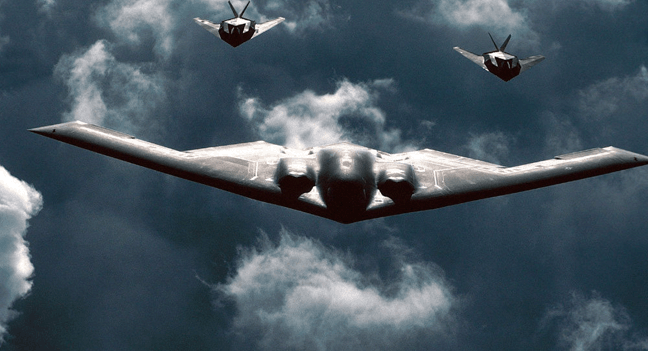
Option 2: Decapitation strikes by bombers or submarines.
Another big gamble would be a decapitating air and missile strike. This would be military action based on the belief that if North Korea’s leadership – Kim Jong Un and his most loyal top military and civilian leaders – could be killed, the regime would implode and collapse.
Success would depend on near-perfect intelligence about all the targets’ whereabouts. Moreover, we would have to assume that many of them – including Kim himself – would be in deeply buried and hardened bunkers that would be difficult to destroy, even with precision conventional missiles and bombs.
And we know from experience that we were not able to immediately take out Saddam Hussein and the other 54 “most wanted Iraqis” when we invaded Iraq in 2003.
If a decapitating strike failed, we would have to assume that North Korea would retaliate and we would be drawn into a protracted ground war.
At a minimum, North Korea would likely unleash a conventional artillery barrage on Seoul, which has a population of 10 million. While such an attack might not level Seoul, it would still cause significant damage and extract untold casualties. Kim might launch his nuclear weapons, believing he had nothing to lose.
Option 3: Conventional ground attack with hundreds of thousands troops.
So that leaves a conventional ground attack, which would likely be preceded and backed up by air and missile strikes.
Given the experience of McMaster, Mattis, and Kelly – as well as the fact that the chairman of the Joint Chiefs of Staff, Gen. Joseph Dunford, is a Marine – such an option makes sense and seems more likely. After all, expeditionary war is exactly what these generals know how to do.
However, almost all the experts believe that any such war would be drawn out and costly –perhaps as many as 20,000 deaths per day in South Korea.
And remember, Kim Jong Un would have the nuclear option at his disposal, along with his chemical and biological weapons. Such is the risk of any military action against a nuclear-armed country.
Option 4: Deterrence.
But the U.S. does have another military option. It just doesn’t involve the actual use of military force. It’s called deterrence.
North Korea has had nuclear weapons for at least a decade and has not used them against either South Korea or Japan. Presumably this is because of the threat of a U.S. nuclear response looms over Pyongyang’s head. If that’s the case, even in the worst case scenario of North Korea having the ability to launch a missile at the continental United States, deterrence would still hold.
Deterrence worked when America and the Soviet Union had thousands of warheads pointed at each other. Supposedly crazy or irrational leaders with nuclear weapons – such as Josef Stalin in the Soviet Union and Mao Zedong in China – were successfully deterred.
Indeed, Kim Jong Un would have to be suicidal to actually attack the U.S., knowing that we could respond with utterly devastating force that could result in his death and the total annihilation of his country. However, the Kim dynasty has repeatedly demonstrated its larger interest is its own survival and perpetuating the regime.
Ultimately, the larger problem is that President Trump’s policy objectives are unattainable.
Denuclearization is a non-starter from North Korea’s perspective because Kim believes – not without reason – that nuclear weapons are a matter of regime survival, having seen what happens to leaders in countries like Libya when they give up their nuclear programs.
As long as President Trump insists on “complete, verifiable and total denuclearization,” Washington is walking America down a path that leads to (likely nuclear) military conflict
North Korea rejects Donald Trump’s call for nuclear talks, as images emerge of ‘ballistic submarine’ under construction, Telegraph, Reuters News Agency 17 NOVEMBER 2017
North Korea has rejected Donald Trump’s call for talks over its nuclear programme just days after the US president completed his high-profile to Asia.
Han Tae Song, North Korea’s ambassador to the United Nations in Geneva, said that negotiations would not happen while America continued “war games” in the region.
The snub occurred as new satellite images suggested North Korea is pursuing an “aggressive schedule” to build its first operational ballistic missile submarine.
The developments mark a double setback for Mr Trump, who is seeking a breakthrough in the stand-off over North Korea after rallying support for his approach in Asia.
However speaking to Reuters, Mr Han rejected the proposal and criticised America for carrying out joint military practices with South Korea.
“As long as there is continuous hostile policy against my country by the US and as long as there are continued war games at our doorstep, then there will not be negotiations,” Mr Han said.
“There are continued military exercises using nuclear assets as well as aircraft carriers, and strategic bombers and then…raising such kinds of military exercises against my country.”
Mr Han said North Korea’s nuclear programme was about protection, saying: “This is the deterrent, the nuclear deterrent to cope with the nuclear threat from America.”
He also claimed Mr Trump drive for tighter sanctions was to “overthrow” the regime by “isolating” it and creating a “humanitarian disaster”.
China has contested Mr Trump’s claim that a “freeze for freeze” proposal – where North Korea stops its nuclear development and America ends its military war games – was off the table.
North Korea nuclear crisis: Japan bracing itself for influx of evacuees if war erupts
Coast Guard readies plans to escort boats from peninsula to designated ports as brinkmanship continues between Pyongyang and Washington The Independent, 16 Nov 17 Japan is studying plans to cope with an influx of perhaps tens of thousands of North Korean evacuees if a military or other crisis breaks out on the peninsula, including ways to weed out spies and terrorists, a domestic newspaper said.
The Japan Coast Guard would escort boats fleeing North Korea to designated ports, where police would screen them by checking their identity and possible criminal records and expel those deemed a threat, The Yomiuri newspaper said on Thursday.
It did not say where those people would be sent, however.
Evacuees granted temporary entrance would be transferred to emergency detention centres, probably in southern Japan, after completing quarantine and other procedures.
Officials would then decide whether they were eligible to remain in Japan, The Yomiuri said.
Regional tension over Pyongyang’s missile and nuclear arms programmes remain high.
The United States and its allies continue to cajole and threaten North Korea to negotiate an agreement that would relinquish its growing nuclear and ballistic-missile Staff – By Ted Galen Carpenter
The United States and its allies continue to cajole and threaten North Korea to negotiate an agreement that would relinquish its growing nuclear and ballistic-missile programs. The latest verbal prodding came from President Trump during his joint press conference with South Korean president Moon Jae-in. Trump urged[3] Pyongyang to “come to the negotiating table,” and asserted that it “makes sense for North Korea to do the right thing.” The “right thing” Trump and his predecessors have always maintained, is for North Korea to become nonnuclear.
It is unlikely that the DPRK will ever return to nuclear virginity. Pyongyang has multiple reasons for retaining its nukes. For a country with an economy roughly the size of Paraguay’s, a bizarre political system that has no external appeal, and an increasingly antiquated conventional military force, a nuclear-weapons capability is the sole factor that provides prestige and a seat at the table of international affairs. There is one other crucial reason for the DPRK’s truculence, though. North Korean leaders simply do not trust the United States to honor any agreement that might be reached.
Unfortunately, there are ample reasons for such distrust. North Korean leaders have witnessed how the United States treats nonnuclear adversaries such as Serbia[4] andIraq[5]. But it was the U.S.-led intervention in Libya in 2011 that underscored to Pyongyang why achieving and retaining a nuclear-weapons capability might be the only reliable way to prevent a regime-change war directed against the DPRK.
Partially in response to Washington’s war that ousted Iraqi dictator Saddam Hussein in the spring of 2003, ostensibly because of a threat posed by Baghdad’s “weapons of mass destruction,” Libyan leader Muammar el-Qaddafi seemed to capitulate regarding such matters. He reconfirmed his country’s adherence to the Nuclear Nonproliferation Treaty in December of that year and agreed to abandon his country’s embryonic nuclear program. In exchange, the United States and its allies lifted economic sanctions and pledged that they no longer sought to isolate Libya. Qaddafi was welcomed back into the international community once he relinquished his nuclear ambitions.
That reconciliation lasted less than a decade. When one of the periodic domestic revolts against Qaddafi’s rule erupted again in 2011, Washington and its NATO partners argued that a humanitarian catastrophe was imminent (despite meager evidence[6] of that scenario), and initiated a military intervention. It soon became apparent that the official justification to protect innocent civilians was a cynical pretext, and that another regime-change war was underway. The Western powers launched devastating air strikes and cruise-missile attacks against Libyan government forces. NATO also armed rebel units and assisted the insurgency in other ways.
Although all previous revolts had fizzled, extensive Western military involvement produced a very different result this time. The insurgents not only overthrew Qaddafi, they captured, tortured and executed him in an especially grisly fashion. Washington’s response was astonishingly flippant. Secretary of State Hillary Clinton quipped[7]: “We came, we saw, he died.”
The behavior of Washington and its allies in Libya certainly did not give any incentive to North Korea or other would-be nuclear powers to abandon such ambitions in exchange for U.S. paper promises[8] for normal relations. Indeed, North Korea promptly cited the Libya episode as a reason why it needed a deterrent capability—a point that Pyongyang has reiterated several times in the years since Muammar el-Qaddafi ouster. There is little doubt that the West’s betrayal of Qaddafi has made an agreement with the DPRK to denuclearize even less[9] attainable[10] than it might have been otherwise. Even some U.S. officials concede[11] that the Libya episode convinced North Korean leaders that nuclear weapons were necessary for regime survival.
The foundation for successful diplomacy is a country’s reputation for credibility and reliability. U.S. leaders fret that autocratic regimes—such as those in Iran and North Korea—might well violate agreements they sign. There are legitimate reasons for wariness, although in Iran’s case, the government appears to be complying[12] with its obligations under the Joint Comprehensive Plan of Action that Tehran signed with the United States and other major powers in 2015—despite allegations from U.S. hawks about violations.
When it comes to problems with credibility, though, U.S. leaders also need to look in the mirror. Washington’s conduct in Libya was a case of brazen duplicity. It is hardly a surprise if North Korea (or other countries) now regard the United States as an untrustworthy negotiating partner. Because of Pyongyang’s other reasons for wanting a nuclear capability, a denuclearization accord was always a long shot. But U.S. actions in Libya reduced prospects to the vanishing point. American leaders have only themselves to blame for that situation.
Ted Galen Carpenter, a senior fellow in defense and foreign-policy studies at the Cato Institute and a contributing editor at the National Interest, is the author or coauthor of ten books, including The Korean Conundrum: America’s Troubled Relations with North and South Korea[13]. He also is the author of more than seven hundred articles and policy studies on international affairs.
North Korea nuclear arsenal too developed to destroy quickly, says Moon, Christine Kim, 14 Nov 17, SEOUL (Reuters) – South Korean President Moon Jae-in said on Tuesday it would not be easy for reclusive North Korea to destroy its nuclear arsenal quickly, even if wanted to, given its weapons programs were so developed. North Korea is under heavy international pressure to end its weapons programs, pursued in defiance of U.N. Security Council resolutions. But it has vowed never to give up its nuclear arsenal.
Speaking to reporters in the Philippines, Moon said that if North Korea agreed to hold talks, negotiations could be held with all options open.
“If talks begin to resolve the North Korea nuclear issue, I feel it will be realistically difficult for North Korea to completely destroy its nuclear capabilities when their nuclear and missile arsenal are at a developed stage,” Moon said in a briefing.
“If so, North Korea’s nuclear program should be suspended, and negotiations could go on to pursue complete denuclearization.”…….
The North defends the programs as a necessary defense against U.S. plans to invade. The United States, which has 28,500 troops in South Korea, a legacy of the 1950-53 Korean war, denies any such intention.
U.S. President Donald Trump has traded insults and threats with North Korean leader Kim Jong Un as North Korea races toward its goal of developing a nuclear-tipped missile capable of reaching the United States.
Trump threatened in his maiden U.N. address to “totally destroy” North Korea if the United States was threatened and has said the time for talking, the policy of previous U.S. administrations, is over.
Moon reiterated his stance that now was the time to increase pressure on North Korea so that it would come to talks……..
He said differences in understanding between South Korea and China, North Korea’s lone major ally, regarding the deployment of the U.S. Terminal High Altitude Area Defense (THAAD) system on South Koran soil had not been resolved.
North Korea threatens ‘barrage of concentrated nuclear strikes’ on US mainland
NORTH Korea has threatened to destroy the Unites States with a “barrage of concentrated strikes” in an astonishing rant in which they accuse Donald Trump of seeking to trigger World War 3. Express UK, By LAURA MOWAT North Korean newspaper, Rodung Sinmum, said Washington was trying to spark nuclear warfare by conducting military exercises on the doorstep of the rogue nation.
Tensions between the US and North Korea have reached boiling point in recent months and Pope Francis has stepped in to try and save the planet from nuclear war.
Ted Galen Carpenter, The United States and its allies continue to cajole and threaten North Korea to negotiate an agreement that would relinquish its growing nuclear and ballistic-missile programs. The latest verbal prodding came from President Trump during his joint press conference with South Korean president Moon Jae-in. Trumpurged Pyongyang to “come to the negotiating table,” and asserted that it “makes sense for North Korea to do the right thing.” The “right thing” Trump and his predecessors have always maintained, is for North Korea to become nonnuclear.
It is unlikely that the DPRK will ever return to nuclear virginity. Pyongyang has multiple reasons for retaining its nukes. For a country with an economy roughly the size of Paraguay’s, a bizarre political system that has no external appeal, and an increasingly antiquated conventional military force, a nuclear-weapons capability is the sole factor that provides prestige and a seat at the table of international affairs. There is one other crucial reason for the DPRK’s truculence, though. North Korean leaders simply do not trust the United States to honor any agreement that might be reached.
Unfortunately, there are ample reasons for such distrust. North Korean leaders have witnessed how the United States treats nonnuclear adversaries such asSerbia and Iraq. But it was the U.S.-led intervention in Libya in 2011 that underscored to Pyongyang why achieving and retaining a nuclear-weapons capability might be the only reliable way to prevent a regime-change war directed against the DPRK.
Partially in response to Washington’s war that ousted Iraqi dictator Saddam Hussein in the spring of 2003, ostensibly because of a threat posed by Baghdad’s “weapons of mass destruction,” Libyan leader Muammar el-Qaddafi seemed to capitulate regarding such matters. He signed the Nuclear Nonproliferation Treaty in December of that year and agreed to abandon his country’s embryonic nuclear program. In exchange, the United States and its allies lifted economic sanctions and pledged that they no longer sought to isolate Libya. Qaddafi was welcomed back into the international community once he relinquished his nuclear ambitions.
That reconciliation lasted less than a decade. When one of the periodic domestic revolts against Qaddafi’s rule erupted again in 2011, Washington and its NATO partners argued that a humanitarian catastrophe was imminent (despite meager evidence of that scenario), and initiated a military intervention. It soon became apparent that the official justification to protect innocent civilians was a cynical pretext, and that another regime-change war was underway. The Western powers launched devastating air strikes and cruise-missile attacks against Libyan government forces. NATO also armed rebel units and assisted the insurgency in other ways.
Although all previous revolts had fizzled, extensive Western military involvement produced a very different result this time. The insurgents not only overthrew Qaddafi, they captured, tortured and executed him in an especially grisly fashion. Washington’s response was astonishingly flippant. Secretary of State Hillary Clinton quipped: “We came, we saw, he died.”
The behavior of Washington and its allies in Libya certainly did not give any incentive to North Korea or other would-be nuclear powers to abandon such ambitions in exchange for U.S. paper promises for normal relations. Indeed, North Korea promptly cited the Libya episode as a reason why it needed a deterrent capability—a point that Pyongyang has reiterated several times in the years since Muammar el-Qaddafi ouster. There is little doubt that the West’s betrayal of Qaddafi has made an agreement with the DPRK to denuclearize even less attainable than it might have been otherwise. Even some U.S. officials concede that the Libya episode convinced North Korean leaders that nuclear weapons were necessary for regime survival.
The foundation for successful diplomacy is a country’s reputation for credibility and reliability. U.S. leaders fret that autocratic regimes—such as those in Iran and North Korea—might well violate agreements they sign. There are legitimate reasons for wariness, although in Iran’s case, the government appears to becomplying with its obligations under the Joint Comprehensive Plan of Action that Tehran signed with the United States and other major powers in 2015—despite allegations from U.S. hawks about violations.
When it comes to problems with credibility, though, U.S. leaders also need to look in the mirror. Washington’s conduct in Libya was a case of brazen duplicity. It is hardly a surprise if North Korea (or other countries) now regard the United States as an untrustworthy negotiating partner. Because of Pyongyang’s other reasons for wanting a nuclear capability, a denuclearization accord was always a long shot. But U.S. actions in Libya reduced prospects to the vanishing point. American leaders have only themselves to blame for that situation.
Ted Galen Carpenter, a senior fellow in defense and foreign-policy studies at the Cato Institute and a contributing editor at the National Interest, is the author or coauthor of ten books, including The Korean Conundrum: America’s Troubled Relations with North and South Korea. He also is the author of more than seven hundred articles and policy studies on international affairs.
The Punggye-ri nuclear test site in Kilju County, North Hamgyong Province, where North Korea has conducted a total of six nuclear tests, and the surrounding area have become a wasteland. The most recent test, during which the North detonated a suspected staged thermonuclear bomb with an explosive yield several orders of magnitude larger than anything the regime has previously tested, has reportedly exacerbated the environmental degradation.
The Research Association of Vision of North Korea interviewed 21 North Korean defectors who recently lived in Kilju. The defectors revealed that trees have stopped growing in certain areas, wells have dried up, and babies are born with abnormal birth defects, according to the Chosun Iblo, a South Korean media outlet.
“I heard from a relative in Kilju that deformed babies were born in hospitals there,” one defector revealed. “I spoke on the phone with family members I left behind there, and they told me that all of the underground wells dried up after the sixth nuclear test,” another said. “If you plant trees in the mountains there, 80 percent of them die,” a former forestry worker explained.
North Korean people drink the water that runs down from Mt. Mantap, under which North Korea conducts its nuclear tests. There are reportedly complaints in the area of a “phantom disease” that appeared after North Korea began conducting regular nuclear tests. Defectors have revealed that residents suffer from unexplained fatigue, headaches, weight loss. Some others have reported an unusually high mortality rate and and nervous system disorders, such as the loss of certain senses, including smell and taste.
Defectors revealed that North Korean citizens living nearby are not notified prior to the detonation of a nuclear device, making it impossible for them to prepare for the tests, the most recent of which caused earthquakes and landslides.
Since North Korea conducted its first nuclear test in 2006, defectors have testified about the dangers to the local civilian population. Now that North Korea is testing more powerful weaponry, the risks of irradiation and contamination may be much higher. South Korea is now carrying out radiation screening for former residents of Kilju County. Around 30 North Korean defectors will be checked for radiation exposure this year.
North Korea appears to be worried about contamination as well. After the most recent nuclear test, local residents were barred from visiting Pyongyang. Additionally, North Korea has reportedly established a hospital to treat irradiated soldiers working at the nuclear test site. It is unclear if the North provides such treatment for prisoners brought in to clean up after a nuclear test without proper equipment and protection, but North Korea’s human rights record suggests that such services are not available for these individuals.
If reports from in country are accurate, it appears that the North Korean people in the area are paying a high price for the regime’s nuclear ambitions.
I’ve always wondered: do nuclear tests affect tectonic plates and cause earthquakes or volcanic eruptions? The Conversation, Jane Cunneen Do underground nuclear tests affect Earth’s tectonic plates, and cause earthquakes or volcanic eruptions? – Anne Carroll, Victoria
Apart from escalating global fears about conflict, North Korea’s recent nuclear tests have raised questions about geological events caused by underground explosions.
Some media reports suggest the tests triggered earthquakes in South Korea. Others report the explosions may trigger a volcanic eruption at Paektu Mountain, about 100km from the test site.
So can an underground test cause an earthquake? The short answer is yes: a nuclear explosion can cause small earthquakes. But it is unlikely to affect the earth’s tectonic plates or cause a volcanic eruption.
Although a nuclear explosion releases a lot of energy in the immediate region, the amount of energy is small compared to other stresses on tectonic plates………
Earthquakes from nuclear testing
The 3 September 2017 North Korean nuclear test generated shock waves equivalent to a magnitude 6.3 earthquake. Eight minutes later, a magnitude 4.1 event was detected at the same site. This may have been linked to a collapse of a tunnel related to the blast.
Several small earthquakes measured since the event may have been induced by the nuclear test, but the largest is only a magnitude 3.6. An earthquake of this size would not be felt outside of the immediate area.
The largest induced earthquake ever measured from nuclear testing was a magnitude 4.9 in the Soviet Union. An earthquake of this size can cause damage locally but does not affect the full thickness of the earth’s crust. This means it would not have any effect on the movement of tectonic plates.
Historical data from nuclear testing (mostly in the USA) shows that earthquakes associated with nuclear testing typically occur when the explosion itself measures greater than magnitude 5, 10–70 days after the tests, at depths of less than 5km, and closer than around 15km to the explosion site. More recent studies have concluded that nuclear tests are unlikely to induce earthquakes more than about 50km from the test site……..
Monitoring nuclear tests
The Comprehensive Nuclear Test Ban Treaty Organisation (CTBTO) has a global monitoring system to detect nuclear tests, including seismometers to measure the shock waves from the blast and other technologies.
Seismologists can analyse the seismic data to determine if the shock waves were from a naturally occurring earthquake or a nuclear blast. Shock waves from nuclear blasts have different properties to those from naturally occurring earthquakes.
Testing was much more common before the CTBTO was formed: between 1945 and 1996 more than 2,000 nuclear tests were conducted worldwide, including 1,032 by the USA and 715 by the Soviet Union.
US officials requested a detailed assessment of the consequences of a North Korean war
The assessment says an invasion is the only way to disarm North Korea with certainty
The statement says millions could die in days and that chemical weapons may be used
The Joint Chief of Staffs directly advise the US President on military matters
In a letter to the Pentagon, two House Democrats had asked about casualty assessments in a possible conflict with North Korea, and Rear Admiral Michael J Dumont of the Joint Staff responded on behalf of the Defence Department.
“It is our intent to have a full public accounting of the potential cost of war, so the American people understand the commitment we would be making as a nation if we were to pursue military action,” the representatives’ letter said.
“We have not heard detailed analysis of expected US or allied force casualties, expected civilian casualties, what plans exist for the aftermath of a strike — including continuity of the South Korean Government.”
In his response, Mr Dumont noted that the United States’ military and intelligence agencies are evaluating North Korea’s ability to target heavily populated areas of South Korea with long-range artillery, rockets and ballistic missiles.
“A classified briefing would be the best place to discuss in detail the capability of the US and its allies,” Mr Dumont’s letter said.
“[And] to discuss capabilities to counter North Korea’s ability to respond with a nuclear weapon and eliminate North Korea’s nuclear weapons located in deeply buried, underground facilities.”
In his response, Mr Dumont highlighted that Seoul, the South Korean capital with a population of 25 million, was just 55 kilometres from the demilitarised zone(DMZ) that separates the two Koreas. The amount of casualties would differ depending on the advance warning and the ability of US and South Korea forces to counter these attacks.
Mr Dumont also highlighted the possibility that chemical and biological weapons might be used by the North in case of a conflict.
In the US military the Joint Chiefs of Staff directly advise the President on military matters.
Responding in a joint statement, 15 Democratic officials and one Republican — all military veterans — called Mr Dumont’s assessment that a ground invasion would be required to destroy the North’s nuclear arsenal “chilling” and “deeply disturbing”.
“The Joint Chiefs of Staff has now confirmed that the only way to destroy North Korea’s nuclear arsenal is through a ground invasion,” the joint statement said. That is deeply disturbing and could result in hundreds of thousands, or even millions of deaths in just the first few days of fighting.
“Their assessment underscores what we’ve known all along: there are no good military options for North Korea.”
They also noted that the Trump administration “has failed to articulate any plans to prevent the military conflict from expanding beyond the Korean Peninsula and to manage what happens after the conflict is over”.
“With that in mind, the thought of sending troops into harm’s way and expending resources on another potentially unwinnable war is chilling,” they said.
“The President needs to stop making provocative statements that hinder diplomatic options and put American troops further at risk.”
Speaking to CNN overnight, Senator Dianne Feinstein, a member of the Senate Intelligence Committee, called the assessment “bleak”, but added that she was pleased that Secretary of State Rex Tillerson was accompanying President Donald Trump during his trip to Asia, where North Korea is the main issue on the agenda.
“I think if he will stay the course and use diplomacy the way diplomacy can be used, then it might be possible to work something out,” Ms Feinstein said.
“The worst alternative is a war which could become nuclear.”
North Korean leader Kim Jong Un provides guidance on a nuclear weapons program in this undated photo released by North Korea’s Korean Central News Agency (KCNA) in Pyongyang September 3, 2017. KCNA via REUTERS
NORTH Korea says there will be no more talking. Instead, Kim Jong-un has sent an ominous warning to Donald Trump.news.com.au, Star writers, AFP, AP, 4 Nov 17 NORTH Korea ruled out talks and threatened to increase its nuclear arsenal in a fresh warning to Donald Trump’s administration as the US President set off on a tour of Asia.
Trump departed for his first presidential trip to Asia Friday, with tensions over North Korea’s nuclear and missile threats looming large. He is due to arrive in South Korea Tuesday, after first visiting Japan.
The North’s state-run KCNA news agency said in a commentary that the US should be disabused of the “absurd idea” that Pyongyang would succumb to international sanctions and give up its nuclear weapons, adding that it is in “the final stage for completing nuclear deterrence”.
“It had better stop daydreaming of denuclearisation talks with us”, said the commentary titled “Stop dreaming a daydream”.
“Our self-defensive nuclear treasure sword will be sharpened evermore unless the US hostile policy toward the DPRK is abolished once and for all”, it said, using an acronym for the official name of North Korea.
The White House said Trump will deliver a speech at South Korea’s National Assembly and urge “common resolve in the face of shared threat”.
But there is widespread concern in South Korea that the US president’s visit might worsen the situation if Trump fails to rein in his fierce rhetoric.
Trump and the North’s leader Kim Jong-un have traded insults and threats of war in recent months.
“Because of his tendency to veer off the script, many Koreans are worried that he may let loose”, Professor Yang Moo-Jin of the University of North Korean Studies told AFP.
Defector: US strike would trigger automatic North Korea retaliation, Miltary Times, By: Matthew Pennington, The Associated Press WASHINGTON 2 Nov 17 — A high-ranking North Korean defector told a congressional hearing Wednesday that a pre-emptive U.S. military strike on the country would trigger automatic retaliation, with the North unleashing artillery and short-range missile fire on South Korea.
The testimony from Thae Yong Ho, former deputy chief of mission at the North Korean Embassy in London, underscored the high risk in using military force against North Korea. The Trump administration has said this is among its options in stopping leader Kim Jong Un from perfecting a nuclear-tipped missile that could strike the United States.
Thae, the highest-level North Korean defector in two decades, appeared to confirm what has long been suspected but rarely articulated by U.S. officials — that even a selective American strike could rain a potentially devastating North Korean military response on the South Korean capital and its environs, about 25 miles (40 kilometers) south of the heavily militarized frontier.
Thae, who is making his first visit to Washington since his defection last year, said the U.S. and allied South Korea would win a war after a preventive military strike on the North, but there would be a “human sacrifice” inflicted on the South from the “tens of thousands” of artillery guns and short-range missiles the North has at the frontier.
“North Korean officers are trained to press their button without any further instructions from the general command if anything happens on their side,” Thae told the House Foreign Affairs Committee, referring to a U.S. bombing or military strike. “We have to remember that tens of millions of South Korean population are living 70 to 80 kilometers away from this military demarcation line.”
He urged Washington to use “soft power” instead …….
Thae’s comments come ahead of President Donald Trump’s five-nation trip to Asia that will include a stop in South Korea. The U.S. administration says it seeks a diplomatic solution to the nuclear standoff but “all options” are on the table. Trump has threatened the total destruction of North Korea if the U.S. is forced to defend itself or its allies.
A Congressional Research Service report published last week said that conservative estimates anticipate that in the first hours of a conflict, North Korean artillery situated along the frontier could cause tens of thousands of casualties in South Korea, where at least 100,000 and possibly as many as 500,000 Americans live — including nearly 30,000 U.S. troops. It said a protracted conflict, particularly one in which North Korea uses its nuclear, biological or chemical weapons, could cause enormous casualties on a greater scale.
Some analysts contend the risk of Kim acquiring a nuclear weapon capable of targeting the U.S. homeland is greater than the risks associated with the outbreak of a regional war, the report said.
KIM Jong-un could test another nuclear weapon “at any time” after his September launch which caused three aftershocks, South Korean spies say.The Sun News Corp Australia Network NOVEMBER 3, 2017 NORTH Korea could be preparing another ballistic missile test amid “brisk activity” at one of Kim Jong-un’s nuclear research facilities, according to local media.
South Korea’s spy agency is anticipating another rocket launch, insisting the crackpot state would continuously push to develop “miniaturised, diversified” warheads, The Sun reports.
The South’s National Intelligence Service (NIS) has spotted “active movement” of vehicles at Kim’s research centre in Pyongyang — indicating the war-hungry despot is preparing another test.
The NIS said “the North will carry out additional nuclear tests and continue to push for the development of miniaturised, diversified nuclear warheads,” adding that a tunnel at a test site was ready to be used “at any time”.
The NIS also mentioned damage to the Punggye-ri nuclear site in the northeast of the country after three aftershocks following the North’s sixth and most powerful nuclear test on September 3.
Last month, a tunnel at the underground nuclear site reportedly collapsed, killing up to 200 people. The disaster happened at the remote Punggye-ri site on October 10, according to Japan’s TV Asahi.
The disaster has prompted fears of a massive radioactive leak which could spark a Chernobyl- or Fukushima-style disaster. The disaster has prompted fears of a massive radioactive leak which could spark a Chernobyl- or Fukushima-style disaster.
A North Korean official said the collapse happened during the construction of an underground tunnel, South Korea’s Yonhap news agency reports. Some 100 people are said to have been trapped by the initial tunnel collapse, with a further 100 lost in a second collapse during a rescue operation, Asahi reported on Tuesday.
The accident is believed to have been caused by Kim’s sixth nuclear test which weakened the mountain, according to the report. It was reported earlier this year that the mountain under which the base is believed to be hidden was at risk of collapsing and leaking radiation into the region. Experts said if the peak crumbles, clouds of radioactive dust and gas would blanket the region, the South China Morning Post reported.
The Punggye-ri test site is carved deep into the side of Mount Mantap.
U.S. pursues direct diplomacy with North Korea despite Trump rejectionArshad Mohammed, Matt Spetalnick WASHINGTON (Reuters) 1 Nov 17, – The United States is quietly pursuing direct diplomacy with North Korea, a senior State Department official said on Tuesday, despite U.S. President Donald Trump’s public assertion that such talks are a waste of time.
Using the so-called “New York channel,” Joseph Yun, U.S. negotiator with North Korea, has been in contact with diplomats at Pyongyang’s United Nations mission, the official said, at a time when an exchange of bellicose insults between Trump and North Korean leader Kim Jong Un has fueled fears of military conflict.
While U.S. Secretary of State Rex Tillerson on Oct. 17 said he would continue “diplomatic efforts … until the first bomb drops,” the official’s comments were the clearest sign the United States was directly discussing issues beyond the release of American prisoners, despite Trump having dismissed direct talks as pointless.
There is no sign, however, that the behind-the-scenes communications have improved a relationship vexed by North Korea’s nuclear and missile tests, the death of U.S. university student Otto Warmbier days after his release by Pyongyang in June and the detention of three other Americans.
Word of quiet engagement with Pyongyang comes despite Trump’s comments, North Korea’s weapons advances and suggestions by some U.S. and South Korean officials that Yun’s interactions with North Koreans had been reined in.
“It has not been limited at all, both (in) frequency and substance,” said the senior State Department official………
At the start of Trump’s presidency, Yun’s instructions were limited to seeking the release of U.S. prisoners.
“It is (now) a broader mandate than that,” said the State Department official, declining, however, to address whether authority had been given to discuss North Korea’s nuclear and missile program.
In Beijing, Foreign Ministry spokeswoman Hua Chunying said China welcomed any dialogue between the United States and North Korea.
“We encourage North Korea and the United States to carry out engagement and dialogue,” Hua told reporters, adding that she hoped talks could help return the issue to a diplomatic track for resolution.
…… Speaking at the United Nations on Sept. 19, Trump vowed to “totally destroy” North Korea if it threatened the United States or its allies, raising anxieties about the possibility of military conflict.
Twelve days later, after Tillerson said Washington was probing for a diplomatic opening, Trump said on Twitter that his chief diplomat was “wasting his time trying to negotiate with Little Rocket Man” – his mocking nickname for the North Korean leader.
Democratic U.S. senators introduced a bill on Tuesday they said would prevent Trump from launching a nuclear first strike on North Korea on his own, highlighting the issue days before the Republican’s first presidential trip to Asia.
…… The New York channel is one of the few conduits the United States has for communicating with North Korea, which has itself made clear it has little interest in serious talks before it develops a nuclear-tipped missile capable of hitting the continental United States.
The last high-level contact between Yun and the North Koreans was when he traveled to North Korea in June to secure the release of Warmbier, who died shortly after he returned home in a coma, the State Department official said.
……. The official said, however, that “the preferred endpoint is not a war but some kind of diplomatic settlement” and suggestions that Washington is setting up a binary choice for Pyongyang to capitulate diplomatically or military action were “misleading.”
Diplomacy, the official said, “has a lot more room to go.”
But Trump’s threats against North Korea are believed to have complicated diplomatic efforts.
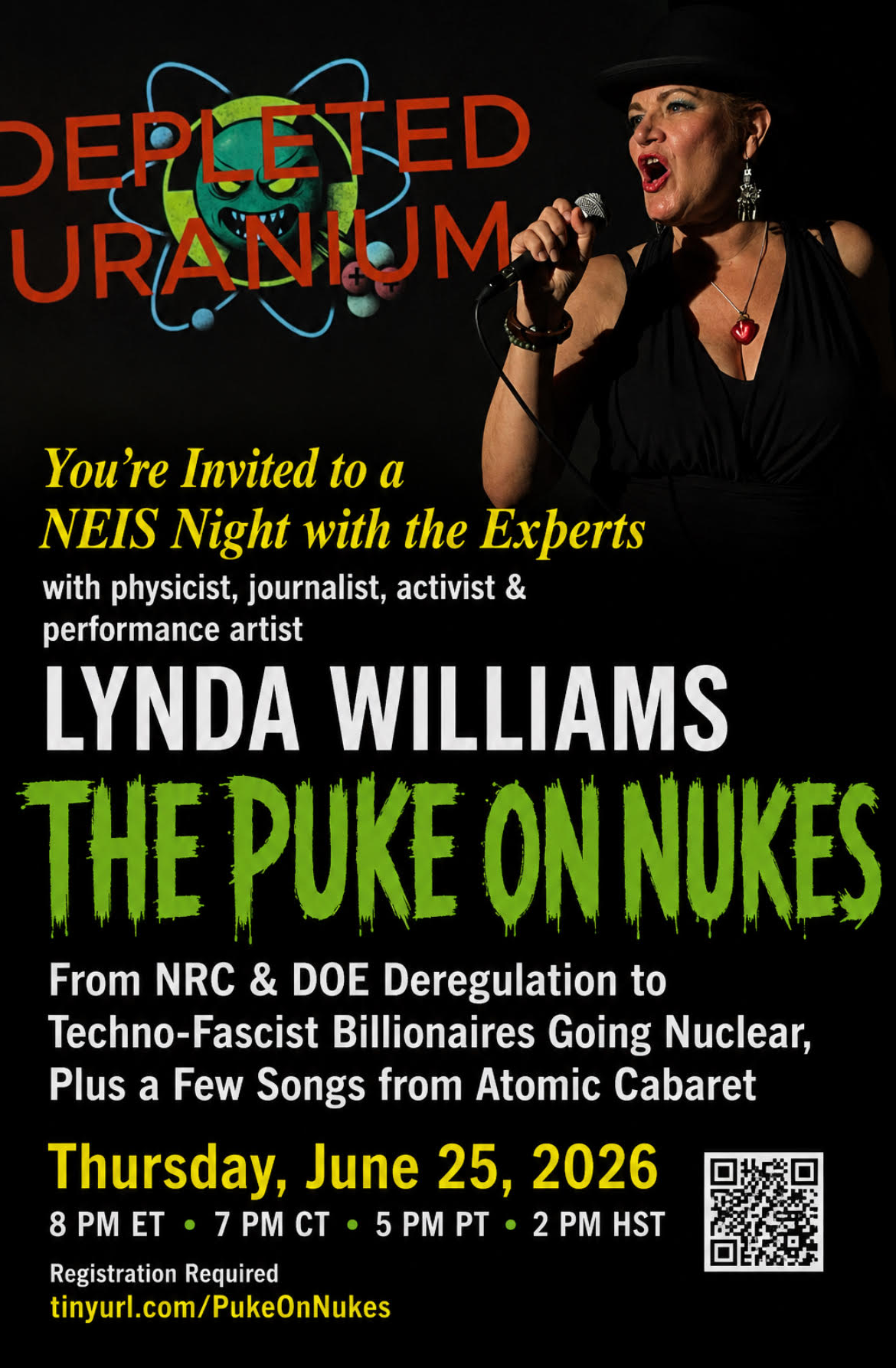
7pm Central Time (8pm ET, 6pm MT, 5pm PT) UTC – 5 From NRC & DOE Deregulation to Techno-Fascist Billionaires Going Nuclear, Plus a Few Songs from Atomic Cabaret REGISTER







 nuclear-news