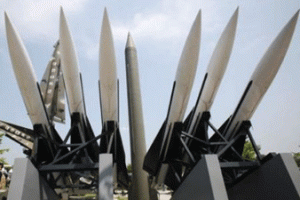
 [Photo] North Korea marks one-year anniversary of alleged nuclear weapons program completion, Daily NK, By Mun Dong Hui, 28 Dec 18,
December 29, 2018
Posted by Christina Macpherson |
North Korea, weapons and war |
Leave a comment
North Korea Says It Won’t Give Up Nuclear Weapons Unless the U.S. Removes Nuclear Threat, TIME, By KIM TONG-HYUNG / AP December 20, 2018 (SEOUL, South Korea) — North Korea said Thursday it will never unilaterally give up its nuclear weapons unless the United States first removes what Pyongyang called a nuclear threat. The surprisingly blunt statement jars with Seoul’s rosier presentation of the North Korean position and could rattle the fragile trilateral diplomacy to defuse a nuclear crisis that last year had many fearing war.
The latest from North Korea comes as the United States and North Korea struggle over the sequencing of the denuclearization that Washington wants and the removal of international sanctions desired by Pyongyang. The statement carried by the North’s official Korean Central News Agency also raises credibility problems for the liberal South Korean government, which has continuously claimed that North Korean leader Kim Jong Un is genuinely interested in negotiating away his nuclear weapons as Seoul tries to sustain a positive atmosphere for dialogue.
The North’s comments may also be seen as proof of what outside skeptics have long said: that Kim will never voluntarily relinquish an arsenal he sees as a stronger guarantee of survival than whatever security assurances the United States might provide. The statement suggests North Korea will eventually demand the United States withdraw or significantly reduce the 28,500 American troops stationed in South Korea, a major sticking point in any disarmament deal.
Kim and President Donald Trump met June 12 in Singapore where they agreed on a vague goal for the “complete denuclearization” of the Korean Peninsula without describing when and how it would occur. The leaders are trying to arrange another meeting for early next year.
But North Korea for decades has been pushing a concept of denuclearization that bears no resemblance to the American definition, with Pyongyang vowing to pursue nuclear development until the United States removes its troops and the nuclear umbrella defending South Korea and Japan. In Thursday’s statement, the North made clear it’s sticking to its traditional stance on denuclearization. It accused Washington of twisting what had been agreed on in Singapore and driving post-summit talks into an impasse.
“The United States must now recognize the accurate meaning of the denuclearization of the Korean Peninsula, and especially, must study geography,” the statement said.
“When we talk about the Korean Peninsula, it includes the territory of our republic and also the entire region of (South Korea) where the United States has placed its invasive force, including nuclear weapons. When we talk about the denuclearization of the Korean Peninsula, it means the removal of all sources of nuclear threat, not only from the South and North but also from areas neighboring the Korean Peninsula,” the statement said.
The United States removed its tactical nuclear weapons from South Korea in the 1990s. Washington and Seoul have not responded to the North Korean statement……..
“If we unilaterally give up our nuclear weapons without any security assurance despite being first on the U.S. list of targets for pre-emptive nuclear strikes, that wouldn’t be denuclearization — it would rather be a creation of a defenseless state where the balance in nuclear strategic strength is destroyed and the crisis of a nuclear war is brought forth,” the KCNA said.
“The corresponding measures we have asked the United States to take aren’t difficult for the United States to commit to and carry out. We are just asking the United States to put an end to its hostile policies (on North Korea) and remove the unjust sanctions, things it can do even without a snap of a finger.”…….http://time.com/5485553/north-korea-nuclear-weapons-us-threat/
December 22, 2018
Posted by Christina Macpherson |
North Korea, politics international |
Leave a comment
WW3: North Korea warns US tensions sparked ‘nightmare of nuclear disaster EVERY NIGHT’
NORTH Korea has stoked tensions with the United States after US Secretary of State Mike Pompeo came under fire in a report carried on an officially sanctioned North Korean news agency. Express UK, By CIARAN MCGRATH, Dec 18, 2018 And it has also taken to opportunity to pointedly remind America it is now a year since “tens of millions of Americans suffered from the horrible nightmare of a nuclear disaster every night” in provocative language which may alarm Washington.
 The Korean Central News Agency took an apparent swipe at Mr Pompeo – one of US President Donald Trump’s closest advisors – in an article attributed to Jong Hyon and published just three days after the treasury department announced sanctions against North Korean official Choe Ryong Hae, who holds several positions including being vice-chairman of the Korean Workers’ Party. Writing on the 38 North website, US-based academic and North Korea expert Robert Carlin said: “Though the Jong Hyon article did not mention this latest development, it surely rankled Pyongyang, a fact made clear in a statement by the policy research director of the Institute for American Studies (IFAS) of the Ministry of Foreign Affairs of the Democratic People’s Republic of Korea a few days late
The broadside at ‘a brazen faced guy’ who ‘had amicable negotiations’ with the DPRK side, but back home talked about a ‘rogue state’ and ‘maximum pressure’ was unmistakably aimed at Secretary of State Pompeo, who has visited Pyongyang several times.
“Personal invective against the other side’s officials, especially leading figures on its negotiating team, marks an unpleasant moment but is not an insurmountable barrier. …..https://www.express.co.uk/news/world/1060671/world-war-3-north-korea-nuclear-disaster-us-mike-pompeo
December 20, 2018
Posted by Christina Macpherson |
North Korea, politics international |
Leave a comment
North Korea warns it could revive nuclear development if U.S. does not lift sanctions, Global News, By Kim Tong-Hyung The Associated Press, 3 Nov 18
North Korea has warned it could revive a state policy aimed at strengthening its nuclear arsenal if the United States does not lift economic sanctions against the country.
The statement released by the Foreign Ministry on Friday evening said North Korea could bring back its “pyongjin” policy of simultaneously advancing its nuclear force and economic development if the United States doesn’t change its stance. The North stopped short of threatening to abandon ongoing nuclear negotiations with Washington.
Still, it accused Washington of derailing commitments made by North Korean leader Kim Jong Un and President Donald Trump at their June summit in Singapore to work toward a nuclear-free Korean Peninsula. It was the first time the North said it could potentially resume weapons tests and other development activities since Kim signalled a new state policy in April.
In an interview with Fox News’ Sean Hannity on Friday, U.S. Secretary of State Mike Pompeo said he plans to talk next week with his North Korean counterpart, apparently referring to senior North Korean official Kim Yong Chol. Pompeo did not provide the location and date for the meeting, which will likely be focused on persuading North Korea to take firmer steps toward denuclearization and setting up a second summit between their leaders……https://globalnews.ca/news/4626862/north-korea-revive-nuclear-sanctions/
December 8, 2018
Posted by Christina Macpherson |
North Korea, politics international |
Leave a comment
Why Insisting on a North Korean Nuclear Declaration Up Front is a Big Mistake, 38 NORTH BY: SIEGFRIED S. HECKER, NOVEMBER 28, 2018, My reply to the frequently asked question if Kim Jong Un will ever give up North Korea’s nuclear weapons is, “I don’t know, and most likely he doesn’t know either. But it is time to find out.” However, insisting that Kim Jong Un give a full declaration of his nuclear program up front will not work. It will breed more suspicion instead of building the trust necessary for the North to denuclearize, a process that will extend beyond the 2020 US presidential election.
However, the time it will take to get to the endpoint should not obscure the progress that has already been made. Since this spring, Kim Jong Un has taken significant steps to reduce the nuclear threat North Korea poses. He has declared an end to nuclear testing and closed the nuclear test tunnels by setting off explosive charges inside the test tunnel complex. He also declared an end to testing intermediate- and long-range missiles including intercontinental ballistic missiles (ICBMs). I consider these as two of the most important steps toward reducing the threat North Korea poses and as significant steps on the path to denuclearization.
Whereas the North still poses a nuclear threat to Japan and South Korea as well as US military forces and citizens in the region, the threat to the United States has been markedly reduced. In my opinion, North Korea needs more nuclear and ICBM tests to be able to reach the United States with a nuclear-tipped missile. Freezing the sophistication of the program is a necessary precursor to rolling it back in a step-by-step process.
At the September 2018 inter-Korean summit in Pyongyang, Kim also told President Moon that he would commit to dismantling the Yongbyon nuclear complex if the US takes commensurate measures—unspecified, at least in public. The Yongbyon complex is the heart of North Korea’s nuclear program. Shutting it down and dismantling it would be a very big deal because it would stop plutonium and tritium production (for hydrogen bombs) and significantly disrupt highly enriched uranium production.
Yet, Kim’s actions have been widely dismissed as insignificant or insincere by both the left and the right of the American political spectrum. In many of these quarters, the sincerity of Kim’s denuclearization promise is judged by whether or not he is willing to provide a full and complete declaration and to agree on adequate verification measures. But Kim’s willingness to provide a full declaration at this early stage tells us little about his willingness to denuclearize. Moreover, I maintain that insisting on this approach is a dead end, certainly as long as Washington continues to apply “maximum pressure” instead of moving to implement the steps on normalizing relations that President Trump agreed to in the June Singapore statement.
A full declaration is a dead end because it is tantamount to surrender, and Kim has not surrendered, nor will he. A complete account of North Korea’s nuclear weapons, materials, and facilities would, in Kim’s view, likely be far too risky in that it would essentially provide a targeting list for US military planners and seal the inevitable end of the nuclear program and possibly his regime.
Furthermore, a declaration must be accompanied by a robust verification protocol. That, in turn, must allow inspections and a full accounting of all past activities such as production and procurement records as well as export activities. And, once all these activities are complete, an inspection protocol must provide assurances that activities that could support a weapons program are not being reconstituted. This would be a contentious and drawn-out affair.
It is inconceivable that the North would declare all of its nuclear weapons, their location, and allow inspections of the weapons or of their disassembly up front. But in addition to the weapons themselves, a nuclear weapon program consists of three interlocking elements: 1) the nuclear bomb fuel, which depending on the type of bomb includes plutonium, highly enriched uranium (HEU), and forms of heavy hydrogen—deuterium and tritium; 2) weaponization—that is, designing, building and testing weapons, and; 3) delivery systems, which in the case of North Korea appear to be missiles, although airplane or ship delivery cannot be ruled out. Each of these elements involves dozens of sites, hundreds of buildings, and several thousand people.
Let me give an example of what is involved just for verification of plutonium inventories and means of production. ………..
It should be apparent that the declaration plus commensurate verification of the amount of plutonium North Korea possesses, which I believe is only between 20 and 40 kilograms, will be an enormous job. I cannot see it being accomplished in the current adversarial environment and certainly not within the timeframe that has been specified by the US government.
A similar sequence of declarations, inspections, and verification measures would have to be developed for the other bomb fuels, namely HEU and the hydrogen isotopes, deuterium and tritium. Verification of HEU inventories and means of production will be particularly contentious because very little is known about the centrifuge facility at the Yongbyon site. As far as we know, my Stanford colleagues and I are the only foreigners to have seen that facility, and then only in a hurried walk-through in 2010. In addition, there exists at least one other covert centrifuge site.
The situation is even more problematic for the second element of the North’s nuclear program, that of weaponization, which includes bomb design, production, and testing because we know nothing about these activities or where they are performed. Although we have some information regarding the nuclear test site at which six nuclear tests were conducted, we do not know if there are other tunnel complexes that have been prepared for testing.
The third element includes all of the North’s missiles and its production, storage and launch sites and complexes. These will also represent a major challenge for complete and correct declarations, inspections and verification.
Once all of the elements have been declared and the dismantling begins, then the focus will have to change to verifying the dismantlement and assessing the potential reversibility of these actions—a challenge that is not only difficult, but one that must be ongoing. ………
At this time, the level of trust between Pyongyang and Washington required for North Korea to agree to a full, verifiable declaration up front does not exist. Hence, my colleagues Robert Carlin and Elliot Serbin and I have suggested a different approach. Negotiations should begin with an agreed end state: North Korea without nuclear weapons or a nuclear weapon program. Civilian nuclear and space programs would remain open for negotiation and possible cooperation. But all facilities and activities that have direct nuclear weapons applicability must eventually be eliminated.
Rather than insisting on a full declaration up front, the two sides should first agree to have the North take significant steps that reduce the nuclear threat it poses in return for commensurate movements toward normalization—the details of which would have to be worked out during negotiations. …………
The Trump team claims progress is being made but insists on maintaining maximum pressure. The North’s Foreign Ministry has pointed outthat the “improvement of relations and sanctions are incompatible.” Also, most US North Korea watchers are either wedded to old think that you can’t negotiate with Pyongyang or they are determined to prove President Trump’s claims on North Korea wrong.
With nuclear tensions on the Korean Peninsula dramatically reduced, it is time to find out if Kim’s drive to improve the economy will eventually lead to denuclearization. He may determine that his nuclear arsenal poses a significant hindrance to economic development that outweighs the putative benefits it confers. Washington and Seoul should work together to encourage rather than inhibit this potential shift. https://www.38north.org/2018/11/shecker112818/
December 1, 2018
Posted by Christina Macpherson |
North Korea, politics international |
Leave a comment
Pompeo to Seoul: Nuclear progress must not lag better Korea ties, REUTERS, November 21, 2018 WASHINGTON--The United States has told its ally South Korea it should not improve ties with North Korea faster than Pyongyang takes steps to give up its nuclear weapons, U.S. Secretary of State Mike Pompeo said on Tuesday.
Speaking as a working group with South Korea to coordinate North Korean policy held an inaugural meeting in Washington, Pompeo indicated that Washington had been concerned that Seoul had moved too quickly with Pyongyang.
“We have made clear to the Republic of Korea that we do want to make sure that peace on the peninsula and the denuclearization of North Korea aren’t lagging behind the increase in the amount of inter-relationship between the two Koreas,” he told a news briefing………
Last month, in a rare sign of discord between Seoul and Washington, South Korean Foreign Minister Kang Kyung-wha said Pompeo had expressed “discontent” at an inter-Korean military pact reached during a summit in September.
The Koreas also agreed in October to begin reconnecting rail and road links despite U.S. concerns that the rapid North-South thaw could undermine efforts to press Pyongyang to give up its nuclear weapons.
At an unprecedented summit in June, U.S. President Donald Trump and North Korean leader Kim Jong Un agreed to work toward denuclearization and peace on the Korean Peninsula and establish new relations.
But negotiations have since made little headway, with Pyongyang upset by Washington’s insistence that international sanctions must remain until it gives up its nuclear weapons.
Last week, South Korean Unification Minister Cho Myoung-gyon said in Washington it was important to provide North Korea with motivation to denuclearize but that sanctions would stay in place “until we see actual progress on denuclearization.” http://www.asahi.com/ajw/articles/AJ201811210041.html
November 22, 2018
Posted by Christina Macpherson |
North Korea, politics international, South Korea, USA |
1 Comment
Nov. 13 (UPI) — U.S. Vice President Mike Pence vowed to work toward the complete denuclearization of North Korea and fully enforce sanctions during a joint press conference with Japan’s prime minister on Tuesday.
Pence, who is expected to attend the APEC meeting in Papua New Guinea on Saturday instead of President Donald Trump, said the United States stands firmly against countries that threatened freedom and openness in the region, including North Korea, NHK reported……
Pence told reporters economic sanctions against North Korea will be fully enforced until complete denuclearization, and that there is still a lot of work that needs to be done before embargoes are lifted. ….https://www.upi.com/Top_News/World-News/2018/11/13/Mike-Pence-North-Korea-sanctions-to-remain-until-denuclearization/8321542114175/
November 17, 2018
Posted by Christina Macpherson |
North Korea, politics international, USA |
Leave a comment
It didn’t appear to be a test of a nuclear device or a long-range missile with the potential to target the U.S. NBC News, Nov. 16, 2018, By Associated Press
SEOUL, South Korea — North Korean leader Kim Jong Un observed the successful test of an unspecified “newly developed ultramodern tactical weapon,” state media reported Friday.
It didn’t appear to be a test of a nuclear device or a long-range missile with the potential to target the U.S. A string of such tests last year had many fearing war before the North turned to engagement and diplomacy.
Still, any mention of weapons testing could influence the direction of stalled diplomatic efforts spearheaded by Washington and aimed at ridding the North of its nuclear weapons.
The North hasn’t publicly tested any weapons since November 2017, but in recent days Pyongyang reportedly expressed anger at U.S.-led international sanctions and ongoing small-scale military drills between South Korea and the United States.
Earlier this month, North Korea’s Foreign Ministry warned it could bring back its policy of bolstering its nuclear arsenal if it doesn’t receive sanctions relief.
Diplomacy has stalled since a summit between Kim and President Donald Trump in June, with Washington pushing for more action on nuclear disarmament and the North insisting that the U.S. first approve a peace declaration formally ending the Korean War and lift sanctions.
https://www.nbcnews.com/news/world/north-korea-tests-new-weapon-amid-stalled-nuclear-diplomacy-n937066
November 17, 2018
Posted by Christina Macpherson |
North Korea, weapons and war |
Leave a comment
North Korea not giving up its nuclear weapons any time soon, Chronicle, 12 NOV, 2018 “……..North Korea declared its nuclear force “complete” and halted missile and nuclear bomb testing earlier this year, but U.S. and South Korean negotiators have yet to elicit from Pyongyang a concrete declaration of the size or scope of the weapons programs, or a promise to stop deploying its existing arsenal.
North Korea has said it has closed its Punggye-ri nuclear testing site and the Sohae missile engine test facility. It also raised the possibility of shuttering more sites and allowing international inspections if Washington took “corresponding measures,” of which there has so far been no sign.
Last week, North Korea called off a meeting with U.S. Secretary of State Mike Pompeo in New York, and state media said on Monday the resumption of some small-scale military drills by South Korea and the United States violated a recent agreement aimed at lowering tensions on the Korean peninsula.
The sites identified in the CSIS report are scattered in remote, mountainous areas across North Korea, and could be used to house ballistic missiles of various ranges, with the largest believed to be capable of striking anywhere in the United States……” https://www.chronicle.co.zw/north-korea-not-giving-up-its-nuclear-weapons-any-time-soon/
November 13, 2018
Posted by Christina Macpherson |
North Korea, weapons and war |
Leave a comment
North Korea warns of returning to nuclear policy, News 24 2018-11-04 North Korea has warned the US it will “seriously” consider returning to a state policy aimed at building nuclear weapons if Washington does not end tough economic sanctions against the impoverished regime.
For years, the North had pursued a “byungjin” policy of simultaneously developing its nuclear capabilities alongside the economy.
In April, citing a “fresh climate of detente and peace” on the peninsula, North Korean leader Kim Jong Un declared the nuclear quest complete and said his country would focus on “socialist economic construction”.
But a statement issued by the North’s foreign ministry said Pyongyang could revert to its former policy if the US did not change its stance over sanctions.
“The word ‘byungjin’ may appear again and the change of the line could be seriously reconsidered,” said the statement carried by the official KCNA news agency late on Friday.
Sanctions
At a historic summit in Singapore in June, US President Donald Trump and Kim signed a vaguely-worded statement on denuclearisation.
But little progress has been made since then, with Washington pushing to maintain sanctions against the North until its “final, fully verified denuclearisation” and Pyongyang condemning US demands as “gangster-like”.
“The improvement of relations and sanctions are incompatible,” said the statement, released under the name of the director of the foreign ministry’s Institute for American Studies.
“What remains to be done is the US corresponding reply,” it added.
The statement is the latest sign of Pyongyang’s increasing frustration with Washington……..
In an interview with Fox News on Friday, US Secretary of State Mike Pompeo reiterated that sanctions will remain until Pyongyang carries out it denuclearisation commitments made in Singapore, adding he will meet with his North Korean counterpart next week. https://www.news24.com/World/News/north-korea-warns-of-returning-to-nuclear-policy-20181104
November 5, 2018
Posted by Christina Macpherson |
North Korea, politics international, USA, weapons and war |
Leave a comment
Pompeo Resuming Nuclear Talks with N. Korea This Week, VOA, November 04, 2018 Ken Bredemeier,
U.S. Secretary of State Mike Pompeo says he is resuming denuclearization talks with North Korea this week in New York, meeting with Pyongyang’s second in command, Kim Yong Chol.
Progress on ending Pyongyang’s nuclear weapons programs has slowed in the months since the Singapore summit in June between U.S. President Donald Trump and North Korean leader Kim Jong Un, when the two leaders signed a general statement calling for the denuclearization of the Korean peninsula.
But Pompeo called the coming talks “a good opportunity” to move toward specifics of when and how North Korea might end its nuclear weapons program. The United States is seeking to finalize a deal by the end of Trump’s first term in office in January 2021.
Pyongyang said Friday it would “seriously” consider resuming its nuclear testing if U.S. economic sanctions against North Korea are not lifted, but Pompeo, in an interview on Fox News Sunday, dismissed the threat……..
Pompeo said there would be “no economic relief until we have achieved our ultimate objective,” the end of North Korea’s nuclear program.
The United States has said it would maintain the sanctions against North Korea until it has reached “final, fully verified denuclearization…….https://www.voanews.com/a/pompeo-resuming-nuclear-talks-with-n-korea-this-week-/4644158.html
November 5, 2018
Posted by Christina Macpherson |
North Korea, politics international, USA |
Leave a comment
North Korea is reportedly preparing nuclear and missile sites for international inspectors, CNBC, Wed, 31 Oct 2018
- South Korea’s spy agency has observed preparations by North Korea for international inspections at several of its nuclear and missile test sites, the Yonhap news agency said on Wednesday.
- Kim Min-ki of the ruling Democratic Party told reporters that intelligence officials had observed what they believed to be preparations for possible inspections at Punggye-ri nuclear test site and the Sohae Satellite launching ground.
South Korea’s spy agency has observed preparations by North Korea for international inspections at several of its nuclear and missile test sites, the Yonhap news agency said on Wednesday, citing a South Korean lawmaker………
November 3, 2018
Posted by Christina Macpherson |
North Korea, politics international |
Leave a comment
|
North Korea leader sincere, must be rewarded for move to abandon nuclear weapons: South Korean president, 15 Oct 18, PARIS (Reuters) – North Korean leader Kim Jong Un is sincere and really means to abandon nuclear weapons, South Korean President Moon Jae-in told a French newspaper, adding that the international community needed to reward him for that.
……..“This year I have discussed in depth with Kim for hours. These meetings have convinced me that he has taken the strategic decision to abandon his nuclear weapon,” Moon told Le Figaro in an interview before a state visit to Paris. Moon is to meet President Emmanuel Macron on Monday.
……Moon said he hoped another Trump-Kim summit would allow the two leaders to go further than the statements they made at their first meeting in Singapore.
“Declaring an end to the Korea war would be a start to establishing a regime of peace,” he said, also calling for the United States to take “reliable corresponding measures to guarantee the security of the regime”.
“We could also in the future discuss the easing of sanctions, in accordance with progress on denuclearization,” he added. https://www.reuters.com/article/us-france-southkorea-northkorea/north-korea-leader-sincere-must-be-rewarded-for-move-to-abandon-nuclear-weapons-south-korean-president-idUSKCN1MO0SG?il=0 |
|
October 15, 2018
Posted by Christina Macpherson |
North Korea, politics, South Korea |
Leave a comment
First, cooperate on nuclear safety in the Korean Peninsula, The Hill,
BY VIET PHUONG NGUYEN AND NAJMEDIN MESHKATI, OPINION CONTRIBUTORS — 10/06/18 Last month in Pyongyang, South Korean President Moon Jae-in and North Korean leader Kim Jong Un held their third summit in less than a year, concluding with agreements that ranged from security issues to the economy, and even a pledge to make a joint bid for the
2032 Summer Olympics. Yet, despite positive assessments of the summit’s outcome by Presidents Trump and Moon,
many observers remain skeptical about real progress because of the conspicuous lack of a concrete statement by North Korea for denuclearization.
Absent since the restart of dialogue with North Korea is any discussion on inter-Korean nuclear safety cooperation, despite concerns over possible safety risks at the North Korean nuclear complex. Inattention to the facility could have dire consequences for the peninsula: radioactive fallout does not recognize borders.
For example, because of its inability to acquire civil nuclear technology from abroad, North Korea might try to develop its own power reactor from a variation of outdated Soviet designs such as the RBMK-1000 type that resulted in the most catastrophic man-made disaster in history, the 1986 Chernobyl nuclear accident. On the other hand, the possible dismantlement of nuclear facilities such as the Punggye-ri nuclear test site, which contains hazardous material and radioactive elements, could contaminate the surrounding environment and expose North Korean workers if there is improper clean-up.
In addition, as the operator of several fuel cycle facilities, North Korean leaders and experts no doubt would be interested in learning more about Japan’s costly lessons with nuclear safety. Despite having sophisticated industrial capability and arguably high nuclear safety standards, Japan has experienced deadly accidents in fuel cycle facilities — most notably the accident at a fuel fabrication plant in Tokaimura in September 1999, when the mishandling of enriched uranium led to the death of two workers from acute radiation exposure, and permanent injury of another. The accident, attributed to poor safety culture and inadequate regulatory oversight, exposed 436 people to radiation.
Without strict safety practices and adequate protection, North Korea might experience a similar scenario. Furthermore, the country has issues related to emergency response and communication in the event of a nuclear accident because of the secretive nature of its nuclear program. In particular, because North Korea terminated all cooperation with the International Atomic Energy Agency (IAEA) in 2009, it would be difficult for outsiders to learn about any incident and provide support, if necessary. It is equally difficult for North Koreans to improve their safety culture and standards without an adequate, transparent working environment.
Why make nuclear safety an early priority in the high-level diplomatic process with North Korea? The number, pervasiveness and close-to-the-border locations of nuclear facilitates in North Korea are reasons enough.
The significant role of nuclear energy in electricity generation in South Korea, where 24 nuclear power units contribute almost 30 percent of the electricity production, means South Korean experts would have much to share.
Indeed, South Korea has had to overcome its own safety problems, such as the cover-up of a plant blackout at the Kori-1 nuclear power unit in 2012, and the revelation of falsified test results for safety-grade equipment in the same year. Scientists and engineers from these two countries should be enabled to cooperate on nuclear safety by sharing information about their safety practices.
Besides, communication platforms have existed for this kind of engineering diplomacy. Striving for the middle-power status in the region, South Korea has proposed several initiatives aimed at regional integration among Northeast Asian countries; thus, the issue of nuclear safety in North Korea would be a perfect opportunity for Moon to promote a nuclear safety initiative for bilateral cooperation of nuclear safety professionals from the two Koreas. …….. https://thehill.com/opinion/international/409750-first-cooperate-on-nuclear-safety-in-the-korean-peninsula
October 11, 2018
Posted by Christina Macpherson |
North Korea, safety, South Korea |
Leave a comment
Why North Korea’s latest nuclear concession isn’t one at all
Secretary of State Mike Pompeo wants you to believe North Korea just gave up something big. It didn’t. Vox By Alex Ward@AlexWardVoxalex.ward@vox.com Oct 8, 2018, Secretary of State Mike Pompeo said on Monday that he and North Korean leader Kim Jong Un made “significant progress” over the weekend toward dismantling Pyongyang’s nuclear program. The problem is it’s not clear what advancement he’s pointing to.
The two met for a nearly three-hour summit in Pyongyang on Sunday to discuss a way to break the impasse in discussions. Speaking after the meeting on Monday, Pompeo told reporters that North Korea has agreed to let international inspectors visit Punggye-ri, the site of all six of North Korea’s nuclear tests. In September 2017, Pyongyang tested a nuke there that was around seven times stronger than the bomb America dropped on Hiroshima in 1945.
Letting inspectors visit the facility may sound well and good, except for one thing: It’s already been destroyed.
North Korea blew up that facility in May. And although the country’s leaders had originally invited international inspectors to witness the demolition, they changed their minds and said they would only allow a small group of foreign journalists to watch. CNN, for example, could only watch the destruction from about 1,600 feet away.
Letting inspectors in now to verify that the site is, in fact, destroyed is certainly a welcome step. After all, North Korea has been reluctant for years to let outsiders into its nuclear facilities and question officials at the sites. And while it’s unclear how much access the inspectors will get, it’s understandable that Pompeo is touting this as a victory……….
A second Trump-Kim summit may be on the horizon
The US and North Korea remain in a stalemate over how to dismantle Pyongyang’s nuclear program.
Washington wants Pyongyang to destroy much of its nuclear arsenal upfront and offer an inventory list of all parts of its program. Kim’s regime, meanwhile, wants President Donald Trump to sign a peace declaration — a nonbinding document that would formally end the Korean War — before Pyongyang makes any concessions.
Experts are split on whether that’s a good idea. Those who want the US to sign the agreement say it’s costless because it’s nonbinding, and therefore America has nothing to lose and everything to gain by signing it………https://www.vox.com/2018/10/8/17952178/pompeo-north-korea-trip-nuclear-site
October 11, 2018
Posted by Christina Macpherson |
North Korea, politics international |
Leave a comment





 nuclear-news