Despite scientific evidence and public opposition, Japan to test ocean nuclear wastewater discharge on June 12
CGTN, 11 June 23
Japan plans to start sending seawater in an underwater tunnel built to release nuclear-contaminated water into the ocean from the Fukushima Daiichi nuclear power plant on June 12, local media reported on Friday citing news from the plant’s operator, Tokyo Electric Power Company (TEPCO).
According to TEPCO, the tunnel has been filled with about 6,000 tonnes of seawater this week for a two-week test before releasing the nuclear-contaminated water from the plant to a point about one kilometer offshore.
Japan is likely to officially begin its plan to dump the nuclear-contaminated wastewater into the ocean as early as the beginning of July. So far, the implementation of Japan’s plan still needs to await the outcome of the International Atomic Energy Agency’s (IAEA) meeting in late June.
However, the content of Cs-137 (a radioactive element that is a common byproduct in nuclear reactors) in the marine fish caught in the harbor of the Fukushima Daiichi Nuclear Power Plant is 180 times that of the standard maximum stipulated in Japan’s food safety law, according to a statement released by the Chinese embassy in Japan on Monday, referring to data from a report released by TEPCO.
It also pointed out that there are more than 60 radionuclides, including tritium, carbon-14, cobalt-60, strontium-90 and iodine-129, in the nuclear-contaminated water. Some long-lived nuclides may spread with ocean currents and result in a bioconcentration effect, which will increase the total amount of radionuclides in the environment and cause unpredictable hazards to the marine ecosystem and human health.
Earlier, TEPCO admitted that tritium, a mildly radioactive form of hydrogen, cannot be removed from the wastewater, but insisted it is not harmful to human health, which has aroused the opposition of many experts.
“When tritium gets inside the body, it’s at least as dangerous as any of the other radionuclides. And in some cases, it’s more than double as dangerous in terms of the effects of the radiation on the genetic material, on the proteins,” Timothy Mousseau, professor of biological sciences at the University of South Carolina, told a press conference in Seoul.
Japan insists that the purified “treated water” is no different from the normal discharged water from a nuclear power plant. ………………………………..
Regardless of raging opposition from home and abroad, Japan has been rushing to dump the wastewater into the ocean, which has incited protests from local civic groups as well as neighboring nations and communities within the Pacific Islands.
A spontaneous protest was held in front of the headquarters of TEPCO in Tokyo on Wednesday evening. Holding banners and flags with slogans that read “Don’t discharge polluted water into the sea” and “Don’t pollute the ocean for all,” the protesters said that the discharge of nuclear-contaminated water in the ocean is a highly irresponsible act.
On the same day, Green Korea United, an environmental group, also staged a protest in front of the Japanese embassy in Seoul, calling the discharge an “international crime” that will transfer the risk of further pollution to the world through the seas…………………. more https://news.cgtn.com/news/2023-06-11/Despite-opposition-Japan-to-test-wastewater-discharge-on-June-12-1kyqtkyBhNC/index.html
Amid opposition, Japan takes 1st step to release nuclear waste water into ocean
China slams Tokyo’s ‘irresponsible’ actions on Fukushima’s contaminated water, urging safe disposal
Alperen Aktas |07.06.2023
Despite mounting pressure, Japan has begun injecting seawater into a drainage tunnel of the crippled Fukushima Daiichi Nuclear Power Plant as a first step to release treated radioactive wastewater into the ocean.
The tunnel was filled with water on Tuesday, triggering a sharp response from the Chinese mission in Tokyo.
Japan plans to release treated radioactive wastewater into the ocean, triggering opposition and concerns from local fishing communities and neighboring countries.
“The harm caused by the discharge of nuclear water into the sea is immeasurable,” China’s diplomatic mission in Japan said in a statement.
“Workers at the crippled Fukushima Daiichi nuclear power plant are sending seawater into an underwater tunnel that has been built to release treated and diluted water from the facility into the ocean,” Japanese public broadcaster NHK reported.
“Once filled with seawater, the tunnel will guide treated water from the plant to a point about 1 kilometer offshore.”
The water release system is nearing completion, with the exception of a reservoir that will store treated water prior to its release. The utility aims to finish all construction tasks by the end of June……………………
Urging Japan not to put future generations at risk, the Chinese Embassy stressed that besides ocean discharge, formation injection, steam discharge, hydrogen discharge, and underground burial are also viable options. However, it is “irresponsible” for the Japanese side not to seriously consider and show other extermination options.
Zhang Kejian, Chairman of China Atomic Energy Authority, also criticized Japan’s “extremely irresponsible” act.
Japan disregarded the concerns of its people and other countries, providing no scientific answers or consulting with neighbors and stakeholders, he said at an International Atomic Energy Agency (IAEA) board of governors meeting held on Monday in Austria.
A signature campaign was launched in South Korea last week to oppose Japan’s intended discharge of radioactive water from the crippled Fukushima nuclear power plant.
The campaign was initiated by South Korea’s leading opposition Democratic Party in the capital Seoul.
DP Chairman Lee Jae-Myung expressed his concerns, questioning how the president and the ruling party can support Japan and grant them immunity and permission to dispose of hazardous nuclear-contaminated water into the ocean.
Japan unveiled the water discharge plan in April 2021, triggering massive criticism from China, South Korea, North Korea, the island nation of Taiwan, and international bodies, including the UN……………………. https://www.aa.com.tr/en/asia-pacific/amid-opposition-japan-takes-1st-step-to-release-nuclear-waste-into-ocean/2916489
Content of radioactive element in fish at Fukushima’s Nuclear Power Plant 180 times of safe limit
CGTN 6 June 23
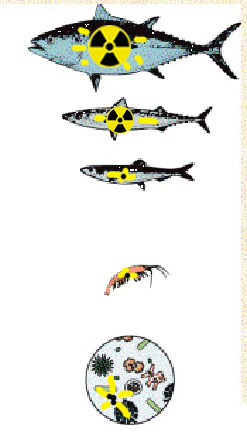
The radioactive elements in the marine fish caught in the harbor of the Fukushima Daiichi Nuclear Power Plant in Japan far exceed safety levels for human consumption, according to a report issued by the plant’s operator Tokyo Electric Power Company (TEPCO) on Monday. In particular, the data released show that the content of Cs-137, a radioactive element that is a common byproduct in nuclear reactors, is 180 times that of the standard maximum stipulated in Japan’s food safety law.
CGTN downloaded the English version of the report available on TEPCO’s official website. According to the data, the sampled black rockfish contains the radioactive element Cs-137 with a content of 18,000 becquerels per kilogram. Data available on the website of Fukushima Revitalization Station run by Japan’s Fukushima prefectural government shows that Japan’s current limit of radioactive cesium in general food which contains fish is set at 100 becquerels per kilogram.
According to the report, the location where the sampled fish was caught is at the port area of Units 1 to 4 of the Fukushima Daiichi Nuclear Power Plant, where a breakwater is built and nuclear wastewater with a high concentration of radioactive substances flows in. TEPCO said it will set up multiple protective nets to prevent fish from swimming out of the harbor.
A Chinese news website sina.com.cn quoted experts noting that the radioactive elements in the nuclear wastewater could penetrate into fish, shrimp and other seafood, and later accumulate in the human body after consumption. ……………………
TEPCO on Monday started sending seawater into an underwater tunnel to be diluted before releasing the nuclear wastewater into the ocean. The company said that all facilities for the water release system are expected to be completed by the end of this month.
Local fishing communities say their businesses and livelihoods will suffer still more damage. Neighboring countries such as China and South Korea and Pacific Island nations have raised safety concerns. Environmental groups including Friends of the Earth oppose the release. https://news.cgtn.com/news/2023-06-06/Radioactive-element-in-fish-at-Fukushima-plant-180-times-safe-limit-1kpOlJEH9xm/index.html
Japan passes law to allow nuclear power stations to operate beyond 60 years
Japan’s parliament has passed legislation allowing the country’s nuclear
power operators to continue using reactors beyond their maximum lifespan of
60 years, by excluding the time spent on increased safety scrutiny in the
wake of the 2011 Fukushima nuclear disaster.
Argus Media 6th June 2023
https://www.argusmedia.com/en//news/2456784-tokyo-passes-law-to-extend-nuclear-reactors-lifespan
Detailed evidence exposes Japan’s lies, loopholes in nuclear-contaminated wastewater dumping plan
Japan’s existing ocean discharge plan and evaluation are based on the assumption that the nuclear-contaminated wastewater can meet discharge standards after treatment.
But unfortunately, the data released by TEPCO showed that as of September 30, 2021, some 70 percent of the then 1.243 million cubic meters of ALPS-treated nuclear-contaminated wastewater still failed to meet the criteria, 18 percent of which even exceeded the standards 10 to 20,000 times over
Firstly, the types of radionuclides that TEPCO monitors are relatively few, making it far from being able to reflect the correct radionuclide dispersion in the contaminated wastewater.
The Fukushima nuclear-contaminated wastewater, coming from the wastewater which was directly in contact with the core of the melted reactor, theoretically contains all the hundreds of types of radionuclides in the melted reactor, such as fission nuclides, a uranium isotope, and transuranic nuclide.
But TEPCO at first only listed 64 types of radionuclides including H-3 and C-14 as a (data) foundation for the works including monitoring and analysis, emission control, and environmental impact assessment. These 64 radionuclides did not include the uranium isotope and certain other α-nuclides, which have long half-lives while some are highly toxic.
TEPCO’s exclusion of the radionuclides mentioned above has greatly compromised the effectiveness of its monitoring work, as well as the credibility of its environmental impact assessment result.
“TEPCO’s plan of only monitoring a few types of radionuclides is unscientific,” the insider told the Global Times.
Later, during the review process of the IAEA Task Force in 2022, TEPCO changed the number of radionuclide types it was monitoring and analyzing to 30, and then decreased it to 29 this year. This is far from enough to provide a complete assessment of the extremely complex nuclides in the Fukushima nuclear-contaminated wastewater.
Secondly, there are missing activity concentration values for multiple radionuclides in TEPCO’s monitoring scheme.
TEPCO’s public report on the 64 radionuclides only provides activity concentration values for 12 radioactive nuclides other than tritium, while over 50 other nuclides do not have specific activity concentration values. The report, while only offering gross α and gross β values, doesn’t disclose the respective concentration levels of many highly toxic radionuclides in the Fukushima nuclear-contaminated wastewater, such as Pu-239, Pu-240 and Am-241.
“[TEPCO’s] current plan only monitors some of the nuclides and the gross α and gross β values, which cannot accurately indicate the fluctuations or changes in the activity of each nuclide after treating the contaminated wastewater due to the fluctuation of the nuclide source term composition,” said the insider.
This operation of TEPCO has largely increased the uncertainty of the [nuclide] source item information of the nuclear-contaminated wastewater, and thus greatly increases the difficulties of making subsequent monitoring plans and marine ecological environmental impact assessment.
Thirdly, TEPCO didn’t make conservative assumptions in many aspects of its monitoring data, and some of the assumptions it made were somewhat “negligent.”
In the process of treating the nuclear-contaminated wastewater, the slight particle shedding of chemical precipitants and inorganic adsorbents in the ALPS may cause some radionuclides to exist in a colloidal state.
Therefore, TEPCO’s assumption that all nuclides in nuclear-contaminated wastewater in the ALPS are water-soluble is obviously invalid, said the insider. “TEPCO should scientifically and comprehensively analyze whether colloidal nuclides are present in the nuclear-contaminated wastewater based on the long-term operation experience of its ALPS system,” he noted.
Huang Lanlan Jun 05, 2023 https://www.globaltimes.cn/page/202306/1291969.shtml
The Fukushima Daiichi Nuclear Power Plant Photo: VCGAs the date for Japan’s planned dumping of nuclear-contaminated wastewater into the ocean approaches, a Pandora’s Box threatening the global marine ecosystem is likely to be opened.
The Japanese government announced its decision on April 13 to release the nuclear-contaminated wastewater from the storage tanks at the Fukushima Daiichi Nuclear Power Plant into the sea. Starting from 2023, the discharge is scheduled to last about 30 years. This decision has garnered widespread attention and sparked great concern across the globe.
While Japanese authorities are busy colluding with some Western politicians in boasting about the discharge plan, Fukushima residents, international experts in ecology, and various stakeholders around the world have kept calling for Japan to reconsider and modify its flawed plan.
Japan’s attempt to “whitewash” the Fukushima nuclear-contaminated wastewater release plan failed again at the Group of Seven (G7) summit in May. The joint statement of the summit did not explicitly state nor allude to the G7 members’ “welcome” of the current dumping plan due to strong opposition. Instead, it only reiterated support for the International Atomic Energy Agency’s (IAEA) review of Fukushima’s treated water release.
An insider familiar with Japan’s dumping plan recently told the Global Times that he has many concerns and doubts about the plan. The insider provided detailed evidence exposing Japan’s lie that whitewashes its dumping plan. He also revealed many loopholes in the plan that the Japanese government and Tokyo Electric Power Company (TEPCO) have refused to talk about or even deliberately concealed from the public.
All provided evidence considered, it is apparent that, currently, Japan is incapable of properly handling the nuclear-contaminated wastewater dumping. The toxic wastewater processed by the Japanese side cannot currently meet international discharge standards, and the country’s reckless behavior, if not stopped and corrected in time, may cause irreparable damage to the global ecosystem.
“There are still many unresolved issues with the source terms of the Fukushima nuclear-contaminated wastewater,” the insider said.
“If the Japanese government and TEPCO continue to have their own way, it may cause improper discharge of nuclear-contaminated water, and that must be taken seriously,” he noted, calling on the two sides to be open, transparent, and honest in solving the problem.
Disappointing data monitoring
Japan’s current plan of releasing nuclear-contaminated wastewater into the sea, though superficially reasonable at first glance, cannot hold up to close scrutiny. Its monitoring on the source terms of the Fukushima nuclear-contaminated wastewater is incomplete, and the data it collects is likely unreliable, observers told the Global Times.
In February 2022, the IAEA Task Force released its first report, the IAEA Review of Safety Related Aspects of Handling ALPS-Treated Water at TEPCO’s Fukushima Daiichi Nuclear Power Station. The report clearly stated that the Task Force “commented on the importance of defining the source term for the discharge of ALPS (Advanced Liquid Processing System) treated water in a sufficiently conservative yet realistic manner.”
Source terms of contaminated water include the composition of radionuclide and the activity of simulation of nuclides dispersion. As the premise of marine environmental monitoring, the accuracy and reliability of the source term-related data is crucial. However, Japan’s data statistics and monitoring on the source terms are disappointingly full of loopholes.
Continue readingTiny radioactive particles persist indoors years after Fukushima

Ellen Fiddian , https://cosmosmagazine.com/science/physics/fukushima-caesium-microparticles/ 4 June 23
Radioactive microparticles were still coating buildings near the Fukushima Daiichi nuclear power plant five years after the disaster, according to a study in Chemosphere.
The researchers found caesium-rich microparticles (CsMPs) in the dust of an abandoned primary school 2.8 kilometres southwest of the plant.
CsMPs are usually 5 micrometres in size or smaller (<PM5), and pose a threat to human health if inhaled because they’re highly radioactive.
They also don’t dissolve well in water, meaning they’re likely to persist in the environment and in bodies of people and animals.
“Given the small size of the particles, they could penetrate into the deepest parts of the lung, where they could be retained,” says senior author Associate Professor Satoshi Utsunomiya, a researcher at Kyushu University, Japan.
The researchers had previously shown that the 2011 Fukushima nuclear disaster, which was triggered by an earthquake and subsequent tsunami, released CsMPs. They found CsMPs in a wide area including as far south as Tokyo, about 300km away.
While they had shown CsMPs were distributed widely in the Fukushima exclusion zone, but had not yet shown that the particles could get indoors.
“When entering the school building, we were all shocked by what we saw. Five years had passed by the time of sampling in 2016, but everything was left as it was at the moment of the 2011 earthquake. It’s as if time had stood still,” says Utsunomiya.
The researchers examined dust samples from floors near the school entrance, on its second floor, and in the school yard.
They found CsMPs at both indoor locations, with higher concentrations near the door.
“The CsMPs may present a threat; as shown in our work, CsMPs may accumulate locally and form hot spots, even in indoor environments,” says Utsunomiya, although the exact health effects of CsMPs are still unclear.
“The potential occurrence of CsMPs in indoor environments dictates a need for detailed studies of indoor CsMPs in residential areas impacted by Fukushima Daiichi nuclear power plant fallout,” says co-author Professor Gareth Law, from the University of Helsinki, Finland.
“I believe it is our duty to conduct rigorous scientific research on the tragic Fukushima events, to find and publicize new knowledge that will be important to society and the next generation,” says Utsunomiya.
“Maybe one day time can begin again for abandoned buildings like the school, but for that to happen, significant clean-up efforts are needed, and if that is to proceed, we first need to know about the forms and extent of contamination in those buildings, such that workers and potential occupants can be protected.”
Japan will be releasing treated radioactive water – nuclear waste from the plant – into the Pacific Ocean later this year.
EDITORIAL: Government turns a blind eye to lessons from nuclear disaster

https://www.asahi.com/ajw/articles/14923055 June 2, 2023
It appears that the lessons learned from the 2011 Fukushima nuclear disaster have been taken so lightly.
The government and a majority of the Diet are heavily responsible for pushing through a reversal of the nation’s nuclear policies without careful deliberation, shifting from a “reduction of dependence” on nuclear power and heading to its “maximum utilization.”
We must keep asking ourselves whether we can solve the many difficult problems plaguing nuclear power plants and whether they could end up haunting future generations.
This week, a bill related to promoting nuclear plants was passed by the Diet.
The government’s responsibilities and measures aimed at the active utilization are stipulated in the Atomic Energy Basic Law.
The new law also relaxed restrictions on nuclear reactors’ operational periods introduced after the catastrophic disaster at the Fukushima No. 1 nuclear power plant, opening a path to allowing reactors to operate beyond 60 years if certain conditions are met.
The Asahi Shimbun in its editorials has opposed the bill and called for its reconsideration.
That is because nuclear plants are plagued with a mountain of issues such as the ever-growing nuclear waste and Japan’s nuclear fuel cycle that has reached an impasse, not to mention safety and economic concerns.
And it is unacceptable for the government to reverse its stance to restarting nuclear plants without showing a path to solving the problems.
Now is the time to speed up reforms to make renewable energy a primary power source from the standpoint of the overall energy policy.
Returning to dependence on nuclear plants could lead to going down the wrong path.
The bill was also rushed along as the government adopted the new policy last year after only several months of debate.
The Diet was supposed to do everything in its power to scrutinize the bill from multiple perspectives, but no deep discussions ensued.
We can’t help but be disappointed.
Reasons cited for the about-face were the need for a stable supply of energy and the decarbonization of energy sources.
But how much of a role do nuclear plants actually play in these goals? And why is it necessary to treat them differently?
The government shied away from answering these questions head-on and repeatedly said it was important to pursue all possible options, including nuclear energy.
With several bills covering a variety of issues bundled into the legislation, discussions on concrete measures also wandered off-track.
It had been explained that the limit on the reactors’ operational periods was originally intended to reduce safety risks.
But the government claimed that it decided from the standpoint of the nation’s energy strategy, instead of safety regulations.
Although it was a major shift, the government failed to provide convincing explanations.
After all, numerous questions, including fundamental problems, were left unanswered.
If this stance continues, it will be inevitable for the government to single-mindedly devote itself to the promotion of its new polices on nuclear plants.
The latest policy shift was led by the economy ministry, seriously undermining the principle of separation between “promotion and regulation,” which is the heart of the nuclear policy introduced in light of the Fukushima disaster.
The government seems set to support the restart of nuclear plants and construction of new ones.
However, at the very least, safety procedures and economic benefits of nuclear plants must be thoroughly considered.
And, no matter how many efforts are made, inconvenient realities about nuclear plants won’t disappear.
The government and party members who voted for the bill must keep firmly in mind that they will have to face these realities sooner or later.
Tritium found beyond safe limits in treated Fukushima wastewater

A type of radioactive isotope in the over 1.3 million tons of wastewater
being collected at the destroyed Fukushima nuclear power plant and planned
for discharge by as early as this summer has been found at levels beyond
those earlier suggested to be safe by the Japanese government, a wastewater
safety review report by the International Atomic Energy Agency showed
Thursday.
According to the report, which corroborated analyses of the treated wastewater by six laboratories including the Korea Institute of Nuclear Safety, the activity concentrations of tritium in the treated water were estimated to be at least 148,900 becquerels per liter.
The wastewater filtered through Japan’s Advanced Liquid Processing System at the Fukushima Daiichi Nuclear Power Station contained more tritium than what was stipulated in Japan’s national regulatory standards for discharge, 60,000 becquerels per liter……………………………………………
Korea Herald 1st June 2023
http://www.koreaherald.com/view.php?mp=1&np=1&ud=20230601000750
Dismay in the region over Japan’s plan for nuclear waste water
Nuclear Waste in Pacific Ocean: Japan’s Plan Triggers Controversy
Japan plans to discharge millions of metric tonnes of nuclear wastewater into the Pacific Ocean. This wastewater has been accumulating since disaster struck the Fukushima nuclear power plant in 2011. Japan is running out of storage space for this wastewater, which is why it is desperately trying to dump the waste in the ocean. But Tokyo’s plan is marred with controversy, with physical protests being arranged against it as well. Watch this Vantage report to know more.
Plan to release Fukushima nuclear plant water into sea faces local opposition: “The sea is not a garbage dump”
CBS BY ELIZABETH PALMER, MAY 31, 2023
Japan’s government is asking for international backup as it prepares to release thousands of gallons of water from the Fukushima nuclear power plant into the sea. The plan has alarmed the public and outraged fishermen — even as the international energy agency looks inclined to back it.
………….The plant sits in what was a lush coastal part of Japan, famous for its seafood and delicious fruit. Today, there’s still no-go area around the power station where fields lie fallow and homes sit abandoned.
Inside a high security fence studded with warning signs, engineers are still working to remove radioactive fuel rods that melted inside the reactors. They’ll be at it for decades.
Another problem is piling up in hundreds of metal tanks on the site: they contain more than a million tons of contaminated water.
…………………………………….. “Piping water into the sea is an outrage,” said Haruo Ono, who has been fishing the ocean off the coast of Fukushima all his life.
“The sea is not a garbage dump,” he said. “The company says it’s safe, but the consequences could catch up with us 50 years down the road.”
………………………………..Haruo Ono, the fisherman, said the science is not the issue.
“People don’t understand it,” he said. “Mothers won’t choose Fukushima fish knowing it’s been swimming in radioactive water. Even if the experts say it’s safe.”
Under current rules, he can only take his fishing vessels out to sea a day or two a week, when he gets the OK from the government.
“This is the end of my livelihood,” he said.
……………. The Fukushima nuclear plant won’t be safely decommissioned for years to come. So far taxpayers have paid $90 billion to clean it up. https://www.cbsnews.com/news/fukushima-nuclear-plant-water-plan-release-into-sea-fear-controversy/
Bill to extend operating period of nuclear plants passes Japan’s Upper House
BY GABRIELE NINIVAGGI, Japan Times, May 31, 2023
A bill to extend the operating period of nuclear power plants to over 60 years — providing safety conditions are met — passed the Upper House on Wednesday, paving the way for a comprehensive overhaul of Japan’s nuclear policy.
The ruling coalition led by the Liberal Democratic Party, with the external support of two opposition parties — the Democratic Party for the People and Nippon Ishin no Kai — voted in favor of the bill, while other opposition forces on the left and center-left vocally opposed the legislation, saying that proposals to guarantee the safety of nuclear power plants were insufficient………..(Subscribers only) https://www.japantimes.co.jp/news/2023/05/31/national/nuclear-plant-operating-period-bill-pass/
1
TEPCO faces new crisis over pedestal blow at Fukushima plant

May 30, 2023 https://www.asahi.com/ajw/articles/14920197
Damage to a pedestal inside the No. 1 reactor at the crippled Fukushima No. 1 nuclear power plant is more critical than previously believed, triggering a more intricate assessment of its resistance to a major earthquake.
Plant operator Tokyo Electric Power Co. (TEPCO) has no time to waste in confronting the issue. It must swiftly assess the damage and take effective action to prevent an accident or leak of radioactive materials.
An underwater robotic probe detected the damage in late March. It found that the metal framework lies exposed along the inner side of the pedestal’s wall for about 1 meter from its bottom and for the entire inner circumference as concrete in these areas has been lost.
There are fears the containment vessel that houses the pressure vessel could crack if the pedestal collapses in a severe earthquake. That could cause radioactive materials to leak.
Referring to the structure’s current earthquake resistance, TEPCO stressed that the pedestal has managed to support the reactor vessel even though the plant “has experienced strong earthquakes.” The utility cited one last year that registered lower 6 on the Japanese seismic intensity scale of 7.
Although the possibility of the pressure vessel tilting or sinking cannot be ruled out, the company asserts the impact will be limited with no risk of radioactive material leaking to the outside.
the Nuclear Regulation Authority (NRA) said last week it could not decide whether the assumptions underlying TEPCO’s risk assessment are accurate as the extent of damage and condition of the structural materials are not yet fully understood. The nuclear safety watchdog also said it would be difficult to reinforce the pedestal because of high radiation levels inside the containment vessel.
For this reason, the NRA called on the utility to evaluate the impact of a possible release of radioactive material into the environment and consider steps to deal with such an emergency.
As one NRA official put it, “I should say (TEPCO’s evaluation) is too optimistic, and it is difficult to say that is very reassuring.”
NRA Chairman Shinsuke Yamanaka said at a news conference, “It is TEPCO’s responsibility to swiftly assess what risks could impact the surrounding environment and its residents.”
Conditions surrounding the reactors that suffered core meltdowns in the nuclear disaster 12 years ago are only now finally being clarified. This has led to the discovery of additional problems that are already difficult to deal with, making the outlook of progress toward decommissioning the reactors even more uncertain.
The degradation of plant parts and materials will continue in the coming years. There is always the risk of a major earthquake striking the plant. Each time it is hit by a strong quake, the damage accumulates and the danger increases. If a radioactive leak occurs, it will seriously compromise the safety of residents, the reconstruction of the local communities and the local fishing industry.
The NRA this month decided not to lift a ban on the movement of nuclear fuel within TEPCO’s Kashiwazaki-Kariwa nuclear power plant in Niigata Prefecture, citing flawed measures to protect the facility against terrorist attacks. There are growing concerns about whether TEPCO is equipped to operate nuclear power plants.
There is absolutely no room for complacency when it comes to the consequences of the Fukushima nuclear disaster. TEPCO must always remain vigilant to a worst-case scenario in tackling related challenges.
IAEA team in Japan for final review before planned discharge of Fukushima nuclear plant water.

abc news, 29 May 23
An International Atomic Energy Agency team has arrived in Tokyo for a final review before Japan begins releasing massive amounts of treated radioactive water into the sea from the wrecked Fukushima nuclear plant, a plan that has been strongly opposed b…
By MARI YAMAGUCHI Associated Press, May 29, 2023
TOKYO — An International Atomic Energy Agency team arrived in Tokyo on Monday for a final review before Japan begins releasing massive amounts of treated radioactive water into the sea from the wrecked Fukushima nuclear plant, a plan that has been strongly opposed by local fishing communities and neighboring countries.
The team, which includes experts from 11 countries, will meet with officials from the government and the plant operator, Tokyo Electric Power Company Holdings, and visit the Fukushima Daiichi nuclear power plant during their five-day visit, the economy and industry ministry said………………………………
Some scientists say the impact of long-term, low-dose exposure to radionuclides is unknown and the release should be delayed.
Japan’s government has stepped up campaigns in Japanese media and at food fairs to promote the safety of seafood from Fukushima, while providing regular briefings to foreign governments including South Korea and members of the Pacific Islands Forum.
…………………. Japanese officials say the water stored in the tanks needs to be removed to prevent accidental leaks in case of another disaster and to make room for the plant’s decommissioning. https://abcnews.go.com/Technology/wireStory/iaea-team-japan-final-review-planned-discharge-fukushima-99669696
Fukushima reactor 1 found to have damaged pedestal supporting nuclear core
(Picture above is of the same structure one year previously)
A nuclear watchdog has asked the operator of Japan’s wrecked Fukushima
nuclear power station to assess potential risks from damage found in a key
supporting structure inside the worst-hit of the three melted reactors. A
robotic probe inside the Fukushima Daiichi nuclear power plant’s Unit 1
primary containment chamber found its pedestal — a main supporting
structure right underneath the core — was largely damaged. The thick
concrete exterior was missing almost all the way around, exposing the
internal steel reinforcement. About 800 tonnes of highly radioactive melted
nuclear fuel remain inside the plant’s three reactors.
LBC 25th May 2023
https://www.lbc.co.uk/world-news/8af57263389e457aa47b8846ede3d7b0/
Japan Nuclear Watchdog Asks Fukushima Plant Operator to Assess Reactor Risk
Photo May 22– damaged pedestal supporting reactor core, Unit 1
By Mari Yamaguchi | May 26, 2023
TOKYO (AP) – A nuclear watchdog has asked the operator of Japan’s wrecked Fukushima nuclear power plant to assess possible risks resulting from damage that was found in a key supporting structure inside one of the three melted reactors.
A robotic probe sent inside the Fukushima Daiichi plant’s Unit 1 primary containment chamber found that its pedestal – the main supporting structure directly under its core – was extensively damaged. Most of its thick concrete exterior was missing, exposing the internal steel reinforcement.
About 880 tons of highly radioactive melted nuclear fuel remain inside the plant’s three damaged reactors. Robotic probes have provided some information, but the status of the melted debris is still largely unknown.
Based on data collected from earlier probes and simulations, experts have said most of the melted fuel inside Unit 1, believed to be the worst hit, fell to the bottom of the primary containment chamber, but some might have fallen through to the concrete foundation – a situation that makes the already daunting task of decommissioning extremely difficult.
At a meeting Wednesday of the Nuclear Regulation Authority, its commissioners agreed to order operator Tokyo Electric Power Company Holdings to urgently assess the risks from the pedestal damage, including the possible leak of radioactive substances from cracks and holes caused by the meltdown. The authority also requested that TEPCO assess potential risks if, in the event of another disaster, the pedestal fails to support the reactor.
”We need to think about responses in case of an accident,” commissioner Shinsuke Yamanaka told reporters. “TEPCO has a responsibility to make the risk assessment as soon as possible.”…………………………………………………….
The damage is believed to be from the initial earthquake in 2011, but might have happened more recently. The images of the exposed steel reinforcement have triggered concerns among local residents about the reactor’s safety.
A plan to release treated, but still slightly radioactive, water from the Fukushima Daiichi plant into the sea has also triggered concerns and protests from the local fishing community and neighboring countries, including South Korea.
A South Korean delegation of government experts visited the plant for two days this week to see the facilities related to the planned water release. The team members were to meet with Japanese officials on Thursday in Tokyo, where they said they plan to follow the review of the International Atomic Energy Agency, which has been assisting Japan to improve transparency and credibility…………………. https://www.claimsjournal.com/news/international/2023/05/26/317199.htm—
1 This Month

Protect Sazan Island from the Trump family! https://secure.avaaz.org/campaign/en/protect_sazan_island_from_the_trump_family_loc/?bqFCVab&v=174511&cl=22707147157&_checksum=5e9dde668860e8231c33699735e16a1fbf22ab2cb01da50c999fe8732b9775ef&utm_source=email&utm_medium=blast_email&utm_campaign=174511


Cuba Is Not a Failed State – It Is a Besieged State
PETITION: “Global Appeal to Endorse Palestinian Right of Return of Refugees”
To see nuclear-related stories in greater depth and intensity – go to https://nuclearinformation.wordpress.com
-
Archives
- June 2026 (129)
- May 2026 (306)
- April 2026 (356)
- March 2026 (251)
- February 2026 (268)
- January 2026 (308)
- December 2025 (358)
- November 2025 (359)
- October 2025 (376)
- September 2025 (257)
- August 2025 (319)
- July 2025 (230)
-
Categories
- 1
- 1 NUCLEAR ISSUES
- business and costs
- climate change
- culture and arts
- ENERGY
- environment
- health
- history
- indigenous issues
- Legal
- marketing of nuclear
- media
- opposition to nuclear
- PERSONAL STORIES
- politics
- politics international
- Religion and ethics
- safety
- secrets,lies and civil liberties
- spinbuster
- technology
- Uranium
- wastes
- weapons and war
- Women
- 2 WORLD
- ACTION
- AFRICA
- Atrocities
- AUSTRALIA
- Christina's notes
- Christina's themes
- culture and arts
- Events
- Fuk 2022
- Fuk 2023
- Fukushima 2017
- Fukushima 2018
- fukushima 2019
- Fukushima 2020
- Fukushima 2021
- general
- global warming
- Humour (God we need it)
- Nuclear
- RARE EARTHS
- Reference
- resources – print
- Resources -audiovicual
- Weekly Newsletter
- World
- World Nuclear
- YouTube
-
RSS
Entries RSS
Comments RSS
 nuclear-news