China puts the brakes on nuclear power
 China Slows Development of Nuclear Power Plants, NYT By KEITH BRADSHER, October 24, 2012 HONG KONG — Still responding to the partial meltdowns last year at nuclear reactors in Fukushima, Japan, the Chinese government has lowered its target for the construction of nuclear power plants by 2015, notably by not building more nuclear reactors at inland locations.
A white paper on energy policy released after a cabinet meeting on Wednesday said that the government planned to have 40 gigawatts of nuclear power capacity installed by 2015, and pledged strict safety standards. While the white paper and state-controlled media did not
describe this as a reduction in the target, the country’s current Five-Year Plan sets a target of 50 gigawatts….. Nuclear power generates only 1.8 percent of China’s electricity, far below the global average of 14 percent. http://www.nytimes.com/2012/10/25/business/global/china-reduces-target-for-construction-nuclear-power-plants.html?_r=2&
China slowing down its nuclear power program
China to approve only a few new reactors by 2015 By David Stanway BEIJING  Oct 24, 2012 (Reuters) – China will approve a small number of new nuclear reactors before 2015 to be built only in coastal regions, the government said on Wednesday, as it unveiled a raft of measures to spur private investments in energy. Continue reading
China’s nuclear power program slows down, as safety problems recognised
China Nuclear Report Acknowledges Safety Concerns, WSJ, By BRIAN SPEGELE And WAYNE MA 16 Oct 12, BEIJING — A report by China’s Ministry of Environmental Protection
acknowledged safety concerns in China’s fleet of nuclear reactors, including potential complications from the sheer variety of reactors in operation…. Continue reading
China still has poor record on nuclear safety, uranium environmental damage
Should China be involved in the UK’s nuclear energy infrastructure? Guardian UK, Paul Dorfman, 21 Sept 12“….In Tibet, the Chinese nuclear industry is engaged in a determined effort to secure uranium deposits located in Amdo, where leaching and open pit extraction are reported to have resulted in significant environmental contamination. Regulation of safety oversight mechanisms is relatively weak in the Chinese nuclear industry, and according to a recent Nuclear Materials Security Index report, China ranks 29th among the group of 32 nuclear nations in terms of nuclear security and materials transparency. Although it’s to be hoped that greater corporate social responsibility and sensitivity to vulnerable industrial communities is evolving in both Russia and China, it’s still troubling to reflect on their respective human rights situations, documented by Amnesty International……http://www.guardian.co.uk/environment/blog/2012/sep/21/nuclearpower-energy?newsfeed=true
Chinese news reports increased exposure to radioactivity as one cause of birth defects
Consumption of prohibited medicine, increased exposure to radioactivity and drinking have also contributed to the increase, experts said.
900,000 Chinese born with birth defects every year http://www.beijingnews.net/index.php?sid/209107845/scat/55582c89cb296d4c/ht/900000-Chinese-born-with-birth-defects-every-year Beijing News.Net 12th September, 2012 Around 900,000 babies are born with birth defects in China every year, the health ministry said Wednesday.
This constitutes about 5.6 percent of the total number of newborns, Xinhua reported.
The ministry report for 2012 on prevention and treatment of defects in newborn babies said birth defects — at 19.1 percent — have become the second-biggest cause of infant deaths in China.
Birth defects are a serious problem in China’s rural areas. Continue reading
China’s nuclear dilemma, Phys Org. September 14, 2012 An expert assessment of China’s nuclear weapons strategy highlights the risk of escalation to nuclear war from a conflict beginning with conventional weapons, due to the unusual structure of the nation’s military. The new study, previously only available in Chinese, appears in the latest edition of The Bulletin of the Atomic Scientists, published by SAGE.
The authors believe that this is the first comprehensive non-governmental study on how China’s nuclear-war plan was developed….. http://phys.org/news/2012-09-china-nuclear-dilemma.html#jCp
China going for energy efficiency, to the tune of $372 billion
Seven Chinese cities and provinces will launch CO2 emissions trading schemes over the next two years ahead of a national scheme later in the decade, as China seeks to move away from traditional command-and-control measures to combat spiraling carbon emissions.
China to spend $372 billion on cutting energy use, pollution Planet Ark : 23-Aug-12 Kathy Chen and Stian Reklev China will plough $372 billion into energy conservation projects and anti-pollution measures over the next three-and-a-half years, part of a drive to cut energy consumption by 300 million tonnes of standard coal, the country’s cabinet said Tuesday.

A report from China’s State Council, or cabinet, said the investments will take China almost halfway to meeting its target to cut the energy intensity 16 percent below 2010 levels by 2015.
The government has earmarked $155 billion of the money for projects that shrink energy use, and while the plan did not detail which types of projects or sectors would benefit from the funds, a big share of the cash is expected to go to industry. Continue reading
Poisonous legacy of rare earths mining in China
Rare-earth mining in China comes at a heavy cost for local villages Guardian UK Pollution is poisoning the farms and villages of the region that processes the precious minerals , 7 August 2012 From the air it looks like a huge lake, fed by many tributaries, but on the ground it turns out to be a murky expanse of water, in which no fish or algae can survive. The shore is coated with a black crust, so thick you can walk on it. Into this huge, 10 sq km tailings pond nearby factories discharge water loaded with chemicals used to process the 17 most sought after minerals in the world, collectively known as rare earths.
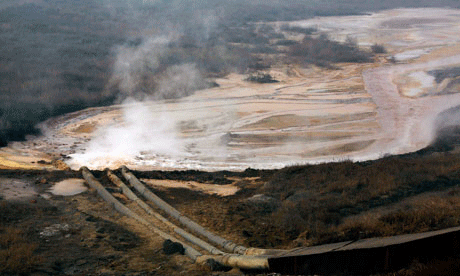
The town of Baotou, in Inner Mongolia, is the largest Chinese source of these strategic elements, essential to advanced technology, from smartphones to GPS receivers, but also to wind farms and, above all, electric cars. The minerals are mined at Bayan Obo, 120km farther north, then brought to Baotou for processing.
The concentration of rare earths in the ore is very low, so they must be separated and purified, using hydro-metallurgical techniques and acid baths. China accounts for 97% of global output of these precious substances, with two-thirds produced in Baotou.
The foul waters of the tailings pond contain all sorts of toxic chemicals, but also radioactive elements such as thorium which, if ingested, cause cancers of the pancreas and lungs, and leukaemia. “Before the factories were built, there were just fields here as far as the eye can see. In the place of this radioactive sludge, there were watermelons, aubergines and tomatoes,” says Li Guirong with a sigh.
It was in 1958 – when he was 10 – that a state-owned concern, the Baotou Iron and Steel company (Baogang), started producing rare-earth minerals. The lake appeared at that time. “To begin with we didn’t notice the pollution it was causing. How could we have known?” As secretary general of the local branch of the Communist party, he is one of the few residents who dares to speak out.
Towards the end of the 1980s, Li explains, crops in nearby villages started to fail: “Plants grew badly. They would flower all right, but sometimes there was no fruit or they were small or smelt awful.” Ten years later the villagers had to accept that vegetables simply would not grow any longer. In the village of Xinguang Sancun – much as in all those near the Baotou factories – farmers let some fields run wild and stopped planting anything but wheat and corn.
A study by the municipal environmental protection agency showed that rare-earth minerals were the source of their problems. The minerals themselves caused pollution, but also the dozens of new factories that had sprung up around the processing facilities and a fossil-fuel power station feeding Baotou’s new industrial fabric. Residents of what was now known as the “rare-earth capital of the world” were inhaling solvent vapour, particularly sulphuric acid, as well as coal dust, clearly visible in the air between houses.
Now the soil and groundwater are saturated with toxic substances. Five years ago Li had to get rid of his sick pigs, the last survivors of a collection of cows, horses, chickens and goats, killed off by the toxins.
The farmers have moved away. Most of the small brick houses in Xinguang Sancun, huddling close to one another, are going to rack and ruin. In just 10 years the population has dropped from 2,000 to 300 people…… http://www.guardian.co.uk/environment/2012/aug/07/china-rare-earth-village-pollution
Rapid growth of China’s solar sector as solar panel prices plummet
The global solar sector has witnessed some extraordinary growth in the past couple of years. According to Bloomberg New Energy Finance, the prices of solar panels have fallen by almost 42% in a single year to $0.87 per watt.
 CHINA SETS 2015 SOLAR ENERGY TARGET AT 21GW Solar PV Investor, BY SARFARAZ KHAN | 12 JULY 2012 Although the massive target might seem overly ambitious to some, most of the industry analysts believe that it is still very modest. China’s local media has revealed that the National Energy Administration (NEA) has decided to quadruple the country’s 2015 solar energy target to 21GW. Continue reading
USA joining with China to develop thorium nuclear reactors
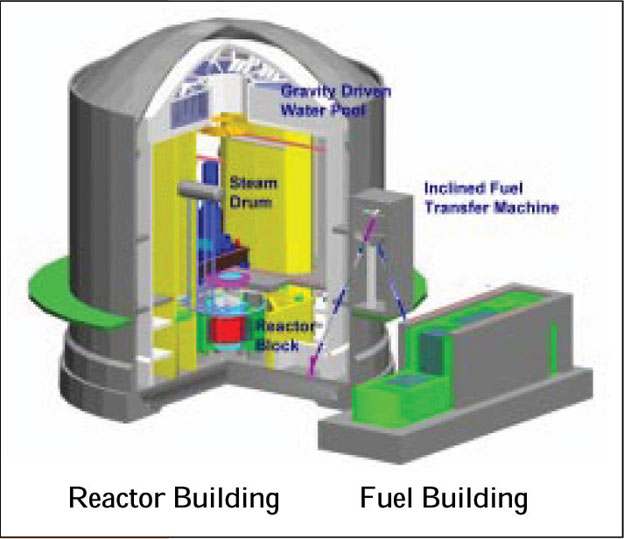 What’s not clear is what, exactly, the U.S. will get from the collaboration….
U.S. partners with China on new nuclear, By Mark Halper Smart Planet June 26, 2012 E Pluribus Thorium? U.S. Assistant Energy Secretary Peter Lyons and Chinese Academy of Sciences’ Jiang Mianheng have joined forces for thorium development. What’s in it for the U.S.?
The U.S. Department of Energy is quietly collaborating with China on an alternative nuclear power design known as a molten salt reactor that could run on thorium fuel Continue reading
Solar panels for IKEA’s buildings in China
IKEA To Use Solar Power on Buildings in China, Market Watch, June 12, 2012, IKEA Group partners with Hanergy to install solar panels on IKEA buildings BEIJING, Jun 12, 2012 (BUSINESS WIRE) — IKEA Group today announced that, as part of its goal to only use renewable energy to power its buildings, it will partner with Hanergy, one of China’s leading clean energy companies, to install solar photovoltaic panels on IKEA owned buildings in China. Continue reading
Despite local government opposition, China funding new nuclear plant in Wangjiang
The Pengze project made headlines in February, when the Wangjiang County government openly opposed its construction on grounds that the site selection was based on unreliable population and seismic activity data.
The County government also alleges that the firm used gifts to entice villagers into agreeing to the plans.
Controversial China nuclear plant funding resumes, Market Watch, Jiangxi nuclear plant gets funding in sign building freeze is ending By Lu Bingyang and Wang Yong BEIJING ( Caixin Online )7 June 12, — One of China’s pioneering inland nuclear power projects has received another capital injection after the government put nuclear development on hold due to last year’s disaster in Japan. Continue reading
China the nuclear lobby’s great hope – or is it?
Public opinion could also pose an obstacle. In a poll carried out by research agency Ipsos MORI after Fukushima, 42% of those surveyed in China were supportive of nuclear power – but that 48% were opposed. It
is also reported that public opposition and environmental concerns have led to the delay in construction of three inland nuclear power sites.
China’s nuclear developments probably matter more to the rest of the world than they do to China.
 Chinese nuclear goes global? China dialogue Antony Froggatt June 06, 2012 From Parisian boardrooms to Kazakh uranium mines, the nuclear industry anxiously awaits news from Beijing. …….
“…… the Fukushima crisis in Japan has had a significant – and under reported – impact on Chinese nuclear developments, triggering a freeze on the start of new construction, a re-consideration of the safety standards of domestic designs and unprecedentedly visible opposition to the building of new, inland nuclear plants. Continue reading
Vigourous and organised opposition to nuclear power in China
many of the companies building nuclear power plants and the government have not held honest discussions with stakeholders and are unwilling to provide adequate information. The Ministry of Environmental Protection rejected Caixin’s application for more information on documents related to the Pengze plant’s environmental assessment.
“Our actions are divided into three phases: official, media and litigation,” Wang said. Petitioning the government was the first step, and using the media to attract attention the second. “If this still doesn’t work, we can only move to litigation. In the next step, we’ll sue whichever departments approved construction of the Pengze nuclear plant, and we’ll sue to the end.”
 Ex-officials battle China nuclear plant plan, Market watch,Retired officials vigorously battle China nuclear power plant plan By Cui Zheng BEIJING ( Caixin Online ) —”… the meltdown on March 11, 2011, is still fresh on the minds of four retired cadres in Wangjiang County.
They petitioned against the Pengze nuclear power project in neighboring Jiangxi Province and ultimately convinced their local government to oppose the plan. This kind of official opposition to a nuclear undertaking is almost unheard of in China. Continue reading
China raising funds to launch nuclear power, but public sentiment is “fragile”
China to Stoke Nuclear Power, WSJ 6 June 12, State-Owned Firm Plans IPO to Fund Reactors; $5.4 Billion Deal Is Possible BEIJING—China National Nuclear Power Co. said it is planning a Shanghai initial public offering that will go toward financing part
of five power projects worth 173.5 billion yuan ($27.2 billion), in a multibillion-dollar deal that signals that the country’s ramp-up of nuclear power is moving forward..
… China National Nuclear Power, according to a statement on the environmental ministry website, will sell shares to raise funds for nuclear-power projects in Fujian, Zhejiang, Hainan and Jiangsu provinces, the statement said, adding that these projects were approved by China’s National Development and Reform Commission between 2008 and 2010. Those projects require 173.5 billion yuan in funding,…
the IPO could be asking a lot of the country’s equity markets. The commission hasn’t approved any sizable IPOs since May, when the regulator gave the green light to China Postal Express & Logistics Co.’s potentially 9.98 billion yuan deal, though that has yet to
launch. Since early May, the benchmark Shanghai Composite Index is down 4%.
“A big IPO would weigh on the stock market further as it would divert funds from the secondary market, especially when the sentiment remains fragile,” said Yang Delong, a fund manager at China Southern Fund….. http://online.wsj.com/article/SB10001424052702303665904577449784005256706.html?mod=googlenews_wsj
1 This Month

22 June – Virtual Event –Climate Change: New Data, New Debate

Monday, June 22, 2026 2:30 p.m. – 3:15 p.m. CT
YouTube. Register here

Protect Sazan Island from the Trump family! https://secure.avaaz.org/campaign/en/protect_sazan_island_from_the_trump_family_loc/?bqFCVab&v=174511&cl=22707147157&_checksum=5e9dde668860e8231c33699735e16a1fbf22ab2cb01da50c999fe8732b9775ef&utm_source=email&utm_medium=blast_email&utm_campaign=174511
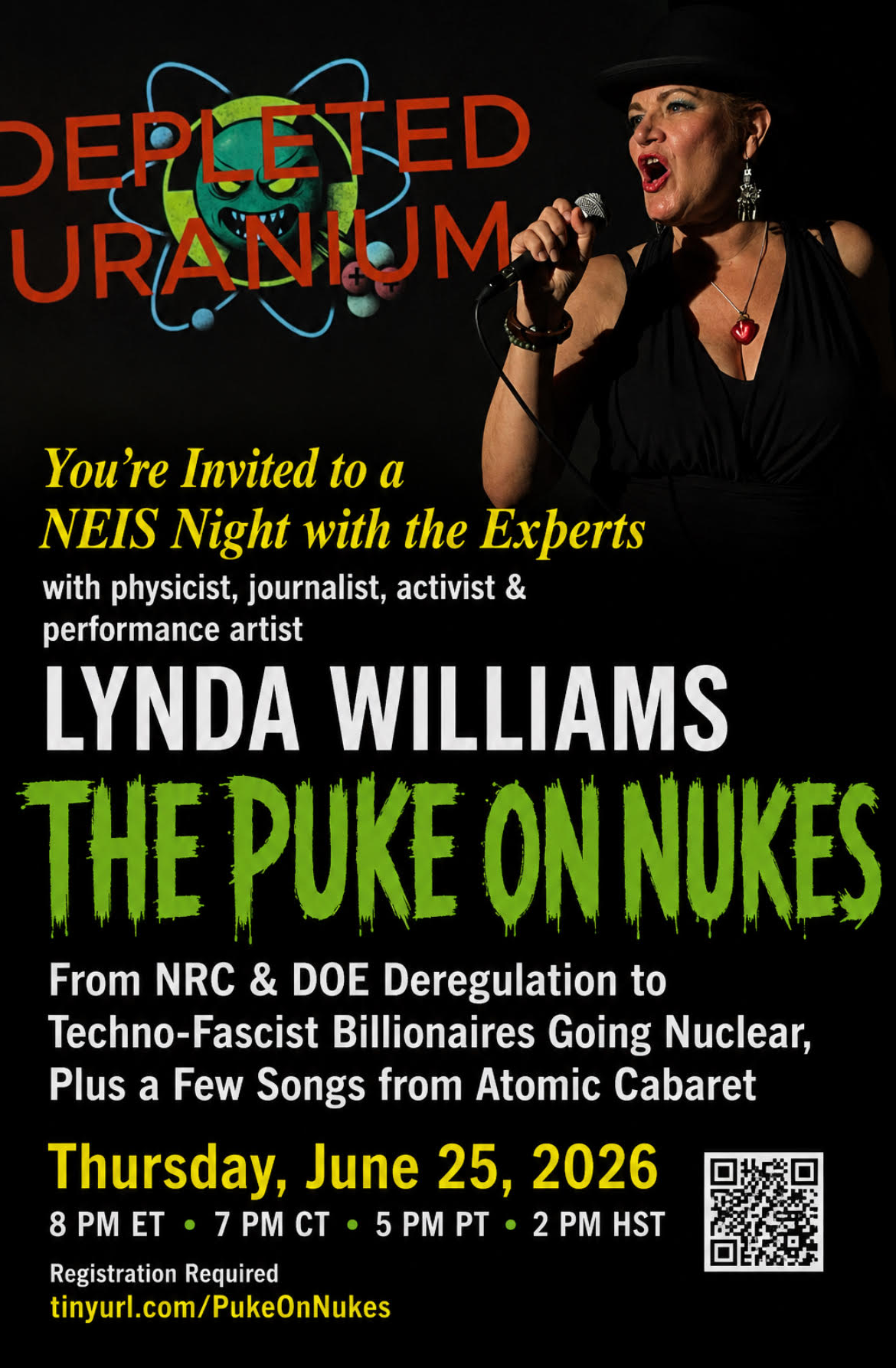
25 June- THE PUKE ON NUKES
Thursday, June 25, 2026
7pm Central Time (8pm ET, 6pm MT, 5pm PT) UTC – 5
From NRC & DOE Deregulation to Techno-Fascist Billionaires Going Nuclear, Plus a Few Songs from Atomic Cabaret REGISTER
26 June – Radiation Trainwreck at the NRC / Join the Protect Better Campaign – https://us02web.zoom.us/meeting/register/4ZlZ5_qLSHGiLSCg8FF6Bg#/registration


Cuba Is Not a Failed State – It Is a Besieged State
PETITION: “Global Appeal to Endorse Palestinian Right of Return of Refugees”
To see nuclear-related stories in greater depth and intensity – go to https://nuclearinformation.wordpress.com
-
Archives
- June 2026 (211)
- May 2026 (306)
- April 2026 (356)
- March 2026 (251)
- February 2026 (268)
- January 2026 (308)
- December 2025 (358)
- November 2025 (359)
- October 2025 (376)
- September 2025 (257)
- August 2025 (319)
- July 2025 (230)
-
Categories
- 1
- 1 NUCLEAR ISSUES
- business and costs
- climate change
- culture and arts
- ENERGY
- environment
- health
- history
- indigenous issues
- Legal
- marketing of nuclear
- media
- opposition to nuclear
- PERSONAL STORIES
- politics
- politics international
- Religion and ethics
- safety
- secrets,lies and civil liberties
- spinbuster
- technology
- Uranium
- wastes
- weapons and war
- Women
- 2 WORLD
- ACTION
- AFRICA
- Atrocities
- AUSTRALIA
- Christina's notes
- Christina's themes
- culture and arts
- Events
- Fuk 2022
- Fuk 2023
- Fukushima 2017
- Fukushima 2018
- fukushima 2019
- Fukushima 2020
- Fukushima 2021
- general
- global warming
- Humour (God we need it)
- Nuclear
- RARE EARTHS
- Reference
- resources – print
- Resources -audiovicual
- Weekly Newsletter
- World
- World Nuclear
- YouTube
-
RSS
Entries RSS
Comments RSS
 nuclear-news