The nuclear industry is not winning hearts and minds in China
 People power holds key to China’s nuclear plans FT.com, By Lucy Hornby at Daya Bay, 26 May 14, China’s nuclear industry has in recent years ventured overseas for new opportunities but it is now facing challenges at home gaining public acceptance of its $150bn expansion plans.
Fears of a nuclear power backlash, stoked by recent demonstrations against other large industrial projects, have rattled regulators as well as nuclear operators China National Nuclear Corp (CNNC) and China General Nuclear Power Corp (CGN).
Regulators fear images of riot police crushing protests at a reactor site – like this month’s violent clashes over a planned garbage incinerator – could quickly harden attitudes against nuclear power.
“If the government just keeps the same attitude of secrecy as in the past, it will create more problems. They need to pursue nuclear power appropriately and safely otherwise there will be more conflicts between the government and people,” says Cao Heping, who studies green economy at Peking University.
The concerns have even moved Chinese regulators to request help from the UK in the hope its government can offer tips on developing public and media support for nuclear power.
Industry executives say Mr Li’s “when appropriate” caveat followed internal discussions about the need to tread carefully, to avoid arousing any anti-nuclear sentiment.
Meanwhile, the meltdown at Fukushima in Japan strengthened Chinese regulators’ hand but also raised worries about public acceptability.
After the Fukushima meltdown, regulators shelved almost half of the 100 or so planned reactor projects due to design or site concerns, including those in earthquake zones or on inland rivers with limited water supply.
That review plus signs of slippage in construction means China could struggle to have all of the new reactors operational in the next six years.
China’s protracted crackdown on civil dissent deters local activists from taking the lead publicly on sensitive projects. Opposition can thus quickly turn into street protests despite new government initiatives to allow public feedback and that could prove a problem if public opinion sours on nuclear power.
Local governments often welcome the investment and jobs nuclear projects bring but disagreement among local officials can fuel protests. City officials’ unease over oil company Sinopec’s long-delayed paraxylene plant was a factor http://www.ft.com/intl/cms/s/0/a6f10e96-e41c-11e3-a73a-00144feabdc0.html#axzz32rprEjFF
USA charges Chinese officials with nuclear cyberspying
 Chinese officials indicted in nuclear cyberspying case, By Eric Tucker, The Times of Israel, 19 May 14 US announces unprecedented charges against military hackers who targeted big-name firms, stole trade secrets WASHINGTON (AP) — The United States announced on Monday unprecedented cyber espionage charges against five Chinese military officials accused of hacking into US companies to gain trade secrets The hackers targeted big-name makers of nuclear and solar technology, stealing confidential business information, sensitive trade secrets and internal communications for competitive advantage, according to a grand jury indictment……..
The indictment says that five hackers — members of the People’s Liberation Army — worked from a building in Shanghai to steal proprietary information from the companies and the labor union, including communications that could have helped Chinese firms learn strategies and weaknesses of American companies involved in litigation with the Chinese government or Chinese firms.
The defendants are all believed to be in China and it was unclear whether they would ever be turned over to the US for prosecution. But the Justice Department, publicizing the charges, identified all five by name and issued “wanted” posters………
The indictment will put a greater strain on the US-China relationship and could provoke retaliatory acts in China or elsewhere.
“What we can expect to happen is for the Chinese government to indict individuals in the United States who they will accuse of hacking into computers there,” said Mark Rasch, a former US cybercrimes prosecutor. “Everybody now is going to jump into the act, using their own criminal laws to go after what other countries are doing.”
Rasch said the indictments attempt to distinguish spying for national security purposes — which the US admits doing — from economic espionage intended to gain commercial advantage for private companies or industries, which the US denies it does. Classified documents disclosed by former National Security Agency analyst Edward Snowden described aggressive US efforts to eavesdrop on foreign communications that would be illegal in those countries.
“These five people were just doing their jobs. It’s just that we object to what their jobs are,” Rasch said. “We have tens of thousands of dedicated, hard-working Americans who are just doing their jobs, too.”
Unlike in some countries, there are no nationalized US industries. American officials have flatly denied that the government spies on foreign companies and then hands over commercially valuable information to American companies. http://www.timesofisrael.com/chinese-officials-indicted-in-nuclear-cyberspying-case/#ixzz32JH7SA85
North Korea warned by China against conducting 4th nuclear test
China warns North Korea against fourth nuclear test, Australia Network News, 20 May 14 China has used diplomatic channels to warn North Korea against conducting a fourth nuclear test after the reclusive state renewed its threat of “counter-measures” against perceived US hostility.
North Korea, which regularly threatens the South and the United States with destruction, is already under heavy sanctions imposed by several UN resolutions beginning in 2006 but has defied pressure to abandon its missile and nuclear programs.
It last conducted a nuclear test in February 2013.
“China has told North Korea that there is no justification for a new nuclear test and that they should not do it,” a Western diplomat who was briefed by Chinese officials said.
The sources said China had used diplomatic channels in Beijing and Pyongyang to convey its anxiety about the possibility of a fourth test to the North……http://www.abc.net.au/news/2014-05-20/an-china-warns-nkorea/5463466
Uranium truck set on fire in India

 Maoists set truck carrying uranium for UCIL ablaze, DNA , 8 May 2014 Maoists torched a government-owned truck in a uranium mining area close to Jamshedpur.
The truck was carrying materials for the Uranium Corporation of India Limited (UCIL) and was engaged at the Bagjata Mines.
From last few weeks, posters with instructions for drivers to stop ferrying uranium ore from the Bagjata Mines have appeared on trucks at regular intervals, instilling fear and tension among transporters.
Maoist leaders have threatened transporters with dire consequences if they continue to do business with UCIL.
The banned outfit had been demanding permanent jobs for locals in the company as compensation for acquisition of their lands in Bagjata.
Senior Superintendent of Police (SSP) of Jamshedpur Amol Venukant Homkar said the incident took place early this morning, and added that 15 unidentified armed persons pulled the driver down from the vehicle and then set it ablaze. Uranium Corporation of India Limited (UCIL) plays a very significant role in India’s nuclear power generation programme……….http://www.dnaindia.com/india/report-maoists-set-truck-carrying-uranium-for-ucil-ablaze-1986317
The world will be changed by China’s renewable energy revolution
China’s Renewable Energy Revolution Has Global Implications, Clean Technica John Mathews and Hao Tan, 8 April 14, China’s renewable energy revolution is powering ahead, with the year 2013 marking an important inflection point where the scales tipped more towards electric power generated from water, wind and solar than from fossil fuels and nuclear. This means that its energy security is being enhanced, while carbon emissions from the power sector can be expected to soon start to fall.
China’s energy revolution, which underpins its transformation into the world’s largest manufacturing system (the new “workshop of the world”), continues to astonish all observers, and terrify some. China is known widely as the world’s largest user and producer of coal, and the world’s largest emitter of carbon dioxide and other greenhouse gases. This is true. Less noticed has been the fact that China is also building the world’s largest renewable energy system – which by 2013 stood at just over 1 trillion kilowatt-hours – already nearly as large as the combined total of electrical energy produced by the power systems of France and Germany.1
The energy landscape continues to give the clearest indication of the trends in industrial dynamics and prospects for the future. China is powering ahead with renewables while at the same time it expands its reliance on fossil fuels; the US by contrast is further locking in its dependence on fossil fuels. The distinction is critical………
We need to sketch in the background to China’s energy revolution, so that the enormity of its commitment to renewables may be appreciated. ……. While coal for thermal power continues to rise, the overall consumption of coal appears to be ‘capped’ at 3,500 million tonnes – a desperate measure taken no doubt in response to the blackening skies and poisoning of water and air
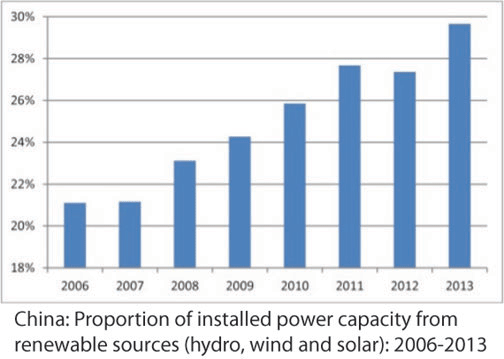
In just the space of eight years, China has become the world’s most important generator of wind power, with the world’s largest capacity and the largest addition of new power capacity in the year 2013. The increase in all three sources of renewables – hydro, wind and solar PV – is shown in Fig. 3, in terms of the proportion of power generated by renewables and its relentless rise (apart from a dip in 2012, following world recession in 2011).
The proportion reached by 2013, of close to 30% of electrical energy generated from renewable sources (hydro, wind and solar), is what gives China its international influence in renewables – and it demonstrates a relentless trend towards greater reliance on manufacturing systems for production of, e.g. wind turbines and solar cells, as opposed to the reliance elsewhere on alternative fossil fuels such as coal seam gas and shale oil…….
The sharp rise in renewables reflects particularly the new commitment to wind power – and it looks set to continue through industrial logistic dynamics. We will develop an argument below for the significance of this date……….
3. Investment trends
Expenditure in building new power generating infrastructure can reveal more than data on capacity and generating additions. The CEC has released investment data for 2013, which reveal the following trends. In terms of investment, China spent more on its grid in 2013 than on new power generation facilities………The significance of this is that China is spending on infrastructure to accommodate more renewable power facilities, as well as on the facilities themselves. Of the new generation facilities, investment in new energy sources accounted for more than 40% of the total investment in new power generation facilities…….
Thus our conclusion that in 2013, China’s leading edge of change in its electric power system is now more “green” than “black”. We have demonstrated above that this is unambiguously so in terms of capacity added and in terms of investment, while in terms of new generation of electrical energy thermal still marginally outranks renewables (180 billion kWh generated to 160 billion kWh)………
at the leading edge, for the year 2013 alone, China added 94 GW of new capacity, of which 55.3 GW came from renewables (59%), and just 36.5 GW (or 39%) came from thermal sources – a dramatic reversal of past trends;…….
our analysis that China’s carbon emissions are set to peak and then to fall – and fall faster than in the US or in Europe……..http://cleantechnica.com/2014/04/08/chinas-renewable-energy-revolution-global-implications/
China’s motives in developing renewable energy
China is serious in its pursuit of renewables, because it seems to believe that its future prosperity depends on building the industries that produce power – complementing its activities in searching for fossil fuels supplies all around the world. There is a lesson here for all other developing countries, and notably for India and Brazil. And not only developing countries.
China’s Renewable Energy Revolution Has Global Implications, Clean Technica John Mathews and Hao Tan, 8 April 14, “……The motives Finally, we need to ask what are the motives for China’s dramatic shift to a renewables trajectory? The common assumption is that it is concern over climate change (global warming) that drives the shift. Important as this motive is, we believe it is the least likely of the explanations for China’s shift. We believe the more plausible explanation for China’s new trajectory – and for the determination with which it is being pursued – is energy security and industrial development. Continue reading
China is No.1 in renewable energy investment
 U.S. Lags Behind China in Renewables Investments, Clean Technica, 6 April 14 By Bobby Magill Follow @bobbymagill Don’t let all those Texas wind farms and massive installations of solar panels in California fool you. The U.S. is not the world leader in clean energy investment.
China is.
China Is #1 In Renewable Energy Investment, US #2, Japan #3 (CHART) With record-breaking solar installations in the US, and solar actually coming in as the #2 source of new electricity capacity in 2013, you might think the US was the #1 market in the world for renewable energy investment. Of course, if you follow how much renewable energy China is installing… or if you just read the headline above, you know otherwise. Here are more details from Climate Central:
For the second year, an annual Pew Charitable Trusts report, “Who’s Winning the Clean Energy Race?”, shows that China is the world leader in clean energy investment, with $54 billion in investments in renewables in 2013, well above total U.S. investment of $36.7 billion. No other clean energy market in the world is operating at that scale,” Phyllis Cuttino, director of Pew’s clean energy program, said during a teleconference Thursday, referring to China.
The report was released just days after the Intergovernmental Panel on Climate Change released the second part to its fifth assessment report, which states unequivocally that people will have to adapt to a world in which human fossil fuel emissions have caused the climate to change, threating lives across the globe as temperatures and seas rise and extreme weather becomes more frequent. Developing renewable energy is seen as one of the primary ways to reduce humans’ impact on the climate.
The Pew report says China’s efforts to slash poverty, expand economic development and solve its air pollution problems have driven the country to invest heavily in clean energy…………
Zwindler said the solar and wind power industries worldwide are in a transition period as subsidies for renewables are scaled back, especially in Germany and Italy, but he is confident renewables will be able to compete in the future with few subsidies.
“It does not take place in all places at the same time,” he said. “If you’re in a sunny part of the world with high electricity prices, putting solar on your roof clearly can make more sense.” http://cleantechnica.com/2014/04/05/china-1-renewable-energy-investment-us-2-japan-3-chart/
Renewed demand for solar PV in China
 Solar PV rebounds as demand comes back with ‘a vengeance’ SMH, March 20, 2014 Solar manufacturers are returning to profit as demand in China soaks up a supply glut that gutted margins for more than two years.
The largest solar-panel maker Yingli Green Energy said it expects to be profitable in the third quarter. It joins peers including JinkoSolar, Trina Solar and JA Solar in guiding investors to expect both income and higher shipments in 2014.
Climbing demand for solar panels is countering a global oversupply of production capacity that erased profits across the industry and bankrupted more than a dozen companies. Developers installed 37.5 gigawatts of panels worldwide last year, up 22 per cent from 2012, and that figure may increase as much as 39 per cent this year, according to data compiled by Bloomberg.
That growth is starting to “sponge up” much of the glut, especially among Chinese manufacturers, that resulted from a buildup in the late 2000s, Pavel Molchanov, an analyst at Raymond James & Associates in Houston, said in an interview. “That has made a real dent in the overcapacity.”
The largest solar manufacturers have cut expenses and are poised to take advantage of growth this year, said Nimal Vallipuram, an analyst at Gilford Securities Inc. in New York.
“They continue to do very well at reducing the costs and their volume is going up very strongly,” he said. “Demand has come back with a vengeance.” http://www.smh.com.au/business/carbon-economy/solar-pv-rebounds-as-demand-comes-back–with-a-vengeance-20140320-353ir.html
China’s nuclear power ambitions fading?
Why China’s nuclear energy ambitions are falling flat http://qz.com/189731/why-chinas-nuclear-energy-ambitions-are-falling-flat/ By Lily Kuo @lilkuo March 19, 2014 At a time when other countries are scaling back their nuclear energy programs, China has been plowing ahead. Its largest nuclear energy companies are considering initial public offerings to raise over $2 billion, and Chinese researchers are racing to build the world’s first nuclear plant that runs on thorium. China’s nuclear reactors account for almost 40% of the world’s total. This year alone, the country plans to add 8.6 gigawatts of nuclear power capability—almost as much as the United Kingdom’s annual nuclear power capacity.
Thus, nuclear power’s contribution to China’s goal of reducing its reliance on coal—and, crucially, reducing the air pollution that is choking many of its major cities and contributing to global warming—is likely to be modest for decades to come.
Nuclear power has been underwhelming in China for many of the same reasons it has struggled elsewhere: it’s technically difficult, expensive, and resisted by parts of the public. Because nuclear power plants take so long to build, and China’s energy demands are imminent, other forms of renewable energy like wind and hydropower have taken precedence. (Nuclear reactors typically require at least six years to build, compared to around two years for geothermal power plants and just a few months for wind farms.)
Engineering problems and delays are also a major culprit, and may prevent China from meeting its scaled-down nuclear power goals. As Grist points out, even if all Chinese nuclear capacity currently under construction were to become operational in the next six years, China would have reached only 45 gigawatts by 2020, well shy of its 58 gigawatts goal. Advanced plants that could bring higher efficiency, like a thorium reactor, will still require years of work to resolve engineering issues, researchers say.
Moreover, one of the benefits of nuclear power is that it can be installed close to where it is in demand—in contrast to wind and hydropower—lessening the distance that electricity has to travel along a power grid where some of the power is inevitably lost. But China is spending over 1 trillion yuan ($162.8 billion) to upgrade and expand its grid. As of last year, 84% of the country’s wind capacity was connected to the grid, from 72% in 2011, and the amount of wind-generated electricity wasted in transfer has fallen to 11% from 16% over the same period,according to Fitch Ratings.
Decades to solve problems of Thorium nuclear reactors
 South China Morning Post, 19 March 14 ……….Researchers working on the project said they were under unprecedented “war-like” pressure to succeed and some of the technical challenges they faced were difficult, if not impossible to solve in such a short period.
They would also probably face opposition from sections of the Chinese public after the nuclear disaster at Fukushima in Japan….One of the technical difficulties is that the molten salt produces highly corrosive chemicals such as fluoride that could damage the reactor.
The power plant would also have to operate at extremely high temperatures, raising concerns about safety. In addition, researchers have limited knowledge of how to use thorium.
“We are still in the dark about the physical and chemical nature of thorium in many ways,” said Li. “There are so many problems to deal with but so little time.”
Western countries such as the United States have experimented with thorium reactors but gave up on the technology because of the engineering difficulties………
One of the technical difficulties is that the molten salt produces highly corrosive chemicals such as fluoride that could damage the reactor.
The power plant would also have to operate at extremely high temperatures, raising concerns about safety. In addition, researchers have limited knowledge of how to use thorium.
“We are still in the dark about the physical and chemical nature of thorium in many ways,” said Li. “There are so many problems to deal with but so little time.”
Western countries such as the United States have experimented with thorium reactors but gave up on the technology because of the engineering difficulties……The thorium reactors would need years, if not decades, to overcome the corrosion issue and the stability of accelerator-driven plants was also in doubt, he said.
“These projects are beautiful to scientists, but nightmarish to engineers,” he said…….After the Fukushima nuclear disaster three years ago, the central government withheld approval for new nuclear plants.
Part of the resistance came from the public, as many people were worried that nuclear plants would cause more serious contamination than the pollution created by coal-fired stations, Gu said.
Government agencies such as the Ministry of Water Resources also opposed the construction of nuclear plants in land-locked areas over concerns that radioactive waste would worsen river pollution.
Wind power racing ahead of nuclear in China
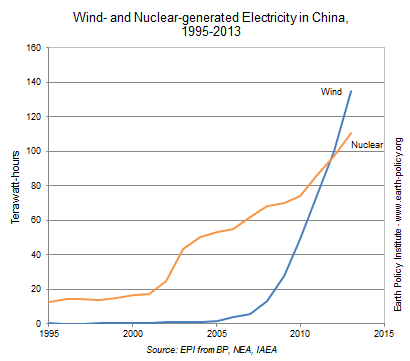
Why is Wind Power Generation Surpassing Nuclear? One of the reasons why nuclear power has not kept up with wind in China is the relative time it takes to get a project up and running. Whereas the typical Chinese nuclear reactor takes roughly six years to build, a wind farm can be completed in a matter of months.
 Wind Leaves Nuclear Behind In China http://cleantechnica.com/2014/03/13/wind-leaves-nuclear-behind-china/By J. Matthew Roney In China, wind power is leaving nuclear behind. Electricity output from China’s wind farms exceeded that from its nuclear plants for the first time in 2012, by a narrow margin. Then in 2013, wind pulled away—outdoing nuclear by 22 percent. The 135 terawatt-hours of Chinese wind-generated electricity in 2013 would be nearly enough to power New York State. Once China’s Renewable Energy Law established the development framework for renewables in 2005, the stage was set for wind’s exponential growth. Wind generating capacity more than doubled each year from 2006 to 2009 and has since increased by nearly 40 percent annually, to reach 91 gigawatts by the end of 2013 (1 gigawatt = 1,000 megawatts). Over 80 percent of this world-leading wind capacity is now feeding electricity to the grid.
Wind generation in 2013 could have been even higher, by an estimated 10 percent, but for the problem known as curtailment—when wind turbines are stopped because the grid cannot handle any more electricity. To help reduce curtailment and reach the official 2020 goal of 200 grid-connected gigawatts, China is building the world’s largest ultra-high-voltage transmission system. The raft of projects now under construction will connect the windier north and west to population centers in the central and eastern provinces. Continue reading
China’s repressive policies in Tibet
 Human Rights Watch chides China for enforcing highly repressive policies in Tibet http://tibet.net/2014/01/23/human-rights-watch-chides-china-for-enforcing-highly-repressive-policies-in-tibet-2/ DHARAMSHALA: China’s policies in Tibet once again came under criticism from Human Rights Watch, which says in annual report released on Tuesday that the Chinese government systematically suppresses Tibetan political, cultural, religious and socio-economic rights.
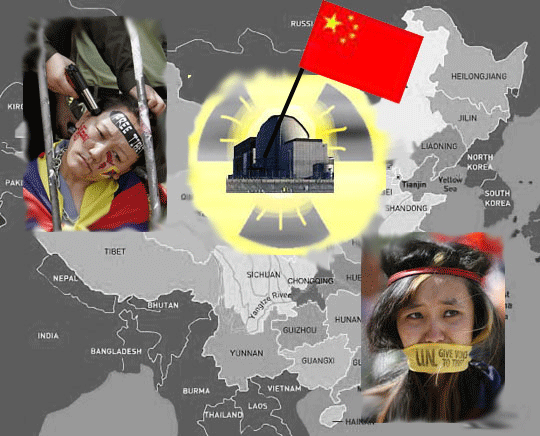 The Chinese government systematically suppresses Tibetan political, cultural, religious and socio-economic rights in the name of combating what it sees as separatist sentiment including non-violent advocacy for Tibetan independence, the Dalai Lama’s return, or opposition to government policy, the report said.
“Arbitrary arrest and imprisonment remains common, and torture and ill-treatment in detention is endemic. Fair trials are precluded by politicised judiciary overtly tasked with suppressing separatism,” it said.
“The Chinese government carries out involuntary population relocation and rehousing on a massive scale, and enforces highly repressive policies in ethnic minority areas in Tibet, Xinjiang, and Inner Mongolia,” Human Rights Watch said in its report.
“The government is also subjecting millions of Tibetans to a mass rehousing and relocation policy that radically changes their way of life and livelihoods, Continue reading
Solar PV installation at record high in China
China’s solar PV installations soared to record in 2013 http://www.smh.com.au/business/carbon-economy/chinas-solar-pv-installations-soared-to-record-in-2013-20140124-31cck.html Developers in China installed a record 12 gigawatts of solar panels last year, almost matching the total amount of solar power in operation in the U.S., and may exceed that this year, according to Bloomberg New Energy Finance.
The power plants were built mostly in the sunny, western provinces of Gansu, Xinjiang and Qinghai and make China’s state-owned power companies the world’s biggest owners of solar assets, the London-based research company said today in a statement.
China was the biggest solar market last year, surpassing longtime leader Germany. Chinese installation more than tripled from 3.6 gigawatts in 2012, and the nation expects to add 14 gigawatts of solar capacity this year, according to New Energy Finance.
China led a 28 per cent increase in global solar installations last year of 39 gigawatts, and total installation may increase another 20 per cent this year, according to the statement. Before 2013, no nation had ever installed more than 8 gigawatts of solar power in a year.
China blocking “inconvenient” foreign news sites
China blocks foreign news sites that revealed elite’s offshore holdings Guardian among sites blocked over reports • China Digital Times publishes details of directive Tania Branigan in Beijing and James Ball in New York theguardian.com, Thursday 23 January 2014
The blocking of foreign news sites that revealed details of offshore holdings by the relatives of senior leaders has continued in China as reports emerged of a propaganda directive ordering websites and services to target users posting on the subject.
Details of the order were published by China Digital Times, a website that monitors censorship instructions.
“Immediately find and remove the foreign media report “China’s Secret Offshore Tax Havens” and related content. Interactive platforms must strictly check [users]. Related images and accusatory comments about leaders and the system [of government] must be deleted without exception,” said the instructions, according to CDT.
“Block the [user] IDs of those who have an evil influence and coordinate on-the-ground investigations with the relevant departments.”…http://engineeringevil.com/2014/01/23/china-blocks-foreign-news-sites-that-revealed-elites-offshore-holdings/
Thorium nuclear reactors for military use, too, funded by USA and Chinese tax-payers
 SPECIAL REPORT-The U.S. government lab behind China’s nuclear power push Dec 20, 2013 Dec 20 (Reuters) – Scientists in Shanghai are attempting a breakthrough in nuclear energy: reactors powered by thorium, an alternative to uranium.
 The project is run by the Chinese Academy of Sciences, a government body with close military ties that coordinates the country’s science-and-technology strategy. The academy has designated thorium as a priority for China’s top laboratories. The program has a budget of $350 million. And it’s being spearheaded by the influential son of a former Chinese president.
But even as China bulks up its military muscle through means ranging from espionage to heavy spending, it is pursuing this aspect of its technology game plan with the blessing – and the help – of the United States. Read more »
1 This Month

22 June – Virtual Event –Climate Change: New Data, New Debate

Monday, June 22, 2026 2:30 p.m. – 3:15 p.m. CT
YouTube. Register here

Protect Sazan Island from the Trump family! https://secure.avaaz.org/campaign/en/protect_sazan_island_from_the_trump_family_loc/?bqFCVab&v=174511&cl=22707147157&_checksum=5e9dde668860e8231c33699735e16a1fbf22ab2cb01da50c999fe8732b9775ef&utm_source=email&utm_medium=blast_email&utm_campaign=174511
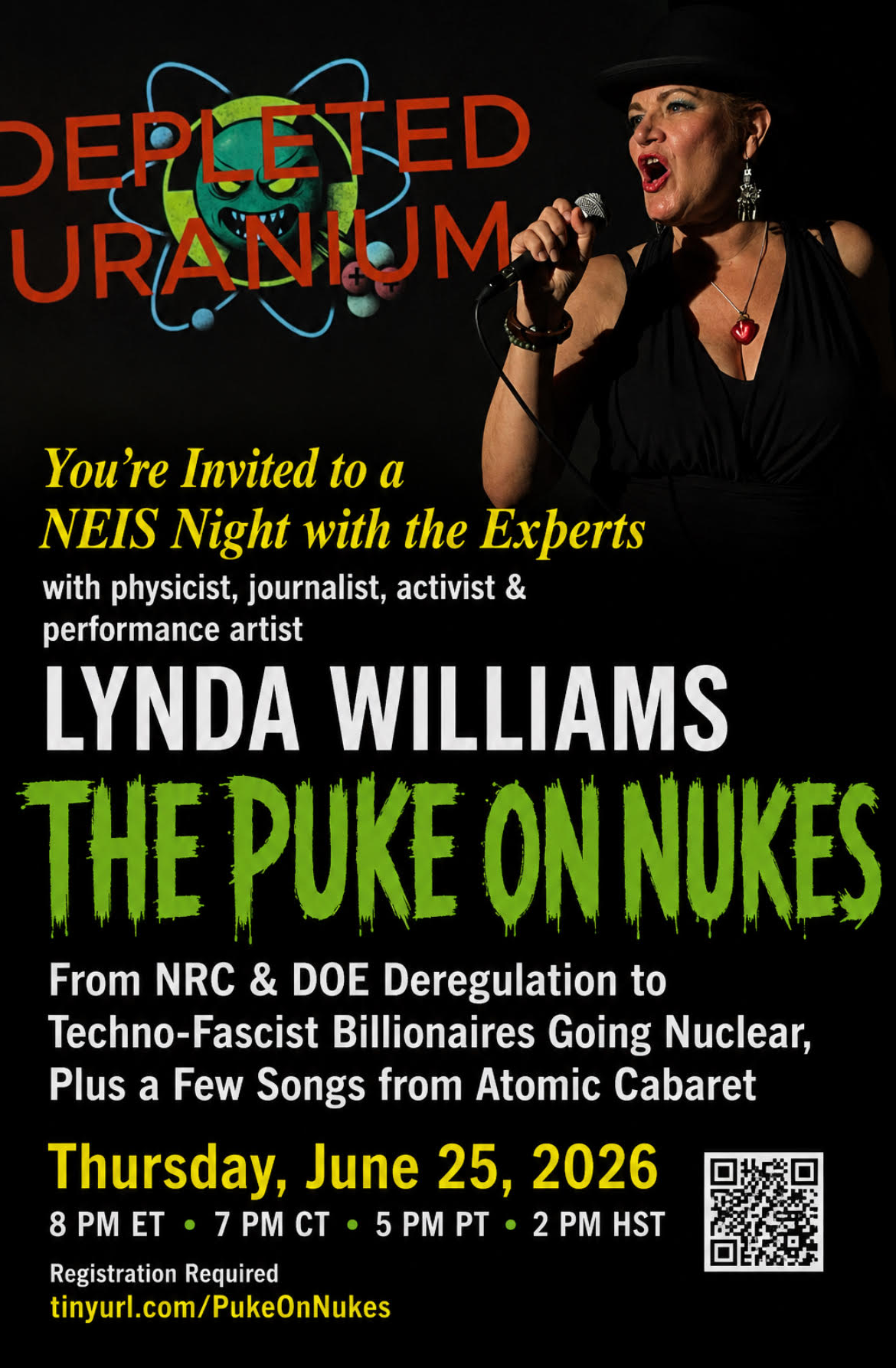
25 June- THE PUKE ON NUKES
Thursday, June 25, 2026
7pm Central Time (8pm ET, 6pm MT, 5pm PT) UTC – 5
From NRC & DOE Deregulation to Techno-Fascist Billionaires Going Nuclear, Plus a Few Songs from Atomic Cabaret REGISTER
26 June – Radiation Trainwreck at the NRC / Join the Protect Better Campaign – https://us02web.zoom.us/meeting/register/4ZlZ5_qLSHGiLSCg8FF6Bg#/registration


Cuba Is Not a Failed State – It Is a Besieged State
PETITION: “Global Appeal to Endorse Palestinian Right of Return of Refugees”
To see nuclear-related stories in greater depth and intensity – go to https://nuclearinformation.wordpress.com
-
Archives
- June 2026 (211)
- May 2026 (306)
- April 2026 (356)
- March 2026 (251)
- February 2026 (268)
- January 2026 (308)
- December 2025 (358)
- November 2025 (359)
- October 2025 (376)
- September 2025 (257)
- August 2025 (319)
- July 2025 (230)
-
Categories
- 1
- 1 NUCLEAR ISSUES
- business and costs
- climate change
- culture and arts
- ENERGY
- environment
- health
- history
- indigenous issues
- Legal
- marketing of nuclear
- media
- opposition to nuclear
- PERSONAL STORIES
- politics
- politics international
- Religion and ethics
- safety
- secrets,lies and civil liberties
- spinbuster
- technology
- Uranium
- wastes
- weapons and war
- Women
- 2 WORLD
- ACTION
- AFRICA
- Atrocities
- AUSTRALIA
- Christina's notes
- Christina's themes
- culture and arts
- Events
- Fuk 2022
- Fuk 2023
- Fukushima 2017
- Fukushima 2018
- fukushima 2019
- Fukushima 2020
- Fukushima 2021
- general
- global warming
- Humour (God we need it)
- Nuclear
- RARE EARTHS
- Reference
- resources – print
- Resources -audiovicual
- Weekly Newsletter
- World
- World Nuclear
- YouTube
-
RSS
Entries RSS
Comments RSS
 nuclear-news