China’s role in the nuclear marketing frenzy
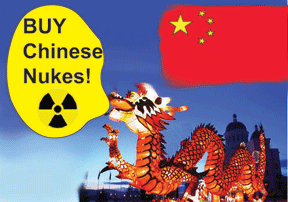 Chinese nuclear firms urged to boost presence overseas South China Morning Post 16 Jan 15 China will push its big nuclear firms to improve their competitiveness and boost their presence overseas as it bids to become one of the world’s dominant nuclear energy powers, Premier Li Keqiang said.
“To continue the struggle to become a strong nuclear energy power, China must comprehensively raise the industry’s competitive advantages, promote nuclear power equipment overseas…..
the country’s two biggest state nuclear companies, China National Nuclear Corp (CNNC) and China General Nuclear Corp (CGN), have agreed to invest in Britain’s Hinkley Point nuclear project.
Wang Zhongtang, the chief engineer at State Nuclear Power Technology Corp, said China was also well on its way to securing projects in Turkey and South Africa.
China has been making steady progress on its own third-generation reactors, including the Hualong I, jointly developed by CNNC and CGN for the purpose of winning overseas projects.
Zheng Hua, a deputy chief engineer with CGN’s reactor design unit, said last month that China hoped to develop Hualong I reactors in Britain, building on the agreement to invest in Hinkley Point.
China was also considering a plan to merge CNNC and CGN in order to pool their resources and improve their competitiveness overseas, sources said late last year. http://www.scmp.com/business/economy/article/1680957/chinese-nuclear-firms-urged-boost-presence-overseas
China well up in the throng to market nuclear technology to other countries
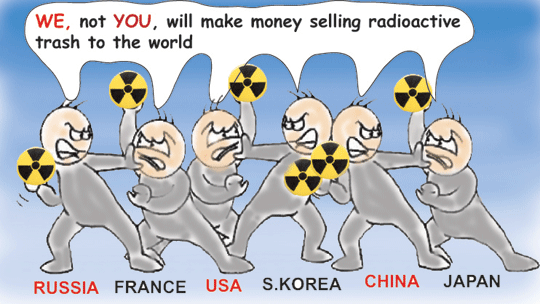
 China ready to sell nuclear fuel for NPPs in Ukraine and Eastern Europe — CNNC source http://itar-tass.com/en/world/771570 January 16, 15 Ukrainian energy sector workers are facing technical problems with American nuclear fuel loading into the Soviet-type reactors BEIJING, January 16. /TASS/. China is ready to sell fuel for nuclear power plants in Ukraine and Eastern Europe, a China National Nuclear Corporation (CNNC) source told TASS on Friday on the sidelines of the World Nuclear Spotlight forum.
According to the source, Chinese companies intend to sell the fuel to the countries that operate various types of Soviet-and Russian-made NPPs. Aside from Ukraine, China is viewing the possibility of exporting nuclear fuel to Hungary and Romania.
The source said Ukrainian energy sector workers are facing technical problems with American nuclear fuel loading into the Soviet-type reactors.
At the moment China is actively buying uranium mines with a view to exporting uranium to other countries in the foreseeable future. Asked about Russia’s possible claims to the Chinese manufacturers of nuclear fuel, he said that “there are no special restrictions.” “Despite the related agreements, the Russian side is unlikely to stop the supplies,” said the CNNC representative.
Russia and China have been actively developing co-operation in the nuclear sphere for many years. For example, State Atomic Energy Corporation Rosatom and CNNC signed a protocol to launch the discussion of possible formats of co-operation in the sphere of construction of nuclear power plants in third countries.
China’s nuclear power delay – problems with its new Westinghouse Advanced Reactor
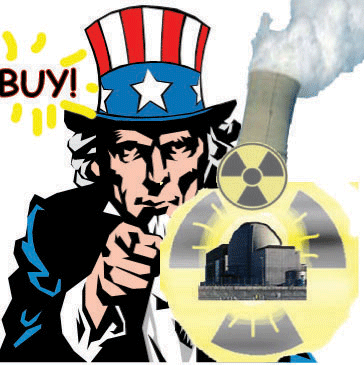
 China’s First Advanced Nuclear Reactor Faces More Delays Start-Up Now Unlikely Until 2016 at the Earliest WSJ By CHUIN-WEI YAP And BRIAN SPEGELE Jan. 15, 2015 BEIJING—China’s ambitions to be a leader in nuclear technology have been dealt a fresh blow, as construction of its most advanced reactor is facing a new delay.
The project—which China is developing with Westinghouse Electric Co. of the U.S.—faces new development problems and now isn’t expected to start up until 2016 at the earliest, the chief engineer at China’s state-owned reactor technology company said Thursday.
“We discovered some new problems during tests so we need to delay it more until next year,” Wang Zhongtang, chief engineer of China’s State Nuclear Power Technology Corp., said on the sidelines of an industry conference. Mr. Wang didn’t specify the nature of the latest problems found at ongoing trials for the reactor, nor did he provide a more precise time frame for its launch.
The delay is the second for the project, which had been slated to start by the end of 2013. It marks another setback for China’s clean-energy ambitions, as technical hurdles loom over Beijing’s aim to triple its nuclear power capacity by 2020…
….the delays have illustrated shortcomings in China’s nuclear sector, particularly when dealing with immature and first-of-a-kind technologies such as those found in the AP1000 reactor, said Li Ning, a nuclear-industry expert at China’s Xiamen University.
Chinese officials “are certainly very frustrated,” said Mr. Li. “I think they feel Westinghouse oversold the system, oversold the technology, promised more than they could really deliver.”………
China’s ambitions and vast market remain vital for the global nuclear industry. French nuclear engineering firm Areva S.A. , which lost out a key bid in 2007 to Westinghouse to build four reactors for China, is still seeking business there…….http://www.wsj.com/articles/chinas-first-advanced-nuclear-reactor-faces-more-delays-1421297393
Chna’s revolutionary programme for renewable energy
China as a model renewable energy economy Ft.com By Li Hejun, China New Energy Chamber of Commerce and Hanergy Holding Group 31 Dec 14 Almost 200 governments met in Peru this month to hammer out a first draft of a global deal to cut emissions, ahead of a new round of climate talks next year in Paris. If the world is to arrest climate change, global economies need to embrace renewable energy. Those looking for a model of how this might be done should consider a possibly surprising source: China.
It has been little noticed by the outside world, but in China a technological revolution that will result in huge gains in efficiency and new applications for renewable energy has already begun…….
China’s renewable energy goals are not simply hot air. The country’s leadership recognises that China must break its dependency on coal if it is to satisfy the surging power demands of a growing middle class and an expanding economy without blanketing the country in smog. China’s renewable energy goals are also necessary for the country’s long-term energy security. Neither coal, shale gas nor any other fossil fuel can secure our energy future………
The new goals will trigger a huge investment push towards renewables. The scale of the new generating capacity to be installed in the next decade will reshape China’s renewable energy market, weeding out weak companies as the government gradually phases out subsidies, and driving gains in efficiency and technological innovation as the remaining industry players compete for market share.
I believe that solar will be at the forefront of this technological advance. Solar energy is fast becoming more affordable. The cost for solar power generation is now 50 per cent lower than it was three years ago. China’s cost of solar power generation has fallen to below Rmb1 per kWh and if we continue that trend, I predict that within 3-5 years the generation cost of solar cells will approach that of coal-fired power………….. http://blogs.ft.com/beyond-brics/2014/12/31/guest-post-china-as-a-model-renewable-energy-economy/
China’s distributed power grid will revolutionise renewable energy
China as a model renewable energy economy Ft.com By Li Hejun, China New Energy Chamber of Commerce and Hanergy Holding Group 31 Dec 14 “……..Even more exciting than falling costs are the new ways in which China will use and transmit power. China is now intent on developing a distributed power grid that will rely on the interconnection of thousands of rooftop and building-integrated solar installations generating power close to the point of consumption. This is a drastic departure from the current centralised power system that relies on goliath, coal-burning power plants and costly, inefficient power transmission over hundreds, or even thousands of kilometres. This new, smart grid will help eliminate pollution, slash costs, and increase reliability.
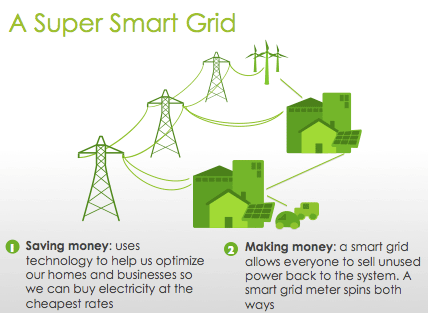
In addition to making the distributed grid possible, new forms of solar technology are ushering in an era of mobile energy in which customers can take power with them wherever they go.
At present, around 90 per cent of the world’s solar power output is geared towards first-generation crystalline silicon panels, which for a long time were the most efficient technology available. But traditional silicon panels are hard, opaque and heavy, while thin film solar technology can be can be lightweight, flexible, and translucent, making it ideal for a wide variety of applications, from curved automobile rooftops and building integration to consumer clothing and portable power stations.
In recent years, thin-film technology has caught up with, and even surpassed, crystalline silicon in terms of both conversion efficiency and cost. Furthermore, producing thin-film cells requires just a fraction of the material and energy necessary to make crystalline silicon, conserving resources, cutting costs, and reducing pollution.
In the coming years, technologies will continue to improve, and prices will continue to fall. Two of the most promising technologies now are solar cells made from CIGS (Copper, Indium, Gallium, Selenide) and those from GaAs (Gallium-Arsenide), with maximum conversion efficiencies topping 20 percent, and 30 percent, respectively. As these are further developed and brought to market on a mass scale, solar panels will transform into something capable of being integrated into nearly every fabric, product, and structure at a reasonable cost……..
Li Hejun is Director of the China New Energy Chamber of Commerce, and CEO of multinational clean energy company Hanergy Holding Group. http://blogs.ft.com/beyond-brics/2014/12/31/guest-post-china-as-a-model-renewable-energy-economy/
In response to USA ‘encirclement’ China taking nuclear weapons underwater
China Takes Nuclear Weapons Underwater Where Prying Eyes Can’t See East Asian News and Politics 2 Jan 15 From Bloomberg News China is preparing to arm its stealthiest submarines with nuclear missiles that could reach the U.S., cloaking its arsenal with the invisibility needed to retaliate in the event of an enemy strike.
Fifty years after China carried out its first nuclear test, patrols by the almost impossible-to-detect JIN class submarines armed with nuclear JL–2 ballistic missiles will give President Xi Jinping greater agility to respond to an attack.
The nuclear-powered subs will probably conduct initial patrols with the missiles by the end of this year, “giving China its first credible sea-based nuclear deterrent,” according to an annual report to Congress submitted in November by the U.S.-China Economic and Security Review Commission.
Deploying the vessels will burnish China’s prestige as Xi seeks to end what he calls the “cold war” mentality that resulted in U.S. dominance of Asia-Pacific security. Since coming to power, Xi has increased military spending with a focus on longer-range capacity, including plans to add to the country’s tally of a single aircraft carrier.
“For the first time in history, China’s nuclear arsenal will be invulnerable to a first strike,” said independent strategist Nicolas Giacometti, who has written analysis for The Diplomat and the Center for Strategic and International Studies. “It’s the last leap toward China’s assured nuclear-retaliation capability.”…………….
First Use
“We must continue to modernize our nuclear capabilities,” Admiral Harry Harris said Dec. 2 at his nomination hearing to become commander of the U.S. Pacific Command, when asked how the U.S. should respond to China’s build up. Harris said that he considered North Korea, which is developing its own nuclear arsenal, to be the biggest threat to security in Asia.
Analysts don’t expect China to modify its longstanding “no-first-use” nuclear policy that states its weapons will only be used if China comes under nuclear attack.
Having enhanced its nuclear-deterrence capability, China may begin to communicate more about the planned evolution of its nuclear forces, Giacometti said.
“More openness on China’s side might then open up more space for confidence-building measures and lay the ground for future arms control discussions,” he said. http://pinione.blogspot.com.au/2014/12/china-takes-nuclear-weapons-underwater.html
Global danger as China and India upgrade their ballistic missiles
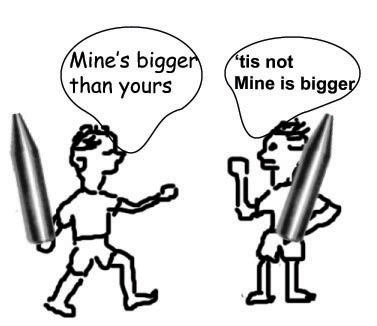
 The Most Dangerous Nuclear Threat No One Is Talking About Zachary Keck http://nationalinterest.org/blog/the-most-dangerous-nuclear-threat-no-one-talking-about-11899 December 19, 2014 While Iran and North Korea’s nuclear programs are all the rage these days, the most dangerous nuclear threat facing the world continues to go largely unnoticed.
Namely, China and India are both on the cusp of deploying multiple independently targetable reentry (MIRV) vehicles on their ballistic missiles, a development that is likely to have profound, far-reaching consequences for the region and beyond.
MIRVed missiles carry payloads of several nuclear warheads each capable of being directed at a different set of targets. They are considered extremely destabilizing to the strategic balance primarily because they place a premium on striking first and create a “use em or lose em” nuclear mentality.
Along with being less vulnerable to anti-ballistic missile systems, this is true for two primary reasons. First, and most obviously, a single MIRVed missile can be used to eliminate numerous enemy nuclear sites simultaneously. Thus, theoretically at least, only a small portion of an adversary’s missile force would be necessary to completely eliminate one’s strategic deterrent. Secondly, MIRVed missiles enable countries to use cross-targeting techniques of employing two or more missiles against a single target, which increases the kill probability.
In other words, MIRVs are extremely destabilizing because they make adversary’s nuclear arsenals vulnerable to being wiped out in a surprise first strike. To compensate for this fact, states must come up with innovative ways to secure their deterrent from an enemy first strike. This usually entails increasing the size of one’s arsenal, and further dispersing to make it more difficult for an enemy to conduct a successful first strike. For example, when the U.S. first deployed MIRVed missiles in 1968, the Soviet Union had less than 10,000 nuclear warheads. A decade later, however, it had over 25,000 (of course, the Soviet Union deploying its own MIRVed missiles incentivized expanding the size of its arsenal since more warheads were needed per missile).
With regards to China and India, then, the introduction of MIRVed missiles could have profound consequences of both of their nuclear postures. One of the most remarkable aspects of every nuclear state not named Russia or the United States is they have relied on an extremely small nuclear arsenal to meet their deterrent needs. This is especially true of India and China who have generally maintained minimum deterrence and no-first use doctrines. With the introduction of countervailing MIRVed missiles, however, there will be strong incentives on both sides to vastly increase the size of their arsenals if any to guard against the threat of a first strike by the other side.
Of course, the consequences of China and India acquiring MIRVed missiles would not be limited to those states alone. Most obviously, India’s acquisition of MIRVed missiles would immediately threaten the survivability of Pakistan’s nuclear forces. In the short-term, this will probably result in Islamabad further dispersing its nuclear arsenal, which in general will leave it more vulnerable to Islamist terrorist groups in the country. Over the long-term, Pakistan will feel pressure to expand the size of its arsenal as well as acquire MIRVed capabilities of its own.
The same pressures will be felt in Moscow.Since the disintegration of the Soviet Union, Russia has relied on its vast nuclear arsenal to compensate for its relative conventional weakness. In the eyes of Russian leaders, this will only grow more necessary as China continues to modernize its conventional military forces. Currently, Russia holds vastly more nuclear warheads than China, which is a source of relief for Moscow. As China MIRVs its missiles, however, as well as likely builds up the size of its arsenal, Moscow will see its nuclear superiority over Beijing rapidly erode. It can be counted on to respond by abrogating its arms control treaties with the United States, and expanding its own arsenal as well. In such a situation, a U.S. president would come under enormous domestic pressure to meet Russia’s buildup warhead for warhead.
Thus, while the prospect of North Korea and Iran acquiring operationalized nuclear arsenals may be concerning, China and India’s MIRVed missiles present far greater threats to the world.
China’s conventional and nuclear weaponry tend to merge
The WU-14 flights are just the latest installment of Chinese military systems revealed to the world through tests and roll-outs. Other examples in recent memory include China’s anti-satellite test (ASAT) in 2007, its ballistic missile defence (BMD) tests in 2010, 2013 and 2014, as well as its unveiling of the J-20 stealth fighter in 2010. This is not to mention its flight of an unmanned aerial vehicle (UAV) in 2013, test of the intercontinental ballistic missile DF-31A in 2014 and recent revelations regarding the DF-41.
The level of sophistication and deployment of many of these systems remains to be seen. Still, these roll-outs indicate that China is shifting from transparency based on intent to one rooted in capabilities.
t first glance, Beijing’s approach towards conventional and nuclear deterrence may appear distinct and static. China’s conventional deterrence is based on war-fighting, counter-force, asymmetry and pre-emption. This is contrasted with its nuclear deterrence posture, which has for decades been founded on non-war-fighting, counter-value, asymmetry and no-first-use. It is often taken for granted that these two deterrence postures are isolated, with their only real point of intersection being asymmetry. Yet, there are indications that China’s conventional and nuclear deterrence are far less independent and fixed than its rhetoric suggests.
This stems from at least five factors:
- China’s Second Artillery has been responsible for both its conventional and nuclear missiles since the early 1990s. The potential for crossover between these two domains has only grown since that time, particularly in light of its training of personnel and advances in missile technology in recent years.
- China’s conventional and nuclear command and control centres are reportedly co-located. This means that an attack, whether through advanced conventional systems or cyber-attacks, while intending to negate conventional command and control centres, could also threaten China’s nuclear command and control, thus leading to escalation.
- China’s system of tunnels leaves gaps in the understanding of its nuclear and conventional forces. While there has been debate about the potential trove of nuclear warheads within China’s Great Wall Engineering project, the issue is less one of quantity than of overall inability to account for location, systems and practices that some Chinese experts maintain verify nuclear posture…………………
USA and other countries struggle to market their nuclear technology to China
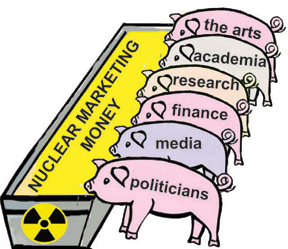 China Wants its Nuclear Reactors ‘Made in China’ WSJ 16 Dec 14 When a unit of North Carolina’s Curtiss-Wright Corp. won a roughly $300 million deal in 2007 to supply components for new reactors in China, industry officials trumpeted China’s nuclear boom as good for U.S. business.
Today, Chinese companies are competing for that business—and foreign companies risk getting left out. Meanwhile, Curtiss-Wright’s contract is caught up in a legal dispute, while Chinese authorities blame the company in part for the delay of a landmark nuclear project. As the WSJ’s Brian Spegele reports:
U.S. and other foreign companies are now struggling to keep their hold in China, the industry’s biggest growth market and a rare bright spot more than three years after the Fukushima disaster in Japan put many of the world’s nuclear projects on hold. Yet China is increasingly turning to local companies to build crucial parts for multibillion-dollar nuclear projects, a result of Chinese industrial nationalism and frustration over U.S. supplier problems………http://blogs.wsj.com/chinarealtime/2014/12/16/china-wants-its-nuclear-reactors-made-in-china/
China’s much touted nuclear future is not so sure
Nuclear power in China – Promethean perils, The Economist Dec 6th 2014 | SHANGHAI |One factor that could slow growth is cost. In the past Chinese governments were happy to throw endless pots of money at favoured state firms in industries deemed “strategic”. Times are changing, however. Economic growth is slowing, and the government must now deal with massive debts left over from previous investment binges. Since the export-oriented and investment-led model of growth is sputtering, officials may soon be keen to boost domestic consumption rather than merely shovel subsidised capital at big investment projects.
China’s nuclear power investment might not be such a good deal
China Nuclear IPO Risks Fading Afterglow By ABHEEK BHATTACHARYA, WSJ Nov. 24, 2014 China’s largest nuclear power company is coming to the table with a high minimum bet.
State-owned CGN Power plans to sell shares worth up to $3.16 billionin Hong Kong this week, making it one of the few pure-play listed nuclear companies in the world. ………
 CGN Power’s multiple is substantially higher than U.S. nuclear operator Exelon ’s 6.7 times and French EDF’s 4.9 times. It is also more expensive than CGN Meiya, CGN Power’s smaller affiliate that went public in September and that fetches 11.2 times Ebitda.
High valuations for CGN Power are dicey because China regulates electricity prices more heavily than in the West. For instance, new nuclear-power plants can’t charge higher tariffs than neighboring coal-fired power, capping earnings potential.
Though Beijing’s plans to cut back on fossil fuels will help growth, the state-run grids prioritize wind and solar over nuclear power when buying and dispatching electricity, according to CGN’s prospectus. Given China’s ambitions to build out solar power, this means nuclear could occasionally lose out. It is also a reminder that nuclear energy may not always enjoy the government’s graces.
CGN Power’s novelty may attract some betting on China’s nuclear future. Yet like many Hong Kong IPOs that do well at first, this bet may lose its afterglow. http://online.wsj.com/articles/china-nuclear-ipo-risks-fading-afterglow-heard-on-the-street-1416819232
Thorium – no prospects as an energy source, but China might use it for weapons
 NUCLEAR OPTIONS: WHAT EXPLAINS U.S.-CHINA COOPERATION ON THORIUM? Georgetown Public Policy Review MATTHEW STRABONE NOVEMBER 6, 2014
China’s nuclear power programme has dubious economic future
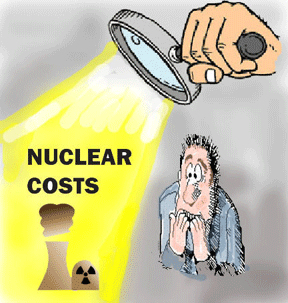 China’s Risky Nuclear Renaissance http://online.wsj.com/articles/heard-on-the-street-chinas-risky-nuclear-renaissance-1414508639 CGN Power’s Plan to Go Public Could Be Dicey By ABHEEK BHATTACHARYA Oct. 28, 2014
Nuclear energy: It’s risky stuff. Hence, there is often a heavy degree of government control over it—which makes it a doubly risky investment proposition.
Especially when that government is China’s.
A number of Chinese state-owned nuclear companies are going public these days. CGN Power, the country’s largest with 9.4 gigawatts of operating capacity, will likely offer $3 billion worth of new shares in Hong Kong next month, reports The Wall Street Journal. A small affiliate, CGN Meiya Power , raised $262 million in Hong Kong last month and has seen its shares rise by 20% since. Meanwhile, another top operator, China National Nuclear Power, also plans an initial public offering.
Once listed, these will be one of a handful of stocks globally, including the likes of Exelon of the U.S. and EDF of France, offering high or pure exposure to nuclear energy. And while much of the rest of the world is ambivalent about or hostile to nuclear energy, Beijing has big expansion plans. The Chinese government suspended new project approvals after Japan’s Fukushima accident in March 2011. But the need to diversify away from smog-causing coal has put its nuclear ambitions back on track. China now targets nearly tripling the nuclear capacity that’s up and running to 58 gigawatts by 2020. The IPOs will help fund that ambition.
The state’s involvement can cut both ways, though. CGN Power sells most of its output to state-run electricity grids at regulated tariffs. For power plants that began operating before 2013, these tariffs are tailored to yield a “reasonable” profit, according to CGN’s prospectus. Yet its net profit has fallen since 2011 because of either surging costs or weakening sales.
For newer plants, the tariff is supposed to be fixed—except when it isn’t. In a bid to avoid competition, these plants are required to cut tariffs if neighboring coal-fired power is cheaper. That’s quite likely as coal prices spiral downward. Energy prices are heavily regulated precisely because consumers are rather attached to light and heat. That makes them subject to political, as well as economic, forces.
In France, for example, shares in state-run EDF tanked 14% in June when the government scrapped a planned tariff increase. There’s even more reason to worry in China since governments could keep down power prices as a stimulus to troubled heavy industries. Growth prospects are high, which is likely one reason that CGN Meiya already trades at 10.9 times 2013 earnings before interest, tax, depreciation and amortization. That is far higher than EDF’s 4.8 times or Exelon’s 6.6 times.
Double-digit multiples are no doubt tempting for IPO bankers but look too much for a large nuclear generator carrying this much political risk. Problem is, CGN’s balance sheet means it needs a high multiple, or fast growth in profits, to make its IPO math work.
Net debt as of this March is a hefty 5.1 times 2013 Ebitda, and still high at four times even if related-party loans are excluded. And less than 10% of the IPO proceeds are currently earmarked for paying off borrowings. As if nuclear power wasn’t risky enough
China launches long range test missile, in effort to catch up with USA’s nuclear arsenal
China Launches Test Missile Capable of Carrying Nuclear Warheads to Europe and US New missile system places London and US east coast under the crosshairs of China’s military .International Business Times By Mark Piggott October 5, 2014 China has successfully launched a test missile capable of carrying a nuclear warhead 10,000km – meaning the whole of Europe and parts of the US is within its range.
“We continue to monitor China’smilitary modernization, including its missile tests”
– Pentagon spokeswoman Cynthia O Smith
The Dongfeng missile can be fired from mobile launchers capable of traversing rough terrain, meaning they can be easily moved and hidden from detection by spy satellites.
China launched the missile on 26 September. The Pentagon confirmed the launch it took place.
Although refusing to provide details, Pentagon spokeswoman Cynthia O Smith told the Washington Free Beacon: “We continue to monitor China’s military modernization, including its missile tests.”…..
It is estimated that China only has around 250 nuclear warheads, compared with the 2,104 operational warheads operated by the US.
Major General Yao Yunzhu, China’s director of the Center of America-China Defense Relations for the Academy of Military Science, said in a letter to the Pacific Forum of the Center for Strategic and International Studies, that China still lags behind the US in terms of nuclear weapons.
“The Ballistic Missile Defense systems that the US and its allies have deployed, or are planning to deploy, are capable of intercepting Chinese nuclear weapons launched for retaliation after it has already been attacked, thus potentially negating the deterrence effect of the Chinese nuclear arsenal,” said Yunzhu.
Retired Peoples’ Liberation Army general Xu Guangyu told the South China Morning Post: “Beijing just wants to increase China’s military might and its nuclear strategic threat. It’s not really targeting the US or other countries.
“China needs to conduct intensive weapons tests and military drills because the (US-led build-up) now in the Asia-Pacific area is not good for Beijing………,.”http://www.ibtimes.co.uk/china-launches-test-missile-capable-carrying-nuclear-warheads-europe-us-1468574
China joins the nuclear marketing frenzy to sell to India
China joins nations eyeing India’s civil nuclear sector, Cold Air Currents, 21 Sept 14 Yahoo News UK: NEW DELHI (Reuters) – China became the latest nation to line up for a stake in India’s civil nuclear energy drive on Thursday, agreeing to open talks on cooperation in a sector that New Delhi sees as the solution to its chronic power problems.
...”I think the Chinese are looking basically at the commercial angle, since India is going to be giving contracts for nearly $150 billion in the next 10-15 years,” said Srikanth Kondapalli, a China watcher at Delhi’s Jawaharlal Nehru University.
The announcement, made after Xi met Prime Minister Narendra Modi in New Delhi, comes on the heels of a deal India struck earlier this month to buy uranium from Australia to increase its fuel supplies.
Days before that, Modi and Japanese Prime Minister Shinzo Abe agreed to accelerate talks on a nuclear energy pact……http://coldaircurrents.luftonline.net/2014/09/china-joins-nations-eyeing-indias-civil.html
1 This Month

22 June – Virtual Event –Climate Change: New Data, New Debate

Monday, June 22, 2026 2:30 p.m. – 3:15 p.m. CT
YouTube. Register here

Protect Sazan Island from the Trump family! https://secure.avaaz.org/campaign/en/protect_sazan_island_from_the_trump_family_loc/?bqFCVab&v=174511&cl=22707147157&_checksum=5e9dde668860e8231c33699735e16a1fbf22ab2cb01da50c999fe8732b9775ef&utm_source=email&utm_medium=blast_email&utm_campaign=174511
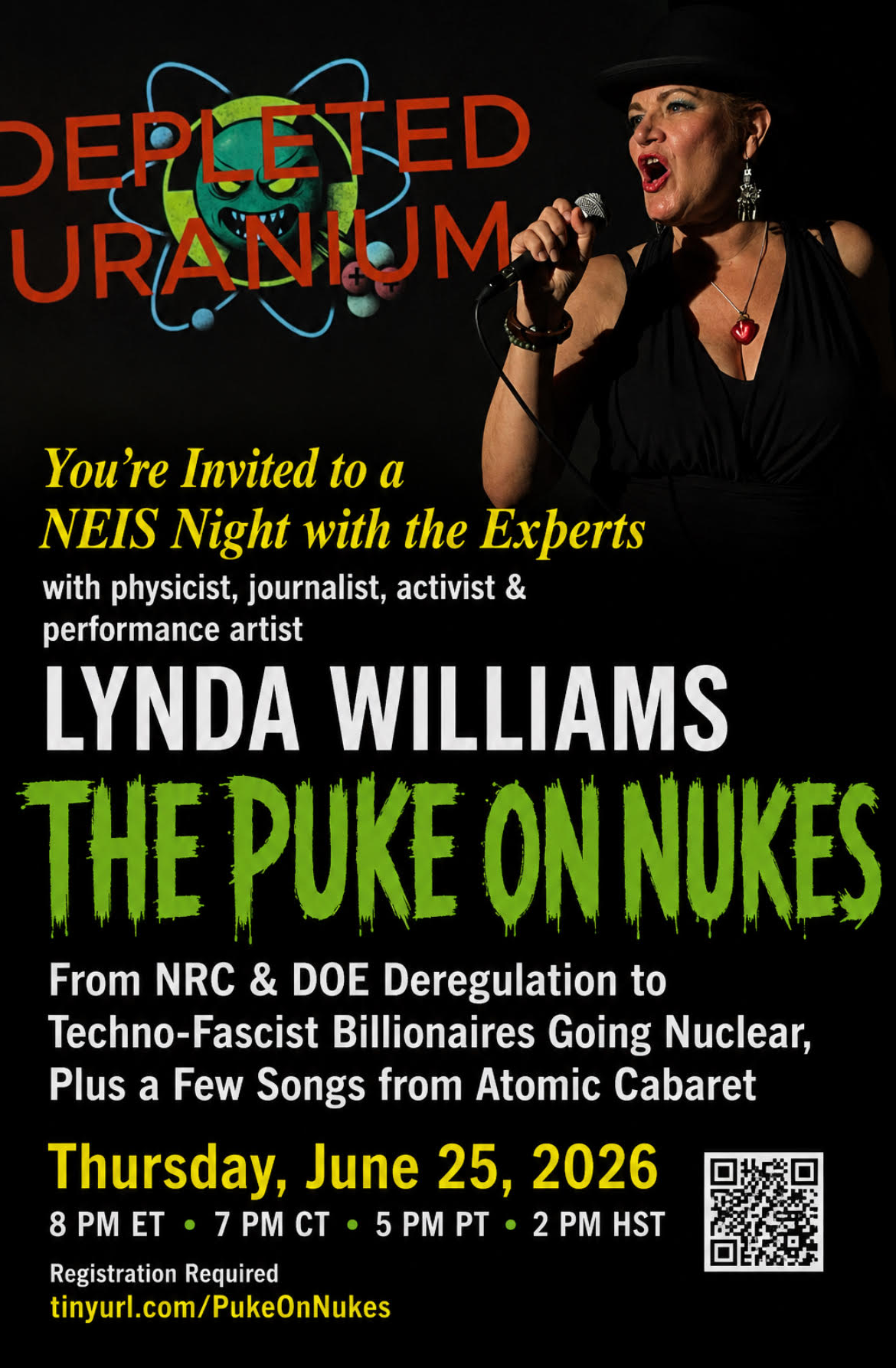
25 June- THE PUKE ON NUKES
Thursday, June 25, 2026
7pm Central Time (8pm ET, 6pm MT, 5pm PT) UTC – 5
From NRC & DOE Deregulation to Techno-Fascist Billionaires Going Nuclear, Plus a Few Songs from Atomic Cabaret REGISTER
26 June – Radiation Trainwreck at the NRC / Join the Protect Better Campaign – https://us02web.zoom.us/meeting/register/4ZlZ5_qLSHGiLSCg8FF6Bg#/registration


Cuba Is Not a Failed State – It Is a Besieged State
PETITION: “Global Appeal to Endorse Palestinian Right of Return of Refugees”
To see nuclear-related stories in greater depth and intensity – go to https://nuclearinformation.wordpress.com
-
Archives
- June 2026 (211)
- May 2026 (306)
- April 2026 (356)
- March 2026 (251)
- February 2026 (268)
- January 2026 (308)
- December 2025 (358)
- November 2025 (359)
- October 2025 (376)
- September 2025 (257)
- August 2025 (319)
- July 2025 (230)
-
Categories
- 1
- 1 NUCLEAR ISSUES
- business and costs
- climate change
- culture and arts
- ENERGY
- environment
- health
- history
- indigenous issues
- Legal
- marketing of nuclear
- media
- opposition to nuclear
- PERSONAL STORIES
- politics
- politics international
- Religion and ethics
- safety
- secrets,lies and civil liberties
- spinbuster
- technology
- Uranium
- wastes
- weapons and war
- Women
- 2 WORLD
- ACTION
- AFRICA
- Atrocities
- AUSTRALIA
- Christina's notes
- Christina's themes
- culture and arts
- Events
- Fuk 2022
- Fuk 2023
- Fukushima 2017
- Fukushima 2018
- fukushima 2019
- Fukushima 2020
- Fukushima 2021
- general
- global warming
- Humour (God we need it)
- Nuclear
- RARE EARTHS
- Reference
- resources – print
- Resources -audiovicual
- Weekly Newsletter
- World
- World Nuclear
- YouTube
-
RSS
Entries RSS
Comments RSS
 nuclear-news