Russia and China propose negotiation plan to lessen North Korea tensions

 Russia, China offer plan to ease N.Korea tension, abc news, 4 July 17 Russia and China have proposed that North Korea declare a moratorium on nuclear and missile tests while the United States and South Korea refrain from large-scale military exercises.
The call was issued in a joint statement by the Russian and Chinese foreign ministries on Tuesday following talks between Russian President Vladimir Putin and Chinese President Xi Jinping.
The statement came after North Korea tested a missile that flew higher and longer than previous ones, sparking concerns around the world.
Moscow and Beijing suggested that if North Korea halts nuclear and missile tests while the U.S. and South Korea freeze military maneuvers, the parties could sit down for talks that should lead to obligations not to use force and to refrain from aggression………..
North Korea says its latest missile test reached a height of 2,802 kilometers (1,740 miles) and flew 933 kilometers (580 miles) for 39 minutes before falling into the sea.
The country’s Academy of Defense Science said Tuesday in a statement that it was a successful test of an intercontinental ballistic missiles called Hwasong-14.
The statement was distributed by North Korea’s KCNA news service.
The reported trajectory was similar to that announced earlier by U.S., South Korean and Japanese officials, though the U.S. judged it to be an intermediate-range missile.
Either way, it would be a longer and higher flight than similar tests previously reported.
The U.S military says it tracked a North Korean missile for 37 minutes before it landed in the Sea of Japan.
The Hawaii-based U.S. Pacific Command said in a statement Tuesday that an intermediate-range ballistic missile was launched from near an airfield in North Korea.
NORAD, or the North American Aerospace Defense Command, said the missile did not pose a threat to North America.
South Korean and Japanese officials reported the North Korean missile launch earlier Tuesday. It is part of a string of recent tests as the North works to build a nuclear-tipped missile that could reach the United States………http://abcnews.go.com/International/wireStory/latest-north-korea-height-distance-missile-48430348
———
Russia and China came close to nuclear war in 1969
Forgotten Fact: Russia and China Almost Started a Nuclear War in 1969, National Interest, Kyle Mizokami, 2 Jul 17, In 1969 the two pillars of the communist bloc, the Soviet Union and the People’s Republic of China, nearly went to full-scale war. Years of deteriorating ties between the two countries, once the staunchest of allies, finally led to skirmishing on the long mutual border between the two countries. While tensions were eventually de-escalated, what if the two countries had gone to war?
On March 2, 1969 Soviet troops patrolling Damansky Island (Zhenbao) on the Ussuri River came under fire from Chinese troops. The attack, just 120 miles from the major Soviet city of Khabarovsk, killed fifty Soviet troops and wounded many more. The Moscow believed that the attack was premeditated, with Beijing bringing in a special combat unit to ambush Soviet forces. Alleged atrocities against wounded Soviet troops made the Soviet leadership furious.
The de-escalation of the Sino-Soviet crisis in 1969 avoided what could have been yet another large, destructive war of the twentieth century. The current friendship between Moscow and Beijing is a reflection of that crisis and the realization that it’s much better for both countries to be allies than enemies. This is particularly in Moscow’s interests: given Beijing’s rapid military and economic progress over the past thirty years, next time, the Kremlin may find the tables turned. http://nationalinterest.org/blog/the-buzz/forgotten-fact-russia-china-almost-started-nuclear-war-1969-21398
China’s Taishan nuclear reactors would have the same safety defects as France’s Flamanville reactor
BFM TV 29th June 2017 [Machine Translation] The manufacturing defects encountered in France also
exist on the two reactors of Taishan, in the south-east of China. The
decision of the nuclear safety authority prompts China to emulate it.
Barely the problem of Flamanville settled, the looks turn to China. The CGN
industrialist built in Taishan, in the south-east of the country, two EPRs
with EDF. These two tanks were manufactured in France, in the factory of Le
Creusot, like those of Flamanville. And obviously have the same
manufacturing defects.
“The same parts are concerned and have been
manufactured with the same process, explained the ASN president,
Pierre-Franck Chevet, but it is the responsibility of the Chinese to
decide. For two years, they have been associated with all the tests and
works of the French authority. On Monday and Tuesday, the representatives
of the Chinese authority and the industrialist CGN were in Paris to follow
the conclusions on the Flamanville EPR. They will have to decide whether
they also impose changes to the lids of the Taishan EPRs. These two
reactors must start between the end of 2017 and the end of 2018.
http://bfmbusiness.bfmtv.com/entreprise/apres-flamanville-la-surete-des-epr-chinois-en-question-1197282.html
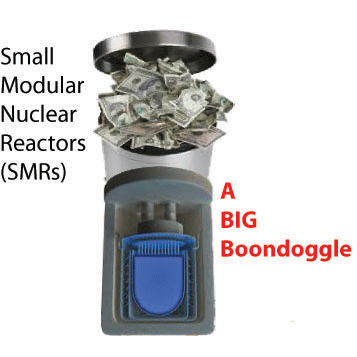
China “looks to small nuclear reactors” – but it’s not really a very good look
 This article is surely meant as a promotional boost for small nuclear reactors, SMRs. BUT – it doesn’t quite read that way. We learn that only the most enthusiastically pro-nuclear nations are interested in SMRs.
Another giveaway is that remarkable confession at the end – that success of SMRs hinges on investors seeing new large-scale plants coming online and building on those successes.
Well, seeing that large nuclear reactors projects are now stalling, all over the place, with delays, safety problems, and ballooning costs – those successes are looking very unlikely. Which leaves SMRs very much in the fantasy world – waiting for investors who never appear.
China looks to small nuclear reactors, news.com.au, JUNE 27, 2017. David Stanway, Reuters China is betting on new, small-scale nuclear reactor designs that could be used in isolated regions, on ships and even aircraft as part of an ambitious plan to wrest control of the global nuclear market.
Within weeks, state-owned China National Nuclear Corporation (CNNC) is set to launch a small modular reactor (SMR) dubbed the “Nimble Dragon” with a pilot plant on the island province of Hainan, according to company officials.
 …..But these so-called “third-generation” reactors have been mired in financing problems and building delays, deterring all but the most enthusiastically pro-nuclear nations.
The challenges of financing and building large, expensive reactors contributed to the bankruptcy of Toshiba Inc’s nuclear unit, Westinghouse, and to the financial problems that forced France’s Areva to restructure.
SMRs have capacity of less than 300 megawatts (MW) – enough to power around 200,000 homes – compared to at least 1 gigawatt (GW) for standard reactors.
China aims to lift domestic nuclear capacity to 200 GW by 2030, up from 35 GW at the end of March, but its ambitions are global.
CNNC designed the Linglong, or “Nimble Dragon” to complement its larger Hualong or “China Dragon” reactor and has been in discussions with Pakistan, Iran, Britain, Indonesia, Mongolia, Brazil, Egypt and Canada as potential partners.
“The big reactor is the Hualong One, the small reactor is the Linglong One – many countries intend to co-operate with CNNC’s ‘two dragons going out to sea’,” Yu Peigen, vice-president of CNNC, told a briefing in May.
…….The success of new small-scale reactors hinges on investors seeing new large-scale plants coming online and building on those successes, said Christopher Levesque, Terrapower’s president.
“We’re not competing with those folks, we’re rooting for them,” he told an industry forum in Shanghai last month. http://www.news.com.au/finance/business/breaking-news/china-looks-to-small-nuclear-reactors/news-story/fa30465507d75bb2efef3bb1de827eca
China sets up 3 nuclear companies in Britain, hopes to market its nukes worldwide

 China Daily 15th June 2017, China’s CGN a step closer to bringing its nuclear technology to UK: China’s
goal of boosting its nuclear technology sector took a big step forward on Wednesday with the creation of three new companies in the UK by China General Nuclear Power Corporation. The new entities are: Bradwell Power
Corp, which will be responsible for the 100 percent Chinese-built Bradwell B nuclear plant; General Nuclear System Ltd, which will shepherd China’s Hualong technology through the exacting five-year UK approval process; and General Nuclear International, which will manage CGN’s projects in the UK.
He Yu, CGN chairman, said: The unveiling of three companies is a solid step forward for CGN to expand its operation in the UK. With its new subsidiaries unfolding, the company is confident that it will grow steadily in the field of nuclear technology in Britain.”
The United Kingdom will formally assess the Hualong One technology as part of a deal reached last year, in which Chinese investment will help build the Hinkley Point C nuclear plant, in which France’s EDF is a major participant, and which will
feature French technology. CGN and EDF have been working together for more than 30 years on nuclear development and construction in China.
Under last year’s agreement, CGN and EDF will collaborate on three UK nuclear plants: Hinkley Point C, in Somerset; Sizewell C, in Suffolk; and Bradwell, in Essex.
CGN intends to use Hualong One technology at Bradwell, which could be the first nuclear plant in a developed economy to use Chinese technology. The companies will seek to get the Hualong One technology approved in the UK via an assessment known as the Generic Design Assessment process. It usually takes about five years to complete.
China hopes that UK approval of its technology will open the door to its use in other countries because the UK’s appraisal regime is considered by industry experts to be the strictest in the world. The proposed Bradwell project is in an early
pre-planning stage, something that is likely to continue for many years, via investigative work and public consultation, before detailed proposals will be produced, allowing a planning application to be made.
http://europe.chinadaily.com.cn/world/2017-06/15/content_29748140.htm
A joint commitment to fight climate change – European Union and China

 Times 2nd June 2017 China and the European Union will announce a new joint commitment to combat global warming today, making a clear break from President Trump after he withdrew the United States from the Paris climate accord.
Critics said that Mr Trump’s promise to revive the coal industry could not be fulfilled. He was surrendering America’s leadership role on the world stage, they added – and China would step in. Nigel Purvis, a US climate negotiator under President Clinton, said: “Trump just handed the 21st century to China. It’s an opportunity for China to rebrand itself as the global leader.”
Mr Trump went against the advice of Rex Tillerson, his secretary of state; Gary Cohn, his chief economic adviser; his daughter, Ivanka; and the Pope. Tim Cook, the chief executive of Apple, had called the White House on Wednesday to urge the president to rethink. Elon Musk, the Silicon Vally billionaire who leads Tesla, the electric car company, said that he would leave the two White House councils on which he served as an adviser. “Climate change is real. Leaving Paris is not good for America or the world,” Mr Musk said.
“If I were a Chinese policymaker I’d be baffled as to why Trump had offered us an open goal,” said John Ashton, who spent years negotiating with China as the Foreign Office’s special envoy for climate change. Other countries may respond by redoubling thei r commitment to the accord, as China and Europe are doing, or by seeking to water down their pledges, as some fear that developing giants such as India and Brazil will do. https://www.thetimes.co.uk/edition/world/eu-and-china-forge-climate-alliance-and-turn-back-on-trump-27pqqzz0s
China suspends permits for new coal plants
China suspends permits for new coal plants as overcapacity policy bites, Energy Desk, May 16, 2017 by Zachary Davies Boren @zdboren The Chinese government has ordered the vast majority of its provinces to stop permitting new coal power projects.
After all these years, sill no model of the European Pressurised Reactor in operation
Dave Toke’s Blog 27th May 2017 It’s now the middle of 2017 and still, after 12 years of trying to build the French European Pressurised Reactor, there is still no model in operation. Even in China, which has, according to some of its domestic critics, let us say a more relaxed attitude to safety requirements compared to western agencies, the EPR at Taishan is still not generating electricity.
It was 16 months ago that the constructors announced that ‘cold start’ tests had been successful and that the whole of the plant (including two sets) would be fully functional this year (2017). Now they say that this will not happen, although one set ‘will’ be running sometime in the second half of this year. But then the plant, which begun construction in 2009, was supposed to be finished in 2013. This failure does present the question of how it is that other nuclear plant built in
China have not been subject to this much delay.
How can we explain this? The obvious reason is that the EPR is a turkey that is widely regarded as bordering on, if not actually, ‘unconstructable’. The difference with other nuclear plant built in China may simply be that the EPR was designed to suit western safety standards.
It’s an easy guess to say what this means for Chinese plans to build nuclear power plant in the UK! In France
construction at the EPR at Flamanville began in 2007 and completion by 2019 seems possible but uncertain. The other EPR at Olkiluoto started in 2005 and is about, so they say. to undergo ‘cold tests’. On the basis of what has happened in Taishan this doesn’t mean that it is about the generate electricity, though. http://realfeed-intariffs.blogspot.co.uk/2017/05/more-delays-in-epr-signals-more.html
In China now online: THE WORLD’S LARGEST FLOATING SOLAR POWER PLANT
THE WORLD’S LARGEST FLOATING SOLAR POWER PLANT JUST WENT ONLINE IN CHINA https://www.digitaltrends.com/cool-tech/china-floating-solar-power-plant/ By Dallon Adams — May 23, 2017 China has announced that the largest floating photovoltaic (PV) facility on earth has finally been completed and connected to the local power grid. Long reviled for its carbon emission record, this is the Chinese government’s latest achievement in its ongoing effort to lead the world in renewable energy adoption.

Located in the city of Huainan in the Anhui province, the 40-megawatt facility was created by PV inverter manufacturer Sungrow Power Supply Co. Ironically, the floating grid itself was constructed over a flooded former coal-mining region.
Floating solar farms are becoming increasingly popular around the world because their unique design addresses multiple efficiency and city planning issues. These floating apparatuses free up land in more populated areas and also reduce water evaporation. The cooler air at the surface also helps to minimize the risk of solar cell performance atrophy, which is often related to long-term exposure to warmer temperatures.
This is just the first of many solar energy operations popping up around China. In 2016, the country unveiled a similar 20MW floating facility in the same area. China is also home to the Longyangxia Dam Solar Park, a massive 10-square-mile, land-based facility touted as the largest solar power plant on earth.
This transition to solar is in large part due to the rapidly plummeting cost of the technology itself. By 2020, China could reduce prices offered to PV developers by more than a third with solar power plants projected to rival coal facilities within a decade. The nation has also announced plans to increase its use of non-fissile fuel energy sources by 20 percent.
An annual report released by NASA and NOAA determined that 2016 was the warmest year on record globally, marking the third year in a row in which a new record was set for global average surface temperatures. That said, if we as a species hope to reverse this dire trend, initiatives like this and others will need to be adopted around the globe.
China installs giant containment dome on new nuclear reactor
China installs heavy containment dome on nuclear plant, Financial Express China today successfully installed the heavy containment dome for its first domestically developed third-generation reactor design which may also be used at the Karachi nuclear plant where Beijing is building two 1100 mw reactors. By: PTI | Beijing: May 26, 2017 The hemispherical dome, weighing 340 tonnes and measuring 46.8 metres in diametre, was installed by crane on the No 5 unit of China National Nuclear Corporation (CNNC) in Fuqing City, state-run Xinhua news agency reported. The installation marks the completion of construction work on the pilot project and the beginning of the assembly stage, said Yu Peigen, deputy general manager of CNNC at the site of installation.

The dome will be used for protection against nuclear accidents under extreme conditions, and both its design and installation are very demanding processes, the report said. The design may be replicated in Karachi plant in Pakistan where China is building two 1100 mw reactors at a cost of USD 6.5 billion. “The installation is much more difficult than that of traditional nuclear reactors because the whole weight of the dome and the ropes is more than 500 tonnes,” said Yang Jianguo, the lifting commander at the site. http://www.financialexpress.com/world-news/china-installs-heavy-containment-dome-on-nuclear-plant/687878/
China cancelling many coal mines, going all out for solar power
In September 2016, China’s cancelled more than 103 under-construction and planned coal-fired power plants, a total of 120 gigawatt hours (GWh) of capacity. In March this year, premier Li Keqiang announced that an additional 50GWh would be shut down or postponed. The coal power stopped in China so far is equivalent to the combined coal power capacity of the UK and Spain. China’s era of one coal-fired station a week is over.
China’s covering a Football field with Solar Panels Every Hour in Quest to End Coal,https://www.juancole.com/2017/05/chinas-covering-football.html | May. 10, 2017 By Janet Xuanli Liao | (The Conversation) | – –
China’s remarkable growth over the past three decades has elevated it to global superpower status. But its economic miracle has also attracted attention for the wrong reasons: the country is now the world’s largest energy consumer, oil importer, and CO₂ emitter. It led to the line that China builds a new coal-fired power station each week being faithfully and unquestioningly repeated. However, this is no longer a fair reflection of the country’s energy situation.
It’s true that China consumes around a quarter of the world’s total primary energy and more than half its coal. This was once a necessity. The “open door” policy to foreign investment that began in the late 1970s led to rapid economic growth and, in turn, a spectacular rise in energy demand. Electricity consumption in China rose from just 232 kilowatt hours (KWh) in 1978 to nearly 6,000 terawatt hours (TWh) today – that is, six thousand billion kilowatt hours – and to keep up with demand, China needed coal.
However, coal as a proportion of China’s energy mix peaked at 75% in the late 1980s and by 2016 it had fallen to 62%, the lowest since the establishment of the People’s Republic in 1949. This was a result of Beijing taking serious measures in recent years to cut coal, in order to reduce domestic pollution and to tackle climate change.
One of these measures was the Top-1,000 Enterprises Energy-Saving Programme. Launched in 2006, the programme targeted the country’s largest energy-consuming firms in sectors like steel, petrochemicals, cement, and textiles. Together, these 1,000 enterprises accounted for a third of the nation’s energy consumption. The programme was quite effective and contributed towards China’s efforts to reduce its energy consumption per unit of GDP.
The government has also taken action to slow the country’s economic growth and set lower annual rate of GDP growth at 6.5% in the 13th Five-Year Plan (2016-2020), against 9-10% in the previous three decades.
Pollution protests
With economic growth slowing and the heaviest polluters being forced to use less energy, coal generation was a natural choice to cut back. By this point, people in China were well aware of the problem with coal. And from the mid-2000s the pollution problem was becoming too serious to ignore, and civil society groups began to protest. Local authorities initially resisted the government’s “war on pollution” but last year brought about some of the worst smog ever recorded in China and the strongest response yet from the central authorities.
In September 2016, China’s cancelled more than 103 under-construction and planned coal-fired power plants, a total of 120 gigawatt hours (GWh) of capacity. In March this year, premier Li Keqiang announced that an additional 50GWh would be shut down or postponed. The coal power stopped in China so far is equivalent to the combined coal power capacity of the UK and Spain. China’s era of one coal-fired station a week is over.
A commitment to cutting emissions
Beijing’s long-standing opposition to international climate change obligations is well-known, at least prior to the 2015 UN conference in Paris. But things are changing. Though China’s coal capacity may yet increase slightly over the next few years, any growth will be dwarfed by planned investment in solar, wind and nuclear.
China is now the world’s largest backer of green energy, accounting for 17% of global investment in the sector. According to Greenpeace, it installed an average of more than one wind turbine every hour of every day in 2015. It also covered the equivalent of one soccer field with solar panels every hour, action that may allow China to meet its 2020 goals for solar installation two years ahead of schedule. By 2030 it is hoped that cleaner energy will help reduce China’s CO₂ emissions by 54% from 2010 levels.
This is good news because the inescapable fact is that efforts to mitigate climate change are doomed to fail if the Chinese do not get on board. Compared with other countries, China still has a long way to go. Britain, for instance, recently managed a day without coal for the first time in more than 130 years, while other countries have drastically cut their carbon footprint.
However, energy policy is, as with most aspects of Chinese life, more complicated and more susceptible to internal and external pressures than many observers believe. The reaction of the Chinese leadership to these pressures gives us hope that the country can free itself of dirty coal, and that this day may come sooner rather than later.
Janet Xuanli Liao, Senior Lecturer in International Relations and Energy Security Studies, University of Dundee
China’s State Nuclear Power Technology Corporation (SNPTC) wanting to take over Britain’s Moorside nuclear project?
 Times 21st May 2017 A Chinese state-owned power giant has set its sights on the £15bn nuclear plant planned for the Cumbrian coast. State Nuclear Power Technology Corporation (SNPTC) is considering investing in Toshiba’s troubled NuGen
project at Moorside — risking a collision with Theresa May and her new interventionist approach to foreign takeovers.
Industry sources said a delegation from SNPTC and its parent, State Power Investment Corporation, was due in London. Eight senior officials will meet executives from NuGen and Britain’s atomic power trade body, the Nuclear Industry Association, on Tuesday.
It is unclear whether the election hiatus will hinder meetings with Whitehall officials. The talks underline China’s ambitions in nuclear power after another state-owned giant, China General Nuclear, bankrolled the £18bn Hinkley Point plant in Somerset. CGN took a 33% stake in Hinkley but its ultimate ambition is to build a power station, fuelled
with its own home-grown reactors, at Bradwell in Essex.
Sources said SNPTC could seek to power NuGen with its own reactor — a derivative of Westinghouse’s AP1000 model, which is planned for the site. SNPTC could not be reached for comment. NuGen said it was exploring a “universe of
options” for investment. https://www.thetimes.co.uk/edition/business/chinese-eye-rescue-of-nuclear-plant-qlj09k5wn
Environmental pollution from North Korea’s underground nuclear tests a concern for China
China fears NK nuke leaks, Korea Times, By Oh Young-jin, 2017-05-21 China fears environmental contamination and earthquakes that may be triggered by North Korea’s underground nuclear tests, possibly bringing Beijing to the breaking point of its patience with its blood-sealed but increasingly defiant ally, a Chinese scholar said during an interview Friday.
Chinese fighter jets buzz US ‘nuclear sniffer’ plane over East China Sea
http://www.washingtonexaminer.com/chinese-fighter-jets-buzz-us-nuclear-sniffer-plane-over-east-china-sea/article/2623592 by Travis J. Tritten | May 19, 2017, Two Chinese fighter jets intercepted a U.S. surveillance plane in the East China Sea on Wednesday amid larger diplomatic efforts over North Korea, the Air Force said.
The service said the crew members of the WC-135 nuclear-sniffing aircraft determined the Chinese pilots of the Su-30 jets were being “unprofessional.” The encounter was still under investigation.
“The issue is being addressed with China through appropriate diplomatic and military channels,” Pacific Air Forces spokeswoman Lt. Col. Lori Hodge said in a released statement.
The WC-135 Constant Phoenix is capable of detecting nuclear weapons activity and was deployed last month to Kadena Air Base on Japan’s far southern island of Okinawa as the North Koreans were ramping up missile testing.
Since then, the Trump administration has been looking to China to pressure the regime of Kim Jong Un to give up its ambitions for a nuclear-tipped intercontinental ballistic missile that could reach the U.S. mainland.
However, there is deep friction between China and the U.S. over that country’s territorial claims in the East China Sea, which includes the Korean peninsula and Japan.
China and South Korea co-operating to reduce nuclear tensions
Xi, new South Korean leader talk nuclear, THE AUSTRALIAN, 11 May 17 Chinese President Xi Jinping and new South Korean President Moon Jae-in have discussed nuclear tensions, with the latter addressing the raft of problems posed by the North’s defiance.
Xi told Moon China had always upheld the denuclearisation of the Korean peninsula and that the nuclear issue should be resolved through talks, which were in everyone’s interests, according to a state television report.
China was willing to keep working hard with all parties, including South Korea, for the peace and prosperity of the Korean peninsula, he said.
Despite its anger at North Korea’s repeated nuclear and missile tests, China remains the isolated state’s most important economic and diplomatic backer even with Beijing signing up for tough UN sanctions against Pyongyang.
Beijing also has its own issues with Seoul. China has vigorously opposed the deployment of a US anti-missile system in South Korea, saying it threatens Chinese security and will do nothing to resolve tensions with North Korea……..
Moon said in his first speech as president on Wednesday he would immediately begin efforts to defuse security fears on the Korean peninsula and would negotiate with Washington and Beijing to ease tensions over the deployment of the Terminal High Altitude Area Defense anti-missile system in the South…..http://www.theaustralian.com.au/news/latest-news/xi-new-south-korean-leader-talk-nuclear/news-story/3ba4f6e5585d7cf577d29f2505a1e332
1 This Month

Protect Sazan Island from the Trump family! https://secure.avaaz.org/campaign/en/protect_sazan_island_from_the_trump_family_loc/?bqFCVab&v=174511&cl=22707147157&_checksum=5e9dde668860e8231c33699735e16a1fbf22ab2cb01da50c999fe8732b9775ef&utm_source=email&utm_medium=blast_email&utm_campaign=174511
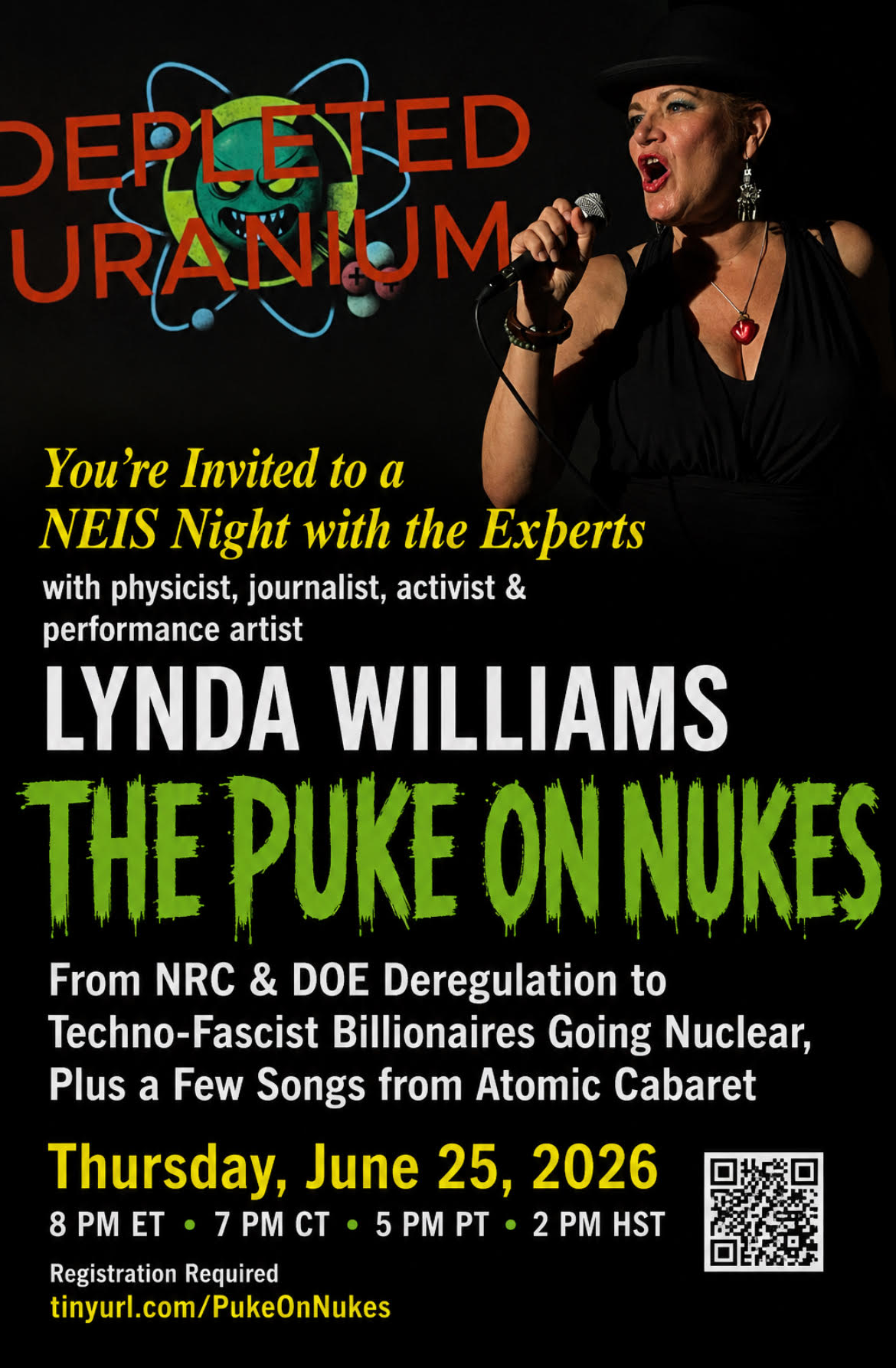
25 June- THE PUKE ON NUKES
Thursday, June 25, 2026
7pm Central Time (8pm ET, 6pm MT, 5pm PT) UTC – 5
From NRC & DOE Deregulation to Techno-Fascist Billionaires Going Nuclear, Plus a Few Songs from Atomic Cabaret REGISTER
26 June – Radiation Trainwreck at the NRC / Join the Protect Better Campaign – https://us02web.zoom.us/meeting/register/4ZlZ5_qLSHGiLSCg8FF6Bg#/registration


Cuba Is Not a Failed State – It Is a Besieged State
PETITION: “Global Appeal to Endorse Palestinian Right of Return of Refugees”
To see nuclear-related stories in greater depth and intensity – go to https://nuclearinformation.wordpress.com
-
Archives
- June 2026 (142)
- May 2026 (306)
- April 2026 (356)
- March 2026 (251)
- February 2026 (268)
- January 2026 (308)
- December 2025 (358)
- November 2025 (359)
- October 2025 (376)
- September 2025 (257)
- August 2025 (319)
- July 2025 (230)
-
Categories
- 1
- 1 NUCLEAR ISSUES
- business and costs
- climate change
- culture and arts
- ENERGY
- environment
- health
- history
- indigenous issues
- Legal
- marketing of nuclear
- media
- opposition to nuclear
- PERSONAL STORIES
- politics
- politics international
- Religion and ethics
- safety
- secrets,lies and civil liberties
- spinbuster
- technology
- Uranium
- wastes
- weapons and war
- Women
- 2 WORLD
- ACTION
- AFRICA
- Atrocities
- AUSTRALIA
- Christina's notes
- Christina's themes
- culture and arts
- Events
- Fuk 2022
- Fuk 2023
- Fukushima 2017
- Fukushima 2018
- fukushima 2019
- Fukushima 2020
- Fukushima 2021
- general
- global warming
- Humour (God we need it)
- Nuclear
- RARE EARTHS
- Reference
- resources – print
- Resources -audiovicual
- Weekly Newsletter
- World
- World Nuclear
- YouTube
-
RSS
Entries RSS
Comments RSS
 nuclear-news