Greenham Common’s renowned Women’s Peace Camp, the world’s longest-running anti-nuclear demonstration
Greenham Common 40 years on – when ordinary women drove nuclear weapons
out of UK. Three Welsh protesters reveal what they learnt after being part
of the renowned Women’s Peace Camp, the world’s longest-running
anti-nuclear demonstration, forty years ago in Berkshire.
Mirror 21st Aug 2021
https://www.mirror.co.uk/news/uk-news/greenham-common-40-years-ordinary-24809222
Astronauts to Mars – a game of cancer-russian-roulette, especially dangerous to women


women were more likely to develop lung cancer than men, suggesting a greater sex-based vulnerability to harmful radiation.
the risk to an astronaut exposed to space radiation is long-term rather than immediate. Without proper shielding (which tends to be rather heavy and thus prohibitively expensive to launch) their chances of developing cancer, as well as cardiovascular disease, cataracts and central nervous system damage, slightly increase each day they are in space. In a person’s cells, space radiation can sever both strands of a DNA molecule’s double helix. And while a few such instances might come with very limited risks, each additional severance raises the odds of developing a harmful mutation that could cause cancer………
New Space Radiation Limits Needed for NASA Astronauts, Report Says, Scientific American, By Ramin Skibba on July 14, 2021 https://www.scientificamerican.com/article/new-space-radiation-limits-needed-for-nasa-astronauts-report-says/ Although meant to minimize risks to human health, the proposed new limits would still be exceeded by any conceivable near-future crewed voyage to MarsAstronaut Scott Kelly famously spent an entire year residing onboard the International Space Station (ISS), about 400 kilometers above Earth, and his NASA colleague Christina Koch spent nearly that long “on station.” Each returned to Earth with slightly atrophied muscles and other deleterious physiological effects from their extended stay in near-zero gravity.
But another, more insidious danger lurks for spacefarers, especially those who venture beyond low-Earth orbit.
Space is filled with invisible yet harmful radiation, most of it sourced from energetic particles ejected by the sun or from cosmic rays created in extreme astrophysical events across the universe. Such radiation can damage an organism’s DNA and other delicate cellular machinery. And the damage increases in proportion to exposure, which is drastically higher beyond the protective cocoon of Earth’s atmosphere and magnetic field (such as on notional voyages to the moon or Mars). Over time, the accrued cellular damage significantly raises the risk of developing cancer.
To address the situation, at NASA’s request, a team of top scientists organized by the National Academies of Sciences, Engineering, and Medicine published a report in June recommending that the space agency adopt a maximum career-long limit of 600 millisieverts for the space radiation astronauts can receive. The sievert is a unit that measures the amount of radiation absorbed by a person—while accounting for the type of radiation and its impact on particular organs and tissues in the body—and is equivalent to one joule of energy per kilogram of mass. Scientists typically use the smaller (but still quite significant) quantity of the millisievert, or 0.001 sievert. Bananas, for instance, host minute quantities of naturally occurring radioactive isotopes, but to ingest a millisievert’s worth, one would have to eat 10,000 bananas within a couple of hours.
Every current member of NASA’s astronaut corps has received less than 600 millisieverts during their orbital sojourns, and most, including Koch, have received much less and can thus safely return to space. But a year on the ISS still exposes them to more radiation than experienced by residents of Japan who lived near the Fukushima Daiichi nuclear accidents of 2011.
“Everybody is planning trips to the moon and Mars,” and these missions could have high radiation exposures, says Hedvig Hricak, lead author of the report and a radiologist at Memorial Sloan Kettering Cancer Center in New York City. Using current spaceflight-proved technologies, long-distance voyages—especially to the Red Planet—would exceed the proposed threshold, she says.
That could be a big problem for NASA’s Artemis program, which seeks to send astronauts to the moon in preparation for future trips to Mars. Another problem for the space agency is that the epidemiological data it uses mostly come from a longevity study of Japanese survivors of atomic bomb blasts, as well as from the handful of astronauts and cosmonauts who have endured many months or even years in low-Earth orbit. NASA’s current space radiation limit, which was developed in 2014, involves a complicated risk assessment for cancer mortality that depends on age and sex, yet more relevant data are necessary, Hricak argues. In the atomic bomb survivor study, for instance, women were more likely to develop lung cancer than men, suggesting a greater sex-based vulnerability to harmful radiation. “But with the knowledge we presently have, we know we cannot make a comparison between high exposure versus chronic exposure,” Hricak says. “The environment is different. There are so many factors that are different.”
NASA wants to update its standards now because the agency is on the cusp of sending so many astronauts well beyond low-Earth orbit, where greater amounts of space radiation seem destined to exceed previously mandated exposure limits. Furthermore, Hricak says, having a single, universal radiation limit for all space travelers is operationally advantageous because of its simplicity. A universal limit could also be seen as a boon for female astronauts, [ Ed. a boon?when they still are more susceptible to cancer than men are?] who had a lower limit than men in the old system and therefore were barred from spending as many days in space as their male counterparts.
The new radiation limit proposed by Hricak and her team is linked to the risks to all organs of a 35-year-old woman—a demographic deemed most vulnerable in light of gender differences in the atomic bomb survivor data and the fact that younger people have higher radiation risks, partly because they have more time for cancers to develop. The goal of the radiation maximum is to keep an individual below a 3 percent risk of cancer mortality: in other words, with this radiation limit, at most three out of 100 astronauts would be expected to die of radiation-induced cancer in their lifetime.
“NASA uses standards to set spaceflight exposure limits to protect NASA astronauts’ health and performance, both in mission and after mission,” says Dave Francisco of NASA’s Office of the Chief Health and Medical Officer. He acknowledges that, while astronauts on Mars missions would benefit from the thin Martian atmosphere that provides some limited protection, “transit in deep space has the highest exposure levels.”
That means long-haul space trips come with the biggest risks. A stay on the lunar surface for six months or more—presuming, of course, that astronauts eventually have a presence there and do not spend most of their time in subsurface habitats—would involve nearly 200 millisieverts of exposure, a higher amount than an extended visit to the ISS. And an astronaut traveling to Mars would be exposed to even more radiation. Whether they reached the Red Planet through a lunar stopover or on a direct spaceflight, they could have experienced significant radiation exposure en route. Even before they embarked on the trip back home, they could have already exceeded the 600 millisievert limit. The entire voyage, which would likely last a couple of years, could involve well more than 1,000 millisieverts. So if astronauts—and not just robots—will be sent to Mars, NASA likely will need to request waivers for them,
Hricak says, although the exact process for obtaining a waiver has not yet been laid out.
The report’s proposal for a new radiation maximum is not without its critics. “For a mission to Mars, a 35-year-old woman right at that limit could have an over 10 percent chance of dying in 15 to 20 years. To me, this is like playing Russian roulette with the crew,” says Francis Cucinotta, a physicist at the University of Nevada, Las Vegas, and former radiation health officer at NASA. Despite the supposed benefits the new limits would have for female astronauts, he is concerned that the risks are particularly pronounced for younger women in space.
On the contrary, Hricak says, in its request for new limits, NASA has sought to be conservative. The European, Canadian, and Russian space agencies all currently have a higher maximum allowed dose of 1,000 millisieverts, while Japan’s limit is age- and sex-dependent like NASA’s current one, mainly because of a shared dependence on the atomic bomb survivor data.
But unlike someone in the vicinity of a nuclear explosion, the risk to an astronaut exposed to space radiation is long-term rather than immediate. Without proper shielding (which tends to be rather heavy and thus prohibitively expensive to launch) their chances of developing cancer, as well as cardiovascular disease, cataracts and central nervous system damage, slightly increase each day they are in space. In a person’s cells, space radiation can sever both strands of a DNA molecule’s double helix. And while a few such instances might come with very limited risks, each additional severance raises the odds of developing a harmful mutation that could cause cancer………
considering how little is known about various health risks from different kinds of space radiation, compared with radiation we are familiar with on Earth, researchers will surely continue with more studies like these to protect astronauts as much as possible. “I can tell you exactly how much exposure you’re going to get from a CT scan,” Hricak says, “but there are many uncertainties with space radiation.”….. https://www.scientificamerican.com/article/new-space-radiation-limits-needed-for-nasa-astronauts-report-says/
Extinction Rebellion climate activists block Faslane nuclear base

Extinction Rebellion block Faslane nuclear base entrance, Climate activists set up a blockade at the Faslane nuclear base by attaching themselves to plant pots. https://www.bbc.com/news/uk-scotland-glasgow-west-56941041 30 Apr 21,
Members of Extinction Rebellion Scotland staged the protest at the north gate of the base on the Gare Loch in Argyll and Bute.
The all-female group placed three planters painted with the words “Safe”, “Green”, and “Future” on the road.
Police Scotland said they were made aware of the incident at 06:20 and officers were at the scene.
HMNB Clyde – known as Faslane – is the Royal Navy’s main presence in Scotland.
It is home to the core of the submarine service, including the UK’s nuclear weapons, and the new generation of hunter-killer submarines.
The protest group said they were demanding a future “safe from the threat of nuclear weapons and environmental destruction”.
Extinction Rebellion said the action was part of the Peace Lotus campaign, a global day of anti-war resistance celebrating the anniversary of the end of the Vietnam War.
An HMNB spokesman confirmed police were in attendance and assisting Ministry of Defence officers in dealing with the protest. He added: “Well-established, fully co-ordinated procedures are in place to ensure the effective operation of HMNB Clyde is not compromised because of protest action.”
Women in government – the key to getting rid of nuclear power

Nuclear withdrawal was thanks to women, says former energy minister, https://www.swissinfo.ch/eng/nuclear-withdrawal-was-thanks-to-women–says-former-energy-minister/46423854 5 Mar 21, Having four women in Switzerland’s seven-person  government played a key role in the decision to phase out nuclear energy ten years ago, according to Doris Leuthard, who was energy minister at the time of the nuclear disaster in Fukushima on March 11, 2011.
The three other female cabinet ministers at the time were Micheline Calmy-Rey and Simonetta Sommaruga from the left-wing Social Democratic Party and Eveline Widmer-Schlumpf from the centre-right Conservative Democratic Party.Leuthard, from the centre-right Christian Democratic Party, admitted that she didn’t immediately realise the scale of the disaster at Fukushima.
“My first reaction was to say that that’s very far away from us, in Japan, in a country that deals seriously and professionally with events of this kind. I didn’t realise right away that it was a major disaster,” she told Le Temps.
In an interviewExternal link with Swiss newspaper Le Temps on Thursday, Leuthard said she would have had a hard time convincing men on the political right to abandon nuclear power.
“I think women are generally more sensitive to the environment and to the risks to which the population is exposed. When safety is at stake, they are willing to look at new solutions, even if it means paying a little more. They were more quickly convinced that we could opt for a new energy mix,” said Leuthard, who stepped down from the government at the end of 2018.
Only gradually did it become clear how serious the disaster was and that Switzerland had to act. On March 14 the government imposed a moratorium on nuclear projects.
“It was a decision that had to be taken quickly because, at the time, we intended to replace the three oldest [nuclear] plants with a modern, new-generation facility. We had to carry out a new risk analysis and see whether we could maintain the nuclear option in our energy policy. We informed the owners of the Swiss power plants, who had submitted applications to build this new-generation facility. It was a difficult moment, as our decision could cause them significant damage. […] I must admit that I didn’t sleep very well for two nights.”
In the end Switzerland did decide in 2011 to phase out nuclear power, which supplies about a third of the country’s electricity production.
In 2017 Swiss voters endorsed a new energy law that aims to promote renewable energy by banning new nuclear power plants and reducing energy consumption.
In December 2019 the 47-year-old Mühleberg nuclear power plant near Bern was permanently switched off – the first of five Swiss nuclear power reactors to be decommissioned. The event was considered so important that viewers could follow the progress live on Swiss television.
I am appalled at the idea of ”Mothers For Nuclear”


As a mother myself, I am appalled that such a group as ”Mothers For Nuclear” even exists. Dont

Christina Macpherson’s websites & blogs
they know about the effects of ionising radiation on women, especially pregnant women? Don’t they know about the breast cancers, the birth deformities in irradiated areas such as Pacific atomic bomb sites, and Belarus-Ukraine, near the Chernobyl site. No, they don’t seem to. (Perhaps that ‘s the beauty of a narrowly S.T.E.M. education?)
Both Heather Hoff and Kristin Zaitz work at the Diablo Nuclear Power Plant. Hoff worked as a plant operator, and now as a procedure writer. Zaitz works as a civil engineer.
Hoff was inspired by none other than that top nuclear schill Michael Shellenberger, and by the glossy nuclear advertising film ”Pandora’s Promise”.
They sound very sincere, but also very ignorant of the negative issues around the nuclear industry.
Why am I not surprised? The nuclear industry is busting its guts trying to get women onside. Their favourite thing is getting (preferably young and attractive) women into engineering, and at the top of nuclear companies. (This is good in two ways – good to promote the industry’s ‘gender equality’ image, and good if they muck up, as Leslie Dewan did, in her bogus claims for Transatomic’s molten salt reactor – let a woman take the flak!)
The thing is – lots of women have expertise in biology, genetics – and an understanding of the effects of ionising radiation. But the nuclear industry has got us all conned that these are ”soft”sciences. So – if you’ve got ”hard” scienvce knowledge – like engineering, then you can be an authority on nuclear issues.
These two women sound very sincere – alarmingly so.
The Activists Who Embrace Nuclear Power, New Yorker, By Rebecca Tuhus-Dubrow, February 19, 2021
To be fervently pro-nuclear, in the manner of Hoff and Zaitz, is to see in the peaceful splitting of the atom something almost miraculous. It is to see an energy source that has been steadily providing low-carbon electricity for decades—doing vastly more good than harm, saving vastly more lives than it has taken—but which has received little credit and instead been maligned. It is to believe that the most significant problem with nuclear power, by far, is public perception. ………..—the pro-nuclear world view can edge toward dogmatism. Hoff and Zaitz certainly seem readier to tout studies that confirm their views, and reluctant to acknowledge any flaws that nuclear energy may have. ……https://www.newyorker.com/tech/annals-of-technology/the-activists-who-embrace-nuclear-power
Dr Helen Caldicott as mentor for anti-nuclear activists
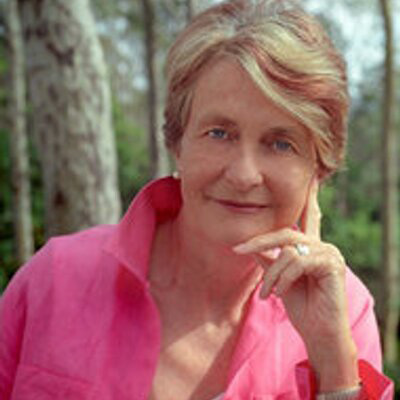 My Six Mentors, “………Helen Caldicott, MD, by Mary Olson, Gender and Radiation Impact Project, 1 January 20121
Helen Caldicott deserves a much greater place in our histories of the Cold War and ending the USA / USSR arms race than she generally gets. This is, perhaps, because she is powerful and a woman. A pediatrician, who in the 1970’s would not tolerate the radioactive fallout she and her patients were suffering from nuclear weapons tests in Australia, Helen and her family came to the USA. She and another physician named Ira Helfand revived what had been a local Boston organization of physicians and created a Nobel Prize winning organization called Physicians for Social Responsibility (PSR), which later participated in the creation of another Nobel Prize winning group, the International Physicians for the Prevention of Nuclear War (IPPNW). These two along with hundreds of other organizations committed to peace and nuclear disarmament formed the International Campaign for the Abolition of Nuclear Weapons (ICAN) which has helped to create the new Treaty on the Prohibition of Nuclear Weapons (see http://icanw.org/the-treaty ) and also won the Nobel Prize (2017).
Helen herself is a powerful communicator and will move audiences at a level that can change the course of someone’s life and work. She followed her own destiny to winning meetings with Mikhail Gorbachev, President of the Soviet Union, where she educated him about Nuclear Winter and the fact that nuclear is not a war that anyone can win. She also met with President Reagan in the era and diagnosing early-stage dementia… Her ability to bring the reality of the world to these men, and reality of these men to the world set her aside, in a class by herself—and was an enormous contribution to us all.
I first met Helen in the body of her Cold War block-buster book “Nuclear Madness.” I was in the midst of an existential crisis that could have become an even bigger health crisis. After college I needed a job (not yet a career) because I was broke, broken up from my first “true” love, and far from home. I got a job as a research assistant in a lab at a prestigious medical school; it was 1984.
Within 2 weeks, I was inadvertently contaminated with radioactivity (without my knowledge) by carelessness of a lab-mate. The radioactive material, Phosphorus-32 is used in research to trace biochemical activity in living organisms. This type of radioactivity is not deeply penetrating, so there was some reason not to panic, however the I was exposed continuously for over a week, and I also found radioactivity at home– my toothbrush was “hot”—so I had also had some level of internal exposure. I was terrified. The lab used concentrations of the tracer thousands of times higher than is typical.
The institution told me there was no danger, but because I was upset, they helped me transfer to a different job. No accident report was filed, and in the midst of transition, my radiation detection badge was never processed. It is not possible to know the dimensions of my exposure—I began having symptoms that were not normal for me. Many people, including some family members told me I was imagining things. No one in my circle understood how terrified I was.
I was fortunate that Helen had already written “Nuclear Madness”—the first edition came out in 1978, just before the March 1979 Three Mile Island nuclear meltdown in Harrisburg PA—an event that propelled the book into multiple printings including a Bantam Paperback edition that I found. It turned out that 7 years later I helped Helen to revise and update the same text for the 1994 WW Norton edition. It was Helen’s deep commitment to truth, to speaking and writing that truth, to empowering people to take action for good. Helen’s words accurately described radiation and its potential for harm, and in my panic about the unknown, this calmed me.
Every other authority I had encountered was trying to tell me there was no problem—when I knew they had no right to dismiss what had happened to me. I am quite certain that had I remained alone with my fear, despair, and confusion my panic would have resulted in behaviors that would have compounded any harm bodily from that radioactive contamination. Reading Helen’s work let me know there was at least one woman walking the Earth who did know what I was going through… it made it possible for me to choose recovery and walk away from a legal battle that would have forced me to maintain, hold and prove a myself a victim. Instead, following in Helen’s wake, I chose Peaceful Warrior. Thank you Helen! : ……….. https://www.genderandradiation.org/blog/2020/12/31/my-six-mentors
Mary Olson pays tribute to Rosalie Bertell, the great explainer of radiation impacts on health.
My Six Mentors, by Mary Olson, Gender and Radiation Impact Project, 1 January 20121
 “……………. Rosalie Bertell, PhD
It was Rosalie who most let me know that I am able to contribute original work towards the day that People, to decide not to split atoms any more. Human beings began splitting atoms in Chicago, in 1942. Rosalie, a PhD in mathematics and member of the Order of Gray Nuns, knew more than anyone else I have worked with, that all of it—every last nuclear license, and radioactive emission, all the waste and all the bombs and all the money congress gives to nuclear activities are choices. People made, and continue to make these decisions…and we can change our mind.
Rosalie studied radiation impacts and was committed to service on behalf of future generations. She won the Right Livelihood award for her work with communities impacted by nuclear industry. Often called the “alternative Peace Prize” – she was one of the first women to be honored. As a laureate, she was encouraged to find and mentor students. Rosalie hoped that I, and my coworker Diane D’Arrigo would go to graduate school and she could be our mentor. We decided since we were already in our 50’s to simply study with her, informally. We traveled, 5 or 6 times to the Mother House where she resided and she generously met with us in the last two years of her life. She was always small in stature, but at that point her back was bent and she barely came up to my chest, but still had the intensity of a wolverine!
It was Rosalie Bertell who helped me tackle one of the biggest challenges I have faced. After a public talk on radioactive waste policy that I gave during this time, a woman asked me if radiation was more harmful to women, to her, compared to a man. Even though I had studied and known many of the top independent radiation researchers, including Bertell, I had never heard that biological sex could be a factor for harm—other than in reproduction (pregnancy)—but that is more about the embryo and fetus than the woman. I told her that I was sorry, I did not know and would get back to her. In fact, I forgot.
Two years later, when nuclear reactors exploded in Japan at a site called Fukushima Daiichi, I remembered that question and knew it urgently needed an answer. I was unaware that Dr Arjun Makhijani and a team had written on sex differences in radiation harm in 2006 (see www.ieer.org ) and also did not turn that up as I searched for any information on differences between males and females. My findings, five years later are an independent confirmation of the IEER work.
Since I found nothing on a basic google dive, I called Rosalie, who was at that point nearing the end of her life, to ask if she had studied biological sex. She had not, and the one report she pointed me to was out of print. It was my second call, a week later, that prompted her to tell me that I would have to look at the data myself.
I had no idea that the National Academy of Science (NAS) had published tables with 60 years of data on cancers and cancer deaths among the survivors of Hiroshima and Nagasaki. Rosalie told me to find out for myself. I was shocked. I had stopped any formal study of math in the 6th grade…she was a mathematician—I asked her to do it, and she reminded me that she was dying. I protested again. It was her next words that pushed me. Rosalie said, “The data is divided by males and females so you can look at this question—and if there is a difference, it will be a simple pattern. It is good you do not have more math because if there is a difference, you will find it and not make it more complicated than it is.” She said to get a few pencils, a sharpener, an eraser and lots of paper, and go to it. I did.
The result was my first paper on the topic, “Atomic Radiation is More Harmful to Women,” (October 2011) published to the web in time for Rosalie to congratulate me. Three years later the paper was the basis for my invitation to speak at the global Vienna Conference on the Humanitarian Consequences of Nuclear Weapons. Three years later as the new Treaty on the Prohibition of Nuclear Weapons was in the work, I founded the Gender and Radiation Impact Project. Rosalie is the one who put rocket fuel in my determination to help. If the world decides to base radiation protection on Refence Little Girl—make every regulation in terms of protecting females who are infants—five years old, future generations have a chance. Rosalie is the one who modeled for me that it is possible to reach for the best possible outcome, and, indeed, we have an obligation to do so………..…… https://www.genderandradiation.org/blog/2020/12/31/my-six-mentors
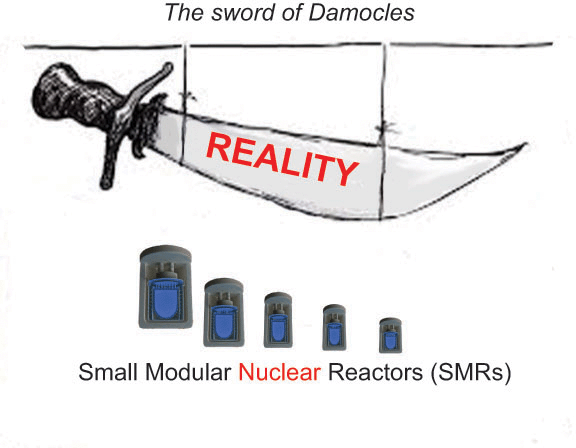
Small Nuclear Reactors (SMRs) if they work, will arrive too late to make a difference to global heating
 Is nuclear power the answer?, DECEMBER 8, 2020 JOHN QUIGGIN
The last (I hope) extract from the climate change chapter of Economic Consequences of the Pandemic. I’m in two minds about whether this is really needed. The group of pro-nuclear environmentalists seems to be shrinking towards a hard core who can’t be convinced (and some of them, like Shellenberger turn out to have been concern trolls all along). But every now and then I run across people who seem open-minded enough, but haven’t caught up with the bad news on nuclear.
Debates about decarbonizing electricity generation inevitably raise the issue of nuclear power. Since nuclear power generates no carbon dioxide emissions (except in the construction phase) it is a potential solution to climate change, with a strong body of advocates.
Some of this advocacy may be dismissed as point-scoring. Rightwing pundits who oppose any action on climate change simultaneously promote nuclear power as carbon free, with the aim of embarrassing environmentalist. There is, however, a small but vocal group of nuclear power advocates who are convinced that a massive expansion of nuclear power is the only way to replace coal-fired power………
Today the choice is not between new nuclear and new or existing coal. It is whether to allocate investment to building nuclear plants or to accelerating the shift to solar and wind energy.
The key problem is not safety but economics. New plants are safer and more sophisticated than those that failed in the past, but they are also massively more expensive to build, and quite costly to operate. The capital costs of recent projects in the US, France and Finland (none yet complete) have been around $10/kw, compared to $1/kw or less for solar. And, whereas solar PV is essentially costless to operate, the operating costs of nuclear power plants are around 2c/kwH. Even when solar PV is backed up with battery storage, it is cheaper to build and to operate, than new nuclear.
The facts speak for themselves. Over the last decade, only two or three reactors have commenced construction each year, not even enough to replace plants being retired. This isn’t the result of pressure from environmentalists or alarm about the safety of nuclear plants. The slowdown is evident in countries like China, where public opinion has little influence on policy decisions, and in countries where public opinion is generally favorable to new nuclear power. China failed to reach its 2020 target of 58 GW of installed power, and currently has only about 15 GW of nuclear power under construction. That compares to 55 GW of new solar and wind capacity installed in 2019 alone.
It is clear by now that large-scale nuclear reactors have no future. The last hope for nuclear power rests on Small Modular Reactors. The idea is that, rather than building a single large reactor, typically with a capacity of 1 GW, smaller reactors will be produced in factories, then shipped to the site in the required number. The leading proponent of this idea is Nuscale Power, which currently has a contract with UAMPS to supply a pilot plant with a dozen 60MW modules.
It remains to be seen whether SMR’s will work at all. Even if they do, it is not clear that the reduced costs associated with off-site manufacturing will offset the loss of the scale economies associated with a large boiler, let alone yield power at a cost competitive with that of solar PV.
In any case, the issue is largely irrelevant as far as the climate emergency is concerned. NuScale’s pilot plant, with a total capacity of 720 MW, is currently scheduled to start operation in 2029. Large-scale deployment will take at least a decade more .
If we are to have any chance of stabilising the climate, coal-fired power must be eliminated by 2030, and electricity generation must be decarbonized more or less completely by 2035. SMRs, if they work, will arrive too late to make a difference. ….https://johnquiggin.com/2020/12/08/is-nuclear-power-the-answer/#more-17451
The world’s banks must start to value nature and stop paying for its destruction
The world’s banks must start to value nature and stop paying for its destruction, Guardian, Robert Watson 28 Oct 20, As a new report spells out how financial institutions contribute to biodiversity loss, the clamour is growing for a new approach.
- Banks lent $2.6tn linked to ecosystem and wildlife destruction in 2019 – report
- The scientific community has long been unequivocal about biodiversity destruction. Last month, the UN reported that the world had failed to meet fully any of the 2020 Aichi bioiversity targets that countries agreed with fanfare in 2010, even as it found that biodiversity is declining at an unprecedented rate, and the pressures driving this decline are intensifying.This week’s Bankrolling Extinction report finds that financial institutions provide the capital that is funding over-exploitation of our lands and seas, putting biodiversity in freefall. Last year, the world’s 50 biggest banks provided $2.6tn (£1.9tn) in loans and other credit to sectors with a high impact on biodiversity, such as forestry and agriculture. Bank by bank, the report authors found a cavalier ignorance of – or indifference to – the implications, with the vast majority unaware of their impact on biodiversity.
In short, this report is a frightening statement of the status quo.
- Fortunately, signs are emerging that some governments are – slowly – taking aim at financial backers of the destruction of the natural world. They must now push more forcefully. In the wake of Covid-19, treasury cupboards may be bare, but with new policies and limited recovery funds, they can steer trillions of dollars of private capital towards a nature-positive response to coronavirus, to spur growth, prosperity and resilience without returning to business as usual over-consumption and climate and biodiversity risk.
- Voices from economics and finance are starting to add impetus and rationale for such momentum. One of the world’s foremost business groups, the World Economic Forum (WEF), has recognised the economic importance of nature. In its annual Global Risks Report, published earlier this year, WEF found that for the first time environmental risks dominated perceived business threats. Biodiversity loss was considered among the five most impactful and most likely risks in the next decade, with concerns ranging from the potential collapse of food and health systems to the disruption of entire supply chains. ……………. https://www.theguardian.com/environment/commentisfree/2020/oct/28/the-worlds-banks-must-start-to-value-nature-and-stop-paying-for-its-destruction-aoe
Womankind arise! — Beyond Nuclear International

Still no equal protection under radiation law
Womankind arise! — Beyond Nuclear International
Nuclear exposure standards discriminate on the basis of sex
By Linda Pentz Gunter, 20 Sept 20,
As we mourn the passing of Supreme Court justice, Ruth Bader Ginsburg, we look back at her landmark victories against discrimination “on the basis of sex” and wonder how nuclear regulations might have stood up to her legal scrutiny. As things currently stand, the nuclear power industry gets away with “allowable” radiation exposure levels that discriminate against women……….
And despite RBG’s immense contribution to our greater wellbeing, as women, we still face discrimination in so many walks of life. That could be about to get worse.
That discrimination remains most infuriatingly true when it comes to the nuclear power industry which is not, it turns out, an equal opportunity poisoner, as we have shown in our earlier articles about Native American and African American communities.
Women and children, and especially pregnant women, are more vulnerable — meaning they suffer more harm from a given dose of radiation than the harm a man suffers from that same dose.
One should quickly add here that scientists still agree that there is no completely safe dose of radiation. In fact, when a dose is described as safe, it doesn’t mean harmless. It means something called “As low as reasonably achievable”, which means as safe as we are prepared to protect for — or, really, as safe as the nuclear industry is willing to pay for.
So not really safe then, and when they say “safe”, the question women must ask is: safe for whom?
In the US, that means safe for someone called Standard Man or sometimes Reference Man. That is on whom the “allowable” radiation exposure standards are based.
Who is Standard Man? ….
Discrimination strikes again here, on the basis of race and age, because the amount of radiation exposure that is considered “safe” for an individual in the US is based on what would be safe for a healthy, robust, 20-30-something white male…….. more https://wordpress.com/read/feeds/72759838/posts/2922365220
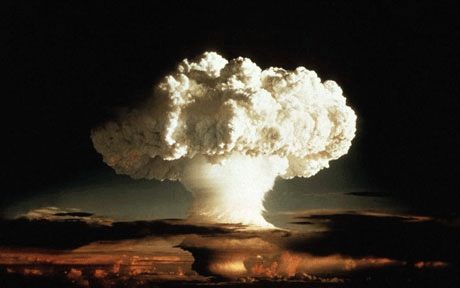
Nuclear bomb testing – the cruellest legacy of environmental injustice and racism
|
Nuclear testing legacy is ‘cruellest’ environmental injustice, warns rights expert,
https://news.un.org/en/story/2020/07/1068481 16 July 2020
Human RightsThe dangerous legacy of nuclear weapons testing continues to affect many communities, a leading rights expert said on Thursday, on the 75th anniversary of testing in the United States, that heralded the nuclear age.
In an appeal to governments worldwide to get rid of weapons of mass destruction, UN Special Rapporteur on toxics, Baskut Tuncak, said that the Trinity tests in New Mexico on 16 July 1945, were the prelude to “two horrific explosions suffered by (the) innocent people of Japan”, during the Second World War.
They were also followed by the detonation of hundreds of nuclear bombs over vulnerable communities in the Pacific, and the disposal of radioactive waste on lands and territories of indigenous peoples. Paradise lostThis had created a legacy of nuclear testing that “is one of the cruellest examples of environmental injustice witnessed” in “what should be a peaceful island paradise”, said Mr Tuncak, who reports to the Human Rights Council in Geneva. From 1946-58, 67 nuclear bombs were detonated on the Marshall Islands, he said, the equivalent of more than 1.5 “Hiroshima-sized explosions every day for 12 years”. Communities “have suffered unimaginably” from radioactive contamination and this continues today “with a legacy of contamination, illness and anguish”, the expert insisted.
Twin environmental disasters made matters worse, he added, referring to climate change-induced sea level rise and nuclear waste concentrated in a radioactive “tomb”. 200 tests in 30 yearsSimilarly, in French Polynesia, over 200 nuclear tests were conducted over a 30-year period from 1966 to 1996, subjecting inhabitants to associated health and environmental damage, the Special Rapporteur said. From Greenland to the indigenous territories of the United States, he warned that people continued to suffer from the nuclear testing era. Waste not“In recent decades, numerous Native American tribes received funding to store unwanted nuclear waste on their lands,” he said. “Those of Point Hope, Alaska, became recipients of radioactive soil and higher cancer rates that are believed to have been the foreseeable result. And the people of Greenland discovered radioactive waste left by the US military, unbeknownst to them as the ice continues to melt in the Arctic.” This discriminatory approach should be addressed by all States as part of the discussion on “systemic racism” and nuclear disarmament, Mr. Tuncak insisted. “Unaddressed, the dangers of radioactive contamination will persist for centuries, and so too will the harmful legacy of racism that surrounds this tragic chapter of humanity,” he added. |
|
Climate change is seriously hitting women, right now

Extreme weather and rising seas are increasing the burden of work, ill-health and violence faced by women who are forced to leave home or left behind as menfolk seek jobs elsewhere
BARCELONA, – From sexual violence in displacement camps to extra farm work and greater risk of illness, women shoulder a bigger burden from worsening extreme weather and other climate pressures pushing people to move for survival, a global aid group said on Tuesday.
Scientists expect forced displacement to be one of the most common and damaging effects on vulnerable people if global warming is not limited to an internationally agreed aim of 1.5 degrees Celsius, CARE International noted in a new report.
“This report shows us that climate change exacerbates existing gender inequalities, with women displaced on the frontlines of its impacts bearing the heaviest consequences,” said CARE Secretary General Sofia Sprechmann Sineiro.
For example, women and girls uprooted by Cyclone Idai, which hit Mozambique, Zimbabwe and Malawi in 2019, are still facing serious health threats due to poor access to basic services and sanitary products, the report said.
And in Ethiopia, where about 200,000 people were forced from their homes last year by drought and floods, women living in overcrowded shelters face higher levels of sexual violence there and on longer, more frequent trips to fetch water and firewood.
Sven Harmeling, CARE’s global policy lead on climate change and resilience, said displacement linked to climate stresses was already “a harsh reality for millions of people today”.
If global warming continues at its current pace towards 3C or more above pre-industrial times, “the situation may irrevocably escalate and evict hundreds of millions more from their homes”, he added.
Climate change impacts are likely to strengthen and “unfold over the next couple of years, and not only in the distant future”, he told the Thomson Reuters Foundation.
Failure to prepare for them will lead to more suffering and people having to abandon their land, he said. Many places already are affected by multiple climate shocks and rising seas, making it harder for those displaced to return, he added.
“(Climate extremes) may mean more men are leaving to try to find income elsewhere, and that puts additional burden on the women who stay back and have to try to earn (money) while taking care of the family,” he said. ……….
In most countries, climate measures supported by public finance do not adequately prioritise women, CARE noted, calling for at least 85% of funding for adaptation projects to target gender equality as an explicit objective by 2023 at the latest.
But some projects are making women a priority, it said……… https://news.trust.org/item/20200707051425-a5d5v/
University boffins discuss the eternal problem of nuclear wastes
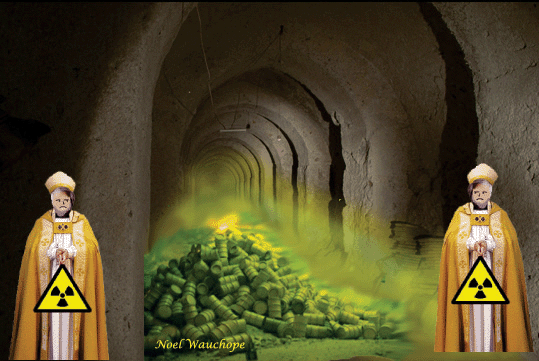
 Amazing – still none of these scientists suggests stopping making this radioactive trash!
The problem of nuclear waste, The Naked Scientists, 07 April 2020 Interview with Claire Corkhill, University of Sheffield
Part of the show The Rise of Radioactivity
Chris – So what you’re saying is, if we’ve got say something that looks like glass, because it’s spitting out all these energetic particles of radiation all the time, it’s slowly going to shatter the glass. It’s almost like shaking the glass very, very hard for hundreds of thousands of years; it’s eventually going to fall to pieces and it will no longer be any good at retaining and constraining the radioactive products inside.
Adam – How do we design something in the future so that this stuff stays where it is, and isn’t archeologist bait, and they suddenly dig up a radioactive cube of glass?
Male dominated climate talks falter, while women’s perspective is excluded
|
The first step to achieving this aim would be gender parity at international climate conferences such as the Madrid COP. While we don’t yet know how many of the 13,000 registered governmental delegates were women, based on past numbers they are unlikely to make up more than a quarter. This is not the only forum where the experiences of women are ignored. Our research, spanning Kenya, Cambodia and Vanuatu, has found women are working collectively to strengthen their communities in the face of climate change. But their knowledge about climate risk is dismissed by scientists and political leaders. Bridging climate awareness When women are excluded from local and national-level governance, the absence of their voices at regional and global levels, such as COP meetings, is virtually assured. Our work across Africa, Asia and the Pacific found scientists – generally male – lack awareness of the knowledge women hold about the local consequences of climate change. At the same time, those women had little access to scientific research. In places where the labour is divided by gender, women and men learn different things about the environment. Though the women in our research generally did not know about government policies or programs on climate change and disaster risk reduction, they were very aware of environmental change. In Kenya, the pastoralist women we spoke to are acutely aware of the link between their physical insecurity and extreme drought. Continue reading |

1 This Month

of the week – Shut Down Drone Warfare!


Tell the Ukrainian Government to Drop Prosecution of Peace Activist Yurii Sheliazhenko

Petition to revoke the licensing of the Near Surface Nuclear Disposal Facility (NSDF) at Chalk River. https://www.ourcommons.ca/petitions/en/Petition/Details?Petition=e-7247
To see nuclear-related stories in greater depth and intensity – go to https://nuclearinformation.wordpress.com
-
Archives
- March 2026 (237)
- February 2026 (268)
- January 2026 (308)
- December 2025 (358)
- November 2025 (359)
- October 2025 (376)
- September 2025 (257)
- August 2025 (319)
- July 2025 (230)
- June 2025 (348)
- May 2025 (261)
- April 2025 (305)
-
Categories
- 1
- 1 NUCLEAR ISSUES
- business and costs
- climate change
- culture and arts
- ENERGY
- environment
- health
- history
- indigenous issues
- Legal
- marketing of nuclear
- media
- opposition to nuclear
- PERSONAL STORIES
- politics
- politics international
- Religion and ethics
- safety
- secrets,lies and civil liberties
- spinbuster
- technology
- Uranium
- wastes
- weapons and war
- Women
- 2 WORLD
- ACTION
- AFRICA
- Atrocities
- AUSTRALIA
- Christina's notes
- Christina's themes
- culture and arts
- Events
- Fuk 2022
- Fuk 2023
- Fukushima 2017
- Fukushima 2018
- fukushima 2019
- Fukushima 2020
- Fukushima 2021
- general
- global warming
- Humour (God we need it)
- Nuclear
- RARE EARTHS
- Reference
- resources – print
- Resources -audiovicual
- Weekly Newsletter
- World
- World Nuclear
- YouTube
-
RSS
Entries RSS
Comments RSS
 nuclear-news