Shock Horror! They’re letting some WOMEN into the Cop29 climate summit committee

Women added to Cop29 climate summit committee after backlash. Panel was
originally composed of 28 men, a move condemned as ‘regressive’ and
‘shocking’. The president of Azerbaijan has added 12 women to the
previously all-male organising committee for the Cop29 global climate
summit, which the country will host in December.
Guardian 19th Jan 2024
https://www.theguardian.com/environment/2024/jan/19/women-cop29-climate-summit-committee-backlash
First Ladies make joint call on the world about Palestine
17/11/2023 https://uzdaily.uz/en/post/84825
Tashkent, Uzbekistan (UzDaily.com) — In a gathering in Istanbul on 15 November 2023, the spouses of Heads of States and Government, along with representatives from various countries, convened at the “United for Peace in Palestine” Summit.
Turkiye’s First Lady Emine Erdoğan hosted the summit titled “One Heart for Palestine” with the spouses of leaders in Istanbul.
Spouses and special representatives of state leaders from many countries, including Qatar, Malaysia, and Uzbekistan, conveyed a message to the world for the innocent people of Gaza.
Their primary objective: to bring global attention to the humanitarian crisis in Gaza and call for an end to the tragic suffering of civilians, particularly vulnerable groups such as children, women, patients, and the disabled.
The summit aimed to advocate for a just and lasting peace and mobilize the international community to address what they assert may constitute war crimes.
“We are deeply concerned about the humanitarian tragedy in the Occupied Palestinian Territories, including Gaza and the West Bank, especially East Jerusalem, due to the war that has unfolded since October 7, 2023,” the statement of the summit said.
A major focus of their statement was the blockade and embargo imposed on Gaza, which they deemed incompatible with international law. They underscored that this blockade not only prevents civilians from accessing basic necessities but has also evolved into a severe violation of human rights.
The leaders’ spouses did not shy away from highlighting the grim statistics, pointing out that the tragedy in Gaza since 7 October has resulted in the deaths of more than 11 thousand civilians, predominantly children and women. They labeled this as one of the most serious violations of international law.
The urgency of the situation prompted a call for immediate action to ensure the safety of pregnant women, children, infants, and patients who find themselves in inhumane conditions and are at risk of massacre.
The summit attendees expressed a collective desire for a two-state solution, envisioning a future where both Israelis and Palestinians can raise their children in peace and security.
The summit’s joint declaration outlined a series of calls to action, urging the global community to intervene promptly:
1. Immediate and collective action to halt the ongoing massacres in Gaza.
2. An immediate cessation of Israeli attacks targeting civilian infrastructure, including schools, hospitals, medical facilities, refugee camps, United Nations facilities, and places of worship.
3. An urgent ceasefire to end hostilities, accompanied by the provision of unhindered, sufficient, and safe humanitarian assistance to civilians in Gaza.
4. A firm rejection of any attempts to forcibly displace the Palestinian civilian population, recognizing the severe impact of displacement, especially on women, children, and the elderly.
5. Immediate and full compliance by all parties with their obligations under international law.
As the international community grapples with this call to action, the “United for Peace in Palestine” Summit marks a collective plea for humanity and justice in the face of a dire humanitarian crisis.
Women with medical education to be banned from leaving Ukraine and forced to sign up for military service – Kyiv Post
Exit from Ukraine may be restricted for some women – Kyiv Post
08.09.2023 https://www.voiceofeurope.com/exit-from-ukraine-may-be-restricted-for-some-women-kyiv-post/
Starting from October 1st, women with medical and pharmaceutical education may be required to register for military service but it is not yet clear whether they will be subject to travel restrictions from Ukraine. This might be similar to men aged 18-60 who are subject to mobilization, as reported by the Kyiv Post newspaper.
According to reports published on the parliament’s website and later removed, Fedir Wenisławski, the representative of the President of Ukraine in the Supreme Council and a member of the Committee on National Security, Defense and Intelligence of the Supreme Council, announced that women must register with military commissions and may not be allowed to leave the country from October 1st.
Wenisławski claimed that after registration, women would be considered conscripts and would be subject to specific procedures regarding foreign travel.
Since the outbreak of the conflict between Russia and Ukraine and the declaration of a state of emergency in Ukraine, men aged 18-60 have been unable to leave the country due to mandatory military conscription. However, Andrij Demczenko, the spokesperson for the Border Guard Service of Ukraine, expressed doubts about the implications of women’s registration with military commissions.
Demczenko stated that border guards have not been informed of any additional restrictions on the freedom to leave Ukraine due to women’s registration in military commissions.
He noted, however, that if such changes in regulations come into effect, border guards will monitor and enforce the new rules.
Lauding Lise Meitner, Who Said ‘No’ to the Atomic Bomb.

when Meitner was invited to work on the Manhattan Project, she responded, “I will have nothing to do with a bomb.”
The movie ‘Oppenheimer’ makes no mention of the co-discoverer of nuclear fission. But she would have wanted it that way.
BY OLIVIA CAMPBELL , 08.24.2023 https://undark.org/2023/08/24/lauding-lise-meitner-who-said-no-to-the-atomic-bomb/?utm_source=Undark%3A+News+%26+Updates&utm_campaign=ae4e66ce7b-RSS_EMAIL_CAMPAIGN&utm_medium=email&utm_term=0_5cee408d66-185e4e09de-%5BLIST_EMAIL_ID%5D
THE FILM “OPPENHEIMER,” which tells the story of the Manhattan Project’s development of the atomic bomb, has made quite a splash this summer, with audiences and critics alike hailing it as a riveting slice of scientific history. But it also has some viewers asking: Where are the women? In the film, Lilli Hornig is the only woman scientist named and portrayed working on the project, though she was not the only one involved. Charlotte Serber, shown as project leader J. Robert Oppenheimer’s secretary, actually did far more. Some scholars argue that physicist Lise Meitner, co-discoverer of nuclear fission, should have been included. As a biographer of historical women scientists, I should be the first in line to decry the erasure or minimization of women’s contributions. But should women be written into stories merely for the sake of representation, without first considering the context and the person? Is this what they would have wanted?
In Meitner’s case, the answer is “no.” Her discovery may have been crucial to creating the atomic bomb, but she wanted nothing to do with it nor wanted to be depicted in films about it. And I believe Meitner’s refusal to participate in the weaponization of her work on moral grounds makes her more worthy of commemoration than Oppenheimer. She chose humanity over notoriety.
According to Ruth Lewin Sime’s detailed biography, “Lise Meitner: A Life in Physics,” Meitner was likely the first female professor in Germany and the head of physics at the Kaiser Wilhelm Institute for Chemistry in Berlin. In 1934, she became so intrigued by Italian physicist Enrico Fermi bombarding elements with newly discovered particles called neutrons that she decided to do some tests of her own. After performing a few experiments, Meitner could tell that something exciting lay on the other side of her digging. She also knew she’d need an interdisciplinary team to properly conduct the research and interpret the results, so she recruited her chemist colleague Otto Hahn and later his assistant Fritz Strassmann. Little did she comprehend that they were on the cusp of upending the principles of nuclear physics.
Over the next four years, Meitner and her team spent their days irradiating various elements with neutrons and identifying the decay products. Meitner would use physics to explain the nuclear processes, and Hahn would conduct chemical analyses. In late 1938, Hahn and Strassmann discovered that neutron-bombarded uranium-235 samples seemed to contain barium — a much lighter element than expected, which the pair could not explain.
Meitner was headed toward the zenith of her career. But she had Jewish ancestry, so while making scientific history, she was also desperately searching for a way to make it out of Nazi Germany alive. With the help of a vast network of colleagues, she fled to Sweden in the summer of 1938. Meitner continued collaborating with colleagues via telephone, letters, and secret meetings for several months after her covert escape, but she would never move back to Germany.
In December 1938, Hahn wrote to Meitner about the puzzling barium results. This led Meitner and her nephew, nuclear physicist Otto Robert Frisch, into a discussion in which they calculated that bombarding uranium with neutrons could split the uranium atom’s nucleus in half, releasing 200 million electron volts of energy. Meitner and Frisch published their results in the scientific journal Nature on Feb. 11, 1939, proposing the process should be called “fission,” named after the biological term used to describe cell division. But Hahn and Strassmann published their own analysis in the journal Naturwissenschaften on Jan. 6. (And Hahn alone was awarded the 1944 Nobel Prize in Chemistry for the discovery of nuclear fission.)
Within a few short months of the papers, dozens of physicists had confirmed the process: uranium-235 atoms absorbed loose neutrons, causing them to become unstable and split. The process, some thought, might prompt a chain reaction. If so, the fission of just one pound of uranium-235 would release the same amount of explosive energy as roughly 8,000 tons of TNT.
The potential practical applications were many, but Meitner refused to be a part of the weaponization of her work. She’d experienced the horrors of war up close during her stint as a nurse at a military hospital near the Russian front in World War I and didn’t want to be involved in the creation of something that would bring pain, suffering, and death. Few scientists refused to help their side create weapons during the war, yet when Meitner was invited to work on the Manhattan Project, she responded, “I will have nothing to do with a bomb.”
When Meitner heard the news of the bombing of Hiroshima, she went for a five-hour walk. What had her science wrought? Rumors flew about her role in the project, despite her clear lack of participation. The Stockholm Expressen newspaper surmised that the bomb had been invented because a Jewish scientist escaped Germany and passed her secrets along to the Allies. Time magazine proclaimed Meitner a “pioneer contributor to the atomic bomb.” But she knew nothing of its creation and deplored this sensationalized, largely false publicity.
In January 1946, Meitner traveled to the U.S. to present lectures and teach classes at several universities across the country, as well as visit old friends and family who had immigrated there when fleeing the Nazis. At the airport in New York, she was met with a horde of photographers and reporters. At a Women’s National Press Club banquet where she was awarded “Woman of the Year,” Meitner sat next to President Harry Truman. When discussing the bomb, both agreed they wished for it never to be used again.
And yes, there were movie offers. Metro-Goldwyn-Mayer asked Meitner to approve of her depiction in the script for “The Beginning or the End,” a film about the development and use of the atomic bomb. Meitner wrote to Frisch that the script was “nonsense from the first word to the last” and that she “answered that it was against my innermost convictions to be shown in a film, and pointed out the errors in their story.” Oppenheimer, on the other hand, approved of the use of his likeness in the movie, apparently welcoming of the media attention.
MGM hoped a bigger payday might persuade Meitner to reconsider. In response, she gave three friends power of attorney and advised them to sue MGM on her behalf if any woman scientist appeared in the film. Meitner continued to refuse permission to use her name in films and plays.
Despite her work being corrupted to create death, Meitner never lost sight of the good that could come of the pursuit of scientific knowledge. “Science makes people reach selflessly for truth and objectivity,” she asserted in 1953. “It teaches people to accept reality, with wonder and admiration, not to mention the deep joy and awe that the natural order of things brings to the true scientist.”
History loves to laud the Oppenheimers: the ones who push the envelope, who puzzle through conundrums in the face of challenges, and who say “yes.” Saying “no” — choosing not to participate — is much less cinematic. But in this case, I think a moral objection is much more worth celebrating. #nuclear #antinuclear #nuclearfree #NoNukes
Brussels: Global Women For Peace United Against NATO Meet With EU Parliament, NATO Representatives
SCHEERPOST, By Colonel (Ret) Ann Wright / Popular Resistance, July 18, 2023
The weekend before the NATO summit in Vilnius, Lithuania, Global Women for Peace United against NATO representing women in 35 countries met July 6-9, 2023 for three days of peace discussions in Brussels, Belgium.
I am writing with details of each of the excellent panels and webinars to provide a sense of the numbers of women from around the world who participated in the program.
Photos of the various events in the conference are being posted in the media section of the Global Women’s website. Video recordings of the sessions are included for each session, but due to technical problems with the recordings, some are not of as good of quality as we had wished.
Global Women Meet With Members of the European Parliament
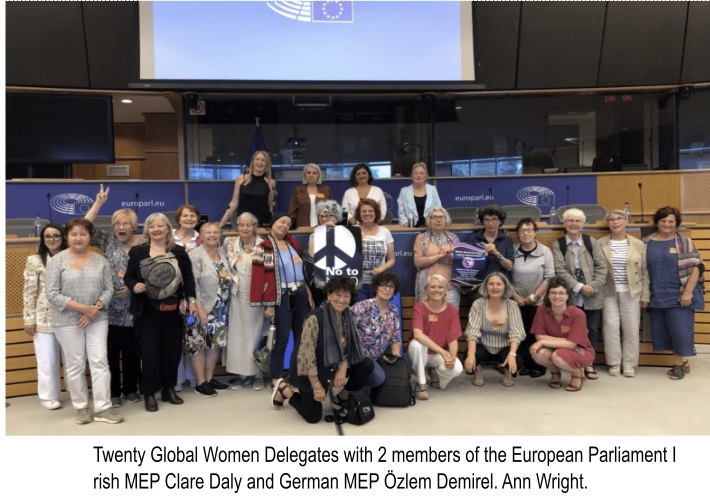
On July 6, 2023, twenty Global Women delegates met with members of the European Parliament to express their concern about the war-making role of NATO. The meeting was moderated by Skeyi Koukouma, from Cyprus, Secretary General of the Progressive Women’s Movement POGO. Irish member of the European Parliament Clare Daly and German member of the European Parliament Özlem Demirel spoke to the Global Women delegation about their concerns about NATO. The delegation gave a copy of the founding statement of Global Women to the members of the European Parliament.
MEP Clare Daly forcefully said that war and militarism are anathema to feminism and equality and stressed that equality, justice and peace are the principles that underpin women’s struggle for freedom. She emphasized that there is no place for militarism or the use of violence to achieve geopolitical goals. She underscored that NATO’s purpose is domination, not justice or the defense of human rights. MEP Daly emphasized that women must resist NATO’s policies, calling for its dismantling and the restoration of equality and peace and not allow NATO to co-opt the use of the term “Feminine Foreign Policy” and “Women, Gender and Equality.”
In her speech, MEP Özlem Demirel referred to the need for immediate demilitarization and obtaining peace only through peaceful means. She also stressed that the funds given for the purchase of arms and military equipment are at the expense of having funds for the strengthening of health, education and other services for the people worldwide.
Almost all of the twenty Global Women delegates took turns speaking, each emphasizing the problems faced in their countries because of NATO’s military actions and mandatory military expenditures. The need for world peace, demilitarization, for human services such as health and education and for strengthening the protection of human rights was emphasized by all delegates…………………………………………………………………………………………………………………………
We will continue to meet to strengthen our international/global solidarity and plan for actions July 9-11, 2024 in Washington, DC for the 75th anniversary of NATO. https://scheerpost.com/2023/07/18/brussels-global-women-for-peace-united-against-nato-meet-with-eu-parliament-nato-representatives/
The Women of Three Mile Island
CounterPunch BY KARL GROSSMAN 12 May 23
Radioactive: The Women of Three Mile Island is the title of a newly-released documentary feature film directed, written and produced by award-winning filmmaker Heidi Hutner, a professor of environmental humanities at Stony Brook University, a “flagship” school of the State University of New York.
With greatly compelling facts and interviews, she and her also highly talented production team have put together a masterpiece of a documentary film.
It connects the proverbial dots of the 1979 Three Mile Island nuclear plant disaster—doing so brilliantly.
The documentary has already received many film awards and has had a screening in recent months in New York City—winning the “Audience Award for Best Documentary” at the Dances With Films Festival—and Harrisburg, Pennsylvania; Sarasota, Florida; Dubuque, Iowa; Long Island, New York; First Frame International Film Festival in New York City; the Environmental Film Festival in Washington D.C., and is soon the featured film at Kat Kramer’s #SHEROESForChange Film Festival in Los Angeles and the Cinequest Film Festival in San Jose, California, as well as the Uranium Film Festival in Rio de Janeiro in Brazil. And there will be tours across the U.S.
Resident after resident of the area around Three Mile Island is interviewed and tells of widespread cancer that has ensued in the years that have followed the accident—a cancer rate far beyond what would be normal. Accounts shared in the documentary are heartbreaking.
A whistleblower who had worked at the nuclear plant tells Hutner of the deliberate and comprehensive attempt by General Public Utilities, which owned TMI, to cover up the gravity of the accident and its radioactive releases, especially of cancer-causing Iodine-131 and Xenon 133.
An attorney, Lynne Bernabei, involved in litigation in the wake of the accident, says the Three Mile Island “cover-up was one of the biggest cover-ups in history.” Meanwhile, the U.S. Nuclear Regulatory Commission which is “supposed to protect the public” has then and since been just “interested in is promoting the [nuclear] industry. This is corrupt,” says attorney Joanne Doroshow, now a professor at New York Law School and director of the Center for Justice & Democracy. Many examples of this are presented.
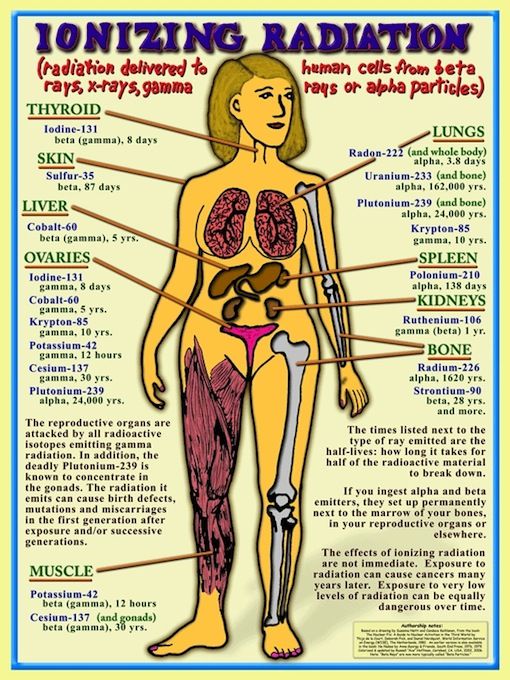
The documentary’s focus on women includes women being far more at risk to the effects of radioactivity than men. Mary Olson, a biologist, founder, and director of the Gender & Radiation Impact Project, says in the film that those setting radiation standards in the U.S. from the onset of nuclear technology in 1942, based impacts on a “25 to 30 years-old” male “defined as Caucasian.” She said, “It has come to be known as the ‘Reference Man.” However, Olson cites research findings that “radiation is 10 times more harmful to young females” and “50 percent more harmful to a “comparable female” than it is to “Reference Man” who is “more resistant” to radioactivity than a woman.
There’s the scientist Dr. Aaron Datesman, who is now pursuing a major chromosomal study regarding the impact of the disaster on the health of people in the area, and how people have been harmed despite the denials of the nuclear industry. This study is based on his recent ground-breaking work, “Radiological Shot Noise,” in Nature.
And more and more.
………………………………… Hutner, in speaking about the focus on women in Radioactivity: The Women of Three Mile Island, explains: “Following health and safety disasters, it is often women on the ground fighting back, and over and over throughout nuclear history, these women are gaslighted, silenced, called hysterical and ‘radiophobic.’ The result of such silencing: we lose significant information about nuclear history, science, and health.”
Hutner goes on: “What I have dug up after over 20 years of ecofeminist research is shocking—Dr. Alice Stewart’s research on the danger of X-rays to fetuses in the womb; Rachel Carson’s writing about radiation and bioaccumulation; Dr. Helen Caldicott’s warnings about the dangers of nuclear weapons and her peace and vital medical health advocacy as a physician (she has been attacked mercilessly and unfairly by male critics on sexist grounds); Mary Olson’s study of the alarming danger of radiation to girls and women, Leona Morgan’s decolonization activism to protect indigenous communities from uranium extraction and poisoning, and the dumping radioactive waste on native lands; poet activist Kathy Jetnil-Kijner’s story-telling about the suffering of women miscarrying in the Marshall Islands after the 67 nuclear test-bombing by the U.S. There are endless stories such as these.”

“By erasing such women’s voices, by gaslighting these women, men have erased significant human stories, science, research,” says Hutner. “This is a classic sexist maneuver. Call women and those who speak up about the dangers of nuclear technology as radiophobic, hysterical, and incapable of understanding science. As the women in Radioactivity explain, when they spoke at the Nuclear Regulatory Hearings and meetings, asking intelligent questions about the verity of the nuclear company’s and NRC’s claims, and armed with detailed information regarding their corruption and cover-ups—what really happened—the women were laughed at, mocked, told to ‘go home and bake cookies.’”
“That’s why we made Radioactive. The public needs to know and understand how they are being lied to, how key aspects of nuclear disasters and radiation impacts have been swept under the rug. And at what cost. This is life and death. An so we focus on buried women stories, and in subsequent film projects we hope to make as part of a series, we will bring in the silenced voices of black, brown, and women’s indigenous groups impacted unequally by nuclear disasters.”
She adds: “The film could not come at a more important time for a number of reasons. With nuclear power being discussed in some circles as an ‘answer’ to our climate crisis, we believe anyone seeing this film will walk away with the unmistakable conclusion that nuclear power must be off the table. TMI is one of a long list of environmental disasters and cover-ups that have caused serious harm to surrounding communities, which will last decades. It was and continues to be the lesson of what happens when a corporation and industry lacking integrity, regulated by an agency completely captured by that industry, is put in charge of people’s lives. TMI happened 44 years ago. But when it comes to systems meant to protect the public’s health and safety from nuclear hazards, nothing has changed and in fact, has only gotten worse.”
Comments about the documentary include:………………………………………………………………………………………..
The documentary website is: https://radioactivethefilm.com/. There you will find listings for upcoming screenings.
Hutner says: “We made Radioactive: The Women of Three Mile Island because the issue of nuclear dangers has ‘died’ as an important cause. It was once a global movement. Front page news. One million people marched in Central Park and so did millions around the world. The big screen popped with blockbusters on the topic. Today: few know or care about nuclear dangers—historical or in the present.”
“Sadly,” Hutner continues, “younger folks are taught nothing in school about nuclear history except a brief lesson (if they are taught anything) on how great nuclear energy is. My students are shocked and aghast at what they learn in my classes (in-depth history and present information). They’ve heard a little bit about Hiroshima and Nagasaki, and they have heard of Chernobyl (barely). They haven’t a clue about anything else. They don’t know what nuclear power is or how it functions. They don’t think about nuclear weapons and the potential for nuclear obliteration.”
“The nuclear industry has won its plan to silence this history and science. They’ve invested heavily in painting a pretty picture, erasing facts, and denigrating concerned citizens, particularly women, as I have explained. There’s no recognition of the great harm done to fetuses, babies, children—especially girl children. There’s a complete disregard for the poisoning of communities of color. Dr. Robert Bullard, the father of the environmental justice movement, and Winona LaDuke, a leading indigenous ecofeminist activist, call this environmental racism.”
“Pronuclear films by Bill Gates, Oliver Stone, Robert Stone, leave out essential information — real experiences of real people who live next to reactors, live with and in disaster zones and highly toxic areas,” Hutner notes. “From what I can see—these guys (note their gender and color) have not spoken with or met the people who live with high rates of cancer and multigenerational cancers in disaster locations. They don’t visit and spend time in these communities. Childhood cancers. Heart disease. Infertility. Deformed babies. Miscarriages. Infertility. On and on.”
“These pro-nuke guys,” Hutner continues, “do not address the science that shows the dangers of radiation exposures or the future of inevitable meltdowns. They blackball this science. They don’t discuss radioactive waste—where and how it’s maintained (poorly—putting all life at risk for thousands of years). And the location of the waste? Mostly indigenous lands and always poorly stored. Waste right on-site at the nuclear facilities, leaving communities located next to and near power plants at risk for thousands of years. They dump nuclear waste in waterways.”…………………………………………………………………………… more https://www.counterpunch.org/2023/05/12/the-women-of-three-mile-island/?fbclid=IwAR0PdDIrL2eXpRa9KFGN2aL7xSLkUwNYVIZFotFrfpKHlRmi8kQSeNCxKUQ
CODEPINK calls on Zelensky, Biden and Congress to seize this chance for peace in Ukraine
On the heels of Russian President Putin ordering troops to observe a ceasefire in Ukraine over Orthodox Christmas, CODEPINK calls on Ukrainian President Zelensky, President Biden and the U.S. Congress to also support a ceasefire that could pave the way for a diplomatic settlement. CODEPINK urges Zelensky to reconsider his rejection of Putin’s truce order, which Zelensky described as a “cynical trap.”
Putin’s support for a Christmas truce followed the Russian Orthodox Church’s plea for a ceasefire, as well as a statement, signed by over a 1,000 US faith-based organizations, in support of a Christmas truce, similar to one that arose spontaneously in the trenches of World War I when in 1914 German and British soldiers along the Western Front put down their arms to jointly celebrate Christmas.
CODEPINK Co-founder Medea Benjamin said, “This Christmas truce from Russia’s side is a tiny ray of light in a horrific war. Ukraine should seize the moment and join the truce, and from there all sides need to move to the negotiating table without preconditions. The entire world is crying out for an end to this war. This could be the beginning of a true dialogue.”
CODEPINK’s Marcy Winograd, who coordinates the Peace in Ukraine Coalition, said, “A truce would set the stage for a negotiated peace to end a US-Russia proxy war that threatens nuclear catastrophe. It is incumbent upon Congress and the White House to acknowledge there is no military solution and appeal to Zelensky to support this truce.”
In December, CODEPINK, Fellowship of Reconciliation and National Council of Elders sent the White House Office of Faith-Based and Neighborhood Partnerships the truce statement signed by ministers, priests, rabbis and imams in hopes of ending the fighting that has taken thousands of lives, displaced millions, further degraded the climate and worsened global hunger.
Mothering a Movement: Notes from India’s Longest Anti-Nuclear Struggle

It was striking how these women activists situated their politics in motherhood and in their responsibility as the guardians for future generations. Prayers to Lourde Matha at the main church, floral tributes to Kadalamma, and protests against the nuclear plant all lie on a continuum as acts of reverence for life. While this politics around maternity might not sit well with a certain progressive outlook, these women are clear about their feminist goals.
A time will come. We will take over the village and remove the nuclear power plant.
Radiowaves Collective, Half-Life, December 2022
‘……………………………………………………………………… Both Idinthikarai and Kudankulam, the other settlement that abuts the northern boundary of the nuclear plant, lie off the beaten path for the tourists that come to Kanyakumari—a narrow strip of “Land’s End” with an old temple, newer memorials to regional and national personages, and the Indian Ocean—located a little over twenty-five kilometers away. Yet in 2011 and 2012, Kudankulam and its nearby villages had commanded significant media attention. Putting aside their caste and religious differences, the locals around Kudankulam had put up a remarkable non-violent resistance against the nuclear establishment. We want to find out what has happened to that movement a decade later.
Next morning, en route to Kudankulam, our bus lurches past the bustling town of Anjugramam and other smaller settlements, surrounded by farmlands and coconut and palmyra trees. But it is the giant windmills, mushrooming all over, that dominate the landscape and serve as a reminder that India is a country hungry for energy. All of this area, Anjugramam onwards, falls under what is called the emergency planning zone: a sixteen-kilometer radius around the nuclear plant that would need evacuation in case of a disaster. Our fellow passengers include some non-locals, who form the bulk of the workforce at the plant. When we do not get off at either the Anuvijay— “Victory of the Atom”— town, a gated community for staff and their families, or the plant some seven kilometers away, the few remaining people on the bus start eyeing us.
Once at the busy main market in Kudankulam, our local guide and a few other men quickly whisk us away to a house where we are scheduled to interview women activists who were involved in the 2012 protests. However, before we can start a conversation with them, a man in a striped blue shirt asks us to write down our names and contact details. “CID [Criminal Investigation Department],” he replies softly when we ask why. “He is a policeman. He is just doing his job,” another man chimes in, matter of factly. The sprawling nuclear plant across the road reaches far into the lives of the people here. Police surveillance is part and parcel of the architecture of the nuclear establishment.
The KKNPP is India’s largest nuclear power plant, housing two Russian VVER-1000 reactors—similar to the ones under siege now in Zaporizhzhya, Ukraine—and has four others in the pipeline. As far as one can tell, it has little to do with nuclear weapons, but the Department of Atomic Energy (DAE)—the agency which oversees all things nuclear in India—makes it easy to indulge in wild speculations. Right from its inception in 1954, the DAE has been notoriously opaque, with little independent or public scrutiny, and prone to misinformation and grandiose statements.
While the US launched its “Atoms for Peace” program in 1953, the motto of the DAE has always been “Atoms in the service of the nation.” But the nebulous nature of these slogans is often put on display. For instance, in 1974, the DAE tested nuclear weapons in the guise of a peaceful nuclear program, calling them “peaceful nuclear explosives” for the development of the nation.1 Things have been equally farcical in the case of the civilian nuclear energy program, where, in the name of national security, the DAE has refused to share details about basic public matters such as energy costs and nuclear safety. And even though the DAE is currently (and consistently) decades behind in meeting its own projections for power generation, it still proclaims a fifty-fold increase in nuclear power by 2050.2 The message is loud and clear: the future is nuclear, and only fools worry about the past—or the present.
“If we say anything against [the plant], they will file a case against us,” says a young woman who teaches science at a nearby school. “We don’t have permission to talk about this issue with the students. We can only teach things that are mentioned in the books,” she continued. While adding that the KKNPP supports some schools in its vicinity, like many others in Kudankulam, she is more concerned about the dismal state of affairs. “We do not have any facilities, we have long power cuts, we receive drinking water only once every ten days, and there are all sorts of diseases. Now, it is not possible to remove the plant, but at least our people should get better jobs. Outsiders have all the permanent positions there.” She is sympathetic to the DAE’s rhetoric of nation-building, but dismayed with the lopsidedness of it all. Why should people who live in metropolitan India receive the benefits of nuclear energy while people from Kudankulam take on the risks?
“People protested a lot, and nothing happened. Many who protested can’t get jobs there. It was a waste,” the teacher concluded. “People have accepted that they must live with the diseases. They have made up their mind to live happily until they die. They have started building bigger houses. And since people have come from other places, the land rates have increased, like in the big cities.” Indeed, right outside the nuclear plant, locals have opened new shops selling food, cellphones, and other sundry items. The area has become a real estate hotspot………………..
The region has seen sporadic protests ever since India and the erstwhile Soviet Union had signed an agreement to build these reactors in 1988, as part of post-Chernobyl nuclear diplomacy.3 With the fall of Soviet Union, the project went nowhere for a decade. In the wake of its Pokhran-II nuclear weapons tests in May 1998 and the sanctions that followed, however, India sought Russia’s help. Construction work at the Kudankulam plant finally began in 2000. However, it was the 2011 Fukushima accident in the aftermath of a tsunami that hit close to home…….
A few days after the Fukushima accident, a senior DAE official announced that “there [was] no nuclear accident or incident [in Fukushima],” instead claiming that “it was purely a chemical reaction and not a nuclear emergency.”4 Such technocratic stonewalling, typical of the DAE, did little to allay the anxieties of people living around the plant. Following a test run at the nuclear plant in July 2011, which involved generating high pressure steam to check safety mechanisms, residents started protesting non-violently. The DAE sought to further counter the heightened fear of locals with high-handedness and by flexing its scientific, economic, and legal authority.
Former Indian president A. P. J. Abdul Kalam—uniquely positioned as both a leading defense scientist and a member of the coastal fishing community in Tamil Nadu—visited KKNPP in November 2011. He declared the nuclear plant to be safe and recommended introducing four-lane highways, hospitals, jobs, and bank subsidies to the area. However, the former President refused to meet those in the village with anti-nuclear sentiments, declaring instead that “history is not made by cowards. Sheer crowd cannot bring about changes. Only those who think everything is possible can create history and bring about changes.”
Months later, tired of intransigent protestors, the state enlisted the help of India’s leading mental health hospital to counsel them. Meanwhile, the police and additional security agencies dealt with dissenting locals in their own style. By the first anniversary of the non-violent protests in August 2012, nearly 7,000 people had been accused of sedition and waging war against the state. Many in Idinthakarai still refuse to forgive the state for how they responded to the protests.
Mildred, a fifty-year-old leader of the Idinthikarai protests with dozens of legal cases against her recounted the day they had marched on the nuclear plant in September 2012. “We were frightened by the gun fire. I was in the front with other women and the hot gas fell between our legs. We couldn’t breathe. We couldn’t see for many days. They captured six other women, but I escaped by swimming into the sea,” For Mildred and other villagers from Idinthikarai, marching on the plant was a last-ditch effort to stop the loading of the nuclear fuel rods and the commissioning of the first reactor at KKNPP.
“That changed everything. We decided to protect the village by destroying the roads. We rang the church bell to warn people about the arrival of the police. We were hurt in our hearts,” Mildred continued. Throughout, the state could only see the irrationality and naïveté of this resistance, with the Prime Minister and Home Minister alleging that “foreign NGOs” were instigating the locals against the KKNPP. However, most apprehensions of the women activists we met in Kudankulam and Idinthakarai were grounded in their personal experience and knowledge…………
In Idinthakarai, this fierce sense of belonging to the soil and sea is a common refrain, even among different generations of women. A senior government official once put this down to their “primitive” mindset—calling them a “sea-tribe”—and to their inability to understand modern society. This framing is, of course, an attempt to dismiss these people as relics of a bygone era. “Mobile phones came around [the protest] time. We started googling the effects [of radiation]. Only then did we realize how dangerous this could be. We saw the fate of Chernobyl, of Fukushima,” a twenty-seven-year-old nurse, Preeka, who was shortly leaving to work at a hospital in Qatar, told us.
…………………there is little substantive dialogue around nuclear safety with the local communities. To date, let alone independent monitoring, plant authorities do not make their environment survey lab reports publicly available.
Albeit without recourse to scientific data, these women read the nuclear plant and its effects on their lives in anecdotal terms and in stories that make sense to them. The fish catch, the illnesses, the changing climate, and the sea all have become signs of things to come. Preeka observed, “the sea is my favorite. But now it is not good and it angers me. Many babies are affected with diseases, such as cancer and thyroid, these diseases are coming to our people… And since people get affected by diseases without doing anything wrong, they can’t control it. It makes me very sad.”
…………………….. these women are not far off from the scholars who see human-made radioactive nuclides as a marker of the Anthropocene.
Even though the authoritarian techniques of the nuclear establishment have prevailed, the activists in Idinthakarai have faith in their own powers………………………………………….. It was striking how these women activists situated their politics in motherhood and in their responsibility as the guardians for future generations. Prayers to Lourde Matha at the main church, floral tributes to Kadalamma, and protests against the nuclear plant all lie on a continuum as acts of reverence for life. While this politics around maternity might not sit well with a certain progressive outlook, these women are clear about their feminist goals.
A time will come. We will take over the village and remove the nuclear power plant…………………………….
A few days before we came, Idinthakarai witnessed a showdown between those who wanted to accept money from the nuclear plant to renovate the village playground and others who remain opposed to any such enticements. Even though the voices of the women activists carried the day, it isn’t clear how long this resistance will last. On our way out, we meet a young engineer, and ask him about his future plans. “I don’t blame others who might work at the plant, but I refused to work there. I have seen the people of my village struggle against it… Our people have no say. I am preparing for a government job. We need to take charge.” Perhaps the hopes of the women aren’t too far-fetched, for people’s movements too have long half-lives. https://www.e-flux.com/architecture/half-life/508409/mothering-a-movement-notes-from-india-s-longest-anti-nuclear-struggle/
60 years of luck -why did the nuclear arms race escalate?

Why didn’t the Cuban Missile Crisis save us?
60 years of luck — Beyond Nuclear International By Linda Pentz Gunter https://beyondnuclearinternational.org/2022/10/16/60-years-of-luck/
When you are a medical professional, relying on luck is not the preferred option. But for 87-year old retired radiologist, Dr. Murray Watnick, there are some circumstances when, if luck comes your way, you readily embrace it.
One such moment was the Cuban Missile Crisis, 13 tense days in October 1962, now being remembered 60 years on. Watnick was serving as a medical officer at the time, assigned to the US Strategic Air Command base at High Wycombe in the UK, headquarters base for the 7th Air Division and also home to a “nuclear bunker”.
The Cuban Missile Crisis is still believed, today, to be the closest the world ever came to nuclear war between two superpowers.
It lasted from October 16-28, 1962, although officially it was finally resolved on November 20. The phrase, ‘thirteen days in October’, remains synonymous with our narrowest of escapes from a nuclear apocalypse.
“We were on edge for 13 days,” recounted Watnick in a conversation last month as he recalled the rising tension among troops when the base was placed on DEFCON 2, the highest alert level before all-out war.
“Fortunately cooler heads prevailed and war was averted,” he said. “We were very lucky to have Nikita Khrushchev and John Kennedy in charge. Theirs were measured responses and a careful analysis of the situation.”
That measured response included a letter written by Khrushchev to President Kennedy on October 26, 1962 that is hard to imagine being replicated today. In part, it said:
“Mr. President, we and you ought not now to pull on the ends of the rope in which you have tied the knot of war, because the more the two of us pull, the tighter that knot will be tied. And a moment may come when that knot will be tied so tight that even he who tied it will not have the strength to untie it, and then it will be necessary to cut that knot, and what that would mean is not for me to explain to you, because you yourself understand perfectly of what terrible forces our countries dispose.
“Consequently, if there is no intention to tighten that knot and thereby to doom the world to the catastrophe of thermonuclear war, then let us not only relax the forces pulling on the ends of the rope, let us take measures to untie that knot. We are ready for this.”
And yet, despite that realization as the bullet of Armageddon was dodged, the Cold War continued and the nuclear arms race between the two super powers escalated to obscene heights. There was a failure to recognize then, and still now, that nuclear weapons are a madness and we need to get rid of them completely. Instead, the world’s collective atomic arsenal ballooned to a high of more than 64,000 by the late 1980s.
Part of the problem, contends Watnick, was once again one of leadership. He recalled a conversation with Dr. Helen Caldicott as she recounted her December 1982 meeting with then US president, Ronald Reagan. Watnick remembered Caldicott telling him how Reagan “was very uneducated about nuclear weapons,” and that “he believed that if you sent a missile towards Russia it could be called back.”
Caldicott, a pediatrician, activist, author and leading light in the nuclear weapons abolition movement, had been invited to the meeting by the president’s activist daughter, Patti Davis. And Caldicott was indeed shocked by Reagan’s profound level of ignorance:
“I wanted to talk to him about the medical effects of nuclear war. He was not interested. He just wanted to talk about numbers of missiles,” Caldicott recounted in a later talk. “I was really shocked to find that everything he said to me was factually inaccurate. To give you an indication of his lack of knowledge, he said he thought submarine-launched ballistic missiles were recallable after they were launched. That’s analogous to recalling a bullet once you’ve shot it from a gun.”
As Caldicott concluded, Reagan “had no background knowledge to debate any point with me at all.”
Perhaps not uncoincidentally, however, what eventually followed was the famous meeting between the US president and then Soviet premier, Mikhail Gorbachev at Reykjavik in Iceland. That summit, on October 11 and 12, 1986, occurred almost exactly 24 years after the Cuban Missile Crisis.
Once again, an opportunity for full nuclear disarmament was lost. While Gorbachev wanted to ban all ballistic missiles, Reagan clung on to his misguided obsession with the Strategic Defense Initiative, also known as “Star Wars.”
Nevertheless, points out Watnick, the Iceland summit still led to the signing, one year later by the US and the Soviet Union, of the Intermediate-Range Nuclear Forces Treaty and eventually, under subsequent US and Russian administrations, to START.
“You have to give a lot of credit to Dr. Caldicott,” Watnick said. “I think she started the educational process for Ronald Reagan.”
Today there are estimated to be around 13,000 nuclear warheads in the world, with Russia and the United States still in possession of the vast majority (approximately 6,257 and 5,550 respectively).
That’s still 13,000 too many, of course. And once again, averting disaster relies on luck.
“With so many nuclear devices in the world, the law of statistics dictates that these types of events will occur,” said Watnick, reflecting on the narrow escape in Cuba 60 years ago. “Lady Luck intervened,” he said. “Who can predict that this will be the situation for future events?”
Who, indeed.
Linda Pentz Gunter is the international specialist at Beyond Nuclear and writes for and curates Beyond Nuclear International.
Young girls up to 10 times more vulnerable to ionizing radiation, especially girls up to 5 years old.
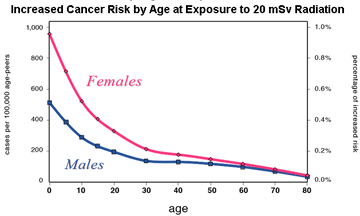
Nuclear Radiation Risk Impacts One Group Far More Than Any Other. Young girls could be up to 10 times more vulnerable to nuclear radiation thanother members of society, with girls aged up to five twice as likely to develop cancer as boys of the same age.
Understanding the risk posed by radiation exposure has been catapulted into public consciousness since
February, when Russia invaded Ukraine. Talk of nuclear war has simmered ever since, with rhetoric ramping up on October 6 when President Joe Biden warned of “Armageddon,” despite the U.S. having no new intelligence that Russian President Vladimir Putin was planning a nuclear strike.
Today, the U.S. Nuclear Regulatory Commission bases its evaluations of the impact of ionizing radiation on the public, and thus its decisions on nuclear licensing and regulation, on a subset of data which describes the “Reference Man.”
The Reference Man, as defined by the International Commission on Radiological Protection, is 20 to 30 years old, weighs 154 pounds, is 5 foot and 6 inches tall, and is Caucasian with a Western European or North American lifestyle. This one-size-fits-all approach describes only a small subset of society.
Newsweek 10th Oct 2022
https://www.newsweek.com/newsweek-com-nuclear-radiation-risk-impacts-one-group-more-other-1750413
MSN 10th Oct 2022
The Age of Women

Pearls and Irritations, By Julian Cribb, Jul 22, 2022
Leadership by wise women is indispensable if we are to escape the catastrophe that male leadership is presently building for humanity.
If humanity is to survive the vast and growing threats it faces, women must assume the leadership of government, business, religion and social institutions around the world. Female leadership is a required solution to the ten catastrophic risks which now confront the whole of our civilisation.
As a rule, women don’t start wars, mine coal or oil, destroy landscapes and forests, pollute air and oceans or poison their children – though they may benefit from those male actions. They tend to think more about the longer term than do men, and to consider the future needs of their children and grandchildren more fully. They tend to seek peaceful and constructive solutions to problems rather than warring over differences in values and beliefs, or over resources.
Since the time our species first differentiated its gender roles, over a million years ago, pragmatic male thought has largely driven our remarkable ascent, our great technological achievements up to the start of the present century. But men are also risk takers – and often ignore or make light of the risks created by the use, misuse or overuse of these technologies. Furthermore, in the hot, overcrowded, resource-depleted, poisoned world of the present and immediate future, competitive male attitudes are also our potential downfall, especially if they lead to wars and mass destruction.
In a world beset by catastrophic risks such as global ecological collapse, nuclear weapons, climate change, universal chemical poisoning, resource scarcity, food insecurity, overpopulation, pandemic disease, deadly new technologies and self-delusion, a fresh human perspective is needed – one which accentuates peaceful co-operation, caring, repair, healing and restoration. One which values food above weapons, health above chemicals, re-use and thrift above wastage, nature above profit, thought for the next generations above immediate self-gratification – and wisdom over mere intelligence or technical skill.
The most striking example of global female leadership is the decision by women everywhere to have far fewer babies. This has brought the birth rate down from 5 babies per woman in the mid-1960s to 2.4 babies in the early 2020s – and it is still falling, in every continent and in almost every country, albeit more slowly. Moreover many women have taken the decision to control their fertility without seeking male approval. They just did it. It is a responsibility the female of our species has undertaken because she instinctually understands the dangers and costs inherent in uncontrolled family and population growth. Women have, on their own initiative, tackled one of the thorniest and most controversial issues affecting the human future – and with demonstrable success. Unswayed by the selfish arguments of economics, nationalism, religion, paternalism or social pressure, they have willingly had fewer children in order that those whom they do bear may live better – or even live at all.
Women are also peacemakers. History offers few, if any, examples of wars of aggression waged by female leaders. Although perfectly capable of responding to military attack, female rulers from Elizabeth I, Maria Theresa and Catherine the Great to Golda Meir, Indira Ghandi and Margaret Thatcher defended their countries against attack by others or else ended wars which they had inherited from their male antecedents. Typically, they pursued their aims through diplomacy. All of the great wars of recent centuries, on the other hand, were started either by male monarchs, dictators or by male-dominated governments.
……….. Women are also peacemakers. History offers few, if any, examples of wars of aggression waged by female leaders. Although perfectly capable of responding to military attack, female rulers from Elizabeth I, Maria Theresa and Catherine the Great to Golda Meir, Indira Ghandi and Margaret Thatcher defended their countries against attack by others or else ended wars which they had inherited from their male antecedents. Typically, they pursued their aims through diplomacy. All of the great wars of recent centuries, on the other hand, were started either by male monarchs, dictators or by male-dominated governments.
In a world where conflict over declining resources of land, water, food, minerals, timber, fish and other vital necessities of life is increasingly probable, male leadership is far more likely to result in mass destruction and death than female leadership. Males in most societies are taught from youth to compete for what they want, and if competition doesn’t work, then to fight for it, often to the death. Sporting role models, gang behaviour, worship of military virtues and imposed patriarchal values cement the process. This masculine ideal is so firmly imprinted on society and on young males as to make questioning it tantamount to heresy – and most men fear to do so. Indeed, the dawning realisation that traditional male values are redundant in a world where humans can eliminate themselves has given rise to anxiety and confusion in many males over the likely loss of their ‘traditional’ roles of warrior and protector.
However, there is nothing compulsory about these traditional roles, ………………….. These stereotypes have endured centuries after the biological necessity for them has passed away. The preservation of these stone age roles in a 21st Century civilisation on the brink of catastrophe is an absurdity. Indeed, they will only hasten it.
Females learn or are taught to achieve their goals by other means, generally peaceful, diplomatic, negotiatory and co-operative. It follows that female leadership is better suited to the conditions of the C21st than it perhaps was to previous centuries – and male leadership less so. Thus, majority female rule can reduce the chances of civilisational collapse, or even human extinction, by war……………
It is noteworthy that women already tend to lead international organisations concerned with human health and wellbeing, with peace, with children and their future – whereas men tend to dominate organisations that pollute, manufacture poisons or weapons, plough up landscapes, pillage the oceans and destroy the climate. There are very few female leaders of the $7 trillion fossil fuels / petrochemicals sector, for example, and the male groupthink in that industry plainly values short-term profit above the safety and survival of humanity (including their own). This is classic male risk-taking behaviour ……….
Petrochemicals kill 12 million people every year and the toll is rising with climate change and the universal spread of poisons. In this case, a male-led industry prizes profit above human life on the largest scale ever to occur in history. But it is by no means unique. Other male-dominated sectors including agriculture, mining, forestry, corporate food and pharmaceuticals, electronics, advertising, armaments and the military, cause similar havoc among humanity, the natural world or both. For the sake of human survival, it is time their leadership underwent a radical repositioning in values, ethics and common sense.
The issue of whether women should lead humanity in the 21st century is thus not a question of gender equality or politics. It is not about ‘feminism’.
It is, quite simply, a foundational rule for human survival at the very time we face a major threat to our existence, arising from our own behaviours.
It is now a matter of choosing the kind of leadership which can best get us through the most dangerous era in all of human history.
Female thinking and leadership can protect a habitable planet and save humanity – or at least, some of it. And this means female thinking by enlightened men as well as by women. To influence global society towards more sustainable, healthy and peaceable solutions to our risks, we need many wise women in positions of power. This is indispensable, if we are escape the fate which male-led competition, aggression, overconsumption and pollution are building for us. https://johnmenadue.com/the-age-of-women-2/
Nuclear power is racist, sexist and ageist — Beyond Nuclear International

Progressive Democrats should reject, not embrace it.
Nuclear power is racist, sexist and ageist — Beyond Nuclear International https://wordpress.com/read/feeds/72759838/posts/4139419698
So why do some progressives support it?
By Linda Pentz Gunter
I am sure that certain Democratic senators such as Cory Booker and Sheldon Whitehouse, who are reasonably progressive on a host of social issues, would not considers themselves racist, sexist or ageist.
Nuclear power is all three of these things, yet Booker, Whitehouse and a number of others on the Democratic left, support nuclear power with almost fervent evangelism.
Let’s start with racism. The fuel for nuclear power plants comes from uranium, which must be mined. The majority of those who have mined it in this country — and would again under new bills such as the ‘International Nuclear Energy Act of 2022’ forwarded by not-so-progressive “Democrat”, Senator Joe Manchin (D-WV) — are Native Americans.
As such, they have taken the brunt of the negative health impacts as well as the environmental degradation both created and then left behind by uranium mines when they cease to operate, as most in the U.S. now have.
Studies conducted among members of the Navajo Nation have shown increases in a number of diseases and lingering internal contamination from uranium mine waste among newborns and children. Chronic ailments including kidney disease and hypertension found in these populations are medically linked with living near –and contact with — uranium mine waste.
At the other end of the nuclear power chain comes the lethal, long-lived and highly radioactive waste as well as the so-called low-level radioactive waste stream of detritus, including from decommissioned nuclear power plants. Again, Indigenous peoples and poor communities of color are routinely the target.
The first and only high-level radioactive waste repository identified for the U.S. was to have been at Yucca Mountain, Nevada, against the strong wishes of the Western Shoshone Nation of Indians, on whose land the now canceled site is located. The Western Shoshone had already suffered the worst of the atomic testing program, with the Nevada atomic test site also on their land, making them “the most bombed nation on Earth,” as Western Shoshone Principal Man, Ian Zabarte, describes it.
An attempt to site a “low-level” radioactive waste dump in the largely Hispanic community of Sierra Blanca, TX was defeated, as was an allegedly temporary high-level radioactive waste site targeted for the Skull Valley Goshute Indian reservation in Utah.
Currently, efforts are underway to secure what are euphemistically known as “Consolidated Interim Storage Sites” in two communities in New Mexico and Texas, again with large Hispanic populations and considerable opposition.
Needless to say, these waste projects come with notable incentives — sometimes more accurately characterized as bribes — for the host community, in an effort to describe the deal as “voluntary.” But this preys upon the desperate economic needs of the most vulnerable communities, which are usually those of color.
The only two new U.S. nuclear reactors still under construction sit close to the African American community of Shell Bluff, Georgia, a population riddled with cancers and other diseases and who bitterly opposed the addition of more reactors to an already radioactively contaminated region.
Nuclear power is sexist because exposure to the ionizing radiation released at every stage of the nuclear fuel chain harms women more easily than men. Women are more radiosensitive than men — the science is not fully in on this but it is likely connected to greater hormone production — but women are not protected for.
Instead, the standard guidelines on which allowable radiation exposure levels are based (and “allowable” does not mean “safe”), consider a healthy, White male, in his mid-twenties to thirties and typically weighing around 154 pounds. He is known as “Reference Man”.
Women’s more vulnerable health concerns, and especially those of pregnant women, the fetus, babies and small children — and in particular female children — are thus overlooked in favor of the higher doses a healthy young male could potentially withstand.
As my colleagues Cindy Folkers and Ian Fairlie wrote:” “Women, especially pregnant women and children are especially susceptible to damage from radiation exposure. This means that they suffer effects at lower doses. Resulting diseases include childhood cancers, impaired neural development, lower IQ rates, respiratory difficulties, cardiovascular diseases, perinatal mortality and birth defects — some appearing for the first time within a family in the population studied.”
Even around nuclear power plants, the very young are at greater risk. Numerous studies in Europe have demonstrated that children age five or younger living close to nuclear power plants show higher rates of leukemia than those living further away. The closer they lived to the nuclear plant, the higher the incidences.
Similarly, the elderly are more vulnerable to the harmful effects of radiation exposure than adults in the prime of life. They, too, are overlooked in favor of protecting a robust man. Elders exposed to radiation are mainly to be found in the uranium mining and milling communities, or where waste dumps are located, and are therefore more likely to be low-income with poorer access to health care and fewer finances to pay for it.
The urgency of the climate crisis is a valid reason to revisit all electricity sources and make some important choices about lowering — and ideally eliminating — carbon emissions. Ruling out fossil fuel use is a must. But turning to nuclear power — rather than the faster, cheaper and safer options of renewable energy and efficiency — is not a humane choice.
If health is the concern, along with climate change, as it most certainly is for someone like Cory Booker, then choosing nuclear power as a substitute for fossil fuels is simply trading asthma for leukemia and asking frontline and Indigenous communities to, once again, suffer the greatest harm for the least return.
A truly progressive energy policy looks forward, not back. Nuclear power is an energy of the past — borne of a public relations exercise to create something positive out of splitting the atom. It was a mistake then. And it is a mistake now. If we are to address our climate crisis in time, and to do so with justice and equality, then we must ensure a Just Transition that considers the most vulnerable and discriminated among us, not what is best for that healthy, White Reference Man.
Linda Pentz Gunter is the international specialist at Beyond Nuclear and writes for and curates Beyond Nuclear International.
New film: The ‘Mothers of the Revolution’ Who Stared Down Nuclear Weapons
The ‘Mothers of the Revolution’ Who Stared Down Nuclear Weapons, The doc ‘Mothers of the Revolution’ chronicles the women who spent years protesting the nukes at RAF Greenham Common. One of those brave women, Rebecca Johnson, tells their story. Daily Beast, Rebecca Johnson Nov. 21, 2021 In September 1981, a ten-day walk from Wales under the banner of Women for Life on Earth arrived at the main gate of RAF Greenham Common, sixty miles west of London. Home to the 501st Tactical Missile Wing of the U.S. Air Force, this nuclear base was designated by NATO to deploy nuclear-armed cruise missiles in Europe. We called for this decision to be publicly debated.
When ignored, Women for Life on Earth grew into the Greenham Common Women’s Peace Camp. I began living there in 1982 and stayed until the 1987 U.S.-Soviet Intermediate-Range Nuclear Forces (INF) Treaty banned and eliminated all land-based medium-range nuclear weapons from Europe, including Cruise, Pershing and SS20s.
After years of being airbrushed out of histories of the Cold War, Greenham’s actions, struggles and legacy are being spotlighted in a new film, Mothers of the Revolution, from acclaimed New Zealand director Briar March. Showing contemporaneous news footage from the 1980s along with dramatized vignettes and reflections from women who got involved with the Greenham Women’s Peace Camp in the 1980s, the film weaves an illustrative narrative from the experiences of a small cross section of activists—not only from Britain, but Russia, East and West Europe, the United States, and the Pacific.
Though it’s taken a long time for our contribution to the INF Treaty to be publicly recognized, other treaties have been influenced by Greenham’s feminist-humanitarian activism and strategies, most notably the U.N. Treaty on the Prohibition of Nuclear Weapons, which entered into international law in January 2021.
While living at Greenham for five years I came to understand what we really need: Not weapons and power over others, but communities that are empowered to love, question and create. We took forward new theories and practices of nonviolence that were feminist and assertive. We didn’t suppress deep human emotions like fear, love and anger, but channelled them into power for change. We needed to be activist and analytical, passionate and diplomatic, stubborn and flexible, courageous and truthful—no matter who tried to silence us.
The cruise missiles arrived in November 1983, which felt like a bitter defeat at first. Yet we refused to give up. …………….
Were we mothers of a revolution? If anything, I think we were part of a long continuum of struggles for women’s rights and safety, following in the footsteps of the women who fought so hard to vote and live free from oppression, slavery, and misogyny. Not mothers but daughters—of all those brave feminist revolutionaries.
I’m so glad Mothers of the Revolution ends with such an inspiring call to action showing the faces and voices of a new generation of fierce Daughters who are campaigning for girls’ education, climate justice, peace, and women’s rights to live free of patriarchal perpetrators and their greedy, oppressive systems of violence. Together we can stop the destroyers and strengthen the naturally diverse, interdependent lives that share and protect our beautiful Mother Earth. That’s our revolution, and we are not finished yet. https://www.thedailybeast.com/the-mothers-of-the-revolution-who-stared-down-nuclear-weapons?ref=scroll
Kamala Harris became the first woman to have control over US nuclear weapons, but only briefly
Kamala Harris became the first woman to have control over US nuclear weapons, but only briefly, Business Insider, Ryan Pickrell, Nov. 19, 2021,
| President Joe Biden briefly transferred presidential authority to Vice President Kamala Harris on Friday.That included the ability to use nuclear weapons, making Harris the first woman in US history to hold that authority.Presidential power was returned to Biden following the completion of a medical procedure. President Joe Biden temporarily transferred his presidential authority to Vice President Kamala Harris on Friday as he underwent a routine colonoscopy, which briefly made her the first woman in US history to have power as commander-in-chief and the first woman to have control of the US nuclear arsenal and nuclear strike authority………………… https://www.businessinsider.com.au/vp-harris-will-become-first-woman-to-control-us-nukes-2021-11?r=US&IR=T |
Women to bring a wake-up call to a world facing nuclear annihilation
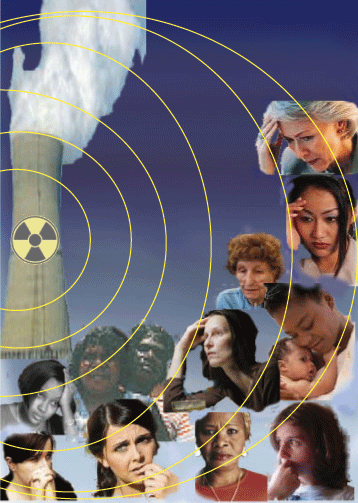
Women To Claim Their Seat at the Nuclear Table
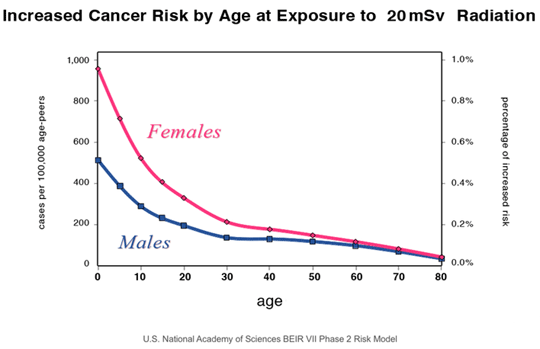
With women still underrepresented in nuclear policymaking and national security planning while being disproportionately impacted by nuclear weapons due to ionizing radiation from their use, testing, manufacturing, storage, and transport, Lazaroff reimagines and redefines national security with her Women Transforming Our Nuclear Legacy (WTONL) global online mentoring program.
Convinced that strong leadership demands “new thinking, not new weapons,” WTONL’s gathering of minds–with U.S. and Russian women experts and citizen diplomats reimagining security–has engaged 400 women from 40 countries including eight of the nine nuclear-armed states.
Excluding women–half of the human race–for much of the nuclear age has brought us to the brink of possible extinction,” Lazaroff advocates for a feminist foreign policy. “We need dialogue over silence, engagement over isolation, cooperation and diplomacy over conflict and war.”
After Her Nuclear Disaster Dress Rehearsal, Cynthia Lazaroff Has A Wake-Up Call For Our World As We Sleepwalk Into Nuclear Extinction Jackie Abramian ForbesWomen, 22 Sept 21, “There are nearly 13,500 nuclear warheads in current arsenals of nine nuclear-armed states. That the U.S. has more nuclear warheads than hospitals should be a wake-up call,” says award-winning documentary filmmaker, environmentalist, nuclear weapons abolition activist, Cynthia Lazaroff who having lived through a 38-minute nuclear cataclysm dress rehearsal in January 2018, hopes to wake up our world to the looming threat of sleepwalking into a nuclear disaster.
Lazaroff’s wake-up call came on the morning of January 13, 2018, when, along with all Hawaiian residents, she received a text: “Emergency Alert: Ballistic Missile Threat Inbound to Hawaii. Seek Immediate Shelter. This is not a drill.” As the reality of the moment unfolded, she scurried about her home, as a nuclear age refugee, hastily deciding which objects to take to the security of a nearby cave–while desperately trying to reach her daughter’s cellphone to let her know, perhaps for the last time to say “goodbye and I love you.” She detailed the harrowing 38-minutes–later confirmed as a false alarm–in her Dawn of a New Armageddon, published on August 6, (Hiroshima Day) in The Bulletin of the Atomic Scientists.
The experience led Lazaroff to found NuclearWakeUpCall.Earth a nonprofit, nonpartisan organization committed to abolishing nuclear weapons with a focus on the U.S. and Russia–which combined have over 90% of the world’s nuclear weapons. She is also on the Board of American Committee for U.S.-Russia Accord, which issued an open letter calling for a new era of diplomacy and engagement between the U.S. and Russia prior to the Biden-Putin summit. She applauds the resumed Biden-Putin dialogue and the “signs of hope”–the New START treaty extension for another five years, Secretary John Kerry’s Moscow visit and meetings with Minister of Foreign Affairs Lavrov as “realizing our shared interest to address the existential threat of climate change,” and the late July U.S.-Russia strategic stability talks in Geneva following the Summit.
“Our demonization of Russia, N. Korea, Iran, and China is justifying the continued military buildup. In 2020, during the global pandemic, the nine nuclear-armed states spent nearly $73 billion on nuclear weapons–over $137,000 per minute, with the U.S. spending over half of this total–$37.4 billion, $70,881 per minute,” Citing Elisabeth Eaves’ article on the newly commissioned $100 billion ground based strategic deterrent (GBSD), Lazaroff underscores the “insane” might of the military industrial complex amidst layers of existential threats of climate change, the pandemic, and racial and socio-economic injustices of our world.
Another sign of hope is 122 countries adopting the Treaty on the Prohibition of Nuclear Weapons (TPNW) with 86 signatory states, while 55 countries have ratified the treaty which entered into force this January. The first treaty Lazaroff says, that is “based not on military law but on humanitarian law” addressing “nuclear colonialism and radioactive racism, the disproportionate impact of nuclear weapons on indigenous peoples, and on women and girls due to ionizing radiation. It is also the first providing assistance to victims of nuclear use and testing and for the remediation of contaminated environments.”
Even with everything I knew about nuclear weapons, nuclear war was unimaginable to me until I lived through those 38 minutes. Now this experience lives inside of me as a mother, as a human being, with a responsibility to wake up and transform our nuclear legacy. It’s never going to go away until we eliminate the risk 100%–I know eliminating nuclear weapons is a tall order. I have no illusions about the formidable obstacles, but we must act. We still have a chance to get this right,” Lazaroff offers a Nuclear Playbook–a 10-step action program with critical recommendations for averting a nuclear catastrophe put forth by Congressional leaders, arms control and security experts, and NGOs such as the Nuclear Threat Initiative (NTI), William J. Perry Project, Ploughshares Fund, Global Zero, Bulletin of the Atomic Scientists, Nuclear Age Peace Foundation, Back from the Brink, among others…………..
Decriminalizing Diplomacy of Peace
“Part of my work is to decriminalize diplomacy with Russia, North Korea, Iran and China. It’s omnicidal behavior not to talk to your nuclear adversary. You can’t just obtain denuclearization on the Korean Peninsula without changing the relationship, without creating the conditions for peace,” says Lazaroff.
The “commercially driven millisecond news cycles,” harboring the “us vs. them” mentality fuels greater divides, “deterring alliance around shared global threats, while lacking introspection,” Lazaroff believes. She commends JFK’s 1963 American University speech, ‘Strategy of Peace’ following the Cuban Missile Crisis when JFK courageously called for ‘introspection’, not to be ‘blind to our differences,’ and addressed our common and ‘mutually deep interests’ with the Soviet Union ‘in a just and genuine peace and in halting the arms race.’
Continue reading1 This Month
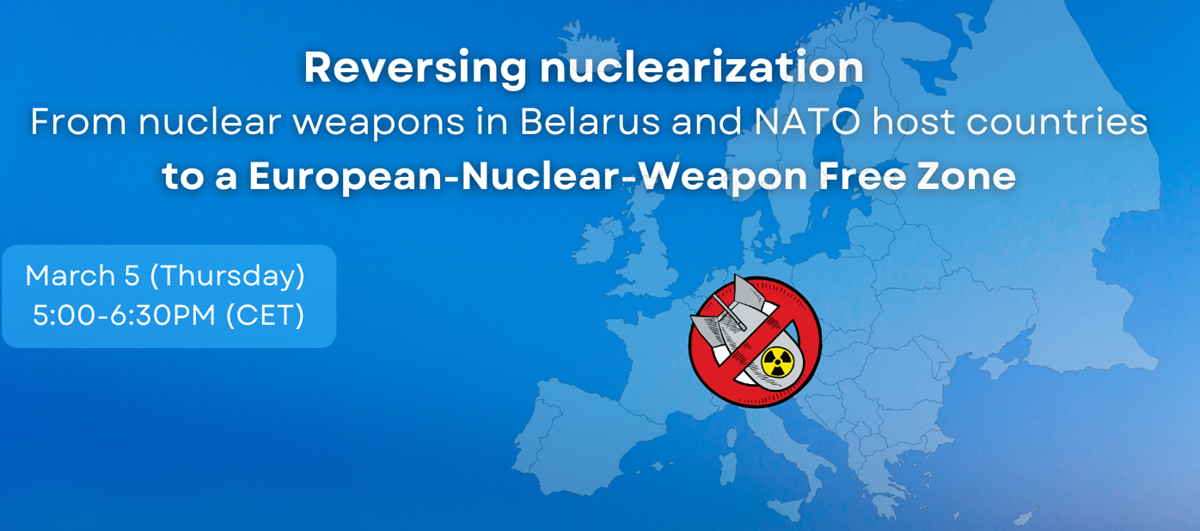
5 March -Online – Reversing nuclearization:
From nuclear weapons in Belarus and NATO host countries to a European-Nuclear-Weapon Free Zone
11am-12:30pm Eastern Time USA / 5pm-6:30pm CET

of the week – Advocating for a
nuclear free beach – https://www.samuellawrencefoundation.org/
The Samuel Lawrence Foundation advocates for a Nuclear Waste Free Beach at San Onofre, join us and take action!

10 March A LIVE WEBINAR THE REAL EFFECTS OF NUCLEAR POWER
What the Industry Isn’t Telling Us
1:00 PM Mountain, 2 pm Central, 3 pm Eastern. Live on the Keepers of the Water Facebook page

18 March Webinar @ 1 PM EST: An Assessment of SMR Projects: The Case of Canada
register for the zoom:
https://us02web.zoom.us/webinar/register/WN_o8BIIOUvQ2ONJR1nta65DQ#/registration

of the week – STOP SMALL MODULAR REACTORS IN CANADA
To see nuclear-related stories in greater depth and intensity – go to https://nuclearinformation.wordpress.com
-
Archives
- March 2026 (37)
- February 2026 (268)
- January 2026 (308)
- December 2025 (358)
- November 2025 (359)
- October 2025 (376)
- September 2025 (258)
- August 2025 (319)
- July 2025 (230)
- June 2025 (348)
- May 2025 (261)
- April 2025 (305)
-
Categories
- 1
- 1 NUCLEAR ISSUES
- business and costs
- climate change
- culture and arts
- ENERGY
- environment
- health
- history
- indigenous issues
- Legal
- marketing of nuclear
- media
- opposition to nuclear
- PERSONAL STORIES
- politics
- politics international
- Religion and ethics
- safety
- secrets,lies and civil liberties
- spinbuster
- technology
- Uranium
- wastes
- weapons and war
- Women
- 2 WORLD
- ACTION
- AFRICA
- Atrocities
- AUSTRALIA
- Christina's notes
- Christina's themes
- culture and arts
- Events
- Fuk 2022
- Fuk 2023
- Fukushima 2017
- Fukushima 2018
- fukushima 2019
- Fukushima 2020
- Fukushima 2021
- general
- global warming
- Humour (God we need it)
- Nuclear
- RARE EARTHS
- Reference
- resources – print
- Resources -audiovicual
- Weekly Newsletter
- World
- World Nuclear
- YouTube
-
RSS
Entries RSS
Comments RSS
 nuclear-news