HerStory: Feminism is the Route to Peace
feminism is about equality, dignity, and shared power–not just for women, but for everyone.
By H. Patricia Hynes for Informed Comment, February 2, 2026, https://scheerpost.com/2026/02/02/herstory-feminism-is-the-route-to-peace/
Jane Goodall, the renowned primatologist and impassioned advocate for nature, founded in her later years an institute through which she launched Roots and Shoots. Young people in more than 60 countries were taught about preserving nature and how to work for environmental good in their communities. Because of her passionate mission to protect from the twin threats of the loss of biodiversity and climate change and her goal to “inspire hope and spark action in others,” especially young people, she was honored as a United Nations Messenger for Peace. Like Goodall, many young women’s groups across the United States have emerged as beacons of hope and are sparking action in others.
In Amherst, Massachusetts, a teen feminist group called Generation Ratify was launched to help endorse the Equal Rights Amendment and advance gender equality. They organized many rallies, three school walkouts, banner drops, film and art shops and lobbied at the state house. In July 2025, they joined with Young Climate Action Now to host Little Leader Convention for 10-to-13 -year-olds with the goal of empowering a new generation of ecofeminists. Recently they partnered with a national youth-led organization Feminist Front to form Feminist Generation. Their generation has lost the secure right to bodily autonomy; they inherit an Earth in climate failure and a country enroute to fascism. In 2026 the Amherst chapter of Feminist Generation will launch an initiative to promote youth voter engagement in the 2026 elections, research gender-based wage gaps in local government, and work with Planned Parenthood to implement a comprehensive sex education curriculum at Amherst Regional High School.
Behind the 2025 progressive wins in the states of Virginia and Pennsylvania were hundreds of young feminist organizers, mobilized and trained by Vote for Equality, the political arm of Feminist Majority. They organized on campuses in both states. Abigail Spanberger, a strong advocate for reproductive freedom, won as Virginia’s first woman governor, with 65% women voting for her and an unprecedented shift in the House of Delegates to a large majority of Democrats. In Pennsylvania, 3 progressive Supreme Court Justices who were instrumental in “safeguarding reproductive rights for Medicaid recipients through Pennsylvania’s Equal Rights Amendment” retained their seats. These young feminists are ready to build on their 2025 victories in 2026.
One of the newest young feminist groups is HerStory at Deerfield Academy in Deerfield, Massachusetts. Katie Kim a junior at the academy, re-named her women’s empowerment group of which she is president HerStory because she “can’t really think of a story in history where there’s no her in it.” All of the HerStory group concur that “a lot of social media influence the branding of feminism” as merely groups of women meeting to express “hatred of men” when that’s “totally not what we do,” they said. It’s more about supporting each other in our community and trying to have local impact. HerStory members see the true history of humankind, as one of partnership, gender partnership.
Bright Yang, a sophomore from China, explained his reasons for joining HerStory, namely that he “recognized how powerful women are.” He gave a “shout out to his mom” who has “played a great, great role” in developing his personality, guiding him through the isolation one can feel in boarding school, giving him ideas and “just happiness in general.” Drawn to Middle Eastern Studies and religion, he noted a similarity in Islam as practiced in Afghanistan and Christianity as practiced by Catholicism, the 2,000 year-old religion “that has so much difficulty merely recognizing women as equals” to make them priests, bishops, and ultimately Pope, though he stated, Afghanistan is much worse.
I asked Herstory members to explain their convictions about the statement, “Feminism is the route to peace” with which they ended my last meeting with them. They responded that at its core, feminism is about equality, dignity, and shared power–not just for women, but for everyone. The link to peace comes from a few main ideas. Equality reduces violence. Societies built on strict hierarchies (men over women, some groups over others) often normalize domination and force. Without embracing feminism, “our rights and voices remain disparaged, creating challenges and disputes,” responded Peggy Huang. Feminism promotes cooperation instead of control, dialogue instead of coercion, and respect instead of fear. These values are strongly associated with lower levels of violence—at home, in communities, and between nations.
Research consistently shows that countries with higher gender inequality tend to have more internal conflict, more authoritarian leadership, and higher rates of violence overall, explained Katie Kim. Inclusive leadership leads to more peaceful outcomes. When women and marginalized groups are included in decision-making, peace agreements last longer, policies focus more on social well-being (health, education, stability), and conflict resolution emphasizes compromise rather than escalation. This isn’t because women are “naturally peaceful,” she added, but because diverse perspectives improve problem-solving.
Currently, Katie is organizing a poetry anthology project with local women empowerment organizations in Amherst. Through poetry–a simple, accessible literary form–she hopes to bring the current youth activists together fighting for the same cause and to foster tighter bonds with one another.
HerStory members are true Messengers for Peace.
H. Patricia Hynes is a retired professor of environmental health, directs the Traprock Center for Peace and Justice in western Massachusetts. She has written and edited 7 books, among them The Recurring Silent Spring (nominated for the Gustavus Myers Outstanding Book Award) and Justice. Her most recent book is Hope but Demand Justice. She writes and speaks on issues of war and militarism with an emphasis on women, environment, and public health.
‘Radioactive patriarchy’ documentary: Women examine the impact of Soviet nuclear testing
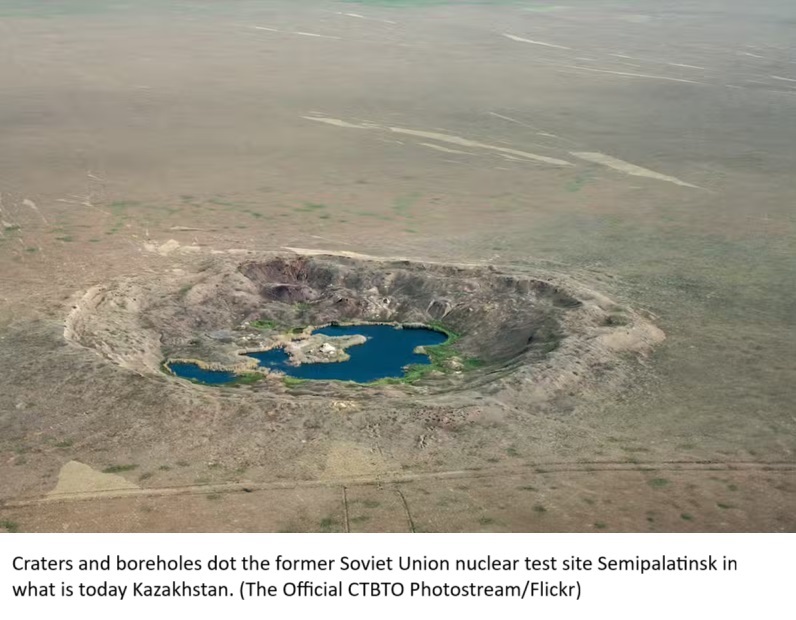
During the time of the detonations, approximately 1.5 million people lived near the sites, despite Soviet claims that the area was uninhabited.
In the ensuing decades, diagnoses of cancers, congenital anomalies and thyroid disease affected the surrounding communities at an alarming rate, particularly for women.
November 17, 2025, Rebecca H. Hogue, Assistant Professor, Department of English, University of Toronto https://theconversation.com/radioactive-patriarchy-documentary-women-examine-the-impact-of-soviet-nuclear-testing-256775
Following recent comments on nuclear testing by United States President Donald Trump and Russian leader Vladimir Putin, it’s more important than ever to remember that nuclear detonations — whether in war or apparent peace time — have long-lasting impacts.
Over a 40-year period, up to 1989, the Soviet Union detonated 456 nuclear weapons in present-day Kazakhstan (or Qazaqstan, in the decolonized spelling)
During the time of the detonations, approximately 1.5 million people lived near the sites, despite Soviet claims that the area was uninhabited.
In the ensuing decades, diagnoses of cancers, congenital anomalies and thyroid disease affected the surrounding communities at an alarming rate, particularly for women.
A new independent documentary, JARA Radioactive Patriarchy: Women of Qazaqstan, examines the impacts of nuclear weapons in Qazaqstan. Jara means “wound” in the Qazaq language.
The film is directed by Aigerim Seitenova, a nuclear disarmament activist with a post-graduate degree in international human rights law who co-founded the Qazaq Nuclear Frontline Coalition. Seitenova grew up in Semey (formerly called Semipalatinsk), Qazaqstan.
Close to Semey is the Semipalatinsk nuclear test site, also known as The Polygon, in Qazaqstan’s northeastern region. It’s an area slightly smaller than the size of Belgium — approximately 18,000 square kilometres — in the former Kazakh Soviet Socialist Republic.
Nuclear Truth Project
Seitenova introduced her film in March 2025 at the United Nations headquarters in New York, hosted by the Nuclear Truth Project. The documentary premiere was a side event at the Third Meeting of States Parties to the Treaty on the Prohibition of Nuclear Weapons.
As a literary and cultural historian who examines narratives of the nuclear age, I attended the standing-room-only event alongside many delegates from civil society organizations.
Nuclear disarmament activist
Seitenova, who wrote, directed and produced JARA Radioactive Patriarchy on location in Semey, aims to bring women’s nuclear stories to Qazaqstan and international audiences.
The 30-minute documentary features intimate interviews with five Qazaq women. The film shares the women’s fears, grief and the ways they have learned to cope, as well as reflections from Seitenova filmed at the ground-zero site.
For Seitenova, it was essential that the film be in Qazaq language.
“Qazaq language, like Qazaq bodies,” she said in an interview after the premiere, “were considered ‘other’ or not valuable.” Seitenova acknowledged it was also important to show a Qazaq-language film at the UN, as Qazaq is not an official UN language like Russian.
Women consensually share experiences
One of Seitenova’s directorial choices was not just what or who would be seen, but specifically what would not be seen in her film.
“I’m really against sensationalism,” said Seitenova. “If you Google ‘Semipalatinsk’ you will see all of these terrible images of children and fetuses.”
Seitenova accordingly does not show any of these images in her film, and instead focuses on women consensually sharing their experiences.
Seitenova explained how narratives regarding the health effects in Semey are often disparaged. When others learn she is from Semey, Seitenova shared, some will make insensitive jokes like “are you luminescent at night?” — making nuclear impact into spectacle, instead of taking it as a serious health issue.
These experiences have propelled her to take back the narrative of her community by correcting misconceptions or the minimization of harms. Instead, she brings attention to the larger structural issues.
“Everything was done by me because I did not want to invite someone who would not take care of the stories of these women,” said Seitenova.
Likewise, Seitenova only interviewed participants who had already made decisions to speak out about nuclear weapons. She did this so as not to risk retraumatizing someone by asking them to discuss their illnesses, especially for the first time on camera.
Global legacy of anti-nuclear art, advocacy
Seitenova also wanted to show a genealogy of women speaking out about nuclear issues in Qazaqstan, contributing to a global legacy of anti-nuclear art and advocacy.
The film features three generations of women, including Seitenova’s great aunt, Zura Rustemova, who was 12 at the time of the first detonations.
As part of this genealogy of nuclear resistance, the film includes footage of a speech from the Qazaq singer Roza Baglanova (1922-2011), who rose to prominence singing songs of hope during the Second World War.
Effects felt into today
JARA Radioactive Patriarchy shows how the impacts of nuclear weapons are felt intergenerationally into the present.
“Many women lost their ability to experience the happiness of motherhood,” interviewee Maira Abenova says in the film. Abenova co-founded an advocacy group representing survivors of the detonations, Committee Polygon 21.
Other interviewees shared how often men left their wives and children who were affected by nuclear weapons to begin a new family with someone else.
Seitenova looks at the roles of women and mothers not just as protectors, but also as those who have launched formidable advocacy.
The film highlights the towering monument in Semey, “Stronger than Death,” dedicated to those affected by nuclear weapons.
The Semey monument depicts a mother using her whole body to protect her child from a mushroom cloud. Just like the monument, Seitenova and the women in her documentary use the film to show how women have been doing this advocacy work in the private and public spheres, with their bodies and with their words.
“I want to show them as being leaders in the community, as changing the game,” Seitenova said.
While the film brings a much-needed attention to the gendered impact of nuclear weapons in Qazaqstan, she makes clear that this is, unfortunately, not an issue unique to her homeland or just to women.
“The next time you think about expanding the nuclear sector in any country” Seitenova said, “you can think about how it impacts people of all genders.”
Trump’s new radiation exposure limits could be ‘catastrophic’ for women and girls.
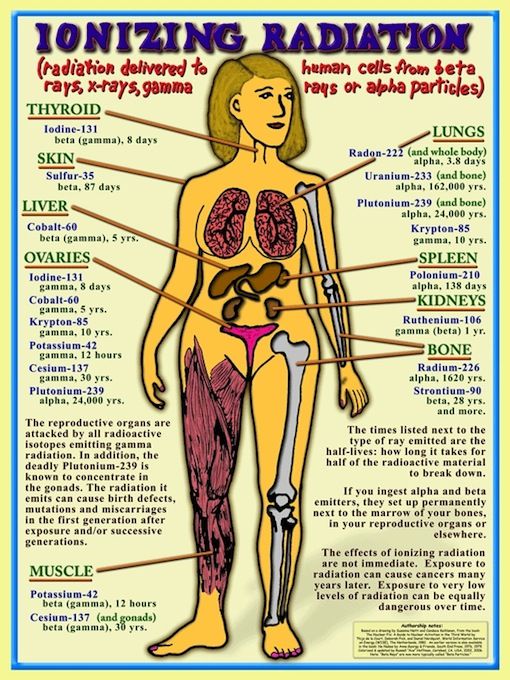
it has since been widely documented that women and young girls are significantly more vulnerable to radiation harm than men—in some cases by as much as a ten-fold difference………… Those most impacted by weaker exposure standards will be young girls under five years old
By Lesley M. M. Blume, Chloe Shrager | November 14, 2025, https://thebulletin.org/2025/11/trumps-new-radiation-exposure-limits-could-be-catastrophic-for-women-and-girls/
In a May executive order, aimed at ushering in what he described as an “American nuclear renaissance,” President Donald Trump declared moot the science underpinning decades-old radiation exposure standards set by the federal government. Executive Order 14300 directed the Nuclear Regulatory Commission (NRC) to conduct a “wholesale revision” of half-a-century of guidance and regulations. In doing so, it considers throwing out the foundational model used by the government to determine exposure limits, and investigates the possibility of loosening the standard on what is considered a “safe” level of radiation exposure for the general public. In a statement to the Bulletin, NRC spokesperson Scott Burnell confirmed that the NRC is reconsidering the standards long relied upon to guide exposure limits.
Now, some radiology and policy experts are sounding alarm bells, calling the directive a dangerous departure from a respected framework that has been followed and consistently reinforced by scientific review for generations. They warn that under some circumstances, the effects of the possible new limits could range from “undeniably homicidal” to “catastrophic” for those living close to nuclear operations and beyond.
“It’s an attack on the science and the policy behind radiation protection of people and the environment that has been in place for decades,” says radiologist Kimberly Applegate, a former chair of the radiological protection in medicine committee of the International Commission on Radiological Protection (ICRP) and a current council and scientific committee member of the National Council on Radiation Protection (NCRP)—two regulatory bodies that make radiation safety recommendations to the NRC. According to Applegate, current government sources have told her and other experts that the most conservative proposed change would raise the current limit on the amount of radiation that a member of the general public can be exposed to by five times. That would be a standard “far out of the international norms,” she says, and could significantly raise cancer rates among those living nearby. The NRC spokesperson did not respond to a question from the Bulletin about specific new exposure limits being considered.
Kathryn Higley, president of the NCRP, warns that a five-fold increase in radiation dose exposure would look like “potentially causing cancers in populations that you might not expect to see within a couple of decades.”
“There are many things that Executive Order does, but one thing that’s really important is that it reduces the amount of public input that will be allowed,” says Diane D’Arrigo, the Radioactive Waste Project Director at the Nuclear Information and Resource Service, a nonprofit group critical of the nuclear energy industry. In a statement to the Bulletin, the NRC said that once its standards reassessment process is completed, the NRC will publish its proposed rules in the Federal Register for public comment.* The NRC spokesperson did not respond to questions about when the proposed new standards would be made public and whether or how the general public would be further alerted to the changes.
Once the proposed policy change hits the Federal Register, the final decision will likely follow in a few days without advertising a period for public input, Applegate adds.
“I’m not sure I know why the loosening is needed,” says Peter Crane, who served as the NRC’s Counsel for Special Projects for nearly 25 years, starting in 1975. “I think it’s ideologically driven.” He points out that the probable loosening of the standards is set to coincide with increased pressure to greenlight new nuclear plants and could weaken emergency preparedness in case of leaks or other accidents: “I think it’s playing with fire.” (The NRC’s Office of Public Affairs did not respond to questions about the rationale for loosening the standards and the timing of the reconsideration.)
Possible shorter timelines for building nuclear power plants, coinciding with weakened radiation exposure standards, could spell disaster, warn other experts. It would be “undeniably homicidal” of the NRC to loosen current US exposure standards even slightly, adds Mary Olson, a biologist who has researched the effects of radiation for over 40 years and published a peer-reviewed study titled “Disproportionate impact of radiation and radiation regulation” in 2019. Olson cites NRC equations that found that the current exposure standards result in 3.5 fatal cancers per 1,000 people exposed for their lifetimes by living near a nuclear facility; a five-fold rate increase in allowable radiation exposure could therefore result in a little over 17.5 cancers per 1,000 people. Expressed another way, that means “one in 57 people getting fatal cancer from year in, year out exposure to an NRC facility,” she says.
The NRC’s Office of Public Affairs did not respond to questions about whether the NRC could guarantee the current level of safety for the general public or nuclear workers if adopting looser radiation exposure standards, and about whether new protections would be put into place.
Are women and children more vulnerable? According to Olson, increased radiation exposure could be even more “catastrophic” for women and children. Exposure standards have long been determined by studies on how radiation affects the “reference man,” defined by the ICRP as a white male “between 20-30 years of age, weighing around 70 kilograms [155 pounds].”
But Applegate, Olson, and other experts say that it has since been widely documented that women and young girls are significantly more vulnerable to radiation harm than men—in some cases by as much as a ten-fold difference, according to Olson’s 2019 study. Olson and Applegate cite another 2006 review assessing and summarizing 60 years of health data on the survivors of the Hiroshima and Nagasaki atomic bombings; the study showed that women are one-and-a-half to two times as likely to develop cancer from the same one-time radiation dose as men.
Young girls are seven times more at risk, they say. Those most impacted by weaker exposure standards will be young girls under five years old, Olson says. Her 2024 study of the A-bomb bomb survivor data for the United Nations Institute for Disarmament Research, titled “Gender and Ionizing Radiation,” found that they face twice the risk as boys of the same age, and have four to five times the risk of developing cancer later in life than a woman exposed in adulthood.
“Protections of the public from environmental poisons and dangerous materials have to be focused on those who will be most harmed, not average harmed,” Olson says. “That’s where the protection should be.”
Infants are especially vulnerable to radiation harm, says Rebecca Smith-Bindman, a radiologist and epidemiologist who is the lead author of a just-released major study in the New England Journal of Medicine documenting the relationship between medical imaging (such as X-rays and CT scans) and cancer risk for children and adolescents; more than 3.7 million children born between 1996 and 2016 participated and have been tracked. Smith-Bindman contests the idea that women are overall more vulnerable to cancer than men, saying that “in general, maybe women are a little bit more sensitive, …[but] women and men have different susceptibilities to different cancer types,” with women being more vulnerable to lung and breast cancers, among other types. But it is “absolutely true that children are more susceptible,” she adds. With children under the age of one, “the risks are markedly elevated.” While these findings are sobering, she points out that with medical imaging, “there’s a trade-off…it helps you make diagnoses; it might save your life. It’s very different from nuclear power or other sources of radiation where there’s no benefit to the patient or the population. It’s just a harm.”
“We’ve known for decades that pregnancy is [also] more impacted” by radiation exposure, says Cindy Folkers, radiation and health hazard specialist at Beyond Nuclear, a nonprofit anti-nuclear power and weapons organization. “Radiation does its damage to cells, and so when you have a pregnancy, you have very few cells that will be developing into various parts of the human body: the skeleton, the organs, the brain,” and exposing those cells to radiation during pregnancy can impact the embryo’s health, she says. Smith-Bindman and her team are also studying the impact of radiation exposure on pregnancy, and while their results are not yet in, “we do know that exposures during pregnancy are harmful,” she says, “and that they result in elevated cancer risks in the offspring of those patients.”
For children, lifetime cancer risk will be increased not only because of the “sensitivity and vulnerability of developing tissues, but also partly [because] they would be living longer under a different radiation protection framework,” adds David Richardson, a UC Irvine professor who studies occupational safety hazards.
Several experts noted the irony that these changes are being mandated by the same administration that is also overseeing a policy of “Make America Healthy Again” (MAHA), an effort being spearheaded by Secretary of Health and Human Services Robert F. Kennedy Jr. “In terms of general [public] knowledge, I think there has not been very large coverage or acceptance of the idea that radiation affects different people differently on the basis of both age and biological sex,” says Olson. “But we now have enough reviews, enough literature to say that the biological sex difference is there. I don’t think MAHA mothers know this because it’s been underreported, [and] they would be concerned if they knew it.”
The NRC’s Office of Public Affairs did not respond to questions about concerns being raised by radiologists and epidemiologists about possible health consequences—especially for children—as a result of increased radiation exposure.
Continue readingRemembering the radical anti-nuclear Greenham Women’s Peace Camp
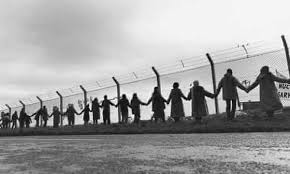
Huck Mag 18th July 2025, https://www.huckmag.com/article/anti-nuclear-greenham-womens-peace-camp-life-fence-janine-wiedel
Life at the Fence — In the early ’80s, a women’s only camp at an RAF site in Berkshire was formed to protest the threat of nuclear arms. Janine Wiedel’s new photobook revisits its anti-establishment setup and people.
Coming of age in the shadow of the 1962 Cuban Missile Crisis, Janine Wiedel remembers the “duck and cover drills” of her childhood years, where students hid under school desks, head in hands, practicing quiet surrender to nuclear Armageddon.
By the ’80s, Wiedel was living and working as a photographer, documenting working-class life in the UK. With Ronald Reagan in the White House, Cold War tensions reached a fevered pitch. Across the pond, Margaret Thatcher, Reagan’s “comrade-in-arms”, welcomed the NATO bequest of 96 US-manufactured, nuclear “cruise missiles”, which were to begin arriving at RAF Greenham Common in 1983.
As NATO and the USSR ran up their arsenals, a grassroots resistance movement sprouted in Greenham, in the English county of Berkshire, taking the shape of a “women’s only” peace camp in 1982. Despite evictions, fences, and spies organised to bring them down, the resistance stayed the course until the American forces packed up their weapons and went home following the collapse of the Soviet Union in 1991.
Their struggle made headlines, with even the Soviet premier Mikhail Gorbachev paying homage to the ‘Greenham women and the peace movement of Europe’ at the signing of the 1987 Intermediate-range Nuclear Forces (INF) Treaty. But those initial media reports, Wiedel remembers, were ultimately disparaging of the women, so she decided to visit the camp for herself in 1983.
“I was fascinated by the community that had evolved as a result of it being ‘all women’ – there were no leaders,” Wiedel says. “The women built homes out of wood they collected, and they lit and tended the fires. They attended and spoke at conferences. They represented themselves in court when they were arrested. Everyone had an equal voice. Confidence grew. The actions were spontaneous and flexible; the authorities and police never knew what they would do next.”
The lesson became clear: don’t stop until the job is done. Now, Wiedel revisits this historic chapter of protest history with Life at the Fence: Greenham Women’s Peace Camp 1983 – 84 (Image & Reality). Through transportive imagery and interviews conducted at the time, the book brings together Wiedel’s masterful reportage as she takes us through the camps, which were built along the nine-mile perimeter of the RAF base, while paratroopers perched in lookout towers, binoculars in hand. Against the backdrop of gnarly barbed wire, the women sorted themselves out among different camp sites, each named for a different colour of the rainbow. It was a world of striking contrasts.
Drawn to women who had given up everything to live in primitive, volatile conditions, Wiedel listened to the women, recording their testimonies, songs, and remembrances which she weaves alongside documentary, portraits, landscape, still life, and reportage of non-violent direct actions.
“At the time, as a ‘women only’ protest, it was subjected to every form of abuse and ridicule by the media,” says Wiedel. “Its presence at the base also became an embarrassment to the Thatcher government. The women, however, managed to remain at the base for 19 years. Everyone I spoke with said it had transformed their lives.”
Life at the Fence: Greenham Women’s Peace Camp 1983 – 84 by Janine Wiedel is published by Image & Reality.
Greenham Common women urge new generation to ‘rise up’ against nuclear threat
Those who set up protest camp in 1980s hope its spirit can be revived to oppose UK’s plan to buy nuclear-carrying jets
Alexandra Topping, https://www.theguardian.com/uk-news/2025/jun/27/greenham-common-women-urge-new-generation-rise-up-nuclear-threat
In August 1981, 36 people, mainly women, walked from Wales to RAF Greenham Common in Berkshire to protest against the storing of US cruise missiles in the UK. They were alarmed about the imminent threat the weapons posed for themselves and for their children, they later said.
More than 40 years on, the prospect of American nuclear weapons stationed on British soil has returned with urgent focus. And for some of the women who were at the Greenham Common women’s peace camp, it is time for dissenting UK citizens to rise up again.
In the wake of the UK government’s announcement this week that it plans to significantly expand its nuclear arsenal by buying a squadron of American fighter jets capable of carrying US tactical warheads, key figures at Greenham hope a new generation of campaigners will take up the baton.
Ann Pettitt, now 78, devised the original idea for a march that led to the formation of the camp. At its height, more than 70,000 women were there and it became the biggest female-led protest since women’s suffrage. It was, as Pettitt says, “actually successful” in managing to hugely raise awareness of the presence of US nuclear warheads in the UK – the last of which left RAF Lakenheath in 2008. The camp went on after the Greenham Common missiles had gone in 1991 and the base was closed in 1992. The remaining campaigners left Greenham Common after exactly 19 years.
Pettitt said this week’s news had left her “disillusioned” but she was hopeful that a younger generation would protest. “It certainly calls for protest, because it’s so stupid,” she said. “Nuclear weapons are like the emperor’s new clothes, they can’t be used and if they are they backfire because of radiation spreads and they target civilians. We should simply not have them.”
The decision to buy 12 F-35A jets, which are capable of carrying conventional arms and also the US B61-12 gravity bomb, a variant of which has more than three times the explosive power of the Hiroshima bomb, has energised the anti-nuclear movement, said Sophie Bolt, the general secretary of the Campaign for Nuclear Disarmament.
The group has organised a protest on Saturday at RAF Marham in Norfolk, and Bolt said Greenham women – many of whom are in their 70s – still form the “backbone” of the resistance.
“These are women who have got a huge history and totally understand how high the stakes are,” she said. “Their determination, creativity and strategic thinking is just really incredible. They are a massive inspiration and so enriching to the campaign.”
One of those women, Angie Zelter, 74, went on to found the civil disobedience campaign Snowball and the anti-nuclear weapons group Trident Ploughshares. In 2019, aged 68, she was found guilty of a minor public order offence for protesting with Extinction Rebellion. “We had a saying, ‘carry Greenham home’, and from the moment I was there that’s what I’ve done,” she said.
But Zelter said it was also time for a new generation of Greenham women. “I think we need a new women’s movement, but I think actually we need everybody to rise up, quite frankly. All we can do as elders is support younger activists and give advice, solidarity and support.”
There was no time for squabbles in despondency, she added. “I hope it is a moment of mass realisation when we come together now and say, look, enough is enough … It is a moment of hope that people will realise that they’ve got to come together and protest loud and clearly.”
Pettitt said those not ready to man the barricades could still join the struggle – by the simple act of writing a letter to MPs to protest about the “outrageous” decision to buy the jets without parliamentary debate. “The way to get it discussed in parliament is to write your MP a letter,” she said. “Parliament is still very archaic … the humble letter is part of that kind of archaic functioning that is surprisingly effective.”
Another original walker, Sue Lent, now 73 and a councillor on Cardiff council, said the general public had lost sight of the anti-nuclear movement, but she hoped that a silver lining from the news this week was that younger and older activists would start “joining the dots”.
“1981 is a long time ago,” she said. “But hopefully the spirit still lives on and can be revived.”
The nuclear divide: Why are women cautious of nuclear energy?
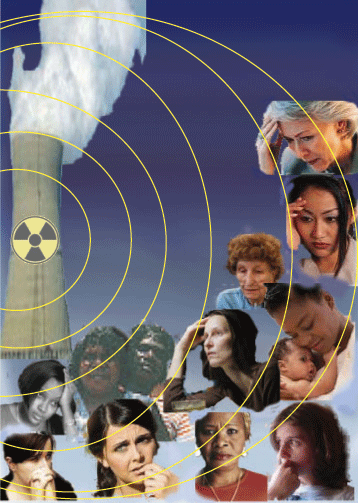
Women are consistently more skeptical than men, and not just marginally so. The gender divide is greater for nuclear technology than for any other energy source.
Their concerns are justified. Studies show women are twice as likely to develop radiation-related cancers, yet safety regulations often rely on the so-called “Reference Man” standard, ignoring biological differences.
by Emma Fackenthall, May 19, 2025, https://nbmediacoop.org/2025/05/19/the-nuclear-divide-why-are-women-cautious-of-nuclear-energy/
As many countries scramble toward a net-zero future, some are betting on nuclear energy to reach their goal. However, a quiet but profound gender divide is growing around nuclear energy.
While nuclear power is often hailed as a critical tool in the climate fight, a growing body of research suggests that fewer women than men support nuclear power. This divide can be explained by safety concerns, ecofeminist ethics of care, and the nuclear industry’s macho culture.
The striking gender divide is another reason to question the viability of nuclear energy to attain climate justice and energy democracy.
Despite the foundational contributions of female scientists to the nuclear field (think Marie Curie, Lise Meitner, and Chien-Shiung Wu) the industry is currently male-dominated. According to a recent international report, women make up only 25 per cent of the nuclear workforce. Among new hires, 28.8 per cent are women, reflecting slow progress. Of that, a mere 18.5 per cent hold leadership roles.
Meanwhile, public opinion surveys spanning 20 countries show a persistent gender difference in support for nuclear energy. Women are consistently more skeptical than men, and not just marginally so. The gender divide is greater for nuclear technology than for any other energy source. Women cite safety risks and the potential to delay the rollout of renewable energy as primary reasons for their lack of support for nuclear energy.
Their concerns are justified. Studies show women are twice as likely to develop radiation-related cancers, yet safety regulations often rely on the so-called “Reference Man” standard, ignoring biological differences. Initiatives like the Gender and Radiation Impact Project are now working to redefine safety metrics using the “Reference Girl,” highlighting the systemic underrepresentation of women in regulatory science.
Indeed, more and more attention is being placed on the lack of female representation in science and society. Books like Unwell Women, Invisible Women, and Feminist City recount these enduring systemic misrepresentations.
The nuclear industry has noted the low female support. A 2023 report by the Nuclear Energy Agency declared the gender gap an “existential challenge” for achieving climate targets. One of its key recommendations? Attract more women through targeted communication campaigns.
The response has been… complicated. Enter the “nukefluencers”: social media-savvy women – many of them models and beauty queens – paid by the nuclear industry to tout the supposed benefits of nuclear power on Instagram and TikTok.
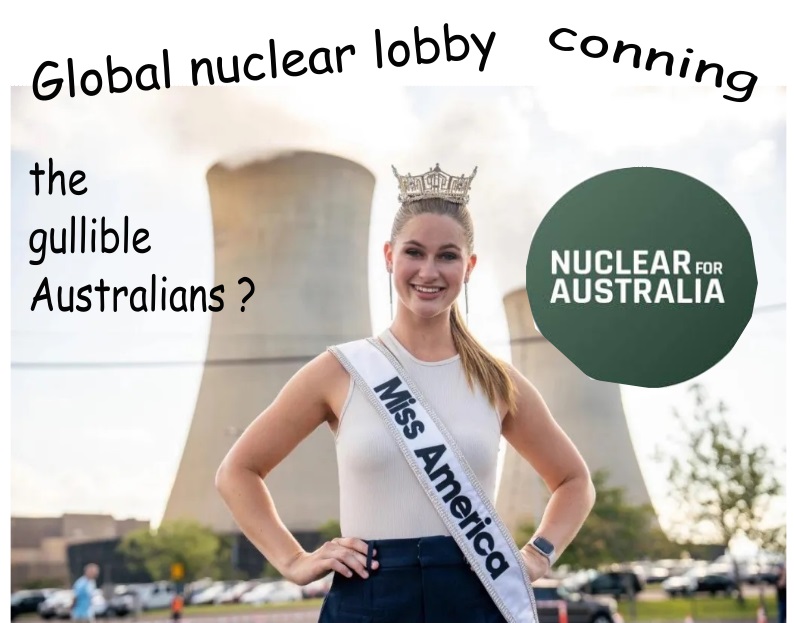
Posts often blend lifestyle content with pro-nuclear messaging, echoing the corporate “girl boss” ethos. But while these accounts aim to appeal to women, a brief analysis reveals that most engagement comes from men. It raises the question: who is this campaign really reaching?
Ecofeminist ethics offer another possible explanation for women’s reluctance to support nuclear energy. This perspective ties environmental degradation to systems of patriarchy and domination, arguing that the same forces that exploit nature also marginalize women, Indigenous peoples, and racialized communities.
Women, therefore, may be more attuned to nuclear energy’s ethical and social implications. Research shows women are 2.5 times more likely to demand climate action and that women-led companies tend to have stronger climate performance.
The “macho mentality” embedded in nuclear culture is another reason. Nuclear power is often portrayed in the media as powerful and dangerous, tapping into masculine ideals. From post-apocalyptic video games to radioactive superheroes, pop culture reinforces the narrative of nuclear as bold and aggressive.
In contrast, renewable energy is frequently associated with care, sustainability, and cooperation – all traits traditionally coded as feminine and therefore undervalued in male-dominated spheres.
Even nuclear industry branding can reflect this gender divide. Some nuclear companies employ harsh, bold typography and stark color schemes that psychological and communications studies believe subconsciously project strength and authority, often masculine traits.
Others, like the nuclear companies in New Brunswick, are attempting to greenwash their image with soft fonts, green logos, and lowercase letters, perhaps in a bid to court a more gender-diverse audience. Ironically, this might alienate men, who may perceive these aesthetic cues as less aligned with masculine identity.
You might think a simple change of font would not have the power to deter men, but studies have shown that men are more concerned with gender-identity maintenance than women and simple things like fonts can deter men due to the risk of harming masculine perception.
Nuclear energy’s gender divide is interwoven in many different ways, but the implications remain far-reaching. If nuclear expansion continues to ignore gendered perceptions and safety concerns, it risks exacerbating conflicts rather than resolving them. Climate justice and social justice are interlinked, ignoring one will equally harm the other.
If we want real change, we need women and other marginalized groups at the decision-making tables. If women are reluctant to support nuclear energy, their reasons need to be understood. Their voices against nuclear energy are important and need validation.
More than just a public opinion gap, the nuclear gender divide is a signal that the future of energy must be inclusive, equitable, and just. Without considering the concerns of women, no technological solution, however potentially powerful, will be truly sustainable.
Emma Fackenthall is a research assistant with the CEDAR project at St. Thomas University. She will be presenting a version of this research in Montreal this May at The Great Transition event.
I’ve got a rocket for these space cadets and their pantomime of feminism
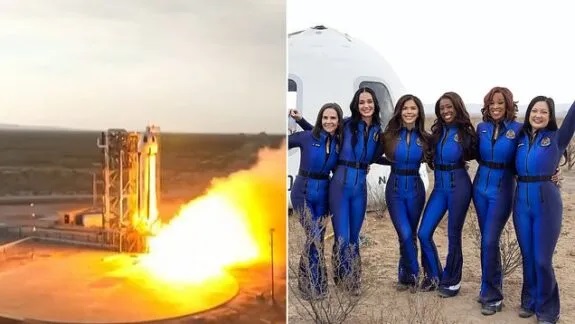
They do not operate the spaceship. They dress sexy for the spaceship flight.
pseudo-feminism.. which wrinkles its nose if you look grey, ugly or old
The Age, Jacqueline Maley, April 20, 2025
“……………………………………………………………….. We didn’t want to look but we found we couldn’t look away when, on Wednesday, Jeff Bezos’ Blue Origin – a space technology company – launched an all-female, B- and C-list celebrity crew of six into space, wearing skintight designer spacesuits and heavy make-up. It was the first fully-lady-mission since Russian astronaut Valentina Tereshkova’s solo space flight in 1963.
The team consisted of the billionaire Bezos’ fiancée, the television journalist and children’s book author Lauren Sanchez; pop star Katy Perry; television host and Oprah-bestie Gayle King; former NASA rocket scientist Aisha Bowe; activist, sexual assault survivor and scientist Amanda Nguyen; and film producer Kerianne Flynn.
“I was like, ‘What am I going to wear?’” Perry told Elle of her initial reaction to the invitation. “But seriously, I have wanted to go to space for almost 20 years.”
In terms of publicity for space tourism for the rich and (dubiously) famous, it was a bonanza. But the heavily girlified nature of the rhetoric around the mission (if we can call it that – the trip lasted for 11 minutes), and its explicit branding as an exercise in empowering girls to aspire to careers in space exploration, well, that made it a very dark day for feminism.
The whole exercise was emblazoned with such drippy femininity and lame girlboss-ery that all womankind was implicated. It was a test of the implicit feminist pact to Support Women. I suspect I failed it.
It’s not something that Virginia Woolf or Betty Friedan ever prepared us for – an all-woman space crew which served quotes like: “I think it’s so important for people to see … this dichotomy of engineer and scientist, and then beauty and fashion. We contain multitudes. Women are multitudes. I’m going to be wearing lipstick.”
Despite not having any direct link to the Trump administration, it all felt so very Trumpy – a symbol of the dark end-days of American democracy; the great American project of aspiration and exploration reduced to a commercialised stunt, obscenely wasteful and vulgar beyond words. …………..
… the moral emptiness of the mission was underscored by leaked documents showing the Trump administration plans to gut key science programs funded by the federal government.
Under the leaked plans, NASA’s science budget for the fiscal year 2026 would be nearly halved. As Nature reported: “At risk is research that would develop next-generation climate models, track the planet’s changing oceans and explore the Solar System.”
Separately, NASA’s Diversity, Equity and Inclusion chief Neela Rajendra was sacked, in compliance with Trump’s executive order to “terminate” all people employed under “DEI” programs.
Business Standard reported Rajendra “played a key role in national initiatives like the Space Workforce 2030 pledge, aimed at increasing representation of women and minorities in STEM fields”.
Sure, but did she put the glam into space? The girlstronauts represent a pantomime of feminism found everywhere across Trump-land.
It’s in the robotically doll-like women who sit behind the men of the administration, nodding and smiling as they announce powerful new assaults on the rule of law.
It’s in the milquetoast “Be Best” initiatives of first lady Melania Trump.
It’s in the administration’s persecution of trans people in the name of “women’s rights”, and in its rollback of abortion rights…………
But at least the women are on stage, right? Women can be treated as a special category as long as they uplift and adorn – that seems to be the message the girl crew have absorbed and then promoted. But there is little point in them being on view if they are not looking “glam”.
Such women equate a certain kind of physical presentation with self-respect, and they defend it as their “right”. They fail to realise, or are too rich to care, that the companies which sell them their version of beauty are exploiting them. They do not operate the spaceship. They dress sexy for the spaceship flight.
It is a nihilistic form of pseudo-feminism that insists on women’s right to “take up space” (as the astronaut women chanted when they reached the zero-gravity part of their adventure), but which wrinkles its nose if you look grey, ugly or old while doing so.
It is a way of reducing women to the status of a pretty distraction, while insisting, straight-faced, that at least that means we are being “seen”. https://www.theage.com.au/politics/federal/i-ve-got-a-rocket-for-these-space-cadets-and-their-pantomime-of-feminism-20250417-p5lslv.html
Gender Stunts in Space: Blue Origin’s Female Celebrity Envoys
April 15, 2025 Dr Binoy Kampmark, https://theaimn.net/gender-stunts-in-space-blue-origins-female-celebrity-envoys/
Indulgent, vain and profligate, the all-female venture into space on the self-piloted New Shepard (NS-31) operated by Jeff Bezos’ Blue Origin was space capitalism and celebrity shallowness on full show, masquerading as profound, moving and useful.
The crew consisted of bioastronautics research scientist and civil rights activist Amanda Nguyen, CBS Mornings co-host Gayle King, pop entertainer Katy Perry, film producer Kerianne Flynn, former NASA scientist and entrepreneur Aisha Bowe and Lauren Sánchez, fiancée of Jeff Bezos. The journey took 11 minutes and reached the Kármán line at approximately 96 kilometres above the earth.
Blue Origin had advertised the enterprise as an incentive to draw girls to pursue careers in science, technology, engineering and mathematics (STEM). It also shamelessly played on the background of some of the crew, with Nguyen promoted as “the first Vietnamese and south-east Asian female astronaut” whose presence would “highlight science as a tool for peace” and also project a potent “symbol of reconciliation between the US and Vietnam.”
Phil Joyce, Senior Vice President of New Shepard, thought it a “privilege to witness this crew of trailblazers depart the capsule today.” Each woman was “a storyteller” who would “use their voices – individually and together – to channel their life-changing experience today into creating lasting impact that will inspire people across our planet for generations.”
What was more accurately on show were celebrity space marketers on an expensive jaunt, showing us all that women can play the space capitalism game as well, albeit as the suborbital version of a catwalk or fashion show. Far from pushing some variant of feminism in the frontier of space, with scientific rewards for girls the world over, we got the eclipsing, if not a wholesale junking, of female astronauts and their monumental expertise.
It hardly compared, at any stretch or by any quantum of measure, with the achievement of Russian cosmonaut, Valentina Tereshkova, who piloted a Vostok 6 into earth’s orbit lasting 70 hours over six decades prior. To have Sánchez claiming to be “so proud of this crew”, tears cued for effect, gave the impression that they had shown technical expertise and skill when neither was required. It was far better to have deep pockets fronting the appropriate deposit, along with the necessary safe return, over which they had virtually no control over.
Dr Kai-Uwe Schrogl, special advisor for political affairs at the European Space Agency, offered a necessarily cold corrective. “A celebrity isn’t an envoy of humankind – they go into space for their own reasons,” he told BBC News. “These flights are significant and exciting, but I think maybe they can also be a source of frustration for space scientists.” How silly of those scientists, who regard space flight as an extension of “science, knowledge and the interests of humanity.”
The Guardian was also awake to the motivations of the Bezos project. “The pseudo progressiveness of this celebrity space mission, coupled with Bezos’s conduct in his other businesses, should mean we are under no illusion what purpose these flights serve.” With Richard Branson’s Virgin Galactic and Elon Musk’s SpaceX, the space tourism market, marked by its bratty oligarchs, is becoming competitive. In an effort to corner the market, attractive gimmicks are in high demand.
The cringingly superficial nature of the exercise was evident in various comments on the fashion aspect of the suits worn by the crew. Here was branding, and the sort that could be taken to space. As Sánchez stated: “Usually, you know, these suits are made for a man. Then they get tailored to fit a woman. I think the suits are elegant, but they also bring a little spice to space.” Blue Origin had capitalised on NASA’s own failings in 2019, which saw the abandoning of an all-female spacewalk for lacking appropriately fitting spacesuits.
On their return, the female cast performed their contractual undertakings to bore the press with deadly clichés and meaningless observations, reducing space travel to an exercise for the trivial. “Earth looked so quiet,” remarked Sánchez. “It was quiet, but really alive.” King, after getting on her knees to kiss the earth, merely wanted “to have a moment with the ground, just appreciate the ground for just a second.” (Surely she has had longer than that.) Perry, on her return after singing What a Wonderful World during the trip, overflowed with inanities. She felt “super connected to life”, as well as being “so connected to love.”
On the ground were other celebrities, delighted to offer their cliché-clotted thoughts. “I didn’t realise how emotional it would be, it’s hard to explain,” reflected Khloé Kardashian. “I have all this adrenaline and I’m just standing here.” From a family of celebrities that merely exist as celebrities and nothing else, she had some advice: “Dream big, wish for the stars – and one day, you could maybe be amongst them.”
Amanda Hess, reflecting on the mission in The New York Times, tried to put her finger on what it all meant. “The message is that a little girl can grow up to be whatever she wishes: a rocket scientist or a pop star, a television journalist or a billionaire’s fiancée who is empowered to pursue her various ambitions and whims in the face of tremendous costs.” Just not an astronaut.
Australia’s MUMS FOR NUCLEAR – propaganda wheels within wheels.
March 30, 2025, https://theaimn.net/australias-mums-for-nuclear-propaganda-wheels-within-wheels/
I’ve only just discovered “Mums for Nuclear” – and they sound just so lovely. They are an Australian offshoot of “Mothers for Nuclear”, which is a very lovely global organisation, full of joy and delight in nature, and of course – all are lovely ladies with lovely children. Here’s a sample of their philosophy:
“I personally went from a fear of nuclear to understanding how many of my assumptions about it were astonishingly far from the truth. The more I read, the more I realized that we direly need more nuclear power to help solve some of the greatest threats to the environment and humanity, including mitigation of climate change, protection of natural resources, reductions in air pollution, and lifting people from poverty. I joined Mothers for Nuclear because I want to help leave a better world for our children.”
That was written by Iida Ruishalme – A Finnish mother, and one of nine women featured on the Mothers for Nuclear website She works as a science writer, and by the way, is the only one who is not directly involved with the nuclear industry. Most of the others are nuclear engineers.
Anyway, the website is beautiful – and it’s easy to come away from it with enthusiasm for nuclear power.
Those nine women represent the USA, Finland, Germany, and the UK. You don’t learn how many members the organisation has, nor where it gets its funding.
From their website:
“In 2022 Mothers for Nuclear became a fiscal sponsor of Stand Up for Nuclear. Stand Up for Nuclear is the world’s 1st global initiative that fights for the protection and expansion of nuclear energy. We are long-term partners who have worked together on multiple campaigns including in California, Europe, Kenya, and many others.”
Mmm..mm – I wondered – “What is a fiscal sponsor“?
“Fiscal sponsorship refers to the practice of non-profit organizations offering their legal and tax-exempt status to groups – typically projects – engaged in activities related to the sponsoring organization’s mission. It typically involves a fee-based contractual arrangement between a project and an established non-profit.”
Mmmmm – sounds as though Mothers for Nuclear is a real help to the nuclear industry, and quite useful to its own members. Though I don’t for a moment doubt their sincerity.
Now we come to the new – and what a timely newness – Australian version – the more relaxed sounding “Mums for Nuclear“. It has joined the “charity” nuclear front group Nuclear for Australia.
Once again, I’ve found it hard to discover just how many members are in Mums for Nuclear. And also – where it gets its funding.
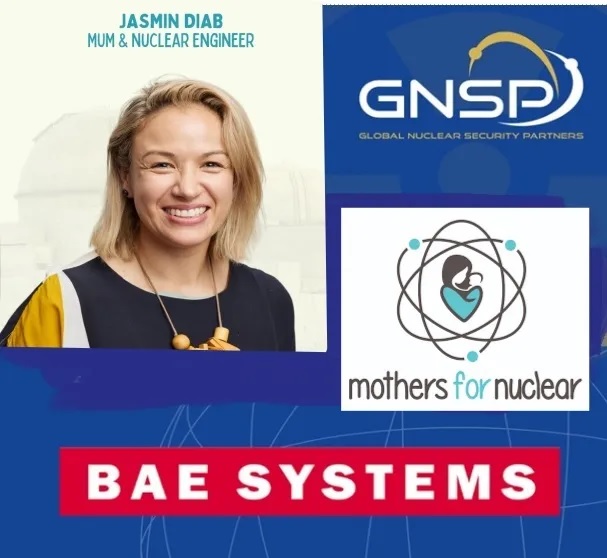
I have found one member, Jasmin Diab, who is the face of the outfit, but doesn’t call herself a CEO or anything formal like that: “Hi, I’m Jaz! I’m a mum of one human and two dogs.”
However, Jaz does have another role, which is quite a bit more formal.
Jasmin Diab is a nuclear engineer and is the Managing Director for Global Nuclear Security Partners (GNSP) in Australia. Global Nuclear Security Partners is a world leading nuclear management consultancy:
“We work with partners, clients and relevant authorities to ensure that novel technology is secure. Across SMR, AMR and fusion we work to make sure that projects, programmes, processes and products are protected and commercially viable.”
“Our clients include: the UK Department for Energy Security and Net Zero; the UK Ministry of Defence; UK National Nuclear Laboratory; the Canadian Nuclear Waste Management Organistion; the Ukrainian Government and nuclear industry; Magnox; Babcock International; BAE Submarines; University of Bristol; University of Manchester and SMR developers. We’ve worked with the armed police capability of the Ministry of Defence Police, Civil Nuclear Constabulary and US teams in protecting nuclear material and developing doctrine, and with the infrastructure police of some Middle Eastern Governments.”
I don’t doubt that Jasmin Diab is sincere, and that she is a good mum to one human and two dogs. And she can provide for them well, with that good job with GNSP. I’m not sure that her message will go down that well with Australian women. A recent national survey shows that Australian women are strongly opposed to nuclear energy and are most concerned any consideration of the controversial power source will delay the switch to renewables.
The Mums for Nuclear groups seem curiously uninterested in the fact that women, and children, are significantly more vulnerable to illness from nuclear radiation than men are.
Protect your girls: We show that biological sex IS a factor in radiation outcomes, WIDELY

Mary Olson, GENDER AND RADIATION IMPACT PROJECT, 1 Jan 25
NEWS: We show in a new paper that the finding that girls and women suffer greater harm from radiation exposure compared to boys and men (who are also harmed) can be seen WIDELY in recent radiation research literature.
Dr Amanda Nichols, University of California at Santa Barbara, lead author, joins Mary Olson, founder of Gender and Radiation Impact Project in the new paper, entitled “Gender and Ionizing Radiation: Towards a New Research Agenda Addressing Disproportionate Harm.”
The paper is available to view or download at no charge, from the publisher: United Nations Institute for Disarmament Research .
The news here is the simple difference between standing on a relatively slender branch, and standing on a robust limb—apply this image to research and it is the difference between evidence found in a limited case, versus the same evidence being FOUND widely—beyond what could have been limited application.
In terms of radiation—a finding was made that radiation harms girls and women more than boys and men in one set of data as early as 2006. That data was in the National Academy of Science (NAS) watershed report called the Biological Effects of Ionizing Radiation VII (BEIR VII).
Now, thanks to the invitation by the UN Institute for Disarmament Research (UNIDIR), I and my co-author Dr Amanda Nichols have sampled the research literature since 2006 (post-BEIR VII) and find that in studies that report data on males and females separately (now common) the sex-based difference can be seen, and in all cases where it is seen, females are harmed more than males. ……………………………………………………………………………………………….. more https://www.genderandradiation.org/blog/2024/12/31/protect-your-girls-we-show-that-biological-sex-is-a-factor-in-radiation-outcome-widely
Gender and radiation: New report shows girls most at-risk group
December 4, 2024,
https://beyondnuclear.org/gender-and-radiation-new-report-shows-girls-most-at-risk-group/
A new United Nations Institute for Disarmament Research (UNIDIR) report by Amanda M. Nichols — Postdoctoral Researcher, University of California, Santa Barbara and Mary Olson — Founder, Gender and Radiation Impact Project entitled Gender and Ionizing Radiation: Towards a New Research Agenda Addressing Disproportionate Harm examines recent research correlating harm from exposure to ionizing radiation and biological sex. The following is the executive summary:
“The detonation of a nuclear weapon in a populated area would cause devastating harm: it can kill thousands of people instantly, whether through the explosion itself, or through the intense heat and high levels of radiation. The mid- and long-term consequences from radiation exposure are less well understood, in part because they manifest differently for male and female survivors.
Robust evidence of differentiated health impacts emerged in 2006, when the US National Academy of Sciences published Biological Effects of Ionizing Radiation VII which reported 60 years of data from the Life Span Study of atomic bomb survivors of Hiroshima and Nagasaki.
Nearly 20 years after the publication of that report, this report speaks to the extent to which new evidence has been published regarding the correlation between harm from exposure to ionizing radiation and biological sex.
This report concludes the following:
The post-2006 radiation research reviewed in this report provides clear evidence that radiation causes more cancer, heart disease, and stroke in women compared to men.

Several studies present evidence that supports the hypothesis that a higher percentage of reproductive tissue in the female body could be one contributing factor to the greater rate of harm from radiation exposure in females compared to males.
In addition to biological sex, some studies suggest that age at time of exposure may be an important factor in assessing radiation outcomes.
Girls (ages 0–5 years) are the most at risk post-birth lifecycle stage for developing cancer and non-cancer related health consequences over the course of the lifetime from exposure to ionizing radiation.
These findings are important for discussions about nuclear non-proliferation and disarmament, given that sex-specific and gendered impacts of nuclear weapons are a prominent topic during the meetings of the Nuclear Non-Proliferation Treaty and the Treaty on the Prohibition of Nuclear Weapons.
More research is needed, however, that takes seriously the ways that age and intergenerational impacts inform discussions about radiological harm. This report concludes with an outline of a future research agenda and suggests research questions applicable across a number of disciplines and lines of inquiry.
Nuclear energy debate draws stark gender split in Australia ahead of next year’s election.
Lisa Cox, 5 Dec 24, https://www.theguardian.com/environment/2024/dec/04/nuclear-energy-debate-draws-stark-gender-split-in-australia-ahead-of-next-years-election
Survey finds 25 percentage point gender gap across all age brackets on whether nuclear power would be positive for the country, with majority of men saying it would.
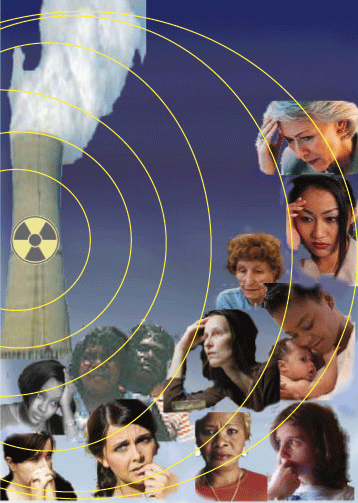
New data points to a stark gender split in attitudes towards nuclear energy, with women much more likely to say they don’t support it or think the risks are too great.
Research company DemosAu surveyed 6,000 people on behalf of the Australian Conservation Foundation and found 26% of women thought nuclear energy would be good for Australia, compared with 51% of men.
DemosAu head of research, George Hasanakos, said the 25 percentage point gender gap was “the sharpest divide in attitudes between men and women” that the research firm had seen on any issue.
The polling found the split was pronounced regardless of the age of the people surveyed, with young men and women just as divided as those from older generations.
While 51% of men agreed nuclear energy would be good for Australia, that support dropped when asked if they would be happy to live near a nuclear plant.
A reported 38% of men agreed they would support a nuclear plant being located close to their city, with 44% disagreeing and 18% neutral. Among women, just 18% agreed they would be happy to have a nuclear plant near their city, with 63% disagreeing and 19% neutral.
“Men support nuclear much more than women,” the ACF chief executive, Kelly O’Shanassy, said.
“But as soon as you ask men more details such as ‘Would you be happy to live next door to a plant?’ or ‘Do you think one will be built within the next decade?’ – that level of support really comes down.”
The report found female respondents were more likely to answer “neutral” compared with male respondents. It identified this as both “a risk and opportunity for campaigners on both sides of the issue” as Australia approaches a federal election but said pro-nuclear campaigners would have to contend with widely held safety concerns about nuclear among women.
On the subject of transporting nuclear waste, the poll found 57% of women and 43% of men said it wasn’t worth the risk.
The prime minister, Anthony Albanese, has said the next election will be a referendum on nuclear power.
The Coalition has proposed seven sites where it says it would eventually replace coal-fired power plants with nuclear plants but not how much this would cost. The government has rejected the idea and the federal House of Representatives is conducting an inquiry into the consideration of nuclear power in Australia.
Multiple energy analysts have argued nuclear energy would be more expensive than other options and a nuclear industry would not be possible in Australia until after 2040.
O’Shanassy said among the report’s more interesting findings was that despite the gender gap on many aspects of nuclear, men and women were aligned in the view that renewables were cheaper.
A reported 47% of men agreed renewables would deliver cheaper energy, compared with 31% who disagreed (with 22% neutral).
While 47% of women also agreed renewables would deliver cheaper energy, 20% disagreed and 33% were neutral.
In separate data, the climate advocacy organisation 1 Million Women surveyed an additional 3,351 women among its own supporters and found 93% were concerned about nuclear.
“Nuclear energy is a distraction to meaningful climate solutions and women don’t have the time or patience to entertain the Coalition’s proposal,” its founder, Natalie Isaacs, said.
Tell President Biden: WE WANT COOPERATION, NOT CONFLICT!

Biden is still asking for billions of dollars to spend on militarizing the Asia-Pacific region and encircling China. While the China-US summit in November was a good start, we’re a long way to building a sustainable and human-centered bilateral relationship where war is unlikely. Tell Biden we can’t afford one more penny on global aggression.
Dear President Joseph R. Biden,
You made an Oval Office address, during which you said, “American leadership is what holds the world together. American alliances are what keep us, America, safe.” In your more than fifty years of public service, however, the US has been involved in multiple wars. Currently, the US is occupying Syria, Iraq, Somalia in addition to supporting Israel’s siege and ethnic cleansing campaign in Gaza. Meanwhile, the Russia-Ukraine conflict has dragged on with no effort dedicated to peace talks.
As your administration seeks $105 billion in military spending, it seeks to allocate $7.4 billion of that money for militarizing the Asia-Pacific region, including more weapons to Taiwan. That doesn’t even include the $10 billion for weaponizing Taiwan authorized by the US Senate last year. About $3.4 billion of your request is for building a base to host attack submarines targeting China. This is all on top of the $9.1 billion for the Pacific Deterrence Initiative proposed by the Pentagon earlier this year.
Civil society organizations and environmentalists in the Philippines, Papua New Guinea, Japan, South Korea, and Guam have protested our military exercises and bases, which many say will make them the first casualties in a potential war. Military alliances don’t make them feel safe, and it is also taking away funds from targeting real threats like the climate crisis.
As we spend money on militarizing the region, it’s only made China more wary of cooperation. Yet, China is a natural ally in our fight against climate change. From Brooklyn to Beijing, extreme weather events are getting deadlier; 83 million more could die from climate-related disasters this century if we don’t limit global warming to 1.5° C by 2030. We implore you to strike a global climate finance deal.
Instead of tens of billions going to genocide in Gaza, war in Ukraine, and weapons systems in the Pacific, we must allocate resources to ensure a livable ecosystem. That kind of leadership is exactly what two-thirds of Americans surveyed by the Pew Research Center in 2020 would like to see – leadership focused on the climate crisis. President Xi has pledged to peak carbon emissions by 2030. You have expressed support for $11 billion in climate finance by 2024. If we don’t fund war, we could spend what you proposed on protecting our planet and much more.
The climate crisis and nuclear weapons

It seems we haven’t the money to save the planet, but we can stump up any amount to fund nuclear death
NORTH EAST BYLINES, by Caroline Westgate, 15-04-2024
A massive and accelerating crisis faces all of us on Planet Earth: the climate is warming, and we will rapidly reach a point where the damage to our ecosystem will be irreversible. Dismayed by the political inertia which fails to address this emergency, increasing numbers of people are resorting to protest through nonviolent direct action.
International conferences regularly agree on aims but fail to implement action with the urgency and on the scale needed to challenge the hegemony of Big Oil. We are told that the money simply isn’t there.
But here in the UK there is one hugely costly project which, if it were cancelled, would release an income-stream which could be directed to the electorate’s real priorities: the climate crisis, the NHS, education and transport. I’m talking about Trident.
Nuclear weapons
I was five years old when America’s atomic bombs destroyed Hiroshima and Nagasaki. Those events ended WW2 but triggered the Cold War. When the Soviet Union, the UK, France and China acquired their own nuclear arsenals, the Cold War settled into a 35-year stalemate of Mutually Assured Destruction (appropriately dubbed MAD), in which it was assumed that a nuclear exchange would be prevented by a ‘balance of terror’.
But in the 1980s, NATO strategists dropped the MAD policy, because advances in military technology gave them the confidence that they could fight and win a nuclear war: their new nuclear-armed Cruise missiles could launch pre-emptive strikes, capable of destroying the Soviets’ nuclear weapons in their silos.
Ordinary people rapidly realised that this development posed an existential threat to millions of civilians on both sides of the Iron Curtain: we had all been conscripted as front-line troops, expendable pawns in NATO’s nuclear game. A re-energised peace movement vociferously opposed Cruise missiles when they arrived on British soil: they were totally under American control, but they made the UK a target.
Embrace the Base at Greenham Common
Greenham Common in Berkshire was one of the Cruise sites. In the summer of 1981, a small group of women from South Wales established a peace camp there. During the first winter of their protest they struggled to get any support or publicity. In conditions of great hardship, they kept the camp going. Their protest grew amid evictions, arrests, imprisonments, and physical attacks. One woman was killed. All of this was accompanied by often viciously mendacious press coverage.
In December 1982, I was one of 30,000 women who responded to an unsigned chain letter, inviting us to ‘Embrace the Base’. We joined hands and encircled Greenham’s 9-mile perimeter fence. We decorated it with objects of significance to us, transforming it into a nine mile work of art.
‘Embrace the Base’ was a high-profile event, but small-scale protests were frequently staged with daring, creativity and humour, either by the women who lived at the camp or by autonomous groups of women who travelled to Berkshire to carry out some anarchic plot of their own devising.
In September 1985, with a group of women from the North East, I made the 300-odd mile journey to Greenham again.
My group had hatched a plan to enter the base to access a small outbuilding on which they were going to paint anti-nuclear slogans, and I was there to support them. By that stage it was ludicrously easy to get through the fence because hundreds of women with bolt cutters had reduced it to shreds. The army kept patching it up, but their efforts were futile. The women from my group walked on to the base, slapped a lot of blue gloss paint on the wall of the outbuilding, then stood quietly, dripping brushes in hand, waiting to be arrested. A group of policemen duly arrived and handcuffed them. To my surprise, I was also arrested, even though I was outside the fence and hadn’t actually done anything wrong. We were all charged with criminal damage and summonsed to appear at Newbury Magistrates’ Court a few weeks later.
From the dock, I made a stirring speech to justify protesting at the base. It cut no ice whatsoever. I was found guilty of criminal damage and ordered to pay a fine and costs, which amounted to £67.75p. I refused to pay. The magistrates, who had seen it all before, wearily referred my case to my local court in Hexham. I knew that the length of time to be spent inside would be calculated pro rata from the amount of the fine I’d refused to pay. It worked out at less than a week in prison, which I felt confident I could cope with.
However, time wore on and nobody arrived to take me away. It was getting perilously near Christmas, when I really didn’t want to be away from my family. I enquired of the clerk to Hexham’s Magistrates when the law would come for me. He said:
“They don’t put people like you in prison. It’s much too expensive. We will contact your employer and put an Attachment of Earnings order on your salary.” I realised that my gesture of defiance would pointless if the only person who knew about it would be the wages clerk at County Hall. Since I was going to have to pay anyway, I decided to turn it into a stunt by making the payment on a novelty cheque……………………………………………………………………………………..
The carbon footprint of the UK military
All this is good for a laugh, but what it says about our priorities is far from funny. It is high time we looked at this issue from the perspective of the climate catastrophe, factoring-in what the military contributes to the UK’s carbon footprint. Dr Stuart Parkinson, of Scientists for Global Responsibility, calculates that the annual carbon footprint of the UK military is roughly equivalent to the carbon emissions of six million average cars. Trident must account for a sizeable proportion of that. Of course, the government omits all mention of those figures when it claims we are progressing nicely towards net zero.
The cost of Trident

We also need to challenge why we spend such colossal amounts of money on Trident, when there are so many urgent rival claims on the public purse. The arguments against the possession of nuclear weapons are as valid now as they were when I wrote my novelty cheque nearly forty years ago.
- the moral objection to threatening the deaths of countless numbers of people.
- nuclear weapons make their possessors a target.
- early-warning systems make it more likely that nuclear war will be triggered by accident.
- nuclear war will be followed by nuclear winter, causing ecocide and wrecking forever any chance of addressing climate change.
But let’s focus on the cost of Trident, which falls on the UK at a time when serious investment in public services is urgently needed on a huge scale. The figures bandied about are quoted not in millions but in billions. The difference between those two quantities is so vast it is hard to grasp, so try this analogy: a million seconds would last for about eleven days, but a billion seconds would last for 31 and a half years.
The Nuclear Information Service calculates the cost of Trident as £172 billion (including its new warheads and its running costs over its projected lifetime). That is a stupendous amount of money to lavish on maintaining the fiction that the UK is a world-class power. Neither the Tories nor Labour dares to question that expenditure. By contrast, Labour’s new idea for a Green Investment Fund (a mere £28 billion) was recently cancelled as unaffordable.
Apparently, we haven’t the money to save the planet, but we can stump up any amount to fund nuclear death.
Why are our priorities so badly skewed? https://northeastbylines.co.uk/the-climate-crisis-and-nuclear-weapons/
Our International Women’s Day Heroine: Rosalie Bertell

ON BY MARIANNEWILDART, https://mariannewildart.wordpress.com/2024/03/08/our-international-womens-day-heroine-rosalie-bertell/
Rosalie Bertell, PhD (1929-2012), was a biometrist – a mathematician who analyzed risks to health from radiation and pollution. In this interview she mainly tells about her research on radiation and cancer, which led to restricting X-rays to diagnostic uses, revealed how above-ground nuclear testing had led to elevated breast cancer cohorts, and helped prevent the establishment of nuclear power plants in several communities.
http://www.radio4all.net/files/wingsradionews@gmail.com/WINGS-33-23CancerMath-28_58-128kbps.mp3
Rosalie Bertell was one of the first to raise concerns about military geoengineering and her book “Planet Earth – Latest Weapon of War” was re-published in 2020 as an updated version thanks to another heroine Dr. Claudia von Werlhof. The book’s first appearance in 2000 did not reach the international reader, because the publisher, The Women´s Press, London, went bankrupt and the book was available only in Canada (Black Rose 2001).

Dr Werlhof said “Rosalie and I, we met only once, in Bonn, Germany, in 2010 at the 30th Anniversary of the Right Livelihood Award, where she proposed to sign the following petition:
“It is morally reprehensible and an offense against humanity and the Earth to interfere with the normal function of the planetary system – to cause or enhance storms, hurricanes, tsunamis, monsoons, mud slides, draught, flooding, earth quakes or volcano eruptions”.
The 22 laureates present from different parts of the world, all of them signed it.
Meeting Rosalie Bertell in person was for me like meeting a very old friend. It is because I share with her the same motivation, feeling and thinking about our Mother Earth: the indignation and pain about her ongoing destruction, the immense love for her, and the necessity of a general planetary upheaval in support of Mother Earth. For this we need exactly what Rosalie Bertell embodied: a burning heart, a very clear mind and a ”planetary consciousness“ that knows about the Planet, our Mother Earth, as a huge living being, the ways she is endangered today, and the firm decision to fight for her life. What else? Mother Earth or Death!
This is what the reader of ”Planet Earth” should learn from its author. We need a world in which it is not necessary to write books like ”Planet Earth”, anymore!”
-
Archives
- February 2026 (211)
- January 2026 (308)
- December 2025 (358)
- November 2025 (359)
- October 2025 (376)
- September 2025 (258)
- August 2025 (319)
- July 2025 (230)
- June 2025 (348)
- May 2025 (261)
- April 2025 (305)
- March 2025 (319)
-
Categories
- 1
- 1 NUCLEAR ISSUES
- business and costs
- climate change
- culture and arts
- ENERGY
- environment
- health
- history
- indigenous issues
- Legal
- marketing of nuclear
- media
- opposition to nuclear
- PERSONAL STORIES
- politics
- politics international
- Religion and ethics
- safety
- secrets,lies and civil liberties
- spinbuster
- technology
- Uranium
- wastes
- weapons and war
- Women
- 2 WORLD
- ACTION
- AFRICA
- Atrocities
- AUSTRALIA
- Christina's notes
- Christina's themes
- culture and arts
- Events
- Fuk 2022
- Fuk 2023
- Fukushima 2017
- Fukushima 2018
- fukushima 2019
- Fukushima 2020
- Fukushima 2021
- general
- global warming
- Humour (God we need it)
- Nuclear
- RARE EARTHS
- Reference
- resources – print
- Resources -audiovicual
- Weekly Newsletter
- World
- World Nuclear
- YouTube
-
RSS
Entries RSS
Comments RSS
 nuclear-news