Australia and the F-35 supply chain: in lockstep with Lockheed

The Australian government has continued arms exports to Israel while assuring Australians it has not sent weapons to Israel for five years
MICHELLE FAHY. MAY 03, 2024, https://undueinfluence.substack.com/p/lockstep-with-lockheed-australia?utm_source=post-email-title&publication_id=297295&post_id=143751160&utm_campaign=email-post-title&isFreemail=true&r=1ise1&triedRedirect=true&utm_medium=email
Australia is one of six western countries that are complicit in the ‘genocidal erasure’ of the Palestinian people by continuing to supply Israel with arms, according to Dr Ghassan Abu-Sittah, a British-Palestinian surgeon and newly elected rector of Glasgow University.
Israel’s relentless bombing campaign has systematically destroyed all of Gaza’s 11 universities plus more than 400 schools, and killed 6,000 students, 230 teachers, 100 professors and deans, and two university presidents.
The elimination of entire educational institutions (both infrastructure and human resources) is ‘scholasticide’ and is a critical component of the genocidal erasure, says Dr Abu-Sittah.
He named the United States, Germany, the United Kingdom, Australia, Canada and France as comprising an ‘axis of genocide’ because they have been supporting the genocide in Gaza with arms, and had also maintained political support for Israel.
Dr Abu-Sittah worked in Gaza for 43 days in the immediate aftermath of the October 7 attacks. His experience was cited in South Africa’s genocide case at the International Court of Justice (ICJ).
In his submission to the ICJ, Dr Abu-Sittah wrote: ‘There was a girl with just her whole body covered in shrapnel. She was nine. I ended up having to change and clean these wounds with no anaesthetic and no analgesic. I managed to find some intravenous paracetamol to give her…her Dad was crying, I was crying, and the poor child was screaming…’
Australia defies the UN
The Albanese government has consistently denied it is supplying weapons to Israel, even as the United Nations pointed a finger directly at Australia, alongside the US, Germany, France, the UK, and Canada, asking these countries to immediately halt all weapons transfers to Israel, including weapons parts, and to halt export licences and military aid.
The Defence Department has refused to answer questions about whether it has halted the arms export permits for Israel that were in place before October 7, the day of Hamas’s deadly attack in Israel.
Defence approved new export permits to Israel after October 7
Defence approved three new export permits to Israel in October 2023, and none in November, December or January (to 29/1), according to figures Defence released following a Freedom of Information (FOI) request I lodged on 29 January.
In a Senate estimates hearing on February 14, the Defence Department revealed it had approved two new export permits to Israel since the Hamas attacks of October 7. Asked for clarification about the timing, Defence’s deputy secretary of Strategy, Policy, and Industry, Mr Hugh Jeffrey, said, ‘Two export permits have been granted since the time of the last estimates’. The previous estimates hearing had been on 25 October 2023.
The Senate Estimates and FOI evidence together show that Defence approved one export permit to Israel prior to October 7 and two in the period October 25–31.
Mr Jeffrey refused to say what items the two new permits covered. Instead he said they ‘would have been agreed on the basis that they did not prejudice Australian national interests under the criterion of the legislation’.
Possible implications
Israel has been using its F-35 fighter jets in its bombardment of Gaza. Australia is one of a number of countries that manufacture and export parts and components into Lockheed Martin’s F-35 fighter jet global supply chain. Given this, there are several reasons why the above information may be significant:
- The head of the F-35 joint program office, Lieutenant General Michael Schmidt, a US Air Force officer, said a year ago that the F-35 program was established with a ‘just in time’ supply chain, where parts arrive just before they’re needed and very little inventory is stockpiled. [Emphasis added.] Lt-Gen Schmidt described that situation as ‘too risky’.
In mid-December, a US Congressional hearing on the F-35 program revealed that the F-35 joint program office had been moving ‘at a breakneck speed to support…Israel…by increasing spare part supply rates’. [Emphasis added.]- More than 70 Australian companies are involved in the global supply chain for the F-35. Several of the companies are the sole global source of the parts they produce. Without them, new F-35 jets cannot be built and those parts in existing jets cannot be replaced. The US recently authorised the transfer to Israel of 25 more F-35s.
The F-35 global supply chain is vulnerable to disruption, which is why Australia could be under pressure to continue meeting supply contracts.
In his testimony to the December 12 Congressional hearing, Lieutenant General Schmidt also made clear the role of the F-35 joint program office in closely supporting Israel:
I had the opportunity to talk with [Israel’s] Chief of Staff just yesterday… [Israel is] very satisfied with [the] performance [the] sustainment enterprise is giving them. We could learn a lot from them in terms of the quickness with which they’re turning airplanes, [plus] all of the things we’re learning ourselves with moving parts around the world in support of a conflict. [Emphasis added.]
Defence Department and Australian industry partnering with F-35 program office
Defence issued a media release on October 30, around the same time it approved the two additional export permits to Israel.
The release announced that Melbourne company Rosebank Engineering had established an important regional F-35 capability that would also contribute to the global F-35 program. The release said Australian industry is playing an increasingly important role in the production and sustainment of the global F-35 fleet and that Rosebank and the Defence Department had partnered with the US F-35 joint program office and Lockheed Martin to establish the new facility.
Lockheed Martin removes information from its website
US multinational Lockheed Martin is the world’s largest arms manufacturer and the prime contractor for the F-35 fighter jet. As the horror of Israel’s war on Gaza has unfolded over the past seven months, there have been court cases and protests targeting the F-35 and its global supply chain.
In this context, Lockheed Martin recently edited the Australian page of its F-35 website to remove the ‘Industrial Partnerships’ section. The text had acknowledged that Australian parts were used in every F-35 fighter jet.
The deleted section can be viewed at the Wayback Machine web archive. This was the opening paragraph:[screenshot on original]
Lockheed Martin has also deleted other information from its website. A feature post about Marand Precision Engineering, another Melbourne-based company supplying the F-35 program, has been removed. The page had described how Marand engineered, manufactured, and now sustains ‘one of the most technically advanced mechanical systems’ ever created in Australia. The system, an engine removal and installation mobility trailer for the F-35, comprises 12,000 individual parts. The page said, ‘Marand has worked in close concert with Lockheed Martin on the F-35 program for many years’ and revealed that in 2022 the company had established a maintenance facility for its F-35 trailer in the US, ‘to better meet Lockheed Martin’s sustainment needs’. The deleted page can be viewed at the Wayback Machine web archive.
Sydney-based Quickstep Holdings is another long-term Australian supplier to the F-35 program. In December 2020, it announced it had produced its 10,000th component for the F-35 program. Quickstep estimated it had completed just 20% of its commitment to the program. The company revealed it manufactures more than 50 individual components and assemblies for the F-35, representing about $440,000 worth of content in each F-35.
Last year, Lockheed Martin also acknowledged that Queensland’s Ferra Engineering had been providing products for the F-35 since 2004 and that it remained a vital partner supporting delivery of the aircraft.
Despite the Albanese government’s persistent and misleading claim that no weapons have been supplied to Israel for the past five years, all of the above companies have supplied parts and components into the F-35’s supply chain during this period.
Threshold for genocide met, says UN Special Rapporteur
On March 26, Francesca Albanese, the UN Special Rapporteur on the Human Rights Situation in the West Bank and Gaza, said, ‘Following nearly six months of unrelenting Israeli assault on occupied Gaza, it is my solemn duty to report on the worst of what humanity is capable of, and to present my findings.’
Ms Albanese said there were ‘reasonable grounds to believe that the threshold indicating the commission of the crime of genocide… has been met’.
On April 5, the UN Human Rights Council adopted a resolution that included a call for an arms embargo on Israel.
Some 28 countries voted in favour of the resolution and 13 abstained. Israel’s two largest suppliers of weaponry, the US and Germany, along with four other countries, voted against it. (The Council has 47 members elected for staggered three-year terms on a regional group basis. Australia is not currently a member.)
The Israel-US game plan for Gaza is staring us in the face

The western media is pretending the West’s efforts to secure a ceasefire are serious. But a different script has clearly been written in advance
JONATHAN COOK, APR 30, 2024, https://jonathancook.substack.com/p/the-israel-us-game-plan-for-gaza
One does not need to be a fortune-teller to understand that the Israel-US game plan for Gaza runs something like this:
1. In public, Biden appears “tough” on Netanyahu, urging him not to “invade” Rafah and pressuring him to allow more “humanitarian aid” into Gaza.
2. But already the White House is preparing the ground to subvert its own messaging. It insists that Israel has offered an “extraordinarily generous” deal to Hamas – one that, Washington suggests, amounts to a ceasefire. It doesn’t. According to reports, the best Israel has offered is an undefined “period of sustained calm”. Even that promise can’t be trusted.
3. If Hamas accepts the “deal” and agrees to return some of the hostages, the bombing eases for a short while but the famine intensifies, justified by Israel’s determination for “total victory” against Hamas – something that is impossible to achieve. This will simply delay, for a matter of days or weeks, Israel’s move to step 5 below.
4. If, as seems more likely, Hamas rejects the “deal”, it will be painted as the intransigent party and blamed for seeking to continue the “war”. (Note: This was never a war. Only the West pretends either that you can be at war with a territory you’ve been occupying for decades, or that Hamas “started the war” with its October 7 attack when Israel has been blockading the enclave, creating despair and incremental malnutrition there, for 17 years.)
Last night US Secretary of State Anthony Blinken moved this script on by stating Hamas was “the only thing standing between the people of Gaza and a ceasefire… They have to decide and they have to decide quickly”.
5. The US will announce that Israel has devised a humanitarian plan that satisfies the conditions Biden laid down for an attack on Rafah to begin.
6. This will give the US, Europe and the region the pretext to stand back as Israel launches the long-awaited assault – an attack Biden has previously asserted would be a “red line”, leading to mass civilian casualties. All that will be forgotten.
7. As Middle East Eye reports, Israel is building a ring of checkpoints around Rafah. Netanyahu will suggest, falsely, that these guarantee its attack meets the conditions laid down in international humanitarian law. Women and children will be allowed out – if they can reach a checkpoint before Israel’s carpet bombing kills them along the way.
8. All men in Rafah, and any women and children who remain, will be treated as armed combatants. If they are not killed by the bombing or falling rubble, they will be either summarily executed or dragged off to Israel’s torture chambers. No one will mention that any Hamas fighters who were in Rafah were able to leave through the tunnels.
9. Rafah will be destroyed, leaving the entire strip in ruins, and the Israeli-induced famine will worsen. The West will throw up its hands, say Hamas brought this on Gaza, agonise over what to do, and press third countries – especially Arab countries – for a “humanitarian plan” that relocates the survivors out of Gaza.
10. The western media will continue describing Israel’s genocide in Gaza in purely humanitarian terms, as though this “disaster” was an act of God.
11. Under US pressure, the International Court of Justice, or World Court, will be in no hurry to issue a definitive ruling on whether South Africa’s case that Israel is committing a genocide – which it has already found “plausible” – is proved.
12. Whatever the World Court eventually decides, and it is almost impossible to imagine it won’t determine that Israel carried out a genocide, it will be too late. The western political and media class will have moved on, leaving it to the historians to decide what it all meant.
13. Meanwhile, Israel is already using the precedents it has created in Gaza, and its erosion of the long-established principles of international law, as the blueprint for the West Bank. Saying Hamas has not been completely routed in Gaza but is using this other Palestinian enclave as its base, Israel will gradually intensify the pressures on the West Bank with another blockade. Rinse and repeat.
That’s the likely plan. Our job is to do everything in our power to stop them making it a reality.
Zelensky wants ten more years of US funding

https://www.rt.com/news/596736-ukraine-us-aid-decade/ 29 Apr 24
The Ukrainian leader has said he is working on getting a long-term assistance package from Washington.
The latest US aid package for Kiev, which was only approved by Congress after more than six months of partisan feuding, might be small potatoes compared to what Ukrainian President Vladimir Zelensky has in mind for his biggest benefactor.
Kiev is negotiating with the administration of US President Joe Biden on a long-term agreement that would put Washington on the hook to provide Ukraine with military, economic, and political support for the next decade, Zelensky said on Sunday in his daily video address. Such commitments are needed to ensure Ukraine has the “efficiency in assistance” it needs to stem recent battlefield advances by Russian forces and gain the upper hand, he said.
“We are working to commit to paper concrete levels of support for this year and for the next ten years,” Zelensky said. “It will include military, financial, and political support, as well as what concerns joint production of weapons.”
Ukraine has already signed bilateral security agreements with several NATO members, including the UK, Germany, and France. Zelensky said he wants the long-term deal under negotiation with Washington to be the strongest pact yet.
However, Ukraine’s bilateral agreements with Western countries so far have stopped short of mutual-defense commitments. The deals merely pledge long-term aid, including support in the event of a future attack, and they are not legally binding. The agreement with Berlin, for instance, can be terminated with six months’ notice.
Zelensky said he wants Ukraine’s bilateral pact with Washington to include specific levels of aid. “The agreement should be truly exemplary and reflect the strength of American leadership,” he said.
US lawmakers approved $61 billion in additional aid for Ukraine earlier this month, after House Speaker Mike Johnson (R-Louisiana) overrode opposition in his own party to pass the bill with unanimous Democrat support. The Biden administration ran out of funding for Ukraine aid earlier this year, after using up $113 billion in previously approved assistance packages.
Republican lawmakers have argued that Biden is merely prolonging the bloodshed in Ukraine without offering a clear strategy for victory or a peace deal with Russia. A poll released in February showed that nearly 70% of Americans want Biden to push for a negotiated settlement with Moscow, involving compromises on both sides, rather than continuing to fund the conflict.
Australian Parliamentarians renew their support for the Treaty for the Prohibition of Nuclear Weapons
Jemila Rushton, Acting Director, ICAN Australia
Australian parliamentarians from across party lines have renewed their support for Australia joining the Treaty on the Prohibition of Nuclear Weapons (TPNW).
In a new video, members of the Parliamentary Friends of the Treaty on the Prohibition of Nuclear Weapons show that action on nuclear disarmament is beyond party politics. Their joint message demonstrates how parliamentarians from across the political spectrum are working together to see the Treaty signed and ratified.
| Featured in the video are Susan Templeman MP (ALP), Member for Macquarie, Jordan Steele-John (GRN), Senator for Western Australia, Monique Ryan MP (IND), Member for Kooyong, Russell Broadbent (IND), Member for Monash, Sam Lim MP (ALP), Member for Tangney, Louise Pratt (ALP), Senator for Western Australia, Lidia Thorpe (IND), Senator for Victoria, Sharon Claydon MP (ALP), Member for Newcastle, Josh Burns MP (ALP), Member for Macnamara, and Josh Wilson MP (ALP), Member for Fremantle. In the video, they state: |
Today, 93 countries around the world are signatories to the Treaty on the Prohibition of Nuclear Weapons – the TPNW.
They are signed up to the legally binding commitment to comprehensively ban nuclear weapons.
Developing them, testing them, producing them, assisting with them, possessing them, threatening to use them, and using them are banned.
The TPNW is giving countries and citizens across the world hope, and a new and promising pathway towards the abolition of these weapons.
It’s about understanding that what we cannot prepare for and what we can adequately respond to, we must prevent.
It’s about continuing Australian leadership when it comes to nuclear disarmament.
It’s about working with our closest neighbours and collaborating with our Pacific family.
It’s about recognising and supporting victims of nuclear weapons testing. For First Nations survivors, for Australia’s nuclear veterans.
As members of the Australian Parliamentary Friends of the TPNW, we are working together to see the Nuclear Weapons Ban Treaty signed and ratified.
We are proud of our country’s commitment to getting rid of other inhumane weapons, like landmines, cluster munitions, biological, and chemical weapons.
We welcome Australia’s engagement with the TPNW under the Albanese Government and we pay tribute to the community activism being undertaken in support of Australia joining this treaty.
History is calling.
US vs China, Israel vs Iran, India vs Pakistan: Asia plays with fire as nuclear war safety net frays
- From the Korean peninsula to the Middle East, a string of nuclear flashpoints has emerged with the unravelling of the global post-Cold War detente
- Amid arms races, sky-high tensions – and the removal of guardrails to avert danger – proliferation ‘threatens to destabilise everywhere’, experts warn
A high-stakes game of geopolitical brinkmanship is playing out across the Middle East and Asia, with Israel and Iran trading missile strikes; India and Pakistan locked in a multi-headed rocket arms race; and power struggles on the Korean peninsula and in the South China Sea combining to create a perilous chain of potential nuclear-conflict zones.
In the past couple of weeks alone, Iran and Israel’s tit-for-tat exchanges amid the war in Gaza have highlighted their ability to target each other’s uranium-enrichment facilities, while the US has deployed mid-range ballistic missiles to the Philippines for the first time since the Cold War…………………………………………………. https://www.scmp.com/week-asia/politics/article/3260551/us-vs-china-israel-vs-iran-india-vs-pakistan-asia-plays-fire-nuclear-war-safety-net-frays?campaign=3260551&module=perpetual_scroll_0&pgtype=article
72 Minutes Until the End of the World?

Carl Sagan’s conclusion is that the enemy is not a foreign nation, it’s the weapons themselves.
The generals that I refer to in that section on the SIOP [Strategic Integrated Operational Plan, the 1960s-era plan for general nuclear war] believed they could fight and win nuclear war, even if it meant killing 600 million people across the globe. That is insane. No one would argue that now.
A new book lays out the frighteningly fast path to nuclear Armageddon.

By KATHY GILSINAN, 04/29/2024 https://www.politico.com/news/magazine/2024/04/29/the-frighteningly-fast-path-to-nuclear-armageddon-00154591
Nuclear war would be bad. Everyone knows this. Most people would probably rather not think through the specifics. But Annie Jacobsen, an author of seven books on sensitive national security topics, wants you to know exactly how bad it would be. Her new book Nuclear War: A Scenario, sketches out a global nuclear war with by-the-minute precision for all of the 72 minutes between the first missile launch and the end of the world. It’s already a bestseller.
It goes without saying that the scenario is fictional, but it is a journalistic work in that the scenario is constructed from dozens of interviews and documentation, some of it newly declassified, as a factual grounding to describe what could happen.
That’s this, in Jacobsen’s telling: A North Korean leader launches an intercontinental ballistic missile at the Pentagon, and then a submarine-launched ballistic missile at a nuclear reactor in California, for reasons beyond the scope of the book except to illustrate what one “mad king” with nuclear weapons could do. A harried president has a mere six minutes to decide on a response, while also being evacuated from the White House and pressured by the military to launch America’s own ICBMs at all 82 North Korean targets relevant to the nation’s nuclear and military forces and leadership. These missiles must fly over Russia, whose leaders spot them, assume their country is under attack (the respective presidents can’t get one another on the phone), and send a salvo back in the other direction, and so on until 72 minutes later three nuclear-armed states have managed to kill billions of people, with the remainder left starving on a poisoned Earth where the sun no longer shines and food no longer grows.
Some scholars, particularly among those who favor large nuclear arsenals as the best deterrent to being attacked with such weapons ourselves, have criticized some of Jacobsen’s assumptions. The U.S. wouldn’t have to court Russian miscalculation by overflying Russia with ICBMs when it has submarine-launched ballistic missiles in the Pacific. Public sources indicate that the president’s six-minute response window is still about in line with what Ronald Reagan noted with dismay in his memoirs. But that assumes he’s boxed into a “launch on warning” policy, something Jacobsen’s sources characterize as a constraint to move before enemy missiles actually strike, but which government policy documents insist is merely an option and not a mandate. (The president could also just decide, contra the deterrence touchstone of “mutual assured destruction,” not to nuke anybody at all in response.)
The book arrives at a time when the countries with the world’s largest nuclear arsenals, the U.S. and Russia, are violently at odds in Ukraine, a Russian state TV host is calling a Russia/NATO conflict “inevitable,” and the Council on Foreign Relations is gaming out scenarios in case the Russians use tactical nukes in Ukraine. Oh, and Iran is closer to a nuclear weapon than ever before. It’s a fair time to ask Jacobsen’s central question — what if deterrence fails? Even if we’d rather not think about it.
This conversation has been edited for length and clarity.
Kathy Gilsinan: The book starts with two missiles out of North Korea and ends with essentially the end of the world 72 minutes later. And the subtitle calls this “a scenario.” Is it a realistic scenario?
Annie Jacobsen: The scenario I chose was pieced together from interviews I did with 46 on-the-record sources and dozens of sources on background, and I ran by them various scenarios to come up with the most plausible scenario that unfolds once it begins. And this is what I came up with. And so far, I haven’t had anyone who actually runs these scenarios for NORAD take issue with the choices that I’ve made and the way in which the decision trees unfold, which makes it all the more frightening.
Gilsinan: Can you walk me through why it would be inevitable that the North Koreans hit us with two and we hit them back with 80?
Jacobsen: Let’s look at the words of General [John] Hyten, former STRATCOM commander, when he did an interview with CNN during former President Donald Trump’s “fire and fury” rhetoric days. And General Hyten said on the record, in a rather “don’t you dare” way, speaking almost directly to North Korea: “If somebody launches a nuclear weapon against us, we launch one back. They launch two, we launch two.”
To drill down a little bit further on that I looked to Dr. Bruce Blair, a former missileer himself. Now he’s deceased, but he became one of the world’s experts on nuclear command and control systems and authority. And he explained in a monograph I cite in the book that it’s far more likely that if North Korea hit the United with one missile, America would send 82 in return. [The monograph, written under the auspices of the anti-nuclear group Global Zero, points to about 80 “aimpoints” relevant to North Korea’s nuclear and other military forces as well as its leadership, but also notes that “graduated and flexible strikes” would be possible. Jacobsen says she relied on other sources to support the assumption the U.S. would attack all the targets.] Everything I did, I linked to an open-source scenario that had been thought through by experts who have dedicated their intellectual prowess to these issues for decades.
Gilsinan: In this scenario, the U.S. responds with ICBMs that have to fly over Russia, with predictable consequences. Why, according to the folks you’ve spoken to, would we risk flying missiles over a nuclear power if we could use submarine-launched missiles from the Pacific Ocean?
Jacobsen: I asked that same question to numerous people, and the most powerful answer came from former Secretary of Defense Leon Panetta himself: “There’s not a lot of thought given to who the hell else may be thinking about doing what … at a time like this.”
Gilsinan: Maybe this is the point of the book. I would like very much to believe that STRATCOM is smarter than me and has thought this through ahead of time.
Jacobsen: Part of the terrifying truth about nuclear war, or if a nuclear exchange were to unfold, is the insane time clock that was put on everything from the moment nuclear launch is detected. This is fact. And so is the fact that the president has only six minutes, that’s the rough time to make this decision. And in that time, the Black Book gets opened; he must make a choice from a counterattack list of choices inside the Black Book. Those choices have been thought through for multiple scenarios, but you can’t possibly take into consideration every contingency in real time, which makes so clear to readers exactly how insane the truth is about the unfolding of the scenario. And the unpredictability of it. And for example, one of the few people that actually read the contents of the Black Book and spoke to me about it in general terms so as not to violate security clearances is Ted Postol [a former assistant to the chief of naval operations]. He’s the one who said to me that every decision was a bad decision.
Gilsinan: Why do we think it’s six minutes specifically? I know that’s in Reagan’s memoirs, but why do we think that is still the case?
Continue readingMacron ready to ‘open debate’ on nuclear European defence
French President Emmanuel Macron is ready to “open the debate” about the role of nuclear weapons in a common European defence, he said in an interview published Saturday
https://www.france24.com/en/europe/20240427-macron-ready-to-open-debate-on-nuclear-european-defence 27/04/2024
It was just the latest in a series of speeches in recent months in which he has stressed the need for a European-led defence strategy.
“I am ready to open this debate which must include anti-missile defence, long-range capabilities, and nuclear weapons for those who have them or who host American nuclear armaments,” the French president said in an interview with regional press group EBRA.
“Let us put it all on the table and see what really protects us in a credible manner,” he added.
France will “maintain its specificity but is ready to contribute more to the defence of Europe”.
The interview was carried out Friday during a visit to Strasbourg.
Following Britain’s withdrawal from the European Union, France is the only member of the bloc to possess its own nuclear weapons.
In a speech Thursday to students at Paris’ Sorbonne University, Macron warned that Europe faced an existential threat from Russian aggression.
He called on the continent to adopt a “credible” defence strategy less dependent on the United States.
“Being credible is also having long-range missiles to dissuade the Russians.
“And then there are nuclear weapons: France’s doctrine is that we can use them when our vital interests are threatened,” he added.
“I have already said there is a European dimension to these vital interests.”
Constructing a common European defence policy has long been a French objective, but it has faced opposition from other EU countries who consider NATO’s protection to be more reliable.
However, Russia’s invasion of Ukraine and the possible return of the isolationist Donald Trump as US president has given new life to calls for greater European defence autonomy.
NNSA Delays Urgent Research on Plutonium “Pit” Aging But Spends Billions on Nuclear Weapons Bomb Cores

Concerned Citizens for Nuclear Safety, 28 Apr 24 http://nuclearactive.org/
This week, CCNS highlights portions of a recent press release by Nuclear Watch New Mexico, Tri-Valley Communities Against a Radioactive Environment (Tri-Valley CARES), and the Savannah River Site Watch about the National Nuclear Security Administration (NNSA). Their piece suggests NNSA does not have its priorities straight in neither producing up-to-date information on the way plutonium appears to age nor providing this information in a timely manner to the public. The entire press release is posted at http://nuclearactive.org/wp-content/uploads/2024/04/240417-NWNM-SRSW-TVC-Plutonium-Aging-PR.pdf
The press release reads: “Nearly three years after filing a Freedom of Information Act request, the public interest group Savannah River Site Watch has finally received [] the congressionally required Research Program Plan for Plutonium and Pit Aging.
However, the document is 40% blacked out, including references and acronyms.
Plutonium ‘pits’ are the radioactive cores of all U.S. nuclear weapons. The NNSA claims that potential aging effects are justification for a ~$60 billion program to expand production. However, the Plan fails to show that aging is a current problem. To the contrary, it demonstrates that NNSA is delaying urgently needed updated plutonium pit aging research.
“In 2006 independent scientific experts known as the JASONs concluded that plutonium pits last at least 85 years without specifying an end date. The average pit age is now around 40 years. A 2012 follow-on study by the Lawrence Livermore nuclear weapons lab concluded:
’This continuing work shows that no unexpected aging issues are appearing in plutonium that has been accelerated to an equivalent of [approximately] 150 years of age. The results of this work are consistent with, and further reinforce, the Department of Energy Record of Decision to pursue a limited pit manufacturing capability in existing and planned facilities at Los Alamos instead of constructing a new, very large pit manufacturing facility…’
“Since then NNSA has reversed itself. In 2018 the agency decided to pursue the simultaneous production of at least 30 pits per year at the Los Alamos National Laboratory (LANL) in northern New Mexico and at least 50 pits per year at the Savannah River Site (SRS) in South Carolina. Upgrades to plutonium facilities at LANL are slated to cost $8 billion over the next five years. The redundant Savannah River Plutonium Processing Facility in South Carolina will cost up to $25 billion, making it the second most expensive building in human history.
“Hundreds of billions of taxpayers’ dollars and future international nuclear weapons policies are at stake. …
Biden Wanted To Sanction An Israeli Battalion But He Didn’t Because Israel Said No
CAITLIN JOHNSTONE, APR 27, 2024
The Biden administration has reportedly canned its plans to issue sanctions on an extremist IDF unit for human rights violations in the occupied West Bank, following backlash from Israel and its high-powered supporters within the US government.
The State Department has put on hold its intention to impose sanctions on the Israel Defense Forces “Netzah Yehuda” battalion for human rights violations in the occupied West Bank and is reviewing the issue in light of information Israel provided in recent days, U.S. sources familiar with the issue said.
Why it matters: The review is part of a consultation process outlined in an agreement between the U.S. and Israel. But Secretary of State Antony Blinken has also been under extensive pressure from the Israeli government, members of Congress and some senior Biden administration officials to reconsider the possible sanctions.
The big picture: The Biden administration had intended to withhold U.S. military aid and training from the Netzah Yehuda battalion — an unprecedented move in the history of relations between the countries.

As Dr Assal Rad has highlighted on Twitter, this decision follows a sequence of events in which ProPublica revealed that Secretary of State Antony Blinken was ignoring his own State Department’s recommendation to sanction Israeli military units that have been credibly accused of human rights abuses like rape and torture, after which Blinken announced that he was preparing to issue sanctions after all. This announcement was met with outrage from Israel and its apologists, with Israeli Prime Minister Benjamin Netanyahu penning a furious screed calling the planned sanctions “the height of absurdity and a moral low”. Those planned sanctions are now canceled.
Or to put it more simply, the Biden administration had planned to sanction an IDF battalion, but it didn’t because Israel said no………………………………………………………………………………… more https://www.caitlinjohnst.one/p/biden-wanted-to-sanction-an-idf-unit?utm_source=post-email-title&publication_id=82124&post_id=144069670&utm_campaign=email-post-title&isFreemail=true&r=1ise1&triedRedirect=true&utm_medium=email
UK troops could be sent into Gaza to help with aid deliveries
Suggestion comes after US announces none of its own troops would be sent to the enclave
Middle East Eye, By MEE staff, 27 April 2024
British troops could be deployed in Gaza to assist with aid deliveries, after the US said it would not be sending any of its own ground forces.
The US previously said a “third party” would be responsible for driving trucks along a floating causeway onto the beach, a role the BBC has learned could be filled by British forces.
The BBC on Saturday quoted Whitehall as saying no decision had yet been made and that the issue had not yet been raised with Prime Minister Rishi Sunak.
US President Joe Biden first announced the plans for a floating pier in Gaza to deliver aid in March.
The US said it would coordinate the security of the temporary pier with Israel and that the temporary port would increase the amount of humanitarian assistance to Palestinians in the war-battered enclave by “hundreds of additional truckloads” per day.
A British defence source told AFP that a UK ship to house hundreds of US army personnel building the pier had set sail from Cyprus.
According to the Pentagon, Royal Navy support ship Cardigan Bay will help to support the international effort to construct the pier, which is set to be completed in May…………………………………………. https://www.middleeasteye.net/news/uk-troops-could-be-sent-gaza-help-aid-deliveries
Gen Z Just Might Save The World
CAITLIN JOHNSTONE, APR 28, 2024, https://www.caitlinjohnst.one/p/gen-z-just-might-save-the-world?r=cqey&utm_campaign=post&utm_medium=email&triedRedirect=true—
Kids are taking over university campuses around the world for the noblest possible reason anyone could do such a thing in 2024. There are so many reasons to feel pessimistic, but Gen Z’s fierce opposition to the Gaza genocide is a massive reason to have hope for the future.
I talk all the time here about the need for a collective awakening and revolution in order to turn this disaster of a civilization around, but it could turn out that what ends up saving humankind is as mundane as a superior generation of humans emerging out of the information age and replacing inferior generations who’ve been far more indoctrinated by mass media propaganda.
Northeastern University brought in the police to break up a pro-Palestine demonstration, claiming antisemitic slurs and hate speech were being used by the demonstrators, but witnesses say it was actually pro-Israel counter-demonstrators who’d been shouting the antisemitic slogans, and a video confirms this. The pro-Israel agitators got some 100 demonstrators arrested by standing near them and shouting “Kill the Jews”, but they themselves were not arrested.
Whoever got this on video is a goddamn hero. Now nobody can deny that this has been happening. https://twitter.com/MaxBlumenthal/status/1784389687798366610
I keep seeing people expressing bafflement at the way Biden keeps alienating his base by shamelessly perpetuating the human butchery in Gaza. Doesn’t he care about getting re-elected?, they ask.
No, Biden does not care whether he gets re-elected, and neither do his empire manager handlers. What matters to them is advancing imperial interests in the middle east, not winning some pretend political puppet show that only exists to entertain and divert the common riff raff. They will happily lose the election and hand the genocidal baton off to Trump and his empire manager handlers who support all the same agendas as Biden’s.
Biden loses literally nothing of material relevance by being a one-term president, so there’d be no reason for him to step back from all the agreements he’s made with the inner workings of the empire to get him where he’s at now even if he wanted to.
❖
One of the weirdest things happening right now is how empire managers and propagandists are claiming these campus protests are being fueled by foreign influence from evil regimes, even as the Israeli PM openly influences state governments to crack down on those protests.
Biden loses literally nothing of material relevance by being a one-term president, so there’d be no reason for him to step back from all the agreements he’s made with the inner workings of the empire to get him where he’s at now even if he wanted to.
If you’ve been shocked by the lies and propaganda your government and your media have been churning out about Gaza, it would probably be a good idea to take another look at what they’ve been telling you about Ukraine too. And Russia, China, Iran, Syria, North Korea, Cuba, Venezuela and Yemen while you’re at it.
The New York Times has a new Pentagon press release disguised as news reporting titled “A New Pacific Arsenal to Counter China,” subtitled “With missiles, submarines and alliances, the Biden administration has built a presence in the region to rein in Beijing’s expansionist goals.”
It’s exactly what it sounds like: it describes the US empire’s military encirclement of China, but frames it as a defensive action to counter “Beijing’s expansionist goals” rather than the extreme act of aggression and military expansionism that it actually is. If China started surrounding the US with war machinery like this it would be World War Three instantaneously.
One of the dumbest things the imperial media ask us to believe is that the US empire is surrounding its #1 geopolitical rival with war machinery for defensive purposes, in response to “expansionist goals” by that rival who has zero war machinery anywhere near the United States.
❖
So many of the awesome anti-imperialists I follow and admire got their start years ago supporting Palestinian rights. Israel-Palestine is like a gateway drug for anti-imperialism and anti-war activism for a lot of westerners, because the issue is so mainstream-adjacent due to the west’s intimacy with the Israeli state.
The Gaza genocide is going to give rise to a real antiwar movement in the west if the empire managers can’t find a way to stomp it out. Which is why they’re trying so hard to do exactly that — but their attempts thus far have been pathetic failures, and have only made things worse for them.
❖
One of the weirdest things happening right now is how empire managers and propagandists are claiming these campus protests are being fueled by foreign influence from evil regimes, even as the Israeli PM openly influences state governments to crack down on those protests.
Holocaust Survivor Tells Student Anti-Genocide Protesters: ‘Just Keep Doing It’
“There is a question of historical responsibility towards injustice, genocide, and fascism,” said Stephen Kapos. “If you are indifferent, if you do not take a stand, you acquire a degree of guilt.”
By Brett Wilkins / Common Dreams
A Holocaust survivor opposed to Israel’s war on Gaza on Wednesday told U.S. student protesters they’re on the right side of history, and that the global wave of demonstrations against the slaughter and starvation of Palestinians will soon force Western leaders to face up to their complicity in genocide.
Stephen Kapos, 86, was 7 years old in 1944 when he was separated from his family during the Nazi extermination of Jews in his native Hungary. Most of his family was murdered in the Holocaust but Kapos survived and moved to the United Kingdom after the 1956 Soviet invasion of Hungary.
Kapos is part of a small group of Shoah survivors and their descendants who “demonstrate disagreement with the use of the Holocaust experience as a cover by the Zionists and the state of Israel.” They attend protests wearing signs around their necks reading, “This Holocaust Survivor Says Stop the Genocide in Gaza!”
“As a Holocaust survivor, my message to the brave student protesters in America is just keep doing it. Don’t give up,” Kapos said in a video published by Double Down News. “We are doing exactly the same, and in the long term we are going to prevail.”
Kapos’ comments came amid a growing wave of pro-Palestine student protests—many of them Jewish-led—on dozens of U.S. university and college campuses in response to Israel’s U.S.-backed war on Gaza, which the International Court of Justice in January found “plausibly” genocidal and which many Israeli and international experts say is undoubtedly a genocide.
According to Gazan and international officials, more than 122,000 Palestinians have been killed or maimed during 202 days of near-relentless Israeli attacks. This figure includes around 11,000 people who are missing and presumed dead and buried beneath the rubble of hundreds of thousands of bombed-out buildings. Around 90% of Gaza’s 2.3 million people have been forcibly displaced. Starvation and dehydration caused by Israel’s bombardment and blockade of Gaza are killing children and other vulnerable people.
Instead of condemning Israeli leaders, the Biden administration has lavished them with billions of dollars in U.S. military aid while providing diplomatic cover for Israeli crimes and blocking recognition of Palestinian statehood at the United Nations.
As the suffering in Gaza continues, U.S. students have set up encampments or staged other forms of protest, some of which have been brutally repressed by police—who have also attacked and arrested journalists and bystanders.
On Wednesday, far-right Israeli Prime Minister Benjamin Netanyahu implored U.S. authorities to crack down even harder on the students, whom he called an “antisemitic mob.”
Highlighting video footage of Netanyahu comparing the student protests to what happened at German universities during the rise of Nazism, Kapos said that “the way that the Israeli government is using the memory of the Holocaust in order to justify what they’re doing to the Gazans is a complete insult to the memory of the Holocaust.”
He said he is also protesting “the conflating of Jewishness with Zionism, which is what the Israeli state is trying to do, which does nothing but increase antisemitism.”
Kapos predicted that “today’s marches are having a very hopeful aspect that is so large, so persistent, so global that eventually the Western leadership—which are trying to deny what is actually going on—will be forced to face up to it, and I think we are not far from that.”
“Today’s marches are having a very hopeful aspect that is so large, so persistent, so global that eventually the Western leadership—which are trying to deny what is actually going on—will be forced to face up to it.”
“There is a question of historical responsibility towards injustice, genocide, and fascism,” Kapos asserted. “If you are indifferent, if you do not take a stand, you acquire a degree of guilt without any doubt and I think it is imperative to assert opposition and even some degree of disadvantage and risk if you want to be guilt-free when history judges what’s happening.”
Kapos and his comrades are part of a long history of Holocaust survivors speaking out against Israeli crimes against Palestinians.
Long before today’s growing acknowledgment that Israel is an apartheid state, the late Suzanne Weiss—whose parents were murdered in Nazi-occupied France—said in 2010 that “the Palestinians are victims of ethnic cleansing and apartheid” and that “the Israeli government’s actions toward the Palestinians awaken horrific memories of my family’s experiences under Hitlerism.”
Hajo Meyer, who survived 10 months in the Auschwitz death camp in Poland, argued during his lifetime that “what is happening to the Palestinians every day under the occupation” was “almost identical” to “what was done to the German Jews before the ‘Final Solution,'” and that instead of making Jews safer, Israeli policies and practices were stoking the flames of antisemitism.
Holocaust survivors who stand up for Palestinian rights have been condemned by critics as “antisemites” and “self-hating Jews” who, in Meyer’s case, allegedly abused his status as a Holocaust survivor.
Kapos, who has experienced such slurs, is undaunted and says he has no plans to stop protesting. During a recent rally in London he vowed, “I’ll keep doing it as long as the bombing and apartheid and the injustice is going on.” https://twitter.com/DoubleDownNews/status/1783270524388294756?ref_src=twsrc%5Etfw%7Ctwcamp%5Etweetembed%7Ctwterm%5E1783270524388294756%7Ctwgr%5E0eba1ba4fc85a62ab6c36c37d2a5e14fdefd9921%7Ctwcon%5Es1_&ref_url=https%3A%2F%2Fscheerpost.com%2F2024%2F04%2F28%2Fholocaust-survivor-tells-student-anti-genocide-protesters-just-keep-doing-it%2F
Kapos’ comments came amid a growing wave of pro-Palestine student protests—many of them Jewish-led—on dozens of U.S. university and college campuses in response to Israel’s U.S.-backed war on Gaza, which the International Court of Justice in January found “plausibly” genocidal and which many Israeli and international experts say is undoubtedly a genocide…………………………………………………………….
Highlighting video footage of Netanyahu comparing the student protests to what happened at German universities during the rise of Nazism, Kapos said that “the way that the Israeli government is using the memory of the Holocaust in order to justify what they’re doing to the Gazans is a complete insult to the memory of the Holocaust.”
He said he is also protesting “the conflating of Jewishness with Zionism, which is what the Israeli state is trying to do, which does nothing but increase antisemitism.”
Kapos predicted that “today’s marches are having a very hopeful aspect that is so large, so persistent, so global that eventually the Western leadership—which are trying to deny what is actually going on—will be forced to face up to it, and I think we are not far from that.”……………………………………………….
Hajo Meyer, who survived 10 months in the Auschwitz death camp in Poland, argued during his lifetime that “what is happening to the Palestinians every day under the occupation” was “almost identical” to “what was done to the German Jews before the ‘Final Solution,'” and that instead of making Jews safer, Israeli policies and practices were stoking the flames of antisemitism………………………………………. more https://www.commondreams.org/news/holocaust-survivors-gaza-genocide
—
How much will the UK’s new nuclear submarines really cost?
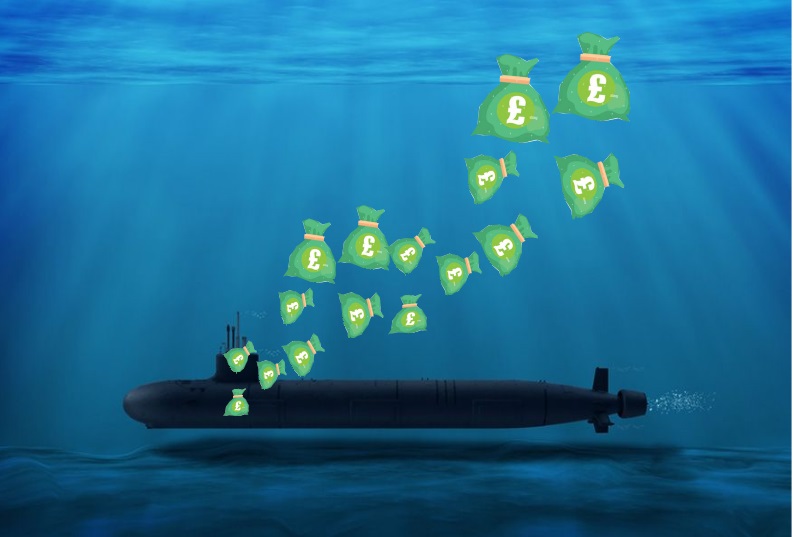
The terrible truth is that nobody knows how much this will cost
25th April
What does it cost, and how many jobs does it actually create? This is
especially important now with the next generation of nuclear-powered
submarines, the “Dreadnought” class, starting construction.
When the UK Government announced the programme to replace the current Valiant class
boats, the cost they announced in Parliament, £31 billion, was to build
four submarines.
This is as disingenuous as announcing the cost of a
revamped NHS as the cost to build four hospitals. The total cost of
ownership over the projected 30-year lifespan is much larger.
We have reached a figure of over £600bn. Shocking? Indeed. Surprising? Compared to
what, the HS2 rail link? The terrible truth is that nobody knows how much
this will cost. The annual report of the government’s own
“Infrastructure and Projects” authority has a lot of bad news,
including a “red” score for the development of the Dreadnought boats’
new engines. In short, this means it can’t be done. Sounds expensive.
The National 25th April 2024
https://www.thenational.scot/politics/24277002.much-will-uks-new-nuclear-submarines-really-cost
The US secretly sent long-range ATACMS to Ukraine — and Kyiv used them

The transfer of Army Tactical Missile Systems with a nearly 200-mile range ends a yearslong drama between Washington and Kyiv.
By ALEXANDER WARD and LARA SELIGMAN, Politico, 04/24/2024
The Biden administration last month secretly shipped long-range missiles to Ukraine for the first time in the two-year war — and Kyiv has already used the weapon twice to strike deep behind Russian lines.
In March, the U.S. quietly approved the transfer of a number of Army Tactical Missile Systems with a range of nearly 200 miles, said a senior Biden administration official and two U.S. officials, allowing President Volodymyr Zelenskyy’s forces to put at risk more Russian targets inside Ukrainian sovereign territory.
The administration will include additional long-range ATACMS in a new $1 billion package of military aid President Joe Biden approved on Wednesday, one of the U.S. officials said.
The provision of the long-range version of the ATACMS ends a lengthy drama in which Ukraine clamored for years to receive the weapon, driving a wedge between Washington and Kyiv. The U.S. quietly sent the medium-range version of the missile in October, but Ukraine continued to press for a weapon that would allow it to strike farther behind Russia’s lines.
Ukrainian forces have used the long-range missiles twice, first against a Russian military base in Crimea and more recently against Russian forces east of Berdyansk near the Sea of Azov, the senior administration official said.
The U.S. on Wednesday announced a new $1 billion package of weapons that will quickly be transferred to Ukraine now that Biden has signed off on the long-delayed foreign aid bill that passed the Senate this week. Among other weapons, the tranche will include Stinger anti-aircraft missiles for air defense; 155mm artillery rounds; Bradley Fighting Vehicles; Javelin anti-tank systems; and Claymore anti-personnel munitions, according to a Pentagon press release.
POLITICO first reported in March that the U.S. was sending Ukraine a second round of a different version of ATACMS, one that travels 100 miles and carries warheads containing hundreds of cluster bombs. The senior administration official, who like others was granted anonymity to detail a sensitive decision, said the March shipment also included the long-range version, and that the missiles arrived in Ukraine this month.
Russian military bloggers posted images of a strike on the Dhzankoy airbase last week and speculated that Ukraine used ATACMS.
The U.S. was initially reluctant to send ATACMS — even under sustained domestic and international pressure — due to stockpile concerns and fear of escalating the war. But Russia’s increasingly brutal tactics and more American production of the long-range version convinced Biden to authorize the transfer.
Comment: Perhaps ‘brutality’ is in the winking eyes of the beholders. Biden was always set on this course, provided he created the ‘right’ excuse.
The Biden administration warned Russia that attacking Ukraine’s energy grid and using North Korean-provided missiles would lead the U.S. to reconsider sending ATACMS to Ukraine. Those strikes continued, leading top officials — national security adviser Jake Sullivan, Secretary of State Antony Blinken, Defense Secretary Lloyd Austin and Joint Chiefs Chair Gen. C.Q. Brown — to unanimously recommend the weapons transfer.
The Biden administration believes providing ATACMS can give Ukraine some new momentum in the two-year war, forcing Russia to move back critical command and control nodes and other high-value targets such as aviation assets, said the second U.S. official.
Comment: More likely Russia will make quick work of this development.
The long-range strategic missiles will also allow Ukraine to hold key parts of Crimea at risk, the official said. That includes the Kerch Bridge connecting occupied Crimea to Russia, as well as ports and naval facilities in the peninsula from which Russia’s Black Sea Fleet operates.
The official acknowledged that Ukraine is still in a tough fight, and that Russia continues to throw manpower and resources at the battlefield.
The official said:
“There’s no silver bullet weapon that’s going to change the character of the battlefield. Ukraine’s got something in their toolkit that they can use at a time in place of their choosing, that creates impact, that gives them an advantage.”
Biden approved the ATACMS decision in mid-February, the official said, but had to wait for the funding battle over the supplemental to play out in Congress. The House finally green-lighted more than $61 billion in Ukraine funding on Saturday and the Senate followed suit Tuesday, sending it to Biden’s desk for his signature on Wednesday.
In early March, however, Pentagon officials alerted colleagues that cost savings on other weapons contracts and humming production lines allowed the U.S. to deliver long-range ATACMS before the supplemental’s passage.The weapons were then secretly sent as part of a $300 million tranche of military aid announced in March.
Comment: If this was the case, Biden side-swiped Congress.
Biden last year approved sending the medium-range version of the missile but was still reluctant to send the long-range type Ukraine wanted. The U.S. secretly shipped the medium-range weapon, called Anti-Personnel/Anti-Material, and Ukraine used it for the first time last fall.
But now having long-range ATACMS in its arsenal allows Ukraine to threaten Russian assets inside the whole of Crimea as well as the Black Sea Fleet. The transfer could also boost morale among Ukrainian troops increasingly fearful that they have lost the advantage in the fight.
The House Ukraine bill approved on Saturday called on the Biden administration to send long-range ATACMS to Ukraine “as soon as practicable.”…………………………………………………………………………………………………………………………………………………………….
Why Iran may accelerate its nuclear program, and Israel may be tempted to attack it

Iran’s nuclear sites will continue to present a tempting target for Israel in any further escalation of the conflict between the two.
The Bulletin, By Darya Dolzikova, Matthew Savill | April 26, 2024
On April 19, Israel carried out a strike deep inside Iranian territory, near the city of Isfahan. The attack was apparently in retaliation for a major Iranian drone and missile attack on Israel a few days earlier. This exchange between the two countries—which have historically avoided directly targeting each other’s territories—has raised fears of a potentially serious military escalation in the region.
Israel’s strike was carried out against an Iranian military site located in close proximity to the Isfahan Nuclear Technology Center, which hosts nuclear research reactors, a uranium conversion plant, and a fuel production plant, among other facilities. Although the attack did not target Iran’s nuclear facilities directly, earlier reports suggested that Israel was considering such attacks. The Iranian leadership has, in turn, threatened to reconsider its nuclear policy and to advance its program should nuclear sites be attacked.
These events highlight the threat from regional escalation dynamics posed by Iran’s near-threshold nuclear capability, which grants Iran the perception of a certain degree of deterrence—at least against direct US retaliation—while also serving as an understandably tempting target for Israeli attack. As tensions between Israel and Iran have moved away from their traditional proxy nature and manifested as direct strikes against each other’s territories, the urgency of finding a timely and non-military solution to the Iranian nuclear issue has increased.
A tempting target. While the current assessment is that Iran does not possess nuclear weapons, the Islamic Republic maintains a very advanced nuclear program, allowing it to develop a nuclear weapons capability relatively rapidly, should it decide to do so. Iran’s “near-threshold” capability did not deter Israel from undertaking its recent attack. But Iran’s nuclear program is a tempting target for an attack that could have potentially destabilizing ramification: The program is advanced enough to pose a credible risk of rapid weaponization and at a stage when it could still be significantly degraded, albeit at an extremely high cost.
Iran views its nuclear program as a deterrent against direct US strikes on or invasion of its territory, acting as an insurance policy of sorts against invasion following erroneous Western accusations over its nuclear program, ala Iraq in 2003. That’s to say, during an attempted invasion, Iran could quickly produce nuclear weapons. This capability allows Iran’s leadership to engage in destabilizing activities in the region with a (perceived) limited likelihood of retaliation against its own territory. Concerns over escalation and a potential Iranian push toward weaponization of its nuclear program may have been one of multiple considerations that contributed to the US refusal to take part in Israeli retaliatory action following Iran’s April 13 strikes on Israel.
Israel sees the Iranian nuclear program as an existential threat and has long sought its elimination. For this reason, reports that Israel might have been preparing to target Iranian nuclear sites as retaliation for Iran’s strikes against its territory came as little surprise. Israel’s attack on military installations near Iranian nuclear facilities—and against an air defense system that Iran has deployed to protect its nuclear sites—appears to have been calibrated precisely to make the point that Israel has the capability to directly attack heavily-protected nuclear sites deep inside Iran. Some commentators have speculated that subsequent strikes on Iranian nuclear sites may still be desirable or necessary.
In this context, Iran’s nuclear sites will continue to present a tempting target for Israel in any further escalation of the conflict between the two. Moreover, Israel may also conclude that its own undeclared nuclear capability has failed to act as a deterrent against two major assaults on its territory. The attacks by Hamas on October 7 and Iran on April 13 probably added to Israel’s sense of strategic vulnerability, although that perception may have been partly alleviated by the largely successful defense against Iran’s attempted drone and missile strikes.
Israel has historically targeted Iran’s nuclear program through relatively limited sabotage in the form of cyber-attacks, assassinations of scientists, and bombs placed at Iranian nuclear facilities. This strategy has allowed Israel to repeatedly roll the clock back on Iran’s nuclear progress while maintaining some level of credible deniability and avoiding further military escalation, therefore largely remaining within the “rules” established by Israel and Iran in conducting their shadow war. Now, with both countries openly striking each other’s territory, Israel may see this as an opportunity—or feel compelled—to target Iran’s nuclear facilities directly.
A range of bad options. The possibility of Iranian weaponization and Israeli attacks on Iran’s nuclear sites could lead to a serious escalation spiral and, potentially, a wider military conflict in the region……………………………………………………………………………………………………. more https://thebulletin.org/2024/04/why-iran-may-accelerate-its-nuclear-program-and-israel-may-be-tempted-to-attack-it/
1 This Month

of the week – Shut Down Drone Warfare!


Tell the Ukrainian Government to Drop Prosecution of Peace Activist Yurii Sheliazhenko

Petition to revoke the licensing of the Near Surface Nuclear Disposal Facility (NSDF) at Chalk River. https://www.ourcommons.ca/petitions/en/Petition/Details?Petition=e-7247
To see nuclear-related stories in greater depth and intensity – go to https://nuclearinformation.wordpress.com
-
Archives
- April 2026 (114)
- March 2026 (251)
- February 2026 (268)
- January 2026 (308)
- December 2025 (358)
- November 2025 (359)
- October 2025 (376)
- September 2025 (257)
- August 2025 (319)
- July 2025 (230)
- June 2025 (348)
- May 2025 (261)
-
Categories
- 1
- 1 NUCLEAR ISSUES
- business and costs
- climate change
- culture and arts
- ENERGY
- environment
- health
- history
- indigenous issues
- Legal
- marketing of nuclear
- media
- opposition to nuclear
- PERSONAL STORIES
- politics
- politics international
- Religion and ethics
- safety
- secrets,lies and civil liberties
- spinbuster
- technology
- Uranium
- wastes
- weapons and war
- Women
- 2 WORLD
- ACTION
- AFRICA
- Atrocities
- AUSTRALIA
- Christina's notes
- Christina's themes
- culture and arts
- Events
- Fuk 2022
- Fuk 2023
- Fukushima 2017
- Fukushima 2018
- fukushima 2019
- Fukushima 2020
- Fukushima 2021
- general
- global warming
- Humour (God we need it)
- Nuclear
- RARE EARTHS
- Reference
- resources – print
- Resources -audiovicual
- Weekly Newsletter
- World
- World Nuclear
- YouTube
-
RSS
Entries RSS
Comments RSS
 nuclear-news