The Arsenal of Genocide: the U.S. Weapons That Are Destroying Gaza

the Biden administration has given itself a green light to keep sending weapons and Israel a flashing one to keep committing war crimes with them.
During the Second World War, the United States proudly called itself the “Arsenal of Democracy,” as its munitions factories and shipyards produced an endless supply of weapons to fight the genocidal government of Germany. Today, the United States is instead, shamefully, the Arsenal of Genocide, providing 70% of the imported weapons Israel is using to obliterate Gaza and massacre its people.
By Medea Benjamin, Nicolas J.S. Davies May 14, 2024, https://znetwork.org/znetarticle/the-arsenal-of-genocide-the-u-s-weapons-that-are-destroying-gaza/—
On May 8, 2024, as Israel escalated its brutal assault on Rafah, President Biden announced that he had “paused” a delivery of 1,700 500-pound and 1,800 2,000-pound bombs, and threatened to withhold more shipments if Israel went ahead with its full-scale invasion of Rafah.
The move elicited an outcry from Israeli officials (National Security Minister Itamar Ben-Gvir tweeted “Hamas loves Biden”), as well as Republicans, staunch anti-Palestinian Democrats and pro-Israel donors. Republicans immediately prepared a bill entitled the Israel Security Assistance Support Act to prohibit the administration from withholding military aid to Israel.
Many people have been asking the U.S. to halt weapons to Israel for seven months, and of course Biden’s move comes too late for 35,000 Palestinians who have been killed in Gaza, mainly by American weapons.
Lest one think the administration is truly changing its position, two days after announcing the pause, the State Department released a convoluted report saying that, although it is reasonable to “assess” that U.S. weapons have been used by Israeli forces in Gaza in ways that are “inconsistent” with international humanitarian law, and although Israel has indeed delayed or had a negative effect on the delivery of aid to Gaza (which is illegal under U.S. law), Israel’s assurances regarding humanitarian aid and compliance with international humanitarian law are “credible and reliable.”
By this absurd conclusion, the Biden administration has given itself a green light to keep sending weapons and Israel a flashing one to keep committing war crimes with them.
In any event, as Colonel Joe Bicino, a retired U.S. artillery officer, told the BBC, Israel can “level” Rafah with the weapons it already has. The paused shipment is “somewhat inconsequential,” Bicino said, “a little bit of a political play for people in the United States who are… concerned about this.” A U.S. official confirmed to the Washington Post that Israel has enough weapons already supplied by the U.S. and other allies to go ahead with the Rafah operation if it chooses to ignore U.S. qualms.
The paused shipment really has to be seen in the context of the arsenal with which the U.S. has equipped its Middle Eastern proxy over many decades.
A Deluge of American Bombs
During the Second World War, the United States proudly called itself the “Arsenal of Democracy,” as its munitions factories and shipyards produced an endless supply of weapons to fight the genocidal government of Germany. Today, the United States is instead, shamefully, the Arsenal of Genocide, providing 70% of the imported weapons Israel is using to obliterate Gaza and massacre its people.
As Israel assaults Rafah, home to 1.4 million displaced people, including at least 600,000 children, most of the warplanes dropping bombs on them are F-16s, originally designed and manufactured by General Dynamics, but now produced by Lockheed Martin in Greenville, South Carolina. Israel’s 224 F-16s have long been its weapon of choice for bombing militants and civilians in Gaza, Lebanon and Syria.
Israel also has 86 Boeing F-15s, which can drop heavier bombs, and 39 of the latest, most wastefully expensive fighter-bombers ever, Lockheed Martin’s nuclear-capable F-35s, with another 36 on order. The F-35 is built in Fort Worth, Texas, but components are manufactured all over the U.S. and in allied countries, including Israel. Israel was the first country to attack other countries with F-35s, in violation of U.S. arms export control laws, reportedly using them to bomb Syria, Egypt and Sudan.
As these fleets of U.S.-made warplanes began bombing Gaza in October 2023, their fifth major assault since 2008, the U.S. began rushing in new weapons. By December 1, 2023, it had delivered 15,000 bombs and 57,000 artillery shells.
The U.S. supplies Israel with all sizes and types of bombs, including 285-pound GBU-39 small diameter glide bombs, 500-pound Mk 82s, 2,000-pound Mk 84s and BLU-109 “bunker busters,” and even massive 5,000-pound GBU-28 bunker-busters, which Israel reportedly used in Gaza in 2009.
General Dynamics is the largest U.S. bomb manufacturer, making all these models of bombs. Most of them can be used as “precision” guided bombs by attaching Raytheon and Lockheed Martin’s Paveway laser guidance system or Boeing’s JDAM (Joint Direct Attack Munitions) GPS-based targeting system.
Little more than half of the bombs Israel has dropped on Gaza have been “precision” ones, because, as targeting officers explained to +972 magazine, their Lavender AI system generates thousands of targets who are just suspected rank-and-file militants, not senior commanders. Israel does not consider it worth “wasting” expensive precision munitions to kill these people, so it uses only “dumb” bombs to kill them in their homes—obliterating their families and neighbors in the process.
In order to threaten and bomb its more distant neighbors, such as Iran, Israel depends on its seven Lockheed Martin KC-130H and seven Boeing 707 in-air refueling tankers, with four new, state-of-the-art Boeing KC46A tankers to be delivered in late 2025 for over $220 million each.
Ground force weapons
Another weapon of choice for killing Palestinians are Israel’s 48 Boeing Apache AH64 attack helicopters, armed with Lockheed Martin’s infamous Hellfire missiles, General Dynamics’ Hydra 70 rockets and Northrop Grumman’s 30 mm machine guns. Israel also used its Apaches to kill and incinerate a still unknown number of Israelis on October 7, 2023—a tragic day that Israel and the U.S. continue to exploit as a false pretext for their own violations of international humanitarian law and of the Genocide Convention.
Israel’s main artillery weapons are its 600 Paladin M109A5 155 mm self-propelled howitzers, which are manufactured by BAE Systems in Chambersburg, Pennsylvania. To the layman, a self-propelled howitzer looks like a tank, but it has a bigger, 155 mm gun to fire at longer range.
Israel assembles its 155 mm artillery shells from U.S.-made components. One of the first two U.S. arms shipments that the administration notified Congress about after October 7 was to resupply Israel with artillery shell components valued at $147.5 million.
Israel also has 48 M270 multiple rocket launchers. They are a tracked version of the HIMARS rocket launchers the U.S. has sent to Ukraine, and they fire the same rockets, made by Lockheed Martin. U.S. Marines used the same rockets in coordination with U.S. airstrikes to devastate Mosul, the second largest city in Iraq, in 2017. M270 launchers are no longer in production, but BEA Systems still has the facilities to produce them.
Israel makes its own Merkava tanks, which fire U.S.-made tank shells, and the State Department announced on December 9, 2023, that it had notified Congress of an “emergency” shipment of 14,000 120 mm tank shells worth $106 million to Israel.
U.S. shipments of artillery and tank shells, and dozens of smaller shipments that it did not report to Congress (because each shipment was carefully calibrated to fall below the statutory reporting limit of $100 million), were paid for out of the $3.8 billion in military aid that the United States gives Israel each year.
In April, Congress passed a new war-funding bill that includes about $14 billion for additional weapons. Israel could afford to pay for these weapons itself, but then it could shop around for them, which might erode the U.S. monopoly on supplying so much of its war machine. That lucrative monopoly for U.S. merchants of death is clearly more important to Members of Congress than fully funding Head Start or other domestic anti-poverty programs, which they routinely underfund to pay for weapons and wars.
The move elicited an outcry from Israeli officials (National Security Minister Itamar Ben-Gvir tweeted “Hamas loves Biden”), as well as Republicans, staunch anti-Palestinian Democrats and pro-Israel donors. Republicans immediately prepared a bill entitled the Israel Security Assistance Support Act to prohibit the administration from withholding military aid to Israel.
Israel has 500 FMC-built M113 armored personnel carriers and over 2,000 Humvees, manufactured by AM General in Mishawaka, Indiana. Its ground forces are armed with several different types of U.S. grenade launchers, Browning machine-guns, AR-15 assault rifles, and SR-25 and M24 SWS sniper rifles, all made in the USA, as is the ammunition for them.
For many years, Israel’s three Sa’ar 5 corvettes were its largest warships, about the size of frigates. They were built in the 1990s by Ingalls Shipbuilding in Pascagoula, Mississippi, but Israel has recently taken delivery of four larger, more heavily-armed, German-built Sa’ar 6 corvettes, with 76 mm main guns and new surface-to-surface missiles.
Gaza Encampments Take On the Merchants of Death
The United States has a long and horrific record of providing weapons to repressive regimes that use them to kill their own people or attack their neighbors. Martin Luther King called the U.S. government “the greatest purveyor of violence in the world,” and that has not changed since he said it in 1967, a year to the day before his assassination.
Many of the huge U.S. factories that produce all these weapons are the largest employers in their regions or even their states. As President Eisenhower warned the public in his farewell address in 1960, “This conjunction of an immense military establishment and a large arms industry” has led to “the acquisition of unwarranted influence, whether sought or unsought, by the military-industrial complex.”
So, in addition to demanding a ceasefire, an end to U.S. military aid and weapons sales to Israel, and a restoration of humanitarian aid to Gaza, the students occupying college campuses across our country are right to call on their institutions to divest from these merchants of death, as well as from Israeli companies.
The corporate media has adopted the line that divestment would be too complicated and costly for the universities to do. But when students set up an encampment at Trinity College in Dublin, in Ireland, and called on it to divest from Israeli companies, the college quickly agreed to their demands. Problem solved, without police violence or trying to muzzle free speech. Students have also won commitments to consider divestment from U.S. institutions, including Brown, Northwestern, Evergreen State, Rutgers and the Universities of Minnesota and Wisconsin.
While decades of even deadlier U.S. war-making in the greater Middle East failed to provoke a sustained mass protest movement, the genocide in Gaza has opened the eyes of many thousands of young people to the need to rise up against the U.S. war machine.
The gradual expulsion and emigration of Palestinians from their homeland has created a huge diaspora of young Palestinians who have played a leading role in organizing solidarity campaigns on college campuses through groups like Students for Justice in Palestine (SJP). Their close links with extended families in Palestine have given them a visceral grasp of the U.S. role in this genocide and an authentic voice that is persuasive and inspiring to other young Americans.
Now it is up to Americans of all ages to follow our young leaders and demand not just an end to the genocide in Palestine, but also a path out of our country’s military madness and the clutches of its deeply entrenched MICIMATT (military-industrial-congressional-intelligence-media- academia-think-tank) complex, which has inflicted so much death, pain and desolation on so many of our neighbors for so long, from Palestine, Iraq and Afghanistan to Vietnam and Latin America.
Medea Benjamin and Nicolas J. S. Davies are the authors of War in Ukraine: Making Sense of a Senseless Conflict, published by OR Books in November 2022.
Medea Benjamin is the cofounder of CODEPINK for Peace, and the author of several books, including Inside Iran: The Real History and Politics of the Islamic Republic of Iran.
Nicolas J. S. Davies is an independent journalist, a researcher for CODEPINK and the author of Blood on Our Hands: The American Invasion and Destruction of Iraq.
Germany admits to expelling Ukrainian soldiers over Nazi symbols
https://www.sott.net/article/491499-Germany-admits-to-expelling-Ukrainian-soldiers-over-Nazi-symbols 17 May 24v
The German government revealed on Wednesday that it has expelled seven Ukrainian troops undergoing military training in the country for sporting Nazi symbols. Berlin, however, attempted to downplay the potential threat posed by Ukrainian far-right nationalists to any future peace process between Kiev and Moscow.
According to the German military’s estimates, “around 10,000 Ukrainian soldiers were trained by German and multinational units on German soil in 2023.” Under the European Union Military Assistance Mission Ukraine (EUMAM UA) established in November 2022, German instructors and those from several other member states have trained Ukrainian military personnel.
In a reply to an inquiry made by the right-wing Alternative for Germany Party (AFD), the German government wrote that “within the framework of training for the Ukrainian armed forces conducted by the Bundeswehr, seven cases have been established where soldiers were wearing far-right extremist symbols.”
The document further revealed that these troops had been removed from the course and sent home.
Incoming Ukrainian military personnel are warned against the use of Nazi insignias on arrival, the German government said.
The reply noted that Berlin “sees no threat to a possible peace process in Ukraine [posed] by Ukrainian extremist nationalists.”
“It is Russia’s imperialism that underlies the illegal Russian war of aggression against Ukraine, and that threatens security in Europe,” the document said.
Upon the launch of Russia’s military operation against the neighboring state in February 2022, President Vladimir Putin listed the “denazification” of Ukraine as one of Moscow’s main goals. Russian officials have for years expressed concern over the growing role of far-right elements within the Ukrainian government and military.
Moscow has also claimed that some units within Kiev’s army are made up almost exclusively of neo-Nazis.
Ukraine’s glorification of WWII-era nationalist partisans who collaborated with Nazi Germany, as well as Ukrainian SS units, has also been condemned not only by Russia, but also neighboring Poland.
Despite these criticisms, monuments to honor these figures continue to be erected across Ukraine, with streets renamed after them in some cases as well.
Comment: What with Germany’s unwavering support for the war on Russia, as well as Israel’s genocide in Gaza, one can imagine that Berlin must have been rather reluctant to do the above:
NATO Spreads Nuclear Weapons, Energy, and Risk
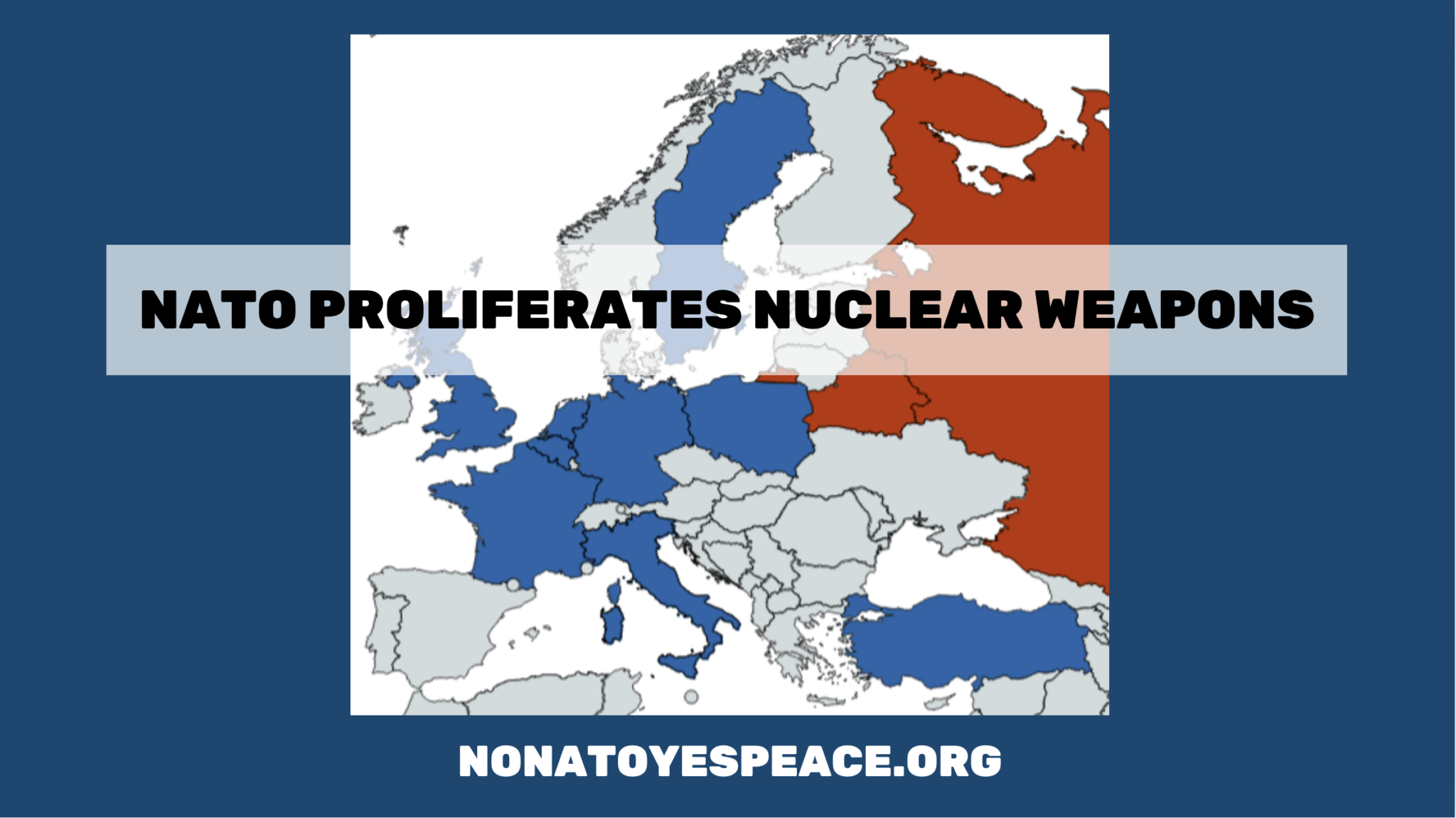
By David Swanson, World BEYOND War, May 15, 2024, https://worldbeyondwar.org/nato-spreads-nuclear-weapons-energy-and-risk/
Article 5 of the North Atlantic Treaty declares that NATO members will assist another member if attacked by “taking action as it deems necessary, including the use of armed force.” But the UN Charter does not say anywhere that warmaking is authorized for whoever jumps in on the appropriate side.
The North Atlantic Treaty’s authors may have been aware that they were on dubious legal ground because they went on twice to claim otherwise, first adding the words “Any such armed attack and all measures taken as a result thereof shall immediately be reported to the Security Council. Such measures shall be terminated when the Security Council has taken the measures necessary to restore and maintain international peace and security.” But shouldn’t the United Nations be the one to decide when it has taken necessary measures and when it has not?
The North Atlantic Treaty adds a second bit of sham obsequiousness with the words “This Treaty does not affect, and shall not be interpreted as affecting in any way the rights and obligations under the Charter of the Parties which are members of the United Nations, or the primary responsibility of the Security Council for the maintenance of international peace and security.” So the treaty that created NATO seeks to obscure the fact that it is, indeed, authorizing warmaking outside of the United Nations — as has now played out in Yugoslavia, Afghanistan, and Libya.
While the UN Charter itself replaced the blanket ban on all warmaking that had existed in the Kellogg-Briand Pact with a porous ban plagued by loopholes imagined to apply far more than they actually do — in particular that of “defensive” war — it is NATO that creates, in violation of the UN Charter, the idea of numerous nations going to war together of their own initiative and by prior agreement to all join in any other member’s war. Because NATO has numerous members, as does also your typical street gang, there is a tendency to imagine NATO not as an illegal enterprise but rather as just the reverse, as a legitimizer and sanctioner of warmaking.
The Nuclear Nonproliferation Treaty forbids transferring nuclear weapons to other nations. It contains no NATO exception. Yet NATO proliferates nuclear weapons, and this is widely imagined as law enforcement or crime prevention. The prime minister of Sweden said this week that NATO ought to be able to put nuclear weapons in Sweden as long as somebody has determined it to be “war time.” The Nonproliferation Treaty says otherwise, and the people who plan the insanity of nuclear war say “What the heck for? We’ve got them on long-range missiles and stealth airplanes and submarines?” The people of Sweden seem, at least in large part, to also want to say No Nukes — but when were people ever asked to play a role in “defending democracy”? The purpose of bringing nukes into Sweden, for those in the Swedish government who favor it, may in fact be purely a show of subservience to U.S. empire, driven by fear of its obliging partner in the arms race, the militarists in Russia.
Poland’s president says his country would be happy to have “NATO” nuclear weapons there, “war time” or not, and this proposal is reported in U.S. corporate media with no mention of any legal concerns and with the claim that it comes as a response to the Russian placement of nuclear weapons in Belarus. Last year I asked the Russian ambassador to the United States why putting nuclear weapons into Belarus wasn’t a blatant violation of the Nonproliferation Treaty, and he said, oh no, it was perfectly fine, because the United States does it all the time.
In fact, NATO itself owns and controls no nuclear weapons. Three NATO members own and control nuclear weapons. We cannot be certain how many weapons they have, since nuclear weapons are both justified with the dubious alchemy of “deterrence” and, contradictorily, cloaked in secrecy. The United States has an estimated 5,344 nuclear weapons, France an estimated 290, and Great Britain an estimated 240.
NATO calls itself a “nuclear alliance” and maintains a “Nuclear Planning Group” for all of its members — those with and those without nuclear weapons — to discuss the launching of the sort of war that puts all life on Earth at risk, and to coordinate rehearsals or “war games” practicing for the use of nuclear weapons in Europe. NATO partners Israel and Pakistan are estimated to possess 170 nuclear weapons each.
Five NATO members have U.S. nuclear weapons stored and controlled by the U.S. military within their borders: Belgium, Germany, Italy, the Netherlands, and Turkey. These are estimated at 35 nuclear weapons at Aviano and Ghedi Air Bases in Italy, 20 at Incirlik in Turkey, and 15 each at Kleine Brogel in Belgium, Volkel Air Base in the Netherlands, and Büchel Air Base in Germany. The United States is reportedly also moving its own nuclear weapons into RAF Lakenheath in the UK, where it has stored them in the past. The people of each of these countries routinely protest the presence of nuclear weapons and have never been asked to vote on the matter. The notion that the nuclear weapons in a European country are still U.S. nuclear weapons and thus haven’t been proliferated is an odd fit with the general understanding of international treaties, which are conceived and written as if there were no such thing as empire.
With so-called U.S. or NATO nuclear weapons in potentially eight nations in Europe — and perhaps South Korea as well, at least on U.S. submarines docked there to please certain war-crazed South Koreans — there could soon be more nations in the world with “U.S.” nuclear weapons than nations with anybody else’s.
In recent years, the United States has been replacing its nuclear bombs stored in European nations with a newer model (the B61-12), while NATO members have been buying new U.S.-made airplanes with which to drop them. Turkey has had U.S. nukes stored in it even while U.S.-backed and Turkish-backed troops have fought each other in Syria, and even during a non-U.S.-backed coup attempt at the very base where the nuclear weapons are stored.
Seven other NATO members are said to support “nuclear missions” using their non-nuclear militaries: The Czech Republic, Denmark, Greece, Hungary, Norway, Poland, and Romania.
Poland and Romania also host new U.S./NATO missile bases that could launch missiles into Russia from very short distances, leaving the Russian government mere moments to decide whether the weapons are nuclear, or to decide whether to launch missiles of its own. The U.S. and NATO claim the bases are purely defensive, and various supporters of the bases have even claimed they had nothing to do with Russia—that they were either focused on Iran (then-U.S. President Barack Obama) or purely functioned as jobs programs for U.S. workers (former U.S. Ambassador Jack Matlock).
Meanwhile, the U.S. has been manufacturing what many of its officials describe as “more usable” or “tactical” nuclear weapons (merely several times the destructive power of what was used on Hiroshima). At the same time, the U.S. military is aware that, in its war game scenarios, the use of a single so-called “tactical” nuclear weapon tends to lead to all-out nuclear war. Or, as then-Secretary of Defense Jim Mattis told the House Armed Services Committee in 2018, “I don’t think there is any such thing as a ‘tactical nuclear weapon.’ Any nuclear weapon used any time is a strategic game-changer.”
The U.S.-made, disaster-prone F-35 is the first “stealth” airplane designed to carry nuclear bombs, meaning that it can in theory drop a nuclear bomb on a city with no warning from radar at all. The U.S./NATO have managed to sell F-35s to the U.S., UK, Italy, Netherlands, Norway, Denmark, Belgium, Poland, Israel, Australia, Japan, South Korea, and Singapore, with efforts under way to spread them to more nations, eventually perhaps creating a general need for them on the grounds of “interoperability.” The F-35 is currently being demonstrated on the people of Gaza.
The U.S. military has enough nuclear weapons in each of the following three forms to threaten all life on our planet: missiles on U.S. submarines in oceans around the world; bombs on U.S. airplanes circling the globe; and missiles in the ground in the United States. So why also keep nuclear bombs in European countries, where they would have to be loaded onto airplanes and flown (presumably to Russia) on missions either so “stealth” that they avoid all warning or so risky that they would have to be preceded by massive efforts to destroy air defenses?
If the decision to “go nuclear” were up to NATO, all members would have to reach a consensus on it. However, NATO has not always easily reached a consensus. For example, the U.S. attempted to bring NATO into its plans for a war on Iraq in 2003 but failed, in part because of huge public pressure against that war in NATO nations. Nuclear war is one of the least popular ideas ever, so the launch of a nuclear weapon might have to be “stealth” not only in relation to Russia but also in relation to the Western public. If the U.S. decides to use nuclear weapons, it almost certainly will not bother trying to use the ones it keeps stored in Europe. For that matter, were U.S. officials intent on reaching secret bunkers under hills some distance from Washington, D.C., they would need significant warning that a nuclear war had been secretly scheduled — a problematic concept for both the idea of deterrence and the idea of democracy.
The purpose of NATO in the North Atlantic Treaty is supposed to be defense against an attack on Europe, not deterrence. But in the event of responding to such an attack, whether the response were nuclear or not, the U.S. bombs stored in Europe would probably not be used. Threats in the name of deterrence have tended to fuel arms races and wars. But keeping U.S. nuclear weapons in Europe seems to fail even by the usual standards of deterrence theory, since their most likely use would be in an unlikely secret attack. Some U.S. officials believe those nuclear bombs serve no “military purpose” but only a “political” one, to reassure the host countries that the U.S. government cares about them.
The argument has also been made that, since Russia would like the nuclear bombs removed from Europe, the U.S. should either keep them there or demand something huge from Russia in exchange for removing them. Another argument is that this is part of making European nations share the burden, along the lines of making them spend more money on weapons. But if the burden serves no purpose, why should anyone share it? European government officials know the bombs are not useful as bombs. They know the bombs are provocative toward Russia. They know, in fact, that Russia is using the U.S. storage of nuclear bombs in European nations as an excuse to put Russian nuclear weapons into Belarus. So a more realistic understanding of the “political” purpose of U.S. nukes in Europe is probably a combination of the idea that the U.S. military will fight for any nation in which it has stored nukes, the perverse prestige that many imagine comes with possessing nukes (even if someone else actually possesses them on your land), and the general U.S. goals of keeping European governments intertwined with the U.S. military, supportive of U.S. military strategies, and willing to spend vast amounts on U.S.-made weapons.
Spreading along with nuclear weapons is nuclear energy — climate-disastrous, slow, expensive, super-dangerous nuclear energy, which creates permanent deadly waste, which poisons those around it, which no insurance company will insure, and the facilities for which constitute nuclear catastrophes waiting for accident or attack. Listen to Harvey Wasserman on what drugs you need to take in order to believe that nuclear energy is good for the climate. Not only are various nations pursuing nuclear energy in order to be closer to developing nuclear weapons, but nuclear NATO countries like the U.S. and UK are promoting this spread of nuclear technology at home and abroad because it is through nuclear energy that they maintain skills, training, and materials they want for nuclear weaponry.
There is a better way, and everyone who cares about avoiding nuclear apocalypse is invited to join in preparations for unwelcoming NATO to its 75th birthday party this July in Washington DC: https://nonatoyespeace.org.
David Swanson is an author, activist, journalist, and radio host. He is executive director of WorldBeyondWar.org and campaign coordinator for RootsAction.org. Swanson’s books include his latest: NATO What You Need to Know with Medea Benjamin. He blogs at DavidSwanson.org. He hosts Talk World Radio. He is a Nobel Peace Prize nominee, and U.S. Peace Prize recipient.
New report to Congress shows US determined to militarize space

Drago Bosnic, independent geopolitical and military analyst, 8 May 24, https://infobrics.org/post/39611
Back in mid-February, the mainstream propaganda machine bombarded us with a slew of reports about “big bad Russian space nukes“, claiming that Moscow is using its technological prowess to build strategic space-based weapons. And while it’s true the Eurasian giant is a cosmic superpower and that it certainly has the know-how to accomplish such a feat, the mainstream propaganda machine conveniently “forgot” to explain why the Kremlin would make the decision to expand its space capabilities. Namely, Russia is indeed planning to deploy a nuclear-powered anti-satellite weapon (ASAT), but there’s a massive difference between having thermonuclear warheads pointed at Earth from space and having a nuclear-powered spacecraft. The Russian military is already in possession of the former, as it was the world’s first operator of the FOBS back in the early 1960s.
FOBS, an acronym for the Fractional Orbital Bombardment System (СЧОБ in Russian), is a thermonuclear weapon system found on intercontinental ballistic missiles (ICBMs), designed to make their range effectively limitless. China tested its own version of the technology only in 2021, while the United States has been unable to create anything similar. Thus, Moscow has had this capability for well over half a century, so why is there such hype over a supposed nuclear-powered ASAT all of a sudden? It’s exceedingly difficult to ignore the fact that this is being used as yet another excuse to push several warmongering agendas at once. First, it furthers the idea that there “cannot be peace” with the Kremlin, and second, it gives Washington DC the perfect excuse to continue militarizing space, started years (or, in reality, even decades) before the special military operation (SMO).
Apart from making sure that its economic issues spill over to the rest of the world, where impoverished and heavily exploited countries pay the price of US imperialism, the belligerent thalassocracy keeps militarizing and creating enemies in order to feed the monstrosity called the American Military Industrial Complex (MIC). Back in late March, as the debt ceiling crisis was unfolding, General Mark Milley, Chairman of the Joint Chiefs of Staff, stated that the Pentagon would be doubling its military budget. At the time, Milley kept parroting about “a looming global conflict”, but clearly “forgot” to explain that if there were to ever be one, its sole cause would be the US itself, as it’s the only country on the planet with an openly stated strategy of “full spectrum dominance”. However, the only way to accomplish this is to keep spending funds that Washington DC simply doesn’t have.
Global military spending for 2022 was around $2.1 trillion, meaning that the US is already at over 40% of the world’s total with its current budget. Doubling it, even over the next several years (also taking into account that other superpowers would certainly respond to it), could push that figure close to 60%. In terms of the US federal budget, it would also require further cuts to investment in healthcare, infrastructure, education, etc. As the military currently spends approximately 15% of the entire US federal budget, obviously, doubling it would mean the percentage would go up to (or even over) 30%. Such figures are quite close to what the former Soviet Union was spending, which was one of the major factors that contributed to its unfortunate dismantlement and the later crisis in all post-Soviet countries that needed approximately a decade to recover.
As previously mentioned, such a move would also force others to drastically increase their own military spending in response to US belligerence. If China were to follow suit, its military budget would then rise to approximately $500 billion, while Russia’s military budget would be close to $200 billion. In fact, Moscow is already in the process of doing this, as it recently increased its defense spending by 70% in 2024 alone in order to tackle NATO aggression in Europe. As we can see, this is causing a military spending “death spiral” that’s extremely difficult to control and is leading the world into an unprecedented arms race. However, it seems that’s exactly what Washington DC wants. On October 12, the US Congress Strategic Posture Commission issued its final report and called for further expansion of America’s already massive arsenal of thermonuclear weapons.
It should be noted that the reasoning (although there’s hardly anything reasonable in it) behind such a decision is a simultaneous confrontation with both Russia and China. This includes massive investment into new weapons systems such as the B-21 “Raider” strategic bomber/missile carrier and Columbia-class SSBN (nuclear-powered ballistic missile submarine), as well as the replacement of the heavily outdated “Minuteman 3” ICBMs (intercontinental ballistic missiles) with new LGM-35 “Sentinel” missiles. All three types are in different stages of development and are expected to be fully operational by the early 2030s. However, with the US debt projected to reach over $50 trillion in less than ten years (the best-case scenario), the viability of such a massive expansion in American military spending is highly questionable (if possible at all).
By 2027, interest payments alone are expected to surpass the Pentagon’s entire budget. What’s more, America’s ability to keep up with the technological advances of its geopolitical adversaries is also falling short, particularly in the development of hypersonic weapons, a field in which Russia has an absolute advantage, despite spending approximately 20-25 times less on its armed forces. The only way for the US to avoid bankrupting itself is to finally leave the world alone and focus on the mountain of domestic issues that keep piling up.
Source: InfoBrics
Swedish PM open to hosting nuclear weapons on home soil in case of war

By Charles Szumski | Euractiv.com, 15 May 24, https://www.euractiv.com/section/politics/news/swedish-pm-open-to-hosting-nuclear-weapons-on-home-soil-in-case-of-war/
Sweden is open to the possibility of having nuclear weapons on its soil in the event of war, Swedish Prime Minister Ulf Kristersson said on Monday, calming the concerns of local communities by asserting that any action would be on “Swedish terms”.
As the Swedish parliament prepares to vote on the government’s proposal for a Defence Cooperation Agreement (DCA) with the US, Kristersson, of the conservative Moderate Party, declared that in peacetime there should be no permanent US troops or nuclear weapons on Swedish soil.
In wartime, however, the situation would be different, the Swedish prime minister told radio broadcaster P1 on Monday, ahead of a high-level meeting between the five Nordic prime ministers and the German chancellor in Stockholm.
“If there is a war with us on our land, which Sweden is drawn into after an attack by others, then it is a completely different situation. Then the whole of NATO benefits from the nuclear umbrella that must exist in democracies as long as countries like Russia have nuclear weapons,” Kristersson told P1.
The deal, which was announced a few months before Sweden joined NATO in late 2023, has already attracted criticism.
Especially as it gives the US military the right to use 17 Swedish military bases across the country, the Left Party and others have criticised the agreement for giving too much power and influence to the US military and for failing to address the issue of nuclear weapons on Swedish soil, as there is no explicit prohibition in the agreement, as there is in similar agreements the US has with Denmark and Norway.
The communities affected have also raised concerns, including that local people will not be allowed to stay in popular natural areas, that there will be more waste, and that there will be “social tensions between US troops and the local population.”
However, Kristersson stressed that Sweden still rules over Swedish territory.
“It is Sweden that decides over Swedish territory. That is crystal clear. Everything takes place on Swedish terms,” he simply added.
China urges US, UK and Australia to stop AUKUS nuclear submarine deal: FM spokesperson

By Global Times May 15, 2024 https://www.globaltimes.cn/page/202405/1312342.shtml
China will continue to utilize platforms such as the International Atomic Energy Agency (IAEA) and the Nuclear Non-Proliferation Treaty (NPT), review process to thoroughly discuss the political, legal, and technical issues related to the AUKUS nuclear submarine deal, a spokesperson from China’s Ministry of Foreign Affairs said on Wednesday. Until the international community reaches a clear conclusion, the US, UK, and Australia should halt the advancement of the initiative, the spokesperson noted.
The remarks were made by Wang Wenbin, spokesperson for China’s foreign ministry, when asked to comment on a workshop titled “AUKUS: A Case Study about the Development of IAEA Comprehensive Safeguards” organized by the Permanent Mission of China in Vienna recently.
On May 10th, the Permanent Mission of China in Vienna hosted a seminar on AUKUS. Representatives from nearly 50 countries’ permanent missions in Vienna, the International Atomic Energy Agency (IAEA) Secretariat, and experts think tanks from both China and other countries attended the meeting, with over 100 participants in total, said Wang, noting that the participants engaged in lively discussions on the supervision and security of AUKUS, highlighting the widespread attention and concern of the international community on this issue.
The AUKUS nuclear submarine deal undermines efforts to maintain regional peace and security. US, UK and Australia are forming a trilateral security partnership, advancing cooperation on nuclear submarines and other cutting-edge military technologies, stimulating an arms race, undermining the international nuclear non-proliferation regime, stirring up blocs, and opposing and disrupting regional peace and stability, Wang said.
The spokesperson said China and other relevant countries in the region have repeatedly expressed serious concerns and strong opposition.
Wang stated that AUKUS also triggered widespread concern about nuclear proliferation internationally. It involves the transfer of nuclear propulsion technology and a large volume of weapons-grade highly enriched uranium, which the existing safeguards and supervision system of the IAEA cannot effectively implement.
There is a significant controversy in the international community over the interpretation and application of relevant safeguards and monitoring clauses. If the three countries insist on advancing cooperation on nuclear submarines, it will create a huge risk of nuclear proliferation and have far-reaching negative impacts on the resolution of nuclear hotspots in other regions, said Wang.
Wang said China has called on the international community to take seriously the impact of AUKUS on the authority and effectiveness of NPT, as well as the deal’s negative effects on the institutional safeguards and oversight mechanisms. China will continue to utilize platforms such as the IAEA and the NPT review process to thoroughly discuss the political, legal, and technical issues related to the trilateral nuclear submarine cooperation. Until the international community reaches a clear conclusion, the US, UK, and Australia should halt the advancement of their nuclear submarine cooperation.
Australian Greens’ dissenting report on The Australian Naval Nuclear Power Safety Bill

1.1The Australian Naval Nuclear Power Safety Bill 2023 (the Bill or ANNPS) is deeply flawed legislation that is only being progressed because of the deeply flawed trilateral agreement that is AUKUS.
1.2The Bill proposes a seriously flawed regulatory model for the dangers of naval nuclear reactors and associated waste.
1.3 The proposed regulator lacks genuine independence, the process for dealing with nuclear waste is recklessly indifferent to community or First Nations interests and the level of secrecy is a threat to both the environment and the public interest.
1.4 Any amendments proposed to improve the many deficiencies of this legislation should not be interpreted as support for the Bill itself or for the AUKUS deal.
1.5 This Bill establishes a new defence naval nuclear regulator that will oversee all aspects of the nuclear production and waste cycle associated with Australian nuclear-powered submarines (and with regard to waste but not the operational activities of UK and US submarines) that operate, are constructed or decommissioned in Australia and Australian territorial waters.
1.6 This regulator will be entirely separate from the existing and long-standing nuclear regulation framework in Australia, which currently sits under the Australian Radiation Protection and Nuclear Safety Act 1998 (ARPANS Act).
Independence
1.7This Bill fails to meet the fundamental international principles of regulatory independence for safely addressing the inherent risks of nuclear power and nuclear waste.
1.8In this Bill, the proposed Australian Naval Nuclear Power Safety Regulator reports directly to the Minister of Defence. The Defence Minister is also responsible, through the Australian Defence Force, for the operation of those same nuclear submarines.
1.9 This is widely out of step with international standards of legal and functional independence for nuclear safety and is contrary to current practice on civil nuclear regulation in Australia.
1.10This is also in direct opposition to the International Atomic Energy Agency in its Fundamental Safety Principles that state: An effective legal and governmental framework for safety, including an independent regulatory body, must be established and sustained.[1]
1.11It is also not in line with the current regulation of nuclear waste in Australia. The regulator, called the Australian Radiation Protection and Nuclear Safety Agency (ARPANSA) sits in the Ministry of Health whereas the Australian Nuclear Science and Technology Organisation (ANSTO) (which operates the Lucas Heights reactor) sits in the Ministry of Industry and Science. This is to ensure the regulator is independent of the industry it oversees.
1.12As the majority report notes in some detail, the proposed model under this Bill is distinct from either the UK or US naval nuclear regulators.
1.13 In the UK, while the main naval nuclear regulator does report through the Ministry of Defence, there is a significant ongoing role for the independent civilian Office for Nuclear Regulation (ONR) in overseeing defence nuclear activities. This is formalised in the General Agreement between the Ministry of Defence and the Office for Nuclear Regulation. This agreement clearly delineates the relationship between the Ministry of Defence and the ONR in discharging their respective roles and responsibilities for the UK’s defence nuclear operations. There is no equivalent role for ARPANSA in this Bill.
In the US, the regulator is known as the Naval Nuclear Propulsion Program (NNPP). This is not run solely by Defense but rather is jointly managed and self-regulated by the civilian National Nuclear Security Administration (NNSA) that reports to the Department of Energy, and the Department of the Navy. By contrast, under this Bill the regulator will be entirely within the Department of Defence and the Defence Minister will have sole ministerial responsibility.
1.15The importance of regulatory independence was outlined in a letter to the CEO of ARPANSA from the Radiation Health and Safety Advisory Council in October 2022 that stated:
Independence of the regulator is a critical part of its effectiveness. The regulator should be independent of the operators and departments overseeing any aspect of purchase, manufacture, maintenance, and operation of the program. It is noted that some of the more significant global nuclear and radiation incidents have arisen from inadequate separation of responsibilities from regulatory capture. More than functional separation, it is important that the independent regulator can operate without influence, and with a strong voice. If a regulatory body cannot provide information on safety and incidents at licensed facilities without the approval of another organisation, issues of independence and transparency will arise. Reporting arrangements should therefore enable the regulatory body to be able to provide safety related information to the Government and the public with the maximum amount of transparency.[2]
1.16During a committee hearing, these concerns were put to the Royal Institution of Naval Architects (RINA), concerning the importance of independence in ‘social licence’:
Senator SHOEBRIDGE: We have good examples, though, of independence. ANSTO is an operator. The regulator of ANSTO reports to a different minister, and that is part of how ANSTO gets social licence. That’s a good example, isn’t it, of structural independence?……………………………………………………
ARPANSA also acknowledged that the key to their social licences was independence through reporting to a minister not associated with the industry they are regulating
1.18In further questioning concerning how this independence can be achieved with the Defence Minister having both the regulator and the body it’s regulating reporting to them, ARPANSA stated:
Senator SHOEBRIDGE: Do you agree it’s a weakness in this bill to have the operator and the regulator both report to the same minister? Or if you don’t want to adopt my phrase, tell me how you would respond to the fact that the regulator and the operator both report to the same minister, given the fundamental importance of independence?
Dr Hirth: I think it’s important to go back to the IAEA, and I think the comments made by RINA in your questions to them this morning around undue influence. Establishing reporting arrangements in order that there isn’t undue influence of interested parties does present a challenge for the Minister for Defence…………………………….
1.19Furthermore, there were concerns raised about the development of a new regulatory body, with all the concerns of independence with the ANNPS Bill, which may also lack the expertise needed……………..
The ability of the Minister through proposed section 105 to issue directions to the regulator further blurs the independence of the new regulator. This was a concern for the Australian Shipbuilding Federation of Unions (ASFU),……………………………………………
1.21Another aspect of the lack of independence concerns the staffing and leadership of the new regulator. It is true that neither the Director-General nor Deputy Director-General can be an active member of the ADF (Australian Defence Force) as specified in proposed section 109.
1.22 However, there is nothing stopping someone from immediately stepping out of the ADF and the next day becoming the Director-General or Deputy Director-General, as this exchange with Defence made clear:……………………………………………………..
1.23 Furthermore, there are no such restrictions on the staff of the regulator, which may all be drawn from active ADF personnel.
1.24 This means the supposed independent regulator of Defence can be run by someone who, the day before was in the Defence, staffed by the Defence and report to the Minister of Defence.
Recommendation 1
1.25 It is recommended that the Bill be amended to ensure a genuinely independent regulator and that the regulator reports to the Minister of Health rather than the Minister of Defence.
1.26 Alternatively, that the regulator more closely reflects the arrangements in the United States and jointly reports to both the Minister of Health and the Minister for Defence, with these Ministers jointly holding Ministerial responsibility under the Bill.
Recommendation 2
1.27 It is recommended that for transparency any direction issued under section 105 be tabled in Parliament within three days where the direction may, or will, negatively impact public health or safety.
Recommendation 3
1.28 It is recommended that section 109 be amended to:
prohibit the Director General from being a current or former member of the ADF or Department of Defence, and;
that the Deputy Director General not be a current member of the ADF or Department of Defence or have been a member of the ADF or Department of Defence for at least two years prior to any appointment.
No public or First Nations consultation
1.29This Bill allows the Minister of Defence to establish ‘designated zones’ for the storage, management and disposal of low, medium and high-level nuclear waste in any part of Australia the Minister chooses by regulation.
1.30This Bill establishes an initial two zones, one at HMAS Stirling at Garden Island in Western Australia and another at the Osborne Naval Shipyard in South Australia. Both zones are close to major metropolitan centres.
1.31Concerning future nuclear waste dumps, the Minister for Defence has indicated that they will only be on Defence land, however, that includes large parcels of land within every major population centre in the country. The Minister also said this can include ‘future’ Defence land.[9]
1.32However, the Bill does not provide even this limitation on where nuclear waste can be located. In fact, the Bill says in bold terms the waste can be on defence land or ‘any other area in Australia’ identified in the regulations. This means, with the flick of the Minister’s pen, any location in Australia can be made into a high-level nuclear waste dump.
1.33This completely excludes any consultation with the local impacted community or with First Nations people whose land and water will be targeted by Defence. With this Bill, neighbours to large defence sites like Holsworthy in Sydney or Greenbank in Brisbane are right to be concerned that they may wake up one morning, with no notice, to find they back onto a high-level nuclear waste dump.
1.34 We have seen from decades of failed attempts to set up nuclear waste sites across the country, most recently at Kimba, that Federal governments have routinely sought to override First Nations people’s claims to the land on this issue. The United Nations Declaration on the Rights of Indigenous Peoples (UNDRIP) specifies the importance of free, prior and informed consent before any such action is taken. This Bill does not even pretend to engage with these principles.
1.35 As the submission from Friends of the Earth stated:
First Nations communities have repeatedly defeated thuggish, racist governments in relation to radioactive waste facilities but that has come at a huge cost in terms of physical and mental health.[10]
1.36The few protections that the law currently gives to First Nations people over their land are removed by this Bill. The Independent and Peaceful Australia Network raised this during a hearing, stating:
There doesn’t seem to have been any notice taken of the United Nations Declaration on the Rights of Indigenous Peoples. They should have the right to prior informed consent on this issue and have full consultation before any designations are made for nuclear waste.[11]
1.37Multiple submissions also raised the comments by Dr Marcos Orellana, UN Special Rapporteur on Toxics and Human Rights, in 2023 on this issue, saying:
It is instructive that all siting initiatives by the Government for a radioactive waste repository have failed, leaving a legacy of division and acrimony in the communities. The loss of lives and songlines resulting from exposure of Indigenous peoples to hazardous pesticides in the Kimberley region, from asbestos exposure in Wittenoom in Western Australia, and from the radioactive contamination following nuclear weapons testing in South Australia, are all open wounds. Alignment of regulations with the UN Declaration on the Rights of Indigenous Peoples is a critical step in the path towards healing open wounds of past environmental injustices.[12]
1.38Concerning the proposed nuclear ‘designated zone’ in Perth, Nuclear Free WA and Stop AUKUS WA noted the importance of the areas around HMAS Stirling, stating in their submission:
Cockburn Sound and Garden Island have significant cultural value for First Nations Peoples … The ecological values of Garden Island, the proximity to Cockburn Sound make radioactive waste disposal here incompatible.[13]
1.39 It is remarkable that on an issue so vital to communities, the potential location of a nuclear waste dump, there is zero public consultation required under this Bill. Compare this to existing laws such as the National Radioactive Waste Management Act 2012, where a site must be voluntarily nominated, evaluated against technical, economic, social and environmental criteria, and offered for public consultation.
1.40 This, together with the express inclusion of the UNDRIP principles, is the minimum standard that should be expected under this Bill for public and First Nations consultation.
Recommendation 4
1.41 It is recommended that the Bill must ensure that there is free, prior and informed consent from First Nations people and the communities impacted before any designated zone is established for low, medium or high-level naval nuclear waste.
Recommendation 5
1.42 It is recommended that the Bill should expressly include reference to, and compliance with, Australia’s international obligations including the United Nations Declaration on the Rights of Indigenous Peoples.
Recommendation 6
1.43 It is recommended that the Bill should adopt the requirements for public consultation and site identification for designated nuclear zones found in the National Radioactive Waste Management Act 2012.
Transparency and collaboration
1.44 The ARPANS Act has key elements to ensure the management of nuclear waste is done in collaboration with other experts and bodies, as well as openly with the public. This Bill fails on both of these fronts……………………………………………………………………………………………
1.47 By creating a legally and functionally separate naval nuclear regulator this Bill ignores decades of experience in both the UK and the US where there is a co-regulatory civil and defence regime. This not only ignores international experience, it also ignores the decades of experience held in Australia’s civilian nuclear regulators and advisers. This is a reckless proposal that will leave Defence to be both the nuclear operator and the nuclear regulator without having ongoing advice from an independent body.
Recommendation 7
1.48 It is recommended that the Bill should require close co-operation and consultation between the proposed naval nuclear regulator and the civilian regulator ARPANSA.
Recommendation 8
1.49 It is recommended that the Bill should be amended to ensure that the Director General receives advice from the relevant nuclear safety advisory groups including the Radiation Health and Safety Advisory Council, Radiation Health Committee and the Nuclear Safety Committee.
UK and US nuclear waste dumping ground
1.50 As noted above the Bill is drafted to allow the UK and US to dump nuclear waste, including high-level nuclear waste, from their existing and decommissioned nuclear submarines in Australia.
1.51 Despite Minister Marles rejecting this as ‘fear-mongering’ when first raised, this fact was admitted by multiple witnesses, including Defence officials and BAE Systems Australia. It also flows from any even moderately close reading of the Bill.[16]
1.52 It turned out to be significantly more than this with numerous organisations confirming that this Bill indeed does allow for the dumpling of nuclear waste in Australia from UK and US submarines.
1.53 Mr Peter Quinlivian, Senior Legal Counsel, BAE Systems Australia admitted the law would permit the dumping of nuclear waste from UK nuclear submarines in the following exchange:…………………………………………………………………………………………………………………….
1.54 Mr Adam Beeson, General Counsel, Australian Conservation Foundation, further corroborated this information said:………………………………………………………………………….
1.55 Mr Kim Moy, Assistant Director-General of the Domestic Nuclear Policy Branch, Department of Defence also admitted that this Bill would allow for the dumping of foreign nuclear waste:……………………………………………………
1.56 Question on Notice 1 from Defence during this hearing also made clear that the current definition is not just limited to low-level nuclear waste, but high-level nuclear waste too.[20]
1.57 This is particularly disturbing given the UK currently has no plan to dispose of the nuclear waste from their nuclear submarines. In the UK there are now six decades of decommissioned rusting nuclear submarines that are filled with high and medium-level nuclear waste for which they have no solution.
1.58 To be clear, under this Bill, there is a real and present danger that either this government or a future government will allow UK nuclear waste to be brought to Australia. This is an extraordinary proposal and is so clearly not in Australia’s interests, let alone the interests of communities and First Nations peoples on whose land this toxic waste will be dumped.
1,59 Mr Dave Sweeny, Nuclear Policy Analyst, Australian Conservation Foundation addressed these concerns ………………………………………………………..
1.60If the AUKUS nuclear submarine deal is to splutter on, then it must not be allowed to become a back door entry for the world’s most toxic nuclear waste.
Recommendation 9
1.61 The Bill must be amended to ensure that no UK or US nuclear waste can be stored or disposed of in Australia.
Overrides other laws
1.62 This Bill also seeks to override or disregard other laws and international obligations.
1.63 For example, the Bill allows for the Minister to override State and Territory laws that might limit where the Federal Government proposes nuclear waste will be stored through proposed section 135 which reads:
If a law of a State or Territory, or one or more provisions of such a law, is prescribed by the regulations, that law or provision does not apply in relation to a regulated activity.
1.64 This issue has been noted by local communities and environmental groups including David J Noonan who stated in his submission:
The Bill is undemocratic and disrespectful to the people of SA in a proposed power under Section 135 “Operation of State and Territory laws” to over-ride any SA Laws or provisions of our Laws effectively by decree, a fiat of unaccountable federal agents to annul our Laws by naming then in Regulations.[22]
Recommendation 10
1.68 It is recommended that section 135 of the Bill should be removed to retain existing State and Territory protections for the safe treatment of nuclear materials.
Recommendation 11
1.69 It is recommended, to ensure the Bill meets the existing requirements for Australia’s nuclear safety regime to be consistent with international standards, that section 136 be amended to require functions performed to be in accordance with, rather than simply to have regard to, prescribed international agreements.
1.70 Each of the above amendments are intended to strengthen a dangerously undercooked bill. Taken together they would significantly strengthen the proposed regulatory regime to make it more independent and to ensure the public interest, public consultation and First Nations’ rights are respected.
1 .71 However, even if all were adopted, the Bill’s express purpose is to facilitate Australia spending some $368 billion to obtain a handful of nuclear submarines. This entire project comes at an eye-watering cost that strips vital public resources from addressing the climate challenge, the housing crisis and rising economic inequality in our country.
1.72 For all these reasons the Bill should be rejected by the Parliament in its entirety.
Recommendation 12
1.73 It is recommended that the Bill be rejected in full.
Senator David Shoebridge, Substitute member, Greens Senator for New South Wales
Footnotes ………………………………………………………………………………………………………………………….. https://www.aph.gov.au/Parliamentary_Business/Committees/Senate/Foreign_Affairs_Defence_and_Trade/ANNPSBills23/Report/Australian_Greens_dissenting_report?fbclid=IwZXh0bgNhZW0CMTAAAR05CTHduGYDKKcA97g2CvxUE5GZijeBqCITeyjzP0E6YtRmwA_t1EDhwE0_aem_AfsyqQjkM1ez6NUjpa-gSqQ_S_XuhvR6d41rhpWq5VIanWmfHvNRjs3Fqrq_uzaOhVymvSX39Jdbj-LRRbQGamPl
Biden Moves Forward Over $1 Billion in Weapons for Israel as Tanks Push Deeper Into Rafah

The weapons package includes tank ammunition, tactical vehicles, and mortar rounds
by Dave DeCamp May 14, 2024 https://news.antiwar.com/2024/05/14/biden-moves-forward-over-1-billion-in-weapons-for-israel-as-tanks-push-deeper-into-rafah/
The Biden administration has notified Congress that it intends to move forward with a weapons package for Israel worth over $1 billion as Israeli tanks are pushing further into the southern Gaza city of Rafah.
The arms package, first reported by The Wall Street Journal, includes $700 million in tank ammunition, $500 million in tactical vehicles, and $60 million in mortar rounds.
The arms could take years to deliver, but the deal demonstrates the US’s long-term commitment to arming Israel despite President Biden’s warning that he could stop supplying certain types of weapons if Israel launches a major attack on “population centers” in Rafah. It also shows Israel that any tank munitions it uses in Rafah will be replenished. Reuters reported on Tuesday that Israeli tanks had entered residential districts in eastern Rafah.

While the US says it put a hold on one shipment of 2,000-pound bombs, National Security Advisor Jake Sullivan said Monday that the US was still committed to Israel and would make sure it received all of the $17 billion in new military aid that was recently approved by Congres. “We are continuing to send military assistance, and we will ensure that Israel receives the full amount provided in the supplemental. We have paused a shipment of 2,000-pound bombs because we do not believe they should be dropped in densely populated cities. We are talking to the Israeli government about this,” he said.
Initial reports about the delayed bomb shipment said a pause was also put on a shipment of 500-pound bombs, but US officials are now only mentioning the 2,000-pound bombs. When asked to clarify if there was a hold on both, the State Department pointed Antiwar.com to the above statement from Sullivan.
Sullivan also made clear that Israel’s push into Rafah still hasn’t crossed Biden’s red line, if one exists at all. “We still believe it would be a mistake to launch a major military operation into the heart of Rafah that would put huge numbers of civilians at risk without a clear strategic gain. The president was clear he would not supply certain offensive weapons for such an operation, were it to occur. It has not yet occurred,” he said.
Before Israel launched its US-approved operation to capture the Rafah border crossing last week, it was estimated that the city was packed with about 1.4 million civilians. The UN said on Tuesday that about 450,000 Palestinians have been driven out of the city so far and are warning that there’s nowhere safe for them to go. The Israeli operation has also cut off aid deliveries through the vital Rafah border crossing, adding to the starvation blockade on the Strip.
Nuclear power and nuclear weapons – two sides of the same coin

In March 2024, Prime Minister Rishi Sunak explicitly linked nuclear weapons production capability with civil nuclear power generation development. This is because nuclear reactors are used to create tritium – the radioactive isotope of hydrogen – necessary for nuclear weapons.
The government has admitted its push for nuclear energy expansion is linked to its strategic military interests
by Peter Wilkinson, 12 May 2024, o https://eastangliabylines.co.uk/nuclear-power-and-nuclear-weapons-two-sides-of-the-same-coin/
The government’s apparent answer to climate change and Russia’s invasion of Ukraine is to triple the amount of nuclear generated electricity in the belief that it generates ‘low carbon’ electricity. But a recent admission by Prime Minister Rishi Sunak suggests there is a strong military component to what looks on the surface to be a civil matter.
The UK review of the energy sector, prompted by the invasion of Ukraine, offered a golden opportunity to address the need to drive down demand for electricity and energy more generally. This could be achieved by retrofitting insulation to the housing stock and buildings, mandating solar panel use for all new homes, investing heavily in renewables, in emerging battery technology and in decentralisation. Instead, the government has focused on a massive expansion of nuclear-generated electricity.
The dual nuclear agenda
Now the reason has finally been openly admitted. Maintaining and improving the supply chain and the knowledge and skills base in the workforce for the UK’s £100bn Trident nuclear weapons renewal programme relies on the civil nuclear sector.
While this claim has been regularly made by anti-nuclear campaigners – and just as regularly denied by minister after minister – it is now openly acknowledged. The Roadmap states quite clearly that it is important to align civil and military nuclear ambitions across government, to strengthen the interconnections between civil and military industries’ research and development, and thereby reduce costs for both the weapons and power sectors.
In March 2024, Prime Minister Rishi Sunak explicitly linked nuclear weapons production capability with civil nuclear power generation development. This is because nuclear reactors are used to create tritium – the radioactive isotope of hydrogen – necessary for nuclear weapons.
The cat which was so carefully and fraudulently hidden for decades is finally out of the bag: ministers now have to acknowledge that the civil nuclear programme owes more to maintaining weapons of mass destruction – weapons that were outlawed by the Treaty on the Prohibition of Nuclear Weapons which entered into force in January 2021 – than it has to do with salvation from the existential crisis that is climate change.
Debunking myths: the truth behind nuclear ambitions
Its brave new world aims for a nuclear sector generating upto 24 Gigawatts of electricity by 2050. That’s comparable to seven new 3.2 Gw capacity Hinkley Point Cs or Sizewell Cs or forty-eight Sizewell A-size reactors at around half a Megawatt output.
The locations for a proposed ‘mix’ of ‘gigawatt-sized reactors’ such as the European Pressurised Reactor (EPR) planned for Sizewell C, and ‘small modular’ and ‘advanced modular’ reactors (SMRs and AMRs respectively) is the subject of the government’s ‘Nuclear Road Map’.
It is, necessarily, largely a work of fiction laced with eulogies to nuclear power and liberally interspersed with admissions of hope over expectations. The truth is that Hinkley Point C is now expected to cost an eye-watering £40+bn from its original £20bn, and Sizewell C has already cost the taxpayer £2.4bn in sweeteners to the private sector.
Commercial SMRs don’t yet exist, and they are not small, unless you consider that Sizewell A falls into that category. AMRs have remained a fantasy for decades and are likely to remain so. Mention them to a nuclear regulator, and you’ll probably get a raised eyebrow in response.
Nuclear revival: promises vs reality
The Sizewell project has yet to be granted multiple construction and operating permits and licences and no final investment decision has been made. Other issues which make Sizewell C a terrible idea include:
- A multi-billion hole existing in its finances
- There is no reliable and guaranteed supply of potable water – of which an average of 2.2 million litres a day are required in the country’s most water-scarce area
- It is situated in a flood zone
- It is in an Area of Outstanding Natural Beauty
- It sits on the fastest-eroding coastline in northern Europe
- An estimated 46 hectares of woodland have already been flattened
- The Environment Agency (EA) has authorised the dumping of 1,590 tonnes of dead and dying fish back into the North Sea each year as a consequence of the Sizewell C cooling water intake (not to mention the 100s of millions of fish, fish larvae and other marine biota)
- In addition, there will be an estimated 171 million sacrificial sand goby, none of which are acknowledged by the EA.
- Radiological discharges from Sizewell C to the sea and air have contested health impacts
EDF ploughs on
The Supreme Court is still considering the merits of a judicial review appeal against the original planning approval. None of these uncertainties and deficiencies have stopped EDF devastating the areas around the development with the sanction of the local planning authority.
The tragedy is that nuclear is now a redundant technology which takes too long to come to our climate-change rescue and is not fit to be in the front-line of defence against climate change. It does not represent a plan of great urgency to meet the accelerating existential threats of climate change.
It has a rapidly narrowing window in which to contribute its electricity to the job of reducing climate change risks. When compared to renewables and conservation measures, nuclear is slow, costly and unreliable in terms of the new technology embodied in the EPR design. The Flamanville project in France, using a Sizewell EPR-type reactor, is still offline, is twelve years late and will cost four times the original budget.
The government has been in thrall to nuclear power for a long time. Perhaps with the admission of its connection to its strategic miliary goals, we can now better understand why that is. But the knowledge only deepens and entrenches the divide between the hawks and the doves.
US Says It Won’t Let Iran Build Nuclear Bomb

Iran International Newsroom, 14 May 24 https://www.iranintl.com/en/202405131207
The US will not allow Iran to build a nuclear bomb, the State Department said on Monday, one day after a senior Iranian official said Tehran would have no option but to change its nuclear doctrine in the face of Israel’s threats.
“[President] Biden and [US Secretary of State Antony] Blinken will not allow Iran to have a nuclear weapon,” State Department deputy spokesperson Vedant Patel said in a press briefing.
He made the remarks in reaction to Sunday comments by Kamal Kharrazi, a senior advisor to Iran’s ruler Ali Khamenei, that the Islamic Republic would be left with no option but to alter its nuclear doctrine if Israel threatened its nuclear facilities or its existence.
“We continue to assess, though, that Iran is not taking any key activities that would be necessary to produce a testable nuclear device,” Patel told Iran International correspondent Samira Gharaei.
Kharazi said on Sunday that Iran does “not possess nuclear weapons, and there is a fatwa from the leader regarding this matter. But what should you do if the enemy threatens you? You will inevitably have to make changes to your doctrine.”
Asked if these comments were a concern for the United States, Patel said, “We don’t believe that the Supreme Leader has yet made a decision to resume the (nuclear) weaponization program that we judge Iran suspended or stopped at the end of 2003.”
“We continue to assess, though, that Iran is not taking any key activities that would be necessary to produce a testable nuclear device,” Patel told Iran International correspondent Samira Gharaei.
Kharazi said on Sunday that Iran does “not possess nuclear weapons, and there is a fatwa from the leader regarding this matter. But what should you do if the enemy threatens you? You will inevitably have to make changes to your doctrine.”
Asked if these comments were a concern for the United States, Patel said, “We don’t believe that the Supreme Leader has yet made a decision to resume the (nuclear) weaponization program that we judge Iran suspended or stopped at the end of 2003.”
When asked about the Biden administration’s strategy toward a “nuclear threshold state” like Iran in the absence of ongoing negotiations, Patel told Iran International, “We have ways of communicating with Iran when it’s in our interest, I’m not going to comment on that.”
In a Monday press conference in Tehran, Iran’s foreign ministry spokesman suggested that Kharrazi’s remarks were not the official position of the Islamic Republic, and that Tehran’s nuclear doctrine has not changed.
“Iran’s official position on Weapons of Mass Destruction has been repeatedly declared by high-ranking Iranian officials, and there has been no change in Iran’s nuclear doctrine,” Nasser Kanaani told reporters in a briefing held on the sidelines of Tehran International Book Fair, citing a fatwa by Ali Khamenei on the prohibition of the production and use of nuclear weapons as the basis for Iran’s position.
However, the fatwa Iranian officials refer to is not an irrevocable principle. Islamic fatwas can change or be reversed at a moment’s notice, experts have pointed out. Also, the alleged Khamenei fatwa is not actually a religious order, it is part of a statement he submitted to an international conference more than a decade ago.
Khamenei may invoke the principle of expediency to overrule his “anti-Nuclear” fatwa. The principle of expediency, as decreed by the founder of the Islamic Republic Ayatollah Khomeini in January 1988, stipulates that the Supreme Leader may even violate the fundamental tenets of the Islamic faith in order to preserve “the Islamic Regime” as the preservation of the Islamic Regime supersedes all else.
Kharrazi on Sunday also raised the issue of Israel’s alleged nuclear arsenal and called for the Jewish state’s nuclear disarmament. “If Israel threatens other counties, they cannot remain silent,” he retorted.
Last week, Kharrazi had stated, “If they dare to strike Iran’s nuclear facilities, our level of deterrence will change. We have experienced deterrence at the conventional level so far. If they intend to strike Iran’s nuclear capabilities, naturally, it could lead to a change in Iran’s nuclear doctrine.”
In recent weeks, Iran has evoked the option of using the nuclear option as a deterrent against the possibility of an Israeli strike against its atomic facilities, amid a new reality in the Middle East after the October 7 Hamas attack.
On Friday, Iranian lawmaker Ahmad Bakhshayesh Ardestani claimed Iran might already possess a nuclear weapon.
He conveyed to the Rouydad 24 website his belief that Iran’s decision to risk attacking Israel in April stemmed from its possession of nuclear weapons.
Ali-Akbar Salehi, who was foreign minister more than a decade ago and is still a key foreign policy voice in the Iranian government, also said last month that Iran has everything it needed to build a nuclear bomb, as tensions rose with Israel amid the Gaza war.
In a televised interview in April, Salehi, was asked if Iran has achieved the capability of developing a nuclear bomb. Avoiding a direct answer he stated, “We have [crossed] all the thresholds of nuclear science and technology.”
Salehi’s statement was preceded by a declaration from a Revolutionary Guard general. In the midst of tensions between the Islamic Republic and Israel, Ahmad Haghtalab, the IRGC commander of the Guard for the Protection and Security of Nuclear Facilities, announced on April 19 that if Israel intends to “use the threat of attacking our nuclear facilities as a tool to pressure Iran, a revision of the nuclear doctrine and policies of the Islamic Republic of Iran and a shift from previously stated considerations is conceivable and likely.”
Since early 2021, when the Biden administration opted for negotiations to restore the Obama-era JCPOA agreement, Iran has vastly expanded its uranium enrichment efforts and is now believed to have amassed enough fissile material for 3-5 nuclear warheads.
Nuclear Weapons at Any Price? Congress Should Say No

Costs are skyrocketing to modernize the U.S. nuclear arsenal. Instead of turning a blind eye, Congress should demand fiscal oversight and make hard decisions balancing costs with deterrence
BY SHARON K. WEINER, 13 May 24, https://www.scientificamerican.com/article/nuclear-weapons-at-any-price-congress-should-say-no/
Bipartisanship seems rare in Congress these days. But one place to consistently find agreement between Democrats and Republicans is support for modernizing the U.S. nuclear arsenal—currently numbering almost 5,000 nuclear warheads, plus the triad of missiles, submarines and bombers to deliver them. Unfortunately, that consensus also seems to extend to turning a blind eye to the exploding costs, which helps explain why the original $1 trillion modernization program proposed in 2010 today has a price tag approaching $2 trillion. That estimate is likely to escalate even further by 2050—the supposed end date for modernization.
Supporting nuclear modernization at any price is neither necessary nor affordable. Instead, Congress needs to improve, and be held accountable for, fiscal oversight of the nuclear arsenal.
Congress should first start by looking at the intercontinental ballistic missiles (ICBMs). In January of this year, the Air Force announced that the price tag for its new ICBM—the Sentinel—had increased by more than 37 percent. This triggered a review mandated by the Nunn-McCurdy Act—a 1982 law that sought to rein in the spiraling cost of military spending. Sentinel’s increased cost—from $96 billion to $130 billion over the next 10 years—is a “critical breach” of the act and should lead to termination of the program. To avoid this, the secretary of defense must explain the cause of the cost growth and restructure the program, which he is expected to do in coming months.
But the Sentinel “critical breach” underplays modernization’s inflation. In 2015 the U.S. Air Force put the price of a new ICBM program at $62 billion and argued that a new missile would be cheaper than maintaining the current Minuteman III ICBMs. A year later an independent Pentagon evaluation had argued that costs could go as high as $150 billion—yet the official estimate put the price at $85 billion. Congress failed to investigate why the budget request was based on the lower figure. So far, no hearings are planned to investigate the Sentinel cost overrun or to consider the options for restructuring or eliminating the program. For perspective, Congress has held two hearings on UFOs in the last two years.
Not to be outdone, the National Nuclear Security Administration (NNSA)—the part of the Department of Energy in charge of making warheads for the nuclear arsenal—announced on April 18 that building the facilities to make plutonium pits for those warheads would cost $28 to $37 billion—a significant jump over the 2018 estimate of $8.6 to 14.8 billion. But that increase doesn’t capture the full picture of the cost inflation that has plagued pit production.
Until 1989, pits were made at Rocky Flats, a U.S. government facility operated by a contractor that was raided by the FBI and subsequently closed after numerous environmental and safety violations. Since that time, only a handful of pits have been made, all at Los Alamos National Laboratory, which itself has a history of safety problems.
In the late 1990s, NNSA began proposing expanded pit production at Los Alamos. In 2001 it proposed a facility to produce 80 pits per year at an estimated cost of $375 million. By 2011 the price tag for pit production had grown to between $3.7 and $5.8 billion—even at that time seen as unrealistically low because the facility’s design had yet to be completed and the estimate was for construction only, not operations and maintenance. By 2014, that plan was abandoned, and a new one was introduced with an estimated cost of $4.3 billion. Soon that too ran over budget and behind schedule. You might notice a pattern here.
At this point, Congress stepped in. But not to investigate the reasons for the cost overruns. Instead, in the 2015 National Defense Authorization Act, Congress simply ordered NNSA to succeed. It decreed that NNSA had to make 80 pits per year by 2027, later extended to 2030. Frustrated with the seeming inability of Los Alamos to make progress, in 2018 pit production was expanded to another NNSA facility: the Savannah River Site in South Carolina. The plan now is to repurpose for pit production a building originally intended to recycle plutonium from dismantled Cold War nuclear weapons to turn it into fuel for nuclear reactors. But that original disarmament project was terminated in 2018 after costs rose from a 2004 estimate of $1.8 billion to $17.2 billion. Congress never held hearings to assess the reasons for this cost escalation, lessons learned or how to prevent similar problems in the future.
If major projects at NASA, the Veterans Administration or almost any other government agency mimicked these problems, Congress would hold hearings and demand explanations. Nuclear modernization deserves the same hard scrutiny.
Congress should require independent cost estimates of the Sentinel program, pit production at both Los Alamos and Savannah River, and any other major nuclear modernization program where the estimated cost exceeds the original baseline by 50 percent or more—a threshold in the Nunn-McCurdy Act. These estimates should be undertaken by an entity that has no fiscal stake in the outcome, and is politically insulated from those who do.
Unlike the Defense Department’s Cost Assessment and Program Evaluation (CAPE) office, which has a track record of independent analysis, the NNSA has struggled to develop a similar oversight capability. The NNSA remains on GAO’s list of federal agencies that are “vulnerable to waste, fraud, abuse, and mismanagement,” or that need broad reform, since the list was first created in 1990. The NNSA has shown, repeatedly, that it cannot change itself.
It’s reasonable, of course, that cost estimates for projects involving uncertainties such as technologies still under development can result in a range of estimates. Routinely rubber-stamping endorsements of the lower figures, however, should stop. Instead the president’s budget submission should adopt the highest credible estimate, accompanied by an explanation of how the program will strive to come in under budget.
Independent cost estimates typically link budgets to services, such as plutonium processing, or material things such as facilities or weapons. In the case of nuclear modernization, though, that’s not sufficient; the link needs to extend to the impact on the strategy of deterrence. Nuclear weapons threaten the lives of billions of people. Does $14 billion worth of pit production provide better deterrence than $37 billion worth? Is a $118 million Sentinel missile more effective at preventing nuclear war than an existing ICBM that costs half as much? It’s only by linking dollars to deterrence that Congress can assess the tradeoffs and move beyond the notion that nuclear modernization is justified regardless of the final price tag.
Israel ‘Has Gone to War Against the Entire Palestinian People’: Sanders
“Any objective observer knows Israel has broken international law, it has broken American law, and, in my view, Israel should not be receiving another nickle in U.S. military aid,” Sanders said.
Common Dreams. OLIVIA ROSANE,13 May 24
Independent Vermont Sen. Bernie Sanders repeated his calls on Sunday for the U.S. to cut off military aid to the far-right government of Israeli Prime Minister Benjamin Netanyahu as it continues its devastating war on Gaza.
Sanders spoke on NBC’s “Meet the Press” in response to a U.S. State Department report released Friday, which found that it was “reasonable to assess” that Israel had used U.S. weapons to violate international humanitarian law in Gaza but that the U.S. was “not able to reach definitive conclusions” as to whether U.S. weapons had been used in any specific incidents.
“Any objective observer knows Israel has broken international law, it has broken American law, and, in my view, Israel should not be receiving another nickle in U.S. military aid,” Sanders said.

Friday’s report came in response to National Security Memorandum 20 (NSM-20), in which President Joe Biden tasked Secretary of State Antony Blinken with obtaining “certain credible and reliable written assurances from foreign governments” that they use U.S. arms in line with international humanitarian law and will not “arbitrarily deny, restrict, or otherwise impede, directly or indirectly, the transport or delivery of United States humanitarian assistance.”
The report, made to Congress, was criticized by human rights organizations who said it mischaracterized both the law and the facts in order to avoid imposing consequences on Israel for waging a war on Gaza that the International Court of Justice has determined could plausibly amount to genocide.
Speaking before Sanders on “Meet the Press,” Blinken denied that the report was an attempt to get out of holding Israel accountable………………………………………………………………………………….
Sanders told NBC that he thought many Republicans and also some Democrats wanted Israel to invade Rafah, but that this was not an opinion shared by the majority of people in the U.S.
“Poll after poll suggests that the American people want an immediate cease-fire. They want massive humanitarian aid to get in,” Sanders said. “The people of our country do not want to be complicit in the starvation of hundreds of thousands of children.” https://www.commondreams.org/news/sanders-israel-war-palestinian-people
Exactly what happens in the seconds after a nuclear bomb is launched
Horror warnings about the impact of a nuclear launch haven’t stopped a select few leaders from threatening to unleash armageddon.
news.com.au, Alex Blair, 12 May 24
12,500.
That is the approximate number of nuclear bombs that exist on our planet today.
Nine countries, the US, India, China, Russia, France, the UK, Pakistan, Israel and North Korea, have become the major players in the most powerful arms race in history.
Officials say the build-up of nuclear weapons arsenals is purely an act of deterrence, but even the slightest of miscues, like the famous 1983 false alarm that almost rang in armageddon, could spark a butterfly effect feared ever since Hiroshima.
The horrific details over what would happen following a nuclear launch have been discussed ad nauseam by humanity’s best minds, who have warned for decades that the destruction of civilisation could be sparked by the press of a button.
But this hasn’t stopped leaders from flexing their might through words. Pundits in Russia have regularly threatened their nation’s nuclear arsenal as Vladimir Putin pushes on with his now two-year “special military campaign”………….
North Korea has similarly flexed its growing nuclear arsenal to the world, boldly defending its right to govern its citizens how the Kim dynasty sees fit, a topic that regularly flares tensions with its closest neighbours and the West.
Despite years of international scrutiny, Kim Jong-un has continued missile tests into 2024, some of which hurtling dangerously close to Japan’s sovereign territory.
Analyst Annie Jacobsen, author of the newly-released book Nuclear War: A Scenario, has broken down the current state of geopolitics and the very real risk nuclear conflict could “end the world as we know it in a matter of hours”.
While there are powerful entities like the UN’s Office for Disarmament Affairs collaborating information over the number of weapons held by the major nuclear players, Jacobsen warns the actual tally could be way off the official estimate.
The CIA will tell you North Korea has 50 nuclear weapons,” she said in a recent appearance on Chris Williamson’s Modern Wisdom podcast.
“But some non-government organisations will tell you that number is as high as 130.”
The world nuke tally peaked in 1986 at a whopping 70,000. From there, nations moved to reduce the amount of planet-destroying armaments. But it only takes one to kick things off.
There is also an issue in where the nuclear material ends up, with plants becoming immediate targets for foreign enemies in the event of conflict.
“Where does all that nuclear material go?” Jacobsen continued. “There’s a plant in Texas call Pentax, that’s where they do that. Not a lot of people know about it. But it is almost certainly on everybody’s nuclear strike target list. Because can you imagine the mayhem that would ensue if you struck that?
“There’s just so many precariously dangerous situations. Anything that touches a nuclear weapon becomes radioactive, both literally and figuratively.”
Endgame
The moment the button is pushed, a lightning speed chain reaction involving “hundreds of thousands” of officials begins.
Jacobsen describes this as “the ticking clock scenario”.
“The way it begins, interestingly, is in space,” she explains.
“That is because the US has spent trillions of dollars in the past few decades to be aware of when anyone launches a missile.” ICBM nukes are specifically designed to cross oceans and strike foreign nations. While they have never been used, the time frame from initial launch to impact is chilling.
“It takes 30 minutes in three phases,” Jacobsen explains, using a hypothetical attack on the US to explain the process.
“The first phase, boost phase, takes five minutes. Midcourse phase, 20 minutes and finally terminal phase, 100 seconds.
“That’s from a launch pad in Russia, 26 minutes and 40 seconds. From Pyongyang, it’s 33 minutes.”
“These satellite systems in space can park above an enemy nation and watch for the hot rocket exhaust on a ballistic missile launch, which it can see in less than a fraction of a second.”
She explains there are systems working around the clock specialised at interpreting the data at lightning speed before ultimately making the most dystopian of calls to the most powerful man on the planet.
“It becomes simply a matter of minutes before the President is notified about this,” she continued. “Within 150 seconds, the systems know whether the missile is directed at us or not.
“Letting the President know that very soon he has to make a decision very soon about a counterattack.”
“We don’t wait to absorb a nuclear blow. We launch. The theory is that whoever is launching at the US will try and take out the nuclear silos so we can’t respond, ’so therefore we must respond’.”………………….
The United States Is Expected to Announce a New $400 Million Package of Weapons for Ukraine
Associated Press | By Lolita C. Baldor and Matthew Lee, May 10, 2024, https://www.military.com/daily-news/2024/05/10/united-states-expected-announce-new-400-million-package-of-weapons-ukraine.html
WASHINGTON — The U.S. is expected to announce a new $400 million package of military aid for Ukraine on Friday, U.S. officials said, as Kyiv struggles to hold off advances by Russian troops in the northeast Kharkiv region.
This is the third tranche of aid for Ukraine since Congress passed supplemental funding in late April after months of gridlock. Ukrainian President Volodymyr Zelenskyy had warned Thursday that his country was facing “a really difficult situation” in the east, but said a new supply of U.S. weapons was coming and “we will be able to stop them.”
According to officials, the package includes High Mobility Artillery Rocket Systems and rockets for them, as well as artillery, air defense and anti-tank munitions, armored vehicles and other weapons and equipment. The officials spoke on condition of anonymity because the aid has not yet been announced. It will be provided through presidential drawdown authority, which pulls systems and munitions from existing U.S. stockpiles so they can be sent quickly to the war front.
Almost immediately after President Joe Biden signed the $95 billion foreign aid package, the Pentagon announced it was sending $1 billion in weapons through that drawdown authority,. And just days later the Biden administration announced a $6 billion package funded through the Ukraine Security Assistance Initiative, which pays for longer-term contracts with the defense industry and means that the weapons could take many months or years to arrive.
Russia has sought to exploit Ukraine’s shortages of ammunition and manpower as the flow of Western supplies since the outbreak of the war petered out while Congress struggled to pass the bill. Moscow has assembled large troop concentrations in the east as well as in the north and has been gaining an edge on the battlefield, Zelenskyy said.
Officials did not say if the latest package includes more of the long-range ballistic missiles — known as the Army Tactical Missile System — that Ukraine has repeatedly requested. The U.S. secretly sent a number of the missiles to Ukraine for the first time this spring and the White House has said it would send more. In one case, Ukraine used them to bomb a Russian military airfield in Crimea.
The new missiles give Ukraine nearly double the striking distance — up to 300 kilometers (190 miles) — than it had with the mid-range version of the weapon that it received from the U.S. in October.
United States nuclear weapons, 2024
The current strategic nuclear war plan—OPLAN 8010–12—consists of “a family of plans” directed against four identified adversaries: Russia, China, North Korea, and Iran.
Just like previous NPRs, the Biden administration’s NPR said the United States reserved the right to use nuclear weapons under “extreme circumstances to defend the vital interests of the United States or its allies and partners” and rejected policies of nuclear “no-first-use” or “sole purpose” (US Department of Defense 2022a, 9)
Bulletin, By Hans M. Kristensen, Matt Korda, Eliana Johns, Mackenzie Knight | May 7, 2024
The United States has embarked on a wide-ranging nuclear modernization program that will ultimately see every nuclear delivery system replaced with newer versions over the coming decades. In this issue of the Nuclear Notebook, we estimate that the United States maintains a stockpile of approximately 3,708 warheads—an unchanged estimate from the previous year. Of these, only about 1,770 warheads are deployed, while approximately 1,938 are held in reserve. Additionally, approximately 1,336 retired warheads are awaiting dismantlement, giving a total inventory of approximately 5,044 nuclear warheads. Of the approximately 1,770 warheads that are deployed, 400 are on land-based intercontinental ballistic missiles, roughly 970 are on submarine-launched ballistic missiles, 300 are at bomber bases in the United States, and approximately 100 tactical bombs are at European bases. The Nuclear Notebook is researched and written by the staff of the Federation of American Scientists’ Nuclear Information Project: director Hans M. Kristensen, senior research fellow Matt Korda, research associate Eliana Johns, and program associate Mackenzie Knight.
In May 2024, the US Department of Defense maintained an estimated stockpile of approximately 3,708 nuclear warheads for delivery by ballistic missiles and aircraft. Most of the warheads in the stockpile are not deployed but rather stored for potential upload onto missiles and aircraft as necessary. We estimate that approximately 1,770 warheads are currently deployed, of which roughly 1,370 strategic warheads are deployed on ballistic missiles and another 300 at strategic bomber bases in the United States. An additional 100 tactical bombs are deployed at air bases in Europe. The remaining warheads—approximately 1,938—are in storage as a so-called “hedge” against technical or geopolitical surprises. Several hundred of those warheads are scheduled to be retired before 2030 (see Table 1 on original).
While the majority of the United States’ warheads comprises the Department of Defense’s military stockpile, retired warheads under the custody of the Department of Energy awaiting dismantlement constitute a “significant fraction” of the United States’ total warhead inventory (US Department of Energy 2023b). Dismantlement operations include the disassembly of retired weapons into component parts that are then assigned for reuse, storage, surveillance, or for additional disassembly and subsequent disposition (US Department of Energy 2023b, 2–11). The pace of warhead dismantlement has slowed significantly in recent years: While the United States dismantled on average more than 1,000 warheads per year during the 1990s, in 2020 it dismantled only 184 warheads (US State Department 2021). According to the Department of Energy, “[d]ismantlement rates are affected by many factors, including appropriated program funding, logistics, legislation, policy, directives, weapon system complexity, and the availability of qualified personnel, equipment, and facilities” ……………………………………..
…………….. we estimate that the United States possesses approximately 1,336 retired—but still intact—warheads awaiting dismantlement, giving a total estimated US inventory of approximately 5,044 warheads.
Between 2010 and 2018, the US government publicly disclosed the size of the nuclear weapons stockpile; however, in 2019 and 2020, the Trump administration rejected requests from the Federation of American Scientists to declassify the latest stockpile numbers (Aftergood 2019; Kristensen 2019a, 2020b). In 2021, the Biden administration restored the United States’ previous transparency levels by declassifying both numbers for the entire history of the US nuclear arsenal until September 2020—including the missing years of the Trump administration. . This effort revealed that the United States’ nuclear stockpile consisted of 3,750 warheads in September 2020—only 72 warheads fewer than the last number made available in September 2017 before the Trump administration reduced the US government’s transparency efforts (US State Department 2021). We estimate that the stockpile will continue to decline over the next decade as modernization programs consolidate the remaining warheads.
Following the Biden administration’s initial declassification in 2021, it has since denied successive annual requests from the Federation of American Scientists to disclose the stockpile numbers for 2021, 2022, or 2023 (Kristensen 2023d). A decision to no longer declassify these numbers not only contradicts the Biden administration’s own recent practices, but also represents a return to Trump-era levels of nuclear opacity. Such increased nuclear secrecy undermines US calls for Russia and China to increase transparency of their nuclear forces.
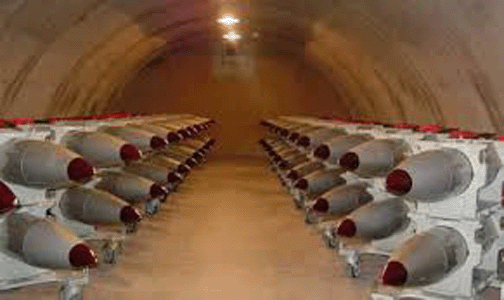
The US nuclear weapons are thought to be stored at an estimated 24 geographical locations in 11 US states and five European countries (Kristensen and Korda 2019, 124). The number of locations will increase over the next decade as nuclear storage capacity is added to three bomber bases. The location with the most nuclear weapons by far is the large Kirtland Underground Munitions and Maintenance Storage Complex south of Albuquerque, New Mexico. Most of the weapons in this location are retired weapons awaiting dismantlement at the Pantex Plant in Texas. The state with the second-largest inventory is Washington, which is home to the Strategic Weapons Facility Pacific and the ballistic missile submarines at Naval Submarine Base Kitsap. The submarines operating from this base carry more deployed nuclear weapons than any other base in the United States.
Implementing the New START treaty
The United States appears to be in compliance with the New Strategic Arms Reduction Treaty (New START) limits. Although Russia “suspended” its participation in New START in February 2023, the United States publicly declared in May 2023 that it had 1,419 warheads attributed to 662 deployed ballistic missiles and heavy bombers as of March 1st, 2023 (US State Department 2023a). The United States initially said that it voluntarily released the numbers “[i]n the interest of transparency and the US commitment to responsible nuclear conduct.” However, the United States did not continue this practice beyond that initial exchange and has not published any aggregate numbers since May 2023 (US State Department 2023a)
The United States contends that Russia’s “suspension” of New START implementation is “legally invalid” (US State Department 2023c). In response, the United States adopted four countermeasures in 2023 that it claimed were fully consistent with international law 1) no longer providing biannual data updates to Russia; 2) withholding from Russia notifications regarding treaty-accountable items (i.e. missiles and launchers) required under the treaty; 3) refraining from facilitating inspection activities on US territory; and 4) not providing Russia with telemetric information on US ICBM and SLBM launches (US State Department 2023c).
The New START warhead numbers reported by the US State Department differ from the estimates presented in this Nuclear Notebook, though there are reasons for this. …………………..
Since the treaty entered into force in February 2011, the biannual aggregate data show the United States has cut its arsenal by a total of 324 strategic launchers, reduced deployed launchers by 220 and the warheads attributed to them by 381 (US State Department 2011). The warhead reduction is modest, only equivalent to about 10 percent of the 3,708 warheads remaining in the US stockpile. ………….
As of March 2023, the United States had 38 launchers and 131 warheads less than the treaty limit for deployed strategic weapons but had 119 deployed launchers more than Russia—a significant gap that is just under the size of an entire US Air Force intercontinental ballistic missile (ICBM) wing. So far Russia has not sought to reduce this gap by deploying more strategic launchers but instead has increased the portion of its missiles that can carry multiple warheads.
The New START treaty has proven useful so far in keeping a lid on both countries’ deployed strategic forces. But it expires in February 2026 and if it is not followed by a new agreement, both the United States and Russia could potentially increase their deployed nuclear arsenals by uploading several hundred of stored reserve warheads onto their launchers.
Nuclear Posture Reviews and nuclear modernization programs
The Biden administration’s 2022 Nuclear Posture Review (NPR) was broadly consistent with the Trump administration’s 2018 NPR…………………………………
Just like previous NPRs, the Biden administration’s NPR said the United States reserved the right to use nuclear weapons under “extreme circumstances to defend the vital interests of the United States or its allies and partners” and rejected policies of nuclear “no-first-use” or “sole purpose” (US Department of Defense 2022a, 9)…………………………………………………………………………………………………………………………………………………
In 2023, multiple governmental advisory commissions published reports intended to influence US nuclear posture. The Congressionally-mandated report on “America’s Strategic Posture,” published in October 2023, included a broad range of recommendations for the United States to prepare to increase the number of deployed warheads, as well as to scale up its production capacity of bombers, air-launched cruise missiles, ballistic missile submarines, non-strategic nuclear forces, and warheads (US Strategic Posture Commission 2023). It also called for the United States to deploy multiple warheads on land-based intercontinental ballistic missiles (ICBMs) and consider adding road-mobile ICBMs to its arsenal…………………………………. the Strategic Posture Commission report’s status as a bipartisan document has been particularly useful for nuclear advocates to push for additional nuclear weapons (Heritage 2023; Hudson Institute 2023; Thropp 2023).
While additional modernization programs are being discussed, the National Nuclear Security Administration, or NNSA, delivered in 2023 more than 200 modernized nuclear weapons (B61–12 bombs and W88 Alt 370 warheads) to the Department of Defense (US Department of Energy 2024).
Nuclear planning and nuclear exercises
In addition to the Nuclear Posture Review, the nuclear arsenal and the role it plays is shaped by plans and exercises that create the strike plans and practice how to carry them out.
The current strategic nuclear war plan—OPLAN 8010–12—consists of “a family of plans” directed against four identified adversaries: Russia, China, North Korea, and Iran. Known as “Strategic Deterrence and Force Employment,” OPLAN 8010–12 first entered into effect in July 2012 in response to operational order Global Citadel. ………………………………………………………………….
…………………………………. changes are evident in the types of increasingly provocative bomber operations over Europe, in some cases very close to the Russian border (Kristensen 2022a). In October 2023, for example, a B-52 bomber from Barksdale AFB in Louisiana participated in NATO’s annual nuclear exercise Steadfast Noon, and in March 2023 a nuclear-capable B-52 cut south only a few kilometers from the Russian sea border and then flew south near Kaliningrad (Kristensen 2023a; NATO 2023).
…………………US strategy has changed in response to deteriorating East-West relations and the new “great power competition” and “strategic competition” strategy promoted by the Trump and Biden administrations, respectively. They also illustrate a growing integration of nuclear and conventional capabilities, as reflected in the new strategic war plan. B-52 Bomber Task Force deployments typically include a mix of nuclear-capable aircraft and aircraft that have been converted to conventional-only missions. With Sweden joining NATO, US strategic bombers now routinely operate over Swedish territory: In August 2022, for example, two B-52s—one version that is nuclear-capable and one that is de-nuclearized—overflew Sweden, the first overflight since it applied for NATO membership in May 2022 (Kristensen 2022c)…………………………………………………………………………………………….
Land-based ballistic missiles
The US Air Force (USAF) operates 400 silo-based Minuteman III ICBMs and keeps “warm” another 50 silos to load stored missiles if necessary, for a total of 450 silos. Land-based missile silos are divided into three wings: the 90th Missile Wing at F. E. Warren Air Force Base in Colorado, Nebraska, and Wyoming; the 91st Missile Wing at Minot Air Force Base in North Dakota; and the 341st Missile Wing at Malmstrom Air Force Base in Montana. Each wing has three squadrons, each with 50 Minuteman III silos collectively controlled by five launch control centers. We estimate there are up to 800 warheads assigned to the ICBM force, of which about half are deployed (see Table 1, on original).
The 400 deployed Minuteman IIIs carry one warhead each, either a 300-kiloton W87/Mk21 or a 335-kiloton W78/Mk12A. ICBMs equipped with the W78/Mk12A, however, could technically be uploaded to carry two or three independently targetable warheads each, for a total of 800 warheads available for the ICBM force……………………………………………………………………………………….
Part of the ongoing ICBM modernization program involves upgrades to the Mk21 reentry vehicles’ arming, fuzing, and firing system at a total cost of nearly $1 billion (US Department of Defense 2023c, 32). The publicly stated purpose of this refurbishment is to extend the vehicles’ service lives, but the effort appears to also involve adding a “burst height compensation” to enhance the targeting effectiveness of the warheads (Postol 2014)………………………………………………………………………………. As part of the Mk21A program, Lockheed Martin was awarded a sole source contract in October 2023 amounting to just under $1 billion for the engineering and manufacturing of the new reentry vehicle (US Department of Defense 2023b). These modernization efforts complement a similar fuze upgrade underway to the Navy’s W76–1/Mk4A warhead.
………………………………………………………………………………………………………………….. The Air Force’s FY24 budget for ICBM Reentry Vehicles Research Development, Test & Evaluation Programs increased significantly from the previous President’s Budget……………………………………………………………………………..
…………………………….Non-governmental experts, including those conducting Department of Defense-sponsored research, have questioned the Pentagon’s procurement process and lack of transparency regarding its decision to pursue the Sentinel option over other potential deployment and basing options (Dalton et al. 2022, 4). Moreover, it is unclear why an enhancement of ICBM capabilities would be necessary for the United States. For instance, any such enhancements would not mitigate the inherent challenges associated with launch-on-warning, risky territorial overflights, or silo vulnerabilities to environmental catastrophes or conventional counterforce strikes (Korda 2021). Additionally, even if adversarial missile defenses improved significantly, the ability to evade missile defenses lies with the payload—not the missile itself. ………………………………………..
……………………………………………….The development of the Sentinel has also been marked by a series of controversial industry contracts, starting with the awarding of a $13.3 billion sole-source contract to Northrop Grumman in 2020 to complete the engineering and manufacturing development stage
…………………………………………..in early 2024, the Air Force notified Congress of a two-year delay in the schedule and an estimated 37-percent increase from the current cost target to at least $125 billion (Tirpak 2024). These amounts do not include the costs for the new Sentinel warhead—the W87–1—which is projected to cost up to $14.8 billion, or the plutonium pit production that the US Air Force and US Strategic Command say is needed to build the warheads (Government Accountability Office 2020).
…………………………………………The schedule and extreme cost overruns for the Sentinel program incurred a critical breach of the Nunn-McCurdy Act, which requires the Secretary of Defense to conduct a root-cause analysis and renewed cost assessment before providing a certification to Congress that verifies the necessity and viability of the program no later than 60 days after a Selected Acquisition
…………………………………………………..Andrew Hunter, Assistant Secretary of the Air Force for Acquisition, Technology, and Logistics clarified that while the cost of the missile itself has increased, challenges with supporting infrastructure is the significant driver of schedule overrun, which also further impacts the overall cost (Tirpak 2024). In addition to an entirely new missile, the Sentinel program includes launch facility replacement and modifications (since the Sentinel may require a larger silo), new missile alert facilities, and new command and control facilities and systems—not to mention new training and curriculum for USAF personnel. Many of these delays are results of staffing shortfalls, clearance delays, IT infrastructure challenges, and trouble with supply chains on the part of Northrop Grumman (Government Accountability Office 2023a, 88)………………………………………………………………………………………………………………………………………………………………………..
Nuclear-powered ballistic missile submarines
The US Navy operates a fleet of 14 Ohio-class ballistic missile submarines (SSBNs), of which eight operate in the Pacific from their base near Bangor, Washington, and six operate in the Atlantic from their base at Kings Bay, Georgia……………………………………………………………………………………………..
Each submarine can carry up to 20 Trident II D5 sea-launched ballistic missiles
……………………………………………………………………………………………………………………Design of the next generation of ballistic missile submarines, known as the Columbia-class, is well underway.
………………………………………..the Navy’s fiscal 2024 budget submission estimated the procurement cost of the first Columbia-class SSBN—the USS District of Columbia (SSBN-826)—at approximately $15.2 billion, followed by $9.3 billion for the second boat (Congressional Research Service 2024, 9). A $5.1 billion development contract was awarded to General Dynamics Electric Boat in September 2017, and construction of the first boat began on October 1, 2020—the first day of FY 2021………………………………………………………..
…………………According to a June 2023 report by the Government Accountability Office, “the program remains behind on producing design products—in particular, work instructions that detail how to build the submarine—because of ongoing challenges using a software-based design tool. These, in turn, contributed to delays in construction of the lead submarine” (Government Accountability Office 2023a, 160). The Navy is working to mitigate additional delays, but these constraints mean that the program is at significant risk of cost overgrowth and is very likely to suffer further setbacks………………………………………………………………………………..
Strategic bombers
The US Air Force currently operates a fleet of 20 B-2A bombers (all of which are nuclear-capable) and 76 B-52 H bombers (46 of which are nuclear-capable)……………………………………………………………Each B-2 can carry up to 16 nuclear bombs (the B61–7, B61–11, B61–12, and B83–1 gravity bombs)…………..An estimated 788 nuclear weapons, including approximately 500 air-launched cruise missiles, are assigned to the bombers, but only about 300 weapons are thought to be deployed at bomber bases (see Table 1). The estimated remaining 488 bomber weapons are thought to be in central storage at the large Kirtland Underground Munitions Maintenance and Storage Complex outside Albuquerque, New Mexico.
The United States is modernizing its nuclear bomber force by upgrading nuclear command-and-control capabilities on existing bombers, developing enhanced nuclear weapons (the B61–12, B61–13, and the new AGM-181 Long-Range Standoff Weapon or LRSO), and designing a new heavy bomber (the B-21 Raider).
Upgrades to the nuclear command-and-control systems that the bombers use to plan and conduct nuclear strikes include the Global Aircrew Strategic Network Terminal (ASNT)…………………………………………………………………………………………………………….
The United States was initially expected to produce approximately 480 B61–12 bombs, but in 2023 it announced that a small number of them instead will be produced as the B61–13, a gravity bomb with a much larger yield (US Department of Defense 2023e………………………………………………………………………………………………………………
The Air Force is also developing a new nuclear air-launched cruise missile known as the AGM-181 LRSO……………………………………………………. The LRSO will arm both the 46 nuclear-capable B-52Hs and the new B-21, the first time a US stealth bomber will carry a nuclear cruise missile. A $250 million contract was awarded to Boeing in March 2019
…………………………………………….It is expected that the Air Force will procure at least 100 (possibly as many as 145) of the B-21, with the latest service costs estimated at approximately $203 billion …………………………………………………………………………………………………………………
Nonstrategic nuclear weapons
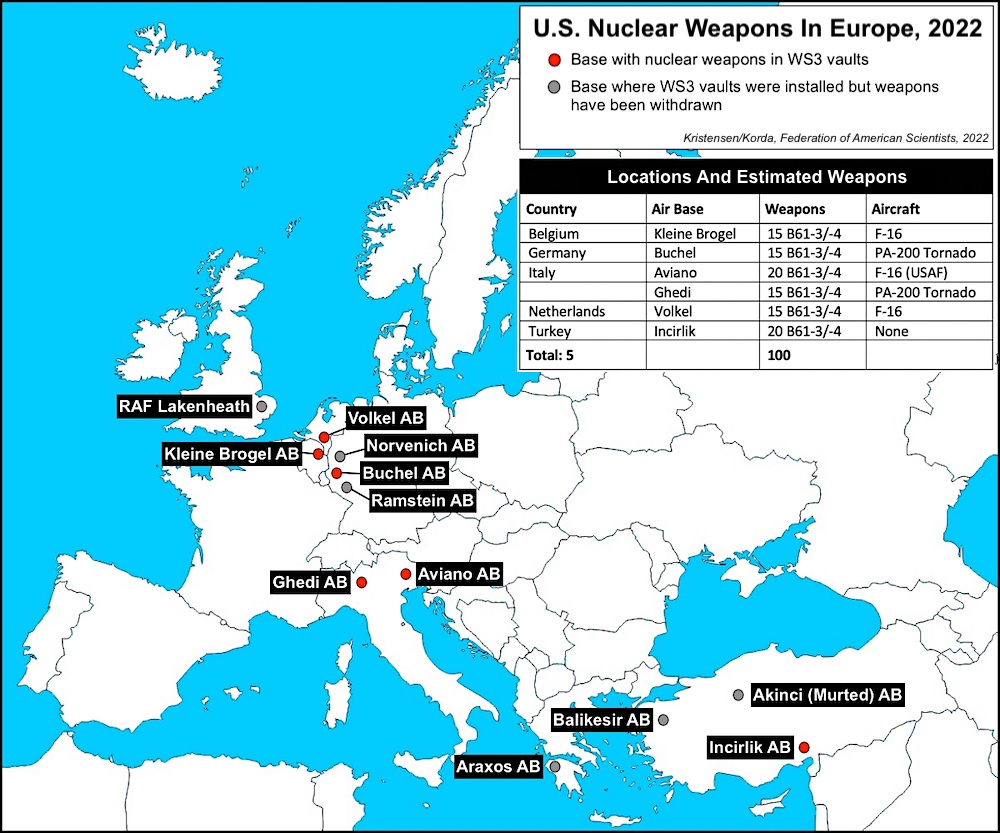
The United States has only one type of nonstrategic nuclear weapon in its stockpile: the B61 gravity bomb. But it exists in several versions: ……………………………………………………. About 100 of these (versions −3 and − 4) are thought to be deployed at six bases in five European countries: Aviano and Ghedi in Italy; Büchel in Germany; Incirlik in Turkey; Kleine Brogel in Belgium; and Volkel in the Netherlands…………………………………………………………………
The Belgian, Dutch, German, and Italian air forces are currently assigned an active nuclear strike role with US nuclear weapons. …………………………………………………………………………………………………………………………..
The United States withdrew nuclear weapons from the United Kingdom around 2007 after storing them at Royal Air Force (RAF) Lakenheath for several decades (Kristensen 2008). But increasing evidence over the past two to three years suggests that the United States may be returning its nuclear mission to UK soil (Korda and Kristensen 2023) (see Figure 3 on original)
……………………………………………………………In addition to the modernization of weapons, aircraft, and bases, NATO also appears to be increasing the profile of the dual-capable aircraft posture. NATO is now publicly announcing its annual Steadfast Noon tactical nuclear weapons exercise. For example, NATO described in 2023 that the exercise involved the participation of 13 countries and 60 aircraft including fighter jets and US B-52 bombers (NATO 2023)………………………………………………………………………………………………
This research was carried out with generous contributions from the New-Land Foundation, the Prospect Hill Foundation, Longview Philanthropy, Ploughshares Fund, and individual donors.
References…………………………………………….. https://thebulletin.org/premium/2024-05/united-states-nuclear-weapons-2024/
1 This Month

of the week – Shut Down Drone Warfare!


Tell the Ukrainian Government to Drop Prosecution of Peace Activist Yurii Sheliazhenko

Petition to revoke the licensing of the Near Surface Nuclear Disposal Facility (NSDF) at Chalk River. https://www.ourcommons.ca/petitions/en/Petition/Details?Petition=e-7247
To see nuclear-related stories in greater depth and intensity – go to https://nuclearinformation.wordpress.com
-
Archives
- April 2026 (114)
- March 2026 (251)
- February 2026 (268)
- January 2026 (308)
- December 2025 (358)
- November 2025 (359)
- October 2025 (376)
- September 2025 (257)
- August 2025 (319)
- July 2025 (230)
- June 2025 (348)
- May 2025 (261)
-
Categories
- 1
- 1 NUCLEAR ISSUES
- business and costs
- climate change
- culture and arts
- ENERGY
- environment
- health
- history
- indigenous issues
- Legal
- marketing of nuclear
- media
- opposition to nuclear
- PERSONAL STORIES
- politics
- politics international
- Religion and ethics
- safety
- secrets,lies and civil liberties
- spinbuster
- technology
- Uranium
- wastes
- weapons and war
- Women
- 2 WORLD
- ACTION
- AFRICA
- Atrocities
- AUSTRALIA
- Christina's notes
- Christina's themes
- culture and arts
- Events
- Fuk 2022
- Fuk 2023
- Fukushima 2017
- Fukushima 2018
- fukushima 2019
- Fukushima 2020
- Fukushima 2021
- general
- global warming
- Humour (God we need it)
- Nuclear
- RARE EARTHS
- Reference
- resources – print
- Resources -audiovicual
- Weekly Newsletter
- World
- World Nuclear
- YouTube
-
RSS
Entries RSS
Comments RSS
 nuclear-news