Nuclear War in Ukraine Is a Distinct Possibility
September 22, 2024, By C.J. Polychroniou / Common Dreams, https://scheerpost.com/2024/09/22/a-nuclear-war-in-ukraine-is-a-distinct-possibility/
The war in Ukraine has been going on for 2.5 years with no end on sight. Not only that, but we are now close to a nuclear war, according to the Norwegian scholar Glenn Diesen who predicted in November 2021 that “war was becoming increasingly unavoidable” as NATO was escalating tensions with Russia by strengthening its ties with Ukraine. Indeed, as Diesen argues in the interview that follows, NATO provoked Russia and sabotaged all peace negotiations, using Ukraine as a proxy to a geopolitical chessboard. Diesen is professor of political science at the University of South-Eastern Norway and author of scores of academic articles and books, including, most recently, The Ukraine War & the Eurasian World Order(2024).
C. J. Polychroniou: On February 22, 2022, in a move that few had anticipated, Russia invaded Ukraine by launching a simultaneous ground and air attack on several fronts. The war hasn’t gone at all as Moscow had intended and it rages on as neither side is seriously considering an end to the fighting. Yet, the invasion is in many ways a continuation of a territorial conflict between Russia and Ukraine that goes back to 2014. What lies behind the Russia-Ukraine conflict? How did we arrive at this dangerous juncture that is now dragging NATO into the conflict?
Glenn Diesen: I predicted the war in an article in November 2021, in which I argued war was becoming “unavoidable” as NATO continued to escalate while rejecting any peaceful settlement. This should have been evident to everyone if we had an honest discussion about what had been happening.
NATO was always part of this conflict, and it did not start as a territorial conflict. The conflict began with the Western-backed coup in Ukraine in February 2014, which was seen as a precursor to NATO expansion and the eventual eviction of Russia from its Black Sea fleet in Sevastopol. As the New York Times has confirmed, on the first day after the coup, the new Ukrainian government hand-picked by Washington established a partnership with the CIA and MI6 for a covert war against Russia. It is important to remember that Russia had not laid any claims to Crimea before seizing it in the referendum in March 2014. This is not a commentary on legality or legitimacy, merely the fact that Russia’s actions were a reaction to the coup.
A proxy war broke out in which NATO backed the government it installed in Kiev and Russia backed the Donbas rebels who refused to recognize the legitimacy of the coup and resisted the de-russification and purge of the language, political opposition, culture, and the church. The Minsk-2 peace agreement of 2015 laid the foundation for resolving the conflict, but this was merely treated as a deception to buy time and build a large Ukrainian army as confirmed by the Germans, French and authorities in Kiev. After 7 years of Ukraine refusing to implement the Minsk agreement and NATO’s refusing to give Russia any security guarantees for NATO’s military infrastructure that moved into Ukraine—Russia invaded in February 2022.
It is correct that the war has not gone as Moscow expected. Russia thought it could impose a peace but was taken by surprise when the U.S. and U.K. preferred war. When Russia sent in its military, the small size and conduct of the invading forces indicated that the purpose was merely to pressure Ukraine to accept a peace agreement on Russian terms. Ukraine and Russia were close to an agreement in Istanbul, although it was sabotaged by the U.S. and U.K. as they saw an opportunity to fight Russia with Ukrainians.
The nature of the war changed fundamentally as it became a war of attrition. Russia withdrew to more defensible front lines, began mobilizing its troops and sourcing the required weapons for a long-term war to defeat the NATO-built army in Ukraine. After 2.5 years of war, this has become a territorial conflict that makes it impossible to resolve in a manner that would be acceptable to all sides. As NATO refuses to accept losing its decade-long proxy war in Ukraine, it must continue to escalate and thus get more directly involved in the war. We are now at the brink of a direct NATO-Russia War.
Did NATO provoke Russia’s invasion of Ukraine? Even if so, didn’t Moscow have any other options other than to resort to the use of military force?
NATO provoked the invasion and sabotaged all paths to peace. The NATO countries affirmed on several occasions that the UN-approved Minsk agreement was the only path to a peaceful resolution of the conflict in Ukraine, yet then admitted that it was merely a ruse to militarize Ukraine. This convinced the Russians that NATO was pursuing a military solution to the conflict in Ukraine that would also involve an invasion of Crimea. As argued by a top advisor to former French president Sarkozy, the U.S.-Ukrainian strategic agreement of November 2021 convinced Russia it had to attack or be attacked.
Russia considered NATO in Ukraine to be an existential threat, and NATO refused to give Russia any security guarantees to mitigate these security concerns. The former U.S. ambassador to NATO, Kurt Volker, argued during the Biden-Putin discussions that no agreements should be made with Russia as “success is confrontation.” This war is a great tragedy as it has resulted in the deaths of hundreds of thousands of young Ukrainians and Russians, made Europe weaker and more dependent, and taken the world to the brink of nuclear war. By failing to admit NATO’s central role in provoking this war, we also prevent ourselves from recognizing possible political solutions.
Russia and Ukraine were close to war-ending agreements in April of 2022, but apparently certain western leaders convinced Ukrainian president Zelensky to back down from such a deal. Is Ukraine a US pawn on a geo-political chessboard?
Zelensky confirmed on the first day after the Russian invasion that Moscow had contacted Kiev to discuss a peace agreement based on restoring Ukraine’s neutrality. On the third day after the invasion, Russia and Ukraine agreed to start negotiations. Yet, the American spokesperson suggested the US could not support such negotiations. When the negotiations nonetheless began, Boris Johnson was sent to Kiev to sabotage them. Johnson later wrote an op-ed warning against a bad peace. The Ukrainian negotiators and the Israeli and Turkish mediators all confirmed that Russia was willing to pull back its troops and compromise on almost everything if Ukraine would restore its neutrality to end NATO expansionism. The mediators also confirmed that the US and UK saw an opportunity to bleed Russia and thus weaken a strategic rival by fighting with Ukrainians. The US and UK told Ukraine they would not support a peace agreement based on neutrality, but NATO would supply all the weapons Ukraine would need if Ukraine pulled out of the negotiations and chose war instead. Interviews with American and British leaders made it clear that the only acceptable outcome for the war was regime change in Moscow, while other political leaders began to speak about breaking up Russia into many smaller countries.
Yes, I believe that Ukraine is a pawn on the geopolitical chessboard. Why do we not listen to all the American political and military leaders who describe this as a good war and an opportunity to weaken Russia without using American soldiers?
What does Russia want from Ukraine?
Russia demands peace based on the Istanbul+ formula. The Istanbul agreement of early 2022 involved Russia retreating from the territory it seized since February 2022 in return for Ukraine restoring its neutrality. However, after 2.5 years of fighting, the war has also evolved into a territorial conflict. Russia therefore demands that Ukraine also recognizes Russian sovereignty over the territories it annexed.
Russia will not accept a ceasefire that merely freezes the front lines, because this could become another Minsk agreement that merely buys time for NATO to re-arm Ukraine to fight Russia another day. Moscow therefore demands a political settlement to the conflict based on neutrality and territorial concessions. In the absence of such an agreement and continued threats by NATO to expand after the war is over, Russia will likely also annex Kharkov, Dnipro, Nikolaev, and Odessa to prevent these historical Russian regions from falling under the control of NATO.
Ukraine has become increasingly a de facto NATO member. What are the chances that Russia might introduce tactical nuclear weapons in the battlefield to achieve its aims?
Russia permits the use of nuclear weapons in response to a nuclear attack or if its existence is threatened. NATO becoming directly involved in the war is considered an existential threat by Russia, and Russia has warned that NATO would become directly involved by supplying long-range precision missiles. Such missiles will need to be operated by American and British soldiers and navigated by their satellites, thus this represents a NATO attack on Russia. We are very close to a nuclear war, and we are deluding ourselves by suggesting we are merely helping Ukraine defend itself.
Can you briefly discuss the implications for world order if the West defeats Russia? And what would the international system look like if Russia wins the war in Ukraine?
The West would like to defeat Russia to restore a unipolar order. As many military and political leaders in the US argue, once Russia has been defeated then the US can focus its resources on defeating China. It is worth remarking that few Western political leaders have clearly defined what “victory” over the world’s largest nuclear power would look like. Russia considers this war to be an existential threat to its survival, and I am therefore convinced that Russia would launch a nuclear attack long before NATO troops get to march through Crimea.
A Russian victory will leave Ukraine a dysfunctional state with much less territory, while NATO will have lost much of its credibility as this was bet on a victory. The war has intensified a transition to a multipolar world, and this likely increase at a much higher pace if NATO loses the war in Ukraine.
NATO expansion that cancelled inclusive pan-European security agreements with Russia was the main manifestation of America’s hegemonic ambitions after the Cold War, thus the entire world order will be greatly influenced by the outcome of this war. This also explains why NATO will be prepared to attack Russia with long-range precision missiles and risk a nuclear exchange.
Israel’s Tally of War Crimes in Lebanon Increases in Wake of Exploding Pagers
The Israeli bombing of a residential neighborhood in Beirut is also a war crime.
By Marjorie Cohn , Truthout, September 23, 2024
Israel escalated attacks against Lebanon on September 23, marking the deadliest day of Israeli bombings in that country since 2006. Israel’s strikes in southern and eastern Lebanon, as well as the capital city of Beirut, left a death toll of at least 274, including women, children and paramedics. The Israeli military targeted “medical centres, ambulances and cars of people trying to flee,” according to Al Jazeera, which cited Lebanon’s Health Minister Firass Abiad as the source for the information. Israel also targeted civilian homes, which it claimed were housing Hezbollah weapons.
This latest targeting of Lebanese civilians comes on the heels of Israel’s detonation of hand-held electronic devices in civilian areas of Lebanon on September 17 and 18, when Israeli forces remotely triggered multiple explosions of electronic pagers and walkie-talkies that killed at least 37 people, including a 9-year-old girl and an 11-year-old boy, and maimed or injured 3,250 people, 200 critically. About 500 people suffered severe eye wounds and others received grave injuries to their hands, faces and bodies. The blasts occurred in residential buildings, barber shops, grocery stores, cars and at funerals. Many civilians, including government and hospital workers, were killed.
Elias Warrak, an ophthalmologist at Mount Lebanon University Hospital in Beirut, treated several of those injured by the blasts. He told the BBC that between 60 percent and 70 percent of the patients he attended had to have at least one eye removed. “Some of the patients, we had to remove both eyes. It kills me. In my past 25 years in practice, I’ve never removed as many eyes as I did yesterday [September 17].”
Israel’s weaponization of 3,000 to 4,000 pagers and walkie-talkies programmed to explode simultaneously constituted “terrifying” violations of international law, according to 22 independent United Nations experts, including 13 special rapporteurs.
The radios and pagers were reportedly distributed to people associated with Hezbollah, which includes both military and civilian individuals. “At the time of the attacks there was no way of knowing who possessed each device and who was nearby,” the experts noted. “Simultaneous attacks by thousands of devices would inevitably violate humanitarian law, by failing to verify each target, and distinguish between protected civilians and those who could potentially be attacked for taking a direct part in hostilities.”
A booby-trap is defined as something designed to kill or injure unexpectedly when a person performs an apparently safe act like answering a pager. International humanitarian law prohibits the use of booby-traps that are disguised as harmless objects when they are constructed and designed with explosives. They breach the principles of distinction, proportionality and precautions.
War Crimes of Murder, Attacking Civilians, Indiscriminate Attacks, Violence to Spread Terror
“These attacks violate the human right to life, absent any indication that the victims posed an imminent lethal threat to anyone else at the time,” the U.N. experts wrote. “Such attacks could constitute war crimes of murder, attacking civilians, and launching indiscriminate attacks.”
The U.N. experts declared, “It is also a war crime to commit violence intended to spread terror among civilians, including to intimidate or deter them from supporting an adversary,” adding, “A climate of fear now pervades everyday life in Lebanon.”
Amal Saad, an expert on Hezbollah, told Drop Site News, “Everyone’s scared to send text messages, to make calls, and they’re afraid to open laptops. It’s definitely led to some level of complete disorientation, fear, confusion, paranoia. It has huge psychological effects.” Saad noted that the purpose behind the explosions “was to terrorize and paralyze and demoralize.”………………………………………………………………………………………………..more https://truthout.org/articles/israels-tally-of-war-crimes-in-lebanon-increases-in-wake-of-exploding-pagers/?utm_source=feedotter&utm_medium=email&utm_campaign=FO-09-23-2024&utm_content=httpstruthoutorgarticlesisraelstallyofwarcrimesinlebanonincreasesinwakeofexplodingpagers&utm_source=Truthout&utm_campaign=097274f518-EMAIL_CAMPAIGN_2024_09_23_08_53&utm_medium=email&utm_term=0_bbb541a1db-097274f518-%5BLIST_EMAIL_ID%5D
Fears of ‘Imminent Catastrophe’ Mount as Hezbollah Hits Back Amid Israeli Airstrikes
“It cannot be overstated enough: There is NO military solution that will make either side safer,” said one U.N. official.
Brett Wilkins, Sep 22, 2024, https://www.commondreams.org/news/israel-lebanon-escalation-rockets
Fears of an all-out Middle East war mounted Sunday as Hezbollah fired more than 100 rockets into Israel, whose military continued bombing targets in southern Lebanon while moving troops, tanks, and other equipment toward the northern border.
During a Sunday funeral speech for three members killed in Israeli airstrikes, Hezbollah Deputy Secretary-General Naim Qassem declared an “open-ended battle” with Israel was underway. Hezbollah is reeling from last week’s unprecedented surprise attack on communication devices that killed dozens of people and wounded thousands more, as well as Israeli airstrikes on Beirut suburbs that have slain dozens of Lebanese including women and children and injured scores more.
The dead include senior Hezbollah commander Ibrahim Aqil.
“We admit that we are pained. We are humans. But as we are pained, you will also be pained,” Qassem told mourners at Aqil’s funeral, directing his remarks to Israel.
In Israel, air raid warning sirens blared warnings of incoming Hezbollah rocket fire that penetrated further south in Israel than at any time in nearly two decades, sending residents scrambling for shelters. Israeli media reported 13 people injured—one of them seriously—and heavy damage to homes and cars.
As officials closed schools, limited gatherings, and ordered hospitals to move patients in the north, the Israel Defense Forces moved troops, tanks, and other equipment toward the border with Lebanon. Numerous social media posts said Israeli reservists had received emergency call-up orders, known as Tzav 8s.
Israeli Prime Minister Benjamin Netanyahu said Sunday that his far-right government would “take whatever action is necessary to restore security” in the northern part of Israel.
“No country can accept the wanton rocketing of its cities,” he said. “We can’t accept it either.”
Hezbollah said it would not stop fighting until Israel stops its assault on Gaza, for which it is on trial for genocide at the International Court of Justice.
Jeanine Hennis-Plasschaert, the United Nations envoy for Lebanon, said on X, formerly known as Twitter, that “with the region on the brink of an imminent catastrophe, it cannot be overstated enough: There is NO military solution that will make either side safer.”
Fears of an all-out Middle East war mounted Sunday as Hezbollah fired more than 100 rockets into Israel, whose military continued bombing targets in southern Lebanon while moving troops, tanks, and other equipment toward the northern border.
During a Sunday funeral speech for three members killed in Israeli airstrikes, Hezbollah Deputy Secretary-General Naim Qassem declared an “open-ended battle” with Israel was underway. Hezbollah is reeling from last week’s unprecedented surprise attack on communication devices that killed dozens of people and wounded thousands more, as well as Israeli airstrikes on Beirut suburbs that have slain dozens of Lebanese including women and children and injured scores more.
The dead include senior Hezbollah commander Ibrahim Aqil.
“We admit that we are pained. We are humans. But as we are pained, you will also be pained,” Qassem told mourners at Aqil’s funeral, directing his remarks to Israel.
In Israel, air raid warning sirens blared warnings of incoming Hezbollah rocket fire that penetrated further south in Israel than at any time in nearly two decades, sending residents scrambling for shelters. Israeli media reported 13 people injured—one of them seriously—and heavy damage to homes and cars.
As officials closed schools, limited gatherings, and ordered hospitals to move patients in the north, the Israel Defense Forces moved troops, tanks, and other equipment toward the border with Lebanon. Numerous social media posts said Israeli reservists had received emergency call-up orders, known as Tzav 8s.
Israeli Prime Minister Benjamin Netanyahu said Sunday that his far-right government would “take whatever action is necessary to restore security” in the northern part of Israel.
“No country can accept the wanton rocketing of its cities,” he said. “We can’t accept it either.”
Hezbollah said it would not stop fighting until Israel stops its assault on Gaza, for which it is on trial for genocide at the International Court of Justice.
Jeanine Hennis-Plasschaert, the United Nations envoy for Lebanon, said on X, formerly known as Twitter, that “with the region on the brink of an imminent catastrophe, it cannot be overstated enough: There is NO military solution that will make either side safer.”
European Union foreign policy chief and European Commission Vice President Josep Borrell said on social media Sunday that “the E.U. is extremely concerned by the escalation in Lebanon, following Friday’s attacks in Beirut and the increasing cross-border violence between Israel and Hezbollah.”
“Civilians on both sides are paying an enormous price,” Borrell added. “An immediate ceasefire is needed.”
In the United States, White House national security spokesman John Kirby toldABC‘s “This Week” on Sunday that the Biden administration—which supplies Israel with billions of dollars in arms and diplomatic cover—is “involved in extensive and quite assertive diplomacy.”
“We want to make sure that we can continue to do everything we can to try to prevent this from becoming an all-out war there with Hezbollah across that Lebanese border,” he added. “We still believe that there can be time and space for a diplomatic solution here.”
Nuclear danger is growing. Physicists of the world, unite!

Bulletin, By Curtis T. Asplund, Zia Mian, Stewart Prager, Frank von Hippel | July 1, 2024
Physicists have been central to imagining, developing, constructing and advancing nuclear weapons ever since the idea of a nuclear chain reaction came to Leo Szilard in 1933. Over the subsequent 90 years, physicists have also been an important force in global efforts aimed at confronting the nuclear threat they created, through the promotion of nuclear arms control and disarmament. Since the end of the Cold War, however, the physics community has been relatively absent as analysts, activists, and advocates contesting nuclear weapons policies. Meanwhile, the Cold War-era nuclear arms control regime has mostly collapsed, a nuclear arms race led by the United States, Russia, and China is underway, and all nine nuclear-armed states are recommitting to nuclear deterrence for the foreseeable future.
In response, in October 2023, a group of 50 physicists from 20 nations gathered for a three-day workshop at the International Centre for Theoretical Physics (ICTP) in Trieste, Italy—“The Increasing Danger of Nuclear Weapons: How Physicists Can Help Reduce the Threat.” The objective of this workshop was to brainstorm on how to mobilize the international physics community to engage in advocacy for nuclear threat reduction. This discussion resulted in the formation of an international working group to help foster this mobilization.
As recently described in the Bulletin and depicted in the movie Oppenheimer, prominent physicists tried to think through the challenges posed by what were then new weapons and be a voice of reason and restraint informing nuclear weapons policy debates during the Manhattan Project and beyond. The early debate and introspection at Los Alamos and elsewhere on the implications of nuclear weapons were not just among Americans, however. The debate was international, involving physicists from many countries within the Manhattan Project, including refugees from Europe escaping fascism. All these efforts were private and aimed at US policymakers, not the larger scientific community or the public.
After the bombings of Hiroshima and Nagasaki and the beginning of the US-Soviet nuclear arms race, the debate about nuclear weapons became more deliberately public and more international. In Princeton in 1946, Albert Einstein announced the Emergency Committee of Atomic Scientists to educate and mobilize scientists and the public on the dangers of nuclear weapons.
The clearest international expression of scientist activism started in 1957 with the Pugwash Conferences on Science and World Affairs. Historian Matthew Evangelista gives Pugwash “considerable credit for substantial breakthroughs in US-Soviet arms control in the late 1960s and early 1970s.” This determined decades-long effort eventually earned the Pugwash Conferences and their key leader, physicist Joseph Rotblat, a shared Nobel Peace Prize in 1995 “for their efforts to diminish the part played by nuclear arms in international politics and, in the longer run, to eliminate such arms.”…………………………………………………….
Today, new efforts by the international physics community against the threats posed by nuclear weapons are very much needed………………………………………………………….
A strong consensus emerged from the Trieste workshop on the importance of catalyzing international advocacy by physicists for nuclear arms control and reduction. Early-career scientists, especially, found engagement with like-minded physicists from various countries to be strongly affirming of their concerns regarding the dangers of nuclear weapons and their desire to engage in policy activism.
As a next step, the ICTP meeting participants agreed to form an international working group to promote engagement and advocacy across and within nations among physicists and colleagues in the engineering sciences. This initiative can complement the efforts underway by the Scientific Advisory Group of the UN Treaty on the Prohibition of Nuclear Weapons to establish a broad network of scientific and technical institutions and experts to support that treaty’s goals.
“Today, the arms race is draining humanity of enormous resources; material, moral and intellectual. Unfortunately, science and scientists have contributed to this dangerous state of affairs. As scientists, as citizens of the world, we have the duty both to recognize this and to use our skill to explore ways out of the present situation.” This is from the call to the 1986 Hamburg meeting. Now, in 2024, physicists must step up again and exercise that responsibility.
Editor’s note: This article is a product of a workshop at the International Centre for Theoretical Physics (ICTP), organized by a committee consisting of the authors as well as Jürgen Altmann and Götz Neuneck. This workshop received support from the ICTP; the Physicists Coalition for Nuclear Threat Reduction; the German Physical Society; the American Physical Society’s Forum on Physics and Society; the Research Association for Science, Disarmament and International Security (Germany); and Princeton University‘s Program on Science and Global Security. https://thebulletin.org/2024/07/nuclear-danger-is-growing-physicists-of-the-world-unite/
Israel Unleashes Hell On South Lebanon With Giant Mystery Bomb As War Escalates
Zero Hedge, by Tyler Durden, Sep 22, 2024
Massive escalation along the southern Lebanese border is very clear at this point, as Israeli jets have pounded Hezbollah positions through much of Saturday.
Al Jazeera correspondents have confirmed that “Israel’s military launched 400 attacks on Lebanon on Saturday and Hezbollah fired rockets at the Ramat David base near the city of Haifa, in their largest exchange of fire since the war on Gaza began.”
Another indicator of the escalation is that Israel is apparently beginning use much bigger bombs compared to much of the past nearly year of internecine fighting. The below widely circulating footage shows a large flash and skyscraper-size fireball, resulting in some viewers speculating it was likely a heavy bunker-buster bomb, or possibly even a tactical nuke of some sort. Whatever it was, there’s never been anything like it used on Lebanon (that we know about).
……………. Since Thursday and the deadly chaos of the two-day pager explosion attack, southern Lebanon has seen the most intense exchange of fire between Hezbollah and Israel since the conflict began after Oct.7.
On Saturday the expanded pace of fire has continued, with Hezbollah having launched at least 90 rockets on northern Israel, and the IDF saying it has mounted at least 80 raids on weapons installations belonging to Hezbollah…………………………………..
The death toll from Friday’s Israeli airstrike which killed Hezbollah special forces commander Ibrahim Aqil has risen to 37, after a day-long rescue operation and workers picking through rubble of a residential building, according to the country’s Health Ministry. Reports say that a meeting of Hezbollah leaders was taking place in either a garage, or a tunnel underneath the building in south Beirut.
“According to source, the meeting was being held in a tunnel under a residential building, a location that was being used for the first time, which has raised Hezbollah’s concerns about the extent Israel has infiltrated its ranks,” Middle East Eye reports. Hezbollah has since confirmed that 16 of its members were killed in the attack.
Lebanon’s government says three children and seven women were among the victims. Over 60 others were injured. The White House has still called the Israeli strike “a good outcome”.
White House National Security Adviser Jake Sullivan described Aqil as having “American blood on his hands and has a rewards for justice price on his head.”
He has long been sought by the US for his alleged role in the 1983 bombing of the US Embassy in Beirut, and well as kidnapping of Westerners in the the later 1980s. He had a $7 million bounty on his head issued by the Justice Department.
“He is somebody who the United States promised long ago we would do everything we could to see brought to justice,” Sullivan said. “You know, 1983 seems like a long time ago,” he added. “But for a lot of families and a lot of people, they’re still living with it every day.”
Some Middle East pundits and commentators expressed “shock” at the celebratory statements by the Biden administration, given the Israeli operation resulted in a high civilian death toll. https://www.zerohedge.com/geopolitical/idf-says-180-targets-eliminated-southern-lebanon-us-lauds-good-outcome-beirut-strike
Biden’s Grand Alliance against Russia in Ukraine beginning to recognize the N word…Negotiations

Walt Zlotow, West Suburban Peace Coalition, Glen Ellyn IL, 20 Sept 24
The US 32 month long proxy war against Russia is not quite over. But everyone in America’s important NATO allies knows America’s Ukraine proxy is losing badly with its military near collapse. The two hundred billions the US and NATO have poured into Ukraine have made not a dent in achieving the ‘good guys’ war aims of taking back the Donbas and Crimea, receiving reparations from Russia, and gaining NATO membership.
While President Biden betrays nary a hint of that stark reality, his European NATO allies, greatly more affected by the economic consequences of this than America, certainly are.
German Chancellor Olaf Scholz recently said, “I believe that now is the time to discuss how to arrive at peace from this state of war, indeed at a faster pace.” Scholz further stated that he will impose a limit on open ended aid to Ukraine and is working on a diplomatic settlement that will include Ukraine ceding territory to Russia.
A senior French diplomat recently told Le Figaro the same thing, citing that the Donbas and Crimea are beyond Ukraine’s military capability and that France lines up with Germany that only a negotiated settlement will end the war.
Insulated from the economic angst of its Western European allies, the US sees no need to deal with reality. For President Biden and his war cabinet including VP Harris, the words ‘negotiated settlement’ and ‘ceding territory’ dare not pass the lips of US diplomats acting more like war generals than statespersons.
Biden and company are still running around like Chicken Little, chirping ‘The Russians are coming, the Russians are coming, to take over Poland on their march to the English Channel.’
That includes presidential candidate Kamala Harris who repeated that delusional meme in her presidential debate.
The US proxy war against Russia, with Ukrainians doing all the dying and the country in ruins, is headed to a negotiated settlement in spite of President Biden’s intransigence.
US Military Policy Is Stoking the Risk of Nuclear War on Korean Peninsula
As Trump and Harris bicker over North Korea, the US military lays plans that could bring nuclear tensions to a brink.
By Ju-Hyun Park , Truthout, September 19, 2024
U.S. politicians can’t stop talking about Kim Jong Un. The two major party conventions have come and gone, with both presidential candidates mentioning the North Korean leader by name. At the Republican National Convention (RNC), Donald Trump claimed Kim had endorsed him, adding, “He misses me.” Just weeks later at the Democratic National Convention (DNC), Kamala Harris alluded to her opponent’s claims, declaring before an enraptured audience that the “tyrant” Kim is “rooting for Trump.”
Neither candidate told the truth. The North Korea’s state news agency was swift to respond to Trump back in June, clarifying the position of the government with characteristically pointed remarks: “No matter what administration takes office in the U.S., the political climate, which is confused by the infighting of the two parties, does not change and, accordingly, we do not care about this.”
The fact-free treatment of North Korea by both parties is a sign of how the electoral cycle has reduced the Korean crisis to a political football. This is especially dangerous in a time when the risk of war in Korea is at its highest in decades. Significantly, neither Republicans nor Democrats seem interested in a public discussion about the concrete situation in Korea, or the major escalations the U.S. is undertaking there.
While the news cameras and the eyes of the electorate were trained on the DNC in Chicago, the U.S. military executed one of the largest war games on Earth in Korea: Ulchi Freedom Shield (UFS). UFS is the latest name for an annual series of military exercises conducted by the Combined Forces Command, the command structure under which the military of South Korea answers to U.S. generals. (The U.S. has had operational wartime command of South Korea’s armed forces since 1950.) Originating in 1976, UFS and its predecessors routinely deploy tens of thousands of troops, along with U.S. “strategic assets” such as aircraft carriers, heavy bombers and nuclear submarines.
This is a major, and widely misunderstood, component of the unfinished Korean War — that for over half a century, some of the largest military maneuvers on Earth are conducted on an annual basis in Korea within sight of the border bisecting the peninsula. Although the U.S. and Republic of Korea (ROK), South Korea’s official name, insist these exercises are defensive, many of them rehearse the invasion and occupation of North Korea.
These “war games,” by their very nature, look identical to the first steps of a real invasion. This year’s UFS featured a whopping 48 individual war drills, deploying 19,000 South Korean troops, 200 military aircraft and an unknown number of U.S. soldiers. What’s more, this year’s war games took place in the context of another significant escalation: emergent plans to potentially redeploy U.S. nuclear weapons to Korea.
Killing Peace
The Korean War was concluded with a ceasefire rather than a permanent peace treaty, making it the longest war in U.S. history. For over 50 years, relations between North and South Korea were structured through the paradigm of independent, peaceful reunification — a mutual commitment to nonviolently end both the Korean War and the division of the Korean people. And since the late 1980s, relations between the U.S. and North Korea were also based on the framework of denuclearization. Both of these diplomatic paradigms have now crumbled.
………………………………………………………………………………………………………………………………………… more https://truthout.org/articles/us-military-policy-is-stoking-the-risk-of-nuclear-war-on-korean-peninsula/
Failed Machismo: Israel’s Pager Killings
September 20, 2024, by: Dr Binoy Kampmark, https://theaimn.com/failed-machismo-israels-pager-killings/
With each ludicrously diabolical move, Israel’s security and military services are proving that they will broaden the conflict ignited when Hamas breached the country’s vaunted security defences on October 7. Notions such as ceasefire and peace are terms of nonsense and babble before the next grand push towards apocalyptic recognition.
The pager killings in Lebanon and parts of Syria on September 17 that left almost 3000 people injured and 12 dead were just another facet of this move. On September 18, a number of walkie-talkies used by members of Hezbollah were also detonated, killing 14. (The combined death toll continues to rise.)
In keeping with the small script that always accompanies such operations, the coordinated measure to detonate thousands of deadly pagers had Mossad’s fingerprints over it, though never officially accepted as such. It featured the use of the Apollo AR924 pager, adopted by Hezbollah as a substitute for smartphone technology long compromised by Israeli surveillance.
The group had ordered 5,000 beepers made by the Taiwanese Gold Apollo manufacturer in the early spring, most likely via BAC Consulting, a Hungarian-based company licensed to use the trademark. According to a Reuters report, citing a “senior Lebanese source”, these had been modified “at the production level.” Mossad had “injected a board inside the device that has explosive material that receives a code. It’s very hard to detect it through any means. Even with a device or scanner.”
The manner of its execution stirred sighs of admiration. Here was Israel’s intelligence apparatus, caught napping on October 7, reputationally restored. French defence expert Pierre Servent suggested that, “The series of operations conducted over the last few months marks their big comeback, with a desire for deterrence and a message: ‘we messed up but are not dead.’” A salivating Mike Dimino, former CIA analyst and plying his trade at Defense Priorities, a US-based think tank, admired the operation as one of “classic sabotage” that would have taken “months if not years” to put into play and proved to be “[i]ntelligence work at its finest.
While admired by the security types as bloody, bold machismo, this venture remains politically stunted. However stunning a statement of power, it only promises temporary paralysis. It’s true that Hezbollah is in disarray regarding its communications, the extent of the compromise, and pondering the nightmarish logistics of it all. Its leader, Hassan Nasrallah, has every reason to feel rattled. But the pretext for an escalation, the temptation to reassert virility and strength, has been set, thereby creating the broader justification for a move into Lebanon.
The broader war, the death, and the calamity, beckons, and an excited DiMino proposes that, “If you were planning a ground incursion into Lebanon to push Hezbollah N[orth] of the Litani, this is exactly the sort of chaos you’d sow in advance.” An unnamed former Israeli official, speaking to Axios, confirmed that the modified pagers had been originally intended as a swift, opening attack “in an all-out war to try to cripple Hezbollah.” Their use on September 17 was only prompted by Israeli concerns that their operation might have been compromised.
Nasrallah, in his September 19 speech, complemented the dark mood. “Israel’s foolish Northern Command leader talks about a security zone inside Lebanese territory – we are waiting for you to enter Lebanese territory.” He also promised that the only way 120,000 Israelis evacuated from the North could return safely “is to stop the aggression on the Gaza Strip and the West Bank.”
Every resort to force, every attempt to avoid the diplomatic table, is another deadly deviation, distraction and denial. It is also an admission that Israel remains incapable of reaching an accord with the Palestinians and those who either defend or exploit their dispossession and grief.
On a granular level, the wide flung nature of the operation, while audacious in its execution, also suggests an absence of focus. The target range, in this case, was violently expansive: not merely leaders but low-level operatives and those in proximity to them. The result was to be expected: death, including two children, and broadly inflicted mutilations. In humanitarian terms, it was disastrous, demonstrating, yet again, the callousness that such a conflict entails. Bystanders at marketplaces were maimed. Doctors and other medical workers were injured. Lebanon’s hospital system was overwhelmed.
Human Rights Watch notes that international humanitarian law prohibits the use of booby–traps precisely because such devices could place civilians in harm’s way. “The use of an explosive device whose exact location could not be reliably known,” opined Lama Fakih, Middle East and North Africa Director at HRW, “would be unlawfully indiscriminate, using a means of attack that could not be directed at a specific military target and as a result would strike military targets and civilians without distinction.”
Amended Protocol II of the Convention on Certain Conventional Weapons, to which both Lebanon and Israel are parties, offers the following definition of a booby-trap: “any device or material which is designed, constructed or adapted to kill or injure, and which functions unexpectedly when a person disturbs or approaches an apparently harmless object or performs an apparently safe act.”
Quibbling over matters of international humanitarian law is never far away. Over the dead and injured in rarified air, disputatious legal eagles often appear. While the use of such devices “in the form of harmless portable objects which are specifically designed and constructed to contain explosive material” is prohibited by Article 7(2) of Amended Protocol II, the legal pedants will ask what constitutes specific design and construction. Ditto such issues as proportionality and legitimate targeting.
Jessica Peake of the University of California, Los Angeles School of Law, is mercifully free of quibbles in offering her assessment: “detonating pagers in people’s pockets without any knowledge of where those are, in that moment, is a pretty evident indiscriminate attack” and also a violation of the rule of proportionality.
The calculus of such killings and targeting enriches rather than drains the pool of blood and massacre. Its logic is not one of cessation but replication. No longer can Israel’s military prowess alone be seen as a reassurance against any retaliation and whatever form it takes. October 7 continues to cast its dispelling shadow. Deterrence through sheer technological power, far from being asserted, has been further weakened.
Why Putin’s nuclear saber-rattling on Ukraine sounds different this time
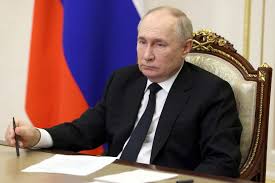
Christian Science Monitor, By Fred Weir, Special correspondent, September 19, 2024, Moscow
Over the course of the war in Ukraine, the Kremlin has drawn several “red lines” – with ostentatious references to Russia’s huge strategic nuclear arsenal – only to seemingly do nothing when these lines are crossed by Ukraine or its Western backers
Red lines:
- It happened when Ukraine acquired new and more powerful Western arms.
- It happened when Kyiv used its own drones to hit Russian airfields, refineries, and even the Kremlin itself.
- Most recently, it happened when Ukrainian forces actually invaded Russian territory. That has led Ukrainians, and many NATO officials, to conclude that Russian President Vladimir Putin’s nuclear saber-rattling is an elaborate bluff.
But when Mr. Putin warned last Thursday that Moscow will consider it a direct act of war by NATO if British, French, or U.S.-made missiles are used by Ukraine to strike targets deep inside Russia, he said this time is different.
Why We Wrote This
The Kremlin has had little success invoking its nuclear arsenal to deter Ukraine and the West from deploying new tactics and modern equipment to stop Russia’s invasion. But that may be changing.
Many Russian experts agree. And for now, Washington seems to be heeding his threat and holding off on permitting Ukraine to use the weapons.
“Russia’s frustration has been growing because the West appears to have lost all fear of nuclear war. Deterrence is absent,” says Sergei Strokan, an international affairs columnist with the Moscow daily Kommersant. During the Cold War, he says, that fear drove both sides to the bargaining table, aiming to limit conflicts and control nuclear weapons.
………………………………………………………………………………………………………………………………………………………….. more https://www.csmonitor.com/layout/set/amphtml/World/Europe/2024/0919/putin-ukraine-war-russia-nuclear-war-ww3?fbclid=IwY2xjawFZl3RleHRuA2FlbQIxMQABHTcSiRBIOeirIFfIogP4ISJt2uGrRaPn6u1PExNVwAUriNd55aENjnbTHw_aem_YYAKI4JyPWZbXh1b5xaDcw
Selling War: How Raytheon and Boeing Fund the Push for NATO’s Nuclear Expansion
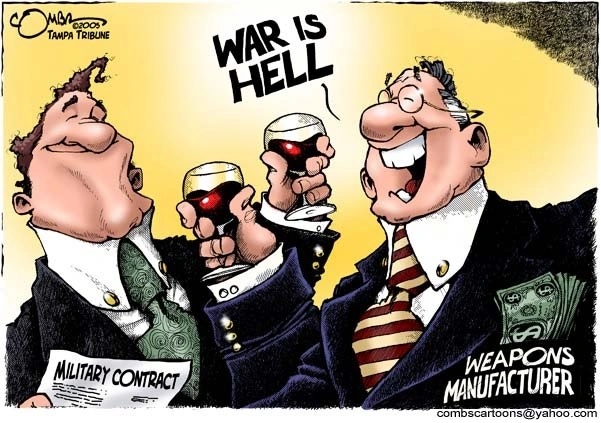
World Beyond War, By Alan Macleod, Mint Press, September 20, 2024
To “counter Russia’s nuclear blackmail,” the Atlantic Council confidently asserted, “NATO must adapt its nuclear sharing program.” This includes moving B-61 atomic bombs to Eastern Europe and building a network of medium-range missile bases across the continent. The think tank praised Washington’s recent decision to send Tomahawk and SM-6 missiles to Germany as a “good start” but insisted that it “does not impose a high enough price” on Russia.
What the Atlantic Council does not divulge at any time is that not only would this drastically increase the likelihood of a catastrophic nuclear war, but that the weapons they specifically recommend come directly from manufacturers that fund them in the first place.
The B-61 bombs are assembled by Boeing, who, according to its most recent financial reports, gave tens of thousands of dollars to the organization. And the Tomahawk and SM-6 are produced by Raytheon, who recently supplied the Atlantic Council with a six-figure sum.
Thus, their recommendations not only put the world at risk but also directly benefit their funders.
Unfortunately, this gigantic conflict of interest that affects us all is par for the course among foreign policy think tanks. A MintPress News investigation into the funding sources of U.S. foreign policy think tanks has found that they are sponsored to the tune of millions of dollars every year by weapons contractors. Arms manufacturing companies donated at least $7.8 million last year to the top fifty U.S. think tanks, who, in turn, pump out reports demanding more war and higher military spending, which significantly increase their sponsors’ profits. The only losers in this closed, circular system are the American public, saddled with higher taxes, and the tens of millions of people around the world who are victims of the U.S. war machine.
The think tanks receiving the most tainted cash were, in order, the Atlantic Council, CSIS, CNAS, the Hudson Institute, and the Council on Foreign Relations, while the weapons manufacturers most active on K-Street were Northrop Grumman, Lockheed Martin, and General Atomics.
These think tanks directly affect conflicts around the world. CSIS, for example, are among the loudest advocates for arming Ukraine, Taiwan and Israel, even as the latter carries out a genocide in Palestine. A recent report lays out a shopping list of U.S. weapons that would help the Israeli military, including Excalibur artillery projectiles, JDAM bomb guidance systems, and Javelin missiles. Those weapons are manufactured by Raytheon, Boeing, and Lockheed Martin, respectively, all of whom are among CSIS’ top funders.
U.S. arms are being used daily to carry out illegal and deadly attacks against civilian populations in Palestine, Lebanon, and Syria, making arms manufacturers directly complicit in war crimes.
One example of this is the recent Israeli bombing of the Al Mawasi humanitarian zone in Gaza. Israel dropped three one-ton MK-84 bombs on the camp, killing at least 19 people. Dozens more are still missing.
According to the UN, MK-84 bomb blasts rupture lungs, tear limbs and heads from bodies, and burst sinus cavities up to hundreds of meters away.
The MK-84 bombs were produced in the U.S. by General Dynamics and sent to Israel with Washington’s blessing. General Dynamics has made huge profits from the slaughter; the D.C.-based arms manufacturer’s stock price has jumped by 42% since October 7.
Conflicts and Conflicts of Interest
Think tanks are an essential part of K-Street, the collective term for the assembly of lobbyists, trade associations and other organizations that attempt to alter government policy……………………………………………………………………………………
There is obviously a massive conflict of interest if groups advising the U.S. government on military policy are awash with cash from the arms industry. This study attempts to quantify that conflict of interest. It analyzed the top 50 most influential foreign policy think tanks in the U.S., according to the University of Pennsylvania’s Global Go to Think Tank Index, and tracked the funding of these 50 organizations to ascertain how much money each received from the weapons industry. A comprehensive funding spreadsheet containing all the numbers used in this study can be found here.
Figures were taken from each group’s websites, funding lists, and financial declarations for the last financial year available. In total, the arms industry donated at least $7.8 million to those think tanks.
This, however, is certainly a significant underestimate for several reasons. ……………………………….
Tanks and Think Tanks
The results were both worrying and unsurprising, as this study found that giant arms manufacturers quietly bankrolled many of the largest and most influential groups advising the U.S. government on its foreign policy. The Atlantic Council alone is funded by 22 weapons companies, totaling at least $2.69 million last year. Even a group like the Carnegie Endowment for Peace, established in 1910 as an organization dedicated to reducing global conflict, is sponsored by corporations making weapons of war, including Boeing and Leonardo, who donate tens of thousands of dollars annually.
The five think tanks that received the most funding from the arms industry are: The Atlantic Council, $2.69 million; Center for Strategic and International Studies (CSIS), $2.46 million; Center for a New American Security (CNAS), $950,000; Hudson Institute, $635,000; and the Council on Foreign Relations, $300,000.
At least 36 weapons manufacturers provided funding to major American think tanks. The most “generous” among them were Northrop Grumman, $1.07 million; Lockheed Martin, $838,000; General Atomics, $510,000; Leonardo S.p.A., $485,000; and Mitsubishi, $443,000.
When presented with these findings, peace activist David Swanson, author of “War is a Lie,” appeared disgusted but not surprised. Swanson described the role of arms industry-funded think tanks as such:
They have to build up through endless repetition and through debates that remain within their bizarre parameters the idea that wars are won, that wars are defensive, that nuclear weapons deter wars, that enemies cannot be spoken with, that weapons spending is a public service that nations should do to the maximum extent possible while stripping funding away from human needs, and similar outrageous pieces of nonsense.”
He Who Pays the Piper
It is no coincidence that the groups receiving the most weapons industry money are home to some of the most hawkish, pro-war voices to be found anywhere. The arms industry, like all corporations, does not donate out of the goodness of their hearts but is instead looking for a return on their investments.
Influential think tanks like CSIS are certainly giving their benefactors bang for their buck, consistently agitating for more military spending and more war around the world, whatever the consequences.
………………………..European countries, CSIS also insisted, must “pull their weight” in NATO, transforming their societies into ones every bit as militarized as the U.S., for the sake of “global democracy.”
Meanwhile, writing in The Atlantic, Eliot A. Cohen, CSIS’ Arleigh A. Burke Chair in Strategy, demanded an escalation in the West’s involvement in Ukraine. “We need to see masses of Russians fleeing, deserting, shooting their officers, taken captive, or dead. The Russian defeat must be an unmistakably big, bloody shambles,” he wrote, adding that “To that end, with the utmost urgency, the West should give everything that Ukraine could possibly use.”
This included long-range missiles and F-16 and F-35 fighter jets.
What neither Cohen nor the Atlantic noted, however, was that the weapons he demanded to be bought and sent to Ukraine are made by General Dynamics and Lockheed Martin, groups that directly fund CSIS……………………….
the relentless pro-war voices were hardly limited to CSIS. In fact, every think tank taking substantial arms industry cash maintained a notably hawkish stance. The Atlantic Council, for instance, policed European nations’ NATO spending in an attempt to pressure them to purchase more arms and has advocated that the U.S. create a new “Indo-Pacific intelligence coalition” that would ramp up tensions with China. CNAS, meanwhile, has claimed that the U.S.’ supposedly muted response to “Chinese provocations” has eroded its “credibility” on the world stage.
Speaking on what think tanks have achieved, Swanson told MintPress:
They’ve normalized the idea of measuring war spending as a percentage of an economy, and the idea that there is no such thing as too much of it. They’ve normalized the idea of only one solution to all problems, even problems created by that one solution, namely war. [And] they present endlessly endlessly endlessly ‘defensive alliance NATO’ with not a soul noticing that NATO’s wars have all been blatantly aggressive.”
The American public is generally skeptical of war. Surveys show that two-thirds of the country wants Washington and Ukraine to directly engage in diplomacy with Russia, even if that means conceding Ukrainian territory. Most Americans are against sending more U.S. troops to the Middle East as well, even if it were only to “defend Israel.”
They hold these positions despite what they are constantly told in the media. A study by the Quincy Institute found that, when discussing Ukraine, 85% of all think tanks quoted in major outlets like the New York Times, Washington Post and The Wall Street Journal received funding from the military-industrial complex. Most prominent among these were CSIS and the Atlantic Council.
Making a Killing from Killing
In his hit 1970 song, “War,” Edwin Starr claimed that the practice was a “friend only to the undertaker.” But war has also been excellent news for weapons contractors. In the past five years, General Dynamics’ stock price has jumped by 103%, Lockheed Martin’s by 107%, and Northrop Grumman’s by 110%.
Arms industry shareholders have seen massive returns on investment, thanks to the actions of a nation addicted to conflict. The United States has been engaged in warfare for 231 of its 248 years as an independent country. According to a report by the Congressional Research Service, a U.S. government institution, America has launched 469 foreign military interventions between 1798 and 2022 and 251 since 1991 alone. This has included special operations, targeted assassinations of foreign leaders, military coups, and outright invasions and occupations of other countries.
More than half of all discretionary Federal spending goes to the military, whose budget is closing in on $1 trillion annually. American military spending rivals that of all other nations combined. The United States also maintains a network of around 1,000 bases around the world, including nearly 400 in a ring encircling China.
This feeds the insatiable appetites of weapons manufacturers, who, therefore, have even more money to spend buying influence and lobbying the government for more war and antagonistic policies that benefit them.
Part of their strategy is funding think tanks in Washington, D.C. For the likes of Lockheed Martin and Raytheon, it is a no-brainer, an astute business investment. A few hundred thousand dollars per year spent bankrolling think tanks like CSIS, CNAS or the Atlantic Council translates into billions of dollars worth of more orders for tanks, ships and aircraft.
By 2016, the United States was bombing seven countries simultaneously. And yet, militarism and the danger to the planet have only increased since then. The U.S. is currently gearing up for potential wars against both Russia and China – two of the largest and most populous states on the planet, and both ones with large stockpiles of atomic weapons. A war with either would risk Armageddon.
This is all great news for the military-industrial-complex, however, who are making a killing. And that is why it is imperative that they be stopped; it is literally a life-and-death issue for all of us.
Feature photo | The North Atlantic Council meeting begins to fill during the meeting of Defence Ministerials at NATO Headquarters, Brussels, Belgium, February 12, 2020. Photo |DVIDS
Alan MacLeod is Senior Staff Writer for MintPress News. After completing his PhD in 2017 he published two books: Bad News From Venezuela: Twenty Years of Fake News and Misreporting and Propaganda in the Information Age: Still Manufacturing Consent, as well as a number of academic articles. He has also contributed to FAIR.org, The Guardian, Salon, The Grayzone, Jacobin Magazine, and Common Dreams.
https://worldbeyondwar.org/selling-war-how-raytheon-and-boeing-fund-the-push-for-natos-nuclear-expansion/
‘The Genocide Gentry’: Weapon Execs Sit on Boards of Universities, Institutions
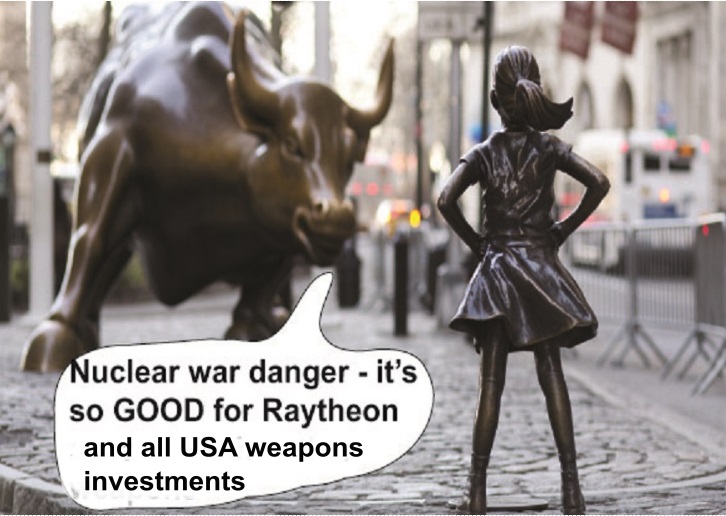
“This research provides a view into just how embedded the corporate, profit-fueled war machine is in our higher education and cultural institutions,” said one campaigner.
Brett Wilkins, Sep 18, 2024, https://www.commondreams.org/news/u-s-universities-weapons-companies
A trio of human rights groups on Wednesday announced a new interactive initiative exposing what the coalition is calling a “Genocide Gentry” of weapons company executives and board members and “54 museums, cultural organizations, universities, and colleges that currently host these individuals on their boards or in other prominent roles.”
The coalition—which consists of the Adalah Justice Project, LittleSis, and Action Center on Race and the Economy (ACRE)—published a map and database detailing the “educational and cultural ties to board members of six defense corporations” amid Israel’s ongoing annihilation of Gaza, for which the U.S.-backed country is on trial for genocide at the International Court of Justice.
” Israel has destroyed every university in Gaza and nearly 200 cultural heritage sites since October 2023, using bombs and weapons manufactured by the companies included in the Genocide Gentry research,” the coalition said. “As of April, these attacks have killed more than 5,479 students and 261 teachers and destroyed or critically damaged nearly 90% of all school buildings in Gaza.”
“Universities across the country including the likes of Columbia University, Harvard University, the University of Southern California, and New York University have remained largely silent on Israel’s genocidal campaign in Gaza,” the groups added. “Behind closed doors, these same universities are hosting executives and board members of the companies manufacturing the weapons used in these attacks as board members, trustees, and fellows.”
Members of the Genocide Gentry include:
- Jeh Johnson, Lockheed Martin board of directors: Johnson is currently a Columbia University trustee, and sits on the board of directors at MetLife and U.S. Steel. Columbia University notably shut down student protests demanding divestment from weapons companies like Lockheed Martin.
- Brian C. Rogers, RTX board of directors: Rogers is currently a trustee of the Harvard Management Company, tasked with managing the $50 billion endowment. Notably Harvard administrators have cracked down on students demanding divestment from weapons companies like RTX, formerly Raytheon.
- Catherine B. Reynolds, General Dynamics board of directors: Reynolds is a trustee of the Kennedy Center and sponsors a fellowship at New York University, which has also cracked down on anti-genocide protests and recently enacted a policy equating anti-Zionism with antisemitism.
“Students on university campuses across the country have not only been demanding divestment, but transparency,” said Sandra Tamari, executive director of the Adalah Justice Project. “Transparency about their institutions’ investments, partnerships, donors, and decision-makers, and their connections to individuals and companies directly enabling and profiting off war and genocide.”
“This research helps provide some of this transparency by illuminating just how embedded the interests of the weapons industry are within our institutions, so we can begin chipping away at the power and influence that they wield,” she added.
ACRE campaign director Ramah Kudaimi noted that “as part of its genocide since October 2023, Israel has targeted universities and cultural centers across Gaza, destroying campuses, museums, libraries, and more.”
“That this is all backed by the United States means U.S. educational and cultural institutions have a responsibility to consider what their role is in helping end these war crimes, and that starts with reconsidering their connections with the weapons companies profiting from the destruction,” Kudaimi said.
Munira Lokhandwala, director of the Tech and Training program at LittleSis, said: “This research provides a view into just how embedded the corporate, profit-fueled war machine is in our higher education and cultural institutions. Through this research, we show how the defense industry shapes and influences our civic and cultural institutions, and as a result, their silence around war and genocide.”
“We must ask our institutions: What role are you playing in whitewashing war and destruction by inviting those who profit from manufacturing weapons onto your boards and into your galas?” she added.
Are the World’s Ongoing Conflicts in Danger of Going Nuclear?
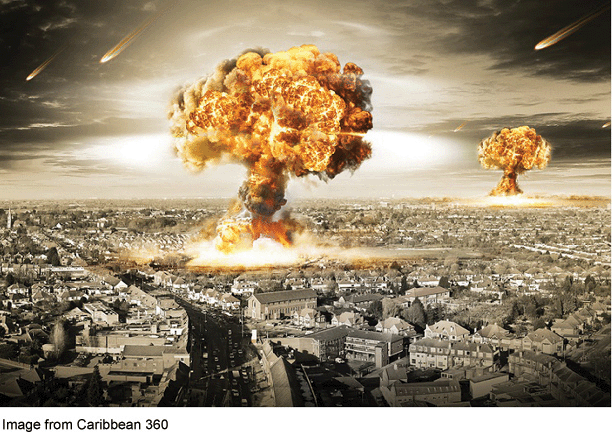
Global Issues, by Thalif Deen (united nations), Tuesday, September 17, 2024, Inter Press Service
UNITED NATIONS, Sep 17 (IPS) – The constant drumbeat of nuclear threats seems never ending—emanating primarily from the Russians, Israeli right-wing politicians and North Koreans.
The threats also prompt one lingering question: Can there be a World War III without the use of nuclear weapons?
In a report August 27, Reuters quoted a senior Russian official as saying the West was playing with fire by considering allowing Ukraine to strike deep into Russia with Western missiles—and cautioned the United States that World War III would not be confined to Europe.
Sergei Lavrov, Russia’s longstanding foreign minister and former UN ambassador, said the West was seeking to escalate the Ukraine war and was “asking for trouble” by considering Ukrainian requests to loosen curbs on using foreign-supplied weapons.
Putting it in the right context, the Washington-based Arms Control Association (ACA) pointed out last week, “the global nuclear security environment could hardly be more precarious.”
Carol Giacomo, chief editor of Arms Control Today, the ACA’s flagship publication, said that weeks before the US elects a new president, the global nuclear security environment could hardly be more precarious.
“Russia continues to raise the specter of escalating its war on Ukraine to nuclear use; Iran and North Korea persist in advancing their nuclear programs; China is moving to steadily expand its nuclear arsenal; the United States and Russia have costly modernization programs underway; and the war in Gaza threatens to explode into a region-wide catastrophe entangling Iran and nuclear-armed Israel, among other countries,” she pointed out.
Meanwhile, Russia and China are refusing to enter arms control talks with the United States, new countries are raising the possibility of acquiring nuclear weapons and decades of arms control treaties are unraveling.
The situation has also prompted Rafael Mariano Grossi, director-general of the International Atomic Agency (IAEA), to warn, in an interview with The Financial Times on August 26, that the global nonproliferation regime is under greater pressure than at any time since the end of the Cold War.
The U.S. presidential election campaign has not engaged publicly on most of these issues in any serious way despite the fact that whichever candidate wins will, once inaugurated, immediately inherit the sole authority to launch U.S. nuclear weapons, wrote Giacomo, a former member of The New York Times editorial board (2007-2020).
Dr M.V. Ramana, Professor and Simons Chair in Disarmament, Global and Human Security, School of Public Policy and Global Affairs, Graduate Program Director, MPPGA at the University of British Columbia, Vancouver, told IPS the dangers posed by nuclear arms, and the very powerful institutions and governments that possess these weapons of mass destruction, have never been greater.
“In the last 16 months, we have seen government officials from Russia (Dmitry Medvedev) and Israel (Amihai Eliyahu) threatening to use, or calling for the use of, nuclear weapons against Ukraine and Gaza respectively” he noted.
The rulers of these countries have already shown the willingness to kill tens of thousands of civilians. “Going further back, we can remember U.S. President Donald Trump threatening to “totally destroy” North Korea. Coming from a person like Trump and a country like the United States that is the only one to use nuclear weapons in war, there is good reason to take such a threat with utmost seriousness”.
Such great dangers, he argued, can be ameliorated only with great visions, by people demanding that no one should be killed in their name, especially using nuclear weapons but not only using nuclear weapons.
This would require people to make common cause with people all over the world, and refuse to be divided by the “narrow nationalisms” that Albert Einstein identified as an “outmoded concept,” as far back as 1947…………………………………………………………………………………………………………………… more https://www.globalissues.org/news/2024/09/17/37679
Putin ally warns West of nuclear war over Ukraine
By Reuters, September 20, 2024, Reporting by Reuters; writing by Mark Trevelyan and Guy Faulconbridge, Editing by William Maclean
Summary
Russian missile ‘could hit Strasbourg in minutes’
Volodin says Russia will use ‘more powerful weapons’
Lawmaker reinforces Putin warning
MOSCOW, Sept 19 (Reuters) – A close ally of President Vladimir Putin warned Western governments on Thursday that a nuclear war would ensue if they gave the green light for Ukraine to use long-range Western weapons to strike targets deep inside Russia.
Vyacheslav Volodin, speaker of the lower house of parliament and a member of Putin’s Security Council, was responding to a vote in the European Parliament urging EU countries to give such approval to Kyiv.
“What the European Parliament is calling for leads to a world war using nuclear weapons,” Volodin wrote on Telegram.
His message was entitled “For those who didn’t get it the first time” – an apparent reference to a warning by Putin last week that the West would be directly fighting Russia if it let Ukraine fire the long-range missiles onto Russian territory.
The Ukraine war has triggered the biggest confrontation between Russia and the West since the 1962 Cuban Missile Crisis, which is considered to be the time when the two Cold War superpowers came closest to intentional nuclear war.
The outgoing head of NATO, Jens Stoltenberg, told The Times this week that the Kremlin leader had declared “many red lines” before but not escalated conflict with the West when they were crossed. Putin’s spokesman said his comment was dangerous and provocative.
In a non-binding resolution adopted on Thursday, the European Parliament asked EU countries to “immediately lift restrictions on the use of Western weapons systems delivered to Ukraine against legitimate military targets on Russian territory.”
Volodin wrote: “If something like this happens, Russia will give a tough response using more powerful weapons. No one should have any illusions about this.” He said it appeared to Moscow that the West had forgotten the vast sacrifices made by the Soviet Union in World War Two.
He said Europeans should understand that it would take Russia’s RS-28 Sarmat intercontinental ballistic missile, known in the West as Satan II, just 3 minutes and 20 seconds to strike Strasbourg, where the European Parliament meets.
US Navy chief unveils plan to be ready for possible war with China by 2027
The announcement of the goals comes as US leaders are treading a fine line, pledging a commitment to the defence of Taiwan while also working to keep communication open with Beijing to deter greater conflict.
Beijing regards Taiwan as part of China to be reunited, by force if necessary. Most countries, including the US, do not recognise Taiwan as an independent state.
But Washington opposes any attempt to take the island by force and is legally bound to support Taiwan’s military defence capability.
Admiral Lisa Franchetti says lessons from combat in the Red Sea and Ukraine’s Black Sea fight can help the US prepare for an attack on Taiwan
SCMP, Associated Press, 19 Sep 2024
The US Navy is taking lessons from its combat in the Red Sea over the past year and what Ukraine has done to hold off the Russians in the Black Sea to help US military leaders prepare the service for a potential future conflict with China.
From drones and unmanned surface vessels to the more advanced operation of shipboard guns, the US Navy is expanding its combat skills and broadening training. It is also working to overcome recruiting struggles so it can have the sailors it needs to fight the next war.
Admiral Lisa Franchetti, chief of naval operations, is laying out a series of goals, including several that will be highly challenging to meet, in a new navigation plan she described in an interview. The objective is to be ready to face what the Pentagon calls its key national security challenge – China.
“I’m very focused on 2027. It’s the year that President Xi [Jinping] told his forces to be ready to invade Taiwan,” Franchetti said. “We need to be more ready.”
The new plan, released on Wednesday, includes what she considers seven priority goals, ranging from removing delays in ship depot maintenance to improving US Navy infrastructure, recruiting and the use of drones and autonomous systems.
One significant challenge is to have 80 per cent of the force be ready enough at any given time to deploy for combat if needed – something she acknowledged is a “stretch goal”. The key, she said, is to get to a level of combat readiness where “if the nation calls us, we can push the ‘go’ button and we can surge our forces to be able to meet the call”.
The announcement of the goals comes as US leaders are treading a fine line, pledging a commitment to the defence of Taiwan while also working to keep communication open with Beijing to deter greater conflict.
Beijing regards Taiwan as part of China to be reunited, by force if necessary. Most countries, including the US, do not recognise Taiwan as an independent state.
But Washington opposes any attempt to take the island by force and is legally bound to support Taiwan’s military defence capability.
An important element in any Asia-Pacific conflict will be the need to control the seas. Franchetti said the US can learn from how the Ukrainians have used drones, air strikes and long-range unmanned vessels to limit Russian ship activity in the western Black Sea and keep access open to critical ports.
“If you look at the Ukrainian success in really keeping the Russian Black Sea fleet pushed all the way over into the east, that’s all about sea denial and that’s very important,” Franchetti said. She added that Ukraine has been innovating on the battlefield by using existing systems, such as drones, in different ways.
The US Navy’s months-long battle with the Iran-backed Houthi rebels in Yemen has provided other lessons…………………………………………………………………. https://www.scmp.com/news/world/united-states-canada/article/3279048/us-navy-chief-unveils-plan-be-ready-possible-war-china-2027
Ukraine hits Russia with “massive drone attack” on military depot in Toropets, causing huge explosion
“If we make no effort to change direction, we will end up where we are heading.”
https://www.cbsnews.com/news/ukraine-hits-russia-drone-attack-toropets-military-depot-explosions/ 18 Sept 24
Kyiv, Ukraine — Ukrainian drones struck a large military depot in a town deep inside Russia overnight, causing a huge blaze and prompting the evacuation of some local residents, a Ukrainian official and Russian news reports said Wednesday. The strike came after a senior U.S. diplomat said Ukrainian President Volodymyr Zelenskyy’s recently announced but still confidential plan to win the war “can work” and help end the conflict that’s now in its third year.
Ukraine claimed the strike destroyed military warehouses in Toropets, a town in Russia’s Tver region about 240 miles northwest of Moscow and 300 miles from the border with Ukraine.
The attack was carried out by Ukraine’s Security Service, along with Ukraine’s Intelligence and Special Operations Forces, a Kyiv security official told The Associated Press, speaking on condition of anonymity to discuss the operation. According to the official, the depot housed Iskander and Tochka-U missiles, as well as glide bombs and artillery shells. He said the facility caught fire in the strike and was burning across an area 4 miles wide.
Russian state news agency RIA Novosti quoted regional authorities as saying air defense systems were working to repel a “massive drone attack” on Toropets, which has a population of around 11,000. The agency also reported a fire and the evacuation of some local residents.
There was no immediate information about whether the strikes had caused any casualties.
Successful Ukrainian strikes on targets deep inside Russia have become more common as the war has progressed and Kyiv developed its drone technology.
Zelenskyy has been pushing for approval from his Western partners, including the U.S., for Ukraine to use the sophisticated weapons they’re providing to hit targets inside Russia. Some Western leaders have balked at that possibility, fearing they could be dragged into the conflict.
Russian President Vladimir Putin warned last week that a decision by the U.S. or its NATO allies to allow Ukraine to use Western missiles to strike targets deep inside Russia would be viewed as “nothing less than the direct participation of NATO countries, the United States, and European countries, in the war in Ukraine.”
Ukraine’s targeting of Russian military equipment, ammunition and infrastructure deep inside Russia with drones and other weapons it already has — as well as making Russian civilians feel some of the consequences of the war that is being fought largely inside Ukraine — is part of Kyiv’s strategy.
The swift push by Ukrainian forces into Russia’s Kursk border region last month fits into that plan, apparently seeking to compel Putin to back down.
Putin has shown no signs of doing that, however, and has been trying to grind down Ukraine’s resolve through attritional warfare, while also trying to sap the West’s resolve to support Kyiv by drawing out the conflict. That has come at a price, however, as the U.K. Defense Ministry estimates the war has likely killed and wounded more than 600,000 Russian troops.
On Tuesday, Putin ordered his country’s military to increase its number of troops by 180,000 to a total of 1.5 million by Dec. 1.
Zelenskyy said last month that his plan for victory included not only battlefield goals but also diplomatic and economic wins. The plan has been kept under wraps but U.S. Ambassador to the United Nations Linda Thomas-Greenfield said during a news conference Tuesday that officials in Washington had seen it.
“We think it lays out a strategy and a plan that can work,” she said, adding that the United States would bring it up with other world leaders at the U.N. General Assembly in New York next week. She did not comment on what the plan contains.
1 This Month

of the week – Shut Down Drone Warfare!


Tell the Ukrainian Government to Drop Prosecution of Peace Activist Yurii Sheliazhenko

Petition to revoke the licensing of the Near Surface Nuclear Disposal Facility (NSDF) at Chalk River. https://www.ourcommons.ca/petitions/en/Petition/Details?Petition=e-7247
To see nuclear-related stories in greater depth and intensity – go to https://nuclearinformation.wordpress.com
-
Archives
- April 2026 (79)
- March 2026 (251)
- February 2026 (268)
- January 2026 (308)
- December 2025 (358)
- November 2025 (359)
- October 2025 (376)
- September 2025 (257)
- August 2025 (319)
- July 2025 (230)
- June 2025 (348)
- May 2025 (261)
-
Categories
- 1
- 1 NUCLEAR ISSUES
- business and costs
- climate change
- culture and arts
- ENERGY
- environment
- health
- history
- indigenous issues
- Legal
- marketing of nuclear
- media
- opposition to nuclear
- PERSONAL STORIES
- politics
- politics international
- Religion and ethics
- safety
- secrets,lies and civil liberties
- spinbuster
- technology
- Uranium
- wastes
- weapons and war
- Women
- 2 WORLD
- ACTION
- AFRICA
- Atrocities
- AUSTRALIA
- Christina's notes
- Christina's themes
- culture and arts
- Events
- Fuk 2022
- Fuk 2023
- Fukushima 2017
- Fukushima 2018
- fukushima 2019
- Fukushima 2020
- Fukushima 2021
- general
- global warming
- Humour (God we need it)
- Nuclear
- RARE EARTHS
- Reference
- resources – print
- Resources -audiovicual
- Weekly Newsletter
- World
- World Nuclear
- YouTube
-
RSS
Entries RSS
Comments RSS
 nuclear-news

